“Since you cannot do good to all, you are to pay special attention to those who, by the accidents of time, or place, or circumstances, are brought into closer connection with you.”
- Saint Augustine
What is The Salvation Army?
The Salvation Army, an international movement, is an evangelical part of the universal Christian Church.
Vision Statement
Wherever there is hardship or injustice, Salvos will live, love and fight alongside others to transform Australia one life at a time with the love of Jesus.
Mission Statement
The Salvation Army is a Christian movement dedicated to sharing the love of Jesus by:
• Caring for people
• Creating faith pathways
• Building healthy communities
• Working for justice
The Salvation Army Australia acknowledges the Traditional Owners of the land on which we meet and work and pay our respect to Elders, past, present, and future. We value and include people of all cultures, languages, abilities, sexual orientations, gender identities, gender expressions, and intersex status. We are committed to providing programs that are fully inclusive. We are committed to the safety and wellbeing of people of all ages, particularly children.
Violence against women
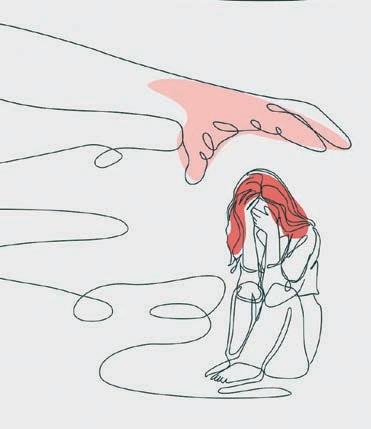
Tragically, gender-based violence (GBV) affects one in three women around the world. Almost unbelievably, one woman is killed every 10 minutes. These sobering statistics show the enormous scope of GBV, but not the devastating reality for the millions of women who experience GBV in all it’s cruel forms every year.
As we approach the International Day for the Elimination of Violence Against Women (25 November) and the following 16 Days of Activism campaign, this edition looks at different aspects of family violence and what can be done, and is being done, to address this worldwide scourge.
Scan here to connect with The Salvation Army services
Founders: William and Catherine Booth
Scan here to subscribe to Salvos Magazine
Salvation Army World Leaders: General Lyndon and Commissioner Bronwyn
Buckingham
Territorial Leader: Commissioner Miriam Gluyas
Secretary for Communications and Editor-In-Chief: Colonel Rodney Walters
Publications Manager: Cheryl Tinker
Editor: Simone Worthing
Graphic Designer: Ryan Harrison
Enquiry email: publications@salvationarmy.org.au
All other Salvation Army enquiries 13 72 58
Press date: 31 October 2025
Printed and published for The Salvation Army by Commissioner Miriam Gluyas at Focus Print Group, Chester Hill, NSW, Darug Nation lands.
We focus on men’s role in driving change in the gender equality movement, showcase a Salvos family violence program impacting both victim-survivors and perpetrators, and share some ideas on how each of us can play a role in ending GBV.
Belinda and Jessica also share their personal stories of family violence, and how courage and support have helped them rebuild their lives and find hope and freedom.
For focused stories and interviews on GBV, go to salvosonline.org.au
Simone Worthing Editor
Addressing violence against women
The annual United Nations International Day for the Elimination of Violence Against Women takes place on 25 November. Violence against women and girls remains one of the most prevalent and pervasive human rights violations in the world. Globally, almost one in three women have been subjected to physical and/or sexual intimate partner violence, non-partner sexual violence, or both, at least once in their life.
Violence against women and girls remains largely unreported due to the impunity, silence, stigma and shame surrounding it.
It can manifest in physical, sexual and psychological forms, including:
• Intimate partner violence;
• Sexual violence and harassment
• Human trafficking;
• Female genital mutilation; and
• Child marriage.
For at least 51,100 women globally in 2023, gender-based violence ended with one final and brutal act – their murder by partners and family members (news. un.org). That means a woman was killed every 10 minutes.
The solution lies in robust responses, holding perpetrators accountable, and accelerating action through well-resourced national strategies and increased funding to women’s rights movements.
Join 16 Days of Activism
From 25 November to 10 December 2025, the 16 Days of Activism to End Genderbased Violence campaign will focus on
the theme: ‘UNiTE to End Digital Violence against All Women and Girls’. Digital violence against women and girls is one of the fastest-growing forms of abuse.
Did you know?
• Globally, an estimated 736 million women have experienced physical and/or sexual violence. One in four adolescent girls is abused by their partners.
• 16-58 per cent of women globally experience technology-facilitated gender-based violence.
• 70 per cent of women in conflict, war and humanitarian crises experience gender-based violence. Scan here for ways you can participate in 16 Days of Activism
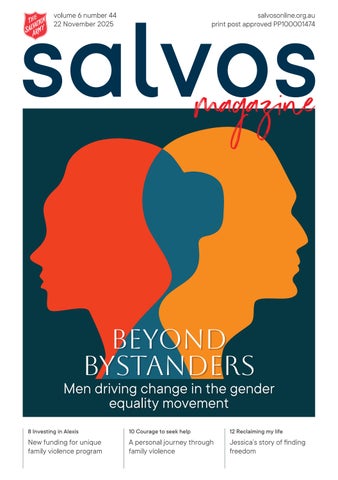
Beyond bystanders
Men driving change in the gender equality movement
Australia will join the global observance of the United Nations International Day for the Elimination of Violence Against Women on 25 November. Below, Lilly McKeich, Salvation Army National Family Violence Specialist, interviews colleague Marcus Tawfik, Senior Manager Practice and Development (Family Violence).
LM: What does it mean to be a true ally in the gender equality movement? Can you talk about a time when you got it wrong as an ally, and what you learned from that experience?
MT: I think for me, it’s about showing up consistently rather than when it’s convenient or comfortable. A key dedication toward this is to listen deeply to ensure supporting women’s voices to be heard, and to challenge systems that do not support women.
I have always thought of myself as an ally, but I always am actively learning and changing to become a better one.
I haven’t always got it right. In my early days of allyship, something I always did was to ensure everyone, including women, were heard; when I started to decentre myself and prioritise the impact of women’s voices, I really started to make steps and strides forward in being an ally for the gender equality movement.
A key message here is that allyship is a practice. It is something that myself and the community that calls themselves allies are continuing to reflect change through feedback, and have a genuine willingness to maybe sit with discomfort.
How do you navigate the balance between using your voice and making space for others, especially women, in advocacy work?
Well, the facts are, men are heard differently, and we need to acknowledge that as men. I believe this comes with a responsibility … We need to be using our voices to create safer spaces, challenge other men that may be on a different part of their journey in allyship and to redirect attention, rather than holding the attention ourselves.
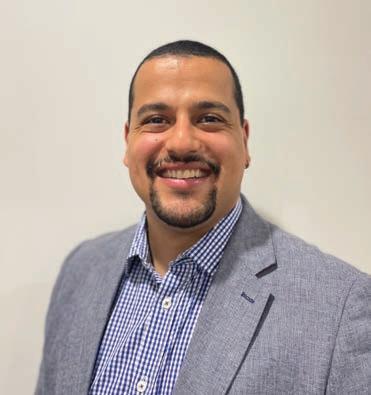
Marcus Tawfik – ally for gender equality.
Something we do in the family and domestic violence space, and in the social services space in general, is to receive consultation from people with lived experience. I think similar principles need to be applied through our allyship –whether it’s listening in our relationships, how we behave as men in public, or even how we co-design and consult alongside the women we work with.
Something that has significantly resonated with me is how I have learned to share power and not just offer support. The 16 Days of Activism [Against Gender-based Violence] is a time to reflect on what advocacy means, and I believe it is not just about lending influence: it’s about redistributing influence! That is one of the core responsibilities men hold through how our voices are heard differently.
What do you see as the most powerful things men can do to support the gender equality movement? How do you
approach having difficult conversations with male peers around sexism, harmful behaviours or gendered violence?
We need to be encouraging men to do the internal work by reflecting on their own biases and anything throughout their lives that may have conditioned or contributed to those biases. Ensuring that there is self-education, rather than relying on women to do that labour and thinking for us men, is vital here. There is a big difference between saying the right thing and doing the hard thing – and large shifts and progression in allyship often comes from doing the hard things.
We need to be approaching family, friends and all the men in our networks with curiosity and respect, not shame. I have used a question like, “Have you thought about how that might come across?” in a way that requires thinking with no shame. When I am supporting allies to continue their journey, I ask powerful questions like
PHOTO BY MATHEUS FERRERO ON UNSPLASH
“Who benefits when men stay silent?” or “If your daughter, partner or mother was in the room, would you still say that?”
I continually demonstrate that vulnerability is strength, particularly when I’m engaging men. I openly share the mistakes I have made through my journey of allyship to normalise learning the concept of growth as an ally. I have found that modelling the behaviour myself invites others to reflect on their allyship and change to do better.
If you could say one thing to men who want to help but feel unsure of where to start, what would it be? What’s the hardest, but most necessary, truth men need to face when it comes to their role in gender inequality? What does true solidarity with women and survivors look like to you?
Here is the truth, men benefit from the same systems that disadvantage women; even if we don’t mean to, we do. We need
to remember that silence equals complicity, so good intentions aren’t enough when it comes to our role in gender inequality – we have a much larger responsibility here.
It all starts with listening. We need to learn to sit with discomfort instead of rushing to have an exchange or fix or explain. One thing in my experience is that solidarity means risk. Yes, it does mean challenging the people that we may have had a relationship [with] our whole lives, like a brother or a friend or leaders within our networks. It is uncomfortable and unpopular, but it is the right thing to do.
True solidarity with women and survivors looks like advocating for systems change, even if that system benefits us as men. We need to always ensure that we centre the voices and the needs of those who are most impacted by gender-based violence.
Funding boost for Alexis program
The Salvation Army’s innovative Alexis Family Violence Response model (Alexis FVRM) has just received a $1.5 million investment from the Victorian Government.
The model aims to reduce family violence for victim-survivors and to achieve accountability among perpetrators.
Natalie Hutchins, the Victorian Minister for Prevention of Family Violence, announced the investment this week, with funding coming from the Labor Government’s Strengthening Women’s Safety Package.
The Alexis FVRM was created in partnership with Victoria Police and The Salvation Army in 2014, after mutual recognition that a more targeted and specialised response was needed for high-risk and recidivist family violence. This is achieved by embedding specialist family violence practitioners into Family Violence Investigation Units, with one
practitioner supporting the victimsurvivor (and children) and the other supporting the person using violence.
The Alexis FVRM currently works across Prahran, Bayside, Morwell and Wonthaggi (Victoria). The additional funding will enable the program to expand to two new sites based on police advice.
The Alexis FVRM provides a collaborative, real-time response to high-risk family violence. It brings practitioners and police together to share information, make joint decisions, and deliver coordinated interventions that strengthen safety and accountability. Operating through a whole-of-family approach, the model supports both victim-survivors and people using violence, aiming to break the cycle of harm and promote long-term change .
With assertive outreach and flexible, intensive support, Alexis proactively
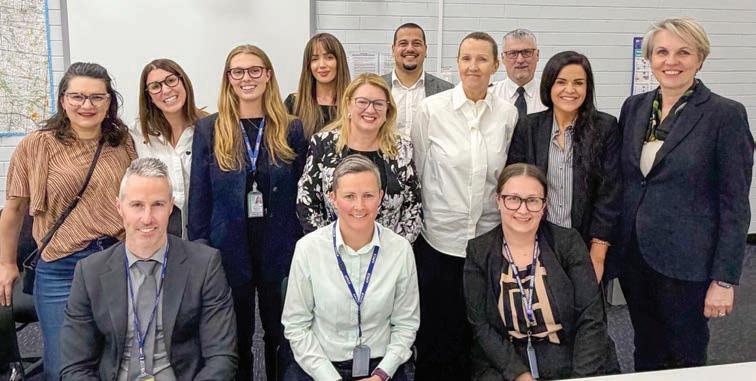
Tanya Plibersek, Federal Minister for Social Services (right) with Salvation Army and Victoria Police personnel. Image supplied.
engages families who are often disconnected from mainstream services due to complex, intersecting barriers. This approach enables timely, traumainformed interventions at critical moments, supporting individuals and families from crisis through to recovery.
Track record
“We welcome the announcement of government investment into the successful Alexis Family Violence Response model,” said Lorrinda Hamilton, Salvation Army National General Manager – Family Violence and Modern Slavery.
“Evidence demonstrates a reduction in risk and recidivism while increasing the overall safety of victim-survivors.”
Minister Hutchins said that “This program has a proven track record of improving safety, holding perpetrators to account and supporting long-term behaviour change.
“This investment builds on the work we’re doing … to stop family violence before it starts, support victim-survivors and keep women and children safe.”
Victorian Minister for Police, Anthony Carbines, said that “Victoria Police plays a critical role in responding to family violence – having specialist workers embedded alongside officers means better support for victims from the very first call.
“These partnerships help police intervene earlier, better protect women and children and connect families with the services they need to stay safe.”
Some information for this story was taken from the miragenews.com tinyurl.com/4d5w7b39
FAMILY
VIOLENCE
– WE HAVE THE POWER TO MAKE
A DIFFERENCE
WE CAN URGE ACTION FROM OUR GOVERNMENTS
When victim-survivors seek help, we need to be able to help them. Governments can work together to ensure there is sufficient funding for crisis supports, and that those supports allow victim-survivors to be physically safe while continuing to be employed, pursue education and be connected.
WE CAN IMPLEMENT CHANGE IN OUR COMMUNITY AND WORKPLACES
Education is key. In our community groups and workplaces, we can have safe but challenging conversations to ensure that people are equipped with the tools and resources to understand the nature of family and domestic violence as a pattern of behaviours over time.
We can also create environments where it is safe for employees and members to disclose family violence. This involves not just cultivating a safe culture, but ensuring that leaders and managers have access to information, training and supervision so they can safely and compassionately connect people experiencing family violence to support.
WE CAN HAVE INFLUENCE IN OUR PERSONAL LIVES
We can challenge our own ideas and language around family violence and question when others use language that minimises or excuses violence within the family or home.
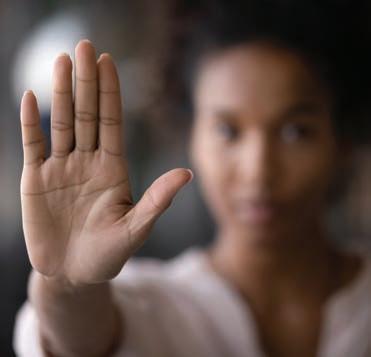
Everyone can call out negative behaviour. It is important to do so in a manner that doesn’t shame the victim, but you can always say “that’s not okay”.
My journey with family violence
The courage to seek help
by Belinda Davis
“I am not a victim of abuse. I am not a victim of abuse. I am not a victim of abuse!”
This thought keeps crashing in on me as I sit in a court building, listening to the lawyer define family violence in Australia. I can’t think about this now, I need to focus. I feel my pulse quicken and my breathing shorten. Stop!
As a Salvation Army minister, I’m present with and supporting someone getting a family violence intervention order. I force my thoughts aside and try to speak words of grace and wisdom.
That moment was the first hint that I was a victim of abuse. Words have power. They hurt. Their bruises take longer to heal than broken bones. Emotional abuse is abuse, just as is physical abuse. That revelation was so very shocking to me that it took months to fully crystallise.
Constant fear
I had never suffered physical violence, but I lived in constant fear of his actions and reactions. Every word was chosen to keep the peace; every action was calculated to avoid incurring his anger. I made choices based on what he may or may not read into them. Although this behaviour was present in our marriage, it got worse after our separation and divorce.
I soon found myself on the other side of the interview room, with the lawyer speaking to me. The police were taking out a family violence intervention order on my behalf. There was more than enough evidence to support my claim that abuse was present and ongoing, despite being divorced for many years.
The order was granted, and then extended, but there was no acceptance of responsibility. I was seen as the antagonist in his world, and he was the victim. This remains unchanged even now.
No stereotype
I had a simplistic view of what abused women looked like, but family violence is not confined to a particular stereotype. It can be found across all ages, genders and demographics.
I have spent much time reflecting on this journey, how it has shaped me, how it has affected my faith. Throughout the relationship, I chose to stay with this person, even with hints of abusive behaviour. I believed that if I demonstrated more love and grace, then the situation would not escalate. I was wrong.
Strength and protector
The Bible verses that have spoken the loudest to me in this circumstance refer to God being my refuge and strength, my protector in times of trouble. These are all from the Psalms: 57, verse 1; 71, verse 3; 91, verse 2; 94, verse 22; 119, verse 114 and 144, verse 2 (just to name a few).
Family violence is complex and messy. It takes a significant amount of courage to stand up. It is not as simple as packing up everything and pretending the relationship never existed.
What has helped me immensely is now being in a stable, loving relationship with a person who supports me and my children and has stood by me as I faced this. I have learned how true love is shown and that I am worthy to be loved like that. David, I am and will forever be grateful.
I wrote this over 10 years ago, and it’s been difficult to revisit it. But I know that if this situation can happen to me, it can happen, and is happening, to others. If it is part of your journey too, please be courageous enough to tell someone. Sharing the burden can be of immense benefit and relief.
If someone shares a similar story with you, take it seriously and seek the appropriate resources to assist and support.
I am an affected family member of violence. My children are affected family members of violence. I can choose to hide away, stay silent and feel shame or I can choose to stand up and say, “No! Violence is not okay. In any form. Ever.”
For the full version of this story, go to tinyurl.com/2bhs26mn
“May Your mercy come to me, O God, for my soul is safe within You, the guardian of my life. I will seek protection in the shade of Your wings until the destruction has passed.”
Psalm 57, verse 1 The Voice Bible translation
Emergency contacts: For life-threatening situations, call 000
National Domestic Violence and Sexual Assault Helpline (24 hours): 1800 737 732 (1800Respect)
For information on Salvation Army Domestic and Family Violence Services, go to tinyurl. com/3avjwwbm
Reclaiming her life
Jessica’s journey from abuse to freedom by Jessica*
Growing up, everything about my family looked perfect on the outside. But as a child, I suffered all kinds of abuse. As an adult, I didn’t understand what healthy relationships looked like.
After years struggling with eating disorders, I found help and healing at a Christian rehab. I started going to a local church and life was good.
That’s where I met my now ex-husband. He had also sought help after decades of drug abuse and was the rehab’s biggest success story. I was soon head over heels in love with him – or the version of him he showed me before we married.
My ex-husband manipulated and charmed everyone. But behind closed doors was different.
Control begins
The coercive control started on our honeymoon.
He laid down all the rules I was now to follow as his wife. I wasn’t allowed to have an opinion, or even a preference, and had to submit to everything he said.
I had to resign from my full-time job as nurse as I earnt more money than him. I had to deposit all my money into a joint account. This was the start of the extreme financial control and abuse. He gave me an allowance of $20 a fortnight.
I didn’t have my own debit card and wasn’t allowed my own phone. I had to ask for permission to go to the toilet, shower or even speak. I had a menu to follow, and he dictated every morsel of food I ate until I was starving.
Abuse intensifies
Things became even more terrifying when he was granted a gun licence, supposedly to deal with pests on the property. Instead, he killed animals to scare me. I was petrified he would shoot me. It was too easy for him to get his gun licence, and this is something I hope to see change in the future.
After five years, I was a complete shell of myself. I suffered financial, physical, emotional and sexual abuse. He had isolated me from everyone I once knew, including family and friends.
And now I was pregnant. Luckily, I saw the GP on my own. She helped me make an escape plan.
I believe my son has been the biggest gift from God. Without him, I wouldn’t have found the strength to get help, escape and keep moving forward.
Getting help
I moved into The Salvation Army women’s refuge, temporarily without my child.
I suffered from complex post-traumatic stress disorder (CPTSD) and needed acute support. I was blessed to join the refuge’s therapeutic intervention program, where I had both one-on-one trauma-informed counselling and group therapy.
When my son returned, I got consistent support from a counsellor who specialises in children’s therapy. This support, and the therapeutic playgroup for children, really helped him heal from his experiences and, through games, we learnt how to co-regulate together. I can now calm and support him when he also gets triggered.
Family violence affects the whole family. My child is a survivor in his own right.
Holistic support
The refuge staff were my biggest advocates and cheerleaders. They cared about and believed in me. I learnt to trust people again and make friends.
I worked with a financial counsellor and started saving for a car loan.
My confidence improved. I found a rental with the support of my case worker, and continue to have counselling from the therapeutic program counsellors. They have literally saved my life and given me so much hope for the future.
The effects of family violence can last a lifetime. I still struggle with shame and guilt, but I have learnt that “Shame is to be left with the perpetrators.”
In my dark moments I call on my supports and, with weekly counselling, I am living a much brighter future and loving being a fully present mum.
Thank God for the Salvos as now I can, “Let it flow, like a river, Let it show, need not shiver.”
Words are hidden vertically, horizontally, diagonally, forwards and backwards. Enjoy!
Aerodynamic
Bicycle
Breakaway
Cadence
Recovery
Recreational Ride
Saddle
Sprint Tour
Unicycle Wheel
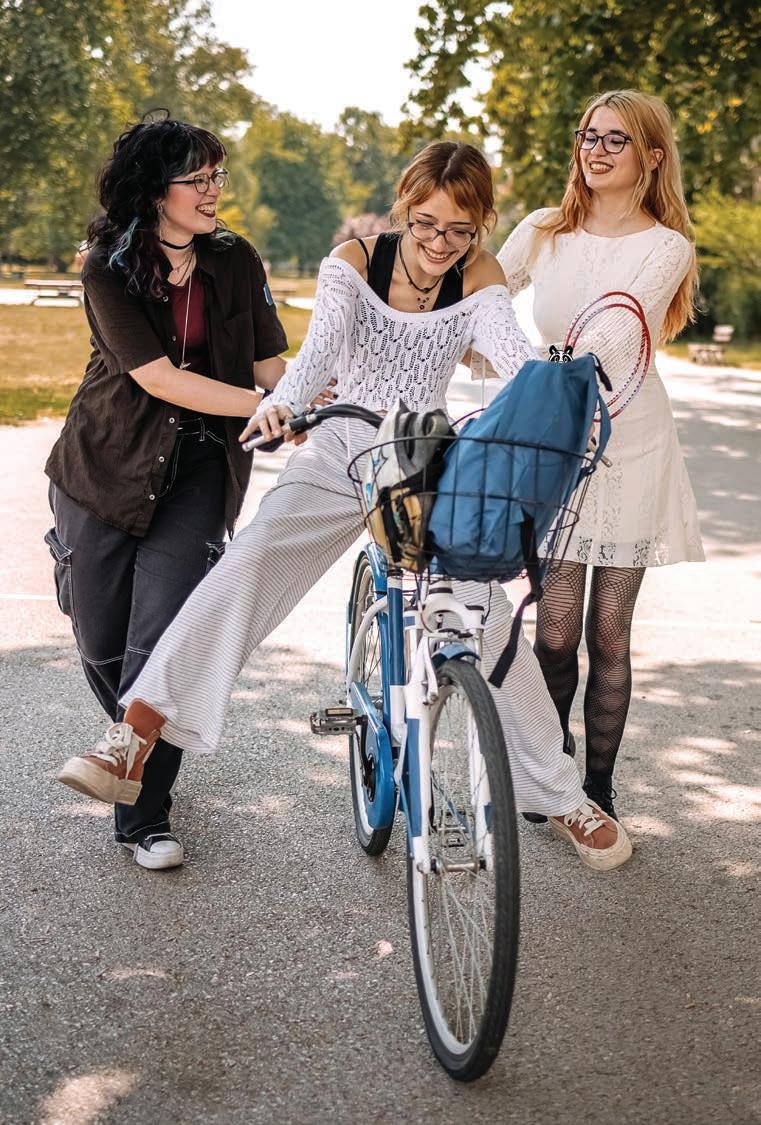
Tum-Tum: is hiding in the bike basket on page 2.
“Speak up for those who cannot speak for themselves; ensure justice for those being crushed.”
Proverbs chapter 31, verse 8
New Living Translation
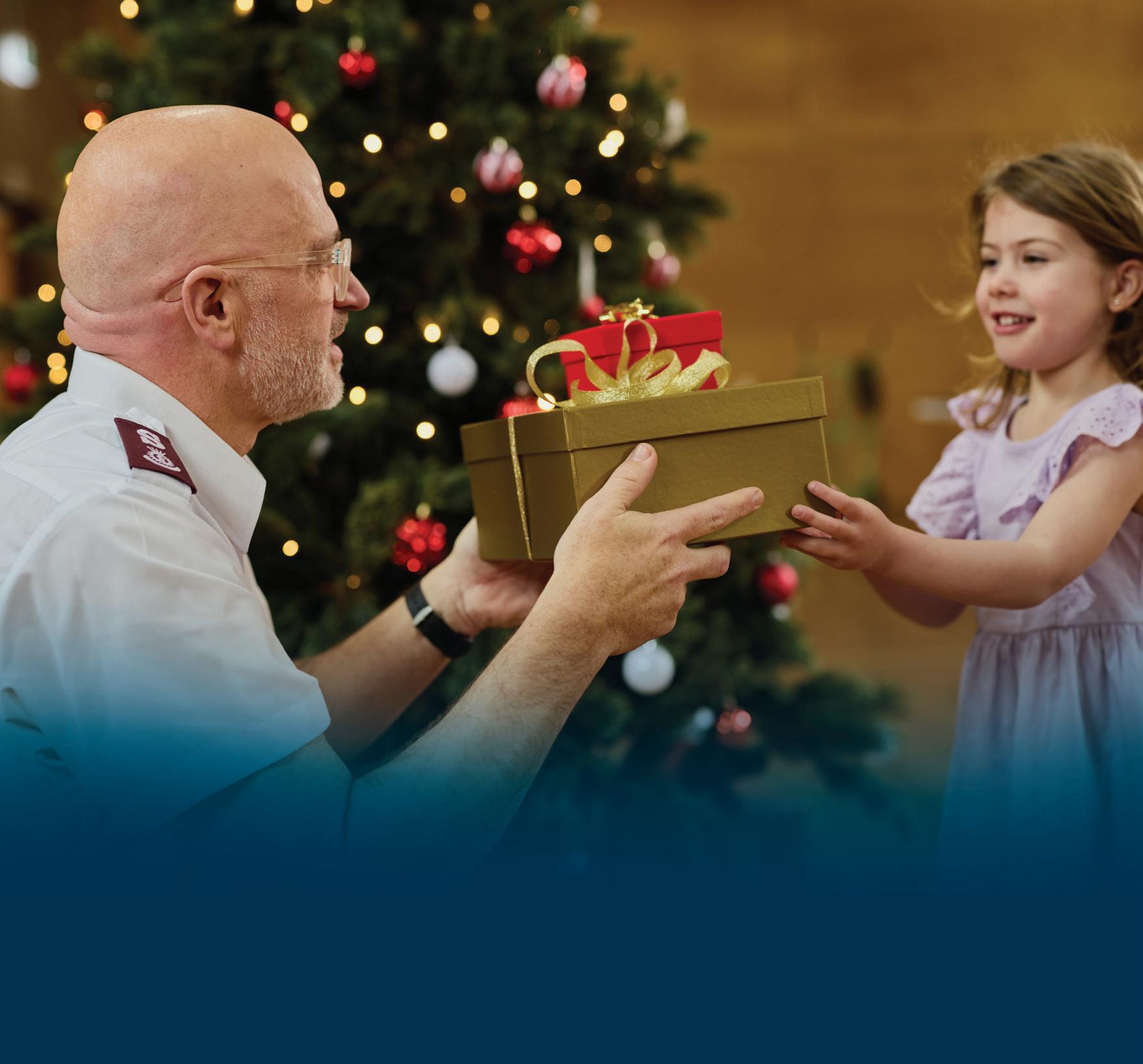
As Christmas approaches, the housing and costof-living crisis continues to push more families to the edge than we’ve seen in years. The Salvation Army is committed to walking alongside those in need, providing vital support to help people rebuild their lives - not just for Christmas, but into the New Year and beyond.
Your kind support means you are the hope families need this Christmas. DONATE TODAY
salvationarmy.org.au/christmas25
“I’ll never forget when I walked into the Salvos Centre. For the first time in what felt like forever, I felt like everything was going to be okay.”