FILM
Women must get in tune with each other for a big performance writes Sarah Olowofoyeku T’S a difficult life, and one that the majority of the population don’t Iyesterday know much about. Comedy-drama Military Wives, released in cinemas (Friday 6 March), shines a light on the experiences of the
Courtesy of Lionsgate UK
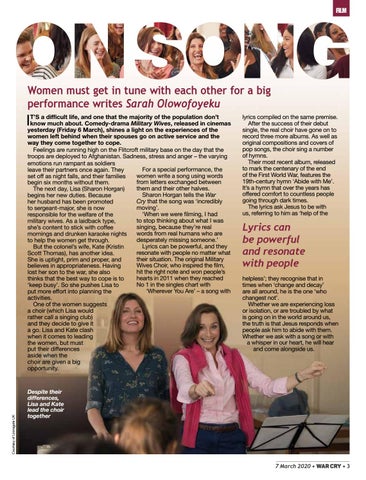
women left behind when their spouses go on active service and the way they come together to cope. Feelings are running high on the Flitcroft military base on the day that the troops are deployed to Afghanistan. Sadness, stress and anger – the varying emotions run rampant as soldiers For a special performance, the leave their partners once again. They women write a song using words set off as night falls, and their families from letters exchanged between begin six months without them. them and their other halves. The next day, Lisa (Sharon Horgan) Sharon Horgan tells the War begins her new duties. Because Cry that the song was ‘incredibly her husband has been promoted moving’. to sergeant-major, she is now ‘When we were filming, I had responsible for the welfare of the to stop thinking about what I was military wives. As a laidback type, singing, because they’re real she’s content to stick with coffee words from real humans who are mornings and drunken karaoke nights desperately missing someone.’ to help the women get through. Lyrics can be powerful, and they But the colonel’s wife, Kate (Kristin resonate with people no matter what Scott Thomas), has another idea. their situation. The original Military She is uptight, prim and proper, and Wives Choir, who inspired the film, believes in appropriateness. Having hit the right note and won people’s lost her son to the war, she also hearts in 2011 when they reached thinks that the best way to cope is to No 1 in the singles chart with ‘keep busy’. So she pushes Lisa to ‘Wherever You Are’ – a song with put more effort into planning the activities. One of the women suggests a choir (which Lisa would rather call a singing club) and they decide to give it a go. Lisa and Kate clash when it comes to leading the women, but must put their differences aside when the choir are given a big opportunity.
lyrics compiled on the same premise. After the success of their debut single, the real choir have gone on to record three more albums. As well as original compositions and covers of pop songs, the choir sing a number of hymns. Their most recent album, released to mark the centenary of the end of the First World War, features the 19th-century hymn ‘Abide with Me’. It’s a hymn that over the years has offered comfort to countless people going through dark times. The lyrics ask Jesus to be with us, referring to him as ‘help of the
Lyrics can be powerful and resonate with people helpless’; they recognise that in times when ‘change and decay’ are all around, he is the one ‘who changest not’. Whether we are experiencing loss or isolation, or are troubled by what is going on in the world around us, the truth is that Jesus responds when people ask him to abide with them. Whether we ask with a song or with a whisper in our heart, he will hear and come alongside us.
Despite their differences, Lisa and Kate lead the choir together
7 March 2020 • WAR CRY • 3
Lifted TOLA DOLL FISHER tells Sarah Olowofoyeku about how a ski trip was a pivotal moment in her recovery from the death of her baby and the breakdown of her marriage
HEY should have had a fairytale ending. T Journalist Tola Doll Fisher was 24 years old when she began a relationship with
a man she had met at work. Within four months, the couple were engaged and after 18 months, married. ‘We got together in the October,’ Tola says. ‘He bought the ring in December, but didn’t tell me. On Valentine’s weekend, he took me to Paris and proposed there. It was very romantic. It felt like everything was meant to be. ‘I absolutely loved being married. It was one of the most important relationships I’d ever had. I loved my husband; we were best friends.’ But their marital bliss was soon in jeopardy. ‘It was a combination of things,’ Tola explains. ‘I was still going to church but he had stopped. Then we had a daughter in 2012. She was born early and her lungs collapsed, so she didn’t live long. ‘My immediate reaction was that I wanted to try again straightaway. I wasn’t interested in grieving. My husband said we should wait and see how things went. I think he had realised he didn’t want to be married, and that was his out. ‘We did go to counselling, but ultimately things ended. I hid our marriage certificate for a while so that he couldn’t file for divorce, and we fought a lot. I kept asking why we couldn’t go through it together. We went back and forth, still together, not together. But in 2013 he filed for divorce and in 2014 it came through.’ Having had a whirlwind start to their relationship, Tola struggled when it all came to a head. ‘I was confused,’ she says. ‘I didn’t understand how it could feel so right but so wrong. I didn’t understand where God was in all of it. ‘I sensed that he was there the whole s Alp h nc time, but he was silent – I was annoyed,’ Fre the in ing Tola went ski she admits. ‘I went a bit crazy for a
6 • WAR CRY • 7 March 2020
to a full life
INTERVIEW
couple of years. I was out partying and drinking pretty much constantly. I didn’t pay attention to my spiritual or physical self. And then I got to the end of the road. I didn’t want to drink or party any more, because I was tired. ‘I hadn’t stopped believing in God. I just decided to try something else and see where that took me. But in doing that something else, I felt God still speaking to me. ‘I had been sleeping with a guy on and off. He worked on a yacht so we were always travelling around the world together. It was
I did the ski season with a Christian company I’d skied with before an intense and fun relationship. I was getting bored in London, so he told me to come and work with him on the yacht. ‘Then he suggested I do a ski season. I wasn’t particularly thinking about God at that point, but I did the ski season with a Christian company I’d skied with before.’ While on the trip in the French Alps, Tola believed that God spoke to her through some of the guests. She says it was a time of healing. ‘I felt that God said to me that I hadn’t grieved over Annie, my daughter. I had gone straight into trying to save the marriage. So he took me into a place of grieving – I was crying all the time. ‘When I came back from the ski trip, I ended things with the guy, and I felt God tell me to leave church for a while, which I thought didn’t make sense at all. But I didn’t trust God or believe he loved me so I think he wanted to show me his love, directly, not through a pastor or vicar. I spent almost two years out of church,
and when I would normally go to church I spent time trying to listen to him. ‘Through that time I learnt that God isn’t the same as church. Growing up in church, I assumed that people in charge knew more than me or were more godly or heard God more than me, but he can and does speak to all of us individually.’ Tola has put the lessons she learnt during that period in a book called Still Standing. ‘When I was going through “the messy middle”, people would say things like, “Don’t worry, you’ll get married again” and, “It’ll be fine, you’ll have another baby,” which was all well and good, but I didn’t want to be fine only when I had those things. ‘I want women to know that, even if they don’t have a relationship right now, God can give them joy right where they are.’ Today, Tola is the editor of a monthly Christian magazine, Woman Alive, and loves life. ‘My motto is John 10:10, in which Jesus says that the thief came to steal and destroy but he came that we might have life and have it more abundantly. ‘I’ve always had this sense that God wants us to live a full life. I’m not living a substandard life because I don’t have a husband or children. I love to celebrate life and the fact that I’m still standing. I do want to get married and have children again, but my life can be as full now as it will be then.’
l Still Standing is published by SPCK
7 March 2020 • WAR CRY • 7
TV SPORT BOSS REACHED DEBT POINT Christians Against Poverty CEO and former head of production at BBC Sport PAULA STRINGER tells Emily Bright how her faith has defined her career
HUSHED reverence fell over Wimbledon’s A Centre Court as Andy Murray stilled himself to serve at match point against
Paula Stringer 8 • WAR CRY • 7 March 2020
Novak Djokovic in 2013. After a short rally, the ball thudded against the net. Andy raised his hands skyward, dropping his racket in disbelief and pumping his fists at the roaring crowd. He had just become the first British Wimbledon men’s singles champion in 77 years. Paula Stringer, former head of production for BBC Sport, recalls that landmark day: ‘I loved overseeing our coverage of Andy Murray winning his first Wimbledon title. That was a big moment for the country.’ She looks back fondly on her seven years at the helm of BBC Sport. ‘I was able to live the dream of covering sport. Being the production lead over radio, television and all of the digital content for BBC Sport was just amazing. ‘We delivered the Olympics and the football World Cup – anything sporty that went out on BBC channels came out from my production team. We could go to anything. I really enjoyed the Euros out in Paris. I also loved Formula One, that was quite an experience.’ One of the key changes she witnessed in the sector during her time was how the coverage of women’s sport grew. ‘It took a significant turn for good about three years ago, as soon as women’s football started to get more television coverage, and then the England women’s hockey team won bronze at the Commonwealth Games.
AELTC/EDDIE KEOGH
INTERVIEW
Paula was at BBC Sport for Andy Murray’s Wimbeldon wins
‘It is better now, and we should celebrate that. The only way that it will continue to change is if it’s given an equal footing with men’s sport, and we’re nowhere near that point at the moment.’ Paula was thriving in her role, and felt accepted, listened to and an important part of the BBC team. However, as in the most thrilling sporting contests, there was an unexpected turn of events in her career. As a Christian, she believed that God was directing her into a different sector. ‘I knew what a privilege the job was that I had been given, that it was a miracle from God. But I decided to leave one of the best jobs in the world to move to Christians Against Poverty for significantly less money.’ A career switch from TV broadcasting to working for a debt charity may seem unconventional. But Paula’s own experiences meant that it was an opportunity she couldn’t pass up. ‘While I worked at the BBC, my husband and I owned and ran a muchloved deli in our local town of Marple. We were outgrowing the premises we were in and so we prayed about it and took out a business loan,’ she remembers. ‘We knew it would be tight, but we had a good business plan. What we didn’t
know was that the recession was lurking around the corner, and we had to close down the deli. ‘My husband almost had a breakdown because of it, and he couldn’t work. Our supplier friends became enemies overnight, because we owed them money we couldn’t pay back. It was the most testing time of our life and marriage. We had the support of amazing people around us, and our local church, but it still felt impossibly hard. ‘We believed the word of God that says: “All things work together for good for those who love God.” Living that out and holding on to your faith is basically all you can do in that type of situation. ‘God used many people to come alongside us, to show us he cared. Money would just miraculously appear, he mended all of our broken relationships, and we paid back every penny to our suppliers.’ Two weeks after they paid back all their debts, Paula’s father mailed her a job advert for the role of executive director at Christians Against Poverty (CAP). She was appointed 18 months ago. In November 2019, she took over as CEO. The charity helps people to tackle their financial difficulties through qualified debt advisers, who set up budgets and
I decided to leave one of the best jobs in the world
negotiate with creditors. Clients receive home visits from trained debt coaches, selected from churches, who are on hand to provide emotional and practical support. CAP also runs a 10-week course called Fresh Start, which helps people to overcome addictions by tackling the root causes. The charity provides job clubs, which equip those who are unemployed with the skills to secure work. ‘I’m so passionate about what CAP does, because I’ve seen the destruction that can come from being in debt or being bankrupt. ‘It is shocking that, in the UK, there are more than 1.5 million people who live in destitution, so cannot afford to feed their families or pay their bills. They can’t clothe themselves properly. These people are on our doorstep, and it’s our job to love them. ‘Everything we do is motivated out of God’s heart for the poor, because we believe that is what God tells us to do. You love the Lord your God first and your neighbour second, and serve the poor.’ To those who may be struggling, she says: ‘There is always hope, so contact us. We can put you in touch with our staff in your area, and provide you with the help that’s needed, whether that’s life skills, job courses or whatever’s required.’ l For more information about Christians Against Poverty visit capuk.org 7 March 2020 • WAR CRY • 9
EXPLORE Prayerlink YOUR prayers are requested for Simon, that he will be steadfast in his Christian faith despite the challenges he faces. The War Cry invites readers to send in requests for prayer, including the first names of individuals and details of their circumstances. Send your Prayerlink requests to warcry@salvationarmy.org.uk or to War Cry, 101 Newington Causeway, London SE1 6BN. Mark your correspondence ‘Confidential’.
Becoming a Christian There is no set formula to becoming a Christian, but many people have found saying this prayer to be a helpful first step to a relationship with God Lord Jesus Christ, I am truly sorry for the things I have done wrong in my life. Please forgive me. I now turn from everything that I know is wrong. Thank you that you died on the cross for me so that I could be forgiven and set free. Thank you that you offer me forgiveness and the gift of your Holy Spirit. Please come into my life by your Holy Spirit to be with me for ever. Thank you, Lord Jesus. Amen Extract from Why Jesus? by Nicky Gumbel published by Alpha International, 2011. Used by kind permission of Alpha International
Nigel Bovey gives chapter and verse on each book in the Scriptures
1 Timothy HE Early Church teacher Paul wrote T two letters to Timothy, his representative in Ephesus. Timothy, like his mentor,
was born in modern-day Turkey. They first met in Timothy’s hometown of Lystra. He subsequently became a junior partner in Paul’s evangelistic tour of Macedonia (see Acts 16:1 to 17:14). Now the ageing Paul writes advice and instruction to his ‘true son in the faith’ (1 Timothy 1:2). Paul is concerned about false teachings. Some teachers are spreading controversial myths; others are saying that being a Christian means having to keep the Law, which God had given to the Jewish people centuries earlier. Some teachers are causing converts to abandon their faith (4:1). Paul tells Timothy to stop them (1:3–11). From his own experience, Paul outlines the fundamentals of his relationship with God. He says that ‘mercy’ (1:13), ‘grace’, ‘faith and love’ (1:14) are what count, not law-keeping. Paul then gives instruction for the conducting of worship. People should pray for those
in authority. Men should be free from anger or controversy in prayer. According to the traditions of his day, Paul says that women should dress modestly, be submissive, not assume a teaching role over a man and be silent in church (2:9–15). Paul outlines the qualifications for the church leadership roles of overseers and deacons. In the King James Bible the word
Money can be an obstacle to faith and a temptation
for ‘overseer’ is translated as ‘bishop’. Paul does not include respective job descriptions, but the personal requirements are similar: monogamous, a good household manager, a person of sincere spiritual conviction, respected by his family and the wider community, temperate, not a lover of wine or money (3:1–13). Paul then puts money into perspective. Money, he says, should be used to provide for one’s dependants, and the church should care for widows who are in genuine poverty (5:3–16). Money can be an obstacle to faith. It can be a temptation. Love of money is at the root of all d one mediator kinds of evil (6:6–10), providing ‘For there is one God an s’ su Je t the man Chris , ind nk false hope for those who put their ma d an d Go n betwee trust in it (6:17–19). ational Version) ern Int w Ne 2:5 y oth (1 Tim
Key verse
"
Looking for help? Just complete this coupon and send it to War Cry 101 Newington Causeway London SE1 6BN Basic reading about Christianity Information about The Salvation Army Contact details of a Salvation Army minister
12 • WAR CRY • 7 March 2020
Name Address