Sounds profound
Sitcom’s Amanda can’t live up to the image she wants to project
‘Dementia is not a barrier to God’



Sitcom’s Amanda can’t live up to the image she wants to project
‘Dementia is not a barrier to God’
The Salvation Army is a Christian church and registered charity seeking to share the good news of Jesus and nurture committed followers of him. We also serve people without discrimination, care for creation and seek justice and reconciliation. We offer practical support and services in more than 700 centres throughout the UK. Go to salvationarmy.org.uk/find-a-church to find your nearest centre.
The Salvation Army first published a newspaper called the War Cry in London in December 1879, and we have continued to appear every week since then. Our name refers to our battle for people’s hearts and souls as we promote the positive impact of the Christian faith and The Salvation Army’s fight for greater social justice.
‘Once upon a time’ is rarely a way to start a story full of gritty realism. Instead, the familiar phrase often takes a reader back to childhood as they settle down for the comfort of a well-known fairy story.
In this week’s War Cry, we feature the British Library’s Fairy Tales exhibition, which highlights these stories of heroes, villains and magic. The family-friendly exhibition reminds visitors of the joy that these tales bring to many children as they grow up.
Having said that, some of the issues dealt with in these stories –Rapunzel’s unjust imprisonment, Cinderella’s forced labour and Hansel and Gretel’s facing the threat of cannibalism – are not obviously suitable material for children. Perhaps the joy is that, in the end, good always triumphs, wrongs are put right and the value of each badly treated character affirmed.
It is how we would wish all real-life stories to end – and the truth is, some do.
Editor: Andrew Stone, Major
Managing Editor: Philip Halcrow
Staff Writer: Emily Bright
Staff Writer: Claire Brine
Staff Writer: Ewan Hall
Editorial Assistant: Linda McTurk
Graphic Designer: Mark Knight
Graphic Designer: Natalie Adkins
Email: warcry@salvationarmy.org.uk
The Salvation Army United Kingdom and Ireland Territory 1 Champion Park London SE5 8FJ
Tel: 0845 634 0101
Subscriptions: 01933 445445 (option 1, option 1) or email: subscriptions@satcol.org
Founders: Catherine and William Booth
International leaders: General Lyndon Buckingham and Commissioner Bronwyn Buckingham
Territorial leaders: Commissioners Jenine and Paul Main
Editor-in-Chief: Major Julian Watchorn


In this week’s magazine, we speak with Tim Swinburn, who tells us how his friend Clare needed a second kidney transplant after undergoing cancer treatment. Tim offered to donate one of his kidneys, and just six weeks after the operation last September, Clare was back on her feet again.
Tim works as a support worker at one of the Salvation Army centres that assist people who are experiencing homelessness. These Lifehouse centres are places where people who are facing very difficult challenges are helped to rebuild their lives.
Every year thousands of people are supported by The Salvation Army when they are going through hard times. The church and charity is inspired in its work by the Christian faith which underpins everything it does, believing that God values and loves everyone.
However gritty and tough a person’s life story may be, God’s love means that there is always the hope of finding a happy ever after.



Amanda faces up to
TV preview: Amandaland BBC1 and iPlayer
By Emily Bright
Singlemum Amanda (Lucy Punch) is taking on her first ‘tone-to-10k’ running challenge, creating social media content for her lifestyle brand Senuous. As she jogs down the street, all seems to be going well for the chaotic figure at the centre of sitcom Amandaland – until her phone video recording is interrupted by music blaring from a car.
Stopping for a spritz of her face and adjustment of her hair, Amanda takes a couple of paces back and tries again, gasping for breath in a pretence of having just run 7k.
But then someone has the gall to park ‘in

shot’. When Amanda confronts the driver, the pair have a tense exchange, which continues until Amanda discovers that the woman she’s arguing with is Abs (Harriet Webb), the ex-wife of her neighbour Mal (Samuel Anderson) and the mother of his son, Ned. Mortified that she’ll have to see Abs again, Amanda makes a speedy exit with excessive politeness.
But Amanda isn’t humbled for long. Behaving as if she is making a pitch on TV show Dragons’ Den, she asks a bank for a business loan in return for an investment in Senuous. She wants to buy a bigger house to impress her followers – a request so superficial, it leaves the bank manager utterly perplexed.
Chatting to Mal on the touchline of her daughter’s football game, Amanda vents about her earlier encounter with Abs. Mal confesses that Abs didn’t like her and called her ‘shallow’. Amanda is horrified by the description and sets about redefining herself as a woman of depth and substance.
Sadly, every time she tries to appear profound, she gives the opposite impression. Amanda’s increasingly desperate attempts to seek approval spiral out of control, with potentially disastrous consequences.
The desire for approval, though, is
something that many of us may be able to relate to. But we’re only human and are unlikely to get on with everyone we meet.
When we struggle with what other people think of us, we may find reassurance in the supportive words of the people who know us best.
And many people find an alwayspresent, never-failing comfort in reading words about the one who knows them better than any human: God. In the Bible –a book known as ‘the word of God’ – they find the reassurance that God ‘will take delight in you with gladness. With his love, he will calm all your fears. He will rejoice over you with joyful songs’ (Zephaniah 3:17 New Living Translation).
The truth is that God rejoices over each of us and offers us reassurance when we’re feeling fearful. Regardless of what people may think of us – or we think of ourselves –we can be secure in knowing that we are of huge value to him.
God’s delight isn’t based on our accolades, income or popularity, but in our identity as his treasured sons and daughters.
Best of all, in our relationship with him, we don’t have to pretend to be something we’re not. God knows us completely and loves us unconditionally. He’s the real deal and is always worth following.
Support can be real parting gift
Claire Brine gives her take on a story that has caught the attention of War Cry reporters
Half of Gen Zers and millennials think that ‘break-ups should have their own rituals’, reported The Times. According to the article, the online marketplace Etsy is reflecting the findings of a survey by adding ‘an option for break-up registers’ alongside its wedding and baby registers, so that ‘those less lucky in love’ can be showered with thoughtful gifts when a relationship comes to an end.
Etsy’s Vicki Pavitt said that the registry was launched ‘to acknowledge break-ups as significant emotional transitions that deserve care and support’. She explained: ‘For so long, we’ve had rituals to celebrate beginnings – engagements, weddings, baby showers – but almost nothing to hold us through the endings, which are just as defining.’
While some readers may roll their eyes at the thought of Gen Zers and millennials creating a post-split wish list, I think the article raises an important point. Of course it’s good to celebrate a couple’s love as they begin married life, or to welcome the arrival of a baby.
But it’s equally important to pay attention to the endings that people experience, the impact that these moments can have and the emotions that may occur.
Some endings I have faced brought feelings of joy and excitement. I remember the thrill of passing my GCSEs and realising that I would never have to study maths again.
I’ve also experienced endings that have caused me great sorrow. A break-up in my early 30s caused my life to fall apart – and while it’s possible that a candle featuring the words ‘A reminder of how hot you are’ may have raised a teary smile, it was the care and patience of my family and friends that I truly appreciated. The people who acknowledged my struggles, rather than simply trying to rush me through them, were invaluable.
Whatever exciting milestones we celebrate in life, I hope we remember to pay attention to the significant occasions which don’t, typically, require party poppers. When we face such times, we need the compassion, understanding and support of others to help us through. And if we want to be on the receiving end of such care, then we need to make sure that we are also prepared to give it.
Strawberry Field – the Salvation Army site that inspired a Beatles song – was named small visitor attraction of the year for the third year in a row at the Liverpool City Region Tourism awards.
The judges praised Strawberry Field as an ‘inspiring attraction appealing to a broad range of people’.
During the awards ceremony, which took place at Liverpool Cathedral, the site also picked up the regenerative tourism prize for its environmental and social contribution to the community, being described as ‘an excellent example of a venue doing good’.
As a boy, John Lennon used to play in the grounds of what was then a Salvation Army children’s home and would attend its annual summer fête, prompting him later to write the song ‘Strawberry Fields Forever’.
Today the site houses a Beatles exhibition and a café, and runs Steps to Work, a training programme for young people facing barriers to employment.
The Salvation Army also runs an on-site church, which invites people from the community to explore the Christian faith.
warcry@salvationarmy.org.uk
Artemis II’s pilot Victor Glover (pictured) thanked God when the crew spoke publicly for the first time since returning from their successful moon mission.
The astronauts were the first to be sent by Nasa to the moon in more than 50 years. Their goal was a 10-day record-setting lunar fly-by to the other side of the moon and back.
‘When this started on 3 April, I wanted to thank God in public,’ said Victor when the crew appeared at an event in Houston, Texas. ‘And I want to thank God again, because even bigger than my challenge trying to describe what we went through, the gratitude of seeing what we saw, doing what we did and being with who I was with … it is too big to just be in one body.’


A record number of people used YouVersion’s Bible apps on Easter Sunday.
The software developer says that some 21.6 million people worldwide accessed the Bible on the day, a 15 per cent rise on last year’s figure. The most popular verse was Matthew 28:6, which points to Jesus’ resurrection and which in the New International Version reads: ‘He is not here; he has risen, just as he said. Come and see the place where he lay.’
YouVersion’s free apps allow people to read the Bible in 2,400 languages and more than 3,750 versions. Users are also able to watch videos, highlight passages and share verses.
YouVersion’s founder, Bobby Gruenewald, said: ‘It’s encouraging to see people searching for and consistently coming back to Scripture for guidance, encouragement and answers. Seeing people around the world
A new initiative has been launched to help churches create worshipping communities for children and families by providing songs already familiar from school assemblies.
The iSingPOP programme will provide resources and training to enable 300 churches to run gatherings where families connected with primary schools can explore faith through music. Run by the charity Innervation Trust, the initiative produces worship songs that are used by more than 77,000 children every week.
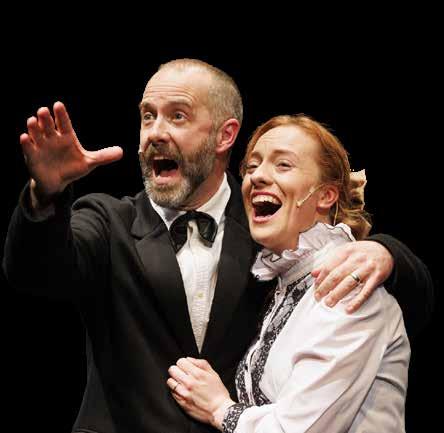
A musical that tells the origin story of a popular 19th-century hymn is touring England until 9 May.
It is Well with My Soul tells the story of how composer Philip Bliss, who wrote the music for the hymn of the same name, travelled with his wife, Lucy, to Chicago and met the lawyer Horatio Spafford, who would later write the hymn’s words. When Horatio experienced personal tragedies during the Great Chicago Fire and the sinking of the steamship Ville du Havre, Philip and Lucy stepped up to support their friend.
The production has previously toured in 2024 and 2025. Its promoters say that It is Well with My Soul explores ‘true and steadfast faith in the midst of tragedy and suffering’.
Army support worker TIM SWINBURN tells why he gave one of his kidneys to a friend – and how life is different as a result
Interview by Claire Brine
When Tim Swinburn learnt that his good friend Clare needed a kidney transplant, he offered to donate one of his own.
‘I can remember our first conversation about it,’ says Tim, who is a support worker at Booth House, a Salvation Army Lifehouse in Swindon, which helps people who have experienced homelessness to rebuild their lives. ‘We knew that Clare wouldn’t be top of the list to receive a new kidney, because she had already been given one some years before –but it had started to fail when she was undergoing cancer treatment.
‘When I realised that Clare was likely to be on dialysis three days a week, for four hours at a time unless she had an operation, I said to her: “You can have one of my kidneys. No question.” Clare broke down crying and replied: “You’re being serious, aren’t you?” I replied that I was, saying: “Let’s get started.”’
Tim and Clare became friends nearly 22 years ago, when they met under tragic circumstances. Back
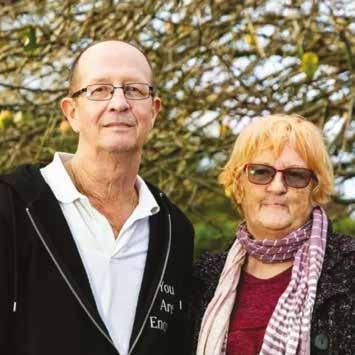
Tim and Clare have been friends for more than 20 years
then, Tim was a family liaison officer in the police force.
‘I got called out to a fatal accident, where a car had left the road and ended up upside down in a garden swimming pool,’ Tim remembers.
‘My role was to identify the body in the car, then inform their next of kin. So, in the early hours of the morning, I knocked on Clare’s door and explained that her 20-year-old son had been killed in a car accident. I then accompanied her when she identified his body.’
While she was still grieving for her son, Clare started working with Brake, a road safety charity, and would go into schools, colleges and other institutions to talk about her experience of loss. In the years that followed, she kept in touch with Tim. The pair became firm friends.
‘We are like siblings,’ says Tim. ‘We talk in the same way. Both of us have this instinct which tells us when we need to phone one another.
‘After I offered to donate my kidney to Clare, I had to undergo numerous medical tests. I also had to assure hospital staff that I wasn’t being coerced or donating my organ for money.
‘Eighteen months later, on 24 September last year, the operation took place.’
Though Tim doesn’t call himself a religious man, he prayed that the procedure would be a success. He understood that such major surgery carried a risk of death.
‘I’m a single dad, so I really didn’t want anything to go wrong,’ he says. ‘Inwardly, I was looking upwards, saying: “Please make this work.” I knew that the operation was meant to happen.’
One kidney removal later, Tim had no
regrets about stepping up to help his friend.
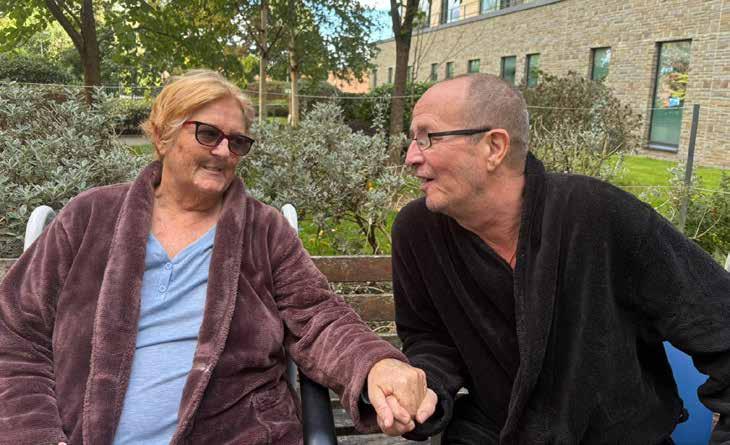
‘Clare is one of those special people –she deserves to live,’ he says. ‘I was so pleased to give her my kidney. I saved her life, which is an amazing feeling. Six weeks after the operation, she was back at the yard with her horses. And I’d come out the other side with a smile on my face as well.’
Three months after his surgery, Tim felt that his body was ready to face another challenge.
‘On Christmas Day, I walked from my home to Booth House, covering a distance of 26 miles,’ he explains. ‘I wanted to raise money for the Lifehouse, so that we can improve some of the areas by making them a bit more homely for the residents.
‘After I completed the walk, I was uncomfortable, but OK. I take medication
for very little. Even after the operation, I took only one tablet for pain relief.’
Not one for sitting still, Tim has already started planning his next fundraising initiative. It’s based on the BBC1 programme Race across the World, a series in which teams race from one country to another, hoping to be the first to reach a final destination.
I can see that my friend is thriving
‘This summer, I’m going to take on a colleague, who works for a knife crime charity, in “Race across the UK”,’ explains Tim. ‘We will start in Glasgow, then make our way, separately, through England to Cardiff, down to Truro, then head to the finishing point at Booth House.
‘Along the way, I’ll be sleeping rough to raise awareness of homelessness and hopefully some more money for Booth House. It’s a place that’s non-judgemental and has at its heart the best interests of people who are underprivileged.
‘I’ve always had a passion for supporting people who are homeless. In this day and age, everyone should have a roof over their head.’
And, concludes Tim, everyone should use their life to try to do good wherever they can.
‘I’d like my story to encourage people to think more about what they can do to help others,’ he says. ‘After donating a kidney, my life has become even better than before, because I can see that my friend is thriving. Once again, I find myself looking up and saying: “Thank you.”’
MARK WORMELL, a church minister who has written a book about dementia, explains how being diagnosed with the condition does not mean the end of someone’s faith journey
Interview by Ewan Hall


Dementia is a word dreaded by many people. The umbrella term covers a range of conditions that affect memory, thinking, communication and behaviour. And a diagnosis that includes the word often prompts fear – both for the person being assessed and their relatives and friends, who can worry about how it will impact their relationships. Some people may also be concerned about whether dementia will affect a person’s faith life.
Such a concern is something that Anglican minister Mark Wormell first grappled with while studying at Bible college in Sydney, Australia.
After joining the college at 50 years of age – having had a previous career as a lawyer – Mark found that, while younger students were sent to youth and children’s groups to undertake their community engagement work, he was sent out to aged care facilities. However, what began as an allocated task became a formative experience that drew him into the lives of older people and prompted him to explore the relationships between belief, identity

and dementia.
‘I found it challenging to engage with people with dementia,’ Mark explains. ‘What particularly struck me was a chapel service that we ran in an aged care facility. It was largely led by younger people, and there was a woman in a wheelchair sitting in the front row, clearly not engaging with what was going on.
‘My heart went out to her – I could not imagine what it must be like to sit there while people were speaking in ways that didn’t connect with her at all.’
Mark noticed that the woman paid little attention to the service until someone sat at a piano and began playing the hymn ‘At the Name of Jesus’.
‘She opened up like a flower,’ he says. ‘She sang every verse from memory. You could see God was doing something in her. What her view of God was from day to day, I don’t know. But when music about God reached her, I thought it was a wonderful thing.
‘For me, that was the catalyst. We can say intellectually that we know no one is beyond God’s care and that his love reaches everyone. But to see his love like
that – I found it very moving.’
In his final year of college, Mark wrote a research paper examining the ethical challenges that church-based organisations face in providing care to older people. As he read widely, he became aware that dementia was almost always framed as a loss, with little consideration given to the person’s faith or capacity to experience God.
Why would memory be a barrier to God?
He says: ‘I thought: why would God not want to bring someone into his family if they’re living with dementia, and why would memory be a barrier to God?’
To understand more, Mark interviewed chaplains and carers from various facilities, who revealed stories of people responding to God despite living with dementia.
‘There was one woman who had been uncommunicative for several months,’ he says. ‘Her carer was a Catholic woman who sat with her and prayed with her.
Towards the end of her life, the patient broke her silence and told the carer: “I am like you.”
‘Another story I remember so vividly was about a woman with Korsakoff syndrome, which is an alcoholic dementia. It led to her being quite aggressive, violent and abusive. One of her children had stopped seeing her as they struggled with the abuse.
‘The lady then entered a Christian aged care facility, and gradually, over the next two years, she mellowed and became one of the most loved people there. Christians think about the gospel changing us, and she showed that kind of change by thinking about Jesus and engaging with the carers and people around her.’
After completing his research paper, Mark’s ministry with older people continued, and he was encouraged to develop his academic paper into a book, Coming to Christ in Dementia. The book aims to show how people living with
Turn to page 10 f

Music can be a way for people with dementia to open up
From page 9
dementia have value – and that they can experience God’s love and presence in their life.
‘Our society is very hostile to the idea that there could be anything positive about a diagnosis of dementia,’ Mark explains. ‘And I understand that no one wants to be diagnosed with the condition. But, with God, it isn’t as fearful as we might think.
‘God teaches us about who we are, and he tells us that we are made in his image and are of infinite value to him. Nothing can separate us from his love. And that remains true even if we lose the capabilities that we associate with a full human life.’
Mark’s understanding of how people engage with faith in different ways was influenced by a friend from church.
‘My friend had a brother who had been born with Down’s syndrome,’ he says. ‘Occasionally, my friend would bring his brother to church. I don’t think I have ever seen anyone happier in church – simply praising God with such joy. And I remember thinking that the work I am doing around dementia is equally applicable to all sorts of different issues.
It applies anywhere we might assume someone’s physical or mental abilities are limited. Those challenges are no limit to God.’
Mark explains that helping a person to explore their faith and relationship with God is still meaningful even when they have dementia. He stresses the importance of continuing to respect, value and affirm the dignity of those living with the condition.
hymns and prayers can still connect
‘Faith
is more than something we can explain in words,’ he says. ‘It is a deep internal sense for our need for God and our dependence on him.
‘I’ve led many services in dementia wards. People may be blind, deaf, using walkers or wheelchairs, or sometimes brought in on beds. They may not appear to follow sermons or readings, but familiar hymns and prayers can still connect.
‘The biggest association is Communion. When the bread and wine
are offered, people reach out, recognising that they are receiving something from the God who loves them.’
A key aspect of the Christian faith is repentance, which is acknowledging to God that you have done wrong, saying sorry for it and choosing to change your behaviour. Mark has had to think about what repentance would look like for someone with dementia.
‘I had to go back to basics and realise that repentance isn’t a formula or saying the right words,’ he says. ‘It is really about giving up our attachment to our sin, putting it behind us and turning to God.
‘When we think about what dementia does to many people – affecting their memory and cognition – it means that they are not attached to their sin. They are not held back from the presence of God by sins from the past, because they can’t remember them; they can simply come to God and trust him. Wherever we are, there’s not an obstacle stopping us from coming to him.’
Mark wants to offer hope to families who are struggling to come to terms with a loved one’s dementia. He wants to offer assurance that the essential personhood
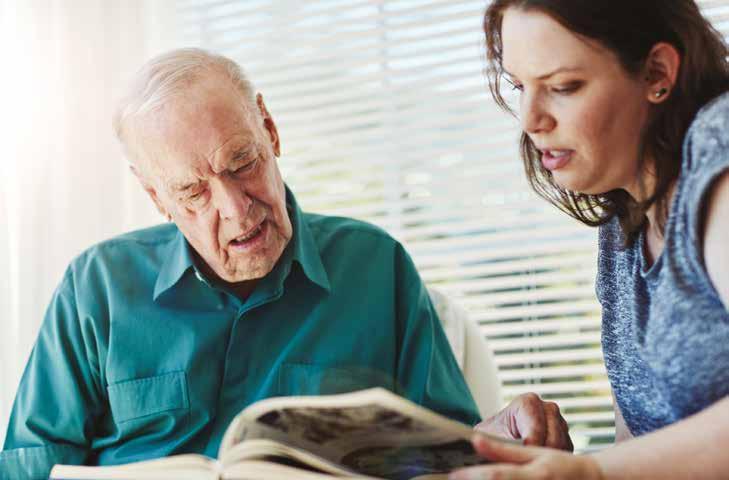
Regularly visiting family or friends with dementia increases the likelihood of experiencing their lucid moments
of someone with dementia is still present.
‘There are two aspects to this,’ Mark explains. ‘First, many people who have studied and written about dementia, both secular and Christian, talk about moments of lucidity. That is why we need to be there regularly.
‘One problem with visiting people with dementia is that people think: “What is the point? What good is it doing them, or me?” But unless you visit consistently, you won’t see those lucid moments. Many people have stories of someone suddenly saying something significant, which becomes a great encouragement.
‘The second point is that when we become Christians, the most important relationship in our lives is with God. What and who we are to God is fundamental to our identity. Whether someone can hold a conversation, stay awake or control their body is irrelevant to God. Good care starts with seeing people as God sees them.’
Mark aims to continue his work on faith and dementia, which includes presenting talks on the topic at events such as Evergreen, a conference supporting ministry for older people, which will be hosted in London by the Christian charity
Pilgrims’ Friend Society.
Mark hopes those in attendance at Westminster Chapel in September will walk away with two key points.
‘First of all, I hope it leads to a greater love of Jesus,’ he says. ‘One of the things that has absolutely delighted me about all the work I’ve done is seeing the way Jesus works in each one of us – in the carers and in the people who come to faith. I try to teach this by showing just how wonderful Jesus is to all of us.
‘Secondly, I hope that people take what I’ve shared with them and, if it’s needed, have more confidence in the way Jesus will reach, engage with, sustain and love people with dementia.’
Reflecting on the process of writing his book, Mark describes it not as something that has tested his faith, but as an experience that has deepened and enriched it.
‘I had always known how important faith and repentance were, but seeing them in this context made me value them even more,’ he says.
In his book, Mark challenges the assumptions that dementia erases faith or severs a person’s relationship with God.
Instead, he offers a different viewpoint –one that recognises faith as something adaptable and constant, not just expressed through words or memories. Mark’s perspective reframes dementia not as a spiritual loss, but as a different way of being faithful. He says that belief can remain even as cognition changes.
‘I’ve always thought that faith, at least, is evidence-based,’ he says. ‘Jesus died –he was nailed to a cross. God raised him, and our faith is based on the historical fact that Jesus died, was raised, and lifted up into Heaven.
‘When I see what God does with people with dementia, I see our faith – and our joy – as evidence-based. I see the difference that Jesus makes in people’s lives.’
The War Cry invites readers to send in requests for prayer, including the first names of individuals and details of their circumstances, for publication. Send your Prayerlink requests to warcry@salvationarmy.org.uk or to War Cry, 1 Champion Park, London SE5 8FJ. Mark your correspondence ‘Confidential’.
There is no set formula to becoming a Christian, but many people have found saying this prayer to be a helpful first step to a relationship with God
Lord Jesus Christ,
I know that I have done things in my life that are wrong and I’m sorry.
Thank you that I can ask you for forgiveness because of the sacrifice you made when you died on the cross.
Please forgive me and help me to live a better life in the future as I learn how to love you and follow your way of living.
Thank you, Lord Jesus.

If you’ve prayed this prayer, scan the QR code or contact us using the coupon on this page

Nigel Bovey gives chapter and verse on each book
This letter to Jewish Christians who live away from their homeland is attributed to James, the brother of Jesus (see Galatians 1:19). He writes that, for believers’ faith in Jesus to be genuine, it must be backed up by behaviour. ‘Faith by itself,’ he argues, ‘if it is not accompanied by action, is dead’ (James 2:17 New International Version).
James identifies one form of religion that is ‘worthless’ (1:26) and another that is ‘pure and faultless’ (1:27). He then describes what behaviour defines and constitutes those false and true brands of religion.
It should be noted that, while James stresses the need for good works, he is not suggesting that they are the way we can earn God’s forgiveness.
Good works are not the route to salvation; they are a result of salvation. Following Jesus means engaging with the world, not mystically escaping from it. Good works are physical evidence of a spiritual reality. James writes: ‘I will show you my faith by my deeds’ (2:18).
His readers, then, are not just to listen to God’s word, but also to ‘do what it says’ (1:22).
Speech is a major definer of what is a false or true religion. The tongue can be used for great benefit or cause great damage (3:1–12).
Having a loose tongue is a mark of false religion (1:26). Other indicators include clinging to ‘moral filth’ (1:21), patronising those in need (2:14–16), ‘bitter envy and selfish ambition’ (3:14), exploiting workers (5:1–6) and self-indulgence (5:5).

True religion, however, is marked by obedience to God’s word (1:22–25), submitting to him and living closely to him (4:7 and 8). Doing these things leads a person to care for distressed widows and orphans (1:27), show no favouritism (2:1–12), love their neighbour (2:8) and speak carefully (3:1–12).
True religion, says James, is driven by heavenly wisdom (3:17), which empowers believers to become peacemakers (3:18) who are patient (5:7–11) and prayerful (5:13–18).
The divide between false and true religion is clear: ‘Friendship with the world means enmity against God’ (4:4). A Christian’s lifestyle should be noticeably different from the standards of the prevailing culture.

To receive basic reading about Christianity and information about The Salvation Army, complete this coupon and send it to
War Cry 1 Champion Park London SE5 8FJ a
Or email your name and postal address to warcry@salvationarmy.org.uk


Feature by Claire Brine
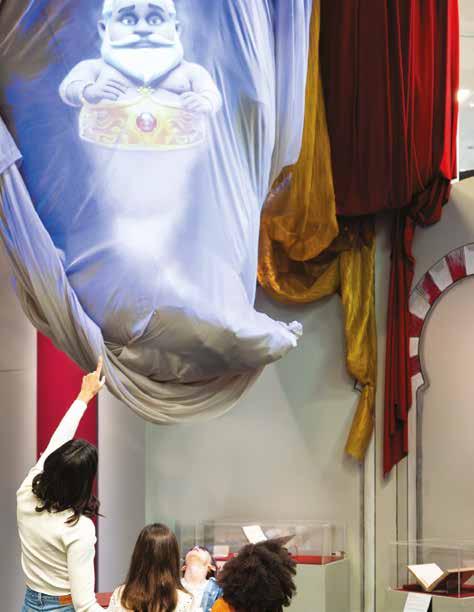
NFairy Tales. The interactive exhibition at the British Library celebrates these stories of old and the heroes, villains and fantastical creatures attached to them.
Setting off from a cosy cottage, visitors encounter characters from Little Red Riding Hood in a mysterious wood, then walk through a gingerbread house known to Hansel and Gretel. From there, they head to a royal palace, home to a number of magical objects, including a genie’s lamp.
3 Frodo Baggins, Gandalf and Aragorn are characters in which book by JRR Tolkien?
4
2 Who provides the voice of Mario in The Super Mario Galaxy Movie?
Who stars as Mary in the BBC drama series The Other Bennet Sister?
5 In which century was the first Wimbledon tennis tournament held?
6 Who was a prime minister of the UK in both the 1960s and 1970s?
What is the title of the latest album by K-pop boy band BTS? ANSWERS
Next stop is a land far away, where families may spot a troll lurking under a bridge and a breakfast table set for three bears.
And no story is complete without a ‘happily ever after’ – a part of the exhibition where parents and children can read their favourite stories together, while also checking out treasured items in the British Library’s collection, such as the original manuscript of Alice’s Adventures Under Ground by Lewis Carroll.
By immersing themselves in books, illustrations, theatre costumes and puppets, families are able to revisit old stories and make fresh discoveries. Rebecca Campbell-Gay of the British Library hopes that the exhibition will highlight not just ‘the wonders’ of fairy stories, but also ‘what makes those tales so timeless’.
The simple fact is that when a story is good, it’s told again and again. Fairy stories appeal because they entertain and spark our imagination.
But the real world has no place for a wish-granting genie. When we face problems, there’s no magic wand to make everything better.
That’s why millions of people turn to another, historical story – a true and powerful page-turner about a real-life hero – to inspire them on their journey through life. The story of Jesus is about an extraordinary man who did extraordinary things.
He walked on water. He healed sick people. He loved his enemies. He forgave sinners. He died on a cross, then rose to life two days later. He was God’s Son. And he promised those who followed him a place in the Kingdom of Heaven.
Whether it’s new to us or not, this is one true and timeless story worth reading again and again.

1. Beaming (7)
5. Clouded (5)
7. Vogue (7)
8. Drench (5)
10. Portent (4)
11. Frightful (8)
13. Mean (6)
14. Achieve (6)
17. Customary (8)
19. Carry (4)
21. Long for (5)
22. Severe (7) 23. Bellow (5) 24. Feared (7)
2. Disagree (7) 3. Keen (4)
4. Loudspeaker (6) 5. Temperate (8) 6. Fill tightly (5) 7. Stupidly (9) 9.


Each solution starts on the coloured cell and reads clockwise round the number


Fill the grid so that every column, every row and every 3x3 box contains the digits 1 to 9
Look up, down, forwards, backwards and diagonally on the grid to find these dessert foods


INGREDIENTS
2tsp oil
500g lean pork mince (5 per cent fat)
2tsp smoked or ground paprika
2tsp ground cumin
1tsp garlic granules
100g iceberg lettuce, shredded
50g tomatoes, chopped
50g cucumber, diced
125g low-fat yogurt, sour cream or mayonnaise
Large handful fresh coriander leaves
150g tomato salsa (optional)
½ tsp dried chilli flakes (optional)
12 crunchy taco shells
Lime wedges, to serve
4

Heat the oil in a large non-stick pan over a medium heat and cook the pork, paprika, cumin and garlic granules for 8-10 minutes, stirring occasionally and breaking up the mince with a wooden spoon until browned.




Place all the remaining ingredients, except the taco shells and lime wedges, in separate bowls.
Warm the taco shells according to the packet instructions. Arrange them in taco holders or on a large plate.
Transfer the pork to a warm serving plate and build the tacos using the separate ingredients according to your liking, before serving with the lime wedges.

INGREDIENTS
4tbsp sweet chilli sauce
3tbsp reduced-salt soy sauce
2tbsp tomato puree
300ml water
4 lean pork loin steaks, fat removed and cut into thin strips
Salt and freshly ground black pepper
1tbsp cornflour
2tbsp oil
Small bunch spring onions, finely chopped
Sticky rice and seasonal vegetables, to serve
METHOD
To make the sauce, stir together the sweet chilli sauce, soy sauce, tomato puree and water in a medium bowl.
Pat the pork strips dry with kitchen paper and transfer to a large bowl. Season, then add the cornflour and toss gently.
Heat 1tbsp oil in a non-stick frying pan or wok over a high heat and stir-fry half the pork strips for 3-4 minutes, tossing occasionally, until lightly golden and cooked through. Set aside on a large plate. Repeat the process with the remaining oil and pork strips, then set aside.
Add the sauce mixture to the pan and cook over a medium heat for 10 minutes, until starting to thicken.
Reduce the heat, then return the pork to the pan and toss in the sauce for 1-2 minutes, until piping hot.
Scatter over the spring onions and serve with the sticky rice and seasonal vegetables.