MAGGIE SAWKINS
Maggie, you founded Portsmouth's popular poetry and music club, Tongues&Grooves. How is Portsmouth’s spoken word scene today? When we began in 2003, the spoken word scene in Portsmouth was almost non-existent. There’s a lot more going on now, from performance poetry and open mics to storytelling soirée. It’s part of a wider trend – you can find spoken word venues up and down the country. For us to have kept going for so long is an achievement, and we’ve inspired others in the city and beyond to have a go. I’m not sure what the future holds – I find the idea of a silent word disco quite appealing. Your recent project, Diving into the Wreck, blew me away. The contributions from people in recovery from addiction were moving, enlightening, disturbing. How on earth did you put the show together? I’d been carrying the idea around for three years or more - that was the easy bit. A successful Big Lottery Fund bid enabled me to get the project off the ground. I began by running workshops at Portsmouth’s Recovery Café to help people write their stories. Once enough material had been gathered, the group worked with Matt Parsons, a local film maker, and director Mark Hewitt to shape the stories into a live literature performance piece. Keeping the 34
Photo:Nivine F. Keating
William Sutton interviews Southsea poet Maggie Sawkins, who won the prestigious Ted Hughes Award for New Work in Poetry, for her moving multimedia live literature show Zones of Avoidance.
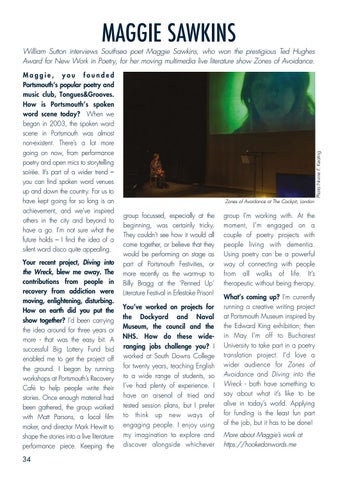
Zones of Avoidance at The Cockpit, London
group focussed, especially at the beginning, was certainly tricky. They couldn’t see how it would all come together, or believe that they would be performing on stage as part of Portsmouth Festivities, or more recently as the warm-up to Billy Bragg at the ‘Penned Up’ Literature Festival in Erlestoke Prison! You’ve worked on projects for the Dockyard and Naval Museum, the council and the NHS. How do these wideranging jobs challenge you? I worked at South Downs College for twenty years, teaching English to a wide range of students, so I’ve had plenty of experience. I have an arsenal of tried and tested session plans, but I prefer to think up new ways of engaging people. I enjoy using my imagination to explore and discover alongside whichever
group I’m working with. At the moment, I’m engaged on a couple of poetry projects with people living with dementia. Using poetry can be a powerful way of connecting with people from all walks of life. It’s therapeutic without being therapy. What’s coming up? I’m currently running a creative writing project at Portsmouth Museum inspired by the Edward King exhibition; then in May I’m off to Bucharest University to take part in a poetry translation project. I’d love a wider audience for Zones of Avoidance and Diving into the Wreck - both have something to say about what it’s like to be alive in today’s world. Applying for funding is the least fun part of the job, but it has to be done! More about Maggie’s work at https://hookedonwords.me