SAINT MICHAEL’S COLLEGE MAGAZINE
Cover Graphics by Abbey Gyurko ’26
Cover Layout by Summer Drexel
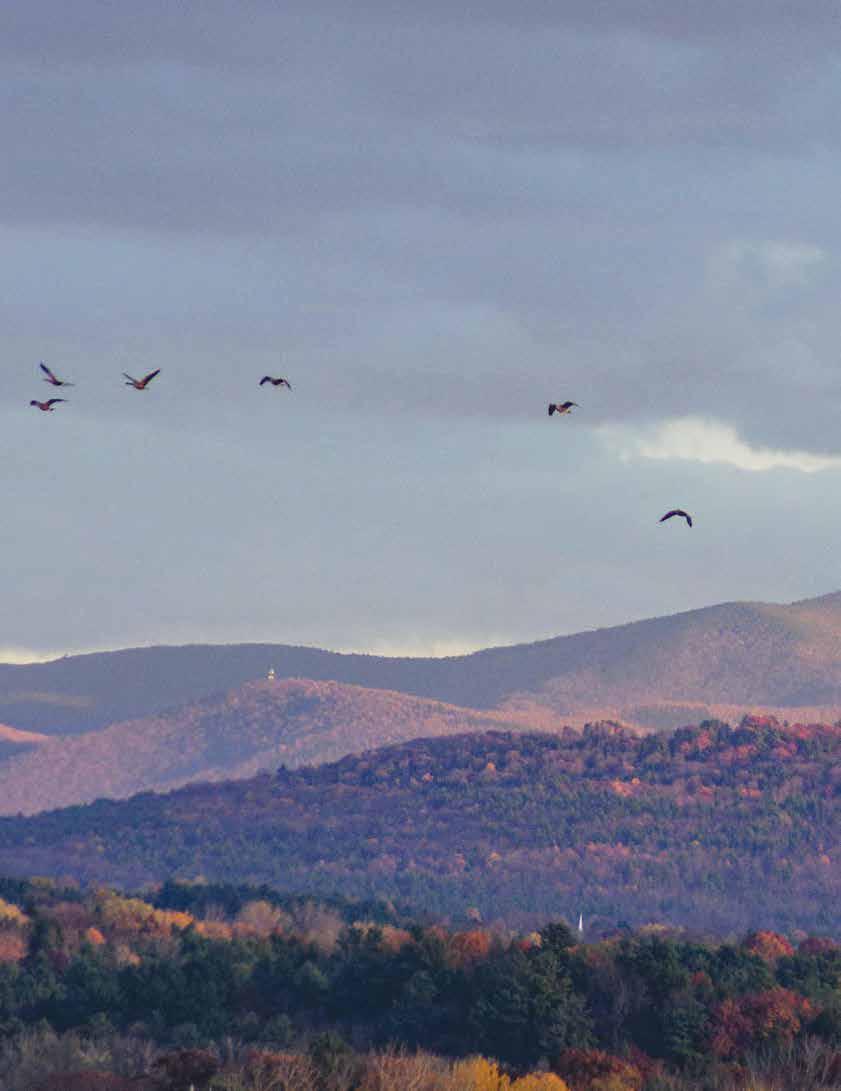
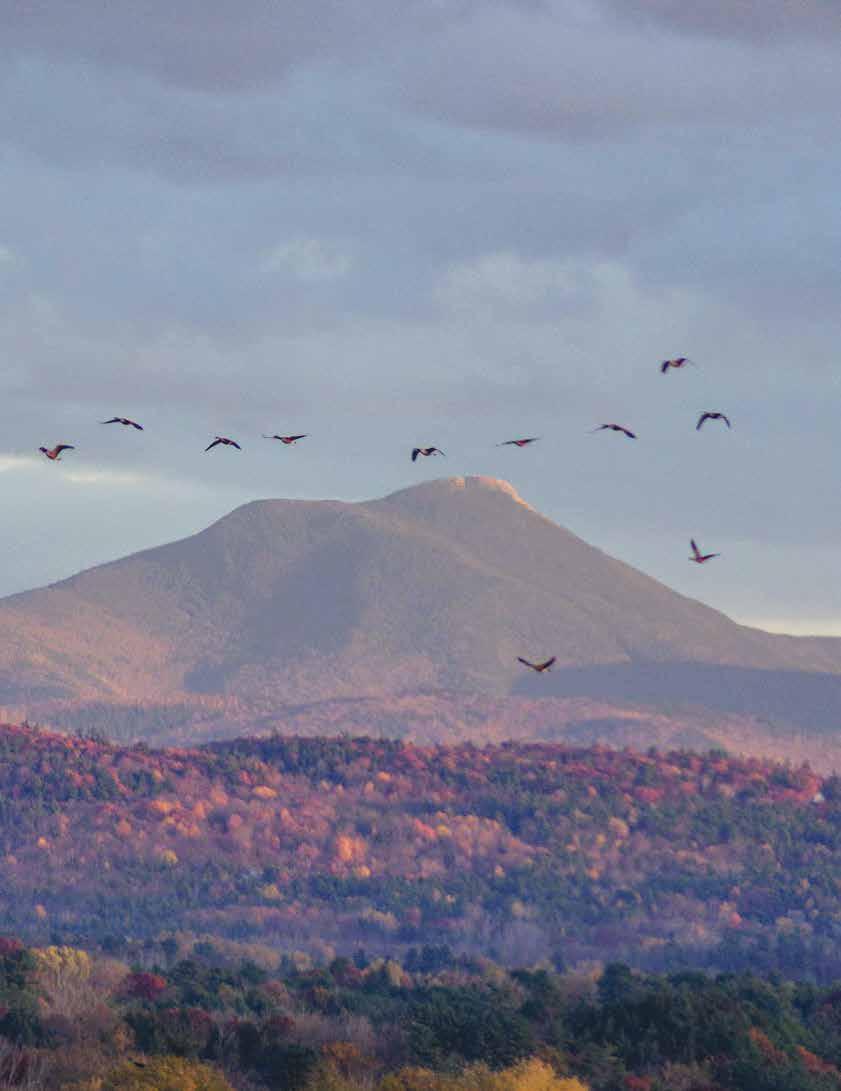
Photo by Steve Mease
In June, my wife Mary and I had the privilege of joining alumni, faculty, and students on the Saint Michael’s Heritage Tour through France and England, retracing the footsteps of Edmundite Father Armand Prével. This journey served as a profound reminder of our shared mission and
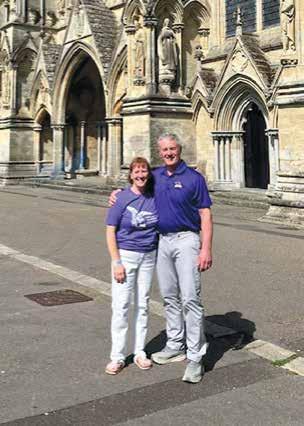
of the enduring vision of the Catholic Edmundite priests who founded Saint Michael’s College more than 120 years ago.
From its founding, Saint Michael’s College has embraced the Catholic intellectual tradition as a transformative force—preparing individuals not only for professional success, but for lives of purpose and service. The Edmundites built a welcoming community where students of all faiths are encouraged to seek truth, nurture curiosity, and uplift others. Today, we carry this legacy forward with a renewed vision: to prepare our students to navigate the complexities of a rapidly changing world with skill, professionalism, and empathy.
In a society that increasingly calls for compassion, critical thinking, and adaptability, the relevance of a Saint Michael’s liberal arts education has never been greater.
These foundational skills empower our graduates to lead with confidence and compassion—ready to serve in a world that demands ethical leadership and a deep understanding of others. As technology continues to reshape traditional career paths, our students must also embody professionalism: making ethical decisions, leading with accountability, and engaging with global cultures through respectful and competent conduct. Equally vital is empathy—the ability to listen deeply, understand diverse perspectives, and serve with genuine compassion. We know that 65 percent of our students will enter careers that do not yet exist.
Skill. Professionalism. Empathy. These are not just academic ideals; they are the core competencies that enable our graduates to navigate uncertainty, foster meaningful human connection, and lead with purpose in a dynamic world.
As we look to the future, Saint Michael’s College stands at the forefront of innovation and transformation in higher education. Rooted in faith and guided by purpose, we remain dedicated to cultivating minds and hearts that seek truth and compassion. Together, we will continue to prepare graduates who bring skill, professionalism, and empathy to a world that needs them more than ever.
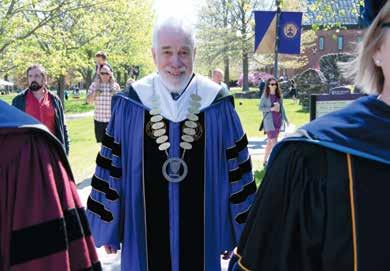
Richard Plumb, Ph.D. President, Saint Michael’s College
SAINT MICHAEL’S
COLLEGE MAGAZINE
Fall/Winter 2025
Volume 25, No. 2
smcvt.edu/magazine
EXECUTIVE EDITOR
Michelle Jordan P’20
CONTRIBUTING WRITERS
Rylee Anderson ’27
April Barton
Tina Gorski-Strong
Angela Irvine
Ellen Kane
Chris Kenny ’86, M’98, P’18
Josh Kessler ’04
Sierra Leonard ’15
Declan McCabe
Elizabeth Murray ’13
Terri Selby
Rev. David Theroux, SSE ’70
Peter Vantine
PHOTOGRAPHER
Jerry Swope
MAGAZINE ADVISORY BOARD
Alaba Apesin
Rev. Michael Carter, SSE ’12
Summer Drexel
Gretchen Galbraith
Michelle Jordan P’20
Ellen Kane
Josh Kessler ’04
Terri Selby
Stephanie Snell
Jerry Swope
Saint Michael’s College Magazine (ISSN 0279-3016) is published twice per year. The views expressed in the Saint Michael’s College Magazine do not necessarily represent the official policies and views of Saint Michael’s College.
POSTMASTER
Please send address changes to:
Saint Michael’s College
One Winooski Park, Box 6 Colchester, VT 05439
SMCMagazine@smcvt.edu
EDITORIAL OFFICE
Saint Michael’s College
One Winooski Park, Box 6
Colchester, VT 05439
802.654.2556
SMCMagazine@smcvt.edu
©2025 by Saint Michael’s College. All rights reserved.
Legacy. It’s a word that holds weight, history, and heart. At Saint Michael’s College, it’s also a word that feels very much alive.
In the pages to come, you’ll read about legacies that have shaped this community—from the Edmundite fathers whose vision built our foundation, to alumni whose generosity and example continue to guide us forward. You’ll meet students and graduates who are building their own legacies through research, service, creativity, and leadership. Each story reflects a different answer to the same question: What is legacy?
Legacy isn’t only about what we leave behind—it’s about what continues to grow because of us. It’s the values that take root, the lessons that endure, and the lives forever changed by the moments we share.
At Saint Michael’s, legacy is woven into everything we do. It begins with the Edmundite tradition—a legacy of faith, learning, and service that has guided the College for more than a century. It’s a promise that education is most powerful when it serves the common good and lifts others.
That promise lives on every day in the people who call this place home. You can see it in the classroom, where curiosity sparks new ideas and professors challenge students to see the world differently. You can feel it in the energy of campus— where learning expands through internships, research, on-campus jobs, athletics, volunteering, and clubs that teach collaboration, empathy, and leadership.
Legacy is also deeply personal. It’s found in the friendships that last a lifetime, in the moments of courage when students find their voice, and in the quiet confidence that comes from knowing they are part of something larger than themselves.
At Saint Michael’s, legacy is not a thing of the past—it’s a living, breathing force. It’s the knowledge, kindness, and conviction that move through generations, shaping lives and inspiring change. And it reminds us that what we build here together will always matter—because true legacy never ends.
Michelle Jordan P’20 Executive Editor
Send your ideas and impressions Via email: SMCMagazine@smcvt.edu
Via snail mail: Saint Michael’s College Magazine
SAINT MICHAEL’S HAS GIVEN ME
Abigail Roman ’25 shared, “As I prepare for the next chapter of my academic journey, I have been reflecting with deep gratitude on my time at Saint Michael’s College and all that it has made possible.
“St. Mike’s has given me the incredible opportunity to be a contributor on three research papers, gain hands-on experience that helped me earn acceptance into a neuroscience graduate program, and recently receive a personal letter from Massachusetts State Senator Dylan Fernandes recognizing my work. These accomplishments were only possible because of the supportive, close-knit, and intellectually rich environment that Saint Michael’s fosters.
“Working one-on-one with exceptional mentors like Dr. Ruth Fabian-Fine and Dr. Adam Weaver has completely changed the trajectory of my future. Their guidance, encouragement, and willingness to include me in meaningful research have been invaluable.
“Outside the classroom, the Mobilization of Volunteer Efforts (MOVE) program played a huge role in shaping my experience, particularly through SMCBuddies, a program I had the joy and honor of co-leading. The opportunity to connect with and learn from members of the greater community through MOVE reminded me of the importance of service, empathy, and human connection—values I will carry forward.
“From the professors who nurtured my curiosity, to the research experiences that challenged me to grow, to the community that made it all feel possible— thank you. I am proud to be a Saint Michael’s graduate and profoundly grateful for the foundation this college has given me.”
When Katie McNally ’14 tells people she’s an archivist, she often gets a puzzled look in return. “At first glance, archives may look like rooms full of boring gray boxes,” she says, “but open one, and you’ll find treasures inside. That thrill of discovery is what got me hooked.”
Her passion for uncovering stories began at Saint Michael’s College, where a World War II history course changed the course of her life. Professor Jennifer Purcell and College Archivist Liz Scott (see page 22) built the class around the historical materials of the Society of Saint Edmund, housed in the Durick Library.
As a French minor, McNally focused on the Edmundites’ experiences in France, combining her love of history, Catholic heritage, and the French language.
That summer, she received a student research grant to trace the journeys of two American Edmundite priests caught in the German invasion of 1940. “It felt almost like watching a movie,” she recalls. “Nothing like how I imagined spending a gorgeous Vermont summer indoors conducting archival research.”
After five years as a high school campus minister, McNally returned to graduate school to pursue her calling in archives. Today, she works at Boston College’s new Catholic Religious Archives, helping preserve the legacies of Catholic religious orders.
“I couldn’t have predicted this professional route,” she reflects, “but hindsight is 20/20—it’s clear my career path started in the basement of Durick Library, immersed in Edmundite history.”
DENALI: CHASING THE SUMMIT
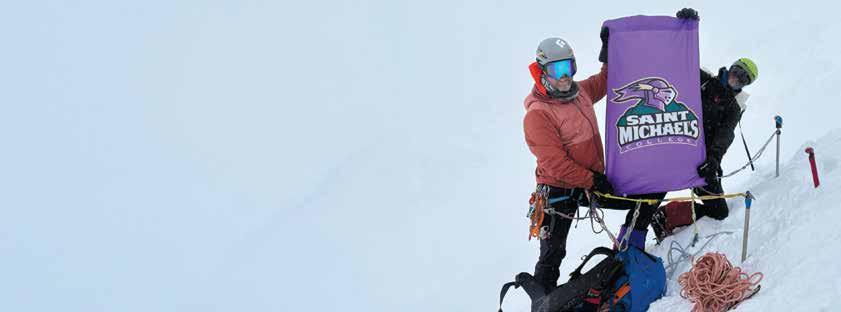
Mark Oldmixon ’04 shared about his attempted Summit of Denali in Alaska alongside Adam Thomas ’03. “While we did not make the summit of Denali, we did reach 16,000 feet and returned home with all of our fingers and toes. After reaching 16,000 on a acclimation climb, we were bogged down by bad weather for a week. In total we spent 16 days on Denali enjoying some great views and ski runs while also hunkering down hiding from the wind and cold. It was a great adventure exploring the mountains of Alaska.”
Oldmixon lives in Fairbanks, Alaska, and works at the University of Alaska Fairbanks, where he can see Denali from campus on a clear day. Thomas lives in Switzerland, where he enjoys the Alps yearround on skis and bikes.
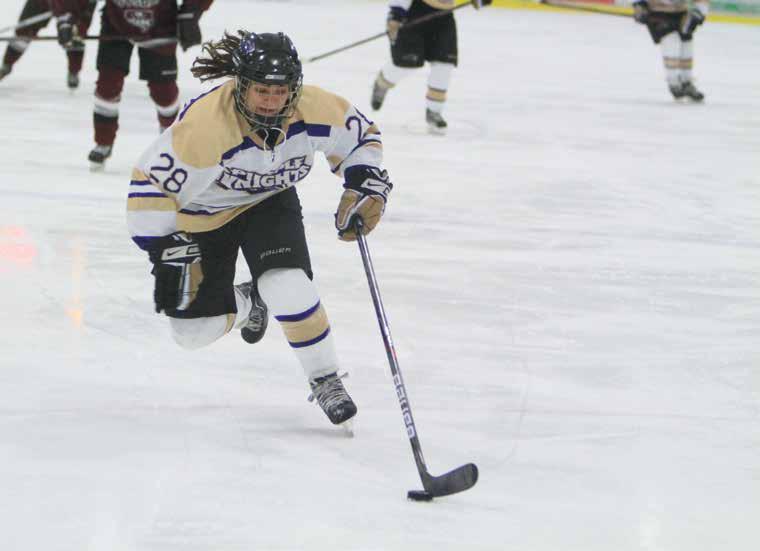
This year, Saint Michael’s College proudly celebrates 25 years of women’s ice hockey, honoring the trailblazers who helped shape the program from its start in 2000. Now led by head coach Meghan Sweezey ’10, a former player with the Purple Knights, the team continues to build on a tradition of resilience, teamwork, and pride. Competing in the New England Women’s Hockey Alliance (NEWHA), the program stands as a testament to dedication on and off the ice. Here’s to 25 years of determination, growth, and Purple Knight spirit—and to the next generation carrying the legacy forward.
Saint Michael’s College offers two new minors—Human Resource Management and Project Management—that prepare students for leadership roles in today’s dynamic workplace. The Human Resource Management minor blends business foundations with courses in recruitment, compensation, employment law, and diversity, helping students learn to build and support inclusive, effective teams. The Project Management minor develops strategic planning, budgeting, and communication skills, preparing students to manage projects across industries and pursue the certified associate in project management (CAPM) credential. Both minors complement any major and equip graduates to lead with confidence, collaboration, and purpose.
BY DECLAN MCCABE
Many graduates remember “the View” as an essential element of life at Saint Michael’s College. Whether a sunrise salutation or a moonrise was your scene, the changing faces of Camel’s Hump and Mount Mansfield have been a presence throughout the College’s history.
Saint Michael’s College and the broader community use the green opposite the Hoehl Welcome Center to appreciate Vermont’s beauty. For graduation photographs, super
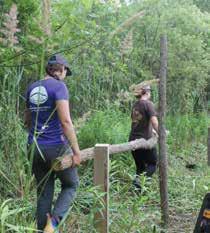
Using lumber from the tree removal, students built a fence around our “Food Forest” in the Natural Area, helping to protect it from deer.
The View in 2015.
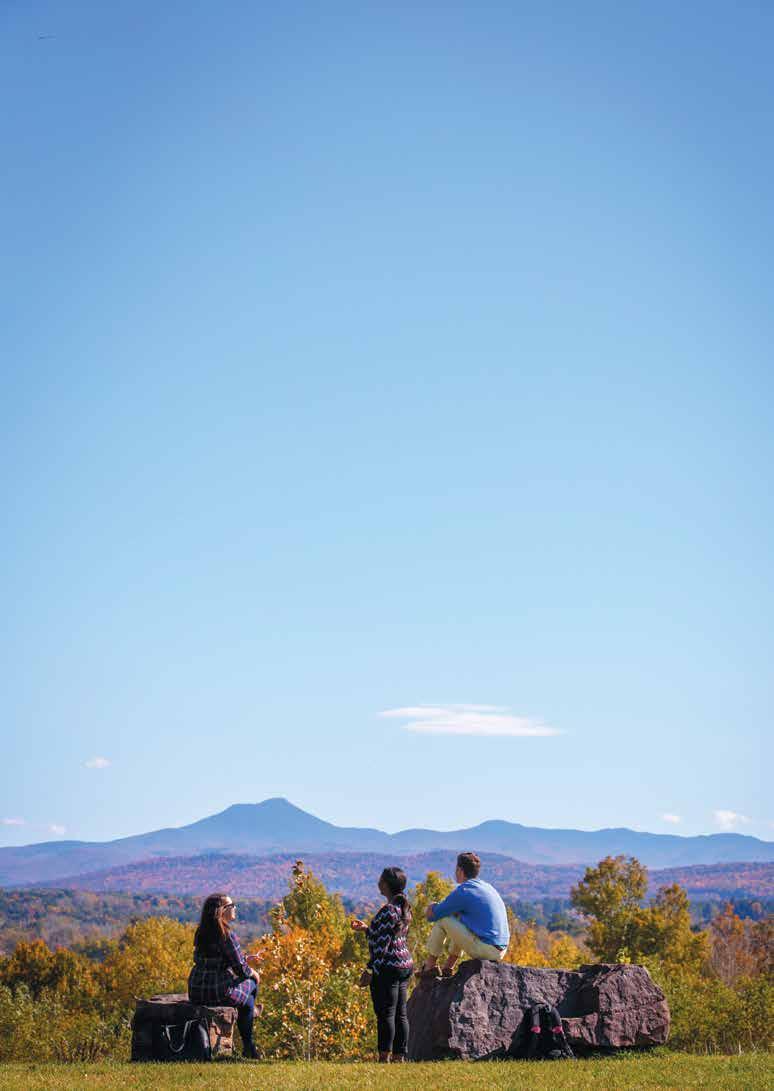
moon events, the total solar eclipse, and even wedding photography, “the View” is a go-to spot.
Recently, invasive black locust trees have obscured the Green Mountain view. Native to Pennsylvania and farther south, black locusts were planted by farmers nationwide to provide rot-resistant fence posts. The species was likely planted on the Kelly Farm long before it was purchased by the Edmundites in 1904.
Since the establishment of the Saint Michael’s College Natural Area in 2017, the Patrick ’61 and Marcelle Leahy Institute for the Environment has led efforts to plant diverse native trees on-site. Our goal is to rebuild natural food webs that nurture insects essential to sustaining thriving bird populations. And if the 193 bird species recorded to date is anything to go by, perhaps this recipe is working? In June, Professor Trevien Stanger and a team of students added 104 American chestnut trees to hundreds of trees planted since 2017.
Removing trees is not a decision we make lightly. But black locusts are invasive in Vermont, so we decided to remove them from the view while preserving spectacular specimens that grace the Merrill Cemetery. After graduation, Christopher Feloney’s team from Vermont Tree
Service cleared half an acre of black locusts from just east of Route 15.
Some of the larger trunks went directly to Sloan Hall, where Professor Brian Collier will mill them to use for artistic work. We hauled slimmer trunks for use as fence posts around the Food Forest that Anna Beech ’20 established while still a student. Still more lumber was chipped and spread by the Teaching Pavilion to suppress weed growth.
We are happy to report that once again, the spectacular Green Mountain backdrop is visible from the green across Route 15. When you visit campus, visit our Natural Area for a hike on the four-mile trail network, a bit of birding, leaf peeping, or enjoying spring ephemeral wildflowers. And perhaps pose for a selfie at “the View” with the Green Mountains over your shoulder!
Declan McCabe is a Saint Michael’s College professor of biology and Natural Area manager. The Saint Michael’s College Natural Area is devoted to conservation, education, research, athletics, and recreation and encompasses 80 percent of the Saint Michael’s College campus between Route 15 and the Winooski River.
BY ELIZABETH MURRAY ’13
Two members of the Class of 2025 will spend the next year overseas after being selected for fellowships through the Fulbright U.S. Student Program.
Jarrett Sweet of Fletcher, Vermont, will teach English as a second language in Vsetin, Czech Republic, and Patrick McGloine of Schuylerville, New York, will conduct research on macro plastics in Vietnam. McGloine is the first Saint Michael’s College Fulbright awardee to be selected for a research-focused Fulbright, said Political Science and International Relations Professor Trish Siplon.
Fulbright scholarships are highly competitive international grants given to students, scholars, professors, and young professionals to study, research, or teach overseas.
“For a small liberal arts college, I am especially proud of our continuing track record of students being selected for Fulbright awards post-graduation,” said Political Science and International Relations Professor Jeff Ayres, director of the Institute for Global Engagement.
As St. Mike’s undergraduates, both Sweet and McGloine completed international internships in Ho Chi Minh City, Vietnam, through a program funded by the Freeman Foundation. Ayres and Siplon both believe this experience enhanced the students’ applications to the Fulbright program.
“Living in another country with a specific role to play within their society is a very different experience than visiting as a tourist,” Siplon said. “Our students … return with both the desire and skills to go deeper.”
Sweet’s and McGloine’s student experiences helped prepare them for global citizenship through the Fulbright program.
“I came to St. Mike’s knowing I was passionate about environmental issues, and the Environmental Science program gave me the tools, experiences, and confidence to pursue this passion on a larger scale,” McGloine said.
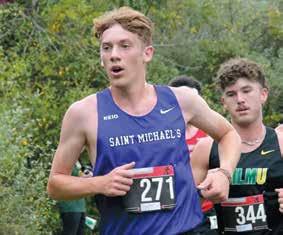
A Fulbright grant became a goal of Sweet’s after his sophomore year academic study trip to Copenhagen, Denmark. “I am most excited about teaching and meeting the students,” Sweet said. “I have found that you learn a lot about a country through their education system.”
BY RYLEE ANDERSON ’27
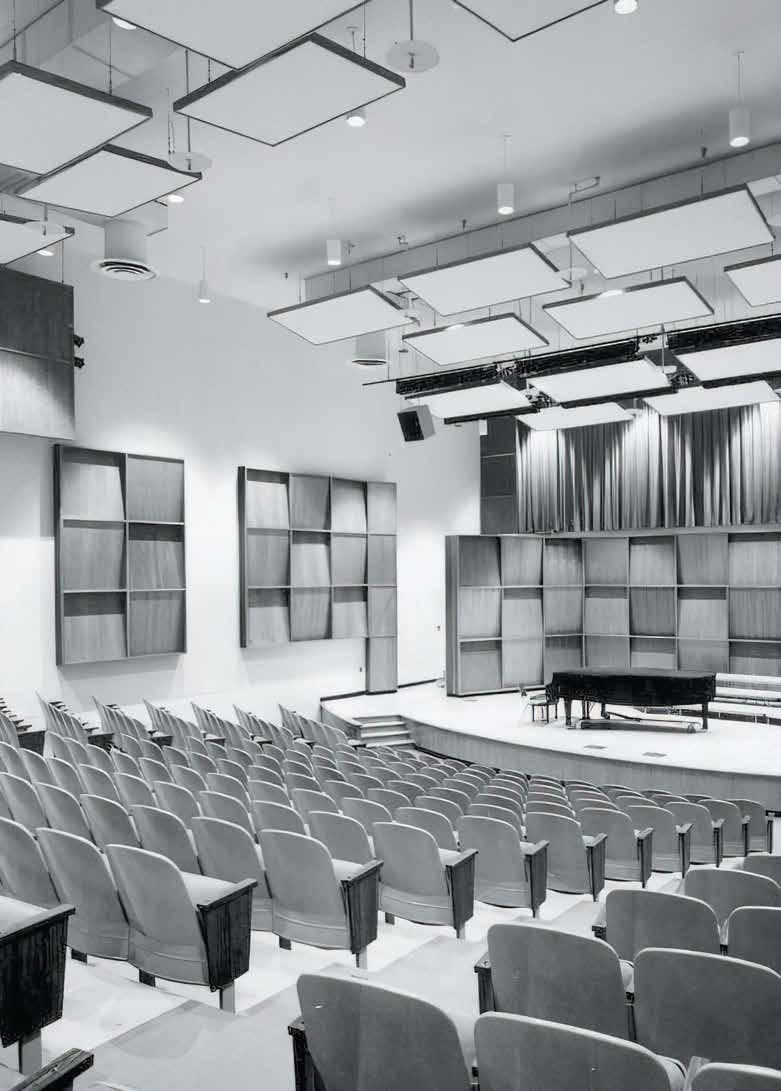
In the 1970s, Fine Arts faculty at Saint Michael’s College had an urgent need for a new performing arts center on campus. The Saint Michael’s Playhouse, founded in 1947 by Professor Henry Fairbanks, was initially located in Austin Hall but was torn down in 1960 to make way for Alliot Hall, necessitating a relocation for theatrical performances. The second Austin Hall, a surplus wooden structure from Fort Ethan Allen, burned in 1970.
After the fire, Dr. William Tortolano, who was chair of the Fine Arts Department at the time, assisted in planning the building that would later become the McCarthy Arts Center. Tortolano worked alongside Donald and Joanne Rathgeb, who had been key figures in running the Saint Michael’s Playhouse as directors, actors, and set designers.
The faculty planners had a vision for a space that would be practical and multipurpose, maintaining the high reputation of performing arts at the College. The new McCarthy Arts Center opened in 1975, and Saint Michael’s Playhouse put on its first production on campus since 1970, The Glass Menagerie by Tennessee Williams.
In September 2025, the College celebrated the arts center’s 50th anniversary. The celebration included tours of the facility, talks with professors past and present, an open house of the archives, and a memorial circle honoring music and theater alumni.
In the early days of the Fine Arts Department, all students were required to take courses in theater, art and design, and music. Those disciplines are still majors today. The College’s departments have grown and changed significantly since then, but they continue to produce well-rounded graduates who enter a variety of industries, including fine arts.
September’s Alumni and Family Weekend brought an opportunity for graduates to reconnect with McCarthy and the Fine Arts Department. A group of former students reminisced with Shakespeare scholar and English Professor Emeritus Nick Clary, along with current theater professors Peter Harrigan ’83 and John Devlin, the current resident designer and technical director.
The Fine Arts Department now offers concentrations in different areas of the performing arts and has a separate Art & Design program. The arts community remains strong—a testament to the active faculty members who continue to provide students with numerous opportunities for growth.
The building has also gone through changes. The seats have been replaced, and a lobby alcove was added in the early 2000s. Professor Brian Collier, curator and director of the McCarthy Art Gallery, enables senior Art & Design majors to put on solo exhibits of their capstone work each spring.
Harrigan said, “If you make an investment in a building like that, you need to keep up with it, and
keep improving things and changing things, and sometimes replacing things.” Harrigan, who plans to retire in 2026, said he wants the McCarthy Arts Center to be supported and used well into the future.
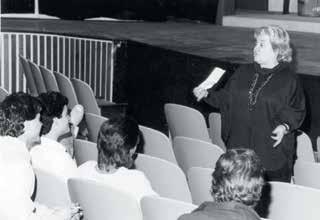
“It has always been a place of welcome and belonging, where students who perhaps didn’t fit into other aspects of campus life could find encouragement from faculty mentors, and lifelong friendships with other students,” Harrigan said. “This is one of the most enduring results of life in McCarthy, and I sincerely hope it will always be present.”
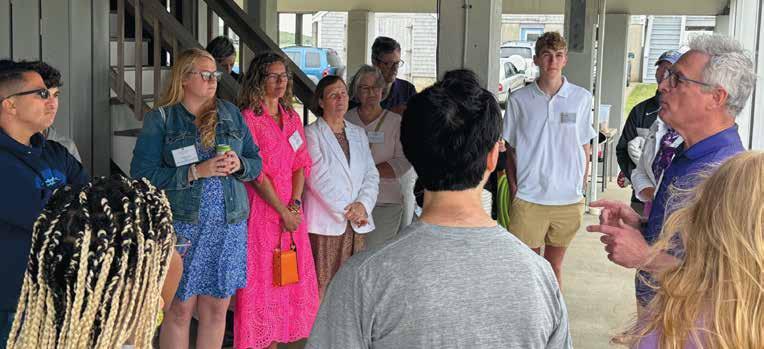
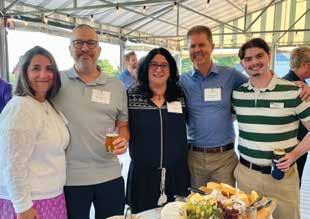
On a perfect summer evening on July 23, Ed ’63 and Susan Dilworth, along with their sons Ted Dilworth ’89 and Tom Dilworth ’93, hosted a reception for current, admitted, and prospective Purple Knights and their families at the Portland Country Club in Falmouth, Maine. Attendees heard a heartfelt reflection on the impact of his education and lifelong friendships from Ed Dilworth, juxtaposed with comments from Cassie Wardwell ’25. Ellen Kane, VP of Institutional Advancement and Communications, and President Richard Plumb also shared campus updates with the more than 40 people in attendance.
On July 27, Howie ’71 and Sue O’Hara hosted a barbecue at their home in Mattapoisett, Massachusetts, in partnership with the St. Mike’s South Shore Club. The event brought together alumni, incoming students with their families, and college leaders for an afternoon of good food and fellowship. President Richard Plumb and VP of Institutional Advancement and Communications Ellen Kane gave warm welcomes. Professor Declan McCabe and Associate Director of Athletics Annie Martin ’19 shared insights on student research and athletics. Kylee Legg ’25 spoke about how St. Mike’s prepared her for her current role with the Mercy Volunteer Corps in Sacramento, California. The gathering celebrated the St. Mike’s community and strengthened connections among the approximately 40 attendees.
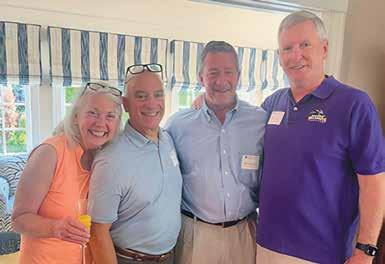
On August 3, Trish and Mark Hansen, parents to Katie Hansen ’26, opened their home in Spring Lake, New Jersey, to approximately 20 alumni and prospective students and their families. The group heard from Assistant Dean of Student Life Heidi St. Peter ’96, Rev. Brian J. Cummings ’86, and VP of Institutional Advancement and Communications Ellen Kane. The trio spoke about the special sense of belonging that students and alumni feel toward St. Mike’s that translates into not only lifelong friendships but a professional support network that boosts careers and sets graduates up for success in life.
L to R: Maureen Heilmann, Rick Heilmann ’81, Trustee Phil McGovern ’81, Rev. Brian J. Cummings ’86
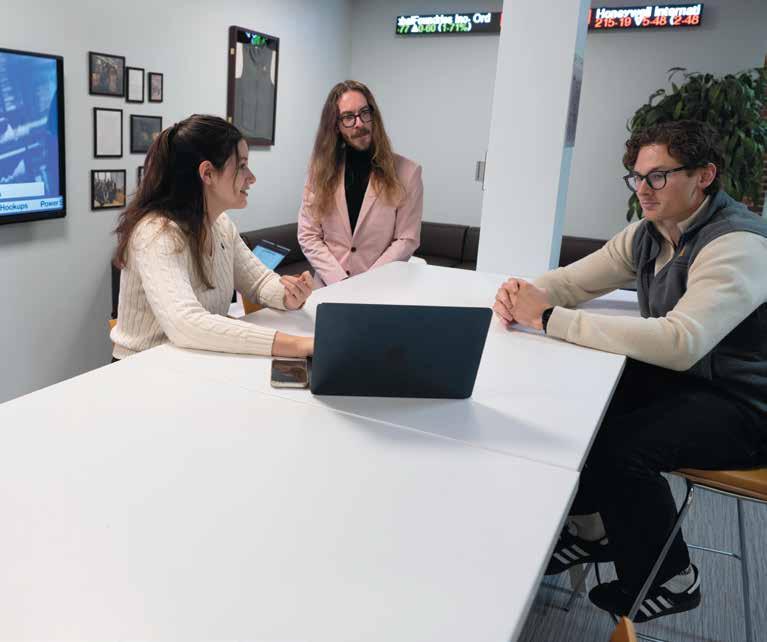
Thanks to a generous alumni donation, Saint Michael’s College created the Student Investment Fund Lounge in Jeanmarie Hall—a dynamic space featuring real-time Bloomberg News and stock tickers, collaborative work areas, and comfortable seating for portfolio analysis and strategy discussions. The lounge supports the Student Investment Fund, launched in 2024 by students interested in finance, economics, and investing. Guided by an investment advisory committee of trustees, students manage a portfolio integrated into the Business program’s Investments course and a one-credit experiential class—transforming classroom learning into real-world financial decision-making experience.
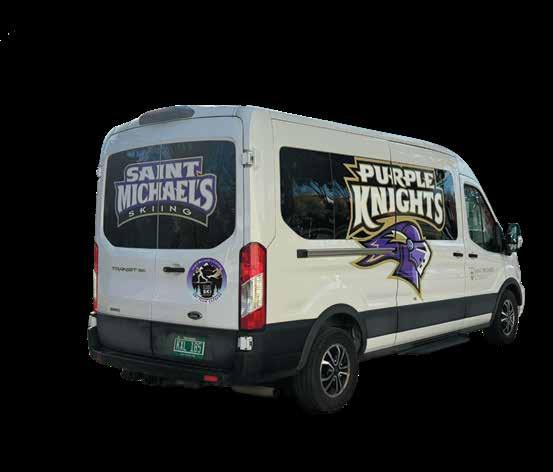
Thanks to the generous support of Tom ’69 and Denise Kelley, the alpine and nordic ski teams now have a dedicated team van to take them to daily training and travel competi tions. Unlike almost every other Saint Mi chael’s varsity program, the Purple Knight ski teams must travel a fair distance away from campus to participate in daily training and scheduled races. There is a heavy demand placed on the College’s existing van pool by the active campus, making van availability a constant concern. The Ford Transit 350 XLT passenger van is perfect for transporting ski ers and their gear—and the customized exte rior graphics will have them traveling in style. When the ski teams are out of season, the van will be available to transport other varsity programs—philanthropy in motion!
BY ANGELA IRVINE
e curious, keep your mind open, and allow yourself to be surprised.” With these words, President Richard Plumb welcomed the 2025 cohort of summer research scholars at a June breakfast. He reminded the students that “the mission of the College thrives through research.”
At Saint Michael’s, research isn’t reserved just for graduate students or professionals. Unlike most colleges across the country, Saint Michael’s offers undergraduates the chance to pursue original research alongside faculty mentors. This early immersion pays off: Students graduate with hands-on experience that strengthens their applications to graduate programs, fuels future careers, and in many cases leads to meaningful discoveries. Recent work in Professor Ruth Fabian-Fine’s lab, for example, included undergraduate contributions that advanced Alzheimer’s disease research—several students were even listed as coauthors on peer-reviewed publications.
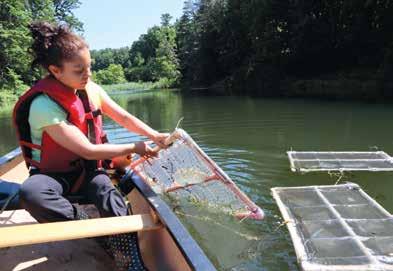
The Saint Michael’s College Summer Undergraduate Research Program is made possible by the generosity of alumni, families, and friends. Funding sources include the John J. Neuhauser Fund for Innovation and Research, the Student Undergraduate Research Fund, the Alumni Fund for Undergraduate Research, and the John C. Hartnett Fund, along with federal grants from the National Science Foundation, the National Institutes of Health, and NASA.
Each summer, students compete for coveted spots in the program. The demanding application process mirrors the rigor of professional grant proposals, preparing students for the challenges of scholarly work beyond campus. Those selected spend eight weeks living and working on campus, developing their projects under the close guidance of faculty mentors.
The range of topics is as impressive as the students themselves:
At the conclusion of the summer, the 24 scholars from the 2025 cohort presented their findings to the campus community, shared at regional and national conferences, and— in many cases—saw their names published as coauthors.
• Chloe Brown ’27 (Art & Design, Environmental Studies): Slowing Down Fast Fashion: Creating Clothes for Style and Sustainability
• Sean DeVito ’27 (Biochemistry): Survey of Heavy Metal Concentrations at the Pike Hill Mine Superfund Site
• Aidan Hall ’27 (Education Studies, Anthropology, and Music): Improving Classroom Management in a Post-Pandemic World
• Isabella Joly ’27 (Neuroscience): Investigating the Purity and Composition of Off-Market Antiviral Drugs for Feline Infectious Peritonitis Treatment
• Olivia Miller-Johnson ’28 (Digital Media and Communications): U.S. Mainstream News and Coverage of Social Media Content Moderation Changes in 2025
Together, these projects highlight the creativity, curiosity, and determination of Saint Michael’s students. They also showcase what makes the College’s research culture so distinctive: the belief that undergraduates, given the tools and support, can make discoveries that matter.
BY TINA GORSKI-STRONG
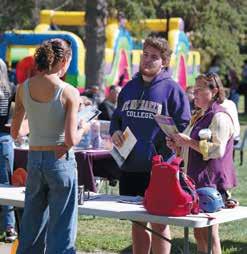
In recent years, especially since the COVID-19 pandemic, research has shown that parents desire and expect more frequent communication from the colleges their children attend.
As a result, Saint Michael’s College has embarked on a revitalized outreach effort aimed at fostering stronger connections with families. The College has made significant strides in enhancing communication and engagement by developing dedicated web pages with campus resources, information, and ways to support the St. Mike’s community. Additionally, the College has partnered with CampusESP to launch a new email communication platform. The Saint Michael’s College Hub has been introduced to keep families updated on the latest news and events on campus while allowing them to
choose the content and frequency of communication.
Over the past two years, crosscampus initiatives have focused on improving how St. Mike’s communicates with and involves families. These efforts have yielded measurable results, including a greater interest in volunteer opportunities, a 33 percent increase in current parent giving, and higher attendance at key events such as this year’s Alumni and Family Weekend. As vital supporters of the College, parents contribute to various initiatives including the Purple Knight Challenge, The Saint Michael’s Fund, and other campus priorities. Furthermore, the Excellence in Teaching initiative, launched last spring, provided an opportunity for support by the parents of the Class of 2026.
BY TERRI SELBY
“Grateful to Uncle Sam for the GI Bill, which allowed me to attend [Saint Michael’s], receiving a student activity award for assisting in establishing the college band, great friendships with so many lifelong friends, and the fine priests who guided and directed us so well.” This is what John Carbonneau ’51 said when asked what was his most memorable experience at St. Mike’s during his 50th Reunion.
For Carbonneau, a native of the Northeast Kingdom, a college education was not in the plans. He went on to have a long career with the American Cancer Society in Florida, retiring as vice president for medical affairs in 1986. He was
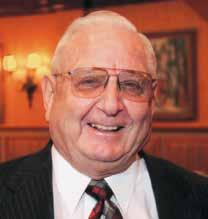
most proud of having helped create ROCK (Reach Out to Cancer Kids) Camp, the first camp in the country for children with cancer, and coordinating construction of the first Hope
For more information, please contact Tina Gorski-Strong, major gift officer and family giving, at tgorskistron@smcvt.edu or Stephanie Snell P’28, director of communications and alumni relations at ssnell2@smcvt.edu.
Lodge built specifically to house patients without charge while they received treatment for cancer away from home.
When the time came to consider their estate plans and philanthropy, Carbonneau and his wife, Elaine, didn’t hesitate to include St. Mike’s. He attributed much of his success to the education he received on the Hilltop, so they felt it fitting to give back. This year, upon Elaine’s death, the College received approximately $135,000 for unrestricted scholarships. Now, thanks to the Carbonneau family, more students will be able to come to St. Mike’s and receive a top-quality, private, liberal arts education just as Carbonneau did.
$8 million Raised in Gifts and Pledges
3811 Total Number of Donors
800 Reunion Attendees
$3.2 million Available in Named Scholarships
352
$427,000 Raised through Purple Knight Challenge 32% Participation Rate, Parents of Current Students
400 Alumni and Family Weekend Attendees
Thanks to the incredible support of our community, Fiscal Year 2025 saw fundraising records made—with an overall 145% increase in cash giving! We are deeply grateful for the outpouring of Purple Knight love, especially during a time when our students need it most.
56% INCREASE IN ANNUAL GIFTS
Gifts to the Saint Michael’s Fund rose by 56% compared to the previous year, empowering the College to respond to immediate priorities and bridge financial gaps for students who depend on aid to pursue their education.
20%
INCREASE IN WILL INTENTIONS
This year, there was a meaningful increase in Heritage Circle members—alumni and friends who have included Saint Michael’s in their estate plans. By documenting a planned gift, donors allow the College to honor their generosity today and build a foundation for tomorrow.
Learn more: plannedgiving.smcvt.edu
SUSTAINING EXCELLENCE AND ACCESS REMAINS A HIGH PRIORITY
The College’s endowment continues to provide a stable, enduring source of funding for student financial aid, academic programs, and research. With more than 300 scholarships already established, donors have the opportunity to enhance an existing fund or create a named scholarship that supports future generations of Purple Knights.
Explore scholarships: smcvt.edu/giving/scholarship-funds
THANK YOU
Every dollar, every donor, every act of generosity strengthens Saint Michael’s College.
Together, we are building a brighter future—one student at a time.
With gratitude,
Ellen Kane VP of Institutional Advancement and Communications
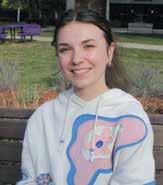
“Without the financial support I’ve received at Saint Michael’s, I wouldn’t be able to continue my passion for learning or apply that knowledge to give back to my community. My goal is to lead a life filled with compassion, caring, and understanding for all life on this planet.”
— ABIGAIL GUIDA ’26
Your generosity ensures that students like Abigail Guida can grow, explore, and thrive at Saint Michael’s.
MAKE YOUR GIFT: SMCVT.EDU/GIVING
START YOUR PLAN TODAY, COURTESY OF ST. MIKE’S
St. Mike’s is proud to offer Giving Docs, a free and secure online tool that makes it easy to create your will. Give yourself and your loved ones peace of mind knowing that your wishes will be honored.
If writing your will has been on your to-do list, now is the time to act. Join the more than 200 members of the Heritage Circle, the legacy society of Saint Michael’s College, and create your estate plans now.
CREATING YOUR WILL WITH GIVING DOCS IS SIMPLE
• Visit GivingDocs.com/SMC to create your free account
• Follow the step-by-step instructions to create your will (and more!)
• Review and print your will and other documents
• Refer to the instructions provided to make your plans legal
“I used the Giving Docs platform to formalize my will.
There was no obligation to include St. Mike’s in my estate, that was just a choice I made because I really enjoyed my college experience. Using Giving Docs to write my will was easy. It was easy to follow and include what I wanted and omit what I did not need. It is a great feeling having my will done and notarized.”
—NOLA URBAN ‘81, HERITAGE CIRCLE MEMBER SINCE 2024
If you’ve already included Saint Michael’s College in your plans, please let us know so we can welcome you to our Heritage Circle and properly thank you. FOR MORE INFORMATION CONTACT: Carla Francis Planned Giving Coordinator 802.654.2618, cfrancis@smcvt.edu
HAVE YOU SEEN US?

TBY APRIL BARTON
he phrase may be new, but it’s a concept more than 120 years in the making—defining what makes Saint Michael’s College so special.
It envelops the past, captures the present, and heralds the future.
This fall, the College is embarking on new ways to reach prospective students—whose imprint will also become part of the St. Mike’s story. How do we find them—these like-minded
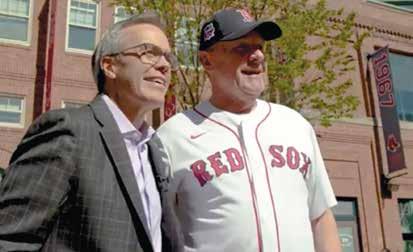
“St. Mike’s exposed me to opportunities I never expected to have in my lifetime. They didn’t only expose me to those opportunities, they made me believe I could do something with those opportunities.”
—TOM CARON ’86 RED SOX ANNOUNCER, NESN
students who will flourish here and who are ready to go on this journey?
That’s where the St. Mike’s Way comes in. We’ve asked Saint Michael’s College community members past and present to reflect on what the St. Mike’s Way is to them. While the stories may be unique to the person, the pattern is one in which certain themes rise to the top: purpose, belonging, achievement, service, creativity, personalization, boldness, curiosity, perseverance, compassion, adventure, connection.
We’ve captured some of these stories on video—you might see a piece featuring prominent alumni at Fenway Park, underwater in an aquarium, on Capitol Hill, or at the Golden Dome. Plus, our current students, faculty, and staff share how they have done extraordinary things or explain how even the everyday can be extraordinary at St. Mike’s.
We’re incorporating these stories into print pieces, showcasing them through a new social media push, and putting them on the web, as well.
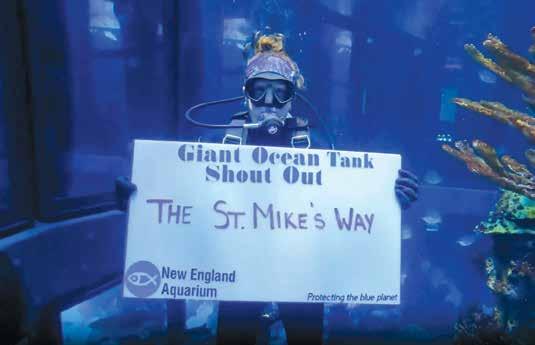
“I was looking for something to broaden my horizons. And so the [study abroad] program I chose was … in Turks & Caicos. There’s a marine resource center on South Caicos, which is the smallest island. Essentially the ocean that was right there was my classroom.”
—LINDSAY PHENIX ’14 SENIOR AQUARIST FOR NEW ENGLAND AQUARIUM
The St. Mike’s Way also captures the mission of making a Saint Michael’s College education affordable and accessible to those who want it. We’re currently rolling out new tuition and scholarship initiatives that simplify the financial aid process for families through the Flagship Match, Free Tuition Vermont, Commuter Commitment, and International Student Scholarship. These programs are designed to be an attractive option for families who may not have realized that a St. Mike’s education is within their reach.
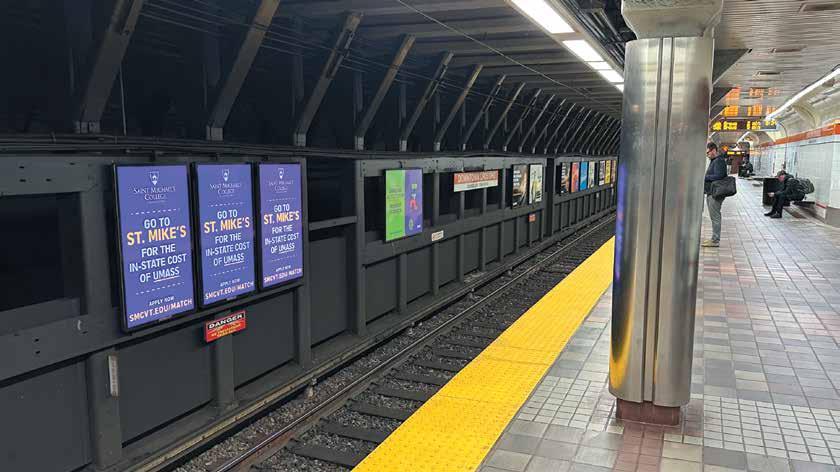
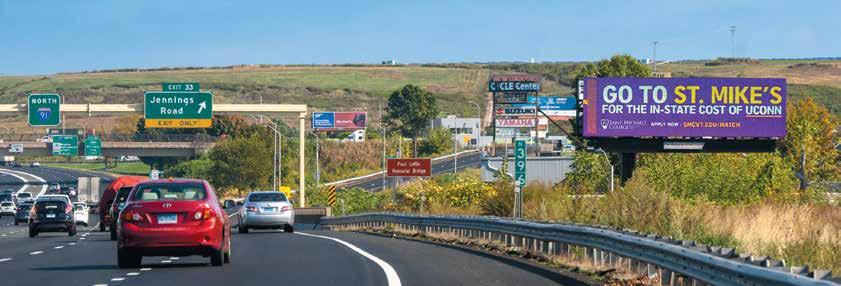
Look for advertisements on social media, in the mail, in commercials,
on billboards in regional states, and even on bus-wrap ads traversing Boston.
We’re extending our reach because we believe in Saint Michael’s College and how it can be truly transformative in the lives it touches.
It’s the St. Mike’s Way.
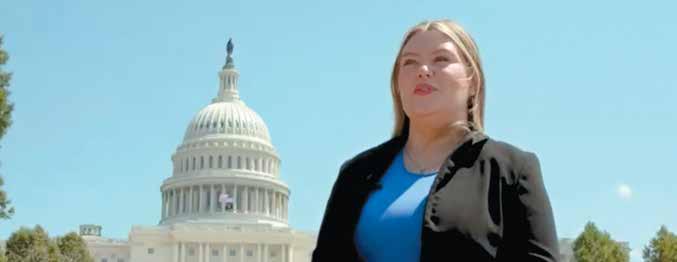
“I just graduated from St. Mike’s: Class of 2025. And now, I work for Senator Bernie Sanders as a part of the minority staff of the HELP (Health, Education, Labor, and Pensions) committee in the Senate. Success to me means leading through action, and that’s something that I have the opportunity to do every day here on Capitol Hill. And I think that’s really what the St. Mike’s Way is.”
—JAMIE COLLINS ’25, OFFICE OF SENATOR BERNIE SANDERS
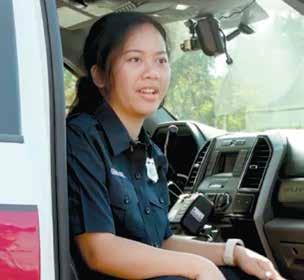
“This is not theoretical, this is not in a classroom. We’re actually responding to people who are in desperate need of help. And we use every skill that we can, just like any normal service.”
—SHANE GERALDEZ ’27, RESCUE SQUAD
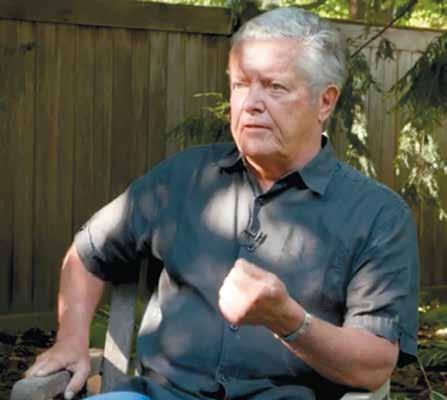
“It’s a small school, but it’s a mighty school because the professors there are so good. The classes are small. You’re not going to be just a number. That was a vital part of how my career progressed. It all started at St. Mike’s.”
—TOM BOWMAN ’77, PENTAGON REPORTER FOR NPR
“A really important aspect of a Catholic liberal arts education is going on and being something that is bigger than yourself. And, I think for me, I certainly spent my life in an organization where I felt [that]. It’s about service and ... I think that is very consistent with the values and experience that I had at Saint Michael’s.”
—GENERAL JOSEPH DUNFORD ’77, RETIRED CHAIRMAN, JOINT CHIEFS OF STAFF
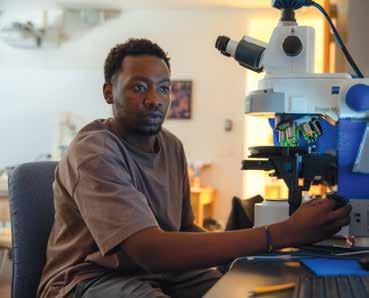
“St. Mike’s creates an environment where every person has a place. They create space for you to discover your true self. Then they help you push your boundaries to see who you can become.”
—NICK WRACKER ’26
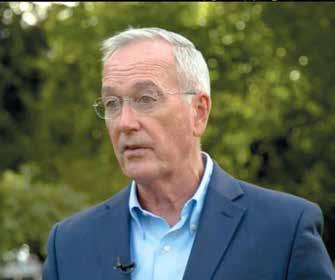
“If you look at the opportunities St. Mike’s presents, you’ll understand that you can do anything you want here. It’s all available and organized in a way to help you achieve. Look at me as an example: I came to St. Mike’s as a kid from Africa and I’ve achieved so much. I’m a certified EMT in Fire and Rescue, I’m the basketball team manager, and I did research in the rainforest of Costa Rica. Everything you do at St. Mike’s presents more opportunities. As the basketball manager, I even attended the Sweet 16. I never thought I’d do that!”
—LUWAGO K. KIPINGI ’26
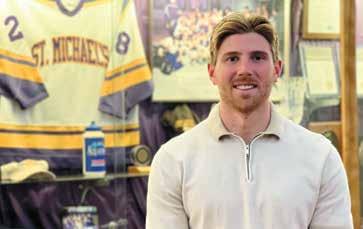
Discover the St. Mike’s Way and hear from the people who live it every day — in classrooms, on campus, and beyond.
WATCH: smcvt.edu/stmikesway

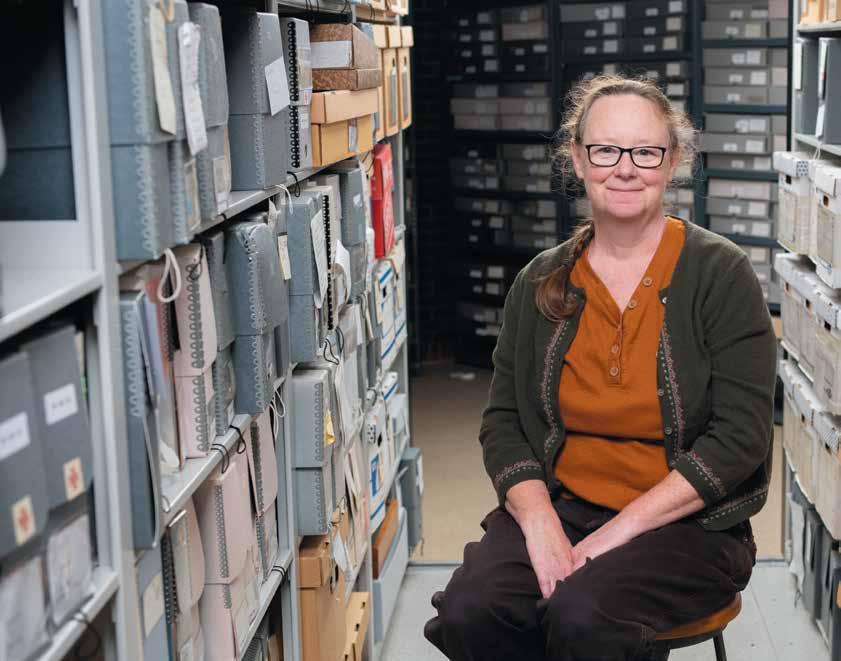
LIZ SCOTT
What’s the most surprising item you’ve come across in the Saint Michael’s archives?
I think that I am surprised that I am still being surprised by what I find—in boxes I have looked in multiple times, I will come across something that I now understand a little better, or that I never realized the significance of.
Approximately how many items—documents, photos, artifacts—are housed in the archives?
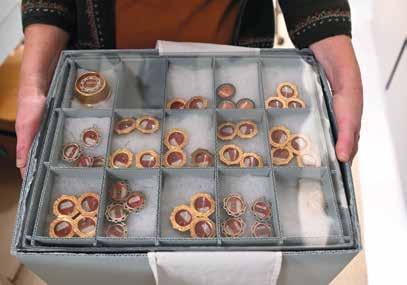
I really cannot say how many items we have. Unlike the library or museums, archives are made up of collections of materials rather than just items. We have hundreds of collections, but some might have 50 folders and others might have 500. There are tens of thousands of photos, only a portion of which have been scanned. Hundreds of audio and video materials—ranging from reel-to-reel to Betamax to DVD. And plenty of things like T-shirts, sports trophies, blueprints….

Can you walk us through the process of how something becomes part of the archives?
Things come to the archives in many different ways. There are official records I collect regularly, such as campus publications and certain meeting minutes. If people are retiring or if there is a big move happening on campus, I will reach out to see what there is. Campus materials are usually arranged [in the archives] according to the office of origin, so I make sure I know what is coming from where. People with something to donate might contact me and see if we are interested, but sometimes things just get sent in the mail or dropped off in the library. Anything really works, but it is important to know who is donating something, so I can make sure that our recordkeeping tracks. It is not super often that I turn down a donation from an alumnus, although I don’t usually take yearbooks or campus publications, since I have multiple copies. Once we decide to accession something, I make sure that I have appropriate storage for it and that it is accessible along with other materials. In the case of most modern digital
materials, I need to make sure that access to the digital items is possible and that they will be accessible for the long term, which is quite different from making sure a piece of paper is available. I am not sure I have had any alumnus offer to donate something “born” digital though.
What do you personally find the most fascinating about working in the archives?
I love the stories. And, I love being able to provide information and items that spur those stories.
Why is archiving important to the history and legacy of Saint Michael’s College?
Keeping the materials from the past is essential to understanding it. That is true on many levels. But in the case of Saint Michael’s, I think the archives helps connect people to the broader community. For instance, just this past homecoming I had people from five different decades of Saint Michael’s notice the Founders Hall sign that now hangs in the Archives Reading Room. They wanted pictures and then proceeded to talk about both the building but also how it shaped their memories of St. Mike’s.. The connections were strong, even though their own particular experiences were different.
What kinds of materials do people most often come to you looking for? Alumni? Students? Faculty? Sometimes people do ask for something specific—photos are always of interest to students and alumni, and I often get asked for information about a particular person or particular event. I have certainly been asked by faculty and administration for minutes of meetings or details of events. But most often people are trying to answer a question, and I work to help them find the answers using archival material.
Do you have a “hidden gem” or favorite piece that you wish more people knew about?
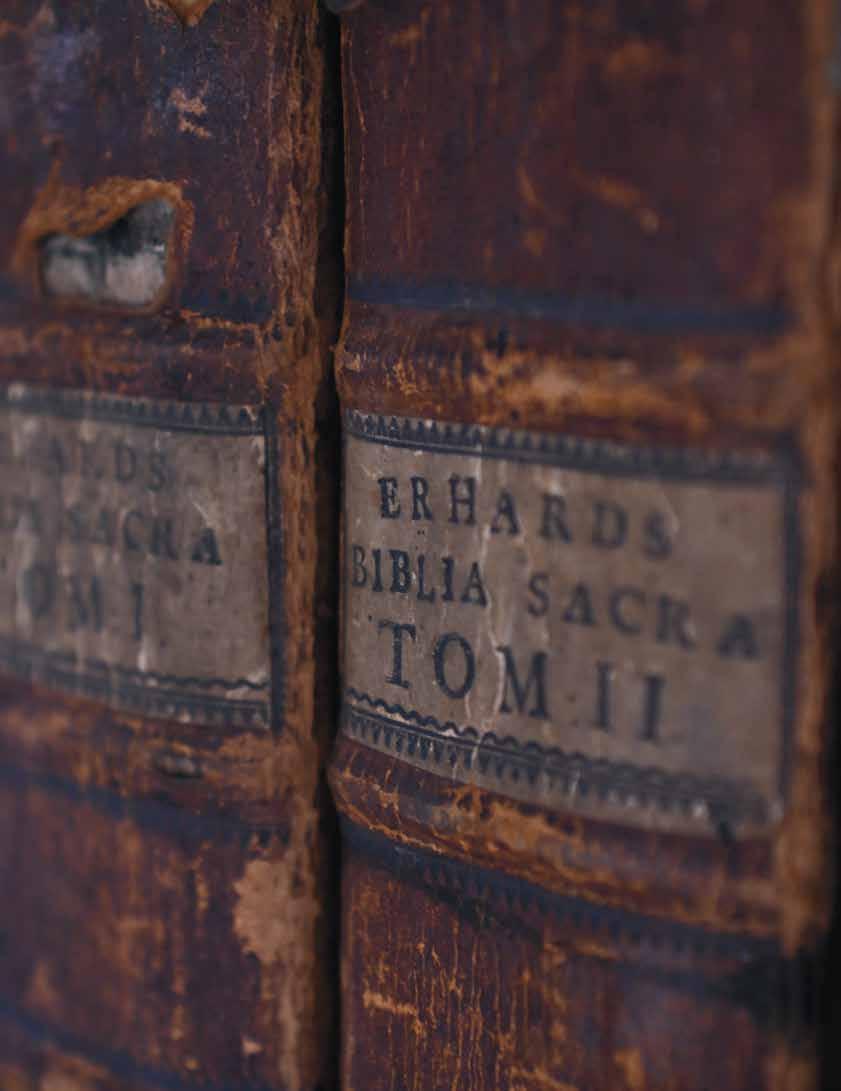
There is a book of etchings by 17th-century printmaker Jacques Callot. He made a lot of innovations in printmaking techniques and is pretty famous for a series called “The Miseries and Misfortunes of War.” The volume is pretty much just prints and a few catalog descriptions of some of the pieces—it was not published in any way. It seems to be one of a kind. For years I wondered where it came from—I assumed it must have come from the Edmundites because it was French (and most of our very old books have some association with the Edmundites). But last year, as he was on campus putting together an exhibit of Cy Sloane watercolors, Terry O’Brien ’72 mentioned that Cy used to have a lot of really random
and wonderful things, like a book of etchings…. When he said that I was so excited to finally discover how it had come to Saint Michael’s (even if I still know nothing about who collected the items in the first place and how and when they were bound together).
How do you preserve fragile or aging items to make sure they last for future generations?
That depends on the items—you treat paper differently than film, which is different from a photo or T-shirt. For some things it might be something proactive—for instance, we once worked with some conservators to repair a map of the gardens at Pontigny—they stabilized it, cleaned it, and made repairs using special tools and papers. But that level of intervention is unusual. Usually we will provide a stable storage container and house in
“I love the stories. And I love being able to provide information and items that spur those stories.”
the archives stacks, which is a stable environment. That makes a huge difference for most items. We scan some items to provide access to many more people while protecting the original. We try not to limit access too much, since the archives are a resource, not a storage facility.
Has technology changed how you do your work? Are there digital archives or online collections available now?
Of course. Technology makes it so much easier for people to access and document things, but it is vitally important to be deliberate and consciously save things. If we don’t, they will not be accessible. In the past, if you came across a box of letters and photos in your attic, you could probably figure out what it was even if it was 100 years old. That is not true at all of the floppy disk that holds stuff from 2002. As for what is available—there are about 10,000 photos available online (out of maybe 40,000), and yearbooks and student newspapers up until about 2018 are online. The college catalogs/bulletins are also available (up until the early 2000s).
If the archives could “tell a story,” what story about Saint Michael’s would it tell?
I don’t think it could tell a story. I think the archives helps stories stay accessible for those who come looking for them.
What’s the quirkiest thing you’ve found in the collection? I really like the International Dome Symposium stuff from 1980—it was in the midst of the energy crisis and there was a big conference on campus. Renowned architect and futurist R. Buckminster Fuller spoke, and it was very well attended. People might remember there was talk about putting a dome over the city of Winooski, but there was also talk about putting one over campus.
If you could add one dream item to the collection, what would it be?
Images of campus and the community from any graduate’s phone between 2008 and now. Modern digital images are really scarce.
What advice would you give to someone who wants to start preserving their own personal history?
Label photos. Name digital files and store them someplace you will have access to. Be proactive—don’t just assume things will be there and that someone is going to remember why it was important to save.
Also can you share how long have you been archiving history with Saint Michael’s College and/or how you have found yourself in this role.
I have been here since September 2001. After spending a long time out of New England (South Dakota, Oregon, and Kentucky), I was seeking a way to come back east and keep working as an archivist. This job was not only in Vermont, but the combination of small liberal arts college and work with the Edmundite records was an amazing fit (I have a master of arts in religion, as well as a master of science in library science).
BY TERRI SELBY
At the Purple and Gold Gratitude Reception on Alumni and Family Weekend, the Lovelette family was recognized as one of the most extensive legacy families in the history of Saint Michael’s College, with four generations of Purple Knights.
Tim Lovelette ’75, P’03, G’29 reflected on how that came to be. Tim’s father, Marshall Lovelette ’50, was a first-generation college student who took advantage of the GI Bill. As Tim wryly noted, this posed a challenge to the school because returning war veterans were not comfortable with the school’s rules and regulations regarding curfews and other issues.
“The vets had plenty of experience with alcohol and I’m sure that some had enjoyed close personal relationships with women. Fortunately, the Edmundites were able to adjust and things worked out,” said Tim. “My class also presented a challenge as the drinking age had just been lowered to 18. Again, adjustments were made and things worked out fine, I think,” he laughed.
Things did work out just fine as Tim graduated with a degree in Philosophy and joined his father in the insurance field. Tim’s daughter, Amy, followed in her father’s footsteps. She graduated in 2003 and, like her father, created a strong group of lifelong friends. Together they hosted several St. Mike’s alumni gatherings on Cape Cod. Parents of current students were always included as well. Tim said, “I pointed out to the parents (especially of first-year students) that they will notice changes in their kids and will always appreciate the value of the St. Mike’s education. This is a result of the College’s approach to living and learning. I refer to St. Mike’s as a ‘miracle in the mountains.’”
Perhaps another miracle occurred as Anna Lovelette ’29 shared that when she was first looking at colleges, St. Mike’s was not on her radar screen. When she did apply, she kept it a secret from her grandfather and aunt. Her voice thick with emotion, she explained that she idolized her grandfather and didn’t want to disappoint him if she didn’t get in, but after coming to campus for a tour with her parents, she knew St. Mike’s was the college for her. “She couldn’t stop smiling,” said her parents.
Tim sums it up this way: “All four of us came to St. Mike’s for different reasons. That speaks well of the College and its ability to move with the times and continue to provide a first-rate education.”
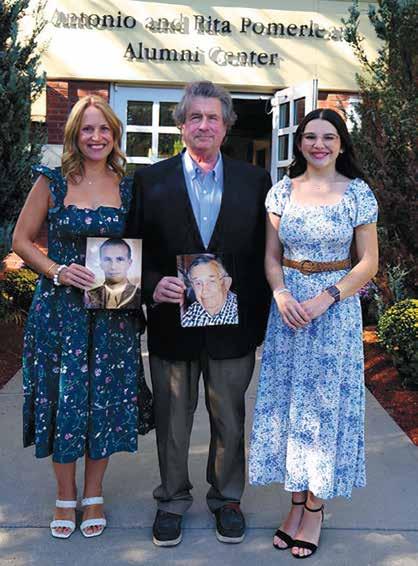
Four generations of Lovelettes.
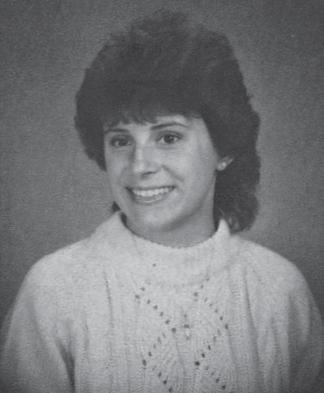
“I have been volunteering since I was in the seventh grade. I volunteered with the CYO at my church and taught religious ed classes. At St. Mike’s, I volunteered with MOVE as one of the first volunteers to Venezuela. I also assisted immigrants, escorting them back to campus from the Canadian border. I was also a Eucharistic Minister while at Saint Michael’s.”
—KIMBERLY SMITH HENNE ‘88
“I was an EMT with Saint Michael’s Fire and Rescue. The fellowship, experiences, and challenges gave me confidence, faith, and a host of friends that I have to this day.”
—SUSAN RICCIO MURAWSKI ’78
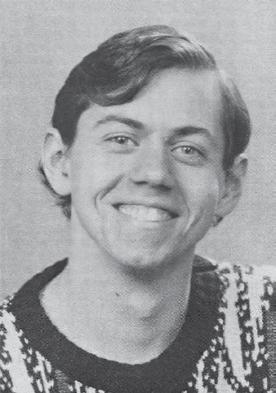
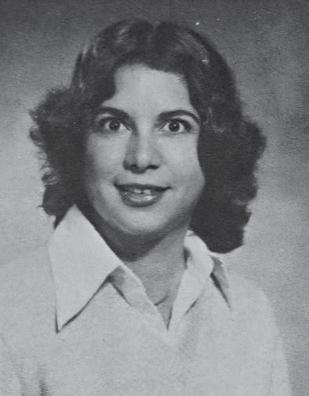
“Volunteering with MOVE, especially through the prison volleyball program, helped me realize and begin to understand my privileged place in the world. Upon graduation I took advantage of this privilege to embark on a year of service through VISTA, soon to become a part of AmeriCorps, which turned into two years as I extended my service.”
—MIKE REIDERER ‘93
“Volunteering at St. Mike’s impacted my life immensely. Getting involved with the MOVE office helped me to make new friends and also strengthen my relationships with many of the friends I still have now, nearly 15 years after graduating. Whether it was participating in After School Games in Winooski, attending correctional volleyball, clearing hurricane-damaged trails in Texas, or building a house in the Dominican Republic—all of my volunteer experiences through St. Mike’s were critical pieces of my college experience and my education outside the classroom. MOVE also provided me with the most incredible mentors—Heidi St. Peter, Jason Moore, and Erin Bodin—who motivated, inspired, and pushed me. Many of the choices I made and activities I got involved in, both in college and after, were impacted directly by Heidi, Jay, and Erin.”
—SARAH REGAN DEWEY ’11
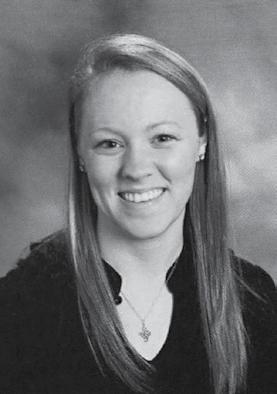
For many alumni, the volunteer experiences at Saint Michael’s defined their student years. A few graduates recall how their service created a legacy of compassion, teamwork, and connection that continues to resonate in their lives.
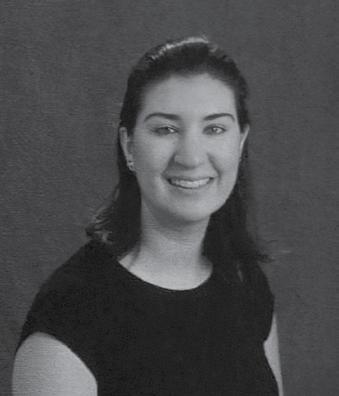
“As a senior, I went on an extended service trip to Immokalee, Florida, where we volunteered with Habitat for Humanity and a local school in a community of migrant farmworkers. I had previously done my internship with Migrant Justice here in Vermont and got to learn how Migrant Justice’s workerdriven food justice program was modeled after the worker coalition in Immokalee. It really brought together the concept from MOVE of “think global, act local” because we have human rights/social justice issues here in Vermont and we can learn ways to help our local community by looking to our neighbors for how they are organizing.”
—MEGHAN VANSTRY ‘17
“Volunteering provided me with a better sense of a world beyond my college life. It added to my sense of community.”
—MELISSA GRASWALDSECCARECCIA ‘95
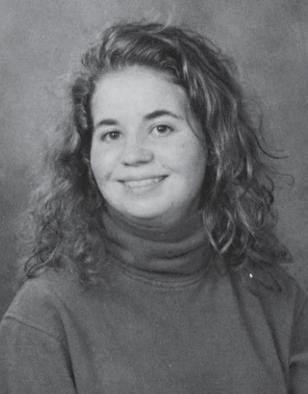
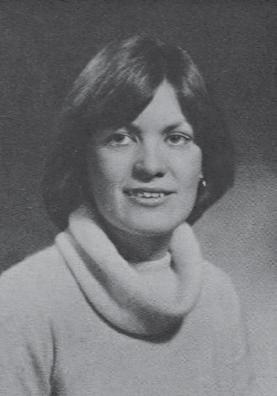
“While a student at St. Mike’s, I volunteered at a local nursing home making regular visits to a woman who had no local family. It was an eye-opening experience for a 19-year-old who could not imagine herself at the age of 80. I am so encouraged to see the level of participation among college students today vs. the late 1970s.”
—VIVIANE KENNEDY BRIGGS ‘78
BY REV. DAVID THEROUX
At Saint Michael’s College, rooted in the tradition of the Society of Saint Edmund, we take seriously the call to build a more just and compassionate society. This call is greater than idealism. It is a commitment grounded in the Gospel and in Catholic Social Teaching, which holds up the dignity of work and the rights of workers as one of its central principles. And yet, in our daily conversations about poverty, need, and assistance, we often rely on an all-too-familiar but inadequate tool: the federal poverty line.
intended for young men caught in poverty. In addition, it was a practical guide, used to qualify students for free or reduced-price meals. But even then, I recognized its limitations. Developed in the 1960s, based on food costs and adjusted only for inflation, the federal poverty line does not account for the dramatic rise in costs for housing, healthcare, child care, or transportation. Nor does it reflect the reality that these costs vary greatly by region. Vermont, for example, has higher housing and heating costs than many other states, but the same poverty line is applied across the country.
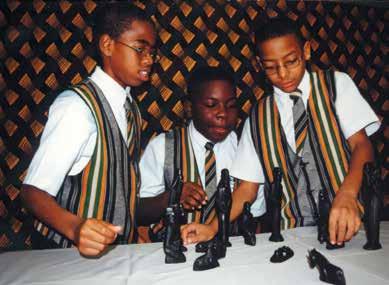

During my years as principal of a tuition-free middle school for African-American boys in New Orleans, we used the poverty line to determine financial eligibility to attend a school
Even many families earning above the poverty line still cannot afford to meet basic needs, and this line, though convenient for policy purposes, fails to measure what is required for a life of dignity. It defines poverty in terms of survival, not in terms of social participation or human flourishing. That gap between statistical poverty and real-life hardship is where the Church’s wisdom becomes urgent.
In Rerum Novarum (1891), Pope Leo XIII addressed this issue directly:
“Let it be taken for granted, therefore, that remuneration for labor must be enough to support the wage-earner in reasonable and frugal comfort. If, through necessity or fear of a worse evil, the workman accepts harder conditions because an employer or contractor will afford him no better, he is made the victim of force and injustice.” (Rerum Novarum, §45)
This foundational teaching insists that wages must support a life of dignity, not merely subsistence. A just wage is not determined solely by what the market can bear or what an employer is willing to pay. It is measured by what is necessary for a person and that person’s family to live securely and participate fully in society. Yet today, a person working fulltime at minimum wage in Vermont, or nearly any other state, often cannot afford safe housing, healthcare, or child care.
The Society of Saint Edmund understood this truth not only in theory but in practice. In the 1930s, the Edmundites extended their ministry to Selma, Alabama, and the surrounding rural areas, where Black sharecroppers and their families lived under generations of economic and racial oppression. The Edmundite Southern Missions began not simply by offering charity but also by standing in solidarity with the poor: creating schools, advocating for civil rights, providing food and clothing, and insisting that dignity required more than survival.
Their commitment continues today as Edmundites work to support Black farmers, promote food security, and walk with those who are economically marginalized. They embody the Church’s belief, rooted in the dignity of the human person, that no one should be left behind because the “official” poverty line does not reflect the true cost of living.
The U.S. bishops echo this in their 1986 pastoral letter Economic Justice for All:
“Every person has a right to life and to the material necessities that are required to sustain it: food, shelter, clothing, health care, education, and employment.” (§80)
“Wages must honor the dignity and worth of the person. They must be at least sufficient to provide adequately for the needs of the worker and his or her family.” (§103)
Here in Vermont, where rural poverty, housing costs, and underemployment often go unrecognized, this teaching matters. And it matters to us as a Catholic college community of educators, staff, students, and alumni who prepare students for vocations in which the dignity of every person is a starting point for action. We are called to imagine something more than a poverty line; we are called to imagine a living wage. A wage that allows people not only to survive but to grow, to rest, to raise children, to contribute, to hope. This is not simply an economic issue; it is a moral one. As Pope Francis reminds us in Laudato Si’:
“Business is a noble vocation, directed to producing wealth and improving our world. It can be a fruitful source of prosperity for the areas in which it operates, especially if it sees the creation of jobs as an essential part of its service to the common good. ... The broader objective should always be to allow other peoples a dignified life through work. A just wage enables them to have adequate access to all the other goods which are destined for our common use.” (Pages 128 and 129)
It is important for us, as members of a Catholic and Edmundite college, to engage deeply with questions of justice and economic dignity. Minimal thresholds like the federal poverty line should not be mistaken for moral standards. It is important for us to recognize the difference between policy tools and ethical imperatives, and to insist that public discourse and institutional practice reflect the full dignity of the human person. In continuing the legacy of the Edmundites, who have stood with the poor in both the North and the South, it is important for us to examine how economic systems measure human worth, and to challenge those that fall short of justice.
Rev. David Theroux, SSE ’70, vice president of Edmundite Mission, regularly shares reflections in his weekly blog, which can be found on the Saint Michael’s College website at smcvt.edu.
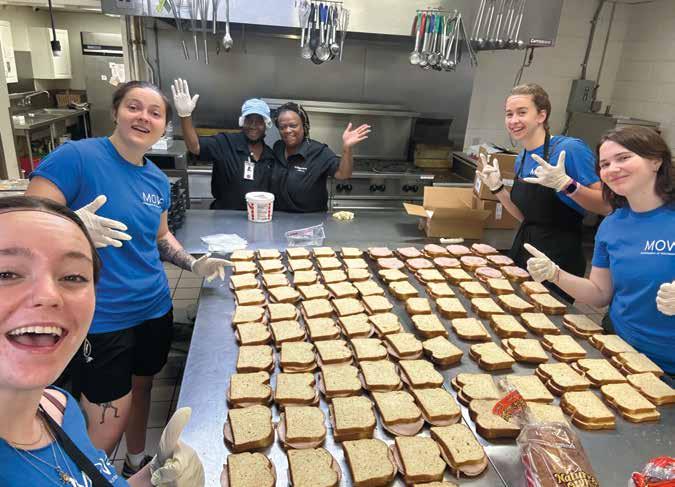
Some don hairnets and latex gloves to make 500 turkey sandwiches each morning for those who might otherwise go hungry
BY APRIL BARTON
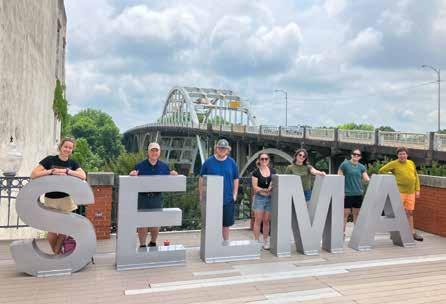
Six students and a staff leader from Saint Michael’s College took a May service trip to the Edmundite Southern Missions in Selma, Alabama.
The Edmundites who founded Saint Michael’s College in 1904 also established the Edmundite Southern Missions in 1937. The missions were key sites during the Civil Rights movement, providing food, medical care, and safety for Black Americans as well as a place to mobilize for voting rights.
Despite federal policy changes over the past 60 years, racial segregation persists. Many white children in the area attend private schools. The Black community makes up
most of the public schools, where only 7 percent of students are proficient in math, and 40 percent of children in Selma are impoverished.
The Southern Missions provide a variety of free services to the local community: The Bosco Nutrition Center provides 1300 meals a day on site and delivers 600 more to the homebound community. The boutique offers clothes and household items. The Bullock Recreational Center is a community hub and safe space as well as an air-conditioned day spot for the unhoused. The academy provides tutoring and college preparatory help, including college visits.
Saint Michael’s College started sending students to Selma in the early 1990s, according to Lara Scott, director of Mobilization of Volunteer Efforts (MOVE). The unique relationship connects two very different communities 1300 miles apart, united in the purpose of helping those in need.
In addition to preparing, serving, and delivering meals for the missions, this year’s participants worked in the garden and cleaned windows at the recreation center; organized donations of clothing, housewares, and furniture; cleaned the boutique; unloaded boxes at the warehouse; and provided tutoring assistance at the academy.
Chris Kenny ’86 in the College’s Office of Institutional Advancement was the staff leader for the group and said he was struck by how closely the St. Mike’s students bonded over the common service mission.
“Watching our students and being immensely proud of their efforts to make a real difference for people in large and small ways was so rewarding,” he said.
Callie Boisvert ’27 and Abbey Gyurko ’27 both said they were moved by the Mission workers’ deep sense of caring. “It was just such a warm community, and everyone was giving hugs and saying hello,” Gyurko said. “Everyone was so grateful for each other.”
Boisvert said that one staff member, whom she helped as he delivered 80 meals, made a special impression on her as he modeled the importance of infusing work with care and connection. She wants to take that same mindset into her own work.
A visit to the Legacy Museum in Montgomery was a powerful component
of the trip. Boisvert, who is an Art & Design major who did a summer research project on activism in art, was stirred by the sculptures’ depiction of themes of enslavement, lynching, and racial injustice.
“A sculpture makes you sit and stare at it for five minutes,” she said. “It’s very moving and another form of showing that art is more than just a physical object to look at.”
Sophia Sevi ’28 came away with a desire to do more for the students in the academy run by the Edmundite Missions. In particular, she would like to find a way to bring groups of Selma students to St. Mike’s for a college visit, further broadening their world and strengthening the relationship the College already has with the Southern Missions.
Sevi has pitched the idea to Saint Michael’s College leadership and hopes it gains traction.
The Selma trip was the only MOVE service trip this past summer. Volunteers expressed how important it was to get out of the sheltered Vermont environment to encounter other perspectives and ways of life and meet new people.
It was also a long, exhausting week, Gyurko said, but one in which the reward outweighed any exhaustion.
Kenny was grateful the College gave him the time to volunteer as a staff benefit. He said the trip helped him identify what is truly important in life.
BY APRIL BARTON ST. MIKE’S GRAD PARLAYS
or Ben Mogensen ’24, St. Mike’s helped ignite a passion for service, teamwork, and conservation that would grow into a roaring fire.
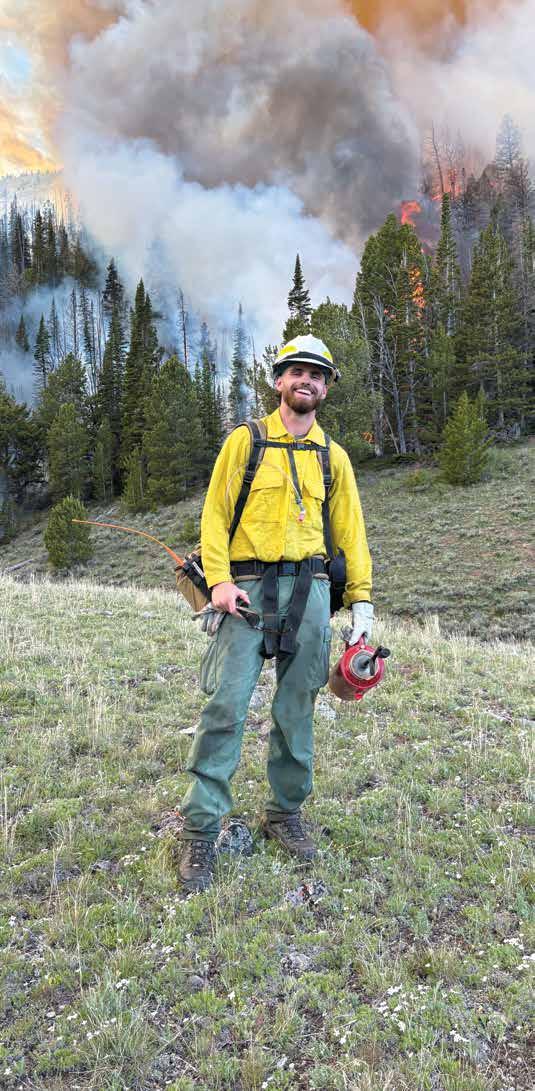
These days he can be seen deploying from a helicopter fighting wildfires for the U.S. Forest Service in Idaho. Before that, he volunteered with AmeriCorps, working on wildfire suppression and controlled burns that foster forest health and protect fire-risk communities in California and Colorado.
As he puts his Environmental Science degree and Chemistry minor to use, Mogensen’s aspirations are just heating up. Amid the flames, he’s found grand adventure and meaning in the large and small—from sawing through burning trees to protect against future wildfires to bonding closely with his team over homecooked meals and crossword puzzles.
Upon leaving St. Mike’s, Mogensen decided to forgo the desk job route and work with his hands.
“I joined AmeriCorps as a land management volunteer because it combined three things that give me a deep sense of purpose: physical challenge, teamwork, and environmental conservation,” Mogensen said.
Mogensen was in the first cohort of the AmeriCorps National Civilian Community Corps Forest Corps, which launched in July 2024. He trained in wildfire mitigation tactics, and then he and other volunteers
were deployed across the U.S. for a 10-month service period.
Mogensen and crew started near Lake Tahoe, then served other parts of northern California and Colorado, including Vail. They worked on wildfire suppression, prescribed burns, and silviculture surveys—essentially a health check for parts of the forest to predict future growth—for timber sales.
The experience was even grander than the vast mountains among which he worked.
“With deep appreciation for the jagged peaks of the Sierras, the powdered snow of the Rockies, and the glow of burning timber, I found peace working closely with eight other people and building a culture of our own design,” he said of the experience.
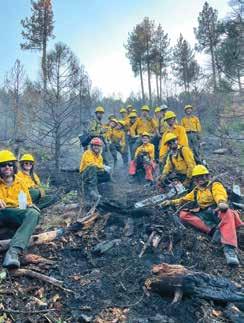
After completing his service with AmeriCorps, Mogensen began working for the U.S. Forest Service in Challis, Idaho. He is part of a helitack crew—a helicopter wildfire module.
These crews drop firefighters near a wildfire so they can assess and respond to the situation on the ground. Often the teams build fire lines, burn-
“In the most practical sense, Saint Michael’s provided me with an affordable education, which gave me the financial freedom to volunteer for a year without the burden of overwhelming student debt,” he said. “On a more personal level, my time working as a kayak instructor in the St. Mike’s Adventure Sports Center prepared me to lead others in
“Everyone I meet has something to teach me.”
ing a line of vegetation so when the fire reaches that point, it doesn’t have the fuel to go further.
At times, teams remain overnight in remote locations, hike to a new spot to be transported out, or prepare a helicopter landing zone in the forest.
Mogensen is pursuing senior firefighter status with the intention of becoming a squad boss; however, his aspirations include moving beyond fire at some point.
He would like to pursue a career in sustainable international development and diplomacy.
“My goal is to work closely with developing nations to ensure that economic development coincides with sound environmental conservation,” he said.
If he hadn’t attended Saint Michael’s College, Mogensen said he is not sure he would have ended up serving in AmeriCorps.
dynamic outdoor environments with both safety and confidence.”
He obtained his Wilderness First Responder certification at St. Mike’s through the Adventure Sports program. He later put the training to use by serving as a medic for his AmeriCorps crew. He treated injuries and helped prevent minor medical issues from escalating, he said.
While at St. Mike’s, Mogensen also received his Peace Corps Prep certification, which equips students with the necessary tools and preparation for volunteer service, such as for AmeriCorps.
Beyond the tangible, St. Mike’s also instilled character values.
“What I carry most from Saint Michael’s is a commitment to approaching every interaction with kindness and curiosity, grounded in the belief that everyone I meet has something to teach me,” he said.
BY APRIL BARTON
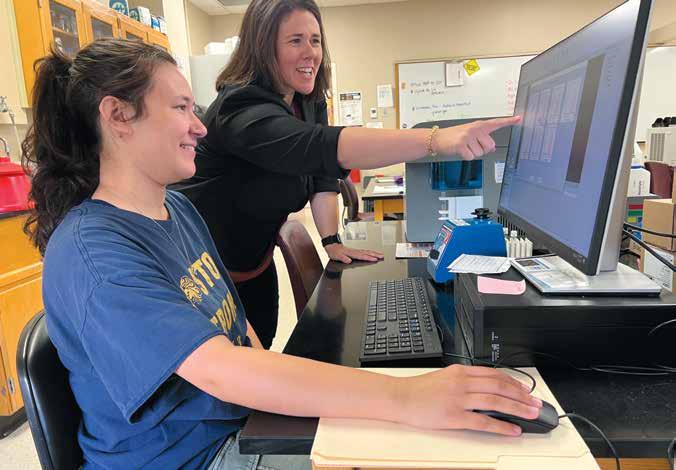
No one at Saint Michael’s College knows the flow cytometer quite like Olivia Goldfarb ’27. She was the first to use the specialized laboratory equipment when the College acquired it in 2024 through a grant, and she has logged the most hours on it so far.
Biology Professor Lyndsay Avery explained that at most other colleges—including large research institutions— an undergraduate like Goldfarb would not have access to a flow cytometer, which uses lasers, fluid, and fluorescent dyes to identify certain characteristics of single cells.
Last summer, Goldfarb used the equipment to examine cell division of T cells with and without the mutation that causes X-MAID, a rare immunodeficiency disease. She and fellow summer researcher Gavin Graham ’25 were attempting to understand what is happening at the cellular level to potentially help patients with this life-shortening condition.
For their summer research projects, Graham and Goldfarb continued work they were doing in summer 2024 and through the school year, which builds upon years of research from Avery and former and current St. Mike’s students working to understand X-linked moesin associated immunodeficiency, or X-MAID.
In X-MAID patients, the T cells, which normally travel throughout the body to the site of an infection, have lost their mobility due to a mutation of the protein moesin. The patient experiences frequent illnesses and difficulty fighting off infection.
The rare disease was first identified in 2012, though modern genetic testing proves that it has affected generations of families. Avery’s interest in the disease started in 2018, when she began postdoctoral research into it, and she has continued it at St. Mike’s.
In fact, hers is one of very few labs studying this disease. Several experts on this particular protein recently retired, and others who are studying X-MAID are clinicians and not doing the same type of in-depth cellular level research, according to Avery. Around 18 cases of X-MAID have been confirmed so far.
“You’re not going to see [Big Pharma] doing research on this because it’s not going to pay out,” Avery said.

Gavin Graham ’25 conducts scientific research on X-MAID, a rare immunodeficiency.
To treat X-MAID, patients often undergo a bone marrow transplant or recurring transfusions. That can be risky and traumatic, especially for young kids.
To create more effective and targeted treatment, more needs to be known about what is happening at the cellular level. Goldfarb’s summer research tested whether cell division might be affected by the X-MAID mutation. Graham went even smaller, to the protein level, looking at natural moesin and mutated moesin and its binding partners.
Last year, he designed a way to isolate moesin and refined the process throughout the school year. For 2025’s research project, he used a technique called immunoprecipitation to gather both regular moesin and mutated moesin,
as well as their binding partners. He sent those samples to the proteomics lab at the University of Vermont to run spectral counting on the 300-ish bound proteins. One protein—ACAP1—stood out as having the greatest difference between the regular moesin and the negative control versus the mutated moesin. In the mutation, the scarcity of ACAP1 was significant.
Graham feels this is not enough data to draw a reliable conclusion. Ideally, he would have liked to perform three screens. However, federal funding through Vermont Biomedical Research Network ran out and has yet to be reinstated. This coincided with cuts to other federally funded scientific research across the nation in the spring and summer.
For now, Graham is reading up on and testing this particular protein, about which not much is known other than that it contributes to cell mobility. It’s possible this is a discovery that could yield more information about the disease.
Goldfarb’s results, on the other hand, showed that cell division didn’t seem to be materially different between the normal T cells and mutated ones.
Before the summer, Goldfarb developed a way to synchronize cells to undergo cell division, or mitosis, at the same rate and stage in order to more easily compare them. Through testing, she found no difference in mitosis, but her work was still a step forward. This was something that research had not shown before, Goldfarb said.
“Having just that little bit of confirmation is validating to know that some things are different with the mutated cells and some things are the same,” Goldfarb said. “How they behave similarly is just as important as … how they behave differently.”
The research St. Mike’s students are doing could have implications for those living with X-MAID or other immunodeficiencies.
Moesin is just one actin-binding protein that causes immunodeficiency, Avery said, adding that there are other diseases their research might be able to shed light on, such as Wiskott-Aldrich disease, which affects as many as 5000 people.
Both Graham and Goldfarb anticipate having careers that involve scientific research and feel fortunate to have had this experience during their undergraduate years.
Goldfarb switched her major to Health Science in part because of her affinity for research. She hopes to find a way to incorporate research and some patient care into a future job.
Graham, a Biochemistry major on track to graduate in December 2025, is weighing his options for graduate school. He is considering studying abroad because the European Union is currently offering U.S. students strong opportunities and funding.
“Research has been instrumental in my college career,” he said. “I feel like I definitely have a leg up compared with peers when we read a scientific paper or talk about something in class.”
For her part, Avery says that training young scientific researchers is her favorite part of the job. “My goal is to create the next generation of scientists who maybe would not have gotten an opportunity someplace else,” she said.
BY TERRI SELBY
For someone whose entire education and career centered on numbers, being an early expert in computer science and statistics, John J. “Jack” Neuhauser, the 16th president of Saint Michael’s College, was truly a people person.
“Even after retirement, Jack was a regular visitor to campus, attending many of our annual Commencement ceremonies, theatrical performances, and other significant events for the College,” reflected President Richard Plumb. “I had the pleasure of getting to know Jack during my almost two years as president, and I know many of you also knew him as both a colleague and a friend.”
Jack served from 2007 to 2018, leading the College through the 2008–09 recession and overseeing transformative projects like the Dion Family Student Center, Aubin Hall, and the Pomerleau Alumni Center. He strengthened ties to our Edmundite founders. He expanded opportunities for students, linking them to applied and experiential learning opportunities with a focus on undergraduate research. He worked tirelessly to make the exceptional educational experience at St. Mike’s affordable to all while championing the liberal arts. Prior to coming to Saint Michael’s, Jack created the Carroll School of Management at Boston College and became an academic administrator.
It was fitting that in his last Commencement address, he urged students to embrace the gift of kindness. There are countless stories of Jack, especially when he was in leadership roles, walking out of his office and asking staff if they wanted a coffee, quietly paying the bill for a retirement party, or sending encouraging emails to novice marathoners. Jack practiced a quiet kindness that is rare these days. As Rev. William Leahy, president of Boston College, noted at Jack’s funeral service, he wasn’t an outwardly pious person, but he lived the gospel every day of his life.
His daughter, Karen, shared a story of Jack as a young father and supportive husband, making spaghetti and meatballs with his three young children. With a pot of tomato sauce on the stove, he encouraged them all to throw meatballs into the sauce pot from farther and farther away until they were shooting meatballs into the pot from the dining room. Karen recalls that red sauce was all over the kitchen. As was love.
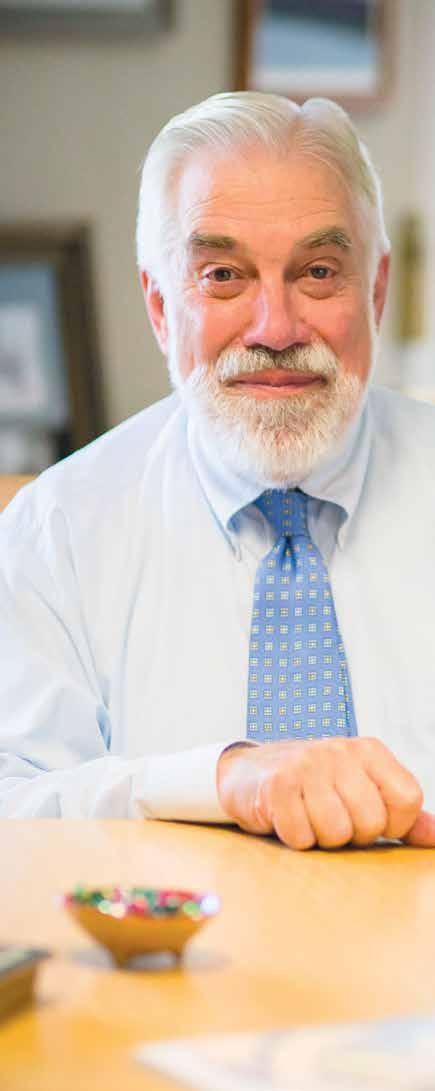
Jack and I go way back—56 years. We have had a significant influence on each other’s lives—he was my mentor, inspiration, and most importantly, a close friend for all those years. I was a student at [Boston College] when he started. He became my advisor, and I took every one of his classes. That began our friendship. He even had me over to his home for cookouts and touch football.
We stayed in touch and eventually, I got him involved with Saint Michael’s College, first as a board member, and then convinced him to become the College’s president. Every Friday night for 15 years of board meeting weekends, we would meet, just the two of us. We went through many bottles of scotch together, although his preferred cocktail was a Bombay Sapphire martini on the rocks.
After those years, we made it a point to visit each other for a couple of days every summer. He would come to our house in Maine, or Diane and I would visit him at his Vermont farm, where he cooked fantastic meals for us. This was the first summer we missed in a long time.
We had excellent, far-ranging discussions about economics, Saint Michael’s, education, politics, sports, family, and stories from our past times together. There is no one else who could have such interesting and deep conversations. He listened, asked questions, and then said such wise things. His passing leaves such a big hole in my life.
I will miss my friend.
—MIKE MCGRATH H’23
BY JOSH KESSLER ’04 AND TERRI SELBY
mighty oak has fallen.” “Some hits feel harder than others; this is one of them.” “He was a true Renaissance Man—athlete, businessman, philanthropist, raconteur, entrepreneur, politician, and family man.”
These were just some of the sentiments shared with the Saint Michael’s College Alumni Office when the community learned the sad news that Richard “Rich” Tarrant ’65 had died this past August.
In accordance with his wishes, Rich’s funeral was celebrated at his alma mater in the Chapel of St. Michael the Archangel on October 4. The men’s basketball team paid tribute to their fellow Purple Knight by wearing black armbands with a purple “22”—Rich’s jersey number, retired only four years after he graduated.
“Mary and I enjoyed getting to know Rich and Deb. Rich was a legend both on and off the basketball court, inspiring greatness through his achievements and generosity at Saint Michael’s and beyond. He was a true Purple Knight whose contributions will continue to inspire for generations to come,” said President Richard Plumb.
A cum laude graduate, Tarrant is widely regarded as one of the greatest student athletes in Saint Michael’s history. After one year at Saint Bonaventure, he transferred to Saint Michael’s on a full scholarship.
A charter member of the Saint Michael’s Athletic Hall of Fame in 1987, Tarrant made history as the first Purple Knight ever selected in the NBA draft, chosen by the Boston Celtics immediately after graduation in May 1965. He was recognized with the Saint Michael’s Alumni of the Year Award in 1990, served on the Board of Trustees from 1987 to 1993, and was inducted into both the New England Basketball Hall of Fame (2001–02) and the Vermont Sports Hall of Fame (2019). Fittingly, the Vermont Sports Hall of Fame class was announced in the very building he had dedicated to his parents decades earlier.
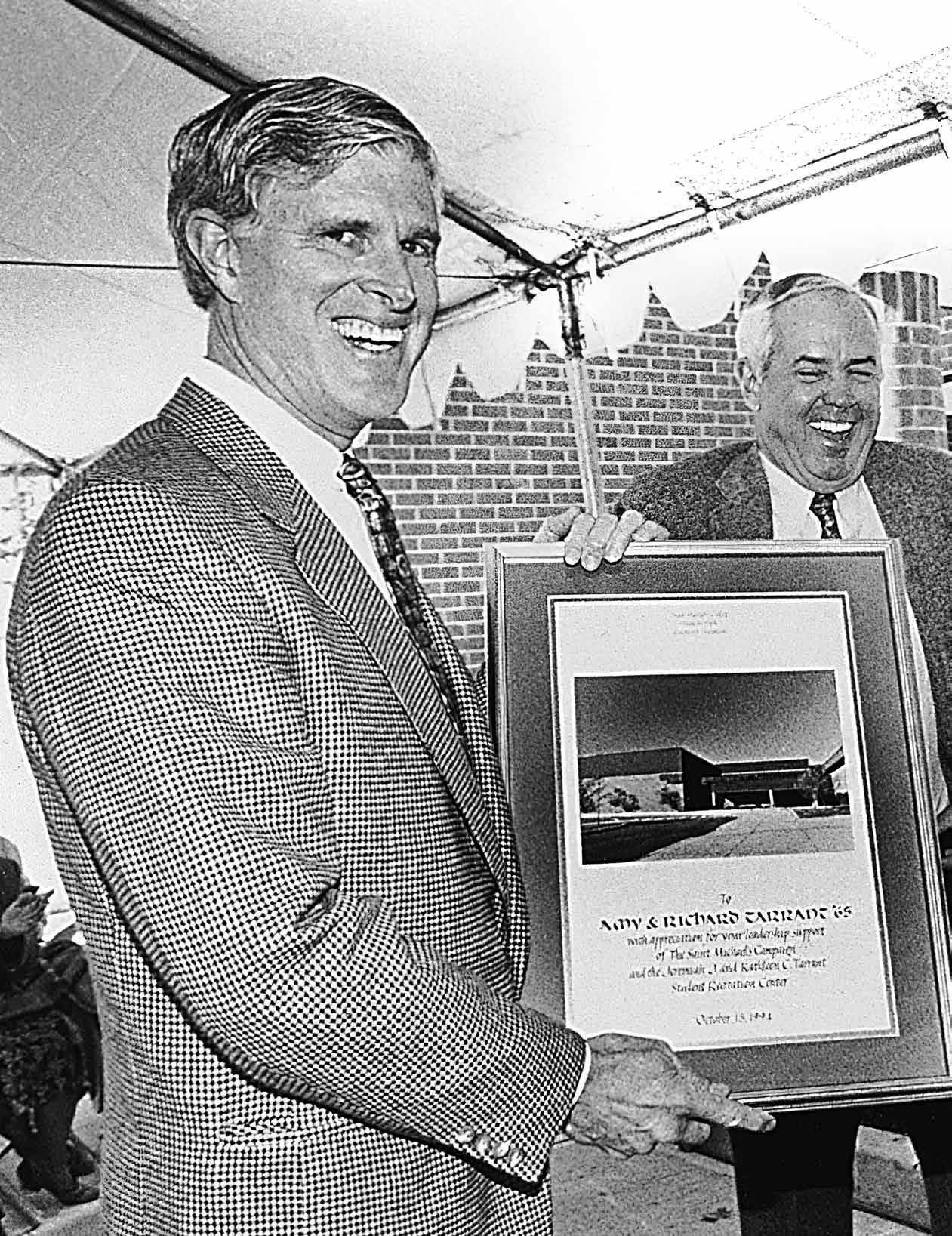
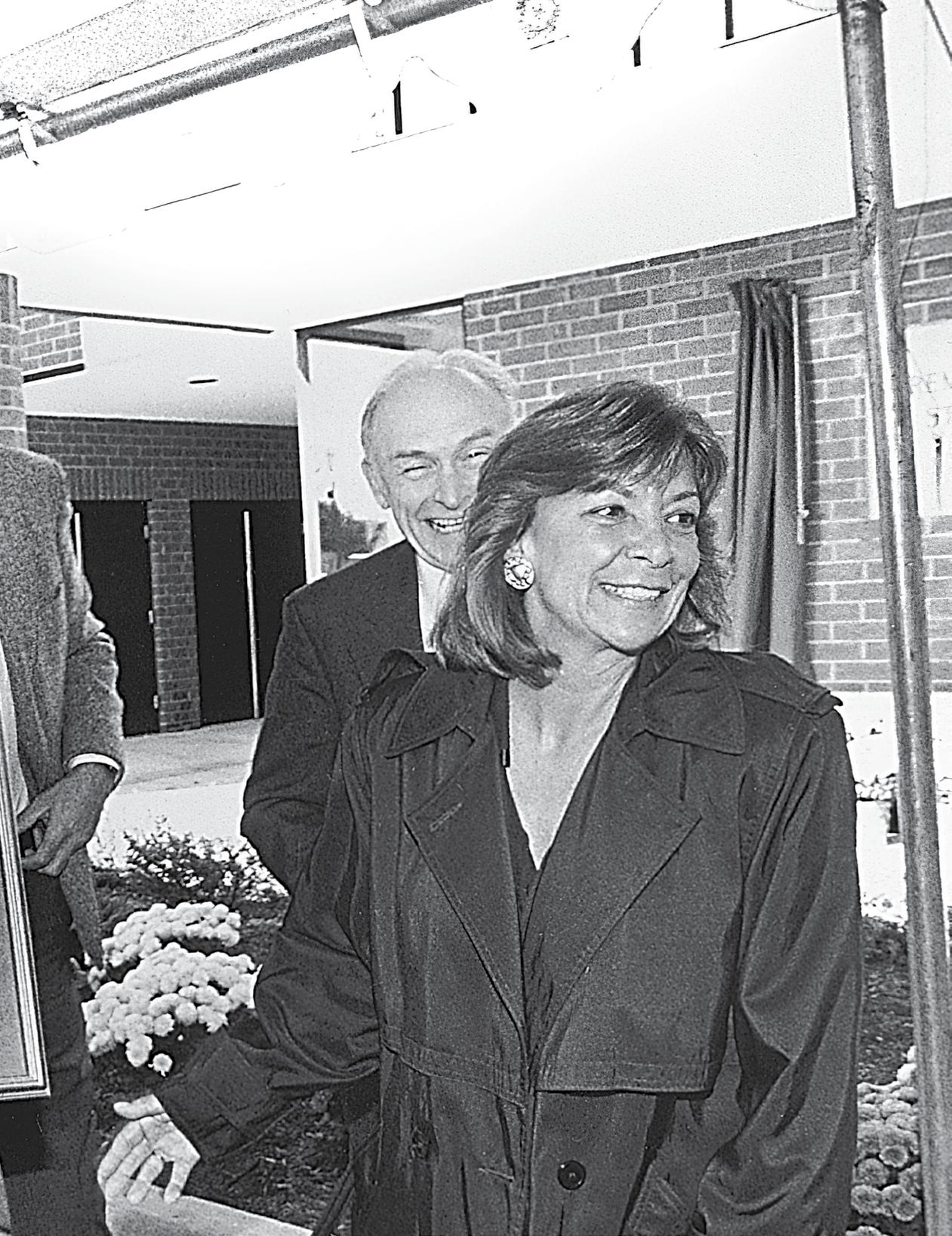
Left: Rich Tarrant ’65 and James Dailey ’57 at Tarrant Center Dedication.
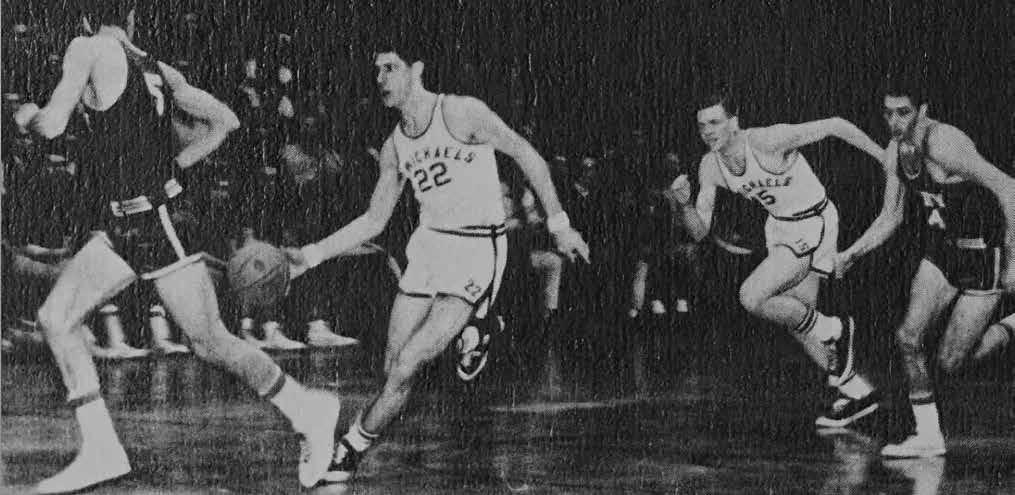
Anne Berry, former VP of Institutional Advancement at Saint Michael’s and now principal at Washburn McGoldrick, remembers working with Rich on funding and dedicating the new athletic center in honor of his parents. “It was one of the highlights of my professional career,” she recalls. To help the Saint Michael’s Campaign exceed its goal, Rich decided to make a second generous gift in honor of his parents, Jeremiah and Kathleen Tarrant, and the sacrifices they made to send him and his brothers to college.
Rich told campaign chair Jim Dailey ’57 he was deeply saddened not to have honored his father before his death. Determined to move quickly, he set out to surprise his mother with a dedication that would unite the family at a celebration on campus. The challenge, Berry said, was keeping the plans secret from Kathleen, who seemed always to know what her sons were up to. Rich joked, “If she finds out, this gift goes away!”
The ruse worked. Kathleen came to campus believing Rich was receiving an alumni award. As she watched her family and friends gather, Rich stepped to the podium and looked her in the eye. “Mom, I’ve lied to you. Today is not about me getting an award. It’s about you and Dad.” He invited her forward to unveil the dedication stone carved with her and her late husband’s names. Kathleen was honored, delighted, and more than a little shocked that Rich had pulled it off.
Berry reflected that the gift was never about Rich himself—his name never appeared on the building. Instead, it came straight from his heart in a gesture that lives on in Tarrant family history.
The Jeremiah J. and Kathleen C. Tarrant Student Recreation Center, dedicated in 1994, transformed Saint Michael’s athletics. The $5 million, 67,000-square-foot facility—made possible by Tarrant’s lead gift—continues to enrich student life with multipurpose courts, a suspended running track, climbing wall, weight rooms, racquetball and squash courts, and the Hall of Fame Room.
Over lunch last March, Rich regaled President Plumb, his wife Mary, and Terri Selby, associate VP of Institutional Advancement, with the story of how he got his start in computers. “After being released at the end of preseason from the Celtics, I figured I needed a job. So I went from the Celtics’ offices to IBM’s Boston Regional Headquarters.” Without an appointment, he told the receptionist he had just come from the office of legendary coach Red Auerbach. “The regional director met with me and hired me on the spot. That wouldn’t happen today!” he chuckled.
At IBM, Rich reconnected with fellow alumnus and teammate Bob Hoehl ’63. In 1969, the two founded IDX Systems Corporation, which revolutionized healthcare technology and helped shape Burlington’s economy. Rich often deflected credit, saying, “Bob was the real brains behind it all.” GE Healthcare acquired IDX in 2005.
That same year, Rich and his wife Deb established the Richard E. and Deborah L. Tarrant Foundation. Hundreds of nonprofits, people, and programs have benefited from its support.
Never one to shy away from new challenges, Rich ran for the U.S. Senate in 2006. In his 50th Reunion Yearbook, he summed it up with his trademark humor and humility: “I had a successful business career sandwiched between failed athletic and political careers.”
Most recently, Rich was concerned with the struggles of boys and young men who, he felt, were falling through society’s cracks. The Tarrant Foundation’s investment in Gone Guys, a documentary on this issue, reflected his commitment. The film won Best Documentary Feature at the Vermont Film Festival—on the very day Rich died.
From the hardwood to the boardroom, from family surprises to statewide philanthropy, Rich Tarrant lived with generosity, humor, and vision. His legacy will endure in the lives he touched, the institutions he strengthened, and the countless stories of a man who gave his all.
BY PETER VANTINE ASSOCIATE PROFESSOR EMERITUS,
drian Languasco brought a truly international spirit to Saint Michael’s College, teaching Romance languages with passion and humor during a remarkable career that spanned 52 years. He earned his B.A. in Romance languages from New York City College, followed by his master’s degree from Columbia University and his doctorate from Università Ca’ Foscari in Venice. Adrian joined the Department of Modern Languages and Literature in 1965 and devoted his entire professional life to Saint Michael’s before retiring in 2017. Originally hired to teach French, he also taught courses in Italian, Spanish, Portuguese, German, and English. Professor Languasco served as chair of the department and organized countless activities for students of languages. He devoted his scholarly attention to translation and public presentations, on campus and beyond, on a wide range of Italian cultural topics. He spent sabbaticals in Germany and Brazil, participated in a faculty trip to Japan, and directed the Saint Michael’s program at the Universidad de las Américas in Mexico for a semester.
“Adrian was known and appreciated by many” for his love of Italy and the Italian language, noted Peggy Imai, director of the study abroad program. He brought students and faculty to Rome, Florence, Milan, Naples, Sorrento, Venice, and the islands of Burano, Capri, and Sicily. He introduced them to the culinary and cultural delights of the dolce vita; urged them to explore the streets and piazzi, fountains and gardens, cafés and canals, monuments and museums; encouraged them to converse with locals and experience a night at the opera; offered them the
Adrian Languasco brought a truly international spirit to Saint Michael’s College, teaching Romance languages with passion and humor during a remarkable career that spanned 52 years.
opportunity to marvel at the Forum, the Colosseum, and the Pantheon, along with churches, cathedrals, and the Vatican; invited them to swim in the Mediterranean and climb Mount Etna.
As his son Michael Languasco ’95 observed, his father had an irrepressible “zest for life”—if there was an opportunity “to take a trip spontaneously or to laugh and break bread with friends, that’s what he did”.
In his honor, faculty in Classical and Modern Languages and Literatures recognize a graduating senior who is especially gifted in multiple languages with the “Professor Adrian Languasco Award.”
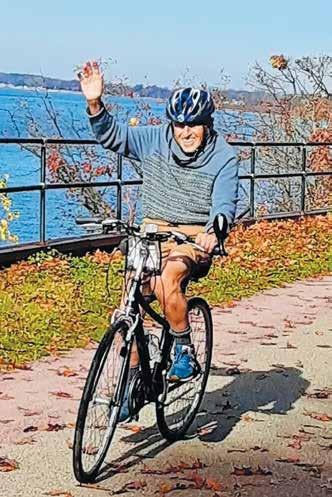
Courtesy Photo
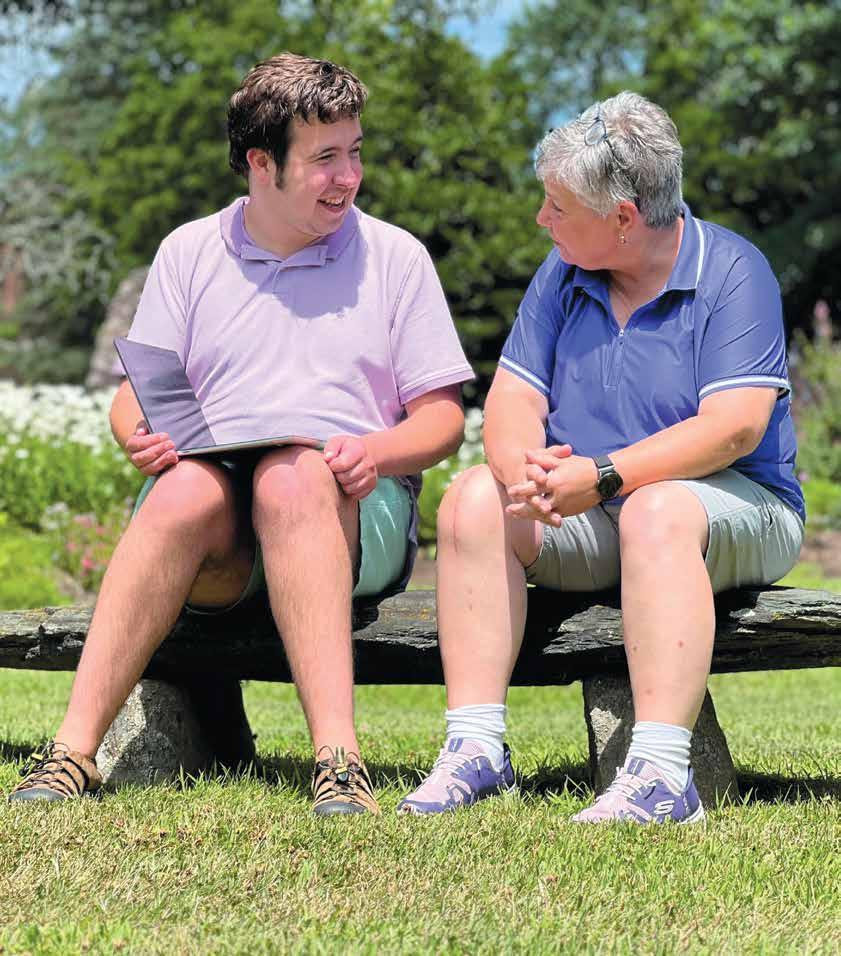
“Saint Michael’s is a place for every single young person to thrive and to learn and to be safe outside their comfort zone.”
BY APRIL BARTON
It might seem unusual to apply business management theory to classroom teaching. But for Aidan Hall ’27 and Business Administration Professor Karen Popovich, the connection made sense—just like their friendship, forged outside the classroom.
For his 2025 summer research project, Hall, an Education Studies and Anthropology double major, studied classroom management. He and Popovich discovered that the teaching styles Hall was analyzing directly corresponded with leadership styles described in business management theory.
Hall decided to embark on a cross-disciplinary project with Popovich.
AUTHORITARIAN/THEORY X: SAME THING BY DIFFERENT NAMES
Since the COVID-19 pandemic, students have been less regulated and have demonstrated lower emotional intelligence than their earlier counterparts, Hall explained. In his research, he found that teaching style can influence student behaviors and outcomes.
Education’s Authoritarian style (called Theory X in organizational management) is an approach in which the instructor or leader sets up rigid rules and systems and expects strict compliance. This contrasts with the Authoritative style (called Theory Y in business), which
prizes mutual respect, models expected behaviors, and encourages creativity and autonomy.
Hall reviewed best practices to employ in classroom management and talked to educators and parents to understand their experiences. He asked such questions as “How do you balance firmness and empathy?” and “How do you balance structure and autonomy?”
Popovich said this project demonstrates the interconnectedness of disciplines, as Hall built on what he learned in education and anthropology classes. “He’s also seeing the relationship of these theories to business and to psychology because a lot of organizational behavior just stems from psych,” she said.
“THE
Hall met Popovich on his first day at Saint Michael’s College as she was working the grill at an Orientation event. The pair immediately hit it off. After that, the two would often run into each other in Alliot Student Center.
Hall took to calling Popovich “the best professor I’ll never have,” because his academic classes in education, anthropology, and music did not mesh with her field.
But now they are working together. “I’m relishing the fact that I get to work with a student who’s outside my immediate discipline but someone I met on their first
day to campus,” Popovich said. “I think that’s something also special about St. Mike’s … how community is formed and how relationships go beyond the classroom walls.”
Hall hopes to be a special educator in a public school or a teacher’s aide or classroom teacher in an independent school one day. He is neurodivergent and describes himself as an autistic empath. He said much of his life’s focus has been learning how to interact socially.
“My life has been about that principle of understanding myself and others, which will help me with any student—definitely with neurodivergent but really any student—especially knowing that what we’re seeing [with recent classroom challenges] is a lack of that understanding,” he said.
Popovich said Hall has been able to see how what he’s doing can impact others, a valuable life lesson. “Saint Michael’s is a place for every single young person to thrive and to learn and to be safe outside their comfort zone,” she said.
The research also has a benefit for Popovich. “I love research,” she said. “And I get to share that with Aidan.”
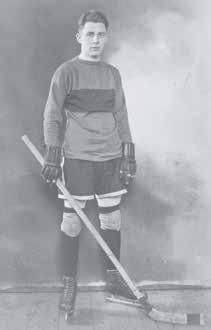
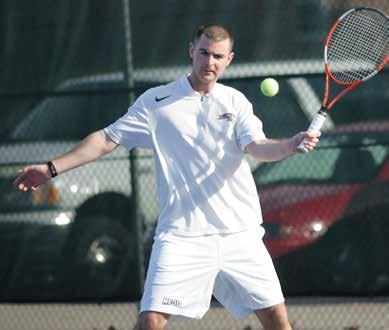
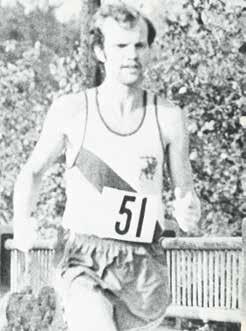
BY JOSH KESSLER ’04
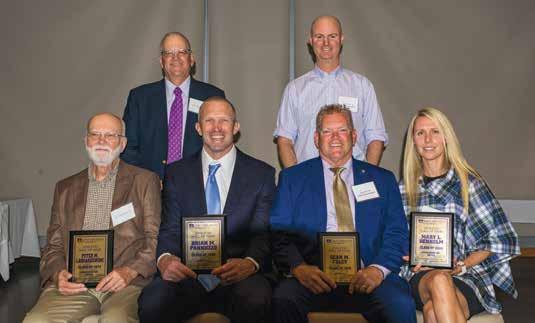
Back Row (L to R): Jim Laskarzewski ’86 (delivered uncle Peter Laskarzewski’s ’73 acceptance speech) and John Lescure ’09.
Front Row (L to R): John Laskarzewski ’69, Brian Pannuzzo ’99, Sean Foley ’88, and Mary Denholm ’09.
Saint Michael’s College inducted its 36th Athletic Hall of Fame class during Alumni and Family Weekend on September 19. A standout group was made up of early hockey great Leo Papineau from Class of 1924, cross-country, cross-country record holder Peter Laskarzewski ’73, men’s ice hockey star Sean Foley ’88, all-conference basketball scholar–athlete Brian Pannuzzo ’99, all-region cross-country runner and two-time Olympic Marathon Trials qualifier Mary Denholm ’09, and tennis record breaker and Purple Heart recipient John Lescure ’09.
Papineau served as captain in ice hockey, tennis, and football, and led men’s ice hockey to its first two state championships, in 1923 and 1924, as a scoring star. As an advocate for girls’ sports in an era when opportunities were more plentiful for boys,
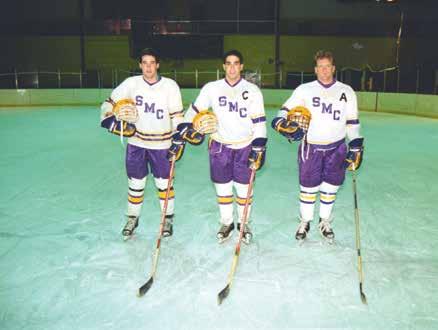
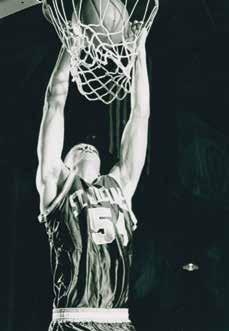
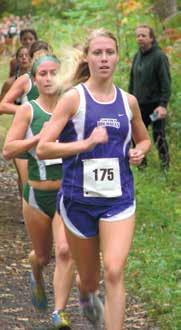
he later became one of the most accomplished coaches in Vermont high school sports history, posting a career record of 670-216-9 across five sports over 27 years at three institutions.
Laskarzewski remains one of the most successful runners in College history, winning 10 races and setting the program’s 5.2-mile distance record while competing on some of the earliest cross-country teams. In the years since, he has been a college professor and a research scientist in pharmaceutical product development. A generous alumnus, he is a long-time contributor to the Dr. Gilbert Grady Scholarship and sponsored a plaque dedicating the Saint Edmund’s 351 faculty office to his father.
Foley remains a highly respected star from early in the Purple Knights’ modern era, key in the former club program’s transition into a competitive varsity outfit. In just three years, Foley graduated fifth in
program history in career goals (34) and points (73) and sixth in assists (39). He was named the 1987-88 ECAC North MVP as the league’s top player, combining with Chris Luca ’88 and Brian Mullahy ’89 to create one of the highest-scoring lines in program history.
Pannuzzo was instrumental in a successful era of men’s basketball, when Saint Michael’s posted an 83-37 mark (50-22 Northeast 10 Conference) while qualifying for two NCAA Division II Tournaments. He is second in school annals in career field goal percentage (57.5%) and finished with 1207 points and 730 rebounds. As a senior, he was named New England Collegiate Athletic Conference Division II Male Athlete of the Year as the region’s top male student athlete, regardless of sport.
An all-region college runner, Denholm has reached even greater heights as a two-time Olympic Marathon Trials qualifier and budding ultrarunning star. In 2024, she won
her 100-mile trail race debut, the grueling Leadville 100, before placing second in the 62nd annual JFK 50, the country’s oldest ultramarathon. She was seventh in UltraRunning Magazine’s women’s UltraRunner of the Year rankings. Denholm is a professional runner for Craft and The Feed High Performance team and a running coach for Lift Run Perform.
Lescure remains one of the most successful tennis players in Saint Michael’s history, graduating with program records for career total wins (65) and doubles wins (37) while tying for sixth in singles wins (28). He and Torr Terranova ’08 also formed one of the top doubles tandems in program history. Since 2009, John has served with the Vermont Army National Guard. In 2024, he was recognized with the Purple Heart for his role in saving the life of a fellow soldier during an attack overseas.
FRESTON’S ’67 NEW MEMOIR
BY ELLEN KANE
ne of Saint Michael’s College’s most distinguished alumni, Tom Freston ’67, has written a riveting new autobiography, Unplugged: Adventures from MTV to Timbuktu, set to release on November 18, 2025, by Simon & Schuster. From the very first line of the prologue, readers are pulled into a whirlwind of stories from a life lived boldly:
“Sometime in the mid-nineties, the heavy metal band Anthrax sent me a small chainsaw. They’d all autographed it. It was a more useful gift than a platinum album or tour jacket—I had a few closets’ worth of those, and I proudly kept the signed chain saw on display in my New York office, on the fifty-second floor of 1515 Broadway.”
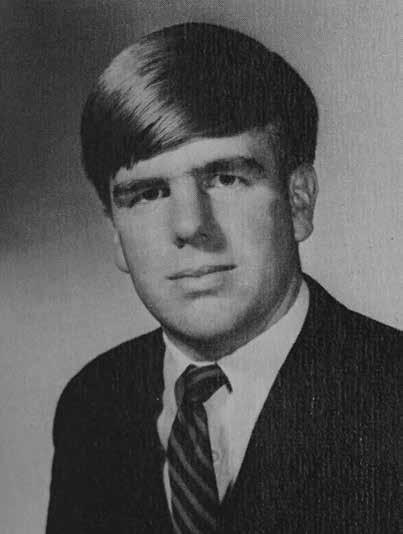
The book is part memoir, part thrill ride, and has already garnered praise from prominent reviewers and cultural icons including U2 frontman Bono, who shared his own reflections on Freston’s journey.
Freston’s path to becoming a media mogul overseeing MTV, Nickelodeon, Comedy Central, VH1, CMT, BET, and Paramount Pictures as head of Viacom can be traced back to his formative years at Saint Michael’s College. In the book, he recalls working as a cafeteria dishwasher to cover room and board
and later finding his passion for music promotion by booking local rock bands for Burlington’s lively fraternity parties.
“But the most fun I had was when I befriended guys in local rock bands and began booking their gigs ... I started hosting parties,” Freston writes.
These early experiences near campus laid the foundation for what would become a groundbreaking career in music television, eventually leading to his Freston’s role as cofounder of MTV.
Saint Michael’s College appears throughout the memoir, not just as a backdrop, but as a catalyst for Freston’s curiosity, creativity, and entrepreneurial spirit. He recounts turning 18 on the day President John F. Kennedy was assassinated, walking out of a Western Civilization class, a moment that marked both personal and national history.
Freston’s story is one of bold adventure, meaningful connections, and relentless innovation—all values deeply rooted in the Saint Michael’s College experience. He exemplifies what it means to seize opportunity and transform it into lasting impact.
To explore more of Freston’s incredible journey and the role Saint Michael’s played in shaping it, pick up Unplugged: Adventures from MTV to Timbuktu—available in hardcover, ebook, and audio download wherever books are sold.

More the Merrier: Laughing at Life When Everyone Thinks You’re Over the Hill
By Jerry Zezima ’75 (iUniverse)
When you reach a certain age (try 70), people figure you’re not long for this world. That’s not true for nationally syndicated humorist Jerry Zezima, who is shockingly immature, which makes him seem a lot younger. Filled with hilarious and absolutely true stories, including Zezima’s account of his return to St. Mike’s for his 50th Reunion (which also appears on p. 64 of this magazine), The More the Merrier proves you can grow old and still be young, and that laughter is, indeed, the best medicine.
By Katy Farber, Assistant Professor of Education, Assistant Director of Teaching and Learning for Institute for the Environment (Routledge)
Real Talk for New Teachers by Katy Farber and Penny Bishop offers practical, encouraging guidance for beginning teachers seeking a fulfilling and sustainable career. Moving beyond “self-care” buzzwords, it provides real strategies for balancing health, time, and emotions; connecting with students, families, and colleagues; and creating engaging classrooms. With tools for reflection, inspiration, and personal action planning, this book helps educators build strong communities and lasting practices for success in teaching.
By Katy Farber, Assistant Professor of Education, Assistant Director of Teaching and Learning for Institute for the Environment (Blackstone Publishing)
The Board by Katy Farber is a gripping small-town thriller perfect for fans of Big Little Lies. After a messy divorce, single mom Liv and her daughter move to rural New Hampshire seeking a fresh start—but soon encounter hostility, corruption, and fear. When Liv suspects the school board is hiding criminal activity, she risks everything to uncover the truth. Is she exposing real danger—or unraveling under the weight of her own doubts?
By Dave Patterson ’02 (Littoral Books)
Euphoria by Dave Patterson is a luminous, deeply affecting collection of 10 short stories set in the once-thriving mill town of Euphoria, Maine. Amid themes of grief, addiction, poverty, and longing, Patterson’s characters grapple for connection and purpose. With empathy, humor, and emotional clarity, his voice brings this place—and its people—to vivid life.
Remembering Mama and La Mia Famiglia: Stories and Recipes
By Louis G. Giancola ‘68, M’95, Adjunct Professor Emeritus, Applied Linguistics (self-published)
Remembering Mama and La Mia Famiglia: Stories and Recipes by Louis G. Giancola is a warm memoir of growing up Italian in a modest Vermont city. Across generations, we follow Mama’s journey—from widowed hardship to strength—and the loving, humorous family that surrounds her. Through food, family, and service, the book celebrates life’s joys, offering heartfelt tales alongside cherished Italian recipes you’ll want on your table.
Seminarians Don’t Blow Stuff Up (Reflections on a Pastor’s Becoming)
By John H.D. Lucy ‘09 (WestBow Press)
Ever wonder what really happens inside seminary? Seminarians Don’t Blow Stuff Up offers a humorous, honest look at seminary life, filled with meaningful reflections for prospective pastors, clergy, and lay readers. From seminarians blowing stuff up and making babies, to wild baboons, bull elephants, magazine turmoil, and failed romances, this book covers it all. You’ll come away laughing, reflecting, and having a deeper hope and trust in God.
By Nancy Lubinsky ’83 (Wildlens Photography)
Learning My ABC’s is an enchanting alphabet primer that pairs every letter with a striking animal photograph and a fun fact. Through vibrant imagery and simple text, young readers meet creatures from all over the world while learning the alphabet. This 38-page book delights curious minds and encourages a love of nature, language, and discovery from A to Z.
By Fred Cerrato ’63 (iUniverse)
A New Jersey Basketball Story by Fred Cerrato ’63 is a spirited coming-ofage tale set in Belleview, New Jersey. After surviving a childhood near-death incident, Bobby Pisano rises as a scoring phenom, while Kathy Cunningham battles expectations to play with boys. Their shared love for basketball binds them as they lead their teams toward a state championship—with friendship, rivalry, and youthful hope on every page.
By Bernadette Samake
M’25 (L’Harmattan)
This illustrated children’s book of African tales and fables will delight readers of all backgrounds. Designed for English language learners (ELLs, TESOL, or ESL), it aims to inspire a love of reading, foster a taste for English, and develop intrinsic motivation. Learners engage with the stories and can build upon comprehension, reading, writing, and speaking skills with accompanying think-and-share prompts, proverbs, and riddles. Gather around the fire and enjoy these timeless African tales and fables.
Unplugged: Adventures from MTV to Timbuktu
By Tom Freston ‘67 (Simon & Schuster)
Tom Freston’s Unplugged: Adventures from MTV to Timbuktu is a wild, globespanning memoir—from hitchhiking the world and launching a fashion venture in India and Afghanistan, to cofounding MTV and leading Viacom. With his deep roots at Saint Michael’s College, Freston’s unconventional ascent proves that daring curiosity and cultural openness can lead to real power and purpose. A story of risk, reinvention, and the driving forces of travel, music, and mission.

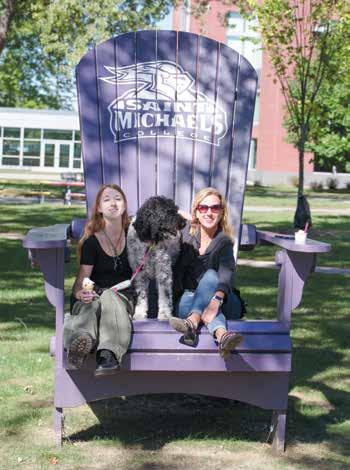
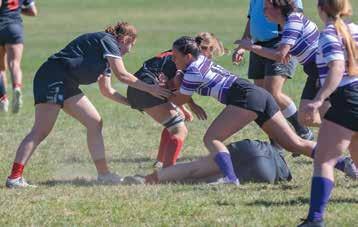
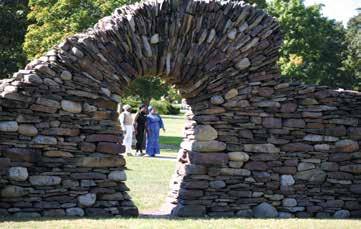
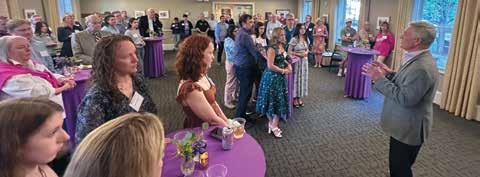
ALUMNI AND FAMILY WEEKEND
BY SIERRA LEONARD ’15
In September, we were thrilled to welcome back over 300 alumni, families, and friends who brought incredible energy and enthusiasm to campus. The weekend was packed with standout events, including a sold-out salad lunch celebrating 10 years of the Farm at Saint Michael’s, the annual college leadership address from President Plumb, and the lively Welcome Back Bash hosted by the SGA and Student Affairs. Guests also enjoyed the debut of Meet the Makers, a showcase of alumni and student creativity and entrepreneurship. Meanwhile, the McCarthy Arts Center celebrated its 50th anniversary with a full day of talks and events honoring its legacy in the arts. With meaningful conversations and joyful reunions, the weekend captured the spirit of Saint Michael’s—warm, welcoming, and full of heart.
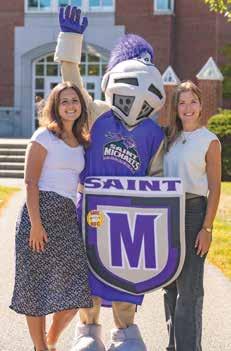
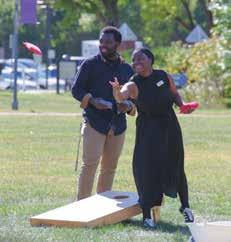
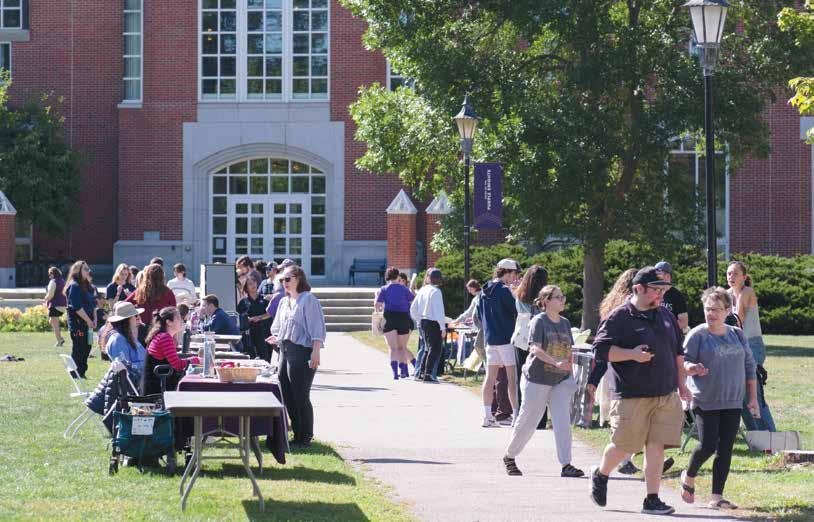
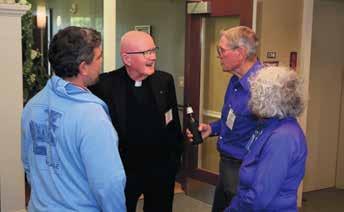
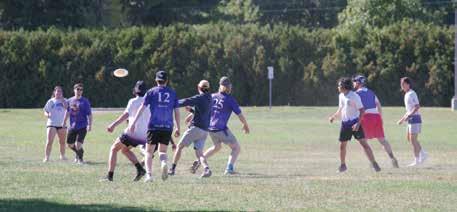
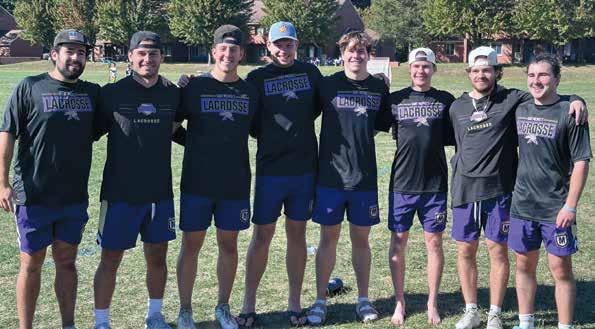
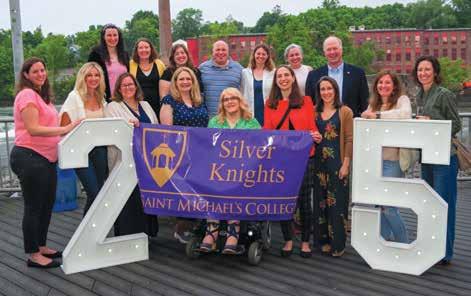

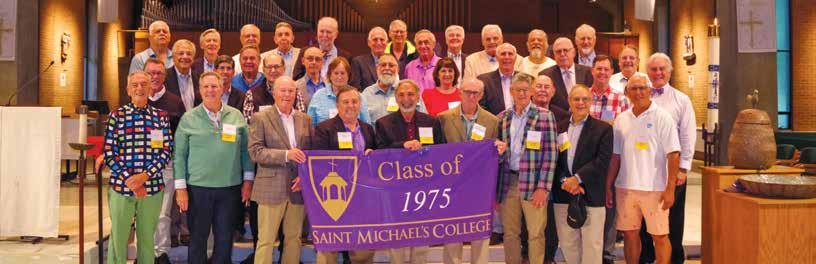
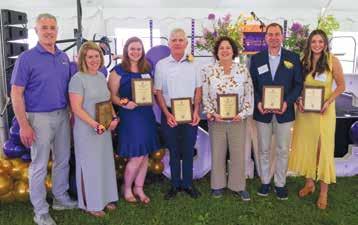
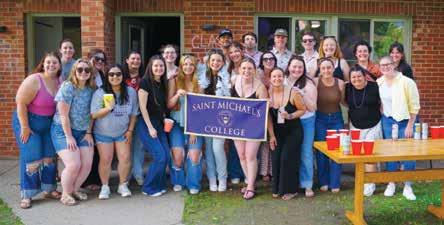
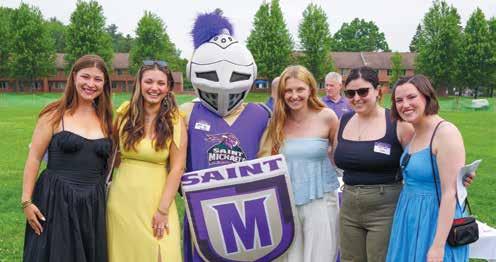
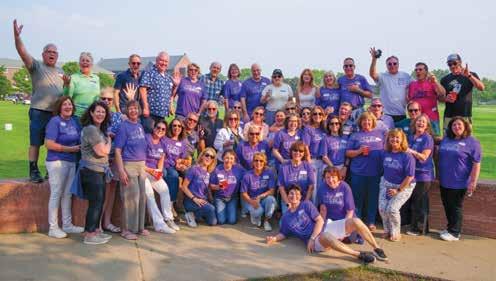
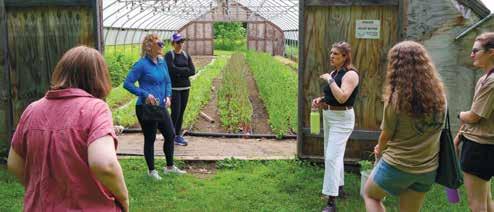
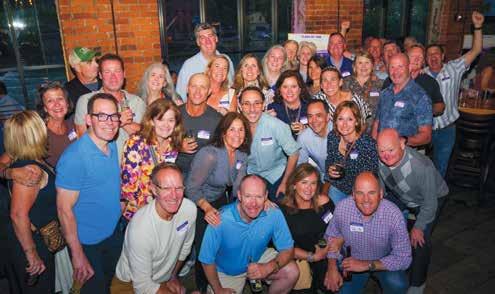
BY STEPHANIE SNELL
Reunion 2025 brought more than 800 alumni back to Saint Michael’s College for a weekend filled with tradition, reconnection, and celebration. From Friday evening through Sunday morning, the energy on campus reflected the strength of the Purple Knight bond.
The Class of 1975 celebrated its 50th Reunion with a Golden Knights induction ceremony, officially joining this honored circle of alumni. Classes ending in 5s and 0s marked their milestones with lively off-campus gatherings at local favorites including Waterworks in Winooski, Switchback Brewing, and Three Needs in downtown Burlington.
Saturday’s Purple & Gold Brunch honored distinguished alumni awardees and included a memorable presentation from former trustees Pamela Batalis ’85, Anthony Maginnis ’80, and Mary Kate McKenna ’80, who delivered a check for $1.2 million on behalf of all Reunion classes to President Richard Plumb.
The celebration continued that evening with the signature P-Knight Party, where more than 600 alumni filled the 300s field to enjoy food trucks, lawn games, axe throwing, and a set by DJ Craig Mitchell ’93 featuring an alumni-curated playlist. Festivities carried on into the night, complete with the nostalgic return of chicken patties at the late-night grill.
The weekend closed with a farewell breakfast in Alliot and Mass in the Chapel, sending alumni home with renewed connections, new memories, and deep gratitude for their time at St. Mike’s.
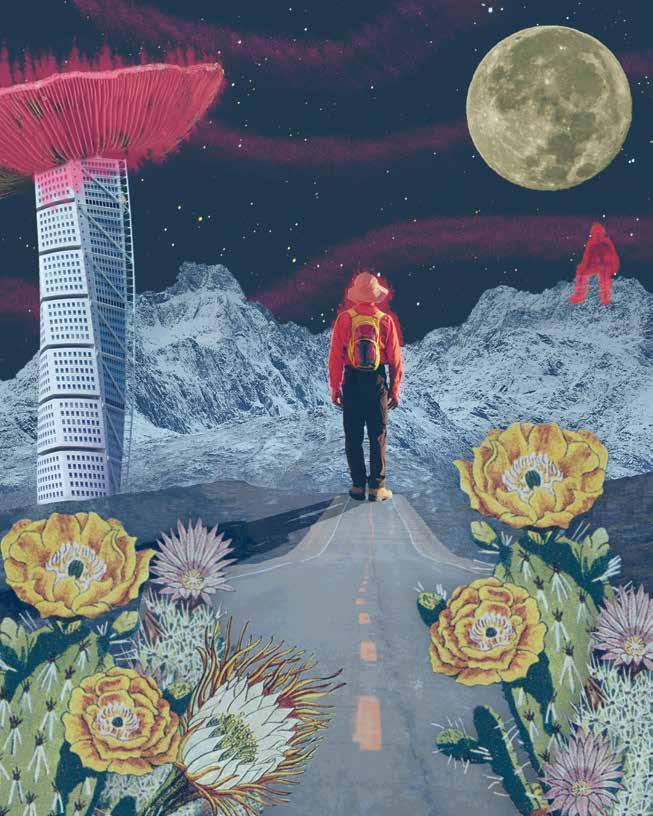
LAWTON JONES
For my Graphic Design class, I created a surreal collage project. The goal of the project was to create a collage that was “bizarre” (surreal) mixing the real with imagination. I believe this one was around 10 images collaged into one with Photoshop. What inspired it was the feeling of exploration and the mix between the natural and the unnatural. I played with the use of real photography and artistic depictions of nature. For example, turning a real building into a burning mushroom.
Greetings, friends!
I hope everyone has been having a wonderful fall and getting ready for those winter months. In Vermont, the snow will be flying soon, which is an excellent reminder for me to dig out our winter clothing for the foreseeable future….
With the changing of the seasons, it’s a great time to reflect and take inventory on the past and think about what is to come. This ties nicely into the theme of this issue of the magazine, “legacy.” People often think of legacies in terms of money or property that is passed down through generations. For me, the word legacy conjures thoughts of people who leave lasting impressions and their impacts on other people. This could show up as how others think, what they say, and what they do, all because of knowing you. This got me thinking about friends, family, and alumni who have shaped and guided me into the person that I am today and have set the groundwork for future iterations of myself. I can only hope that my words and actions have been able to affect others in the ways others have affected me.
Saint Michael’s College uniquely positions students to think bigger and beyond themselves. With a well-rounded education, versatile skills to help them tackle anything, and empathy to meet people where they are, the groundwork is being laid for the next generation of Purple Knights to establish their legacy, paying it forward for the generations to come.
At the September meeting of the Alumni Board of Directors, we were able to hear from President
Plumb about the state of the College, as well as from our interim VP of enrollment, Joel Wincowski. Both discussed some challenges of the current higher education landscape, and more importantly, what St. Mike’s is doing to address those challenges. Both spoke about how the College will continue to focus on preparing students with skills, professionalism, and empathy to navigate the ever-changing world. This continues the legacy we all experienced while at St. Mike’s that ensured we were prepared to be truly adaptable, flexible, and ready for whatever life throws our way, both personally and professionally.
In thinking about the theme of legacy for the Alumni Board of Directors, we recently launched six committees to help with alumni engagement: Admissions, Athletics,
Career Symposium, Student Success, Reunion & Awards, and Events & Fundraising. Our goal is to engage alumni in these specific areas and to provide ways for them to continue to be a part of the St. Mike’s community while serving as a bridge between alumni and students. Want to be a part of something great? Reach out to me or to Stephanie Snell, and we’ll happily talk through how you can help.
Lastly, come hang with us! The Alumni Office is planning multiple regional events across the country, and there’s likely one happening near you. Check out the Alumni Page for the most recent schedule at www. smcvt.edu/alumni. Also, mark those calendars for Reunion Weekend 2026 for June 4 to 7. We’d love to see you!
As I sign off, I’m filled with immense joy at the legacy St. Mike’s has given to me and strive to pay that legacy forward. Cheers to a fantastic close to 2025, and hope to see you at an upcoming event!
All the best,
Jillian Kasierski Charest ’04 President, Saint Michael’s College Alumni Association
1963
Fred Cerrato has written four books. His latest is A New Jersey Basketball Story. Read how Bobby Pisano and Kathy Cunningham work together to become superstars and lead their respective teams to the state championship game. See Works, page 48.
(2.) James Cahill says, “Happily retired after 40 years practicing OB-GYN, mainly in Vermont. Enjoying traveling and delivering Meals on Wheels as well as a justice of the peace in our town.”
(3.) Bill Troy shared how St. Mike’s Reunions for the Class of 1965 have been made all the more magical over these many years by a special gathering held on Saturday afternoon of each Reunion at the Lake Champlain house of classmate John Cunningham. “Our 60th, this year, was no different and saw 24 Golden Knights rejoin, and rejoice, while achieving this special milestone.” Front row (L to R): Joe Seremeth, Gerry Loftus,
Ray Dargie, Kirk Weixel, John Cunningham, Greg Tocci, Ned O’Brien; Second row: Larry Monaldo, Frank Stratford, Bill Duncan, Jim Geier, Larry Dugan, Matt Reiner, John Higgins; Third row: Jim Whitman, Bill O’Connell, Kevin Wright , Chick Smith, Tom Colangelo, Bob Armstrong, Bill Troy, and Mike Ryan.
(1.) Fr. Brian J. Cummings ’86 says, “The Board of Directors of the Edmundite Missions met and the statue of Our Lady of Selma was rededicated on the Missions campus after it was refurbished.”
Attending were Edmundite Fathers Dave Cray ’67, Brian Cummings ’86, Board Chair, Steve Hornat ’72, and Richard Myhalyk ’66. Also pictured are other members of the Board of Directors, which include Business Professor Emeritus David LaMarche ’69 and Bill Campbell ’81, and Chad McEachern ’91, president of the Edmundite Missions. Children and staff from the Edmundite Learning Center and the
Edmundite Academy are also pictured.
1968
Louis Giancola (MATESL ’95, and Adjunct Professor Emeritus, Dept. of Applied Linguistics) recently published his family memoir/cookbook Remembering Mama and La Mia Famiglia: Stories and Recipes. He also shared he had two book launch events as fundraisers for the U.S. Committee on Refugees and Immigrants in Vermont. The events were held at the Rutland Free Library in May and at Saint Michael’s College in June. “Afterwards, I donated $2,525 from the sale of all signed books to U.S.C.R.I. Vermont.”
See Works, page 48.
(4.) Jerry Zezima recently wrote The More the Merrier: Laughing at Life When Everyone Thinks You’re Over the Hill. “When you reach a certain age (try 70), people figure you’re not long for this world. That’s not true for nationally syndicated humorist Jerry
Zezima, who is shockingly immature, which makes him seem a lot younger. Filled with hilarious and absolutely true stories, including Zezima’s account of his return to St. Mike’s for his 50th Reunion (which also appears on p. 64 of this magazine), The More the Merrier proves you can grow old and still be young, and that laughter is, indeed, the best medicine,” wrote Zezima. You can read The More the Merrier: Laughing at Life When Everyone Thinks You’re Over the Hill on iUniverse. See Works, page 48.
(5.) John Scanlon wrote, “A group from the Class of 1978 got together for golf and fun in Litchfield, CT, this July.” L to R: Bill AKA “Buff” Downes, Billy O’Keefe, Don Dunworth, Mike Kenny, Kevin Sullivan, John Scanlon, Marc Weiss, Ron Amato, Dennis Gears, and Jimbo Keene.
(6.) Jill Hanlon Holland shared a photo from a summer Cape Cod gathering of friends from the classes of 1978,
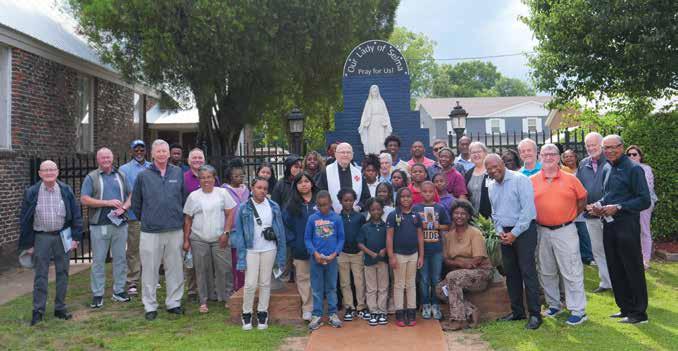
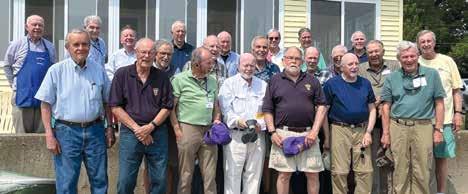
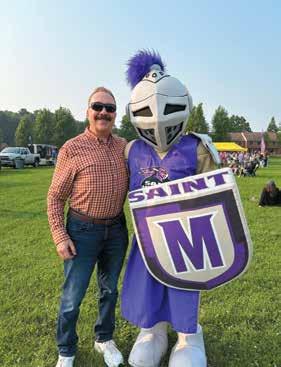
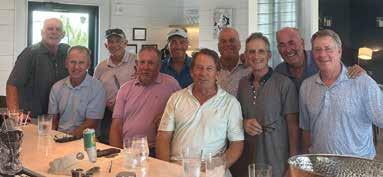
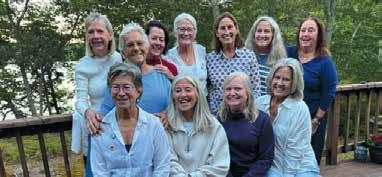
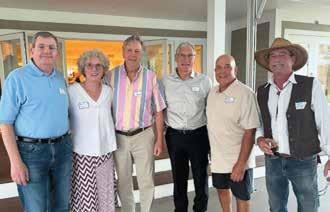
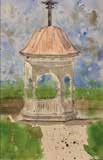
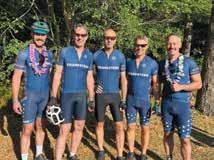
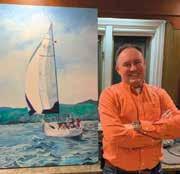
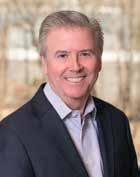
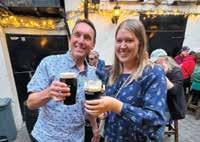
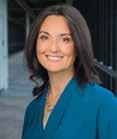
1979, and 1980.
Front row: Maggie Downes-Angus ’79, Jayne Speechley Boyle, Paula M. Devereaux ’80, Patty Morrissey Hearns; Back row: Jill Hanlon Holland, Martha Dame, Sue-Ann Corrigan ’79, Jennifer Wade Garrity ’79, Kelly Diamond ’77, Kerrin Diamond Cole, and Pat Normandeau.
(1.) Michael Devine wrote “Several St. Mike’s alums gathered at the Scituate (MA) High School Class of 1975’s 50th reunion on 16 August 2025.” L to R: Mike Devine, Pam Gunn Rice, Jim Caffrey ’77, Doug Curtis (who has no connection at all to St. Mike’s—he photobombed the picture), Doug Koelsch ’79, and Danny McCarty (who attended St. Mike’s for one year, 1975-76, before transferring elsewhere).
(2.) Abigail Stewart ’09, regional site administrator North Shore for Historic New England, hired fellow alumna Maura Quinn to be a tour guide for the Phillips House in Salem, MA, and the Boardman House in Saugus, MA. Both women thank St. Mike’s for their never-ending curiosity about the arts and history. It has been great fun for
them as they share their enthusiasm for historic education and preservation with visitors.
Nancy Lubinsky recently published a children’s book. Discover Learning
My ABC’s by Nancy Lubinsky ’83, a fun and beautiful way to learn the alphabet! The book combines stunning animal photography by Nancy with a fun A to Z journey.
See Works, page 48.
(3.) Rich Gallerani writes, “I am happy to share that my essay ‘Grace on Tap’ has been published in the Spring/ Summer 2025 edition of the Chesterton Review This is my second essay to be published in the Review.”
(4.) Rich Gallerani also writes, “A recent watercolor of the Cupola. St. Mike’s has been on my mind more these days as my 40th Reunion is fast approaching!” Title of work: Painting of the Founders Hall Cupola.
(5.) Dan Lagan submitted a photo of group photo from the Pan Mass Challenge Ride for Dana Farber Cancer Institute. In photo:
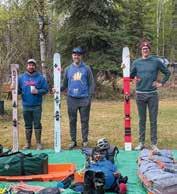
Kevin O’Riordan ’12, Dan Lagan, Chris Lagan ’92, Greg Lagan ’90, and Tom O’Riordan ’07
(6.) Peter Houde has been selected to display his oil paintings at the Sandy Cleary Gallery at the Nashua Performing Art Center, in Nashua, NH. It’s the first public viewing for these works, and the show runs through early December.
(7.) The Bulfinch Group is pleased to announce that Peter Leddy has been named a Leaders Club qualifier by the Guardian Life Insurance Company of America (Guardian). Leaders Club is one of the highest honors annually awarded by Guardian to financial professionals who demonstrate outstanding service and dedication to their clients.
(8.) Alumni George Goldsworthy and Kaitlyn Geary ’14 happened across each other in
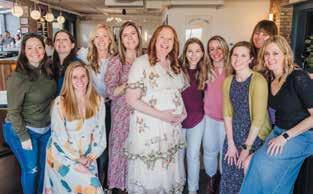
Dublin, Ireland, and shared several pints of Guinness. Cheers!
(9.) Cortney R. Stapleton was recognized by PRWEEK as being a 2025 Woman of Distinction. Cortney is currently CEO of The Bliss Group, a marketing communications agency.
Casner & Edwards attorney Jennifer M. Clark was recognized by the Best Lawyers in America 2026 in the area of family law. Inclusion in the Best Lawyers in America is based on an extensive peer-review process designed to capture the aggregate opinion of leading lawyers about the professional abilities of their colleagues within the same geographical and legal practice area. Best Lawyers has been published since 1983 and highlights the top 5% of practicing attorneys in each practice area. Its 2026 selections will
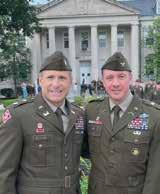
be featured in the 32nd edition of the Best Lawyers in America.
Dave Patterson recently published a new book: Euphoria: 10 Maine Stories. A collection of short stories that take place in a struggling milltown in Maine.
See Works, page 48.
(10.) Mark Oldmixon lives in Fairbanks, AK, and works at the University of Alaska Fairbanks, where he can see Denali from campus on a clear day. Adam Thomas ’03 lives in Switzerland, where he enjoys the Alps year-round on skis and bikes.
Mark writes “While we did not make the summit of Denali, we did reach 16,000 feet and returned home with all of our fingers and toes. After reaching 16,000 on an acclimation climb, we were bogged down by bad weather for a week. In total we spent 16 days on Denali, enjoying some great views and ski
runs while also hunkering down hiding from the wind and cold. It was a great adventure exploring the mountains of Alaska.”
See Voices, page 4.
(11.) Katie Healey Farrow writes, “I attended the baby shower for 2004 alumna and second gen (and sibling of an alumna) Corinne O’Connor. We’re all super excited for Corinne and all in this photo went to St. Mike’s and I think all but Moe (Maureen) and Lindsay Klim graduated in 2004.” L to R: Maureen Cacioppo, Caitlin DePeter McGuigan, Beth Murray O’Brien, Molly Lydon Cook, Beth Winton Campbell, the Beautiful Corinne O’Connor, Katie Healey Farrow, Jen Quinlan Cancellieri, Lindsay Cross Hanson, Lauren Hurley McCallum, and Lindsay Klimkowski Forrest!
(12.) Colonel Ryan Case ’03 and Lieutenant Colonel Justin Belford have been selected to serve alongside a group of 76 senior military officers
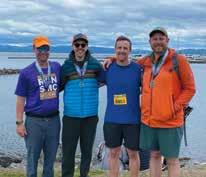
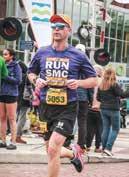
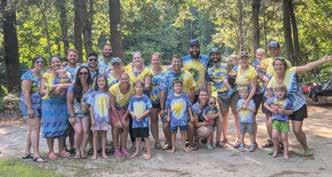
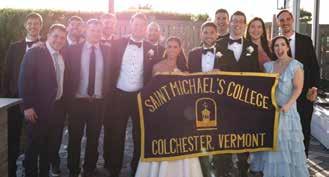
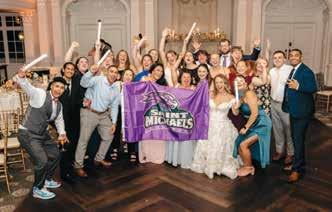
as 2025 U.S. Army War College Fellows. Col. Case will spend his fellowship year at the Daniel K. Inouye Asia-Pacific Center for Security Studies, while Lt. Col. Belford will complete his fellowship at Carnegie Mellon University’s Heinz College.
(1.) Paul Molzon submitted a few Vermont City Marathon pictures! L to R: Paul Molzon, Jordan Scampoli, Tim Humphrey, and Owen Glubiak ran in Burlington’s Vermont City Marathon Relay Memorial Day Weekend for the third time, achieving a team PR this year!
Rob Hasson was promoted to associate professor with tenure at Providence College on July 1, 2025. He is a member of the Department of Social Work and currently serves as chair of the department.
Rev. John H.D. Lucy has written Seminarians Don’t Blow Stuff Up: Reflections on a Pastor’s Becoming. It’s published through Westbow Press. See Works, page 48.
Chris Gosselin has been accepted into the Doctor of Education (Ed.D.) in Educational Leadership program at the Boston College Lynch School of Education and Human
Development. Chris currently serves as director of instructional technology and innovation for the Needham Public Schools in Massachusetts.
(2.) Liz Wall writes, “A crew from St. Mike’s class of 2010 got together to celebrate their 15-year reunion in North Conway, NH, in August 2025. Alumni include: Danielle Segal, Justin Miller, Alison Dionne Madden, Dan Purcell, Christian Jevne, Whitney Wildes, Lauren Levy Tierney, Jolie Frechette, Heather Barss, Matt Sjoblom, Patrick Wall, Ryan Walker, Emily Wright, Christine Amoresano Gallager ’11, Erick Gallager, Liz Hawkes Wall, and nine future St. Mike’s Knights.”
Cassandra Varanka writes “Thrilled to share that I’ve joined the Nuclear Threat Initiative (NTI) as director of legislative affairs. This role brings together the core strands of my career, encompassing congressional service, nonprofit advocacy, and a deep commitment to nuclear risk reduction. I am grateful to join this mission-driven team at such a pivotal moment!”
Alumni Kaitlyn Geary and George Goldsworthy ’93 happened across each other in Dublin, Ireland, and shared several pints of Guinness. Cheers!
See page 58 for photo. (8)
(3.) Matthew Prescott and Kristen Bonsante were married on May 10, 2025, in Middletown, Rhode Island. Alumni in attendance included, L to R: Mark Worthen, Matthew Napoli, Casey Buck, Evan Spencer, Samuel Olore, Erik Hoiseth, Michael Girardi, Kristen Prescott (née Bonsante), Matthew Prescott , Daniel Kirk, Trevor Brown, Jennifer Pelkey, Chloe Olore, and John Pelkey
Melinda Burkhart writes, David Burkhart announced his engagement and wedding in October 2025.
Marie Maillet and Aidan Walter ’18 were married June 21, 2025, in Isle La Motte, VT.
(4.) Aleksandra Apkarian (St. Mike’s Softball) married Nicholas Dorcean (St. Mike’s Baseball and grad student from 2017 to 2018) on July 20, 2025. The wedding hosted over 20 St. Mike’s graduates, including Chandler and Benjamin Davis ’18, married in 2022.
Katelyn Stemrich was promoted to the rank of
lieutenant in the United States Navy while serving as a judge advocate general stationed aboard Naval Air Station Jacksonville. Her longtime boyfriend, Jack Gowetski ’18, pinned on her new rank.
(5.) On June 20, 2025, Brennan Foley and Lillian Wyand were married.
Saint Michael’s College takes pride in its alumni and joyfully shares the news of their lives and achievements. Publishing these alumni messages does not reflect any endorsements or positions taken by the College.
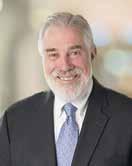
John J. “Jack” Neuhauser, retired president of Saint Michael’s College, former academic vice president and dean of the Carroll School of Management at Boston College, and gentleman farmer, died September 30, 2025, at Lahey Hospital in Burlington, Massachusetts, following a brief illness. He was 82. He began his nearly five-decade-long career in academia at Boston College in 1969 and became the dean of the Carroll School of Management in the mid1970s. In 1999, Jack was appointed to the role of academic vice president of Boston College. Shortly after
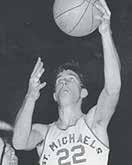
Richard “Rich” Tarrant ’65 died on August 12, 2025, in Hillsboro, Florida. He was a true Renaissance man whose life touched countless people as an athlete, entrepreneur, philanthropist, and devoted family man. A proud Purple Knight, he excelled on the basketball court before cofounding IDX Systems, which trans -
Michael Christopher Kehoe ‘67 passed away peacefully on August 13, 2025. He was a loving father, grandfather, brother, and uncle. He was a proud veteran, a dear friend to many, and an integral part of the community. Born and raised in Burlington, Kehoe attended Rice High School before joining the U.S. Navy. Upon his return three years later, he attended Saint Michael’s College, where he majored in American Studies. He then moved to Aspen, Colorado, to work in
that, he joined the Board of Trustees at Saint Michael’s College. In 2007, Jack was unanimously chosen as the 16th president of the College. He guided Saint Michael’s through the 2008–09 recession and championed online summer programs and collaborations via the Green Mountain Higher Education Consortium with Middlebury and Champlain colleges. He served on the boards of numerous businesses and institutions including the University of Vermont Medical Center. Jack cherished the friendships and knowledge gained through these experiences. At his final Commencement ceremony in 2018, he urged graduates to embrace “the gift of kindness” and return to campus often. He followed his own advice, remaining active in the Saint Michael’s community, regularly attending campus events. Read more on page 36.
formed healthcare technology. Beyond his professional success, Rich and his wife, Deborah, gave generously through their foundation, supporting education, healthcare, and community life across Vermont. He brought the same energy to politics, friendships, and storytelling, always with his trademark wit and loyalty. Rich will be remembered with gratitude and affection for his vision, humor, and deep kindness. Per his request, a memorial service to say farewell to Rich was held October 4 at the Chapel of St. Michael the Archangel. Read more on page 38.
the ski industry for a few years, returning to work in a family business. In 1977, Kehoe recognized an unfilled retail niche and created an upscale men’s clothing store. He and business partner Tom Pierce opened Michael Kehoe Men’s Clothing, which catered to fashion-conscious men with more discriminating tastes, selling hand-tailored suits, silk ties, and Italian-made shoes. The business opened just as the Church Street Marketplace was being renovated into a pedestrian mall, and drew regular shoppers from as far away as Montréal. He retired in 2020. Kehoe’s first cousin, Pat Robins ’61, described him as “a person of high character and strong opinions.” He will be missed dearly by all who knew him.
We are saddened to learn about the loss of our beloved alumni, faculty, staff, and friends of the College.
To read their full obituaries, please use the listed URL or QR code below. Our deepest sympathies are extended to their families and loved ones.

1951
Bernard G. LaRocque, G’27
1954
Frank D. Falcetti
1957
Richard D. Gelinas, Esq.
David A. Dery
1960
Joseph J. Reiher
Col. Frederick E. Nowak, USAF (Ret.)
1961
Norman Corriveau
1962
John B. Hough, Jr.
Col. John E. Fredette
1963
Lt. Col. William J. Crennan (Ret.)
John F. Coughlan
Michael B. Armstrong, M.D.
1964
Joseph E. Donald, Jr.
Thomas P. “Tom”
Kane, Esq.
Richard E. Tarrant
Ernest M. Tyrrell
1966
William J. Dillon
1967
John “Jack” M. Biuso, P’96
Raymond O. Dufort
Michael C. Kehoe
1968
Edward F. Connolly, Jr.
1969
Thomas W. Kulhowvick
1971
Robert J. Nolet, Jr.
1973
David F. Curley 1965
Michael P. Berardino
Jean C. Johnson
Donna K. Austin
John T. Butler, Jr.
John J. Troy
John G. Meaney
M. McDonough
M. Martin
Eric M. Dunn M1973
Sr. Ruth M. Ravey M1981
Sr. Pauline Labrie, CSC
M1982
Merryl M. Pisha
M1983
Patricia J. Agaman (formerly Bradley)
M1987
Nancy Martenis
M1995
Rev. Mansel D. Wells
M1998
Margaret A. Targett ’65
M2003
James A. Hester, Jr., Ph.D.
FACULTY, STAFF, AND FRIENDS
Gary L. Duffy
Adrian Vittorio Languasco
Jack Neuhauser
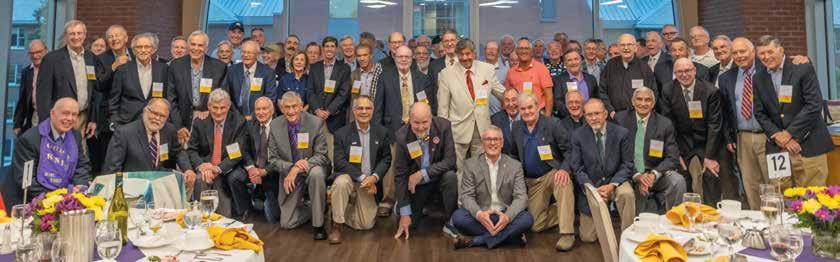
By Jerry Zezima ’75
Thanks to the wonderful values instilled in me at Saint Michael’s College in Colchester, Vermont, where I graduated magna cum lager, I do not (as yet) have a criminal record.
But I do have a happy marriage because my wife, Sue, also went to St. Mike’s and accompanied me to our 50th Reunion, where we saw dozens of cheery classmates, reminisced about our crazy antics, and met the College’s new president, Dr. Richard Plumb, a gregarious and impressive man who not only listened politely to my stupid jokes and outlandish stories, but kindly refrained from revoking my diploma.
The Reunion was a golden opportunity to spend time with our great friends Tim and Jane Lovelette. Tim was the ringleader behind the best pranks pulled by the notorious Class of 1975.
On the advice of my attorney, who is in jail, I can’t go into details, but I can say that the high jinks sometimes involved live snakes.
Tim married Jane, who went to nearby and now closed Trinity College, in 1974, between junior and senior years. They recently celebrated their 51st wedding anniversary.
“Jane says I’m better than nothing,” Tim told me.
“I told Sue that I’m like crabgrass: She can’t get rid of me,” I said.
“Sue hasn’t had to put up with you for as long as Jane has had to put up with me,” Tim said, noting that Sue and I have been married for only 47 years.
But Tim and I are still the picture of immaturity, even though we couldn’t repeat a prank we pulled at a previous Reunion by sneaking into the pictures of all the celebrating classes.
This time, we didn’t pull it off because it was raining and photos of classes that graduated in years ending in 0 or 5 were moved to the Chapel, where we might have been struck by lightning. Not only that, but we were late for our class photo.
“Maybe they can Photoshop us in,” I suggested.
“They probably Photoshopped us out of the ones at that other Reunion,” said Tim.
We also appeared in a photo at a previous Reunion holding a Saint Michael’s banner—upside down.
“That’s when you were voted Alumnus of the Year,” I reminded Tim.
“You nominated me,” he recalled.
“If they only knew,” I said.
The highlight of the 50th Reunion was the Golden Knights Dinner, where two memorable things happened: I asked the president of the College to dance and our class photo was retaken—with me and Tim in it.
As we were finishing our meal, which was delicious, President Plumb came over to our table and urged us to get up and dance. I got up, went over to him, and said, “Would you like to dance?”
“Wouldn’t you rather dance with your wife?” he wondered. Instead, I danced with Terri Selby, the school’s associate associate VP of Institutional Advancement, who not only could be on Dancing With the Stars (I’d be on Dancing With the Stiffs), but did a fabulous job in coordinating the Reunion, which honored 10 classes.
The next evening we attended the P-Knight Party, where I met Mike the Knight, the school’s costumed mascot, so named because the athletic teams are called the Purple Knights.
“Are you a good knight?” I asked. “I had a lot of good nights when I went here. I can’t remember most of them.”
I also was happy to see so many nice people, including two fellow journalists: classmate John Kennedy and his wife, Mary Ellen Klas, who didn’t go to St. Mike’s but fit right in.
At the Farewell Breakfast the next morning, I thanked President Plumb for a wonderful weekend and for seeing to it that all the “Wanted” posters of me were taken down.
“The statute of limitations has expired,” he assured me.
As we were leaving, Marybeth Sonski Marquardt, a member of the Class of 1980, took a photo of me, Sue, Tim, and Jane. Tim and I were holding a Saint Michael’s banner— upside down.
“A fitting way to end the Reunion,” Tim said.
I nodded and stated the obvious: “We’re still crazy after all these years.”
Saint Michael’s College
One Winooski Park, Box 6
Colchester, VT 05439
Change Service Requested