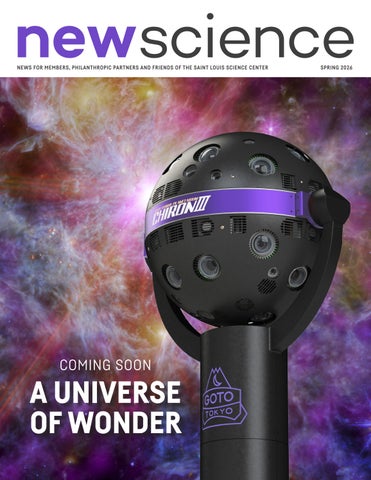
newscience
COMING SOON
![]()
COMING SOON


Saint Louis Science Center
Board of Commissioners
Dr. Mark S. Wrighton, Chairman
Dr. Christine Jacobs, Vice-Chair
Dr. Kelvin Adams, Secretary
Michael J. Baughman, Treasurer
Chris Almeida
David Baringer
Mark Sawyier
Mark Sears
Dr. Jeremy Williams
Saint Louis Science Center
Board of Trustees
Edward Monser, President Abe Adewale
Aaron Addison
Simon Bailey
Lawrence Casey
Barry T. Cervantes
Jim Curran
Beverly Estes Guyton
Richard C.D. Fleming
Paris Forest
Devin Fraley
G. Patrick Galvin
Jenna Gorlewicz
Kevin Gunn
Jerome Harris
Dr. Martin H. Israel
Jamie Jabouri
Lindsey Jubel
David Kocs
Dr. Toni Kutchan, Ex-Officio
Erik Lindbergh
Carol B. Loeb
Gregg Maryniak
John F. McDonnell (Life Trustee)
RADM Lee J. Metcalf, USN (Ret.)
Maurice Muia
Dr. Sam Page, Ex-Officio
James Qin
Tim Rozar
Donn Rubin
Kathleen R. Sherby
Judy Sindecuse
Cara Spencer, Ex-Officio
Zar Toolan
Craig Unruh
Kenneth L. Wagner
Breck Washam
Candace Webster
Dr. David J. Werner
Dear Friends of the Saint Louis Science Center,
We have kicked off an exciting year here at the Science Center, igniting curiosity, planting seeds of innovation, and demonstrating that science has space for everyone. And just as science is always making new discoveries and evolving our understanding of our world, I’m thrilled to share sneak peeks at some of the upcoming experiences at the Science Center that will bring STEM to life in new ways.
In this spring issue of NewScience, you can learn more about our upcoming special exhibition, The Blue Whale Story, which opens May 23. This limited-run experience will immerse guests in the incredible biology of blue whales, sharing how these massive creatures became Earth’s largest animals ever.
Our Gallery Spotlight looks at the iconic James S. McDonnell Planetarium and shares details of upcoming enhancements that will take science learning into the future. Be sure to read more about these next-generation upgrades, including a new state-of-the-art star projector made possible by the St. Louis-based Centene Foundation, that will expand how our guests explore both our universe and our own planet.
You can also learn about upcoming opportunities to engage your curiosity at events like SciFest: The Great Outdoors Expo, the EV Experience, and more.
In our Donor Spotlight, you can hear from Einstein Society members Jeremy Williams (who also serves on the Science Center’s Board of Commissioners) and Rachel Presti about why they support our mission and how the Science Center plays a role in their family’s lives. Our Einstein Society members go above and beyond in powering our work, and in this issue we are proud to recognize those who joined or renewed their Einstein Society membership last year.
Our mission wouldn’t be possible without the generous support of our members, donors, and Zoo-Museum District taxpayers. If you are inspired to show additional support, please mark your calendar for Give STL Day on May 7 (or make a gift anytime at slsc.org/donate) to make a gift or help encourage others to participate. St. Louis is a science city, and a gift of any size helps us continue to share the wonder and joy of science with everyone.
Please enjoy this issue of NewScience, and we hope to see you soon at your Science Center, where there’s always something new to discover.

With gratitude,

Ray Vandiver President and CEO
To inspire everyone to be curious and engaged in science. Mission of the Saint Louis Science Center

Contact
314.289.4400 | slsc.org
Saint Louis Science Center
5050 Oakland Avenue St. Louis, Missouri 63110
Membership
Services, Sales & Member
Reservations: 314.289.4414 slsc.org/membership memberships@slsc.org
Reservations
Advance Sales & Group Reservations: 314.289.4424
Education
Programming information: education@slsc.org
Events
Host your next private event at the Saint Louis Science Center. Services and catering provided by Saint Louis Science Center Events. For information: 314.286.4667.
Complimentary wheelchairs and strollers are available in the lobby. Motorized scooters are available for a rental fee. Personal Hearing Assistance Devices are available at the OMNIMAX® Theater and Planetarium. Captiview caption devices are available for all OMNIMAX® films.
The Saint Louis Science Center gratefully acknowledges the support of our Official Partners.


Connect with us for updates, special events and fun science.
Meet Kim and Melanie in our member spotlight and learn about upcoming member events.
Learn from Professor Feng Jiao about the advancements he and his team are working on to make it possible to grow food in dark places –like outer space!
This year, we bid adieu to our ZEISS star projector – but that also means we’re saying hello to the newest, best, and brightest star projector in the United States. Learn all about it!
What stars are shining in the night sky this spring? What’s getting composted by our Sustainable Futures Team? Look no further.
Big news about our upcoming special exhibition! Plus, don’t miss our EV Experience, our spring SciFest, and much more.
It’s another year of Summer STEM Explorers! Learn more about our camp program.
Help us recognize our Einstein Society members for their generous support and then see some of the exclusive experiences in store for 2026. In our Donor Spotlight, meet Jeremy Williams and Rachel Presti and discover why they’re proud to support the Science Center.


Thursday, Friday, Saturday: 9:30am–4:30pm Sunday: 11:00am–4:30pm Monday: 9:30am–4:30pm


How long have you been members?
Well, it started with my grandparents, Charles and Challie Loomis, taking my brother Scott and me to the old Science Center in Clayton when we were little. I remember driving a car simulator and learning about circulation while looking at the transparent woman. Fast forward to the 1990s, when the new Science Center opened, and my parents, Jim and Marcia Loomis, joined. I have continued our family membership ever since, and now I’m the grandparent bringing the grandkids to the Science Center!
Melanie and I are both educators. Melanie taught Social Studies with St. Louis Public Schools for many years and then became the Dean of Students at Carr Lane. She retired last year and enjoys walking in Forest Park and bringing our younger grandkids to the Discovery Room. I am still working as the Director of Federal Programs for the Fox School District, and it’s easy to appreciate the value in supporting a place that provides free access for everyone to enjoy.
How often do you visit, and what do you like to do here?
We visit at least ten times a year and enjoy special events such as OMNIMAX® Member Previews and Member Missions like the wine-tasting event in the GROW Gallery. We bring each new grandchild to the Discovery Room – at first, one at a time, then two, and then all three. Now our older grandkids love the OMNIMAX movies and seeing real dinosaur bones. Each visit is an adventure through their eyes.


Tell us a favorite memory about spending time at the Science Center.
At Member Appreciation Night, the Makerspace gallery team had a workshop where our grandkids got to make light-up ornaments all by themselves, and then, to top that off, they got a hot chocolate that included a visit to the topping bar where they could select whipped cream, sprinkles, and chocolate chips. They thought that was the best!

What are your favorite types of member events?
Melanie and I really enjoy the Vault events. It is fun to see new artifacts on display and learn about the Collections from Kristina Hampton. Member Missions like the wine event are always fun and interesting, and we are always looking forward to the next special event.


“IT’S EASY TO APPRECIATE THE VALUE IN SUPPORTING A PLACE THAT PROVIDES FREE ACCESS FOR EVERYONE TO ENJOY.”
For anyone considering a Science Center membership, why would you recommend it?
Our membership provides us with an opportunity to enjoy a movie or a special exhibition close to home. It also includes free parking, which is an added bonus. Most importantly, it gives us a place to bond with our five grandkids in a safe, fun learning environment. The benefits of being able to take them to the Discovery Room, OMNIMAX movies, special member events, and even other science centers when we travel has been priceless.


SUNDAY, APRIL 19 | 3:00–4:30PM New Member Expedition
Reservations available Monday, March 23
Are you new to membership at the Saint Louis Science Center? This event is perfect for you! Join other new members as we guide you through all the benefits of being a member at the Science Center. Afterward, be sure to join in the building tour and enjoy a science demonstration!
SUNDAY, APRIL 19 | 5:30 & 6:45PM OMNIMAX® Member Preview: Wild Asia
Reservations Monday, March 23
What’s your favorite member benefit, and why?
Over the years, we have enjoyed the ASTC reciprocal benefits and have used them to visit museums and science centers in Arizona, California, Colorado, Florida, Georgia, Hawaii, Illinois, Kansas, New Mexico, New York, Oregon, Texas, and Washington. We also enjoyed the summer camp discount when we sent our oldest grandson to Summer STEM Explorers camp two years ago.
Wild Asia invites viewers to join an epic journey across the world’s largest continent whose extreme landscapes have pushed wildlife to the limit! Immerse yourself in the lives of a tiger family in western Nepal, watch a Tibetan fox hunting amongst yaks on the vast Tibetan Plateau, and catch intimate glimpses of the secretive red panda in its Himalayan stronghold.
FRIDAY, MAY 22 | 9:30AM–3:30PM Member Preview of The Blue Whale Story
Join us for a preview of our newest special exhibition before the public gets their turn! Only members will be invited to meet Blue during our regular operating hours on Friday, May 22.
Visit slsc.org/member-events for more information!

I work on a simple but radical idea: what if we could grow food without sunlight? Not by giving up on nature, but by updating it? My team builds “electro-agriculture” systems that turn carbon dioxide and renewable electricity into a liquid food for plants, so they can grow in the dark.
Imagine a system like a layer cake: solar panels on top, an electrolyzer in the middle that converts CO₂ into acetate, and a quiet farm on the bottom where crops sip that acetate and grow. This approach lets us grow greens, tomatoes, mushrooms, and more in basements, in deserts, inside cities, and even in spacecraft where sunlight is scarce or unreliable. It is a way to make food where people are, not only where the weather cooperates.
Today, I am a professor at Washington University in St. Louis, where I work with engineers, chemists, biologists, and partners outside academia. I am also actively participating in research at CURB, a National Science Foundation-funded Engineering Research Center that is pursuing electro-bio systems for advanced biomanufacturing. CURB brings together people who design devices with people who design life, so that carbon can flow intelligently from CO₂ into things the world needs: food, materials, and fuels. The center gives us a home for ambitious ideas that no single lab could carry alone.

I did not begin in agriculture. I trained as a chemist and fell in love with electrochemistry, the science of altering molecules using electricity. Early in my career, I studied how to transform CO₂ into useful chemicals. Then a question kept nagging me: if we can make clean carbon molecules efficiently, could we also feed living systems with them? That question pulled me into collaborations with biologists and plant scientists. We tried organisms that already like acetate, such as yeast and fungi, then challenged ourselves with plants. I still remember the first modest success: algae growth media turning green in a growth chamber without a single lamp on. It felt like seeing a door open.
How did I end up here? It was step by step, following questions that would not let go. As environmental challenges became clearer to me, I realized the food system is both vulnerable and powerful. It uses a vast share of land and water, and farmers are on the front lines of droughts, floods, and heat. Vertical farms promise control, but the lights are energy hungry. Electro-agriculture offered a different route: harvest the sunlight to generate electricity with efficient photovoltaics, then use the electricity to turn CO2 into acetate that biology can digest. I built new partnerships, learned new research fields, and accepted that progress meant leaving my comfort zone. The path was not straight, but it was straightforward in terms of the problems and solutions.
The most fulfilling part of this work is to progress towards something that may improve our daily lives. Food that is grown down the block can arrive on your plate hours after harvest, not days or weeks later. It is also more resilient. If a storm knocks out roads or a drought withers fields, food production inside a city can continue. Additionally, electro-agriculture is powered by electricity, which is more predictable in price than many crops that depend on weather to determine their resultant yields and prices. That means steadier food prices and fewer shocks for families.
The electro-agriculture concept was born for space: a way to provide fresh food for crewed missions. NASA supported our work through the Deep Space Food Challenge, in which our team placed second in 2024. In orbit or on the Moon or Mars, sunlight can be intermittent, space is tight, and resupply is risky. Electroagriculture converts a spacecraft waste stream into value: the CO₂ that astronauts exhale becomes acetate, which becomes food and, indirectly, oxygen as plants grow. For long missions, such a closed loop is not a luxury but a necessity. The same design choices that deliver resilience in space translate to Earth, supporting food production after disasters, in remote communities, and across arid regions.
For people who are interested in pursuing a career in my field or are just curious: stay open minded and practice out-of-the-box thinking. Let curiosity pull you into STEM subjects, from chemistry and physics to biology, data, and design. Explore widely and question defaults. Dare to be the first in your lab, your class, or your community. Start small, test boldly, and learn fast. Innovation favors those who combine ideas across boundaries and build what they imagine. Let your creativity feed people, solve problems, and open doors.
There are days when this work feels like science fiction. But the fundamentals are surprisingly simple. We use the same inputs as photosynthesis does: CO₂, water, and sunlight. We just route the energy differently and more efficiently. It can translate into safer manned missions in deep space, where independence from sunlight is freedom.
If you remember only a few things about electroagriculture, let them be these:
We can grow food without light by feeding crops a safe, simple molecule called acetate that we make from CO₂ using renewable electricity.
2 3 4
This pathway bypasses the inefficiency of photosynthesis and has already shown large gains in energy efficiency, with a clear route to further improvements.
Electro-agriculture can work in cities, deserts, disaster zones, and spacecraft, bringing production closer to people and reducing reliance on weather.
The same closed loops that make life possible in space can make life more stable on Earth.
Electro-agriculture is not about replacing farmers. It is about giving humanity another way to make food, one that is more sustainable and resilient to climate conditions. It began for me with a stubborn question and a small mushroom in the dark. Where it goes next is up to all of us.


Professor Feng Jiao holds a BSc in Chemistry from Fudan University in China and a PhD in Chemistry from the University of St. Andrews in the United Kingdom. Following the completion of his postdoctoral training at the Lawrence Berkeley National Laboratory, he joined the faculty at the University of Delaware in 2010. Then, he was promoted to full professor in 2021 and served as the Director of the Center for Catalytic Science & Technology. In August 2023, Professor Jiao joined the Department of Energy, Environmental & Chemical Engineering at Washington University in St. Louis and was recently appointed as the Lauren and Lee Fixel Distinguished Professor. He also serves as the director of the Center for Carbon Management. The Jiao Research Group is developing innovative electrochemical devices to address critical energy and sustainability challenges.
Zeiss Retires January 31, 2026
For nearly 25 years, the ZEISS UNIVERSARIUM Mark IX star projector was the true “star” of all shows in the James S. McDonnell Planetarium’s Bill & Laura Orthwein StarBay.
The unique instrument projected over 9,000 individual stars depicting a beautiful night sky away from the region’s light pollution and helped to educate millions of guests in the McDonnell Planetarium.
“The Zeiss,” as we called it, was officially retired on January 31, 2026, to make way for the new GOTO Chiron III Hybrid with Cosm Digistar projection system that will illuminate the night sky and beyond starting later this year.


During the instrument’s service, the Zeiss was the focal point for stellar highs, like the 2017 total solar eclipse in St. Louis, to tragic lows, like the 2003 Space Shuttle Columbia disaster. Throughout it all, the Zeiss acted as a guiding star, helping guests better understand the wonders of a changing cosmos.
“Saturn had 18 known moons in 2001 when the Zeiss was installed,” said McDonnell Planetarium Manager, Will Snyder. “Today, we know of at least 274 moons that orbit Saturn!” As our knowledge of space changed, so did the Zeiss. Visiting technicians from Germany joined our onsite technician each year to perform maintenance and periodic upgrades. The projector was the first Mark IX in the Americas to be retrofitted with LEDs, greatly reducing power usage and increasing the brightness of the stars.
Whether in use for Star Shows, Laser Shows, or even wedding receptions, the Zeiss created memories for Planetarium guests that will last a lifetime.
“My favorite part of working with the Zeiss was the audible ‘gasp’ from audiences when the lights would fade and they would see the beauty of a clear, dark sky,” said Snyder.
“Making sure our new projector would simulate that level of realism was important to us when choosing a successor for the Zeiss.”
The Zeiss retires as the longest serving star projector in the McDonnell Planetarium’s 63-year history.


The next generation of shows at the James S. McDonnell Planetarium arrives this summer, powered by a new hybrid projection system and upgrades to the Bill and Laura Orthwein StarBay.
The GOTO Chiron III Hybrid with Cosm Digistar, made possible by the St. Louis-based Centene Foundation, will make the McDonnell Planetarium the largest and most advanced hybrid planetarium in the United States.
This system is the newest of four projectors that have dominated the heart of the McDonnell Planetarium.
The first was a GOTO ‘Saturn’ L-1 projector installed in 1963, which “looked like a large spark plug,” says Saint Louis Science Center President and CEO Ray Vandiver, recalling a childhood memory. 1963


The GOTO Chiron III Hybrid with Cosm Digistar, made possible by the St. Louis-based Centene Foundation.

In addition to the GOTO Chiron III star projector, the new Planetarium experience will be supplemented by a high-resolution digital projection system capable of transforming the entire dome of the Orthwein StarBay into an immersive data visualization tool for astronomy, geospatial science, and more.
Powered by Cosm Digistar, the world’s most advanced planetarium software, shows will no longer be limited to the night sky as viewed from Earth. Audiences will now be able to land on Mars, orbit distant exoplanets, or fly to the edge of the Milky Way galaxy and beyond. The Digistar system allows audiences to move freely in time and space, traveling up to 13.8 billion light years away from Earth and experiencing nearly the entirety of the observable universe.
According to Snyder, “The strength of this system lies in its ability to display new discoveries and datasets in near real time.” Planetarium educators will be able to share new findings in the universe with audiences as they happen.
“If the James Webb Space Telescope released a new image this morning, we can zoom in on it this afternoon; if astronomers discovered a new interstellar comet, we can fly out to track its orbit. I think guests will be blown away by how quickly we can bring the latest news of the cosmos to St. Louis,” said Snyder.


The new star ball, also produced by the Japanese astronomical optics company GOTO, is their flagship Chiron III model and will be the first of its kind installed in the United States. This optomechanical projector is a true marvel of modern miniaturization, able to recreate over 9,500 individual stars visible to the unaided eye, all with accurate color temperature and spectral type. Beyond the limit of human vision, binoculars can be used to reveal nearly 100 million additional stars within the Milky Way, and over 300 deep-sky objects, reproduced
The GOTO Chiron III recreates the sky with a resolution equivalent to nearly 70k, far surpassing the abilities of current digital projectors and even LED screen
Since opening in 1963, the Planetarium has been the place to look to the sky, but this new technology provides an opportunity to look back on the Earth from space.
Modern satellites collect vast amounts of geospatial data about our planet ranging from weather patterns to animal migrations. These insights will be brought down to Earth and presented in a live, up-to-date format, just like a traditional Star Show.
“There were only about 1,000 satellites in orbit in 2001 when the last planetarium projector was installed. Today, there are over 11,000 active satellites,” said Snyder. “Exploring Earth from orbit not only helps us better understand our planet, but it provides a valuable lens we can use when searching the cosmos for habitable worlds.”


“The sky that the GOTO creates is truly breathtaking,” said Snyder. Because light pollution obscures the real night sky in St. Louis, Snyder explained, “it is especially important for city residents to have an accurate Planetarium sky, which can remind us of the connection to the cosmos our ancestors shared for generations.”
The GOTO Chiron III Hybrid with Cosm Digistar projection system will become the beating heart of the McDonnell Planetarium for years to come. Through its engaging visuals and live, educator-led shows, this investment aims to inspire guests of all ages to look up to the stars and beyond.


The installation of our new GOTO Chiron III Hybrid with Cosm Digistar projection system, made possible by the St. Louis-based Centene Foundation will make the James S. McDonnell Planetarium the largest and most advanced hybrid planetarium in the United States.


HYBRID PLANETARIUMS feature the best of both worlds by combining an optomechanical star projector for the most realistic night sky with a digital data visualization system to take audiences to the stars and beyond. These two systems work in perfect harmony to create a seamless and immersive world-class experience.
For over 100 years, planetariums have strived to recreate the vastness of space, but the technology utilized has progressed with time.


The earliest planetariums utilized massive optomechanical projectors consisting of highly specialized gearwork and lenses to project a realistic view of the night sky. As the decades passed, optomechanical star projectors have gained new features, shrunk in size, and evolved from using energyintensive incandescent lamps to LED technology.

stars necessary to create an accurate and realistic night sky. Digital projectors often struggle with contrast, leading to washed-out projections and further reducing the realism of the planetarium experience.


The GOTO Chiron III is the heart of the new hybrid planetarium, and the Cosm Digistar is the brains. Together, these two technologies will combine to take audiences to the stars and beyond!
The GOTO Chiron III star projector in our new hybrid planetarium system is a marvel of modern optomechanical technology. In a projector only 18 inches in diameter, high powered LEDs shine their light through proprietary optical fiber light guides to faithfully recreate the night sky viewed from anywhere on Earth.
The optical design of the Chiron III uses custom ground lenses utilizing low dispersion and anomalous dispersion glass. The high refractive index of these lenses minimizes chromatic aberration and other optical distortions to create crisp, pinpoint star images less than 4 arc minutes in diameter. This allows the Chiron III to produce a sky at a resolution equivalent to nearly 70k.

Further increasing the realism of the Chiron III’s projection is its high dynamic range and ability to adjust the brightness of all stars. Previous optomechanical projectors struggled with the brightest stars lacking contrast to the dimmest stars, creating an unnatural and artificial appearance. The dynamic range of the Chiron III allows the shapes of constellations to emerge realistically compared to fainter stars and increases the accuracy of the projection.
High-precision gears and motors allow the Chiron III to move in all three axes and transport audiences to any location on Earth, 10,000 years into the future or 10,000 years into the past – all within ten seconds or fewer.
The Cosm Digistar component of our hybrid planetarium system utilizes four laser-powered digital projectors to create a 360-degree immersive experience. These projectors are powered by a rack of high-performance computers capable of recreating the entirety of the observable universe and displaying 3D scientific data visualizations.
Preserving a dark night sky is vital for a hybrid planetarium. The Digistar’s already impressive 16,000:1 contrast ratio is further improved by utilizing custom lenses with built-in iris mechanisms. These irises adjust the amount of light the projectors emit, dimming the digital images down when a dark night sky is displayed and allowing them to display their full brightness for vivid images.
The Digistar’s power is provided by real-time access to hundreds of sky surveys and scientific databases. Data from the European Space Agency’s Gaia mission provides the most comprehensive and precise three-dimensional map of the Milky Way galaxy. Additional astronomical and geospatial datasets from NASA, the European Southern Observatory, the National Oceanic and Atmospheric Administration, and a host of observatories and satellites supply new discoveries streamed into the planetarium each day.
On Earth, an advanced terrain engine supports flying into valleys and through mountain ranges with beautiful volumetric clouds and photorealistic tiles. Terrain datasets and detailed elevation data are combined with high resolution up-to-date satellite imagery to give in-context views of scientific data, including changing weather patterns, animal migrations, active satellites, and more, or simply provide beautiful views of the landscape.

Will Snyder, our own expert on hybrid planetariums, has been Manager of the James S. McDonnell Planetarium since 2019 and has a degree in astrophysics from Clarion University of Pennsylvania. Prior to coming to the Saint Louis Science Center, he was Director of the James H. Lynn Planetarium at the Schiele Museum of Natural History outside of Charlotte, NC and was Director of the Ingram Planetarium in Sunset Beach, NC. Will’s first job working in a planetarium was as a laserist at the historic Buhl Planetarium and Carnegie Science Center in his hometown of Pittsburgh, PA.


Planetarium Shows will be unavailable this spring as the James S. McDonnell Planetarium’s Bill & Laura Orthwein StarBay undergoes exciting upgrades. In the meantime, stay up to date with what’s happening above St. Louis with these resources and events curated by our Planetarium Team!
The McDonnell Planetarium’s Night Sky Update is the best way to keep up with everything visible in the St. Louis region. Posted on the Science Center blog each Saturday, the Night Sky Update supplies a new observing highlight each week and detailed observing guides to view the sun, moon, visible planets, and the International Space Station. Additional information is included on upcoming events like eclipses, meteor showers, comets, and more. To view the Night Sky Update, visit slsc.org/tag/night-sky-update/
Nighttime telescope viewing is offered monthly through public Star Parties. Beginning at dusk, a variety of telescopes are available on the grounds of the McDonnell Planetarium, with operators on hand to answer questions and guide our guests in observing a variety of celestial targets.
Friday, March 6: 5:30pm–8:30pm Planetary Targets: Venus, Jupiter, Saturn Friday, April 3: 6:30pm–9:30pm Planetary Targets: Venus, Jupiter Friday, May 1: 6:30pm–9:30pm Planetary Targets: Venus, Jupiter
Please note, the Monthly Sky Lecture usually offered during Star Parties will be unavailable during the closure of the Orthwein StarBay. All observing events are weather permitting and are subject to sudden cancellation; visit slsc.org to determine whether the event is occurring.
Daytime solar telescope viewing is provided outside the McDonnell Planetarium as part of our regularly scheduled Solar Sundays program. A variety of solar telescopes and observing techniques are used to provide guests with safe views of the Sun, including the ability to see features like sunspots and solar prominences.
Sunday, March 15: 11:00am–3:00pm Sunday, April 19: 11:00am–3:00pm
Sunday, May 17: 11:00am–3:00pm Sunday, May 31: 11:00am–3:00pm
Solar Sundays are offered, weather permitting, the third Sunday of every month year-round, and every Sunday between Memorial Day and Labor Day.

A total lunar eclipse will be visible in the early morning hours of March 3. Often called a “blood moon,” the moon will take on a distinctive red hue as it passes through the darkest part of the Earth’s shadow. For late risers, another lunar eclipse will be visible in August after sunset.
The vernal equinox marks the first day of spring in St. Louis. On this day, the sun shines above the celestial equator, providing equal amounts of light to both northern and southern hemispheres.
The annual Lyrid Meteor Shower will peak in the early morning hours of April 23. While typically only producing an average of 10-15 meteors per hour, the Lyrids are capable of uncommon surges that can bring rates of up to 100 per hour!
The Eta Aquariid Meteor Shower is one of two showers caused by debris left behind by Halley’s Comet as it orbits the sun. Best viewing will be in the early morning hours of May 6, but the waning gibbous moon is likely to spoil the show, obscuring all but the brightest meteors.
The moon takes about 29.5 days to go through a full cycle of phases, meaning most months will only have one full moon. May 2026 will have a full moon on May 1 and a second, often called a “blue moon,” on May 31. Another definition for blue moon describes the third of four full moons in a season. These quirks in our calendars happen on average every two or three years, leading to the phrase “once in a blue moon.”
All spring, two “evening stars” will dominate the sky in St. Louis. The planets Venus and Jupiter will shine brightly after sunset and are well placed for observing. Throughout most of the season, the brighter of the two planets, Venus, will be in the west, with Jupiter shining in the south. Jupiter will slowly drift closer to Venus, and the pair will meet in conjunction on June 9.


After a few years of program piloting and learning through trial and error (that’s the scientific method in practice), the Saint Louis Science Center has adopted Green Guidelines for use at events like SciFest, Science Center Up Late, and internal meetings and trainings.
Green Guidelines provide us with a framework and outline for best practices in waste reduction. These guidelines include composting, as well as utilizing reusable tableware when possible, and when not possible, using compostable plates, cups, and utensils instead. The Science Center’s Sustainable Futures Team is comprised of team members from many departments and has worked closely with our onsite catering and food service providers and the Science Center Building Services team to build a program that can be successful.
The practices of recycling and composting can be confusing to many. To that end, the Science Center provides informational signage for guests and staff and is committed to continued training for our teams.
Waste reduction and diversion are just some components of our larger sustainability efforts. Please visit slsc.org/sustainability to learn about our other actions.


7,500 pounds food waste diverted from landfill
The Science Center has diverted over 7,500 pounds of food waste to a commercial composting facility, which means keeping 7,500 pounds of food waste from going into a landfill.
The EPA reports that “wasted food causes 58% of methane emissions from municipal solid waste landfills.” Methane is a powerful greenhouse gas generated when food breaks down before collection systems are in place.
Do your part to reduce food waste whenever possible.
SPECIAL EXHIBITION | OPENING SUMMER 2026
Get ready to whale-come an aquatic giant to the Saint Louis Science Center! The Blue Whale Story takes you face-to-fin with the ocean’s largest—and most surprising—scientific superstar.
Did you know that the ancestor of the blue whale we know today was once a land animal? That’s right! Nearly 50 million years ago, Pakicetus walked the earth. The now extinct animal is one of our earliest members of the whale family. It walked on four legs and is often characterized by its wolflike appearance.
Over time, these early whale ancestors moved to the water to avoid predators and to take part in the abundance of food. Thanks to the vastness of available space, these mammals would eventually grow into the largest animals on earth.
Today, blue whales are known not just for their size, but for their docile behavior and ability to memorize songs. They also serve as an indicator for the health of our oceans; when blue whales thrive, they regulate the marine life food chain and offer

The Blue Whale Story is more than just an exhibition—it is rooted in real science and the tragic loss of nine endangered North Atlantic blue whales. In 2014, these whales became trapped in ice off the coast of Newfoundland, and their passing represented a significant loss for their already vulnerable population. Two of these whales were recovered and studied, giving scientists at the Royal Ontario Museum (ROM) a rare opportunity to examine their anatomy, tissue, and genetics. DNA samples, bone measurements, and tissue analysis have provided insight into blue whale health, population structure, and evolutionary history, while also revealing how human activity and environmental changes impact these gentle giants.
By revealing the scale, vulnerability, and beauty of blue whales, The Blue Whale Story emphasizes the importance of ocean conservation. From ship strikes and climate-driven changes in krill populations to the legacy of 20th-century whaling, the blue whale’s story is a powerful reminder of our


Throughout the exhibition you can...
+ Meet “Blue,” one of the two recovered whales, coming in at 80 feet long.
+ Hear surround-sound whale calls, compare different whale songs, and learn what they may be communicating.
+ Play “License to Krill,” an exciting game of survival where you try to dodge dangerous obstacles and “dive deep” to capture and eat krill.
+ Get your picture taken inside a full-scale model of a blue whale jaw.
+ See a visual progression of how whales evolved from four-legged land mammals to ocean giants.

Whether you are a lifelong marine enthusiast or a guest encountering a whale for the first time, the exhibition offers a rare opportunity to feel awe, wonder, and respect for one of Earth’s most extraordinary creatures. Step into the world of blue whales and experience an unforgettable journey from the depths of the ocean to the heart of conservation science.
Members receive half-priced tickets to the exhibition opening May 23, 2026. Don’t miss out on your chance to see Blue in the Lou!
When she was alive, Blue reached nearly 80 feet long including the fluke at the end of her tail.
Blue weighed over 200,000 pounds when she was alive! (That’s the weight of 1.5 sauropod dinosaurs).


The Science Center will be hosting our EV Experience on March 7-8 for the third year. Guests are invited to explore Boeing Hall, our exhibitions venue, as we fill it with real, cuttingedge electric vehicles and friendly faces chatting about ongoing work in the fields of automotive design and infrastructure.
There will be several EV models on display so that guests can see the variety of options available to them and how each might fit into their lifestyles. Partners will be on hand to discuss how they are tackling all the challenges of the future of mobility, from the development of charging networks and increasing battery range to encouraging education and awareness. Adult guests can even sign up to participate in our Ride & Drive program and get behind the wheel of one of a half dozen different EV models!
As the country celebrates 100 years of Route 66, the famous highway that wound through parts of St. Louis and helped to create American car culture, we’ll be looking to the future to see how companies design for safety, convenience, and helpful features. As our partners share how they’ll contribute to the next 100 years of automotive culture, we’ll be here to connect these STEM stories and continue to inspire the next generation of engineers and designers!

Special thanks to Ameren for their generous support for the EV Experience.

Pi plays a role in all our lives, whether we are aware of it or not.
To some, pi is a distant memory of equations learned in their high school geometry class. To others, it’s an important irrational number that is used in the mathematics of planetary motion, DNA structure, and by structural engineering to design buildings that can withstand earthquakes. It is always there with its unending numbers and lack of patterns. It is a number deserving of a proper celebration.
This Pi Day, our Science Center galleries will highlight this fabulous irrational number and math in general with a series of activities located throughout our spaces. Weather permitting, guests can see the big “Pi in the Sky” with telescope viewing outside of the McDonnell Planetarium.
In GameXPloration, guests can play “Race to Pi” to test their memorization skills. And of course, we will offer all types of games and interactives to demonstrate pi and introduce even our youngest guests to the idea of infinity. Math is fun; it can even be irrational. Let’s all celebrate it together!
Why should you never talk to Pi? Because it will go on and on forever.
Why should you never argue with Pi?
Because it is completely irrational.

What do you get when you divide the circumference of the sun by its diameter? Pi in the Sky, of course!
SATURDAY, MAY 30 | 9:30AM-4:30PM
Discover a deeper appreciation for the great outdoors at our all-day, free event! Participate in activities and engage with STEM experts and organizations related to outside life, safety, activity, work and play, weather, nature, and more.
See the latest news about SciFest at slsc.org/scifest


All members have access to early registration. Members at the Family & Friends level or above receive a 20% off discount.


Camp 2026 began even while 2025 camp was still in session.
“During camp, we refine programming as needed and evaluate how the day’s activities are resonating with and working for our campers,” explained Emily Lemonds, Manager of Early Childhood, Camps and School Engagement. “All these changes are factored into 2026 plans and themes, along with the evaluations we receive from our campers’ parents.”
One of the hardest parts of planning Summer STEM Explorers Camp is narrowing down our themes and activities. “There are so many wonderful ways to activate the material and get the campers hands on and excited about science. Choosing which ones to use is always my big challenge,” admitted Lemonds.


Campers in 2026 will recognize familiar themes and enjoy some new ones. For our dinosaur-loving campers, we are thrilled to offer the theme again with the title Paleo Party, with new engaging activities and content. Campers choosing the Big Science theme will explore big animals, big engineering, and big space – and, of course, have big fun. All of our camps encourage a maker mindset, which has significant overlap with the scientific method and the practice of critical thinking, but our Crazy Contraptions camp will feature making and creation as the main themes, allowing campers to practice iteration. We are excited to offer Science of Play 2.0 based on our very popular Science of Play in 2025. We will offer the same science and fun, but with updated topics of exploration for the campers.
Camp sells out quickly, so if you can’t make it this year, be sure to mark your calendar for 2027! We look forward to seeing your campers there. For more information visit slsc.org/camps.
How long have you been at the Science Center?
Just over three years.
When you were Discovery-Room aged, what did you want to be when you grew up?
Paleontology is the only thing I can ever remember wanting to do. My dad tells me that when I was four, I came up to him and said, “I want to be a paleontologist!” He is not sure where I learned about paleontology, but from a very young age, I have been interested in rocks and fossils. Many times, I was more interested in looking for fossils in the decorative gravel outside restaurants than going inside to eat. I am thankful that my parents helped to foster my interests and didn’t complain too much when I brought backpacks full of rocks home from day camp.
Tell us about your educational background.
I attended the University of Wisconsin for my undergraduate degree in geology, and from there I moved to Ohio. My Master of Science was at Ohio University, where I did two projects. The first was a paleoenvironmental analysis of paleosols (fossil soils) that are Late Pennsylvanian in age (~300 million years old). Soil formation involves rocks, water, atmospheric gases, plants, and animals. By studying fossil soils and then comparing them to modern soils, we can learn a lot about ancient environments.
My second project involved reptiles! I studied traces (tracks, trails, and burrows) made by two species of modern lizards. I varied the soil moisture and density to see how the traces

made by the lizards changed. Fossil traces are compared to modern traces, just like paleosols are compared to modern soils. This helps scientists make hypotheses about soil and moisture conditions of ancient habitats when fossilized lizard traces are found.
Next, I moved to Cleveland and completed my Ph.D. at Case Western Reserve University. My dissertation was also a paleosol analysis – just about 288 million years younger and 5,000 miles further south than my first one. I studied the paleosols of a middle Miocene (~12 million years old) mammal fossilproducing locality in the high desert of Southern Bolivia. My goal was to provide an environmental context for the unique fossil mammal fauna found there. Many of the mammal species found there are from an extinct group called Notoungulates. They have no modern analogues to which they can be compared, so a significant amount of what we know about the habitats they lived in comes from looking at the soil they lived on!
How did you go from studying Bolivian fossils and soils to working with the children of St. Louis, Missouri? Do you find your education to be relevant to the early education work you do today?
When I began my Ph.D., I planned to continue the academic route in a research role; however, as I got close to completing my degree, I realized I missed teaching after four semesters of being a teaching assistant. At this point, I switched my post-degree job searches from research-based postdoctoral positions to teaching-based professorships.
I accepted a part-time adjunct position teaching at Diablo Valley College in California, and shortly thereafter, a fellow professor heard me talk about my past experiences working with children at day camps. He connected me with the director of the Math-Science Nucleus, a nonprofit that runs the Children’s Natural History Museum. It only took one day of leading field trips at the Museum to fall in love with working with children all over again. I cannot get enough of their curiosity and enthusiasm for learning. When I relocated to St. Louis in 2020, I knew I wanted to continue working with children, which is how I ended up being a full-time early childhood educator and a part-time college professor.
My education is very relevant to the early childhood programming my team does here at the Science Center. Advanced degrees are about the process, not the product. Through studying fossils and paleoenvironments I’ve learned about, and more importantly, how to communicate about, aspects of physics, chemistry, biology, ecology, as well as herpetology and mammalogy. You never know what questions a young learner will ask; every day, I draw on what I learned during my academic journey to help foster curiosity and wonder for young learners, as well as their grownups. We never stop learning. Grownups may not show enthusiasm for learning in the same way children do, but we cannot forget how important it is to engage their curiosity, as well. I love what I do because I help give children and their grownups shared educational experiences that they will take far beyond the doors of the Science Center.
Tell us about some favorite memories of the time you’ve spent working here.
There are so many! I love the looks of wonder that my learners get when they experience something new or make a new connection. I also love all the chances we get to be silly.
A couple of specific memories that stand out: a child saying, “He’s living his best life!” as he acted out a battle between a model Spinosaurus and a model T. rex (the Spinosaurus won); a five-year old coming up with an idea for a two-person Halloween costume of the Tacoma Narrows Bridge (each person can bob up and down to demonstrate the unfortunate motion of the bridge); and sitting on the floor, talking to a two-year old about sea stars. She was in a sassy stage where she wanted to learn but did not want to be seen listening to me. She was sitting next to me but turned 90 degrees away. When I paused, she looked over at me, but then she’d turn away when I started talking again. I like to think that maybe I was once a sassy child sitting on the floor with an educator. Maybe that is how my four-year-old self learned about paleontology for the first time.


This spring, curiosity and creativity come together in the most delicious way possible. The Saint Louis Science Center and Hi-Pointe Drive-In are teaming up to make science sweeter — one milkshake at a time.
From April 6 through July 6, Hi-Pointe will donate a portion of proceeds from their signature milkshake to support the Science Center’s STEM education programs, helping inspire the next generation of scientists, engineers, and innovators. Every sip supports hands-on learning experiences that spark discovery for thousands of students and families across the St. Louis region.
The partnership is designed to give back — and give guests more reasons to explore. Science Center members can show their membership card at any Hi-Pointe DriveIn location to receive a discount on their meal ticket, while Hi-Pointe customers who bring their restaurant receipt to the Science Center can enjoy a discount on Family & Friends or Family & Friends MAX memberships.
With six Hi-Pointe locations across Missouri, it’s easy to join the fun — just visit any of them to help support the Science Center. Whether you’re stopping in for a burger and shake or exploring the wonders of science, this collaboration celebrates what makes St. Louis unique — a community driven by creativity, learning, and local flavor.
To learn more about the programming offered in our Discovery Room, visit slsc.org/discovery-room
So grab a shake, fuel your curiosity, and join us in making an impact. Together, we’re proving that when science and milkshakes mix, everyone wins.
Improve lives, transform communities, and empower future generations in the Einstein Society.
The Einstein Society is a catalyzing community of supporters who share a core belief - that science has the power to inspire, connect, and transform. In the Einstein Society, you help ensure that our free-to-enter museum remains a place where wonder is always waiting for all.
Einstein Society members enjoy all the benefits of membership, PLUS:


President’s Council
Mary Jane and Michael Baughman
Carol B. Loeb∞
Jennifer and Jeffrey McDonnell
Margo and Edward Monser
Barbara and Andrew Taylor∞
Fellow
Crystal and John Beuerlein
Sandra Blasingame
Emily and Colin Frost
Dorothy and Melvyn Lefkowitz
Anne and John McDonnell∞
Chrissy Taylor and Lee Broughton
Laurie and Raymond Van De Riet
Risa Zwerling Wrighton and Mark Wrighton
Patron
Rosemary and Robert Emnett
Amy and Pat Galvin
Carol Garr∞
Barbara and David Gifford∞
Beverly Estes Guyton
Elizabeth and Tim Hampton∞
Barbara and Michael Hurst
Christine Jacobs and Hank Webber
Constance and Eugene King
Mary and Bob Krieger
Katherine Kreusser
Cynthia and Raymond Peters∞
Richard Robb∞
Nancy and Eric Seiler
Sarah Smith and Dick Fleming
Paula and Dana Stephens
Dianne and Grenville Sutcliffe∞
Sarah Trulaske
Ellen Uhlemeyer
Donna and Craig Unruh
Ruth and Breck Washam
Linda and Peter Werner
Member
Mary Jo Abrahamson
Karen and Kelvin Adams
Anica and Aaron Addison
Nicole and Abiodun Adewale
Carol Robert Armstrong
Toni Armstrong and Richard Spener
Martha and David Aronson∞
Robert Ashton
Ramon Bahl
Robin and Simon Bailey
Annika and Joe Bartek
Barbara Bauwens
Robbie and Ted Beaty
Rick Beaver
Alice and Patrick Behan
Kim Beisman and Alan Silverberg
Barbara and Barry Beracha
Marion Black
David Blasingame
Karen Branding and Rick Hummell
Camilla and Stephen Brauer
Josephine and Douglas Brockhaus
Deborah and Samuel Bross
Sherri and David Brown
Nancy L. Buth∞
Barry Cervantes
Kuo-En Chen and Yi-Hung Chen
Marcy and Richard Cornfeld
Marianne and Martin Doerr
Hazel and Arnold Donald
Ellen and Henry Dubinsky∞
Kathryn and Richard Dyer
Ida and Gerald Early
Ann and Anton Eisel
Cheryl and Steven Ensor
Steve Feiner∞
Suzanne and Dennis Fetter
Linda and Steven Finerty∞
Logan Finerty
Callie and Devin Fraley
Virginia and Christopher Gaebe
Nancy and Walter Galvin
David Ganz
Nancee and Andy Glaser
Joan and Joseph Gleich
Edward Goedeker
Kathryn and George Gokel
Jenna and Matthew Gorlewicz
Kim and Joseph Gorman
Marcella and Michael Grayson
Paula and Michael Gross
Kevin Gunn
Tracy Hart and Tom Hassel
Kelly and Nick Hastings
Virginia Heagney and James Tobin
Margaret and Michael Heinz
Judith Ho and Richard Schulz∞
Maribeth and Ronald Hollon
Janet Holloway
Lotsie and Rick Holton
Ashley Hudson and Brian McKenzie
Kathleen Hull and Tim Eberhardt
Margie and Edward Imo∞
Joanne and Joel Iskiwitch∞
Margaret and Martin Israel∞
Bettie Johnson
Cheri and Wayne Jones
Constance and Eugene Kahn
Beth and Tim Kastner
Charlotte and William Kennedy
Katherine and Robert Kilo
Judy and James Kiske
Carol and Ward Klein
Fran and Roger Koch
David Kocs
Carol Kohfeld
Jackie and James Kreutz
Patricia Krosch
Hannah and Lawrence Langsam
Judith Levy∞
Mark Lo
Lauren and Zackary Lokey
Barbara Luedde and Carl Pruess
Susan and Dan Luedke∞
Ryan Maher
Joan and Michael Malloy
Nancy Matis
Elizabeth and James McDonnell∞
Nancy Meyer and Richard Kutta
Renee and Bruce Michelson∞
Julie and Dan Miller
Linnie Morgan
Loretta and Mike Muretich
Ellen Nahlik and Thad Simons
Bonnie and Bill New
Elizabeth and Charles Niedringhaus
Jeannette and Alan Nissenbaum
R. E. Nystrom
The O’Connell and Tapia Families∞
Charles Oertli*∞
Judy and Paul Putzel
Mirella Ravarino
Amy and Charles Roberts
Eloise Ross
Nancy and Donald Ross∞
Emily and Cory Rylan
Bobby Sanderson and David Weiss
Laura and Mark Sawyier
Sheila and Robert Schuette
Susie and Robert Schulte
Anna and Mark Sears
Mary Louise and Frank Serdy
Berkley Shands
Peter and Julie Sharamitaro
Kathleen and James Sherby
Judy Sindecuse
Pamela and Steven Solomon
Maura and James Speiser
Lecie and Richard Steinbaum
Barbara Steps
Barbara* and Warren Stiska
Karen and Jeffrey Stokes
Mary Strauss
Susie and Jeffrey Stuerman
Donald Suntrup
Linda and David Swain
James Tabor
Ada Taylor and Debra Jones
Timothy Tegeler∞
Steven Teitelbaum
Rebecca Thompson and Philip Hammer
Donna and Ray Vandiver
Melinda and Curtis Voelkel
Maryann and Michael Vognild
Lida and Kenneth Wagner
Ellen and John Wallace
Dan Weber
Karen and Richard Weber
Phyllis Weber
Robin Weinberg and Scott Anderson∞
Kay and David Werner
Marcia Whitson
Kimberly Williams
Carolynn and Stephen Wolff
Denise Wool
∞ Charter Member | * Deceased
This list reflects Einstein Society members from November 1, 2024 to December 31, 2025.


On November 6, 2025, the James S. McDonnell Planetarium hosted Stellar Sips and Cosmic Connections, an evening dedicated to science, community, and discovery for members of the Einstein Society. Guests were welcomed through the Holekamp Space Port and into the Orthwein StarBay, where the atmosphere buzzed with conversation and anticipation. Attendees enjoyed craft beers from 4 Hands Brewing Co.— including space-inspired brews—alongside signature cocktails and an array of hors d’oeuvres and desserts.
A highlight of the evening was an exclusive look at artifacts from NASA’s historic Gemini program, presented by Kristina Hampton, Manager of Collections and Special Projects. Among the items was an authentic capsule ejection seat, used for testing purposes, offering a tangible link to the pioneering missions that shaped space exploration and the era when the Planetarium itself was built.
Outside, telescopes invited guests to gaze at Saturn, the moon, and even a distant nebula, creating a real-time connection to the cosmos. Indoors, Chief Institutional Advancement Officer Bobby Sanderson welcomed attendees and introduced Science Center President and CEO Ray Vandiver, who shared how a childhood visit to the McDonnell Planetarium sparked his lifelong passion for science. Vandiver previewed upcoming enhancements, including ultra-high-resolution digital projection and tools to visualize NASA and NOAA climate data— advancements that will keep the Planetarium at the forefront of immersive science education. (Read more about these exciting upgrades on page 10.)
The evening culminated in a 10-minute Star Show led by Planetarium Manager Will Snyder, who demonstrated a pristine night sky free of light pollution and explored planetary movements and recent astronomical discoveries. Guests departed with a nostalgic treat—astronaut ice cream— symbolizing both the legacy of space exploration and the future-forward vision powered by Einstein Society members.

TUESDAY, MARCH 24
Science on the Move
of Purina Institute
Learn how scientists at Purina are harnessing the power of leading-edge research into nutritional technologies that help improve and extend the lives of cats and dogs around the world. Your exploration will culminate with a guided tour of Purina Institute’s state-of-the-art interactive exhibit space that showcases the power of nutrition science and breakthrough discoveries. Space will be limited.

MAY 2026
Join us at our featured special exhibition for 2026, The Blue Whale Story. Enjoy a fascinating experience, then connect with Saint Louis Science Center President and CEO Ray Vandiver over beverages and bites.
Be part of these events bringing you closer to the Science Center's mission. Join the Einstein Society today at slsc.org/einstein-society


Support the Saint Louis Science Center for Give STL Day! On Thursday, May 7, consider making a charitable gift of any size in support of our work and mission to inspire everyone to be curious and engaged in science
Your generosity provides critical operating support through the Curiosity Fund, which helps to power the Science Center’s daily operation, free community events, and hands-on, informal STEM programs, igniting the imaginations of more than 600,000 of people each year. Learn more at slsc.org/givestlday.
Looking to support now? Make a gift anytime at slsc.org/donate

For Jeremy Williams and Rachel Presti, supporting the Saint Louis Science Center is more than philanthropy—it’s a shared belief in the power of curiosity and making science accessible to everyone.
“The Science Center is one of those gems in our community that we feel fortunate to be able to support,” Jeremy says. “It reflects our commitment to making science approachable and inspiring to all.”
Both live out this belief in their professional lives. As Head of Climate LLC, Digital Farming and Commercial Ecosystems for the Crop Science division of Bayer, Jeremy leads a diverse team developing digital tools to unlock the next wave of agriculture innovations. Rachel, an MD/PhD, advances critical scientific knowledge and mentors budding researchers as the Medical Director of the Infectious Disease Clinical Research Unit at Washington University School of Medicine.
When Jeremy joined the Science Center’s Board of Commissioners, it was much more than just another responsibility, but rather an opportunity to give back, even beyond his work with Bayer. He saw how Bayer’s mission (“Science for a better life”) aligned with the Science Center’s, which led him to say “yes” when asked to join.
As is the case with so many families, the Science Center has long been part of their family history. Both Jeremy and Rachel remember aspects of the organization from the time before they had kids—a son, now 20, and a daughter, 17—to experiences today.
For Rachel, her strongest memories include the former “MedTech” gallery where guests could see early medical technology like contact lenses (as thick as Coke bottle glass, Rachel recalls). Jeremy points to the Blue Angels OMNIMAX® Theater film and many of the special exhibitions hosted over the years. “We bring in some really cool stuff,” he says.
“I’ve always loved the exhibits.”
Both Jeremy and Rachel note the McDonnell Planetarium remains a favorite, and even walking across the SkyBridge connecting the Planetarium to the Science Center’s Oakland Building is something special.
Looking back, Rachel says, “Our son was absolutely enamored with dinosaurs. He knew the names of dinosaurs before he knew the names of people.” Their daughter, she says, had more of a “maker” mindset, enjoying activities where she could build.
Now, their children are entering their college years and still carry the curiosity of STEM learners. As he grew, their son

switched from a passion for dinosaurs to an interest in aerospace engineering. Meanwhile, their daughter is considering majoring in chemistry and going into medicine.
Today, Jeremy and Rachel continue to enjoy the Science Center.
“I still like the Planetarium,” Rachel says. Jeremy notes that in his younger years he used to love going to movies by himself, and he hopes to find time to see more of the OMNIMAX films. “It’s such an amazing, immersive experience,” he says. In fact, the couple wishes more adults would keep the Science Center in mind as a destination—with or without kids—whether they’re looking to be entertained, to learn, or both.
Outside of the Science Center, Jeremy and Rachel are active in their church. In fact, in the past few years Rachel stepped in to fill a gap and began playing the pipe organ during services.
Jeremy also serves other organizations enriching the fabric of St. Louis, including the United Way of Greater St. Louis’ Board and the Donald Danforth Plant Science Center’s Danforth Leadership Council. Both enjoy traveling with their children and seeing different parts of the globe.
For Rachel, spaces like the McDonnell Planetarium provide not just a means to explore beyond our planet, but also a

place to escape—even momentarily—from the day-to-day stresses of life. “It makes you realize there’s a whole big universe out there, and it’s amazing and beautiful,” she says. “It can help us realize how small our problems are.”
Jeremy and Rachel both agree that the Science Center is a world-class institution, and it’s remarkable that such a high-caliber place is free to enter. “There’s something so special about the Science Center,” Jeremy adds. “It makes science more engaging and more inviting to a broader cross section of people. I think that’s super cool.”
“In general,” he says, “my goal in life is to ensure that the advantages I now enjoy, that others can have access to those advantages also.” By contributing to the organization, Jeremy and Rachel are helping to ensure that the Science Center’s mission can continue without financial barriers to entry.
“Almost everything we give to has that thread,” Jeremy says, “making things accessible for more people.”
“Science education is so important,” Rachel says, especially in ways that help connect STEM with people’s everyday lives. “We need more places like the Science Center that can break down science in a way that’s fun and entertaining.”
She adds, “When science can sometimes seem daunting with technical terms and acronyms, programs and experiences at the Science Center can lead to moments of insight and understanding.”
“If you can get people to see how things really work and have those ‘Aha! I didn’t know that’s how that worked’ moments,” she says, “then it’s not magic, it’s science.”
5050 Oakland Ave. St. Louis, MO 63110
The Saint Louis Science Center is a committed steward of the environment. We are proud to continue to offer the digital and interactive version of NewScience at slsc.org/newscience
If you would like to opt for a sustainable choice and only view NewScience digitally, please send an email to us at memberships@slsc.org to no longer receive a paper subscription.
You can also send us an email if:
• Your email address has changed
• Your name is misspelled
• Your address is incorrect


CLOSING APRIL 19