

Leo Nolan, Partner

Wyatt Batchelor, Partner

Michael Mulcahy, Partner

Kevin Mulcahy, Partner

Trip Cowin, Partner

MBN Brands

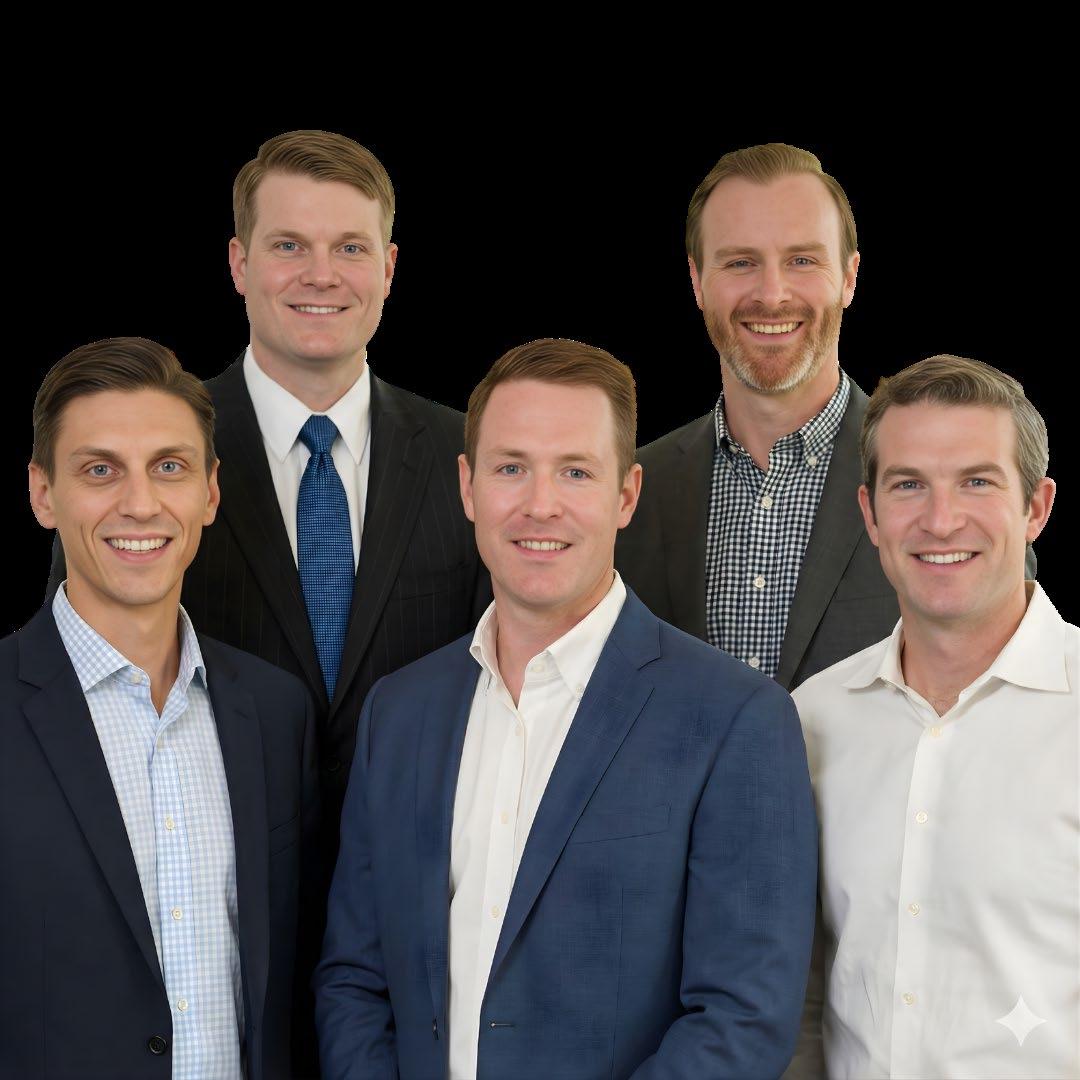





Leo Nolan, Partner
Wyatt Batchelor, Partner
Michael Mulcahy, Partner
Kevin Mulcahy, Partner
Trip Cowin, Partner
MBN Brands
By Paul Marino
The firm maintains a diverse, businessoriented practice focused on investment funds, litigation, corporate, real estate, regulatory and compliance, tax and ERISA.
Drawing on the experience and depth of our lawyers in these distinct areas, we can leverage each lawyer’s industryspecific knowledge to help our clients succeed. This collaborative approach brings to the table a collective insight that contributes to sensible, efficient resolutions, and allows us to remain attentive to the cost and time sensitivities that may be involved.
Sadis’s clients include domestic and international entities, financial institutions, hedge funds, private equity funds, venture capital funds, buyout funds, commodity pools, and numerous businesses operating in various industries around the world.


BY PAUL MARINO
SADIS & GOLDBERG
In early January 2025, the wind was at our backs, the sun was shining on our face; I had so much confidence in the market that I was convinced the market would “rip”; and I was not alone. The University of Michigan Consumer Sentiment Index (“ICS”) consumer sentiment survey was at a near 5 year high (with a 71.70 handle)¹ and the consumer confidence index (“CCI”) was also at a multi-year high (with a 104.1 handle)², small business index (“SBI”) sentiment on the other hand dipped to 62.3
from 69.1 at the end of Q4 2024 (survey results suggested the dip was a result of worry about consumer spending and inflation).³
As I write today in the middle of December, the ICS sits at 51 (20 point drop) and CCI is 11.3 points under water at 88.7. It is not an understatement to say that the foregoing is not good; however, not all is lost. The SBI for Q3 2025 rose to 72 which (as described by the publisher of the report) is an “alltime SBI high”.⁴
So, small business owners are feeling good, consumers are not—what does it mean for M&A professionals? Based on what I am seeing, it seems that 2026 will outstrip 2025 and we will see greater deal volume and more deal activity spread across the deal landscape (e.g., aggregate global M&A value rose (driven by a cluster of mega / >$10B deals) while deal counts fell — i.e., big deals pushed dollar value higher even as overall transaction activity softened (especially in the middle market).⁵
For those of us living in the middle market the last part of the foregoing sentence is painful to read because we lived it; but beneath the headline numbers, dealmaking in the first half of 2025 was slower than expected.⁶ Why did the deal market cool off so much? The talking heads (pick your preferred media platform of choice) would have you believe it was taxes, tariffs, interest rates, global uncertainty, and just about any number of other potential calamities (except for global warming— that one seems to have vanished—at least for now). I posit the real reason deal volume fell, at least to this guy (especially in the middle and lower middle market) is valuation. The spread between the bid and ask is still too high.
Here are some thoughts: First, when deal volume hits a decade low but total deal value is up year over year, that tells me (i) the mega deals that closed in 2025 were really deals that were in the pipeline that didn’t close because of the change from the previous (less accommodative) administration to the new (more accommodative) administration and (ii) irrespective of financing, the mergers created cost cutting to such an extent that cost of financing was out-stripped by valuation created by merger (let’s not forget that publically traded
companies trade at MUCH higher multiples than private companies—and that includes publically traded private equity companies).
Second, combine (i) lofty valuations with (ii) higher interest rates/cost of capital and stricter lending terms and you get (iii) a deal market that failed to launch.⁷ Third, as deal sizes get bigger you run out of chairs (think musical chairs) and when that happens EVERYONE starts to worry about being the guy left standing because you know what they call him: loser. Conversely, if you’re the seller that has held out and didn’t sell because you think your company is worth as much as your friends who sold in 2022 at a 15x EBITDA multiple, you too don’t want to be a loser (and like handicaps, there is a lot of vanity associated with what your business is sold for). In addition to multiples being lower, the “all cash walk away” offer is hard to find, with many buyers wanting additional structure such as rollover equity, earnouts, and/or seller notes to bridge valuation gaps.
In short, many sellers still want the multiples of days past when capital was cheap and plentiful and multiples were high, while buyers are trying to deal with the reality that it is harder to underwrite and hit their needed returns due to the cost of capital and market risk — that disconnect reduced closings.⁸
On the middle and lower middle market deal side: deal activity picked up in the second half of 2025 and should continue to prove both strong and robust.⁹
What’s driving the ascent in the middle/lower middle market?
• Dry powder.10 There remains significant amount of unpaid capital in the system. Many PE funds, family offices and credit providers have undeployed capital waiting for the right moment. The backlog of companies held by funds (due to slower exits) adds urgency.
• Adjustment of Valuations and Leverage. With higher borrowing costs and inflationary pressures, deal multiples have come down.11
• Shift Toward More Creative Structures And Alternative Sponsors. Most limited partners are suffering from illiquidity fatigue and have grown impatient with GPs. The foregoing fact has given rise to continuation vehicles but most of all has created the rush to secondary fund formation. In this liquidity winter, most LPs are looking at DPI as the greatest attribute for any sponsor and as luck would have it, most IS have a great track-record for returning capital in a 4-6 year time period.12
• Exit Backlog & Anticipated Liquidity. With fewer exits in 2022-24, many portfolio companies are “waiting” for the right exit window. As the macro stabilizes, that backlog can release and fuel more deal activity. The fact is that no one likes to give up on their “draft picks”, and the same can be said about GPs. Portfolio companies remain platforms well past their expiration date because GPs don’t want to give up on a trade they may have paid too much for a few years back.13
The foregoing is why Independent Sponsors (“IS”) have taken off in the current investment landscape. Also, the following is a consideration:
• Pick your Platform: The idea of choosing a deal to invest in directly or vis-à-vis a sponsor is greatly appreciated by investors (mostly family offices and HNW individuals who are less enthralled by blind pool funds and like the idea of having more autonomy to choose which deals and which sponsors to back). It means investors get a clear line of sight on the transaction and (more than likely) the exit.
• When You Know, You Know: The ability to direct invest in an area that you know well creates superior alignment between all parties is a great selling point for sponsors. If you deal with a number of family offices you quickly realize that many family offices (especially those run by first and second gen) invest in areas that they know (usually where they made their money). A single platform SPV allows for this type of investment transparency, alignment and commonality. But it’s not just family offices, you also are seeing a huge rise is more institutional investors backing good ISs with good deal.
• People Who Need People: Sellers like to sell to people who understand them and their business. ISs, for the most part, get into the weeds discussing the sellers business. The fact is people like to deal with people who they understand and speak the same language (take note, this isn’t saying sellers will not sell to the highest bidder—they often will but when everything is equal they’ll sell to the group they trust).
The IS model is evolving to one that mirrors what a middle market PE firm used to look like. A few deals with high IRR in narrow sector specific transactions. And what I mean by a few deals is a number of addon/tuck-in business that are in line with or adjacent to the platform.
Of course, there are always headwinds in the middle/lower middle market (and more specifically IS); here are a few:
• Execution Risk: Let’s face it, without having a pool of capital behind you there is always a risk that the deal won’t get done because there isn’t cash available. Execution risk is closely tied to the equity and/or debt fundraising market. In 2026, with a new Fed Chairman coming online, a potential recession on the horizon, and a national election, you can bet that the monetary policy coming out of Washington, D.C., will be accommodative. And this will apply to interest rates but, for example, look for more incentives from the SBA for US manufacturing, etc.
• Competition and Valuations: With PE firms and IS competing for the same quality assets, valuations will be bid up, therefore squeezing returns.
• Capital Stack Complexity: ISs often rely more heavily on custom capital stacks (equity from family offices, debt from specialty lenders, etc). The terms may vary widely, and deal economics/ ownership can become more bespoke.
• Operational Resources: Some ISs may have less scale, fewer in-house operations or integrations teams compared to large funds. To create value, they must be smart about sourcing management talent, leveraging operational expertise, and running effective post-deal playbooks.
The deal environment in 2026 is being shaped not just by macro or capital structure, but also by a few evolving themes — geography, sector, and strategy.
Private equity firms and sponsors are increasingly looking outside their traditional domestic markets for growth or opportunity.
In emerging markets, as interest rates stabilize, and companies seek capital for growth, there are opportunities, though with higher risk. For independent sponsors, cross-border deals may become more viable (e.g., will near shoring and strength of dollar push companies to look at Mexico or Canada…or Argentina).
• Technology / digital transformation: Given that many portfolio companies and targets suffered from outdated technology, sponsors are focusing on value creation via modernization, AI adoption, digital services, SaaS models (although, my guess is SaaS is going to have to adopt to the new AI business order).
• Healthcare / Life Sciences: Aging demographics,

regulatory tailwinds, and innovation mean that healthcare continues to be attractive; HOWEVER, health care is a political football and one has to wonder when “deflate” gate hits the space.
• Infrastructure & Energy Transition: With the globe no longer on death watch (apparently catastrophic climate change has been revised) and sustainability mandates lessened, many funds are moving out of the rent seeking space of climate activism but instead pivoting to the real need for infrastructure development to meet AI energy needs (e.g., data center, etc.)
• Middle-Market/Fragmented Industries: Industries with smaller players (lowermiddle market) where consolidation, digital enablement, and operational improvement can drive outsized returns. ISs are particularly active in this market. Again, look for on or near shoring to have an oversized impact in the middle and lower middle markets.
• SPAC: SPAC’s will make a comeback. You heard (actually read) it here first. The valuations in public markets (albeit volatile) are much higher than private markets and with the dearth of exits in PE (and GP continuation vehicles making up 50p of the secondary market—not a good sign for LPs clamoring for DPI), it is a good time for SPACs.
• Add-On Strategy: Since platform deals are harder to source and will command premium pricing, many sponsors will emphasize add-on acquisitions to build scale and drive value.
• Growth Equity / Minority Investments: Instead of full control LBOs, some sponsors will lean into growth equity, preferred equity, minority stakes with rights — especially where leverage is constrained.
• Co-Investment & Hybrid Capital: To reduce fees and align interests, LPs are co-investing more. Sponsors are offering co-investment opportunities. Bain’s data shows co-investment ratios remain meaningful.
• Alternative Capital Structures: Independent sponsors and smaller funds will use more creative capital stack alternatives (e.g., mezzanine, unitranche, preferred equity, structured equity) to compensate for higher debt cost or limited leverage.
Deal participants need to layer in thematic/sectoral awareness and geographic flexibility into their sourcing and value-creation playbooks. Just doing “generic buyouts” in 2025 is higher risk. Thematic clarity and operational execution matter more than ever.
As Yogi Berra once said, “it’s tough to make predictions, especially about the future.”15
Nonetheless, if you look at 2025 it is a tale of two M&A markets, the first half was tepid at best with movement in the later part of the second quarter driven by massive transactions, likely resulting from
an accommodative regulatory body. The second half saw the aggregate value of deals in the US increasing to $598 billion in the third quarter, which is the highest in four years.16 Sounds awesome, but much like modern box office sales figures, the data is somewhat punk.17
equity, growth equity, structured deals, coinvestments, secondaries. Irrespective of interest rates, the “classic leveraged buyout” may become less dominant. With the rise of DPI as a deal metric, look for sponsors to have a shorter duration.
The total number of deals in the US remained mostly flat during 2025, which means that we are not transacting nearly as much as we have previously done in years past. In fact, according to a survey conducted by Deloitte, the value of US deals in Q3 jumped 56% whereas the volume only increased by 1.6%.18
Here is what I expect to see in 2026:
• Interest Rates Start To Ease (Conditionally): If central banks signal rate cuts, the cost of debt for leveraged deals should decline, unlocking higher leverage and more willing sellers. That could accelerate deal volume.
• Deal Volume Recovery: After a slower 2022-25, we expect deal flow to pick up further in 2026 — especially add-on deals, platform builds, carveouts. The IS model will continue to mature, with more capital providers, more hybrid models (seeded, pledge funds), and more competition.
• More Creative/Alternative Structures: Expect growth in minority investments, preferred
• Value Creation Plays Front And Center: Given exit/ multiple constraints, operational improvement, digital transformation, consolidation strategies will differentiate winners. One question you’re going to hear (even in trade and trade services deals (e.g., HVAC, etc.) is how will artificial intelligence impact this business.
• Fundraising Bifurcation: Top-tier large funds will continue to raise easily; emerging managers will still face headwinds, but independent sponsor pools will open up more. Shorter duration and return of capital are key. Thereby giving IS an advantage.
• Exit Backlog Will Begin To Roll: By 2026, we may see more liquidity events, but the excess will have been “priced in” and value creation from operations will matter more than the multiple arbitrage of earlier years.
• Increased Consolidation In The Sponsor/Fund Industry: Smaller funds may merge, strategic partnerships may form, and competition may thin out.
• If interest rates remain high (or rise), the leverage advantage may be further constrained.
• If macroeconomic growth disappoints (recession,
inflation shock, supply-chain disruption), the deal market could stall.
• Regulatory shocks (e.g., stricter antitrust/FTC rules, geopolitical decoupling) could make crossborder deals riskier.
• Valuation recovery may be uneven: some sectors will bounce, others may lag — sponsors must pick wisely.
• Execution risk remains acute in independentsponsor deals — capital is not committed upfront, and sponsor/backer alignment matters more.
HOW MANY MORE TIMES - What Sponsors/ Investors Can Do To Prepare For 2026
• Build Sourcing Pipelines Now: sponsors with deal flow ready as activity picks up will gain advantage.
• Focus On Operational Playbooks: invest in digital, talent, integration teams, and value creation systems.
• Diversify Deal Strategy: include growth equity, carve-outs, add-ons, and minority deals, international.
• Strengthen LP/Backer Relationships: transparency, alignment, previous execution track-record will matter.
• Stress-Test Exit Assumptions: assume longer holding periods, potential for multiple stagnation, emphasize operational growth.
• Consider Independent Sponsor Structure: If you’re a deal professional outside a large fund, 2026 may be a strong year to launch or scale an IS platform.
For sponsors, investors, and advisors, the message is: “be bold, but be grounded.” The environment for deals is better than 2022-25 in many respects, but the rules have changed. Leverage is more expensive, valuation arbitrage is harder, execution and value creation matter more than ever, and structure matters. Independent sponsors, in particular, have strong tailwinds, but must execute seamlessly and build resilience.
Looking ahead to 2026, those who are ready with a pipeline, aligned capital, operational playbook, and global/sector awareness will likely have the upper hand. The question isn’t just “how many deals can we do” but “how well can we execute, create value, and exit in a more complex environment”.
1. https://ycharts.com/indicators/us_consumer_sentiment_index? (visited, 12/4/2025) 100 being the baseline.
2. https://www.conference-board.org/topics/consumer-confidence/ (visited, 12/4/2025)
3. https://www.uschamber.com/co/run/finance/metlife-small-business-index?utm (visited, 12/4/2025) graded on a scale of 0-100 with 100 being the best.
4. https://www.uschamber.com/sbindex/summary?utm (visited, 12/4/2025)
5. https://dealogic.com/insight/ma-highlights-1h25/?utm (visited, 12/4/2025)
6. https://dealogic.com/insight/ma-highlights-1h25/?utm (The number of transactions has plummeted to a two-decade low, down 16% to 16,663 deals as of 23 June.)
7. Failed to launch like a 28-year man-child who graduated from a top tier liberal arts school, wearing tube socks, in his robe living in his parents basement, listening to sports to talk radio
8. It should be noted that smaller firms (both sell and buy side) are more susceptible to sector-specific headwinds (supply chains, tariffs, demand shifts). https:// www.pwc.com/gx/en/services/deals/trends.html?utm (visited, 12/4/2025)
9. According to the Citrin Cooperman 2025 Independent Sponsor Report: 44% of independent sponsors surveyed in 2025 are targeting companies with EBITDA > $10 million (versus only 4% in 2017) (https://www.citrincooperman.com/Focused-Programs/Independent-Sponsor-Report?utm) (visited, 12/4/2025)
10. Very few words are overused more than “dry powder”; it is in my top 10 least favorite business terms (i) Synergy: The corporate equivalent of “magic happens here;” ; (ii) Value-add: Usually means… nothing was actually added; (iii) Circle back:“I don’t want to deal with this right now;” (iv) Bandwidth: Your calendar isn’t the problem; your willpower is; (v) Low-hanging fruit: The mythical easy tasks no one ever seems to pick; (vi) Move the needle: Because apparently everything is a giant speedometer; (vii) Win-Win: Win-Win: When said, usually means someone is losing; (viii) Take it offline: Corporate for “stop talking about this in front of people;” (ix) Thought Leadership: Often used as a fancy wrapper for basic observations. Honorable Mention: (x) Pivot: Overused since 2020 and still going strong; and (xi) Greenshoots: the most overused word of the GFC.
11. For instance, Citrin Cooperman notes that the average multiple for emerging sponsors dipped to 8× (versus 9.9× earlier) and that 76% of independent sponsors closed deals at 6× or less in the past year. (visited, 12/5/2025; https://www.citrincooperman.com/In-Focus-Resource-Center/What-To-Expect-in-Private-Equityin-2025?utm)
12. https://www.sadis.com/insights/strengths-and-weaknesses-of-dpi-how-the-distributions-to-paid-in-capital-metric-illuminates-and-obscures-fundperformance
13. Exit windows remain muted — in particular, IPOs and strategic sales are slower compared to the boom years. That leaves many sponsors holding portfolio companies longer, which places pressure on internal rates of return (IRRs). The Harvard Law publication notes that “elevated levels of untapped dry powder” and “long holding periods” are issues for sponsors in 2025. https://corpgov.law.harvard.edu/2025/01/24/private-equity-2024-review-and-2025-outlook (visited, 12/5/2025)
14. For example, the Citrin Cooperman report points out that 43% of PE/VC-owned companies say that outdated tech is their biggest barrier to AI adoption. (https:// www.citrincooperman.com/In-Focus-Resource-Center/What-To-Expect-in-Private-Equity-in-2025) (visited, 12/5/2025)
15. My favorite prognosticator is of course Mr. T in Rocky III, prediction, yeah, I have a prediction, “Pain” (https://www.youtube.com/watch?v=SNguN22of8k&t=5s)
16. https://www.deloitte.com/us/en/what-we-do/capabilities/mergers-acquisitions-restructuring/articles/m-a-trends-report.html?utm (visited, 12/5/2025).
17. In other words, number of movie tickets (in total) is way down but the cost of a movie ticket has dramatically increased in price.
18. https://www.deloitte.com/us/en/what-we-do/capabilities/mergers-acquisitions-restructuring/articles/m-a-trends-report.html?utm (visited, 12/5/2025).

PAUL MARINO Partner
Sadis & Goldberg pmarino@sadis.com
Paul Marino is a partner in the Financial Services and Corporate Groups. Paul focuses his practice in matters concerning financial services, corporate law and corporate finance. Paul provides counsel in the areas of private equity funds and mergers and acquisitions for private equity firms and public and private companies and private equity fund and hedge fund formation.

BY DON LEVY KROLL
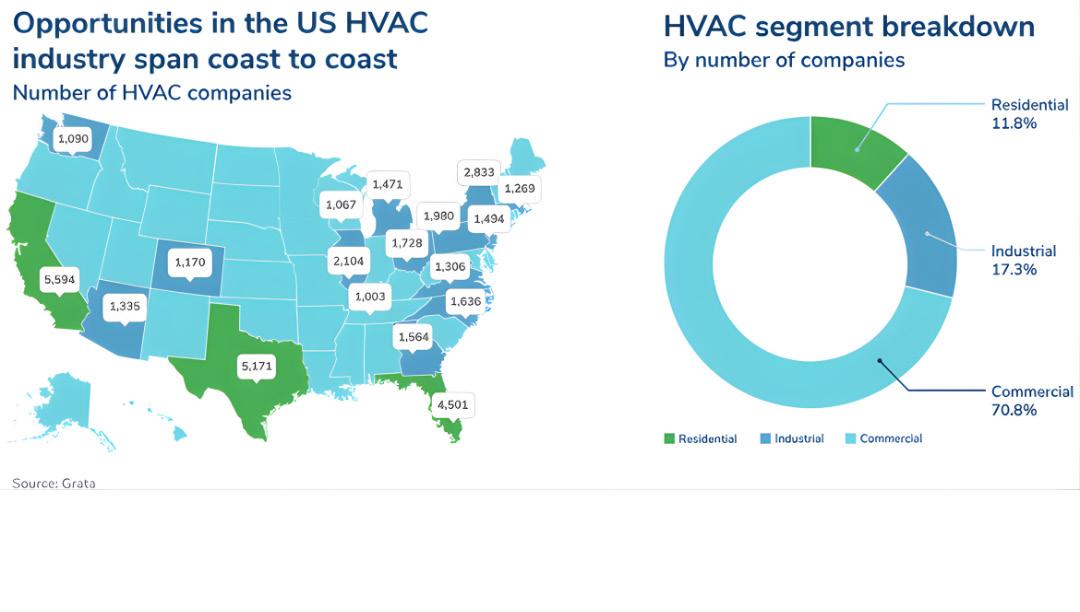
Global HVAC in general, from commercial and residential services to equipment and system manufacturing, remains a large, durable market, estimated in excess of $350 billion in 2025, with mid-single-digit CAGR through the next decade.
More specifically, PE firms remain the dominant buyers of residential HVAC service platforms, executing buy-and-build rollups across various regions in the U.S. Large growth/mega-cap PE and alternative-asset groups (Goldman Sachs Alternatives, General Atlantic, L Catterton, Gryphon, Gamut and various others) are buying sizeable regional platforms, while middle-market PE and strategic consolidators focus on tuck-ins and regional density.
Essential, recurring and locally fragmented, residential/commercial service platforms continue to trade actively. A notable example: Sila Services’
sale from Morgan Stanley’s PE arm to Goldman Sachs Alternatives, reportedly at ~$1.5billion including debt in early 2025. These trends have been strong for the last five plus years and continue into Q4 2025 and 2026, primarily due to the focus on recurring revenue via annual/ periodic maintenance plans, low capital intensity, multitrade bundles (HVAC + plumbing + electrical) and technology-enabled service ops.
• Companies with maintenance plans, membership programs and consistent seasonal service cycles provide investors with predictable revenue and EBITDA, along with a strong base on which to further build and grow.
• The multitrade capabilities keep customers with one family of companies and allow for crossselling opportunities.
• Large platforms, such as Sila Services and Apex Services Partners (an active Alpine Investors platform), have completed numerous add-ons
and created well-oiled corporate development and integration processes and protocols allowing for swift and efficient M&A processes.
• Platforms are also now focusing on businesses with upgraded dispatch, mobile invoicing and various modern diagnostic tools that improve productivity, margins and scalability, which is more attractive to investors.
Deal valuation remains at a premium with PE buyers paying double digit multiples for high quality platforms (mid-teens Enterprise Value/EBITDA), especially those with significant recurring revenue.
From an add-on perspective, many of the smaller tuck-ins, which in many cases are single-digit EBITDA family/founder owned businesses, are trading for multiples generally ranging from three to eight times and in some instances more, to the extent they are larger professionalized companies. Founders who have run these smaller regional residential HVAC businesses for decades are educating themselves on the current M&A boom in residential HVAC services.
They are retaining advisors and seeking M&A, knowing that a significant liquidation event may be in their futures, while many often remain with the company to run the business and retain equity. Earnouts and performance-based consideration are often built into the purchase agreement terms.
Diligence considerations and processes also continue to be rigorous, especially with sophisticated PE platform buyers, where advisors are being retained for various workstreams, including but not limited to financial, tax, employee/HR and benefits, and insurance diligence, among others, as necessary. Buyers will deep dive into the target’s labor model, technician productivity, customer churn and retention, recurring revenue breakdown and integration.
Overall HVAC Industry Outlook: Through 2026, the industry expects active add-ons by PE-backed service platforms, continued trimming of noncore assets by global OEMs (e.g., Carrier’s sale of its fire/security businesses) and fast deal flow in controls/AI and mission-critical cooling. HVAC equipment distribution roll-ups are expected to remain steady as strategics seek to increase market share in growth geographies. With secular tailwinds (electrification, refrigerant transition, AI compute), the sector’s M&A engine appears to be poised for continued activity, even if multiples stay selective and buyer due diligence is rigorous. Further, the residential HVAC M&A outlook is that it may be about halfway through the broader consolidation cycle, but commercial HVAC services have a longer runway, which we will see as we get into 2026.

DON LEVY Managing Director, Transaction Advisory Services
Kroll
Don Levy is a managing director in the New York office of Kroll, and a member of the Transaction Advisory Services team. Don has approximately 22 years of professional experience, encompassing M&A transaction advisory services, management consulting focused on distressed companies, real estate acquisitions analysis and public accounting.
BY DREW BRANTLEY
FRISCH CAPITAL

Afew years ago, we were 10 days before closing. The capital providers were all lined up. Due diligence was complete. Legal docs were almost done other than a few minor points and signatures. Everything was buttoned up and ready to close other than one small item on the list, the background check. Nevertheless, we were not
worried. Before the deal started, the Independent Sponsor had asked the seller, “when we run a background check, is anything going to show up other than a speeding ticket?” and the seller had said, “nothing”.
The background check came back and to say it was
bad is an understatement. Turned out the seller, who was going to be the CEO post close, had spent 5 years in a federal penitentiary for two felony counts of mail fraud and insurance fraud. When our Independent Sponsor client asked the seller why he didn’t tell him about it then when he had asked previously, he told him that he had paid an attorney $20,000 to wipe it off his record.
Nevertheless, the deal died that day, on the “one yard line”. It was a painful lesson learned.
Even though this is an extreme story, it is a true story. However, it is not the only time that we have had surprises show up on background checks that have impacted a capital providers’ view on a deal. Independent Sponsors have a lot on their plates when doing a deal. Especially managing costs and broken deal expenses. To this point, most Independent Sponsors prioritize due diligence costs that are both cost efficient, and may provide greater certainty to close and comfort around buying the business. Take it from us, it can come back to bite you in the long run if you don’t do a simple background check.
In many cases, the easy thing that can be done even before you sign the Letter of Intent (LOI) is to have a conversation with the seller. When you talk to them, we would encourage you to tell them that you are going to run a background check on them and key management (CEO, CFO etc.). Then ask them if there is anything that will come up that we need be aware of, other than speeding tickets. When we ask the questions, we list the
following specific items: judgments, bankruptcies, felonies, jail time, criminal charges, indictments, outstanding legal cases (personal or business), etc. that we need to be aware of and will show up on a background check?
Most of the time when you ask this question, with the follow-up that you will be doing a thorough background check, people will be open and forthright with you about anything in their background that might come up on a background check. This is the ideal scenario. If they bring something up, ask for the details, and then you and your capital providers can figure out if it’s a “Show stopper” or something you can live with. When you run the actual background check, it can then confirm what you heard.
When you get a background check back and there is something other than a speeding ticket, typically capital providers are looking for two types of items. The first is a major item such as a felony, jail time, bankruptcy. Things that would be either headline risks for them as an investor or might shape your view of them in a certain role. For example, if a CFO has filed for personal bankruptcy and there is not a good reason as to why, this might make you question if they will be a good steward of the company’s money and finances if they were not good stewards of their own money and finances.

The second items capital providers are looking for on a background check is a pattern of behavior. If someone has a myriad of smaller items either the same or different that come up in a background
check, does it point to a potential pattern of behavior or the character of that individual. For example, lets say an entrepreneur has started multiple companies in their lifetime, and a background check reveals a single judgment from a previous business. If they can provide you with the information, and that judgment was settled and the story around why, there are plenty of reasons
where you could get comfortable that this was a one-time isolated incident. However, if that same person’s background check came back and there were 11 judgments and they could not provide you with details of each judgment and the receipts showing they were settled, then that begins to look like a pattern of behavior that would cause one to question that person’s judgment and their ability to
be a good partner.
Everyone’s story is different. And there are plenty of items that will come up on background checks that do not raise a red flag for capital providers and Independent Sponsors. What you hope for is that the person is open about what the item is and can provide the necessary supporting information to confirm their story. People being transparent goes a long way. It’s when people hide things, or intentionally mislead you, that a small thing becomes a big problem.
Keep in mind that each capital provider is different. And just because an Independent Sponsor doesn’t think something is an issue, doesn’t mean that a capital provider will have the same view. And just because one capital provider takes a certain stance on an item, doesn’t mean another capital provider will have that same stance. You have to talk to everyone and understand that each capital provider is different.
So back to the original point, a background check

is arguably one of best “bang for your buck” due diligence items an Independent Sponsor can do, and the earlier the better. It is so impactful that we, Frisch Capital, now request that when we engage with a new Independent Sponsor client, that it is the first thing they do before we go to market to raise the capital for their transaction. If a skeleton is going to come out of the closet we want to know that as soon as possible, and not 10 days before closing as we did on that previous deal years ago.
There are a lot of options for background checks out there, and we do not endorse one firm over another. There are a lot of options, and some more cost effective than others. We have found that there are some good high level background checks that are very cost effective that will flag any major items in someone’s background. And then if you need or want to do a more in-depth background check later you can.
Regardless of which background check firm you choose to work with, or how much money you spend, do it early in the deal. Learn from our experience, do not wait to get the background check results right before closing.
DREW BRANTLEY
Managing
Director
Frisch Capital Partners drew@frischcapital.com 706-227-4144
Drew is a serial entrepreneur having started 5 businesses, sold a few and still owns some. He knows what it’s like to be in your shoes. He sees the Independent Sponsor model as the method executives and industry experts can take to own and run already established businesses. He now dedicates his career to helping individuals buy companies, find greater success and live life on their own terms.


BY HARRIS ADAM WITHUM
The One Big Beautiful Bill Act (“OBBBA”) introduces some of the most consequential depreciation changes in recent years, creating new planning opportunities for businesses investing in equipment, machinery, and certain real property. Building on the existing bonus depreciation regime, OBBBA not only restores 100% bonus depreciation but also expands the concept of immediate expensing to areas that historically received far more limited deductions.
This article provides a deeper look at the key changes, how they apply in practice, and what taxpayers need to consider as they plan capital expenditures over the next several years.
Under prior law, bonus depreciation was being phased down from 100% (in place from 2017–2022) to 80% in 2023, 60% in 2024, and ultimately 0% for property placed in service after 2026. OBBBA removes this phase-down and permanently reinstates 100% bonus depreciation for qualified assets placed in service after January 19, 2025.
Qualified property generally includes:
• Tangible personal property with a recovery
period of 20 years or less;
• Machinery and manufacturing equipment;
• Computers, servers, and technology equipment;
• Furniture and fixtures;
• Certain qualified film, TV, and live theatrical productions; and
• Water utility property.
This makes full expensing available for most capital investments that businesses routinely make.
Bonus depreciation depends on when an asset is acquired, not only when it’s placed in service.
Acquisition is determined by:
• The date the taxpayer enters a binding written
contract to acquire or construct the property; or
• The date construction begins (for selfconstructed property).
If a binding contract existed before certain key dates, the asset might be ineligible for 100% expensing. This is especially relevant for equipment purchased through long-term supply contracts, or for property with long lead times such as custom fabrications, turbines, vessels, or sophisticated machinery.
OBBBA retains two important taxpayer elections:
1. Electing out of bonus depreciation for an entire
class of property; and 2. Electing partial depreciation (40% or 60%) instead of 100%.
Taxpayers may use these elections to manage taxable income, preserve NOLs, or coordinate with state nonconformity.
Perhaps the most significant expansion in OBBBA is the introduction of Qualified Production Property (“QPP”), a new category that allows certain real property used in manufacturing or production to be fully expensed in Year 1.
This is a groundbreaking shift. Before OBBBA, commercial buildings were generally depreciated over 39 years, with no bonus depreciation. Now, portions of manufacturing facilities may qualify for immediate expensing.
QPP generally includes nonresidential real property used:
• For manufacturing;
• For production or processing;
• For refining or other industrial operations; and
• As an integral part of producing tangible goods.
To meet the definition, the property must be directly involved in production. Portions of a building that do not qualify are office space; administration; marketing; human resources; and storage not part of production.
complexity. A single facility may include both QPP-qualifying areas and non-qualifying areas, requiring a detailed cost-segregation-level analysis to allocate costs appropriately.
To be eligible for 100% expensing as QPP:
• Construction must begin between January 20, 2025 and December 31, 2028;
• The property must be placed in service by January 1, 2031; and
• “Original use” must begin with the taxpayer (i.e., it must be newly constructed or first used by the business)
These windows create an incentive for manufacturers to accelerate project planning and construction scheduling.
Long-term operational planning is critical, if QPP ceases to be used in production during a specified recapture period (likely 10 years):
• The taxpayer may be required to recapture part or all of the expensed amount;
• Repurposing, selling, or converting the building may trigger recapture; and
• Changes in production lines or redesign of a facility could unintentionally jeopardize qualification.
This distinction creates opportunities and
This may:
Immediate expensing dramatically reduces taxable income in the year of acquisition or completion. For large capital projects, this can create millions of dollars of near-term tax savings. Many companies will now find it more cost-effective to:
• Modernize production lines;
• Replace aging machinery;
• Expand capacity; and
• Build new manufacturing or processing facilities.
It is essential that Businesses carefully document the following:
• Construction start dates;
• Contract execution dates;
The return of 100% bonus depreciation and the introduction of QPP may fundamentally change how businesses plan investments, especially in sectors like manufacturing, logistics, industrials, and data-center operations.
• Original-use determinations;
• In-service dates; and
• Allocation of building components between QPP and non-QPP
Businesses operating in many jurisdictions will need to project state-by-state impacts, as not all states conform to federal bonus depreciation, and fewer still are likely to adopt QPP rules immediately.

HARRIS ADAM Senior Manager, Advisory Services Withum
• Reduce the benefit in nonconforming states;
• Create deferred-tax liabilities; and
• Increase compliance complexity.
OBBBA delivers a powerful combination of incentives: the return of full bonus depreciation and a completely new opportunity to expense qualifying real property used in production. For many businesses, especially manufacturers, this represents a substantial reduction in the after-tax cost of capital investment.
However, eligibility hinges on the specific facts of a project, and the rules contain a number of technical requirements, timing windows, and potential clawbacks. Companies should begin reviewing their planned capital expenditures now, map out project timelines, and evaluate whether construction or acquisition plans can be structured to qualify.
With thoughtful planning and careful documentation, businesses can capture significant benefits from the new law, potentially accelerating investment, improving competitiveness, and enhancing cash flow for years to come.
Withum is a forward-thinking, technology-driven advisory and accounting firm, helping clients to Be in a Position of Strength in today’s modern business landscape.
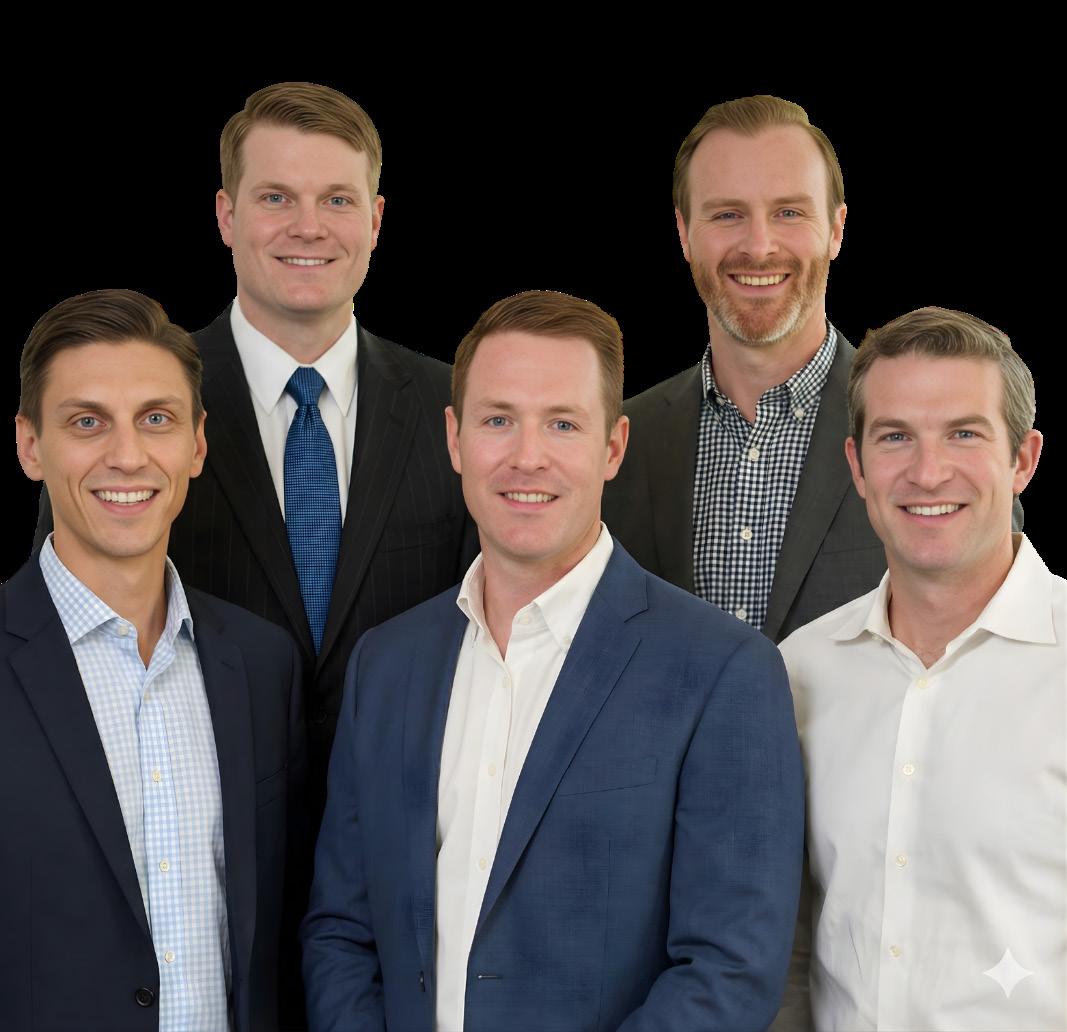
Wyatt Batchelor and Kevin Mulcahy, partners at MBN Brands, were recently interviewed by Paul Marino of Sadis & Goldberg. The MBN team has built a diversified operating and investment platform focused on acquiring, building, and scaling lower middle market businesses. MBN was formed with the goal of creating best-in-class platforms rather than one-off transactions, emphasizing long-term ownership, operational rigor, and disciplined capital deployment. Over time, the firm has expanded into multiple verticals, with a concentration in consumer and franchised businesses.
MBN Brands typically partners with founder- and family-owned companies that are at an inflection point—where professionalization, scale, and institutional processes can unlock the next phase of value creation. Rather than relying on financial engineering alone, the team focuses on building durable operating platforms through disciplined acquisitions, organic expansion, and selective partnerships. This approach has allowed MBN to assemble portfolios that benefit from shared infrastructure and experienced operating leadership.
In the lower middle market, the firm sees its role as helping entrepreneurs transition from founder-led operations to professionally managed
organizations. That often means upgrading systems, formalizing reporting, and strengthening management teams. MBN’s patient capital orientation gives operators the flexibility to reinvest cash flow into people, technology, and brand development, rather than prioritizing short-term outcomes.
Alignment with partners and operators is a core principle of MBN’s strategy. The firm structures its investments so that incentives remain longterm and management teams retain meaningful ownership. This partnership-first mindset fosters trust and accountability, allowing MBN to work closely with leadership teams as they navigate acquisitions, integrations, and multi-year growth plans.
With experience across a range of operating environments and a disciplined approach to platform building, MBN Brands continues to see opportunity in fragmented markets where scale and professionalization can drive value. As many founders seek thoughtful succession solutions, MBN is positioned to provide both capital and stewardship to businesses entering their next chapter.
For an in-depth exploration of Wyatt Batchelor and Kevin Mulcahy’s business insights, please watch the full video interview at SADIS.com
BY THOMAS SHEFFIELD & HUB INTERNATIONAL THOMAS CLARO STABLE ROCK SOLUTIONS
Private equity is built on the art of calculated risk: acquiring, growing, and exiting businesses to drive returns for investors.
But when an unexpected lawsuit hits, a tax position collapses post-close, or a cyberattack slows or shutters operations, even the best planned investment strategies can unravel. These risks— often invisible at first—can cost sponsors millions,
threaten IRR targets, and derail exits.
Enter insurance—not just as a passive requirement to close a deal, but as an active risk transfer mechanism that protects both the fund and its portfolio companies. For private equity firms and independent sponsors, engaging with an experienced insurance broker is no longer a backoffice function. It’s a strategic partnership that

helps identify, quantify, and offload risk at every stage of the investment lifecycle. Understanding “risk transfer” and the insurance that can be used to soften negotiation positions and manage unknown transactional liabilities is increasingly essential.
The world of private equity presents a unique set of exposures – the fund itself, its partners, and its GPs can be targeted by litigation or regulatory actions. Portfolio company boards (often with sponsor representation) can face personal liability. Even with planning, acquisitions can carry latent liabilities like unpaid taxes, cyber vulnerabilities, or undisclosed environmental contamination. Additionally, operational risks—like employment practices lawsuits or product liability—can sink performance or disrupt add-on integration.
Each of these risks can be addressed—or in some cases, fully transferred—through targeted insurance solutions. However, risk transfer isn’t just about “buying a policy.” It’s about examination and structuring comprehensive, customized coverage that fits within the PE firm’s investment strategy and financial model. Insurance brokers— in tandem with other consulting enterprises, have emerged as key partners in this process and help to identify risk and resources to help companies exit or build strategic value in the mergers and acquisitions process.
The insurance broker is far more than an intermediary. For private equity firms, a specialized broker acts as a transactional advisor, diligence consultant, underwriter liaison, and strategic risk partner. The process typically unfolds in four key phases:
Every deal begins with risk diligence. While sooner is always better in the deal, this sometimes begins only after being triggered by some key risk element or at the recommendation of one of the various advisors on the deal. Alongside legal, accounting, and tax advisors, the insurance broker advises on risks and risk transfer. The broker reviews deal documents, financials, and operational reports to uncover insurable risks. This includes:
• Reviewing the target’s historical claims, policy coverage, and uninsured exposures.
• Assessing corporate governance and board composition to identify D&O coverage needs.
• Flagging transaction-specific issues (e.g., pending litigation, tax uncertainties, environmental liabilities) that could become a problem postclose.
Review of portfolio company benefits program with eye on saving money for employees and broadening offerings.
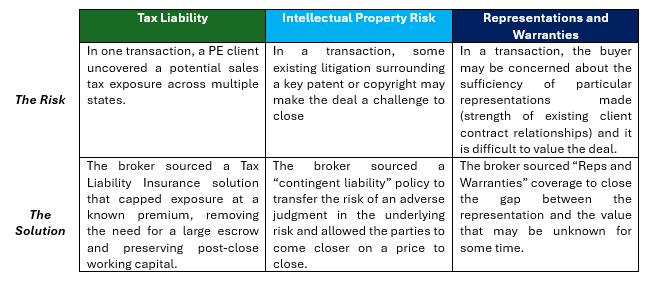
Early engagement allows the broker to flag risks that can be insured and advise whether that insurance can be bound in time for closing. For example:
Once risks are identified, the broker works with the sponsor and legal team to build a bespoke insurance program which includes the following:
Transactional Risk Products:
• Representations and Warranties Insurance (RWI) to protect against breaches of reps in the purchase agreement.
• Tax Liability Insurance for uncertain or disputed tax positions.
• Contingent Liability Insurance for known but lowprobability litigation or regulatory exposures.
Operational Insurance for the portfolio company:
• Directors & Officers (D&O) Insurance, often a must-have at both fund and company levels.
• Cyber Liability Insurance, especially critical in healthcare, SaaS, or e-commerce investments.
• Employment Practices Liability (EPL) and Errors
& Omissions (E&O) coverage, depending on industry.
Fund-Level Insurance:
• Dedicated GP/Fund D&O policies to protect the management entity, partners, and advisors.
• Crime, fiduciary, and cyber policies for backoffice risk.
The broker’s job is to structure these layers so they complement each other—avoiding duplication or dangerous gaps. For example, a broker may negotiate coordinated D&O policies that specifically allow some coverage when insureds sue other insureds and shared retention limits to streamline claims if both the fund and a portfolio company are named in a lawsuit. This is a key risk in the PE space and one that has to be carefully addressed to get coverage.
Employee Benefits:
• Human Capital Management Program
• Health and Welfare
• Retirement/Wealth Management
With the program designed, the broker solicits quotes from top insurance carriers. In the world of private equity, this process is often bespoke and fast-moving. The broker plays a critical role in this process and acts as the advisor in the process.
Considerations for engaging the marketplace and underwriting process:
• Positioning the risk favorably: Preparing a detailed submission that highlights strong controls, governance, and sponsor experience.
• Negotiating policy terms: Beyond price, the broker advocates for key terms like policy limits, exclusions, tail coverage, and notice provisions.
• Managing underwriting calls: For RWI and specialty policies, the broker coordinates diligence Q&As and underwriter meetings, ensuring consistency with the deal team’s narrative.
In fast-paced auction environments, brokers can pre-negotiate “stapled” RWI policies to ensure that the buyer can close quickly without compromising protection.
The insurance relationship doesn’t end at binding.
A true PE-specialist broker will stay involved to help with various ongoing risk management considerations. Examples of what a broker will help
a client with post-binding their insurance program include:
• Coordinating add-on acquisitions into the existing insurance program.
• Monitoring claims, advocating on behalf of the sponsor, and managing coverage disputes.
• Adjusting limits and structures as portfolio companies scale.
• Aligning policy renewals with board meetings and financial reporting cycles.
Over time, the broker becomes a strategic advisor to both the deal team and the operating partners, offering portfolio-wide insights and cost efficiencies.
Example: One sponsor rolled up four service businesses into a single platform over 18 months. The broker created a “master” insurance program with consolidated limits and risk engineering services, saving over 20% in annual premiums while improving coverage breadth.
RWI in Action
In a platform acquisition, the buyer relied on seller-provided financials showing no pending litigation. Months later, an ex-employee brought a whistleblower lawsuit alleging financial misconduct during the seller’s ownership period. Because RWI had been secured and properly tailored to include this type of claim, the insurer reimbursed the buyer for legal defense costs and the eventual
settlement—avoiding a direct hit to the company’s balance sheet.
A mid-market sponsor faced a shareholder suit after a disappointing exit. The plaintiff claimed the fund breached its fiduciary duties by pushing an undervalued sale. Thanks to a tailored D&O policy that included “Side A” coverage and defense outside limits, the fund’s legal defense costs were fully covered, and partner reputations were preserved.
In today’s environment of high valuations, tight
regulatory scrutiny, and compressed hold periods, PE firms and independent sponsors cannot afford surprises. Insurance is no longer just a compliance checkbox—it’s a powerful tool to preserve value, unlock efficiencies, and make deals more competitive.
But the value of insurance is only as good as the strategy behind it. That’s why partnering with an experienced insurance broker who understands the pace, complexity, and nuance of private equity is critical. The right broker not only helps you transfer risk—they help you turn insurance into a strategic advantage.
THOMAS SHEFFIELD Executive Vice President Hub International
Thomas Sheffield currently serves as Executive Vice President & ProEx (Professional & Executive Risk) Leader of HUB International Northeast. Specializing in working with both Financial Institutions, specifically commercial and investment banks and Private Equity sponsors his focus is on helping clients mitigate exposure through development of comprehensive risks management programs and transferring risk through the use of insurance.


THOMAS CLARO Managing Director Stable Rock Solutions
Tom Claro is a licensed Attorney and Insurance Broker working with business owners, executives and other professionals to ensure efficient risk management solutions for companies.



Managing Director
Stable Rock Solutions
Tom Claro is a Managing Director at Stable Rock Solutions, where he leads the firm’s Insurance Services practice, providing business and personal insurance solutions. Tom brings more than two decades of experience across insurance, legal, and advisory roles, having held senior positions at USI Insurance Services, Marsh, Arthur J. Gallagher & Co., Swiss Re Corporate Solutions, and AIG, where he focused on complex claims, property and casualty risk, and client advisory services. He previously served as a Law Clerk at the National Football League.
In addition to his professional work, Thomas is the Head Football Coach at Chaminade High School. Earlier in his career, he was a player for 3 years in the National Football League, competing with the Arizona Cardinals, New England Patriots, Jacksonville Jaguars, and the Barcelona Dragons.

BY FRANK BUKOWSKI
GROUP

According to Novogradac (2025), the most recent data on the total number of Qualified Opportunity Funds (QOFs) tracks at approximately 7,800 funds with an estimated current value around $112 Billion. The most recent fund raising by the top 50% of QOFS accounts for $42.48 Billion of the equity raised.
OZ tax incentives made permanent
New rules should increase rural investment and raise awareness of the positive impacts of OZ, but will restrict the areas that qualify.
Ever since the creation of Opportunity Zones (OZ) as part of the Tax Cuts and Jobs Act of 2017¹, there has been a necessary push for extension of OZ tax incentives, as well as proposals for improvements such as impact reporting and increased incentives for rural zones². On July 4th, 2025, proponents got
their wish as a new version of OZ was contained within the One Big Beautiful Bill Act³ (OBBBA).
Opportunity Zones have driven billions of dollars of investment⁴ to underinvested areas throughout the country, with one study⁵ estimating that "the OZ incentive has roughly doubled the number of new housing units" in these areas. This new version comes with changes that are likely to affect which communities receive OZ investment and the form that investment takes.
One element of the OBBBA that could inspire a big sigh of relief is that it made Opportunity Zones tax incentives permanent. This not only eliminates the original sunset date at the end of 2026, but also means stakeholders won't have to worry about any other sunset date in the future.
Changes to OZ tax incentives
The original OZ tax incentives came in three forms⁶:
1. Deferral of tax on realized capital gains invested in a Qualified Opportunity Fund (QOF) by December 31st, 2026.
2. Exemption of tax on capital gains realized upon exit from a QOF if held at least 10 years.
3. 10% step-up in basis for capital gains invested by December 31st, 2021, and held for at least five years, with an additional 5% step-up in basis after seven years.⁷
The new version contains similar incentives, slightly tweaked:
1. Deferral of capital gains taxes for five years or when the investment is sold, whichever is earlier.
2. Exemption of tax on capital gains realized upon exit if held for at least 10 years. If the investment is held 30 years or more, the basis will be set at the 30-year mark.
3. The 10% step-up in basis at the five-year mark is now permanent, but the additional 5% at the 7-year mark was eliminated.
Deferral of tax on realized gains invested in a QOF for up to five years.
Exemption of tax on capital gains realized upon exit from a QOF if held at least 10 years.
10% step-up in basis for capital gains invested by December 31st, 2021, and held for at least five years.
Additional 5% step-up in basis after seven years.
Deferral of tax on realized gains invested in a QOF for up to five years.
Same exemption, but if investment is held 30 years or more, basis will be set at 30-year mark.
10% step-up in basis after five years is now permanent. Sevenyear step-up in basis is eliminated.
The return of the 10% step-up in basis should encourage more investors to take part, but some critics worry the elimination of the 7-year benefit will drive investors toward the types of shorterterm real estate projects⁸ that dominated the early years of the program⁹, rather than operating businesses10 that can drive long-term job creation.
Opportunity Zones direct investment toward lowincome communities. For OZ 2.0, the definition
of "low-income community" has become more restrictive, limited to census tracts where the median family income is less than 70% of the metropolitan area's median family income (for non-metropolitan areas, the standard will be the state median family income). This is reduced from 80% in the original OZ definition.
A tract can also qualify if it has "a poverty rate of at least 20 percent" AND the median family income "does not exceed 125 percent of the metropolitan area median family income" for those tracts within metropolitan areas, or "of the statewide median family income" for those tracts not in metropolitan areas.
As EIG notes11, this 125% cap "closes a statistical loophole that allowed a small number of highincome census tracts to qualify for OZ status." One of the biggest complaints about the original zones was that they included some areas that were already improving economically before OZ began12 This change will ensure OZ investment is directed toward the communities of greatest need, as was the original intent.
The OBBBA created the Qualified Rural Opportunity Fund (QROF). A QROF is any QOF "that holds at least 90 percent of its assets" in rural OZs. The definition for "rural" excludes any "city or town that has a population of greater than 50,000" and "any urbanized area contiguous and adjacent to" such a city or town.
incentives for investors: the 10% step-up in basis after five years is increased to 30% for QROFs. This is a big win for rural communities, as an extra 20% will surely be enough to draw the attention of investors.
While the OBBBA included much of what industry stakeholders were looking for, some things were missing, such as eligibility for non-capital gains or Fund of Funds structures. There were also changes some may find disappointing: the 7-year step-up in basis was eliminated, and the tax exclusion on new capital gains is now capped at 30 years.
One rule eliminated was that which allowed for the inclusion of non-low-income tracts if they were contiguous to designated Opportunity Zones. The repeal of this rule may benefit the legitimacy of OZ by making it less likely for OZ investment to end up in areas that don't need it, but it also means there will be fewer places where QOFs can invest, effectively shrinking the OZ map.
Also repealed was the special rule for Puerto Rico that designated all low-income tracts on the island as QOZs. This will mean fewer opportunities within Puerto Rico, as its zones will be selected based on the same procedure as those in the 50 states.
Rural areas have found it difficult to attract OZ investment13, and OZ 2.0 solves this with greater
JTC has been among many voices advocating for impact reporting requirements14 to help investors
select the best projects and to aid in improving OZ as a whole. OZ 2.0 includes two types of reporting requirements, those for the Secretary of the Treasury to supply regarding OZ's overall impact and those for individual QOFs to supply both to the Secretary and to their investors.
The Secretary's report must include information such as the number of QOFs, "the percentage of population census tracts designated as qualified opportunity zones that have received qualified opportunity fund investments," and "the aggregate approximate number of residential units resulting from investments made by qualified opportunity funds in real property."
The Secretary's report must also include impact measurements based on "economic indicators, such as job creation, poverty reduction, new business starts, and other metrics." Every five years, the report must include a comparison with a control group, using metrics such as unemployment rate, household poverty rate, and rates of affordable housing and home ownership. This should go a long way toward getting an accurate picture of how OZ is performing and how it can be improved.
QOFs must provide information on the location and value of assets held by the fund, a list of their investors, and “other information as the Secretary may require.” In addition, employment information must also be reported, including the number of monthly full-time employees and “such other indication of the employment impact of such trades or businesses as determined appropriate by the Secretary.”
Zones15, we at JTC believe this commitment to impact reporting will provide a substantial benefit to the Opportunity Zone community. Job creation data can help investors identify which funds and projects have the greatest impact, allowing the funds fulfilling OZ's legislative intent to stand out and potentially attract greater investment.
New Opportunity Zones will be designated July 1st, 2026. OZ 2.0 tax incentives begin six months later, on January 1st, 2027. This gives stakeholders plenty of time to evaluate the new map and encourage governors to choose tracts in an equitable manner. It also gives fund managers and investors plenty of time to evaluate the new zones and begin 2027 with a full understanding of the new rules.
EIG's analysis includes a note that "The current OZ map will remain in effect through the end of 2028, meaning that it will overlap with the new round of designations for two years." This extension ensures that those currently planning projects in tracts that will not be part of OZ 2.0 won't have the rug pulled out from under them, and has significance for how 2026 may look for the industry.
There is every reason to believe OZ will see an increase of investors once rural zones and updated tax incentives kick in. There will be plenty that investors, fund managers, and communities looking for investment can do during the next year to position themselves for what should prove to be an exciting environment under OZ 2.0.
As leaders in impact reporting for Opportunity
For a fund manager, the OZ 2.0 bill opens up
new pathways for impactful investments. It not only provides enhanced incentives and clearer guidelines, but also increases transparency and confidence in Opportunity Zones. With these improvements, funds can drive meaningful returns for their investors while actively contributing to the revitalization of local communities, a win-win for responsible capital and sustainable growth.
JTC Plc (“JTC”) is a global provider of fund, corporate and private client services. JTC administers more than $410 billion in assets and employs more than 2,300 people worldwide. JTC currently administers 72 Opportunity funds with an approximate AUA of $10 Billion. A leader in specialty financial
1. https://www.congress.gov/115/bills/hr1/BILLS-115hr1enr.pdf
administration, JTC serves markets characterized by high administrative complexity, elevated transaction security needs and challenging compliance requirements.
JTC does not provide legal, tax or investment or other professional advice and, whilst it may review and report upon such advice received, JTC does not give, accept or endorse and should not be understood to be giving, accepting or endorsing such advice.
2. https://www.jtcgroup.com/insights/changes-coming-to-oz-proposed-new-opportunity-zones-legislation/
3. https://www.congress.gov/bill/119th-congress/house-bill/1/text
4. https://www.jtcgroup.com/insights/opportunity-zones-have-done-what-they-were-created-to-do-will-that-be-enough/
5. https://eig.org/opportunity-zones-housing-supply/
6. https://www.jtcgroup.com/insights/opportunity-zones-5-year-basis-benefit-set-to-expire/
7. https://www.irs.gov/credits-deductions/opportunity-zones-frequently-asked-questions
8. https://www.dailyjournal.com/mcle/1727-joint-ventures-in-opportunity-zones-what-the-new-rules-mean-for-investors-and-developers
9. https://www.jtcgroup.com/insights/what-critics-of-the-opportunity-zones-initiative-get-wrong/
10. https://www.jtcgroup.com/insights/why-operating-businesses-are-key-to-the-long-term-success-of-opportunity-zones/
11. https://eig.org/opportunity-zones-2-0-where-things-stand/
12. https://www.jtcgroup.com/insights/how-to-get-opportunity-zone-investment-to-the-places-that-need-it-most/
13. https://www.jtcgroup.com/insights/how-opportunity-zones-can-be-used-to-revitalize-rural-communities/
14. https://www.jtcgroup.com/insights/why-the-impact-act-is-exactly-what-opportunity-zones-need-and-now/
15. https://www.jtcgroup.com/insights/best-practices-in-opportunity-zones-fund-administration-measuring-social-impact/

FRANK BUKOWSKI Senior Director -Institutional Capital Services
JTC Group
JTC Group (“JTC”) is a global provider of fund, corporate and private client services. JTC administers more than $410 billion in assets and employs more than 2,300 people worldwide. JTC currently administers 72 Opportunity funds with an approximate AUA of $10 Billion. A leader in specialty financial administration, JTC serves markets characterized by high administrative complexity, elevated transaction security needs and challenging compliance requirements.
As a leading global fund administrator with c.$410bn in assets under administration, including c.$54bn in real estate funds, we deliver seamless, end-to-end support at every stage of the fund lifecycle. With genuine real estate experience and a global reach, we go far beyond traditional fund administration. Let our expertise unlock the full potential of your real estate investments.
Find out more at jtcgroup.com/realestate

ISAE 3402 Certified
Listed on FTSE 250 c.$410 Billion USD Group AUA c. 2,300 People Global Platform





BY PAUL MARINO
SADIS & GOLDBERG

For Independent Sponsors (“IS”), the regulatory question of registration often falls into a zone of ambiguity. Unlike more traditional private equity fund managers, IS operate deal-by-deal or with minimal committed capital. The question of whether an IS’s activities will require the IS to register as an investment adviser (IA) or a brokerdealer can become a strategic cost and structuring hurdle.
• Sponsors should be aware of the investment adviser registration requirements under federal laws as well as the states in which they operate.
• Sponsors who manage a single platform over $150mm or multiple platforms that exceed a combined asset value of $150mm or more may be required to register with the SEC.
In this article we unpack the regulatory frameworks, map the “when,” explore the “why,” and provide practical considerations as to whether IS should register as investment advisers or a broker dealer.
The article focus primarily on the investment adviser registration question (which is often relevant for sponsors), and then touches on broker-dealer/ finder issues.
We will also examine state vs. federal registration issues and related exemptions from registration.
Since IS often form transaction vehicles (SPVs, LLCs, single-asset acquisitions) and raise capital on a deal-by-deal basis, it’s critical to determine whether the IS entity is acting in the capacity of an
investment adviser to those vehicles (which may trigger registration above certain asset threshold) or is simply acting as a principal/investor/operator who does not provide investment advice relating to securities (which likely would not trigger any registration obligations).
Under the Investment Advisers Act of 1940 (the “Advisers Act”), an investment adviser (an “Adviser”) is defined broadly to include any person who, for compensation, engages in the business of advising others as to the value of securities or as to the advisability of investing in, purchasing or selling securities.
Key federal triggers:
• Advisers who manage $100 million (or $25 million if the adviser has a place of business in New York) unless an exemption is available. Advisers who manage exclusively private-funds can typically take advantage of exemptions from registration upon filing as an “exempt reporting adviser” (“ERA”). An ERA exemption allows advisers to avoid full SEC registration, but they still must file a partial Form ADV, disclosing key info and adhering to anti-fraud rules, acting as a lighter regulatory
touch for smaller, specialized advisors. In the case of private equity funds, advisers will lose this exemption and must register with the SEC upon achieving “$150 million RAUM” (regulatory assets under management) threshold (post-Dodd-Frank). Advisers who manage exclusively venture capital funds may take advantage to this exemption without regard for RAUM¹
State regime: State investment adviser statutes and notice filings
• Unless an adviser is registered with the SEC as an “RIA”, advisers will be subject to potential registration obligations under state laws. Each U.S. state sets its own rules for Adviser registration as well as exemptions.²
• Many states have a “de minimis” exemption (e.g., fewer than certain number of clients, no physical office).³ For example, in New York: if you are an Adviser to less than six New York clients, the adviser is exempt from registration as an investment adviser with the state of New York. Based on principles provided under federal law, notably, a private fund is considered one client – and each investor in the private fund is not counted as a “client” for these registration purposes.
• States may also have certain exemptions for exempt reporting advisers (“ERAs”), similar to the federal ERA, based on model rules developed by the North American Securities Administrators Association (“NASAA”). Specific adoption, as well
as requirements to secure this exemption, will vary on a state-by-state basis.
• If required, state registration typically involves filing Form ADV via the IARD system
Which registration path generally applies to independent sponsors?
Given the frameworks above, what should independent sponsors consider?
States registration?
If the independent sponsor:
i. Is not registered as an investment adviser with the SEC (even if exempt as a federal ERA), for example, the independent sponsor has assets under management below the dollar threshold required for registration with the SEC,
ii. State law does not provide for a registration exemption.
then it may be possible that state registration or a state law exemption from registration is required..⁴
Federal (SEC) registration?
If the independent sponsor’s adviser entity:
i. Exceeds $100 million of RAUM ($25 million if sponsor has a place of business in New York) and manages both private funds and separately managed accounts or exceeds the $150 million
of RAUM and manages exclusively private funds, or
ii. advises a registered investment company or business development company, or
iii. has a multi-state footprint (and is required to register as an investment adviser in 15 or more states),then
federal registration via the SEC may be required or advisable. Below the thresholds mentioned above, independent sponsors will typically secure exemptions from registration by filing an abrieviated Form ADV as an ERA under federal and state laws.
Both state and federal?
Once an adviser is registered with the SEC, state registration is preempted—but there may still be state notice-filing requirements (so while full registration may not be necessary, some administrative state compliance remains).
The adviser still must be mindful of state antifraud statutes, solicitation laws, and state-level conduct rules (even if registered only federally). The preemption is registration—not conduct regulation.⁵
Thus, in practice, “both” can mean federal registration + state notice filings, but full dual registration is not required for advisers once federally registered; however, state-level issues (particularly broker-deal registration, capital raising,
securities offerings) remain. Of note, any time an independent sponsor receives “transaction based compensation” in connection with the offering of interests in a SPV or other entity, broker-dealer registration will typically be required under both federal and state laws.
Specific considerations for independent sponsors
Drawing from the regulatory roadmap above, here are topics especially relevant to independent sponsors in the middle/low-middle market (which is your practice focus) — and how you might advise clients or position your own activities.
1. Vehicle structure and the “adviser” role
If the sponsor is organizing and directing the assets (for example, making decisions in respect of the SPV) then adviser registration may be required. Conversely, if the sponsor plays a limited role (e.g., sources the deal, arranges capital, takes board seat, but the capital provider has full control over the investment decisions) then the adviser’s registration risk may be lower.
Capital-raising
The capital-raising component of independent sponsorship introduces a separate dimension: the issuer of the SPV is offering securities to investors, typically under a private placement (e.g., Regulation D). The sponsor must consider state securities (blue sky) requirements, broker-dealer regulation, and whether the sponsor’s services (arranging capital and sourcing deals) trigger broker-dealer registration or finder regulation under federal and
state securities laws.
Thus, independent sponsors often need to coordinate adviser registration (if relevant) with securities-offering regulation and broker/finder compliance.
In your focus area of middle/lower-middle market M&A (say transactions in the $5mm-$50mm EBITDA range), independent sponsors may start with smaller investor pools and limited AUM, which helps reduce the regulatory burden.
For example, a single platform transaction will likely reduce or eliminate filings for state security laws (of course depending on the structure of the deal and location of both the investors and the independent sponsor); however, growth in investor count, crossstate solicitation, or larger capital pools may shift the registration calculus quickly.
Since many independent sponsors intend to evolve (for instance, raise a micro-fund, launch a multideal platform, convert to a traditional private equity fund) your registration strategy should anticipate “what happens when we scale.”
Key considerations:
• If you anticipate surpassing the $150 million AUM mark (or whichever threshold applies) you may decide to register with the SEC proactively rather than scramble later. Remember, however, that registration with the SEC is typically only permitted once an adviser has at least $100
million of RAUM.
• If you are currently registered or are required to register multiple states (15+ states) your analysis may shift toward federal registration (some rules permit advisers required to register in 15 or more states to register with SEC instead).
• Your vehicle structure will matter: if you begin managing multiple SPVs or pooled vehicles (rather than deal-by-deal), the “adviser” function may become more central and therefore subject to more scrutiny. Also, for purposes of the private adviser or ERA exemptions for registration, SPVs with a single investor are considered a SMA, causing the sponsor to lose the ERA exemption and likely requiring registration under federal or state laws.
Costs of registration include:
• Preparation of Form ADV (and amendments)
• Compliance program implementation (written policies & procedures, code of ethics, chief compliance officer)
• Possible state-level reporting/filing fees and annual renewals.
• Ongoing examination risk (by SEC or states).
• Operational burden of tracking AUM, client count, cross-state activity.
Benefits of registration include:
• Enhanced investor confidence (especially institutional/private-fund investors) who may prefer working with registered advisers.
• Pre-empting state registration burdens if
federally registered (one umbrella).
• Clearer regulatory regime and avoidance of inadvertent non-compliance.
• Better positioning if scaling up to larger deal sizes, pooled funds or more complex vehicles.
Risks of not registering when required:
• Civil penalties for non-compliance, including possible disgorgement of advisory fees charged to private funds under management. The MVA memo warns of “regulatory landmines” for noncompliance.
• Reputational risk with investors.
• State securities regulators may assert jurisdiction and impose headaches.
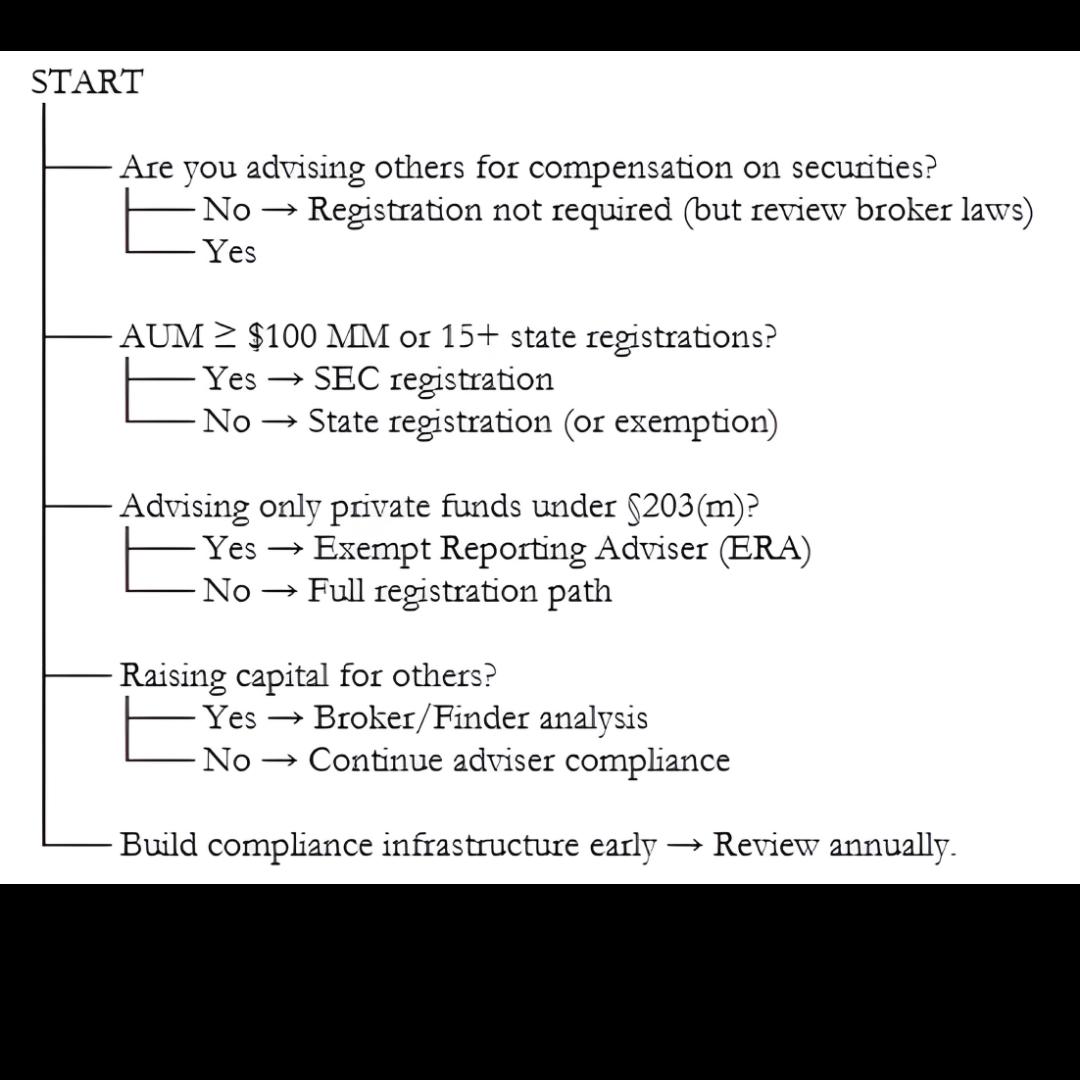
Finally, the question an adviser role sufficiently limited and the investor base sufficiently small/ controlled that we can remain under state registration (or even exempt) until a threshold is surpassed; and then build in triggers for migrating to SEC registration once scaling thresholds are crossed.
1. Generally, if an adviser manages $100 million or more in regulatory assets, registration with the SEC will be required (subject to various exceptions).
2. See, New York State Attorney General https://ag.ny.gov/investment-advisers-faq?utm_source=chatgpt.com
3. See, https://www.investopedia.com/ask/answers/09/series63-050509.asp (visited 11/18/2025)
4. Depending on the structure of the deal and location of investors on structure, an IS may reduce or eliminate filings for state security laws. Additionally, from a practical standpoint, if the sponsor deals with a single investor, offers are private, no blind pool, and the adviser role is limited, then the regulatory burden may be lower.
5. https://www.sec.gov/about/offices/oia/oia_investman/rplaze-042012.pdf (visited, 11/30/2025)
PAUL MARINO Partner Sadis
& Goldberg
pmarino@sadis.com
Paul Marino is a partner in the Financial Services and Corporate Groups. Paul focuses his practice in matters concerning financial services, corporate law and corporate finance. Paul provides counsel in the areas of private equity funds and mergers and acquisitions for private equity firms and public and private companies and private equity fund and hedge fund formation.
BY JASON CHERTIN & MARIE LIANG MCMILLAN LLP

For U.S. advisors, dealers, and investment fund managers considering doing business in Canada, understanding the Canadian securities regulatory landscape is critical. Although, the Canadian regulatory environment creates some compliance challenges there are many opportunities for U.S. firms seeking to raise capital, establish funds or offer advisory services north of the border. Despite the regulatory differences, Canada remains an attractive jurisdiction due to its robust investor base and harmonization initiatives.
Law-making authority in Canada is similar to its American counterparts in that the power to enact legislation is split between the federal government and the provincial and territorial governments.
However, unlike the U.S. where the Securities and Exchange Commission (“SEC”) plays the lead role in regulating securities markets with state securities regulatory agencies that supervise these activities

within their borders, Canada operates under a decentralized model. Each of Canada’s thirteen provinces and territories has its own securities regulator, such as the Ontario Securities Commission (“OSC”) in the Province of Ontario, coordinated through an umbrella organization, the Canadian Securities Administrators (“CSA”).
While the decentralized model allows for more direct service since each regulator is closer to its local investors and market participants, this can cause more regulatory hurdles to do business in Canada. Efforts to create a single national regulator have been struck down by the Supreme Court of Canada, most notably in Reference Re Securities Act, 2011 SCC 66. Fortunately, at least in terms of the securities regulatory regime, many regulations have been harmonized across the provinces and territories by the CSA through the use of National Instruments and Multilateral Instruments.
Apart from the CSA and each of the thirteen territorial regulators, there are other organizations
that also frame the Canadian securities regulatory framework such as the Canadian Investment Regulatory Organization (“CIRO”), the Canadian Investor Protection Fund (“CIPF”) and the Ombudsman for Banking Services and Investments (“OBSI”). Together these organizations form and oversee the rules that advisors, dealers, and investment fund managers when doing business in Canada must comply with.
The Canadian Investment Regulatory Organization
CIRO is the national self-regulatory organization that oversees all investment dealers, mutual fund dealers and trading activity on Canada’s debt and equity marketplaces. In 2023, the organization consolidated the functions of the Investment Industry Regulatory Organization of Canada (“IIROC”) and the Mutual Fund Dealers Association of Canada (“MFDA”) to streamline the compliance rules.
Comparably, the Financial Industry Regulatory Authority (“FINRA”) serves a similar function in the U.S. that is a private not-for-profit membership and self-regulatory organization for member broker-dealers that is responsible under federal law for supervising its member firms. Its main
purpose, similar to CIRO, is to protect investors and safeguard the integrity of the capital markets.
In 2009, CIRO (formerly IIROC) and FINRA signed a memorandum of understanding to enhance the effectiveness of both organizations through the exchange of information about compliance and enforcement-related matters and other cross-border assistance and oversight, resulting in improved regulatory cooperation.
Canadian Investor Protection Fund
The Canadian Investor Protection Fund is the approved investor protection fund sponsored by investment dealers and mutual fund dealers who are members of CIRO. CIPF is authorized to provide coverage within prescribed limits to eligible clients in case of a CIRO member’s insolvency. In fact, CIPF is a mandatory investor protection mechanism tied to CIRO membership meaning that any firm operating in Canada under CIRO must participate in CIPF and contribute to its funding, including U.S. firms expanding into the country as part of its regulatory obligations.
In the U.S., the Securities Investor Protection Corporation (“SIPC”), established under the Securities Investor Protection Act of 1970, is a non-
profit membership corporation that oversees the liquidation of bankrupt broker-dealers and recovers assets to their customers. However, the SIPC is not a self-regulatory organization and it has no regulatory authority. Therefore the SIPC cannot investigate investor complaints or take action against solvent, operating brokerage firms similarly to the CIPF.
Lastly, the Ombudsman for Banking Services and Investments is a national, not-for-profit and independent organization that provides an independent dispute-resolution service for consumers and small businesses with a complaint they are unable to resolve with their banking services or investment firm. It is an impartial external dispute resolution mechanism for most registrants in Canada and those who seek to operate in the jurisdiction.
There is no direct equivalent in the U.S. although the FINRA Dispute Resolution Services provides a similar mandate. However, unlike OBSI, there are fees for arbitration and mediation, and its decisions are binding (although there has been movement in Canada to allow OBSI the authority
for binding decisions to create a fully effective system of redress that is final).
For U.S. firms seeking to do business in Canada, differences in the two countries’ regulatory frameworks affect registration and compliance, requiring them to navigate new regulatory agencies and rules. However, Canada has made an effort to reduce fragmentation over the years to avoid gaps, complexity, overlap and the potential for delayed responses. Example of these efforts include the registration exemptions through the use of national instruments and the passport system.
For securities dealers and advisors, there are a number of exemptions from the registration requirements. For example, through National Instrument 31-103, the international dealer and international advisor exemptions allow certain foreign dealers and advisors to provide limited services without having to fully register in Canada, as long as the prescribed conditions are satisfied. This means that firms can file limited forms and avoid the registration process. This exemption, as a national instrument, is available across all provinces and territories, and is therefore a valuable tool for U.S. firms but requires careful planning to avoid inadvertent breaches.
If full registration is needed due to the business model or objective, registrants can benefit from the passport system that simplifies multi-jurisdictional registration by allowing firms to deal primarily with a single principal regulator. Therefore, market
participants are subject to one set of harmonized registration requirements in all jurisdictions.
This system contrasts with the U.S., where the Advisers Act of 1940 and other rules imposed by the SEC governs most investment activities nationwide. For U.S. firms, the Canadian regulatory structure can create a dual challenge of understanding both harmonized rules and the local nuances that may apply in each jurisdiction, layered with other obligations from regulatory bodies such as CIRO and CIPF with its mandatory contributions.
Despite regulatory differences, Canada offers compelling advantages as a stable market with a large and growing institutional, family office and high net worth investor base. In particular, the country’s financial ecosystem is anchored by its mandatory pension system and large institutional investors, which collectively manage trillions of dollars in assets – and these institutions actively seek diversified strategies, including U.S.-based funds and advisory services.
While regulatory requirements can cause an additional compliance burden, registration also signals strong governance and compliance, which is often a prerequisite for institutional mandates and can differentiate a firm from competitors. Moreover, Canada’s regulatory framework is stable and predictable, reducing geopolitical risk compared to other jurisdictions. It also allows U.S. firms to diversify across jurisdictions reducing reliance on U.S. capital flows and mitigating geopolitical or regulatory risk.
Canada’s decentralized regulatory model may seem daunting compared to the U.S. system, but with proper planning and reliance on available exemptions, the passport system and harmonization tools, U.S. advisors, dealers, and fund managers can successfully navigate the landscape and the benefits make Canada a market worth exploring.
If you would like to discuss the Canadian securities regulatory environment in more detail or explore how you can do business in Canada, please contact any member of McMillan’s Investment Funds & Asset Management Group who would be pleased to speak with you at your convenience. We advise many
Canadian and nonresident fund managers, dealers and portfolio managers on Canada’s complex registration and compliance obligations. We provide solutions-oriented legal advice through our offices in Vancouver, Calgary, Toronto, Ottawa and Montréal. For more information, please visit our website at www.mcmillan.ca.
The foregoing provides only an overview and does not constitute legal advice. Readers are cautioned against making any decisions based on this material alone. Rather, specific legal advice should be obtained.
McMillan is a leading business law firm serving public, private and not-for-profit clients across key industries in Canada, the United States and internationally. With recognized expertise and acknowledged leadership in major business sectors, we provide solutions-oriented legal advice through our offices in Vancouver, Calgary, Toronto, Ottawa and Montréal. Our firm values – respect, teamwork, commitment, client service and professional excellence – are at the heart of McMillan’s commitment to serve our clients, our local communities and the legal profession.


BY GLEN CARBALLO
DIME PRIVATE & COMMERCIAL BANK

In the independent sponsor model, capital is king—but cash alone does not close deals. The real difference between a one-off transaction and a repeatable, scalable independent sponsor practice is operational infrastructure. At the center of that infrastructure sits a frequently underestimated relationship: the banking partnership. Dime Community Bank (Dime) has the people and the tools in place to be the partner you need.
Most independent sponsors start off as lone wolves or small teams. They source proprietary deals, negotiate directly with sellers, and raise equity on a deal-by-deal basis. In the early days, banking feels like a commodity. “I just need a checking account and a wire template.” That
mindset works—until it doesn’t. When you are suddenly managing $5–50 million of equity commitments, multiple capital sources, complex waterfalls, and aggressive closing timelines, a traditional commercial bank quickly becomes the bottleneck that can kill momentum, reputation, and returns.
A strong banking partner in the independent sponsor ecosystem, like Dime, is not a vendor, it is a strategic operating partner that impacts five critical areas: speed, credibility, cost, compliance, and scalability.
Independent sponsors live and die by the speed of their deals. Proprietary deals often come with 30–60 day exclusivity windows and sellers who have been burned by private equity processes that drag on for months. Every delay increases the risk of re-trade, broken exclusivity, or a competing bidder sneaking in.
A sophisticated banking partner moves money like a sponsor expects:
• Same-day domestic wires and next-day international wires as the standard (not “expedited”)
• Dual-control approval workflows that still allow 2-hour turnaround
• Pre-funded escrow accounts so the moment equity commitments are signed, funds are already in the closing escrow
• Real-time treasury dashboards that let you see every investor wire the moment it hits
I have seen independent sponsors lose sevenfigure earn-outs because their bank held a $12 million wire for “review” over a long weekend. Conversely, sponsors with the right banking relationship routinely close transactions in 10–14 business days from equity commitment to funding—something that feels like witchcraft to traditional private equity buyers.
Backed by over 160 years of service and the financial strength of Dime Community Bank, our Private and Commercial Banking team is
your single point of contact when it comes to fulfilling your financial needs. Dime’s Private and Commercial Bankers not only have the experience to help you meet and exceed your financial goals, we provide direct access to senior-level management, giving your business an edge over the competition and shifting the perception to “This feels institutional.”
This level of credibility influences everything:
• Sellers are more willing to grant exclusivity
• Intermediaries are more likely to bring you proprietary opportunities
• Lenders and mezzanine providers perceive lower execution risk, which translates into better pricing and covenants
In short, you borrow your bank’s credibility while your own track record is still building.
3. COST: THE HIDDEN 0.5–1.5% MOST SPONSORS NEVER SEE
Banking feels “free” because many services are bundled or waived. Dig deeper and the cost is real:
• Wire fees ($30–$50 domestic, $75+ international) on 50–150 investor wires per deal
• FX spreads of 100–300 bps on Canadian LPs or European family offices
• Monthly “analysis” fees, cash balance requirements, or dormant account charges
• Escrow agent mark-ups when the bank insists on using its own trust company
A good banking partner eliminates or heavily
discounts these fees for independent sponsors and private equity clients. Over a dozen deals, the savings alone can equal another full percentage point of carried interest. More importantly, they offer true multi-currency accounts (USD, CAD, GBP, EUR) with mid-market FX rates—something that saves 50–150 bps for any cross-border investor.
Post-2020, institutional and high-net-worth investors have dramatically higher expectations around transparency and compliance. They want:
• Individual capital call notices with personalized wiring instructions
• Real-time visibility into when their wire hits the escrow
• KYC/AML completed once at the banking level, not re-done for every deal
The best banking partners create dedicated independent sponsor platforms that solve these problems at the bank level rather than forcing each sponsor to build their own investor portal (an expensive distraction). Investors notice the difference. A clunky, manual process signals “this might be their first rodeo” while a seamless digital experience screams “this team has done this before.”
The ultimate test of a banking relationship arrives
when you have overlapping deals. Imagine closing Deal A on March 31 while simultaneously calling capital for Deal B and preparing escrow for Deal C. Some banks would crumble under the operational load.
A true partner offers:
• • Multiple legal entities under one banking umbrella with segregated accounts
• • Treasury Management teams that understand waterfalls and promote structures
• • Revolving credit facilities against undrawn capital commitments (a game-changer for working capital or multiple simultaneous closings)
• • Deposit accounts that can sweep excess cash into money-market funds with same-day liquidity
These features turn an independent sponsor practice from a series of one-off transactions into a real asset management business with predictable overhead and institutional-grade operations.
Not all “private banking” or “commercial banking” teams are created equal. Here’s what the top independent sponsors look for:
1. Dedicated Private Equity / Independent Sponsor Team
Avoid generalist commercial bankers. You want a team that already services 50–200 sponsors
and speaks your language (carry, promote, recycling provisions, etc.).
2. True Same-Day Wire Capability
Ask for the cut-off time on a $25 million wire with no pre-notification. If the answer is not “5:30 pm ET,” keep shopping.
3. Multi-Currency Accounts with Real FX
You will eventually have a Canadian insurance company, a Swiss family office, or a UK pension as an investor. Plan for it on day one.
4. Expertise, Efficiency & Execution
The best banking partners understand the daily intensity of coordinating multiple money movements between businesses.
5. Investor Portal / Digital Onboarding Investors should onboard once at the bank level and then receive deal-specific capital call links. Anything less is now below market.
6. No Ridiculous Cash Balance Requirements
Some banks still demand $5–10 million of average collected balances to waive fees. The modern players have moved to relationship pricing based on total activity.
7. References from Peers
The independent sponsor community is tight knit. Ask for three current independent sponsor clients in your deal size range. Call them.
In the independent sponsor world, you are only as good as your last closing. Sellers, investors, lenders, and intermediaries all form judgments based on how professionally you execute. A world-class banking partner is not a luxury, it is a necessity. It lets you move faster, look bigger, save money, reduce risk, and delight your investors.
The sponsors who treat banking as a strategic relationship rather than a utility are the ones graduating from “one deal every few years” to building real franchises with dozens of portfolio companies and hundreds of millions under management.
Choose wisely. Your next deal—and your reputation—depends on it. Choose Dime, We’ve
Got Your Bank. Member FDIC.
GLEN CARBALLO
Director of National Deposits
Dime Private & Commercial Bank
Backed by over 160 years of service and the financial strength of Dime Community Bank, our Private and Commercial Banking team is your single point of contact when it comes to fulfilling your financial service needs.
Dime’s Private and Commercial Bankers not only have the experience to support your financial needs across business and personal lines, but are also empowered by the bank as your single point of contact with direct access to senior management to support all your banking needs.
BY DAVID FITZGERALD SADIS & GOLDBERG

If you are a credit professional looking to put your risk, credit and valuation experience to work in the private lending market, you would do well to consider launching a Small Business Investment Company (SBIC). An SBIC is a privately managed investment fund licensed and regulated by the U.S. Small Business Administration (SBA) to provide debt and equity capital to qualifying U.S. small businesses.
This article provides a concise roadmap for private credit managers evaluating launching a private credit lending vehicle through the SBIC program.
Specifically:
i. The article explains how SBA-provided debenture leverage can scale capital raised from private investors; ii. it outlines why regulated banks find investing in
SBICs particularly attractive; and iii. discusses the practical basics of qualifying for an SBIC license.
For private credit managers, the SBIC program can materially amplify committed private capital with standardized, government-backed leverage on terms that are difficult to replicate in the private credit markets. The core leverage mechanic is straightforward: the SBA provides debenture leverage on “regulatory capital” raised from private investors to licensed SBICs¹. In practical terms, every dollar raised from private investors can often support roughly three dollars of investable capital, within SBA limits and depending on the strategy and the particulars of the SBA license. In most cases, an SBIC’s total SBA leverage cannot exceed a set multiple of private capital raised², and the SBA may further tailor commitments based on the track record of the SBIC’s investment team, portfolio composition, and compliance history.
The leverage provided by the SBA is in the form of guaranteed debentures with long-dated, fixedrate terms. The rate is set semi-annually, priced off market yields with an SBA program charge layered in, and results in a known cost of funds through maturity. Debentures typically have a 10-year term with semiannual interest payments and principal due at maturity, which creates a predictable amortization schedule for managers. Program constraints limit how and when leverage can be drawn and used, but those constraints are transparent and standardized, allowing managers
to structure portfolios and cash flows with a high degree of certainty.
The availability of SBA leverage is subject to SBA review of the SBIC’s strategy, risk controls. SBIC’s are subject to leverage caps at both the per-SBIC level and on families of SBICs to manage concentration risk and ensure safety and soundness. While exact caps and pricing adjust over time through SBA rulemaking and semiannual pools, the financing remains long-dated, fixed-rate, non-mark-tomarket, and supported by a mature operational infrastructure.
From a fundraising perspective, this leverage translates into several advantages. First, it can significantly scale a manager’s strategy without demanding the same volume of capital commitments from private investors. Second, the standardized terms and SBA oversight are familiar to institutional investors, which can shorten education cycles and reduce perceived financing risk compared to bespoke fund-level facilities.
Third, the leverage is non-dilutive to private investors, so the gross-to-net outcome can be attractive when underwriting conservative target returns. Finally, the SBIC program’s policy mandate to finance U.S. small businesses can resonate with investors that prioritize domestic job creation, supplier ecosystems, and lower-middle-market credit access.
Launching an SBIC also opens an excellent
"TheSBICprogramcanmaterially amplifycommittedprivatecapital withstandardized,governmentbackedleverage...."
institutional source of private capital for private credit managers, namely U.S. regulated banks. Banks often agree to act as the anchor limited partners in SBICs because SBICs align uniquely well with banking laws, supervisory expectations and bank community-development objectives.
SBICs are a well-recognized investment class for banks and bank holding companies, because of the defined quantitative leverage limits within which SBICs must operate and the ongoing compliance oversight of SBICs by the SBA. That predictability helps internal legal, compliance, and risk teams of a bank both diligence and monitor the banks’ credit exposure to the SBIC, using well-understood checklists tied to licensing status, leverage profile, investment eligibility, valuation controls, and reporting.³
Operationally, SBICs map well to banks’ thirdparty risk management standards. SBA licensing conditions impose investment eligibility rules, valuation and reporting protocols, conflict-of-
interest safeguards, and leverage constraints that create a strong control environment. From a risk standpoint, bank exposure is usually limited to committed capital in a limited partner role, and the fund-level leverage is uniform and transparent. Strategically, SBICs give banks diversified access to small and lower-middle-market borrowers who may also be, or become, bank clients for treasury, deposits, or senior secured lending—with appropriate conflicts, information barriers, and compliance controls in place.
The upshot is that SBICs deliver an unusual combination of regulatory transparency, CRA impact, Volcker relief, and disciplined leverage—all of which make banks natural, repeat investors in the asset class.
Qualifying for an SBIC license is a structured process
with clearly articulated milestones and substantive criteria. While the SBA refines processes and forms over time, the core elements are stable and focus on team quality, strategy suitability, and program compliance.
The licensing pathway typically begins with a preliminary engagement and a Management Assessment Questionnaire that details the backgrounds and track record of the manager’s principals, as well as the expected target markets, strategy, pipeline, governance, and compliance program of the fund. The SBA’s screening emphasizes the principals’ demonstrated smallbusiness investing or lending experience, portfolio construction discipline, and the ability to operate within program rules. Principals that pass initial screening receive a “greenlight” to proceed toward licensing, at which point the SBA expects evidence of private capital formation that is consistent with the amount of leverage being sought from the SBA by the SBIC.
Managers must raise a minimum amount of private capital to qualify⁵, and larger leverage commitments generally require commensurately larger private capital support. The SBA evaluates the quality and durability of that capital, including the identity of limited partners, side-letter terms, and any structural features that could impair fund stability or subordinate the SBA’s interests.
Once licensed, managers operate under ongoing SBA oversight. SBICs are subject to periodic examinations, financial reporting, valuation standards, investment eligibility rules tied to small-business size and use-of-proceeds, affiliate and conflict-of-interest restrictions, and portfolio
concentration limits. Certain transactions require prior SBA approval. Leverage draws must be matched to eligible investments, and the fund must maintain compliance with leverage coverage, distribution, and fee limitations set out in the program rules and the SBIC’s governing documents. Independent audits, robust internal controls, and documented valuation methodologies are expected.
Finally, life-cycle management is integral to the program. The SBA expects prudent pacing, diversification, and exit planning consistent with the debenture maturity profile. SBICs in winddown maintain program compliance obligations until leverage is fully repaid and the license is surrendered, a process the SBA supports through established wind-down procedures.
For private credit managers, the net picture is compelling. The SBIC license pairs disciplined, long-dated, fixed-rate leverage with a regulatory framework that institutional investors—and particularly regulated banks—understand and value. When matched to a compatible credit strategy and a qualified team, it can be a capitalefficient and scalable way to expand into or deepen exposure to the U.S. lower-middle private credit market.
If you would like more information on launching or qualifying an SBIC, please contact David Fitzgerald at dfitzgerald@sadis.com or 212-573-8428.
1. “Regulatory Capital” is defined as capital actually paid in to an SBIC, plus unfunded commitments from “institutional investors”, less any noncash assets contributed to the SBIC. Institutional investors are business entities with a net worth of at least $10mm (excluding unfunded commitments); banks, insurance companies, pension plans and tax-exempt foundations or trusts with a net worth of at least $1.0mm and high net worth individuals with a net worth of at least $10mm (excluding the equity in their most valuable residence) or with a net worth of at least $2.0mm if the commitment to the SBIC does not exceed 10% of the individual’s net worth.
2. Based on the amount of an SBIC’s Regulatory Capital, the SBA will provide a maximum amount of leverage commitment, typically in a coverage ratio of 2:1. However, an SBIC’s actual leverageable capital is the amount of Regulatory Capital actually paid into the SBIC and must at all times be less than then the standard 2:1 SBA leverage coverage ratio. So, for example, if an SBIC has raised commitments from qualifying investors of $100mm, the SBA’s leverage commitment will typically be $200mm. However, if the SBIC has only drawn $50mm of actual paid in capital, the total amount of the leverage commitment that may actually be drawn is $100mm. Further, this 2:1 leverage coverage ratio must be monitored and maintained by the SBIC at all times.
3. Critically for banks, SBICs are excluded from the Volcker Rule’s “covered fund” definition. This removes many of the ownership restrictions, compliance burdens, and life-cycle frictions that banks face with largely unregulated private equity or credit funds, including issues around seeding, sponsorship, and parallel fund interests. The exclusion also extends through wind-down, simplifying exit management. Also, SBIC investments commonly receive positive consideration under the Community Reinvestment Act. Because SBICs channel capital to small businesses and support job creation and economic development—including in low- and moderate-income communities—they tend to fit squarely within bank CRA strategies. The CRA credit is well understood by examiners, which reduces execution risk around expected community development treatment and helps banks deploy CRA-motivated capital at scale. Public welfare investment authority further facilitates bank participation. For national banks and others regulated under state-law, SBIC commitments typically qualify as public welfare or community development investments, providing a clearly understood legal framework for bank investment and a straightforward internal approval path.
4. The SBA evaluates an SBIC applicant’s investment team for demonstrated ability to execute the proposed strategy prudently under the program’s rules. The review is centered on the Management Assessment Questionnaire (MAQ), a formal interview, diligence on experience and character, and committee approvals. The SBA assesses whether the principals collectively have the skills, experience, and cohesion to manage an SBIC consistent with the fund’s proposed strategy and the program’s regulatory requirements. In practice, the SBA looks for at least two substantially full time principals with substantive, analogous principal investing experience and a realized track record of success; the SBA also weighs team cohesion and governance to avoid “one person” dominance in decision making. The SBA’s public guidance summarizes “successful SBIC” teams as experienced, with complementary skills and a history of working together, pursuing a strategy they have executed before, and supported by an aligned fund structure. As such, a history of an investment team working together previously can be important in the licensing decision, as well as the amount of leverage commitment the SBA will provide to the SBIC.
5. All SBIC applicants must satisfy minimum capital requirements. The SBA requires that SBIC applicants have initial paid-in and/or committed Private Capital equal to the greater of: (1) a statutory minimum of $5 million (or $3 million if the applicant meets the requirement for “good cause”), or (2) any minimum amount stipulated in the applicant’s own SBIC license application for an initial closing of the SBIC. In addition, the SBA may decline to license an application if it determines that the applicant’s initial capitalization is not reasonably sufficient to carry out its stated business plan effectively. Irrespective of the amount of Regulatory Capital, an SBIC applicant must have a minimum of $2.5 million of leverageable capital prior to licensure. As a practical matter, the SBA must receive documentation showing that the $2.5 million requirement has been satisfied during the SBIC’s capital raising.

David Fitzgerald is a Partner in the firm’s Financial Services and Corporate Groups. David’s practice focuses on investment funds, securities, joint ventures, regulatory compliance and investment advisers. He regularly structures and organizes hedge funds, private equity funds, funds of funds, separately managed accounts and hybrid funds. Additionally, he advises private fund managers on structure, compensation, employment and investor issues, and other matters relating to management companies.
BY ROGER KOWALSKI
IGLOBAL FORUM

Family offices are entering 2026 with discipline, patience, and a sharper focus on alignmentcreating both challenges and opportunities for Independent Sponsors. According to McKinsey’s Global Private Markets Report 2025, privatemarket liquidity remains tight. The investmentsto-exits gap hit a ten-year high, with $780 billion more invested than realized, reinforcing why family offices are pacing deployment more deliberately. Yet despite slower distributions, family offices continue to lean into the lower middle market, where operational upside is more controllable and valuations remain more rational.
The Independent Sponsor Summit featured a Keynote Address with where two family offices discussed deal origination, deployment strategy, and what they look for in an independent sponsor. Where families source deals hasn’t changed - they still rely overwhelmingly on trusted relationships over broad outbound processes. BNY’s 2025 Single Family Office Insights reports that 64% of family offices expect to make six or more direct
investments this year, and most prefer sponsorled opportunities that come through warm introductions. Consistent with this, the Citrin Cooperman Independent Sponsor Report 2025 shows that business brokers, boutique banks, and direct relationships remain the dominant channels, with 40% of sponsors sourcing deals directly from company owners or management, and 46% having closed deals from broken auction processes where trust and fit mattered more than process perfection. Family offices reward sponsors who build the relationship before the LOI, not after.
Liquidity expectations among family offices also differ from traditional LPs. Families have the flexibility to hold strong assets longer, and they’re doing just that. BlackRock’s Global Family Office Survey 2025 notes that alternatives now make up 42% of family-office portfolios (up from 39% in 2023), with many planning to increase allocations to private credit and infrastructure. Deloitte’s Family Office Private Capital Study reinforces the trend: direct private-equity investing among family
offices has risen from 22% in 2021 to 30% in 2023, driven by a desire for control and reduced fee drag. This aligns with independent-sponsor deal dynamics, where the Citrin Cooperman Report shows typical hold periods clustering around 5–10 years, enabling families to compound value rather than force premature exits.
For Independent Sponsors, the message is clear: families want clarity, alignment, and a sponsor who can articulate both why this asset and why you. Track record and credibility matter, but so does valuation discipline. Citrin’s Report shows that 54% of sponsor-led deals closed at 4–6x EBITDA, with another 17% closing below 4x - proof that disciplined underwriting still wins in the inefficient lower-middle market. Meanwhile, Deloitte and BNY data show that families gravitate toward sponsors who present thoughtful operational plans, proven sector insight, and early transparency around strategy and roles.
Ultimately, family offices remain one of the most flexible, relationship-driven, and attractive capital sources in private equity, but they expect the same clarity and alignment from their partners.

sponsor’s value-creation plan must be explicit, not implied. And in a capital-selective environment where deployment has slowed but interest in highquality deals remains strong, the independent sponsors who invest early in relationships and operate with discipline will be the ones families remember and back.
• Warm intros still beat process. Family offices overwhelmingly back sponsors they know early. Pre-LOI conversations double your chances of getting funded.
• Discipline is the new edge. With slower distributions and tighter markets, families want sponsors who buy at 4–6x EBITDA and show a clear operational plan, not bidders chasing heat.
• Longer holds, bigger outcomes. Family offices are leaning into 5–10 year horizons and direct investing, fueling demand for sponsors who can compound value, not flip assets on a clock.
Where can Family Offices go to Meet Independent Sponsors? The Independent Sponsor Summit in Miami on March 12-13, 2026
ROGER KOWALSKI Director, Strategic Partnerships iGlobal Forum roger@iglobalforum.com
We are a global events and media organization connecting senior business executives and decision-makers for over 15 years. Our goal is simple: to help you tackle challenges by providing valuable connections.
COMING TOGETHER FOR THE FIRST TIME IN Miami, March 12–13, 2026
These co-located events bring together independent sponsors, capital providers, operating partners, and private equity professionals for two days of networking, insight, and deal-making across the entire lifecycle of a transaction, from sourcing and financing to post-close value creation and exits.
You’ll leave with practical strategies, proven frameworks, and new relationships to accelerate your dealflow and portfolio results.
to register 15% OFF Use code * ISS20EARNOUT Earnout Magazine readers save
BY JONATHAN BERNSTEIN
SADIS & GOLDBERG

As artificial intelligence (“AI”) transforms businesses, many clients are exploring whether AI tools can help reduce legal costs, better understand legal documents and prepare more efficiently for attorney consultations. While AI provides simplified explanations for complex matters and saves clients time in finding answers, using AI tools effectively requires understanding of their capabilities and risks, particularly regarding confidentiality and legal accuracy.
AI tools can transform how you engage with any subject matter (including legal). As it pertains to matters of the law, AI can help you become an informed client and helping you use attorney time more efficiently. These benefits only occur when AI tools are used appropriately and securely. The technology serves best as a preparation and educational resource, empowering you to engage more effectively with legal counsel, rather than replacing professional guidance. AI tools are to legal what the internet is to medical; lots of information but the trick is in the diagnosis.
Prior to writing any prompts or uploading any document to an AI tool, it is important to take the necessary steps to protect any confidential information. AI tools typically save user data to train their models, leaving all information, including sensitive personal information or other confidential information, on their servers. The first step for clients to take is to remove all sensitive data, which includes, but is not limited to, the following:
• social security numbers,
• tax identification numbers,
• bank account details,
• proprietary business information,
• terms deemed confidential,
• trade secrets, and
• internal financial data.
Clients should consider providing a sanitized version of the text in question within the prompt, or only upload redacted documents. A client should never upload documents (or direct text) containing
attorney communications or legal advice from their counsel, as this could waive attorney-client privilege protection afforded to those communications or advice.
In a September 2024 article titled “AI and AttorneyClient Privilege: A Brave New World for Lawyers”, the American Bar Association emphasized that using an AI tool without proper precautions may compromise confidentiality protections fundamental to the attorney-client relationship. Documents shared with AI tools may lose their attorney-client privilege protection, potentially exposing sensitive legal strategies and communications.¹
Beyond privilege concerns, uploading confidential business information to AI tools creates additional risks, including breaching confidentiality. Many consumer AI tools incorporate uploaded documents into their training datasets, potentially exposing your business information to unintended uses. The mere existence of certain documents or agreements is often confidential, and uploading these materials could inadvertently disclose sensitive business relationships or strategic initiatives and breach that confidentiality. In order to minimize these risks, clients should look into using enterprise AI solutions that offer enhanced privacy features, including data encryption and guarantees against using your data for model training.
Where AI tools can excel when prompted properly is generating executive summaries of lengthy
agreements, highlighting critical provisions such as payment terms, change of control provisions, termination rights, and liability limitations. They can create structured timelines of obligations and deadlines, helping you track compliance requirements across multiple agreements. These tools are also valuable for comparing standard terms across different contracts, identifying variations that may require additional negotiation or legal review.
The quality of AI assistance depends significantly on how you structure your queries; clear, specific prompts yield more accurate results than vague questions. When reviewing a commercial lease, instead of asking “What does this lease say?” try prompting: “List all tenant obligations in Section 5 with their respective deadlines.” For employment agreements, consider: “Identify any non-compete restrictions, their geographic scope, and duration.” While AI tools can be very effective at organizing this information, it is important to double-check the work in case the AI tool misunderstood or missed any provisions, or even fabricated content entirely. Clients and counsel alike should always verify AI tool responses against the original document before relying on its analysis.
Additionally, it is helpful to break complex documents into manageable sections, as AI tools can struggle when analyzing specific provisions within large documents. Focus on specific provisions requiring clarification and request that AI cite section numbers when providing analysis, enabling you to verify interpretations against the source material. This approach improves accuracy and helps you understand how different contract provisions work together. AI tools are particularly
effective for initial drafts and early-stage document reviews, though their usefulness decreases after multiple rounds of revisions where nuanced negotiations and party-specific considerations impact the drafting and compromises are buried therein. However, clients should be mindful of the AI tool that they deploy to analyze documents and provisions, as certain AI tools create additional risk around a breach of confidentiality of the underlying document or provision that are uploaded.
AI tools such as ChatGPT, Claude, Harvey and Copilot each have their unique strengths and weaknesses, allowing users to determine which platforms best apply to their matter. The American Bar Association has published an article titled “AI Tools for Legal Work: Claude, Gemini, Copilot, and More”, guiding lawyers on the capabilities of each platform so that lawyers can understand the benefits of any given tool, such as:
• ChatGPT – best for preparing emails and rewriting
• Claude AI – best for complex cognitive tasks and transcribing static images
• Gemini – usage on mobile devices, including responding to text and completing tasks
• Harvey – advantage of a closed system
• Copilot – integration with Microsoft Office and Microsoft 365
While clients can look for similar guidance in their industry, the best path is to use various platforms to determine which provides the best output for your given legal matter. Additionally, It is important to manage the risk of disclosing confidential information to an AI tool – clients don’t want to upload confidential information to an AI
tool that is the equivalent of leaving your document on a table in a coffee shop. While ChatGPT, Claude, Gemini and Copilot all offer methods to opt-out of having your data used to train the underlying AI model of the AI tool, the opt-out provision does not guarantee the data is secure. To best protect any documents or data provided to AI tools, it is best to use enterprise subscriptions through these AI tools, which offer varying levels of security depending on your business needs.
Maximizing successful integration of AI tools requires open collaboration with your attorneys. Ensure you inform your legal team when you've used AI to review documents, providing them with both your AI-generated summaries and the specific prompts you used. This transparency allows your attorneys to maximize the utility of AI interpretations and identify any misunderstandings by the AI tool that could affect your legal strategy.
An important step at the beginning of an attorneyclient relationship is establishing a clear process with counsel for using AI in document analysis. The agreed process should specify which types of documents are appropriate for AI review, which AI tools meet security requirements, and how AIgenerated insights should be documented.
AI tools can significantly enhance the value of your attorney consultations by helping you prepare prior to meetings, ensuring your time with an attorney is efficient and effective. This efficiency can translate directly into reduced legal costs—for example, using AI to generate a summary of compensation
committee materials or board meeting minutes allows your attorney to review your analysis and understanding, shortening the billable time spent on summarizing and explaining their work. Before meetings, clients can use AI to identify provisions they don't understand, generating lists of clarification questions. By using the AI tool to create a preliminary list of issues in advance of the initial meeting to discuss a document, a client can initially focus the conversation on those issues they find most important. Additionally, take note of how you used AI so that you can discuss with your attorney which tools you used and what questions they helped generate.
Despite their capabilities, AI tools face limitations in legal analysis. A Stanford RegLab study published in the Journal of Empirical Legal Studies in March 2025 noted that even AI tools trained on legal analysis provide incorrect information, known as “hallucinations”, in between 17% to 33% of responses2. AI users, including some attorneys, have used incorrect AI analyses with unfortunate outcomes. For example, lawyers in California and Alabama have faced fines for filings that included citations to non-existent caselaw³, and a New Jersey lawyer faces sanctions in New York courts after being accused of using AI in a court filing, and then allegedly using AI again in his response to the accusation⁴. Judges are more frequently imposing sanctions on legal professionals who submit AIgenerated content without verifying the accuracy of their filings. Rather than treating the AI tool response as a final authority, treat it as a starting point for further research or discussion.
AI tools can only work with the information you provide. Without the background of your matter and the context of your question, an AI tool is unable to:
• understand that you accepted less favorable terms in one section because you negotiated more favorable terms elsewhere, or
• that certain provisions were structured as compromises tied to other benefits.
This limited perspective prevents an AI tool from appreciating and correctly analyzing whether a specific contract term is favorable or unfavorable in your specific scenario.
One way to mitigate this issue is to have the AI tool focus on provisions that have yet to be negotiated, rather than sections already finalized by all parties. The resulting response should be more accurate because it gives the AI tool a focused batch of data to process, allowing the AI tool to work in a closed universe, without the need for context or additional detail that it is not equipped to consider, while also removing any unnecessary information that could influence its response.
AI tools have additional limitations to consider, including:
• difficulty understanding jurisdiction-specific legal requirements
• failing to account for recent legislative changes or court decisions that may affect your agreements
• evaluate whether provisions are enforceable in specific circumstances or to predict how courts might interpret unclear language.
Multi-party agreements require complex prompts that must convey the positions and negotiated compromises of all parties, which when delivered inaccurately or unclear, can result in an inaccurate response, limiting the utility of the AI tool.
Most importantly, AI tools cannot provide legal advice or replace professional judgment in complex business matters. Rather than prompting an AI tool for guidance on whether you should sign an agreement or what points to negotiate, it is more effective to ask for interpretations of the current agreement so that you can make an informed decision with a complete understanding. Decisions based exclusively on an AI tool’s analysis could lead to serious legal and financial consequences, but
using it to better inform your own analysis or your discussion with legal counsel can lead to better results for your organization. The most effective use of AI tools is not as a replacement for legal counsel or for your own business judgment, but as an assistant to help you effectively and efficiently understand problems and find solutions.
If you have any questions about this article or about coordinating an AI plan with your attorney, please contact Jonathan Bernstein (jbernstein@ sadis.com).
1. AI and Attorney-Client Privilege: A Brave New World for Lawyers (American Bar Association): https://www.americanbar.org/groups/business_law/resources/ business-law-today/2024-september/ai-attorney-client-privilege/
2. Hallucination-Free? Assessing the Reliability of Leading AI Legal Research Tools (Stanford RegLab): https://reglab.stanford.edu/publications/hallucination-freeassessing-the-reliability-of-leading-ai-legal-research-tools/
3. Fake AI Citations Produce Fines for California, Alabama Lawyers (Bloomberg Law): https://news.bloomberglaw.com/litigation/fake-ai-citations-produce-finesfor-california-alabama-lawyers
4. NY Judge Sanctions Lawyer for Fake AI Citations (New York Daily Record): https://nydailyrecord.com/2025/10/08/judge-sanctions-lawyer-for-fake-ai-citations/

JONATHAN BERNSTEIN Partner
Sadis & Goldberg
Jbernstein@sadis.com
Jonathan Bernstein is a Partner in the Financial Services and Corporate groups. Jonathan focuses his practice in matters concerning mergers & acquisitions, outside general counsel, and corporate law. He serves as a trusted advisor to private equity sponsors, family offices and middle-market and familyowned businesses across industries. Jonathan has experience representing clients across the fashion, apparel, distribution, consumer products, media, manufacturing, healthcare, technology and hospitality industries, among others. He assists our clients in connection with acquisitions, divestures, sales and financing. Our clients benefit from Mr. Bernstein’s knowledge of their businesses to execute transactions, along with his extensive experience executing complex transactions. As an outgrowth of the close relationships he develops with our clients, Jonathan routinely works with our clients to craft business strategies which meet their business priorities while managing risk. He also serves as an outside general counsel, advising on the full gamut of day-to-day legal issues. He takes a practical approach to deal-making that puts a premium on big-picture issues that matter to his clients.
BY SAM LIEBERMAN & FRANK RESTAGNO
SADIS & GOLDBERG

ANew York trial court recently enforced a “Full Ratchet” anti-dilution provision against a creative attempt to avoid its terms by using variable pricing for a later round of financing. In Phoenix Motor Inc. v. JAK Opportunities
II, LLC, Sadis & Goldberg won a motion to dismiss a claim seeking to avoid enforcement of a Full Ratchet anti-dilution provision, for which our client negotiated as a condition of making its initial investment. This is an important ruling for private equity and venture capital investors, who commonly negotiate for Full Ratchet anti-dilution
provisions to protect their investments from being diluted in a subsequent financing round.
A Full Ratchet is a common provision in early-stage investing that “offers … cost protection should the pricing of future” financing “rounds be lower than that of the initial round.”¹ A Full Ratchet operates as “an anti-dilution provision that applies, for any shares of common stock sold by a company after the issuing of [a] convertible security[], the lowest
sale price as the [new] adjusted … price … for existing shareholders.” (Id.) Early-stage investors often use their leverage as an early investor to seek Full Ratchet provisions that will protect them against being diluted by later financing rounds.
For example, if, after initially issuing Stock (or Warrants) at $10 per share in Round 1, the Company later issues Stock (or Warrants) at $5 per share in Round 2, the Full Ratchet applies to compensate Round 1 investors by giving them the $5 per share lower price and also “additional shares sufficient to maintain” the same total value they had originally, i.e., twice as many shares.² A Full Ratchet achieves this by automatically reducing the price downward “to reflect the … price of the shares issued in subsequent rounds,” and correspondingly adjusting the total number of … shares upwards, to achieve the same economic result.³
In the Phoenix Motor case, Phoenix Motor Inc. (“Phoenix”) in 2023 obtained early-stage financing from JAK Opportunities II, LLC (“JAK”) in exchange for a warrant (“Warrant”) to purchase 1.5 million Phoenix shares at a $1.30 per share exercise price.⁴ The Warrant had a Full Ratchet anti-dilution provision to protect JAK from dilution by a later round of financing. If Phoenix did a later round of financing at a lower price, JAK’s exercise price would be adjusted downward to the lowest price of the later financing round, and the number of shares would be adjusted upwards by the same proportion as the difference in price.
the possibility of a future financing round done at a variable price, which is adjusted based on factors like current stock trading price. JAK’s Full Ratchet provision provided that JAK’s conversion price would be adjusted to the “lowest price per share” for which a share of Phoenix’s common stock “may become issuable assuming all possible market conditions” under an agreement for a new round of financing. Accordingly, JAK’s Full Ratchet provision required a new, lower price that is the lowest possible price at which stock could ever possibly be issued under a new round of financing, under any market condition. In short, the Full Ratchet required using the lowest possible price in a later financing round.
A year and a half after issuing the Warrant to JAK, Phoenix entered into a new loan agreement with J.J. Astor & Co. (“J.J. Astor”), in which Phoenix agreed to borrow additional funds in two tranches (the “J.J. Astor Agreement”).⁶ In exchange, Phoenix agreed to issue J.J. Astor two promissory notes to secure each of the two tranches of debt.
Conversion Price.
As soon as Phoenix executed the J.J. Astor Agreement containing its floorless Conversion Price, Phoenix was “deemed” under the Warrant to have issued common shares for “the lowest price per share for which one share of Common Stock is at any time issuable” under the J.J. Astor Agreement.⁸ This triggered JAK’s Full Ratchet provision, to reduce the Warrant’s exercise price to the lowest possible issuance price under the J.J. Astor Agreement,⁹ which contained no floor price.
Accordingly, JAK exercised its Warrant at $0.12 per share, a price well below the Warrant’s original exercise price (and well below the $0.60 per share market price). The $0.12 price per share was proper, assuming the Full Ratchet provision applied. Phoenix disputed JAK’s exercise price, and argued that the Full Ratchet provision did not apply. Phoenix then sued to recover the difference between the original exercise price and the far lower price JAK paid for the shares.
variable prices, including as low as $0.01 per share. Accordingly, JAK argued that it was entitled under the Full Ratchet provision to buy shares for as low $0.12 per share – which made its conduct proper under the Warrant’s plain terms.
In response, Phoenix argued that (i) the J.J. Astor Agreement did not trigger the Full Ratchet provision re-setting the conversion price as low as $0.12 per share, and (ii) JAK would get a windfall if it used an exercise price at $0.12, which was well below JAK’s $0.60 per share market price.
The Court agreed with JAK and dismissed Phoenix’s complaint.10 It held that the J.J. Astor Agreement triggered the Warrant’s Full Ratchet provision. It emphasized that the Warrant directs the use of the “lowest” price at which a share “may become issuable assuming all possible market conditions.”11 That language captured the J.J. Astor Agreement’s Conversion Price, which was tied to whatever Phoenix’s share price might be on the future date when J.J. Astor would be required to provide additional financing, which future price could be anything, without any specified price floor. Accordingly, the Court held that JAK’s purchase of shares at a $0.12 per share price was permissible under the Full Ratchet provision.
Importantly, JAK’s Full Ratchet provision addressed
Importantly, the new investment used a variable “Conversion Price” with no floor if either J.J. Astor or Phoenix elected to convert the second note (the “Additional Note”) into Phoenix common shares. If either party converted, the Conversion Price would be tied to Phoenix’s stock price at the future “Funding Date” of the Additional Note.⁷ Phoenix’s stock price could be anything at that future time, and the J.J. Astor Agreement set no floor on the
JAK retained Sadis to handle this case, and JAK immediately moved to dismiss the complaint. JAK argued that the Full Ratchet’s plain terms required using the lowest possible price under the J.J. Astor Agreement. The J.J. Astor Agreement used
The Court rejected Phoenix’s attempts to avoid the consequences of the full ratchet it had granted to JAK. Phoenix took issue with the variable future Funding Date of the Additional Note, arguing that JAK had “to wait for an actual agreement” to fund the Additional Note, and use the market price on the date of that agreement.12 The Court disagreed, because that interpretation “doesn’t give any significance” to the Warrant’s language
that the exercise price is tied to the price that a convertible security “may become issuable assuming all possible market conditions.”13 The J.J. Astor Agreement contained the “option” that there “could be a second round” of financing,” and that sufficed to trigger the Warrant’s full ratchet.14
Nor was the contemplation of the Additional Note Funding Date an unenforceable “agreement to agree.”15 The fact that “the exact terms of how [the Additional Note] will be invoked [were] unclear” at the time the J.J. Astor Agreement was signed “doesn’t make it any less of an agreement.”16
Phoenix Motor Inc. v. JAK Opportunities II LLC, is an important victory for private equity and venture capital investors who invest using agreements with Full Ratchet provisions. This ruling stands out as one of a very few New York or Delaware decisions ruling on the enforcement a Full Ratchet anti-dilution provision, against a counterparty who
seeks to avoid the clause’s dramatic effect on price. Courts had long recognized that a “full-ratchet protection” is among the “most common” forms of anti-dilution protection in securities purchase and lending agreements. But few recent decisions had actually applied a Full Ratchet provision to a later financing providing for a floorless conversion price, and enforced the clause over an issuer’s attempt to limit the clause to a higher price. The case therefore provides rare, concrete guidance that courts will enforce negotiated Full Ratchet protections against investment dilution, and will reject issuer attempts to avoid their obligations under Full Ratchet provisions.
Samuel J. Lieberman and Frank S. Restagno defended JAK in this matter. For further information regarding distressed financing disputes, please contact Sam at (212) 573‑8164 (slieberman@sadis.com) or Frank at (212) 573‑8145 (frestagno@sadis.com).
SAM LIEBERMAN
Parter
Sadis & Goldberg
slieberman@sadis.com
Sam Lieberman is Co-Head of Sadis’s Litigation department. He is a tenacious trial lawyer who consistently delivers successful results for high-profile plaintiffs and defendants in securities and business disputes. He regularly represents clients in high-stakes securities, M&A, shareholder rights, blockchain technology, RMBS, and business divorce litigation. He regularly defends clients in investigations by the SEC, FINRA, U.S. Attorneys’ Office, and other regulators.
On the Plaintiffs’ side, Sam has obtained well over $100 million in judgments and recoveries for clients. As defense counsel, Sam has repeatedly won full dismissal of claims at the pleading stage and at trial, and has had success persuading government regulators to close investigations without bringing any charges. Sam has been recognized as a leading lawyer or profiled by SuperLawyers, Martindale-Hubbell (AV-rated), the American Lawyer, and the National Law Journal. He began his career at Cravath, Swaine & Moore, after graduating Columbia Law School as Senior Editor of the Law Review.


1. J. Fernando, Full Ratchet Anti-Dilution: Definition, Example, and Alternative, Investopedia.com (Sept. 25, 2025), available at https://www.investopedia.com/ terms/f/fullratchet.asp.
2. Full Ratchet, Corporate Finance Institute, available at https://www.investopedia.com/terms/f/fullratchet.asp.
3. Id.
4. The Warrant may be viewed at https://iapps.courts.state.ny.us/fbem/DocumentDisplayServlet?documentId=fKzESQykTf_PLUS_8vfqZBwQKZw==&system=prod.
5. Warrant §2(b)(ii).
6. The J.J. Astor Agreement may be viewed at https://iapps.courts.state.ny.us/fbem/DocumentDisplayServlet?documentId=Z1p_PLUS_dQDsmC1UZxDrgw_PLUS_ TjQ==&system=prod.
7. J.J. Astor Agreement §1.01, pp. 1-3.
8. Warrant §2(b)(ii).
9. Id. §2(b), p. 7.
10. See Decision & Order on Motion, Phoenix Motor Inc. v. JAK Opportunities II LLC, Index No. 653703/2025 (Nov. 25, 2025), https://iapps.courts.state.ny.us/ fbem/DocumentDisplayServlet?documentId=uF_PLUS_qUnyhKkx0CSHDI4Sunw==&system=prod. The Court’s reasoning is set forth in the transcript of the hearing on the motion to dismiss (“Transcript”), at https://iapps.courts.state.ny.us/fbem/DocumentDisplayServlet?documentId=_PLUS_ KTSKn7iFXflhhHJpZC46Q==&system=prod.
11. Transcript at 39-40.
12. Id. at 38-39.
13. Id. at 39.
14. Id.
15. Id. at 43.
16. Id.
17. Id. at 44.
18. Choupak v. Rivkin, 2015 WL 1589610, at *3 (Del. Ch. Apr. 6, 2015); see also Hindlin v. Gottwald, 2020 WL 4206570, at *6 (Del. Ch. July 22, 2020) (“[A]nti-dilution clauses are common contractual provisions.”); EVIP Canada, Inc. v. Schnader Harrison Segal & Lewis LLP, 2021 WL 964943, at *22 (S.D.N.Y. Mar. 15, 2021) (“A full ratchet anti-dilution provision protects the place of a … security in the capital structure of a corporation ….”).


FRANK S. RESTAGNO
Parter
Sadis & Goldberg
frestagno@sadis.com
Frank S. Restagno is a Partner in the firm’s litigation group. His extensive trial and arbitration experience includes the successful prosecution and defense of a wide range of claims before federal juries and domestic and international arbitral tribunals, including claims for breach of fiduciary duty, false advertising, and breach of contract. He has managed cases spanning all phases of litigation, from pre-complaint investigation through appeal.
Before joining Sadis & Goldberg, Frank was an associate at Winston & Strawn LLP, where he focused on federal securities class action defense, M&A and corporate governance-related litigation and advice, and breach of contract and intellectual property disputes. In law school, Frank was the Managing Editor of the Fordham Urban Law Journal and interned for Magistrate Judge A. Kathleen Tomlinson of the Eastern District of New York and Associate Justice Angela M. Mazzarelli of the Appellate Division of the New York Supreme Court, First Department.
BY JOHN BOVA
OPERATING PARTNER AND RESOURCE

Middle Market deals are evaluated by demonstrated equity value creation and return. How that journey is executed and invested in will vary across the private capital landscape. Some firms are very direct in driving value creation with portfolio company investments and others prefer an approach of “ we are not
operators and invest in management.” Either approach has challenges and costs related to action or inaction. Both camps inevitably share the issue of how effectively they can underwrite management intention and skills to drive a scalable enterprise. There are considerations and levers that active operating biased investment firms can evolve and
assess the issue of right amount of support.
Cost adjusted operating models are a core part of value creation for portfolio companies where the balance sheet and working capital align with the size of the organization to create scale, growth, and value. It is an easy construct and valuable as a north star to guide the development and transformation of a company. Private Equity at times can stumble over the description of the Operating Partner model they deploy. There are many but most firms start with the ex-CXOs that are deployed into long term projects at portfolio companies ( Operating Advisor construct). The evolution can then take it to a model that is Operating Advisor Construct with 1 or 2 full time/part time ( and can be 1099 as much as W2) Generalist Operating Resources ( Hybrid model). Then the least committed approach is more of a model to source and retain talent as needed ( on demand). The model options today are much greater than even 10 to 15 years ago. As is the possibilities of compensation ranging from salary plus carry ( traditional) to part time/fractional but intentional (contracted) with a bonus that can range from a synthetic carry vehicle created, to stock or to bonus based on EBITDA impact. The main idea is that model and compensation is no longer the limiter to build a model. Perhaps like a portfolio company they should be looking at Optimal Operating Model versus the financial constraints of calling the outcome, the Operating Partner Model.
Through breaking down the model, PE firms and other capital providers can build a scaleable model that is cost effective and can accomplish core functions.
1. The model must have scale elements as at any given time the fund could be fund raising, deep into diligence ( perhaps in multiple investment opportunities ), driving a 100 day on-boarding of resources and reporting expectations and plus the urgent need for remediating and giving depth to a critical transformation initiative. Scale is best derived by having a cohort of intentional fractional/interim resources. There is the issue of “is he-she” available when I need them and will they do the dirty work I ask. Accomplishing this by pure on demand is difficult. A better model would be to have a cohort on retainer with one compensation structure while work is pending. In this period internal PE firm functions like, tool-template creation, event visibility and codification of processes can be done. When deployed into a portfolio company the payment structure shifts to the portfolio company and hours are dedicated to value creation. The economics at that point are picked up by the portfolio company directly or via other fundcreated structures. The billable hours portfolio can be different when performing portfolio company work versus PE Fund functions.
2. The other area that is also related to scale is the creation and maintenance of a resources group. This group is aligning functions and skills with upcoming needs. This area requires knowledge of what period we are in; management meeting to Diligence-Close to 100-day planning>ownership and value creation capture. This area is the keeper of tools and templates and also the auditing of third-party relationships with Solution Providers. The final part of a resources group is the curation of Executive/Operating Advisors who can be leveraged for board
sitting, mentoring of CXOs and for management meetings depending on experience.
This allows for the purpose building of team structure that meets needs. For example, a situation where a deployment of an ERP system needs to be rapidly addressed can have a team composition of 1 Generalist Operating Partner, a Solution Provider who is aligned to the application software as an employee or deployment partner and possibly an Operating Executive who is CFO like and is mentoring the CXO suite through the process to operating effectiveness.
Scale, speed and expertise are the main ingredients building it out in that manner makes a firm agile, able and cost effective.
Middle Market Private Equity firms (PE) have experimented with or institutionalized the Operating Partner/Operating Resource Role. While the PE Investment Team and the portfolio company leadership own the value creation plan, the operating partner can provide it scale, speed and expertise.
The largest PE firms only funded Full-time Operating Partners primarily up until about 2010. These Operating Partners of the 1.0 era were a combination of pedigreed CXO and large name consulting firms that served as one part advisor to the PE fund and also an asset to fund raising and
the LP-GP relationship. They also could be available for work in the form of more mentoring than doing and execution. This is a more McKinsey model and consequently a comfortable approach for large portfolio companies and the largest PE firms.
As Operating Partner models went more into the middle market, the need for execution at less mature firms ( acquisition size of $50-100M of revenue and lower) brought more of a need for resources that do the work and can report it out. Hence the model of Operating Executive versus Operating Partner emerges. The Operating Executive in a middle market form was more in a 1099 model, not necessarily full-time and the variable upside was more stock in a portfolio company they were aligned to for longer periods of time. The length of time was also new and more unique as these people served in CXO roles until one was hired or they stayed on in an interim consultant role that may have had board responsibilities.
The approach created nontraditional paths to the role and nontraditional compensation models. This allowed middle market firms to draw from the emerging glut of executives coming out of the great recession of 2008 looking to the middle market and a large number of consultants who wanted out of that business model. The emerging approach for much of the 2010-2020 era allowed middle market firms to focus on businesses with strong sustainable models for the thesis and not worry so much about having strong A player type executives as they had new ways to augment, strengthen, mentor, or even replace.
All good things do not last and while the Operating Advisor build out was able to develop and serve
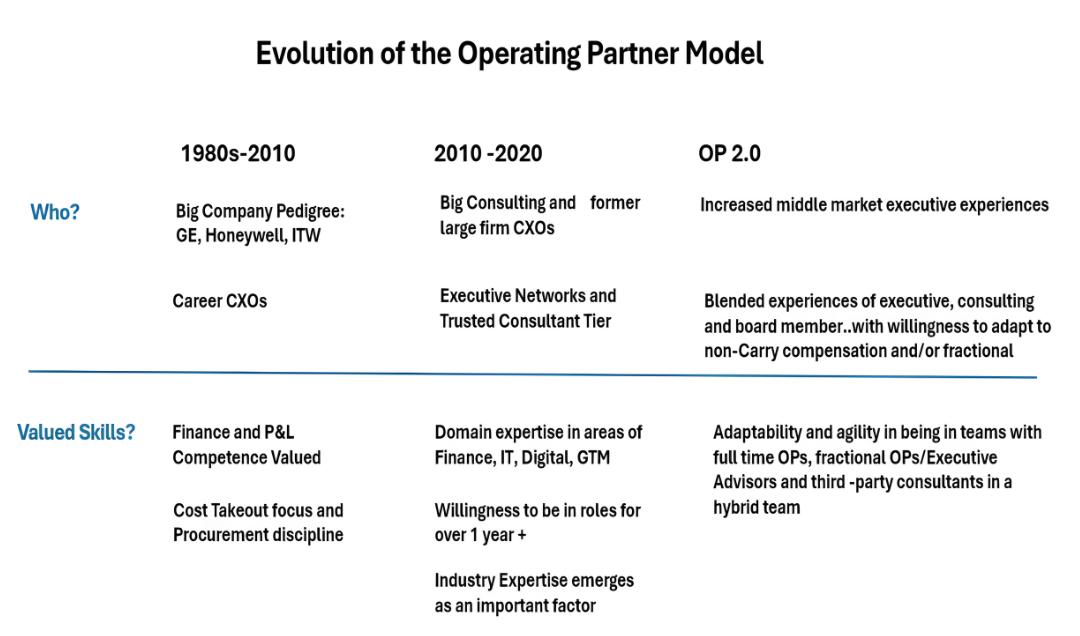
middle market well, it started to show cracks by 2020 driven by a number of factors including:
• Great for execution and leadership resources but not scaleable across many portfolio companies with potentially similar problems.
• Great for performance and reporting rigor but not a resource to document tools, templates, playbooks, case studies, and development of CXO forums across the portfolio companies.
• Operating Advisors in their 60s provide broad experience but began phasing themselves out or became more selective on the assignments they would take.
• As fundraising became more competitive, the need for full-time Operating Partners and/or a demonstrated documented model of Value Creation became a much-needed asset.
• For PE funds raising families of funds, they needed a scaleable model. For example, a Growth Equity Firm that mostly did minority investing and with less than 15 platforms can collaborate with the Operating Advisor Model. If
you then raise a larger Growth Fund, a majority Buyout fund and sector fund, the model cannot deliver demonstrated value creation any longer as they were not designed for scale and investment type and company maturity impact the needs and length of engagement.
What are the parts of the new Operating model template to drive an Operating Model at portfolio companies? And how does it give PE firm’s agility and cost effectiveness?
Hybrid – Mixed Models and Teams requires work to develop, recruit and manage but it is a way to have a limited but potent internal team, fractional CXO/fractional Operating Partners that are on retainer, so they are aligned and available and final augmentation with best in breed consultants and professional services firms. The model of compensation becomes more varied and tailored to the needs and modeling of the contribution the resources are making. It also can be tailored to the portfolio firms hence opening up investment
opportunities.
Definition
Lower middle market PE and independent Sponsor deals tend to lean into a Generalist Operating Partner model. These individuals can provide leadership and experience across domain areas of Finance, Go-to-Market, Tech Stack Transformation and CXO assessment and change. There are some sourcing hacks that investors ( both in committed funds and independent sponsors) can leverage to build out an operating model for a portfolio company. Generalists become an anchor that serve multiple areas and potentially across multiple portfolio companies. They also not only drive value at the portfolio companies but also strengthen the Operating Partner model. Is it another generalist for scale but from a different industry or is it a more junior resource for scaling or is it a Specialist Operating Partner?
Transformation is a prolonged process and evolves with the market as a company is trying to strengthen a position in. The changes begin in finance and quickly pivot into needing more technology and that drives KPIs of the cost optimized operating model and commercial changes to drive go-to-market excellence. An experienced generalist approach with the ability to drive change and communication is valuable. Specialist Operating Partners and SMEs ( internal or external) can always be added into situations when appropriate, so the PE firm retains scale and leverage, and the portfolio company is not overwhelmed with multiple resources with reporting requests in the company simultaneously.
An area that is gaining interest or at least a conversation is the topic of how a PE firm transitions older Operating Partners and building a potential longer term CXO tier is the “Chief of Staff” model. All areas of PE firms are currently working on the area of succession in the GP and IC tiers but also in Operating. Many current day Operating Partners came from larger conglomerates that trained people for significant P&L roles and built rigor and repetition into the training years. This does not exist today. Many earlier career potential Operating Partners have education and big Consulting pedigree for example but not operating repetition and experience. Consequently, the industry Is responding by in effect creating their own training ground through this model. It identifies earlier career resources with potential to mentor and learn with CXOs or evolve through the training to aspire to be a CXO in lieu of a PE Operating Partner. Either way the PE has an investment and a potential longer-term win. The Chief of Staff that a firm trained up and ready is aligned to portfolio companies for long-term roles in driving initiatives with the CXO. It becomes great training. A resource for a CXO builds trust and potentially strong outcomes and repetition in day-to-day operating situations. CEOs in middle market companies need all the help they can get.
The opportunity here is to address the right support and reporting cadence to ensure that early warnings or debriefs on outsized successes in initiatives are fully understood. The Operating Partner will play a role of interpreter of PE sponsor intentions to the CXOs of the portfolio company and function as a
CXO whisperer focused on helping them action the most impactful initiatives. CXOs own the agenda as it is not about the Operating Partner. They are they to drive scale with transparency and ease of reporting. That reporting can take the form in weekly/monthly check in preparation, driving improvement and speed to develop month end reporting packages or improving quarterly board decks.
The sooner it begins at diligence the better for insights down the way. A periodic review of the diligence documents, thesis and growth model and measuring to expectations should be a habit. It can give a reset when needed, it can allow the thesis to be reassessed internally and provide fresh perspectives on potential pivots. Value Creation resides with the Investment Committee and the CXOs of the portfolio company. Having early and on-going assessment of these diligence documents and the subsequent reports being used to assess and measure progress makes good sense.
AI – But is it to deploy it and find a significant use case or something else 2025 has been a year where AI stress has come to Private Equity. Mostly the form it has taken is; are we missing out and we are not identifying the right use case to drive impact. They are living in how to create urgency and a new initiative at portfolio companies while keeping their leadership focused. Successful adopters in PE are working with their strongest portfolio companies to use low code-no code tools to address tactical execution in areas of commercial transformation and operational
effectiveness. The ability to drive impact through AI will have a number of factors to be considered to achieve successful outcomes.
• The portfolio company needs to have strong structured data with data governance in place to have the ability to use it for value creation maneuvers in all domain areas from finance to human capital to growth.
• The portfolio company needs to have tools and templates from the PE firm that should be building a center of excellence or domain area that needs consistent monitoring and aggregating the case studies for wider portfolio company use cases, adoption, and skill development.
• Having core business process documented is a suitable place to start so that there is a road map to assess where to improve.
A concurrent area to execution of use cases is the assessment of where AI is impacting the fund’s investment. A new criteria for investments and investment thesis is to define industries and areas to invest in where AI will have limited to no impact on the market. This begins to drive AI from the Tech area into the market enabling and strategy areas as AI drives speed and scale, which is the desired outcome of most Operating Partner models.
Top line growth is an area where PE is working hardest to drive internal skill and operating resources, tools, and approaches to share. Most issues where an investment is not performing are a growth-related initiative that failed, was not identified and continues to be problematic. It is both an operating area issue that simultaneously
exposes a people or executive issue. The situation was not called out as early as problematic or needing an original approach or alignment with the PE sponsor. One situation usually prompts changes in both. The Commercial ( more organic growth) or M&A growth ( add-ons) has multiplied effects if the core operating model is both cost optimized and the processes around go to market motions are successful and now craving and needing resources for scale.
Growth prompts resources for M&A and resources and time to assess go-to-market to ensure that the enterprise is deriving growth and value creation. These 2 areas working in tandem drives top line with a cost adjusted model to provide a basis for exit where the market will drive the multiple at exit, but EBITDA expansion and growth is driven by the PE firm and enterprise.
Operating Resource models are an imperative to the middle market. Companies with less than mature management teams and strategic processes will

continue to dominate deal flow. Today finding the best deal to get done in a market with growth prospects and defensible profitable revenue can be the focus. The Operating Resource model and individuals to be deployed will help GPs address the monitoring and value creation challenges and by having hybrid, scaleable models is critical. Deal types and situations will always provide diverse challenges and how to address with speed will differentiate the investors as operating agility on an ongoing basis and situation driven will determine the more successful participants in the space.
John Bova is a Transformation, Commercial Excellence and RevOps Leader in Private Equity Firms and Portfolio Companies. John has played many roles in the private capital space over 30 years Including senior executive to fast growing middle market companies, Independent Sponsor, PE and Family Office Advisor and Consulting Practice Leader driving value creation through technology and transformation. https://www.linkedin.com/in/johnabova/