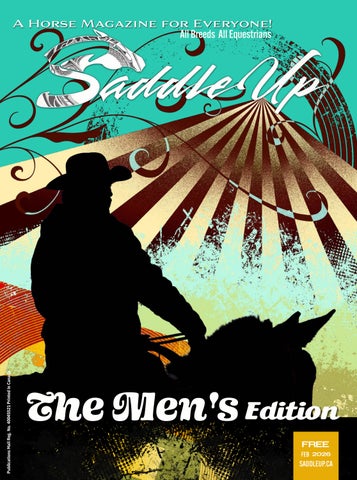
Feb 2026 Saddle Up Magazine

Page 1


SPANMASTER has been supplying and installing steel and fabric structures since 1998, with over 2400 projects in our portfolio.

Custom-designed accessory, commodity, livestock, or equipment storage buildings, laid out to suit your needs and engineered to exceed site-specific snow loads while meeting BC Building Permit requirements, where applicable.

We will consult during the design process to bring your dreams to life, and then fully install with one of our in-house crews and equipment.

Our in-house crews and equipment work year-round to make your dreams come true – big or small.

est. 2000 Available Digitally

Executive Editor & Publisher

Tass Speer

Co-Editor & Design

Ruby Gerhart

Graphic Production & Design

Lonnie Rangler

Writer & Marketing Strategist

Amber Zierath

MAIN OFFICE

TOLL FREE 1-866-546-9922

ads@saddleup.ca

hello@saddleup.ca

SADDLEUP.CA

MAILING ADDRESS

Saddle Up magazine

PO Box 371

Armstrong, BC, Canada V0E 1B0

Published and Printed In Canada

Publications Mail Reg. No. 40045521

GST Reg. No. 751444159RT0001

ISSN No. 1701-6002

© All Rights Reserved

SUBSCRIPTIONS

$28.00 CDN plus tax per year or $42 US per year. (11 issues)

Reproduction of any materials without written permission from the editor is prohibited. Opinions and statements expressed in this publication are not necessarily those of the editor.

FROM THE EDITORS NOTE

Welcome to our first annual Men’s Edition, celebrating men and their horses—athletes, trailblazers, and dedicated horsemen who shape both the industry and their communities. This special issue shines a spotlight on horsemanship at its best, honoring the passion, leadership, and commitment that continue to strengthen the sport and its culture for generations to come.

All of our Men’s Features, Laureen James, Danika McGuiness, Barn Canada, HCBC, BCHBC

Founder Nancy Roman 18 06 16

We’re proud to share the stories of trainers, athletes, an artisan, a farrier, a rancher, a blacksmith, a volunteer, and a devoted dad—each making a meaningful impact within their discipline and beyond. A heartfelt thank-you to the men who were nominated, and to the wives, friends, and supporters who took the time to submit nominations. Special thanks as well to the clubs who participated—everyone played a role in bringing this inaugural Men’s Edition to life.

We’re already looking ahead to next year’s Men’s Edition. Watch for our May issue, where we’ll celebrate our horse ladies. Until then, happy reading and happy riding.

Tass & Ruby

Better traction,

Get more from your Scootboots this season with Scootboot Traction Studs. From ice, to mud, to grass. What was excellent just became exceptional.

Trust is Everything

When they run to greet you at the gate every morning or ready themselves for you to saddle up and give a world champion performance, their trust in you is everything.

Give them the best so they can give you the best with champion level care.

The Men's

This special men’s edition is a celebration of men and their horses. From athletes to trailblazers within the industry and community, and horsemen alike. Through their stories, we honour those who continue to build and strengthen horsemanship and its culture, as well as the sport and its community, for generations to come.

I’m a third-generation rancher, so horses have always just been a part of my life. We have always had horses and used them for all aspects of ranch work, but in the last 10 years (since my retirement from bull riding) we’ve started to train and trade horses for the majority of our income. Horses now consume my life as bull riding did; the hunger and thirst for knowledge are hard for most people to understand. I’ve been very fortunate to be able to surround myself with some of the best horsemen and women in the industry. Bull riding took 20 years of my life, and now I’m trying to catch up!

horsemanship and riding?

There really isn’t one person I can say has influenced me more than any others. I’d say when I started picking up broncs, that lit a fire to start trying to get the best set of horses I could.

Tyler Thompson is a working cowboy and rancher from Diamond Alley, Alberta, and a former two-time CFR Bull Riding Champion. After stepping away from competitive bull riding, Tyler became a respected rodeo pickup man, selected to work the CFR for the past five years, known for his quick reflexes, horsemanship, and reliability in the arena. Off the rodeo grounds, he is a dedicated husband and father, deeply committed to his family, his ranch, and the traditions of Western ranch life.

What’s next for you in the sport or in life?

What does good horsemanship mean to you?

Good horsemanship to me is getting the most out of a horse that you can. My wife, Sheena, has been a big help to me on this because sometimes I lose sight of the fact that some horses are built and wired to do something great that another is not. So to be able to build on every horse’s strengths, make them want to do it, and get them the best THEY can possibly be is good

This year I am excited to add a stud horse to the lineup, VF BUZZ RUG, who I will be riding at many of the Canadian Pro Rodeos. This stud will be a large part of our horse program and will add a lot of value to a brand we have worked hard to create. I’d love to work some bigger rodeos in the states, but I haven’t really pursued it, and I’m not sure if I will; our family is growing up really fast, and I don’t want to miss it. To work the Canadian Finals is always the goal, and it's always an honour to get voted into.

Looking ahead, what legacy do you hope to leave—both for the horses you work with and for the next generation of riders?

That I gave everything 120% and refused to be outworked. There may be people who have more talent than you, but there is no excuse for anyone to work harder. We are not all given the same natural talent or opportunities, but we are all given the same 24 hours in a day, and what you choose to do with those 24 hours will dictate your level of success. When I first started training horses, it was an addiction; there is so much knowledge and talent out there, and I wanted it all. I still do. There is a quote that reads, “Try to never be the smartest person in the room, and if you find you are, find a new room.” I think this is the reason my horses and my training have evolved the way they have. I hope that the next generation remembers that and keeps that drive to get better each and every day and to know that there is always something to learn, no matter where you are in your own program.

At just 22, Canadian eventer Kyle C. Morton is focused on reaching the Olympic podium. He competes internationally up to CCI4* Eventing and 1.40 m show jumping and was recently named to Canada’s U25 Eventing Development Squad, highlighting him as one of the country’s rising talents with hopes of representing Canada on the Olympic Eventing team one day.

How did you get started with horses?

I got started with horses when I was driven to a stable one day by my mother after having tried every other sport imaginable and hated them all. So, my mother drove me to a stable in a last-ditch effort to get me to like a single sport, thinking I would not enjoy horses, but I fell in love. I was leasing my first pony within six months and had one of my own within a year.

Who or what has had the greatest influence on your approach to horsemanship and riding?

I have had the gift of working with some of the best eventing riders in the world, seeing how their stables work, and seeing the mindset they have. The two greatest influences on my outlook towards horsemanship, though, are my first eventing coach, who taught me to respect and love each horse individually. She taught me that each horse has its own way of going, and that is something that needs to be discovered and then encouraged. The second is my fiancé. We met about 4 years ago, and both she and I run a yard together. She also cares deeply about each horse, taking the time to form a bond so that the horses know that they are safe and can be free to explore what works best for them.

What does good horsemanship mean to you?

Kyle C. Morton

Good horsemanship, to me, is the act of treating each horse as an individual with its own will, personality, and talents. As riders, we need to not try to put every horse into a mould and change who they are, but rather adapt what we do to get the best out of the horse.

What’s the most unexpected thing that’s happened to you with a horse?

The most unexpected thing to happen to me with a horse is ending up in Germany, where I now live and compete. I never thought I would be living in Hamburg, riding next to legends of the sport every weekend, but here I am, representing Canada to the best of my abilities on the international stage.

What’s next for you in the sport or in life?

The next big thing for me in the sport is the U25 Eventing World Championships in Millstreet in July of this year. The bigger goal after that is the 2028 Olympics in LA, where I hope to ride for Canada.

Looking ahead, what legacy do you hope to leave—both for the horses you work with and for the next generation of riders?

In terms of a legacy I wish to leave the horses I work with, I hope for them the best life they can find if it is that we are parting ways, or for them to grow old and remain healthy until they retire in one of my fields. For the next generation, I aim to encourage kindness. I think it is an undervalued quality in this amazing sport we all do; the horses we ride try so hard for us, and kindness is what I believe they deserve. I also believe that it brings the best out in a horse, so I hope to show the world that you can achieve all your dreams and more through that mindset. kcmeventing.com

Thomas Linford

Thomas’s impact on the horse industry extends far beyond the show ring. A husband, father, farrier, colt starter, and equine transporter, he brings experience, humour, and a no-nonsense approach to everything he does. Alongside his wife, Grand Prix rider Lindsay Linford, he calls Eclipse Equestrian Home Farm in Okotoks home, where he is known for his long hours, generosity, and constant support of the equestrian community.

How did you get started with horses?

I grew up on a farm in Fort St. John. At a young age, I rode for a gentleman who introduced me to driving teams, branding, and cattle drives. As a teenager I went on to start colts for another gentleman before starting a series of jobs working at large ranching outfits, including Douglas Lake, the Gang, Nicola, and Coldstream, as well as driving trucks for logging companies, tankers, and horse transport. During that time, I also went to shoeing school in Oklahoma with my brother Clint Linford. Eventually I moved away from ranch life and trucking to work as a farrier full-time.

What's one exercise or skill owners can practice with their horses to help make your job easier as a farrier?

Speaking for all farriers, we love clients that take the time to train their horses to stand patiently and pick up their feet so we can get to work. Contrary to popular belief, training the horse to stand isn't part of the farrier's responsibility. If extra training is needed, it’s always appreciated when it's communicated in advance so time and costs are allocated accordingly.

What does your ideal day off look like?

It doesn’t happen as often as it should, but my wife and I recently got a rooftop tent so we can spend more time camping, and in the winter we try to hit the slopes whenever possible. But let’s be honest, we have a farm. Most days off are spent doing the “honey-do-list” and spending time with the kids.

What's one farrier tool you can't live without?

My GE nippers

Reece Howden

What’s the most unexpected thing that’s happened to you with a horse?

Reece Howden is a Canadian ski cross athlete from Cultus Lake, British Columbia, and one of the sport’s most accomplished competitors. Renowned for his explosive starts and consistency under pressure, he is the winningest male ski cross racer of all time and a Crystal Globe overall World Cup champion. During the current season, Howden earned his 19th career FIS World Cup victory in Arosa, Switzerland, surpassing Jean-Frédéric Chapuis, then won three consecutive races in December. A proud member of Canada’s national team, he continues to dominate the World Cup circuit.

How did you get started with horses?

Just falling head over heels for the lifestyle and everything to do with it. Everything that has ever happened to me in the horse industry has been my doing. I had no access to it through family or friends, but I kept trying and trying, and eventually things started to fall into place. It’s everything

Looking ahead, what legacy do you hope to leave—both for the horses you work with and for the next generation of riders?

I first got started with horses at a ranch near to where I lived. I was surveying new cattle guards on a grazing lease after the Adams Lk forest fire and met some of the cowboys working at the ranch. I said I had a little bit of experience riding horses, and I was looking to get to learn more and willing to work for free, so they took me on, and we went and started some new Mustang colts that were on the ranch, and I just kept riding all summer, and I just tried to collect as much knowledge as I could and loved every bit of it.

Who or what has had the greatest influence on your approach to horsemanship and riding?

Definitely Allan Dussault; he was the first person to help me start colts and introduced me to riding in the mountains. But I like to be a student, so I try to absorb knowledge from lots of places. Whether it is someone I meet in person or a video I see online, there is always a reason people do things a certain way.

What does good horsemanship mean to you?

To me, good horsemanship means always being a student and being open to learning new things. Also, be willing to put in the time necessary and be honest with yourself when you are rushing things and the results are not what you hoped. Good relationships are a 2-way street; it works the same for working with horses—you have to give before you can take.

What’s next for you in the sport or in life?

Well, I recently made a move to Alberta, partly for better training for skiing and partly for better access to opportunities in the horse and ranching community. At the moment I am still heavily invested in skiing in the winter, but in the summer my goal is to try and learn as much as I can and get as much exposure as I can so that when I am ready to retire from skiing, I will have the knowledge and community to pursue whatever I want to pursue in the horse and ranching community.

IG: reece_howden

When people look at my legacy, I want them to have two trains of thought. One being “Why on earth did he do that? It makes no sense,” the other being “How on earth did he do that? One day I want to do that.” I hope for the sake of those kids, who maybe didn’t grow up around horses but always looked up to cowboys or cowgirls growing up; that got that same feeling that I got when I went to my first rodeo, and that they follow that feeling to wherever it leads. Because for some people the feeling you get in the saddle, covering country on a loose rein, is something you don’t want to miss out on.

Jason Irwin

What’s next for you in the sport or in life?

We plan to continue to build our horse business and our clinic business. We’re always looking for new and better ways to reach more people. We are currently in the process of creating an online subscription training service to help people with their horses.

Jason Irwin is a Canadian horse trainer and clinician from Ontario, specializing in colt-starting, foundation horsemanship, and problem-solving with young horses. He and his wife, Bronwyn, run Jason & Bronwyn Irwin Horsemanship, offering clinics and demonstrations across North America. Known for his practical, horse-first approach, Jason shares his methods through hands-on training, television appearances on The Horse Trainers, and will be this year's Wild Card competitor in the 2026 Road To The Horse event.

How did you get started with horses?

I have been around horses since I was a little kid and started my first colt when I was 12 years old. I have always been drawn to horses and wanted to learn about them from a very early age.

Who or what has had the greatest influence on your approach to horsemanship and riding?

My family raised some horses when I was growing up but then switched to full-time in the horse business when I graduated from college. We would buy a lot of horses to add training to and then sell them along with the horses that we were raising. I also trained horses for other people (at the time mostly starting colts and fixing problems). I had to learn to get along with every horse standing in front of me, and I had to train them in a way that they would work for other people and not just me. This has had the biggest influence on my training program.

What does good horsemanship mean to you?

I think good horsemanship is understanding how a horse thinks and responds to things and then using that knowledge to present information to him in a way that he can easily understand.

What’s the most unexpected thing that’s happened to you with a horse?

I sold a horse over the phone to a girl one day. She later came to the farm to see about another horse, where I met her in person for the first time. We ended up going out and later getting married. Bronwyn and I now run Jason & Bronwyn Irwin Horsemanship together.

Looking ahead, what legacy do you hope to leave—both for the horses you work with and for the next generation of riders?

I would like to help people understand their horses better. By doing that I believe I am helping both people and their horses at the same time. That helps people and their horses get along better and stay safer and makes a more enjoyable life for both.

Lane Thiessen is a skilled rawhide braider from Gem, Alberta, specializing in handcrafted hackamores, reins, and other traditional horse gear. He began braiding in 2016 while staying in a desert bunkhouse near Maple Creek, Saskatchewan, and credits master braider Bill Black as a key influence on his work. Known for combining functionality with artistry, Thiessen creates pieces that serve both working cowboys and riders in the cow-horse world, keeping the tradition and craftsmanship of rawhide braiding alive.

How did you get started with horses?

I got started with horses at an early age, maybe six or seven years old. Cowboying with my dad (Bryn Thiessen) and my brother, I was no stranger to a rough string of horses. Dad liked crossing those wildy horses back into the quarter horses, and it sure made for a lively branding pen in the spring.

How did you get started working with rawhide and braiding?

I got started braiding rawhide when I moved to Saskatchewan to cowboy for Chad Beck at Bitter Lake. Chad got me started braiding rawhide when I had mentioned to him that I needed a half-inch bosal; I started out of pure necessity. I posted a picture of my first bosal on Facebook, and master rawhide braider Bill Black messaged me and said it “looks pretty good,” which was encouraging. That was just shy of 10 years ago this winter, and Bill has been my mentor and a close friend since. I’ve always admired Bill’s work because one of his principles is function before beauty, and function is paramount in quality gear. To me, a quality hackamore has a rawhide core, which can’t be mimicked by any other synthetic material on earth. If you expect something to have life in it, it ought to have lived some kind of life.

What’s the most unexpected thing that’s happened to you with a horse?

This was a question that I've been asked before. While I’ve had plenty of wrecks, the most unexpected one was when I was starting some colts with my good friend Brady Neufeld. We had a good string of horses that we wanted to use to start roping, but we didn’t have any roping steers available. The only thing that was available to us was Brady’s llama, and we figured, if you can rope a llama, you should be able to rope a cow. I lined out after this llama, but my little mare wasn’t too sure of it, slipped in the dirt, fell down, and broke my leg. I drove myself to the hospital, and when staff asked the cause of the incident, “roping a llama” made the entire emergency room go quiet.

Looking ahead, what are your goals, and what legacy do you hope to leave?

Lane Thiessen

My goal with my braiding is to create quality gear that helps the horse and rider communicate clearer and quicker, whether that be in the show pen or out doctoring calves in the desert. My biggest goal (through my braiding) is that God would be glorified through making the most out of his gifts and blessings of love for horses and his creation. FB: LTBraiding

Kevin is a familiar face at the Kelowna Riding Club and throughout the Okanagan equestrian community. A long-serving member of the KRC Board of Directors, he brings a strong work ethic and a focus on facility improvements, including stabling, footing, and irrigation. Outside the club, Kevin is co-owner of Day’s Century Growers, a fourth-generation farm. Alongside his wife, Tracy Avery, he has played a key role in KRC’s continued success.

How long have you been involved in the horse community, and when did you first become involved with the riding club?

I rode western hunting in the high country as a teenager and young man, but I became much more involved in the horse community and the riding club 16 years ago when Tracy and I got together. I have also supplied alfalfa/grass hay to the equine community for 50 years. 50-60 years ago, I used to go watch my friends, the Munson kids, ride in shows at the KRC.

What’s your favourite memory at the KRC with your family?

Watching Tracy and Lil win ribbons riding Dagles and Sassy. Loved that.

What tool or piece of equipment would you recommend to other riding clubs that has made your life easier?

Kevin Day

The Parma arena groomer that the club recently purchased works well. Saves time grooming due to extra width and enables adding footing amendments such as fine shavings to be incorporated easily. Being able to do this acts as an affordable means to soften the top 1.5 inches of the footing, and moisture retention is improved.

What projects are you planning to help with this year at the KRC?

Footing improvements, procurement of bedding for events, construction of a permanent manure storage bin, and manure removal.

What advice would you give to someone considering volunteering?

Advice I would say to someone considering volunteering, "Do it, but do it in a sustainable way." It is very hard if you take on too much at once and is very common with the lack of volunteers that is common under these circumstances. Great satisfaction is possible if you don’t burn out.

What’s the most unexpected thing that’s happened to you with a horse?

I have been riding since I was very young but stepped away from it and was given the opportunity to re-engage in the community and culture about 4 years ago when I started working with the YMCA’s Camp Chief Hector. This is when I truly started to pursue riding and growing my skills as a horseman in a few sectors, including training and farrier work. This transition is what led me to work alongside many different horsemen and women and ultimately led me to work with Rosie Latimer, someone I consider a mentor.

Looking ahead, what legacy do you hope to leave—both for the horses you work with and for the next generation of riders?

I don’t really know what impact I want to leave just yet, but that being said, I’d like to leave a positive one. I aim to pass on my passion for the industry and horsemanship as a whole to all the children I work with, as they are the next generation.

Who or what has had the greatest influence on your approach to horsemanship and riding?

I was lucky enough to have someone, Rosie as previously mentioned, who I would consider a mentor not only in my horsemanship journey but also in my life, and she has really shaped the way I approach horsemanship. She has taught me a lot and helped me build my confidence, knowledge base, and contacts.

IG: Nolan.Kisinger

Adam Blackmon Nolan Kisinger

Nolan Kisinger is originally from Innisfail, Alberta, and now resides in Kananaskis, where he serves as lead wrangler at the YMCA’s Camp Chief Hector. In this role, Nolan trains horses and teaches riders of all ages about horsemanship, safety, and riding skills. Outside of the camp, he is pursuing a farrier apprenticeship and developing his colt-starting skills. Always seeking new challenges, Nolan also enjoys working with mules and expanding his hands-on experience with a variety of equine projects.

How did you get started with horses?

The most unexpected thing to ever happen to me while working with horses is the feeling I get when I finally feel/see the horses I work with get it. The excitement and how good it feels get me every time! I have some horror stories and some accidents, of course, so those situations can be unexpected, but I’m sure everyone does in this industry; however, the thing that draws me to the sport is watching horses have it click after all the work, dedication, and steps leading them there. Finally seeing it click for them and then watching them grow into something useful and confident is always so rewarding, and I never expected it to feel so great.

What does good horsemanship mean to you?

Good horsemanship to me, and something that has stuck with me from my mentor, is to always ride to the horse you're on. In my eyes, this means to ride any horse in a way that leaves them a little bit better each time you get off, whether that be a little bit softer, kinder, and/or more willing. I get to work with a wide range of horses from seniors to colts, and I would not ride a 20-year-old the same as a 12-year-old nor a 12-year-old the same as a 3-year-old. The most important thing to be a good horseman in my eyes is to match your expectations to the abilities of the horse you're on.

What’s next for you in the sport or in life?

What’s next for me is mainly continuing to grow my knowledge on horses as well as mules. I hope to continue to expand my skillset and work with more horses and mules, as well as other professionals in our industry. I am also looking to potentially do more working cowboy work and work through my farrier apprenticeship. Mainly I am wanting to get more time in the saddle and learn as much as I can from others. In the more immediate future, what you can expect to see from me is guiding and teaching others how to pack into the backcountry on horseback for multi-day trips.

IG: blackmon_performance_horses

Adam Blackmon is a Canadian horse trainer and NRCHA-accredited judge based in Merritt, British Columbia, known for his work with performance and cow horses. He is listed in the trainer directory of the National Reined Cow Horse Association, reflecting his role helping riders and horses develop solid fundamentals and horsemanship. He also serves as an accredited judge with the NRCHA, demonstrating his commitment to the sport and its standards.

How did you get started with horses?

As a kid, I grew up watching the Lone Ranger and Roy Rogers. I always wanted to be a cowboy. My first riding experience was at Timberline Christian Camp, where I rode a horse named Mustang. As we passed some horses in a field, Mustang reared straight up in excitement. Horrified, my counsellor turned around and, much to his surprise, found me smiling from ear to ear, hoping he would do it again. From that moment on I was hooked!

Who or what has had the greatest influence on your approach to horsemanship & riding?

John Lyons, Todd Bergen, and Cayley Wilson, all in very different ways, helped shape me into the horseman that I am today.

What does good horsemanship mean to you?

It may sound cliche, but I truly believe that the horse really does come first. Each horse is an individual. One program doesn’t fit all. A good horseman tailors the program to the horse, not the other way around.

What’s the most unexpected thing that’s happened to you with a horse?

What’s next for you in the sport or in life?

of wicked bridle horses that I’m building with plans to take one to the World's Greatest Horseman in 2027. I also have some really cool cutting prospects that I’m eager to get into the show pen this year.

Winning the L1 Open Cowhorse Futurity in Idaho on a little horse named Vons Golden Reys in 2018. It was the last futurity of the year, and she wasn’t ready, nor was I. Her performance in the show pen took me completely by surprise. She showed me how a true show horse performs even better in the show pen than the practice pen.

What message do you have for the next generation of riders?

Alexander Grayton is a Canadian international show jumping rider, trainer, and clinician based near Calgary, Alberta. Founder and president of Grayton Farms, he is known for developing both young horses and riders with a thoughtful, systematic approach to horsemanship. Grayton has competed at the Grand Prix level, produced champions in young horse and national finals competitions, and worked with top programs including Spruce Meadows and Team Millar. Beyond competing, he shares his expertise through coaching and clinics across Canada, helping riders refine their skills.

How did you get started with horses?

I don’t come from an equine family, so my story may be different than a lot of professionals. My sister and I started riding at a local stable once a week as one of many hobbies and activities. Over the next 10 years or so, horses began to take up a larger part of our lives—we started to show locally and leased very good teaching horses. While I was finishing up my engineering degree, we bought our first horse, switched trainers, and things started to really ramp up for me. I had been playing tennis at a very high level, with daily training and gym commitments in addition to my studies and show jumping training. I had to make a choice, and it was horses all the way from there as soon as I graduated!

Who or what has had the greatest influence on your approach to horsemanship and riding?

Alexander Grayton

I am very fortunate to have had several incredible teachers at various points in my life. I wouldn’t know and feel what I do today, so I owe them all a great debt. Christine Waldroff gave me so many opportunities and helped foster my love of the horse. Frank Selinger opened my eyes to the real sport, growing my skills exponentially. Kyle King taught me how to have feel, how to prepare and peak for competitions, and how to make things happen in the ring. Ian Millar refined my understanding of preparation and training, increasing technical skills and strategic thinking. Emile Hendrix and his family have been integral parts of my appreciation for the commercial aspect of the business, and how to operate with integrity and passion. George Morris is without a doubt the most impactful person in my equestrian life. His encouragement to keep learning, reading, and seeking to build on the classical history of horsemanship, his advocacy for thoughtful training that kept the horse at the centre of it, his way of encouraging excellence and expecting you to live up to it really resonated with me.

What does good horsemanship mean to you?

Good horsemanship centres around understanding the horse and being able to see things through their point of view. It’s a common sense thing to say, but it’s exceptionally hard to do with a human brain. To be able to have empathy for what the horse is experiencing, what they may be thinking or feeling about it, trying to find a way to make sense to them, and rewarding a job well done, all while maintaining an acute awareness of the size imbalance and boundaries.

What’s next for you in the sport or in life?

I still have a few sports goals that I would love to achieve in my competitive life. My dream is to ride in a major championship for Canada. Sourcing and developing horses for the sport have become cornerstones of what my wife and I do, and I feel like it will always be part of our business—maybe I can develop one to be a champion one day! I don’t think there’s a way that horses won’t be in my life, but as has been the case since the start, it might always look a little different!

Looking ahead, what legacy do you hope to leave—both for the horses you work with and for the next generation of riders?

I hope I make sense to my horses. I hope I make their lives easier as a result. I hope I build a spark and love for the sport in them. I hope they learn to trust me—and vice versa—so that they never feel like I’m taking anything from them but that we’re doing this together. I sincerely hope my horses are happy. If I could put that all together into a more succinct phrase, I hope my legacy is that I have always tried to think “horse first.” I have always tried to deepen my understanding so that I can simplify the process without contradiction, and I hope that my students can find that same. alexandergrayton.com

T.J. Walkem is a cattle rancher from Spences Bridge, British Columbia, helping manage the family’s 60 Ranch, a grass-fed beef operation grounded in a strong connection to the land. With training in natural resources and sustainable ranching practices, T.J. combines hands-on ranch experience with careful stewardship of pastures and wildlife. He has faced the challenges of wildfire seasons firsthand, including protecting livestock and managing burned rangelands, and has worked with programs that support ranch resilience, range conservation, and the health of British Columbia’s grasslands.

How did you get started with horses?

I was born into it. I’m a 5th-generation rancher. My great-grandfather, along with his father, raised, trained, and sold horses before cattle became prominent in this area. Coming from the Nlaka’pamux Nation, horses were a way of life. After the war, horse prices plummeted, and cattle were introduced as a new means of income for our family.

What does good horsemanship mean to you?

We select superior genetics to build the best-suited animal for our vastly diverse terrain. Good ranching to me means exceptional animal husbandry while maintaining traditional Nlaka’pamux values as stewards of the land.

What’s the most unexpected thing that’s happened to you with a horse?

The most unexpected thing that’s happened with a horse has to be raising an orphaned feral horse in our basement last winter.

What’s next for you in the sport or in life?

What’s next? Trying to keep up with the ever-changing environment, such as droughts and fire seasons. Our practice has to evolve as our landscape changes. We hope to work towards self-sustainability, our horse breeding program, and our purebred Simmental herd.

How did you get started with horses?

My family has been the greatest influence by maintaining the value of work ethic and ensuring the success of the next generation. I want to leave something sustainable and successful for my children to continue. My great aunt of the Curnow ranch taught me the value of slowing down and watching the situation. That you can’t change what is done and to accept it and carry on. Having many older family members to learn from It is a great value to know the old ways of doing things and still be able to apply them to current situations while infusing them with new ways to teach the next generation. Ensuring legacy and history are carried on.

Looking ahead, what legacy do you hope to leave—both for the horses you work with and for the next generation of riders?

I am always working with the mindset to develop our operation to be more efficient and sustainable. Maintaining and protecting our resources as First Nations people by setting stewardship goals while executing strong management strategies, we can ensure these resources for generations to come.

Michael McGuinness

I've had 100s of them. On every ranch I've been on, I've had a favourite. Walker, at Fraser River Ranch, loved to rope. He could cover miles and miles, but he loved roping calves at branding time, and if you missed, he would get mad that you did. Spider, down at Scotty Creek, was a good-travelling, big, stout horse, good in the mountains and good to shoe. Cinch, at Alkali, she would go all day and didn't care about anything except being a little cinchy in the morning and going over backwards. But once you got past that, she was the cowiest horse in the world, and you were just along for the ride.

Blacksmithing: What do you most enjoy making, and what sets your work apart?

I'm more of a traditional blacksmith. I make functional ornamental items from barn door hinges to hooks and hangers and candlesticks. I make knives too in the traditional blacksmith way as opposed to the modern 'stock removal method' that you see knife makers doing today. For example, they get a piece of steel, and they grind a knife out of it. A blacksmith gets a piece of steel and shapes a knife out of that piece of steel. In a traditional blacksmith knife, the molecules are more compressed, giving you a stronger product when finished if you followed the tempering process correctly.

What legacy do you hope to leave for the next generation of riders and your kids?

Learn how to ride properly with your back and hips. How to work with your horse, not against it. And not just ride your horse but be with your horse and become a part of your horse.

Jackpinecowboy.com/blog

Ken Wiklund

Outside of working, what’s your favourite way to spend an afternoon?

I enjoy mountain biking and building trails with our local association. You can also find me camping in the summer and enjoying some time on the lake.

Michael McGuinness is a working cowboy and traditional blacksmith, hand-forging bits, spurs, and other equestrian gear. Drawing on years of ranch experience, he combines time-honoured techniques with practical durability, creating tools that are functional, reliable, and rooted in Western tradition. Whether at the forge or on the range, Michael brings skill, craftsmanship, and a deep respect for horses and ranch life to everything he does.

How did you get started working with horses and blacksmithing?

My dad worked at a ranch in Okanagan Falls; when I was 13, he got me a job working there as a ranch hand. After I wrecked enough pieces of equipment, the owner decided to try me on a horse, and I never looked back from there. Blacksmithing: I worked with an old timer. Another example of me breaking machinery: I almost slid off a steep road with a load of hay and a grapple bucket on front. I tipped the bucket forward as we were sliding and dug the bucket into the ground to try to stop, breaking off two grapples. Ol' Chris showed me how to heat up and bend steel to make new ones. That showed me that there was a lot you could do with steel.

Can you recall one of your favourite horses you cowboyed on over the years and why?

As far as cowboying, it would have been Maury and Lloyd Thomas out of Okanagan Falls. Growing up in Okanagan Falls, of course I knew Kenny McLean, who taught all us kids how to rope. The other one would have been Ol' Lawrence Wylie; he taught me one of the most important things I learned about cows. The best thing to do when moving cows is not to panic about anything. Horses—Monte Mooney was probably the biggest one, and if you were to ask him, he probably wouldn't even know he taught me anything. I used to like to get him talking, and I'd just listen to what he said, then go home and try it on my own horses, and it's always worked.

Ken is known for tackling problems in unconventional ways, guided by his unofficial motto: “If it’s worth doing, it’s worth overdoing.” This mindset has shaped his work as an entrepreneur and product developer. Five years ago, he and his wife, along with daughters Karen, Ashton, and Kirsten, bought a honey farm and turned it into a base for designing and testing his latest innovation, the Nordic AutoFeed. Ken thrives on challenges, calling obstacles “my mountain to climb.” Inspired by horse ownership and time spent helping his daughters at the barn, he continues to experiment, build, and push what’s possible—often with a pitchfork in hand.

How did horses come into your life?

My wife grew up on a farm and rode her neighbour’s horses. As adults, my wife’s sister had horses, and we’d bring our young family out to their farm for sleigh rides. It was a highlight, and my daughters began riding lessons when they were elementary school age.

Do you have a favourite horse story from your daughters’ childhood that captures your time together?

After a hack at the local riding club, I challenged my daughters, Erika and Kirsten, to gallop their horses. They were 14 and 11 at the time and had been in lesson programs for years and hadn’t had many opportunities to gallop. The gallop sprint turned into a race, which ended in some crow hops and both girls falling off. Everyone was in good spirits, and it’s a story we still laugh about around the dinner table.

What’s been the biggest adjustment in shifting from being their dad to their business partner?

We’ve worked together in building the farm, and it’s allowed us to figure out how to best divide up tasks and communicate effectively. All of my kids have worked in our previous family business, so we’re practiced at figuring things out together and being committed to a certain quality of work.

When it comes to product design, what’s unique to designing for horses versus the other products you’ve developed?

Horses are inherently hard on things, whether it’s fencing, equipment, or, at times, themselves. We need to consider the horse’s reaction as flight animals and build products that are as safe as they can be while still being durable and weather resistant. We’ve done a lot of testing and continue to make adjustments in response to the way the horse interacts with the product.

Kole Ashbacher is a saddle bronc rider from Arrowwood, Alberta, who has qualified for both the Canadian Finals Rodeo (CFR) and the National Finals Rodeo (NFR). Known for strong performances at major Canadian and U.S. rodeos, he has competed at the CFR multiple times and consistently posts top scores. Beyond competing, Kole is part of the Lazy 2 Rodeo Company, which provides steer riding stock to rodeos across Alberta, helping support and encourage youth involvement in the sport.

How did you get started with horses?

I grew up in a rodeo stock contracting family. From as early in my life as I can remember, I have been handling and caring for bucking horses both at home and at many rodeos throughout the summers. This opened the doors for me to fall in love with the sport of rodeo and the animal athletes that are involved in it.

Who or what has had the greatest influence on your approach to horsemanship and riding?

My father taught me at a very young age how to handle bucking stock. He taught me how to chase a herd of bucking horses across a large pasture and how changing your body position can turn a horse even up to a 1/4 mile away. He taught me how to handle a nervous bucking horse in the bucking chute in order to keep them calm and safe until it's their turn to compete.

What does good horsemanship mean to you?

Kole Ashbacher

To me, good horsemanship in saddle bronc riding is knowing bucking horses enough to handle them properly and safely in the chute as well as knowing how to handle them in the arena to ensure that they perform their best. Some horses need to buck with as little pressure on their nose as possible, whereas some horses buck better with a little more pressure. I have to know how to handle my bronc rein accordingly to suit each bucking horse.

What’s the most unexpected thing that’s happened to you with a horse?

I watched my sister walk out into a herd of bucking horse mares and foals and walk back with a 2-month-old colt that was bred to be a bucking horse, leading him by his mane. This bucking horse colt was super friendly from the get-go and stayed that way his whole life. He would walk up in the middle of the pasture for scratches all the time and went on to become one of the horses that I practice my bronc riding on.

What’s next for you in the sport or in life?

I intend to continue rodeoing in both Canada and the USA for as long as I am able and healthy. I plan to grow my future family in the sport and around horses and the rodeo way of life and possibly raise some of my own bucking horses.

IG: ashbacher18 I want to grow the sport of rodeo in Canada. I hope to help as many young saddle bronc riders improve their craft so that we can continue to show off the amazing animal athletes that we get to work with. If we, in rodeo, continue to work with the next generation of cowboys and rodeo stock, it should allow for rodeo to grow to bigger stages and be a better sport altogether.

The Standard Today

Gold Spring Custom Hats Ltd.

A cowboy hat isn’t just a decorative piece for a cowboy, and it’s not just to look “cool,” punchy, or Instagram-ready. It serves as a practical piece of equipment first and foremost, with weather protection keeping the rain, sun, and wind off your face; hats are designed for year-round and all-weather use.

For decades, working cowboys, rodeo cowboys, Western lifestyle enthusiasts, actors, tourists, and many others have relied on Vern Elliott to make their hats just right for them. Now operating with his son, Clay, as Gold Spring Custom Hats Ltd., their hat shop sits just west of Nanton, Alberta.

When you pull into the yard, horses exhale as they munch on hay; a round corral sits conveniently tucked behind a log barn, and a simple cedar-sided shop with a dog sleeping on the covered porch sits between the barn and the ranch house. You’re greeted with a big, friendly, warm welcome as if you were family. As sweet and rustic as the exterior of the shop may look, inside it houses decades of hard work from a family that has been prominent in the western industry for years. Their history and successes line the interior walls of the building with rodeo trophies, bronzes, trophy saddles, buckles, and pictures of the family. This shop is the place where the industry’s best hats are made; more than a store, it’s a peaceful gathering place where their customers are always their priority.

How It Began

Vern and his wife, Mona, opened Daines Western Wear in the Vernon mall in 1976. The Kelowna location opened in 1981, and the Salmon Arm location operated for five years in the 1980s. They had a wide variety of clientele: the local market, a lot of support from guys they knew in the rodeo industry, and the tourist market, with Silver Star ski hill being just up the road. Within a couple of years, Vern says, “The store just turned magical.” The retail side of Western fashion and boots really came together, but what encouraged them to start making hats—rather than just supplying and fitting factory hats—was the support of working cowboys from big outfits like the Gang Ranch, Nicola, and Douglas Lake. “They were very supportive while we learned the ropes,” says Vern. In 1981, Mona and Vern decided they needed to find a superior hat — one that was tougher and could stand up to the elements and the hard work cowboys endure. They sourced the finest materials from a company in Tennessee, which they still work with today and which remains the standard for the best-quality 100 percent beaver material on the market. They began travelling and spent time in various top-of-the-line hat shops in the United States. Vern took what he learned from each shop and combined it to create the top-quality hats that he and Clay make today.

The Daines Western Wear franchise went by the wayside in the early 2000s, and in 2003 Vern and Mona went out on their own, moving into a free-standing building just north of Vernon, BC, on Highway 97 overlooking Swan Lake, operating as Cowboys Choice. From there, it became a staple at rodeos, cuttings, and Western events across BC to s e e the “Cowboys Choice Trailer,” a mobile hat shop. Y o u could walk in and have Vern design a hat for you, steam billowing from his steamer as he heated and shaped the hat right before your eyes. It was a unique experience. Vern has an eye for looking at a person’s face and framing a hat to highlight the owner’s features and lifestyle. It’s a true talent he has.

Growing up, Ty and Clay were both heavily involved in rodeo, and both went on to have professional careers. Ty competed professionally as a bull rider in Canada as well as on the PBR circuit. Ty married his high school sweetheart, Hayley, who also had a professional rodeo career in barrel racing.

Both the boys had moved to Alberta, and they then convinced their dad to move east. At first, Vern worked out of his house for a while, with hats and equipment filling every room. After about 6 months, they renovated the old shop to what it is today as the home to Gold Spring Hats Ltd., officially opening in 2014. The name is dear to their hearts. Gold Spring is a site near Buffalo, Alberta, where Mona’s family ranch is located—a special place where Mona’s ashes have now been spread. A unique feature of each custom hat is found inside the liner, where you’ll see the business logo. The family had taken a picture of this site, and then artist Gena LaCoste painted a picture of it. It is the sight of Gold Spring looking south across the Red Deer River.

T he Hat‐Making Process

The perfect fit is their main focus. You will find that the shape of the hat will not change on your head when the hat is fitted correctly, preventing the brim from warping. Getting the right fit has to do with the person’s head shape and hair. Vern and Clay use an Allie Maillard Conformateur. This contraption lines up a series of pins that creates a punched card with a top-down outline of your head; it gives the most accurate head measurement and circumference for the best fit. News Flash, the human head is not symmetrical at all!! A hat doesn’t have to fit tight to be a good fit to stay on; it should be comfortable and sit nicely along the sweatband. They are designed to stay on and be comfortable so that you can wear them all day.

Priority for durability is right up there with fit. The actual making of the hat is what makes a good hat. The Elliotts use a 24-26 individual step process they have designed and perfected over the years. Along with using the best 100 percent beaver and beaver-blended material on the market, this is what sets Gold Spring Hats apart from the rest.

Creating

the finest end result.

This process takes about 8.5-9 hrs depending on colour for each hat, with a drying time in between. Preparation of material is critical for a hat to have the durability Gold Spring requires. Clay does all the preparation of the material. The pressing and the ironing are the most critical steps in the whole process, taking 3-4 hrs. The pressing and ironing are the key parts causing the fibres to knit and felt themselves together, allowing for a stronger hat. They take all the shrinkage out of the material prior to finishing them.

This is followed by the sanding process, taking off the long fibres and developing the completely flat, smooth surface, addressing the bottom side and top side of the brim as well as the crown. After this it is the burning process, installation of the sweatband, and then the shape/ profile. This process for durability gives the hat a long working life.

Looking to the F uture

When Vern talks about his family and his boys, he beams with pride; there is no doubt that the Elliott family has been blessed and remains a close-knit, supportive family. But life has not been without its challenges. Clay had a successful saddle bronc career, as a two-time Canadian champion as well as a three-time NFR qualifier. In early 2019 he sustained a broken neck at a rodeo down in Oklahoma. This changed the trajectory of Clay’s life. He came home to heal up, and in the healing process is when he got more involved in the hat shop, and he has put that same dedication and passion into his hats as he did into his saddle bronc career. As for Rodeo, the injury didn’t sideline him for long, and he has since ignited back into the rodeo circuit as a professional tie-down roper. With a passion for his horses and for making quality tie-down horses. Half his days are spent in the shop, and half his days are spent working his horses. “The rodeo business and the hat shop feed one another; they complement each other well,” says Clay.

Design is secondary. “The trim and what you see with the shape are secondary. We can do anything with a hat once it is completed correctly,” says Clay. With a rounding jack, they cut the brim from the crown out to the specified length the customer requires. They then hand-finish the edge for a nice bevel. This is followed by the final step of shaping it into its style. Gold Spring Hats are not disposable; they are made to last for years to come. They encourage their clients to change the sweatbands every couple of years to prevent perspiration from leaking through to the felt and add life to the hat. They offer resizing, reshaping, refinishing, and repairs primarily for Gold Spring Custom Hats. A unique service is resizing a sentimental favourite to pass on to children or friends, extending the life of the old hat and keeping family legacies alive. While every factory hat has its place regardless of quality or cost, many are not able to be refurbished.

This is a 9 year old hat that had been used hard. After washing just like a garment and refurbishing the middle RH picture shows the results. “The Gold Spring finishing process allows us to renovate our hats with the finest results.”

Above the

hat fit to the customers unique configuration.

Clay is surrounded and supported by great mentors such as Cade Swor, Blair Burk, and Mark Nugent. His learning process has been taking their wisdom and putting it into action. He enjoys starting his horses with the goal of making them be a better horse. “I want to be known for a guy who always has a few good tie-down horses, not just one but several,” says Clay. When he’s not in the shop or riding his horses, he enjoys fly fishing and hunting. Clay built a house 4 miles west of the shop and in September 2025 was married to his gorgeous wife, Kaylin.

Ty and Hayley are even closer now, being 8 miles southeast from Vern’s place. They are highly successful sale reps for Wrangler, Weaver, and Canada West Boots. With their son Carter, 13, showing interest in calf roping. Their winters consist of roping together and staying close as a family. Their daughter Raena, 10, is a good breakaway roper, but her passion lies in goat tying and barrel racing. “Ty and Hayley do everything with their kids,” says Vern. “The only time Raena gets off her horse is when her horse is tired,” he chuckles.

Vern’s passion truly is found in what he does and with his family. He loves the hat shop. “It’s a wonderful, highly successful business right now.” He loves the horses and the cows, and he wouldn’t want to be anywhere else. Vern has always boasted about his clientele for years and how wonderful everyone truly is: “From world champions, ranch cowboys, cutters, and reiners. 90% of our clientele wear their hat day in and day out. Every one of them we have a bit of a connection with.”

“A common question I get asked is, ‘Do you miss B.C.?’” Of course I do! This year marks 50 years since Mona and I moved there. I miss the friends and people we connected with, the ranch community, the Native people, and mostly Barb and Corrie, who were my coworkers for all the years. In saying that, we have gained outstanding relationships with the Nanton, Williams Coulee, and southern Alberta families that we are truly grateful for.”

Article by Danika McGuinness. Danika lives in the mountains of the Cariboo with her husband and two boys. Together they manage a small piece of land, Danika is also a Leather artisan. To learn more info on Danika’s leather works and written works please go to jackpinecowboy.com/blog and for more events check out Blackcreekranchbc.com

Elliot Family L-R: Carter, Vern, Clay, Kaylin, Hayley, Raena, and Ty
Left a photo of Mona hangs on the main wall of the shop.
Formillion enables them to actualize the

At Alberta Boot Company, a stud is defined by his character, not his volume. He shows up, follows through, and values things made the right way. He chooses quality because it lasts and carries himself with quiet confidence because he has nothing to prove. Walking into Alberta Boot Company means aligning with that way of being. Strong, capable, and grounded in tradition

With it’s clean lines and classic shape, the Oro cowboy hat brings a sharp, confident finish to a man’s look.

Built for early starts and long days, the Georg Roth Denim Jacket in Fern is an easy, dependable layer that holds up, looks right, and never overthinks its job.

The Gavin Shirt pairs subtle Western detailing with an effortless fit that carries from day to night

POLIZZI

The Biko UF Leather Jacket in Cognac wears close and softens with time, developing character with every outing.

A bold knit cardigan made for men who carry themselves well in every season. Worn open or zipped up, it adds presence without effort.

ABCO Jace Boots Price $500

Made from rugged Crazy Horse leather, these Alberta Boot Company boots are designed to wear hard and age beautifully. With a square toe and a roper heel, they offer a steady, masculine profile that feels as good as it looks.

Supple deerskin gloves built to work hard and wear in, not out. Made for men who rely on their hands and expect their gear to keep up.

TASHA POLIZZI Gavin Shirt

DISCOVER

9.56 ACRES IN SOUTH EAST KELOWNA, BC A property built for living fully immersed in nature where you can grow your own food, harvest lavender, grapes & honey! A place where family gathers, horses roam & evenings end poolside as the sun sets, all from your private 5,400+ sqft estate overlooking orchards, farmland & the valley below. Extensively updated, the home offers the perfect family floor plan with 4 bedrooms, 5 bathrooms, a home office & full basement spread across 3 levels. Entertain from the kitchen with high-end SS appliances, enjoy tons of natural light & retreat to the main-floor primary bedroom with direct access to the backyard oasis. The outdoor living space features a saltwater pool, water fountains, putting green, stamped concrete patio, built-in speakers & stunning west-facing views. In addition to the triple garage, the property includes a detached 4-car shop with oversized doors attached to a spacious drive-thru barn with horse bays, wash station & radiant in-floor heating throughout. Enjoy a greenhouse, shelter for hay storage, 5 horse paddocks, premium fencing, honey apiary, lavender rows, extensive landscaping, & irrigation water + endless potential for your agricultural or equestrian vision!

From Farrier

To Influencer to a Career in Modelling and TV

Having a love of horses can lead to some very interesting opportunities. If you have a passion for equestrian products and services, you might be able to become an equestrian model, social media influencer, or brand ambassador. According to the Alberta Government (ALIS), the short-term employment forecast for modelling as a career or side hustle is on the rise. (2024-2026 Alberta Short-Term Employment Forecast)

The best thing about equestrian modelling is that you can teach your horse to model alongside you. How cool is that! It doesn’t matter what age you are or if your body type doesn’t scream starved model; this is a gig that will embrace you. Agencies and consumer brands are looking for real, enthusiastic, be-yourself people to represent their equestrian brands.

Since this is Saddle Up’s Men’s Edition, I took a little creative liberty by featuring a male model within the horse industry. Meet Sam Dracott, a UK-based registered farrier whose passion for horses has also taken him in front of the camera, modelling for the equine industry. So here we go—QUIET ON SET!

UK-based registered farrier Sam Dracott shoes horses across a range of disciplines, including polo, dressage, eventing, hunting, and show jumping, and he also specializes in remedial and laminitic shoeing. W hen I spoke with Sam, he was on his way to Barbados to do some farrier work. I spoke with his media manager, Freddie, as Sam sweated in the sun; under a horse, he was putting a set of shoes on. Freddie said it was a blistering 30+ degrees. The following week Sam and Freddie were jetting off to a photo shoot location. Sounds like crazy fun and perhaps a little hectic. Sam has an interesting story to tell us about how his exciting equestrian modelling journey began.

“I started sharing my day-to-day farrier work on TikTok and quickly realized that people really enjoy watching my videos. In a couple of months I had over 1 million followers.” His farrier career and online influence led into a career of modelling, influencing, and TV shows.

I learned about Sam through the CS Equine Models website—an equestrian modelling and talent agency based in the UK. CS Equine

is unique because they specialize in connecting equestrians with a love for modelling and social media with consumer brands specific to equestrians. CS has many male models, but Sam stood out to me because he is also a farrier. I think that his career combination of farrier, model, and social media influencer makes him an exceptionally interesting person.

Sam’s a busy fella, so he had his manager Freddie contact me through WhatsApp while they were in Barbados and Sam was working on a horse’s feet. It was a great opportunity to get a feel for the extent of Sam’s multifaceted career.

Q: How did you become an equestrian model?

My first modelling job was when I was 18 years old for an equestrian brand. It was a great experience and completely different from anything I’d done before. As I shared more of my farrier work online, brands began reaching out because they liked the genuine equestrian side of my life. Since then, I have been lucky to work with a huge range of amazing brands and recently a global non-equestrian brand that will be announced soon! It has all grown naturally through my work with horses.

Q: What is it like being a model?

I really enjoy the modelling projects. Each one is different, and there is a good atmosphere on set; it’s a fun contrast to my day-to-day farrier work. I still find it a bit weird that my normal day job as a farrier has opened the door to these opportunities.

Q: What does a typical day of modelling on location look like? Do they really use the term “on location”?

Yes, they do use that term. Most equestrian shoots start early and are outdoors, usually in a yard or a field. The day is a mix of different outfits, changing locations, riding, and working around the horses. It is a completely different pace to shoeing, and I always enjoy the variety.

Q: Is modelling anything like what you see in the movies or on reality shows?

I have been lucky to work across both modelling and TV. Appearing on ITV in 2023 and then again in 2024 as a farrier, which opened the door to other opportunities. This year I rode on All Star Academy, which combined both horses and filming! What people do not always see is how much goes on behind the scenes. Filming days are long, and there is a lot of preparation, especially when horses are involved, but the production teams are always incredible to work with. It can be busy and demanding, but it gives you a real appreciation for the finished result. I would love to do something equestrian in film one day. That would be very cool.

Q: How did you choose farriery as a career?

I have ridden and been around horses my whole life. I used to watch my farrier and thought, This is exactly what I want to do. I loved that it was hands-on, outdoors, and centred around horses. I am a first-generation farrier in my family, which I am really proud of. It is a very rewarding job, and I feel very lucky to do it. I now have my own horse. I genuinely love my job and working with horses, and I would not change it for the world.

Q: How does farrier work play into your modelling career?

Farriery always comes first for me, and the modelling work has come alongside it through horses. It all feels very natural and suits the life I already live. I really feel lucky to do both, and it has been an amazing journey so far.

“We are proud to create a platform that embraces the extraordinary blend of equestrianism and content creation.” This agency’s goal is to establish connections with equestrian riders, models, and content creators, offering opportunities for them to express their unique talents that bring brands’ visions to life.CS has a list of equestrian models, both male and female, and since this is Saddle Up’s first annual Men’s edition, I thought it would be fun to connect with Charliee Seymour, the founding director of CS Equine Agency, to learn more about what equestrian models do from the agency’s perspective. Speaking with Charliee was a wonderful experience—she’s passionate about the opportunities available to equestrians and their horses around the world. Sam Dracott was one of the models whose bio I discovered on the CS website.

Popular Brands CS has supplied models, influencers, and content creators for: Sheikh Zayed National Union Parade—Abu Dhabi, Range Rover—Global Advert, Woof Wear, and Pikeur Eskadron, to name a few.

Q: How are models chosen for equine modelling jobs?

Model selection for each equestrian modelling job is different every time. Some clients know exactly who they want from our website; others have a certain look or sample size they have to work within. In that case I always provide every model as an option that fits the brief they require, and then the selection is made by the client.

Q: What countries and equine brands hire your models?

Every client is different and has a different vision/style they’re going for, so it depends on what they want the model for. It could be a huge campaign, or it could be more of a rider/partnership with the horse they’re looking to shoot. When it comes to the models, they will select the ones they feel align with that vision. If they aren’t 100% sure, I will always put forward the options I feel best align to help them with the decision, but predominantly the client decides.

Q: Are there photo shoots and social media events where the location is tricky to photograph or video the horses and models?

No. All photoshoots are organized so that the location is suitable for what each client wants to shoot. The horses used tend to be mostly our model’s horses. If not, we have ones that we know don’t find shoot environments stressful. We want everything to go as smoothly as possible. Touch wood, all organized shoots/events have all been successful. The only thing that could make it difficult to photograph is if the weather suddenly changes or unexpected things like that happen.

Q: What countries and equine brands hire your models?

Mostly the UK; however, we have worked with our models in events in Abu Dhabi for the last two years, which is incredible. We have interest from brands based in Germany and the Netherlands as well.

Q: Are photo shoots very different for brands like Gucci or Ralph Lauren compared to equine sports brands and services that supply models?

Shoots for more mainstream brands are very different compared to equestrian brand shoots. We had one of our models in a new Range Rover Velocity Blue advert in 2024. Her role was to simply canter a horse and look good/natural doing so for a very short clip of her in the advert. The equestrian brands will need to shoot a lot more product for different collections coming out and potentially have the models on and off the horses doing riding shots, depending on their vision.

Q: What does a day in the life of an equestrian model look like from start to finish when on location?

It varies depending on the brand. Some shoot days are longer than others. Typically, they’re early starts to get themselves ready and to travel to the shoot location. If they are quite far away, they will travel the night before. Not all brands provide hair and makeup artists, so the model might have to get themselves ready. I f they need to bring their horse with them, then things look slightly different, as they will need to help get the horse ready also. There is always a lot of work that goes on behind the scenes in preparation. Shoot days do tend to fill the whole day with photography and videography, so it’s pretty fullon. There is a lunch break halfway through, and then it’s on to the final stretch. But, like I said, every shoot day is different; some are more laid back than others, but they are such great days regardless.

It’s great to know that there is a niche market for equestrians as models for popular brands. If you’re passionate about the horse industry and have favourite brands, you could become a brand ambassador. Brands are typically looking for realistic, authentic horse people to represent their products and services and they need a variety of people who truly represent what riders around the world look like.

Tips To Get You Started in Equestrian Modelling

Build a portfolio—have a professional photographer snap photos of you and your horse in a variety of outfits by brands you love. The photos should be taken in a variety of locations, some with your horse and some without. Don’t use any filters, and selfies are never a good idea. Agencies and brands want to see you in a natural state. G o through your social media accounts and clean them up. Make sure any photos or posts are respectable.

Follow the brands you would like to model for and interact with them appropriately. Connect with modelling agencies. They like models to define their niche so they can match models and brands’ campaign needs. You can use your own horse on some photo shoots, but make sure your horse is quiet and calm. Do lots of desensitizing. Brands are always looking for models and influencers that can showcase their passion, their values, and their love of the brands they model for.

From the forge to the film set, Sam Dracott’s journey shows that staying true to your love of horses can open doors you never expected.

To learn more about Sam Dracott visit samdracottfarrier.com To Learn more about CS Equine Models visit csequinemodels.com Photos of Sam Dracott hot shoeing and riding the gray horse are courtesy of Phoebe Davidson Photography. Remaining photos of Sam were provided by Sam Dracott. Photo of Charliee Seymour was provided by Charliee Seymour of CS Equine Models.

Laureen James BCom, Journalist, EC/NCCP Coach Certification IOB. Laureen is an equine journalist who writes for many publications. She also writes for the pet industry and is a columnist for Unison 50+ News. She has covered rodeos and related events over the past few years as a journalist and photographer.

Automatic Hay Feeder

For the equestrian enthusiast, this property is truly exceptional. It is just so amazing and wonderful to be able to walk out to your own private indoor heated riding arena (70’ x 142’) that provides yearround training and riding opportunities. The attached heated barn includes 6 box stalls and wash bay. There are many pens and paddocks, shelters, auto waterers, and a 100 x 200 outdoor riding arena on this 15 Acre parcel.

Exceptional custom-built walkout bungalow offering over 5,055 sq. ft. of quality living space. The home showcases superior craftsmanship with air conditioning, hardwood and slate flooring, vaulted ceilings, and solid cherry woodwork through out, gorgeous rock fireplace, 4 bedrooms, 4 bathrooms, in-floor heat and more. Heated triple attached garage. A rare opportunity—luxury living and equestrian excellence just minutes north of Cochrane, Alberta.

Slezak Karl

Chasing Gold in Canadian Eventing

Olympic Goals

Karl and his equine partner Hot Bobo, an 11-year-old Irish Bay Sport Horse mare, qualified to attend the 2024 Olympic Summer Games. Their most notable finish along the road to qualifying was their win at the Cosequin Lexington CC4*-S as part of the Land Rover Kentucky Three Day Event in April of last year.

already mentally prepared to compete with our teammates.”

Leader & Coach

In a further testament to their dynamic partnership, the combination placed fourth at the Pan American Games in Santiago, Chile, in October 2023. The Games were a huge success for the Canadian Eventing Team, who won a team gold medal for the first time. With TerraNova CCI4*-S and Ocala International CCI4*-S under their belt, Karl Slezak made his Olympic debut for Canada in Eventing at Paris 2024. Canada ultimately finished 11th in the team event, and Slezak and Hot Bobo were Canada’s top-placed pair, finishing 32nd individually on a 52.60 final score.

In 2025, Karl Slezak was named to Equestrian Canada’s Eventing National Team Program “A Squad” with Hot Bobo, and he backed that up with strong results, including 4th in the CCI3-S at Morven Park International (final score 39.7), plus a win in Open Preliminary at Bouckaert Equestrian H.T. International. He also placed 2nd in Open Intermediate at the Ocala Fall Horse Trials with Hot Bobo.

A Commitment to Team Success

Karl’s decades as an eventer have propelled him to the top of the world and he is quick to point out that his success is in part,

Karl is passionate about dedicating his time and energy to greener horses, developing their trust and building their confidence. He has trained and developed many horses over his equestrian career and has had incredible success with many of them. His relationship with Hot Bobo is just one of the special cases he’s enjoyed so far, in part because she supported him in reaching his Olympic goals. While she required a great deal of patience and guidance in the beginning, Karl’s compassionate approach solidified trust between them.

Karl’s philosophy of keeping calm and collected while riding extends to his teaching as well. As he puts it, “With horses, the best reaction is minimal reaction; stay relaxed and calm. This is true when supporting riders as well.” As an instructor, Karl shares his pride in the sport and how he appreciates riders of all levels because he respects their personal goals. “You adapt to the riders and what they want—just like we adapt to the horse’s needs.”

Karl Slezak is a Mad Barn High Performance Athlete. Learn more about Karl's coaching @ teamslezakeventing As Canada's leader in equine nutrition, Mad Barn thanks Saddle Up for featuring this story. To read the full version of this article written by Laura Gray, MSc & reviewed by Dr. Emily Gilbert, PhD, visit https://madbarn.ca/karl-slezak-equestrian-athlete-profile

Photos courtesy of MadBarn

World Class Nutrition

Proudly Canadian

“As a Canadian event rider I'm a strong advocate for Mad Barn. Their products have consistently delivered outstanding results in both the performance and appearance of my horses”

Slezak

Mad Barn products are made in Kitchener, Ontario, Canada from domestic and imported ingredients.
Karl
Team Canada Olympic Athlete Pan-Am Gold Medalist

NEW YEAR, NEW WEBSITE!

New year, new w ww.hcbc.ca! We’ve refreshed our website and hope you enjoy the new look and improved navigation. With so much information available, we’ve worked hard to make finding what you need easier and more intuitive.

RENEW NOW FOR 2026!

2025 memberships have now expired. Renew or join today to stay covered for the upcoming year—and don’t forget to remind your friends and barn buddies!

2026 Membership Rates

2026 Adult Membership $69.00 + tax

2026 Youth Associate $49.00 + tax

2026 Family Enrollment $159.00 + tax

Additional Family Youth $19.00 + tax

( Minimum/Maximum 3 people defined as parent(s) or legal guardian(s) and their minor children residing at the same address. Maximum 2 adults per family. Each member will receive their own number and card.)

February Field Knowledge 2026

Join us every Monday evening in February at 7pm PST (except the 16th for Family Day) for our February Field Knowledge Webinar Series! Register once for all webinars, need to miss a week, or only interested in a few? no problem! (but we will still email you the link). These sessions are only available live at this time, so mark your calendars! This event is free for HCBC members but pre-registration is required, non-members can register for $100+tax.

Feb 2 - Barefoot, Boots and Shoes: How to Choose What’s Best for Your Horse presented by Gerard Laverty.

Feb 9 - Equine Infectious Diseases with Dr. Nora Chavarria

Feb 16 - No Session (Family Day)

Feb 23 - Equine Dentistry: What Every Horse Owner Should Know with Dr. Michelle Husulak

Speaker bio’s and registration available here: https://hcbc.ca/events/februaryfield-knowledge-2026/

CONNECT WITH US!

Office Hours

Monday - Friday 8:30 - 4:30 pm

Executive Director administration@hcbc.ca Agriculture & Industry industry@hcbc.ca

Membership membership@hcbc.ca

Coaching and Education coaching@hcbc.ca

Marketing and Communications communication@hcbc.ca

Recreation and Trails recreation@hcbc.ca Competition competition@hcbc.ca Community Development development@hcbc.ca

HCBC Bookstore bookstore@hcbc.ca Finance and Grant Funding finance@hcbc.ca

ADvENtURES

With Phillippé

Winter can mean the blues, but Phillippé found the best way to beat them!

We headed out for a pony winter trail drive at Bar CS Ranch with loads of friends and their ponies. Bar CS Ranch hosted their fifth annual pony trail drive in mid-January. Thankfully the weather was fantastic, and so were the ponies.

The hot dogs and treats were also pretty fantastic. Thanks so much for hosting!

CLUB Hub

This is a tribute to those who are far more than the common man. In my keepsake drawer I keep a large rusted nail, obviously sawed off about halfway down. To me it symbolizes the strength and stability of the good man who is my partner. Of course the horse had knocked off a top rail in the paddock. Leaving a nail sticking up. With a claw hammer I struggled with all my weight to remove it. Having seen me from the house, my husband appeared. He wielded a hacksaw and proceeded to take it off at the base. In all, taking about ten seconds. Problem solved!

And that is my point. Where would I be without his love, care, and understanding. Perhaps with a person not impassioned by horses, his life would have been a lot more peaceful. But then, he would have been a lot more bored.

On behalf of all the horse girls, I thank the horsemen. We catch them up in our enthusiasm and they are empowered! Grateful for every last one of you.

Bruce, very smart, always kind Brian, the horses get him

canadian cowboy challenge

Here are stories and experiences from some of our

male competitors with the Canadian Cowboy Challenge CCC

Michael rides in both the Rookie and Non-Pro divisions. “I enjoy the CCC obstacle challenge because of the camaraderie and building relationships with both their horse and fellow competitors. It’s a supportive environment, making a lot of friends and training your horse to trust you and building confidence in it.

Denton rides in the Open, Non-Pro, and Buckin’ Crazies . “We are proud to be raising Quarter Horses bred with purpose—horses designed to meet the demands of Cowboy Challenge and real horsemanship. Our program focuses on producing horses with sound minds, solid conformation, and natural cow sense. From the ground up, our foals are handled with care, started thoughtfully, and encouraged to be confident, willing partners. These are horses meant to think through obstacles, stay steady under pressure, and perform with heart. Whether navigating a challenging course or heading out for a long day’s ride, our horses reflect the values the Canadian Cowboy Challenge stands for: versatility, trust, and true partnership between horse and rider. We believe great horses aren’t rushed—

Al is a CCC judge and rides in the Open and Buckin’ Crazies . “I have been president of the CCC from 2014 to 2024. I have been part of the major changes that have occurred within the association, and I’m very happy to see the direction that it has gone for the past 10 years. I have not participated in the challenges as much as I would like to, but anyone that has experienced being a president in an association knows how much work is entailed in doing so. I have really enjoyed the changes that I have seen from the riders over the years that have improved themselves and their horses in completing obstacle courses. Now that I have resigned, I am settling back and starting to ride more

Eric, current president of the CCC, rides in the NonPro, Older Than Dirt, and Open divisions. "I have been a member since 2017 and was introduced to the CCC by Al. At that time, my wife and I were still pretty new to horses and were taking lessons at a local barn. I started leasing a horse from Al in 2016, and he encouraged me to come out to a CCC challenge at a local arena in the spring of 2017. That first event really hooked me, and I ended up attending three more challenges that same year. What I love about the CCC is how fun and genuinely challenging the events are. They give me a chance to put into practice what I’m learning, and they push me to keep improving. Just as important, the people are incredibly supportive and encouraging—it really feels like a community where

Michael riding Greg
Denton riding
canadiancowboychallenge.com
Al riding Hoot

The Backcountry Horsemen of BC A History Lesson – The Story of Railroad Tracks

The U.S. standard railroad gauge (distance between the rails) is 4 feet, 8.5 inches. That’s an exceedingly odd number. Why was that gauge used? Because that’s the way they built them in England and English expatriates designed the U.S. railroads. Why did the English build them like that? Because the first rail lines were built by the same people who built the pre-railroad tramways, and that’s the gauge they used. Why did “they” use that gauge then? Because the people used the same jigs and tools that they had used for building wagons, for that wheel spacing.

Why did the wagons have that particular, odd wheel spacing? Well, if they tried to use any other spacing, the wagon wheels would break on some of the old, long-distance roads in England, because that’s the spacing of the wheel ruts. So, who built those old rutted roads? Imperial Rome, for their legions, which everyone else had to match for fear of destroying their wagon wheels. Those roadways have been used ever since.

Since the chariots were made for Imperial Rome, they were all alike in the matter of wheel spacing. Therefore, the United States standard railroad gauge of 4 ft 8.5 inches is derived from the original specifications for an Imperial Roman war chariot. In other words, bureaucracies live forever.

So, the next time you are handed a specification/procedure/process and wonder, “What horse’s ass came up with this?” You may be exactly right. Imperial Roman army chariots were made just wide enough to accommodate the rear ends of two warhorses.

Now the twist in the story:

When you see a Space Shuttle sitting on its launchpad, you will notice that there are two big booster rockets attached to the sides of the main fuel tank. These are solid rockets. boosters or SRBs. The engineers who designed the SRBs would have preferred to make them a bit larger, but the SRB’s had to be shipped by train from the factory to the launch site through a tunnel in the mountains. The tunnel is slightly wider than the railroad. track, and, as you know, is about as wide as two horses’ behinds.

So, a major Space Shuttle design feature of what is arguably the world’s most advanced transportation system was determined over two thousand years ago by the width of a horse’s ass. And you thought being a horse’s ass wasn’t important! Horse’s asses control almost everything…. Explains a whole lot of things, doesn’t it?

Author unknown

Illustrations by Vivian Harder, Aldergrove Chapter.

Promoting equine activities and knowledge in the south Cariboo with Shows, Clinics, Gymkhanas and more. President: Danita McLaren

E-mail: 100mileoutriders@gmail.com ~ www.100mileoutriders.org

bctherapeuticriding.com

Promoting therapeutic riding, equine-based therapeutic services, and para-equestrian activities throughout BC through networking, educational programming, and outreach activities. JOIN US!

BC CARRIAGE DRIVING SOCIETY

Pleasure, Combined, Recreation from Minis to Drafts, bccarriagedriving.com 926

BC PAINT HORSE CLUB

bcphc.com, Open Show & Competition Program, award sponsorships for local clubs, youth scholarship. maddy.shannon33@gmail.com 426

CHILLIWACK RIDING CLUB

Drill Team, Horse Shows (Heritage Qualifiers), Gymkhana, Trail Rides, Clinics, Open Ride, Socials, crchorse.ca 326

NORTHERN SADDLE CLUB

Smithers BC. Check out our website at northernsaddleclub.com and follow us on Facebook 426

VERNON DISTRICT RIDING CLUB (Vernon BC), check out our website at vernonridingclub.com or visit our Facebook & Instagram pages 326

VINTAGE RIDERS EQUESTRIAN CLUB (Fraser Valley BC), English/Western, lectures, clinics, socials, safe and fun, vintageriders@mail.ca, on Facebook 626

WILD ROSE DRAFT HORSE ASSOCIATION www.wrdha.com. Barb Stephenson (Secretary) phone 403-933-5765 (8:00 am to 8:00 pm) 326

EDUCATION. RECREATION. INSPIRATION.

Welcoming a diverse equestrian community by fostering an environment of enjoyment, development, and competition. More details and dates available at kelownaridingclub.ca 3745 Gordon Drive, Kelowna BC

Want to enjoy miles of beautiful new trails with your equine partner in BC? Try Endurance Riding!

We welcome all levels of riders and all breeds of equines.

Info on clinics and events at www.erabc.com

July

Carlo
Harper with Calypso Rowan Harper with Sam Wise
Kendrew with Rita

business services

BEDDING, HOG, FUEL, SHAVINGS

REIMERSFARMSERVICE.COM

(BC Interior) 1-855-737-0110 or 250-838-0111. Bulk Shavings, Sawdust, Bark Mulch and Hog Fuel. 4x4x4 Shavings Totes 326

EQUINE FIRST AID

EQUUSOUL EQUINE FIRST AID Courtney Gledstone 604-838-1182

Equine Emergency First Aid courses available for all ages & ability levels, CE credits avail.

FEED DEALERS

ASHCROFT HOME BUILDING CENTRE (Ashcroft) 250-453-2281 Otter Co-op Dealer & Pet Foods. You can find us on Facebook 326

HORSE BLANKET & REPAIR

HORSE BLANKET & SADDLE PAD

WASHING & REPAIRS Clean used Blankets for sale Town Centre Dry Cleaners

250-546-0104 Armstrong 1025

TRAILER REPAIRS

PETERSEN TRAILERS LTD. (Langley) 604-533-4209 Service and Repairs. All makes. petersentrailers.ca 924

TRAILER SALES

KITT EQUIPMENT TRAILER SALES, (Chilliwack & Aldergrove), 1-877823-7199, Horse ~ Stock ~ Utility ~ Dump ~ Flatdecks

Kittequipment.com 626

STALLIONS & BREEDERS

APPALOOSACENTRE.COM

250-963-9779 Real Appaloosas for Today and the Future! 925

VETERINARIANS

ANIMAL CARE HOSPITAL

Williams Lake 250-392-5510

Quesnel 250-747-3053

Drs. Magnowski, Scheidt, Thompson, Jordan, Deitrick, Johnston, Wurzer 625

CONNECT VETERINARY SERVICES (Okanagan) 250-212-3513 Mobile Equine, Dr. Savannah Beavers, connectvetservices.com 326

INTERIOR VETERINARY HEALTH SERVICES (Okanagan) 250-863-5996, Mobile Equine, Brytann Youngberg DVM, VSMT, College of Animal Chiropractors 326

Turn static files into dynamic content formats.

Create a flipbook
Issuu converts static files into: digital portfolios, online yearbooks, online catalogs, digital photo albums and more. Sign up and create your flipbook.