HCReportAutumn11Final_HCReport000 11/3/11 11:55 AM Page 1
High Country Report
Celebrating Our 34th Year
Autumn 2011 • Vol. 34, No. 1 online at: www.hccaonline.org
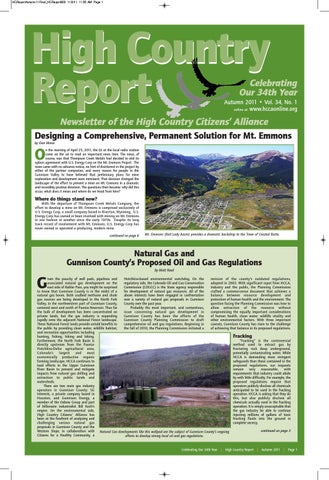
Newsletter of the High Country Citizens’ Alliance Designing a Comprehensive, Permanent Solution for Mt. Emmons by Dan Morse n the morning of April 25, 2011, the DJ at the local radio station came on the air to read an important news item. The news, of course, was that Thompson Creek Metals had decided to end its option agreement with U.S. Energy Corp on the Mt. Emmons Project. The news came with no advance notice, no hint of disinterest in the project by either of the partner companies, and every reason for people in the Gunnison Valley to have believed that preliminary plans for mine exploration and development were imminent. That decision changed the landscape of the effort to prevent a mine on Mt. Emmons in a dramatic and incredibly positive direction. The questions then became: why did this occur, what does it mean and where do we head from here?
O
Where do things stand now? With the departure of Thompson Creek Metals Company, the effort to develop a mine on Mt. Emmons is comprised exclusively of U.S. Energy Corp, a small company based in Riverton, Wyoming. U.S. Energy Corp has owned or been involved with mining on Mt. Emmons in one fashion or another since the early 1970s. Despite its long track record of involvement with Mt. Emmons, U.S. Energy Corp has never owned or operated a producing, modern mine. continued on page 6
Mt. Emmons (Red Lady basin) provides a dramatic backdrop to the Town of Crested Butte.
Natural Gas and Gunnison County’s Proposed Oil and Gas Regulations by Matt Reed
G
iven the paucity of well pads, pipelines and revision of the county’s outdated regulations, Hotchkiss-based environmental watchdog. On the associated natural gas development on the adopted in 2003. With significant input from HCCA, regulatory side, the Colorado Oil and Gas Conservation east side of Kebler Pass, you might be surprised industry and the public, the Planning Commission Commission (COGCC) is the State agency responsible to know that Gunnison County is in the midst of a for development of natural gas resources. All of the crafted a common-sense document that achieves a natural gas boom. Both coalbed methane and shale above interests have been engaged in confrontation balance between resource development and gas sources are being developed in the North Fork over a variety of natural gas proposals in Gunnison protection of human health and the environment. The Valley, in the northwestern part of Gunnison County, question facing the Planning Commission was how to County over the past year. centered west and north of Paonia Reservoir. Thus far allow extraction of the resource without Probably the most important, and contentious, the bulk of development has been concentrated on compromising the equally important considerations issue concerning natural gas development in private lands, but the gas industry is expanding of human health, clean water, wildlife vitality and Gunnison County has been the efforts of the rapidly onto the adjacent National Forest landscape. other environmental factors. With three important Gunnison County Planning Commission to draft These National Forest lands provide untold benefits to comprehensive oil and gas regulations. Beginning in caveats, Gunnison County has risen to the challenge the public by providing clean water, wildlife habitat, the fall of 2010, the Planning Commission initiated a of achieving that balance in its proposed regulations. and recreation opportunities including hunting, fishing, hiking and biking. Fracking Furthermore, the North Fork Basin is “Fracking” is the controversial directly upstream from the Paoniamethod used to extract gas by Hotchkiss-Delta agricultural area, fracturing rock deep underground, Colorado’s largest and most potentially contaminating water. While economically productive organic HCCA is demanding more stringent farming landscape. HCCA continues to safeguards than those contained in the lead efforts in the Upper Gunnison proposed regulations, our requests River Basin to prevent and mitigate remain very reasonable, with impacts from natural gas drilling and requirements that industry could abide extraction to public lands and by with little difficulty. For example, the watersheds. proposed regulations require that There are two main gas industry operators publicly disclose all chemicals operators in Gunnison County: SG anticipated to be used in the fracking Interests, a private company based in operation. HCCA is asking that they do Houston, and Gunnison Energy, a this, but also publicly disclose all chemicals actually used in the fracking member of the Oxbow Group and part operation. It is simply unacceptable that of billionaire industrialist Bill Koch’s the gas industry be able to continue empire. On the environmental side, injecting millions of gallons of toxic High Country Citizens' Alliance has fracking fluids into the ground in been at the forefront of analyzing and complete secrecy. challenging various natural gas proposals in Gunnison County and the continued on page 3 Western Slope, in collaboration with Natural Gas developments like this wellpad are the subject of Gunnison County’s ongoing Citizens for a Healthy Community, a efforts to develop strong local oil and gas regulations.
Celebrating Our 34th Year
|
High Country Report
|
Autumn 2011
|
Page 1
HCReportAutumn11Final_HCReport000 11/3/11 11:55 AM Page 2
The Board and Staff: Faces & Changes From the Executive Director
A Great Summer!
Doing it “Right”
Thank you for your support, Billy Rankin, President
High Country Report High Country Report is a publication of High Country Citizens’ Alliance. The mission of High Country Citizens’ Alliance is to champion the protection, conservation and preservation of the natural ecosystems within the Upper Gunnison River Basin.
n environmental work the right thing to do is sometimes hard to figure out, and then actually doing it can be challenging. It is clear to me how important this concept is to environmental issues facing our region. In the case of Mt. Emmons, we are fortunate that the right thing to do is not all that difficult to figure out. Intuitively and scientifically the risks and impacts of developing a major molybdenum mine in the Dan Morse Crested Butte watershed are far too high and the benefits too few. The right thing to do is simply to not mine Mt. Emmons. We are doubly fortunate that a significant number of people share this view and hope to permanently end the threat of a mine. The more difficult task is taking the right steps to prevent a mine on Mt. Emmons. High Country Citizens' Alliance has begun new efforts to bring about a permanent solution to the Mt. Emmons issue. We are working with a team of environmental experts, attorneys and community members to determine how to “do it right” so we can end the fight, leave Mt. Emmons protected in perpetuity, and focus on myriad other environmental challenges facing our community and our world. I hope you find the explanations of this work in this newsletter informative and compelling, and I ask you to join us in a substantial effort to end the Mt. Emmons mine threat once and for all. On other issues the right path forward isn’t always as clear, and this makes taking the right steps to get toward the goal all the more difficult. A case-in-point is the national and local dialogue surrounding natural gas extraction. The development and use of natural gas has real environmental impacts – on water quality, on the land, on wildlife and on people and communities. Natural gas is also in significant demand – for heating homes, generating electricity and as a so-called “transition fuel” to ease the way from fossil fuels to alternative energy sources. The tension between these impacts and the increasing demand for natural gas has created significant debate over where development should or should not take place, whether or not hydraulic fracturing or “fracking” can be done safely, and how the industry will be regulated. HCCA continues our long-term efforts to protect our environment from the impacts of natural gas development. We were one of the first organizations to begin monitoring natural gas proposals in the North Fork Valley, and for the last decade we have continued our efforts to prevent and limit impacts from natural gas development. Our work has led us to formally protest gas leases, to litigate major gas pipeline proposals, to push for stronger regulations and to advocate for development plans that cause the least possible impact. We’ve chosen these tactics because we think they will be the most successful ways of limiting the impacts of natural gas development in our region and because we know they are within the realm of what is possible within current legal constraints. Our efforts have stopped a number of gas development efforts, improved others, and we are a known and respected voice in the debate over how best to regulate the industry. While we continually evaluate how we’re doing in all of our efforts, we believe that our tactics on the natural gas issue are effective and will provide the best protections for our environment and our communities as the pressure to develop natural gas continues.
I
Dan Morse
HCCA welcomes new Board members from left to right, Jeremy Rubingh, Kate Vogel and Peggy Moore.
Welcoming New Board Members uring the past year High Country Citizens’ Alliance has had the pleasure of working with four new board members representing four distinct points of view. Jeremy Rubingh comes to us with a background in environmental science and filmmaking. He has directed and produced two films related to Mt. Emmons: “Trespassing,” and the award winning “Red Lady – the Battle for Your Mountains.” Kate Vogel is a retired Professor and Chairman of the Department of Biology at the University of New Mexico as well as a Founding member of Alliance for Clean Electricity. Peggy Moore is a retired Early Childhood Center
D
Director and Gunnison County Democrats Central Committee Member. She has a background in Education. Our newest board member Rich Karas is a retired Professor of Physics and Vice President for Academic Affairs at Western State College and California State University - San Marcos. He has also been the Member and Vice Chair for Gunnison County Planning Commission (2007-2011). He has chaired for the Gunnison County Carbon Policy Task Force (2009-2010) as well as for the Gunnison County Energy Action Plan Committee (20082009). We are very fortunate to have such a diverse board full of varied opinions and backgrounds influencing our decision-making process.
Board of Directors
Staff
Billy Rankin, President Larry Mosher, Vice President Steve Schechter, Secretary Richard Karas Peggy Moore Sue Navy Jeremy Rubingh Kate Vogel
Dan Morse, Executive Director Jennifer Bock, Associate Water Program Director Steve Glazer, Water Program Director Brett Henderson, Administrator Matt Reed, Public Lands Director Newsletter Layout Lisa Sacco, saccografix@cox.net
High Country Citizens’ Alliance P.O. Box 1066 Crested Butte, CO 81224 970-349-7104 970-349-0164 fax email: office@hccaonline.org web site: www.hccaonline.org
HCCA formed in 1977 to protect Red Lady and community from Amax molybdenum mine First Red Lady Salvation Ball, ‘78 HCCA’s St. Jude’s Thrift Store (Chez Ceil) opens, ‘78 Joined w/local ranchers to prevent aspen clearcuts on Kebler, ‘80 Amax leaves due to community opposition and drop in moly prices, ‘81 Successfully appealed National Forest Plan, reducing timber harvest, ‘85 Planted baby spruce trees at ski area to mitigate cutting for ski runs, late ‘80s Helped stop Collegiate Range Aurora Project (transmtn. diversion), ‘88 Colo. Legislature passes HCCAauthored water conservation bill, ‘91 Created nationallyrecognized range reform with local ranchers, Interior Secretary Babbitt, Gov. Roy Romer; coined term ‘Cows Not Condos’, ‘92-’93 Helped create local wilderness areas: Fossil Ridge and OBJ addition, ‘93 Keeping our water in the basin, no transmountain diversion (ongoing) Don Baker begins leading HCCA senior hikes, ‘93 ongoing Proposed affordable housing ordinance to the County; resulted in BOCC hiring an affordable housing coordinator, ‘94 Worked with County and landowners to keep Cement Creek Rd. from backcountry plowing; led to protection of other drainages, ‘94
HCCA Timeline of Events and Accomplishments 1977-2011
Page 2
|
High Country Report
|
Autumn 2011
|
Celebrating Our 34th Year
High Country Citizens’ Alliance ©2011 All Rights Reserved
Summer has officially ended and I begin to reflect on the many hikes, bike rides, river runs, and wilderness nooks that I visited this summer, and the many more places that I did not make Billy Rankin it to. I feel blessed to live in a place where during a single summer it is impossible to get to every magical place in the Elk Mountains. Yes, summer is short but it is so powerful. The hills seemed greener than they have been in years, the rivers full, the lupine thicker than imagined, and snow remained on the peaks for much of the summer. The energy in town was high, Elk Avenue vibrant, shops and restaurants full, with smiling tourists and hard-working locals, also smiling. Whether it was the Fourth of July, Arts Festival, Alpenglow, or happy hour at the Eldo, I had wonderful interactions with people who expressed feeling lucky and thankful to be here in this valley. It didn’t matter if it was someone’s first time here, a part-time resident, or a 30-year local. It didn’t matter if it was the lower loop or the high summits. It didn’t matter if it was walking down the streets or traversing the Ruby Range. People love, respect, and appreciate this place we call paradise. We are surrounded by natural beauty, open spaces, and an intact ecosystem and that is what makes this place special. People feel it when they are here and understand the importance of what we have. I have been complimented for how great it is here, how different we are from the other towns, and how we are following a good path. A good path is when, above all, we take care of our surrounding ecosystems, and make the health of our land, water, and wildlife a priority in our everyday lives. High Country Citizens’ Alliance is helping sustain the path to a healthy and well-preserved environmental future for the Upper Gunnison River Basin. For the past 34 years, HCCA has been working hard to fulfill our mission to champion the protection, conservation and preservation of the natural ecosystems within the Upper Gunnison River Basin. Whether a mine on Red Lady, a transcontinental water diversion, natural gas leases, or issues of energy and climate change, HCCA has been there to be a part of the conversation to help influence a better outcome for the environment. We are the only ones doing what we do and we do it year-round. Some people have expressed recently that HCCA has been too conservative and not radical enough. HCCA has certainly matured over the years. We rarely take extreme stances with no compromises. HCCA believes in smart growth and understands the need to develop, utilize resources, and promote a healthy economy. Our staff and board are not comprised of “radicals”, but instead, highly educated environmentalists, attorneys, writers, artists, professors, guides, policy makers, and people who are experts in their fields and genuinely care about the environment. HCCA accomplishes its goals by integrating expert analysis and scientific research with environmental education, informed debate and policy participation. HCCA is a leader in the environmental movement and has networked, created allies, partners, and is highly respected by our peers and even by our opposition at times! Read on and enjoy this newsletter and see all of the great and important things HCCA is involved with. As I look out my window and watch the trees turn yellow, my head turns to Mt. Emmons. I hate to admit it, but I look forward to it becoming completely snow covered. Red Lady, Evans, Redwell, Wolverine, Coon, Climax Chutes, so many different aspects of this mountain to ski and explore. Full of historic ski descents, and full of Molybdenum. We continue to fight the fight and now is the time to Save Red Lady forever. If it were for nothing else, this mountain is worth billions for its lifetime of potential human adventures.
HCReportAutumn11Final_HCReport000 11/3/11 11:55 AM Page 3
Save Public RedLands Lady Another Molybdenum Mine Proposal? by Matt Reed controlled by China, which produces over 97% of the world’s rare earth mineral supply. New demand is straining that supply, and investors are looking to Colorado’s public lands to increase production. The mining and refining of these minerals can have significant environmental impacts, especially in the relatively intact ecosystems of the basin’s public lands. Mining helped build Colorado, but in many places would be incompatible with the values and expectations of today’s residents and visitors. HCCA will provide detailed analysis of the potential impacts of developing the Tomichi molybdenum and Powderhorn rare earth deposits to show the irreversible changes that would occur to public lands and watershed health. We will also work diligently to mobilize public sentiment, including local governments, against unwise molybdenum and rare earth extraction.
igh Country Citizens' Alliance was founded in 1977 for the specific purpose of fighting a molybdenum mine near Crested Butte. That battle has been successful thus far. Unfortunately, the mining industry is now pursuing molybdenum and copper mining at a new location in eastern Gunnison County known as the Tomichi Deposit, near the town of White Pine and the Continental Divide, and adjacent to Tomichi Creek and the pristine headwaters of the Gunnison River. Water is life in the rural west, and life here depends on clean water. A large-scale, high-elevation industrial zone along pristine creeks that flow into our rich agricultural landscape could create untold damage. Similarly, booming interest in “rare earth” mineral exploration and development is taking hold in the southern reaches of the Gunnison Basin, near Powderhorn. Global rare earth mineral production is currently
H
HCCA’s Matt Reed joined Whitepine residents and the Gunnison County Planning Commission on a site visit of a proposed copper and molybdenum exploration project above Whitepine.
Proposed Oil and Gas Regulations continued from page 1 We also are asking that the County have the express authority to hire an inspector to inspect gas facilities. Currently, inspections are conducted by the State. The most glaring weakness in the State’s regulations is enforcement. The State has a five-year goal for inspection of gas facilities, but it is essentially complaint-driven. The average inspection lasts ten minutes, and each inspector has roughly 1,000 wells to visit each year. This void should be filled at the county level by including language in the regulations requiring a county-level inspector. Finally, HCCA is asking that an Air Quality Monitoring Plan be implemented by operators to minimize impacts to air quality. Given the numerous environmental and public health concerns associated with natural gas development and fracking, Gunnison County has taken the position that it has the authority to regulate development, although industry disagrees. In fact, SG Interests filed a lawsuit in June 2011
rom 2010 to 2011, HCCA researched the feasibility, benefits and impacts of the possibility of a geothermal energy facility at Tomichi Dome, east of Gunnison. Our efforts helped shape recent decisions by the United States Forest Service (USFS) and Bureau of Land Management (BLM) on the proposal. Through coordination with other conservation groups, federal agencies, local governments and the public, HCCA is helping to guide any possible geothermal facility onto appropriate public lands and in a low impact configuration. While geothermal energy is renewable and sustainable, it nevertheless leaves a footprint on the land, and must be sited carefully, particularly with relation to Gunnison sage-grouse. HCCA’s goal has been to avoid impacts to sensitive resource concerns while promoting a clean source of energy. Thus far, our efforts have paid off as the USFS and BLM are considering leases for an eventual facility in a way that minimizes impacts to wildlife, land and water.
F
Next steps High Country Citizens’ Alliance will continue to press for the strongest county regulations allowed under law. It will be essential to generate support for the proposed regulations and ensure that they are approved without being compromised. HCCA will also continue its coordination with the public and
other conservation groups across the state to oppose gas leases on public lands, combat fracking with toxic chemicals, and ultimately convince the State of the need for a significant revision of its current approach to gas development. If you have questions or concerns on this important (and complicated) topic, please contact Matt Reed, HCCA’s Public Lands Program Director, at matt@hccaonline.org.
Colorado Roadless Rule Poses Threats
Geothermal Development by Matt Reed
aimed at curtailing Gunnison County’s ability to regulate gas development. While the lawsuit’s main issue is preemption, or the interaction between state and county regulations, HCCA is of the opinion that SG Interests threw the kitchen sink at the County in an attempt to keep our county commissioners from adopting the new regulations. While the legal battle continues, Gunnison County is engaged in negotiations with the State over how best to achieve a balanced approach to regulating this industry.
by Matt Reed espite a robust National Basin. As a natural gas drilling Roadless Rule adopted in boom takes hold in our 2001 that offers community’s backyard, HCCA is outstanding protection for at the forefront in analyzing and Colorado’s National Forest opposing leasing, drilling, piping roadless lands, the State of and hydraulic fracturing. Colorado continues headlong in Natural gas development may its efforts to craft a Coloradobe appropriate for some areas, specific roadless rule. And despite but not for the last roadless the efforts of High Country landscapes in Colorado. Citizens' Alliance to secure the Similarly, several expansions for strongest possible protections for coal mines in local roadless roadless areas in Gunnison areas are being proposed, County, a significant threat looms something that the USFS and in numerous proposals for natural BLM have been reluctant to gas and coal development. oppose. HCCA continues the Colorado’s 4.4 million acres of The Cochetopa Hills Roadless Area is one of the many Gunnison fight to protect these areas from roadless lands contain the last Basin areas deserving of continued protection under the Colorado permanent industrial scarring. large, continuous swaths of Roadless Rule. Our roadless areas deserve full relatively pristine habitat in the protection and should not be state (outside of wilderness areas), and are essential for the compromised by loopholes in the law that allow and even survival of endangered species and biodiversity in general. Many of encourage the unsustainable extraction of climate-changing the roadless areas within the Upper Gunnison River Basin are resources. relatively low in elevation, offering outstanding habitat types for a High Country Citizens’ Alliance will oppose all natural gas and variety of species. As the legal and political fracas around adoption coal leases offered for sale inside the boundaries of 2001 Inventoried of a final Colorado-specific roadless rule enters its final stage, old Roadless Areas and Proposed Colorado Roadless Areas. We will also and new threats continue to surface. Specifically, wild and continue coordination with other Colorado conservation untrammeled roadless landscapes in the basin are threatened by organizations to battle gas and coal lease sales and development in an unrelenting push to extract natural gas and to mine coal. roadless areas, engage local governments and local communities, HCCA’s goal in our roadless advocacy is the permanent and advocate for denial of Applications for Permits to Drill (APDs) protection of all roadless areas in the Upper Gunnison River that require any surface use in roadless areas.
D
Celebrating Our 34th Year
|
High Country Report
|
Community Yard Sale in conjunction with CB Town Cleanup, ‘98 ongoing
Court dismisses NECO’s Rocky Point pump storage project water rights—after years of our collaboration w/ UGRWCD, Gunnison County, Crystal Creek homeowners, ‘98
Helped make Three-Way Land Trade more equitable for public, ‘98
Helped voters pass countywide Open Space Ballot Initiative 1A, ‘97
Joined with Taylor Park ranchers, Gunnison business owners, to keep FHWA from paving Cottonwood; minimized Taylor Road realignment, ‘97
Petitioned for UGRWCD to hold elections, 19962003 (nonconsecutive years)
HCCA’s “Green Team” gave ecological tours at ski area; was CBMR/WSC/HCCA partnership; did summer nature hikes and slide shows, ‘96-’97
Cooperated with ranchers to determine water quality classification in Basin, ‘97
Road Inventory Project (RIP) mapped hundreds of miles of usercreated roads to assist Forest Service, ‘96 to ‘03
Joined successful community opposition to Snodgrass expansion, ‘94-’96
HCCA Timeline of Events and Accomplishments 1977-2011
Autumn 2011
|
Page 3
HCReportAutumn11Final_HCReport000 11/3/11 11:55 AM Page 4
Water Program Come Low or High Water
Operating Dams for Environmental Values by Jennifer Seidenberg Bock
T
he 2011 water year was an extraordinary one in the Gunnison Basin, as it was throughout much of the mountain west. Inflow into Blue Mesa Reservoir from April to July totaled 893,000 acre-feet (AF), an amount higher than 70% of prior years. What did all of this water mean for the ecology of the Gunnison River, which benefits from high peak run-offs that reinvigorate both endangered fish and riparian habitat? That answer depends largely upon the management of the river by the Bureau of Reclamation (BOR), and two significant legal developments related to its practices.
New management practices In 2009, after decades of lawsuits and negotiations, a decree was finally entered in Colorado water court for a federally reserved water right for the Black Canyon of the Gunnison National Park. The decree requires a year-round base flow in the canyon of 300 cubic feet per second (cfs), and also creates a flow regime with annual peak flows and shoulder flows intended to mimic the natural hydrograph of the river. However, even these mandated flows must take into account the amount of water necessary to fill Blue Mesa. Further, flows must be regulated in order to accommodate flood control concerns downstream in Delta and Whitewater. By the end of 2011, the BOR hopes to finalize an Environmental Impact Statement (EIS) outlining operating procedures for the Aspinall Unit—the Blue Mesa, Morrow Point, and Crystal Dam and power plants on the Gunnison River. The new operating plans are designed to assist in the recovery of the Colorado River’s endangered fish species – including the Colorado pikeminnow and razorback sucker – and also implement the requirements of the Black Canyon Decree. The preferred alternative calls for peak flows in June of above 2000 cfs on average. It also requires ramping up to peak flows to begin five days prior to the estimated peak, with increases of no more than 500 cfs per day. The BOR’s plan, announced in its draft EIS, varies targeted peak flows depending on forecasted inflow and the requirements of the Black Canyon water right. For example, in a big water year such as 2011, if forecasted inflows are high the BOR would operate the Aspinall Unit for higher peak flows in the Black Canyon. In contrast, in a drier year, the peak through the Black Canyon would lower. These peaks must take into account a maximum flow level at Whitewater to prevent flooding, after the North Fork joins the Gunnison.
The 2011 water year This year, the Gunnison River through the Black Canyon peaked on June 8th at an average of 7,180 cfs over a twenty-four hour period. In comparison, last year’s peak was 4,200 cfs on May 18th. Unfortunately, the shoulder flow leading up to this year’s peak was unnaturally flat at 2,500 cfs for about three weeks while Blue Mesa was filling prior to
Welcoming Our New
Water Program Director High Country Citizens' Alliance is pleased to welcome Jennifer Bock to our Water Program. Jennifer joined HCCA in July, 2011 as Associate Water Program Director and has been working closely with our Director, Steve Glazer, to learn the critical water resources issues facing the Upper Gunnison Basin. Jennifer came to HCCA with a broad background in water issues. She graduated from UC Berkeley School of Law with a certificate in environmental law, and worked as an Attorney for two years in San Francisco representing local governments and environmental groups. Jennifer learned Colorado water law while serving as a clerk to Justice Gregory J. Hobbs of the Colorado Supreme Court. Jennifer is thrilled to return to the Gunnison Valley, where she worked from 2000 to 2001 as an organizer for CoPIRG at Western State College. We are excited to have Jennifer on staff with her diverse background in law and policy as well as grassroots organizing. After leaving Gunnison, Jennifer opened the first environmental field office in northwest Colorado for the Colorado Environmental Coalition, and for three years organized citizens there to support the wilderness protection of BLM lands. In August, Jennifer (formerly Seidenberg), married Garret Bock, who is pursuing a teaching certificate at Western State and is a student teacher at the Crested Butte Community School. HCCA plans to appoint Jennifer as the Director of the Water Program upon Steve Glazer’s retirement, after decades of building the program, at the end of the year. Please join us in welcoming Jennifer to Crested Butte and the HCCA community. Jennifer can be reached at jen@hccaonline.org. HCCA is extremely pleased to have Jennifer Bock join us as our Associate Water Program Director.
The Black Canyon benefits from HCCA efforts on water rights and endangered species protection. BOR’s ramping towards the peak. In addition, there was a second peak in the Canyon on July 15th of about 3,000 cfs. Once Blue Mesa was filled, the BOR allowed more water downstream. According to the BOR’s management plans for this fall, Black Canyon flows will be at about 1000 cfs September through mid-November, before increasing again to over 1500 cfs in mid-December to accommodate hydropower interests during a key time for energy demand.
Room for improvement: forecasting and shoulder flows This year’s peak was higher than it should have been under the BOR’s management plans and the year’s actual inflow. The error can be found in forecasting. The BOR determined its peak flow target for the Black Canyon water right according to its May 1 forecast of 945,000 AF total inflow. The BOR’s forecasts fluctuated from 800,000 AF on April 15 to 945,000 AF on May 1, while the actual inflow ended up at 893,000 AF. The BOR increased its forecast on May 1 based on late April snow accumulations in the high country, but still saw run-off later than expected, well into July. The same forecasting difficulties that led to a higher peak flow this year could presumably lead to lower peak flows than called for under the Black Canyon decree. Moreover, hydropower demands and the filling of Blue Mesa results in unnatural shoulder flows and late season peaks, evident even in this wet water year. Yet, despite the problems with forecasting, the Gunnison River in the Black Canyon did enjoy a healthy peak flow, and a vast improvement in approximating the river’s natural cycles. High Country Citizens' Alliance participated in negotiating the Black Canyon decree and commented on the forthcoming EIS. We look forward to continuing to work with the BOR as it implements the Decree and the EIS and we will continue advocating for the restoration of the Gunnison River ever closer to its natural hydrograph.
Gunnison Basin Roundtable Progress Report by Steve Glazer n 2005, the Colorado Legislature, in order to facilitate There are two components of conservation: passive planning for our future water needs, created nine river and active. The conservation community has produced basin committees (roundtables) to assess our water a supplement to the IBCC report called “Filling the needs (agricultural, municipal and industrial, Gap.” It suggests that with active conservation, no new recreational and environmental) through 2050. They projects would be needed. Potential new projects could also created an Interbasin Compact Committee (IBCC) be a transmountain diversion from the Yampa to the to encourage discussion between roundtables to explore Front Range, The Big Straw (a pumpback project on the opportunities to meet state-wide needs. Colorado River from the Utah state line to the Front In meeting the legislative mandate to assess our Range), pumpback pipelines from the lower S. Platte consumptive and non-consumptive needs, the Gunnison and the lower Arkansas rivers, a Blue Mesa pipeline to Basin Roundtable completed its Basin Report in June the Front Range and a pipeline from Flaming Gorge 2011. This report can be viewed or downloaded at: Reservoir in Wyoming to the Front Range (see http://cwcb.state.co.us/water-management/basin- accompanying story). roundtables/Documents/Gunnison/GunnisonBasin The Gunnison Basin Roundtable was invited to NeedsAssessmentReport.pdf . It describes how discuss a possible new project with the Arkansas consumptive and non-consumptive needs can be met Roundtable. I was selected to be on the subcommittee while avoiding or minimizing conflict between these to discuss options. We told the Arkansas committee seemingly disparate needs. members that a transmountain diversion is off the The IBCC produced a report that outlines how future table because of legal limitations but we would talk needs, statewide, can be met using a four-pronged about how Blue Mesa could be used as an approach. The four ingredients are: 1. Finding augmentation supply to protect all transmountain alternatives to permanent dry-up of agricultural lands by diversions to the Front Range if the Lower Basin states allowing farmers to fallow land on a rotational basis and (CA, NV and AZ) called for curtailment of all water uses lease the water saved to municipalities; 2. Building junior to 1922. Identified Projects and Processes (IPPs); 3. Water As a result of our discussions, the subcommittee is conservation; and 4. New water projects. now studying the concept of how Blue Mesa could be Rotational fallowing will help sustain the used as a water bank. This would allow water in the agricultural economies of rural communities on the Gunnison Basin to flow downstream, meeting the Black eastern plains. Several IPPs have been built or are Canyon water rights and generating flows below Delta under construction while others are still in the to help recover listed endangered fish in the Lower permitting stage. They include the Aurora Prairies Gunnison and Colorado Rivers. There are many Water Project, Colorado Springs Southern Delivery complex legal and modeling options to be studied over System, Windy Gap Firming Project, the Moffat Tunnel the next year to determine whether this water bank Collection System Enlargement and the Northern concept is feasible. If so, it will eliminate the possibility Integrated Supply Project. of a new Blue Mesa pumpback pipeline.
I
Pres. Clinton signs bill creating Black Canyon of the Gunnison National Park-we worked on bill’s language and passage, ‘99 Annual fall Sustainable Communities Symposium, ‘99 ongoing Began our annual People’s Fair Bake Sale, ‘99 Helped get Mt. Emmons Iron Fen designated Colorado State Natural Area and USFS Special Interest Area, ‘99 Helped local coalition defeat Union Park proposal, 2000 Worked to get President Clinton’s Roadless Rule adopted, 2000 Served on committee to help BOCC revise Gunnison County Land Use Resolution,’97-’01 Serve on Sage Grouse Mitigation Committee to mitigate landfill expansion, ‘01 ongoing Published Community Indicators Project’, ‘01 Produced “The Gunnison Sage Grouse ~ A Dance of Survival”video, ‘01 Commemorative climb to top of Red Lady for HCCA 25th Anniversary, ‘02 Sued for Black Canyon of the Gunnison National Park water rights, ‘03 Published ‘Blueprint for Water Sustainability’, ‘03 Mountains to Mesas (M2m) creates proposal for more wilderness in Forest Plan revision, ‘03 ongoing
HCCA Timeline of Events and Accomplishments 1977-2011
Page 4
|
High Country Report
|
Autumn 2011
|
Celebrating Our 34th Year
HCReportAutumn11Final_HCReport000 11/3/11 11:55 AM Page 5
Save WaterRed Program Lady The Flaming Gorge Project
Latest Threat to the Colorado River by Jennifer Seidenberg Bock plan to divert water flowing in the Green River in southwestern Wyoming and pump it all the way to consumers on the front range of Colorado is gaining interest from some water suppliers and great concern from High Country Citizens' Alliance and the Colorado environmental community. First proposed by Colorado businessman Aaron Million, front range water interests including the Metro and Arkansas Basin Roundtables as well as the South Metro Water Supply Authority (composed of suppliers from Arapahoe and Douglas Counties, as well as Parker and Castle Pines) and the Pikes Peak Regional Water Authority (northern El Paso County) are now promoting the idea.
A
The Green River at Steamboat Rock could be impacted if the proposed Flaming Gorge pipeline proposal were to move forward.
A pipeline on a grand scale
The “Regional Watershed Supply Project” (RWSP) as proposed by Aaron Million would divert up to 250,000 acre-feet of water per year (AFY) from two sources: one on the Green River the Upper Basin States—Utah, and one at Flaming Gorge reservoir. The water would then be Colorado, New Mexico and pumped over 560 miles across southern Wyoming in order to Wyoming—are apportioned 7.5 make deliveries along the front range of Colorado. If ever million acre-feet of water per year, the constructed, the pipeline would probably not start supplying the The Green River in Brown's Park National Wildlife Refuge. lower Basin states are apportioned front range until the 2030s. The pipeline being eyed by front –photo by Luke Schafer the same. The key provision of the range water interests would likely be of the same scale and scope Colorado Environmental Coalition compact is the delivery requirement— as Million’s proposal. that the Upper Basin states must The cost estimates for a 250,000 AFY pipeline are staggering: about $9.5 billion in capital construction costs alone. Operation and maintenance “not cause the flow of the river at Lee’s Ferry” to fall below a cumulative 75 million acre-feet costs are estimated at $217 million per year, owing to the high energy costs of pumping nearly for any consecutive ten year period. This requirement is problematic because the net one million tons of water on average per day at elevation. The cost per acre-foot per year production of the Colorado River is likely far below the 15 million acre-feet per year that was breaks down to $39,000 – far more than the $400 to $1000 that the front range has recently assumed in 1922. Indeed, in the first decade of the 21st century, the Colorado River averaged paid to develop water resources such as the Gross Reservoir expansion and various agricultural flows of only 12.1 million acre-feet per year at Lee’s Ferry. Moreover, the effects of climate transfers. Aaron Million has promised that private investors would shoulder the burden rather change are likely to make the River even less productive. Despite the realities of the Colorado River and climate change, water developers continue than the public, yet the high cost to build the pipeline would eventually be passed on to to dream big. That is in part because, on paper, the Upper Basin states are not using their ratepayers on the front range in the form of hook-up fees and delivery charges. entire 7.5 million acre-feet allocation, and amongst the Upper Basin states, Colorado is using only about 2.14 million acre-feet of its 3.36 million acre-feet allocation. Developers and some Environmental impacts In its comments to the Army Corps on its initial scoping of the Million proposal, the US state officials see this gap and ask why Colorado should let water it is “entitled” to flow past Fish and Wildlife Service wrote, “[t]his project has the potential to alter hydrological, fluvial the state line. Unfortunately, this simplified perspective does not take into account the Upper geomorphic, and ecological processes downstream in both the Green and Colorado Rivers to States’ delivery obligation which likely trumps any entitlement. If delivery obligations cannot Lake Powell, affecting riverine and riparian species and habitats . . .potentially affected species be met under current operations, a “compact call” would be triggered—requiring Colorado to and habitats are federally listed species, designated critical habitats, species that are curtail post-1922 diversions in order to meet the Lower Basin states’ allocation. Post-1922 diversions account for a large percentage of the Gunnison Basin’s agricultural and municipal candidates for Federal listing, and State-sensitive species.” The endangered species particularly at risk from the proposed depletion of the Green uses. Perhaps most importantly, developers’ desire for the “unused” portion of Colorado’s River are the Humpback Chub, the Bonytail, the Colorado Pikeminnow, and the Razorback allocation also ignores the devastating environmental effects of dewatering the Colorado Sucker. All four of these species have been the focus of the Upper Colorado River Endangered River further and further upstream. Fish Recovery Program, which has been at work for nearly twenty-five years to restore them. The presence of these species will bring the provisions of the Endangered Species Act into play Next steps In September 2011, the CWCB voted to fund a Flaming Gorge Task Force to study the in any environmental analysis of the project, raising the question of why, with the costs described above, environmental impacts and potential legal barriers, so many are so enamored project. Hearing broad opposition from the environmental community and West Slope interests, the CWCB funded the task force at $72,000 – less than a third of the money with a project full of so many significant question marks. requested. Although many west slope interests are opposed to the project and even its study, each basin roundtable, including the Gunnison roundtable, has agreed to participate in the Impacts on the Gunnison Basin Although the impact of the project would be enormous on the ecological resources of the project’s study, if only to voice their concerns and ensure that the substantial problems with Green and Colorado Rivers, it would also influence the management of the Gunnison River, the project are adequately analyzed. High Country Citizens' Alliance encourages the public due to the wide reach of the “Law of the River.” The management of the Colorado River and to participate in upcoming opportunities for citizen input on the project. Watch for action its tributaries is governed by the 1922 Colorado River Compact. Under the 1922 Compact, alerts and contact us if you have questions: jen@hccaonline.org or steve@hccaonline.org.
Longtime HCCA Water Director, Steve Glazer, to Retire by Dan Morse
S
teve Glazer taught himself nearly everything he knows about water in the Gunnison Basin. Then, when he’d accrued a strong grasp of water issues, he began working to protect our water. And over the course of the past twenty-plus years, Steve has worked tirelessly on every sort of issue ranging from massive proposals to divert our water to the Front Range to the cleanup of historic mine pollution in our watersheds. All along, Steve has been a staunch advocate for environmental cleanup and protection, while also developing long-standing working relationships with people in the water development and regulatory communities. His unique ability to be a strong
advocate while reaching out to other interests has gained him widespread recognition as an effective and respected voice on Colorado’s critical water issues. Steve has decided that he will retire from his work with High Country Citizens' Alliance on January 1, 2012. HCCA is deeply appreciative of Steve’s efforts for the HCCA Water Program over the past two decades and we are proud to carry on a tradition of effective water advocacy in Colorado. While we will continue to draw on Steve’s expertise from time-to-time, the water program will transition to new fulltime leadership. We are very pleased to have hired Jennifer Bock to take the helm of the water program and we are
fortunate that Steve and Jen will have several months to work together to transfer Steve’s wealth of experience and knowledge. Looking forward, we are confident that Jen will continue to Steve Glazer advance HCCA’s important efforts for water resources in our region and will build on Steve’s many years of effort. In closing, the entire Board of Directors and Staff of High Country Citizens' Alliance express our sincere thanks to Steve and we all wish him the best as he enjoys some well-deserved free time.
Helped Gunnison County write Coalbed Methane regs, ‘03 First Small and Charming Home Tour, ‘03 “The Preserve” 44-acre Conservation Easement finalized with CBMR, ‘04 Back in federal court vs. Phelps-Dodge patenting approval, with CB and County, ‘04 Started Coal Creek Watershed Coalition to clean up Standard Mine, Elk Creek and Coal Creek, ‘04 ongoing Formed West Slope Water Network with Western Colorado Congress, Trout Unlimited and San Juan Citizens’ Alliance to coordinate West Slope water issues, ‘04 Settled lawsuit vs. Forest Service and BLM, winning agreement for environmental analysis for Leon Lake #2 coalbed methane well site, ‘04 Worked with Western Slope Environmental Coalition and Colo. Environmental Coalition to stop BLM leasing for gas development in Crystal Meadows, ‘04 Held weekend of public lands events including trail work day in Oh-Be-Joyful with Forest Service, ‘04 Celebrated Wilderness Act 40 Years, organized Wilderness Expo with Forest Service, National Park Service, BLM, WSC and Elk Mountain Hikers Club, ‘04
ºHCCA Timeline of Events and Accomplishments 1977-2011
Celebrating Our 34th Year
|
High Country Report
|
Autumn 2011
|
Page 5
HCReportAutumn11Final_HCReport000 11/3/11 11:55 AM Page 6
Red Lady Update Comprehensive, Permanent Solution for Mt. Emmons They are not a mining company. The company has evolved over the last three decades and is now almost exclusively focused on natural gas development. U.S. Energy Corp has been very clear all along that they would require a partner or buyer in order to develop the Mt. Emmons Project and have been actively soliciting another company to participate in the project since Thompson Creek’s departure. As U.S. Energy Corp seeks partners and tries to determine how to proceed, there is a window of opportunity for the Gunnison Valley community to develop a solution that would eliminate the mining threat.
What does this window of opportunity mean? In the midst of a long-running fight, it can be difficult to recognize an opportunity to put an end to the fight and move on to other efforts. Such a moment of opportunity is now upon the Gunnison Valley and it’s important not only that we recognize it, but also that we capitalize on it. I’ve often said
that the fight over Red Lady is not our objective. Our objective is to prevent mining in that location because of the nearly certain impacts it would cause for the environment and economy of Crested Butte and the entire Gunnison Valley. Our efforts of the past three years have largely been focused on the mine permitting process and opposing the companies’ efforts to gain the permits necessary to begin preliminary work on the mine. The change in the Mt. Emmons Project earlier this year has led HCCA to re-focus our efforts on identifying a permanent solution even as we maintain our efforts to fight each and every mine permit. Crafting a comprehensive and permanent solution will be complex. As identified in the sidebar to below, the elements of a permanent solution could prove difficult to put together, but HCCA considers each of these pieces to be critical to an effective solution. HCCA has begun to have preliminary conversations with different organizations and individuals about each of these components, and we will continue to learn more about how they can be accomplished in the coming months.
continued from page 1
What next? We will complete our preliminary examination of whether and how a comprehensive and permanent solution to the mining threat can be assembled and we will engage the community in discussions about each aspect of such a solution. Over time, we hope to use the capable and persistent forces that this community is known for to achieve a long-sought end to any possibility of a mine on Red Lady.
What you can do High Country Citizens’ Alliance will only be as effective as your interest and support for our Red Lady work allow. Developing a solution to permanently prevent mining on Mt. Emmons will require not only HCCA’s work – it will require a broad-based community effort. We are interested in feedback from the community as we embark on efforts to put a permanent end to the mining threat. It’s been a long battle, but with your help, we have every chance of winning.
Elements of a Permanent Solution for Mt. Emmons Devising a way to permanently remove the threat of mining from Mt. Emmons has been a topic of discussion within the community and among our leaders for many years. Ultimately, such a solution rests on the ability of the community to collaborate with different levels of government to address the many complex components of a solution. HCCA is actively working to assemble the different components of such a permanent solution, and our analysis indicates that a comprehensive solution will include the following steps: • Assure operations of the Mt. Emmons Water Treatment Plant • Transfer of private land to the Federal government • Transfer of mining claims to the Federal government
The Mt. Emmons Water Treatment Plant is a critical component of any long-term solution to the threat of mining on Red Lady.
• Withdrawal of the entire area from the authority of the 1872 Mining Law • Dismissal of water rights held by the project • All other permits invalidated
Ongoing Challenges to a Mine on Mt. Emmons by Dan Morse
H
igh Country Citizens' Alliance has been at the forefront of challenges to a mine on Mt. Emmons for 34 years. A core philosophy of this effort has been to challenge each and every initiative and permitting attempt by the mining company. We continue to mount challenges to every aspect of the mine proposal. Our efforts during 2011 have included:
Water Rights Diligence Case
Road Use Permit
High Country Citizens’ Alliance initially challenged the water rights for a mine on Mt. Emmons during the late 1990s. In 2008, we renewed our challenge to those water rights and the case continues today. We remain a party to the case and we continue to argue that U.S. Energy Corp. failed to meet a critical deadline for the filing of a mine plan in order to prove that they can and will use the water rights. This failure to produce a plan demonstrates their inability to put the water to beneficial use and HCCA will continue our case against this water right.
Similar to the water treatment plant situation, U.S. Energy Corp. lacked a permit, until very recently, to use the Forest Service road leading to its property. HCCA successfully identified this deficiency in Forest Service permitting and requested that the agency conduct a public process to issue a new road use permit and analyze the impacts of U.S. Energy’s use of the road. Unfortunately, the Forest Service elected to issue a new permit without public input or review of the impacts of the road being used for mining purposes. HCCA continues to monitor the situation.
Bonding for the Mine Tunnel
Baseline Studies
In 2011, the State of Colorado issued its final approval for U.S. Energy Corp. to begin construction of a mine tunnel in Mt. Emmons for the purpose of conducting additional drilling of the ore body. Unfortunately, that approval lacked a requirement for an adequate financial guarantee for the approved activities. This means that if there were problems with construction of the tunnel, or if additional environmental contamination resulted and the company was unable to complete its work, there would be no financial guarantee for its cleanup. HCCA has challenged this lack of an adequate bond in Denver District Court and that litigation is ongoing.
In 2010 and 2011, the Mt. Emmons Project was intent on getting permission to begin a series of studies to assess baseline resource conditions in the areas where they might eventually seek to conduct mining activities. Public meetings were held in Crested Butte and Gunnison and the community expressed its significant concerns about helicopter noise and other likely impacts. With the departure of Thompson Creek Metals, however, progress on a Baseline Studies Plan has stalled. At this time it is unclear whether or not U.S. Energy Corp will continue pursuit of an approval for the baseline studies. HCCA is communicating with the Forest Service to understand how this plan for baseline studies might proceed.
Water Treatment Plant Permit
Water Quality
The water treatment plant on Mt. Emmons is situated on U.S. Forest Service lands. Accordingly, the mine company is required to have a permit for the building and the water treatment operations. Unfortunately, no such permit exists and the only permit ever issued was related more to construction than to operations of the plant. HCCA is actively seeking a remedy to this significant oversight. We have encouraged the Forest Service to require U.S. Energy Corp. to submit an application for a new permit for the plant, but the company has failed to do so. We are increasing our efforts to force the company to obtain a permit for the plant.
Coal Creek continues to suffer water quality impacts from heavy metals resulting from historic mining on Mt. Emmons. As a stream listed on the EPA’s 303(d) list, Coal Creek is an impaired water body that requires remediation efforts in order to meet water quality standards. One of the ways of cleaning up an impaired water body is to limit the total amounts of chemicals that can be discharged to the stream. A process has begun locally to set those standards for Coal Creek and establish the Total Maximum Daily Load or TMDL. HCCA’s Water Program is actively engaged with the State of Colorado in this process and will continue to pursue its implementation in the years to come.
Page 6
|
High Country Report
|
Autumn 2011
|
Celebrating Our 34th Year
Kobex Resources, partner to US Energy, backs out of partnership, ‘08
Mountains to mesas (M2m) alternative for Forest Plan submitted, ‘08
HCCA pursues Supreme Court resolution of Red Lady patenting battle, ‘07
Mt. Crested Butte sewage spills prompt us to action with Water Quality Control Division; better regulations ensued, ‘06
2001 Roadless Rule reinstated by US District Court, ‘06
With Gunnison County and Western Resource Advocates we win Black Canyon of the Gunnison National Park water rights federal case, ‘06
HCCA challenges U.S. Energy to not mine Red Lady without community support, ‘06
Victorious Union Park litigation-transmountain diversion defeated, ‘06
Serve on County’s Gunnison Sage Grouse Strategic Committee, ‘06 ongoing
Helped Gunnison County get better statewide stormwater rules for oil & gas, ‘05
Helped keep Ute Cup, a potentially damaging motorcycle event, from occurring on the GMUG, ‘05
Started annual Red Lady Forum to open dialogue about mining and its impacts on communities, ‘05
HCCA Timeline of Events and Accomplishments 1977-2011
HCReportAutumn11Final_HCReport000 11/3/11 11:55 AM Page 7
StayingSave in “The RedKnow� Lady HCCA Says Thank You
The Gunnison Sage-Grouse –
to Our Many Supporters
surviving another year
by Dan Morse and Brett Henderson
by Sue Navy he winter of 2010-11 was long, cold and snowy, but the Gunnison sage-grouse managed to persevere through it with spring population numbers remaining about the same as the previous year, in the range of 3,000 birds. Spring saw the first sagegrouse festival in Gunnison, which attracted many participants. Activities and displays helped enhance awareness of the bird and its habitat needs. High Country Citizens' Alliance helped organize the third Gunnison Sage-Grouse Summit, entitled “Lifestyles and Livelihoods ~ Everyone Plays a Role,� which presented a detailed look into the multi-faceted (and problematic) world of species conservation. Numerous field scientists, land managers and public land users offered their expertise and opinions on the complexities of people and wildlife sharing a finite landscape. Including all user groups in efforts to protect an imperiled species improves our chance of success.
T
The Gunnison Sage-Grouse Strategic Committee continues to wrestle with the numerous challenges inherent in restoring a delicate population of birds. Conflicts exist even among bird species, as growing populations of ravens increasingly predate sage-grouse eggs, preventing new chicks from hatching. Coyote and fox are among other sage-grouse predators. Determining how to achieve balance among predator and prey species is difficult and often controversial. Large predators, such as wolves, are not being considered in the equation, so we may never see truly
synchronous interactions among species. In January 2012, the US Fish & Wildlife Service will release a “proposed rule� for protecting the Gunnison sage-grouse under the Endangered Species Act (ESA). It could be another year before formal designation. Until then, Conservation Candidate Agreements with Assurances are being implemented with landowners in order to lessen any potential effects of ESA protection on them. The Strategic Committee is beginning to identify priority habitats within the Gunnison Basin that hold the most potential for species restoration. The combination of varying conservation strategies may someday enable the Gunnison sagegrouse to flourish. Threats will continue, however, and discussions about geothermal leasing, predators, trails and development, etc., will go on. As always, High Country Citizens' Alliance will continue to participate as impactful decsions are made.
High Country Citizens’ Alliance works to protect the environment of the Gunnison River Basin and we are proud of the organization’s track record of accomplishments. Those accomplishments are not possible without the strong support of our members and funders. Specifically, we’d like to thank the individuals and organizations that have supported our work during the past year, including:
High Country Heroes The High Country Heroes are passionate and dedicated, multi-year leaders of High Country Citizens' Alliance's grassroots campaigns to protect, conserve and preserve the natural ecosystems of the Upper Gunnison Basin. The High Country Heroes effort is an essential leadership circle that provides HCCA with long-term financial stability to move quickly on critical issues. To date, HCCA has more than 60 Heroes who have committed to multiple years of significant financial support. We thank them for their commitment to our work.
Our Members Along with the High Country Heroes an important source of financial support for HCCA’s effort comes from our members. We are a membership organization and our work is done on behalf of the individuals and businesses that have chosen to join us. Thank you for sustaining this grassroots organization.
Foundations Another significant source of support for HCCA comes from private and corporate foundations and other funders that support different aspects of our work through grant funding. We greatly appreciate the support of the Maki Foundation, New Land Foundation, Walton Family Foundation, Wolcott Family Foundation, The Community Foundation of the Gunnison Valley, Kenney Brothers Foundation, Norcross Wildlife Foundation, Western Resource Advocates, Western Clean Energy Campaign, the Town of Crested Butte, Gunnison County, New Belgium Brewing and the Patagonia Environmental Initiatives Program. We appreciate the continued support for our efforts from these critical foundation supporters.
Don Baker Hikes for Seniors 2011 was a splendid year for Don Baker Legacy Hikes for Seniors, led by Sue Navy (center). Just ask these folks who hiked Scarp Ridge!
Volunteers and In-Kind Supporters HCCA is the grateful recipient of countless hours of volunteerism and in-kind donations during our many events and efforts each year. Without these considerable volunteer efforts, HCCA would not be able to achieve its many goals. Thank you for giving your time.
) WO U L D L I K E T O H E L P P R O T E C T T H E L A N D
WA T E R A N D WI L D L I F E O F T H E 'U N N I S O N 6A L L E Y %NC L O S E D I S MY ME MBE R S HI P O F † †
) N D I V I D U A L &A MI L Y
† †
-Y C H E C K
P A Y A B L E T O 2E D ,A D Y $E F E N S E &U N D
F O R ? ? ? ? ? ? I S E N C L O S E D
3T U D E N T "U S I N E S S
0L E A S E C H A R G E MY 6I S A
-A S T E R C A R D
$I S C O V E R O R !-%8 ? ? ? ? ? ? ?
) WO UL D L I KE T O MA KE A N A DDI T I O NA L DO NA T I O N O F
†
†
† †
#A R D ? ? ? ? ? ? ? ? ? ? ? ? ? ? ? ? ? ? ? ? ? ? ? ? ? ? ? ? ? ? ? ? ? ? ? ? ? %X P ? ? ? ? ? ? ?
†/T H E R ? ? ? ? ? ? ? ? †
O R D I G I T #66 S E C U R I T Y C O D E ? ? ? ? ? ?
.A ME ? ? ? ? ? ? ? ? ? ? ? ? ? ? ? ? ? ? ? ? ? ? ? ? ? ? ? ? ? ? ? ? ? ? ? ? ? ? ? ? ? ? ? ? ?
"I L L I N G :I P ? ? ? ? ? ?
3I G N A T U R E ? ? ? ? ? ? ? ? ? ? ? ? ? ? ? ? ? ? ? ? ? ? ? ? ? ? ? ? ? ? ? ? ? ? ? ? ? ?
-A I L I NG !DDR E S S ? ? ? ? ? ? ? ? ? ? ? ? ? ? ? ? ? ? ? ? ? ? ? ? ? ? ? ? ? ? ? ? ? ? ? ? #I T Y ? ? ? ? ? ? ? ? ? ? ? ? ? ? ? ? ? ? 3T A T E ? ? ? ? ? ? ? ? ? :I P? ? ? ? ? ? ? ? ? ? ?0L E A S E MA I L Y O U R C O N T R I B U T I O N T O G H #O U N T R Y #I T I Z E N S !L L I A N C E 0HO NE ( ? ? ? ? ? ? ? ? ? ? ? ? ? ? ? ? ? ? 7 ? ? ? ? ? ? ? ? ? ? ? ? ? ? ? ? ? ? ?(I 0 / " O X %MA I L ? ? ? ? ? ? ? ? ? ? ? ? ? ? ? ? ? ? ? ? ? ? ? ? ? ? ? ? ? ? ? ? ? ? ? ? ? ? ? ? ? ? ? ? ? -E MB E R S H I P I N C L U D E S O U R S E MI A N N U A L N E WS L E T T E R A N D E MA I L A L E R T S †) WO U L D P R E F E R N O T T O R E C E I V E E MA I L A L E R T S †) WO U L D L I K E T O V O L U N T E E R WI T H (##!
#R E S T E D "U T T E
#/
., 4HA NK Y O U F O R Y O UR T A X D E D UC T I B L E C O NT R I B UT I O N
Celebrating Our 34th Year
|
High Country Report
|
Thompson Creek Metals joins Amax, Cyprus-Amax, Phelps Dodge and Kobex in walking away from attempting to mine Red Lady, ‘11
Co-organized 3rd Gunnison SageGrouse Summit in Gunnison, ‘11
WQCD finally acknowledges and addresses stormwater pollution coming from Mt. Emmons Keystone Mine site, ’10-‘11
Participated in Colorado water quality rulemaking process– now molybdenum cannot exceed 220 micrograms/liter in Colo. water bodies, ‘10
Success in changing Colorado Mining Law to end secret approval process, ‘10
Led effort to author Gunnison Basin Roundtable's Nonconsumptive Needs Assessment, ’09-‘11
FS and BLM release Gunnison Travel Management Plan eliminating over 500 miles of redundant motorized trails, ‘10
Colo. PUC revises its rules in order to increase oversight over Tri-State’s Resource Planning process, ‘09
“Red Lady, the battle for your mountains�, sent to 10,000 homes, ‘09
Black Canyon water rights case resolved, restoring seasonal flows, ‘08
Facilitated the organization of ACE (Alliance for Clean Electricity), ‘08
Red Lady prayer flag project has local prayers and artwork hanging worldwide, ’08, ongoing
HCCA Timeline of Events and Accomplishments 1977-2011
Autumn 2011
|
Page 7
HCReportAutumn11Final_HCReport000 11/3/11 11:55 AM Page 8
Looking for a great holiday gift idea? Honor a loved one with a gift membership to High Country Citizens’ Alliance – and protect the Upper Gunnison River Basin at the same time! And please consider HCCA in your estate planning or planned giving distributions.
HIGH COUNTRY CITIZENS’ ALLIANCE
Non-Profit Org. U.S. POSTAGE
PAID Excel Mailing
P.O. Box 1066 Crested Butte CO 81224
Staying in “The Know” Outreach and Volunteer Opportunities igh Country Citizens’ Alliance has various volunteer opportunities available throughout the year to members and non-members alike. Most of the opportunities arise in the need of volunteer hours for organizing, setting up, and working events or helping with our mailings to all members. Some of our bigger events during the year where we need volunteer assistance are:
H
4th of July Parade Every year we participate in the Crested Butte Fourth of July parade. We are always open to ideas for a theme and welcome anyone who wants to walk in the parade and show support for their local environment.
High Country Hero Today!
Red Lady Defense Fund Mailing and Year-End Mailing The mailings take place in late fall and early winter respectively. Both mailings require volunteers to help stuff envelopes with donation materials. If you are looking for a volunteer opportunity that does not require much time, give some thought to helping with one of our mailings while socializing with fellow HCCA supporters.
Red Lady Salvation Ball Our annual ball benefiting the organization and our work to Save Red Lady is usually held toward the end of March. We need help soliciting raffle prizes from local businesses, selling raffle tickets and decorating for the ball.
Become a
All of the events and mailings above could not be possible without the much appreciated help of HCCA’s wonderful group of volunteers. If you have any interest in volunteering our would like more information about any of HCCA’s events, please call or email Brett at the HCCA office at 970.349.7104 Ext. #3, or office@hcca online.org.
igh Country Heroes are passionate and dedicated, multiyear leaders of High Country Citizens’ Alliance’s grassroots campaigns to protect, conserve and preserve the natural ecosystems of the Upper Gunnison River Basin. Become a participant in an essential leadership circle that provides High Country Citizens’ Alliance with the long-term financial stability to move quickly on critical issues threatening Upper Gunnison Basin ecosystems. Your commitment represents a rare and rewarding opportunity to make a dramatic difference for the future of this place we love. Current High Country Heroes have the opportunity to renew their pledge by contacting the office or visiting our website. For more information, or to sign up, please visit our website at www.hccaonline.org or just give us a call at 970.349.7104, Ext. #3.
H
Arts Festival The Crested Butte Arts Festival in early August is a great event for HCCA to promote awareness of the organization and its goals to residents and visitors who may have not heard of HCCA. The set-up and take-down of our tent and materials is a great way to spend a little time helping out while still enjoying the Arts Festival.
People’s Fair/Bake Sale At the People’s Fair in early September, we sell baked goods donated by the community with all proceeds benefiting our mission to champion the protection of the Upper Gunnison Watershed. We encourage any supporters with a talent for baking to please donate their favorite baked goods to a great cause.
A hanging valley in the Uncompahgre National Forest. –photo by Brett Henderson