QUARTERLY NEWSLETTER | WINTER 2023 – #43
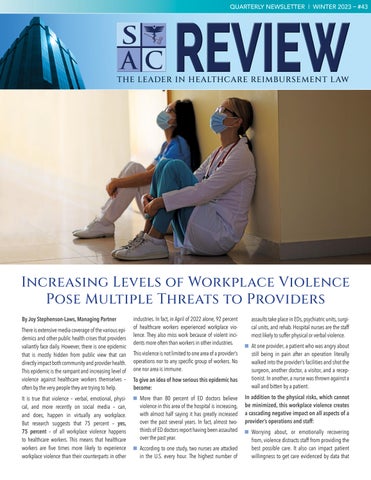
Increasing Levels of Workplace Violence Pose Multiple Threats to Providers By Joy Stephenson-Laws, Managing Partner There is extensive media coverage of the various epidemics and other public health crises that providers valiantly face daily. However, there is one epidemic that is mostly hidden from public view that can directly impact both community and provider health. This epidemic is the rampant and increasing level of violence against healthcare workers themselves – often by the very people they are trying to help. It is true that violence – verbal, emotional, physi cal, and more recently on social media – can, and does, happen in virtually any workplace. But research suggests that 75 percent – yes, 75 percent – of all workplace violence happens to healthcare workers. This means that healthcare workers are five times more likely to experience workplace violence than their counterparts in other
industries. In fact, in April of 2022 alone, 92 percent of healthcare workers experienced workplace violence. They also miss work because of violent incidents more often than workers in other industries. This violence is not limited to one area of a provider’s operations nor to any specific group of workers. No one nor area is immune. To give an idea of how serious this epidemic has become: ore than 80 percent of ED doctors believe M violence in this area of the hospital is increasing, with almost half saying it has greatly increased over the past several years. In fact, almost twothirds of ED doctors report having been assaulted over the past year. A ccording to one study, two nurses are attacked in the U.S. every hour. The highest number of
assaults take place in EDs, psychiatric units, surgical units, and rehab. Hospital nurses are the staff most likely to suffer physical or verbal violence. A t one provider, a patient who was angry about still being in pain after an operation literally walked into the provider’s facilities and shot the surgeon, another doctor, a visitor, and a receptionist. In another, a nurse was thrown against a wall and bitten by a patient. In addition to the physical risks, which cannot be minimized, this workplace violence creates a cascading negative impact on all aspects of a provider’s operations and staff: orrying about, or emotionally recovering W from, violence distracts staff from providing the best possible care. It also can impact patient willingness to get care evidenced by data that
suggest that when there is violence in the ED, patients may just leave without getting any treatment.
mental health disorders and economic issues into this equation, you get a volatile situation where violence is easily triggered.
L ess than optimum care can impact community health, which, in turn, can negatively affect everything from readmission rates to a provider’s reputation and rankings.
This situation is so dire that many, if not most, healthcare workers now believe that workplace violence is “just part of the job”. In fact, it is perceived as so common that many healthcare workers experiencing workplace violence don’t talk about it with colleagues or report it to provider administrations.
I ncreasing burn-out and emotional exhaustion of the staff can exacerbate turnover. This presents providers with human resources and financial management challenges given the cost of replacing staff and training their replacements. It also can impact productivity, recruitment, and retention.
What Providers Can Do
These are, in no specific order: C riminal actions such as a robbery or theft where the healthcare worker is not the target but is injured during the act. P atient-on-staff violence where the assaulter has some type of relationship with the provider such as a patient or family member who becomes violent during care. S taff-on-staff violence, for example doctor-onnurse, doctor-on-doctor, or nurse-on-nurse, which can include bullying, intimidation, and physical abuse. R elationship violence, where the perpetrator does not have a connection to the provider but rather to the victim of the violence and commits the act at the victim’s workplace. Research suggests that the second type of workplace violence (committed by patients, their friends or family) is the most common in a healthcare setting. This is not very surprising given the inherent stress, frustration, worry, anger, confusion, and heightened emotions inherent in receiving medical care and where receiving bad news is unfortunately common. If you add staff shortages,
R einforce and provide continuous training to de-escalation teams, and create them if they don’t already exist, to help reduce potential situations with patients, friends, family, and visitors. P rovide staff with multidisciplinary training on how to identify risks for workplace violence and how to reduce these risks including employing medical chaperones when appropriate and indicated.
A nother direct cost of workplace violence in healthcare is absenteeism. Estimates are this absenteeism costs providers over $53 million per year.
The best way to address and mitigate any ongoing problem is to look at its causes to identify possible remedies. The same is true for providers looking for ways to protect staff from workplace violence. The first is to look at the different types of workplace violence and to determine which are most prevalent in a healthcare setting.
Look at current floor and treatment area designs to ensure that staff will always have close, unencumbered egress in case of an emergency (this may be as easy as moving a nursing station away from a wall).
Of course, there is no simple nor “one size fits all” solution to workplace violence against healthcare workers, but some tangible steps providers can take include: E stablish a “zero tolerance” policy against any form of worker-on-worker workplace violence and provide training on this policy including how to identify risks and accessing support programs. Empower staff members to report all inci dents of workplace violence – both physical and verbal – to administration through staff training, confidential reporting, and internal communications. R eview current workplace wellness programs to help address the mental health and other causes of worker-on-worker violence. R eview current physical security measures on the provider campus and expand, if appropriate, to include both visible security (guards, doors, cameras, barriers) to deter attempts at violence as well as “invisible” security measures (panic buttons, staff location badges, check-in areas with secure access to treatment areas, fewer access points). R eview family/friend communication protocols for keeping them updated on patient status, for example when they are transferred to recovery from the surgical suite, to reduce stress and worry. Also provide effective communications training to patient-facing staff.
Consider establishing consequences for patients, relatives and visitors committing violence against provider staff (work with local law enforcement to see what recommendations they may have without necessarily having to immediately take a bereaved family member away in handcuffs). Reach out to community groups, nonprofit and business groups asking for support and participation in programs to reduce violence at hospitals and other healthcare locations. Despite its complexity and prevalence, providers can and should be taking steps to reduce and eliminate all forms of workplace violence. In doing so, they will be supporting their staff, the communities they serve and their own bottom lines.
EXCITING PARTNER ANNOUNCEMENTS
This quarter’s Spotlight is on Co-Managing Partner, Richard Lovich. What is your area of expertise within SAC? As Co-Managing Partner, I am a Jack of All Trades. I have been practicing law as a civil litigator and trial attorney for over 38 years, and have also managed law firms for 34 of those years, and thus developed a working knowledge of pretty much each nook and cranny of law practice.
What one piece of sage advice can you offer to our clients that can help them in the future? Trust but verify. Maintain a strong working relationship with payers until they prove that they are not your partner. A payer that allows a large, multimillion dollar inventory of unpaid or underpaid claims to develop and doesn’t institute effective remedial action is not your partner. You have rights under your hospital services contract and it is not an act of bad faith to insist that your rights be respected. Get paid for the work you do.
Barbara Lam Partner
Marcus Morrow Partner
We are excited to kick off 2023 with some well-deserved partner announcements.
We are proud to welcome Barbara Lam, Marcus Morrow, and Jennifer Jiao as our newest partners, who will be joining Founding and Managing Partner, Joy Stephenson-Laws, and Co-Managing
Can you talk about a recent success story of yours? What was the challenge and how were you able to overcome it? All of my successes are directly related to the work of our full SAC team. Covid presented many challenges to maintain the high standards of excellence we have established for over 30 years. Because of our top notch SAC team, across all departments, we were able to weather the storm and overcome the countless issues presented by sickness, remote work, and adapting to virtual meetings.
Do you have any hobbies or interests outside of work? I am still waiting for the call from the Dodgers to play center field, so I use much of my free time in batting practice. Some might see that as a bit of an unlikely occurrence, so I keep my options open. I love movies, from silents to film noir. Big Bogart fan, Buster Keaton, and Laurel and Hardy. I have a large baseball, Hollywood memorabilia, and autograph collection, and I love video games, especially Virtual Reality games. A common Saturday involves me landing on the moon with Neil Armstrong, touring the Titanic underwater, and saving the universe from zombie invasions. All in a day’s work. Music is also big, Elton John, Sam Cooke, Elvis, and Jerry Lee Lewis. I attended the iconic
Jennifer Jiao Partner
David Mastan Senior Partner
Partner, Rich Lovich along with Karlene Rogers-Aberman, David Mastan, Christopher Hapak, Shadi Shayan, and Charles Acquisto. They have consistently demonstrated their expertise and dedication to our clients, and we have no doubt that they will thrive in their new roles.
1975 Elton John concerts at Dodger Stadium, and recently closed the circle by attending his last concert in North America, also at Dodger Stadium.
Do you have any charitable causes that interest you and events you have participated in recently? I contribute to fundraising for homeless shelters and to wounded veterans.
Do you have family and/or pets you’d like to tell us about? I have five daughters and three grandchildren. All of my daughters are incredibly smarter than I am, and I am extremely proud and awestruck by them. My grandchildren are scary bright and will no doubt change the world.
Do you have any guilty pleasure television shows, movies or other activities to tell us about? I am a sucker for the comedic stylings of the Three Stooges, W.C. Fields, and Charlie Chaplin.
What are your favorite foods? Colors? Other favorites? My favorite color is heliotrope, I am a lifelong devotee of gefilte fish.
Karlene Rogers-Aberman Senior Partner
Christopher Hapak
Complex Litigation Partner
We would also like to congratulate David Mastan and Karlene Rogers-Aberman on being named Senior Partners and to Christopher Hapak on being named Complex Litigation Partner.
UPCOMING EVENTS:
March 15, 2023, Minnesota AAHAM Spring Conference, St. Cloud, MN Rich Lovich, Co-Managing Partner of SAC, will be delivering a virtual presentation at the Minnesota AAHAM Spring Conference on March 15th. His topic of discussion will be on payor contracting.
February 22, 2023, Managed Care Virtual Meeting
SAC Attorney Chuck Acquisto will be co-presenting at the South Carolina Hospital Association’s Managed Care virtual meeting. The presentation, entitled “Improving Managed Care Contracts from a Legal Eye View”, will provide insights and discussion opportunities for hospitals to address important questions. All articles are written by the SAC Litigation team. The SAC Litigation team includes attorneys, nurses and physicians with extensive experience in all areas of law related to healthcare matters. Additionally, SAC partners hold legal advisory positions with healthcare organizations and sit on the boards of numerous healthcare-related organizations, and monitor all outgoing SAC client marketing materials and related content.
DISCLAIMER: This newsletter is for general educational and informational purposes only. You should not act upon this information without seeking your own independent professional advice.
We would love to hear from you! If you have questions, comments or feedback, please email us at SACReview@sacfirm.com.
Northern California
Chicago, Illinois
5700 Stoneridge Mall Rd. Suite 35 Pleasanton, CA 94588 (925) 734-6101 – Main (925) 463-1805 – Fax
20 N. Clark St. Suite 3300 Chicago, IL 60602 (312) 636 1870 – Main (818) 559-5484 – Fax
5938 Priestly Dr. Suite 101 Carlsbad, CA 92008 (760) 201-4344 – Main (818) 559-5484 – Fax
303 North Glenoaks Boulevard Suite 700 Burbank, CA 91502
303 N. Glenoaks Blvd. Suite 700 Burbank, CA 91502 (818) 559-4477 – Main (818) 559-5484 – Fax
Quarterly Newsletter WINTER EDITION 2023 Enclosed
WWW.SACFIRM.COM
Southern California