Manifesto

Page 1

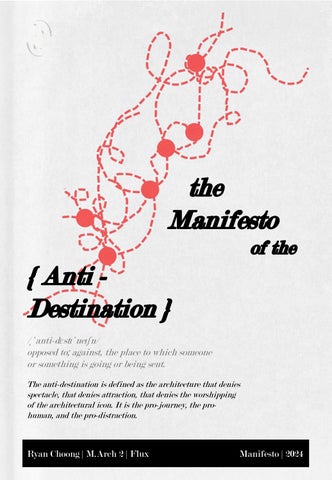
the Manifesto ofthe

{AntiDestination}

/ˌˈanti-dɛstɪˈneɪʃn/ opposedto;against,theplacetowhichsomeone orsomethingisgoingorbeingsent.

Theanti-destinationisdefinedasthearchitecturethatdenies spectacle,thatdeniesattraction,thatdeniestheworshipping ofthearchitecturalicon.Itisthepro-journey,theprohuman,andthepro-distraction.

Ryan Choong | M.Arch 2 | Flux Manifesto | 2024

1.TheMicroDeathoftheCity (Or,theDestinationCityproblem)

2.TheDestination (Or,theGod-IconofCityplanning)

3.LynchandJourney (Or,theCityasExperience)

4.TheLepakManifesto (Or,theMalaysianDerive)

5.TheArchitectureoftheAnti-Destination (Or,aCureforSpectacle)

6.TheArchitectureofWandering (Or,RestoringAimlessnesstotheCity)

7.ManifestoSummary (Or,thePath)

The Manifesto of the Anti-Destination | 2024
‘thecityisdead!
experience
destination!’
TheMicro-DeathoftheCity (Or,theDestinationCityProblem)
nolongerdowe
thecity! longlivethe

1 ‘people canonlyexperience thecityasthesumof its icondestinations’

{thedestinationcityproblem}

Thestateofour citiesisbecomingincreasinglydisconnected. Thisisduetothe biasofcityplanningasgravitatingtowards ‘destinationspaces’:spaces thatare iconic attractors that are ‘airlifted’ and inserted into a site. City dwellers are compelledtomove ‘to’pointsinthecity,butnever‘through’thecity. Aslongas thisparadigmexists,thecityiseffectivelydead;peoplecanonlyexperiencethe cityas thesum ofitsicondestinations: thecityofLondonbecomesBigBen& the LondonEye, thecity of Rome isjust the Colosseum & the Pantheon. The architecture of anti-destination seeks to defy this, by denying the worship of iconarchitecture,andbringingbackjourney&experiencetoourcities.

The Manifesto of the Anti-Destination | 2024
‘Thespectacle isthestageatwhich thecommodity hassucceededin totallycolonizing sociallife’

TheDestination

(Or,theGod-IconofCityPlanning)

The Manifesto of the Anti-Destination | 2024

TheCommodityasSpectacle

{readingsfrom‘TheSocietyoftheSpectacle’}

GuyDebordreferencesKarlMarx’s‘Capital,Volume1’inhisbook‘TheSociety oftheSpectacle’ . Marxstates that ‘commodities’are itemsthatare bought,and sold in an exchange, and thus have perceived value. Debord interprets the Spectacle as commodification of experience. Debord claims that commodities rule sociallife, and thuscommodity,image andproducts are seen as theonly things that are important(notexperience). TheSpectacle describes the human identification and obsession withimages,icons, and attractivebrandings. The Spectacle forces us to believe that appearances, commodity and thatproducts, commodityfetishismandsuperficialityisallthereis. And,bymakingusbelieve thattheSpectacleisreal,andistheonlyandmostdesirablethinginsociety,it becomes real. They can be seen as fanciful distractionsaway fromexperienced reality

The Manifesto of the Anti-Destination | 2024

TheSpectacle(space)

{spaceascommodityandspectacle}

From the understanding of The Society of the Spectacle as people’s obsession withimageryandcommodityfetishism,thesame istrueofspace. Weconstruct ourspaces as iconiclocations(suchas landmarkparksandclubs)thatdemand attentiontoa site. These‘Spectaclespaces’are iconicattractionsthatdistractus fromgenuinelyexperiencingjourneysthroughspace,byartificiallyinsertinga superficialiconina sitethatdemandsour attentionanddistractsfromit. Asa result, we only associate our spaces and our cities with thatsingular God-icon Spectaclespace. BecausepeopleareblindinglyobsessedwithSpectacle,theyfail toperceiveanyotherspace.

The Manifesto of the Anti-Destination | 2024

Spectacle(space)

/ˈspɛktəkl/

{spectaclespaceasicon}

Spectacle spaces are spaces that are primarily concerned with serving as attractive destinations. They demand the image of the city by overriding perceptionandsequence ofexperiencesbybecomingan over-poweringimagein the viewer’smind. Asa result,theyrarelycontribute to thesurroundingplace, andmerelyservesasanattractiveicon.

The Manifesto of the Anti-Destination | 2024

TheDestinationasSpectacle

{spectacleasanti-journey;destinationasspectacle}

Lastly,thedestinationcan beseen as a formofspectacle: thedestinationisthe iconic end-goal of people’s travel through a city. The destination is alldemanding,andthushijacksourexperientialjourneysthroughthecity. Bythis construction logic, architects harm our city experiences by creating sites and citiesthatcanonlybeexperiencedasthedestinationthatdemandsourattention ofit. Thiscauses us tosee citiesas destinationstogo‘to’,insteadofjourneysto behad‘through’thecity. Activityandattractionismovedaway fromthepublic realm of street space and cityscape, instead funneled into these, usually privatisedandformal,Destinationspaces. Welosetheabilitytoexperiencethe city‘as-is’;instead,obsessingoverdestinationstoreach.

The Manifesto of the Anti-Destination | 2024

{destinationasspectaclespace}

TheDestinationisdefinedas theendpointgoaloftravel. It,liketheSpectacle, isanall-demandingicon,andthatitsoverpoweringnaturehijackstheabilityof city dwellers to experience their journeys by being an obsessive icon. It is a powerfulend-imagethatcitydwellersassociateasbeingthesingularexperience and space, but in fact distracts them from experiencing meaningful journeys throughthecity.

The Manifesto of the Anti-Destination | 2024
/ˌdɛstɪˈneɪʃn/
Destination
‘The Destination istheantijourney, andthus theantiexperience.

{destinationastheanti-experience}

The destination is the obsession of people travelling to it, and by being an overpowering and all-important image, it stops the city dweller from experiencingthejourneythroughthecity. TheDestinationistheanti-journey, and thus the anti-experience. The idea of destination architecture is the ultimateenemy ofexperience. It is the God-icon ofcityplanning thatpeople worshipasifitistheonlythingthatonemustcareaboutinthecity.

The Manifesto of the Anti-Destination | 2024 2

Situationist

{situationistdiagram}

ThesituationistmapofParis,hererecreatedas amap ofMayfield,Manchester, shows the directional relations ofspace by thesituationist,bydrawing arrows depicting the direct paths through space to recognizable locations (Destinations).

The Manifesto of the Anti-Destination | 2024

Anti-Destination

{anti-destinationdiagram}

Understandingthattheanti-destinationManifestofocuseson thejourney,and not destinations, a recreated diagram visualises how the anti-destination Manifesto should beinterpreted: all focus isput on thejourney, thedirection, thearrow,thepath;thedestination,however,iscompletelydisregarded.

The Manifesto of the Anti-Destination | 2024

DestinationcanonlybeafteraJourney

{Thenatureofanti-destination}

Atthispointitisnecessary toacknowledgesome ofthecontradictorypointsof the anti-destination argument. In short, destinations in architecture, city planning, and urbanplanning are allowed under thisManifesto, but must be preceded by a journey. Destinations themselves are not a negative aspect, but Destinations withoutjourney are: Destination can only be allowed to exist as partofajourney. Adestinationas asinglepoint,insertion,andiconicstructure without theconsideration,design andplanningleadingup toit, and how that affects the city experience is the true anti-journey, and thus is why this Manifesto positions itself as ‘Anti-Destination’: this Manifesto is ‘AntiDestination-without-Journey’

The Manifesto of the Anti-Destination | 2024
‘Bythiswe meantheease withwhichitsparrs canberecognizedand canbe organized intoa coherent pattern’
The Manifesto of the Anti-Destination | 2024
LynchandJourney (Or,theCityasExperience)

LynchandJourney

{readingsfrom‘TheImageoftheCity’}

Kevin Lynch’s ‘The Image of the City’, writes the city as series of urban elements: path, landmark, node, district, edge. When we understand that Lynch’sworkwasdedicatedtotheway thatpeopleperceivespace,andthustheir cities,weunderstandthatLynch’surbanelementsaredescriptiveofasequential journeythroughthecity. Andhisdescribed‘imageofthecity’isproducedas a result of this journey through space. From this, we also understand that the ‘imageofthecity’(asdescribedbyLynch)isgivenrobustnessbybeingpartofa step-by-stepsequence, eachurbanelementbuildingupon theprevious. Thecity isexperiencedasifastoryline.

The Manifesto of the Anti-Destination | 2024

Journey

{JourneyasExperience}

The journey, is here defined as the process of travelling through space and places. Theenddestinationisconsideredsecondary. Ajourneyisonlyconsidered ajourneythroughthesequentialprocess thatdefinesit. Thismeans that‘travel to’doesnotserve thesamepurpose as a‘journeythrough’aspace, as a traveltoa placemaybeinterpretedasadirectlineofmovementtoadestinationpoint,and puts a lowemphasis on the sequence andprocess of travel. In a journey, the process of travel itself is emphasised over the destination. A journey is an experience had when moving through space. It is specifically not the direct travelfromoneplacetoanother.

The Manifesto of the Anti-Destination | 2024
ˈ ʒəː

3 ‘if destinationistheproblem, thenthejourney, astheoppositeof destination,isthe cure’

{journeyastheanti-destination}

If Spectacle space, as the destination, is seen as being detrimental to the experienceofspace, thenwe cannaturallyconcludethatthejourney,as a direct opposite to the destination, should be considered as the most conducive to reintroducing and improving the experience of space to people. The journey throughaspaceastheultimateexpressionofspatialexperience

The Manifesto of the Anti-Destination | 2024

DestinationPath

{diagramofdestination-goingpath}

The destination-going path is a pattern of monotone, one-direction, and thereforeone-notetravel,linearly,totheintendedpointofdestination. Theuser is focusedonly on reaching their endgoal, with no intention ofdeviating or exploringtheirsurroundings.(Essentiallyignoringthem)

The Manifesto of the Anti-Destination | 2024

JourneyPath

{diagramofjourneypath}

The journey path still reaches the destination, but includes the process of exploration, therefore allowing additional circumstances and encounters to occurinthepathandonthewaytothedestination. Thejourneypathbreaksthe monotonyofdestinationpathbyofferingdeviationandexploration.

The Manifesto of the Anti-Destination | 2024

TheLepakManifesto (Or,theMalaysianDerive)

The Manifesto of the Anti-Destination | 2024
lepakabit’
‘Nowdowhat?’ ‘Go jalan-jalan onlylah’ ‘Yeah,gothere

Lepak

{Lepak;Or,theMalaysianDerive}

The word Lepak (literally loiter) is a phenomenon of Malaysian walking/wandering culture that evades definition: it is the aimlessness of wandering, within a space (usually backalleys, marketstreets, or malls) with theimplicitunderstanding a ‘ Lepak’will lead to an experience ofchance, and that the Lepak is a search for this chance experience. This uniquely Asiandefined aspect of city-dwelling is an important parable in understanding the relationshipsand,morespecifically,thelackofLepak, thatplaguestheWestern city-dweller’sexperience. The exactaimlessness,chance, & wander ofLepak is theexactspiritwhichmustberevivedintheexperienceofWesternCityliving.

The Manifesto of the Anti-Destination | 2024
ˈ ɛ

Dérive

{LepakComparedto theSituationistDerive}

Thederive,as setoutbytheSituationistGuyDebord, isliterallytranslatedas ‘drift’,andisa methodof‘unplannedjourney’throughtheurbanenvironment. Deriveisusedas a vehicleforcounteractingthepredictabilityandmonotonyof everyday city experiences under capitalism. Comparing the Derive to Lepak draws several similarities. However, the Lepak differs in being a carefree journey, focused on the social activity of wandering and experiencing social encounters,whileDeriveisaconscientiousexplorationandobservationofspace. At itsbest, a Lepak becomessubconscious,carefree, and theLepak is itself a form ofsocializing, like a walk or shoppingtripalonghigh streets. Thekey differencebeing that this Asiatic variant of Derive has a high focus on social encounters,situations,andcommerce.

The Manifesto of the Anti-Destination | 2024
ʁ
‘activities areconsideredonlyan improvised/ impromptu by-productoftheLepak’

{whyLepakisimportant}

Theimportanceofaimlessnessliesinitsexploratoryandchanceencounters:the inception of a Lepak usually begins out of boredom, and a desire to go out, preciselywithno aim. TheexperienceofaLepakisbirthedfromthedynamism of encounters withshops, street markets, vendors, and other chance moments experiencedalong theway. Theimportance ofLepak is inproviding theCitydweller with a unique, non-repetitive, and always-dynamic avenue by which theycanexperiencetheirCity. Theactionsofpurchases,eatingandsocialising, areasecondaryresultcreatedfromtheimprovisationsoftheLepak. Thatis,the Lepak as improvisations which create social, commercial, and community activity. This is in directopposite to common sentiments that one goes out in search of these activities(socialisation, shopping,eating etc.). InLepak, these activitiesareconsideredonlyanimprovised/impromptubyproductoftheLepak.

The Manifesto of the Anti-Destination | 2024
4
5
‘TheabilityforLepakroutesto useblankspacesasan improvisedspace,withan impromptumannerofactivity andinteraction,iswhatmakes Lepakastrongactivator.’

{theinformalstreetandLepak]

Lepak routeshappen on thestreet, and the streetinformality is the factor of success for Lepak. Asian streets, shopping streets, and alleys are co-opted informally by local communities to create social spaces, street-side eateries, stallsforshoppingetc, inspaces thatwouldotherwisebeconsideredunattractive or uninhabitablebylargedeveloperswhoare more concernedwithDestination developments. The informal activity and hijacking of empty liminal space createsstreetactivityalongtheLepakroute,whichthenspiralsandcreateseven more activity in a feedback loop, turning a dead liminal space into a now bustlinghubofactivityintheLepakroute;Lepakas an activator. Theability forLepakroutestouse blankspaces asanimprovisedspace,withanimpromptu mannerofactivityandinteraction,iswhatmakesLepakastrongactivator.

The Manifesto of the Anti-Destination | 2024
‘Theresultingspaceisa uniquely human-basedspace, cateringto humanactivity’

{HumanscaleofLepak]

As previously established, Lepak usually occurs in alleyways, streets, and marketstreets: areas whichare uniquelyhuman-scaled. Theseareas may begin as inaccessibletovehicularaccess, or existinareas outsideofvehicularaccess, oraresimplyanimprovisedspace madefromaplotoflandconsideredtoosmall fora counciltooccupy/constructon. Therefore,a humanelementcanonlyenter and use that space. The resulting space is a uniquely human-based space, cateringtohumanactivity:as thedemographicsthatenteranduse thespace are designed and constructed tospecifically cater to a humanproportion, size and scale, ignoring the need for vehicular entry and servicing. The dynamism of Lepakactivityisalsoseen asoccurringinahumantimescale,astheexperience iscateredtoauniquelyhumanexperienceoftime: astheywalk,eat,orsit,and throughout an average (working) day. Here we understand the lepak as the uniquelypro-human;atahumanscaleinhumantime.

The Manifesto of the Anti-Destination | 2024
6
7
‘withsomany micro-destinations and micro-stimuli thatastraight-line, monotonouspathisan impossibility’

{theLepakandstimulus]

Lepak routes commonly occur along populated shopping streets, coffee shop routes,andbackalleysthatbecomeareas ofhighactivity:apracticethatshould be replicated to populate the emptiness of the Western city/street model. The highactivityandstimulusofthechaoticscrambleofmarkets,shoppingstreets, streetfood,andstreetsidegatheringspacesengagesuserssoheavilythattheycan become lost inspace, as they wander fromactivitypoint toactivitypoint, the lines and barriers between each blurred so much that they begin to form a continuousjourneywithouta clearbeginningor end. TheLepakistogetlostin the abundance ofactivity, with so many micro-destinations and micro-stimuli thatastraight-line,monotonouspathisanimpossibility.

The Manifesto of the Anti-Destination | 2024

TheArchitectureofthe Anti-Destination (Or,aCureforSpectacle) ‘Nomore chance encounters, nomore freeaction;allis pre-determined bythespectacle destination’

The Manifesto of the Anti-Destination | 2024

TheAnti-DestinationArchitecture

{understandingthearchitecturalproblemofDestination}

Citiesare currentlybeingdesignedwithon over-relianceon creatingattractive Destinations. This creates the problem of ‘Destination Cities’ whereby city planning becomes a series ofpointdestinations, with no connectiveactivity in the streets leading up to them. This creates an emptiness and placeless void space, wherecityplanningandarchitecturehasneglectedthesespaces. Suchis theproblemofDestination. TheManifestooftheAnti-Destinationcan alsobe interpretedas theManifestoofthePro-Journey. ThisManifestorepresentsthe guidelines by which a new architecture must be made to combat our current paradigmsofpro-destination,anti-journeyarchitecture.

The Manifesto of the Anti-Destination | 2024
8
‘createdanddesigned forpeopleas moving “through” thecity,not “to” alocation’

{through,notto}

The anti-destination manifesto emphasises the design of space as taking a person on a journey ‘through’ the city and not ‘to’ a singular location (Destination).; challenging the current monotony and straight-line nature of Destination-goingas thepatternofmovingfromonepointtotheother. Under thisManifesto,thenew architectureshouldbecreatedanddesignedforpeople asmoving‘through’thecity,not‘to’a location;tocreateajourneythroughspace tobeexperienced. Theprocess ofjourneythroughaspace isjustasimportantas theactivitythathappenswithintheenclosedcircuitwithina(closed)space.

The Manifesto of the Anti-Destination | 2024

9 ‘thedesignof howpeoplemovethroughspace isjustas important

asthe destination’

{designingjourney}

Thenewarchitectureshoulddesignnotjustthebuildingasdestination,butalso curateitsmovementandjourney,anditsrelatedjourneysgoingon arounditas part of the site’s context of journeys. Understanding that movement is inseparablefromarchitecture,becauseitisthevehiclebywhichusersperceive and experience space: that architecture should not be designed as a series of stops/views. Thatcitydesignshouldnotjustbecreatedasaseriesofdestinations, butthatthedesignofhowpeoplemovethroughspace isjustasimportantas the destination:asapathtobeexperienced,notachecklisttotickoff.

The Manifesto of the Anti-Destination | 2024
‘againstthe hyperfocused intentionality ofdestinationgoing’

{lingeringasentropy}

UnderstandingthatDestinationcreatesamonotonyofpeoplemovinginstraight linestoasingledestination,andnotactuallyexperiencinganyjourney. Thisis becausethenatureofDestinationscreatesanoverly-focused,one-trackintention and direction oftraveling to a certainpoint in thecity, withoutany room for exploration along its route. The Anti-Destination works against the hyperfocused intentionality of destination-going by introducing aimlessness, that takesaway fromthespecificfocusesoftravel,thusbringingahigherdynamism ofactivityandexperience.

The Manifesto of the Anti-Destination | 2024 10

11

‘tode

formalise space,whereby Destinationsareconsidered hyper-formal’

{informalspaceanddeformalisingtheformal}

TheAnti-Destinationalsoseekstode-formalisespace,wherebyDestinationsare consideredhyper-formal:theyarespaces thataredesignedforpeopletogoto,to followasetofruleswithin,tointeractwithitonlyinitsintendedfunction,and then to leave. In some cases, peopleprepare themselves indress,equipment or mentalitywiththespecificpurpose/intentofgoingtotheseDestinations,witha clear idea and expectation of the experience within. To de-formalise space means to introduceinformality: a sense of self-construction andimprovisation that comes with experimentation, improvisation of use, and freedom of experience. Thenew architectureshouldbeaccommodatingtoapproachesofall types,aswellasfromalldirections.

The Manifesto of the Anti-Destination | 2024
‘to give it more wonder’ (wander)

TheArchitectureofWandering (Or,RestoringAimlessnesstotheCity)

The Manifesto of the Anti-Destination | 2024

TheWanderer’sArchitecture

{bringingaimlessnessbacktothecity}

Understanding that cities are being produced as a result of Destination architecture,theAnti-Destinationarchitecturetakesplaceintheformthenew Wanderer’sArchitecture. As theopposite of Destination-going, the Wanderer’s Architectureshouldcelebratetheactivityofwandering,asopposedtothehyperintentionality of Destinations. It should occupy the space ‘other than’ Destination: whereby a Destination architecture builds monolithic structures, connected by roads, the Wanderer’s Architecture builds roads, connecting to monolithic structures (Destinations). Therefore, the Wanderer’s Architecture can beunderstoodas streetarchitecture,urbanplanning,citymasterplanning, andallotherarchitecturesthatsurround,andthusgivea sense ofplacetothe monolithic Destination architecture. It is theoccupation ofgaps in the urban fabric,andthusfillsintheblanksoftheDestination-citymodel.

The Manifesto of the Anti-Destination | 2024

12

Wandering istheprogram, activity, and objective

{theactivityofwandering}

Theactivityofwanderingas animportanthumanbasicactivityisundervalued inarchitecture. Forexample,architectureofwork,living,eating,commerce and evenbathingexist,recognisingthoseactivitiesasimportantbasiccore activities inhumanlife. Likewise,theactivityofwanderingmustberecognisedas a basic humanneed. Thevalueofwanderingas anactivityissimilartotheactivityof leisurelywalking(throughapark,orhighstreet). Itisaleisurelyactivitythat brings a sense of calmness, and freedom of expression in it. The need and objectiveoftheactivityofwanderingisthesame ashavingcityparks:allowing people to spend leisure time and simply exist. In the new architecture, wanderingistheprogram,activity,andobjective.

The Manifesto of the Anti-Destination | 2024

13 theaimlesswander isnotthesame astobelostinemptiness, ratheritisachosen andenjoyed carefreeexploration

{wanderingasbeinglost}

Akeydistinctionmustbemadethattheaimlesswanderisnotthesame as tobe lostinemptiness,ratheritisachosenandenjoyedcarefreeexploration. Thatis, aimlessness andwandering is a ‘chosenlostness’ . Forexample,one may just as easilywanderaimlesslyaroundanemptycityoremptyconcreteplaza. However, thisisan aimlessnessandwanderingthatisdrearyandunengagingtotheuser, withnothingtoexploreor experience. Thearchitectureofwanderingseeksfor theuser tochoosetogetlost,andenjoyitas anexperience. Theuser shouldfeel a sense ofgetting lost that is engaging and rewarding, not a sense of lost in emptyspace. Thearchitectureofwanderingisthatofdesignedwandering.

The Manifesto of the Anti-Destination | 2024

13

TheWanderas anewmethodfor interacting withthecity

{thenewmodelforcityinteraction}

Thecurrentcityfollowsapro-Destinationparadigm,thatnegativelyeffectsour experience of thecity. It isnecessary for a new city model to beproposed; one that defies the Destinationmodel, andproposes a new method for interaction withthecityinoppositionto Destination-going. Thenew modelofinteracting with thecity should be one thathighlights thespace ‘otherthan’Destination, one thatpurposefullyplacesa lowerimportanceon Destinationpoints,andthus encouragesinteractioninthestreets,andinterstitialspaces ofthecity. Thenew model should bring activity outside of Destination spaces, and thus its architecturaldesignshouldbeon thestreet,andaway fromDestinationspaces. Thenewmethodforinteractingwiththecitytakesplaceinthestreet,celebrates walkingandexploration,andprioritisesmovementthroughaspace ratherthen focusingon apre-determinedendgoalor location; allactivitythatcomes from this exploration should be considered as secondary, whereby the practice of explorationandmovementitselfbecomestheactivity,andallencounters,social situationsandstoppingmomentsaremerelyaby-productofwandering.

The Manifesto of the Anti-Destination | 2024

thespecificintent istohave

{theaimlessnessofwandering}

The aimless nature of wandering cannot be understated: the architectural activityofwanderingshouldonlybedefinedasimprovised;non-pre-determined, and aimless. By thisdefinition, we understand thatwandering comes from a desire for aimlessness, which is under-represented in our current capitalistic lifestyleswhichdemandstoomuchpurpose oftheaverageperson. Additionally, if we see that the Destination is a form ofpre-determinedintentionality and organization, we can surmise that journey is a form of aimlessness unintentionality anddis-organization. The new architecture seeks tochallenge the idea thatspace can only beexperience withplanned intent andcare, and thatsomehowaimlessnessinspace issomethingtobeavoided. Instead,thenew architecturecelebratesun-intentionality. Thus,tobetrulyanti-destination,the specificintentistohavenospecificintentwhenusingspace.

The Manifesto of the Anti-Destination | 2024 14
no
specificintent

15 torestore aimless-ness to space

{theneedforaimlessspace}

Theneedforaimlessspace istheultimateandfinalgoalofthemanifesto. The aimlessarchitectureprovidesan optionandavenue forcitydwellerstowander leisurely, as an expression of freedom of movement. It denies the idea of travelling ‘to’ an iconic destination in efficient, straight lines and without exploration. Humansshouldbeallowedtowander,explore,andmaketheirown destinationsandexplorevariedroutes;notthosethatarepre-determinedbycity planners and architects. Thatpeople should be allowed to meander and break themonotonyofmovementthroughthestreets,cities,andspace. Towanderisto acknowledge the idea thathumans, whenengaged andgiven a chance toplay andexplore, willalways choose that over the most efficientstraight line to a singlepointedlocation.

The Manifesto of the Anti-Destination | 2024
‘Thisis wander-ing manifest.’

ManifestoSummary (Or,thePath)

The Manifesto of the Anti-Destination | 2024

1

‘ peoplecanonlyexperiencethecityasthesum ofitsicondestinations’

2

‘TheDestinationistheanti-journey,andthus theanti-experience.

3

‘ifdestinationistheproblem,thenthe journey,astheoppositeofdestination,is thecure’

4 ‘activitiesareconsideredonlyan improvised/impromptubyproductofthe Lepak(wandering) ’

5

‘TheabilityforLepak(wandering)routesto useblankspacesasanimprovisedspace,with animpromptumannerofactivityand interaction,iswhatmakesLepakastrong activator.’

6

‘Theresultingspaceisauniquelyhumanbasedspace,cateringtohumanactivity’

7 ‘withsomanymicro-destinationsandmicrostimulithatastraight-line,monotonouspath isanimpossibility’

8

‘createdanddesignedforpeopleasmoving “through”thecity,not“to”alocation’

The Manifesto of the Anti-Destination | 2024

‘thedesignofhowpeoplemovethroughspace isjustasimportantasthedestination’

‘againstthehyper-focusedintentionality ofdestination-going’ 11 ‘tode-formalisespace,wherebyDestinations areconsideredhyper-formal’

‘Wanderingistheprogram,activity, andobjective’

‘Wanderingasanewmethod forinteractingwiththecity’ 14 ‘tochallengetheideathatspacecan onlybeexperiencedwithplannedintent’ 15 ‘torestoreaimlessnesstospace’

The Manifesto of the Anti-Destination | 2024 9
12
10
13

Conclusion(1)

{thedestinationproblem}

Toconclude,thismanifestoaimstobringawarenesstodesigners,architects,and cityplanners to thegrowing cause of concern that is the Destination(and the Destinationcity),ascreatingdisconnectedislandlocationswithinthecity,that harmtheexperiencesofpeoplethroughspace. ThephenomenonofDestinations createsanobsessive,hyper-focusedintentionalitytowardshowweperceivespace, and, like theSpectacle, therefore creates a hyper-reality of howspace and the city is observed: as we only see space as destinations to be ticked off of a checklist. The Destinationphenomenonputs blinders on us and overall harms our consumption andperception towardsspace thatonly Destinations matter, andthatthereisno chanceforexperienceoutsideoftheseDestinations. Given this paradigm, our society, city planning, and architecture will only drift further and further toward a city of Destinations, with emptiness and undesignedblankstreetsofliminalspaceconnectingthem.

The Manifesto of the Anti-Destination | 2024

Conclusion(2)

{restoringaimlessnesstospace}

This manifesto alsopreaches the aimlessness ofwandering as an antithesis to the intentionality of destinations. Aimlessness opposes the Destination by encouraging users to deny the hyper-specific, pre-determined and intentional travelfromonelocationtoaDestinationbyintroducinganaimlesswander,that takes the user on a non-pre-determined journey. The importance of bringing aimlessness back to the city gives people a vehicle to wander, and challenges preconceptions of how we should consume space: with wandering, we can perceive spaces as more than just singular destinations of specific function. Aimlessnessbrings freedom back to how we experiencespace and fills in the gaps between Destinations: wandering space seeks to enhance and provide contexttoDestinationarchitecture.

The Manifesto of the Anti-Destination | 2024

InterpretationsofAnti-Destination

{Author’sCommentary}

Itisimportanttoacknowledgeherethemany possibleinterpretationsofAntiDestination as a concept. TheLepak is an interpretation of Anti-Destination that,byhaving a multiplicity andintensity of varied activities andspaces, it interferes with Destinationspaces byforcing users to wanderaimlessly in an attractiveandengagingspacethatdisarmstheiroriginalfocusandintention,by offering an alternativepath. Theinverse,however, is also true: a space that is heavilydis-engagingandun-intenseinactivitymay alsocreatefeelingsofAntiDestinationbycreatingcalmnessandmeditation, thatthencauses a user tobe lostaimlesslyinapeacefulmoment. Forexample,situationistssuchas Debord have often praised superstructures (and not microstructures) as being most conducivetothederivemethodofwanderingduetotheirsheerscalecreatinga naturalsense oflostness. ItisimportanttorememberthatLepakisusedinthis Manifesto as a case study, but other interpretations of Anti-Destination as a concept, Anti-Destination design methods, and further implications are also possible. I am not suggesting that a recreation of Lepak should be the only methodtodesignagainstDestinations.

The
|
Manifesto of the Anti-Destination
2024

ContradictionsofSpectacle&Destination

{Author’sCommentary}

It is alsoimportant toacknowledge thecontradictory nature ofSpectacle and Destination spaces. For example, one could argue that, should any structure becomepopularenough, that it would become a Destinationby manner of its popularityandattractivenessas a landmarkor touristattraction. Whilethisis true,thepurpose ofthisManifestoisnottoeliminatethepresence ofSpectacle and Destinationspaces, rather it is to alleviate their over-imposing nature on theexperience ofspace through the introduction ofdesignedjourneyspaces & journey paths. This Manifesto necessarily denounces the Spectacle and Destinationspacesonlyastheypertaintothecreationofempty,blank,liminal or interstitial‘gaps’ in our cityexperience: if a Spectacle/Destination exists as partofaJourney,itisanacceptabledesign.

The Manifesto of the Anti-Destination | 2024

Definitions:

Spectacle(space)

Spectaclespacesarespacesthatareprimarilyconcernedwith servingasattractivedestinations.Theydemandtheimageof thecitybyoverridingperceptionandsequenceofexperiences bybecominganover-poweringimageintheviewer’smind’

Destination

TheDestinationisdefinedastheendpointgoaloftravel.Itis apowerfulend-imagethatcitydwellersassociateasbeingthe singularexperienceandspace,butinfactdistractsthemfrom experiencingmeaningfuljourneysthroughthecity.

Journey

Thejourney,isheredefinedastheprocessoftravelling throughspaceandplaces.Theenddestinationisconsidered secondary.Ajourneyisanexperiencehadwhenmoving throughspace.Itisspecificallynotthedirecttravelfromone placetoanother.

DestinationPath

Thedestination-goingpathisapatternofmonotone,onedirection,andthereforeone-notetravel,linearly,tothe intendedpointofdestination.Theuserisfocusedonlyon reachingtheirendgoal,withnointentionofdeviatingor exploringtheirsurroundings.

Lepak

ThewordLepak(literallyloiter)isaphenomenonof Malaysianwalking/wanderingculturethatevadesdefinition: itistheaimlessnessandnothingofwandering,withinaspace (usuallybackalleys,marketstreets,ormalls).

Derive

Thederive,assetoutbytheSituationistGuyDebord,is literallytranslatedas‘drift’,andisamethodof‘unplanned journey’throughtheurbanenvironment.

The Manifesto of the Anti-Destination | 2024

Bibliography

1.Debord,G.(1977)Societyofthespectacle.Detroit:Black andRed.

2.Lynch,K.(1977)Theimageofthecity.Cambridge, Mass:MITPress.

3.Marx,K.,Paul,E.andPaul,C.(1942)Capital.:Volume 1.London,NY:Dent;Dutton.

The Manifesto of the Anti-Destination | 2024
‘thecityisdead!

nolongerdowe experience!

longlivethe destination!

Howcanweexpecttoexperienceanythinginthe citywhenallweconstructaregod-iconbuildings?

{themicrodeathofthecity}

Thestateofour citiesisbecomingincreasinglydisconnected. Thisisduetothe biasofcityplanningasgravitatingtowards ‘destinationspaces’:spaces thatare iconic attractors that are ‘airlifted’ and inserted into a site. City dwellers are compelledtomove ‘to’pointsinthecity,butnever‘through’thecity. Aslongas thisparadigmexists,thecityiseffectivelydead;peoplecanonlyexperiencethe cityas thesum ofitsicondestinations: thecityofLondonbecomesBigBen& the LondonEye, thecity of Rome isjust the Colosseum & the Pantheon. The architecture of anti-destination seeks to defy this, by denying the worship of iconarchitecture,andbringingbackjourney&experiencetoourcities.

(fromchapterone)

Manchester School of Architecture 2024

Turn static files into dynamic content formats.

Create a flipbook