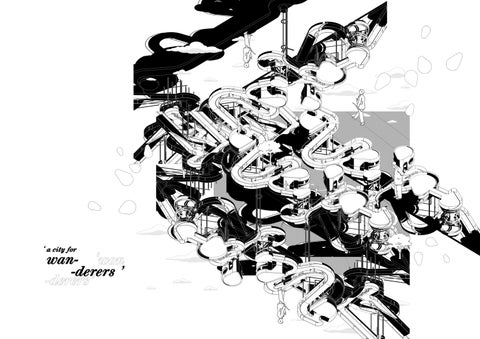
Thestateofourcitiesisbecomingincreasinglydisconnected.This isduetothebiasofcityplanningasgravitatingtowards‘destinationspaces’:spacesthatareiconicattractorsthatare‘airlifted’and insertedintoasite.Citydwellersarecompelledtomove‘to’points inthecity,butnever‘through’thecity.Aslongasthisparadigm exists,thecityiseffectivelydead;peoplecanonlyexperiencethe cityasthesumofitsicondestinations. {thedestinationcityproblem}
architecture
{theneedforaimlessspace}
The aimless architecture provides an option and avenue for city dwellerstowanderleisurely,asanexpressionoffreedomofmovement. It denies the idea of travelling ‘to’ an iconic destination in efficient, straight lines and without exploration. That people should be allowed to meander and break the monotony of movement through the streets, cities, and space. To wander is to acknowledgetheideathathumans,whenengagedandgivenachance toplayandexplore,willalwayschoosethatoverthemostefficient straight line to a single pointed location. Additionally, aimless space exists in between Destinations, and thus gives character a place,ratherthangivinglocationstoaplace.Theaimlessspaceis necessarytofillintheblanksaroundaDestination,andthusgive theDestinationcontext.
through pattern
{through,notto}
Theanti-destinationmanifestoemphasisesthedesignofspaceas takingapersononajourney‘through’thecityandnot‘to’asingular location (Destination).; challenging the current monotony and straight-line nature of Destination-going as the pattern of movingfromonepointtotheother.UnderthisManifesto,thenew architectureshouldbecreatedanddesignedforpeopleasmoving ‘through’thecity,not‘to’alocation;tocreateajourneythrough spacetobeexperienced.Theprocessofjourneythroughaspaceis justasimportantastheactivitythathappenswithintheenclosed circuitwithina(closed)space.
‘a waltz in the garden’ : ‘moments’
The scheme uses elevated walkways of varying playful heights and playful curves to take people through the garden space. The design is a play on the pathways moving through botanical gardens, here designed here to be raised off the ground
An example of an ‘isolation pod’ module typology. These pods provide an enclosed space promoting closeness with nature. The design plays on the ‘wonder’ of the scheme, providing a space for quiet contemplation and meditation, with nature.
The largest space of the ‘a waltz in the garden’ subsection of the scheme is a large open park space, providing an embracing grove that organically gathers people in its center, which is the crossing of several axes of travel through Mayfield.
‘a waltz in the garden’ : elevation
Elevation1of2showingtheelevatedgardenwalkways.Thissection ofgardenliesalongapieceofside-roadtothewestoftheDepotMayfieldsite.Thisisthefirstspaceinteractedwithwhenenteringthesite fromthesouth,onthesideofMayfieldpark.
key plan
‘a waltz in the garden’ : elevation
Elevation2of2showingthegatheringparkspace.ThissectionislocatedatthetriangularlottothefrontofDepotMayfield,facingPiccadillyStation.Thesiteliesatthecrossroadsofseveralmainroads passingthroughMayfield,andthusmakestheperfectgatheringnode inMayfield.
‘a waltz in the garden’ : plans
Roof plan delineating massing and layout of spaces, directions and networks of paths,andplacementoftreesandgrasslandthroughoutthegardens.Theplanalso showsaclose-upofsitecontext,withthetriangularandenclosingnatureofthe gatheringspaceshownbesthere.
Floorplanshowingtheinternalspacesofthescheme.Amajorityofspacesinthe gardenarepavilions,withopenspacessupportedbysteelcolumnsandbeamscreatingapermeablespace.Someenclosedroomsarepresenttoprovidemoreprivate spacesbywallingoffareas,curatingamoretranquilenclosurearoundthegardens.
‘a railway for people’ : ‘moments’
Here the winding and playfil nature of walkways through the scheme are best shown. Paths curve and diverge, creating non-linearity. The visual confusion is intentional: as users are not quite able to pick a path through the space, they are encouraged to approach and explore (to wander) to find their way. All the while, the path is still curated to lead people through the space.
Module ‘pods’ provide spaces that frame views throughout Mayfield for trainspotting, people watching and views of scenery throuhout Mayfield.
Conversation pits ‘deposit’ wanderers moving through the space, with views serving as the backdrop. The curved inward pit provides a comforting, enclosed space, which encourages the gathering, chatting and interaction of people within the space.
‘a railway for people’ : elevation
Longelevationshowingtheschemerestingonaplotofemptyspace along Piccadilly Station’s emerging railway tracks. The site runs parallel with Fairfield Street and is designed as an elevated walkwayalongFairfieldStreet,takingusersthroughMayfieldalongthat route,atanelevatedlevel.
‘a railway for people’ : plans
Roof plan showing massing and layout of spaces and overlapping floorplans.Thisplanalsobestshowsthelayoutofmodules,which neveroverlap/crossoverwalkways.Thisdesignshowsthe‘depositing’ and‘emerging’natureofmodulesandroomsas‘breakingout’fromthe gapsbetweenpathways:Anti-Destination,asthespacesareemergent ofthegapsbetweenmovementonly.
key plan
‘a
Floor plan showing internal layouts of pavilions and module ‘pod’ rooms. The pods and spaces are furnished with seating pointing inward,creatinga‘pit’-likeroomlayout.Thefloorplanalsoshowsgreen gardensinbetweenspaces,formingtheschemeintobothanelevated gardenaswellasawalkwayinfrastructure.
railway for people’ : plans key plan
‘a hill on the depot’ : ‘moments’
The design is made to mimic a hill, and thus a play on knolls & mounds of grass dirt and rock is designed in the form of seating spaces, playing on the ideas of picnicking and sitting on mounds as one hikes along a rolling park hill.
Long sight-lines and gentle curves, with a clearer visual focus contirbute to the scheme being more open, and having a more relaxed activity, creating a leisurely storlling experience.
Having open and wide field-like linear spaces provides the necessary space for exercise and play, such as games like tennis, frisbee, and even football.
‘a hill over the depot’ : elevation
Elevationshowingtheplacementofthe‘hill’alongtheDepot’scurrentlyunder-utilisedserviceramp.Thisschemeproposestheadaptive re-use and pedestrianisation of the Depot Mayfield’s Service ramp intoauseableparkspacealongtheramp.
key plan
‘a
hill over the depot’ : plan
Asimilardesignlanguageasusedinthe‘gardens’isrepeatedhere.The massingandlayoutofspaceshereismuchlighter,promotingamore open,linearparkspace.Mostspacesareconcentratedtotheeast(the bottom) of the ramp, where they can blend into existing buildings. Theplanlightenstowardthetopoftheramp,creatingan‘unfolding’, ‘lightening’and‘openingup’ofspacestowardtheupperlevels.
key plan
‘a bridge over the city’ : ‘moments’
The network of bridges crossing between Mayfield Depot and the railway forms the ground levels of Fairfield and Temperance street into a play on a canyon. This perspective shows the physical connectivity of the scheme spanning all across Mayfield, connecting spaces that once were once only visually connected.
This perspective shows the scheme as a footbridge crossing over the railway tracks below. The importance of the crossing being ‘over’ the tracks creates a freedom of movement, where crossing under the arches creates a tunnel vision and darkness, here the bridge spans between two worlds, crossing the ‘wall’ of the railway tracks.
Enclosed pods provide a resting area for people before crossing the bridge. Just as parks provide benches for rest, the vertical city-park should also provide sitting; here in the form of a sitting pod.
Elevation showing the way spaces sit along the side of the railway arches.Structuralcomponentssuchasheavybeamsandcolumnsare hiddenwithinsolidstructures.Firestairsandelevatorscarryperople verticallyupthroughthespace.Thewalled-offnatureofthearches isseenclearlyhere
key plan
‘a
bridge over the city’ : section
{sectionthrougharches}
Sectionshowingthewaythebridgesitsovertherailwaytracks.The archspacebelowboresthroughtheredbrick,whilethebridgeabove mimickthatcrossing,asanelevatedpath.
key plan
Roof plan of the footbridge section showing the layout of spaces at eitherendofthenarrowbridge.Here,thebridgelayoutcanbeseenin planasa‘connector’betweenTemeperanceStreettothesouthandthe Ancoatsareatothenorthofthebridge.Theabilityoftheschemeto cutacrossthe‘wall’oftherailwaytracksisseenhere.
key plan
Casestudysectionofonesetofmodules,showcasingthetypicalconstructionmethodstoberepeatedthroughoutthestructure.Thiscase studysectionappearsalongsection2:theelevated‘railway’.
key plan
Structuralconcreteflooringrestsonsteelfloordecking,withfloor beamsholdingupthewholestructure. {metaldeckfloorconstructiondetail}
{combiboardwallpanelconstructiondetail}
Combiboard wall panel construction uses only light vertical reinforcements to hold panels up, with horizontal reinforcements inserted in profile. Air holes are punched into the section as both structuralsupportandtolightenthepanel.BothinternalandexternalfacesofthepanelsystemaremadeofPVC.
{GRPfibreglassroofconstructiondetail}
GRPfibreglassroofingwithdecksupportoverthewallstructure. Edgetrimsrunsinfrontofthewallsurfacetoencloseandprotect theedgeconnectionbetweenwallsandroof.
Flux
{materialityvisualisation}
Thevisualisationshowsmaterialsappliedtostructureandcontext,to showtheschemeasbeing‘ofplace’fittingintocontext..Therenders representwhattheschemecouldlooklikeoncefullybuilt.
{theCityasaParkmodel}
Thelargestimplicationforthefutureofthefuturemodelisthe creation of a new city model: the City as a Park. It is a concept that posesaphilosophical&manifestoquestiontothearchitecturalandurbandesigncommunityatlarge:whyisitdrabtomove through the city? How do we break the monotony of city-movementandDestination-going?AndwhatifwedesignedtheCityas aPark?Thisschemepresentsthebeginningsofanewsetofrules fordesigningthecity,andthuscanbeappliedtovariousconexts notjustinMayfieldorManchester,buttocitiesaroundtheworld.