

C o-op Co-op C omments Comments

Unlock comfort and savings
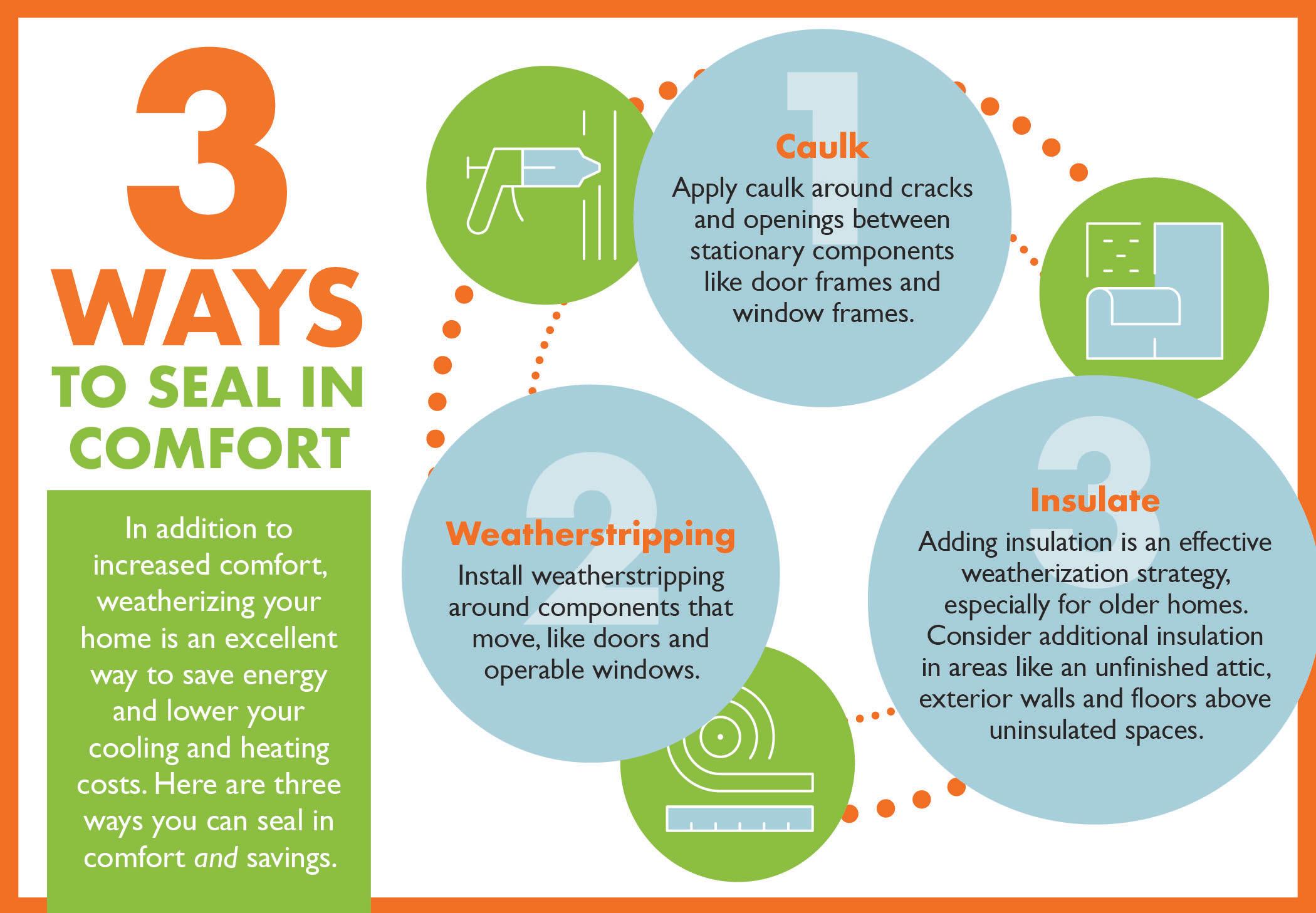
We typically think about weatherizing our homes during winter months when we are standing next to a chilly window or a drafty exterior door. But weatherizing your home provides comfort and energy savings year-round, especially during summer months when your air conditioner is working overtime.
According to energystar.gov, a home with insufficient insulation and air leaks wastes more than 20 percent of the energy used to heat or cool the home – essentially throwing money out the door. Fortunately, most weatherization projects are easy to DIY and can be completed in a day.
The simplest and most cost-effective weatherization strategies include air sealing around windows and exterior doors.
If you have older windows, odds are you have air escaping through tiny cracks and gaps around the frame. Do a quick visual inspection. If you can see any daylight around the frame or the windows rattle easily, you likely have air leaks. Also check for any small cracks around the frame which may not be visible with sunlight.
If you suspect you have leaky windows and plan to apply new caulk, be sure to remove the old caulk and clean the area well before application. Caulking materials vary in strength and properties, but you will likely need a half-cartridge per window.
Silicone caulk is a popular choice and can also be used to seal joints between bathroom and kitchen fixtures. If you have any leftover caulk, use it to seal those areas. Another effective but simple weatherization project is installing weather-stripping around exterior doors. The most common
types of weather-stripping options are Vchannel, felt and foam tape. To choose the best type for your home, consider temperature fluctuations and weather exposure. Most homeowners opt for felt or foam tape; both options are easy to install but will need to be replaced every couple years, depending on wear and tear. Weatherstripping should be installed around the top and sides of the door.
If you see daylight around the bottom of an exterior door, consider installing a door sweep in addition to weather-stripping. Door sweeps are available in aluminum, plastic, vinyl and felt options.
Another way to improve comfort in your home is adding insulation. While this is a more costly project and requires a
professional’s help, it is an effective way to decrease heat flow, which impacts energy use in winter and summer months. Older homes may need additional insulation to either replace older materials or meet newer efficiency standards. Contact a qualified installation specialist if you suspect your home’s insulation levels are inadequate.
The best way to identify air leaks in your home is a blower door test. A blower door test helps determine how airtight your home is and identify air leaks.
In addition to saving energy, air sealing can help you avoid moisture control issues, improve indoor air quality and extend the life of your heating and cooling system. Weatherizing will unlock year-round comfort and savings on monthly energy costs.
A newsletter for members of Rural Electric Cooperative June 2024
Unmask energy scams

Consumers with water, gas and electricity connections have long been targets for utility scams. But in today’s digital world, every swipe and click increases the risk of potential scams.
Scammers are more sophisticated than ever before, and they understand our increasing reliance on technology. With their sharpened digital knives, scammers have adapted their tactics to trick unsuspecting consumers through a variety of methods.
Scammers typically disguise themselves – either physically or digitally – as utility employees or representatives to steal consumers’ money or personal information. A common trick is to claim a consumer’s bill is past due and threaten to disconnect service if payment is not received immediately. Scammers approach consumers through a variety of means, including phone calls, text messages, emails and even in-person visits. However, the digital line of attack is increasingly more common.
For example, new capabilities disguising caller ID or “spoofing” can make the phone number you see on caller ID appear to be from a trusted source. Spoofing makes it easier for scammers to deceive you because it is more difficult to immediately verify the call. Another recent scam
uses fraudulent websites that are identical to a utility payment webpage – and what is worse, these pages are often promoted on search engines to trick consumers into clicking and making a payment.
Another recent scam involves phone calls, text messages or emails claiming you overpaid your electric bill and will receive a cash or banking refund. This is likely a scam aimed to steal your personal information.
There are several red flags you can watch for to identify an energy scam.
Scammers often use high-pressure tactics to create a sense of urgency, like claiming your electricity or other services will be disconnected if a payment is not made immediately.
Additionally, scammers may ask for unusual payment methods such as gift cards or cryptocurrency. If someone is pushing for an unusual payment method, it is likely a scam.
You have probably noticed many digital scams, like emails or text messages, include poor grammar, spelling errors and odd email addresses. These are red flags, so when you see these dodgy forms of communication, consider it a potential scam.
REC will never demand an instant, immediate payment and threaten to disconnect your service without prior notices or warnings. We strive to resolve challenging situations and work with our members to avoid disconnects.
Whether in-person, over the phone or online, always be suspicious of an unknown individual claiming to be an REC employee requesting banking or other personal information.
If you are ever in doubt about a potential energy scam, just give us a quick call at 405-756-3104 so we can assist. REC wants to help protect you and our community against utility frauds, and by notifying us about potential scams, you can create the first line of defense. We encourage you to report any potential scams so we can spread the word and prevent others in our community from falling victim.

June 2024
Co-op Comments
Official publication of Rural Electric Cooperative, Inc. CO-OP COMMENTS is owned, controlled and directed by Rural Electric Cooperative, Inc. It is printed monthly and mailed to members in Garvin, McClain, Comanche, Stephens, Grady and Carter counties in Oklahoma.
Rural Electric Cooperative, Inc. 13942 Highway 76 • P.O. Box 609
Lindsay, OK 73052 405-756-3104 • 800-259-3504
Outage Number: 855-399-2683
www.recok.coop
Board of Trustees
Gary Jones, President, District 1
Scott Christian, Vice President, District 1
Brent Bacon, Sec./Treasurer, District 1
Larry Anderson, District 2
Johnny Harrel, District 2
Terri Hays, District 2
Mark Finch, District 3
Randy Griswold, District 3
Sonny Harrison, District 3
Lisa Whitman, Attorney
Management and Staff
Dusty Ricks, Manager/CEO
Linda Ray, CFO
Kelli Lindsey, Administrative Assistant and Staff Coordinator
Elaine Gilreath, Manager of Customer Service and Data Processing
Jon Jones, Manager of Engineering
Mitch Gilreath, Manager of Information Technology Services
Eric Neill, Manager of Cyber Security and Special Projects
Megan Lawrence, Manager of Member Services and Marketing
Casey Henson, Manager of Safety and Loss Control/Facilities
David Crull, System Superintendent
Jason Mays, Operations Superintendent
2 Co-op Comments CEO’s MESSAGE
REC hosts art calendar contest
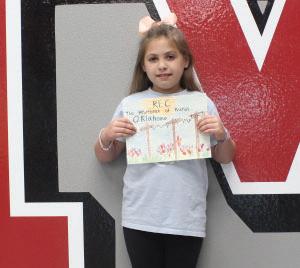
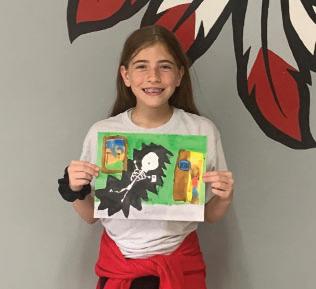
Recently, REC held its annual art calendar contest for students within REC’s service territory. The winning artwork submitted will be used in the calendar given to the members at REC’s 85th Annual Meeting.
Students from 12 schools: Bray-Doyle, Cement, Dibble, Lindsay, Maysville, Ninnekah, Paoli, Pauls Valley, Purcell, Wayne, Wynnewood and Whitebead submitted 188 entries. REC received submissions from students in first grade through 12th.
Entries needed to include a rural electricity theme and contain the letters REC. Students were allowed to use their desired medium on an 8 ½ x 11 inch paper.
REC had local artists:Valerie Beck and Jacquelyn Knapp anonymously select the winners for the contest. Beck is a former


art teacher and artist from Lindsay and Knapp is a Professor of Art and Coordinator of the Art Department at USAO in Chickasha. The judges selected the front cover art winner along with each month's winners. The cover art winner won $100 while the individual month winners won $50 each. 246000
The front cover art winner is Jesus Sifuentes from Pauls Valley. Monthly calendar winners include: Embree Mauldin from Whitebead, Lorali Howe from Lindsay, Lupe Charqueno from Pauls Valley, L'rae Pearson from Pauls Valley, Idona Navarro from Pauls Valley, Auri Crouch from Pauls Valley, Avril Brown from Pauls Valley, Dylan Rains and Jacelyn Watson from Lindsay, Presley Barnett from Pauls Valley, Kaci Jo Stephens from Dibble, Kaydance Brown from Lind-


Co-op Comments 3 CO-OP NEWS
say, Brooklyn Green from Pauls Valley and Tiffany Castro from Ninnekah.
Lindsay art winners.Pauls Valley Junior High art winners.
Ninnekah art winners.
Pauls Valley Elementary art winner.Whitebead art winner.
Dibble art winner.
FOR SALE: 30 acres with three-bedroom, one and a half bath, brick home, attached garage and an unattached additional two car garage with a loft and a fenced in backyard, $399,000. PH:405-344-7289.
Account number worth $10 bill credit
Locate your account number in an article of this issue; it will be good for a $10 credit on your electric bill. To claim the prize, you must locate the account number - if the number is yours, contact REC by the 10th of the month and we will credit your account. Only the member assigned that number is eligible for the prize. If you don’t know your account number, it can be located on your electric bill.
Co-op Connections
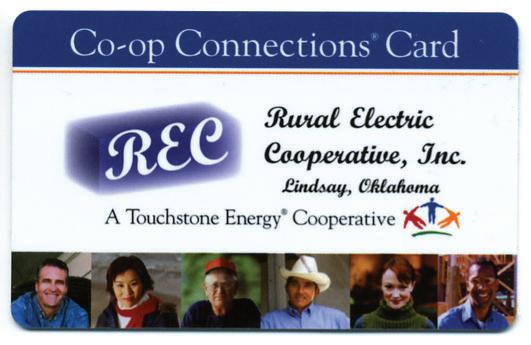
Use your Co-op Connections Card to save you money on lodging, photographs, oil changes and other items. You can also save on prescriptions, dental, vision, hearing, lab work and imaging and chiropractor services at participating locations. Your card is a discount card. If you have misplaced your card, contact REC for a replacement card and use it to save yourself some money.
Energy Efficiency Tip of the Month
Did you know ceiling fans can help you save energy? Ceiling fans create a windchill effect on your skin to make you feel a few degrees cooler. Raise the thermostat a few degrees and turn on fans to reduce air conditioning costs. Set fan blades to rotate counterclockwise during summer months and clockwise during winter months. Remember, ceiling fans cool people but don’t actually lower the indoor temperature. Turn them off when you leave the room. Learn more at www.energy.gov.
FOR SALE: Land in the Keechi area, 40 acre tract, Ninnekah school district, rural water, REC electric, excellent hunting plentiful, property sets on a dead end road, building site with grass for livestock. PH: 580-512-3096.
Classified Ads
are FREE to REC members to post non-commercial items. Deadline for ads is the 8th of every month. Call the Member Services Dept. at 405-756-3104 ext. 238.
Nominating Committee will meet in June
The 2024 Nominating Committee will meet in June to select candidates for Rural Electric Cooperative’s Board of Trustees. As defined in the Bylaws, the Nominating Committee will select at least three members: one from each district, as candidates for the Board of Trustees. These candidates names will appear on the official voting ballot for REC's members to vote on during Annual Meeting.
The Nominating Committee is made up of three members from each of REC’s three board districts. A minimum of one representative from each district must be in attendance at the meeting to constitute a quorum and conduct business.
Guidelines for nominations and election of trustees are contained in Article Three (3), Section Seven (7) of REC’s Bylaws. Copies of Bylaws are available upon request at REC’s headquarters.
Candidates for the Board of Trustees are voted on at REC’s 85th Annual Meeting Saturday, October 5, 2024. The meeting will be held in REC’s Multi Purpose Center located north of Lindsay on State Highway 76.
Additional nominations may be submitted by petition with any 50 or more members of the Cooperative, acting together, in writing over their signatures. Any such nomination shall list the candidate’s name with necessary signatures and be filed with the Cooperative at least 120 days prior to the Annual Meeting of the Membership.
A list of candidates nominated by the Nominating Committee and by petition shall be filed in the office of the Cooperative and posted at the main entrance of the Cooperative’s headquarters in Lindsay, Oklahoma at least 90 days prior to the Annual Meeting.
Local Co-op Connection Card Deals
A-U-Store It, Purcell -
$5 off first month rent
Backroads Boutique, Lindsay5% off everything excluding special order and sale items
Best Western, Chickasha15% Off Regular Room Rate
Blue Moose Portable and Septic Services, LLC, Elmore City5% Off Septic Tank Pumping, Tent Rental and Special Event Toilet Rentals
Chickasha Diesel Services, Chickasha$50 off any big diesel oil change
Edwards Canvas, Pauls Valley - 5% Off
Jenny’s Pics Photography, Lindsay10% Off $50 or More Purchase of Pictures
Lindsay Tire and Lube, Lindsay$5 Off Any Full Service Oil Change
M & M Furniture, Chickasha10% Off Any Purchase
Mazzio’s Italian Eatery, Purcell10% Off Purchase
Photos by Ginger, Pauls Valley1 Free 8x10 Print With First Order of $25 Pharmacy Discounts -
Check out the discounts available using your Co-op Connections Card at participating pharmacies throughout our area. For a complete list of pharmacies, visit REC’s website to see if your pharmacy is offering discounts to Co-op Connections Card holders.
Advertisement
Classified
Co-op Comments 4
REAL
ESTATE