FEATURE
Calf rearing passion brings southern options When it comes to a calf rearing business anyone brave enough to take it on can well feel they are at the riskiest end of the livestock industry. Costs are loaded upfront well before any income is received, market prices can shift between the start and end of the season turning budgets into fantasies, and animal health issues can send losses soaring. BY RICHARD RENNIE
But none of that stopped farming couple Brent and Susan McEwan from starting their calf rearing operation near Palmerston, East Otago from scratch. Three years on, their business Rednalhgih Udders is starting to see rays of success fall across it, and they can appreciate just how much they have achieved in a short time. No strangers to hard work, Brent and Susan purchased the 84ha property just over three years ago after they finished up a sharemilking contract in the Maniototo region. There they had been sharemilking 3,000 cows across three operations. The 23 staff they employed totalled more than the population of many of the district’s villages, and keeping the operation fully staffed and running smoothly was a constant juggling act for the couple. “We were both born on the Maniototo and it’s a great place, but it’s also a tough, cold one, and getting staff can be really hard to do.” Susan admits her passion had always been calf rearing, and by the time they left the region she
had regularly reared hundreds of replacements. It was a passion she discovered when the couple lived near Oamaru with her working for Reid Farmers Limited and Brent then driving trucks. “Rearing calves was a bit of a sideline for me. For Brent, he discovered his passion for dairying when I had some calves that needed to be paid for and in return the farmer asked us if we would milk over Easter for him—Brent was taken by it from the first time he did it.” Multiple sharemilking jobs and a careful eye on savings helped them build their equity, stepping
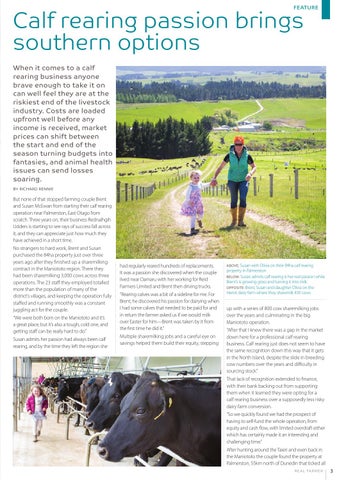
ABOVE: Susan with Olivia on their 84ha calf rearing property in Palmerston BELOW: Susan admits calf rearing is her real passion while Brent’s is growing grass and turning it into milk OPPOSITE: Brent, Susan and daughter Olivia on the Heriot dairy farm where they sharemilk 430 cows
up with a series of 800 cow sharemilking jobs over the years and culminating in the big Maniototo operation. “After that I knew there was a gap in the market down here for a professional calf rearing business. Calf rearing just does not seem to have the same recognition down this way that it gets in the North Island, despite the slide in breeding cow numbers over the years and difficulty in sourcing stock.” That lack of recognition extended to finance, with their bank backing out from supporting them when it learned they were opting for a calf rearing business over a supposedly less risky dairy farm conversion. “So we quickly found we had the prospect of having to self-fund the whole operation, from equity and cash flow, with limited overdraft either which has certainly made it an interesting and challenging time.” After hunting around the Taieri and even back in the Maniototo the couple found the property at Palmerston, 55km north of Dunedin that ticked all
RE A L FA RM E R
3
FEATURE the boxes for an operation, including being a size they could afford on their own. “We wanted a place that was close to the main road for calf delivery, had a northerly aspect to it and had good contour.” What they got was an ex-sheep property that at 84ha was too small to convert to dairying, on light soil with northerly facing paddocks that are ideal for keeping calves warm and dry. However it was only split into 12 paddocks and the couple needed about 60 to ultimately handle the 3,000 calves they reared that first year. “We had a great team of fencing contractors, they would ask me ‘how many paddocks do you need today?’ and I would tell them five, and by the end of the day I would be putting the calves into these new paddocks, just as they were hanging the gates.” It was a tough first year with troughs not hooked up they had to be filled by hand out of a 20mm hose dragged around. Races were not sealed and rearing sheds were pitched up in rapid time, staring on July 27, and by August 12 all three new sheds were full of calves. “The support we had from the local community here was wonderful, they welcomed us and helped us wherever possible, they could see the value in having a business like this and did all they could to help us make it happen.” Feeding was not as refined as it is now, with 60 mobs of calves fed using four mobile towed feeders. At the end of that season the McEwan’s travelled to the North Island on an ideas trip, gathering hints and layouts from some large scale operators there. “One of the best ideas we saw was someone feeding all their calves in one place on a concrete pad from a fixed feeder. We headed home, gutted the sheep yards and concreted an area and set up four 15 teat feeders with a view of ensuring ‘every calf every day’ got the feed it should get.” BELOW: Distance is the sacrifice for Susan with Olivia and husband Brent who sharemilks on a property two and a half hours away
They set up two training paddocks to funnel calves to the feeding pad, after spending their first three weeks inside the sheds. “It initially takes three days to train them to come in, but after that they are away with one of us bringing the calves in, while the other supervises the feeding.” Brent and Susan incorporated a straight feed system rather than the traditional circular pattern, rotating calf mobs back and forwards similar to a herringbone dairy shed. “Having the calves come out means we see each calf moving every day—if a calf does not come out of its paddock, you know there is something wrong, and they will end up in the ‘sick shed’.” That is split into seven pens for every day of the week, with a record kept of treatments and recovery. “Basically if they are not right by the end of day seven they will never be right. It is an efficient way to remove any sick animal and any possible infection from the main mobs. Meantime having two people feed the calves every day means even if one of us has an off day, the other is likely to spot anything that is wrong.” It is a low margin, high number business to succeed, with Susan feeding once a day and targeting a six week period to get calves to weaning weight of 70kg. To help get the business on a sound cash flow footing Brent opted this year to take up a sharemilking job on a 430 cow farm two and a half hours south at Heriot (see accompanying article). For Susan this has meant even greater reliance upon her good friend and employee Jodie Kemp to help rear this season’s 1,500 calves. “Jodie loves the calves as much as I do, and she is absolutely critical to the operation here with Brent away.” They also have two part time workers to help with feeding the 1.5 tonne a day of meal the calves need plus all the straw, lucerne baleage and every day calf jobs Another vital part of her team this year has been the support received from calf nutritionist
Dr Bas Schouten and Sloten Sprayfo whey based milk powder distributor Warren Tanner of Agri-vantage. “Bas’s advice this year has made a lot of difference— he recommended we add straw to the calves’ diet, along with lucerne balage into the calves’ feed along with pellets. On cold days they really hoe into the straw, and the lucerne is an excellent source of protein, coming out of Central Otago.” She says ATS also played a big part in helping out this season. When their previous supplier couldn’t accommodate their needs on their massive powder purchases, things were looking grim so they looked elsewhere for an alternative. “But our Methven calf client put us onto ATS who said they would be happy to assist on our powder purchase, and that made a huge difference, it would be hard to operate without that.” Susan’s aim is to get the calves as accustomed to a pasture type diet well before being sold on, avoiding the transitional growth check that so often sets calves back by 10kg or more when they hit pasture at their new home. While the numbers of calves reared can seem dizzying, the quality of care they get is closer to individual treatment than many ever get on smaller operations. Susan and Jodie weigh the calves as often as twice a week to monitor growth rates from 50kg onwards. They are mobbed in similar weight bands and once outside after three weeks inside receive a lined canvas cover to help preserve body heat and therefore maintain weight gain. “Bas has said a Friesian calf will start to shiver at about 9-11C, and if they are then their growth rate can drop right back to less than 200g a day, we need them to be achieving 600g a day, and there are plenty of days the temperature does not get over 10ºC.” Susan believes the colder temperature regime helps keep the bugs and infections common in calf operations up north to a minimum, and
4
RE AL FARM E R
FEATURE
With Brent contracted for another season in Heriot after this one Susan is also considering her options as the operation starts to come into its own. That includes possibly rearing autumn born calves, splitting the work load (and cash flow) more evenly through the year. Contract rearing calves for dairy farmers who lack the skilled staff to do it themselves could also be another option. With four leased blocks also running bull beef her day is a full one, with an early start that has her accompanied by their four year old daughter Olivia. summer’s high temperatures help bake off any lingering infection risk, helped by the dry Otago climate. “We are also very conscious of hygiene, with every pen sprayed out with Virkon every second day, we use river stones in the pen, the sheds are purpose built and we are pretty strict about what weight of calf we accept to rear.” They have a 40kg cut off weight for taking calves to rear, something that took a while to be accepted by farmers and agents, but one that ensures she can meet their six week weight targets, and ensure the final weaned calf is one they are happy with. “We have to have them at 100kg by 12 weeks. We also keep traumatic events like de-budding limited to one event at a time. Touch wood, we have had no infection issues over the three years.” The catchment for the McEwans sourcing calves stretches from Ashburton to Dunedin, and they are the southern rearers for 500 of Fonterra’s export heifer trade. A large bull farming client in Methven also contracts to buy 600 Friesian bull calves, appreciating the consistent quality that ensures he can finish the calves through to 16 months. She admits getting the numbers this year has been trickier, in part she thinks because dairy farmers have bobbied more calves in the tougher payout season, but those calves have come in heavier at 44–47kg.
“I can see now how the really tough early days have bought us to a point where the business is going well—I think we have something to offer the South Island and its farmers, and it’s something I am absolutely passionate about.”
A long distance farming affair There would be few farming spouses who would tolerate their partner shifting 2.5 hours away to run another farm, only able to visit between milkings once a week. But that distance is the sacrifice Palmerston farming couple Brent and Susan McEwan made in July this year to make their future more secure, and pursue their respective passions. The McEwans committed everything they had to their Palmerston calf rearing business, with limited bank support they have had to self-fund the operation into the success it is today. But Susan admits the calves are also her real passion, while Brent’s is growing grass and turning it into milk. “I know Brent would have happily stayed in the Maniototo milking, but he also appreciated how committed I was to making this business work, despite not being a big fan of rearing calves himself.” says Susan. Two years into the rearing business they have managed to find a compromise that fits,
ABOVE: Susan and Brent are very conscious of hygiene with every pen sprayed out every second day and the use of river stones in the pens LEFT: The McEwan’s now feed all of their calves in one place on a concrete pad from a fixed feeder
even though it has involved Brent taking up a sharemilking position on a 430 cow farm at Heriot, 2.5 hours south. Susan admits it was “a bit weird” at first seeing her partner and husband of 23 years drive off to a new job without her, but they have managed to carve a routine out for their individual weeks’ work, with Brent making it home once a week to see her and daughter Olivia. “He is on a 16 hour milking routine, so if he gets up here at 9.30pm he can get Olivia off to kindy and does not have to leave until 10am. It won’t be long before we are able to go down and see him in the weekends too.” She admits they did it tough over late winterearly spring when neither saw the other for eight weeks as their respective operations got into full swing through calving. But the extra income Brent’s position generates is invaluable in putting their business onto a sound footing, given the inherent risks that calf rearing businesses face every season. “Even though dairying is going through a bit of a down patch, that extra income is enough to really make a difference.” She admits she misses him the most for tasks she calls the “blue jobs”, including recently having to make the decision to shoot a horse, and for certain tractor jobs. Meantime, to mark the months of their long distance marriage and much to the delight of Olivia, Susan is dyeing her hair a different colour every month they are apart—so far she has worked through shades of pink, green, blue and orange. “I am working my way through them, and promised him I would have a rainbow of them in May, to mark our first year!”
RE A L FA RM E R
5