Mercury - Bernabe Demurrer

Page 1


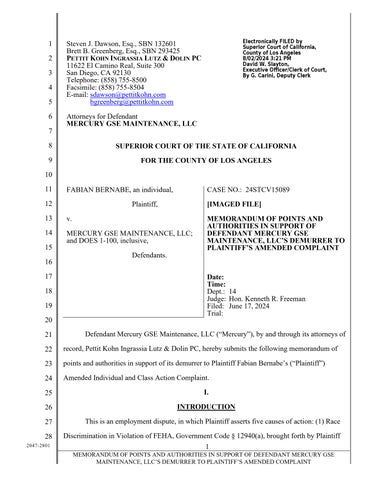
Steven J. Dawson, Esq., SBN 132601

Brett B. Greenberg, Esq., SBN 293425

PETTIT KOHN INGRASSIA LUTZ & DOLIN PC

11622 El Camino

Telephone: (858) 755-8500

Facsimile: (858) 755-8504

E-mail: sdawson@pettitkohn.com bgreenberg@pettitkohn.com

Attorneys for Defendant MERCURY GSE MAINTENANCE, LLC

SUPERIOR COURT OF THE STATE OF CALIFORNIA

FOR THE COUNTY OF LOS ANGELES

FABIAN BERNABE, an individual, Plaintiff, v. MERCURY GSE MAINTENANCE, LLC; and DOES 1-100, inclusive, Defendants.

CASE NO.: 24STCV15089

[IMAGED FILE]

MEMORANDUM OF POINTS AND AUTHORITIES IN SUPPORT OF DEFENDANT MERCURY GSE MAINTENANCE, LLC’S DEMURRER TO PLAINTIFF’S AMENDED COMPLAINT

Date: Time: Dept.: 14

Judge: Hon. Kenneth R. Freeman Filed: June 17, 2024

Trial:

Defendant Mercury GSE Maintenance, LLC (“Mercury”), by and through its attorneys of record, Pettit Kohn Ingrassia Lutz & Dolin PC, hereby submits the following memorandum of points and authorities in support of its demurrer to Plaintiff Fabian Bernabe’s (“Plaintiff”)

Amended Individual and Class Action Complaint.

INTRODUCTION

This is an employment dispute, in which Plaintiff asserts five causes of action: (1) Race Discrimination in Violation of FEHA, Government Code § 12940(a), brought forth by Plaintiff

individually against all Defendants, (2) Failure to Prevent Discrimination in Violation of Cal. Gov. Code § 12940(k), brought forth by Plaintiff individually against all Defendants, (3) Wrongful Termination in Violation of Public Policy, brought forth by Plaintiff individually against all Defendants, (4) Violation of Cal. Bus. & Prof. Code § 16600, et seq., brought forth by Plaintiff and each member of the putative class against Mercury, and (5) Violation of Cal. Bus. & Prof. Code § 17200, et seq., brought forth by Plaintiff individually against Mercury.

Mercury now demurs as to both the Fourth and Fifth Causes of Action on the grounds that Plaintiff fails to allege sufficient facts to state a claim. Specifically, Plaintiff cannot allege that Mercury’s non-solicitation of employees provision in its confidentiality agreement constitutes a noncompete clause or even that it currently applies to him in the first place, which would afford him the necessary standing to bring his claims. Consequently, the Court should sustain this demurrer without leave to amend.

II.

PROCEDURAL HISTORY & MEET AND CONFER EFFORTS

On June 17, 2024, Plaintiff filed an individual and class action complaint against Defendants, asserting the above causes of action. On June 21, 2024, Plaintiff filed an Amended Individual and Class Action Complaint (the “FAC”) asserting the same causes of action. (Declaration of Brett B. Greenberg (“Greenberg Dec.”) ¶ 3, “Exhibit A.”)

On July 16, 2024, in an attempt to avoid the necessity of this demurrer, Mercury’s former counsel sent a meet and confer letter to Plaintiff’s counsel, detailing Mercury’s concerns regarding Plaintiff’s Fourth and Fifth Causes of Action now addressed herein. (Greenberg Dec. ¶ 4, “Exhibit B.”) On July 17, 2024, Plaintiff’s counsel responded via email, expressing Plaintiff’s unwillingness to amend these causes of action. (Greenberg Dec. ¶ 5, “Exhibit C.”)

Mercury has therefore satisfied its obligation pursuant to California Code of Procedure section 430.41 to meet and confer in a good faith attempt to obviate the need to file a demurrer. However, in light of Plaintiff’s unwillingness to amend the FAC, Mercury is left with no choice but to demur as to the Fourth and Fifth Causes of Action

RELEVANT FACTUAL BACKGROUND

Plaintiff was employed with Mercury from November 8, 2021 to January 19, 2023. (FAC at ¶¶ 9, 16.) At or around the time Plaintiff was hired, Plaintiff allegedly signed Mercury’s Confidentiality Agreement (“Confidentiality Agreement”), which contained the following provision regarding the non-solicitation of employees, consultants, contractors, or suppliers (“Employee Non-Solicitation Provision”):

“To the extent permitted by law, Employee agrees that during Employee's employment with the Company and for a period of 12 months immediately following the termination of Employee's employment with the Company for any reason, whether initiated by Employee or the Company, Employee shall not, directly or indirectly, solicit or induce or attempt to solicit or induce any of the Company's employees, consultants, contractors or suppliers to leave their employment or engagement with the Company, or otherwise interfere or attempt to interfere with the Company's relationship with any of its employees, consultants, contractors or suppliers.” (FAC at ¶ 50 (emphasis added).)

Plaintiff alleges that this provision is an unlawful under California Business and Professions Code § 16600, et seq. (FAC at ¶¶ 48-49.)

However, Plaintiff alleges no facts demonstrating how the Employee Non-Solicitation

Provision restrained him from his engaging in his profession in any way. Furthermore, per the above language, the provision applied to Plaintiff only through January 19, 2024, after which time it had no bearing on him whatsoever. Nevertheless, on behalf of himself and the putative class of other employees of Mercury, Plaintiff filed his complaint nearly five months later on June 17, 2024 (and his FAC on June 21, 2024) perplexingly seeking injunctive relief regarding a provision that no longer applied to him.

Additionally, despite offering no facts to show that the Employee Non-Solicitation

Provision restrained him from engaging in his profession or served as a “de facto non-compete” (FAC at ¶ 52), and despite the provision having already expired/being void as to him as of January 19, 2024, Plaintiff alleges that Mercury somehow violated Cal. Bus. & Prof. Code § 16600.1 (and thus Cal. Bus. & Prof. Code § 17200, et seq.) by not notifying him by February 14, 2024 that the above provision was void (id. at ¶ 58-59).

///

LEGAL STANDARD

A party against whom a complaint has been filed may object by demurrer on the grounds that the pleading does not state facts sufficient to constitute a cause of action. (Code Civ. Proc., § 430.10.) The court may disregard and ignore contentions, deductions, and conclusions of fact or law stated in the complaint. (Picton v. Anderson Union High School District (1996) 50

Cal.App.4th 726, 732-733.) “Doubt in the complaint may be resolved against plaintiff and facts not alleged are presumed not to exist.” (C&H Foods Co. v. Hartford Ins. Co. (1984) 163

Cal.App.3d 1055,1062.) A party may not avoid a demurrer by suppressing facts that prove the claim meritless. (See Larson v. UHS of Rancho Springs, Inc. (2014) 230 Cal.App.4th 336, 344345.) A demurrer should be granted without leave to amend if a plaintiff cannot possibly amend a complaint to state a cause of action. (CAMSI IV v. Hunter Technology Corp. (1991) 230 Cal.App.3d 1525, 1538-1539.) The plaintiff bears the burden of showing that a defect can be cured. (Id. at 1539.)

V.

LEGAL ARGUMENT

A. Fourth Cause of Action – Violation of Cal. Bus. & Prof. Code § 16600, et seq.

Plaintiff alleges that Mercury’s Employee Non-Solicitation Provision constitutes a noncompete provision in violation of Cal. Bus. & Prof. Code § 16600, et seq. However, Plaintiff fails to allege sufficient facts to state a cause of action pursuant to § 16600 for the following reasons: (1) as a threshold issue, Plaintiff lacks standing because the provision at issue had already expired/was void prior to his bringing his action, (2) employee non-solicitation provisions, such as Mercury’s, are consistently upheld under California law, and (3) Plaintiff alleges zero facts to show that he is/was restrained in his ability to engage in his profession and therefore cannot demonstrate that the provision constitutes an unlawful noncompete clause. Thus, Plaintiff’s cause of action fails and a demurrer should be sustained without leave to amend.

1. Plaintiff Lacks Standing Because Defendant’s Employee Non-Solicitation Provision Already Expired Prior to Plaintiff’s Filing his Action

“In general, a named plaintiff must have standing to prosecute an action. (Code Civ. Proc., § 367 [“Every action must be prosecuted in the name of the real party in interest, except as otherwise provided by statute.”].) ‘Standing is typically treated as a threshold issue, in that without it no justiciable controversy exists.’” (CashCall, Inc. v. Superior Court (2008) 159 Cal.App.4th 273, 286 [71 Cal.Rptr.3d 441], citing People v. Superior Court (Plascencia) (2002) 103 Cal.App.4th 409, 420 [126 Cal. Rptr. 2d 793].) A plaintiff lacks standing to seek injunctive relief under Cal. Bus. & Prof. Code § 16600 if the plaintiff does not stand to benefit therefrom. (Fisher v. CRST Van Expedited Inc. (C.D.Cal. May 4, 2016, No. EDCV 15-878-VAP (SPx)) 2016 U.S.Dist.LEXIS 200579, at *18-19.) For class action matters, “the named plaintiff must be a member of the class he or she purports to represent.” (CVS Pharmacy, Inc. v. Superior Court (2015) 241 Cal.App.4th 300, 307 [193 Cal.Rptr.3d 574].)

Assuming Plaintiff’s own allegations as true, Plaintiff does not have standing to assert a violation of Cal. Bus. & Prof. Code § 16600 or § 16600.1 or seek injunctive relief thereunder. Specifically, Plaintiff’s employment with Mercury ended on January 19, 2023, such that the Employee Non-Solicitation Provision was no longer in effect as of January 19, 2024. However, Plaintiff did not file his complaint until June 17, 2024, and his FAC until June 21, 2024 – over five months after the Employee Non-Solicitation Provision expired. Therefore, Plaintiff is not subject to the provision, and he was not when he filed the complaint/FAC 1

As Plaintiff stands to gain nothing from the injunctive relief he seeks, he lacks standing to assert this cause of action on his own behalf or on behalf of the putative class, whose interests he cannot adequately represent.

///

1 Moreover, Plaintiff does not even have standing to allege a violation of the February 14, 2024 notice requirement of § 16600.1(b), which he alleges as part of his Fifth Cause of Action Per the statute, this deadline served to provide notice that noncompete clauses were void. However, the Employee NonSolicitation Provision is not a noncompete clause (see Section A2 below), and by that date, Plaintiff’s provision had already expired and was already void anyway, meaning it was not subject to this deadline (see Section B below).

2. Employee Non-Solicitation Provisions are Consistently Upheld as Enforceable by Law in California

While Cal. Bus. & Prof. Code § 16600.1 prohibits noncompete clauses in employment contracts, contrary to Plaintiff’s baseless allegations that Mercury’s Employee Non-Solicitation Provision constitutes a noncompete provision, California courts consistently uphold the enforceability of provisions regarding the non-solicitation of the employer’s employees. (See, e.g., Loral Corp. v. Moyes, (1985) 174 Cal. App. 3d 268, 279-280 [holding that a one-year posttermination employee non-solicitation provision did not violate § 16600 because “[t]he restriction presumably was sought… in order to maintain a stable work force and enable the employer to remain in business” and had “no overall negative impact on trade or business.”], see also Barker v. Insight Global, LLC (N.D.Cal. July 24, 2018, No. 16-cv-07186-BLF) 2018 U.S.Dist.LEXIS 123896, at *22-26, [considering numerous decisions 2 to hold that an employee non-solicitation provision is valid – and not an unlawful noncompete provision.])

As the above employee non-solicitation provisions were enforceable by law, Mercury’s Employee Non-Solicitation Provision is enforceable as well. Moreover, Mercury’s Employee Non-Solicitation Provision is limited in scope on its face, applying only “[t]o the extent permitted by law…” (FAC at ¶ 50, emphasis added.) Therefore, it is necessarily no broader than California law permits. Mercury’s Employee Non-Solicitation Provision thus cannot constitute an unlawful noncompete clause and Plaintiff’s cause of action fails.

3. Plaintiff Fails to Allege Any Facts Showing that the Employee NonSolicitation Provision Restricted him in any Way

Particularly against the background that California law permits employee non-solicitation provisions, Plaintiff fails to allege any facts whatsoever to even suggest that the subject Employee

2 In making its ruling, the Court considered the following decisions: “Hendrickson v. Octagon Inc., 225 F. Supp. 3d 1013 (N.D. Cal. 2016); Sonic Auto., Inc. v. Younis, No. 15CV00717, 2015 U.S. Dist. LEXIS 190427, 2015 WL 13344624 (C.D. Cal. May 6, 2015); Arthur J. Gallagher & Co. v. Lang, No. C 14-0909, 2014 U.S. Dist. LEXIS 71286, 2014 WL 2195062, at *1 (N.D. Cal. May 23, 2014); Dominion Enterprises v. LinkUSystems, Inc., No. SACV111852, 2012 U.S. Dist. LEXIS 195813, 2012 WL 12886502 (C.D. Cal. Feb. 16, 2012); Thomas Weisel Partners LLC v. BNP Paribas, No. C 07-6198, 2010 U.S. Dist. LEXIS 11626, 2010 WL 546497 (N.D. Cal. Feb. 10, 2010)).” (Barker at *22.)

Non-Solicitation Provision constitutes an unlawful noncompete clause. Instead, Plaintiff merely alleges that Mercury’s “non-solicitation provision acts as a de facto non-compete in that it restrains Plaintiff from engaging in his profession,” (FAC, at ¶ 52). This assertion is conclusory and lacks any allegations to support it. Plaintiff never alleges that the Employee Non-Solicitation Provision hindered him from finding new employment. He never alleges that it hindered him from starting his own business. He never alleges that it hindered him from making new contacts or forming new relationships in the industry. In fact, he never alleges how it restrained him in any way. As such, Plaintiff could not have possibly been harmed, such that he has not alleged, and cannot allege, sufficient facts to state a cause of action.

For the above three reasons, the Court should sustain Mercury’s demurrer as to Plaintiff’s Fourth Cause of Action without leave to amend.

B. Fifth Cause of Action: Violation of Cal. Bus. & Prof. Code § 17200, et seq. Plaintiff fails to allege facts sufficient to state a cause of action pursuant to Cal. Bus. & Prof. Code § 17200 because he fails to allege that he has standing. To have standing to assert a UCL cause of action, “a party must… (1) establish a loss or deprivation of money or property sufficient to qualify as injury in fact, i.e., economic injury, and (2) show that that economic injury was the result of, i.e., caused by, the unfair business practice or false advertising that is the gravamen of the claim.” (Kwikset Corp. v. Superior Court (2011) 51 Cal.4th 310, 322 [120 Cal.Rptr.3d 741, 246 P.3d 877], see also Barker at 19-20.) Merely alleging that a defendant has violated the UCL only by way of violating § 16600, without sufficient underlying facts, gives rise to a demurrer as to the UCL cause of action. (Golden State Orthopaedics, Inc. v. Howmedica Osteonics Corp. (N.D.Cal. Sep. 8, 2016, No. 14-cv-3073-PJH) 2016 U.S.Dist.LEXIS 121710, at *9.)

Here, Plaintiff alleges no facts whatsoever to show that he suffered from any economic injury of any kind, which precludes his standing and dooms his cause of action under § 17200. All that Plaintiff alleges is that Mercury violated the provision of § 16600.1 that required employers to provide notice by February 14, 2024 that noncompete clauses are void, which, per the same statute, would give rise to this cause of action. However, for the reasons stated above,

the Employee Non-Solicitation Provision does not constitute a noncompete clause and therefore was not subject to this February 14, 2024 notice deadline in the first place. Additionally, the Employee Non-Solicitation Provision expired for Plaintiff on January 19, 2024. As such, Plaintiff was not even subject to the Employee Non-Solicitation Provision on February 14, 2024 anyway. That is to say, even assuming the Employee Non-Solicitation Provision does constitute a noncompete provision (which it does not), as of February 14, 2024, Mercury would have had no reason to provide any notice to Plaintiff, since that provision was already void as to Plaintiff.

Once again, Plaintiff has no standing to claim a § 16600.1 violation, so his UCL claim stemming therefrom must fail as well.

In sum, Plaintiff cannot assert standing for his UCL claim because he alleges no facts to show injury in fact in the slightest, and his only basis is an alleged violation of § 16600.1, for which he has no standing to assert either. Thus, he cannot state a cause of action under Cal. Bus. & Prof. Code § 17200 and a demurrer should be sustained without leave to amend.

VI.

CONCLUSION

Plaintiff will not be able to remedy the above defects. Mercury therefore respectfully requests that this court sustain its demurrer to the above causes of action with prejudice.

Respectfully submitted,

Dated: August 2, 2024

By: ____________________________________ Steven J. Dawson, Esq. Brett B. Greenberg, Esq. Attorneys for Defendant

PROOF OF SERVICE

Fabian Bernabe v. Mercury GSE Maintenance, LLC

Los Angeles Superior Court Case No. 24STCV15089

I, the undersigned, declare that:

I am and was at the time of service of the papers herein, over the age of eighteen (18) years and am not a party to the action. I am employed in the County of Los Angeles, California, and my business address is 5901 W. Century Blvd., Suite 1100, Los Angeles, California 90045.

On August 2, 2024, I caused to be served the following documents:

[ X ] BY ELECTRONIC SERVICE (Code Civ. Proc. § 1010.6 and Cal. Rules of Court, rule 2.251): I caused such document(s) to be electronically served on those parties listed below, at their respective electronic service address(es) listed below, from e-mail address mhampton@pettitkohn.com

Imad Y. Elias, Esq.

James R. Laguzza, Esq.

LAW OFFICES OF MANN & ELIAS

8383 Wilshire Blvd., Suite 750

Beverly Hills, CA 90211

Tel: (323) 857-9500

Fax: (323) 857-9525

Email: imad@mannelias.com; jim@mannelias.com

Attorneys for Plaintiff FABIAN BERNABE

Majed Dakak, Esq.

Ryan Davis, Esq. KESSELMAN BRANTLY STOCKINGER, LLP

1230 Rosecrans Ave., Suite 400

Manhattan Beach, CA 90266

Tel: (310) 307-4555

Fax: (310) 307-4570

Email: mdakak@kbslaw.com rdavis@kbslaw.com

Attorneys for Plaintiff FABIAN BERNABE

I am readily familiar with the firm’s practice of collection and processing correspondence for mailing. Under that practice, it would be deposited with the United States Postal Service on that same day with postage thereon fully prepaid at Los Angeles, California, in the ordinary course of business. I am aware that service is presumed invalid if postal cancellation date or postage meter date is more than one day after the date of deposit for mailing in affidavit.

I declare under penalty of perjury under the laws of the State of California that the foregoing is true and correct. Executed on August 2, 2024, at Los Angeles, California.

Turn static files into dynamic content formats.

Create a flipbook