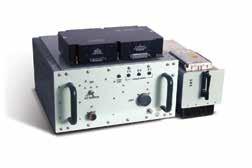

Behlman introduces the first test-proven VPX power supplies developed in alignment with the SOSA Technical Standard. Like all Behlman VPXtra® power supplies, these 3U and 6U COTS DC-to-DC high-power dual output units feature Xtra-reliable design and Xtra-rugged construction to stand up to the rigors of all mission-critical airborne, shipboard, ground and mobile applications.
> 6U power module developed in alignment with the SOSA Technical Standard
> Delivers 1050W DC power via two outputs
> VITA 46.11 IPMC for integration with system management
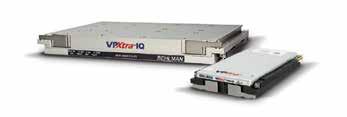
> 3U power module developed in alignment with the SOSA Technical Standard
> Delivers 800W DC power via two outputs
> VITA 46.11 IPMC for integration with system management

COTS (kots), n. 1. Commercial off-the-shelf. Terminology popularized in 1994 within U.S. DoD by SECDEF Wm. Perry’s “Perry Memo” that changed military industry purchasing and design guidelines, making Mil-Specs acceptable only by waiver. COTS is generally defined for technology, goods and services as: a) using commercial business practices and specifications, b) not developed under government funding, c) offered for sale to the general market, d) still must meet the program ORD. 2. Commercial business practices include the accepted practice of customer-paid minor modification to standard COTS products to meet the customer’s unique requirements
—Ant. When applied to the procurement of electronics for the U.S. Military, COTS is a procurement philosophy and does not imply commercial. Office environment or any other durability grade. E.g., rad-hard components designed and offered for sale to the general market are COTS if they were developed by the company and not under government funding.


EDITORIAL
EDITORIAL SUBMISSION AND RELEASES
johnr@rtc-media.com
PUBLISHER/CEO
John Reardon • johnr@rtc-media.com
CONTRIBUTING EDITORS
John Reardon, Odile Ronat
ART AND PRODUCTION
CREATIVE DIRECTOR
Shae Mirizzi • shaezrear@gmail.com
DIGITAL MARKETING MANAGER
Scott Blair • scott@blair-media.com
AD TRAFFIC
Vaughn Orchard • vaughno@rtc-media. com
FINANCE AND ACCOUNTING
Paige Reardon • paiger@rtc-media.com ADMINISTRATION/CIRCULATION
Dawn Dunaway • dawnr@rtc-media.com
ACCOUNT MANAGER
SALES MANAGER
Vaughn Orchard • vaughno@rtc-media. com
CUSTOM AND CONTRACT SERVICES
John Reardon • johnr@rtc-media.com
COTS Journal
CORPORATE OFFICE
RTC Media
110 S Rancho Santa Fe, Virgin UT 84779 PO 790039
Phone: (949) 226-2023
Fax: (949) 226-2050
www.rtc-media.com
PUBLISHED BY RTC MEDIA
Copyright 2026, RTC Media. Printed in the United States. All rights reserved. All related graphics are trademarks of The RTC Group. All other brand and product names are the property of their holders.





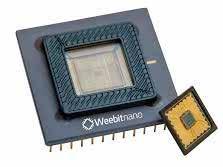
Weebit Nano secures a license agreement with Texas Instruments.
Global semiconductor leader licenses Weebit’s non-volatile memory (NVM) IP for some of its products.
Weebit Nano Limited announced it has licensed its resistive random access memory (ReRAM) technology to Texas Instruments (TI), a global semiconductor company that designs, manufactures, and sells analog and embedded processing chips.
Under the terms of the agreement, Weebit’s ReRAM technology will be integrated into TI’s advanced process nodes for em-
Textron Systems Corporation announced a contract to deliver three Aerosonde® Mk. 4.7 vertical takeoff and landing (VTOL) uncrewed aircraft systems (UAS) to Tantita Security Services, a highly respected and capable security solutions provider within Nigeria. The systems will be delivered in a fully ITAR-Free configuration designed for ease of export to international customers. These aircraft will significantly enhance security operations to protect Nigeria’s vital oil
bedded processing semiconductors. The agreement includes IP licensing, technology transfer, design, and qualification of Weebit ReRAM in TI’s process technologies.
Weebit ReRAM is a low-power, cost-effective NVM that has proven excellent retention at high temperatures and has been qualified for AEC-Q100 150°C operation.
Amichai Ron, Senior Vice President, TI Embedded Processing, said: “We are excited to collaborate with Weebit Nano to integrate ReRAM memory technology into our process technologies and products. The TI and Weebit Nano collaboration will enable our customers to get access to industry-leading NVM technology in per-
and gas infrastructure. The sale also includes options for training and additional aircraft to support planned capability expansion, building on a previous Foreign Military Sale (FMS) contract to the country.
The Aerosonde Mk. 4.7 VTOL UAS offers a runway-independent configuration powered by Hybrid Quadrotor technology, enabling vertical takeoff and landing. Its proven performance and benchmark-setting reliability make it an adaptable solution for security operations across Nigeria’s high-risk sectors.
“The Aerosonde Mk. 4.7 VTOL UAS is a mature, highly reliable, and industry-proven autonomous solution that will provide Tantita Security Services with transformational capability to execute their security operations,” said David Phillips, Senior Vice President, Air, Land and
formance, scale, and reliability, which will enable us to enhance our position as a leading embedded processors provider.”
Coby Hanoch, CEO of Weebit Nano, said: “TI is one of the world’s foremost integrated device manufacturers, producing tens of billions of chips every year. This agreement is another strong signal that the industry is moving towards ReRAM as the successor to flash memory in SoC designs. It also reinforces Weebit’s position as the leading independent provider of ReRAM technology.”
Sea Systems. “The Aerosonde system’s demonstrated performance and benchmark-setting reliability will enable the Tantita team to expand its capabilities to protect the oil and gas infrastructure essential to Nigerian security and prosperity.”
This award builds on the support the Aerosonde UAS family of systems has been providing to international customers over the last several years. The Aerosonde UAS offers multi-mission capability built upon a family of systems that have amassed over 700,000 flight hours in some of the world’s most challenging environments. The system has operated worldwide and currently runs on over 10 U.S. Navy ships. The system is equipped for multiple payload configurations, including VTOL and fixed-wing options.

One Stop Systems, Inc. announced it has received an approximately $1.2 million pre-production order from a new U.S. defense prime contractor for the design, development, and delivery of ruggedized integrated compute and visualization systems for U.S. Army combat vehicles.
“This engagement with a new, top-tier U.S. de-

Mercury Awarded Contract To Develop Multi-Mission Subsystem for U.S.
Mercury Systems, Inc. announced in September that it was awarded a multi-year, cost-plus-fixed-fee development contract to develop a multi-mission, multi-domain subsystem for a U.S. defense prime contractor.
“This program will leverage open standards and a broad set of capabilities from the Mercury Processing Platform, including advanced microelectronics packaging, mixed signal conversion and distribution, thermal management, and chassis-level integration,” said Joe Plunkett, Vice President of Mercury’s Advanced Concepts Group, which will lead the program. “This award demonstrates the customer’s confidence in our ability to rapidly develop trusted, integrated solutions and subsequently transition to the highrate manufacturing that is required to support multiple national security platforms.”
Mercury Systems – Innovation that matters®
Mercury Systems is a global technolo-
gy company that delivers mission-critical processing to the edge, making advanced technologies profoundly more accessible for today’s most challenging aerospace and defense missions. The Mercury Processing Platform allows customers to tap into innovative capabilities from silicon to system scale, turning data into decisions on time-
fense prime contractor marks a meaningful milestone for OSS,” said Mike Knowles, President and CEO of OSS. “We believe integrating our hardware into a prime contractor’s system solution for Army combat vehicles validates the performance, ruggedization, and technical maturity of our platforms. It also strengthens our position to compete for, and win, larger production opportunities as the Army pursues next-generation vision, sensor distribution, and sensor processing technologies across its fleet of manned and unmanned platforms.”
We believe the award represents a significant expansion of OSS’s participation in next-generation vision and sensor programs for the U.S. Army by integrating OSS-designed hardware directly into a prime contractor’s system-level solution. This program builds on the Company’s existing development activities with the U.S. Army to help modernize ground vehicle situational awareness and digital sensor fusion architectures.
lines that matter. Mercury’s products and solutions are deployed across more than 300 programs in 35 countries, enabling a broad range of applications in mission computing, sensor processing, command and control, and communications. Mercury is headquartered in Andover, Massachusetts, and has more than 20 locations worldwide.
In a record-breaking year for the F-35 Lightning II program, Lockheed Martin (NYSE: LMT) delivered 191 F-35s in 2025, surpassing the previous delivery record of 142 jets.
Annual F-35 production is now running at a pace five times faster than any other allied fighter currently in production, underscoring the program’s scale and maturity.
The milestone comes on the heels of the program reaching one million flight hours earlier in the year. In 2025, the program team also delivered the most advanced software to date with the completion of TR-3, as they sustained the global fleet of almost 1,300 aircraft and growing.
Most importantly, the F-35 continued to prove its performance in real-world combat operations, including:
• Playing a key role in suppressing Iran’s air defenses during Operation Midnight Hammer.
• Recording nearly 5,000 mishap-free flight hours during a U.S. Marine Corps F-35B deployment
• Eliminating Russian drones over Poland marked the first time NATO F-35s have engaged threats in allied airspace.
Customers continued to show confidence in the F-35 as they expanded their fleets, with Italy and Denmark increasing their programs of record by adding 25 and 16 aircraft, respectively. And across the program, international customers met major program milestones:
• Finland celebrated the rollout of its first F-35.
• Belgium welcomed its first in-country aircraft.
• Norway completed deliveries of its F-35 fleet.
In September, the F-35 Joint Program Office (JPO) and Lockheed Martin reached a final agreement of Lots 18-19 for the production and delivery of up to 296 F-35s for $24 billion, marking the finalization of the largest production contracts in program history. The JPO and Lockheed
Martin also agreed to an Air Vehicle Sustainment Contract award this year, which supports annualized sustainment activities across the F-35 enterprise for 2025 and beyond.
“I’m immensely proud of the F-35 enterprise for delivering on our production commitments, performing with excellence, and growing our global partnerships in 2025,” said Chauncey McIntosh, Vice President and General Manager of the F-35 Lightning II Program. “As our warfighters continue to employ the F-35 to protect the interests of America and our allies around the world, we’re committed to continuing to push the latest technology into the hands of the warfighter to defeat any threat.”
With 12 nations operating the F-35 across the global fleet, and almost 1,300 aircraft in service, the F-35 is delivering on its promise of unmatched reliability and lethality. Lockheed Martin is positioned to keep the fleet at the cutting edge of technology and to support our allies as they expand their capabilities worldwide, ensuring the F-35 remains an indispensable contributor to global security for decades to come.

Parsons Corporation announced that the company was recently awarded a tenyear, $392 million single-award contract by a Federal customer. This represents new work for the company and leverages the
company’s biometrics and network engineering capabilities.
Parsons offers advanced biometrics and identity management solutions, combining hardware, software, and integration expertise to support federal, defense, and law enforcement missions. The company has delivered over 3,500 mobile biometrics solutions that provide cutting-edge
tools for collecting and analyzing biometric data in real time, enabling faster identity verification and improved threat detection during critical missions.

BAE Systems has signed two contracts worth approximately $171 million for its Bofors 40mm and 57mm 3P (Pre-fragmented, Programmable, Proximity- fused) advanced ammunition, in a combined procurement from both the Swedish Defence Materiel Administration (FMV) and the Finnish Defence Forces Logistics Command (FDF LOG COM).
The Swedish Armed Forces will receive both 40mm and 57mm ammunition, and the Finnish Navy will receive 57mm ammunition, as additions to their current stock.
The state-of-the-art ammunition is a
Anduril to provide propulsion for Boeing’s offering in the U.S. Army’s advanced midrange interceptor competition.
Boeing has partnered with Anduril Rocket Motor Systems in the U.S. Army’s Integrated Fires Protection Capability (IFPC) Increment 2 Second Interceptor competition. Anduril will provide the solid rocket motor for the team’s medium-range interceptor offering.
Boeing was awarded an Other Transaction Authority (OTA) Project Agreement to develop the new midrange interceptor on Dec. 5 as part of the Army’s efforts to enhance defenses
flexible, multipurpose round suitable for defeating targets such as drones, missiles, helicopters, swarming boats, surface vessels, and land targets.
“As a trusted partner to Sweden and Finland, this joint purchase marks an important step in further strengthening defence capabilities in the region and enhancing bilateral cooperation to keep Europe safe,” said Lena Gillström, president of BAE Systems Bofors. “We are delivering cutting-edge solutions to put our customers in the best position to meet future challenges.”
The ammunition will primarily be used by the Stridsfordon 90 and the naval gun system within the Swedish Armed Forces. Additionally, existing and future air defense units equipped with 40 mm anti-aircraft guns will be able to employ this ammunition to address a wide range of aerial threats.
against emerging aerial threats.
The Boeing-Anduril team aims to complement existing short- and long-range air defense systems with an affordable, capable solution to counter increasing low-flying, mid-range threats such as cruise missiles and militarized drones.
“This partnership underscores our commitment to forming innovative, disruptive, and agile industry teams that deliver new capabilities to warfighters sooner,” said Bob Ciesla, vice president, Boeing Precision Engagement Systems. “We’re confident that this partnership will result in a novel solution that helps meet the Army’s evolving air defense needs.”
“Boeing and Anduril are partnering to deliver a
critical, scalable rocket motor systems capability for the U.S. Army,” said Burhan Muzaffar, senior vice president at Anduril Industries. “This partnership is a major step forward in strengthening the industrial base and ensuring our warfighters receive the reliable, modern capabilities they need.”
The Army expects the IFPC Increment 2 Second Interceptor to integrate with and enhance existing systems, delivering more robust, cost-effective, layered air and missile defense for future combat environments.
The Army tentatively plans to select companies to move forward to the competition’s prototype stage in 2026.

Palantir Technologies Inc. announces a three-year renewal of its contract with the DGSI, France’s domestic intelligence agency, extending a partnership that has been ongoing for nearly a decade. This agreement relates to the supply of Palantir’s proprietary software platform, as well as the integration,
support, and assistance services necessary for its deployment and operational use.
This renewal comes at a time when national security challenges require robust, scalable technological capabilities that meet the highest standards in security, confidentiality, and data governance. The scope of Palantir’s involvement remains strictly defined and aligned with the operational and regulatory requirements set by the French authorities.

The $150 million contracts are part of Elbit Systems’ strategic partnership with BAE Systems Hägglunds.
IronFist achieves breakthrough technological milestone with live interception of over a dozen 120mmKE tank rounds during European demonstration.
Elbit Systems Ltd has been awarded new contracts, totaling $150 million, by BAE Systems Hägglunds for its Iron Fist Active Protection System (APS) for integration into CV90 Infantry Fighting Vehicles (IFVs) operated by European NATO member states.
These new awards follow a major milestone achieved in September 2025, when Elbit Systems conducted a high-profile live-fire demonstration in Europe, showcasing Iron Fist’s ability to defeat advanced kinetic energy (KE) threats. During the trial, the system successfully intercepted more than a dozen 120mm KE APFSDS tank rounds - a rare accomplishment in the APS field. The event,
attended by senior military and defense industry representatives, validated Iron Fist’s effectiveness against some of the most challenging anti-armor threats faced on modern battlefields.
The Iron Fist APS is an advanced hard-kill active protection system designed to enhance the survivability and self-defense capabilities of armored platforms against a wide range of modern battlefield threats. As the Israel Defense Forces’ second-generation APS, Iron
Additionally, it is part of a broader effort to support the transition towards French autonomy, in line with the French government’s strategic directions.
Supported by a French team of employees with France-based leadership and governance, Palantir’s solutions have supported the French internal intelligence service in its critical work, including during major national events such as the 2024 Olympic and Paralympic Games.
The renewal of this contract confirms Palantir’s role as a technological partner that stands with French institutions responsible for national security and reaffirms its commitment to providing cutting-edge capabilities with the level of rigor and reliability required for essential missions for France.
Alex Karp, co-founder and CEO of Palantir, said: “We are very proud to support the DGSI in its crucial work in the service of France and its fight against terrorism. This contract renewal reaffirms Palantir’s commitment to serving the interests of France since 2016, and ensuring the security of the French people.”
Fist combines high performance with a compact design, characterized by low volume, weight, and power requirements. The system delivers 360-degree protection against various anti-armor threats, including Anti-Tank Rockets (ATR), Anti-Tank Guided Missiles (ATGM), Unmanned Aerial Systems (UAS), loitering munitions, and Kinetic-Energy (APFSDS) tank ammunition, in both open terrain and complex urban environments.

The Northrop Grumman to Rapidly Develop Marine Corps CCA with Kratos’ Valkyrie UAS
Northrop Grumman (NYSE: NOC) was competitively awarded the U.S. Marine Corps’ Marine Air-Ground Task Force Uncrewed Expeditionary Tactical Aircraft (MUX TACAIR) Collaborative Combat Aircraft (CCA). This award combines Northrop Grumman’s uncrewed capabilities and autonomous leadership with Kratos’ Valkyrie uncrewed aerial system to work alongside crewed fighters to provide air dominance in high-threat environments.
Northrop Grumman will develop and rapidly deliver platforms that include:
• Advanced Mission Kit: Northrop Grumman’s cost-effective mission kit features
sensors and software-defined technologies specifically designed for uncrewed aircraft. The mission kit’s flexible technology can deliver a range of kinetic and non-kinetic effects, making the platform a combat-ready asset.
• Open Architecture Autonomy Software: Northrop Grumman’s open-architecture autonomy software, Prism, will autonomously manage the aircraft’s operations.
• Valkyrie Uncrewed Aerial System from Kratos Defense and Security Solutions: Fully equipped for a variety of missions that will include conventional takeoff and landing capabilities, enhanced runway flexibility with a modular airframe and payload bays for customizable effects.
Krys Moen, vice president, advanced mission capabilities, Northrop Grumman:

L3Harris Technologies announced that AE Industrial Partners (“AE Industrial”) has agreed to acquire a controlling interest in L3Harris’ Space Propulsion and Power Systems business at a total enterprise value of $845 million.
Transaction closing is expected in the second half of 2026, subject to obtaining regulatory approvals and satisfaction of other cus-
tomary closing conditions. L3Harris’ RS-25 rocket engine business is excluded from the sale. L3Harris will retain a ~40% ownership stake in the new space technology business with AE Industrial.
“L3Harris is strongly committed to the Department of War’s (DoW) vision for a faster, more agile defense industrial base while remaining laser-focused on driving value for our shareholders and customers,” said Christopher Kubasik, Chairman and CEO, L3Harris. “This transaction further aligns the L3Harris portfolio with DoW core mission priorities.”
L3Harris has consistently pursued traditional and non-traditional partnerships to drive business growth and advance critical
“Northrop Grumman remains at the forefront of advanced sensing capabilities, delivering innovative solutions that meet the needs of the warfighter with unmatched speed and reliability. This enhanced capability set ensures optimal performance for both crewed and uncrewed platforms.”
Steve Fendley, president of Kratos Unmanned Systems Division: “The integration of the Kratos Valkyrie aircraft system configured with the world’s best multifunction mission systems from Northrop Grumman results in a high-capability CCA at a price point that enables the uncrewed systems to be deployed in mass with crewed aircraft.”
Northrop Grumman has packaged its sensors and other mission capabilities into a smaller envelope, resulting in a more cost-effective solution that is compatible with an uncrewed platform. Combining existing product lines and proven capabilities, Northrop Grumman, Kratos, and commercial partners developed a missionized CCA that includes survivability, connectivity, lethality, and supportability elements. With more than 20 successful flight demonstrations in operationally relevant environments, Northrop Grumman and Kratos are offering the U.S. Marine Corps a low-risk, expedited path to MUX TACAIR mission capability and persistent joint crewed and uncrewed expeditionary operations.
Northrop Grumman is a trusted provider of autonomy and mission solutions with decades of autonomous experience and more than 500,000 autonomous flight hours. The company builds capabilities that support the entire spectrum of uncrewed solutions, including MUX TACAIR, Lumberjack, Project Talon, and Beacon.
technologies. Previous space investments by AE Industrial include Firefly Aerospace, RedWire Space, and York Space Systems, demonstrating the group’s experience in the national security and space exploration markets.

RTX awarded FAA contract to deploy next-generation surveillance radars for the National Airspace
Innovative, ready-now technologies will enhance safety, reduce operational complexity, and increase efficiency for all airspace users.
Collins Aerospace, an RTX business, has been awarded a $438 million contract by the Federal Aviation Administration to support the Radar System Replacement program, a cornerstone of the agency’s effort to modernize the U.S. National Airspace System. The program is a key part of the Department of Transportation’s Brand New Air Traffic Control System.
Collins will deliver next-generation cooperative and non-cooperative radar systems, providing air traffic controllers with reliable, secure information to support operations. These new radars will simplify operations by replacing multiple legacy systems with a unified, cost-effective, and adaptable architecture.
“As a trusted supplier to the FAA for more than 70
Adds Advanced PCIe and CXL Switching Silicon Portfolio; Expands Marvell’s UALink Scale-up Switch Team with Top Engineering Talent
Marvell Technology, Inc. announced it has entered into a definitive agreement to acquire XConn Technologies (“XConn”), a provider of advanced PCIe and CXL switching silicon. The acquisition expands Marvell’s switching portfolio by adding XConn’s PCIe and CXL products and augments Marvell’s Ultra Accelerator Link (“UALink”) scale-up switch team, adding highly experienced engineering talent with deep domain expertise in high-performance switching.
As AI workloads scale, data center system design is evolving from single-rack deployments to larger, multi-rack configurations. These next-generation platforms increasingly require a high-bandwidth, ultra-low-latency
years, Collins is ready to rapidly deploy next-generation radar systems that replace outdated technology with a single, modern, and interoperable solution,” said Nate Boelkins, president of Avionics at Collins Aerospace. “These systems integrate seamlessly with existing infrastructure, enhance safety and efficiency for air traffic controllers, reduce long-term costs, and ensure the system is prepared for the future of the National Airspace.”
Systems will include the Condor Mk3, a cooperative surveillance radar capable of communicating directly with aircraft transponders, and the ASR-XM, a non-cooperative radar that detects aircraft using reflected signals. Both are qualified to meet FAA surveillance requirements through prior test-site certification activities.
More than 550 RTX radar systems are already operating in the national airspace, providing a proven foundation for large-scale modernization. RTX’s Condor Mk3 and ASR-XM radar systems provide precise aircraft tracking, especially at lower altitudes.
scale-up fabric, such as UALink, to efficiently connect large numbers of XPUs and enable more flexible resource sharing across the system.
UALink is a new open industry standard purpose-built for scale-up connectivity, enabling efficient, high-speed communication so multiple accelerators can operate together as a single, larger system. UALink builds on decades of PCIe ecosystem innovation and incorporates proven high-speed I/O
techniques to meet the bandwidth, latency, and reach requirements of next-generation accelerated infrastructure.
Together, Marvell and XConn bring together a significantly larger, integrated team to fully address the rapidly emerging opportunity in UALink switching and to comprehensively support the growing list of customers and partners who want to work with Marvell to evolve their next-generation AI platforms.

Galleon Embedded Computing (Galleon), a Spectra Defense Technologies (Spectra) business unit, today announced it was selected to provide comprehensive, ruggedized mission computing systems to support ongoing modernization efforts for next-generation ground vehicles across the defense community.
Ground vehicle programs are increasingly moving toward open-architecture systems, digital engineering, and design approaches that can easily scale as mission needs evolve. These efforts require onboard computing that can handle large volumes of sensor data, enable real-time processing at the edge, and integrate smoothly across a wide variety of platform designs. Galleon’s mission computing portfolio is designed to meet these needs and provides integrators with trusted,
field-tested, customizable solutions that will enable warfighters to maintain a long-term capability advantage across the modern battlespace.
“We are honored to be a part of these critical next-generation ground vehicle efforts,” said Ray Munoz, Chief Executive Officer, Spectra Defense Technologies.
“This work demonstrates Spectra’s leadership in delivering mission-proven and future-ready computing solutions for ground platforms, and we remain focused on helping integrators reduce development timelines, integrate new capabilities more easily, and scale vehicle architectures quickly. Our High Performance Recorder (HPR) solution, combined with Galleon’s proven XSR product family and Network Attached Storage (NAS) technologies, will give ground vehicle platforms the high-speed data management and information advantage they need as modernization efforts accelerate across the defense community.”
As part of this next-generation ground vehicle initiative, Galleon will deliver a family of rugged data-serving and mission-computing solutions that includes its established XSR technology, a high-performance computing architecture designed for harsh environments with removable storage, encryption-ready configurations, and a compact form factor suited for vehicle-mounted
applications. The company will also deliver its NAS solution, a ruggedized capability designed for deployed systems that enables secure, high-density data access across vehicle subsystems, supports simultaneous users, and offers flexible network connectivity options. Galleon will also deliver the HPR, a next-generation recording system that supports significantly higher data rates, advanced sensors, and the fast, reliable data handling required for modern ground vehicle missions, including support for multi-channel high-speed Ethernet interfaces, removable high-capacity storage modules, and ruggedized operation in harsh environments.



By Dan Demers, Regional Vice President Americas, Congatec
In mobile edge applications, success is no longer measured by raw compute performance alone. What matters is how much performance can be delivered per watt — and per square centimeter of board area.
Whether the platform is a rugged field robot, a mobile mapping system or a drone, the efficiency of the compute determines how far that device can travel, how much it can carry, and how reliably it functions over its deployment lifetime.
However, today’s embedded edge systems are no longer limited to simple control loops or low-resolution data
capture. In a typical mobile edge application, you can expect to find:
• One or more cameras for high-resolution image or video capture and streaming
• On-device AI in support of tasks such as object recognition, obstacle avoidance, and simultaneous localization and mapping (SLAM)
• Secure connectivity for high-bandwidth data exchanges — not just remote control
• Additional applications, e.g., safety monitoring or predictive analytics
All of this requires high-performance local computing that reduces reliance on the cloud and delivers on real-time requirements. Of course, the trick lies in delivering the performance an application requires under the constraints of a mobile design limited by size, weight, power, thermal dissipation, cost, and other factors.
Selecting a host processor for a mobile edge system isn’t the same as choosing a discrete component. Rather, it defines the entire system envelope: If a processor’s performance per watt
is too low, a chain of consequences — that may include one more of these — quickly follows:
• Reduced range resulting from faster battery drain
• Increased size and weight to accommodate larger batteries
• Increased size and weight to accommodate thermal management solutions like fans or heatsinks
• Reliability risks associated with insufficient thermal management
• Increased cost if additional compute (ASICs or dedicated accelerators) or high-speed PCB materials and design are required
• Feature limitations if sensors or applications must be removed to support power budgets
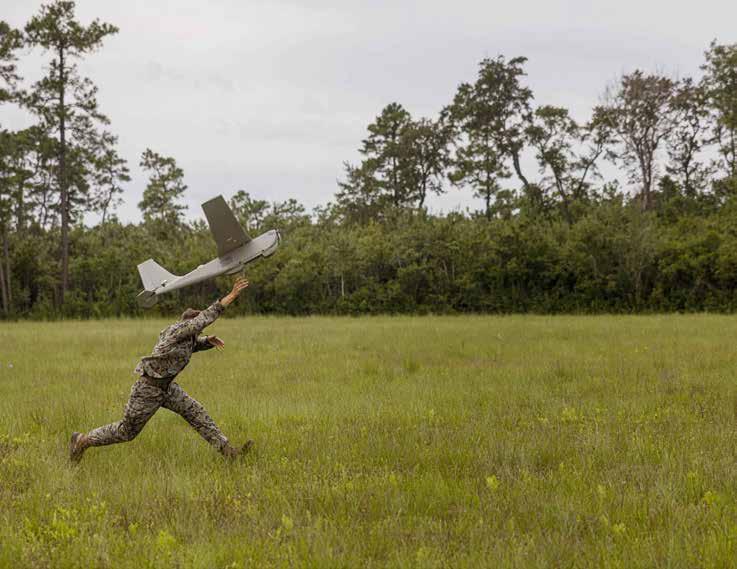
Let’s look at the requirements of a mid-size drone. This example system has four HD cameras running AI-based obstacle detection, SLAM, and live mapping. Such a hefty list of requirements can quickly exceed the capabili-
ties of a conventional small form-factor embedded processor module — and that’s before considering any additional applications or subsystems that the module must support.
Presented with the wrong processor and memory combination, designers may need to accept shorter flight range or start adding co-processors that compound power and thermal management issues. Either way, the end product is less competitive on the market.
The same design principles apply to mobile robots, portable medical devices, industrial edge platforms, and more. In each case, the ceiling is only as high as that which the performance per watt per area can deliver.
Alternatively, the same drone design team could choose an off-the-shelf computer-on-module (COM) in a reduced form factor to start their design. The COM-HPC Mini standard was created specifically for these performance-per-watt tradeoff scenarios,
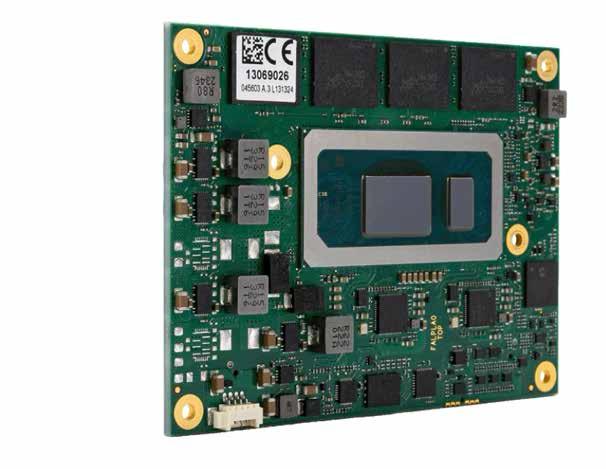
The conga-HPC/mRLP -- a COM-HPC Mini high-performance module based on 13th Gen Intel Core processor series – is an off-the-shelf SWaP-C embedded module for drones, robots and other mobile edge systems.
Source: congatec
supporting processor thermal design power (TDP) up to 100 W in a footprint of just 95 mm × 70 mm.
The congatec conga-HPC/mRLP is one example of a COM-HPC Mini module that delivers high compute density in a tight power budget. See figure 1. Its onboard 13th Gen Intel Core processor is a heterogeneous multicore processor available in extended temperature variants. The device contains between one and six Performance cores and four-to-eight Efficiency cores, where Performance cores support the execution of AI or application software and Efficiency cores manage communications, control, and the like.
The 13th Gen system on chip (SoC) also integrates Intel Iris Xe graphics. With up to 96 execution units for offloading multimedia-intensive workloads from primary cores, it adds performance without increasing size, power consumption, or cost — a major contrast with a discrete accelerator.
High-bandwidth I/O interfaces native to the COM-HPC Mini specification — PCIe Gen 4/5, USB4, and MIPI
CSI — deliver data from high-fidelity sensors and between the processor and memory in support of real-time compute, onboard sensor fusion, and local autonomous decision making.
While each functional area in the system could require separate processors — and could potentially demand different modules altogether — the COM approach consolidates them into a single module. For drone system designers, the reduced performance per watt per area results in longer flight time, more
robust feature sets, and an overall more competitive product.
Innovation in the technology market will continue its march toward greater performance at lower power consumption and cost. Fortunately, mobile edge system designers can now leverage the benefits of COM-HPC Mini platforms to speed time to market on pre-validated, off-the-shelf platforms that are easily upgradable for long-term viability.
Access to a robust performance per watt per area profile is especially important to mobile edge system designers, who continuously balance their application’s demands with SWaP-C constraints. Fortunately, COM-HPC Mini platforms are readily available for design and deployment.
Looking to boost SFF drone capabilities?
Learn more about the congatec COMHPC Mini ecosystem at congatec.com.

By John Reardon, Editor – COTS Journal
The integration of Commercial Off-the-Shelf (COTS) solutions has long been a cornerstone of the defense industry’s strategy, enabling the rapid deployment of advanced technology while controlling costs. As artificial intelligence (AI) and large language models (LLMs) move from the commercial sector into critical military applications—such as autonomous intelligence, surveillance, and reconnaissance (ISR) platforms and predictive logistics systems—the need for robust, unified AI security standards has never been more pressing. The existing landscape, characterized by fragmented guidelines and a lack of uniform certification, presents a significant risk to national security and
mission integrity. Lasso Security, leveraging its deep expertise in securing generative AI (GenAI) ecosystems, has introduced a comprehensive AI security framework designed to address these unique challenges and provide the defense sector with a structured, auditable path from chaos to excellence.
The digital industries have previously demonstrated that unified standards drive measurable risk reduction. Frameworks like the Payment Card Industry Data Security Standard (PCI DSS) and ISO/IEC 27001 have

established common languages for information protection and payment security, making practices uniform and auditable at scale. However, the AI ecosystem currently lacks this critical unification. Multiple competing initiatives from various bodies, including the NIST AI Risk Management Framework, the EU AI Act, and proprietary industry standards, create challenges for organizations navigating contradictory definitions and compliance requirements.
For the military and defense sectors, this fragmentation translates directly into operational, security, and legal risks. Without globally accepted standards, AI deployments can operate without mandatory security requirements, creating security blind spots and inconsistent risk management even within a single organization.
The maturity of the AI industry, particularly with the rapid adoption of GenAI and autonomous agents, demands a single, certifiable framework. Lasso’s white paper outlines the foundational elements for this standard, emphasizing the need for concrete, auditable controls and independent certification processes similar to PCI DSS assessments. The framework aims to move AI security from an overwhelming challenge to a manageable journey through a structured progression model.
A key element is leadership decision-making, which drives the adoption of AI and mandates its secure, responsible deployment. Organizations treating AI security as a board-level concern are better positioned to establish dedicated governance bodies, such as AI Security Councils. The framework also addresses the critical role of human oversight in the age of autonomy, recommending Human-in-the-loop (HITL) as a design principle for responsible deployment.
Lasso’s framework structures Responsible AI, Security, and Governance across three distinct lifecycles, offering a structured progression model to assess maturity from Level 1 (Ad-hoc) to Level 5 (Optimized):
• Language Model Lifecycle: This track governs AI applications from conception to retirement. It includes mandatory provenance verification
for third-party foundation models, rigorous red-teaming and adversarial testing, and secure development practices integrated with DevSecOps pipelines. It also emphasizes robust underlying data governance, recognizing that the integrity of an LLM system is only as strong as the data it is built upon.
• Access Management Lifecycle: This addresses the need for dynamic, context-aware access controls for both human and agentic AI entities. It moves beyond traditional access management by integrating with enterprise single sign-on (SSO) systems to support context-based access control (CBAC), the principle of least privilege, and the detection and prevention of unsanctioned “Shadow LLM” usage.
• Operational Usage Lifecycle: This track focuses on real-time monitoring and incident response in deployed systems. It includes continuous monitoring and logging of all AI interactions, the implementation of dynamic guardrails, and ongoing red-team validation to identify new attack vectors in real-world conditions.
•
The defense industry demands the highest levels of security and control, adhering to strict requirements such as FedRAMP High, DoD SRG, ITAR, and CJIS. Lasso’s security solutions are available through platforms like AWS GovCloud (US), directly enabling federal customers to deploy GenAI while meeting these stringent compliance requirements.
Lasso’s platform unifies offensive (red teaming) and defensive (blue teaming) efforts into a single, real-time “purple teaming” loop, which is essential for the continuous threat detection needed in military applications. This approach allows the DoD to leverage existing, proven COTS technologies and adapt them to specific, mission-critical requirements.
By providing a structured framework and the necessary tools for continuous monitoring, real-time threat detection, and automated remediation, Lasso is enabling federal and public-sector agencies to move forward with GenAI without compromising mission integrity. This move is crucial for maintaining a technological lead in a rapidly evolving global landscape.

The E320 is the latest addition to the Pixus line of ruggedized Ettus/NI Software-Defined Radios (SDRs). The first in the E-series ruggedized enclosures is an IP67 weatherproof design.
The E320 is an IP67-rated outdoor solution in a compact size. It features a conduction-cooled
Auterion announced a significant step towards autonomous mass in modern warfare: the successful live demonstration of a hybrid drone swarm composed of FPV and fixed-wing drones from different manufacturers executing a unified, end-to-end kill chain. The demonstration for government customers in Munich, Germany, marks the first time such a mixed formation has operated as a single, coordinated combat entity. This achievement represents a decisive step toward the unmanned battlefield.
The event brought together eight shortrange FPV munitions and two medium-range fixed-wing platforms, linked through Auterion’s swarm engine and guided by human operators. The swarm executed the full find, fix, and finish sequence, including a coordinated, vision-guided terminal approach and synchronized strike effects.
“This is the moment when swarming autonomy stops being a concept and becomes an operational reality,” said Lorenz Meier, CEO and founder of Auterion. “For the first time, FPVs and fixed-wing loitering munitions from different manufacturers flew, hit, and finished together as a unified swarm. This is the architecture that future warfare will be built on.”
Unlike traditional drone operations that rely on manual piloting, the Auterion demonstration showed a coherent swarm acting on shared logic across varied airframes. FPV drones conducted rapid, low-altitude engagements while fixedwing systems executed ISR and longer-range strikes. Each drone understood the mission, the
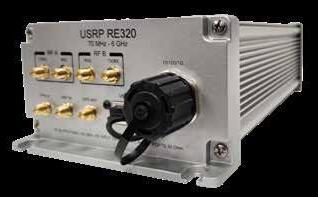
design for a temperature range of -10C to 60C, with extreme options from -40C to 70C available upon request. A full MIL ruggedized version or other customized configurations are also available.
Pixus now offers ruggedized NI Universal Software Radio Peripherals (USRP) for each type. This includes the Embedded, Networked, Bussed, and X series. The tunable transceivers are ideal for acquiring wide swaths of the electromagnetic spectrum, developing Electronic
target set, and the timing of effects.
According to Meier, this shift is essential. “The modern kill chain is simply too fast for manual coordination. Software has to do the heavy lifting, while humans make the decisions. This is how you maintain control without slowing down the fight.”
The demonstration also marked the first time unmanned systems from three different manufacturers have operated as a single combat swarm. Auterion’s operating system enabled full interoperability, eliminating the typical maze of bespoke integrations. Auterion unified diverse systems under a single architecture, demonstrating how allies can rapidly scale and integrate industry solutions without vendor lock-in.
“Interoperability is not a slogan anymore. It’s a battlefield requirement,” Meier said. “We need to overpower our near-peer adversaries with mass.”
The hybrid swarm operated under Auterion’s Nemyx engine, which provided autonomous real-time coordination. Live feeds and mission data are integrated into ATAK and delivered as a standardized cursor-on-target (COT) feed to other battle management systems, providing operators with full situational awareness and positive control. This level of integration reflects how kill chains are evolving: they are becoming software-defined and network-native.
Auterion’s hybrid swarm demonstration embodies a fundamental shift in warfare. Rather than treating drones as isolated tools, modern forces are moving toward swarms that operate as distributed, intelligent formations. The implications for deterrence, attrition, and survivability are profound.
“We’re watching the battlefield evolve from manned platforms with unmanned support, to unmanned forma-
Warfare (EW) and Signals Intelligence (SIG/ INT) applications, satellite communications (SATCOM), and other wireless communications/control applications.
In addition to the ruggedized Ettus/NI USRPs, Pixus offers Modular Open System Architecture and SOSA-aligned backplanes, enclosures, and chassis managers. The company also develops ruggedized and COTS solutions for various VITA and PICMG specifications.
tions with humans in command,” said Meier. “Today’s demonstration shows what comes next: mass autonomy that scales across nations and manufacturers. The future fight will be defined by swarms, not individual drones.”

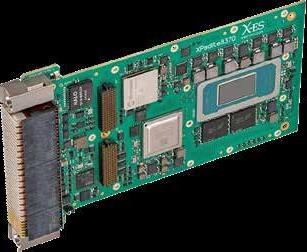
Extreme Engineering Solutions (X-ES) Announces New Rugged Single Board Computers Powered by Intel® Core™ Ultra (Series 3) Processors
Extreme Engineering Solutions, Inc. (X-ES), a leader in the design and manufacture of rugged embedded computing solutions, has announced the integration of the new Intel® Core™ Ultra (Series 3) processors—formerly code-named “Panther Lake”—into its latest line of high-per-
North Atlantic Industries (NAI) announced it has been awarded a contract to execute an obsolescence-driven refresh of the Improved Data Modem for Open Systems REMAN (IDMOSR). This refresh extends the service life of existing IDM-401 installations while aligning with the U.S. Army’s aviation modernization objectives for digital interoperability, cybersecurity, and mission data link performance across current and future aircraft fleets.
Since 2012, NAI has been the hardware supplier of the IDM 401, fielding more than 3,800
formance Single Board Computers (SBCs).
Leveraging Intel’s cutting-edge 18A process technology, these new SBCs, including the flag ship XPedite8370 3U VPX module, are engi neered to deliver unprecedented AI acceleration and computational efficiency for mission-critical applications. The Intel Core Ultra (Series 3) architecture features a three-tier hybrid core design that combines performance, efficiency, and low-power cores to optimize mixed-criticality workloads in the most demanding environments.
harsh conditions is non-negotiable.”
“By incorporating Intel’s 1.8 nm-class technology, we are providing our customers with a significant leap in per-
LRUs across platforms, including the AH-64 Apache, UH-60 Black Hawk & CH-47 Chinook. Kevin Knight, Senior Program Manager, SAIC quoted in a direct statement “In Army Aviation service, the IDM-401 has demonstrated exceptional reliability with a long-term return rate of 0.02% and a warranty return rate of approximately 0.5%, underscoring its proven performance as a mission-critical digital data link for secure communications, situational awareness, and coordinated operations across U.S. and allied fleets.”
“SAIC and NAI have partnered for more than two decades to deliver dependable, mission-ready solutions to Army Aviation,” Additionally, Kevin said “Building on the field-proven success of over 3,800 IDM-401 units—and exceptionally low return and warranty rates—our joint team is ensuring a successful transition to IDM-OSR that sustains readiness today and equips the fleet with next generation capabilities for tomorrow’s missions.”

The new product line supports up to 64 GB of LPDDR5 SDRAM with in-band ECC and features integrated Microchip PolarFire™ SoC FPGAs for enhanced security and custom logic. Designed for seamless integration, the modules align with the Sensor Open System Architecture™ (SOSA) technical standard, ensuring interoperability and rapid deployment for defense and aerospace sectors.
The IDM-OSR obsolescence refresh preserves full form, fit, and function compatibility with the IDM-401 while replacing end-of-life components and updating processing and security elements to current standards. The refresh provides increased data throughput, enhanced cybersecurity protections, and modular I/O expansion to meet today’s multi-domain mission demands—delivering a seamless, low-risk path to sustainment without requiring aircraft-level redesign or requalification of interfaces.
NAI’s longtime partner, SAIC, will collaborate on the IDM-OSR effort as part of a 20-year partnership with NAI. This joint team will ensure a smooth transition from IDM-401 to IDM-OSR and provide Army Aviation with next-generation capabilities while minimizing program risk, schedule impact, and lifecycle cost.
“As the U.S. Army advances its aviation modernization and digital interoperability priorities, NAI is proud to sustain and enhance a proven capability through an obsolescence-driven refresh,” said Lino Massafra, VP of Sales and Marketing at North Atlantic Industries. “IDM-OSR retains the trusted reliability of the IDM401 while incorporating targeted technology updates that reduce retrofit complexity and lifecycle cost across legacy and next-generation platforms.”
All IDM-OSR refresh activities—including redesign for obsolescence and manufacturing— will be performed at NAI’s headquarters in Bohemia, New York. Leveraging its vertically integrated engineering and production capabilities, NAI ensures consistent quality, performance, and compliance with demanding aerospace and defense standards while minimizing program risk and downtime.
Trident Infosol, a trusted provider of rugged embedded systems, proudly announces
the launch of Falcon 3R, the latest innovation in its proven Falcon family of small-form-factor (SFF) computers. Designed for the most demanding avionics, defense, aerospace, and rugged industrial applications, Falcon 3R delivers a breakthrough combination of enhanced capabilities, expanded I/O flexibility, and unmatched SWaP (Size, Weight, and Pow-
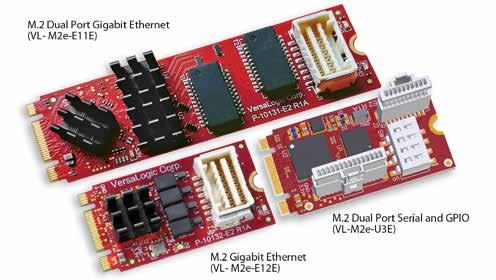
VersaLogic Corp has announced a new line of rugged M.2 modules designed for reliable operation in harsh environments. This new lineup includes modules featuring Single-port Gigabit Ethernet with onboard magnetics, Dual-port Gigabit Ethernet with onboard magnetics, Dual-port Serial & GPIO, and Dual CAN Bus modules. These modules are rated for operation in industrial temperature applications ranging from -40° to +85°C.
These M.2 modules are made for embedded OEMs and system integrators. They offer reliable connectivity in very small form factors, making them suitable for transportation, defense, industrial automation, and medical applications.
“Customers can now easily add more connectivity features to embedded systems with reliable, full-performance M.2 modules designed for industrial temperature applications (-40° to +85°C),” said Len Crane, VersaLogic President.
“These compact M.2 expansion boards prioritize thermal management and operate flawlessly across the entire industrial temperature range.”
• Operating Temperature: -40° to +85°C
• Shock and Vibration: MIL-STD-202H
• Module Options:
er) efficiency. Powered by the 13th Gen Intel® Core™ i7-13800HRE processor (6 performance cores + 8 efficiency cores, 20 threads), Falcon 3R not only builds on the legacy of the Falcon line but takes a decisive leap forward with significantly expanded mezzanine card support—5 x MiniPCIe and 2 x XMC slots— making it the most I/O-intensive system in the Falcon family. This advancement enables engineers to deploy a much wider range of I/O modules, ideal for complex, mission-critical, and data-heavy applications.
“Falcon 3R represents a major leap forward in rugged computing, bringing best-in-class performance in the industry’s most compact footprint,” said Mr. Pawan Seth, Director at Trident Infosol. “With its enhanced mezzanine card architecture, it unlocks a new level of I/O scalability, giving our customers the flexibility they need for evolving defense and aerospace requirements.”
• M.2 Dual-port Gigabit Ethernet (VLM2e-E11E) – 2280 B+M key
• M.2 Gigabit Ethernet (VL-M2e-E12E) – 2242 B+M key
• M.2 Dual-port Serial and GPIO (VLM2e-U3E) – 2242 B+M key
• M.2 Dual CAN Bus (VL-M2e-C2E) –2242 B+M key
WINSYSTEMS Unveils SBC-477 PowerTier™ Series: Compact, Rugged SBCs with 13th Gen Intel® Core™ Performance
WINSYSTEMS, a leader in embedded computing solutions, introduced the SBC-477 PowerTier™ Series, a new generation of rugged single board computers engineered for industrial applications where performance, power, reliability, and space are critical. These embedded computers support a wide range of uses, including industrial automation, energy management, transportation management, and MIL/COTS.
The SBC-477 PowerTier Series delivers powerful computing in a compact footprint,
powered by a 13th Gen Intel® Core™ Raptor Lake hybrid CPU – an i7, i5, i3, or Intel® Processor U300E. WINSYSTEMS can help OEMs and system integrators fine-tune the optimal SBC configuration to meet the performance, power, and I/O requirements demanded for their application.
“Our new PowerTier Series of rugged SBCs has captured significant interest even prior to its official launch, from customers who are working within tight specification requirements,” said WINSYSTEMS’ Chief Revenue Officer Robert Dunaway. “This new product series significantly adds to our embedded portfolio’s ability to fulfill these needs.”
Designed to operate in extreme environments, this embedded computer supports an extended temperature range of -40°C to +85°C. Thermal options include a heat spreader and active cooling.
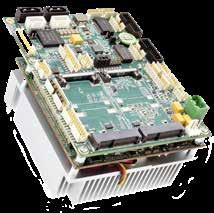
Key Features:
• 13th Gen Intel® Core™ Raptor Lake processors
• Support for Windows 10/11 IoT, Ubuntu Linux, and other x86 real-time OS
• Up to 64GB DDR5 5200 MT/s RAM
• Triple UltraHD display support
• Dual Ethernet: 2.5Gb + 1Gb
• Mini PCIe and SIM card expansion
• TPM 2.0 hardware-based security
• Small form factor
• Extended product lifecycle of 10+ years
The SBC-477 PowerTier Series is built to meet the demands of modern industrial deployments with high MTBF, ruggedized connectors, and flexible I/O options including USB 3.0/2.0, RS-232/422/485, GPIO, and I2C.

mPOD JAMMER TRAINING POD
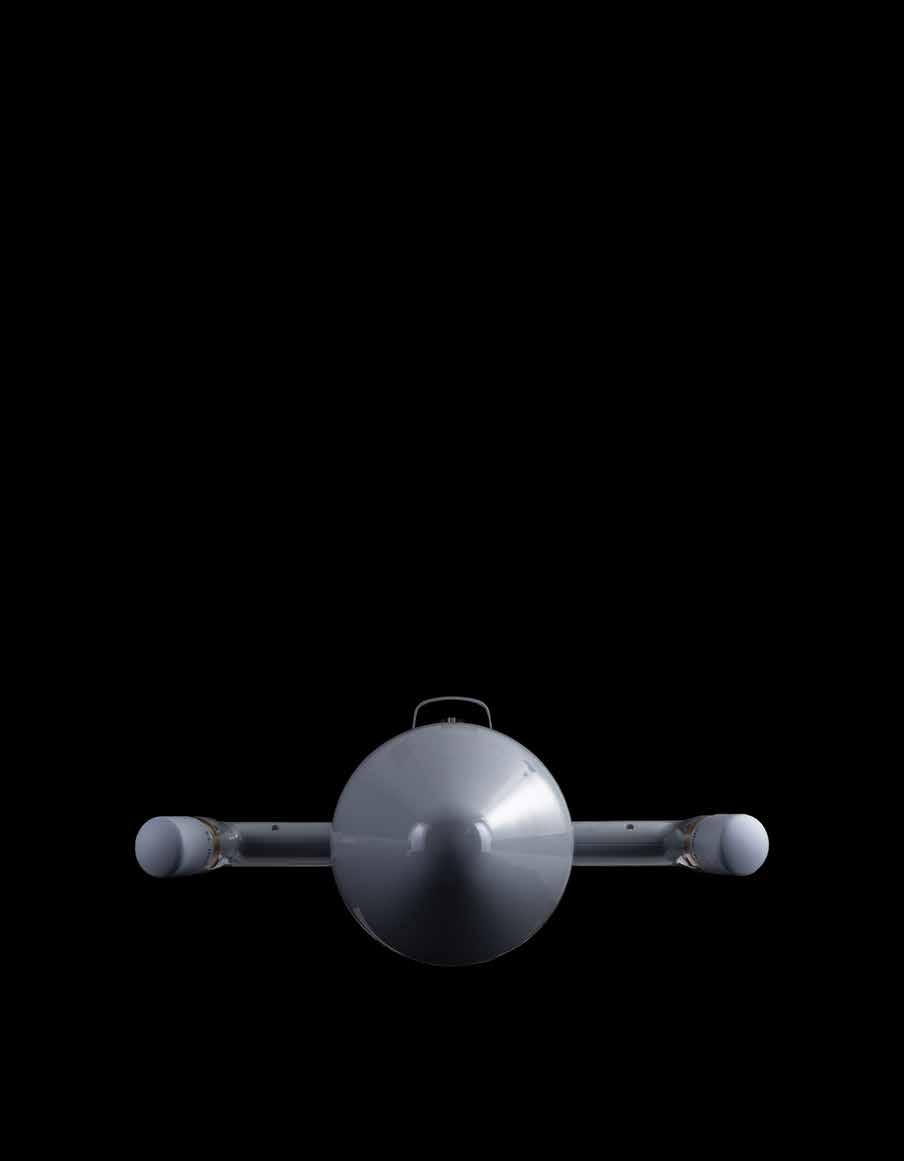
mPOD uses DRFM technology to emulate realistic combat scenarios, replicating near-peer jamming for fast, accurate electronic warefare training.
mrcy.com/mpod
Annapolis Micro Systems.
Behlman Electronics.
Dolphin.
Great River Technology.
Highland Technology.
Mercury Systems.
MSS.
PICO Electronics, Inc.
www.behlman.com
.www.dolphinics.com/COTS
www.greatrivertech.com
.www.highlandtechnology.com
.www.mrcy.com
.www.cotsjournalonline.com
.www.picoelectronics.com
COTS Journal (ISSN#1526-4653) is published monthly at; 110 S Rancho Santa Fe, Virgin UT 84779. Periodicals Class postage paid at San Clemente and additional mailing offices.
POSTMASTER: Send address changes to COTS Journal, 110 S Rancho Santa Fe PO 790039, Virgin UT 84779.
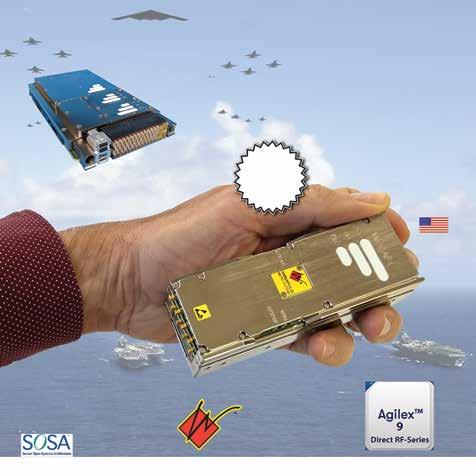



Behlman has provided reliable power to mission-critical military airborne, shipboard, ground and mobile applications for over 50 years. Behlman offers the widest array of COTS AC to DC and DC to DC power supplies that meet military requirements at industrial pricing.
> Proven military reliability without the high cost of full mil-spec
> Built to perform to full power at rated temperatures
> Modified COTS solutions that offer faster delivery, higher reliability and lower cost than custom designs
> Hundreds of designs to meet a wide range of applications