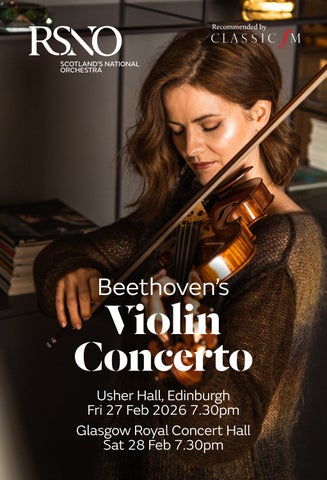
Usher Hall, Edinburgh Fri 27 Feb 2026 7.30pm
Glasgow Royal Concert Hall Sat 28 Feb 7.30pm


![]()


Usher Hall, Edinburgh Fri 27 Feb 2026 7.30pm
Glasgow Royal Concert Hall Sat 28 Feb 7.30pm


Usher Hall, Edinburgh Fri 27 Feb 2026 7.30pm
Glasgow Royal Concert Hall Sat 28 Feb 7.30pm
Musician extraordinaire, Jörg Widmann’s talents know no bounds. Experience his dynamism tonight as he returns to the RSNO to conduct Mendelssohn’s historical thriller of a symphony, his own explosive homage to Beethoven, Con brio, and joins the ‘extraordinary’ (Gramophone) violinist Veronika Eberle in a very personal performance of Beethoven’s radiant Violin Concerto.
BEETHOVEN Violin Concerto in D Major Op61 [42’]
JÖRG WIDMANN Con brio [12’]
MENDELSSOHN Symphony No5 in D Major Op107 Reformation [33’]
Jörg Widmann Conductor
Veronika Eberle Violin
Royal Scottish National Orchestra

The Glasgow performance will be recorded for the RSNO Archive. Supported by the Iain and Pamela Sinclair Legacy.
If viewing these notes at the concert, please do so considerately and not during performances. Please silence all mobile telephones and alerts, and refrain from taking photographs, without flash, until the end of each piece.
DUNDEE
THU 19 MAR: 7.30PM
EDINBURGH
FRI 20 MAR: 7.30PM
GLASGOW SAT 21 MAR: 7.30PM
Pärt Cantus in Memoriam
Benjamin Britten
Elena Langer The Lives of Birds*
World Premiere
Tchaikovsky Symphony No4
Kristiina Poska Conductor
Anna Dennis Soprano
*Commissioned by the RSNO and generously supported by Javan Herberg KC and Jessica Boyd KC

Book online at
Welcome to this evening’s performance.
It’s a great pleasure to have Jörg Widmann back with us. Jörg first visited in 2020 as a last-minute replacement in our Digital Season created during the Covid-19 pandemic; he proved to be one of the highlights of the series. Jörg really is one of the most creative musicians in the world right now – a man who can do it all! Tonight he conducts Beethoven and Mendelssohn, as well as his own composition, Con brio. During lockdown he wrote new cadenzas for each of the Beethoven Violin Concerto movements especially for our soloist Veronika Eberle, who makes her RSNO debut this weekend.
I’m sure many of you in Glasgow will have just been to our community orchestra’s pre-concert showcase. All Together Now meet monthly with conductor Robert Baxter and receive coaching from our musicians. This evening they premiered a special commission by Lisa Robertson created in collaboration with the orchestra members. Don’t worry if you missed the showcase; All Together Now perform again in April in Glasgow Royal Concert Hall’s New Auditorium. For more information on the community orchestra and their performances, head to rsno.org.uk/ alltogethernow
Community work is a vital part of what we do, and we are always diversifying the ways in which we reach Scotland’s communities. As an example, just this week, to celebrate World Gaelic Week, First Violin Liam Lynch presented the Gaelic-language version of our animated film Yoyo & The Little Auk in The Birks Cinema, Aberfeldy, for local school pupils.
Next weekend, the fantastic RSNO Chorus and their director, Stephen Doughty, perform Rachmaninov’s All-Night Vigil in Greyfriars Kirk in Edinburgh and St Aloysius’ Church in Glasgow. I hope to see many of you there.
Alistair Mackie CHIEF EXECUTIVE

Formed in 1891, the Royal Scottish National Orchestra (RSNO) is one of Europe’s leading symphony orchestras. Awarded royal patronage by Her Late Majesty The Queen in 1977, its special status in the UK’s cultural life was cemented in 2007 when it was recognised as one of Scotland’s five National Performing Companies, supported by the Scottish Government.
Led by Music Director Thomas Søndergård, the Orchestra performs across Scotland, including concerts in Glasgow, Edinburgh, Dundee, Aberdeen, Perth and Inverness, and appears regularly at the Edinburgh International Festival and BBC Proms. The RSNO tours internationally, most recently visiting China and Europe.
The RSNO has a worldwide reputation for the quality of its recordings, receiving a 2020 Gramophone Classical Music Award for Chopin’s Piano Concertos (soloist: Benjamin Grosvenor), conducted by Elim Chan, two Diapason d’Or awards (Denève/Roussel 2007; Denève/Debussy 2012) and eight GRAMMY Award nominations. In recent years, the RSNO has cultivated an international reputation for world-class film, television and videogame soundtrack recording. The Orchestra has recorded for BAFTA-winning
series Silo (Apple TV) and worked with the likes of GRAMMY Award-winning composer Lorne Balfe on Life on Our Planet (Netflix). Other notable titles include Nuremberg (Sony Pictures), Now You See Me: Now You Don’t (Lionsgate), Horizon: An American Saga (Warner Bros) and Star Wars Outlaws (Ubisoft). The Orchestra records at its bespoke in-house facility in Glasgow.
The RSNO believes that music can enrich lives and aims to inspire, educate and entertain people throughout Scotland and beyond with its performances, recordings and engagement programmes. Supporting schools, families, young professionals and wider communities, the RSNO delivers high-quality initiatives for all ages and abilities. The RSNO’s engagement offering includes its singing strand, encompassing a Buggy Choir and Chorus Academy in both Dundee and Glasgow and a lunchtime Workplace Choir, which complements the well-established and highly respected RSNO Youth Choruses and RSNO Chorus. The community choruses are designed with the benefits of group singing for health and wellbeing at their core and are open to all.
FIRST VIOLIN
Maya Iwabuchi LEADER
Lena Zeliszewska ASSOCIATE LEADER
Tamás Fejes ASSISTANT LEADER
Patrick Curlett
Caroline Parry
Ursula Heidecker Allen
Lorna Rough
Susannah Lowdon
Alan Manson
Liam Lynch
Veronica Marziano
Joana Rodriguez
SECOND VIOLIN
Cheryl Crockett
GUEST PRINCIPAL
Marion Wilson
Jacqueline Speirs
Emily Nenniger
Anne Bünemann
Sophie Lang
Robin Wilson
Kirstin Drew
Colin McKee
Helena Rose
VIOLA
Tom Dunn PRINCIPAL
Felix Tanner
Asher Zaccardelli
Susan Buchan
Nicola McWhirter
Lisa Rourke
Maria Trittinger
Francesca Hunt
CELLO
Betsy Taylor
ASSOCIATE PRINCIPAL
Kennedy Leitch
Yuuki Bouterey-Ishido
Rachael Lee
Sarah Digger
Robert Anderson
Gunda Baranauskaitė
Joseph Donmall
DOUBLE BASS
Nikita Naumov PRINCIPAL
Moray Jones
Michael Rae
Neus Camp
Alexandre Cruz dos Santos
George Podkolzin
FLUTE
Katherine Bryan PRINCIPAL
Jack Welch
PRINCIPAL PICCOLO
OBOE
Adrian Wilson PRINCIPAL
Peter Dykes
Henry Clay
PRINCIPAL COR ANGLAIS
CLARINET
Timothy Orpen PRINCIPAL
William Knight
Duncan Swindells PRINCIPAL BASS CLARINET
BASSOON
David Hubbard PRINCIPAL
Jonathan Churchett
Paolo Dutto
PRINCIPAL CONTRABASSOON
HORN
Amadea Dazeley-Gaist
PRINCIPAL
Alison Murray
Martin Murphy
TRUMPET
Mark O’Keefe
GUEST PRINCIPAL
Emily Ashby
TROMBONE
Dávur Juul Magnussen PRINCIPAL
Cillian Ó Ceallacháin
Alastair Sinclair
TIMPANI
Emmanuel Joste GUEST PRINCIPAL

Jörg Widmann is one of the most remarkable and versatile artists of his generation. He is Artistic Director of the Lucerne Festival Academy, which has been a central pillar in the field of contemporary music within the festival since its founding by Pierre Boulez in 2004. During the 2025/26 season, he performs worldwide as a clarinettist, conductor and composer, including his third season as Principal Guest Conductor of the NDR Radiophilharmonie. He is also Associate Conductor of the Münchener Kammerorchester and Artistic Partner of Sinfonietta Riga.
Following engagements with the Seoul Philharmonic Orchestra and Orquesta y Coro Nacionales de España, one of his main focuses of the 2025/26 season is on the United States: Widmann conducts the Cleveland Orchestra for the first time, as well as the Atlanta and Detroit Symphony orchestras. He also tours South America with the Münchener Kammerorchester.
Widmann gave the world premiere of Mark Andre’s Clarinet Concerto über at the Donaueschinger Musiktage 2015. Other clarinet concertos dedicated to and written for him
include Wolfgang Rihm’s Musik für Klarinette und Orchester (1999) and Aribert Reimann’s Cantus (2006).
Widmann’s compositions are performed regularly by conductors such as Daniel Barenboim, Daniel Harding, Kent Nagano, Franz WelserMöst, Christian Thielemann, Iván Fischer, Andris Nelsons and Sir Simon Rattle, and premiered by orchestras including the Wiener and Berliner Philharmoniker, New York Philharmonic, Concertgebouw Orchestra, Cleveland Orchestra, Orchestre de Paris and London Symphony Orchestra. He was Composer in Residence with the Berliner Philharmoniker during the 2023/24 season. The residency culminated in the world premiere of his Concerto for Horn, with Stefan Dohr as soloist and the Berliner Philharmoniker conducted by Rattle.
Widmann studied clarinet with Gerd Starke in Munich and Charles Neidich at the Juilliard School in New York, and later became a Professor of Clarinet and Composition, first at the University of Music, Freiburg and since 2017 as Chair Professor for Composition at the Barenboim-Said Academy, Berlin. In 2024 he was named a member of the Royal Swedish Academy of Music, and received an Honorary Doctorate from the University of Limerick in 2023. In 2025 he was elected President of the International Max-Reger-Society.
Widmann studied composition with Kay Westermann, Wilfried Hiller, Hans Werner Henze and Wolfgang Rihm. His works continue to receive many awards, most recently the BachPreis der Freien und Hansestadt Hamburg and Musikpreis der Landeshauptstadt München.


FIRST PERFORMANCE
Vienna, 23 December 1806
DURATION 42 minutes
1. Allegro ma non troppo
2. Larghetto –
3. Rondo: Allegro
Today Beethoven’s Violin Concerto is regarded as one of the Himalayan peaks of the concerto repertoire – which only makes the neglect it suffered in Beethoven’s lifetime all the more surprising. It wasn’t until the great violin virtuoso Joseph Joachim took up the work in 1844 that its fortunes began to change. But then, its premiere was not well-starred.
The Concerto was played for the first time by its original dedicatee, Franz Clement, at Vienna’s Theater an der Wien on 23 December 1806. It is said that Clement more or less sight-read the violin part: even if he was a phenomenal player, that would hardly give him time to master the Concerto’s emotional and intellectual complexities. One critic stated that the general verdict was ‘that it contains beautiful passages, but … that the context often seems broken, and that the endless repetition of unimportant passages produces a tiring effect’.
How seriously did Clement take his chosen task? According to one source, in the pause between the first two movements he improvised a jig holding the violin upside down! Whatever Beethoven thought of that, when the Violin Concerto appeared in print, two years later, it bore a dedication, not to Clement, but to Beethoven’s close childhood friend Stephan von Bruening.
Perhaps we should have compassion for those bewildered critics, and even for Clement himself. Not only is the Concerto very long indeed by the standards of the Classical era, but technically it is hugely demanding, with an unprecedented amount of exposed high writing for the violin requiring pure tone and extra pressure from the fingers. ‘When I composed it’, Beethoven told the violinist Ignaz Schuppanzigh, ‘I was conscious of being inspired by God Almighty. Do you think I can consider your puny little fiddle when He speaks to me?’
All the same, the first movement begins gently, with a hymn-like theme for woodwind, preceded by five quiet drum-taps on the tonic, D. At first these drum-taps sound like a simple introductory figure, but they turn out to be a significant motif in their own right. The orchestra presents all the main themes, with two powerful fortissimo outbursts. As the second of these subsides the soloist enters, as though in mid-phrase, leading to an exquisite high-pitched version of the first theme. The rest of this movement maintains a fine balance between lyricism and dramatic display – which, it seems repeatedly to ask us, is the real heart of the matter: quiet reflection or resolute action?
In the slow movement lyricism prevails. The rapt, otherworldly quality of this music is enhanced by the muting of the strings and the extreme transparency of much of the orchestral
accompaniment. But at the very end, strings seize on the main theme’s opening dotted rhythm and transform it into a jagged fortissimo. A short solo cadenza leads straight into the Rondo finale, and one of Beethoven’s most catchy dance tunes. For most of its length the finale is buoyant and good-humoured; but after the climactic solo cadenza there is a moment of mystery as violinist and orchestra lead quietly through a wide range of distant keys before bringing us safely back home. The coda is mostly triumphant display, but with one little deft touch of humour left for the very end.
© Stephen Johnson
If you enjoyed Beethoven’s Violin Concerto, why not try his Symphony No9 Choral [performances on 12 and 13 Jun 2026].
It was a great pleasure for me to write new cadenzas for Beethoven’s Violin Concerto during Covid, for Veronika Eberle, Sir Simon Rattle and the London Symphony Orchestra. My inspiration was, of course, Beethoven’s Concerto itself, but also the individual talents of the musicians involved. Needless to say, the solo violin takes centre stage. However, it is joined by two orchestral instruments – timpani and double bass. The solo violin plays either alone or in duet with one of the other instruments, and occasionally there are veritable chamber-music terzettos with all three instruments.
Despite the tonal and formal freedom, it was important to me for everything to revolve around melodic, harmonic and rhythmic material from the Violin Concerto itself. Nothing was to overshadow Beethoven’s original, and yet I wanted to create a completely new tonal cosmos in which Beethoven’s themes could appear in a different light. Another crucial consideration was to maintain a Beethovenian construction principle to keep the vastly differing cadenzas of the three movements together formally and to connect them as a group. For example, a fragment from the third movement is integral to the cadenza of the first movement, while conversely, the large thematic blocks from Beethoven’s first movement radiate into the cadenzas of the second and third movements. I was aiming for a symphonic unity across all movements, so to speak, and carefully ‘painted over’ the recapitulation of the first movement to blur the classic boundaries between cadenza and orchestral recapitulation, seeking to make it emerge from the cadenza as organically and imperceptibly as possible. The cadenzas are written in my own musical language, but consist almost entirely of material from Beethoven’s Violin Concerto.
May listeners hear the Concerto – in all its stark radicalism, its brazen beauty and its love of experimentation – in a new way with these cadenzas: as music of today.
© Jörg Widmann, 2022. Translation: Esther Dubielzig.

Veronika Eberle’s exceptional talent and the poise and maturity of her musicianship have been recognised by many of the world’s finest orchestras, venues and festivals, as well as by some of the most eminent conductors.
In the 2025/26 season, Veronika makes her Carnegie Hall debut in a tour of Europe and the USA with the Chamber Orchestra of Europe and Yannick Nézet-Séguin. Other notable debuts include the Konzerthausorchester Berlin (Søndergård), Helsinki Philharmonic (Bihlmaier), Tokyo Metropolitan Symphony (Storgårds), Hyogo PAC Orchestra (Ottensamer) and RSNO (Widmann). She also makes returns to the Dresdner Philharmonie (Albrecht), BBC National Orchestra of Wales (Bloch), Gürzenich Orchestra (Bihlmaier) and Brussels Philharmonic (Ono).
Recent highlights include US debuts with the New York Philharmonic Orchestra (Canellakis), Boston Symphony Orchestra (Stutzmann) and Cleveland Orchestra (Popelka), and returns to the LA Philharmonic (Rustioni), Orchestre Symphonique de Montréal (Nagano) and Budapest Festival Orchestra (Fischer).
Other key collaborations include orchestras such as the London Symphony Orchestra, Concertgebouworkest, Munich Philharmonic, Gewandhaus Orchestra and Rundfunk Sinfonieorchester Berlin, as well as conductors including Sir Simon Rattle, Bernard Haitink, Daniel Harding, Christian Thielemann, Lorenzo Viotti, Louis Langrée, Robin Ticciati, Paavo Järvi, Alan Gilbert, Heinz Holliger, Sir Antonio Pappano and Andrés Orozco-Estrada. Veronika has worked closely with composers such as Toshio Hosokawa, who dedicated his violin concerto Genesis to her, and Jörg Widmann, who composed new cadenzas for Beethoven’s Violin Concerto, which Veronika recorded with Rattle and the LSO.
As a dedicated chamber musician, Veronika performs regularly with artists such as Sol Gabetta, Steven Isserlis, Julia Hagen, Beatrice Rana, Nils Mönkemeyer and Dénes Várjon, performing at festivals including Klosters Music, Menuhin Festival Gstaad, Rheingau Musik Festival, Festspiele Mecklenburg-Vorpommern, Mozartfest Würzburg, Carinthischer Sommer and Vevey Spring Festival. In the 2024/25 season, she returned to London’s Wigmore Hall as Artist in Residence.
Veronika was a Radio 3 New Generation Artist 2011-13 and a Dortmund Konzerthaus ‘Junge Wilde’ artist 2010-12.
Born in Donauwörth, Veronika was a junior student at the Richard Strauss Konservatorium in Munich with Olga Voitova, later continuing her studies with Christoph Poppen and Ana Chumachenco. She plays the 1693 ‘Ries’ Stradivarius, which is kindly on loan from the Reinhold Würth Musikstiftung.
Munich, 25 September 2008
DURATION 12 minutes
‘The most important thing in my artistic career is to combine tradition and innovation,’ German composer Jörg Widmann has said. And with its melding of Beethoven and now – of Classical gestures with a soundscape very much of our own times – you could hardly find a more pertinent description than that of his 2008 orchestral piece Con brio.
Born in 1973, Widmann is young enough not to have been overly conditioned by the dogma of the tradition-rejecting post-war avant-garde. His music is entirely at ease with – and very aware of – the centuries of music history that have gone before it, especially that of his own country. But for Widmann, music history isn’t just Bach, Beethoven and Brahms, important though they are to his musical world, but also contemporary composers Henze, Rihm, Goebbels (all three of whom taught him) and Lachenmann.
The title of the piece means ‘with vigour’, and it was a favourite expression marking of Beethoven, seeming to encapsulate the bristling energy and heroism of a certain style of his music. Widmann’s own Con brio was one of six pieces commissioned by the Bavarian Radio Symphony Orchestra for its 2008/09 season, to accompany a complete cycle of Beethoven’s symphonies.
And the piece represents a constant, restless interplay between Beethoven’s musical language and Widmann’s own more contemporary sounds. Sometimes it’s Widmann’s modernistic gestures that seem to intrude on Beethoven’s musical world; at other times it’s Beethovenian gestures and sounds that emerge imperceptibly from a more dissonant, colouristic soundscape. The result brings in tongue-in-cheek humour, mischievous wit, and also a kind of febrile energy verging at times on deranged frenzy.
Con brio begins with timpani strokes and decisive orchestral chords, both of which play crucial roles throughout the piece. Instruments are later propelled off by the music’s unstoppable energy to generate their own jagged, dissonant lines, or to multiply in filigree detail, or simply to break down into half-heard flutterings, mutterings and breathings. A sudden speed-up kicked off by lyrical woodwind figures propels us towards the work’s mysterious, skittering ending, sounding like an enormous machine winding down until it grinds to a halt.
© David Kettle

FIRST PERFORMANCE
Berlin, November 1832
DURATION 33 minutes
1. Andante – Allegro con fuoco
2. Allegro vivace
3. Andante
4. Andante con moto
For us lesser mortals, there’s always a crumb of comfort in knowing that even the most gifted composers could suffer from moments of doubt. Felix Mendelssohn is a very good case in point. Although blessed with the most amazing compositional fluency, he was nevertheless extraordinarily self-critical. He laboured intensively over a number of his most significant works, refusing to sanction their publication until he was fully satisfied with what he had written.
On some occasions, his reaction was even more extreme. A good example is the so-called Reformation Symphony which, despite its numbering and rather high opus number, was in fact his second large-scale symphony. Mendelssohn began drafting the score in 1829 in the hope of completing it in time to celebrate the 350th anniversary the following year of the Augsburg Confession and thereby demonstrate to the world his deep commitment to the Lutheran faith.
A number of issues, however, conspired to delay these plans. One particular drawback took place in Paris in 1830, when conductor François Habeneck offered a trial performance of the work with the Paris Conservatoire Orchestra. But the orchestra condescendingly rejected the score after only one run-through, using the somewhat specious argument that Mendelssohn’s music was ‘too scholastic and lacking in melody’.
When a further performance that was supposed to take place in London the same year failed to materialise, Mendelssohn decided to revise the score. But even after completing his revisions, there was a further delay, since he had to wait until November 1832 for the work to receive its first public airing in Berlin under the title Symphonie dur Feier der Kirchen-Revolution (Symphony in celebration of the Church Revolution).
It is almost certain that Mendelssohn’s ego was already bruised by the French rejection of his Symphony. But the rather tepid response to the work following its Berlin performance must have been even more disconcerting. These experiences merely served to discourage him from giving the Symphony a platform elsewhere. Indeed, such was Mendelssohn’s negative attitude towards the work that by 1838 he had declared to his friend Julius Rietz: ‘I can no longer stand the Reformation Symphony; I would prefer to burn it than any other one of my pieces; it shall never be published.’ Fortunately, Rietz ignored the composer’s protestations, but nonetheless waited 20 or so years after Mendelssohn’s death in 1847 before publishing the score.
From our vantage point, it is difficult to understand why Mendelssohn should have lost confidence in a work which abounds in so many impressive passages, not least the fervent slow introduction to the first movement which displays a contrapuntal richness and nobility whose sound-world presages the radiant opening to his later oratorio St Paul. Undoubtedly, its most striking moment is the quotation of the Dresden Amen – a motif that was later used memorably by Wagner in his music-drama Parsifal and by Bruckner in his Ninth Symphony.
Equally compelling is the ensuing Allegro con fuoco, which generates a level of turbulence that is reminiscent of the closing pages to his overture Fingal’s Cave, and the reintroduction of the Dresden Amen at the end of the development section is a masterstroke, providing a moment of necessary calm reflection.
The two middle movements are rather different. A light and charming Scherzo, tinged with obvious allusions to the equivalent movements in Beethoven’s symphonies, is followed by a slow, lyrical intermezzo Andante whose haunting
melody could easily have formed one of the composer’s Songs without Words.
The Finale returns to the liturgical atmosphere that was conjured up in the Symphony’s slow introduction, this time manifested in a harmonised statement of the Lutheran chorale Ein’ feste Burg ist unser Gott (A mighty fortress is our God), which through a sequence of variations eventually builds up to a powerful and affirmative apotheosis.
© Erik Levi
If you enjoyed Mendelssohn’s Symphony No5 Reformation, why not try his Hebrides Overture Fingal’s Cave [performances on 12 and 13 Jun 2026].


We are grateful to all our individual supporters for their generous philanthropy and loyalty. Your support enables the Orchestra to achieve its most ambitious goals and to continue inspiring people across Scotland both on and off the concert stage.
RSNO Benefactors
Sir Ewan and Lady Brown
Gavin and Kate Gemmell
Kat Heathcote and Iain Macneil
Ms Chris Grace Hartness
RSNO Patrons
Geoff and Mary Ball
Lady Rebecca Fraser
Walter and Janet Reid Charitable Trust
George Ritchie
Stephen Sweeney
Valerie Wells
Chair Patrons
Assistant Conductor
Celia Llácer
The Solti Foundation Chair
First Violin
Maya Iwabuchi LEADER Dunard Fund Chair
Tamás Fejes ASSISTANT LEADER
The Bill and Rosalind Gregson Chair
Ursula Heidecker Allen
The James and Iris Miller Chair
Elizabeth Bamping
The WL and Vera Heywood Chair
Alan Manson
The Hugh and Linda Bruce-Watt Chair
Liam Lynch
Mr Kyle Anderson Weir
Lorna Rough
The Sir Richard Dunbar Chair
RSNO Conductors’ Circle
Ardgowan Charitable Trust
Stina Bruce Jones
Ian and Evelyn Crombie
Kenneth and Julia Greig
Shirley Murray
David and Alix Stevenson
Eric and Karen Young
Learning and Engagement Patrons
William Brown, W.S
The Dundee RSNO Circle Committee
Neil and Nicola Gordon
Professor Gillian Mead, FRSE
Nicholas and Alison Muntz
Maurice and Nicola Taylor Charitable Trust
Second Violin
Marion Wilson ASSOCIATE PRINCIPAL
The Nigel & Margot Russell Chair
Sophie Lang
The Ian & Evelyn Crombie Chair
Emily Nenniger
Mr Jamie & Kyle Anderson Weir
Viola
Tom Dunn PRINCIPAL
The Cathy & Keith MacGillivray Chair
Lisa Rourke SUB PRINCIPAL
The Meta Ramsay Chair
Francesca Hunt
The Rolf and Celia Thornqvist Chair
Beth Woodford
Mr Jamie & Kyle Anderson Weir
Cello
Pei-Jee Ng PRINCIPAL
Mr Jamie & Kyle Anderson Weir
Betsy Taylor ASSOCIATE PRINCIPAL
The Maxwell Armstrong Chair
Kennedy Leitch ASSISTANT PRINCIPAL
The David and Anne Smith Chair
Rachael Lee
The Christine and Arthur Hamilton Chair
Double Bass
Nikita Naumov PRINCIPAL
The Gregor Forbes John Clark Chair
Michael Rae ASSISTANT PRINCIPAL
James Wood Bequest Fund Chair
Flute
Katherine Bryan PRINCIPAL
The David and Anne Smith Chair
Oboe
Adrian Wilson PRINCIPAL
The Hedley Wright Chair
Peter Dykes ASSOCIATE PRINCIPAL
Witherby Publishing Group Charitable Trust Chair
Cor Anglais
Henry Clay PRINCIPAL
In memory of a dear friend, Fiona H
Clarinet
Timothy Orpen PRINCIPAL
The Shirley Murray Chair
William Knight
The Turcan Connell Chair
Horn
David McClenaghan SUB-PRINCIPAL
The Springbank Distillers Chair
Alison Murray ASSISTANT PRINCIPAL
Mr & Mrs Pierre and Alison Girard
Martin Murphy ASSISTANT PRINCIPAL
The Gordon Fraser Charitable Trust Chair
Andrew McLean
The Catherine McLagan Chair
Trumpet
Christopher Hart PRINCIPAL
Ms Chris Grace Hartness
Timpani
Paul Philbert PRINCIPAL
Ms Chris Grace Hartness
Staff
Chiko Parkinson
COMMUNITY SINGING ASSISTANT
Supported by ScotRail
We are also grateful to those who give but who wish to remain anonymous.
If you would like to discuss how you can become an RSNO Patron, please contact Constance Fraser, Head of Development (Individuals and Partnerships), at constance.fraser@rsno.org.uk
Virtuoso
Ms Catherine Y Alexander
Mrs A M Bennett
Mr Alan and Mrs Carolyn Bonnyman
Dame Susan and Mr John Bruce
Stephen and Morny Carter
Francesca and Eoghan Contini
Mackie
Dr Clive Criper
Martin and Carola Gordon
Scott and Frieda Grier
Judith and David Halkerston
Iain MacNeil and Kat Heathcote
MBE
Ian and Sarah Lister
Miss A McGrory
Maureen Michie
Mr James Miller CBE
Mrs Abigail Morrison
Nicholas and Alison Muntz
Bernard and Jane Nelson
Meta Ramsay
Mr and Mrs W Semple
Gregor and Lesley Stewart
Mr Ian Taft
Claire and Mark Urquhart
Raymond and Brenda Williamson
Margaret Duffy and Peter Williamson
Symphony
Mr John Brownlie
Mr A Campbell
Dr K Chapman and Ms S Adam
Sir Sandy and Lady Crombie
Mr W G Geddes
Elizabeth Gibb
Dr Robert Gibb
Mr I Gow
Mr J D Home
Christine Lessels
Katharine M E Liston
Philip Whitely and Robert H Mackay
Hon Lord McGhie
Mrs A McQueen
Mr Iain Percival
Mr and Mrs David Robinson
Mrs Henrietta Simpson
Ian and Janet Szymanski
Dr C Cradock and Dr S Todd
Nelson and Barbara Waters
Concerto
Neil Barton
Mrs Mary Black
Miss D Blackie
Dr C M Bronte-Stewart
Dr F L Brown
Mr and Mrs Burnside
David Caldwell
Ms H Calvert
Ross Cavanagh
Myk Cichla
Terry and Joan Cole
Dr J Coleiro
Mr and Mrs B H Cross
Christine and Jo Danbolt
Mr P Davidson
Steven J Davis
Mr and Mrs K B Dietz
David and Sheila Ferrier
Mr C Ffoulkes
William Findlay
Mr and Mrs M Gilbert
Lord and Lady Hamilton
Mrs S Hawthorn
P Hayes
David G Henderson
Dr and Mrs P Heywood
Ms H Kay
Mr and Mrs W Kean
Nicholas Kilpatrick
Morag MacCormick
Mr and Mrs Marwick
Mr S Marwick
Mrs Sandra Maxwell
Mr and Mrs G McAllister
Mrs M McDonald
Dr A H McKee
Mr Rod McLoughlin
Morag Millar
Mrs B Morinaud
Dr and Mrs D Mowle
Mr KR and Dr CC Parish
Ms A and Miss I Reeve
Mrs E M Robertson
Sheriff Linda Ruxton
Dr and Mrs G K Simpson
Dr Norma H Smith
Mr and Mrs A Stewart
Jenny Stewart
David and Helen Strachan
Mr I Strachan
Dr G R Sutherland
Mr and Mrs J B Watson
Mr and Mrs D Weetman
Helen and Peter Wilde
David W Wren
Roderick Wylie
Sonata
Mr and Mrs G H Ainsley
Mr K Allen
Dr A D Beattie
Mrs H Benzie
Mr R Billingham
Lord and Lady Borthwick
John Bradshaw and Shiona Mackie
Mrs Bryan
Andrew Burrows
Mrs C M Campbell
Miss S M Carlyon
Amanda Carter-Fraser
Alan Clevett
Lady Coulsfield
Adam and Lesley Cumming
Mrs C Donald
J Donald and L Knifton
Mr John Duffy
Mr R M Duncan
Brigadier and Mrs C C Dunphie
Mrs E Egan
Mr R Ellis
Mr R B Erskine
Dr E Evans
Dr A Ewing
Kenneth Forbes
Mr D Fraser
Philip and Karen Gaskell
Mrs M Gibson
Mrs M Gillan
Mrs J K Gowans
Dr J and Mrs H Graham
Professor and Mrs A R Grieve
Simon and Fiona Guest
Dr P J Harper
Dr N Harrison
Mr and Mrs R J Hart
Bobby and Rhona Hogg
Mr and Mrs F Howell
Mrs A Hunter
Inez Hutchison
Professor R N Ibbett
Thomas Jakobsen Burns
Geoffrey and Elizabeth Johnston
Ms K Lang
Dr Dorothy A Lunt
Mrs Jean C Martin
Mr and Mrs J Martin
Ms S McArthur
Jean McCutcheon
Rhyse McDermid
Mr M McGarvie
Mrs S McGeachan
Dr Colin McHardy
Ms H L McLaren
Margaret McLay
Libby McLean
Mr and Mrs B Mellon
Kathryn Michael
Simon Michaelson
Mr I Mills
Mrs P Molyneaux
Kenneth M Murray
Bruce and Christine Nelson
Alastair Ogilvie
Mr and Mrs K O’Hare
Mr and Mrs K Osborne
Dr G Osbourne
Mr A Ownsworth
Mr R Parry
John Paterson
Misses J and M Penman
Mr J W Pottinger
Miss J A Raiker
Alastair Reid
Ms F Reith
Dr and Mrs D Robb
Anne Robertson
Mr I Robertson
Ms A Robson
Mrs J Shanks
Mr J A Shipley
Dr M J and Mrs J A Shirreffs
Richard and Gillian Shirreffs
Ana Smith
Mrs E Smith
Mr M Smith
Dr and Mrs B Stack
Mrs Lorna Statham
Mrs R F Stewart
Mr and Mrs B Tait
Lisbeth Thoms
Dr and Mrs T Thomson
Dr Morag Ward
Dr Alex Watson
Mr W Watters
Alan Weddell
Mr and Mrs D Weetman
Mr R Young
Thank you to all our members of the Circle, including Overture members and those who wish to remain anonymous.

If you would like to discuss how you can become an RSNO Circle member, please contact Polly Lightbody, Individual Giving and Partnerships Officer, at polly.lightbody@rsno.org.uk

Charitable trusts and foundations have a distinguished history of supporting the RSNO, both on and off the stage. From one-off donations for specific concerts and musicians’ chairs, to multi-year funding for our community engagement initiatives, including our Schools Programme, every grant in support of our work is truly appreciated. We are grateful to the following trusts and foundations for their generosity:
Aberdeen Endowments Trust
ABO Sirens Fund
Adam Mickiewicz Institute
Alexander Moncur Charitable Trust
Alma & Leslie Wolfson Charitable Trust
Adam Mickiewicz Institute
Balgay Children’s Society
Boris Karloff Charitable Foundation
Brownlie Charitable Trust
Castansa Trust
CMS Charitable Trust
Common Humanity Arts Trust
Cookie Matheson Charitable Trust
Cruden Foundation
David and June Gordon Memorial Trust
Dunclay Charitable Trust
Educational Institute of Scotland
Ettrick Charitable Trust
Fidelio Charitable Trust
Forteviot Charitable Trust
Gannochy Trust
Gaelic Language Promotion Trust
Gordon Fraser Charitable Trust
Great Britain Sasakawa Foundation
Harbinson Charitable Trust
Hobart Charitable Trust
Hugh Fraser Foundation
James Wood Bequest Fund
Jennie S Gordon Memorial Foundation
Jean & Roger Miller’s Charitable Trust
Jimmie Cairncross Charitable Trust
John Scott Trust Fund
John Mather Trust
Jones Family Charitable Trust
JTH Charitable Trust
Leach Family Charitable Trust
Leng Charitable Trust
Lethendy Charitable Trust
Marchus Trust
McGlashan Charitable Trust
Meikle Foundation
Mickel Fund
Miss E C Hendry Charitable Trust
Miss Jean R Stirrat’s Charitable Trust
Murdoch Forrest Charitable Trust
N Smith Charitable Settlement
Nancie Massey Charitable Trust
Noel Coward Foundation
Northwood Charitable Trust
Nugee Foundation
Pear Tree Fund for Music
PF Charitable Trust
Pump House Trust
Q Charitable Trust
R J Larg Family Trust
Ronald Miller Foundation
Rowena Alison Goffin Charitable Trust
Russell Trust
Scops Arts Trust
Scott Davidson Charitable Trust
Scottish Enterprise
Solti Foundation
Souter Charitable Trust
Stanley Morrison Charitable Trust
Stevenston Charitable Trust
Sylvia Aitken Charitable Trust
Tay Charitable Trust
Thriplow Charitable Trust
Tillyloss Trust
W A Cargill Fund
W M Mann Foundation
W M Sword Charitable Trust
Walter Scott Giving Group
Wavendon Foundation
Weir Charitable Trust
Zich Trust
We are also grateful to a number of trusts that wish to stay anonymous.
If you would like more information about our work and how you can make a difference, please contact Niamh Kelly, Trusts and Projects Manager, at niamh.kelly@rsno.org.uk
FUNDERS


PRINCIPAL MEDIA PARTNER


CORPORATE SUPPORTERS


PRINCIPAL TRANSPORT PARTNER


BROADCAST PARTNER

PARTNERS
Adelaide Place • Age Scotland • Black Lives in Music • Charanga • Children’s Classic Concerts
Children’s Hospices Across Scotland • Classic FM • Douglas Academy • Dundee Science Centre
Dunedin Consort • Edinburgh Zoo • Education Scotland • Fanzclub • Gig Buddies • GMAC Film
Heads of Instrumental Teaching Scotland • Hebrides Ensemble Kibble • Luminate • Marine Conservation Society
MARSM • Music Education Partnership Group • ParentZone • The Pyramid at Anderston
Royal Conservatoire of Scotland • Scottish Book Trust • Scottish Chamber Orchestra
Scottish Refugee Council • Sistema Scotland • St Mary’s Music School • Tayside Healthcare Arts Trust
Trees for Life • University of Glasgow • V&A Dundee • Visible Fictions
With thanks to Mr Hedley G Wright and the Springbank Distillery for their support of the RSNO
If you would like more information about sponsorships, corporate partnerships or fundraising events with the RSNO, please contact Constance Fraser, Head of Development (Individuals and Partnerships), at constance.fraser@rsno.org.uk
PATRON
His Majesty The King
ARTISTIC TEAM
Thomas Søndergård
MUSIC DIRECTOR
Patrick Hahn
PRINCIPAL GUEST CONDUCTOR
Celia Llácer
ASSISTANT CONDUCTOR
Ellie Slorach
ENGAGEMENT CONDUCTOR
Kellen Gray
ASSOCIATE ARTIST
Neeme Järvi
CONDUCTOR LAUREATE
Alexander Lazarev
CONDUCTOR EMERITUS
Stephen Doughty DIRECTOR, RSNO CHORUS
Patrick Barrett DIRECTOR, RSNO YOUTH CHORUSES
CHIEF EXECUTIVE
Alistair Mackie
CHIEF EXECUTIVE
Dr Jane Donald
DEPUTY CHIEF EXECUTIVE
Charlotte Jennings
EXECUTIVE ASSISTANT (MATERNITY LEAVE COVER)
Nicola Kelman
EXECUTIVE ASSISTANT (MATERNITY LEAVE)
PLANNING
Tammo Schuelke
DIRECTOR OF ARTISTIC PLANNING
Xander van Vliet
ARTISTIC PLANNING MANAGER
Rachel Pullin
ARTISTIC PLANNING OFFICER
Richard Payne
HEAD OF LIBRARY SERVICES
Megan Bousfield
LIBRARY ASSISTANT
Christine Walker
CHORUS MANAGER
ORCHESTRA MANAGEMENT
Matthias Van Der Swaagh
HEAD OF ORCHESTRA MANAGEMENT
Brodie Smith
DEPUTY ORCHESTRA MANAGER
Megan Walker
ORCHESTRA AND PROJECTS OFFICER
OPERATIONS AND PRODUCTION
Craig Swindells
HEAD OF PRODUCTION
Ashley Holland
STAGE MANAGER
RSNO BOARD OF DIRECTORS
Elected Directors
Gregor Stewart
CHAIR
Gail Blain
HONORARY TREASURER
Ruth Binks
Kayla-Megan Burns
Ken Hay
Kat Heathcote MBE
Don Macleod
David Robinson
John Stewart
David Strachan
Cllr Edward Thornley
NOMINATED DIRECTOR
Julia Miller
COMPANY SECRETARY
Dylan Findlay
ASSISTANT STAGE MANAGER
Ted Howie
FACILITIES MANAGER
LEARNING AND ENGAGEMENT
Andrew Stevenson
DIRECTOR OF ENGAGEMENT
Anna Crawford
ENGAGEMENT DELIVERY MANAGER (MATERNITY LEAVE)
Rachel Naismith
ENGAGEMENT DELIVERY MANAGER (MATERNITY COVER)
Maisie Leddy
ENGAGEMENT PRODUCER
Chiko Parkinson
COMMUNITY CHORUS AND PARTNERSHIPS
COORDINATOR SUPPORTED BY SCOTRAIL
EXTERNAL RELATIONS
Dr Jane Donald
DIRECTOR OF EXTERNAL RELATIONS
Carol Fleming
HEAD OF MARKETING
Constance Fraser
HEAD OF DEVELOPMENT (INDIVIDUALS AND PARTNERSHIPS)
Kirsten Reid
HEAD OF DEVELOPMENT (TRUSTS AND PROJECTS) (MATERNITY LEAVE)
Lisa Ballantyne
PARTNERSHIPS OFFICER
Keilidh Bradley
GRADUATE ANIMATOR
Ian Brooke
PROGRAMMES EDITOR
Fred Bruce
TRUSTS AND PROJECTS ADMINISTRATOR
Clara Cowen
MARKETING MANAGER
Player Directors
Katherine Bryan
Christopher Hart
David Hubbard
William Knight
David McClenaghan
Lorna Rough
SCHOOLS ADVISORY GROUP
Ruth Binks
Pam Black
Norman Bolton
Martin Greig
Neil Millar
Mae Murray
Seonaid Eadie
EXTERNAL RELATIONS OFFICER
Katie Kean
COMMUNICATIONS AND MARKETING OFFICER
Niamh Kelly
TRUSTS AND PROJECTS MANAGER
Polly Lightbody
INDIVIDUAL GIVING AND PARTNERSHIPS OFFICER
Graham Ramage
GRAPHIC DESIGNER
Sam Stone
INFORMATION SERVICES MANAGER
Ross Williamson
VIDEO PRODUCER (MARKETING)
AUDIO
Hedd Morfett-Jones
STUDIO MANAGER
Sam McErlean
MEDIA MANAGER AND AUDIO ENGINEER
Ahan Sengupta
TRAINEE AUDIO ENGINEER
FINANCE AND CORPORATE SERVICES
Nicola Mills
DIRECTOR OF FINANCE AND CORPORATE SERVICES
Susan Rennie
HEAD OF FINANCE
Jade Wilson
FINANCE OFFICER
Abby Dennison
FINANCE ADMINISTRATOR
Phoebe Connolly
FINANCE ASSISTANT
Contents © Copyright RSNO and named authors.