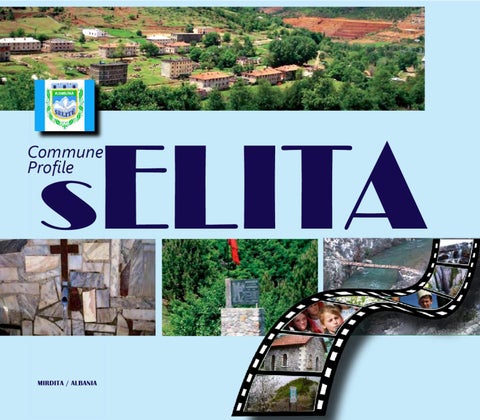
Commune Profile
mIRDITA / aLBANIA
Publisher:
Address: Rr. Abdi Toptani, Torre Drini, Nr. 63. Tiranë, Shqipëri. P.O. Box. 7451 Tel: +355 4 226 20 67 website: www.cangoalbania.org
email: info@cangoalbania.org Design: Printed: Emal Edition: 100
© 2009 Cango All rights reserved. The contents of this booklet may be freely used for non profitable intentions, provided each reproduction acknowledges CANGO as copyrighter.
Commune Profile
Table of Contents
Acknowledgement......................................................................................5 Mayor’s Foreword........................................................................................6 Historical Overview....................................................................................7 Geographical Description.........................................................................9 Climate .......................................................................................................10 Natural Resources.....................................................................................11 Demography..............................................................................................13 Infrastructure and Public Utilities..........................................................14 Agriculture and Breeding........................................................................15 Economic Development .........................................................................17 Education....................................................................................................19 Health Service...........................................................................................19 Social Care Service...................................................................................20 Culture and Tradition................................................................................20 Local Government....................................................................................21
This publication was supported by CANGO, with funds from CAFOD UK (Catholic Agency of England and Wales for Overseas Development).
Acknowledgements
T
he Centre for Collaboration between Communities, Authorities and NGOs (CANGO) would like to thank all the members of the Community Advisory Board for their valuable support in the course of the preparation of this profile. Without their help and support it would have been impossible to gather all the necessary information for this publication. We would like to express our gratitude to the representatives of the Commune Council, to the Commune employees, to the representatives of the Commune and of the local business for their valuable participation and contribution. We are grateful to the work group, especially to our consultant Artan Rroji from the Foundation for Local Autonomy and Governance (FLAG) who led the process for the preparation of this profile. Finally, the findings of this document are the views of the representatives of the Selita Community Advisory Board and CANGO and do not necessarily reflect the position of CAFOD UK (Catholic Agency of England and Wales for Overseas Development) who provided the funds for its preparation and publication. November 2009
Mayor’s Foreword
We would like to particularly thank the staff and experts of CANGO (Center for Cooperation between Communities, Local Authorities and NGO-s) for their decisive cooperation and overall support in the process. This is the first Profile prepared by our local government. It exhibits our local resources which thus exposed may become the focus of long-term development programmes. The authors of this Plan are open to discussions and suggestions so that it may be enriched with fresh data. Thank you! Nikolin Lleshaj
I
n order to live up to its good governance mission and for the benefit of the community, Selita Commune Government is now presenting our commune’s profile.
The Selita Commune work group and I would like to thank all those who, with their dedication, made possible the preparation of this important document for the future of our area.
Historical Overview
S
elita of Mirdita has been inhabited since the late Paleolithic era. In fact, various paintings, fragments of clay vessels, work tools and other objects found in a cave in the proximity of Mërkurth village date back to that period. Nevertheles, albeit an ancient dwellingplace, Selita appears in documents only starting from the late middle ages. There are different theories as to the origin of its name. According to one theory it derives from the Slavonic word “sella” which means “village”, but it has proven scientifically wrong. Whereas another theory holds that it derives from the Albanian word “selitë”, meaning “the seat of government”). This is a scientifically acceptable version as Selita has been governed or self-governed since early times. In a document of 1641, Mark Skura writes: “Selita e Madhe (Big Selita) is a big dwelling-place made up of many villages. There is a Roman Catholic church, St. Alexander’s, in
its center, at the place called Qafë-Kishë, which serves not only as a place for religious cerimonies, but also as a venue for national and cultural meetings”. (State Archives) Selita, together with Kthella and Rraza, is part of the so-called three Ohrid bayraks because once it used to be part of Ohrid sanxhak. They shared with Mirdita the same dialect, tradition and culture, and above all the Catholicism, unlike the local communities that had converted, forced by the Turkish invaders, to Islam. The Old Selita (i.e. the autochthon Selita population) was led by the bayrak leader (a role played by the Kodhelis from Lufaj village) and by the bayrak elder (a role played by the Gjokolas from Gjoça village). Subsequently a family from Shosh of Dukagjin took over the bayrak leadership; Geg Voci (Gjikola) was the first bayrak leader from the Gjikola family. Whereas the bayrak elder role was taken over by the Zogjajs (Lleshis) from Dukagjin; Geg Lleshi was the first bayrak elder from this family.
Historical Overview
Selita is religiously heterogenous: most of the population is Catholic, the rest Muslim. The majority are autochthone, the others are have arrived from Shosh of Dukagjin during the first half of the 16th century and have settled down in the villages of Kurbnesh, Lëkundë, Mërkurth and Kumbull. Over the years many inhabitants have left Selita because of the scarce agricultural land, but when they settled down in places never inhabited before, they used to call their new dwelling-places after their native land: Selita of Kurbin, Selita of Tirana, etc. And they also dedicated their new churches to the same saints they were dedicated to in the country they came from. The Selita people have joined all the national movements over the centuries. In the 19th century’s war against the Turks, in the battle for the conquest of Durres, they were successful in clearing the pathway to Durres by seizing the Preza castle. Led by their bayrak leader Gjetë Geg Voci (Gjikola), they took part in the battles waged by the Prizren League, especially
in the battle of Shtime, in Kossovo. In the 1920 Lushnja Congress, Selita was represented by patriot Gjon Shkurt Lufi. During the Communist regime Selita experienced a fierce persecution. The regime barbarously misused the income from Selita’s rich-in-gold chrome and copper. For 30 years the Kurbnesh mine galleries became the tomb of more than 450 people from Selita and elsewhere, aged 50 or less
Geographical Description
S
elita lies in the east of Mirdita. In the north it borders with Orosh Commune, in the east with Dibra, in south-west with Mati, in the west and north-west with the Kthella Commune. In spite of various administrative divisions over the centuries, Selita has preserved the Mirdita customs and traditions. Selita of Mirdita (the Big Selita) has a 100 km2 hillymountainous territory, whereas the present Selita has a 63km2 territory with heights from 500 to 2018 metres above sea level.
Climate
S
elita belongs to the mediterranean mountain climatic belt, hence it has a cold winter with 0.80m-1m thick snow that lasts 2-3 months, especially in heights 1000m above sea level. In valleys it lasts several weeks. The average temperature is 11oC, whereas the annual active biological temparature is 3000-3100oC. The lowest temperature on record is minus 27oC, but usually temperatures fluctuate between 18 and 22oC. July is the hottest month with temperatures up to 32oC . Its cool summer makes Selita attractive for summer holidays. Annual precipitation varies from 2200 to 2280 mm. The strong winter winds in the Uraka valley are fit for the production of electrical power. Selita has more than 1800 sunny hours and 156 sunny days a year.
10
Natural Resources Land
Water Network
Selita is located in the vertical zone of the oak and beech-pine belt extreme. It has brown and dun lands which are soft, rich in humus, with a soil generally no more than 0,6- 0,8 m thick, varying from not much acid to neutral, with stone fragments. During winter waters drain away and in summer the land does not get very dry, so the area abounds in crops, in fruit trees (apples, plums, and pears), and in vineyards, partcularly in Kthellë Epër, Bardhaj, Lufaj and Lëkundë.
A number of small torrents, not rich in water, cross Kthellë Epër, Lufaj and Lëkundë. Their waters are used for irrigation during summer. The Uraka river springing from the slopes of Didha and Mulli mountains, crosses along Mëkurth, Kurbnesh and Zajs and flows into the Ulza lake. Water temperature in 1.5m depths is 4-6oC during summer and -25 up -30oC during winter, so there lives the trout, albeit not in great numbers. In the proximity of Mërkurth village and at its entrante flows the underground Shutreja water visible from a 15 metres deep netural well. The waters of Kroi i Bardhë (the White Spring), 1300 metres above sea level, are curative for kidney, heart, liver and digestion apparatus diseases.
The forest dun highlands of thin soil and rich in humus, nitrogen and potassium are fit for the cultivation of patatoes, ryes, apples, cherries and plums.
Vegetation Since the villages of Selita have different climates, they have different vegetation, namely: undergrowth (strawberry-tree, heather, juniper, common elder, huckleberry, willow and poplar) in Kthellë Epër, Bardhaj, Lëkundë, Lufaj; oak woods
(common oak, ash, maple) in the middle heights of Kthellë Epër, in the east of Bardhaj zone, in the heights of Tranga in Lufaj, along the Uraka riverside from Kurbnesh to Mërkurth; beech and pine in the Mull, Didhë, Valmor and Kunora mountains; black and white Balkan pines in the Kunora Alps, used for timber in the construction industry and for housefits; the frangula in Didhe and Valmor, whose bark is used in various industrial technologies. Near Kurbnesh town and Zajs, Mërkurth, Kumbull and Kthellë Epër villages there are tre plateaus of 611 hectares used especially for sheep and goats summer grazing. The amount of grass collected there totals 100-200 tons a year.
11
Natural Resources
Forests Selita is rich of forests which occupy an area several times bigger than the agricultural land. The animals, especially goats, find good pastures there. They also have a positive ecological impact as they purify and cool the air, prevent land erosion and are economically profitable. The 5485 ha forest area is divided as follows: Table 1 - Forests
Information Source: Forest Service Directorate
12
After the forests’ ownership passed over from the state to the commune, a number of donors have offered funds for their management. The Commune’s Strategic Plan for Economic Development provides for new, especially pine, afforestations and for mountain embankments to prevent erosion. The forest association founded 5 years ago has contributed to the management and maintenance of the forests.
Fauna The forests, being thick and far from dwelling places, shelter all sorts of animals, such as the brown bear, wolf, fox, hare, weasel, stoat, squirrel, roe deer, boar, jackal, etc. There also live many fowls, such as the hawk, eagle, raven, crow, magpie, robin, blackbird, songthrush, swallow, daw, cuckoo, woodpecker, owl, partridge and wood piegeon. The most common reptiles are some sort of shorts snakes, especially the Balkan’s viper, the lizard, the turtle and, when it rains, the salamander. In the torrents of Kthellë Epër, Lëkundë e Lufaj grow a number of amphibians and the barbel.
S
Demography
elita’s population in 2009 amounts to 1998 inhabitants, 561 households, whereof 66 in Kurbnesh town and 495 in villages. The average age is relatively new. After the 1990’s, because of unemployment, the active population, which is the largetst age-group, has moved to Rrëshen and elsewhere in Albania or abroad.
Table 2 - Population Statistics
Information Source: Selita Commune Table 3 - Population in 2009
Information Source: Selita Commune Registry Office
13
Infrastructure and Public Utilities
S
elita is crossed by Tirana-RrëshenSelitë-Lurë road and has a total of 25 km internal communal roads. All the village roads are connected with the Tirana-Rrëshen-Selitë-Lurë and each village is connected with the center of the commune through a motorway. In Kthellë Epër, Lëkundë, Kurbnesh and Mërkurth there are 8 footbridges whose maintenance is defrayed by commune funds. The commune also funds the road maintaince and cleaning.
Table 5 - Distances commune center-villages
The public utilities offered in the commune are: • Water Supply The biggest water-supply, 3 km long, is that of Kurbnesh town. The small ones are those of Kthellë Epër and KumbullMërkurth. All the villages have taps at the drinking water springs. • Cementery Maintentance The cemeteries are surrounded, cleaned and maintanined
Table 4 - Distances commune center-towns
Information Source: Public Uitilities Office Table 6 - Distances commune center - other communes
• Telecommunication 90% of the territory of Selita is covered with cell signal from the AMC and Vodafone companies. Shortly, Albtelecom is also expected to cover the area with its signal. Work is underway for internet lines installations • Electrical Power Supply Selita is supplied with electrical power from the Ulza hydro-power plant through a direct 110 kw line. A power sub-station in Kurbnesh provides power to the villages of Selita, those of Derjan commune (Mati district) and to some villages of Kthella commune.
14
Information Source: Selita commune Information Source: Public Uitilities Office
Agriculture and Breeding Agriculture
Selita has a territory of 11.250 ha whereof 505 ha are agricultural land. 321 ha of the latter have been distributed to the commune farmers pursuant to law 7501, and the remainder, 184 ha, state property, is unproductive. Selita has 8394 ha of forests, 321 ha of crops and fruit plantations, 611 ha of meadows and pastures, and 1740 ha of unproductive
land. The most cultivated crops are the maize, fodder (lucerne), patatoes in Kurbnesh, Zajs, Kumbull, Mërkurth, Lufaj, whereas in villages situated in lower parts they cultivate maize, vegetables, fruits and grapes. High temperatures are propitious to the growth apples, pears, figs, nuts, cherries, plums, peaches, tomatoes, pepers, onions,
garlics and cabbage. In Bardhaj and Lëkundë many farmers have created 2-3 dynym vineyard plantations.The farmers have received government subsidies to plant new fruit trees, and that has resulted in the increase of cultivated land and consequently in greater production and revenues. Table 9 - Agriculture Crops in 2000 Production in 2000
Table 7 - Land Statistics
Crops
Production in 2008 Total
Amount ha
Yield kv/ha
Total
40
50 kv/ha
2000 1170
kv
Cereals
83 ha
37.5 kv/ha
3118
Patatoes
10 ha
130 kv/ha
1300
6
195 kv/ha
Beans
20 ha
20 kv/ha
400
6
17 kv/ha
102
Vegetables
14 ha
188.7 kv/ha
2642
13.7
216.4 kv/ha
2964.6
139 kv/ha
15720
0.125 kv/tree
840
Fodder Fruit
Grapes Productive vines
Table 8- Land area
Yield
kv
Productive fruit-trees
Information Source: Forest Service Directorate
Amount
113 ha 9407 trees 6721
115
131.8 kv/ha
15157
0.132 kv/tree
10005
0.05 kv/tree
500
8875
9950 vines
7850 10300
6600
0.105 kv/tree
Vineyards
3.6 ha
95 kv/ha
New plants
1.4 ha
693
10000 1.4 5600
Information Source: Mirdita Agriculture Office
Information Source: Selita Commune Land Registry Office
15
Agriculture and Breeding Breeding Thanks to Selita’s geographical conditions, the stock-breeders breed animals for meat, milk and wool. Sheep and goats make up 70% of the livestock, cattle 10% and other domestic animals around 20%. Breeding capacity is 6,000-10,000 sheep and goats. Since the market prefers “bio” meat, the average weight of sheep and goats goes from to 25 to 35 kg. Stock-breeders, mainly from Zajs, Mërkurth, Kthellë-Epër and Kurbnesh, trade goat cheese. They get 1.5-2 kg of cheese per 10 litres of milk. Table 10 - Breeding Statistics
Information Source: Rrëshen Agriculture Office
16
Economic Development Employment
Loca Production and Business
The Selita people are mainly selfemployed in agriculture, livestock breeding, viniculture and fruticulture. Only a few work in the education and health state sector.
Selita is crossed by Uraka river which, because of its clean and cold water, is rich in red dots trouts. Uraka river has its source at the Selita col and flows into the Ulza lake, where a hydro-electric power station has been constructed years back. Table 11 - Employment No
Description
2003
2004
2005
2006
2007
2009/1st half semester
2008
1
Registered unemployed
190
117
56
31
30
24
31
2
Employed
89
87
75
63
65
63
63
a
In the state sector
83
82
70
61
60
63
63
b
In the teh private sector
3
5
5
2
5
8
8
3
Getting unemployment aid
8
7
6
2
2
2
1
Information Source: Mirdita Employment Office
The business consists mainly in small agricultural and breeding activities. Their products go mainly for the fulfilment of the same farmers’ needs and only small quantities of raki , bio meat and goat cheese are traded. The future of the business depends on the numerical increase of sheep and goats, hence their breeding will be a priority. Table 12 - Small business activities
Information Source: Selita Commune Burimi: Komuna SelitĂŤ
17
Economic Development
Tourism
Tourism in Selita could develop in four main directions: a. Historical tourism Many families own towers in villages which the visitors can both visit and lodge in. b. Sightseeing tourism To this end may well serve the many Selita caves, the most known of which are those of Mërkurth, of Ndue Doci, of Shutreja. Whereas Guri i Gjonit and other breath-taking places are fit for mountain climbing. c. Curative tourism Selita is well known for the curative (Kroi i Bardhë White Spring) that gushes forth from the westerns slopes of Kunora mountain. It is visited every year by hundreds of Albanians and foreigners. d. Agro-tourism The bio-products of mountainnous Mulli, Valmor, Didha and Tranga may well attract people loving agro-tourism.
18
Apiculture
A whole variety of plants and the vicinity of the mountains with each other have favoured the increase of the number of beehives. Positive in this direction has also been the farmers’ abstaining from the use of herbicides. In winter the bee-breeders transfer the hives in mild climate areas and in summer in mountain meadows. Apiculture is thriving especially in Mërkuth, Kurbnesh, Zajs,Trang of Lufajs and to a lesser extent in Bardhaj and Kthellë-Epër villages. The honey produced is of high quality and the market demand high.The objective is to double or triple the quantity of beehives.
Mining Industry
Selita is rich in ore reserves, especially in rich-in-gold chrome and copper and this industry provides employment in the commune. There are copper reserves in the area of Kurbnesh and Kthellë Epër, and of chrome in Hurdh-Toll (Kunora mountain) and in Lufaj (Tranga mountain). Some Canadian companies are providing assistance to find out ore bodies and to establish the ore amount there.
Medical Pants
Another wealth of Selita are the medical and hetero-oil plants. In the alps of Mull, Valmor and Kunora grow great quantities of bilberry (Vaccunium myrtillus L.), wild rose (Rosa canina), savory (Satureja montana), coltsfoot (Tussilago farfara), sage (Salvia officinalis), marjojam (Origanum vulgare), lemon balm (Melisa officinalis), balsam (Hypericum perforatum), frangula (Rhmmus frangula), juniper (Juniperus communis), cowsleep (Primula veris),strawberry tree (Arbustus unedo L.), Alp plum (Prunus brigantiaca), blackberry (Rubus specia vulgatum), wild apple (Malus silvestris), wild pear (Pyrus communis anygdalifoms), thorn-apple (Crataegus mollis L), butcher’s broom (Ruscus aculeatus L), blackberry (Robus ulmifoglius) etc.
Education
S
chooling in Selita started in 1923. At present there are four schools in villages and one school in Kurbnesh town. Until 2003 there has been a global high school in Kurbnesh.
Table 13 - Secondary Schooling 2004-2005 Pupils
Lufaj
48
20 28
4
2005-2006 Pupils Teacher T F M s 42 18 24 3
Bardhaj
63
41 42
6
80
Village T
F
M Teachers
43
37
6
2006-2007 Pupils
2007-2008 Pupils
T
F
35
15
Teacher T s 20 3 32
70
37
33
M
6
65
2008-2009 Pupils T
F
M
Teachers
13
Teacher s 19 4
32
15
17
3
33
32
69
35
34
7
F
M
6
Mº rkurth
13
6
7
2
10
5
5
2
11
7
4
1
5
5
0
1
3
3
0
1
Kurbnesh
103
52 51
7
90
49
41
5
79
40
39
7
70
34
36
3
66
32
34
6
Kthellº Epº r
59
33 26
5
41
22
19
4
31
21
10
5
24
15
9
7
18
9
9
3
Information Source: Mirdita Education Directorate
Health Service
T
he health centres in the Commune center, Kthellë-Epër, Bardhaj and Kumbull-Mërkurth offer first-aid care.Their construction in 2006-2008 was funded with state funds. The Austrian Caritas has financed the construction of Lëkundë health center and of a modern health center in the Commune center. There is a 13-member medical staff working in these centres: eleven nurses-midwives, one physician assistant and one general practitioner. The Kurbnesh health center provides round-the-clock service.
Table 14. Health Sector Employees
Information Source: Mirdita health Directorate
19
Social Care Service The economic aid office, subordinate to the commune authorities and the Lezha Regional Directorate, is in charge of providing social aid. Table 15 - Economic Aid Statistics Year 2005 2006 2007 2008 2009
Economic Aid Number of families Amount in 000 ALL 315 8313 275 9220 250 7300 221 9000 205 11600
Information Source: Selita Commune Social Aid Office
Culture and Tradition
J
ust like anywhere else Albania, handicraft has developed in Selita very early. Word working is common in all the villages, but especially in villages near the forests, such as in Kumbull and MĂŤrkurth. Wood working consists mainly in the production of vessels necessary for the processing and preservation of diary products, for the collection of grapes and for keeping liquids. Some carpenters produce also dower chests, wool processing tools, decorative ceilings, parquet, doors, windows and beehives.
20
Work Invalidity Number of invalids Amount in 000 ALL 121 6797 118 6685 107 7200 99 7300 101 7100
Local Government
S
elita has 8 villages and one town. The commune was established in 1992 when the first pluralistic elections took place. Kurbnesh town is the center of the commune housing the commune government offices. The council chairman and his deputy are elected by 13 council members. The council has standing committees elected at the beginning of each mandate. The commune mayor has a staff of ten employees, one service worker and six village chairmen. Selita has been organized in villages since early middle ages. During the communist regime, the old Selita was split initially into three and later on into two districts and two prefectures (such is the situation at present). The administrative units (villages) of the ethnic selita are : 1. Kurbnesh 2. Mërkurth 3. Kumbull 4. Lëkundë 5. Zajs 6. Bardhaj
7. Lufaj 8. Tharr 9. Daç 10. Lami i Madh 11. Gjoçaj 12. Zallë-Gjoçaj
Selita Commune Government Organization Chart
Voters Commune Council
Council Committees
Council Secretary
Commune Mayor
Finance Office,
Economy-Finance Committee
Social Service Office
Education, Culture, Sport Committee
Public Utilities Committee
Deputy Commune Mayor
Current Selita comprises : 1. Kurbnesh (town) 2. Kurbnesh (village) 3.Kumbull 4.Mërkurth 5.Lëkunde
6.Zajs 7.Bardhaj (Bozhiq) 8.Lufaj 9.Kthellë Epër
Cicil Emergencies and Tax Office
Internal audit
Village chairmen
21
Financial and Investment Capacity
The commune budget has been increasing over the years, but it still remains low compared to the the needs of the community for infrastructure and services. Table 16 - Commune Budget Statistics (ALL) Year
Central Government Grant
Commune Revenues
Public Investments
Local Government Investments
2005
10476
474
2156
474
2006
13358
357
4493
357
2007
13193
472
3380
472
2008
13209
1532
3960
590
2009
13548
170
4540
700
Information Source: Selita Commune Finance Office Table 17 - Government and Donor Investments (000 all) No.
Selita Commune
2001-2005
2006
2007
2008
2009
Financial Source
Secondary Education 1 2
Lufaj school reconstruction Encirclement and rearrangement of the Kurbnesh school settings
4700
Mirdita Education Office 3450
Total i
4700
Lezha District
3450
Health Center 1
Bardhaj Health Center
2
Mº rkurth Health Center
1000 1000
Competitive State Grant
Lº kundº Health Center
1900
Mirdita Karitas
Kthellº Epº r Health Center
1605
Competitive State Grant
1000
Totai ii
Lezha District
4505
Infrastruktura rrugore
22
1
Bardhaj-Kurbnesh road construction
2
Local road maintenance
700
3
Local road maintenance
950
4
Kthellº Epº r- commune motorway
5000
5
Local road maintenance
1000
6
Local road maintenance
7
Local road maintenance Water-supply Kroi i Bardhº Watersupply construction KUZ reconstruction Kurbnesh, stage 1 Total iii
1 2
1400
F.SH.ZH State Grant State Grant Competitive State Grant State Grant 1250
State Grant 1710
State Grant
1400 15650
Information Source: Selita Commune Finance Office
6000
1250
3110
2000 2000
State Grant Competitive State Grant
23
24
Address: Rr. Abdi Toptani, Torre Drini, Nr. 63. TiranĂŤ, ShqipĂŤri. P.O. Box. 7451 / Tel: +355 4 226 20 67 / Mob. 069 20 42 190 website: www.cangoalbania.org / email: info@cangoalbania.org
Selita commune, Mirdita e-mail: komunaselite@yahoo.com