
THANK YOU FOR BEING PART OF THIS 50 YEAR JOURNEY
It’s hard to believe: this year marks fifty years since I started RR Auction.
Back in 1976, I was a kid in Boston with a love of collecting, and no real sense of where it would all lead. My grandfather offered me $1,800 to start a small business; he never asked questions, and never asked for his money back, he just believed in me. That belief set everything in motion.
My one-man operation selling baseball memorabilia and modest autographs grew slowly. I spent the first ten years working out of my parents’ basement, manually hand-typing catalogs every month and mailing them out myself. I persevered, caring about doing things the right way, learning as I went, and treating people well.
Carla, my wife at the time, was always there to help. In 1986, I hired Bill White as our first team member, and forty years later he’s still with the company today. In 1996, Elizebeth Otto joined the consignment department, and she’s still here, too. I’m proud of the people who have stood by this company, and equally proud of my children and other family members who have worked here over the years, including my son Bobby, who now serves as our COO; watching him help lead the business has meant a great deal to me.
As years passed we became respected as specialists in documents and manuscripts. Since 1976, we’ve handled pieces spanning the full stretch of written history...from Earhart to Einstein, from Henry VIII to Henry David Thoreau, from Beethoven to Babe Ruth. At the heart of it all are the handwritten letters and manuscripts, which represent a personal connection that has always been the foundation of this company.
Over the years, we’ve handled some remarkable pieces in space exploration. We’ve directly represented several moonwalkers—Dave Scott from Apollo 15, Alan Bean, Charlie Duke, the last man on the moon Gene Cernan, and others. Their space-flown hardware and mission-used artifacts have been a meaningful part of our story, and I never take for granted the trust that these astronauts placed in us.
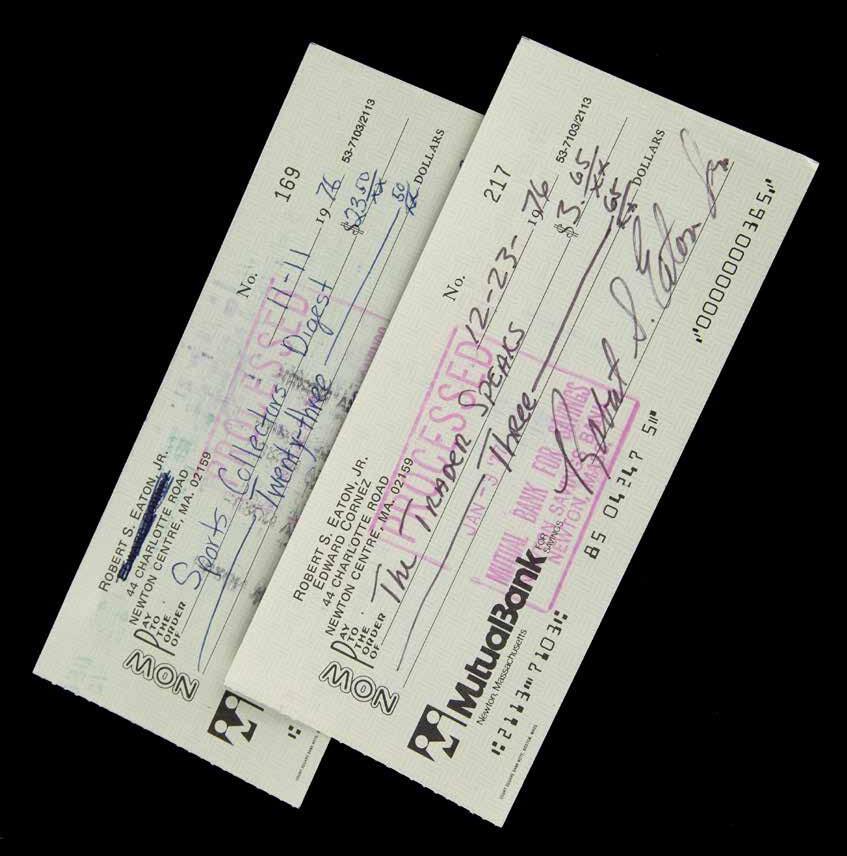
In technology, our history closely parallels that of Apple: we both started in 1976. In recent years, we’ve handled Apple documents, contracts, and some remarkable hardware that date back to the tech giant’s earliest days, including Steve Jobs’ personal Apple-1 prototype, and Apple Check Number One, the first check the company ever issued. Helping tell that sensational story has been a privilege.
American history has always been at our core, and Revolutionary War-era material from the Founding Fathers remains a cornerstone of what we offer. We’ve been proud to present material from signers of the Declaration of Independence, including Button Gwinnett, one of the most elusive and sought-after names in American history. The nation’s 250th anniversary, alongside RR Auction’s own 50-year history, serves as a reminder of why preserving these documents matters, and why we take this responsibility seriously.
We’ve been honored to represent many delightfully unexpected items as well! We sold the $28 million seat on Jeff Bezos’s first Blue Origin flight; we handled Jim Sanborn’s Kryptos archive, tied to one of the great modern code-breaking puzzles; and we revealed and sold a previously unknown JFK film taken in Dealey Plaza. These certainly aren’t the kinds of things I ever dreamed of selling while typing catalogs in my parents’ basement, but they’ve become pivotal parts of our story nonetheless.
But the moments that stay with me aren’t the headlines and high-ticket items; they’re the moments when we’ve helped people change their lives, when the outcome of a consignor’s item has made a sincere difference for them, very often exceeding their financial expectations. RR Auction has always been about people. Consignors. Buyers. Referrals. And, of course, the staff who have worked hard behind the scenes—none of this would be possible without them.
Through it all, I think about my grandfather’s gesture, the quiet belief he showed when he trusted and believed in me with that $1,800. Half a century later, everything we’ve built has come from that same sense of belief. People believed in what we were doing— they gave us a chance, and they sent others our way. For that, we are forever grateful.
WITH GRATITUDE, BOB EATON FOUNDER, RR AUCTION
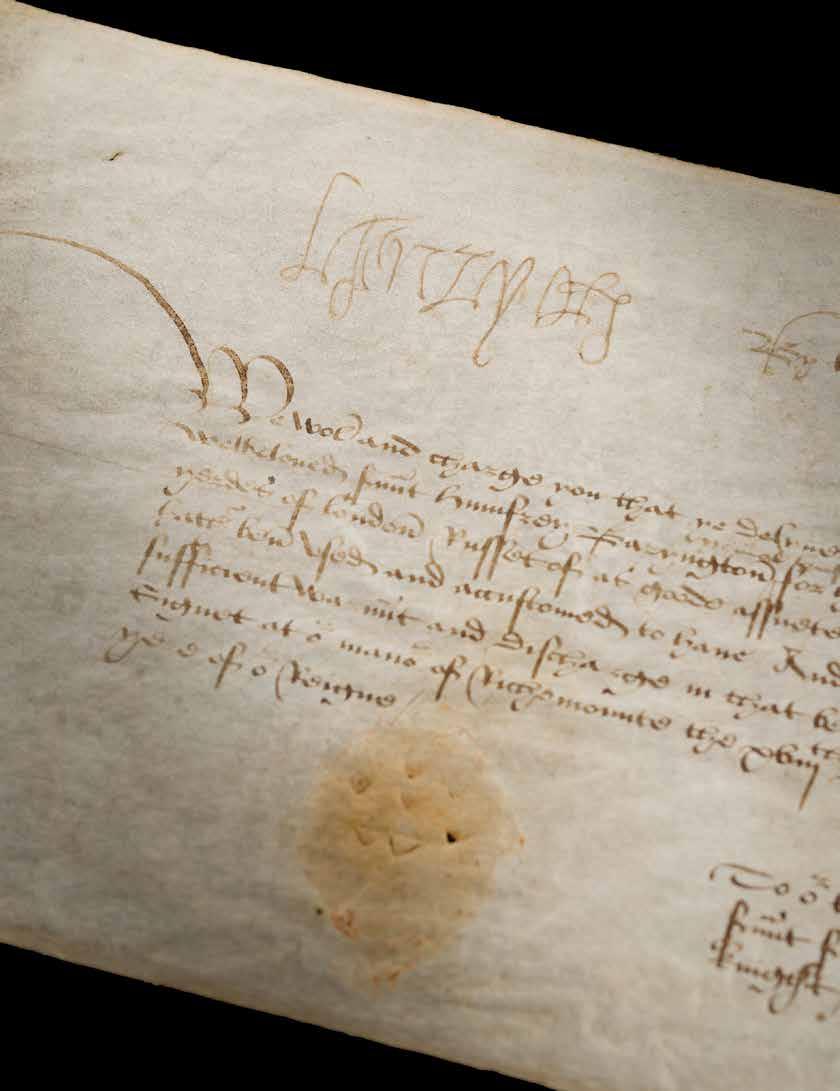
King Henry VIII directs the Keeper of the Wardrobe to deliver five yards of “london russet”
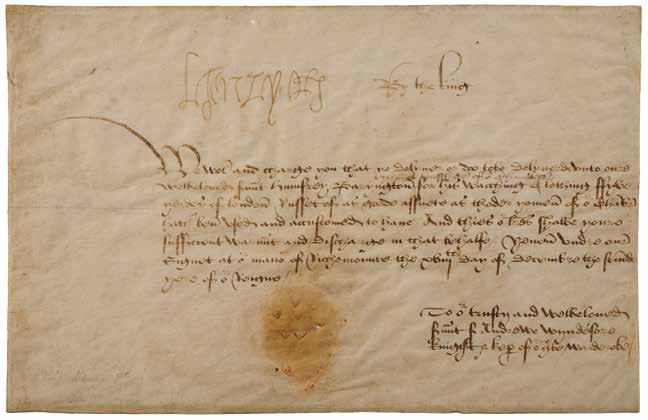
LOT 4001
King Henry VIII Document Signed to the Keeper of the Wardrobe
Vellum manuscript DS, signed “Henry R,” one page, 9 x 5.75, December 18, 1510. A warrant in the form of signet letters close to Andrew Wyndesore, Keeper of the Wardrobe, ordering material to be delivered to Humfrey Baryngton. In full: “We wol and charge you that ye delyvre or doo to be delyvred unto oure welbeloved s[erva]unt Humfrey Baryngton for his watching clothing ffyve yerdes of london russet of as goode assuete as thoder yomen of o[ur] cha[m]bre hath ben used and accustomed to have. And thies o[ur] l[ett]res shalbe youre sufficient warraunt and discharge in that behalfe. Geven undre our signet at o[ur] mano[r] of Richemounte the xviiith day of decembre the seconde yere of o[ur] reigne.” In fine condition, with traces of a red wax seal toward the bottom.
Andrew Windsor (1467–1543), 1st Baron Windsor, was an English peer and politician who served as Keeper of the Great Wardrobe from 1504 to 1543. He played a key role in King Henry VIII’s 1513 military campaign in France, taking part in the Battle of the Spurs on August 16th, where he was among the first to be advanced as Knights Bannerets. In 1514, he accompanied Mary Tudor to France for her marriage to King Louis XII and later signed the 1518 marriage and peace treaties with France. Windsor also attended the historic Field of the Cloth of Gold in June 1520, a summit between Henry VIII and Francis I which saw an opulent display of wealth by both kings. From the personal collection of a lifelong collector, teacher, and traveler with a passion for world history. His collecting years ranged from the 1970s to the present day, meaning that several of the premier pieces have not been on the market in decades.
Starting Bid $2,500
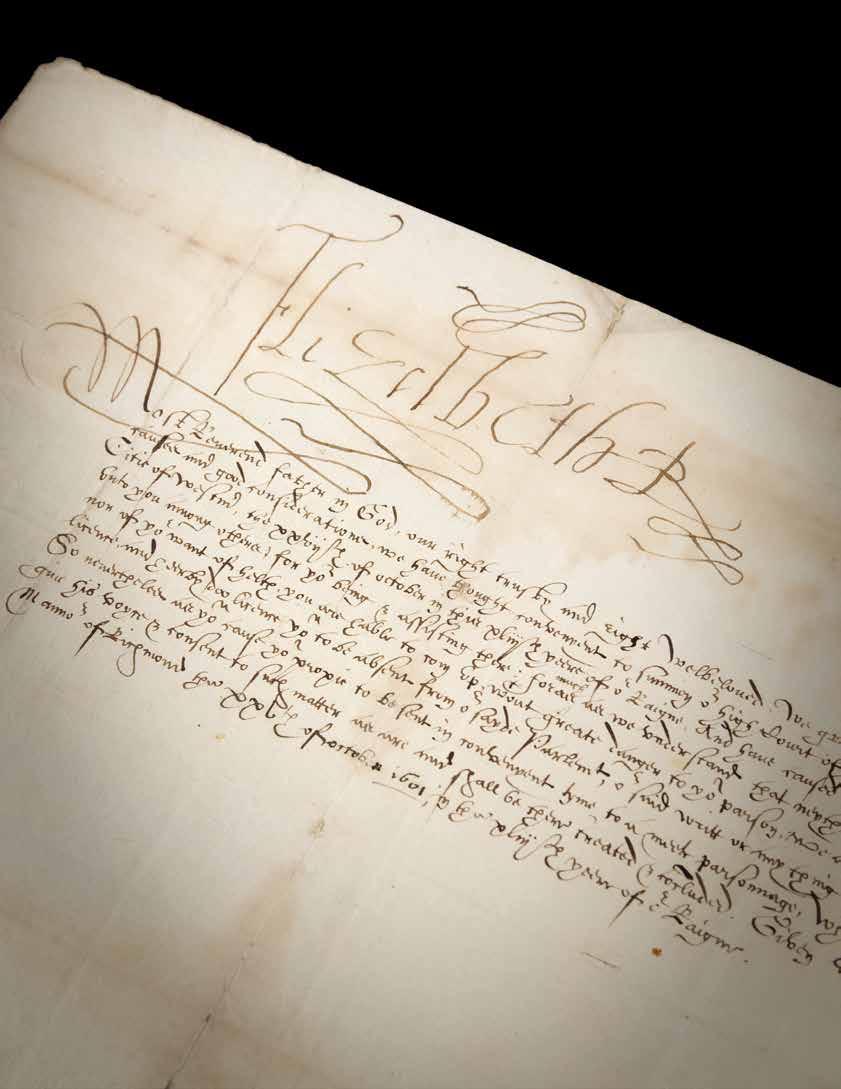
Queen Elizabeth I excuses
the Archbishop of York from attending a session of Parliament, citing his
“greate yeeres” and “want of helth”
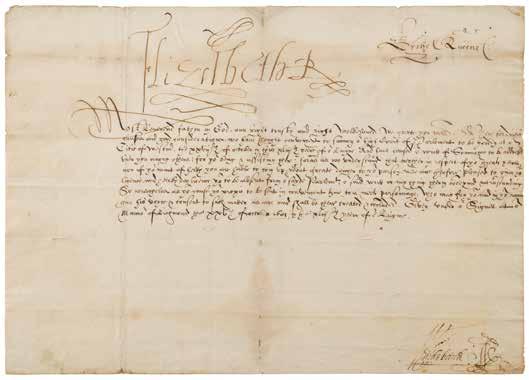
LOT 4002
Queen Elizabeth I Letter Signed to the Archbishop of York, Excusing Him from Attending Parliament
LS signed “Elizabeth R,” one page, 12 x 8.5, October 25, 1601. Letter to Matthew Hutton, Archbishop of York, excusing him from personally attending the new session of Parliament, on the grounds of age and infirmity, and instructing him to appoint a proxy. In part: “Where for divers causes and good considerationes, we have thought convenient to summon our high Court of Parlement to be holden at our Citie of Westm[inster], the xxvijth of october in the xliijth yeere of our Raigne. And have caused our writt of Sommonce to be addressed unto you among others for your being & assisting there: for as much as we understand that neyther in respect of your greate yeeres nor of your want of helth you are hable to com up w[ith]out greate danger to your parson. We are therfoer pleased to give you licence and heerby doo licence you to be absent.” In very good to fine condition, with scattered light dampstaining and old expert repairs to split folds.
Queen Elizabeth I summoned Parliament to meet only thirteen times during her reign of forty-five years. The session of 1601 referred to here was to be the last, and was called to ask for fresh subsidies to forestall the possibility of an attack by the Spanish from Ireland.
The recipient, Matthew Hutton (1529–1606), was Archbishop of York from 1595 to 1606. Hutton was respected for his learned sermons, his clemency in political and religious matters, and his advocacy for moderation toward Puritans. He died at Bishopthorpe and was buried in York Minster, leaving a reputation as one of the era’s eminent Anglican prelates. From the personal collection of a lifelong collector, teacher, and traveler with a passion for world history. His collecting years ranged from the 1970s to the present day, meaning that several of the premier pieces have not been on the market in decades.
Starting Bid $2,500
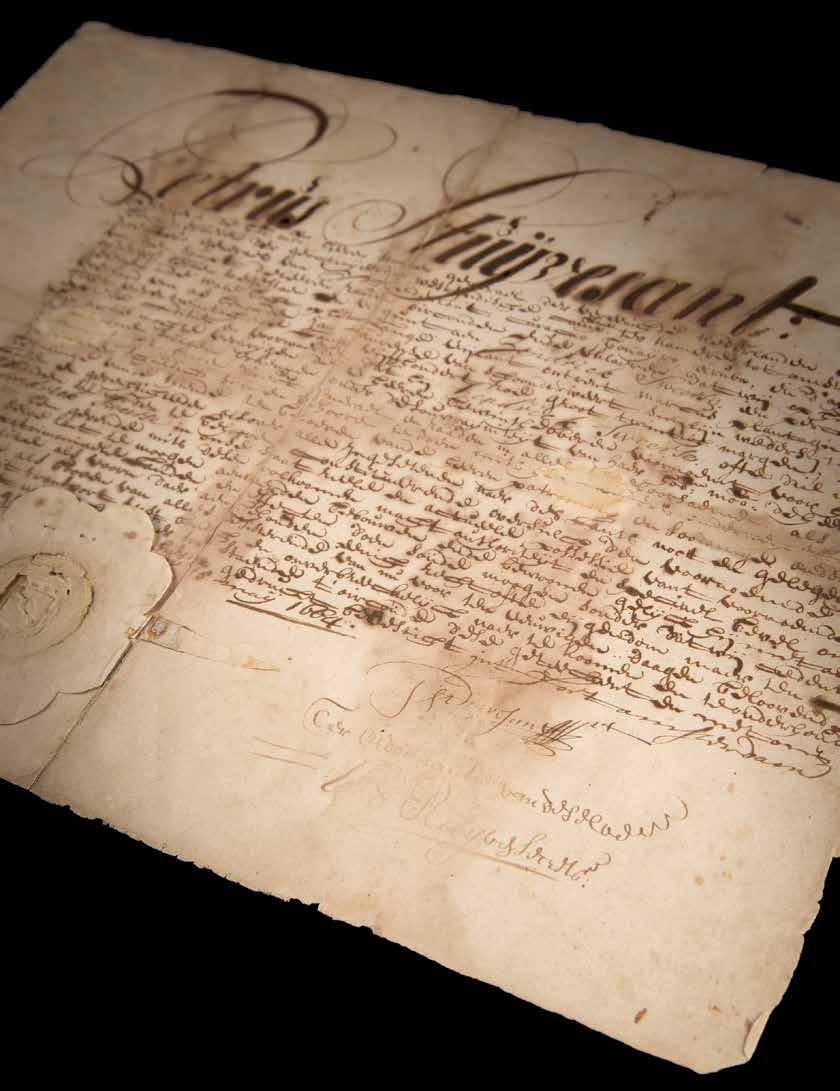
Four months before surrendering New Amsterdam to the English, Stuyvesant grants land on Long Island
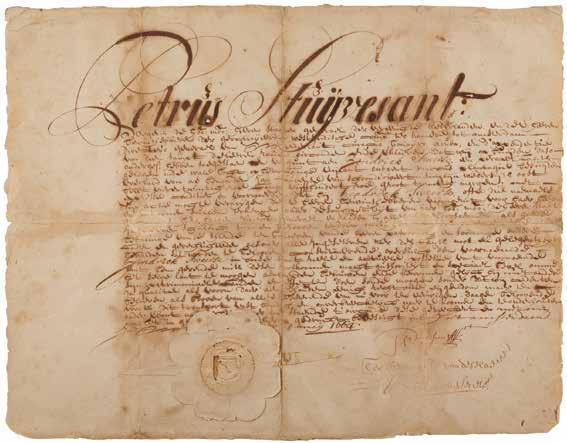
LOT 4003
Peter Stuyvesant Document Signed, Granting Land on Long Island in 1664, Four Months Before Surrendering New Amsterdam to the English
Last Dutch Director-General of the colony of New Netherland (1612–1672) who was a major figure in the early history of New York City. Manuscript DS in Dutch, signed “P. Stuyvesant,” one page, 16.75 x 13, May 15, 1664. Document with an impressive calligraphic header, “Petrus Stuyvesant,” issued at “Fort Amsterdam,” confirming a grant of land to Hendrick Sweerse on Long Island. Prominently signed at the conclusion in ink by Peter Stuyvesant as Director-General of New Netherland. The embossed paper seal affixed at the lower left remains largely intact. In good to very good condition, with professional repairs to separations of the intersecting folds, areas of ink erosion, and dampstaining (touching the signature). A sought-after example of a rare colonial autograph.
The one-legged Stuyvesant, often referred to as either ‘Peg Leg Pete’ or ‘Old Silver Nails’ on account of his nail-studded prosthesis, served as the director-general of New Amsterdam for the final time in 1664. Situated within Fort Amsterdam on the southern tip of present-day Manhattan, Stuyvesant had run the Dutch colony for nearly 17 years, and achieved much in improving the economy and quelling Indian hostilities that threatened the growth of Dutch settlement. His charge came to end, however, when on August 27, 1664, four English frigates sailed into New Amsterdam’s harbor and demanded New Netherland’s surrender. Initially defiant, Stuyvesant soon yielded when his call-to-arms went unheeded, and he was forced to sign a treaty on September 9th, ceding the colony to the Duke of York.Illustrated in The Western Pursuit of the American Dream: Selections from the Collection of Kenneth W. Rendell (p. 17, University of Oklahoma Press, 2005).
Starting Bid $10,000
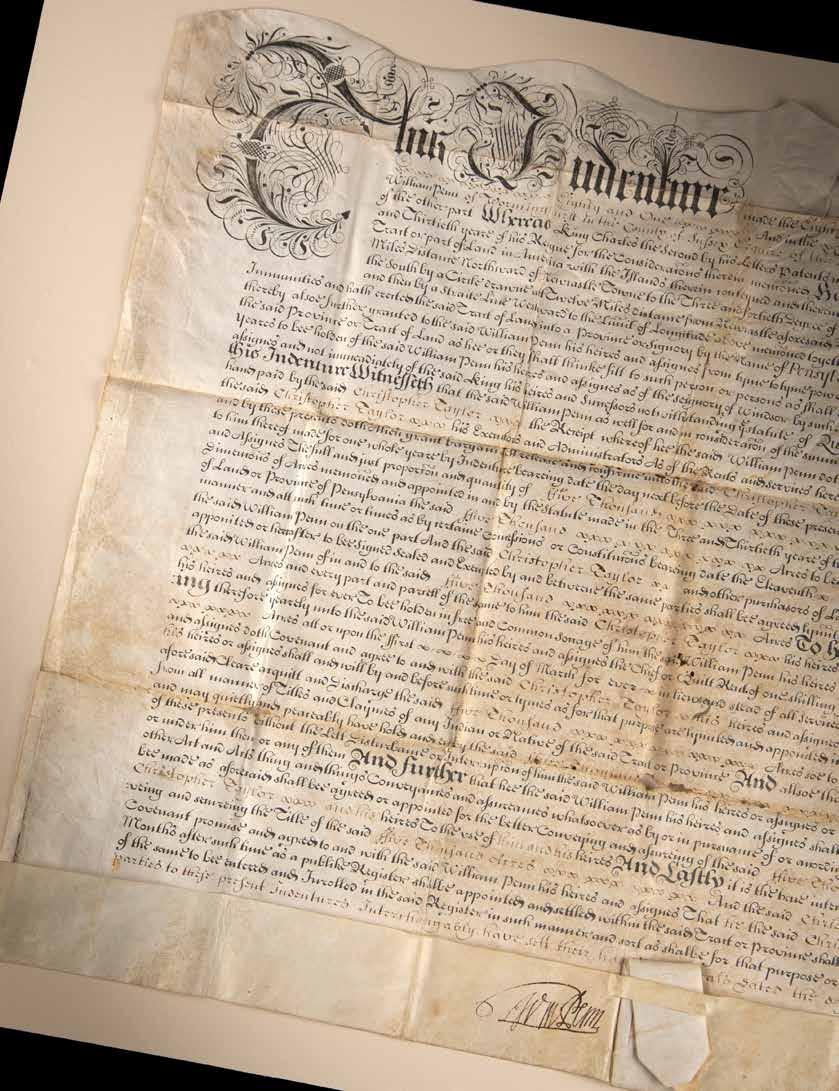
William Penn grants a 5,000-acre tract to one of Pennsylvania’s ‘First Purchasers’
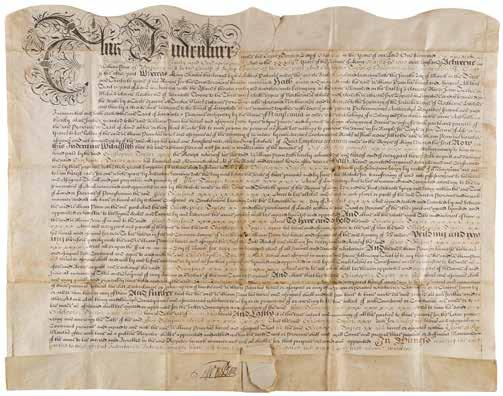
LOT 4004
William Penn Document Signed, Granting 5,000 Acres to One of Pennsylvania’s ‘First Purchasers’
English-born Quaker (1644–1718) and founder of the colony that became the State of Pennsylvania. Historic partly-printed vellum DS, signed “Wm. Penn,” one page, 27.25 x 21.5, October 28, 1681. Indenture by which Penn conveys 5,000 acres of land in the newly chartered Pennsylvania to Christopher Taylor for the sum of £100. In part: “Whereas King Charles the Second…hath given and granted unto the said William Penn, his heirs and assigns, all that tract or part of land in America…together with divers great powers, pre-eminences, authorities, royalties, franchises and immunities; and hath erected the said tract of land into a province or signory, by the name of Pensylvania, in order to the establishing of a colony and plantation in the same…for and in consideration of the summe of one hundred pounds…paid by the said Christopher Taylor…assign the full and just proportion and quantity of five thousand acres.” Neatly signed in the lower margin in ink by William Penn. Affixed by its top edge to a 32.5 x 23.5 mat. In very good condition, with soiling, staining, and small areas of loss at the fold intersections.
In 1681 William Penn received a royal charter from King Charles II for an expansive tract of land in North America that would become the Province of Pennsylvania, part of the Crown’s effort to satisfy a debt owed to his father and to establish a proprietary colony built on principles of religious tolerance and orderly governance. Penn’s strategy for financing and populating the new province was to sell large blocks of land to investors and settlers willing to support and develop the colony. These early buyers, known as the ‘First Purchasers,’ provided critical capital to Penn, and many of them subsequently emigrated to Pennsylvania or sent tenants to settle and work the land.
Christopher Taylor, a Quaker born in Yorkshire, England, immigrated to the colony by sailing with Penn’s fleet in 1682, probably aboard the ship Welcome. On arriving, he was immediately immersed in early Pennsylvanian politics: he stood alongside William Penn when he and Tamanend of the Lenape concluded the Treaty of Shackamaxon on November 22, 1682, and was appointed by Penn as a member of Pennsylvania’s first Provincial Council. Illustrated in The Western Pursuit of the American Dream: Selections from the Collection of Kenneth W. Rendell (p. 20, University of Oklahoma Press, 2005).
Starting Bid $500
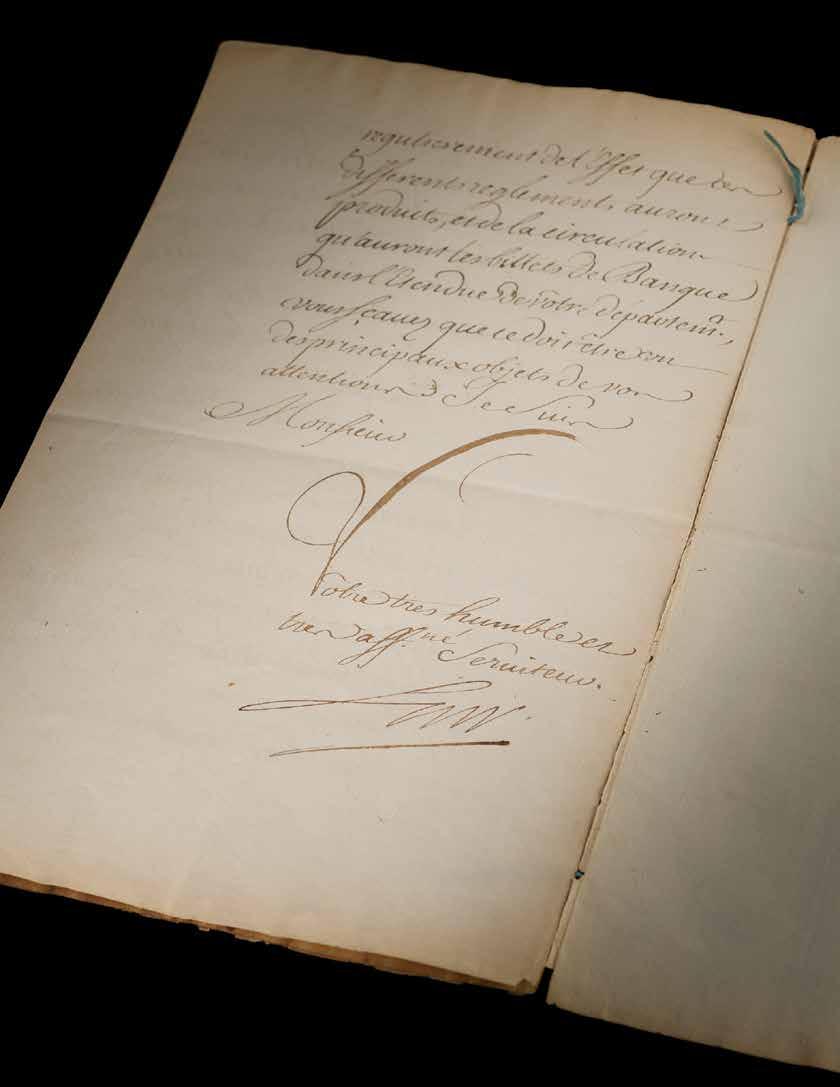
In an ill-fated attempt to prop up his failing financial system, John Law orders currency manipulation at the peak of the Mississippi Bubble crisis
LOT 4005
John Law Letter Signed, Ordering Currency Manipulation Amidst France’s First Paper-Money Experiment
Scottish economist (1671–1729) known as a monetary reformer and as the originator of the ‘Mississippi scheme’ for the development of French territories in America. LS in French, signed “Law,” six pages on adjoining sheets, 8 x 12.75, May 5, 1720. Letter ordering a currency increase, in part (translated): “I give you notice that His Royal Highness has judged it necessary to order a currency increase beginning today, the fifth of the present month, the legal tender currency namely, the gold Louis minted in accordance with the Edict of May 1718 for 48 livres, the halves in proportion, those of the minting ordered by the Edict of November 1716 for 60 livres, the halves and quarters in proportion, those of the minting order by the Edict of May 1709 and December 1715 for 40 livres, the doubles and halves in proportion, and those of preceding mintings…
The intention of His Royal Highness was that immediately on receipt of this letter you will make public in the whole extent of your department the increases which you will make at the same time as visits in all the royal banks, in the place of your residence, and that you summon the same day all your subdelegates to make similar visits in the offices of receipts of the King’s treasurer in places of their subdelegates…You will give me the pleasure of informing me regularly of the effect that these different rules will produce, and of the circulation
that the banknotes have in the extent of your department, and you know that this must be one of the principle objects of your attention.” In fine condition.
John Law’s financial system was at its peak—and already beginning to fracture—by the spring of 1720. As architect of France’s experiment with paper money, Law sought to replace hoarded specie with banknotes issued by the Royal Bank, newly merged with the Company of the Indies. Mounting public anxiety over the stability of paper currency led investors to demand redemption in gold and silver, threatening the entire system. In response, Law and the regent, Philippe d’Orléans, issued a series of increasingly coercive monetary decrees designed to control the circulation and valuation of metallic coinage.
Written at the height of the Mississippi Bubble crisis, this letter vividly documents John Law’s desperate efforts to prop up his collapsing financial system. As confidence in paper money faltered, specie was aggressively regulated through fluctuating official valuations and intrusive inspections of banks and treasury offices, as ordered here. These measures, intended to force reliance on banknotes and suppress hoarding, only accelerated public distrust. Within months, Law’s system imploded entirely, triggering financial ruin across France. Disgraced and politically isolated, Law fled the country later in 1720, leaving behind both his fortune and one of the most infamous monetary experiments in European history.
Starting Bid $500
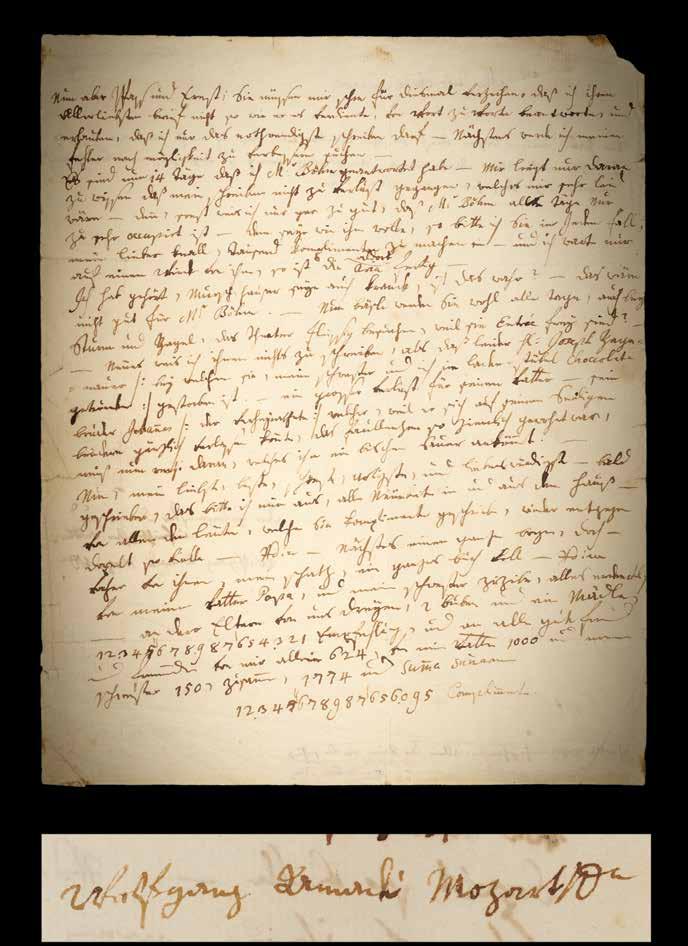

“Wolfgang Amadé Mozart” playfully writes to his little cousin, sending “12345678987656095 compliments”
and an update on his work:
“The aria will be finished”
LOT 4006
Wolfgang Amadeus Mozart Autograph Letter Signed to His Cousin, Bäsle: “The aria will be finished”
ALS in German, signed “Wolfgang Amadé Mozart,” one page both sides, 7.5 x 9.25, April 24, 1780. Handwritten letter to his cousin, Maria Anna Thekla Mozart, known to him as his beloved ‘Bäsle,’ being the seventh in a famous series of nine affectionate, playful, and exuberant letters to her. He opens the letter with a courtly tone, thanking her for her previous message in a typically florid fashion (translated): “You answered my last letter so beautifully that I don’t know where to find the words to express my gratitude enough, and at the same time to assure you once again how much I am your most obedient servant and most sincere cousin.” At the bottom, he playfully adds: “I wanted to write more, but as you can see, the space is too small. Adieu, adieu.”
On the reverse, he fills the page with playful prose and practical manners, apologizing for his brief reply, mentioning a letter to the theater director Johann Heinrich Böhm, and expressing his readiness to compose an aria upon request. In part (translated): “Now, let’s get down to brass tacks. You must forgive me this time for not answering your dearest letter as it deserves, word for word, and allow me to write only the bare essentials. Next time, I will try to correct my mistake as best I can.
It has now been 14 days since I replied to Mr. Böhm. My only concern is to know that my letter has not been lost, which I would be very sorry about. Otherwise, I know all too well that Mr. Böhm is always far too busy. Be that as it may, I beg you in any case, my dear Mr. Böhm, to send a thousand compliments there. I’m just waiting for a nod from him, and then the aria will be finished. I’ve heard Munschhauser is also ill, is that true? That wouldn’t be good for Mr. Böhm.—Now, dear friends, you will probably diligently attend the theater every day, even in storm and hail, because you have free admission?—
I have nothing new to write to you, except that unfortunately Joseph Hagenauer (with whom you, my sister and I were drinking chocolate in the shop-room) has died.—a great loss for his father—his brother Johannes (who married), who, because he could rely completely on his deceased brother, was quite accustomed to idleness, must now face it, which is a bit of a bitter pill for him to swallow.”
He closes with characteristic linguistic exuberance and affection, exaggerating his sentiments to cosmic proportions in a mock-accounting of compliments and greetings: “Well, my dearest, best, most beautiful, kindest, and most lovable…I ask you to send me all the news in and out of the house—from all the people to whom you wrote compliments, in return twice as many—Farewell—Next, a whole sheet, but—before that, my darling, a whole book full of them—Farewell from my father Papa, and my sister Zizibe, everything imaginable—to your parents, from us three, 2 boys and a girl, 12345678987654321 commendations, and to all good friends from me alone 624, from my father 1000 and my sister 150, together 1774 and in total 12345678987656095 compliments.” In fine condition, with occasional staining and a few tiny edge tears and losses.
Accompanied by a wrapper inscribed by Josephine Baroni von Cavalcabò, the companion and sole heir of Mozart’s son Franz Xaver Wolfgang Mozart, addressed in German to the conductor Joseph Labitzky (translated): “A handwritten letter from the immortal Mozart. From the estate of W. A. Mozart Jr., who died in Carlsbad, For Mr. Kapellmeister Labitzki as a token of our deepest gratitude,” dated at Vienna, April 19, 1845.
Mozart’s correspondence with Maria Anna Thekla Mozart, written between 1777 and 1782, is unparalleled in its personal tone and playful verbal inventiveness. These letters were composed during a pivotal time as Mozart sought to liberate himself from Salzburg’s courtly constraints and establish himself as an independent composer in Vienna. The reference to Johann Heinrich Böhm is particularly significant, as it reveals Mozart’s active pursuit of operatic commissions beyond Salzburg. He would soon be commissioned by Karl Theodor, Elector of Bavaria, to compose the opera Idomeneo for a court carnival.
Of the nine known Bäsle letters, five reside in major institutional collections (four at the British Library and one at the Pierpont Morgan Library). The whereabouts of three others are unknown. The present Letter No. 7 is the only example known to appear at public sale, representing a singular opportunity to acquire one of the most celebrated private letters in Mozart’s corpus.
Starting Bid $25,000
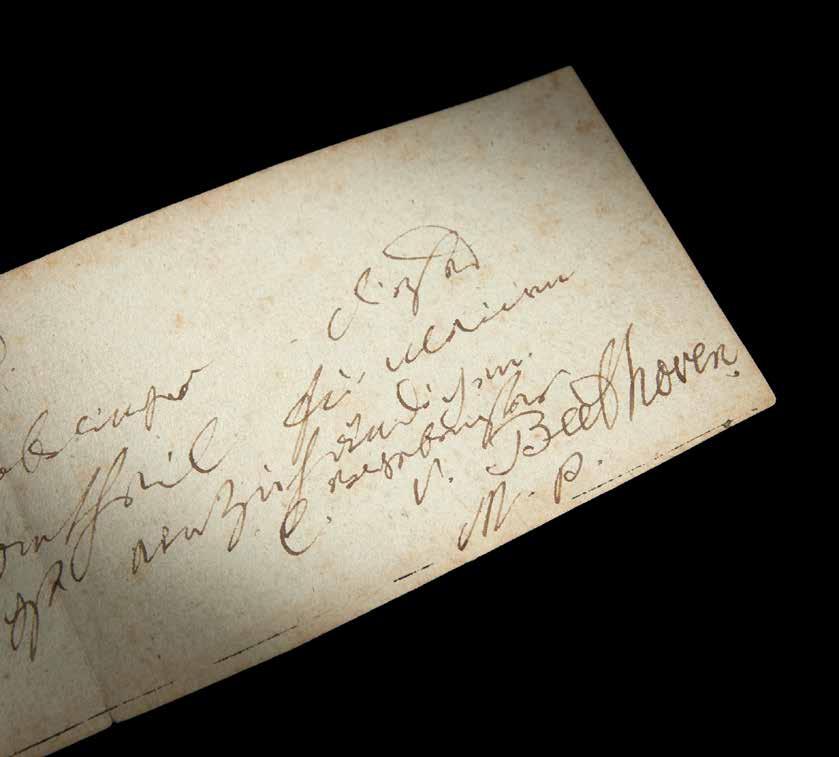
Sought-after autograph letter signed by Ludwig van Beethoven— a glimpse into the turbulent guardianship of his nephew
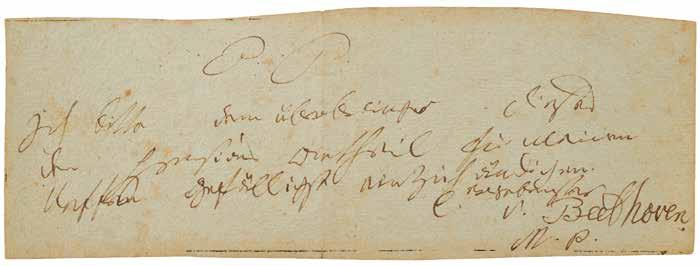
LOT 4007
Ludwig van Beethoven Autograph Letter Signed, Directing Payment of His Nephew’s Pension
ALS in German, signed “l. v. Beethoven,” one page, 8.25 x 3, [Vienna, perhaps 26th October 1819]. Handwritten letter to an employee of the Universal Office, in full (translated): “Please kindly pay the bearer of this letter the portion of my nephew’s pension.” At the top, Beethoven writes “P.P.” (Praemissis Praemittendis), a conventional form of polite address, and closes with “M.P.” (Manu Propria), meaning ‘with one’s own hand.’ In fine condition, with a central vertical fold, and scattered light foxing.
The sole nephew of composer Ludwig van Beethoven, Karl van Beethoven (1806–1858), was the only son of the composer’s brother, Kaspar Anton Karl van Beethoven, and Johanna van Beethoven (née Reiss). He is chiefly remembered as the focus of a bitter custody battle between his mother and his famous uncle following his father’s death in 1815. It was one of the ugliest and most traumatic episodes in the composer’s life
In a contract dated May 10, 1817, Johanna agreed to transfer half of her pension toward the education of her son Karl. The Universal Office (Universalkameralamt) was the competent authority responsible for disbursing Johanna’s pension. The “bearer” referenced may have been Joseph Karl Bernhard or Franz Oliva, both of whom assisted Beethoven with domestic and financial matters. This letter directly reflects Beethoven’s hands-on—and often obsessive—involvement in his nephew’s financial support, a central and emotionally charged aspect of his later life.
In her 1952 article on Beethoven’s letters, music historian Emily Anderson observes that ‘when Beethoven was in a hurry, he frequently used ‘P[raemissis] P[raemittendis]’ as a form of address to all sorts of correspondents.’ That he adds ‘M[anu] P[ropria]’—self-authenticating his sought-after signature—adds even greater interest to the piece.
Recorded as Letter No. 1346 in the Correspondence of Beethoven.
Starting Bid $5,000
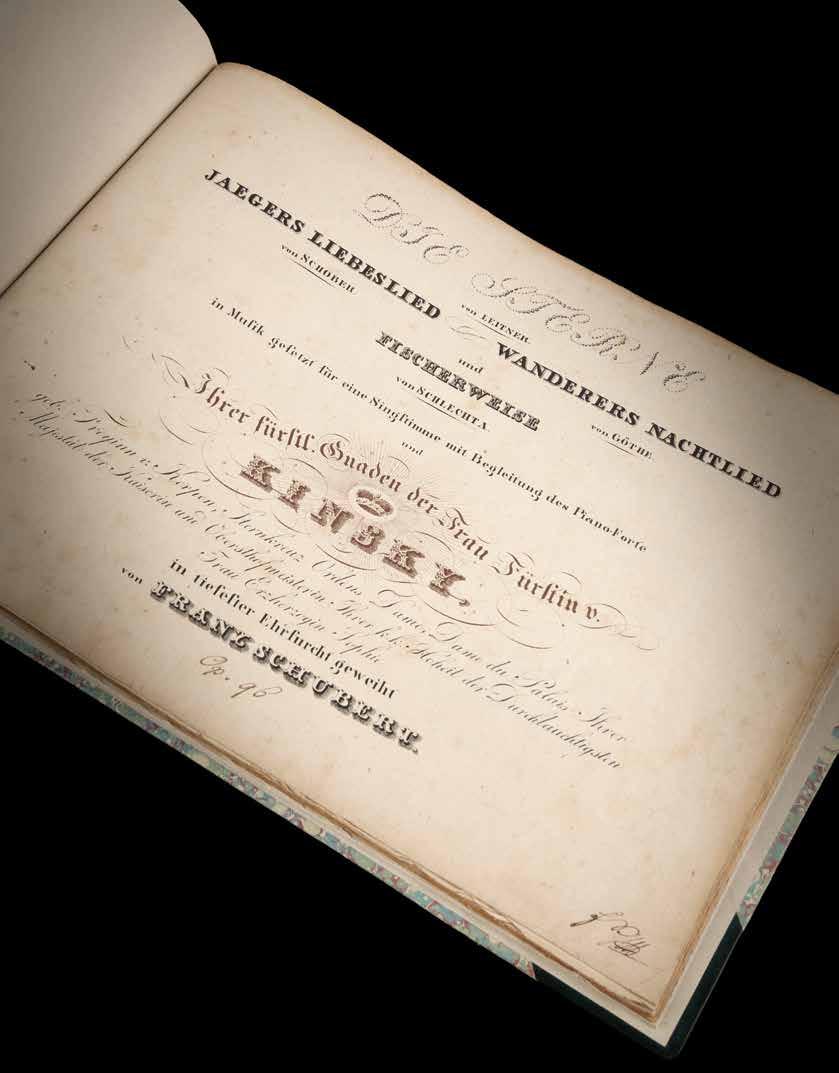
Schubert certifies his Op. 96
‘Die Sterne von Leitner’
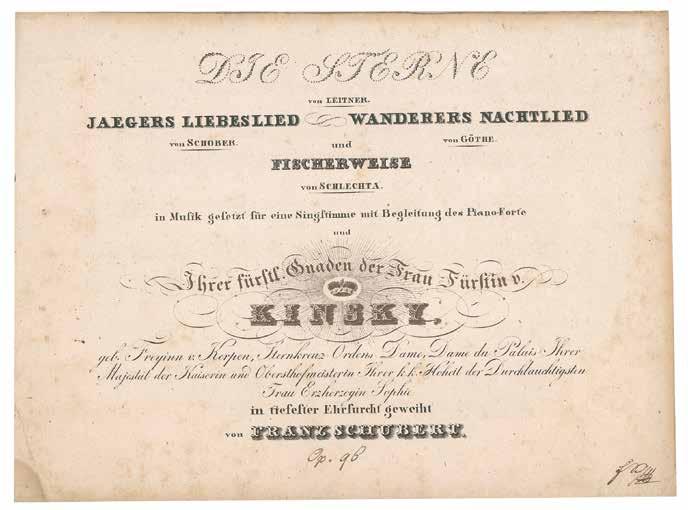
LOT 4008
Franz Schubert Signed Sheet Music - Op. 96 ‘Die Sterne von Leitner’
Prodigious Austrian composer (1797–1828) whose vast oeuvre comprised over 600 secular vocal works (mainly lieder), seven complete symphonies, sacred music, operas, incidental music, and a large body of piano and chamber music. Known only to a relatively small circle of admirers in Vienna during his lifetime, Schubert’s international renown grew immensely in the decades after his death at the age of 31. Extremely rare signed music score for ‘Die Sterne von Leitner,’ printed in Vienna in 1828, 13 x 9.75, 17 pages, signed in the lower right corner of the title page in ink by Franz Schubert with his
paraph, adding the opus number, “Op. 96,” below the printed title. Handsomely bound in half calf with marbled green boards, and the spine titled in gilt. In fine condition, with scattered light foxing and soiling.
Written in January 1828, the composition ‘Die Sterne’ was first performed as Schubert’s private concert on March 26, where it was sung by his friend and most famous interpreter, Johann Michael Vogl. It is probable that no more than 100 copies of this earliest issue of the sheet music were printed; later issues were not initialed by Schubert, and the opus number was printed.
Starting Bid $1,000
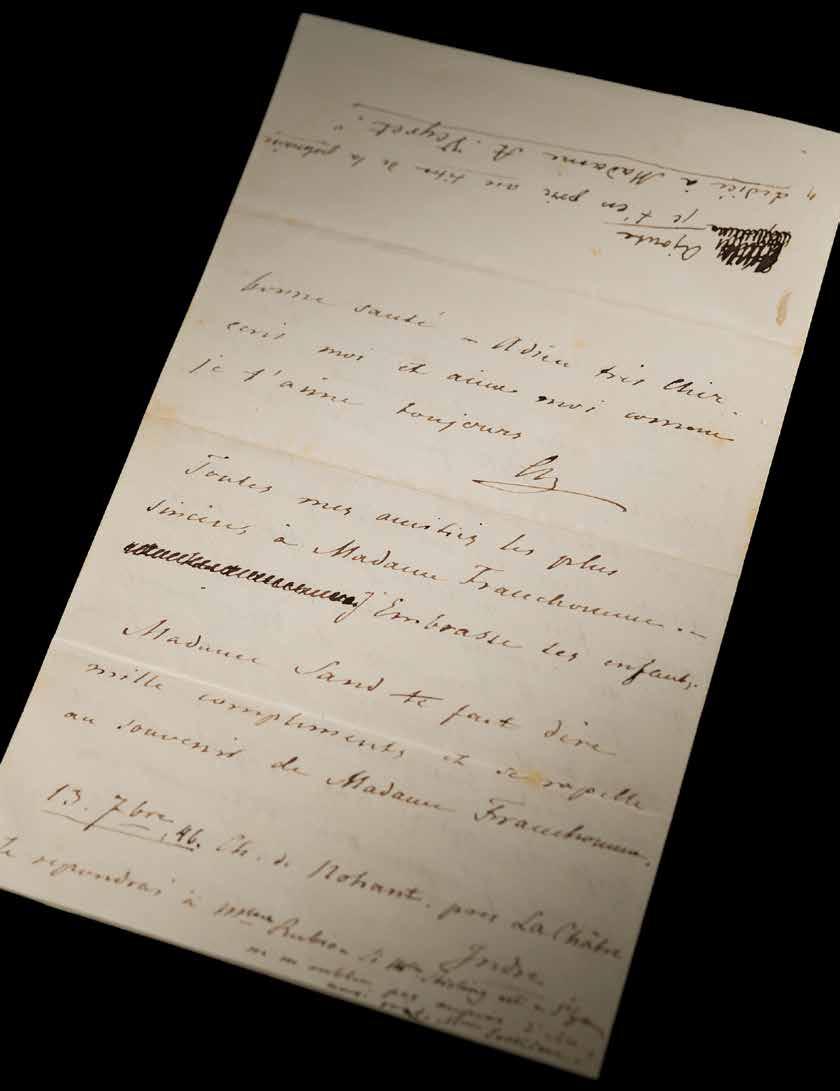
Content-rich handwritten letter by
Frederic Chopin
on the publication of his Op. 61, ‘Polonaise-Fantaisie,’ with references to George Sand, Auguste
Franchomme, and Jane Stirling
LOT 4009
Frederic Chopin Autograph Letter Signed on the Publication of Op. 61, ‘Polonaise-Fantaisie’
ALS in French, signed “Ch.,” four pages on two adjoining sheets, 4 x 6.5, September 13, 1846. Handwritten letter to his close friend, the cellist Auguste Franchomme, about the publication of his music, referring especially to his Op. 61, ‘Polonaise-Fantaisie.’ In part (translated): “I am very annoyed that Brandus is absent and that Maho is not yet able to receive the manuscripts he so often requested from me this winter… Please be so kind as not to entrust my manuscripts to them without receiving the agreed-upon payment, and send me a five-hundred-franc note immediately in your letter…Keep your millions for another time.”
In a postscript, he sends regards from himself and “Madame Sand”—his famous lover, the writer George Sand—to the Franchomme family, and asks to be remembered to his friend and student, the pianist Jane Stirling, and others: “If Mme. Stirling is in St. Germain, please remember me to her, as well as to Mme. Erskine.” Finally, he provides further publishing instructions at the top: “Please add to the title of the Polonaise, ‘dedicated to Madame A. Veyret.’” In fine condition. Accompanied by the original mailing envelope, addressed in Chopin’s own hand. Also includes an export certificate from the French Ministry of Culture.
Chopin writes during the final, fragile phase of his life, when declining health and financial anxiety increasingly shaped his daily concerns. By this point he was an internationally admired composer, but still dependent on advances and punctual payments from Parisian publishers such as Brandus. His irritation over delays and insistence on immediate payment reflect his precarious finances and his careful control over how—and when—his music entered the public sphere. The work he mentions most pointedly, the Polonaise-Fantaisie, Op. 61, represents one of his most innovative late compositions, blending the rhythms of Polish national dance with free, introspective fantasy, and marking a stylistic culmination of his mature voice.
The letter also illuminates Chopin’s close personal and professional circle. Auguste Franchomme, the recipient, was his dearest friend and musical confidant, while the postscript greetings situate Chopin within a network of devoted supporters, including his companion George Sand and his Scottish pupil and patron Jane Stirling. Notably, the reference to Sand comes just a year before their famous breakup, lending some added poignancy. This letter passed by descent through the Franchomme family and was first offered at Sotheby’s in 2011.
Starting Bid $10,000
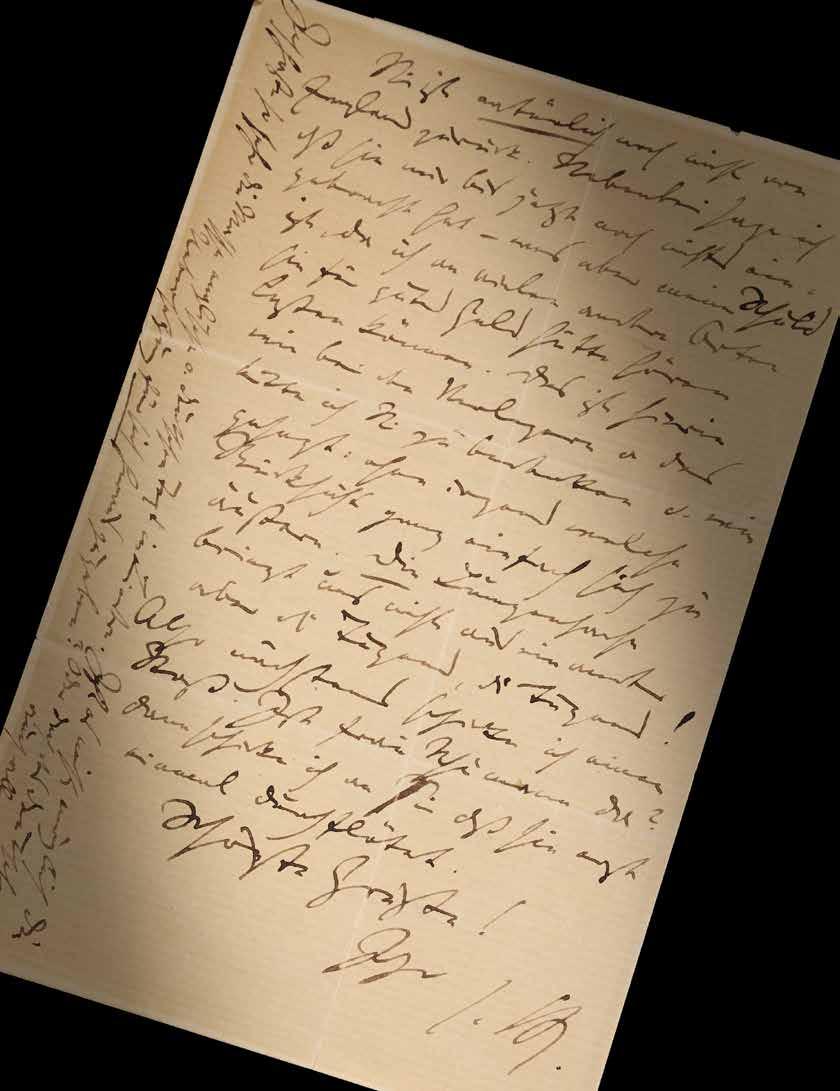
Brahms considers the publication of Symphony No. 1:
“Probably I’ll set it for two pianos, which would be the proper thing to do”
LOT 4010
Johannes Brahms Autograph Letter Signed on the Publication of His Music, Referring to Symphony No. 1 and Clara Schumann
Famed German composer (1833–1897) whose works in the classical spirit, written in the midst of the Romantic era, take a place among the most enduring music of the 19th century. ALS in German, signed “J. Br.,” four pages on two adjoining sheets, 5.5 x 8.5, May 21, 1877. Handwritten letter regarding the publication of his music, in full (translated): “I feel sorry for my poor delicate songs! If only you would fast for one day, that is, keep away from bad jokes and expressions. Stillroth has several samples with him but the others are much nicer! Actually I have a collection of girls’ songs, where every possible condition is taken care of very nicely—except for that certain condition! There is even a girl’s curse in it. I really would like you to announce them as ‘Girls’ Songs,’ even if we don’t put it in the title.
Now if I am to have the first word in money matters, I must ask you most earnestly to be nice enough to take my word as a preliminary suggestion and to answer frankly, I shall answer just as openly and frankly. You cannot possibly insult or hurt me by anything you say. I shall fit in with whatever is proposed to me. But I won’t give them to anyone even if he offers more.
I would rather give the songs more cheaply to a lot of more virtuous publishers than you and the Herzogenberg press—if there were any—right?
Do you think we can price the songs at 150 Thaler apiece—I don’t think so and I warn you. I also call your attention to the fact that there is a big pile of them here and that you can call a halt whenever you want.
For the symphony I have several times heard 5000 Thaler mentioned. Tell me how much less would still be too much! I count the score for four hands in. Probably I’ll set it for two pianos, which would be the proper thing to do.
If we are ever to see it in print I must not forget that I am due to send the full parts and, as they wish, some violin parts to Karlsruhe.
The symphony is naturally not yet back from England. I may add incidentally that it hasn’t brought me in anything yet—which is, however, my own fault, since I could have had it performed in several other places for good money. It is the same as with the publishers and I ask you to think it over. As I said: say what you think without any hesitation. This miserable business won’t cause us to quarrel. But Virtue, Virtue. So I’ll be sending you a mass of paper very soon. Is Frau Schumann there? If she is I’ll ask her to try them out.”
Brahms adds a handwritten postscript: “I detest so much the mass of English and German texts in songs. Isn’t it possible to publish the translation separately? Or at least the German separately too?” In fine condition, with tiny stains and losses to corners, and a couple of small edge splits at folds.
Written in May 1877, this lively and revealing letter dates from a pivotal moment in Johannes Brahms’s career, just months after the triumphant premiere of his Symphony No. 1, the long-awaited work that firmly established him as Beethoven’s true symphonic heir. Here Brahms addresses the practical and artistic negotiations surrounding the publication of both his songs and the new symphony, candidly discussing fees, formats, and publishers while mixing sharp humor with characteristic self-criticism. His remarks on “girls’ songs,” translations of song texts, and proposed arrangements for piano reflect his meticulous concern for how his music would be presented and received, while references to England, Karlsruhe, and Clara Schumann situate the letter within his active international network. Altogether, the letter offers an unusually frank glimpse of Brahms balancing artistic ideals and commercial realities at the height of his creative maturity.
Starting Bid $500
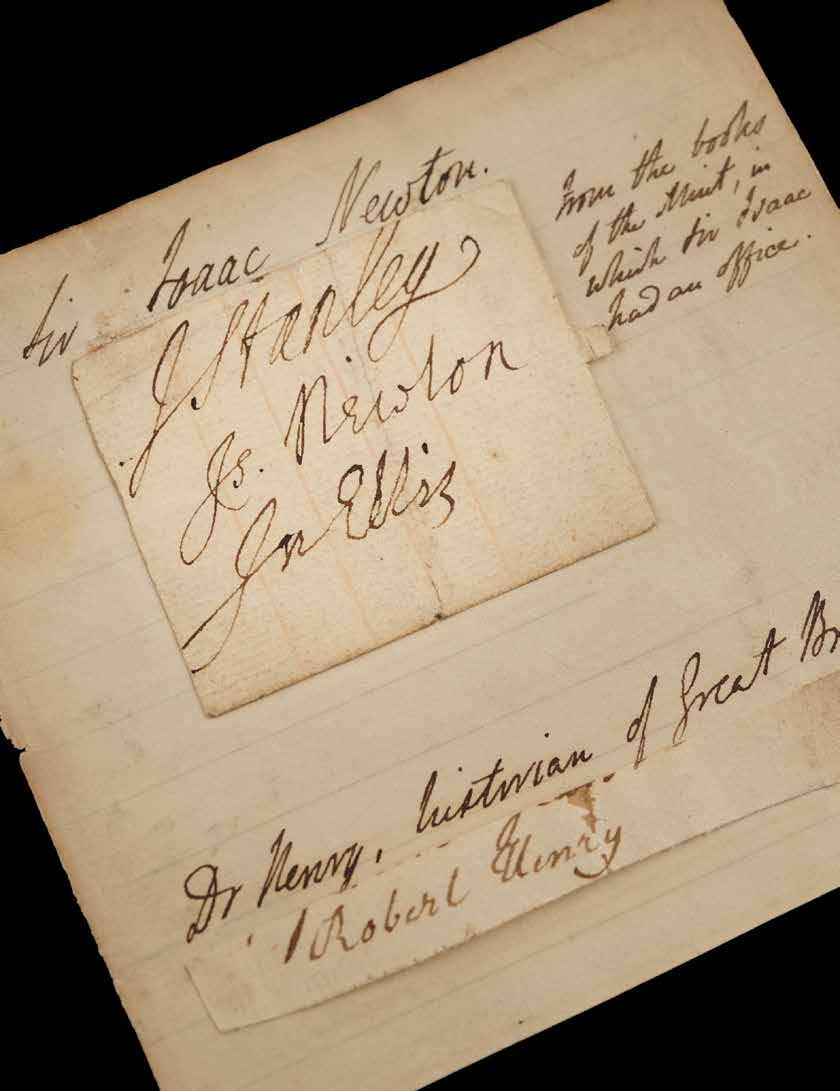
Sought-after signature of
the brilliant Isaac Newton, one of modern science’s monumental minds
LOT 4011
Isaac Newton Signature
English physicist, mathematician, and astronomer (1643–1727), widely regarded as the most influential figure in the history of science, whose ideas and discoveries, including calculus, the laws of gravitation and motion, and observations on the nature of light and optics, earned him a place among the most profound geniuses in the history of mankind. Neat ink signature as Master of the Mint, “Is. Newton,” on an off-white 2.25 x 1.75 slip, also signed by John Stanley and John Ellis. Affixed to a slightly larger page with an identification notation above, also annotated: “From the books of the Mint, in which Sir Isaac had an office.” Also affixed below is the signature of historian Robert Henry. In very good to fine condition, with light soiling and a central vertical fold.
Recommended by his friend Charles Montagu, Chancellor of the Exchequer, Isaac Newton was appointed Warden of the Mint in 1696. The following year he undertook the office of Master of the Mint, a position that he would hold for the last 30 years of his life. Newton made the position a high priority, and though he continued to write and publish scientific works, he retired from his Cambridge duties in 1701 to focus on the position. As Master, he reformed the currency and punished counterfeiters to his fullest extent of the law. From the personal collection of a lifelong collector, teacher, and traveler with a passion for world history. His collecting years ranged from the 1970s to the present day, meaning that several of the premier pieces have not been on the market in decades.
Starting Bid $1,000
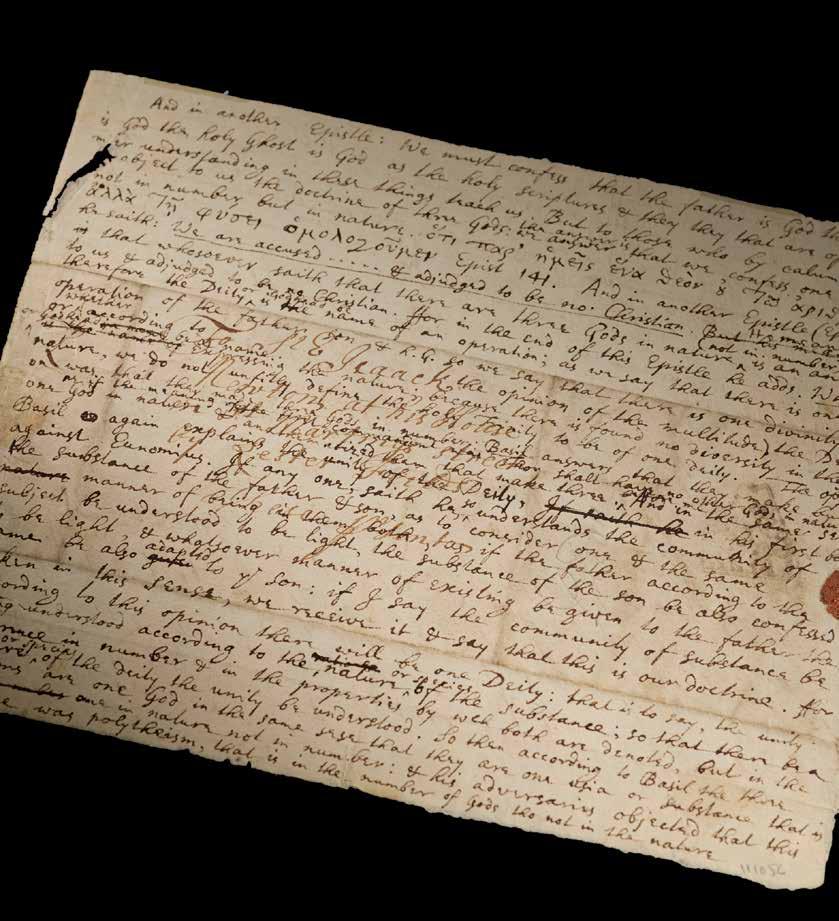
“We must confess that the father is God, the Son is God, the holy Ghost is God as the holy scriptures & they that are of sublimer understanding in these things teach us”
Isaac Newton confronts the foundations of Christian doctrine
LOT 4012
Isaac Newton Handwritten Religious Manuscript with Commentary on the Holy Trinity: “We must confess that the father is God, the Son is God, the holy Ghost is God”
Significant handwritten religious manuscript by Isaac Newton, one page both sides, 7.75 x 6, no date but circa 1720s. Newton writes concerning the Arian Heresy, quoting Basil’s opinion on the matter. In the fourth century, Arius, a priest of Alexandria, argued that Christ, being the Son of God, must have been a creature rather than a divinity, otherwise Christians would have to admit that they were worshipping two gods. A serious schism arose, and accordingly the Emperor Constantine summoned all the bishops in Christendom to Nicea to settle the question—the first general council in the history of the Church.
Newton writes, in part: “And in another Epistle: We must confess that the father is God the Son is God the holy Ghost is God as the holy scriptures & they that are of sublimer understanding in these things teach us. But to those who by calumny object to us the doctrine of three Gods: the answer is/we answer that we confess one God not in number, but in nature. [12 words in Greek] Epistle 141. And in another Epistle (Epist 80) he saith: ‘We are accused….& adjudged to be no Christian’…He means that whosoever saith that there are three Gods in nature (not in number) is an anathe to us & adjudged to be no Christian. For in the end of this Epistle he adds: Whether therefore the Deity or Godhead &c. is the name of an operation; as we say that there is one operation of the father son & h.G. so we say that there is one divinity: or whether (according to the opinion of the multitude) the Deity Godhead by a name expressing the nature; because there is found no diversity in the nature, we do not unfitly define the holy Trinity to be of one deity. The objection was that they made three Gods in number: Basil answers that they make but one God in nature, as if the meaning of the first commandment was Thou shall have no other Gods in nature and from them that make three. And in the same sense Basil again explains the unity of the Deity, in his first book against Eunomius. If any one, sith he, so understands the community of the substance of the father & son, as to consider one & the same manner of being in them both, as if the father according to the subject be understood to be light, the substance of the
son be also confessed to be light, & whatsoever manner of existing be given to the father the same be also adapted to ye Son: if I say the community of substance be taken in this sense, we receive it & say that this is our doctrine. For according to this opinion there will be one Deity: that is to say, the unity being understood according to the nature or species of the substance; so that there be a difference in number & in the properties by wch. both are denoted, but in the nature or species of the deity the unity be understood. So then according to Basil the three persons are one God…that is one in nature not in number: & his adversaries objected that this doctrine was polytheism.”
Interestingly, Newton writes over the address panel of a desperate plea addressed to him—”Isaack Newton, at his House on Martin’s Street by Lester Fields”—the opposite side reading, in part: “I am reduced to strayghts dayly for the body & have no comeing to supply it: I want an imployment & I desier your worship.” Newton continues his religious writings in the blank lower margin. In fine condition, with two small edge tears.
Newton’s theology had correlations with his physics—Newton essentially viewed God the Father as the cause of gravity and Christ the Son as the ruling principle of the natural world. For Newton, Christ was different in substance from God and subject to God’s dominion. The 4th-century Church Council of Nicea, which Newton studied, ruled that Christ and God were one in substance—a ruling that ran counter to Newton’s own ‘heretical’ anti-trinitarian religious beliefs—and Newton repeatedly returned to the topic and re-examined it anew. The present manuscript may pertain to Newton’s long planned, but unpublished, work on The History of the Church.
Scholars now increasingly recognize the importance of Newton’s theological views for an understanding of the whole man and his science. Newton himself kept his heretical religious views secret, and his heirs suppressed his manuscripts on theology for 200 years after his death—and they are only now beginning to see the light of day. A rare and revelatory witness to Newton’s most private intellectual struggle—where the father of modern science wrestles with the foundations of Christian doctrine itself.
Starting Bid $1,000
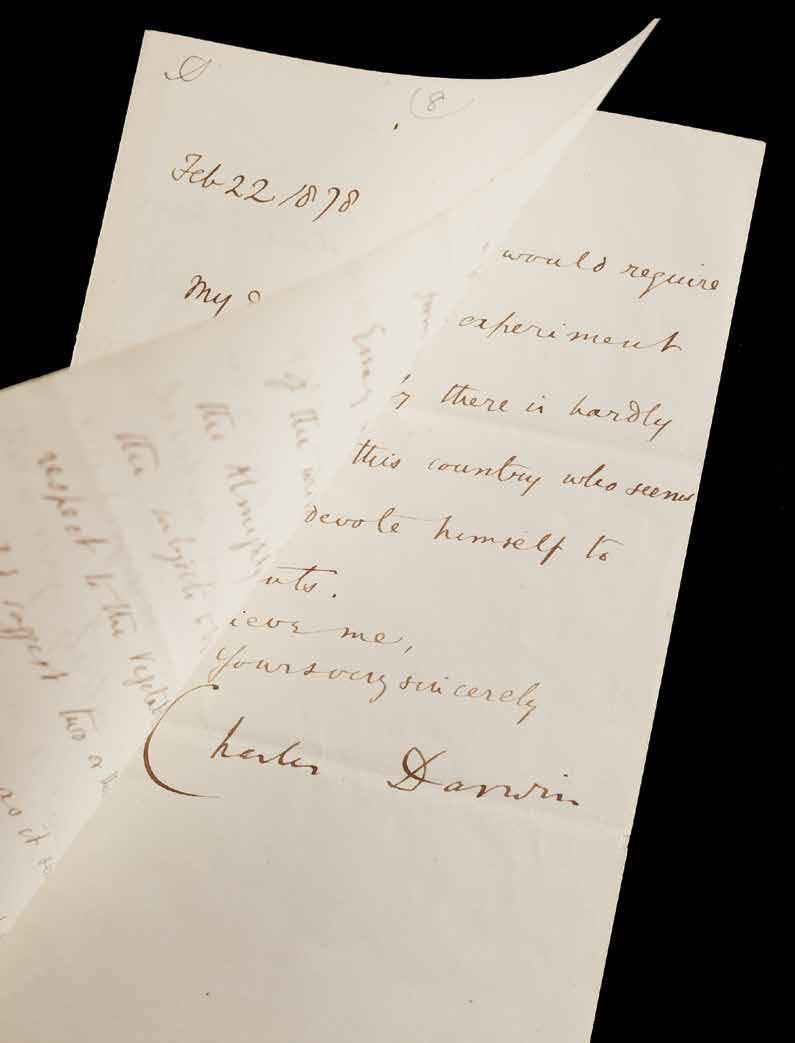
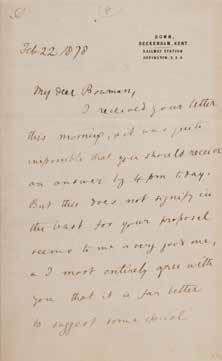
“These subjects would require a long course of experiment & unfortunately there is hardly any one in this country who seems inclined to devote himself to experiments”
LOT 4013
Charles Darwin Letter Signed:
“There is hardly any one in this country who seems inclined to devote himself to experiments”
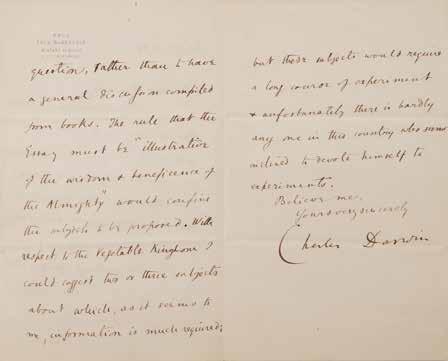
LS signed “Charles Darwin,” three pages on two adjoining sheets, 5 x 8, Down letterhead, February 22, 1878. Letter to the distinguished physiologist William Bowman, in full: “I received your letter this morning, & it was quite impossible that you should receive an answer by 4 p.m. today. But this does not signify in the least for your proposal seems to me a very good one, & I most entirely agree with you that it is far better to suggest some special question, rather than to have a general discussion compiled from books. The rule is that the Essay must be ‘illustrative of the wisdom & beneficence of the Almighty’ would confine the subjects to be proposed. With respect to the Vegetable Kingdom I could suggest two or three subjects about which, as it seems to me, information is much required; but these subjects would require a long course
of experiment & unfortunately there is hardly any one in this country who seems inclined to devote himself to experiments.” In fine condition.
Addressed to the eminent anatomist Sir William Bowman, this letter reflects Darwin’s thoughtful approach to scientific inquiry, advocating for focused experimental investigation over purely theoretical or book-derived research. Particularly striking is Darwin’s candid lament that few in Britain were willing to undertake the sustained experimental work he believed necessary—an observation that underscores both the challenges of 19th-century scientific research and Darwin’s enduring commitment to empirical methodology. From the personal collection of a lifelong collector, teacher, and traveler with a passion for world history. His collecting years ranged from the 1970s to the present day, meaning that several of the premier pieces have not been on the market in decades.
Starting Bid $500
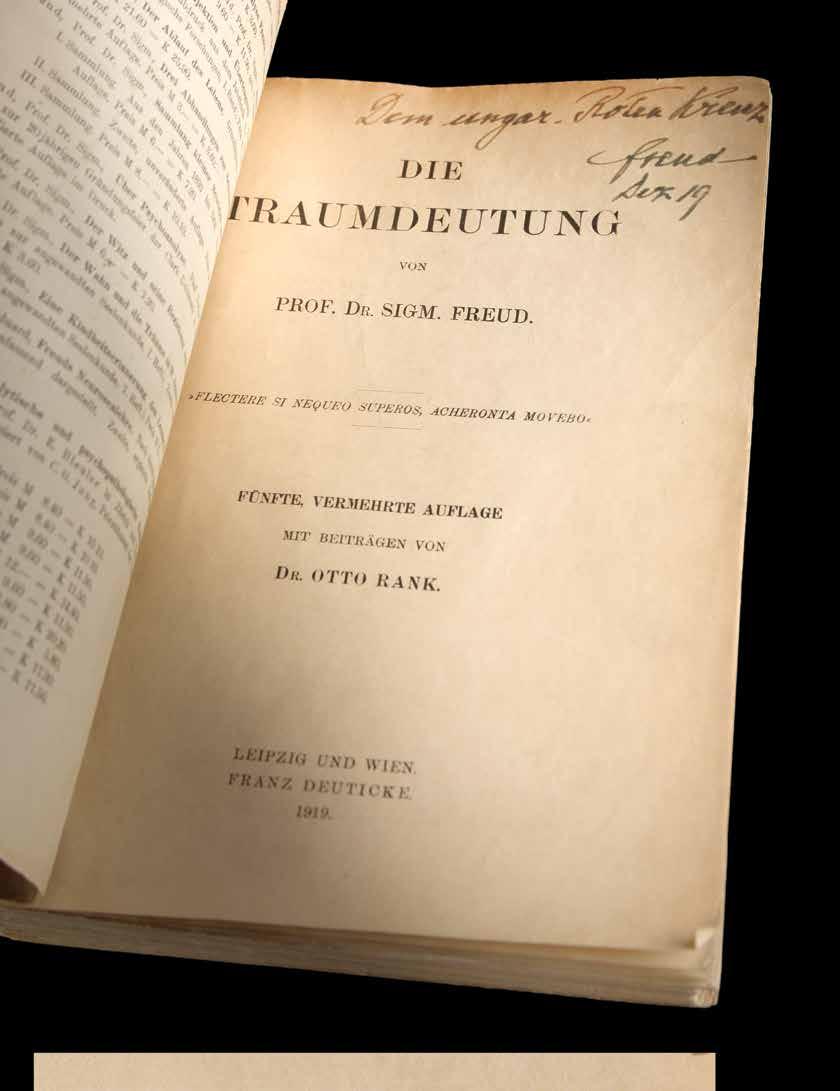
Sought-after signed copy of Sigmund Freud’s classic psychoanalytic work,
Die Traumdeutung [The Interpretation of Dreams], presented to
the Hungarian
Red Cross
in the wake of World War I
LOT 4014
Sigmund Freud Signed BookDie Traumdeutung [The Interpretation of Dreams] - A Foundational Text of Psychoanalysis
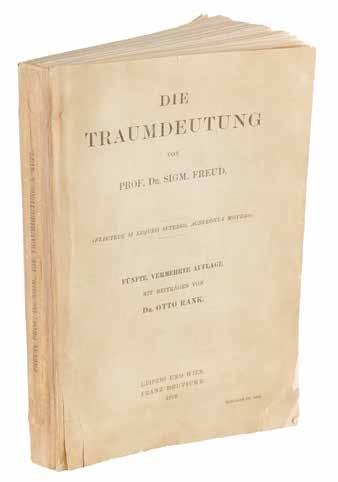
Signed German-language book: Die Traumdeutung [The Interpretation of Dreams]. ‘Fifth, enlarged edition.’ Leipzig and Vienna: Franz Deuticke, 1919. Softcover, 6.25 x 9.25, 474 pages. Signed and inscribed on the title page in fountain pen to the Hungarian Red Cross, “Dem ungar. Roten Kreuz, Freud, Dec. 19.” Autographic condition: very good to fine, with light toning and soiling. Book condition: G/None, with small chips and tears to wrappers, light soiling, spine creased and darkened, and creasing to the last few pages.
The Interpretation of Dreams (Die Traumdeutung) was first published in German in an edition of 600 copies, a modest printing that took eight years to sell. As Sigmund Freud’s ideas gained wider attention, the book went through seven additional editions during his lifetime, and the first English translation, by Abraham Brill, appeared in 1913. In the work, Freud proposed that dreams function as expressions of wish fulfillment, using symbolic language to reveal hidden desires and unresolved conflicts. Over the past century, the book has come to be regarded as one of his most influential works, shaping the development of psychology and leaving a lasting mark on science, art, and literature.
Although initially patriotic at the outbreak of World War I, Freud grew critical of its violence as all three of his sons— Martin, Ernst, and Oliver—served in the Austro-Hungarian army. Of the sons, all of whom survived, Martin’s service was especially formative: he was wounded in 1915, later taken prisoner, and remained closely connected to the Red Cross through his care and through his relationship with Ernestine ‘Esti’ Drucker, a volunteer Red Cross nurse whom he later married. Against this background, a copy of The Interpretation of Dreams inscribed to the Hungarian Red Cross in December 1919 reads less like a formal presentation and more like a quiet gesture of thanks from the revered founder of psychoanalysis.
Starting Bid $500
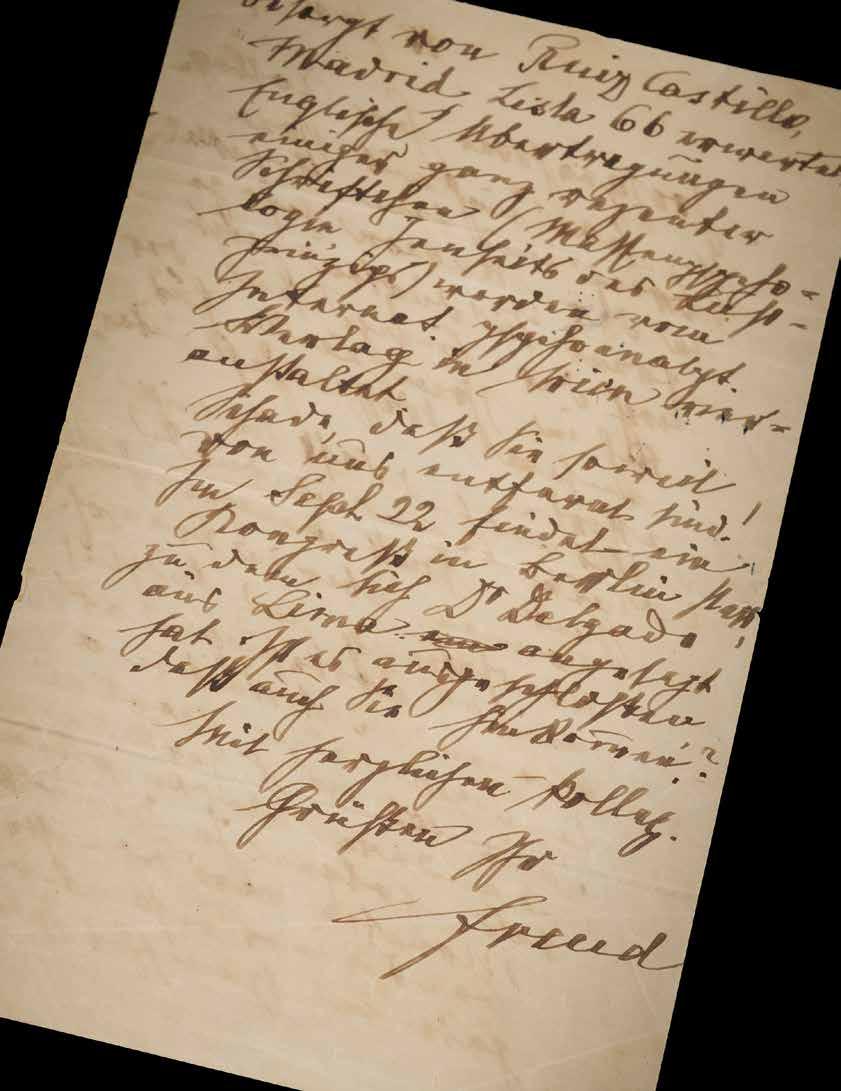
Freud recommends translations of his works, including ‘Introduction to Psychoanalysis,’ ‘Beyond the Pleasure Principle,’ and ‘Group Psychology’
LOT 4015
Sigmund Freud Autograph Letter Signed, Recommending Translations of ‘Introduction to Psychoanalysis’ and ‘Beyond the Pleasure Principle’
ALS in German, signed “Freud,” one page both sides, 5.25 x 8.25, personal letterhead, January 15, 1922. Handwritten letter to a colleague, in full (translated): “I was very happy to receive your letter and the article in the Nación. You must even now be the only person in your country who takes an interest in our discipline.
I am sorry that you do not read German; otherwise, I would be able to send you many things. But my lectures have recently appeared in French (Introduction á la psychanalyse, Pagot & Cie., Paris, 106 Bd. St. Germain), and other works are supposed to follow soon. The first volume of a set of collected works in Spanish, put out by Ruiz Castillo, Madrid, Lista 66, is expected in the next few months. English translations of some quite recent shorter works (Massenpsychologie [Group Psychology], Jenseits des Lustprinzips [Beyond the Pleasure Principle]) have been arranged by the Internationaler Psychoanalytischer Verlag [International Psychoanalytic Press] in Vienna.
It is too bad that you are so far from us! In September 1922, a conference is being held in Berlin, which Dr. Delgado from Lima has said that he will attend. Is it out of the question that you could also come?” In very good to fine condition, with light creasing, minor mounting remnants to the top edge, and light show-through from writing on opposing sides.
In the aftermath of World War I, psychoanalysis was rapidly expanding beyond the German-speaking world into an international intellectual movement. Freud spent time actively promoting translations of his work into French, Spanish, and English, reflecting both the growing global demand for psychoanalytic theory and his central role in shaping its dissemination.
In 1920, Horace Liveright published the first English-language edition of A General Introduction to Psychoanalysis—the most popular and widely translated of Freud’s works, containing 28 lectures on key psychoanalytic concepts such as the unconscious, dream interpretation, repression, and neuroses. Written in accessible, non-technical language, it became one of Freud’s most popular books, serving as both a summary of his ideas and an entry point for readers new to psychoanalysis. A French translation, released by Paris published Pagot & Cie., followed in 1922.
Starting Bid $1,000
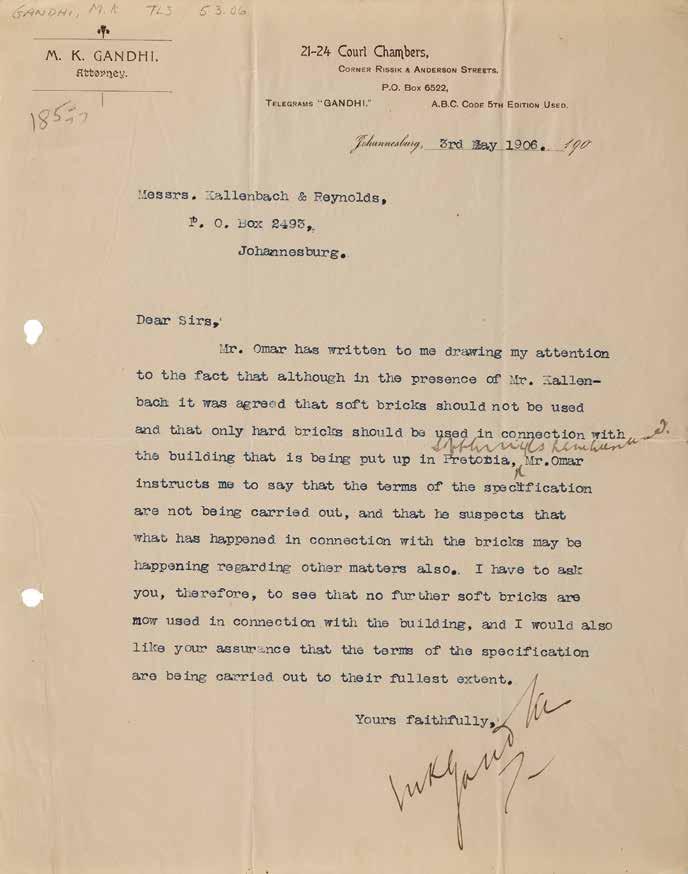
In the year of ‘Satyagraha,’ attorney M. K. Gandhi writes to his friend and devotee on architectural matters
LOT 4016
Mohandas Gandhi Typed Letter Signed in the Year of ‘Satyagraha’ (Johannesburg, South Africa, 1906)
TLS signed “M. K. Gandhi,” one page, 8.25 x 10.5, “M. K. Gandhi, Attorney” letterhead, May 3, 1906. Letter to “Messrs. Kallenbach & Reynolds, Johannesburg,” the architectural firm of his close friend Hermann Kallenbach. In full: “Mr. Omar has written to me drawing my attention to the fact that although in the presence of Mr. Kallenbach is was agreed that soft bricks should not be used and that only hard bricks should be used in connection with the building that is being put up in Pretoria, Mr. Omar instructs me to say that the terms of the specification are not being carried out, and that he suspects that what has happened in connection with the bricks may be happening regarding other matters also. I have to ask you, therefore, to see that no further soft bricks are now used in connection with the building, and I would also like your assurance that the terms of the specification are being carried out to their fullest extent.”
The letterhead gives the address of Gandhi’s office as “21–24 Court Chambers, Corner Rissik & Anderson Streets,” in the Central Business District of Johannesburg, South Africa—an area today known as ‘Gandhi Square.’ In very good to fine condition, with light show-through from a few small pieces of tape on the back.
Gandhi had settled in South Africa in 1893, taking on a one-year contract as an attorney for an Indian merchant there. It was while living in this racially charged environment that Gandhi began to develop his political ideology. While protesting in Johannesburg in 1906, he adopted his famous methodology of ‘Satyagraha,’ or nonviolent protest, which would become critical to his later fight for Indian independence. The term itself, ‘Satyagraha,’ was coined and developed by Gandhi, who introduced it in a piece in his ‘Indian Opinion’ newspaper that year.
Gandhi and Kallenbach became close friends through their association in Johannesburg, for a time living together in what is now known as the ‘Satyagraha House.’ In 1914, Gandhi left South Africa to return to his native India, bringing with him an international reputation as a leading Indian nationalist, theorist, and community organizer. Though he would not see Kallenbach again, the two maintained a regular correspondence. A significant letter from an early, transformative period in Gandhi’s life and career. From the personal collection of a lifelong collector, teacher, and traveler with a passion for world history. His collecting years ranged from the 1970s to the present day, meaning that several of the premier pieces have not been on the market in decades.
Starting Bid $500
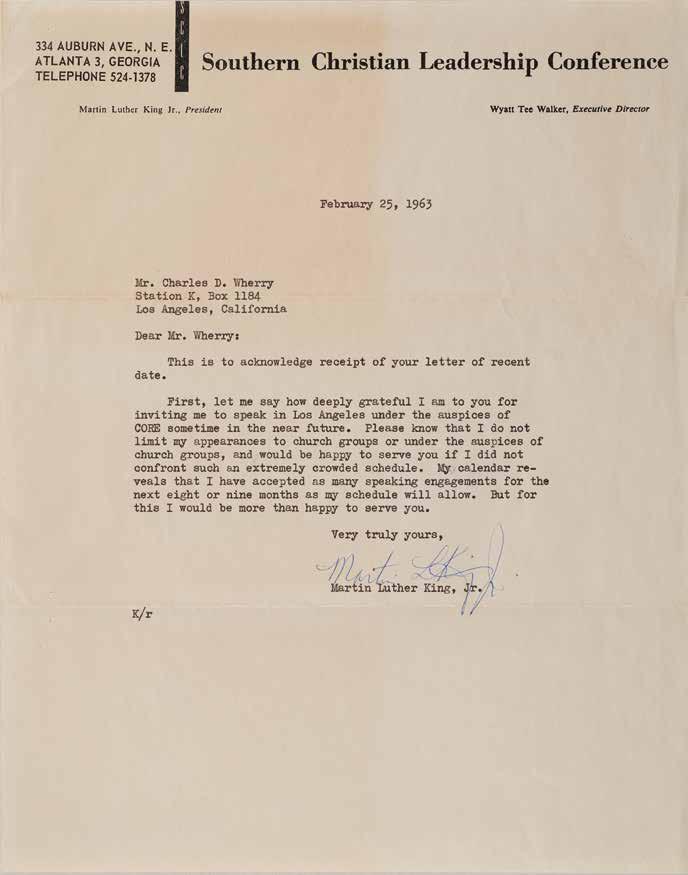
King consults his calendar six months before his enduring ‘I Have a Dream’ speech: “I have accepted as many speaking engagements for the next eight or nine months as my schedule will allow”
LOT 4017
Martin Luther King, Jr. Typed Letter Signed, Six Months Before His ‘I Have a Dream’ Speech: “I have accepted as many speaking engagements for the next eight or nine months as my schedule will allow”
TLS signed “Martin L. King, Jr.,” one page, 8.5 x 11, Southern Christian Leadership Conference letterhead, February 25, 1963. Letter to Charles D. Wherry, in part: “First, let me say how deeply grateful I am to you for inviting me to speak in Los Angeles under the auspices of CORE sometime in the near future. Please know that I do not limit my appearances to church groups or under the auspices of church groups, and would be happy to serve you if I did not confront such an extremely crowded schedule. My calendar reveals that I have accepted as many speaking engagements for the next eight or nine months as my schedule will allow. But for this I would be more than happy to serve you.” In fine condition, with blocks of faint toning. Accompanied by the original mailing envelope.
Written just six months before his historic “I Have a Dream” speech at the March on Washington on August 28, 1963, this letter dates to a pivotal moment in Martin Luther King Jr.’s leadership of the Civil Rights Movement. At this early stage of the year, King was already facing an overwhelming national demand for his voice—as reflected in his reference to an “extremely crowded schedule”—while preparing for a series of landmark actions, most notably the Birmingham Campaign that would begin that spring. The letter underscores King’s broad commitment to civil rights activism beyond the church, aligning closely with secular organizations such as CORE—the Congress of Racial Equality—and illustrates the accelerating momentum that culminated later that summer. From the personal collection of a lifelong collector, teacher, and traveler with a passion for world history. His collecting years ranged from the 1970s to the present day, meaning that several of the premier pieces have not been on the market in decades.
Starting Bid $500
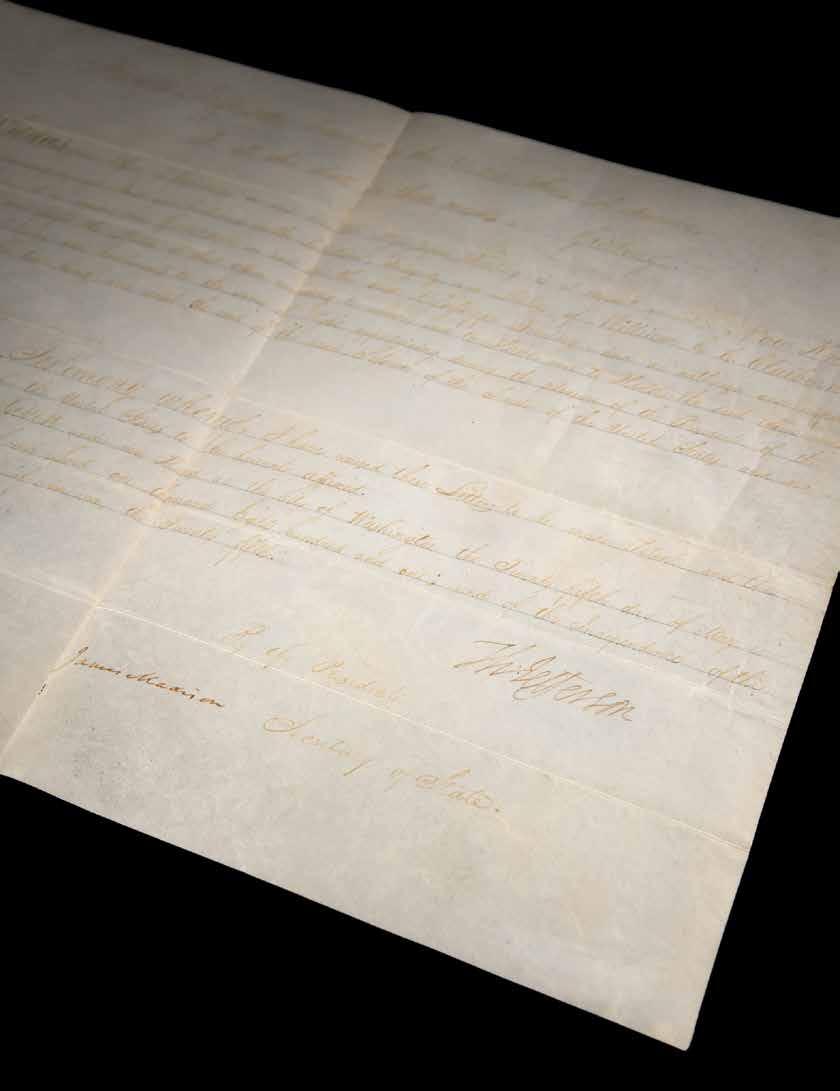
Jefferson and Madison appoint William Claiborne, future overseer of the Louisiana Purchase transfer, as governor of the Mississippi Territory
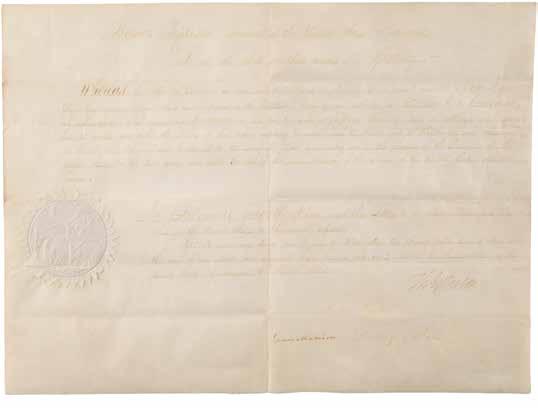
LOT 4018
Thomas Jefferson and James Madison
Document Signed as President and Secretary of State, Appointing William C. C. Claiborne, Future Overseer of the Louisiana Purchase Transfer, as Governor of the Mississippi Territory
Vellum manuscript DS, signed “Th: Jefferson” as president and “James Madison” as secretary of state, one page, 15.5 x 11.5, May 25, 1801. Document appointing William C. C. Claiborne as the governor of the Mississippi Territory, in part: “Whereas the Office of Governor in and over the Mississippi Territory is at present vacant; Now Know Ye, that reposing especial Trust and Confidence in the Patriotism, Integrity and Abilities of William C. C. Claiborne, of Tennessee, I do appoint him Governor in and over the said Mississippi Territory.” Neatly and boldly signed at the conclusion in ink by President Thomas Jefferson and Secretary of State James Madison. The white paper seal affixed on the left side remains intact. In fine con-
dition, with uniform overall fading, not affecting readability or the clarity of the signatures. Claiborne served in the House of Representatives through 1801, supporting Jefferson over Burr in the contentious election of 1800 and helping to rally votes among the Tennessee delegation. Shortly after taking office, Jefferson appointed him governor of the Mississippi Territory, a position Claiborne held from 1801 to 1803.
In 1803, Claiborne relocated to New Orleans to help oversee the transfer of Louisiana from French to United States control following the Louisiana Purchase. He subsequently governed the Territory of Orleans from 1804 to 1812. Upon Louisiana’s admission to the Union in 1812, Claiborne was elected the state’s first governor, serving until 1816. An important early Jefferson presidential appointment, documenting the administration of America’s southern frontier on the eve of the Louisiana Purchase.
Starting Bid $1,000
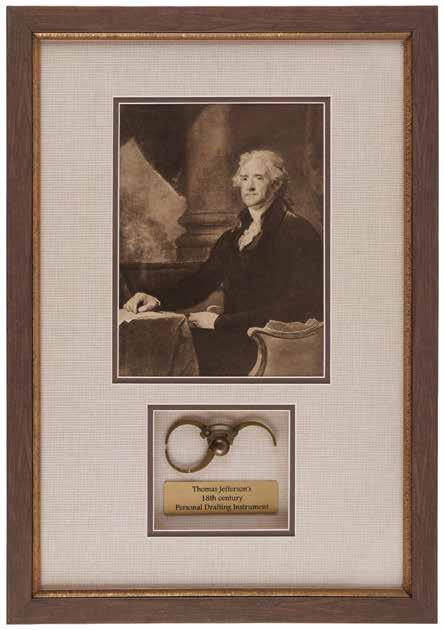
Measuring instrument from the personal collection of Thomas Jefferson—ca. 1800 brass parallel calipers supplemented by a detailed provenance report
LOT 4019
Thomas Jefferson Brass Drafting Tool (ca. 1800) from His Personal Collection
Ca. 1800 specialized drafting tool belonging to Thomas Jefferson, measuring 3.5˝ x 1.75,˝ with a missing bottom arm to the right side. The instrument, identified as brass parallel calipers, is archivally mounted and framed with an engraved plate and portrait of Jefferson to an overall size of 13 x 18.5. In fine condition. Accompanied by a signed and notarized letter of provenance that details the instrument’s line of ownership and the connection between the JeffersonRandolph and Monroe-Hoes families.
Provenance: Thomas Jefferson; by descent to his great-great-great granddaughter, Frances Maury Burke (1861-1933); by gift or purchase to Rose Gouverneur Hoes; by descent to Laurence G. Hoes; by bequest to Camilla Hoes Pope; Heritage, November 2011; Bonhams, April 2025.
‘Science is my passion, politics, my duty.’ – Thomas Jefferson
A polymath of considerable degree, Thomas Jefferson’s expertise ranged across a broad array of disciplines, with his extensive library at Monticello offering him a near-unlimited wealth of literature. Jefferson’s wide-ranging curiosity led him into a variety of scientific explorations, in agriculture, architecture and drafting, technology, botany, and medicine, among others. He not only served as the nation’s third president, but for 17 years, he served as president of the American Philosophical Society.
Starting Bid $500
LOT 4020
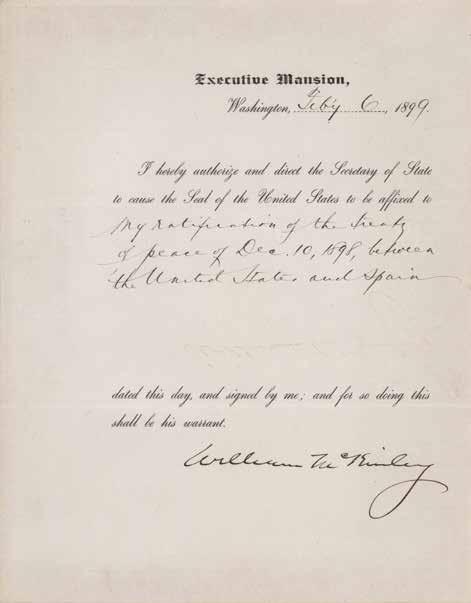
President McKinley ends the Spanish-American War, ratifying
“the treaty of peace” between the United States and Spain
William McKinley Document
Signed as President, Ratifying a Peace Treaty with Spain to End the Spanish–American War
Partly-printed DS as president, one page, 8 x 10, February 6, 1899. President McKinley directs the Secretary of State to cause the Seal of the United States to be affixed to “my ratification of the treaty of peace of Dec. 10, 1898, between the United States and Spain.” Boldly signed at the conclusion in ink by President William McKinley. In very fine condition. Accompanied by a bilingual printing of the treaty.
The ‘Treaty of Peace between the United States of America and the Kingdom of Spain,’ commonly called the ‘Treaty of Paris,’ officially ended the Spanish-American War and marked the end of Spain’s colonial empire in the Americas and the Pacific. Signed on December 10, 1898, the treaty required Spain to relinquish control of Cuba and cede Puerto Rico, Guam, and the Philippines to the United States for a payment of $20 million. This agreement significantly expanded U.S. influence overseas and marked the emergence of the United States as a global imperial power.
The war had seen the emergence of Theodore Roosevelt as a national hero, celebrated for his gallantry in leading the ‘Rough Riders’ at the Battle of San Juan Hill. He would join McKinley’s ticket as the vice presidential candidate in his 1900 re-election campaign. Roosevelt’s popularity helped secure the Republican ticket’s landslide victory, and he would assume the presidency just months later after McKinley’s assassination in 1901.
Starting Bid $2,500
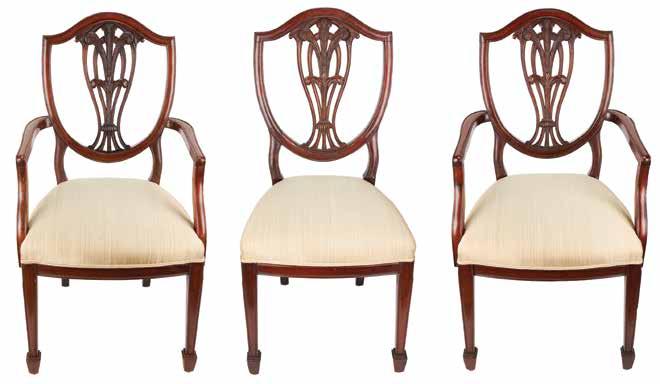
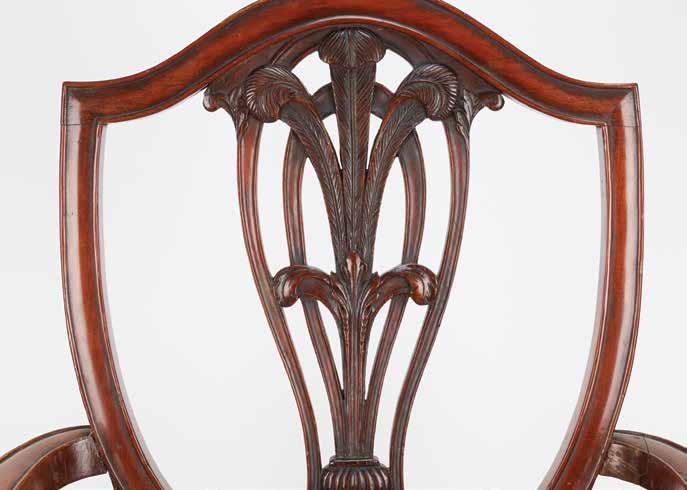
Late 19th-century Victorian mahogany dining chairs custom-ordered by
Sara Delano Roosevelt and presented as gifts to Franklin and Eleanor Roosevelt, used by the couple for decades in the storied Roosevelt House on East 65th Street
LOT 4021
Franklin and Eleanor Roosevelt’s (3) Victorian Dining Chairs from Their Manhattan Townhouse at 49 East 65th Street - Gifted Furnishings from Sara Delano Roosevelt
Elegant set of three late 19th-century Victorian mahogany dining chairs by A. E. Ostermeier, Inc., originating from the estate of Franklin and Eleanor Roosevelt, which were originally custom-ordered and presented to the couple by Franklin’s mother, Sara Delano Roosevelt, when her son and daughterin-law moved into her double townhouse on 47-49 East 65th Street in Manhattan, New York, with Sara residing at No. 47, and Franklin and Eleanor, with their two young children, Anna and James, living in No. 49.
The furniture consists of two armchairs and one side chair, all in George III style, each with seats padded in rose-stained silk, straight molded legs, and a shield-form back centered with three ostrich feathers, a plume device found on the Roosevelt family coat of arms. In overall very good to fine condition, with varying degrees of wear from use, including repaired cracks, chips, and rubbing to the frame, and some light stains to the fabric.
Roosevelt House, the double townhouse at 47–49 East 65th Street, played a central role in the personal and political lives of Franklin and Eleanor Roosevelt. In 1905, Sara Delano Roosevelt promised the home to the newly married couple, and by 1908 Franklin and Eleanor settled into No. 49 while
Sara lived next door at No. 47. Over the next 24 years, the house became the base from which Franklin rose from New York State Senator to President of the United States, including his recovery there after polio in 1921. It was also where Eleanor began her public life and lifelong advocacy for civil liberties and human rights.
Roosevelt House hosted influential figures from across American public life, including Mary McLeod Bethune, Frances Perkins, Harold Ickes, and Henry Morgenthau. In the winter of 1932–1933, Franklin convened key meetings there that helped shape the First Hundred Days and the early New Deal.
The Roosevelts also developed a close relationship with neighboring Hunter College. After Sara’s death in 1941, the family sold the house to a nonprofit consortium representing Hunter students, with President Roosevelt reducing the price and contributing to a new student library. In 1943, Eleanor Roosevelt attended the reopening of the building as the Sara Delano Roosevelt Memorial House, honoring Sara’s commitment to interfaith and interracial understanding and establishing one of the nation’s earliest student centers of its kind.
Provenance: Sara Delano Roosevelt; Franklin and Eleanor Roosevelt; John A. Roosevelt; Christie’s, February 2001: Selections from the Private Collections of Franklin & Eleanor Roosevelt and Family.
Starting Bid $1,000
LOT 4022
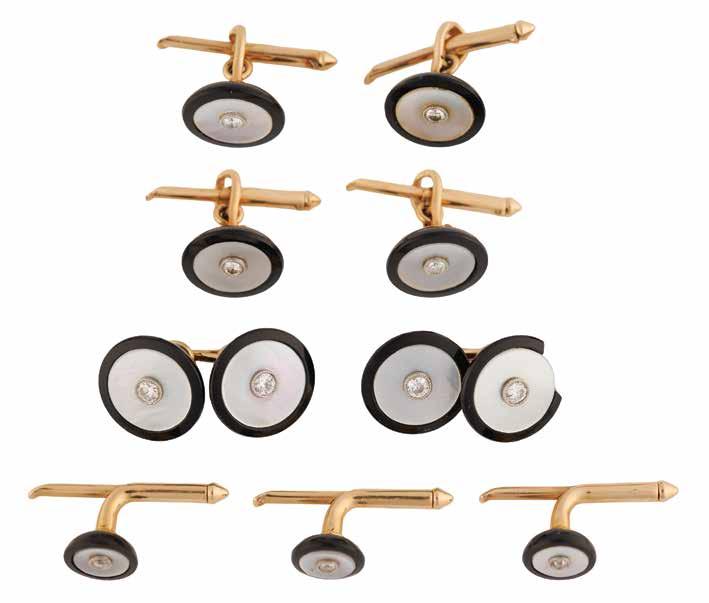
Franklin D. Roosevelt’s Lot of (9) Diamond-Set
Formalwear Accessories - (2) Cufflinks, (4) Vest Studs, and (3) Shirt Studs
Matching lot of nine formalwear accessories from the personal wardrobe of Franklin D. Roosevelt, consisting of a pair of double-sided cufflinks, four vest studs, and three shirt studs. All feature coordinating black onyx circular disks set with
mother-of-pearl, centering upon a diamond collet, mounted in 14K gold, and bearing maker’s marks for Larter & Sons. Includes their original blue leather jewelry case from Lambert Bros. of New York. In overall fine condition, with a chip to onyx of one cufflink. Provenance: Christie’s, February 2001: Selections from the Private Collections of Franklin & Eleanor Roosevelt and Family.
Starting Bid $1,000
“I am coming to Stockholm”— handwritten letter from Senator Kennedy to his Swedish mistress, Gunilla von Post, arranging plans for a romantic reunion— “Write to me right away as I shall be leaving for Europe in 2 weeks”
LOT 4024
John F. Kennedy
Autograph Letter Signed as a Massachusetts Senator, Sent to His Swedish Mistress, Gunilla von Post
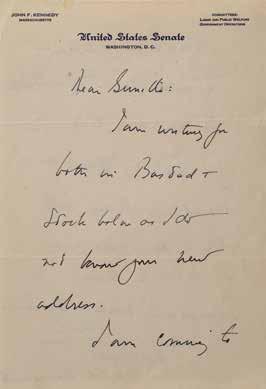
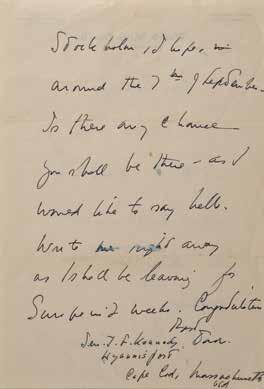
ALS as a Massachusetts Senator, signed “Jack,” one page both sides, 6.25 x 9.25, personal United States Senate letterhead, postmarked June 1955. Handwritten letter to his mistress, Gunilla von Post, a Swedish aristocrat Kennedy had met by chance in Cannes, France in the summer of 1953, just weeks before his wedding to Jacqueline Bouvier. In full: “I am writing you both in Bastad + Stockholm as I do not have your new address. I am coming to Stockholm, I hope, around the 7th of September. Is there any chance you shall be there – as I would like to say hello. Write to me right away as I shall be leaving for Europe in 2 weeks. Congratulations.” This parting expression is likely a reference to von Post’s engagement to the wealthy Swedish landowner Anders Ekman, whom she married later that year in 1955. Kennedy adds his address below, which incorporates his signature: “Sen. J. F. Kennedy, Hyannisport, Cape Cod, Massachusetts, USA.” Includes the original mailing envelope, written in Kennedy’s own hand. In fine condition, with a few minor ink smudges.
As detailed in her poignant memoir, Love, Jack, von Post recounts that she and Kennedy spent an intensely intimate and joyful week together while traveling through Sweden in August 1955. Von Post later wrote that in the year following their affair, Kennedy sought to end his marriage and bring her to the United States, but these efforts were blocked by his father, his political ambitions, and the couple’s shared sensitivity to Jacqueline Kennedy’s miscarriage in 1955 and pregnancy in 1956. Gunilla von Post and John Kennedy would see each other only one other time, this by chance at a gala at the Waldorf Astoria in 1958 while von Post was pregnant with her first child. Her husband died while piloting a plane in 1960, and Kennedy was assassinated in November 1963; von Post remarried and lived the rest of her life in Florida, where she published her memoir in 1997.
Starting Bid $1,000
An intended target of 9/11— official ‘White House Guided Tour’ ticket and ticket stub dated September 11, 2001
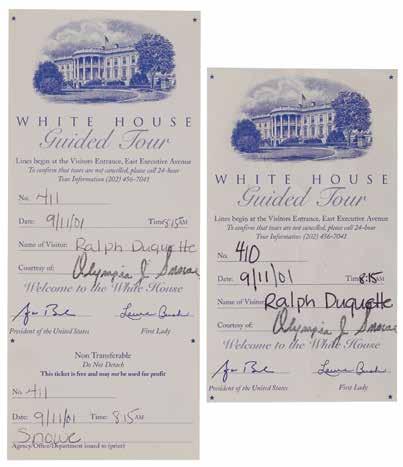
9/11: White House Guided Tour Ticket and Ticket Stub - Both Dated to September 11, 2001
Official ‘White House Guided Tour’ ticket and ticket stub, both dated for a tour on September 11, 2001, at 8:15 AM, approximately 16 minutes after American Airlines Flight 11 departed Boston’s Logan Airport en route to the North Tower of the World Trade Center in New York City, where it would crash at 8:46 AM, and set into motion the deadliest terrorist attack in history. The complete ticket, 3 x 7, and the ticket stub, 3 x 5.25, are both numbered “410,” issued to “Ralph Duquette,” and bear stamped signatures of President George W. Bush and First Lady Laura Bush. Both also bear stamped courtesy signatures of Olympia Snowe, then a senator from Maine. The reverse of the tickets contain overhead maps of the White House and the surrounding area. In overall very
good to fine condition, with heavy creasing to the used ticket. The White House, as many believe, was an intended target of the 9/11 conspirators. This reality was avoided when the heroic passengers of United Airlines Flight 93 sacrificed their lives to thwart the attack, fighting back against their hijackers and forcing the plane to crash into a field roughly 130 miles northwest of the capital. On the same morning, President Bush was visiting the Emma E. Booker Elementary School in Sarasota, Florida, some 900 miles away from Washington, D.C. He returned to the White House at approximately 8:30 PM and addressed the nation from the Oval Office, reaffirming American resilience, that those responsible would be found, and ushering in what became known as the War on Terror. A poignant reminder from one of America’s darkest days.
Starting Bid $200
Uncut sheet of four $2 bills, signed in gold by Donald Trump
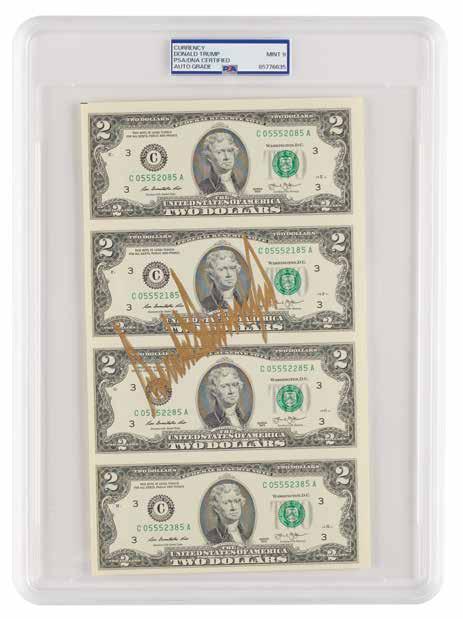
Donald Trump Signed Uncut $2 Dollar BillsPSA MINT 9
Uncut sheet of four Series 2013 two-dollar bills, prominently signed on the portrait side in uncommon gold ink by Donald Trump. In very fine condition. Encapsulated and graded by PSA/DNA as “MINT 9.” An unusual, highly appealing format for Trump’s autograph.
Starting Bid $200
LOT 4027
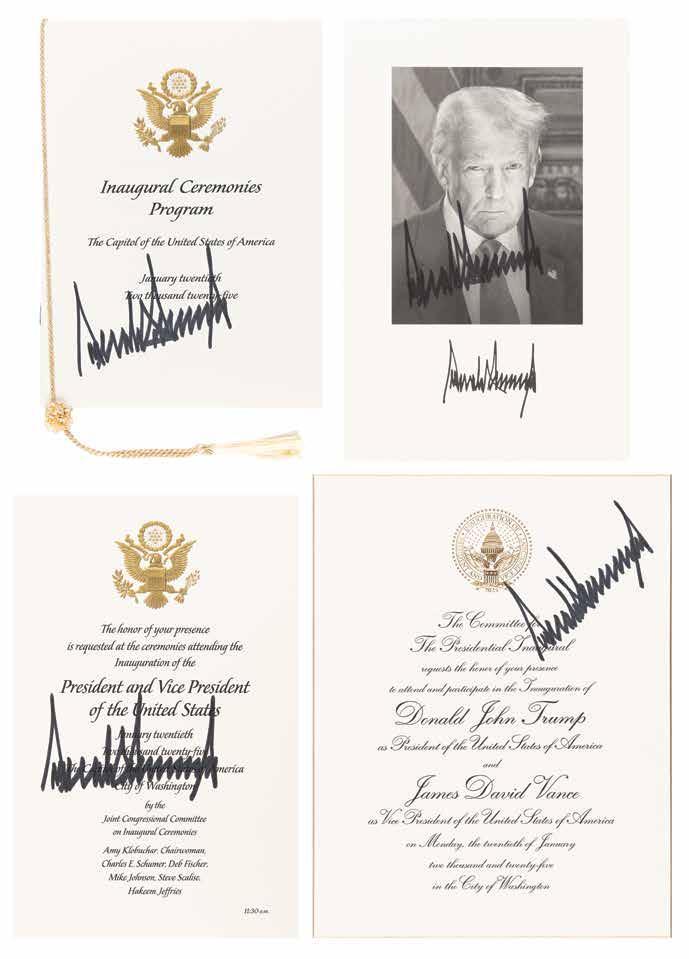
Full set of inaugural pieces from the 2025 presidential inauguration of Donald Trump, each item signed prominently by America’s 47th president
LOT 4028
Donald Trump (4) Signed Items from the 2025 Presidential Inauguration - Portrait, Program, and Invitations
Four official items from Donald Trump’s second presidential inauguration, each signed prominently in black felt tip by the 47th president of the United States. The group includes: a 6.5 x 10 cardstock photograph of Trump by photographer Daniel Torok, with its original “Congress of the United States” envelope (this portrait served as an official ‘placeholder’ at the
start of his term); a 6 x 8.5 “Inaugural Ceremonies Program,” with embossed presidential seal and its original decorative tassel; a printed 6.5 x 10 inaugural ceremonies invitation with embossed presidential seal; and a printed 8.5 x 11 invitation for “The Presidential Inaugural,” with its original cream-colored presentation folder and red envelope, both bearing an embossed presidential seal. In overall very fine condition. Each item is accompanied by a full letter of authenticity from PSA.
Starting Bid $500
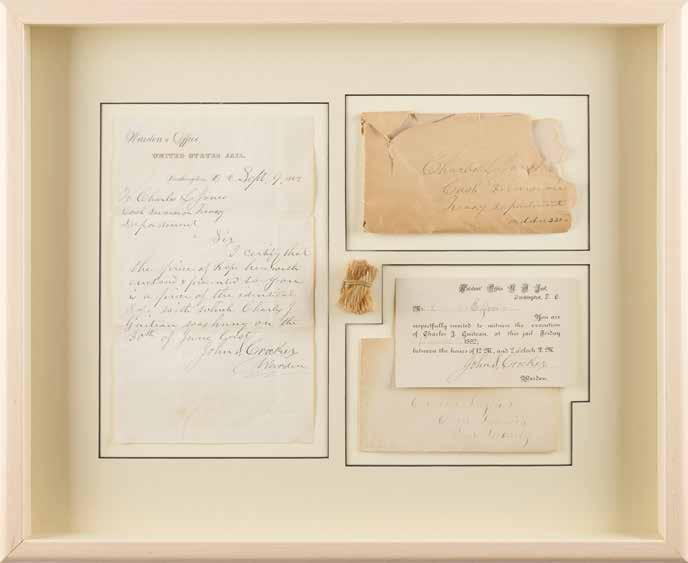
Original rope section of the hangman’s noose
“with which Charles J. Guiteau was hung,” included with an original execution invitation card and a letter of authenticity, both signed by D.C. Jail
Warden John S. Crocker
LOT 4029
The Execution of Charles Guiteau: Original Rope Section of Hanging Noose and Original Execution Invitation Card, with Handwritten Letter of Authenticity from Warden John S. Crocker
Original 1˝ x 1.25˝ x 1˝ section of hemp rope deriving from the noose used to execute assassin Charles Guiteau at the District of Columbia Jail on June 30, 1882. The braided rope is bound with twine and complemented by an original invitation card for Guiteau’s execution, as well as an ALS from John S. Crocker, warden of the D.C. Jail, certifying the rope as authentic. Both the invitation and the letter are accompanied by their original envelopes, which are addressed to Charles L. Jones, a federal employee with the Treasury Department. All of the items are mounted and framed together to an overall size of 18.5˝ x 15.25˝. In overall fine condition.
The original execution invitation card, 4.75˝ x 3˝, issued to “Charles L. Jones” by the Wardens’ Office U.S. Jail of Washington, D.C., reads: “You are respectfully invited to witness the execution of Charles J. Guiteau, at this jail Friday, June 30th, 1882, between the hours of 12 M., and 2 o’clock P.M.” Signed below in ink by Warden John S. Crocker.
The handwritten letter from Crocker, one page, 5.5˝ x 9˝, Warden’s Office, United States Jail letterhead, September 9, 1882, reads: “I certify that the piece of Rope herewith enclosed & presented to you is a piece of the identical Rope with which Charles J. Guiteau was hung on the 30th of June last.”
After shooting President Garfield on July 2, 1881, Guiteau was initially apprehended and held on charges of attempted murder; it was not until Garfield succumbed to infection from his wounds nearly three months later that he could be brought up on charges of murder. Guiteau was formally indicted for murder on October 14, 1881, pleading not guilty, and the trial began in Washington on November 14, 1881. Although Guiteau would insist on trying to represent himself during the entire trial, the court appointed Leigh Robinson to defend him. Robinson retired from the case after just a few days, and Guiteau’s brother-in-law, George Scoville—a real estate attorney—then became lead counsel for the defense, feeling obliged to represent his family member. The assassin was found guilty, sentenced to death on January 25, 1882, and executed by hanging five months later on June 30, 1882.
Starting Bid $500
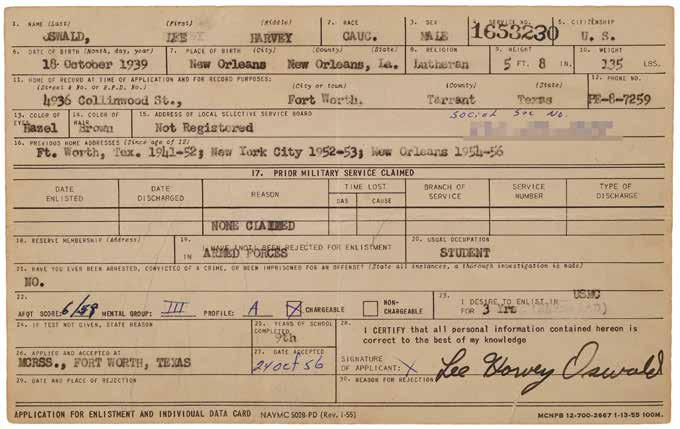
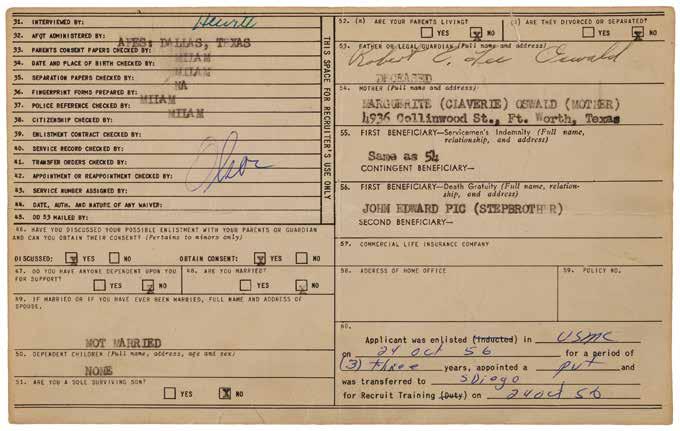
Lee Harvey Oswald’s application for enlistment in the U.S. Marine Corps
LOT 4030
Lee Harvey Oswald Signed Application for Enlistment in the U.S. Marine Corps
Partly-printed United States military “Application for Enlistment and Individual Data Card,” signed “Lee Harvey Oswald,” one page both sides, 8 x 5, with an acceptance date of October 24, 1956. Oswald’s application for enlistment in the United States Marine Corps, filled out in type with personal information including his date of birth (“18 October 1939”), place of birth (“New Orleans”), religion (“Lutheran”), height (“5 ft. 8 in.”), weight (“135 lbs.”), and home address (“4936 Collinwood St., Fort Worth”). The application also documents his AFQT score, mental group, and profile; on the reverse, it lists a series of internal checks and family data, including the signature of his brother, “Robert E. Lee Oswald,” acting as his guardian. At the conclusion, it notes: “Applicant was enlisted in USMC on 24 Oct 56 for a period of (3) three years, appointed a pvt and was transferred to SDiego for Recruit Training.” In fine condition, with light creasing and a small tear to the bottom edge.
This Marine Corps enlistment application dates to a formative moment in the early life of Lee Harvey Oswald, who enlisted in the United States Marine Corps on October 24, 1956, just one week after his seventeenth birthday. Because he was underage, the enlistment required the consent of his older brother, Robert Oswald, Jr., who signs as his legal guardian.
Oswald’s enlistment marked an attempt to escape a troubled home life and assert independence, motivations later attested to by family members. His stepbrother, John Pic, testified be-
fore the Warren Commission that Lee was wanted ‘to get from out and under…the yoke of oppression from my mother.’ Two days later, on October 26, 1956, Oswald reported for duty at the Marine Corps Recruit Depot in San Diego, where he was assigned to the Second Recruit Training Battalion and began training in, among other things, the use of the M-1 rifle. His practice scores were reportedly not very good, but when his company fired for a record on December 21, he scored 212, two points above the score necessary to qualify as a sharpshooter (with the classification scale ranging from marksman to sharpshooter to expert).
Over the next three years, his skill seemingly declined; a Marine in the same unit as Oswald in 1958 reported that he was frequently given the red flag in qualification firing, indicating a complete miss of the target, and when re-tested in May of 1959, Oswald qualified only as a marksman.
It has been frequently argued that even an expert marksman would struggle to duplicate Oswald’s alleged feat in the assassination of Kennedy, hitting a moving target three times in less than nine seconds (the time has been heavily disputed, ranging from 5.6 to 8.3 seconds).
As one of the earliest official records of Oswald’s adult life, this application provides critical context for understanding the personal, military, and psychological background of the man who would become central to one of the most consequential events in American history.
Starting Bid $1,000
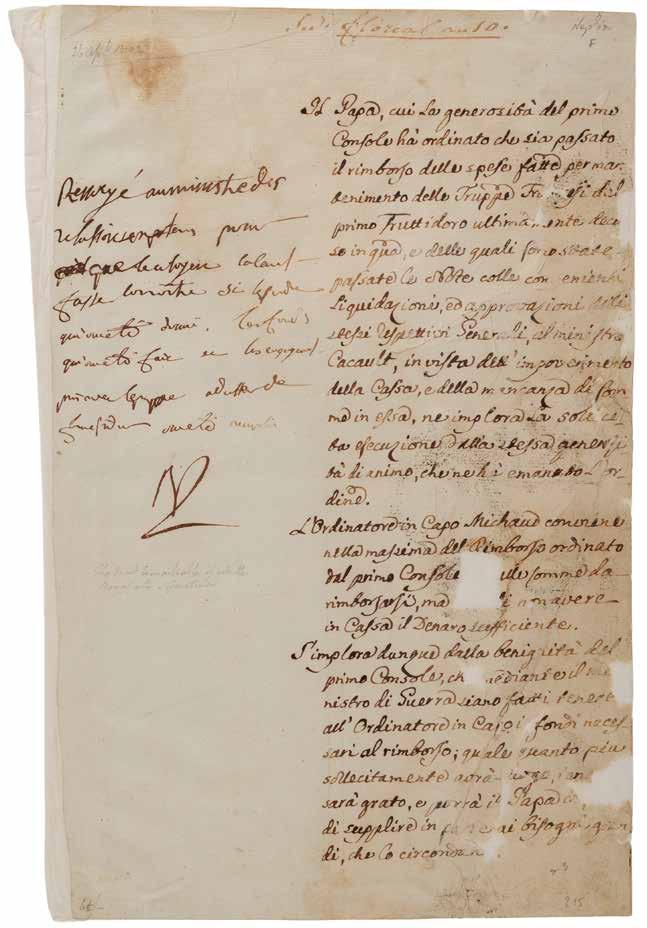
Following the Concordat of 1801, Napoleon Bonaparte oversees payment to Pope Pius VII for the maintenance of French troops
LOT 4031
Napoleon Autograph Endorsement Signed (8 Lines), on a Claim by Pope Pius VII for the Maintenance of French Troops
Manuscript DS in French and Italian, signed “Np,” one page, 8 x 12.5, [April 26, 1802]. Document in Italian concerning the disbursement of funds to Pope Pius VII, in part (translated): “The Pope, to whom the generosity of the First Consul has ordered reimbursement of expenses incurred for the maintenance of French troops from 1 Fructidor until now, and which are recorded with the preferential and depreciative liquidations and approvals of Minister Cacault, with a view to depleting the treasury and the lack of proper procedure, I implore the execution of this order. I beg the generosity of soul who gave it. Chief authorizing officer Michaud has agreed to the maximum amount of reimbursement ordered by the First Consul, but I do not have sufficient funds in the treasury. I therefore implore the kindness of the First Consul to have the necessary funds for reimbursement delivered to the chief authorizing officer through the Minister of War.”
In the left margin, Napoleon Bonaparte pens his handwritten endorsement in French: “Referred to the Minister of Foreign Affairs so that Citizen Cacault may indicate whether the orders…the funds that were donated and the commitments made to the Pope since Fructidor have been fulfilled.” In very good condition, with complete archival backing to reinforce tears and losses, and small areas of paper loss affecting some of the primary text.
This very rare document stems from the critical months following the ratification of the Concordat of 1801, when Napoleon Bonaparte, as First Consul, sought to normalize relations between post-Revolutionary France and the Catholic Church after a decade of estrangement. The reimbursement of expenses to Pope Pius VII for the maintenance of French troops in papal territory was not merely an administrative matter, but a deliberate political gesture intended to demonstrate France’s renewed respect for ecclesiastical authority and international obligations. Such payments formed part of Napoleon’s broader effort to restore stability and public order within France and across Europe.
Napoleon’s handwritten endorsement reveals his characteristically direct supervision of diplomatic and financial affairs. By referring the matter to the Minister of Foreign Affairs and demanding confirmation from the French envoy to the Holy See that promised funds had in fact been delivered, Napoleon signals the importance he initially attached to honoring commitments made to the Pope.
The document thus offers an early glimpse into Napoleon’s personal involvement in shaping the relationship between France and Pope Pius VII—an alliance that would later culminate in Napoleon’s coronation as emperor, and ultimately unravel in dramatic fashion with his excommunication from the Church.
Starting Bid $10,000
Nelson’s signed “Order of Battle” for Trafalgar—Captain Bayntun’s copy, issued from the HMS Victory on October 10, 1805
LOT 4032
Horatio Nelson Signed “Order of Battle” for Trafalgar - The Defining Naval Engagement of the Napoleonic Wars
Manuscript DS, signed “Nelson & Bronte,” one page, 8 x 13, October 10, 1805. Document headed “Order of Battle,” addressed to “H. W. Bayntun Esq., Captain of His Majesty’s Ship Leviathan by Command of the Vice Admiral…Given on board His Majesty’s Ship Victory of Cadiz the 10th of Octob’r 1805.” Issued eleven days prior to the Battle of Trafalgar, the document lists the “Frigates, Sloops, &c” in Lord Nelson’s fleet. On October 21, 1805, in the defining naval clash of the Napoleonic Wars, Nelson shattered the combined French and Spanish fleets, thwarting Napoleon’s plans to invade and securing British command of the seas, even as he fell in victory. In his triumphant death, Nelson was immortalized as a national hero. The document enumerates the ships of Nelson’s fleet alongside their captains, with several struck through by Bayntun and annotated as “not in the battle.” The revised list reflects the roster that would comprise Nelson’s force at Trafalgar, including the ships Téméraire, Victory, Neptune, Conqueror, Agamemnon, Leviathan (commanded by Henry William Bayntun), Ajax, Orion, Minotaur, Africa, Spartiate, Prince, Mars, Royal Sovereign, Tonnant, Belleisle, Bellerophon, Colossus, Achille, Polyphemus, Revenge, Britannia, Swiftsure, Defence, Thunderer, Defiance, and Dreadnought. Bayntun also records the fate of some of the captains, noting that George Duff and John Cook were “killed,” and Charles Tyler and James Nicoll Morris were “wounded.” Signed at the conclusion in ink by Horatio Nelson, “Nelson & Bronte,” and by his secretary, “John Scott.” In fine condition, with archival reinforcement to the perimeter of the verso.
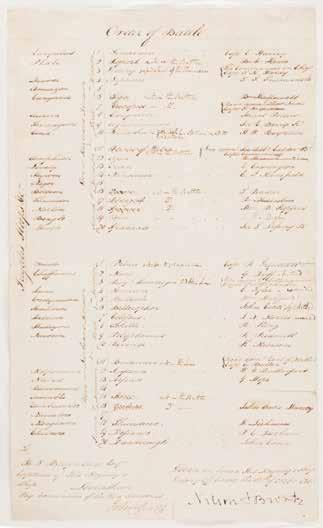
Distributed to Nelson’s captains as the fleet prepared for its decisive engagement, this “Order of Battle” represents a rare surviving example of the operational papers that governed one of history’s most consequential naval encounters. Approximately thirty copies are believed to have been prepared for commanding officers, most long since lost, destroyed, or absorbed into institutional archives. Captain Hugh William Bayntun’s copy stands among the most significant forms of Nelson material to reach the market: not a routine letter or order, but a battle-related command document signed by Nelson and his secretary, John Scott, both of whom would be killed in the engagement. On October 21st, Scott stood on the quarterdeck of Victory beside Nelson, prepared to record the day’s events. One of the first cannonballs to strike the ship killed him instantly. Nelson himself was mortally wounded later that afternoon by a French sharpshooter, falling near the same spot. Bayntun, as commander of HMS Leviathan, fought admirably in the battle, engaging and capturing the Spanish ship San Agustín. That this document carries the autographs of both Nelson and Scott—signed in the final days before the battle that would claim their lives—lends it exceptional historical poignancy
Starting Bid $2,500
Sun Yat-sen assists in translation while exiled in London
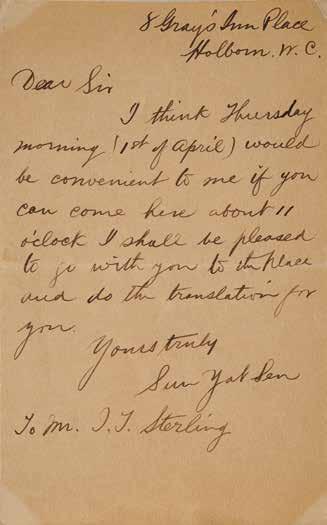
LOT 4033
Sun Yat-sen Autograph Letter Signed While Exiled in London: “I shall be pleased to go with you to the place and do the translation for you”
Founding father and first president of the Republic of China (1866-1925). ALS signed “Sun Yat Sen,” one page, 4.5 x 7, no date but circa 1896. Handwritten letter to J. T. Sterling, written from “8 Gray’s Inn Place, Holborn, W.C.,” where Sun lived while exiled in London. In full: “I think Thursday morning (1st of April) would be convenient to me if you can come here about 11 o’clock I shall be pleased to go with you to the place
and do the translation for you.” In fine condition, with slight discoloration to the corner tips. While living in London in 1896, Sun Yat-sen was kidnapped by agents of the Qing legation and held at the Chinese Legation. His release—after intervention by British friends and the press—made him internationally famous and helped launch his revolutionary career. From the personal collection of a lifelong collector, teacher, and traveler with a passion for world history. His collecting years ranged from the 1970s to the present day, meaning that several of the premier pieces have not been on the market in decades.
Starting Bid $500
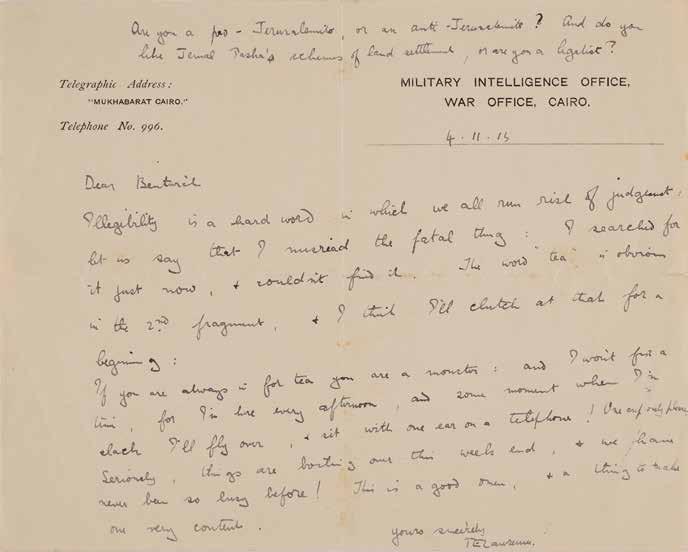
Lawrence gathers political intelligence before the Arab Revolt: “Are you a pro-Jerusalemito, or an anti-Jerusalemite?
And do you like Jemal Pasha’s schemes of land settlement, or are you a legalist?”
LOT 4034
T. E. Lawrence Autograph Letter Signed, Probing Legal Opinions Before the Arab Revolt: “Are you a pro-Jerusalemito, or an anti-Jerusalemite? And do you like Jemal Pasha’s schemes of land settlement, or are you a legalist?”
World War I–dated ALS, signed “T. E. Lawrence,” one page, 8.25 x 6.5, Military Intelligence Office, War Office, Cairo letterhead, November 4, 1915. Handwritten letter to legal academic and Zionist activist Norman Bentwich, in full: “Illegibility is a hard word in which we all run risk of judgement: let us say that I misread the fatal thing: I searched for it just now, & couldn’t find it. The word ‘tea’ is obvious in the 2nd fragment, & I think I’ll clutch at that for a beginning: If you are always in for tea you are a monster: and I won’t find a time, for I’m home every afternoon, and some moment when I’m back I’ll fly over, & sit with one ear on a telephone! One cup only please. Seriously, things are boiling over this week end, & we have never been so busy before! This is a good omen, & a thing to make me very content.” Lawrence also adds an inquiry at the top of the sheet: “Are you a pro-Jerusalemito, or an anti-Jerusalemite? And do you like Jemal Pasha’s schemes of land settlement, or are you a legalist?” In fine condition.
Written from the Military Intelligence Office in Cairo, this letter dates from the formative period of T. E. Lawrence’s wartime service, before his emergence as ‘Lawrence of Arabia,’ and offers a rare glimpse into his early role within British intelligence in the Middle East. At this moment, Cairo functioned as the strategic center of British operations against the Ottoman Empire, and Lawrence—then an intelligence officer and noted Arabist—was deeply engaged in the political and intelligence ferment that would soon culminate in the Arab Revolt. His remark that “things are boiling over” reflects the escalating urgency of British efforts in the region and his own growing involvement in events of historic consequence.
Addressed to Norman Bentwich, a British legal scholar and influential figure in emerging Zionist and Palestinian legal affairs, the letter is notable for its probing political inquiry. Lawrence’s question regarding attitudes toward Jerusalem and Ottoman statesman Jemal Pasha’s land-settlement schemes reveals that debates over the city’s future governance and land law in Palestine were already actively underway—nearly two years before the Balfour Declaration. In 1920, Bentwich would become the British-appointed attorney-general of Mandatory Palestine. Combining wit with political insight, the letter captures Lawrence at a pivotal early stage: intellectually engaged, politically perceptive, and already participating in conversations that would help shape the postwar Middle East.
Starting Bid $1,000
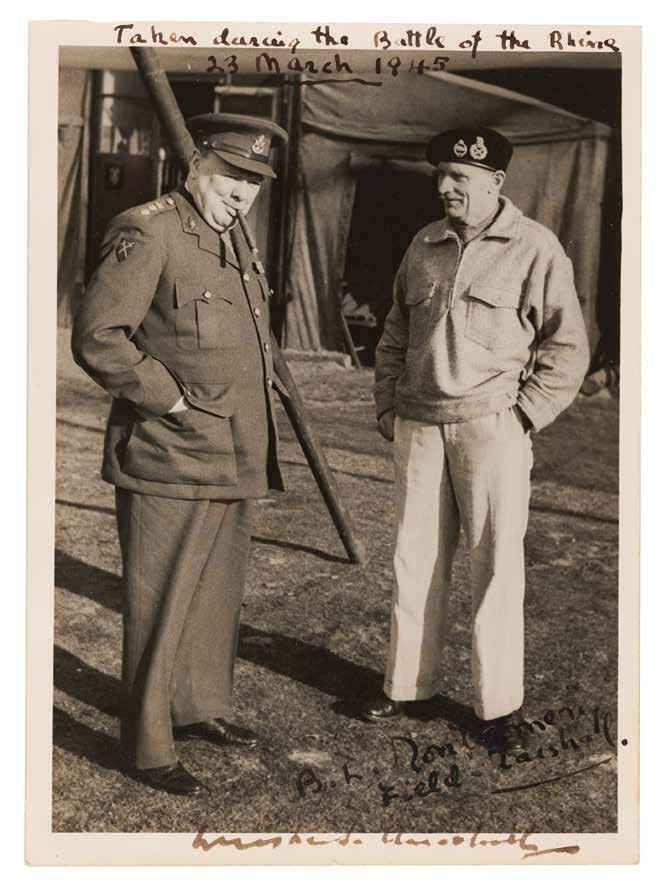
Image shown larger than actual size.
“Taken during the Battle of the Rhine, 23 March 1945”—exceedingly rare dual-signed photo of Prime Minister Winston Churchill and Montgomery of Alamein, pictured during Operation Plunder’s historic crossing of the Rhine river into German territory
LOT 4035
Winston Churchill and Montgomery of Alamein Signed Photograph - “Taken during the Battle of the Rhine, 23 March 1945”
Outstanding matte-finish 4.75 x 6.5 full-length photo of Prime Minister Winston Churchill smoking a cigar and standing with Field Marshal Bernard Law Montgomery, 1st Viscount Montgomery of Alamein, during Operation Plunder and the crucial Rhine river crossing, signed along the lower border in fountain pen, “Winston S. Churchill,” and immediately above, “B. L. Montgomery, Field-Marshal,” who adds to the upper section, “Taken during the Battle of the Rhine, 23 March 1945.” In fine condition. Originates from the estate of Montgomery of Alamein.
On the night of March 23, 1945, the Allies launched Operation Plunder, the decisive assault to cross the Rhine and enter Germany. The operation was conducted by Field Marshal Sir Bernard Montgomery’s 21st Army Group, with crossings at Rees, Wesel, and south of the River Lippe by the British Second Army under Lieutenant General Miles Dempsey and the U.S. Ninth Army under Lieutenant General William H. Simpson. Planned by Montgomery as a massive, coordinated assault, the Battle of the Rhine combined a three-army advance, Operation Varsity airborne landings, a five-thousand-gun artillery barrage, and heavy Anglo-American bombing, supported by vast stockpiles of bridging equipment and supplies.
Prime Minister Winston Churchill was present at Montgomery’s headquarters near Venlo on the eve of the operation and, on March 24th, observed the Varsity airborne landings with Montgomery. The following day, Churchill accompanied Montgomery to General Dwight D. Eisenhower’s headquarters, where they received a briefing before moving to a sandbagged house overlooking the Rhine and a quiet stretch of the German-held east bank.
After Eisenhower’s departure, Churchill—accompanied by Montgomery, U.S. commanders, and armed guards—insisted on crossing the river in an LCVP landing craft, landing for approximately 30 minutes in enemy territory without opposition. The party then visited the shattered railway bridge at Wesel, withdrawing only when German artillery began to range the area.
Churchill’s daring presence at the front underscored Allied confidence and symbolized the dramatic shift in momentum. The successful Rhine crossing marked the final major Allied push into Germany, with German defeat now clearly imminent. Churchill, noted for his insistence on being near the front lines, later remarked, ‘I never worry about action, but only inaction.’
Starting Bid $1,000
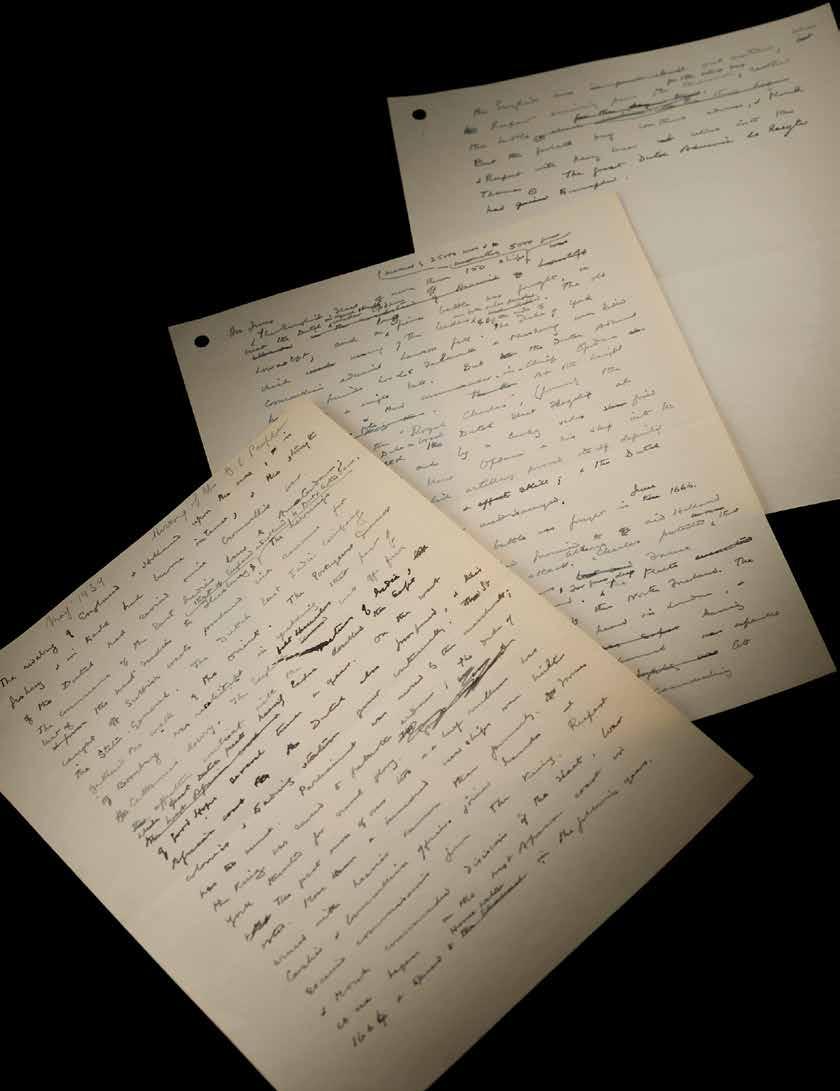
Churchill drafts his epic History of the English-Speaking Peoples, documenting the 17th-century “rivalry of England & Holland upon the seas”
LOT 4036
Winston Churchill Handwritten Working Draft for A History of the English-Speaking Peoples, Documenting the “rivalry of England & Holland upon the seas”
Three pages of Winston Churchill’s original handwritten working draft of his epic four-volume A History of the English-Speaking Peoples, 8 x 10, identified and dated at the head in pencil by Churchill’s secretary Kathleen Hill, “May 1939, History of the E. S. People.”
In this passage, Churchill focuses on the Anglo-Dutch rivalry of the 1660s, beginning: “The rivalry of England & Holland upon the seas, in fishing & in trade had become intense, & the strength of the Dutch had revived since Cromwell’s war. The commerce of the East Indies drew to Amsterdam; that of the West Indies to Flushing; that of England & Scotland to Dort & Rotterdam. The herrings caught off Scottish coasts produced rich revenues for the States-General. The Dutch East India Company gathered the wealth of the Orient. The Portuguese Governor of Bombay was recalcitrant in yielding that part of Catherine’s dowry….
On the West African coast the Dutch also prospered, & their colonies & trading stations grew continually. It was too much. Parliament was moved by the merchants; the King was roused to patriotic ardour; the Duke of York thirsted for naval glory… More than a hundred new ships were built, armed with heavier cannon than previously. Former Cavalier & Cromwellian officers joined hands & received commissions from the King. Rupert & Monk commanded divisions of the Fleet. War at sea began on the West African coast in 1664, and spread to home waters in the following year.
In June the English fleet of more than 150 ships, manned by 25,000 men & mounting 5,000 guns, met the Dutch in equal strength off Lowestoft, and a long, fierce battle was fought, in which many of the leaders on both sides perished…
An even larger battle was fought in June 1666. Louis XIV had promised to aid Holland if she were the victim of attack. Although Charles protested that the Dutch were the aggressors, France declared war upon England. For four days the English and Dutch fleets battled off the North Foreland. The sound of the guns was heard in London…
The English were out matched, when Rupert arriving from the Channel for the third day, restored the battle. But the fourth day continued adverse, & Monk & Rupert with heavy losses retired into the Thames. The great Dutch Admiral de Ruyter had triumphed.” Churchill makes several revisions and corrections throughout the text. In fine condition.
Skilled as a writer, orator, and historian, Churchill would receive the Nobel Prize in Literature in 1953 ‘for his mastery of historical and biographical description as well as for brilliant oratory in defending exalted human values.’ These working manuscript pages come from one of Churchill’s most ambitious and longgestating literary projects. A History of the English-Speaking Peoples was primarily conceived and largely written during his ‘wilderness years’ in the late 1930s, heavily interrupted by World War II, and finally published between 1956 and 1958. The ambitious, comprehensive work covers the period from the Roman conquest of Britain in 55 B.C. to the beginning of the First World War.
Starting Bid $1,000
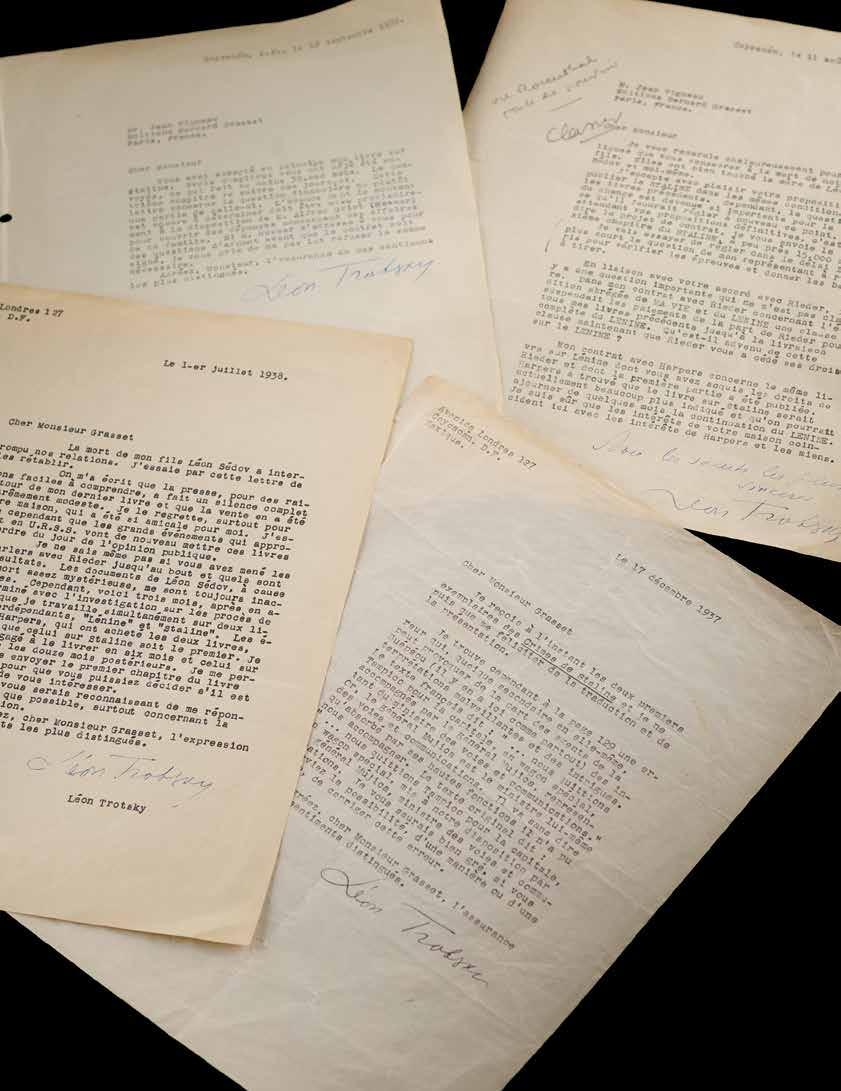
Trotsky drafts
books
on
Stalin and Lenin, warning that errors “may provoke malicious interpretations and intrigues by the agents of the GPU (there are some of them here, as everywhere)”
LOT 4037
Leon Trotsky (4) Typed Letters Signed, Preparing to Publish Books on Stalin and Lenin While Exiled in Mexico
Four TLSs in French, signed “Leon Trotsky,” each one page, 8.25 x 11, dated from December 1937 to September 1938. Trotsky writes from Coyoacán, Mexico, to his publishers, Bernard Grasset and Jean Vigneau, about his books on Stalin and Lenin, and the mysterious death of his son Lev Sedov. Excerpts from the letters, in translation:
December 17, 1937: “I have just received the first two copies of ‘Stalin’s Crimes’ and I can only express my satisfaction with the translation and presentation. I do, however, find on page 129 an error which, although secondary by itself, may provoke malicious interpretations and intrigues by the agents of the GPU (there are some of them here, as everywhere).” He explains what should be changed and how poorly chosen words can have the most disastrous consequences. He would be assassinated in Mexico two and a half years later, on August 20, 1940, by an agent of Stalin.
July 1, 1938: “The death of my son Léon Sedov interrupted our relationship. I am trying through this letter to re-establish them. I have been told that the press, for reasons easy to understand, maintained complete silence around my latest book and that sales were extremely modest. I regret this, especially for your firm, which has always been so friendly toward me. I nevertheless hope that the great events coming up in the U.S.S.R. will once again bring these books to the forefront of public opinion. I do not even know whether you pursued discussions with Rieder to the end and what were the results. The documents of Léon Sedov, because of his rather mysterious death, are still inaccessible to me. However, three months ago, after finishing the investigation into the Moscow Trials, I began working simultaneously on two connected books, Lenin and Stalin. Harper Editions, which bought both books, insists that the one on Stalin be published first. I have committed myself to deliver it within six months, and the one on Lenin in the twelve months following. I allow myself to send you the first chapter on Stalin so that you may decide whether it is likely to interest you.”
August 11, 1938: “I warmly thank you for the lines you devoted to the death of our son. They deeply touched Léon Sedov’s mother and myself. I gladly accept your proposal to publish Stalin under the same conditions as the previous books… While awaiting your definitive proposals, that is to say the draft contract, I am sending you the second chapter of Stalin, approximately 15,000 words.” He continues, saying that he is charging his correspondent in Paris with correcting the proofs and, in the meantime, he wishes to clarify an important question: “In my contract with Rieder concerning the abridged edition of My Life and Lenin, a clause suspended payments by Rieder for all my previous books until the complete delivery of Lenin. What has become of this clause now that Rieder has ceded its rights on Lenin to you? My contract with Harpers concerns the same book, Lenin, for which you have acquired the rights from Rieder and for which the first part has been published. Harpers has found that the book on Stalin would at present be much more timely and that one could postpone for a few months the continuation of Lenin.”
September 19, 1938: “You have accepted my book on Stalin in principle. Three chapters have already been sent, amounting to at least 35,000 words. This letter concerns the financial question.” He explains the manner in which he wishes it to be settled.
Together, these letters vividly situate Trotsky at one of the most precarious and intellectually productive moments of his life: a revolutionary in permanent exile, writing under constant threat while racing to shape the historical record of Bolshevism against Stalinist distortion. Composed from his fortified residence in Coyoacán amid the terror of the Moscow Trials and the shadowy reach of the Soviet secret police, the correspondence reveals Trotsky not only as a political thinker but as a meticulous author and shrewd negotiator, deeply involved in translation, contracts, publicity, and timing. The references to surveillance, suppressed sales, and the “mysterious” death of his son reveal the personal cost of his opposition to Stalin. As primary-source material linking Trotsky’s final major works to the events that would soon culminate in his assassination, these letters offer exceptional insight into the intersection of Trotsky’s ideology and exile.
Starting Bid $500
Stalin mediates a bureaucratic dispute in the USSR, seeking to preserve the “unity of the organization” of the Red Army
LOT 4038
Joseph Stalin Document Signed, Mediating a Bureaucratic Dispute in the USSR to Preserve Unity in the Red Army
Manuscript DS in Cyrillic, signed in blue pencil, “Stalin,” one page, 6.5 x 8.5, no date. Order to “Comrade Kalinin,” in part: “By the decision of the Sovnarkom of the USSR, the Military-Sanitary Department is included in the Narkomvornmor. This decision has been objected to by the Sovnarkom of the RSFSR Central Executive Committee. For the purpose of creating the unity of the organization of RKKA and as well as planned (systemic/regular) militant training is all its field, including sanitary as well, we suggest the objection of Sovnarkom of RSFSR be declined.” Signed at the conclusion in blue pencil by Joseph Stalin, and countersigned by Bolshevik leaders Sergo Ordzhonikidze and Kliment Voroshilov. In very good to fine condition, with dampstaining along the rough left edge.
This document concerns a bureaucratic dispute between the Sovnarkom (Council of People’s Commissars) of the USSR— the highest executive authority of the Soviet Union—and the Sovnarkom of the RSFSR (Russian Soviet Federative Socialist Republic), which objected to the reorganization in question. Offering a firsthand record of Stalin’s role in shaping the centralized power structure of the early Soviet state, the leader orders that the Military-Sanitary Department be placed under the Narkomvornmor (People’s Commissariat for Military and Naval Affairs), thereby integrating military medical services into the central defense apparatus. The stated goal is to ensure “unity of organization” and systematic military training across the RKKA (Workers’ and Peasants’ Red Army), including its medical and sanitary branches. From the personal collection of a lifelong collector, teacher, and traveler with a passion for world history. His collecting years ranged from the 1970s to the present day, meaning that several of the premier pieces have not been on the market in decades.
Starting Bid $500
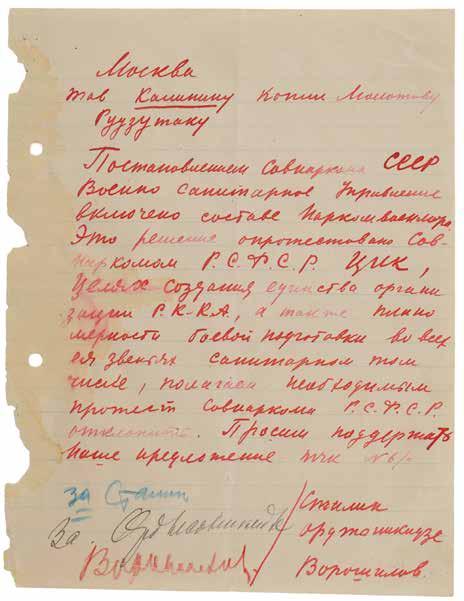
Seldom-seen 1946 letter by Zhou Enlai, organizing “transportation of supplies to the Communist Liberated Areas”
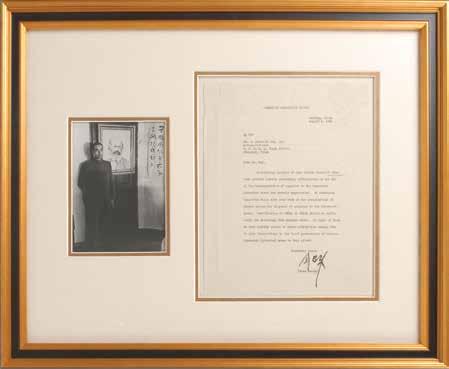
LOT 4040
Zhou Enlai Typed Letter Signed, Organizing “transportation of supplies to the Communist Liberated Areas”
Scarce TLS in English, one page, 8 x 10.25, Communist Delegation Office letterhead, August 8, 1946. Letter to Mr. J. Franklin Ray, Jr., acting director of the United Nations Relief and Rehabilitation Administration [UNRRA] in Shanghai. In part: “Your efforts towards overcoming difficulties in the way of the transportation of supplies to the Communist Liberated Areas are greatly appreciated. We associate ourselves fully with your view of the cancellation of passes system for shipment of supplies to the Liberated Areas. Certificates of UNRRA or CNRRA should be sufficient for obtaining free passage there. In light of this, we have already cabled to Yenan authorities asking them to give instructions to the local governments of various Communist Liberated Areas to this effect.” Archivally double-matted and framed with a photo to an overall size of 21.75 x 17.75. In fine condition, with light creasing and erased office notations to upper right.
The UNRRA was an international agency founded to organize the administration of relief measures such as food, fuel, clothing, and medical supplies to countries that had been hit especially hard during World War II. However, the end of WWII brought about the resump-
tion of the Chinese Civil War in which the Nationalist and Communist factions battled for control. Although the UNRRA was supposed to be an apolitical humanitarian organization, it seemed that the vast majority of aid was falling into the hands of the Nationalists. Supply trucks bound for areas held by the Communists were also frequently intercepted by the Nationalists, who either seized the goods being transported or simply prevented them from reaching the Communist areas. According to Chou En-lai, the Communists controlled all or part of nineteen provinces yet received less than one percent of all UNRRA shipments into China.
George C. Marshall spent the year of 1946 in China attempting to broker peace between the warring parties and reach a democratic resolution, but the relationship between the United States and the Communists had grown increasingly strained and by the time of this letter it seemed clear that these efforts were futile. By the end of the year it was clear that war was inevitable and President Truman called Marshall back to the US, where he began developing his next major project—the Marshall Plan. With fine content regarding the situation of China at the beginning of the Communist Revolution, this is an extremely scarce and desirable letter.
Starting Bid $1,000
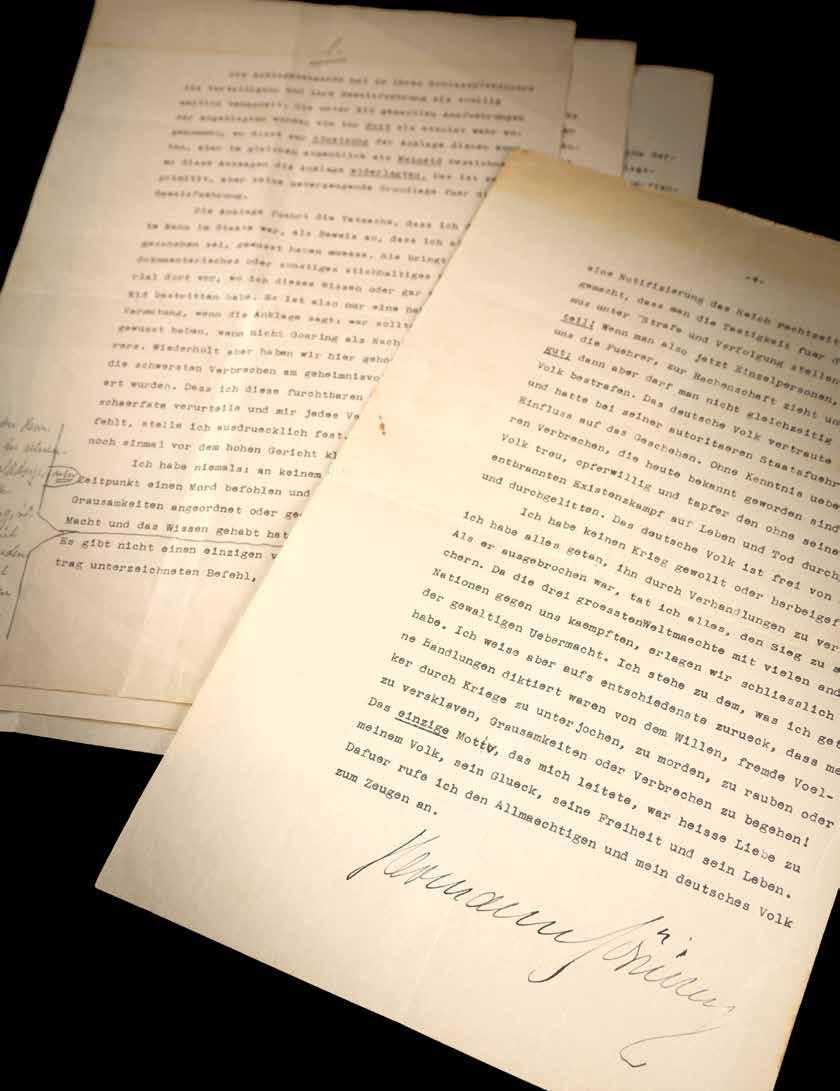
“I stand on what I have done”— Göring prepares his final statement at Nuremberg
LOT 4039
Nuremberg Trials: Hermann Goring’s Retained Typed Manuscript Signed, Preparing His Final Statement to the War Crimes Tribunal: “I stand on what I have done”
TMS in German, signed “Hermann Göring,” four pages, 8 x 13, no date but circa August 1946. Göring’s retained draft of his final statement as read before the International Military Tribunal at Nuremberg on August 31, 1946, in part (translated): “The prosecution in the final speeches has treated the defendants and their testimony as absolutely worthless. The statements made on oath by the defendants were accepted as absolutely true when they seemed to support the Indictment, but characterized as perjury when they refuted the Indictment…The prosecution uses the fact that I was the second man in the State as proof that I must have known all that happened. But it does not present any documentary or other valid proof when I have denied on oath that I knew about certain things, much less desired them. It is therefore only an allegation a conjecture when the prosecution says, ‘Who should have known these things if not Goering, who was successor to the Fuehrer?’…
I desire to state clearly once more before the High Tribunal that I never decreed the murder of a single individual at any time, nor did I order or tolerate other atrocities when I had the power and the knowledge to prevent them…Mr. Jackson stated that one cannot accuse and punish a state, but that the leaders must be held responsible. He seems to forget that Germany was a sovereign state and that her legislation within the boundaries of the German nation was not subject to the jurisdiction of foreign countries…The German people placed their trust in the Fuehrer, and under his authoritarian rule they had no influence on events…The German people are free from guilt.
I did not desire the war, nor did I bring it about. I did everything to prevent it by negotiations. After it had broken out. I did everything to assure victory. As the three greatest powers on earth, together with many other nations, were fighting against us, we finally succumbed to their tremendous superiority. I stand on what I have done, but I deny most emphatically that my actions were dictated by the desire to subjugate foreign peoples by war, to murder, rob or enslave them, to commit crimes…The only motive which guided me was my ardent love for my people, its happiness, its freedom, and its life. And to this I call on the Almighty and my German people to bear witness.” Göring makes a ten-line handwritten pencil correction in the margin of the first page, and a three-word correction to the second page—reflecting his last attempts to shape his historical legacy and save his own life. In very good to fine condition, with central vertical and horizontal folds, light creasing, and a band of subtle toning across the top.
Hermann Göring—the most infamous surviving Nazi and the main target of the International Military Tribunal—stood trial at Nuremberg as a chief architect of Germany’s war of aggression and the regime’s crimes against humanity. As Reichsmarschall and head of the Luftwaffe, he was accused of orchestrating war plans, exploiting occupied territories, and overseeing institutions that enabled mass murder, including the concentration camps. Throughout the trial, Göring attempted to portray himself as a loyal bureaucrat who acted in the interest of the state and was unaware of the full extent of atrocities, seeking witness testimony to support his claims. Despite his defenses and attempts to manipulate the proceedings, he was convicted on multiple counts, including crimes against peace, war crimes, and crimes against humanity. Sentenced to death, he committed suicide by ingesting cyanide the night before his scheduled execution. Provenance: Lot 119, Auction 122, Charles Hamilton Galleries, Inc., New York, September 6, 1979.
Starting Bid $1,000
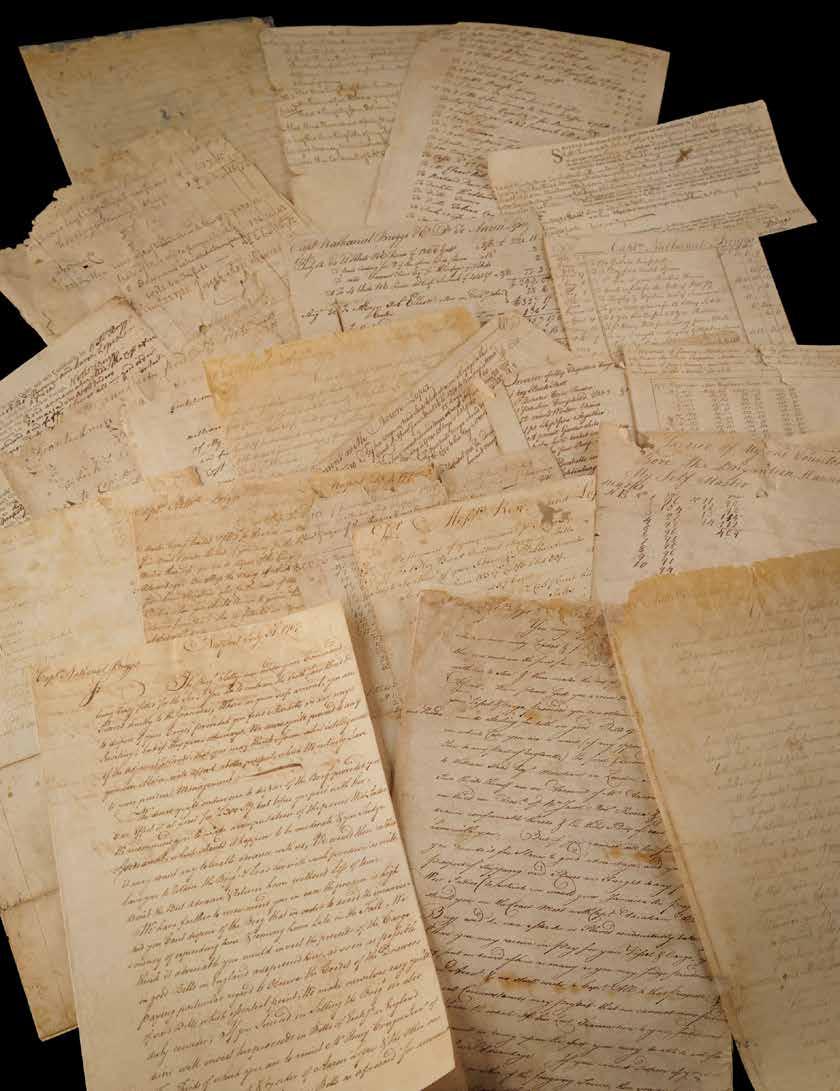
“Come
away with
all
the Slaves You can bring off”—an unusually comprehensive archive documenting the Atlantic slave trade
Slave Trade: Archive of (22) Documents Chronicling the Transatlantic Trade of Aaron Lopez and Jacob Rodrigues Rivera
Remarkable archive documenting the triangular slave trade that was financed with British capital and operated by the important and successful Rhode Island merchants, Aaron Lopez and Jacob Rodrigues Rivera, spanning the period of the development and peak of their business through their deaths. The collection comprises 22 letters and documents dated from July 22, 1765–July 14, 1791, totaling over 40 pages, most signed by Lopez, Rivera, or their captain, Nathaniel Briggs.
Taken together, this archive places Lopez and Rivera squarely within the broader Atlantic commercial system that linked New England, West Africa, the Caribbean, and Great Britain in the 18th century. Rhode Island merchants were among the most active North American participants in the transatlantic slave trade, and Newport in particular emerged as a major hub by mid-century, fueled by distilleries that transformed Caribbean molasses into rum for export to Africa. These papers document that system not in the abstract, but at its operational core—through instructions, invoices, balance sheets, and correspondence that show how vessels, cargoes, enslaved people, and credit were converted into profit across multiple markets and jurisdictions. The routine language of trade underscores how deeply slavery was embedded in the everyday mechanics of Atlantic commerce.
The archive is especially significant for the clarity and continuity with which it records the triangular trade over more than two decades. From the loading of vessels and the dispatch of rum and provisions from New England, to the acquisition
and shipment of enslaved people on the African coast, and finally to their sale in the West Indies, the documents trace the full commercial cycle with rare completeness. Few surviving collections document this process so consistently and in such detail, making this archive an unvarnished primary record of the transatlantic slave trade at its height and a sobering testament to the scale of human exploitation within 18th-century maritime commerce.
The first letter, characteristic of the archive as a whole, is an LS signed “Aaron Lopez for Self & For Jacob Rod’s Rivera,” three pages on two adjoining sheets, July 22, 1765, to Captain Nathaniel Briggs. In part: “You being…Master of our Sloop the Betsey…make the best of your way to the Coast of Africa. When please God you arrive there, endeavour to dispose of your Vessel & Cargo, provided you can obtain at Least One Thousand & one Hundred Pounds Sterling…But if you cannot sell her for Bills, and you can do it for Slaves to good advantage, and you have a prospect of shipping said Slaves on Freight to any part of the West Indies…when you have finished your Trade on the Coast, proceed with your Vessel & Slaves…to Kingston in the Island of Jamaica & there deliver whatever Slaves you may carry in on Account of the owners to Mr. Philip Livingston Junr. merchant there, to whom we shall give our necessary orders for the disposal of them…and we shall give Mr. Livingston orders to Account with you…from the Neat Sales of the Slaves at Jamaica that you may put in his Hands on our Account…We would in the strongest manner recommend to you…that you are Watchful of the security of the Slaves.” For a complete accounting of the lot, see RRAuction.com.
Starting Bid $1,000
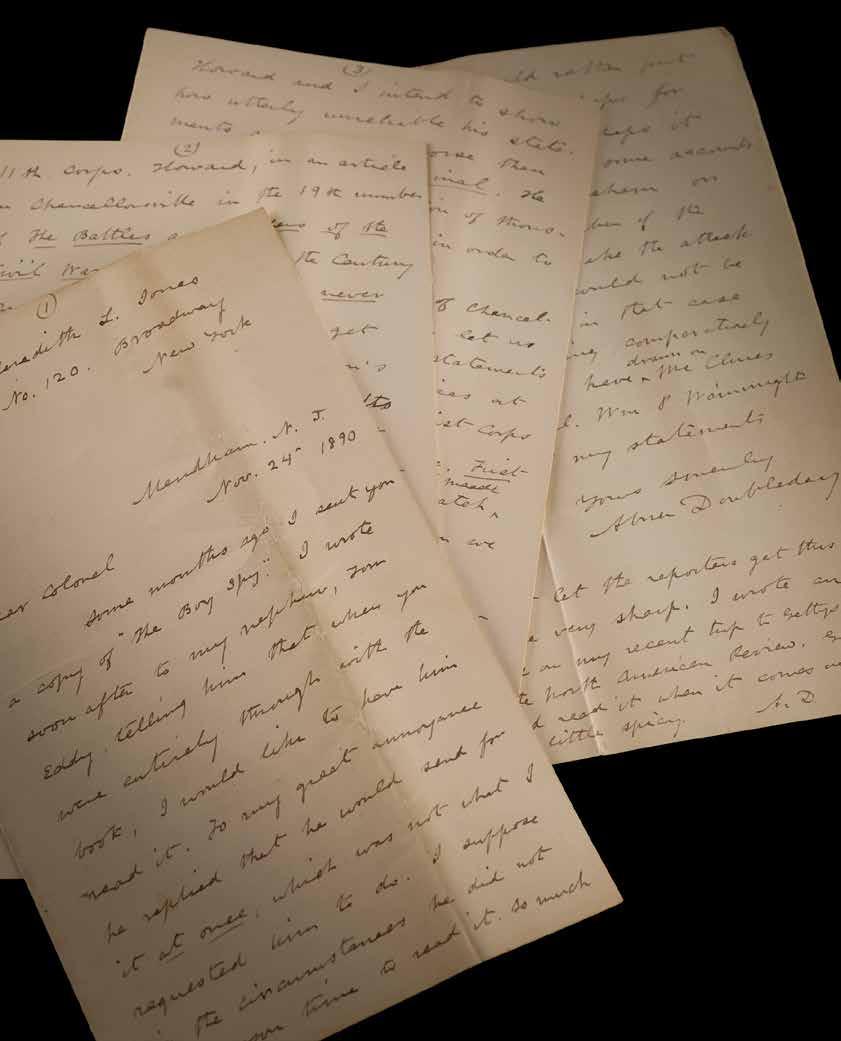
“He has ruined the reputation of thousands of innocent men in order to enhance his own”—
lengthy, 14-page handwritten letter from Abner Doubleday on the continued falsehoods advanced by Major General Oliver O. Howard regarding Gettysburg, Chancellorsville, and the heroic efforts of the First Army Corps
LOT 4043
Abner Doubleday Autograph Letter Signed on Oliver Otis Howard and His “Criminal” Falsehoods Concerning the Battles of Gettysburg and Chancellorsville
ALS, fourteen pages, 5 x 8, November 24, 1890. Addressed from Mendham, New Jersey, a lengthy handwritten letter to Union Colonel Meredith L. Jones, who served under Doubleday in the First Corps. In it, Doubleday offers a controlled but impassioned indictment of Oliver O. Howard for what he viewed as false and self-serving accounts of Chancellorsville and Gettysburg. The letter, in part: “My object in writing now is to give you a brief account of my trip to Gettysburg…I found General [Oliver Otis] Howard seated opposite the group of Frenchmen and endeavoring to impress them and the Count with the excellence of his generalship, and trying to do away with the facts stated in my book. I could’ve controverted his statements, but did think it would be very seemly to have anything in the way of an altercation in presence of the foreigners…
Howard, in an article on Chancellorsville in the 19th number of The Battles and Leaders of the Civil War, published by the Century Company, states that he never received [Joseph] Hooker’s order to get ready for [Thomas J.] Stonewall Jackson’s attack, and that the thickets and woods enabled Jackson to take him unawares…You may consider this pretty much an old story and ask why I revive it, but you will see later on that the First Corps have a serious accusation to make against Howard, and I intend to show how utterly unreliable his statements are. They are worse than that, for they are criminal. He has ruined the reputation of thousands of innocent men in order to enhance his own.” In fine condition, with an offset vertical fold to each page. A fascinating and revealing letter from Doubleday in his postwar effort to define responsibility, reputation, and historical truth among Union commanders.
Interested bidders can find a fuller transcription of the letter on our website.
Starting Bid $200
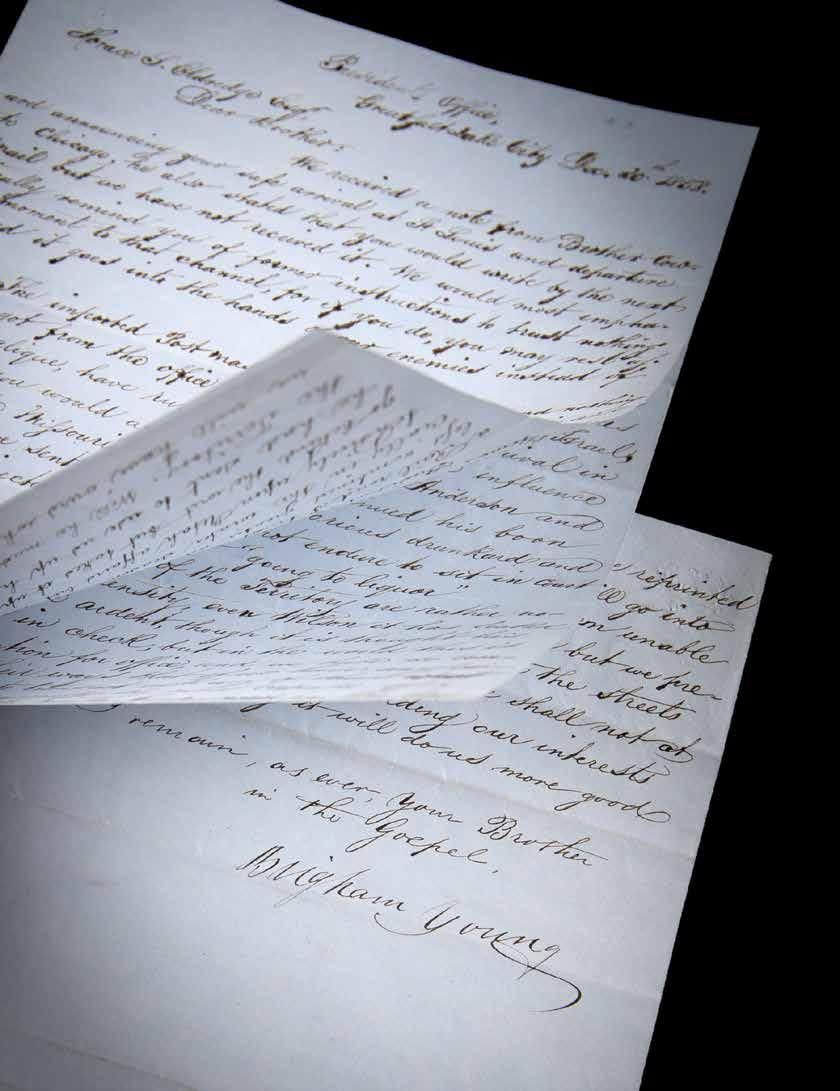
Ousted as governor, Brigham Young comments on the possible statehood of Utah and a new edition of the Book of Mormon
LOT 4045
Brigham Young Letter Signed on President Buchanan, the Possible Statehood of Utah, and a New Edition of the Book of Mormon: “We trust now that it will go into more general circulation”
LS signed “Brigham Young,” six pages on adjoining sheets, 7.75 x 9.75, Great Salt Lake City, December 30, 1858. Letter to Horace S. Eldredge, an important member of the Mormon Church, wagon master for Brigham Young’s company, territorial marshal for the State of Deseret, Brigadier General in the Utah Militia, and from 1852, the immigration agent for the Mormon Church in St. Louis.
In part: “We received a note from Brother Coward announcing your safe arrival at St. Louis and departure to Chicago, he also stated that you would write by the next mail but we have not received it. We would most emphatically remind you of former instructions to trust nothing of moment to that channel, for if you do, you may rest assured it goes into the hands of our enemies instead of ours. The imported Postmaster still holds sway and nothing can be got from the office until the Hurt, Burr, Craig and Dolson clique, have rummaged to their hearts content. I wish you would ascertain if you can how many copies of the Missouri Republican containing the Presidents message were sent to this Territory by the Express and to whom directed. The Valley Tan managed to monopolize every copy sent or at least keep them under its own thumb, so that even Governor Cumming could not get a copy until after that paper had issue it.
The Members of the Legislative Assembly refused to receive the message through that channel, not feeling to patronize such a dirty, filthy, slanderous sheet. Of this and other matters I have written more fully to Brother Cannon, whose letter you will probably see. If it comes to your hands first you are at liberty to open and read it and be sure either to take or send it by some private conveyance to him and not trust our letters in the Mails at all. We suppose that the mail party consider the Express coming through in eleven days from St. Loo quite a
brilliant affair but we think if our Express company had been let alone until this time it would have beaten that by a great odds, especially if Congress had backed it up with two hundred thousand dollars a year for carrying the mails as they do now. To say the least this Express was very exclusive in its favors when it could not afford a single citizen and not even Governor Cumming a copy of the message. I have no doubt but the butterfield company will beat them but their being able to come through with the express does not prove their ability to carry the mails within time as there is no news of the last two which were due last week and the week before and those which have come lately arrived some week or ten days after their schedule time.
President Buchanan inclines to the southern route for a Rail road. I trust that it will be so located, it doubtless combines greater advantages in many respects especially in the winter season. He also treats pretty extensively upon Utah affairs but his investigations do not go behind the writ but takes it up after the troops which he had sent to use us up had actually come into the Territory. Well he must have ‘his say’ just now we will have ours when the whole subject comes up for investigation. On the whole we consider the message quite favorable as much so as we could expect.
His recommendation of extending the land laws pre-emption right &c to us is quite suggestive and we trust will have the way to many other things, the greatest of which is our admission, or at least an enabling act.
The Courts or court I should say as thus far we have had but one for which we are truly thankful is simply making an ass of itself as everybody else will do who strikes against Israel. Mr. Sinclair at an early day after his arrival in the Territory placed himself under the influence of Burr, Craig, Hurt, who with Kirk Anderson and others of like stripe have since continued his boon companions; he is moreover a notorious drunkard and appears as though he could not endure to sit in court outside of an hour without ‘going to liquor.’
Continued onto the next page.
Continued from previous page.
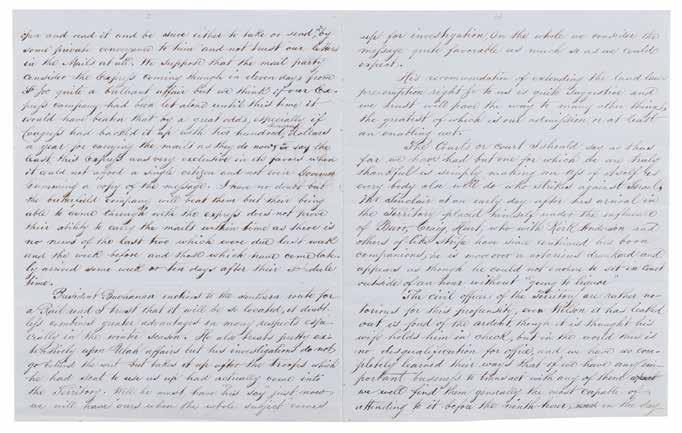
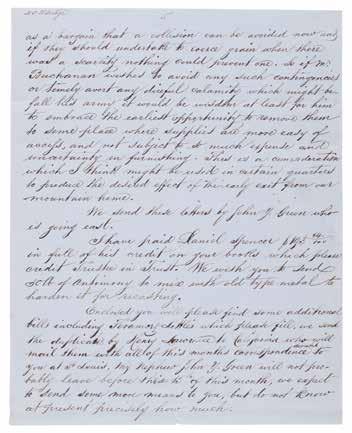
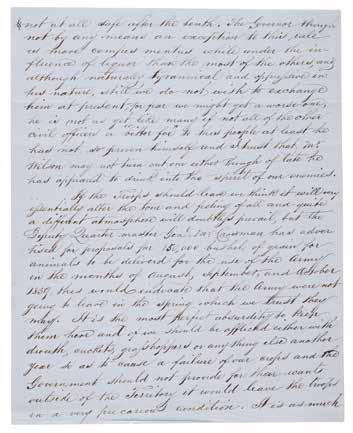
“We presume that now it will be hawked about the streets by every seller of new publications”
The civil officers of the Territory are rather notorious for this propensity, even Wilson, it has leaked out is fond of the ardent, though it is thought his wife holds him in check, but in the world this is no disqualification for office, and we have so completely learned their ways that if we have any important business to transact with any of them we will find them generally the most capable of attending to it before the ninth hour, in the day not at all safe after the tenth. The Governor though not by any means an exception to this rule us more compes mentus while under the influence of liquor than the most of the others, and although naturally tyrannical and oppressive in his nature, still we do not wish to exchange him at present, for fear we might get a worse one. He is not as yet like many if not all of the other civil officers a ‘bitter foe’ to this people, at least he has not so proven himself and I trust that Mr. Wilson may not turn out one either though of late he has appeared to drink into the spirit of our enemies.
If the Troops should leave we think it will very essentially alter the tone and feeling of all and quite a different atmosphere will doubtless prevail, but the Deputy Quarter master Gen’l Mr. Crosman has advertised for proposals for 150,000 bushels of grain for animals to be delivered for the use of the Army in the months of August, September, and, and October 1859, this would indicate that the Army were not going to leave in the spring, which we trust they may. It is the most perfect absurdity to keep them here and if we should be afflicted either with drouth, crickets, grasshoppers, or anything else another year so as to cause a failure of our crops and the Government should not provide for their wants outside of the Territory it would leave the troops in a very precarious condition. It is as much as a bargain that a collision can be avoided now and if they should undertake to coerce grain when there was a scarcity nothing could prevent one. So if Mr. Buchanan wishes to avoid any such contingencies or timely avert any direful calamity which might befall his army, it would be wisdom at least for him to embrace the earliest opportunity to remove them to some place where supplies are more easy of access, and not subject to so much expense and uncertainty in furnishing. This is a consideration which I think might be used in certain quarters to produce the desired effect of their early exit from our mountain home.
We send these letters by John Y. Green who is going east. I have paid Daniel Spencer $193.64 in full of his credit on your books which please credit in Trustee in trust. We wish you to
send 50 lb. of antimony to mix with old type metal to harden it for recasting. Enclosed you will please find some additional bills…John Y. Green will not probably leave before the 15th of this month, we expect to send some more means to you, but do not know at present precisely how much…
We observe that Wright & Co. of New York have reprinted the Book of Mormon we trust now that it will go into more general circulation. We have often been unable to get it even into the Book Stores for sale but we presume that now it will be hawked about the streets by every seller of new publications. We shall not at present prosecute them for invading our interests in the copyright, believing it will do us more good than harm.” In fine condition. Accompanied by a custom-made presentation folder.
Written in the aftermath of the Utah War, this important letter offers a rare, unguarded window into Brigham Young’s leadership at a moment when political survival and religious evangelism were deeply intertwined. Addressed to the trusted Horace S. Eldredge, Young details his profound distrust of federal mail channels, perceived manipulation of news by hostile editors, corruption among territorial officials, and the destabilizing presence of federal troops. He also comments pointedly on President Buchanan’s recommendations regarding land preemption rights, viewing them as a possible pathway toward Utah’s admission as a state.
Particularly notable is Young’s forward-looking discussion of the Book of Mormon, prompted by the late-1858 New York reprint issued by Jas. O. Wright & Company, drawn from Joseph Smith’s carefully revised 1840 Nauvoo edition. Although unauthorized and commercially motivated, the reprint represented a rare opportunity for wider national circulation of Mormon scripture at a time when official Church editions were scarce and difficult to obtain.
Young’s pragmatic decision not to challenge the publishers— believing the exposure would do “more good than harm”—reflects a calculated embrace of wider exposure at a moment when Mormonism was under intense national scrutiny. At once political, ecclesiastical, and deeply personal, the letter stands as vivid testimony to Brigham Young’s efforts to safeguard Mormon autonomy while advancing the faith during one of the most volatile periods in its history.
Starting Bid $5,000
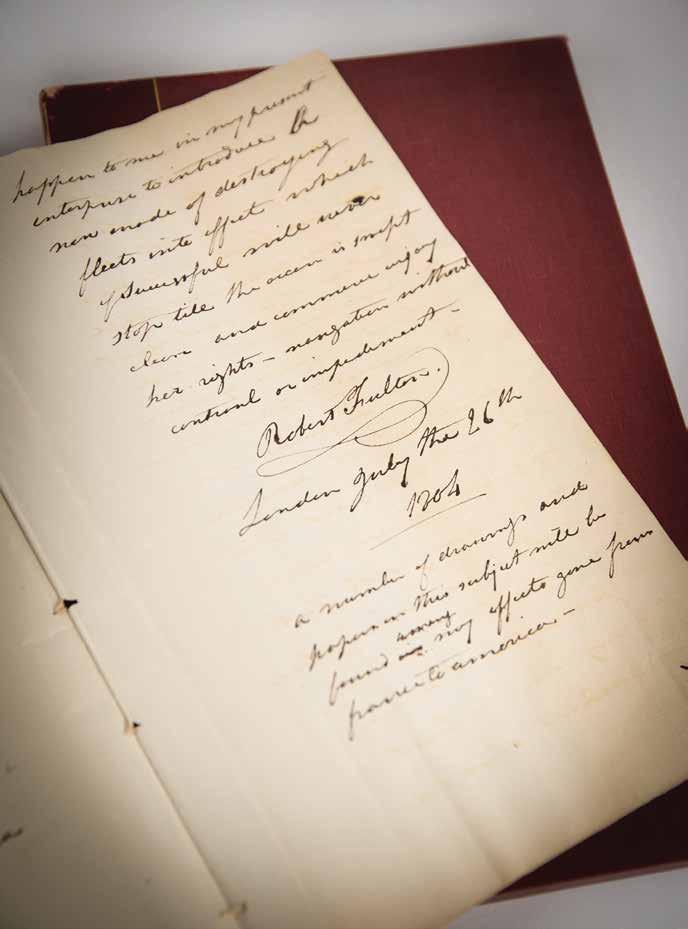
Robert Fulton outlines the construction of his “Submarine Vessel” in 1804,
promising a new era of warfare that will “totally annihilate the existing military marine system and give liberty to the seas”
LOT 4046
Robert Fulton Autograph Manuscript Signed on Submarine Construction and Warfare: “This engine pursued to perfection will to a certainty totally annihilate the existing military marine system and give liberty to the seas”
Important autograph manuscript signed twice, “Robt. Fulton” and “Robert Fulton,” fifteen pages on eight leaves, 8 x 12.5, June–July 1804. Fulton pens a summary of his submarine experiments, headed: “Notes on the Submarine Vessel, the last and and most perfect of my drawings on this subject, drawn London, June the 12th 1804 to the 20th.” The text of this document is designed to accompany seven plates (not present), and it is a direct forerunner of Fulton’s later manuscript discussion of his work, ‘On Submarine Navigation,’ completed in August 1806; the descriptions of the plates in this manuscript are closely comparable to those in the 1806 manuscript, but by no means identical—Fulton’s revisions reflect changes in nomenclature for devices described and findings from experiments conducted in the interim two-year period.
The text begins with a description of the submarine vessel, in part: “The incompressible part of this vessel in which the men are when it descends is supposed to be composed of brass cylinders cast 6 feet diameter 6 feet long and about one inch thick, three or more of those may be screwed together at the flanges—to make a length of 16 or 24 feet. The ends…part of a sphere to resist the pressure of the Water in all directions. The dome where the men enter may be 3 feet diameter and 3 high with a smaller dome in the lid through which to make observations when just rising above the surface of the water.” He goes on to present a list of “different parts” of a submarine vessel, noting that “any mechanic can trace their movements and uses.” Among the items listed are “the Bow anchor,” “the plunging flyers,” “the Bow cable,” “a small safety pump to drive the water out of the ballancing chest,” “a pipe and cock to let the water into the ballancing chest,” “a movement to work the rudder while under water,” “the crank of the stem flyers,” and “a screw movement to hoist the stern flyers out of gear…and out of water when the vessel is under sail.” The manuscript goes on to describe several of these parts with greater specificity
Concluding the manuscript, Fulton writes: “These seven drawings with this discription will enable any able mechanician to construct and perform the experiments of a plunging Vessel—This vessel is not intended to be brought under a ship which is to be attacked. All that can be expected of a vessel of this kind is to hide herself if pursued or lie under the water during the day approaching the harbours or fleets in the night and there depositing her cargo of submarine bombs anchor them or have them to the tide or use them by any other means which time and practice may point out. This engine pursued to perfection will to a certainty totally annihilate the existing military marine system and give liberty to the seas and more permanent peace to nations. It is a great agent in promoting liberty and the friends of man by curing the madness of stupid politicians—it is worthy [of] the genius and utmost care of the United States, as it will guard that young and prosperous republic…I have taken precaution to secure it to my country least any accident should happen to me in my present enterprise to introduce a new mode of destroying fleets into effect which if successful will never stop till the ocean is swept clean and commerce enjoy her rights.”
Fulton signs at the conclusion in full, “Robert Fulton, London, July the 26th 1804,” adding: “A number of drawings and papers on this subject will be found among my possessions gone from France to America.” In fine condition, with some occasional slightly irregular light toning. Accompanied by a custom-made presentation folder and slipcase, lettered in gilt on the maroon morocco spine.
Fulton had arrived in London from France in the spring of 1804 to offer the British his services in developing submarine weapons, having recently designed the ‘Nautilus’ submarine in France under a grant from Napoleon Bonaparte. The English initially offered Fulton £800 to develop a second Nautilus for the Royal Navy; however, after their victory over Napoleon’s fleet at the Battle of Trafalgar, the work was deemed unnecessary and progress came to a halt. Frustrated at being sidelined, Fulton made the decision to return to the United States in 1806, where he presented his ideas on submarines and naval warfare to the United States government, believing that the advent of submarine defenses would bring a “more permanent peace to nations.” An important autograph manuscript offering a fascinating record of the evolution of Fulton’s work in submarines. Ex. Sotheby’s, 1987.
Starting Bid $5,000
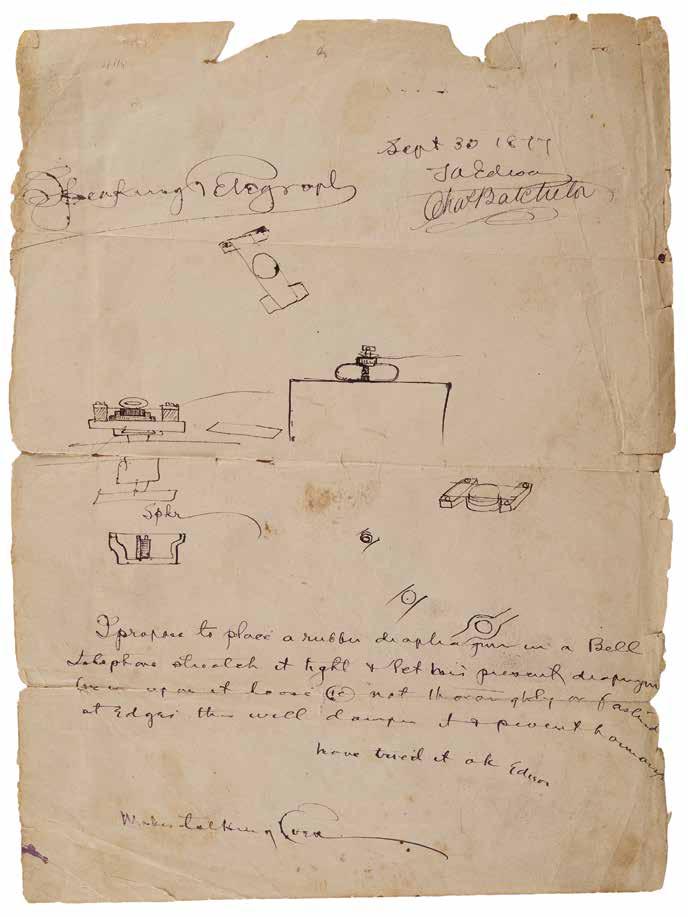
Edison experiments with the “Speaking Telegraph”— early laboratory notes on practical developments for the telephone
LOT 4049
Thomas Edison Early Autograph Laboratory Notes Signed with Sketches of the “Speaking Telegraph” (1877)
Exceptional, early laboratory notes written and signed twice by Thomas Edison, “T. A. Edison” and “Edison,” one page, 9 x 11.75, September 30, 1877. Edison sketches an experimental version of his “Speaking Telegraph”—an early telephone transmitter and receiver designed to transmit voice electrically—with a handwritten explanation below, in full: “I propose to place a rubber diaphragm in a Bell Telephone, streatch it tight & let his present diaphragm lean upon it loose, i.e. not thoroughly or fastened at edges this will dampen it & prevent harmonics, have tried it out OK.” Additionally signed at the top by his longtime assistant, Charles Batchelor, who famously supported Edison in some of his most important projects in the fields of telegraphy, telephony, and electric lighting. In good to very good, fragile
condition, with light staining and soiling, edge chips and tears, and splitting to the folds. Following Alexander Graham Bell’s 1876 Centennial Exposition demonstration, Edison believed the telephone to be fundamentally flawed—particularly its inability to transmit clearly over long distances—and set out to remedy its acoustic limitations. Assisted by Charles Batchelor, who conducted many of the auditory tests due to Edison’s near deafness, Edison experimented with diaphragms, mouthpieces, and resistance-altering materials throughout 1877. The present laboratory notes record a significant breakthrough: Edison’s use of a rubber diaphragm to dampen harmonics and improve vocal clarity. Edison’s concluding note—“Have tried it OK”—highlights the practical success of the experiment. A sought-after, tangible record of Edison’s hands-on engineering process, documenting a significant experiment in the evolution of electronic voice transmission.
Starting Bid $1,000
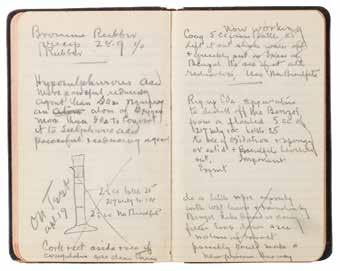
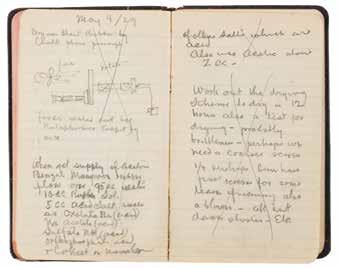
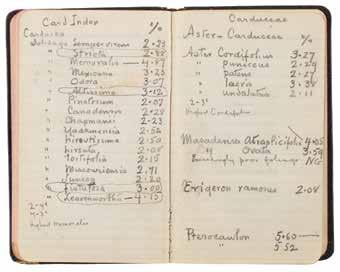
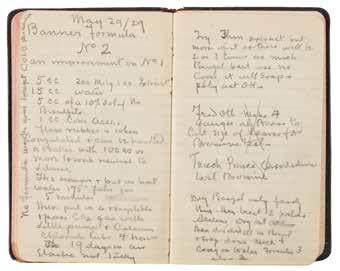
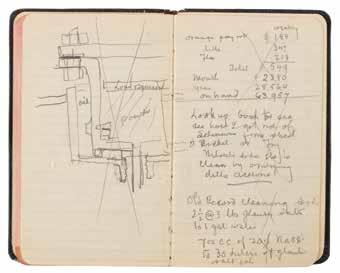
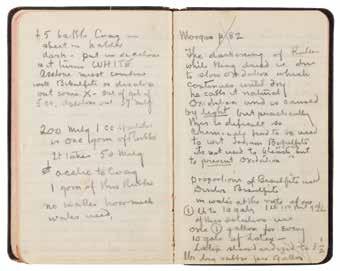
Thomas Edison’s handwritten laboratory notebook, with 130 pages documenting his extensive botanical experiments in the search for a domestic source of rubber
LOT 4048
Thomas Edison’s Handwritten Experimental Notebook - 130 Pages on the Development of Domestic Rubber
Extraordinary original handwritten botanical laboratory notebook by Thomas Edison, containing 130 handwritten pages in pencil, 4 x 6.75, circa 1929. Towards the end of his life, Edison was attempting to find a practical way of creating rubber from domestic plants. With Henry Ford and Harvey Firestone, he founded the Edison Botanic Research Corporation in 1927 and celebrated his 80th birthday by giving tours of his experimental garden.
The notebook opens with nineteen pages of fairly comprehensive botanical dictionary definitions, such as “Acaulescent—no stems,” “Achoenium—one seeded,” “Axil—angle on upper side between a leaf & the stem,” “Bifurcate—forked in 2 branches,” and “Calyx—small leaves forming cup of the flower,” continuing alphabetically through “Obvolute,” before ending abruptly with an initialed note: “Get book I have & copy. E.”
Following several blank pages, Edison continues with over a hundred pages of notes and memos about specific experiments, proposed ideas, inspirations, and scientific recipes—an amalgam documenting Edison’s arduous engineering process. One of these notes, in part: “Pectose is the primary material from which pectin is derived, this is due to an enzyme Pectase. Pectase is gotten from fresh Carob.”
Edison discusses various experiments and extraction processes at length, mentioning benzol, mangrove powder, petroleum, alcohol, ammonia, acetone, sulphate, aldehyde, formaldehyde, chloroform, “gum arabic (arabic acid) prepared from Beets,” and other chemicals and materials used in his experiments, while observing some of the properties of the resulting “rubber gobs.” Edison notes: “The darkening of Rubber while being dried is due to slow oxidation which continues until dry.” On another page, he writes: “In washing rubber in running water, if not running water in tank gets foul. Micro organisms which cause decomposition of the serum products flourish only in the presence of air. The optimal temp seems to be 100.7 in a moist atmosphere.”
He also sketches some experimental apparatus, and records an index of values associated with various plants in the Solidago (goldenrod), Aster, Rubiaceae, Asclepiceae families, among others. At the end of the journal, he notes: “The plant which I thought was a Golden rod with bulb of leaves at apex is… not a Solidago but Euthamia graminifolia.” In fine condition, with minor damage to the bottom the spine. Housed in a large full morocco clamshell case. Edison’s efforts were not futile: after testing some 17,000 plant samples, he eventually found an adequate source for rubber in the Solidago (Goldenrod) plant. Near the end of 1929, Edison announced that Solidago leavenworthii, also known as Leavenworth’s Goldenrod, could be crossbred to give a 12% latex yield; the new variety was named in his honor, Solidago edisoniana.
Starting Bid $5,000
LOT 4047
Edison’s international influence: “Mr. Kirkgard goes to Denmark to start Electric Lighting”
Thomas Edison Autograph Letter Signed on “Electric Lighting” in Europe
ALS signed “T. A. Edison,” one page, 5.5 x 8.25, From the Laboratory of Thomas A. Edison letterhead, November 16, 1887. Handwritten letter to “Friend Beggs,” presumably John I. Beggs, a vice president and general manager of the Edison General Electric Illuminating Company. In full: “The bearer Mr. Kirkgard goes to Denmark to start Electric Lighting. He would like to see the Central Station at N.Y. & would like a letter from you to your Harrisburg friends as he wants to see the latest Central Station. Please accommodate him.” In fine condition, with a few small stains, one touching a single word of text.
This brief but revealing letter places Thomas A. Edison squarely at the center of the global expansion of electric power. By this date, Edison’s direct-current lighting system had already transformed urban life in the United States, and central generating stations—such as his pioneering Pearl Street Station in New York—served as models for electrification projects worldwide. Edison’s recommendation of Mr. Kirkgard, who was traveling to Denmark “to start Electric Lighting,” demonstrates the international reach of his influence and the active export of American electrical expertise to Europe.
Starting Bid $300
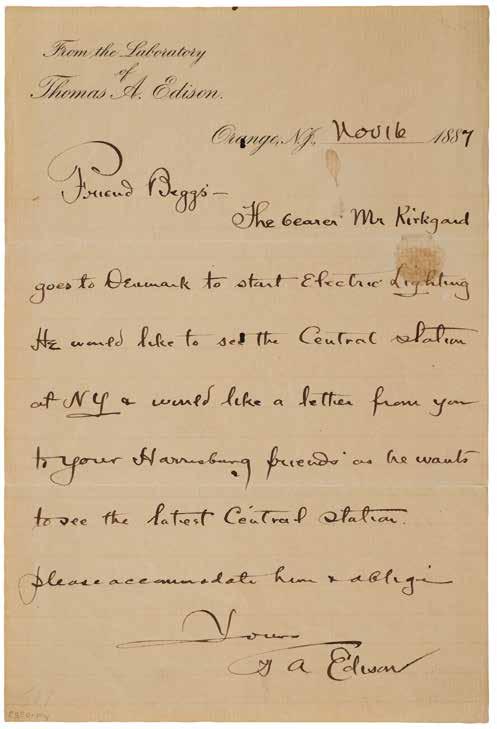
At the Institut du Radium, Curie works on certifying “instruments for Radiochemistry”
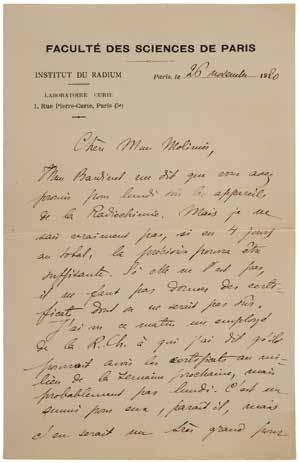
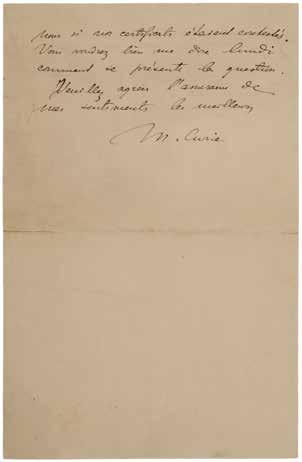
LOT 4050
Marie Curie Autograph Letter Signed, Certifying “instruments for Radiochemistry”
ALS in French, signed “M. Curie,” two pages on two adjoining sheets, 5.25 x 8.25, Faculté des Sciences de Paris, Institut du Radium, Laboratoire Curie letterhead, November 26, 1920. Handwritten letter to Mme. Molinier, regarding the certification of laboratory instruments. In part (translated): “Mme. Bardinet tells me that you have promised for Monday evening the instruments for Radiochemistry. But I truly do not know whether, in a total of 4 days, the accuracy will be sufficient. If it is not, certificates must not be issued if one is not certain of them. I saw this morning an employee of R. Ch. to whom I said that he could have the certificates in the middle of next week, but probably not on
Monday. It is an inconvenience for them, it seems, but it would be a very great one for us if our certificates were challenged. You will be kind enough to tell me on Monday how things stand.” In fine condition, with small splits to the central horizontal fold.
Written in late 1920 on the letterhead of the Institut du Radium, this autograph letter reflects Marie Curie’s central role in establishing rigorous scientific standards during a formative period for modern radiochemistry. Curie was deeply engaged in the daily administrative and technical responsibilities of the Paris laboratories she directed, insisting upon meticulous precision and ethical responsibility in her scientific practices.
Starting Bid $500
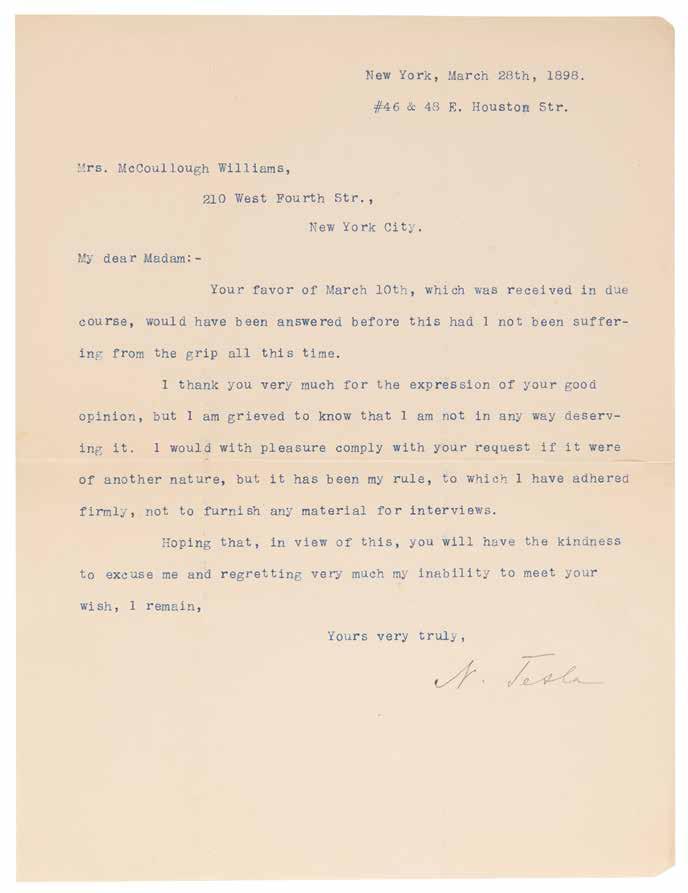
“I thank you very much for the expression of your good opinion, but I am grieved to know that I am not in any way deserving it”—modest letter from the intrepid inventor, dated to the year he premiered his remote-controlled boat, ‘the telautomaton,’ and caused a New York City earthquake with a test-run of his electro-mechanical oscillator
LOT 4051
Nikola Tesla Typed Letter Signed (1898) - The Year That He Caused an Earthquake in Manhattan
TLS signed “N. Tesla,” one page, 8 x 10.5, March 28, 1898. Letter to Mrs. McCoullough Williams, in full: “Your favor of March 10th, which was received in due course, would have been answered before this had I not been suffering from the grip all this time. I thank you very much for the expression of your good opinion, but I am grieved to know that I am not in any way deserving it. I would with pleasure comply with your request if it were of another nature, but it has been my rule, to which I have adhered firmly, not to furnish any material for interviews. Hoping that, in view of this, you will have the kindness to excuse me and regretting very much my inability to meet your wish.” In fine condition, with two unobtrusive edge tears.
A modest letter from the visionary inventor, typed and signed from a noteworthy location during a most noteworthy year. In 1898, at the first Electrical Exhibition at Madison Square Garden in New York, Tesla presented his most recent invention: a remotely controlled boat called the telautomaton. In doing so, Tesla performed the first public demonstration of the wireless transfer of commands at a distance by controlling the movements of the boat with radio waves. The moment was a pioneering step in the field of remote control and also one of the earliest milestones in the birth of robotics and automation.
That same year, while testing his electro-mechanical oscillator at his laboratory at 46 East Houston Street, Tesla reportedly
caused a small earthquake in New York City — the epicenter being his own lab. Tesla attached the oscillator — around 7 inches long and described by Tesla as something ‘you could put in your overcoat pocket’ — to an iron pillar that went down through the center of this building to the sandy floor of the basement. It began to hum, sending out rhythmic pulses. Initially, it was subtle, barely noticeable.
Then, metal equipment clanged together, the floor started to tremble, and cracks appeared in the walls. Panic spread throughout the neighborhood as windows shattered and people rushed into the streets, convinced that an earthquake had struck. Realizing that the situation was spiraling out of control, Tesla grabbed a sledgehammer and smashed the device, which immediately stopped the vibrations. When the police arrived, Tesla met them at the door and calmly explained, ‘Gentlemen, I’m sorry. You are just a little late to witness my experiment. I was trying to shake the Earth.’
News about Tesla’s earthquake machine spread, but rather than being celebrated, it was met with fear. Tesla sought funding to develop the device further, but found investors wary of such destructive potential. Years later, scientists confirmed the power of mechanical resonance, the same principle that caused the Tacoma Narrows Bridge in Washington to collapse in 1940. Wind created a resonant vibration that caused the steel structure to twist and fall like a ribbon, a concept understood by Tesla decades earlier.
Starting Bid $500
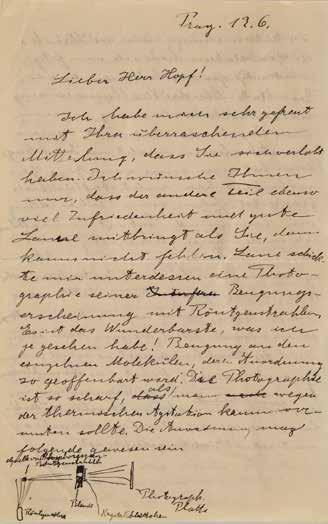
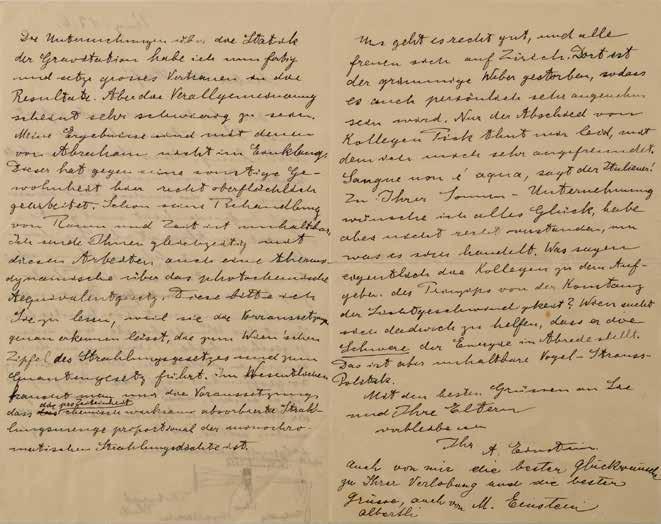
“The most wonderful thing that I have ever seen!”—Einstein sketches
Max von Laue’s X-ray diffraction apparatus amidst a discussion of static gravitational fields and the speed of light
LOT 4052
Albert Einstein Autograph Letter Signed on the Statics of Gravitation, the Constancy of the Speed of Light, and Max von Laue’s Discovery of X-ray Diffraction - “The most wonderful thing that I have ever seen!”
ALS in German, signed “A. Einstein,” three pages on two adjoining sheets, 4.25 x 6.75, June 12, [1912]. Handwritten letter to fellow physicist and collaborator Ludwig Hopf, with remarkable commentary on Max von Laue’s discovery of X-ray diffraction, his own work on static gravitational fields, and the recent death of his thesis advisor—and avowed scientific nemesis—Heinrich Friedrich Weber.
In full (translated): “I was very happy to receive your surprising news that you are engaged. I wish for you only that the other party brings as much contentment and good spirits as you do; in that case, you will lack for nothing. Meanwhile, Laue sent me a photograph of his deflection phenomenon with X-rays. It is the most wonderful thing that I have ever seen! Deflection at the individual molecules, whose arrangement is thereby revealed. The photograph is so sharp that one could scarcely imagine it on account of the thermal agitation. The arrangement would have been like this:” Here, Einstein sketches the experimental apparatus, diagramming the “source of phosphorescence—X-rays,” “Röntgen tube,” “shutter,” “crystal lamina” and “photographic plate.” He continues: “I have finished the investigations of the statics of gravitation and have great confidence in the results, but generalizing them seems to be very difficult. My findings do not agree with those of Abraham. Contrary to his usual custom, he did quite superficial work here. Even his treatment of space and time is untenable. Along with these papers, I am also sending you a thermodynamic one about the photochemical equivalence law, which I ask you to read because it makes it possible to clearly see the presupposition that leads to Wien’s take on the radiation law and to the quantum law. In essence, the only presupposition needed is that the chemically active amount of radiation absorbed per unit of time is proportional to the density of the monochromatic radiation. We are doing quite well, and everyone is looking forward to Zürich. Grim old Weber has died there, so it will also be very pleasant on a personal level. I’m sorry only about saying goodbye to my colleague Pick, with whom I have become good friends. Sangue non è aqua [blood is thicker than water], the Italians say! I wish you the best for your sun research, but I have not properly understood what it’s about. What are your colleagues really saying
about giving up the principle of the constancy of the speed of light? Wien is also trying to help by questioning the weight of energy, but that is just burying one’s head in the sand.”
At the conclusion, Einstein’s wife, Mileva, pens a message (translated): “Best wishes on your engagement and the best of greetings from me also, and also from Albertli. M. Einstein.” In fine condition. Written in June 1912, this remarkable letter captures Albert Einstein at a pivotal crossroads—personally, intellectually, and historically—just as several of the most transformative developments in modern physics were converging. Einstein was then a professor in Prague, on the cusp of returning to Zürich, and deeply immersed in problems that would soon culminate in the general theory of relativity. His confident remarks on having completed work on the statics of gravitation reflect his intense engagement with gravitational theory in the immediate pre-relativistic phase, when he was struggling to reconcile gravitation with relativity and openly critiquing rivals such as Max Abraham.
At the same time, his astonishment at Max von Laue’s discovery of X-ray diffraction—here described as “the most wonderful thing” he had ever seen—places the letter at the very birth of X-ray crystallography, a breakthrough that would revolutionize physics, chemistry, and structural science and earn Laue the 1914 Nobel Prize. Einstein’s hand-drawn diagram underscores his instinctive grasp of the experiment’s profound implications for modern science. The letter also vividly situates Einstein within the argumentative and highly personal scientific culture of early 20th-century physics. His comments range freely from quantum theory and Wilhelm Wien’s radiation law to debates over the constancy of the speed of light, revealing a community still wrestling with the full consequences of relativity and quantum ideas. The sharp aside regarding the death of Heinrich Friedrich Weber—Einstein’s former thesis advisor and longtime adversary—adds a strikingly human dimension, underscoring how personal rivalries and institutional politics shaped scientific careers. Finally, Mileva Einstein’s warm postscript grounds the document in domestic life, reminding us that these epoch-making ideas were forged amid friendships, marriages, losses, and everyday transitions. Taken as a whole, the letter offers an unusually intimate snapshot of Einstein in motion: alert to revolutionary discoveries, confident yet uncertain about his own path, and embedded in the living fabric of modern physics as it was being made.
Starting Bid $1,000
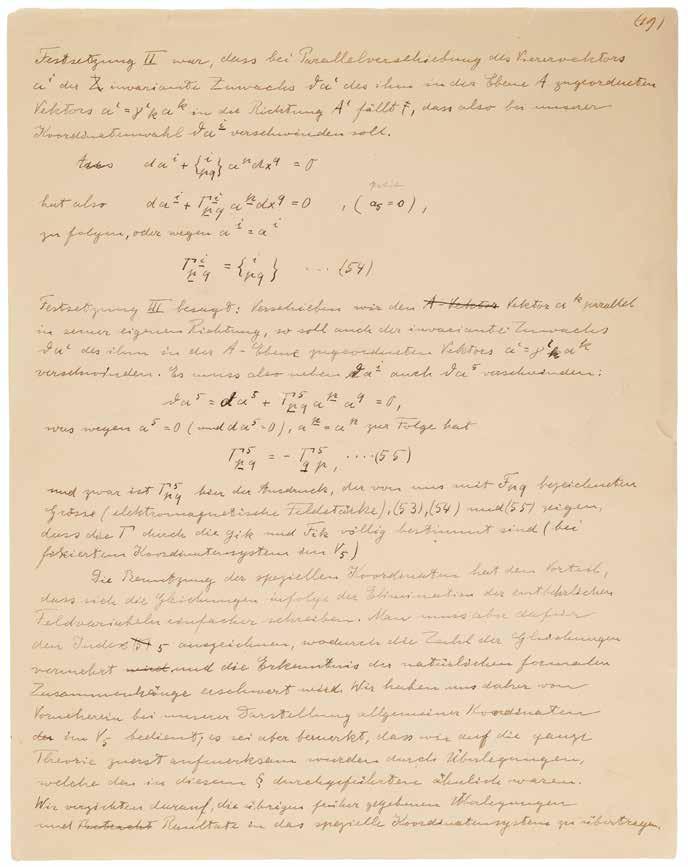
Einstein works to formalize his
‘Unified Field Theory’—a draft for his 1931 paper ‘Einheitliche Theorie von Gravitation und Elektrizität’
LOT 4053
Albert Einstein Handwritten Scientific Manuscript on the Unified Field Theory
Handwritten scientific manuscript in German by Albert Einstein, one page, 8.75 x 11.25, no date but circa 1931. A page from Einstein’s draft for his paper ‘Einheitliche Theorie von Gravitation und Elektrizität [Unified Theory of Gravitation and Electricity],’ published in collaboration with Walther Mayer in 1931 as part of Einstein’s long, ultimately unsuccessful quest for a unified field theory.
The page comprises the conclusion of section 7 of the paper, from the paragraph after equation 53 to the end, with a few cancellations and emendations. Einstein pens several mathematical equations throughout, concluding (translated): “The use of special coordinates has the advantage that, as a result of eliminating superfluous field variables, the equations are written more simply. One must, however, pay for this by singling out the index 5, which increases the number of equations and makes it more difficult to recognize the natural formal relationships. We have therefore from the outset used general coordinates in V5, in our presentation; it should, however, be
noted that our attention was first drawn to the entire theory by considerations similar to those carried out in this paragraph. We refrain from translating the other considerations and results previously given into the special coordinate system.” In fine condition. Accompanied by a custom-made presentation folder with gilt-stamped spine.
The complete paper, which Einstein submitted to the Prussian Academy of Science at its session on October 22, 1931, was published in Sonderausgabe aus den Sitzungberichten der Preussischen Akademie der Wissenschaften, PhysikalischeMathematische Klasse, 1931, XXV (this page corresponds to pp.555-6 of the printed text).
At the beginning of 1929, Einstein published equations for his unified field theory of gravitation and electro-magnetism, based on the concept of parallelism at a distance with respect to four orthogonal vectors of reference. He continued to pursue the subject of the ‘Unified Field Theory’ for the rest of his life, though he never satisfactorily mastered the problem.
Starting Bid $1,000
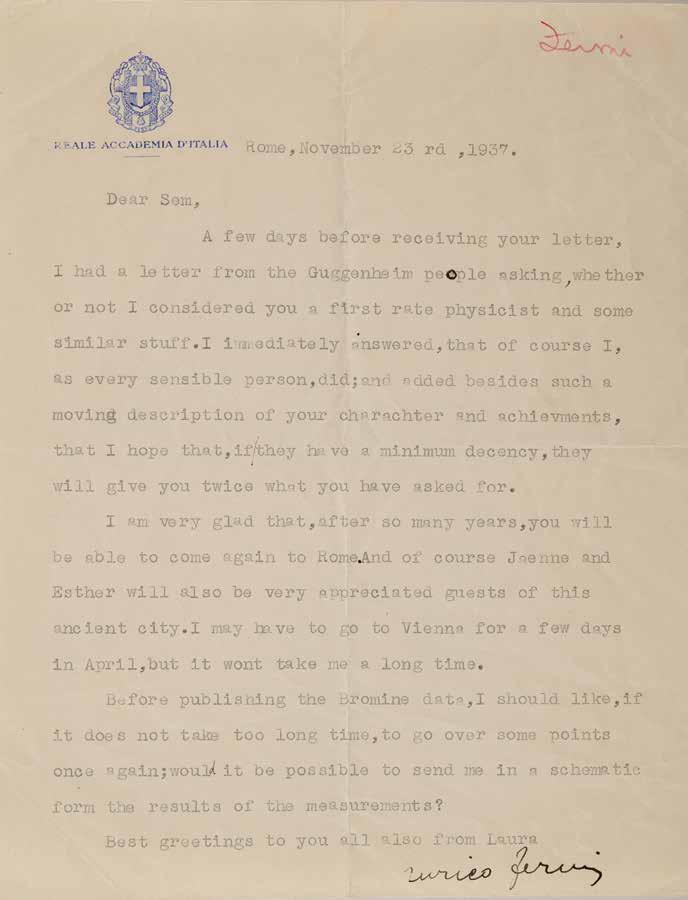
“I had a letter from the Guggenheim people asking, whether or not I considered you a first rate physicist and some similar stuff”
LOT 4054
Enrico Fermi Typed Letter Signed to Samuel Goudsmit: “I had a letter from the Guggenheim people asking, whether or not I considered you a first rate physicist”
Physicist (1901–1954) who became the first to split the atom and was awarded the Nobel Prize for Physics in 1938 for his developments in harnessing nuclear power. TLS, one page, 6.5 x 8.5, Reale Accademia d’Italia letterhead, November 23, 1937. Letter to “Sem,” the physicist Samuel Goudsmit, in full: “A few days before receiving your letter, I had a letter from the Guggenheim people asking, whether or not I considered you a first rate physicist and some similar stuff. I immediately answered, that of course I, as every sensible person, did; and added besides such a moving description of your character and achievements, that I hope that, if they have a minimum decency, they will give you twice what you have asked for.
I am very glad that, after so many years, you will be able to come again to Rome. And of course Jeanne and Esther will also be very appreciated guests of this ancient city. I may have to go to Vienna for a few days in April, but it wont take me a long time.
Before publishing the Bromine data, I should like, if it does not take too long time, to go over some points once again; would
it be possible to send me in a schematic form the results of the measurements?” In fine condition, with light creasing.
After studying abroad with Max Born and Paul Ehrenfest, Enrico Fermi held a lectureship at the University of Florence from 1924 to 1926, where he produced his first major experimental work with Franco Rasetti and developed the statistical theory later known as Fermi–Dirac statistics; in 1927 he became Italy’s first professor of theoretical physics at the University of Rome, achieving international recognition that culminated in his election to the Accademia d’Italia in 1929. Samuel Goudsmit, trained at the University of Leiden under Ehrenfest, made early contributions to spectroscopy and the Zeeman effect that led to his influential electron spin theory, and in 1927 joined the faculty of the University of Michigan, a leading center of theoretical physics. Fermi and Goudsmit became close through Fermi’s repeated visits to Michigan in the 1930s, during which Fermi grew increasingly drawn to the United States; as fascist pressures mounted in Italy, he ultimately left Rome for New York in 1938 after receiving the Nobel Prize. From the personal collection of a lifelong collector, teacher, and traveler with a passion for world history. His collecting years ranged from the 1970s to the present day, meaning that several of the premier pieces have not been on the market in decades.
Starting Bid $500
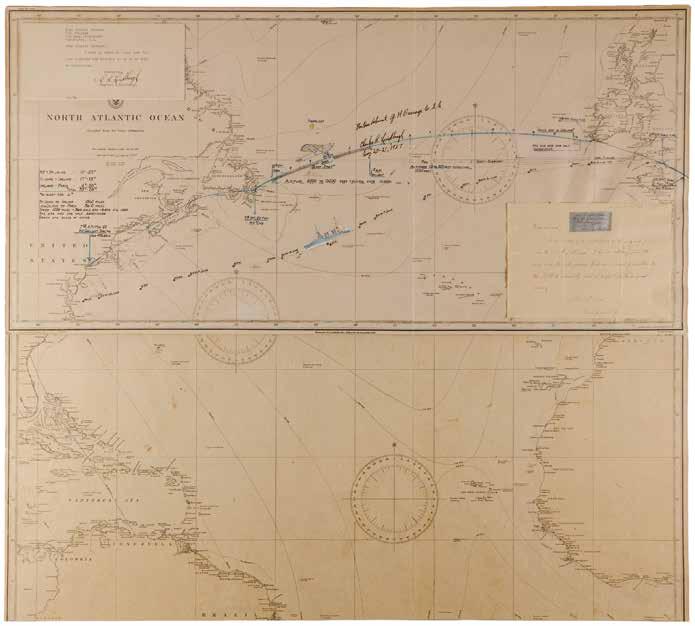
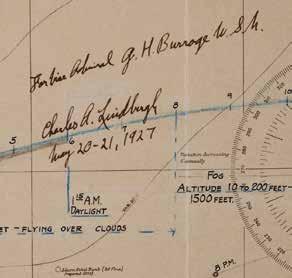
“Long Island to Paris 3610 Miles”— an amazing oversized nautical chart narrating Lindbergh’s historic transatlantic solo flight,
with a swatch of “original fabric from the ‘Spirit of St. Louis’”
LOT 4055
Charles Lindbergh Oversized Signed Chart
Tracing the Path of the Spirit of St. Louis, Presented to the Commander of the USS Memphis, Who Returned Him to America after the Transatlantic Solo Flight - with TLS, ALS, and Fabric Swatch
Remarkable oversized visual narrative of Charles Lindbergh’s historic first transatlantic solo flight, 35.5 x 17, being an annotated map of the North Atlantic Ocean (U.S. Hydrographic Office, 54th Edition, October 1922), evidently prepared under Lindbergh’s direct narration during his return voyage aboard the USS Memphis, and presented to the ship’s commander, Vice Admiral Guy Hamilton Burrage. Boldly signed and inscribed at center in fountain pen, “For Vice Admiral G. H. Burrage, U.S.N., Charles A. Lindbergh, May 20–21, 1927.”
The left side of the map is annotated with a summary of flight times and fuel consumption: “N.Y.–St. Johns - 11H-23M, St. Johns–Ireland17H-15M, Ireland–Paris - 4H-50M, Total 33H-28M. No sleep for 61H. St. Johns to Ireland 1860 Miles, Long Island to Paris 3610 Miles, Speed 108 1/2 Miles - 366 Gals. Gas - 6 Qts. Oil Used, Ate one and a half sandwiches. Drank one glass of water.”
The flight path is traced below, from Roosevelt Airfield in Garden City, New York, to Aéroport Le Bourget in Paris, which lies slightly off the chart in the right margin. Times, conditions, and notable events are indicated along the route, starting with takeoff: “7:52 a.m. - May 20. NY Daylight Savings Time. Gas - 451 Gals.” The Spirit of St. Louis’s journey is traced in blue pencil, up the New England coast and over St. John’s, Newfoundland at “7:15 P.M., 20 May, N. Y. Time.” By 8:15 Lindbergh is over the open Atlantic—and in darkness, climbing in altitude from “8000 to 1000 feet—flying over clouds.”
Lindbergh meets the rising sun at 1:15 A.M., as he is about midway across the ocean. “Daylight…Fog, altitude 10 to 200 feet—occasional 1,500 feet. Hazy-overcast.” Nearing land, Lindbergh grows concerned about his navigation due to fog and fatigue; spotting some fishing boats, he descends to a low altitude to ask for directions, hoping to yell, “Which way is Ireland?,” but he sees no fishermen to ask. As it turns out, he was over two hours ahead of schedule and less than three miles off course. He eats “one and one half sandwiches” off the Irish coast, passes over Cornwall, and flies above the coastal French town of Cherbourg as the sun sets at “8:30 P.M. Paris Time.” At “10:20
P.M, 21 May, Paris Time,” Lindbergh reaches his destination—with 85 gallons of gas to spare. On arriving at Paris, Lindbergh circles the Eiffel Tower, then flies to Le Bourget Aerodrome. Because the airfield is not marked on his map, he briefly mistakes it for an industrial complex—the bright lights are actually tens of thousands of spectators’ car headlights, creating Paris’s largest-ever traffic jam. About 150,000 people rush the field, pull Lindbergh from the plane, and carry him on their shoulders for half an hour—a hero’s welcome. Souvenir hunters damage the Spirit of St. Louis by tearing off pieces of its linen covering before French soldiers can secure the aircraft and move it to safety. The triumphant Lindbergh is fêted throughout Europe with receptions in France, Belgium, and Britain, eliciting massive media coverage, countless gifts and invitations, and drawing enormous crowds wherever he goes. After this brief, celebratory tour, on June 4, 1927, Lindbergh and his ‘Spirit of St. Louis’ airplane leave Europe aboard the USS Memphis—commanded by Guy Burrage—bound for the United States. Their weeklong voyage home is traced in pencil, with times and dates inked in black; the paths are further illuminated with sketches of the Spirit of St. Louis and USS Memphis. Upon arriving, a fleet of warships and multiple flights of military aircraft escort the Memphis up the Potomac River to the Washington Navy Yard, where President Calvin Coolidge awards Lindbergh with the Distinguished Flying Cross. Affixed to the map are two letters to Burrage from Lindbergh. At the upper left is a TLS, signed “C. A. Lindbergh,” no date but probably 1927, shortly after this historic voyage. In full: “I want to thank you very much for your kindness and courtesy to me on my trip to Washington.”
At the lower right is an ALS signed “Charles A. Lindbergh,” January 23, 1929, in full: “I am enclosing a small piece of the original fabric from the ‘Spirit of St. Louis.’ This was cut away from the wing when the center gasoline tank was removed preparatory to the flight to Mexico City, and is a part of the original covering,” with the silvery two-inch swatch affixed above, also identified and signed by the aviator: “Part of the original fabric from the ‘Spirit of St. Louis,’ to Rear Admiral Guy H. Burrage, Sincerely, Charles A. Lindbergh.” In fine condition.
An extraordinary, likely unique, cartographic record of Charles Lindbergh’s 1927 transatlantic flight, annotated under his direction and preserved with signed letters and original aircraft fabric from the Spirit of St. Louis.
Starting Bid $5,000
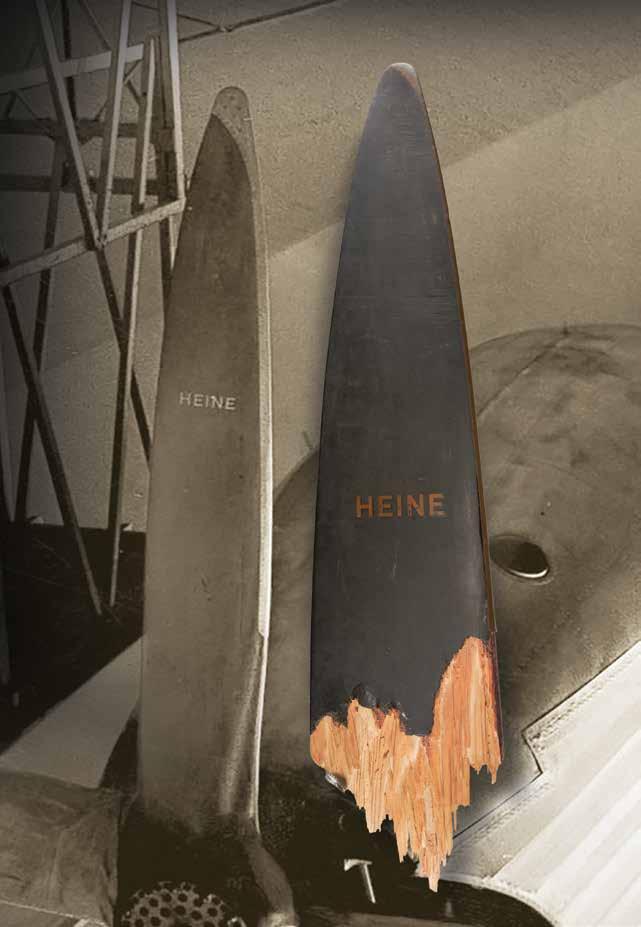
Substantial 5-foot surviving propeller blade tip
section of the LZ 129 Hindenburg, discreetly salvaged from the Lakehurst crash site by a U.S. Navyman commended for his actions
“on the occasion of loss of the Airship HINDENBURG”
LOT 4056
LZ 129 Hindenburg Propeller Blade Tip Fragment - Rare Surviving 5-Foot Relic from the 1937 Disaster at Lakehurst
Five-foot wooden propeller blade tip recovered from the wreckage of the hydrogen-filled German airship LZ 129 Hindenburg, which caught fire and was destroyed during its attempt to dock at the mooring mast at U.S. Naval Air Station Lakehurst, New Jersey, on May 6, 1937. The disaster claimed 36 lives—13 passengers and 22 crewmen among the 97 persons aboard, along with one fatality on the ground—and effectively brought the era of rigid passenger airships to an abrupt end.
Delayed by headwinds and afternoon thunderstorms, the Hindenburg passed over Boston, Massachusetts, on the morning of May 6th and later that day flew low over Manhattan Island, to the delight of commuting New Yorkers, while awaiting improved weather in nearby New Jersey. After conditions cleared, the airship rerouted to Lakehurst and began its final landing approach shortly after 7:00 p.m. At approximately 7:25 p.m., during the mooring maneuver, some witnesses reported a flutter of fabric, a possible gas leak, while others claimed to see a dim blue flame upon the Zeppelin’s skin. Moments later, the great airship was engulfed in fire. It fell from an altitude of 295 ft (90 m) and, in less than 40 seconds, its bow crashed into the earth.
This historic artifact was salvaged at the crash site by U.S. Navy Yeoman First Class Joseph E. Cely, who was among those on duty at Lakehurst to greet the Hindenburg’s arrival. In the immediate aftermath of the disaster, Cely and his commanding officer encountered a serviceman carrying a large piece of debris. When the officer questioned the man about the object, the nervous serviceman—fearing repercussions—discarded it into nearby tall grass and fled. Once order was restored, Cely returned to the location and retrieved the item—this propeller blade tip. To discreetly remove it from the site, he covered it with a blanket and transported it back to base under the guise of an ‘ironing board.’
Included with the propeller blade fragment is a U.S. Naval Air Station Lakehurst memorandum from 1939 related to Cely’s work with the U.S. Navy’s K-2 non-rigid blimp, two newspaper articles related to the Cely family’s decadeslong storage of the artifact, and Cely’s official Navy Department ‘Continuous Service Certificate’ booklet, which places him at Lakehurst throughout 1937, with a section of the book’s ‘Com-
mendations’ section reading: “6-30-37. Commended by Commanding Officer for efficient, resourceful and highly creditable performance of duty on the occasion of loss of the Airship HINDENBURG.”
The propeller blade tip measures 64˝ x 14.5˝ x 3˝ and weighs 21 pounds, approximately, and is constructed of laminated mahogany finished in black paint. The face of the blade features the propeller manufacturer’s name, “HEINE,” painted in gold, the splintered bottom section reveals internal wire mesh reinforcement, and the leading edge retains its original brass sheathing for rain and abrasion protection.
Heine Propellerwerke was a Berlin-based German manufacturer active in the interwar period, specializing in large laminated wooden propellers for aircraft and rigid airships. The firm was a supplier to Luftschiffbau Zeppelin, producing propellers for major Zeppelin airships, including LZ 127 Graf Zeppelin and LZ 129 Hindenburg, where its robust, metal-reinforced wooden blades were paired with high-torque diesel engines for sustained transatlantic operation. Heine propellers are identifiable by factory-applied markings, such as the painted “HEINE” name present on this blade.
The Hindenburg was powered by four Daimler-Benz DB 602 (LOF6) 16-cylinder, V-type diesel engines, each producing approximately 1,100–1,320 horsepower, for a combined output of roughly 4,800 horsepower. Each engine drove a four-bladed, reversible-pitch wooden propeller measuring approximately 20 feet in diameter, mounted in an aft-facing ‘pusher’ configuration.
The engines were housed in four external gondolas—two forward and two aft—and were attended in flight by onboard mechanics. The reversible-pitch propellers allowed the engines to be run in reverse, aiding maneuvering and docking. This propulsion system enabled the Hindenburg to cruise at approximately 78 mph, with a maximum speed of about 84 mph, exceptional performance for a rigid airship of its size.
A rare surviving propulsion artifact from the Hindenburg, this blade fragment occupies a singular place in aviation history and would serve as an awesome centerpiece to any historical collection—the only other widely cited recovered section of a Hindenburg propeller is a partial blade held in the collection of the Smithsonian Institution.
Starting Bid $5,000
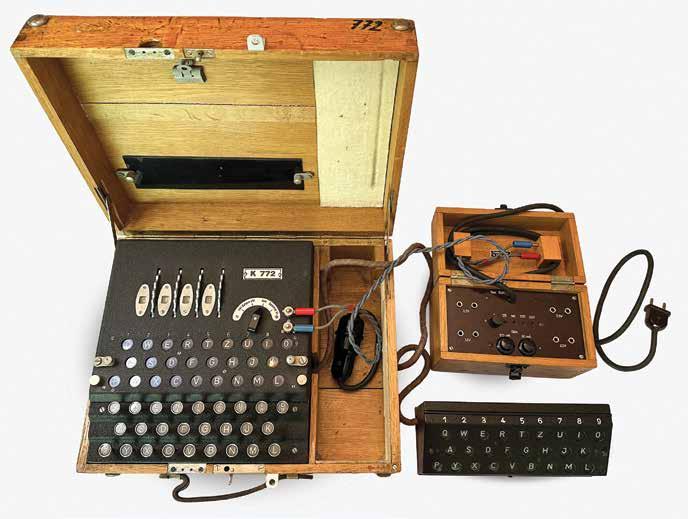
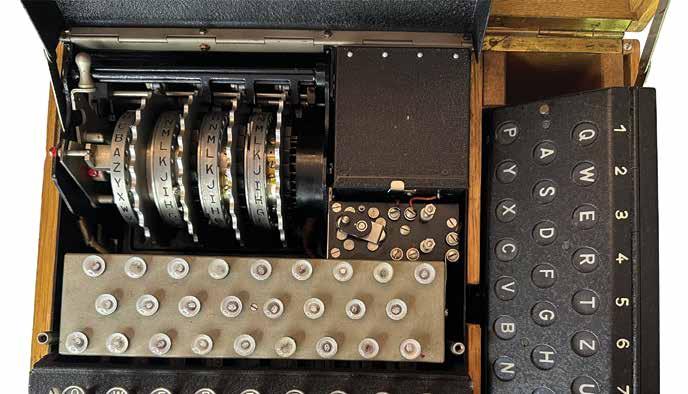
World War II–era Swiss Enigma K— the neutral nation’s wartime cipher machine, one of less than twenty known
LOT 4057
Enigma Swiss-K Cipher Machine (World War II-era, Fully Operational)
Extremely scarce, fully functional Swiss Enigma K (or SwissK) electromechanical cipher machine, the variant used by Switzerland’s military and foreign ministry during World War II, a time when the neutral nation was surrounded by Axis-controlled territory. Based on the standard commercial Enigma K by Heimsoeth und Rinke, Berlin, the Swiss-K is differentiated by its wider Swiss-made wooden case that accommodates its external lamp panel, which allowed an officer or clerk to view and record the message being deciphered by the Enigma operator.
The Swiss began using the machines in 1938 with an initial order of 14 commercial Enigma K machines, followed by 65 more in 1939, and two larger batches received in May and July 1940, bringing the total to 265 machines in use by July 1942: 102 with the Swiss Army and 163 with the Swiss Air Force; the Foreign Ministry used machines on loan from the Army. Of these 265 Swiss-K machines, fewer than twenty are known today.
The top of the cipher machine’s housing bears its serial number plate, reading “K772,” and features windows for its four settable rotors: three cipher rotors (marked “I,” “II,” and “III,” all with matching serial number “K772”) that move during encoding, and one special reflector rotor (serial number “K787”), which is preset by the operator. Stored inside the lid are extra lightbulbs and the green contrast filter. Includes the external power supply unit, built by the Swiss company H.
Stucki Transformatorenbau in Bern, marked “772” on the case; these rare power supplies were used exclusively by the Swiss military and the Swiss Foreign Office to power as many as four Swiss-K Enigmas at once. Unlike the Wehrmacht Enigmas, the Swiss-K did not employ a plugboard (Steckerbrett) and its rotors were lettered rather than numbered.
The Swiss Enigma K has a standard German “QWERTZ” keyboard with 26 white-on-black keys, with matching “QWERTZ” lighted display. When a key is pressed, the corresponding encoded letter—as determined by the specific arrangement of the rotor wheels—is illuminated. With each key press, the rotors step to produce a new enciphering route—thus, an easily crackable simple substitution cipher is avoided, as letters are not encoded the same way twice. Though originally delivered with standard commercial wiring, the Swiss immediately altered the wiring of the cipher rotors for security. In 1941, after finding out that the French had decoded some of their Enigma traffic, the Swiss Army also modified the stepping mechanisms of their machines to further obfuscate the code.
Despite the modifications, Swiss Enigma traffic, especially diplomatic messages, was compromised: the Swiss codes were read by Allied cryptanalysts from the start of the war, and German intelligence also broke them from 1939 onwards. The machines were decommissioned in 1946 and replaced by the Swiss-designed NEMA, which addressed lessons learned from the vulnerabilities of the Swiss-K and represented a significant advancement in rotor-based cryptography.
Starting Bid $5,000
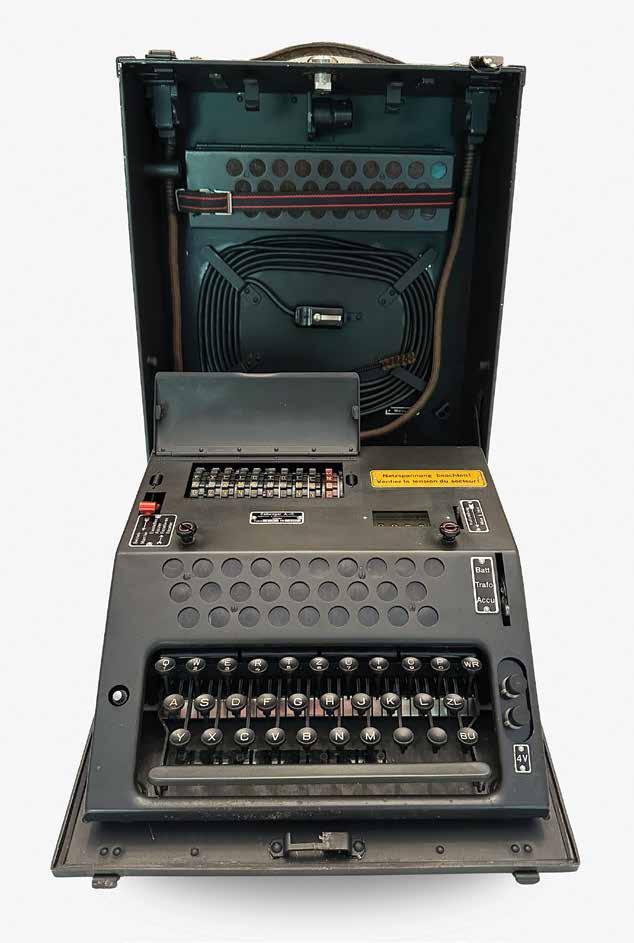
Scarce ‘signal school’ version of the Swiss successor to the Enigma machine
LOT 4058
Swiss NEMA Model 45 Cipher MachineSuccessor to Enigma
Original Swiss NEMA Model 45 cipher machine, serial no. TD370, developed by Zellweger AG in Uster, Switzerland, during World War II as a replacement for the German Enigma Model K that was being used by the Swiss Army. The machine is also known as T-D, which stands for Tasten-Drücker Maschine (keypress machine).
The electro-mechanical wheel-based cipher machine features ten wheels: four electrical rotors with 26 contacts at each end, one electrical reflector with 26 pairwise cross connected contacts, and five drive wheels that control the stepping of the rotors and reflector. The stepping mechanism is adjustable and irregular, making the machine much less predictable than its predecessor—and therefore far more difficult to crack.
This NEMA machine was used at signal schools for officer training, and features an uncommon label on the lid in German, French, and Italian (translated): “For use by schools and courses only.” Most NEMA machines were stored away to be used in the event of war and carried a different label. Accompanied by a power cable, cleaning brush, two keys and a key tag (with matching numbers, “TD370”), and extra light panel; the lamp adapter is functional but broken into two pieces.
During WWII, the Swiss Army used a modified version of the German-made commercial Enigma Model K machine. After the Swiss discovered that their Enigma K traffic was being read by both the Allied forces and the Germans, they started the development of their own improved machine, which they called NEMA, derived from “NEue MAschine [NEw MAchine].”
The NEMA cipher machine was developed between 1941 and 1943, and the first prototype was ready in early 1944. After a few modifications and improvements, the machine was finally approved in March 1945. Production started in 1946, with the first machines entering service in 1947. The NEMA was used by the Swiss Army in the years following WWII, and by the Swiss Diplomatic Service. The NEMA was officially declassified in 1992.
Starting Bid $500
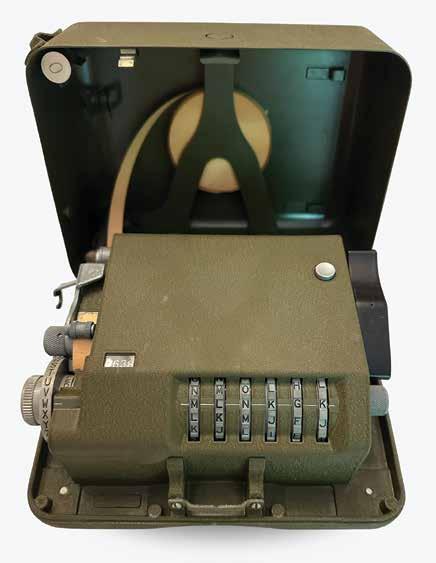
Portable M-209 cipher machine, as used by American troops on the front lines in WWII
WWII American M-209-B Cipher Machine
Desirable World War II–era American M-209-B mechanical pin-and-lug cipher machine, measuring 7.25˝ x 5.25˝ x 3.5˝, identified on the plate on the top of the case: “Signal Corps, Converter M-209-B, 58584:CACH, 6919-PHILA-44.” Held inside the top of the case are a roll of paper tape and two tubes—one containing an oiler tool (cap stamped ‘O’) and the other with an extra ink roller (cap stamped ‘I’). Also includes the original olive drab canvas carrying bag, marked “M-209-B” on the front, with the front pocket containing a Signal Corps Message Book M-210.
The M-209 is a portable hand-operated mechanical cipher machine initially developed in the late 1930s by the entrepreneur and inventor, Boris Hagelin. Hagelin fled Sweden for the United States at the outbreak of WWII and worked with the US Military to refine his cipher machine design. The M-209 was the result of this collaboration and the machine would be used by the US during WWII, as well as many other countries for decades after the end of the war. The relationship between Hagelin and the US goes much deeper than the collaborations during WWII: a February 2020 article in the Washington Post detailed the secret relationship Hagelin had with the CIA and German Intelligence services. The development of the M-209 led to one of the biggest intelligence operations in CIA history, known as ‘Operation Rubicon.’ In this operation the CIA used their secret technique to allow them to read all of the M-209 and other Hagelin cipher machine-enciphered messages until 2018.
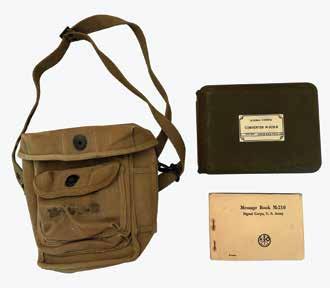
This rotor-based cipher machine does not require electricity and is lightweight and durable, making it perfectly suited for tactical front line use. While the code generated by the M-209 was not as strong as the Enigma code, and could sometimes be read within 4 to 24 hours by the Germans, it was considered secure enough for tactical messages that were of no value after that length of time. The key is set by using the six adjustable cipher wheels with moveable lugs. Text is entered letter-by-letter using the selector wheel on the left side, and the encoded output letter is printed on the narrow paper strip.
Starting Bid $500
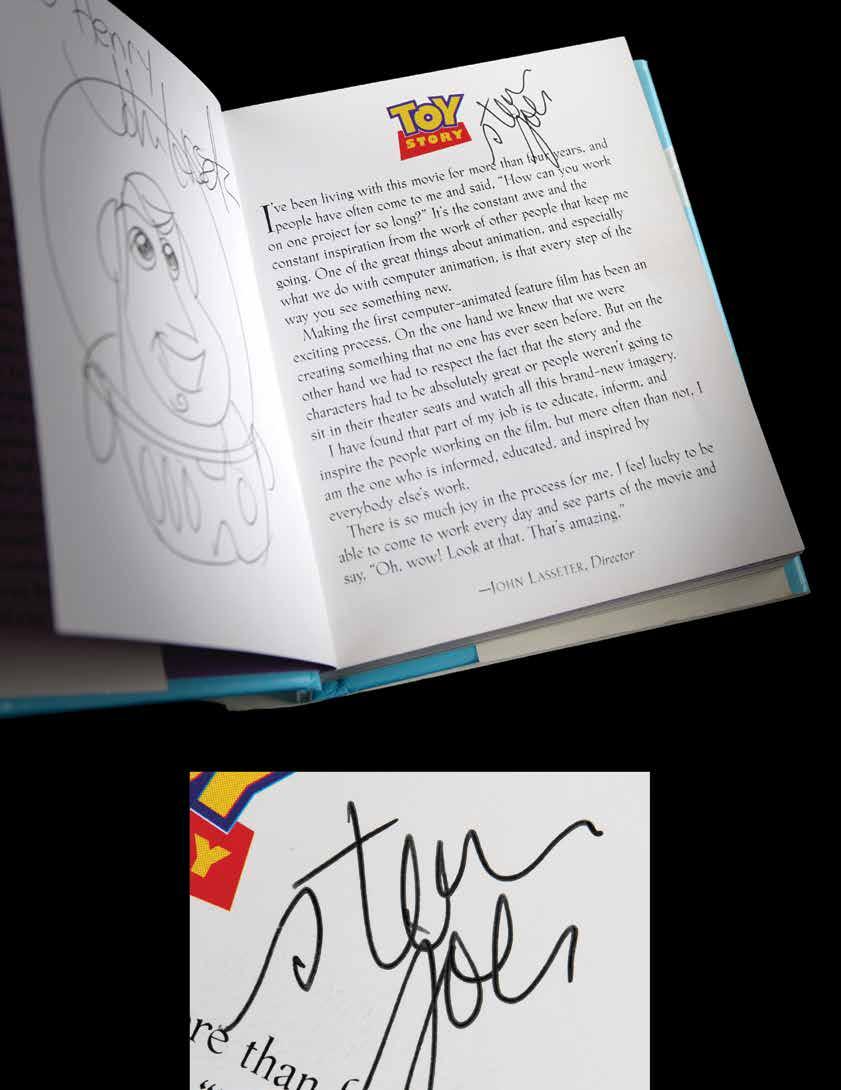
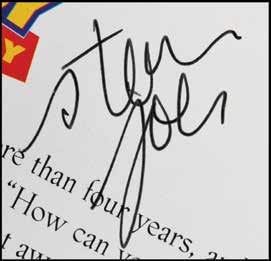
Making of Toy Story book signed by Pixar visionaries
Steve Jobs and John Lasseter
LOT 4060
Steve Jobs and John Lasseter Signed Book - Toy Story: The Art and Making of the Animated Film
Signed book: Toy Story: The Art and Making of the Animated Film. A ‘Disney Miniature,’ First edition. NY: Hyperion/Welcome, 1995. Hardcover with dust jacket, 4.75 x 5.5, 189 pages. Signed on the opening printed foreword from John Lasseter in black ink, “steve jobs,” and signed and inscribed on the adjacent page, “To Henry, John Lasseter,” who adds a wonderful sketch of Buzz Lightyear. According to the consignor, the signatures were obtained at a Pixar shareholders’ meeting between 2001 and 2005. In fine condition, with light wear to the dust jacket, including a small tear to the spine.
Includes a color 14 x 11 Lithograph from Toy Story 2 as part of The Disney Store’s “The 2000 Lithograph Collection,” and two 1996 and 1997 Annual Reports of Pixar Animation Studios, which both contain characters from the animated films A Bug’s Life and Toy Story, as well as sections for the company’s financial performance, strategic initiatives, and operational highlights.

Steve Jobs played a pivotal role in transforming Pixar into one of the most influential animation studios in history. After acquiring the small graphics division from Lucasfilm in 1986, he funded and guided Pixar through years of technological development and creative experimentation. His belief in the power of computer animation—paired with the visionary storytelling of Pixar’s creative team—led to groundbreaking films like Toy Story, the first fully computer-animated feature. Jobs’ blend of entrepreneurial drive and design sensibility helped turn Pixar into a studio known for innovation, emotional storytelling, and enduring cultural impact.
Starting Bid $1,000
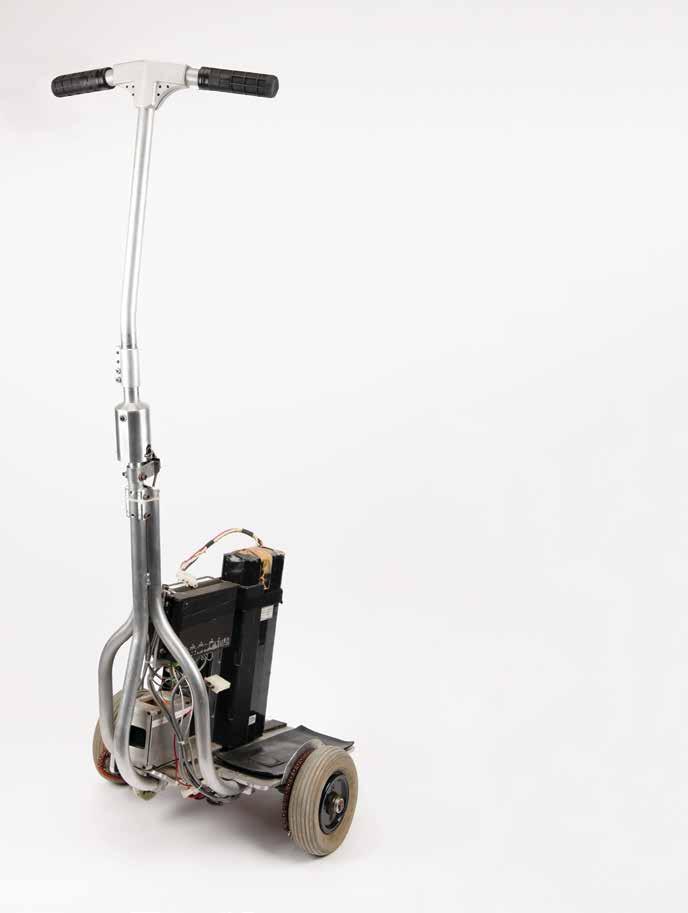
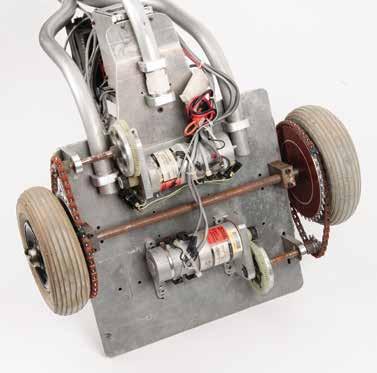
‘Codename Ginger’— unique early prototype of the Segway personal transporter, a milestone of 21st-century tech
LOT 4061
Segway ‘Ginger’ Prototype - A Milestone of 21st-Century Tech
Early engineering concept prototype of the Segway twowheeled personal transporter, codenamed “Ginger,” developed in secret by Dean Kamen in the late 1990s. The product was revealed with much fanfare in December 2001 as a selfbalancing personal mobility electric vehicle that was expected to transform urban transportation and revolutionize cities of the future.
The Segway captured the imagination of Silicon Valley and global investors alike at the turn of the century and became synonymous with early 21st-century tech ambition. Backed by notable investors such as Steve Jobs and John Doerr, the project raised over $100 million in development funds and was once heralded as the most anticipated tech reveal since the original Macintosh. Jeff Bezos, an early supporter of the Segway, called it ‘one of the most famous and anticipated product introductions of all time.’
Today, the prototype stands not only as a marvel of engineering—featuring breakthrough dynamic stabilization and battery technology—but also as a cultural artifact that marked a pivotal moment in personal mobility and startup mythology.
The “Ginger” prototype stands approximately 52˝ tall, with a wheel-to-wheel length of about 19˝ and a front-to-back depth of 21˝. It is equipped with a T-handle grip bar attached to an early prototype version of the ‘LeanSteer’ tilting switch mechanism, allowing the rider to turn left or right. The platform has two momentary switches underneath the rubber footpads, and a label, “Ginger,” toward the front. The central console carries a nickel-cadmium rechargeable battery, controller unit, and chassis housing a Watson Industries displacement/rate
gyro system (ADS-C132-1A). The gray 7˝ utility wheels are independently driven by a belt-and-gear system utilizing servo motors mounted on the platform’s underside.
The ‘Ginger’ project—named for dancing actress Ginger Rogers—grew out of Dean Kamen’s earlier stair-climbing wheelchair project codenamed ‘Fred’ (for ‘Fred Upstairs,’ a pun on Fred Astaire), which was brought to market under the ‘iBOT’ name. The Segway leveraged the same core technology as the iBOT, repurposed for the consumer-industrial—rather than medical—market.
Accompanying the prototype is a framed reprint of the movie poster for the Astaire-Rogers film ‘Follow the Fleet,’ plus a hardcover copy of the book Code Name Ginger: The Story Behind Segway and Dean Kamen’s Quest to Invent a New World by Steve Kemper.
Kemper writes of the first time he laid eyes on Ginger: ‘That’s the world-shaker? After Dean’s buildup it made a drab first impression. Two toy wheels flanked a thin metal platform with a metal T-bar rising from it. Compared to the sleek candy-colored scooters, Ginger looked as plain and stern as a schoolmarm among fashion models. Dean flipped a couple of switches, stepped on to the platform, and leaned forward. Ginger darted off. When he leaned backwards, the machine reversed. He pirouetted Ginger in place like a spinning figure skater; the turning radius was zero. Ginger zipped around the room like a hummingbird, and as quietly. Once animated, this schoolmarm was beautiful…’It’s your personal magic carpet,’ he said.’
Originates from the collection of James Norrod, who served as President and CEO of Segway Inc. from April 2005 to January 2010, and accompanied by his signed letter of provenance.
Starting Bid $10,000
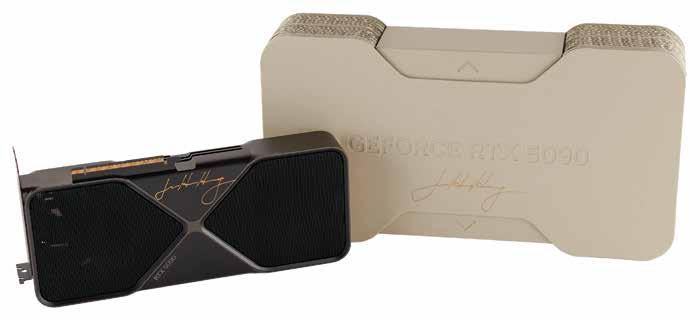

GeForce RTX 5090 GPU signed twice by NVIDIA co-founder
Jensen Huang—the card at the bleeding edge of the AI revolution
LOT 4062
Jensen Huang Twice-Signed NVIDIA GeForce RTX 5090 Founders Edition GPU
Extremely desirable NVIDIA GeForce RTX 5090 ‘Founders Edition’ graphics card in its original packaging, signed on the package top in gold ink, “Jensen Huang,” and on the metal housing of the card itself in gold ink, “Jensen Huang.” Housed in its original shipping box, measuring 18˝ x 11.25˝ x 5.25˝. In very fine condition. Representing the latest in GPU technology, the GeForce RTX 5090 carries an MSRP of $2000 and is sold out virtually everywhere.
From NVIDIA: ‘The NVIDIA® GeForce RTX™ 5090 is the most powerful GeForce GPU ever made, bringing gamechanging capabilities to gamers and creators. Tackle the most advanced models and most challenging creative workloads with unprecedented AI horsepower. Game with full ray tracing and the lowest latency. The GeForce RTX 5090 is powered by the NVIDIA Blackwell architecture and equipped with 32 GB of super-fast GDDR7 memory, so you can do it all.’ In October 2025, as the leading chipmaker of the AI revolution, NVIDIA became the first public U.S. company to be valued at over $5 trillion.
Starting Bid $1,000
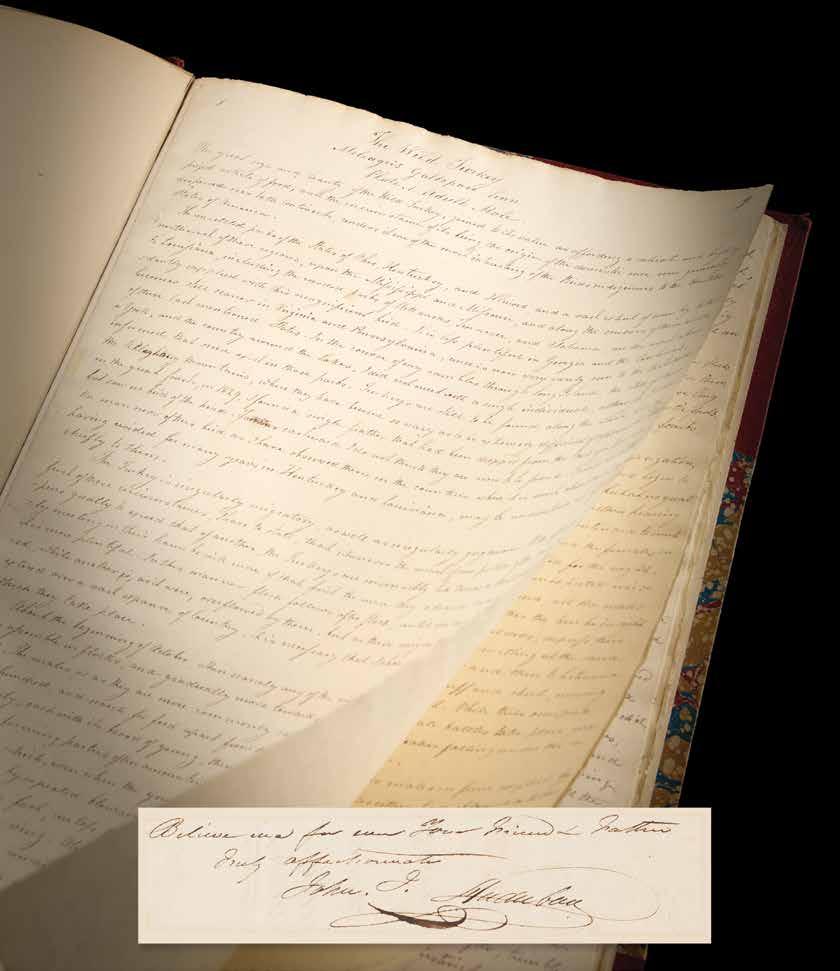
Audubon observes
North America’s greatest game bird:
“The usual gate of
the Turkey
is a walk, during which time it frequently opens each wing”
LOT 4063
John J. Audubon Handwritten Draft of His ‘Ornithological Biography’ Entry on the Wild Turkey, the First Plate in The Birds of America
Six pages of John J. Audubon’s handwritten working draft on the “Wild Turkey,” penned on four 10.25 x 16.25 sheets, portions of which were incorporated into his description of the bird published in his ‘Ornithological Biography’ of 1831. The fragmentary draft contains fascinating commentary on the wild turkey’s appearance, habits, and behavior, as well as advice for trapping and hunting.
Audubon writes, in part: “The usual gate of the Turkey is a walk, during which time it frequently opens each wing…During the summer months Turkeys seek the paths on roads & the plowed fields for the purpose of wallowing in the dust by which means they clean their bodies from the Ticks that at that season infect them…The eggs of the wild Turkey are delicate…The enclosures that are made to entrap wild Turkeys are called Pens–they are placed in such parts of the woods where a flock or flocks of Turkeys have been observed…
Whilst at Henderson I had among many other wild birds a fine Male Turkey, raised from its earliest youth under my care, I had caught it when probably only 2 or 3 days old—it grown well and so tame that he would follow any person who called it and became the favourite of the little village…One morning I saw it fly off very early toward the wood…Several days elapsed but the bird did not return. I went toward some lakes near Green River to shoot when having walked about 5 miles I saw a fine large Male Turkey cross the path before me moving leisurely along—Turkey being at that season in best order for the table, I ordered my dog to chase it and put it up—The animal went off with great rapidity, and I saw it near the Bird with surprise as I observed this latter paying but little attention to him. Juno was on the point of seizing it when she suddenly stop’d & turned her head towards me, as I saw my own favourite Bird and discovered that it has known the Dog at a glance and would not fly from it although the sight of a strange one would have caused it to run off at once…The following spring it was accidentally shot being taken for a wild one & brought to me on being recognized by the red ribbon it had round its neck… The Flight of this bird is powerful & swift, it is composed of strong
flapping that would at first induce the observer to think that the wild Turkey could not easily raise to the tall tops of our largest forest trees, but no sooner as the bird left the ground which it does with a great spring of its powerful legs than it raises with velocity and thus ascends to the highest branches…
Turkeys when alighted on a tree are sometimes very difficult to be seen, they stand so still that no clue of their position is granted to the hunter.—Should you discover it, and it is down on its legs on the branch, you may approach with less care, but if it is standing erect the greatest precaution is necessary…When a Turkey is merely winged by a shot or a ball it falls in such quick manner…the bird on reaching the ground instead of loosing time by tumbling & rolling over and about as other wounded birds often do, the Turkey makes ample usage of its long & powerful legs and runs off.”
Three of the manuscript pages are bound in three-quarter morocco with marbled boards, along with a clipped signature, “Believe me for ever Your Friend & Father, Truly affectionate, John J. Audubon,” a brief presentation letter from 1905 (“The accompanying MSS; is, so far as can be determined, part of the original draft for the article by John J. Audubon, on the ‘Wild Turkey’”), and an eleven-page transcript of Audubon’s final draft, penned in an unknown hand. In fine condition, with some light staining. Audubon’s detailed commentary on the Wild Turkey reflect the themes he later polished in his Ornithological Biography (the textual companion to his monumental The Birds of America, 1827–1838) and reveal how he combined empirical observation with narrative flair to bring North American bird life to an eager public. Audubon’s choice of the bird as the very first plate in The Birds of America reflects both his personal affinity for this native species and its symbolic importance in early America—so much so that Benjamin Franklin and Audubon himself championed the turkey as a more fitting U.S. emblem than the bald eagle. The manuscript’s vivid reflections on trapping, seasonal habits, and a beloved tamed bird also illustrate the naturalist’s immersive approach: he lived closely with his subjects and recorded not just measurements but the lived experience of wildlife on the early American frontier.
Starting Bid $5,000
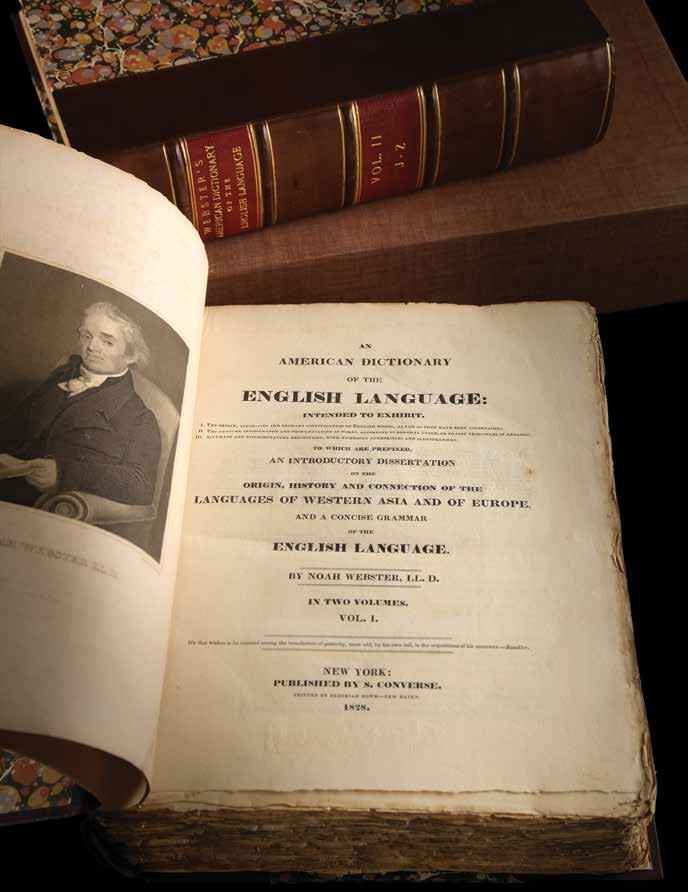
Scarce first edition of Noah Webster’s American Dictionary of the English Language
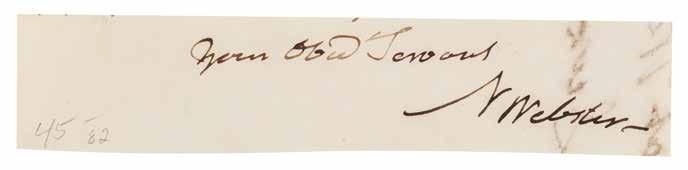
LOT 4064
Noah Webster: An American Dictionary of the English Language (First Edition, 1828)
Rare book: An American Dictionary of the English Language, Vols. I and II, by Noah Webster. First edition. NY: S. Converse, 1828. Hardcovers rebound in three-quarter chocolate calf with marbled boards, uncut edges, 10.25 x 12.5, containing some 70,000 entries: the first volume covers A–I, and the second volume covers J–Z. The title page describes Webster’s intent to exhibit: “The origin, affinities and primary signification of English words, as far as they have been ascertained. II. The genuine orthography and pronunciation of words, according to general usage, or to just principles of analogy. III. Accurate and discriminating definitions, with numerous authorities and illustrations. To which are prefixed, an introductory dissertation on the origin, history and connection of the languages of Western Asia and of Europe, and a concise grammar of the English language.” Loosely laid in is Webster’s ink signature, “You obed. servant, N. Webster,” on an off-white 5 x 1 slip.
Book condition: G+/None, with some marginal losses and staining to Webster’s frontispiece portrait in Vol. I, corner creasing to some of the pages, restored losses to endpapers preceding the text of Vol. II, inexpert tape repairs and staining to the title page of Vol. II, tape repairs to the last two pages of Vol. II, and some minor soiling to the textblocks. Each volume is housed in a brown cloth slipcase. Noah Webster’s An American Dictionary of the English Language was published in April 1828 after more than two decades of work to create the first comprehensive dictionary tailored to the United States. At age 70, Webster completed this two-volume lexicon of about 70,000 entries—roughly 12,000 more than earlier dictionaries—in part by drawing on extensive language study and adding many technical terms and Americanisms that had not appeared before, as well as advocating spellings (like ‘color,’ ‘center,’ ‘honor’) that became hallmarks of American English. Though only about 2,500 copies were printed and sales were initially slow, the work marked a major advance in modern lexicography and helped establish a distinct American linguistic identity.
Starting Bid $1,000
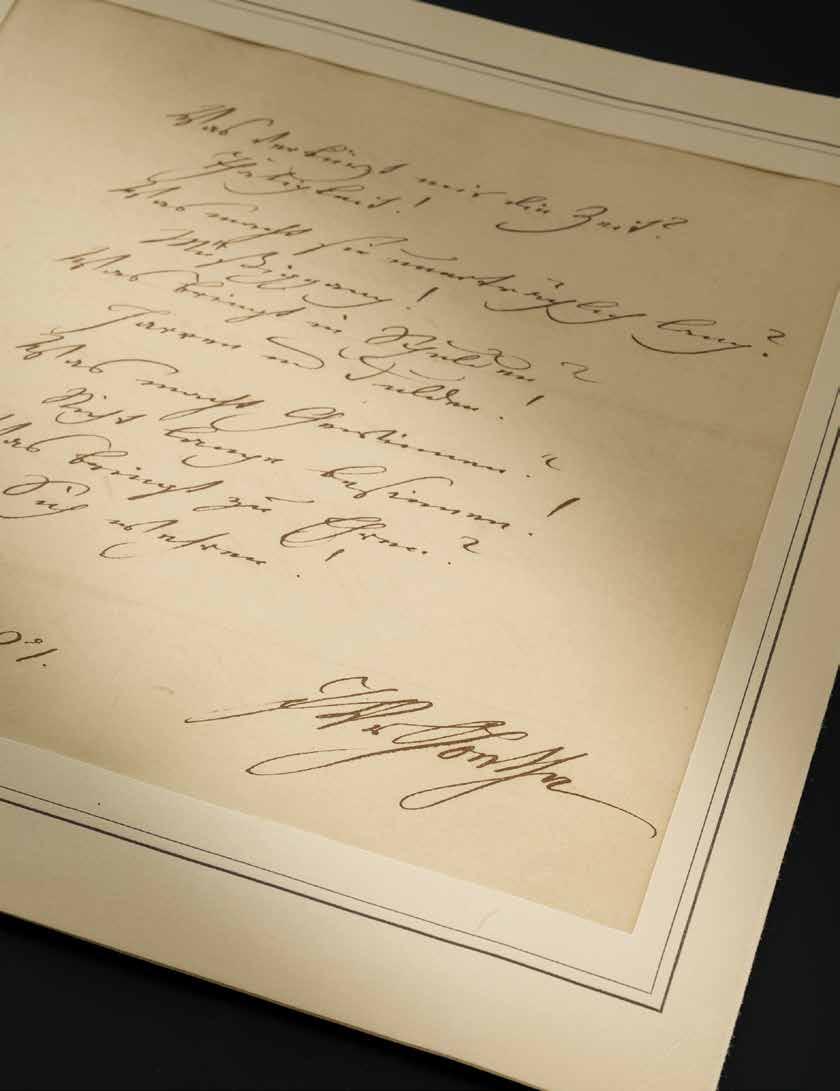
“What makes time short to me? / Activity!”—
Goethe’s Orient-inspired aphorisms from the West–Eastern
Diwan
LOT 4065
Johann Wolfgang von Goethe Autograph Poem Signed - ‘Fünf andere’ from West–östlicher Divan
Autograph poem in German, signed “J. W. v. Goethe,” one page, 7 x 6.5, July 16, 1821. Goethe pens his poem ‘Fünf andere [Five Others],’ from his seminal 1819 collection of poetry, West–östlicher Divan [West–Eastern Diwan]. In full (translated): “What makes time short to me? / Activity! / What makes it long and spiritless? / ‘Tis idleness! / What brings us to debt? / To delay and forget! / What makes us succeed? / Decision with speed / How to fame to ascend? / Oneself to defend!” Housed in an 8.75 x 8.5 presentation folder. In fine condition. Accompanied by a mailing envelope from German antiquarian bookseller and art dealer Paul Graupe, sending the poem to a friend at Klinik La Moubra in Switzerland, plus a brief handwritten note.
Also accompanied by a brief family history, which holds that Paul Graupe “gave the poem to my mother’s Aunt Margaret (my grandmother’s sister), who was born in 1909, now deceased.
Aunt Margaret and Paul Graupe met when they were both patients at La Moubra in Wallis, Switzerland before the war. He was prone to giving his friends gifts on special occasions. Paul Graupe was quite wealthy, Jewish, and had a deformity; one leg being shorter than the other, a birth defect…After Mr. Graupe went back to Germany, Aunt Margaret never heard from anyone who knew what happened to him.”
First published in 1819 and expanded in 1827, West–östlicher Divan stands among Goethe’s most celebrated late works, inspired by his profound engagement with Persian poetry, particularly the verse of Hafez. Conceived as a poetic dialogue between East and West, the collection reflects Goethe’s fascination with comparative religion and the universality of artistic expression. Blending lyric intensity with philosophical reflection, the Divan explores themes of love, temporality, faith, and self-knowledge, embodying Goethe’s ideal of a world literature (Weltliteratur) that transcends national and cultural boundaries.
Starting Bid $1,000
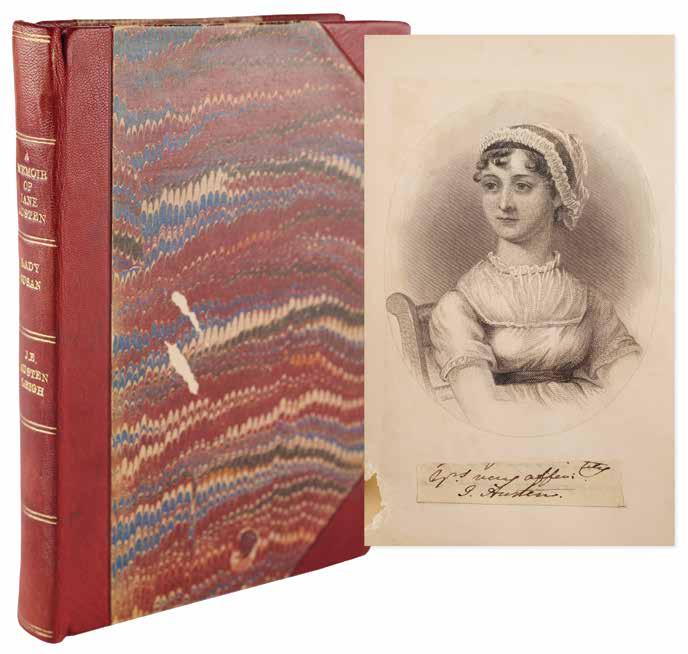
“Yrs. very affec’tely, J. Austen”— a literary rarity, the scarce signature of Jane Austen, acclaimed author of classics
Sense and Sensibility and Pride and Prejudice
LOT 4066
Jane Austen Signature - Rare Autograph of the Beloved English Novelist
Immensely rare ink signature, “Yrs. very affec’tely, J. Austen,” on an off-white 3 x .5 sheet, which has been affixed below an engraved frontispiece portrait of Jane Austen found inside a fourth edition of the book A Memoir of Jane Austen by Her Nephew J. E. Austen Leigh, to Which Is Added Lady Susan and Fragments of Two Other Unfinished Tales by Miss Austen, hardcover rebound in quarter leather with gilt titling to the spine and marbled boards, 5 x 7.25, 197 pages, published by Richard
Bentley & Son of London in 1879. Autograph condition: fine. Book condition: G+/None, with a cracked front hinge, minor loss to the corner of the frontispiece, slightly foxed title page and tissue guard, and two scuffs to the front board.
One of literature’s most influential names, Jane Austen remains enormously rare across all signed formats. This bold example represents the first such offering in our company’s 50-year history and can be qualified as nothing short of momentous. A rare opportunity not soon to be repeated.
Starting Bid $1,000
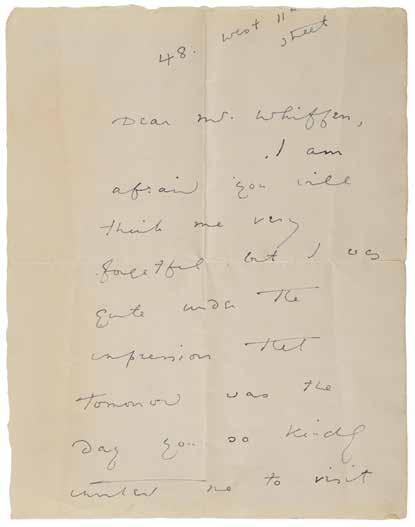
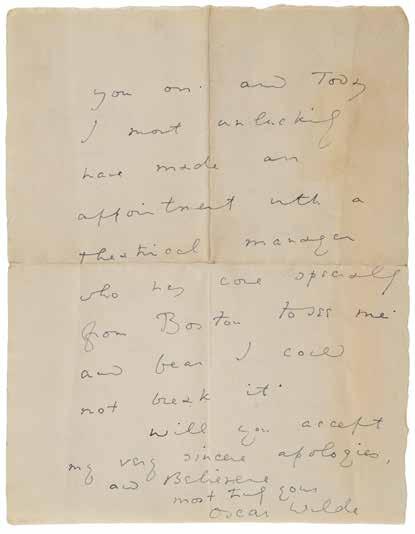
Oscar Wilde prepares to stage his plays in America: “I most unluckily have made an appointment with a theatrical manager”
LOT 4067
Oscar Wilde Autograph Letter Signed: “I most unluckily have made an appointment with a theatrical manager”
ALS, signed “Oscar Wilde,” one page both sides, 7 x 9, no date but circa November/December 1882. Handwritten letter to “Mr. Whiffen,” from “48 West 11th Street.” In full: “I am afraid you will think my very forgetful but I was quite under the impression that tomorrow was the day you so kindly invited me to visit you on and today I most unluckily have made an appointment with a theatrical manager who has come specially from Boston to see me and fear I can not break it.” In fine condition, with some light edge toning. Oscar Wilde arrived in New York on January 7, 1882, and departed for home two days after Christmas. During this period, he embarked on an
ambitious lecture tour on aestheticism that carried him across the United States and into Canada, reaching as far west as Colorado and as far south as Texas. He returned to New York in late October, where he entered into serious negotiations for American productions of his early plays, Vera and The Duchess of Padua. Vera proved a spectacular failure when staged in New York in August 1883, while The Duchess of Padua fared only marginally better, closing in January 1891 after twenty-one performances. From the personal collection of a lifelong collector, teacher, and traveler with a passion for world history. His collecting years ranged from the 1970s to the present day, meaning that several of the premier pieces have not been on the market in decades.
Starting Bid $500
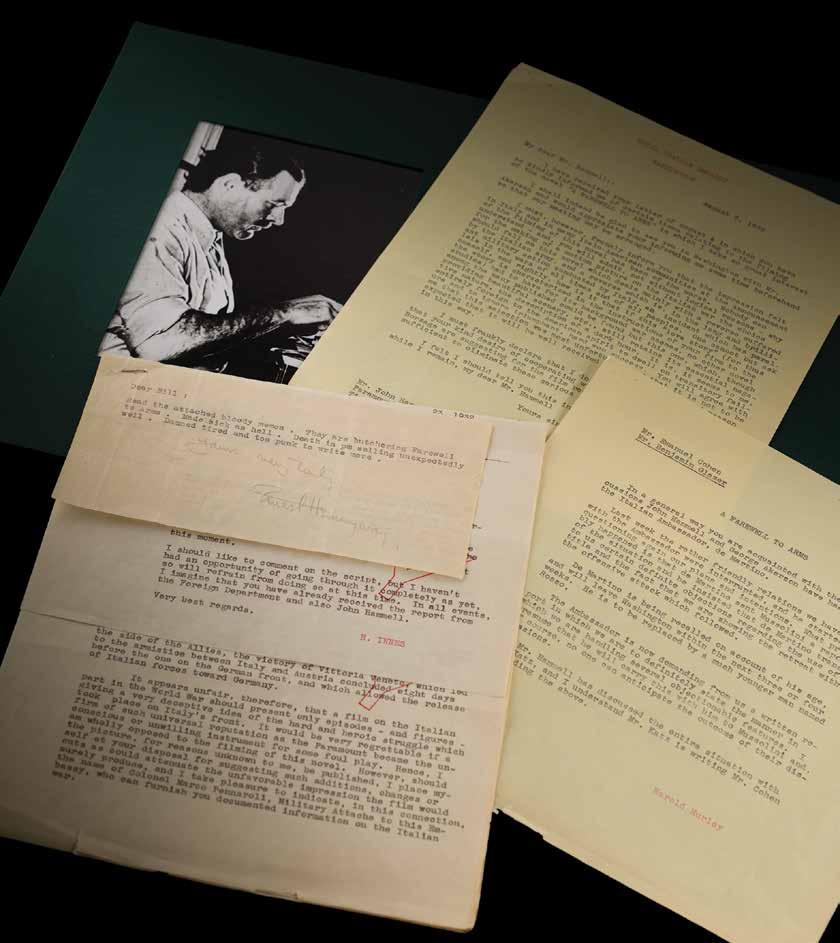
“They are butchering Farewell to Arms” —Hemingway lashes out against Hollywood rewrites and Mussolini’s censorship
LOT 4068
Ernest Hemingway Typed Letter Signed, Lashing Out Against Hollywood Rewrites and Mussolini’s Censorship: “They are butchering Farewell to Arms”
TLS signed “Yours very truly, Ernest Hemingway,” one page, 7.5 x 3.5, no date but circa 1932. Note to “Bill,” in full: “Read the attached bloody memos. They are butchering Farewell to Arms. Made sick as hell. Death in pm selling unexpectedly well. Damned tired and too punk to write more.” Hemingway’s note is stapled to six pages of copied correspondence from Paramount-Publix Corporation and the Royal Italian Embassy, dated from July 6–August 12, 1932.
The correspondence begins with a letter from Italian Ambassador Giacomo de Martino to Paramount’s George Akerson, in part: “I have read the novel ‘Farewell to Arms,’ by Ernest Hemingway,’ and I am communicating to you my impressions which, I must avow, are not favorable. Mr. Hemingway is among the best known and most popular writers, in this case, however, he has failed to present the background of his story—the war on the Italian front—with any degree of adequacy. His description is not only very superficial, but rendered with such a narrow view and such poverty of color as to render the book, in my opinion, almost valueless from the artistic and historical standpoints. One would almost be led to believe that the selection of this novel was made with the purpose of placing before the American public, quite in evidence, the only episode of the Italo-Austrian war which marks a reverse of the Italian arms, a reverse not greater indeed than those suffered by each one of the Countries at war, while the Italian Army has so many feats and achievements to be proud of…
It appears unfair, therefore, that a film on the Italian part in the World War should present only episodes—and figures—giving a very deceptive idea of the hard and heroic struggle which took place on Italy’s front. It would be very regrettable if a firm of such universal reputation as the Paramount became the unconscious or unwilling instrument for some foul play. Hence, I am wholly opposed to the filming of this novel…It seems it would not be difficult to make radical changes in the novel, so as to render full justice to the enormous and very successful efforts made by Italy for the final victory and thus fully satisfy the Italo-American public.”
On August 6th, having received word that the project would proceed, the ambassador writes again: “I must…frankly inform you that the impression felt in Italy and in many Italo-American communities at the announcement of the filming of this novel has been of the worst. Nobody can understand—and, you will admit, not without logical reasons—why for the making of a motion picture on the Italian war the choice should fall on this novel which deals many with a reverse suffered by the Italian army, and a reverse which is, in the long and brilliant military action conducted by Italy, an incident which has parallels in the wars of all times and of all peoples. One cannot but ask oneself, and rightly, how is it that if this ‘love story’ (for thus the story is characterized in the instructions of your firm to the studios) had to have for its background war scenes, no other novel among the many published could be found but this one, which, though providing beautiful scenery, etc., still retains its essential negative nature, the description of a dark hour. It is, it seems to me, entirely foreign to the American spirit to dwell on transitory failure and to ignore triumphant, hard won success. You will agree with me that this selection was most unfortunate and that it is not to be expected that it will be well received by those who feel and reason in this way…I do not see how the few changes that your kind desire of cooperating with me and the ability of Mr. Borzage are suggesting for the film rendering of the novel can be sufficient to eliminate these serious inconveniences.”
On August 12th, Paramount producer Harold Hurley reports: “Last week the rather friendly relations we have had with the Ambassador were interrupted, and he started questioning again our plans and intentions. What probably happened is that de Martino sent Mussolini a report of the situation and he insisted that de Martino transmit to us certain definite objections regarding the use of the title and the fact that we are showing the retreat without the offensive attack which followed. De Martino is being recalled on account of his age, and will leave Washington within the next three or four weeks…The Ambassador is now demanding from us a written report in which we are to definitely state the manner in which we are handling several objectionable features. I presume that he will carry this with him to Mussolini and, of course, no one can anticipate the outcome of their discussions.” Two other Paramount inter-officer memoranda document the receipt and forwarding of the ambassador’s letters. In fine condition, with small edge tears to bottom edges of the memos, and the last two pages detached from the staple. Accompanied by a custom-made presentation folder bound in one-quarter green morocco.
Starting Bid $1,000
The mind behind James Bond, perfectly posed—an iconic signed portrait of Ian Fleming, armed with a cigarette and revolver
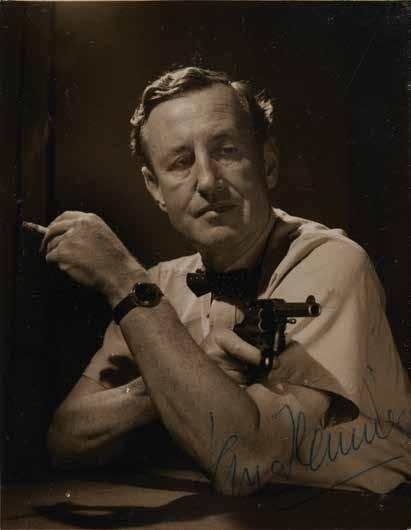
Image shown larger than acutal size.
LOT 4069
Ian Fleming Signed Photograph - Perfectly Posed Portrait
Vintage matte-finish 3.25 x 4.5 photo of the celebrated James Bond novelist, cigarette in one hand and revolver in the other, signed in blue ballpoint, “Ian Fleming.” Reverse bears the credit stamp of ‘Portrait Gallery’ photographer Douglas Glass. In fine condition, with light silvering to the darker areas of the image and some mounting residue to the reverse.
A striking and iconic portrait, this image perfectly encapsulates Fleming’s cultivated public persona—equal parts urbane gentleman and chronicler of danger. Posed with the tools that would come to define his literary legacy, Fleming appears every inch the worldly creator of James Bond, whose fusion of sophistication and lethal resolve reshaped the modern spy novel. Signed photographs of Fleming are scarce in general, and portraits of this caliber—especially one so thematically aligned with his work—are especially highly sought.
Starting Bid $1,000
of the James Bond Creator
Signed copy of The Nation from May 17, 1965, featuring Hunter S. Thompson’s first take on the Hell’s Angels—‘The Motorcycle Gangs: Losers and Outsiders’
LOT 4070
Hunter S. Thompson
Signed Original Issue of ‘The Nation’ (May 17, 1965) - His First Article on The Hell’s Angels
Original issue of The Nation from May 17, 1965, Vol. 200, No. 20, 30 pages, 8.5 x 10.75, with front cover showing motorcycle artwork next to bold text promoting “The Motorcycle Gangs,” an article written by gonzo journalist Hunter S. Thompson, who has signed the front cover in red ballpoint, “The Saga – part I, HST.” Framed to an overall size of 10 x 12.25. In fine condition. The fivepage article, ‘The Motorcycle Gangs: Losers and Outsiders,’ begins on page 522 and reads, in part: ‘Last Labor Day weekend newspapers all over California gave front-page reports of a heinous gang rape in the moonlit sand dunes near the town of Seaside on the Monterey Peninsula. Two girls, aged 14 and 15, were allegedly taken from their dates by a gang of filthy, frenzied, boozed-up motorcycle hoodlums called ‘Hell’s Angels,’ and dragged off to be ‘repeatedly assaulted.’’
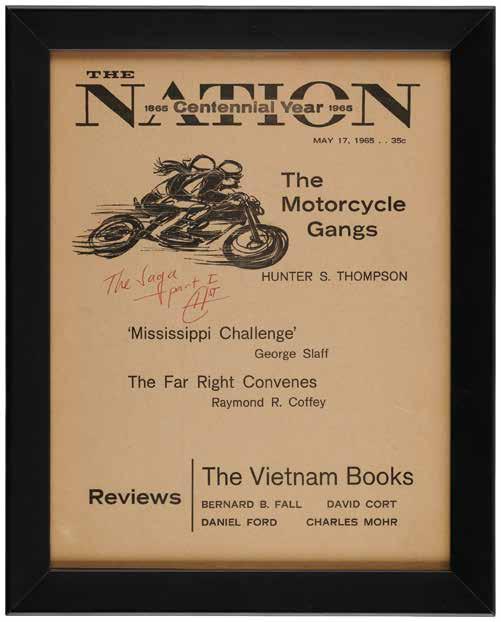
Having recently quit the National Observer, a 27-year-old Thompson accepted Nation editor Carey McWilliams’s $100 offer to write an article on the subject of motorcycle gangs. The article, published about a month later, prompted book offers from several publishers interested in the topic. In preparation for his soon-tobe best-selling Hell’s Angels: The Strange and Terrible Saga of the Outlaw Motorcycle Gangs, Thompson spent a year in close proximity with Hell’s Angels from the San Francisco and Oakland chapters, earning their trust and unique camaraderie before ultimately being pummeled and forced out for their company after openly opining against spousal abuse. A decidedly rare signed copy of the publication responsible for jump-starting the career of one of America’s most notorious reporters.
Starting Bid $500

A visual counterpart to The Dharma Bums— original painting by Jack Kerouac of ‘Buddha,’ a symbolic piece from circa 1956-60, alternatively titled ‘The Gary Buddha,’ a possible reference to fellow poet and Buddhist practitioner Gary Snyder—formerly displayed at the Whitney Museum of American Art in New York City
LOT 4071
Jack Kerouac Original Painting of ‘Buddha’ (‘The Gary Buddha’), ca. 1956-1960 - Formerly Displayed at the Whitney Museum of American Art
Original artwork by influential novelist and Beat poet Jack Kerouac, entitled ‘Buddha,’ accomplished in graphite and acrylic on a beige 14.5 x 17 sheet of artist paper, which is signed in the lower left in black ballpoint, “Kerouac.” The painting, which some sources have called ‘The Gary Buddha,’ prominently features a central Buddhist figure surrounded by radiant flamelike marks and seated above two figures positioned at the lower corners: a kneeling, robed man with a halo encircling his head and a bowl placed at his knees, and a floating head with exaggerated facial features, most notably the eyes. Archivally framed under Tru Vue UV-protective glass to an overall size of 19 x 25. In very good condition, with creasing, corner loss, and tape stains from old repairs to several tears.
Labels to the frame backing indicate that the painting was displayed at the Whitney Museum of American Art in New
York City (November 1995-February 1996) and at the Whistler House Museum of Art in Lowell, Massachusetts (October 1998).
In keeping with the alternative title, ‘The Gary Buddha,’ the central figure may represent Gary Snyder, Kerouac’s close friend and fellow Beat poet, whose commitment to Buddhist practice influenced Kerouac during the mid-1950s, including the period in which The Dharma Bums was written. The kneeling figure below may be interpreted as a symbolic self-representation of Kerouac as a devotee or seeker, positioned beneath the central figure in an attitude of reverence. The disembodied head at lower left appears symbolic rather than portrait-like, and may allude to suffering, impermanence, or the ‘hungry ghost’ state of craving and unrest found in Buddhist tradition. Executed circa 1956–1960, during a period of Kerouac’s sustained interest in Buddhism, the work reflects the personal and exploratory nature of his visual art, which was often informal, symbolic, and created without aim for exhibition.
Starting Bid $5,000

Andy Warhol’s ‘Sitting Bull’— a powerful fusion of pop color and cultural memory
LOT 4072
Andy Warhol Oversized Screenprint‘Sitting Bull’ (FS IIIA.70)
Oversized color 36 x 36 screenprint entitled ‘Sitting Bull,’ executed at the same time as Warhol’s 1986 Cowboys and Indians series, stamped on the reverse by the Andy Warhol Foundation and the Andy Warhol Estate. Printed on Lenox Museum Board by Rupert Jasen Smith, New York. Archivally matted and framed to an overall size of 46.5 x 47. In very fine condition.
Warhol portrays the famed Lakota leader in a classic frontfacing pose, rendered with his signature use of bold, flat color and high contrast. Sitting Bull’s face is transformed into an arresting electric blue, punctuated by neon yellow highlights, while saturated reds and warm tones ground the ceremonial garments and symbolic elements. The effect is at once rev-
erential and contemporary—elevating a historical figure into the realm of Pop iconography while alluding to the tension between lived history and its mediated representation.
The print derives from Warhol’s 1986 ‘Cowboys and Indians’ series—an artistic exploration into the mythos of the American West—though he chose to exclude the image from the final, published version of the portfolio. By placing Sitting Bull within the same visual framework as American movie stars and Western archetypes, Warhol invites a reconsideration of who is mythologized in American culture and why. The result is a powerful late-career statement that blends portraiture, historical commentary, and Warhol’s enduring fascination with fame.
Reference: Andy Warhol Prints: A Catalogue Raisonné, Feldman & Schellmann IIIA.70.
Starting Bid $5,000
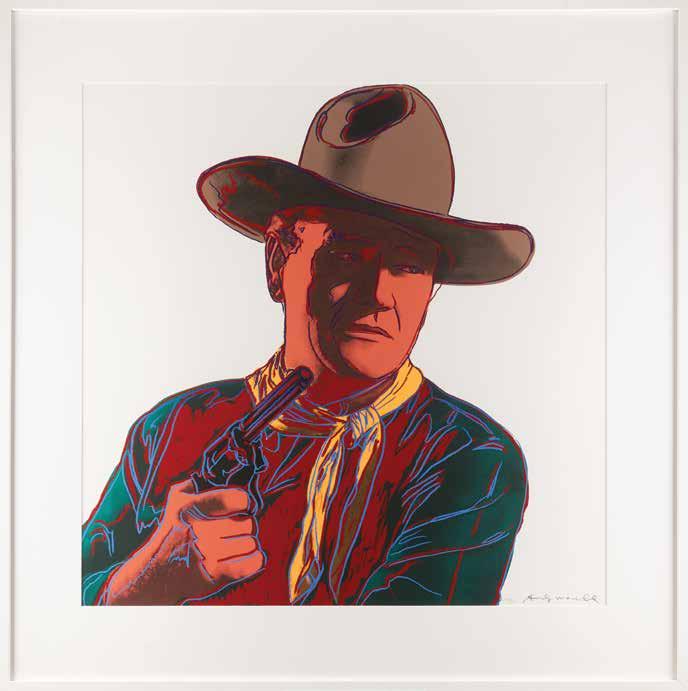
Hollywood’s Western icon— a limited edition oversized screenprint of John Wayne from Andy Warhol’s ‘Cowboys and Indians’ series
LOT 4073
Andy Warhol Oversized Signed Screenprint - ‘John Wayne’ (Ltd. Ed. #216/250) (FS II.377)

Oversized color limited edition 36 x 36 screenprint entitled ‘John Wayne,’ from Warhol’s 1986 Cowboys and Indians series, numbered 216/250, signed in pencil in the lower right, “Andy Warhol.” Published by Gaultney, Klineman Art Inc., New York, and printed on Lenox Museum Board by Rupert Jasen Smith, New York. Archivally matted and framed to an overall size of 46.5 x 47. In very fine condition.
‘John Wayne’ is among the most iconic images from Andy Warhol’s celebrated ‘Cowboys and Indians’ series, completed just one year before the artist’s death. In this late body of work, Warhol explores the mythology of the American West, applying his unmistakable Pop Art aesthetic to figures whose identities were shaped as much by mass media as by history. John Wayne— emblematic of Hollywood’s idealized cowboy hero—is transformed into a symbol of American cultural mythology.
The image is based on a publicity still from The Man Who Shot Liberty Valance (1962), with Wayne’s stoic gaze, cowboy hat, and six-shooter amplified through Warhol’s bold use of color and graphic contrast. The result is a powerful synthesis of celebrity portraiture and historical commentary, underscoring Warhol’s enduring fascination with fame, image-making, and the construction of national identity.
Reference: Andy Warhol Prints: A Catalogue Raisonné, Feldman & Schellmann II.377.
Starting Bid $10,000
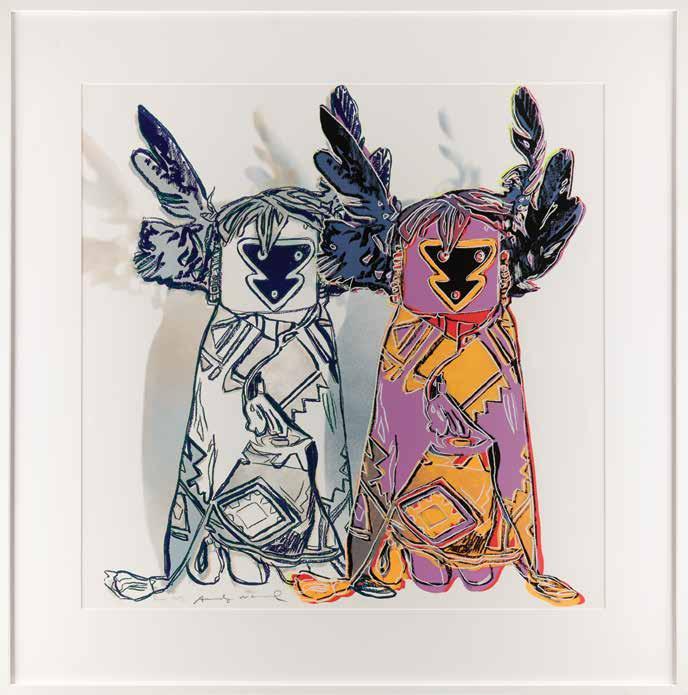
LOT 4074
‘Kachina Dolls’—
an artist’s proof of Warhol’s reimagining of Indigenous iconography as Pop Art
Andy Warhol Oversized Signed Screenprint - ‘Kachina Dolls’ (Ltd. Ed. #AP41/50) (FS II.381)
Oversized color limited edition 36 x 36 artist’s proof screenprint entitled ‘Kachina Dolls,’ from Warhol’s 1986 Cowboys and Indians series, numbered AP41/50, signed in pencil in the lower left, “Andy Warhol.” Published by Gaultney, Klineman Art Inc., New York, and printed on Lenox Museum Board by Rupert Jasen Smith, New York. Archivally matted and framed to an overall size of 46.5 x 47. In very fine condition.
In ‘Kachina Dolls,’ Andy Warhol shifts his focus from Hollywood and historical archetypes to Indigenous cultural symbolism, presenting a pair of Hopi ceremonial figures through his distinctive Pop Art lens. The image draws on traditional carved Kachina dolls—objects created to embody spiritual beings and to pass cultural knowledge across generations—reimagined here in vivid color and sharp contrast.
Rather than portraying a single iconic personality, Warhol emphasizes pattern, form, and repetition, transforming the dolls into bold visual motifs. The composition’s bright palette and flattened forms simultaneously celebrate the power of the original objects while inviting reflection on the tension between cultural tradition and modernity
Reference: Andy Warhol Prints: A Catalogue Raisonné, Feldman & Schellmann II.381.
Starting Bid $5,000
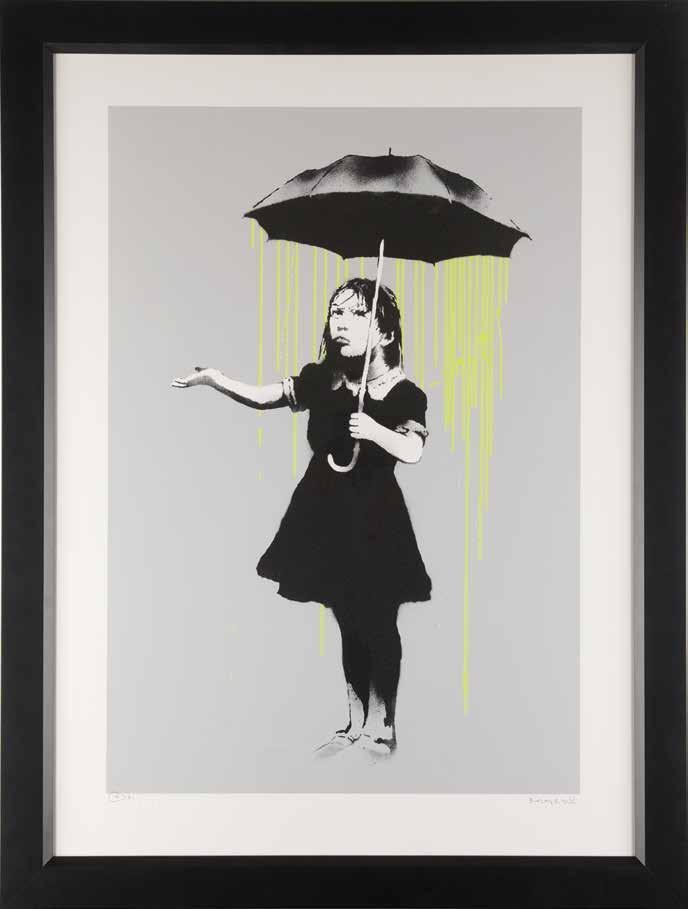
Exceedingly rare ‘yellow rain’ variant of Banksy’s
‘Nola’ aka ‘Umbrella Girl,’ an elusive 2008 limited edition screenprint signed by legendary street artist Banksy
LOT 4075
Banksy Signed ‘Yellow Rain’ Screenprint of ‘Nola’ aka ‘Umbrella Girl’ (Ltd. Ed. #4/31) - 21˝ x 29˝
Highly coveted limited edition color 21 x 29 screenprint on wove paper by street artist and political activist Banksy entitled ‘Nola,’ or ‘Umbrella Girl,’ numbered 4/31 in the ‘yellow rain’ variant, signed in the lower right corner in pencil with his artist signature, “Banksy.” Released in 2008 and published by Pictures on Walls, this rare ‘Nola’ print depicts a young girl holding an umbrella, her hand extended to detect the fall of rain. In a characteristic Banksy twist, the umbrella’s canopy, a normal agent of protection, proves to be the true source of the rain. The lower left of the print bears the edition number and a POW (Pictures on Walls) blindstamp of Banksy’s ‘Heavy Weaponry’ image, an elephant with a bomb strapped to its back. Archivally framed under Tru Vue UV-protective glass to an overall size of 25 x 33. In fine condition, with faint marks to the borders.

Banksy’s ‘Nola’ emerged in the Marigny neighborhood of New Orleans, Louisiana, as a direct response to the catastrophic aftermath of Hurricane Katrina in 2005. The mural formed part of a series of around 15 works addressing the disaster’s impact on the city, including governmental failure and the resilience of its inhabitants. The title is an affectionate reference to the city’s nickname, which is strikingly personified by Banksy as a young girl, Nola, confused by the rain falling from inside her umbrella.
By reversing this function and allowing the rain to fall from within the umbrella rather than from the sky, Banksy suggests that the very systems and institutions created to protect us can, at times, cause harm instead. A clever critique of the failure of flood defenses meant to protect the city’s residents, the piece serves as a pointed indictment of FEMA and the government’s inadequate response to the crisis and its failure to safeguard those most affected by the storm.
The first edition of ‘Nola’ featured white raindrops and was released in 289 signed copies. Subsequent editions included 63 prints with grey rain, 32 with neon orange rain, and 31 with neon yellow rain. Additionally, 66 artist proofs were issued featuring multicolored rain. ‘Nola,’ in all her sadness and beauty, has since become one of Banksy’s most sought-after prints.
Starting Bid $10,000
Early 1955 hand-inked Peanuts
Sunday comic strip by Charles Schulz, featuring Beethoven-loving Schroeder and the jealous Lucy
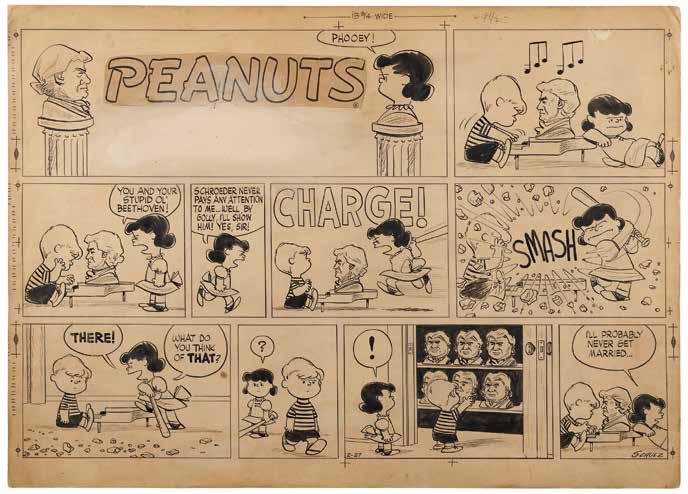
LOT 4076
Charles Schulz Signed Original Hand-Drawn Peanuts Sunday Comic Strip (February 27, 1955)
Original hand-inked ten-panel Peanuts Sunday comic strip by Charles Schulz, 23.5 x 17, signed in the lower right corner of the last panel in black ink, “Schulz.” In this classic Peanuts strip, Schroeder is absorbed in playing Beethoven at his toy piano while Lucy demands his attention. Frustrated that Schroeder values Beethoven over her, Lucy dramatically smashes the composer’s bust in a fit of jealousy—only to be met with Schroeder’s stunned silence and quiet retrieval of another bust from a hoard of duplicates. The strip ends with Lucy reflecting, in classic Schulz fashion, that her behavior might explain why she’ll “probably never get married.” In very good to fine condition, with toning, light soiling, and a roughed-up
surface area below the strip name. This strip appeared on February 27, 1955, and was adapted in both ‘You’re in Love, Charlie Brown’ and ‘Happiness is a Warm Blanket, Charlie Brown.’ As Schroeder was among the least-often seen of the regular Peanuts characters—as the strip evolved, he came to appear mainly in occasional story lines with Snoopy or Lucy—original strips in which he is featured so prominently are relatively uncommon. A fantastic piece of oversized original artwork from the classic cartoon’s formative years. From the personal collection of a lifelong collector, teacher, and traveler with a passion for world history. His collecting years ranged from the 1970s to the present day, meaning that several of the premier pieces have not been on the market in decades.
Starting Bid $1,000
Original cartoon for The New Yorker by Charles Addams, showcasing his macabre wit
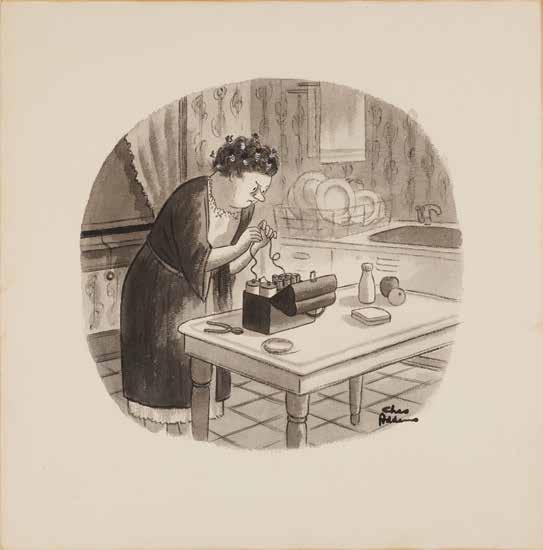
LOT 4077
Charles Addams Signed Original Artwork for The New Yorker
Classic original artwork for a one-panel New Yorker cartoon showing a woman wiring a bomb into her husband’s lunch box, accomplished in pen and ink by Addams on 14.25 x 14.25 artist’s board, signed in the lower right corner in ink, “Chas. Addams.” Stamped on the reverse: “The New Yorker, Editorial Department, 25 West 43rd Street.” In fine condition.
A quintessential example of Charles Addams’s darkly comic genius, this original drawing created for The New Yorker
captures the artist’s sly subversion of domestic normalcy. Rendered in rich washes of ink and gray tone, the scene transforms an everyday kitchen into a stage for macabre humor, as an otherwise ordinary woman calmly tends to her unsettling contraption. Addams’s expressive line and deadpan wit are on full display, making this a superb work by one of the most influential cartoonists of the 20th century. From the personal collection of a lifelong collector, teacher, and traveler with a passion for world history. His collecting years ranged from the 1970s to the present day, meaning that several of the premier pieces have not been on the market in decades.
Starting Bid $200
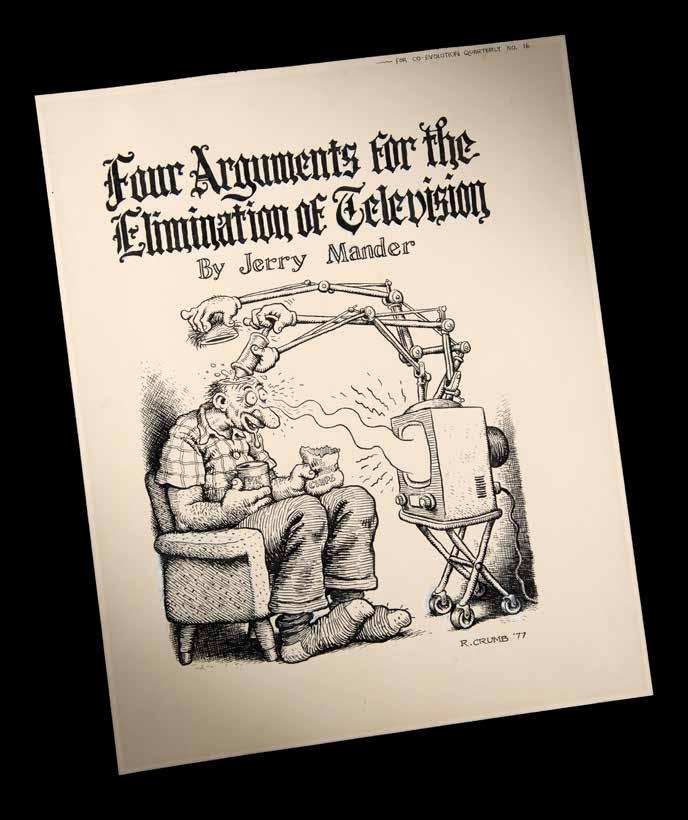
‘Four
Arguments for the Elimination of Television’—original artwork by Robert Crumb published in the Winter 1977/78 issue of CoEvolution
Quarterly magazine—an unsettling satirical sketch on the future of screen obsession
LOT 4078
Robert Crumb Original Artwork for CoEvolution Quarterly (Winter 1977/1978) - “Four Arguments for the Elimination of Television”
Original artwork by Robert Crumb for issue No. 16 of CoEvolution Quarterly magazine (Winter 1977/1978), created as the feature illustration for an article by Jerry Mander entitled “Four Arguments for the Elimination of Television,” accomplished in black ink with white gouache accents on an off-white 11 x 13.75 sheet of artist paper, which is signed in the lower right, “R. Crumb, ‘77,” who adds along the upper edge, “For Co-Evolution Quarterly No. 16.” The artwork, set below a Blackletter-style title and achieved in Crumb’s trademark crosshatched pen-and-ink style, depicts a slovenly, wide-eyed man seated in an armchair in front of a rolling television set. From the television’s top three mechanical arms extend over to the man, with one hand lifting his neatly severed scalp while the other two work in tandem to inject a mystery fluid into his open skull. The man, portrayed as the average American consumer, holds a can of “Beer Type Drink” and a bag of “El Cheeso Chips,” as the TV screen sends a wavy energy flow into his unblinking eyes. This drawing was printed on page 38 of the issue, a copy of which is included. In very fine condition,
with faint toning from prior display. CoEvolution Quarterly was an influential, countercultural magazine published from 1974 to 1985 as an outgrowth of the Whole Earth Catalog universe. Edited by Stewart Brand, the magazine focused on the idea of ‘coevolution,’the belief that human society, technology, ecology, and culture evolve together and should be consciously shaped rather than passively accepted.
A fierce opponent of modern consumer culture, artist Robert Crumb joined forces with CoEvolution in the late 1970s, where their shared ideas and visual approach made for an ideal partnership of alternative thinking. Though not a regular staff illustrator, Crumb provided artwork that complemented the magazine’s skeptical view of mass media, materialism, and modern habits. His involvement included the front and back covers of the Summer 1977 issue, the front cover of the Winter 1979/80 issue, and several interior feature illustrations commissioned for individual articles. A darkly humorous and masterfully rendered work of original satire by Robert Crumb, whose unsettling depiction of screen obsession feels as topical today as ever.
Starting Bid $1,000
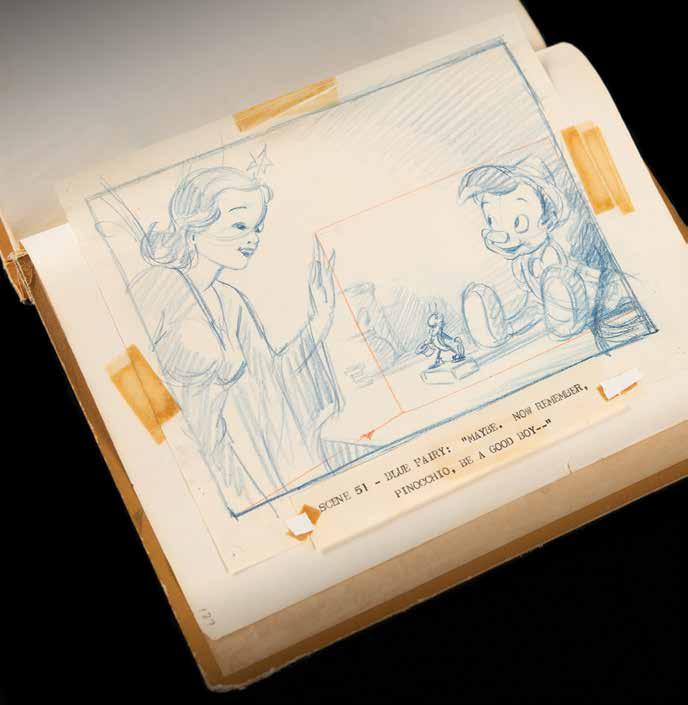
View video of book online at www.RRAuction.com.
‘I wish I may, I wish I might…have the wish I make tonight’—museum-worthy ‘Continuity Sketch Book’ for the Disney classic Pinocchio, a director-used scene-by-scene visual reference guide for the film’s opening 18 minutes, from Jiminy Cricket’s introduction to Pinocchio’s transformation into a real boy
LOT 4080
Disney’s 1939 Pinocchio Director-Used Continuity Sketch Book with (48) Original Storyboard Drawings and (175+) Photographic
Model Images
Original circa 1939 Disney Director’s ‘Continuity Sketch Book’ for the Oscar-winning 1940 classic Pinocchio, the studio’s second animated feature film, which was used by sequence and supervising directors to strategically order the film’s opening 18 minutes, concluding with the moment that the Blue Fairy says, “Now remember, Pinocchio, be a good boy.” The sketchbook contains a total of 114 pages, which include 48 original preliminary storyboard drawings and nearly 200 photographic storyboard images that provide unprecedented insight into the meticulous planning of one of Disney’s most iconic films.
The book is presented as a rivet-bound binder with beige boards, 10.5˝ x 12.5˝, the front of which bears an affixed title label, “Continuity Sketch Book, 2003 - Seq. 1, Seq. 1.1, Seq. 1.5.” The book is essentially divided into three sections: Sequence 1 (pgs. 1-22, scenes 1-17), Sequence 1.1 (pgs. 25-71, scenes 1-89), and Sequence 1.5 (pgs. 73-127, with two pages marked 115, and pages 3, 13, and 24 also found in this section; this sequence focuses on scenes numbered from 2 to 51, though not all scenes accounted for). To classify their ongoing animation projects, Disney numbered their feature-length films in the 2000s and their studio’s shorts in the 1000s. Snow White was 2001, Bambi was 2002, and Pinocchio was 2003; when early script problems with Bambi proved intractable, Walt Disney decided to move forward with development for Pinocchio.
The sketchbook’s 48 original drawings, accomplished in graphite and colored pencil on animation paper ranging in size from 6.5˝ x 5˝ to 12˝ x 10˝, are all located in the section marked Sequence 1.5, which contains individual character sketches of Jiminy Cricket (21), Pinocchio (9), and the Blue Fairy (5). The section also contains several multi-character sketches, such as Pinocchio and Jiminy Cricket (5), Pinocchio and the Blue Fairy (3), Jiminy Cricket and the Blue Fairy, Geppetto and Figaro, and a wonderful drawing of Pinocchio, Jiminy Cricket, and the Blue Fairy (Scene 51, page 127), which represents the final page of the sketchbook. The drawings are pictured on pages 3, 13, 24, 74-75, 78-81, 83-85, 87, 91-95, 97-101, 103-105, 107-109, 112-116, and 118-127. In addition to the sketches, the book contains 193 original photographic storyboard images, ranging in size from 1.5˝
x 1.25˝ to 6.75˝ x 5.25˝, with a handful hand-embellished in graphite or ink, most notably Scene 6 (page 8), with the caption reading: “Camera focus on inside of house – Dialog continues: …. And looked in. It was a shame to see such a nice cheerful fire like that going to waste.” An artist has added a detailed frame to the main image of Geppetto’s workshop, which has also been touched up in ink and graphite.
The majority of the pages contain typed captions (some affixed with tape) that feature dialogue or scene descriptions, including several moments forever ingrained in cinematic history. Highlighted captions include: Scene 1, page 1 (“Long shot – Pinocchio book set-up – Cricket is singing the ‘Wishing’ song”); Scene 83, page 68 (“Scene starts on extreme close-up of wishing star in sky. We hear Geppetto, offstage, as he says: ‘Starlight, starbright, first star I see tonight, I wish I may –, I wish I might…have the wish I make tonight”); Scenes 84 and 85, page 69 (“Geppetto and Figaro are both looking at the star at the beginning of the scene. Then Geppetto turns toward Figaro and says: ‘You know what I wished, Figaro?’… ‘I wished –’…‘That my little Pinocchio might be a real boy.’”); and Scene 29, page 103 (“C.U. Pinocchio; ‘Am I a real boy?’”). In fine condition, with some wear to binder boards, and several of the tape-affixed captions are becoming loose; the book is missing pages 10, 11, 12, 23, 76, 77, 82, 86, 89, 90, 102, 106, 110, and 117, and page 62 is missing its three photo storyboard images (scenes 68-70). Accompanied by numerous certificates of authenticity from Choice Collectibles ASG.
Given the sketch book’s role as a visual story outline for Pinocchio’s integral opening set-up, its narrative importance remains indisputable, as does its introductory animation style, which transitioned into a world of realism that forever changed the look and feel of animated feature films overnight. The influence of renowned Disney animator Freddie Moore is also readily apparent in the 10 rare early drawings of The Blue Fairy, who bears a noted resemblance to the original Disney princess, Snow White. Disney artists were still trying to perfect a more human ‘princess look,’ and as Animation Director on Pinocchio, Moore was instrumental in achieving the final depiction. A staggering relic of animation history, whose historical importance to the art of movie-making is undeniable—its availability to collectors signals an event not to be missed.
Starting Bid $5,000
Whistle while you work— Snow White sweeps the cottage of Bashful, Grumpy, and Sleepy in this beautiful multi-character cel set-up from Disney’s first animated feature film
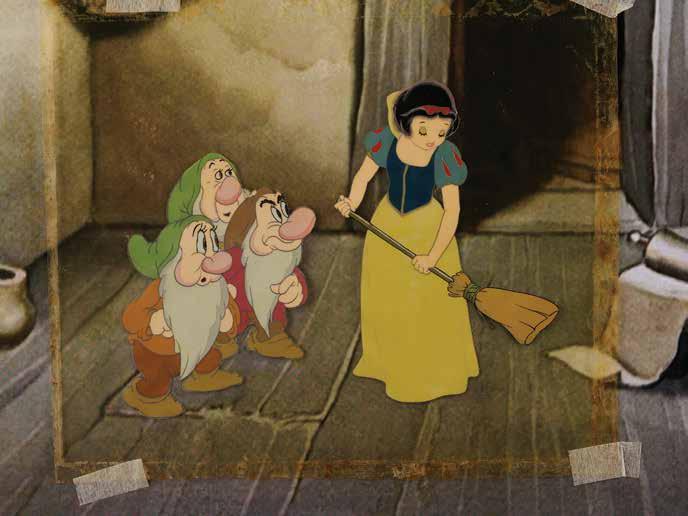
LOT 4079
Snow White, Bashful, Grumpy, and Sleepy production cels from Snow White and the Seven Dwarfs
(Walt Disney Studios, 1937) Two original production cels of Snow White, Bashful, Grumpy, and Sleepy from Snow White and the Seven Dwarfs, placed on a color laser copy background of the interior of the dwarfs’ cottage. The Snow White cel has been trimmed and depicts the original Disney princess in an exquisite full-figure pose with broom in hand, a scene
reminiscent of the film’s memorable ‘Whistle While You Work’ sequence. The dwarf cel, which shows the trio watching their new house guest, has been trimmed to size and applied neatly to the Snow White cel. Character images measure 3.25 x 4.75 (Snow White) and 3 x 3.75 (dwarfs), with overall dimensions of 17 x 11. In fine condition, with trivial rippling, and adhesive remnants to the edges. An attractive multi-character set-up from cinema’s first cel animated feature film.
Starting Bid $500
Beautifully realized watercolor painting by Disney chief illustrator Gustaf Tenggren for the children’s book Farm Stories
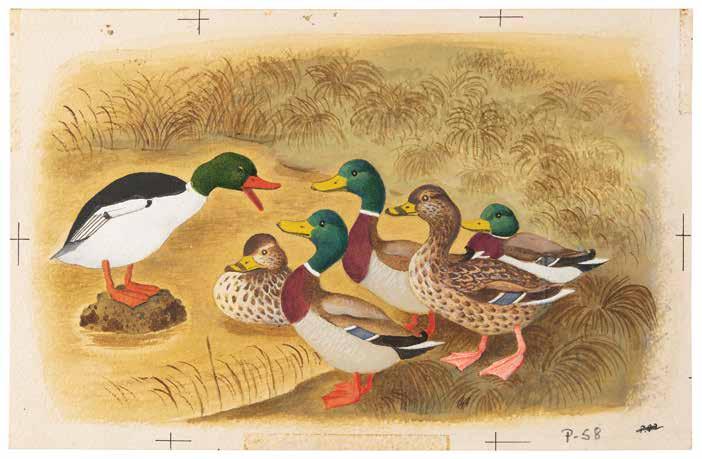
Gustaf Tenggren watercolor painting of a duck family from Farm Stories
(Giant Golden Book, 1946) Gorgeous original watercolor painting by Gustaf Tenggren for the children’s book Farm Stories, which depicts a mallard standing on a rock and quacking to a group of five other ducks. Accomplished in watercolor on untrimmed 9.5 x 6 artist paper, marked “P. 58” in the lower border; the final version was ultimately printed on page 82 of the book. Included with the painting is a special limited first edition of Farm Stories, numbered 110/650, hardcover, published by Simon and Schuster in 1946, signed on the colophon in bold ink by Tenggren and by authors Kathryn and Byron Jackson. In overall fine condition, with some wear and areas of paint to book covers. A noted Swedish-American artist, Tenggren was a chief illustrator for The Walt Disney Company in the late 1930s before moving on to work on children’s Little Golden Books. Some of the films he worked on were Snow White, Pinocchio, Fantasia, and Bambi.
Starting Bid $300

Alice meets the Cheshire Cat of Tulgey Wood—marvelous panoramic concept painting by Mary Blair for the surreal Disney classic Alice in Wonderland

LOT 4082
Mary Blair panoramic concept painting of Alice and the Cheshire Cat from Alice in Wonderland
(Walt Disney Studios, 1951) Beautiful original panoramic concept painting by Mary Blair for Alice in Wonderland, which imagines a nocturnal meeting between Alice and the Cheshire Cat in Tulgey Wood. Blair adds boldness and life to each of the painting’s six main components, essentially pairing her visual ideas into three primary motifs—character (Alice and the Cheshire Cat), atmosphere (the full moon and mistladen landscape), and environment (the cat’s great tree and surrounding foliage). Her use of clean art theory and visual storytelling is expertly realized, seamlessly weaving color and
mood and character to keep the viewer constantly engaged. Accomplished in tempera on 20.25 x 8.75 artist’s board. In fine condition, with tack holes at corners.
Blair was a concept artist for Disney during the 1940s and early 1950s, working on designs for such films as Peter Pan, Cinderella, and Alice in Wonderland. She also created designs for several Disney attractions (including It’s a Small World), and her largest work ever, the multi-story mosaic in Disney World’s Contemporary Hotel concourse. A stunning, well-composed panoramic painting featuring Blair’s stylish interpretation of two of Disney’s most desirable characters.
Starting Bid $1,000
From Neverland to London, Mary Blair beautifully imagines the stealthy nighttime mission of Peter Pan and Tinker Bell to the Darling family rooftop
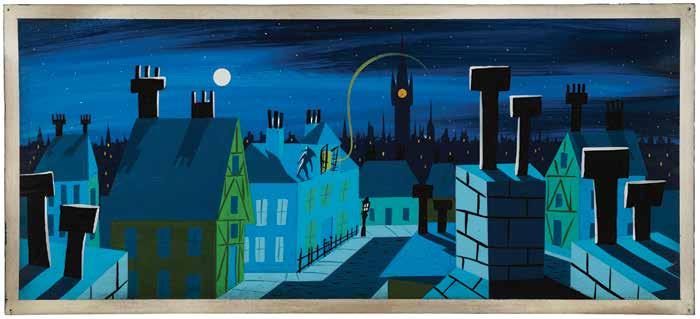
LOT 4083
Mary Blair panoramic concept painting of Peter Pan and Tinker Bell from Peter Pan
(Walt Disney Studios, 1953) Original panoramic concept painting by Mary Blair for Peter Pan, depicting Peter Pan and Tinker Bell poised atop the roof of the Darling family’s London home. Rendered in evening tones of blue, black, gray, and green, the scene unfolds across a sweeping expanse of the English cityscape, with endless peaks and spires punctuated by glowing dots of window light, a clever use of visual distraction that heightens the piece’s central focus—the stealthy nighttime mission of Pan and Tink. Both characters are shown with minimal detail—Pan a moon-limned silhouette and Tink a bright orb with a curling trail of pixie dust—as they approach
the open French window of the Darling children’s bedroom, the silence of their movement in tandem with the stillness of the surrounding moon, stars, and shadow. Accomplished in tempera on 20.5 x 9.25 artist’s board. In fine condition, with tack holes to corners.
Blair was a concept artist for Disney during the 1940s and early 1950s, working on designs for such films as Peter Pan, Cinderella, and Alice in Wonderland. She also created designs for several Disney attractions (including It’s a Small World) and, her largest work, the multi-story mosaic in Disney World’s Contemporary Hotel concourse. A conceptual masterpiece from the legendary Mary Blair.
Starting Bid $1,000
The inescapable dungeon of Maleficent— the darkest reaches of Sleeping Beauty
are brought to terrifying life by the great
Eyvind Earle
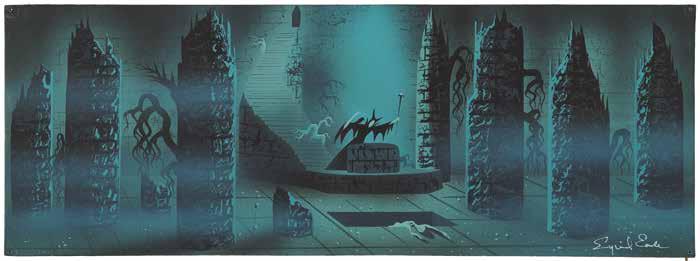
LOT 4084
Eyvind Earle concept painting of Maleficent from Sleeping Beauty
(Walt Disney Studios, 1959) Original panoramic concept painting by Eyvind Earle for Sleeping Beauty, which depicts the sorceress Maleficent tormenting a prisoner in the dungeon of her castle. The vividly rendered scene serves as an exploratory dungeon concept, a visualization of Maleficent’s cruelty and dominion that, despite going unused in the film’s final product, offers a rarely seen sample of Earle at his darkest. The dungeon is shown in eerie hues of blue and gray, its immense, impenetrable space jutting with large and ill-shapen columns and somber, sickly shoots of vine and vegetation, elements that enclose on the scene’s central abomination. At
the base of a long staircase is Maleficent, leaning with raised arms and scepter over a stone cauldron, and below this, upon the floor opens a rectangular pit and the emerging specter of a long-tortured captive. Accomplished in gouache on 16.75 x 6 artist’s board, signed in the lower right corner in light blue paint, “Eyvind Earle.” In fine condition, with tack holes to corners. Disney artist Eyvind Earle was Sleeping Beauty’s production designer, and Disney gave him a significant amount of freedom in designing the settings and selecting colors for the film. Earle also painted the majority of the backgrounds himself, and his stylistic influence is readily apparent in the final product. A terrific depiction of the ‘Mistress of All Evil’ at her most unforgiving.
Starting Bid $1,000
The iconic castle of Sleeping Beauty, a stunning panoramic concept piece from the film’s legendary production designer, Eyvind Earle

LOT 4085
Eyvind Earle panoramic concept painting of Sleeping Beauty’s castle from Sleeping Beauty
(Walt Disney Studios, 1959) Original panoramic concept painting by Eyvind Earle for Sleeping Beauty, which depicts in mesmerizing detail the film’s iconic castle from high atop the countryside. From the perspective of a distant observer emerging from a forest, the castle and the surrounding town and farmland combine beautifully as an engrossing fairy tale vista, imagery redolent of the moment where Briar Rose and Prince Phillip emerge from the forest at the close of the film’s
memorable ‘Once Upon a Dream’ musical sequence. Accomplished in tempera on 22 x 9 artist’s board, signed in the lower right corner in beige paint, “Eyvind Earle.” In fine condition, with tack holes to corners. Disney artist Eyvind Earle was Sleeping Beauty’s production designer, and Disney gave him a significant amount of freedom in designing the settings and selecting colors for the film. Earle also painted the majority of the backgrounds himself, and his stylistic influence is readily apparent in the final product.
Starting Bid $1,000
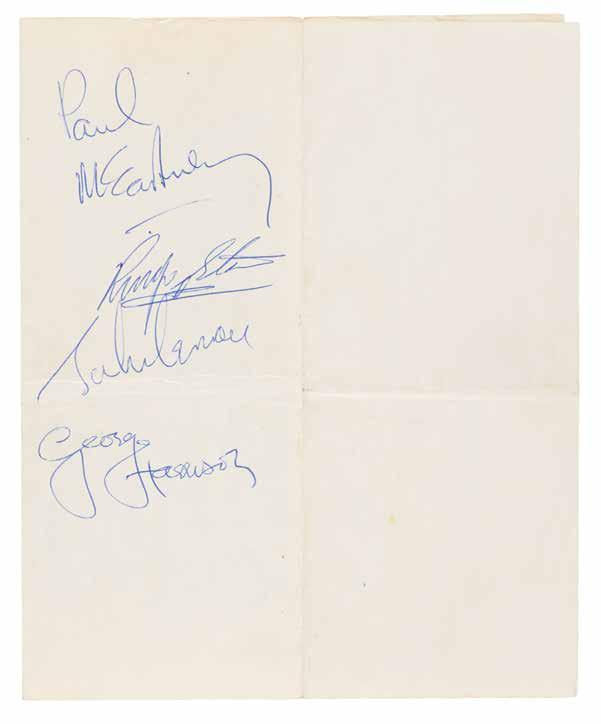
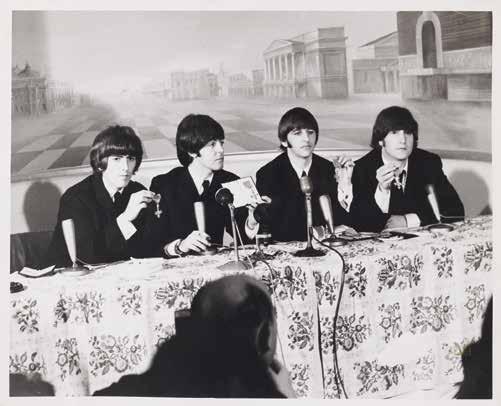
The Beatles are honored by Queen Elizabeth II with their prestigious MBE awards on October 26, 1965— beautiful, well-spaced Beatles autographs obtained by an attending OBE recipient
LOT 4087
Beatles Signatures - Obtained at Buckingham Palace When the Band Received Their MBEs from Queen Elizabeth II (October 26, 1965)
Vintage ballpoint signatures of the Beatles — “Paul McCartney,” “Ringo Starr,” “John Lennon,” and “George Harrison” — on the reverse of an 8 x 13 typed letter from the Central Chancery of the Orders of Knighthood (St. James’s Palace), dated October 7, 1965, sent by Major General C. H. Colquhoun to Lieutenant Colonel Harold Smith, directing the latter to attend an investiture at Buckingham Palace on October 26, 1965, to receive an OBE (Officer of the Order of the British Empire) award presented by Queen Elizabeth II. Smith was awarded the OBE for his service in the Royal Army Service Corps. In fine condition, with intersecting folds.
On the same day that Lieutenant Colonel Harold Smith received his OBE award at Buckingham Palace, the Beatles were also in attendance to accept their own MBEs (Member of the Order of the British Empire) from Queen Elizabeth II. The band had been informed of the honor earlier that month by manager Brian Epstein while working at London’s Twickenham Studios on their film Help! When the day arrived, the quartet drove up to Buckingham in Lennon’s black Rolls-Royce, drawing a crowd of some 4,000 fans, many of whom climbed lampposts and Palace gates in an effort to catch a glimpse of the group.
Along with hundreds of other recipients, each Beatle personally received his medal from the Queen. Four years later, however, Lennon publicly distanced himself from the honor. On November 25, 1969, he wrote a letter to Queen Elizabeth II: ‘I am returning my MBE as a protest against Britain’s involvement in the Nigeria-Biafra thing, against our support of America in Vietnam and against ‘Cold Turkey’ slipping down the charts. With love. John Lennon of Bag.’ This gesture had no effect on Lennon’s MBE status, which could be renounced, but ultimately only the Sovereign has the power to annul the original award. The medal, together with Lennon’s letter, is held at the Central Chancery of the Orders of Knighthood.
Accompanied by a certificate of authenticity from Tracks, a vintage photo of the band with their MBEs, a clipped newspaper article, and a letter of provenance from Harold’s son, which reads: ‘My father (Colonel Harold Smith) was awarded the OBE for services to the military. He was summoned to Buckingham Palace to receive the honour and my Mother and I (14 at the time) accompanied him to the Palace on the appointed day, 26 October 1965. I can’t remember whether we were aware beforehand that the Beatles were to receive their MBEs on the same day but it was certainly apparent when we arrived at the Palace gates as we were greeted with a crowd of screaming girls!
We were checked in at the gates, passed through the arch into the Quadrangle and then led inside…My Father told us later that while all the honour recipients were being organised, he had noticed the Beatles surrounded by a few people, and realised that he would not be very popular with me if he failed to get their autographs. Fortunately, he had the letter inviting him to the Palace to collect his OBE and after negotiating the crowd he got through to them and gratefully obtained their signatures on the reverse of the letter, before returning to his place in the queue…
The recipients came through to receive their honours in order of seniority. We saw my Father receive his OBE and a short while later the Beatles came in together to receive their MBES. Most recipients exchanged short pleasantries with the Queen but the Beatles took longer. Unfortunately we could not hear what was being said… In 2011, at the end of an episode of the Antiques Roadshow, the BBC announced they were to film a special issue to celebrate the Queens Diamond Anniversary in 2012 and were looking for interesting items with links to the Queen. I contacted them regarding my Beatles autographs story and I was subsequently invited to Kensington Palace to film the episode which was broadcast as part of the Anniversary celebrations on 10 June 2012.’
Starting Bid $2,500
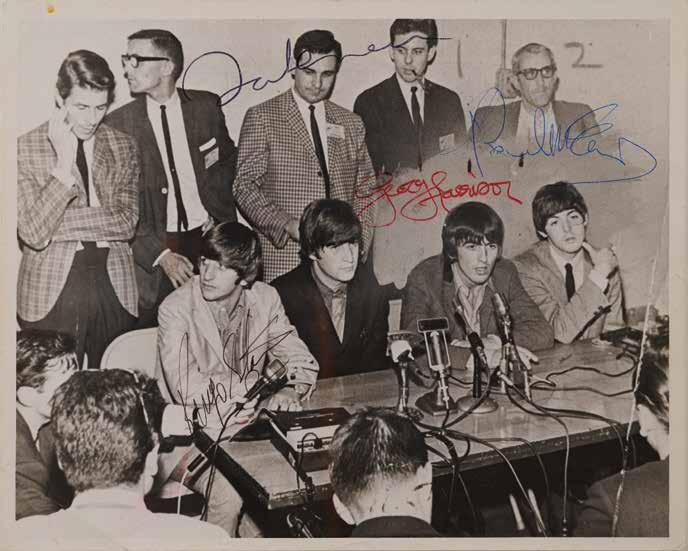
Peerless, incomparable fully signed Beatles photograph featuring four ‘solo era’ autographs of John, Paul, George, and Ringo, obtained in person over a five-year period beginning in 1976— the only known band-signed ‘post break-up’ photo known to exist
LOT 4086
Beatles Fully Signed ‘Post Break-up’ Photograph - Each Autograph Obtained In-Person After the Group’s Official Disbanding in April 1970
Vintage glossy 10 x 8 photo of the Beatles seated together at a press conference before their concert at the Cincinnati Gardens in Cincinnati, Ohio, on August 27, 1964, signed in various ink types by all four musicians, with each member having signed at a different location after their official disbanding in April 1970: in blue ink by Paul McCartney on May 24, 1976, outside of the Stanhope Hotel in New York City; in red felt tip by George Harrison on November 15, 1976, at the Ambassador Hotel in New York City; in black felt tip by John Lennon on December 20, 1976, outside of The Dakota building in New York City; and in black felt tip by Ringo Starr on March 24, 1981, when the rock star appeared as a guest on the Phil Donahue Show in Chicago. The signatures were obtained by pioneering in-person autograph collector Howard Siegel, an
amateur photographer from Cincinnati who also took candid shots of other famous musical acts like Elvis Presley, Led Zeppelin, the Rolling Stones, Bruce Springsteen, and The Who. In very good to fine condition, with overall creasing, and a tiny hole touching the ‘a’ in McCartney’s first name.
Accompanied by a letter of authenticity from noted Beatles expert Frank Caiazzo, which reads, in part: “Complete Beatles autograph sets from the solo era are as rare as rare can be. There were not many in-person graph obtainers in the 1970s who would have had the ability to get all four on separate occasions and separate locations – but there was one. His name was Howard Siegel…This is the only known photograph in existence that has been signed by all four members of The Beatles after they broke up in 1970, thus making it incredibly scarce and desirable.”
Starting Bid $1,000
‘One Armed Many Featured Creature’— original absurd humanoid drawing from the mind and hand of John Lennon
LOT 4088
Beatles: John Lennon Original ‘Humanoid’ Sketch with Authenticity Statement from Cynthia Lennon
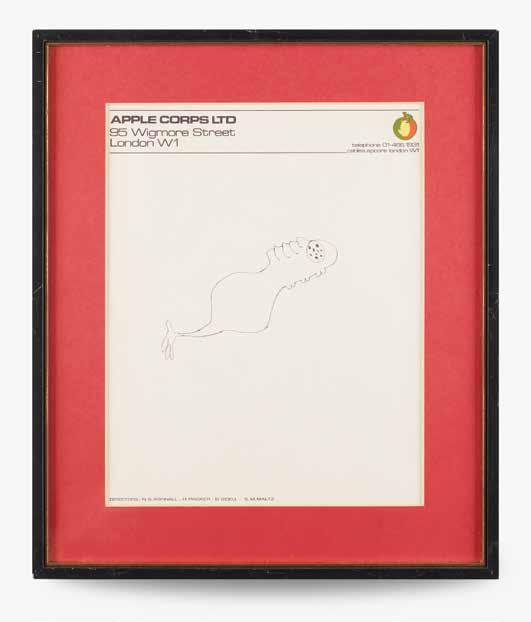
Original sketch by John Lennon of a humorous, anatomically incorrect specimen, unsigned, accomplished in black ink by Lennon on an off-white 7.75 x 9.75 sheet of Apple Corps Ltd. (95 Wigmore Street) letterhead. The drawing depicts a humanoid creature with an irregular assortment of body parts: one arm (or leg), one nose, one eye with nine pupils, three ears, and three mouths. Matted and framed to an overall size of 11.25 x 13.25. Included with the sketch is a signed and handwritten description statement from Lennon’s first wife, Cynthia Lennon (née Powell), who writes: “John Lennon / ‘One Armed Many Featured Creature’ / Pen and ink drawing on Apple Corps Ltd. headed paper / circa 1967-1968.” The drawing very likely dates to 1968; the Beatles moved to Wigmore Street as a temporary address for their headquarters in late January 1968 before moving to their Savile Row, London address in mid July 1968. In fine condition. Accompanied by a certificate of authenticity from Tracks. A desirable original drawing from Lennon, whose penchant for absurd art was famously published in his classic books, In His Own Write and A Spaniard in the Works. Provenance: Christie’s, Pop and Guitars: The Cynthia Lennon Collection, Part II, 1995.
Starting Bid $1,000
Six months after inciting a Chicago riot, Jim Morrison and the Doors return to the Coliseum in November 1968 and sign in full for an event photographer
LOT 4089
The Doors Signed 1968 ‘Waiting for the Sun Tour’ Program - Obtained at the Chicago Coliseum (November 3, 1968)
Original concert program from The Doors’ 1968 ‘Waiting for the Sun’ Tour, 22 pages, 8.75 x 11.5, signed and inscribed inside on their respective portrait pages in ink and ballpoint, “Chuck, Jim [Morrison],” “To Chuck, Robby Krieger,” “To Chuck, John [Densmore],” and “To Chuck, Ray Manzarek.” The inside front cover is dated November 13, 1968, and signed by the local supporting act Holocaust. The recipient of these autographs was an event photographer who attended The Doors’ show at the Chicago Coliseum in Chicago, Illinois, on November 3, 1968. In very good to fine condition, with light creasing and general handling wear. Accompanied by full letters of authenticity from REAL and JSA. This represents the only known fully signed program of the Doors from 1968.
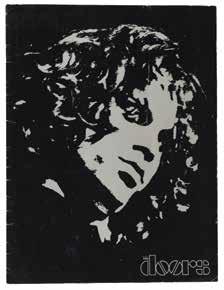
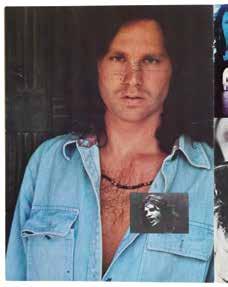
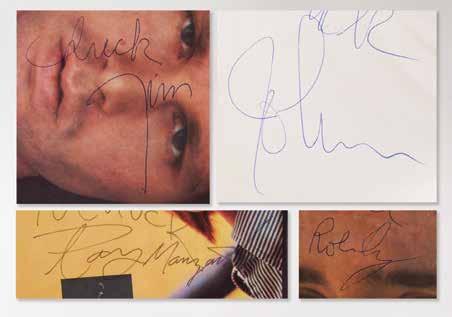
The Doors returned to the Chicago Coliseum roughly six months after their infamous appearance there on May 10, 1968—an evening that descended into chaos when Jim Morrison incited a riot, forcing the band to flee as a crowd of 4,000 stormed the stage. The Doors, and Morrison in particular, were far tamer at the November engagement; however, four days later, on November 7, 1968, at the Veterans Memorial Coliseum in Phoenix, Arizona—just two days after the U.S. presidential election—Morrison reverted to enfant terrible form. Openly voicing his displeasure with Richard Nixon’s victory, Morrison declared, ‘Well, we have a new resident. If we don’t like him, we will get him!’ His conduct that night, which reportedly included obscene gestures, nearly sparked another riot and ultimately resulted in a five-year ban on the band’s performances in Phoenix.
Starting Bid $1,000
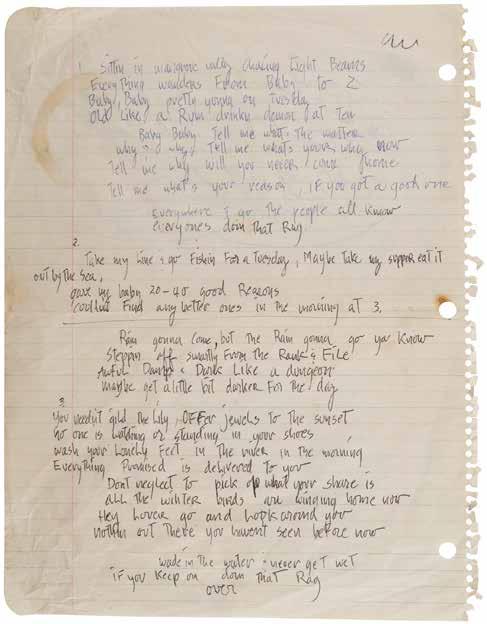
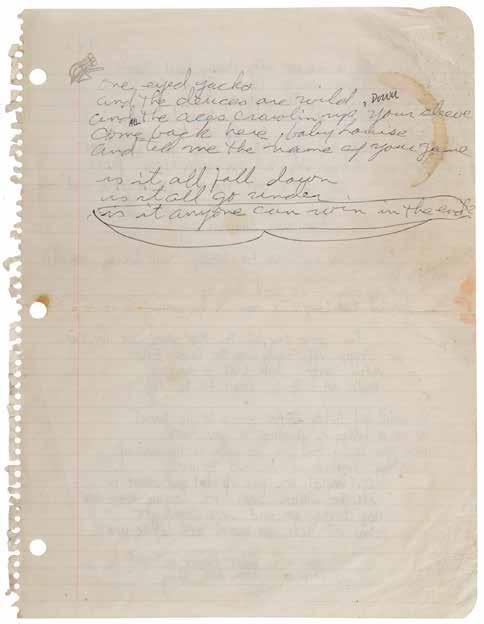
Extraordinary original handwritten song lyrics by Jerry Garcia and Robert Hunter for the song
‘Doin’ That Rag,’ the surreal and psychedelic fourth track from the Grateful Dead’s legendary third studio album, Aoxomoxoa
LOT 4090
Grateful Dead: Jerry Garcia and Robert Hunter
Original Handwritten Song Lyrics for ‘Doin’ That Rag,’ an Experimental Classic from the Band’s 1969 Album, Aoxomoxoa
Original manuscript lyrics to the classic 1969 Grateful Dead song ‘Doin’ That Rag,’ handwritten by founding member Jerry Garcia and the band’s lyricist, Robert Hunter, on both sides of an off-white 8.5 x 11 sheet of notebook paper. Undated, the song was likely conceived by Garcia and Hunter between September 1968 and January 1969, fine-tuned, set to music, and released as the fourth track on the Dead’s critically acclaimed third studio album, Aoxomoxoa, which was released on June 20, 1969.
The lyrics, unsigned, are started by Garcia, who writes the song’s first three verses on the front side, and finished by Hunter on the reverse with the fourth and final verse, with Garcia adding two words to the final verse, “All” and “Down,” and circling the song’s last line. Penned in blue and black ballpoint, the lyrics read, in part: [Garcia] “1. Sittin in Mangrove valley chasing light beams / Everything wanders from Baby to Z / Baby, baby, pretty young on Tuesday / Old like a Rum drinkin demon at tea / Baby baby tell me what’s the matter / Why? Why tell me what’s your why now / Tell me why will you never come home / Tell me what’s your reason, if you got a good one / Everywhere I go the people [Garcia switches to black ballpoint] all know / everyone’s doin that rag.” Upon closer examination, the ‘Doin’ That Rag’ lyric manuscript is nearly identical to the recorded version, with only a few minor variations. In fine condition, with some light soiling, and a drinking glass stain.
Accompanied by full letters of authenticity from REAL, JSA, and Beckett Authentication Services, a detailed letter of authenticity from Jeff Gold, the owner of Recordmecca and a
former executive vice president/general manager of Warner Bros. Records, and a signed letter of provenance from Susan Klein, former publicist for the Grateful Dead, who was gifted these lyrics by Garcia when she visited his home in July 1979.
The letter from Gold, who obtained the lyrics directly from Klein, reads, in part: “Original handwritten Grateful Dead lyric manuscripts are extremely rare. In nearly 50 years of buying and selling collectible records and music memorabilia, I have had only one full and one partial set of Jerry Garcia handwritten lyrics, both for cover songs. This is the first example I have encountered of a Garcia-written lyric manuscript for an important original Grateful Dead song (I’ve never seen a Grateful Dead lyric manuscript in the hands of both Garcia and Hunter). While a few Grateful Dead manuscripts have surfaced over the years, in my opinion, none have been remotely this important.”
Recorded during the Aoxomoxoa sessions in San Francisco between September 1968 and March 1969, ‘Doin’ That Rag’ captures the Grateful Dead at a pivotal, exploratory moment. Still a young band, the Dead poured extraordinary time and money into their highly anticipated third studio effort, essentially giving themselves a crash course in multi-track recording while helping pioneer the use of 16-track technology in rock. The song’s intricate, layered sound sits at the heart of Aoxomoxoa, an album beloved for its strange, playful, and darkly psychedelic spirit, and it remains a cult favorite more than 50 years later. The record also marked the beginning of Robert Hunter’s tenure as a full-time lyricist, cementing his legendary partnership with Jerry Garcia and affirming his role as an indispensable member of the Grateful Dead despite never performing onstage. Hunter’s role was later formally recognized when he became the only non-performing band member to be inducted into the Rock and Roll Hall of Fame.
Starting Bid $5,000
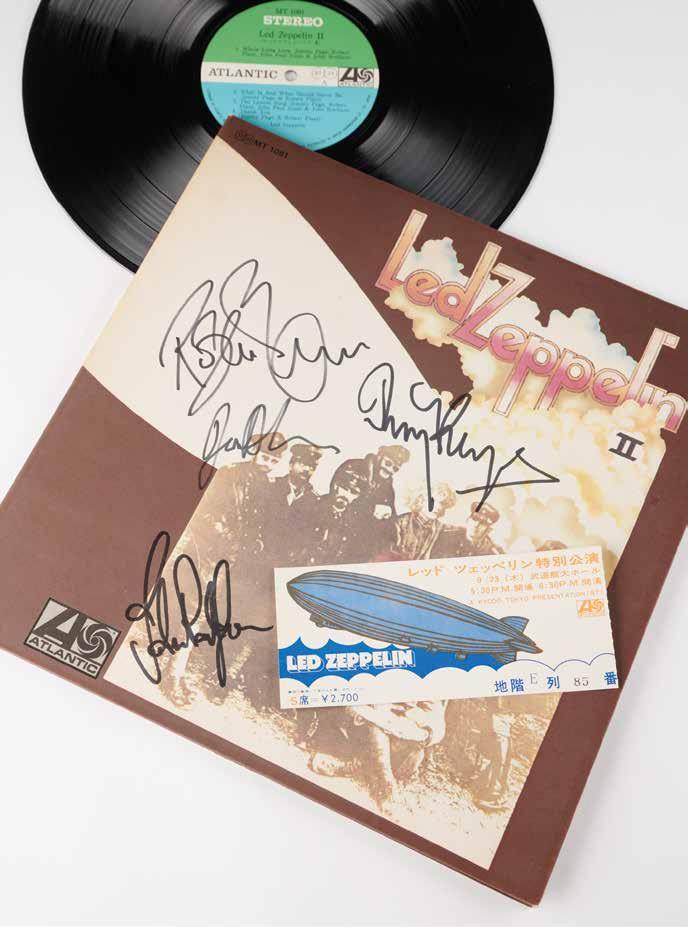
Outstanding, uninscribed Japanese pressing of Led Zeppelin II, boasting large, bold, and well-spaced signatures of the entire band, complete with an original concert ticket stub from the first show of their historic 1971 Japanese Tour
LOT 4091
Led Zeppelin Signed Album - Led Zeppelin IIObtained at the Start of Their Historic 1971 Japanese Tour
Japanese vinyl pressing of Led Zeppelin II, the second studio album from Led Zeppelin, which was released on October 22, 1969, signed prominently on the front cover in bold black felt tip by the full group: Robert Plant, Jimmy Page, John Paul Jones, and John Bonham. Includes a rare original ticket stub for Led Zeppelin’s landmark concert at the Nippon Budokan in Tokyo, Japan, on September 23, 1971, the first stop of their historic 1971 Japanese Tour. The consignor notes that the autographs were obtained in the lobby of the Hilton Hotel in Tokyo on September 22, 1971, when the band stayed there to perform two sold-out shows at nearby Budokan Hall on September 23rd and 24th. In fine condition, with a trivial marker squiggle to the back cover. The record is included. To date, this represents the finest example of a fully signed Led Zeppelin album that we have ever offered.
Led Zeppelin’s 1971 Japanese Tour marked the band’s first visit to Japan and ran from September 23 to September 29, 1971, shortly after the conclusion of their American tour. The group arrived in Tokyo on September 22nd on a flight from Honolulu and checked into the Hilton, where they held a press conference attended by Japanese journalists and photographers. The tour was significant as it was among the earliest visits to Japan by a major Western rock band and drew major media attention.
The brief, five-date tour included a notable benefit concert in Hiroshima on September 27th. In appreciation, the city presented the band with a letter of thanks and a commemorative city medal from the mayor. A typical set list from the shows featured some of the band’s most iconic numbers, such as ‘Immigrant Song,’ ‘Black Dog,’ ‘Stairway to Heaven,’ ‘Dazed and Confused,’ and ‘Whole Lotta Love.’
Accompanied by a certificate of authenticity from Tracks and a detailed letter of provenance from the original recipient: “In September 1971, as a high school student in Tokyo, I was an enthusiastic fan of Led Zeppelin and deeply moved by their music. Upon learning that the band would be staying at the Tokyo Hilton Hotel during their Japan tour, I decided to take a chance and try to meet them in person.
On September 22, 1971, I waited for approximately 10 hours in the lobby of the Tokyo Hilton. As each member came and went through the main entrance, I politely approached them one by one and respectfully asked for their signatures. I was incredibly fortunate and honored that all four members - Robert Plant, Jimmy Page, John Bonham, and John Paul Joneskindly agreed to sign the album for me directly.
The signed album has been carefully preserved ever since. It has been stored in a custom acrylic frame, kept in a dark, climate-controlled storage area to prevent exposure to light and dust. This item has remained in my private collection for over five decades and has never been publicly offered until now.’
Starting Bid $5,000
Rare blue ‘management’ rain jacket from the iconic Woodstock Music and Art Fair of 1969, originating from the personal collection of the festival’s emcee, organizer, and production manager, John Morris
LOT 4092
Woodstock: John Morris’s Event-Used ‘Woodstock Music and Art Fair’ Rain Jacket - Officially Worn as the Festival’s Emcee and Production Manager
Original 1969 blue nylon Woodstock Music and Art Fair rain jacket, which was personally-owned and -worn by the festival’s production manager and stage announcer, John Morris. The buttoned jacket, size small, features a drawstring waist, and the back prominently shows Arnold Skolnick’s iconic design of a bird perched on the upper neck of a guitar. There were three different official colored jackets issued for Woodstock: green for crew, red for security, and blue for management personnel, the latter being the rarest of the three. The inner collar retains its original Feko label. In fine condition, with stains to the left arm, and wear to the back design. Accompanied by a certificate of authenticity from Tracks.
Originating from the estate of longtime concert promoter John H. Morris (1939–2023), who began his career as a theatrical producer, working with performers such as Peter Cook, John Cleese, and Cass Elliot. In July 1967, during the ‘Summer of Love,’ he produced his first rock concert: a free show in Toronto’s City Hall Square featuring Jefferson Airplane and the Grateful Dead. While in Toronto, Morris and Joshua White introduced large-scale theatrical staging to rock concerts, including a psychedelic light show projected from behind a giant screen, marking the beginnings of what became known as the Joshua Light Show.
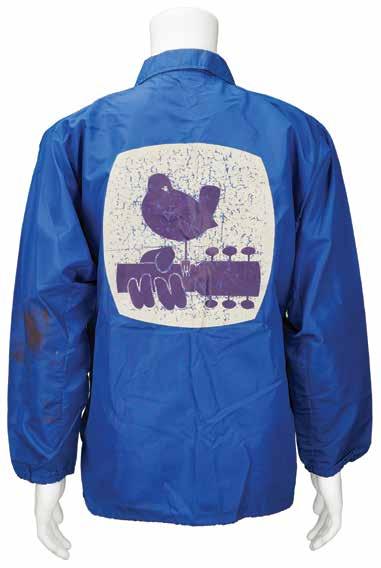
Morris later persuaded Bill Graham to open a Fillmore theater in New York, where he served as managing director and co-produced the first European tours for Jefferson Airplane and The Doors. He went on to act as production manager for the Woodstock Music and Art Fair, booking many of the performers and serving as principal Master of Ceremonies. He is widely recognized as the ‘voice of Woodstock’ for delivering the announcement, ‘It’s a free concert from now on.’
After relocating to England in 1970, Morris launched London’s first rock-and-roll theater, the Rainbow, which opened with The Who on November 4, 1971. He continued producing concerts in Europe and the United States through 1990, including 19 Grateful Dead shows, the first European tour of Paul and Linda McCartney’s band Wings, and tours with Ike and Tina Turner, Chuck Berry, New Riders of the Purple Sage, and Santana. His production companies also presented concerts by Stevie Ray Vaughan, David Bowie, Pink Floyd, and Frank Zappa, and he served as manager for Otis Redding, the Danish band Gasolin’, and Japanese jazz musician Stomu Yamashta.
Starting Bid $500
Magnificent “gold coin” Chicago bank interest note from 1926, twice-signed
by Al Capone, his wife, and his mother
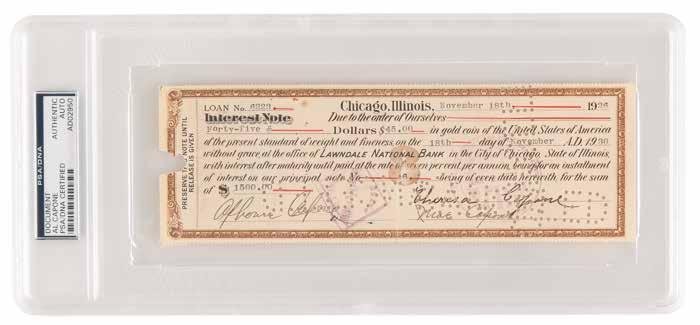
LOT 4093
Al Capone Rare 1926 Twice-Signed ‘Gold Coin’ Chicago Bank Document
Rare partly-printed DS, signed twice by legendary Chicago Outfit gangster Al Capone, “Alphonse Capone,” and also twice-signed by his mother, “Theresa Capone,” and his wife, “Mae Capone,” one page, 8.75 x 3, November 18, 1926. An interest note for “Loan No. 6223,” in part: “Due to the order of Ourselves…$45.00 in gold coin of the United States of America of the present standard of weight and fineness, on the 18th day of November A.D. 1930 without grace, at the office of Lawndale National Bank in the City of Chicago…with interest after maturity until paid, at the rate of seven percent, per annum, being for an installment of interest on our principal and note No. 6 being of even date herewith for the sum of $1500.00.” Signed at the conclusion by Al Capone, his mother Theresa Capone, and his wife Mae Capone, and also endorsed on the reverse by all three. In fine condition. Encapsulated in a PSA/DNA authentication holder.
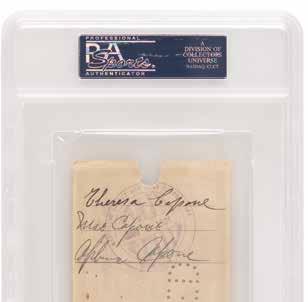
Capone rose to prominence throughout the 1920s, making a name for himself as a leader of the Chicago underworld. Increasingly implicated in the corruption of political, law enforcement, and labor officials, he was convicted of income tax evasion in 1931 and sentenced to 11 years of imprisonment, serving part of his sentence on Alcatraz. His autograph is scarce in any format, and this extraordinary example—a twice-signed “gold coin” Chicago bank document boasting two full-name autographs, plus the signatures of two members of the Capone crime family—stands out as one of the best Capone documents we have ever offered. It is one of just a handful of these Al Capone bank documents to come to market in the past twenty years, and would be the ‘kingpin’ of any collection of 20th-century Americana.
Starting Bid $1,000
Mob boss Al Capone’s Colt semi-automatic pistol, given to one of his bootleggers for protection
LOT 4094
Al Capone’s Colt .25 Model 1908 Vest Pocket Pistol, Presented to a Chicago Bootlegger
Colt Model 1908 Vest Pocket semi-automatic pistol presented by Al Capone to a Chicago bootlegger, serial #148999, cal. .25 ACP, 2 1/8˝ barrel. The pistol retains about 70% factory blue with fine condition checkered black hard rubber factory grips. The mechanics are fine, all factory lettering is clear, and a proper two-tone magazine is included. Housed in a custom wooden case with form-fitting velvet lining.
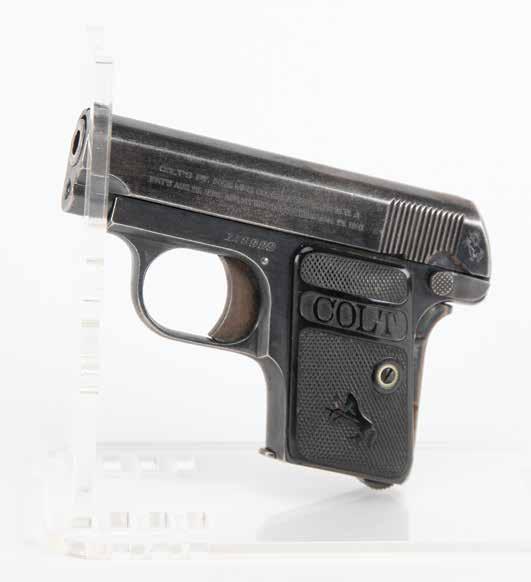
Accompanied by a notarized letter by Philip Mascarello, dated September 11, 2000, to Greg Martin of Butterfield’s Auction House. He writes: “I have a 25 cal. Colt gun serial #148999 that was given to my folks in the prohibition era by Al Capone. My mother told me it was given to them for protection if needed. My father was a bootlegger in those days. Al Capone would stop at our house and have some of my mother’s cooking Italian style which he liked. From what I remember he always stopped at night (Capone). There was a place in Chicago Heights called Hungry Hill where he had a brewery which was close to our house. You did not dare say any wrong about Capone in that area as he fed most of the people living there…I remember the big black Cadillac that Capone came in. He always had a driver…I remember the people that made the booze. Luigi was my father, Emilio was his brother and Pete & Setimo. My father was killed being chased by the police. He had a load of booze in the back seat of the Oakland car he was driving. He ran into a moving freight train.” This transfers as a modern firearm.
Starting Bid $1,000
Prohibition-era official mug shot photograph of a 22-year-old Bugsy Siegel, arrested as a suspicious character by the Philadelphia Police Department during a bootlegging run with Meyer Lansky in April 1928
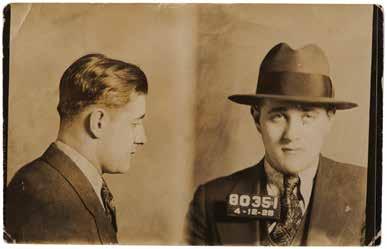
LOT 4096
Bugsy Siegel Original Mug Shot Photograph (April 12, 1928) - The Earliest Known Arrest Photograph of the Murder, Inc. Mobster
Incredibly early Prohibition-era pearl-finish 5.5 x 3.5 official mug shot photograph of legendary mobster Bugsy Siegel, pictured at the age of 22 in profile and front-facing views. The reverse bears a booking form from the “Bureau of Police, Philadelphia,’ which is filled out in a clerical hand and contains the following information: Name (“Benjamin Sagal”), Alias (“Segal, Siegal”), Age (“26”), Height (“5 ft, 8 1⁄4 in.”), Weight (“161 1⁄2”), Build (“Med”), Hair (“Dark Brown”), Eyes (“Gr + Blue”), Complexion (“Med Dk”), Born (“N.Y.C.”), Occupation (“Auto Delivery”),
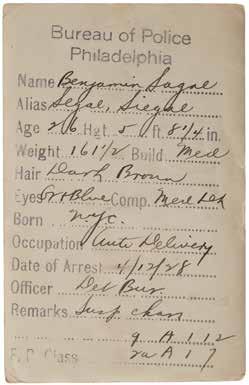
Date of Arrest (“4/12/28”), Officer (“Det. Bur.”), and Remarks (“Susp. char.”).” In very good to fine condition, with scattered small creases. While many have assumed that the New York Police Department took this mug shot, Benjamin ‘Bugsy’ Siegel was actually arrested in Philadelphia in April 1928 for being a suspicious character. In addition to lying about his age, Bugsy also told the authorities that he was in the auto livery business when, in reality, he and Meyer Lansky were running a bootlegging gang in New York City at the time. An amazing piece of criminalia that represents the earliest known arrest photograph of Bugsy Siegel.
Starting Bid $200
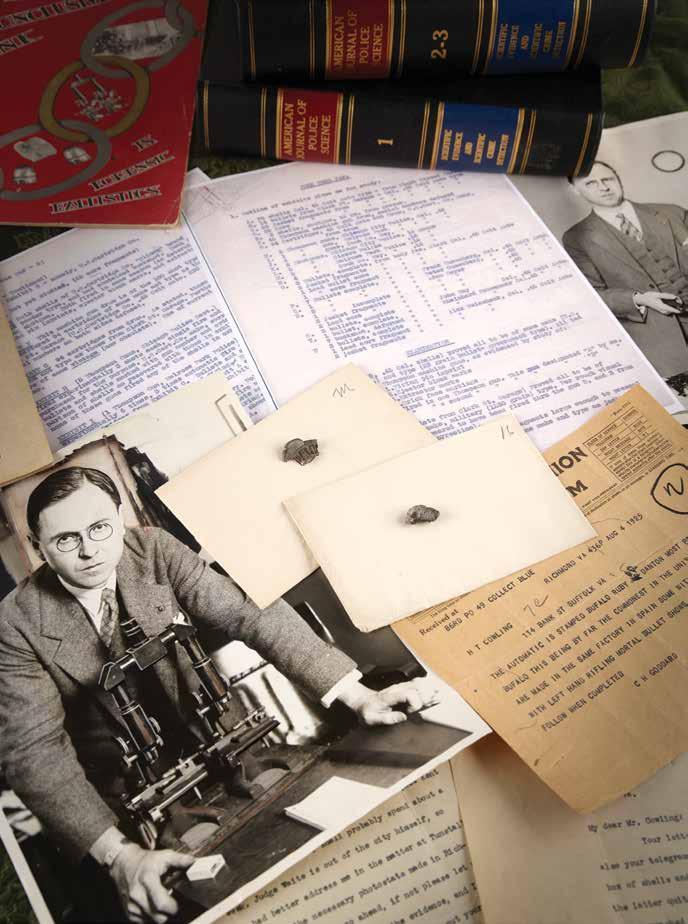
Evidence “M” and “16”—virtually unobtainable Saint Valentine’s Day Massacre crime-scene bullet fragments examined by forensic ballistics pioneer Calvin H. Goddard
LOT 4095
Saint Valentine’s Day Massacre (2) Original Crime-Scene Bullet Fragments from the Forensic Laboratory of Calvin H. Goddard
Two original ‘Goddard Lab’ bullet fragments recovered from the crime scene of the Saint Valentine’s Day Massacre, the infamous gangland execution in which seven members and associates of Chicago’s North Side Gang were murdered by assailants disguised as police officers. The men were lined up facing a wall inside a garage in Chicago’s Lincoln Park neighborhood and shot at close range with Thompson submachine guns and a shotgun; seventy rounds were fired from the Thompsons, along with a single shotgun cartridge, on February 14, 1929—one of the most notorious unsolved crimes of the Prohibition era.
These fragments—marked as jacket fragment “M” and core fragment “16”—were recovered alongside 14 intact bullets and 70 ejected shell casings, part of a larger evidentiary group that included 25 jacket fragments designated ‘A’ through ‘Y’ and 22 core fragments numbered 1 through 22, all of which were collected as evidence and submitted to the Scientific Crime Detection Laboratory in Chicago, where they were examined by pioneering forensic scientist Calvin H. Goddard. Measuring approximately .75˝ × .5˝ each, the fragments are accompanied by their original 1929 Calvin Goddard laboratory envelopes marked “M” and “16,” as well as modern photographic prints showing enlarged X-ray images of both pieces and the original evidence inventory list submitted to Goddard for examination, on which fragments “M” and “16” appear as Exhibits “C” and “D.”
In passing through the victims, the bullets fragmented upon striking bone or other solid objects, producing jacket fragments that are torn and highly irregular; contemporary forensic reports note that some examples from the crime scene retained traces of dark-colored wool from the victims’ overcoats. Goddard’s analysis demonstrated that the weapons used were not police-issued firearms, leading investigators to conclude that the killings were the work of organized crime. Of further evidential import is the presence of a special “S” stamp found above the cannelure of the jacket fragment identified as “M.” This marking corresponds to U.S. Cartridge Co. special “S”–stamped .45 ACP ammunition, examples of which were recovered during a Michigan police raid on the home of Fred “Killer” Burke, long suspected to have been one of the Saint Valentine’s Day Massacre gunmen. Burke was exposed after a drunken automobile collision in St. Joseph, Michigan, in December 1929, during which he fatally shot a responding police officer. Although Burke escaped, a subsequent search of his lakeside residence uncovered a cache of weapons, ammunition, and ballistic equipment, including two Thompson submachine guns and quantities
of U.S. Cartridge Co. ammunition bearing the distinctive “S” stamp. These materials were forwarded to Goddard’s Scientific Crime Detection Laboratory, where test-firing conclusively demonstrated that the Thompson guns seized from Burke discharged bullets matching those recovered from the Massacre victims—rendering the “S” stamp on fragment “M” a highly significant forensic link between the crime-scene evidence and ammunition found in Burke’s possession. In overall fine condition.
Included with the fragments are two signed letters of transmittal from historian Neal Trickel, along with an unfired 12-gauge 00 buckshot cartridge from the Goddard Bullet Reference Collection, possibly originating from ammunition recovered with massacre suspect Fred Burke’s guns in Michigan. Similar cartridges were used during testfiring of suspected massacre weapons; this example is a Peters ‘Victor’ cartridge, whereas those recovered from the garage were U.S. Cartridge Co. ‘Climax’ brand, three unfired examples of which are included. Also accompanying the lot are three ballistics-related letters from Calvin Goddard, dated 1925 (two ALSs and one TLS) on his Bureau of Forensics Ballistics letterhead, a 1925 telegram from Goddard, four vintage wire photographs and two modern prints of Goddard, and a group of period ballistics publications associated with the Scientific Crime Detection Laboratory. Highlights include Firearms Identification (FBI, circa 1941), bearing the ownership stamp “Jos. C. Wilimovsky”; A History of Firearm Identification by Goddard (1936); and the two-volume American Journal of Police Science (1930–1931), printed by Northwestern University Press for the Laboratory. The fragments derive from the estate of Neal Trickel, a Wisconsin collector and longtime associate of noted crime historian William J. Helmer. Trickel developed a close interest in the work of Colonel Calvin H. Goddard, in part through his personal relationship with Joe Wilimovsky, Goddard’s longtime laboratory assistant. When the Scientific Crime Detection Laboratory was sold to the Chicago Police Department in 1938, Wilimovsky retained a significant archive of Goddard’s original materials, including correspondence, firearms, cartridges, and ballistic evidence. Long believed lost—reportedly destroyed in a Chicago Police Department basement flood—portions of the forensic evidence from the ‘Gangland Crime of the Century’ instead survived through Wilimovsky and later passed to Trickel, preserving a direct and continuous forensic link to the Massacre and to the foundational work of modern scientific crime detection. Today, the Mob Museum retains the overwhelming majority of the surviving physical evidence from the Saint Valentine’s Day Massacre, and no other crime-scene bullets are known to have been offered at public auction, making these fragments extraordinarily rare.
Starting Bid $1,000
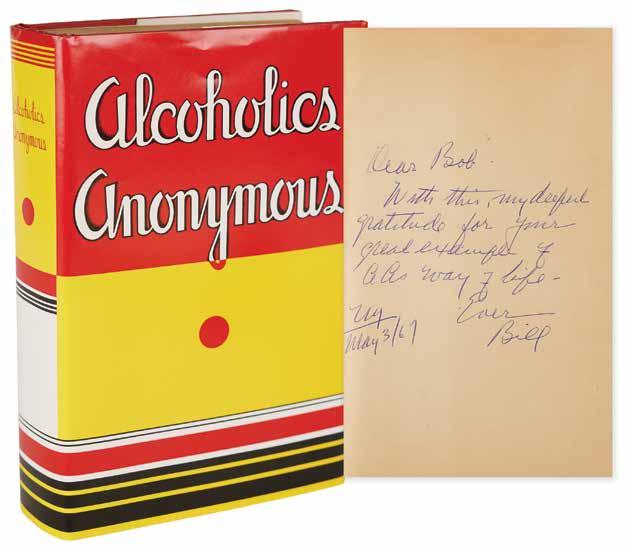
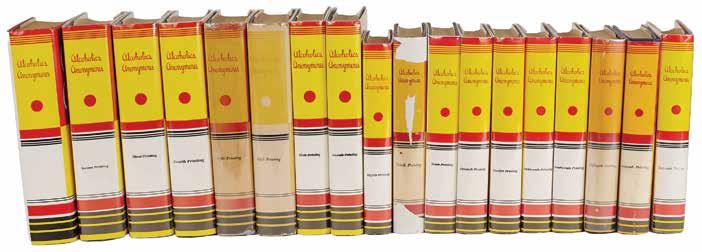
Every early printing of Alcoholics Anonymous—including a signed first printing of Bill W.’s ‘Big Book’
LOT 4097
Bill Wilson Signed Book - Alcoholics Anonymous (First Edition, First Printing), in a Complete Run of First Editions (Sixteen Printings)
An amazing collection of first editions of Bill W.’s classic ‘Big Book,’ comprising a complete run of all sixteen printings— highlighted by a sought-after signed first printing, plus the extremely scarce seventh printing. Five original dust jackets are included (5th (2), 9th, 15th, and 16th), while the remainder are wrapped in facsimile reprint jackets. Eighteen books in total, as two are duplicated within the group.
The two highlights of the collection are:
- Alcoholics Anonymous. First edition, first printing (April 1939). NY: Works Publishing Company, 1939. Hardcover bound in the original red cloth , 6.25 x 9.25, 400 pages. Signed and inscribed on the first free end page in blue ballpoint, “Dear Bob, With this, my deepest gratitude for your great example of AA’s way of life—Ever, Bill, NY, May 3/67.” Book condition: G+/None, with some rubbing and soiling to boards, small splits to cloth toward the top of the front joint, a bumped top front corner, and some expert professional restorations to include minor color touchups to the red cloth, and the application of new endpapers.
- Alcoholics Anonymous. First edition, seventh printing (January 1945). NY: Works Publishing Company, 1945. Hardcover bound in the original navy blue cloth, 6.25 x 9.25, 400 pages. An opening page carries the “Important Notice” statement: “This is a war time printing and is complete and unabridged in contents. While the type face remains unchanged, the book has been drastically reduced in size and weight in order to conform with Government regulations for saving paper.” Despite this statement, the book was made the same size as the previous printing—a mistake that led to a quick halt in production. It is estimated that only a few hundred (~200-500) seventh printings were produced before the stoppage, making it far and away the rarest edition of the ‘Big Book.’ Book condition: VG-/None, with minor rippling to cloth and rubbing to boards, edgewear, some minor dampstaining to textblock edge, and an ink inscription on the half-title page, “James Wilson, One Day at a Time.”
The other books include:
Alcoholics Anonymous - First edition, second printing (March 1941)
Alcoholics Anonymous - First edition, third printing (June 1942)
Alcoholics Anonymous - First edition, fourth printing (March 1943) (2 copies, one in an original 5th printing jacket)
Alcoholics Anonymous - First edition, fifth printing (January 1944) (original jacket)
Alcoholics Anonymous - First edition, sixth printing (June 1944)
Alcoholics Anonymous - First edition, eighth printing (February 1945)
Alcoholics Anonymous - First edition, ninth printing (January 1946) (original jacket)
Alcoholics Anonymous - First edition, tenth printing (August 1946)
Alcoholics Anonymous - First edition, eleventh printing (June 1947)
Alcoholics Anonymous - First edition, twelfth printing (October 1948)
Alcoholics Anonymous - First edition, thirteenth printing (February 1950)
Alcoholics Anonymous - First edition, fourteenth printing (July 1951)
Alcoholics Anonymous - First edition, fifteenth printing (January 1954)
Alcoholics Anonymous - First edition, sixteenth printing (August 1954) (2 copies, one in an original jacket)
These books are in overall very good condition, and the original jackets are in overall good condition, with some fading colors and paper loss. First published in 1939 during the final years of the Great Depression, Alcoholics Anonymous—the foundational text of the worldwide AA movement—would go on to become one of the most influential American books of the 20th century, shaping modern concepts of recovery, peer support, and addiction treatment. The sixteen printings of the first edition, issued between 1939 and 1954, document the formative years of the Fellowship as it expanded from a small group into an international organization. As a complete run, this collection offers a rare bibliographic record of that evolution, made all the more exceptional by the inclusion of a signed first printing and the legendary wartime seventh printing, widely regarded as the rarest and most sought-after edition of the Big Book.
Starting Bid $5,000
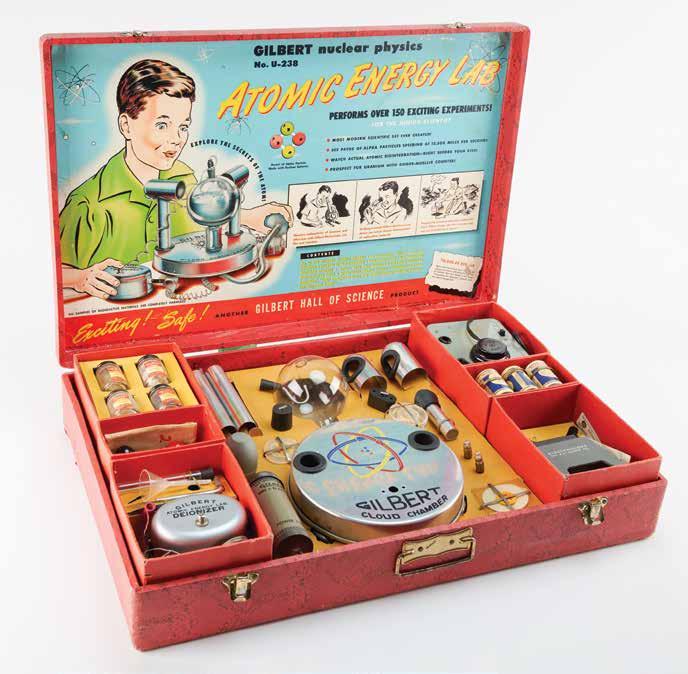
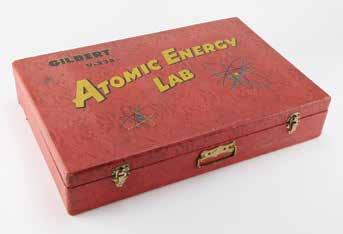
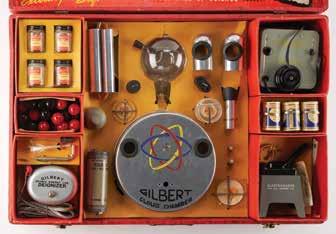
Rare, complete example of the Gilbert U-238 Atomic Energy Laboratory— the ‘most dangerous toy in history’
LOT 4098
Gilbert U-238 Atomic Energy Laboratory - ‘The Most Dangerous Toy in History’
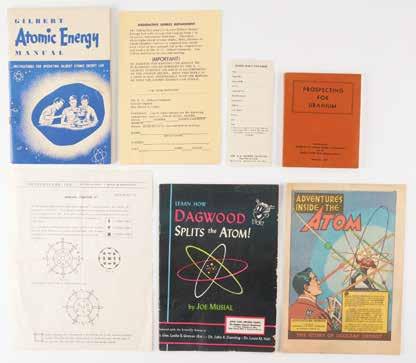
Rare, complete example of the Gilbert U-238 Atomic Energy Laboratory in its original reed suitcase, measuring 25˝ x 16.5˝ x 5˝, created by Alfred Carlton Gilbert, known for his development of the Erector Set and popular chemistry kits. The laboratory kit contains a cloud chamber, allowing the viewer to watch alpha particles traveling at 12,000 miles per second; a spinthariscope showing the results of radioactive disintegration on a fluorescent screen; and an electroscope measuring the radioactivity of different substances in the set: carnotite, autunite, torbernite, and uraninite. Includes the original 59-page “Gilbert Atomic Energy Manual,” a “Prospecting for Uranium” guide published in 1949 by the US Atomic Energy Commission and US Geological Survey, a “Dagwood Splits the Atom” instructional comic book, an “Adventures Inside the Atom” comic book, an “Inorganic Structure Kit” instruction sheet from Metaloglass, Inc., a “Radioactive Source Replacement” form, and an “Inspector’s Voucher” from the A.C. Gilbert Company date-stamped August 21, 1950. In very good to fine condition, with some scuffing and edgewear to the case and the interior artwork.
Components list:
- Battery-powered Geiger-Müller counter
- Electroscope
- Spinthariscope
- Wilson cloud chamber with a short-lived alpha source (Po-210) in the form of a wire
- Four glass jars containing natural uranium-bearing (U-238) ore samples (autunite, torbernite, uraninite, and carnotite from the ‘Colorado plateau region’)
- Low-level radiation sources (beta-alpha (Pb-210); pure beta (possibly Ru-106); and gamma (Zn-65))
- ‘Nuclear spheres’ for making a model of an alpha particle
- Three ‘C’ Batteries
Produced only in 1950 and 1951, with fewer than 5000 sold total, this set is extremely rare and highly coveted. In 2006, the pop culture publication Radar Magazine called the lab set one of ‘the 10 most dangerous toys of all time’ because it contained radioactive material. The professional journal IEEE Spectrum published a more-detailed review in 2020, discussing the kit in the context of the history of science education kits and safety concerns. It described the likely radiation exposure as ‘minimal, about the equivalent of a day’s UV exposure from the sun,’ provided that the radioactive samples were not removed from their containers, in compliance with the warnings in the kit instructions.
Starting Bid $1,000
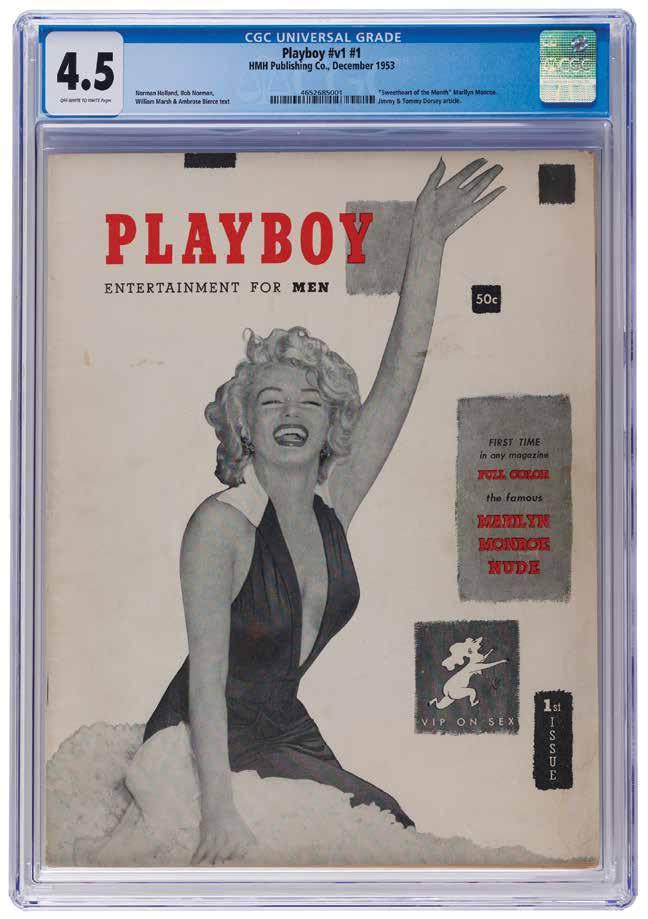
Sought-after example of Playboy #1, featuring an iconic nude of Marilyn Monroe
Playboy #1 - CGC Universal Grade 4.5
CGC Universal Grade 4.5 (Off-White to White Pages). Soughtafter newsstand edition Playboy #1 (HMH Publishing Co., December 1953), featuring Marilyn Monroe on the front cover and inside. This iconic magazine, which famously features a full-color nude of Miss Monroe (the one and only “Sweetheart of the Month”) as the centerfold, launched Hugh Hefner’s Playboy into the national spotlight as America’s leading magazine for men’s entertainment.
Early in 1953, 27-year-old Hugh Hefner, a former staff member at Esquire then employed by Children’s Activities magazine, decided to test the waters with a ‘new’ kind of publication. To that point, men’s magazines were typified by a pulpy potpourri of action and adventure fiction, cornball humor, tame, toothless exposés, and low-grade cheesecake pictorials. Hefner, sensing the incipient sea change in American attitudes toward sex—a sophisticated, cosmopolitan openness that lay beneath the veneer of Eisenhower-era propriety—assembled, at his kitchen table, the first issue of what would become one of the greatest success stories in the history of publishing.
The first issue of Playboy, which bore a cover price of 50¢, was anchored by a series of nude ‘calendar’ photos that had been modeled in the previous decade by struggling starlet Marilyn Monroe. Though the images had been around for years, Hefner’s gamble paid off handsomely with more-thanrespectable sales of nearly 54,000 copies. Encouraged by this auspicious launch, Hefner made continuous improvements to the magazine, eventually phasing out reprinted material in favor of original fiction (contributed, over the years, by such respected figures as Saul Bellow, Kurt Vonnegut, John Updike, and Joyce Carol Oates), and, more famously, lavishly produced nude pictorials featuring wholesome ‘girls next door.’ By the end of 1956, Playboy surpassed Esquire as the top-selling magazine of its type and was well on the way to inspiring legions of men to recite one of most durable howlers in the history of dubious claims: ‘I get it for the articles!’
Because of its uniquely iconic status, and because few of the original purchasers could have predicted the magazine’s eventual status as a bona-fide institution, copies of Playboy’s first issue have attained status among collectors as the most desirable and sought-after example of any periodical in any genre.
Starting Bid $300
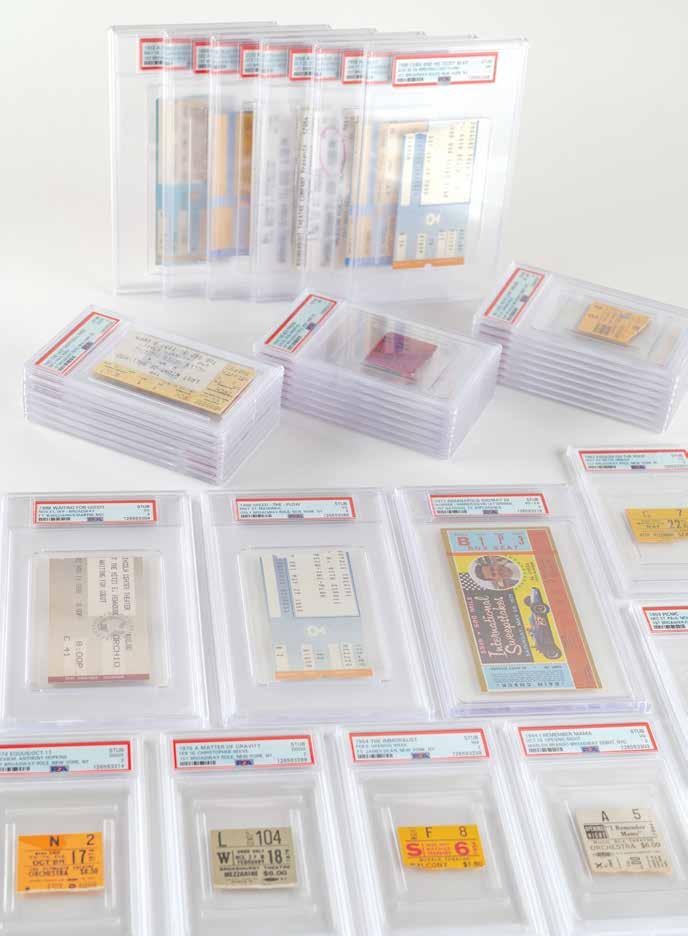
Star-studded stage debut and early career ticket collection of 40 entertainment icons, highlighted by legends like James Dean, Marlon Brando, Madonna, Barbra Streisand, Robert Redford, and Paul Newman
LOT 4100
Actors and Entertainers Collection of (37) Historic Stage Milestone Tickets and Ticket Stubs, Including James Dean, Marlon Brando, Madonna, and Barbra Streisand
Ticket and ticket stub collection documenting historic stage debuts and early, pre-fame performances of approximately 40 future stars of music and entertainment, which includes iconic Hollywood actors like
James Dean, Marlon Brando, and Robert Redford, crossover giants like Madonna, Bette Midler, and Barbra Streisand, and legendary funnymen like John Belushi, Robin Williams, and Steve Martin. The collection, which contains a total of 37 tickets and ticket stubs, is alphabetized by surname and categorized by key career milestones, ranging from opening-night Broadway debuts and first Broadway productions to early Broadway roles and formative theatrical appearances.
Starting Bid $1,000
Each item in the collection has been individually encapsulated and graded by PSA, and is listed as follows:
Opening Night Broadway Production Debuts
- Marlon Brando (I Remember Mama at the Music Box Theatre, on October 19, 1944)STUB VG 3
- James Caan and Peter Fonda (Blood, Sweat and Stanley Poole at the Morosco Theatre on October 5, 1961) - FULL NM-MT 8
- Dustin Hoffman (A Cook for Mr. General at The Playhouse, on October 19, 1961)STUB VG-EX 4
- Cole Porter (Can-Can at the Shubert Theatre, on October 19, 1953) - STUB FR 1.5
- Burt Reynolds (Look, We’ve Come Through at the Hudson Theatre, on October 25, 1961)
- STUB EX-MT 6
- Neil Simon (Catch a Star! at the Plymouth Theatre on September 6, 1955) - STUB PR 1
Broadway Debut (First Broadway Production)
- Julie Andrews (The Boy Friend at the Royale Theatre, on June 24, 1955) - STUB PR 1
- Warren Beatty (A Loss of Roses at the Coronet Theatre, on December 15, 1959)
- STUB FR 1.5
- Sid Caesar (Make Mine Manhattan at the Broadhurst Theatre, on July 17, 1948) - STUB EX-MT 6
- Robert De Niro (2) (Cuba and His Teddy Bear at the Longacre Theatre, on August 9 and 30, 1986) - STUB EX-MT 6 and STUB NM 7
- Adam Driver (Mrs. Warren’s Profession at the American Airlines Theatre on October 13, 2010) - STUB NM-MT 8
- Ralph Fiennes (Hamlet at the Belasco Theatre, on May 21, 1995) - STUB GOOD 2
- Carrie Fisher (Irene at the Minskoff Theatre, on December 21, 1973) - STUB EX-MT 6
- James Gandolfini (A Streetcar Named Desire at the Barrymore Theatre, on May 16, 1992) - STUB NM 7
- Anthony Hopkins (Equus at the Plymouth Theatre, on October 17, 1974) - STUB GOOD 2
- Nicole Kidman (The Blue Room at the Cort Theatre, on December 20, 1998) - STUB EX 5
- Paul Lynde [Mel Brooks] (Leonard Sillman’s New Faces of 1952, at the Royale Theatre, on October 4, 1952; also served as the debut of Mel Brooks, who wrote several sketches for the play) - STUB GOOD 2
- Madonna (Speed-the-Plow at the Royale Theatre, on May 27, 1988) - STUB VG 3
- Bette Midler (Fiddler on the Roof at the Majestic Theatre, on May 22, 1967) - STUB VG 3
- Paul Newman (Picnic at the Music Box Theatre, on December 17, 1953) - STUB VG 3
- Christopher Reeve (A Matter of Gravity at the Broadhurst Theatre, on February 18, 1976) - STUB GOOD 2
- Paul Rudd (The Last Night of Ballyhoo at the Helen Hayes Theatre, on September 9, 1997) - STUB GOOD 2
- Jeremy Strong (A Man for All Seasons at the American Airlines Theatre on October 21, 2008) - STUB GOOD 2(MK)
- John Travolta (Over Here! at the Shubert Theatre, on August 7, 1974) - STUB VG 3
- Christopher Walken (J.B. at the Anta Theatre, on June 15, 1959) - STUB VG-EX 4
- Sigourney Weaver (The Constant Wife
at the Shubert Theatre, on May 8, 1975)STUB VG 3
- Robin Williams and Steve Martin (Waiting for Godot at the Lincoln Center Theater on November 11, 1988) - STUB VG 3
Early Broadway Appearances
- James Dean (The Immoralist at the Royale Theatre on February 6, 1954) - STUB NM 7
- Gene Hackman (Poor Richard, on ‘Opening Night’ at the Helen Hayes Theatre on December 2, 1964) - STUB NM 7
- Robert Redford (Sunday in New York at the Cort Theatre, on December 13, 1961)FULL NM-MT 8
- George C. Scott (General Seeger, ‘Opening Night’ at the Lyceum Theatre, on February 28, 1962 - STUB NM 7
- Barbra Streisand (Funny Girl at the Winter Garden, on May 2, 1964) - STUB NM 7
Early Theatrical Productions
- John Belushi and Chevy Chase (National Lampoon: Lemmings at the Pine Knob Music Theatre, on June 18, 1973) - STUB VG 3(MK)
- David Letterman (TV debut at the 1971 Indianapolis 500, at the Indianapolis Motor Speedway in Speedway, Indiana, on Saturday, May 29, 1971) - STUB VG-EX 4
- Al Pacino (The Local Stigmatic at the Actor’s Playhouse, on November 5, 1969) - FULL NM-MT 8
- Sidney Poitier (Anna Lucasta at the American Theatre on December 12, 1947) - STUB FR 1.5
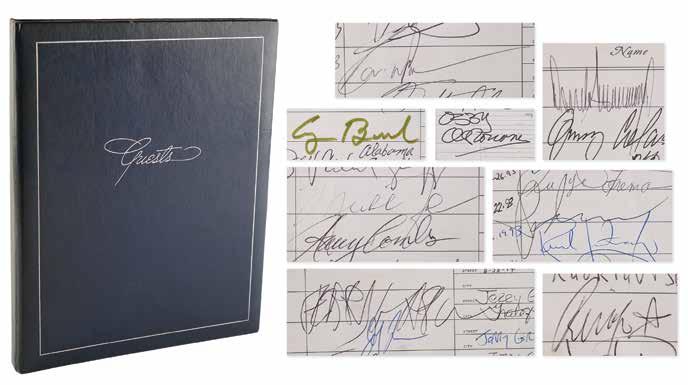
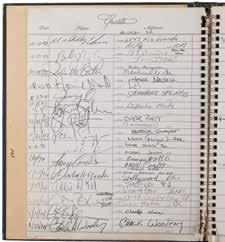
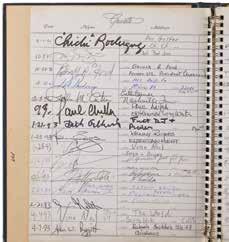
Star-studded 1990s
airport guestbook signed by Jerry Garcia, Michael Jordan, Donald Trump, and dozens more
LOT 4101
Phoenix Airport Guest Log Signed by (60+)
Notables, including Donald Trump, Michael Jordan, and Jerry Garcia
Unique 9 x 11.25 hardcover guest book from Phoenix Sky Harbor International Airport, signed by over 60 celebrities and notable figures during the 1990s. Highlights are: Jerry Garcia, Michael Jordan, Madonna, Ringo Starr, Sting, Ozzy Osbourne, Donald Trump, Gerald Ford, George Bush, and Robin Williams (adding “professional fool for hire”).
Other notable signers include: Kirstie Alley, Paul Anka, Charles Barkley, Vida Blue, Clint Black, Jon Bon Jovi, James Brown, Pat Buchanan, Billy Ray Cyrus, Jerry Colangelo, Jeff Cook, Scott Crossfield, Danny DeVito, Bob Dole, Michael Dorn, Donald
Fagen, George Foreman, Jeff Foxworthy, Kenny G, Ernest Gallo, Dave Gahan, A. C. Green, Tom Hanks, Eddie Hill, Grant Hill, Bruce Jenner, Magic Johnson, Connie Kalitta, Jim Kelly, Jack Kemp, Rush Limbaugh, Howie Mandel, Reba McEntire, Art Modell, Joe Montana, Vince Neil, Frank Peterson, Oliver Platt, Mary Lou Retton, John Ritter, Chi Chi Rodriguez, Kenny Rogers, Axl Rose, Dick Rossi, Sawyer Brown, Charlie Sheen, Rod Stewart, Danny Sullivan, Patrick Swayze, Al Unser, Vicki Van Meter, Joe Walsh, Paul Westphal, Chuck Woolery, and Steve Young. In fine condition.
A rare cross-section of late-20th-century popular culture, where political power, athletic greatness, and entertainment royalty are preserved together in one remarkable volume.
Starting Bid $500
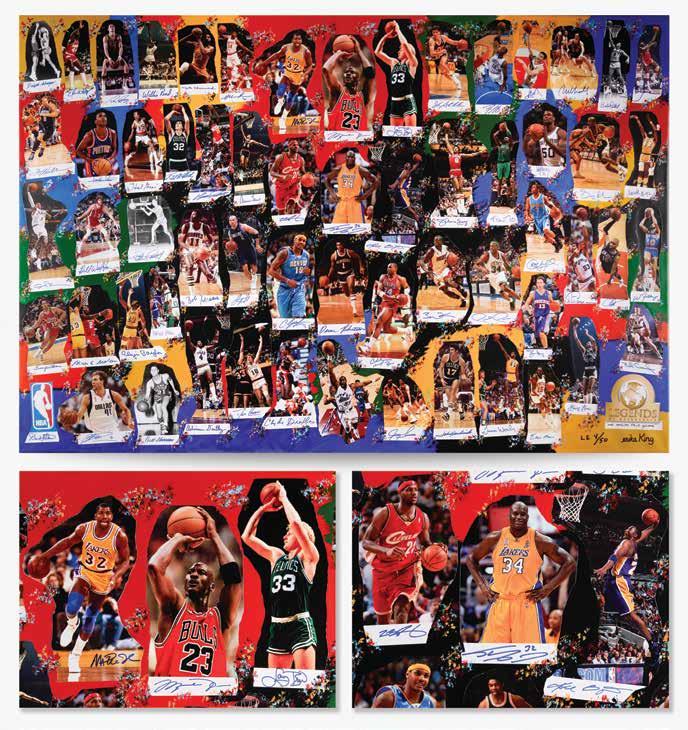
‘Legends of Basketball –We Made This Game’—an NBA fan’s dream piece, limited edition fine art collage signed by 60 of the biggest names in basketball history, a group highlighted by MVP superstars Michael Jordan, Kobe Bryant, Magic Johnson, Larry Bird, Shaquille O’Neal, and LeBron James
LOT 4102
NBA Legends (60) Multi-Signed Fine Art Photo Collage - ‘Legends of Basketball – We Made This Game’ (Ltd. Ed. #LE 4/50) - 60˝ x 40˝
Limited edition color 60˝ x 40˝ fine art photograph collage by Miami-based artist Erika King entitled ‘Legends of Basketball – We Made This Game,’ numbered LE 4/50 as part of the ‘Legends Edition,’ featuring an original stylized painted canvas background mounted with in-game action images of 60 of the NBA’s greatest players, a fraternity highlighted by all-time greats like Michael Jordan, Kobe Bryant, Magic Johnson, Larry Bird, Shaquille O’Neal, and LeBron James. The full list of NBA players, each of whom has signed in blue felt tip below their respective likeness, is as follows (alphabetical):
Carmelo Anthony, Charles Barkley, Rick Barry, Elgin Baylor, Larry Bird, Bill Bradley, Kobe Bryant, Vince Carter, Bob Cousy, Dave Cowens, Bill Cunningham, Adrian Dantley, Clyde Drexler, Julius Erving, Walt Frazier, Kevin Garnett, George Gervin, Artis Gilmore, Hal Greer, John Havlicek, Connie Hawkins, Elvin Hayes, Dwight Howard, Allen Iverson, LeBron James, Magic Johnson, Michael Jordan, Jason Kidd, Bob Lanier,
Jerry Lucas, Karl Malone, Moses Malone, Bob McAdoo, Kevin McHale, Yao Ming, Earl Monroe, Steve Nash, Dirk Nowitzki, Hakeem Olajuwon, Shaquille O’Neal, Robert Parish, Chris Paul, Gary Payton, Bob Pettit, Paul Pierce, Willis Reed, Oscar Robertson, David Robinson, Dolph Schayes, Bill Sharman, John Stockton, Isiah Thomas, Nate Thurmond, Dwyane Wade, Bill Walton, Jerry West, Lenny Wilkens, Dominique Wilkins, Deron Williams, and James Worthy. The piece is also signed by former NBA Commissioner David Stern and by the artist, Erika King. In fine condition.
Accompanied by a certificate of authenticity from Dreamstar and Icon Art Images, which states that this “art piece was individually hand signed by each player and authenticated by each player with a participation agreement, and each autograph was personally witnessed by a Dreamstar and Icon Art Images representative for authenticity…This original fine art collage was created by artist Erika King, Icon Art Images and Dreamstar in conjunction with the National Basketball Association, NBA Properties, Inc. and the National Basketball Retired Players Association.”
Starting Bid $2,500
Conditions of Sale
ANYONE EITHER REGISTERING TO BID OR PLACING A BID (“BIDDER”) ACCEPTS THESE CONDITIONS OF SALE AND ENTERS INTO A LEGALLY, BINDING, ENFORCEABLE AGREEMENT WITH R&R AUCTION COMPANY OF MASSACHUSETTS, LLC (“RR AUCTION”) TOGETHER WITH BIDDER, THE “PARTIES”).
This Agreement contains important provisions that control rights and liabilities, and specifically has provisions governing how disputes are handled as well as LIMITATIONS OF LIABILITY that can be imposed upon RR Auction, WAIVER OF JURY and ARBITRATION PROVISIONS. This acknowledgement is a material term of these Conditions of Sale and of the consideration under which RR Auction agrees to these terms. PLEASE READ CAREFULLY.
The following terms and conditions (“Conditions of Sale”) constitute the sole terms and conditions under which RR Auction will offer for sale and sell the property on its website, and/or described in the catalog of items for auction (the “Catalog”). These Conditions of Sale constitute a binding agreement between the Parties with respect to the auction in which Bidder participates (the “Auction”). By bidding at the Auction, whether in person, through an agent or representative, by telephone, facsimile, online, absentee bid, or by any other form of bid or by any other means, Bidder acknowledges the thorough reading and understanding of all of these Conditions of Sale, all descriptions of items in the Catalog, and all matters incorporated herein by reference, and agrees to be fully bound thereby.
Section 1
The Parties1.1 RR Auction and Auction
This Auction is presented by RR Auction, a d/b/a/ of R&R Auction Company of Massachusetts, LLC, as identified with the applicable licensing information on the title page of the Catalog or on the www.RRauction. com Internet site. The Auction is conducted under these Conditions of Sale. Announcements and corrections from the podium at live auctions and those made through the Conditions of Sale appearing on the Internet at RRauction.com supersede those in the printed Catalog.
1.2 Bidder
Bidder shall mean the original Bidder on the property offered for sale by RR Auction and not any subsequent owner or other person who may acquire or have acquired an interest therein. If Bidder is an agent, the agency must be disclosed in writing to RR Auction prior to the time of sale, otherwise the benefits of the warranty shall be limited to the agent and not transferable to the undisclosed principal.
The rights granted to Bidder under these Conditions of Sale are personal and may not be assigned or transferred to any other person or entity, whether by operation of law or otherwise without the express written assent of RR Auction. Bidder may not transfer, assign, or otherwise convey these Conditions of Sale or any of the rights herein, and such purported transfer, assignment, or conveyance shall be null and void. No third party may rely on any benefit or right conferred on any Bidder by these Conditions of Sale, and no third party is intended as a beneficiary of these Conditions of Sale.
Bids will not be accepted from minor persons under eighteen (18) years of age without a parent or legal guardian’s written consent containing an acknowledgment of the Conditions of Sale herein and indicating their agreement to be bound thereby on behalf of the Bidder.
All Bidders must meet RR Auction’s qualifications to bid. Any Bidder who is not a client in good standing of RR Auction may be disqualified at RR Auction’s sole option and will not be awarded lots. Such determination may be made by RR Auction in its sole and unlimited discretion, at any time prior to, during, or even after the close of the Auction. RR Auction reserves the right to exclude any person from the Auction.
If an entity places a bid, then the person executing the bid on behalf of the entity agrees to personally guarantee payment for any successful bid and
agrees to be bound by these Conditions of Sale in addition to company for whom the Bidder is acting
By accepting the Conditions of Sale, Bidder personally and unconditionally guarantees payment.
Section 2
Bidding Privileges
2.1 In order to place bids, Bidders who have not established an account with RR Auction must either furnish satisfactory credit information (including two collectibles-related business references) or supply additional information if requested, well in advance of the Auction. Bidders who are not members of RRAuction.com should pre-register before the close of the Auction to allow adequate time to contact references. Privileges will be granted at the sole discretion of RR Auction. Additionally, Bidders who have not previously established credit or who wish to bid in excess of their established credit history may be required to provide a cash deposit prior to RR Auction’s acceptance of a bid. Check writing privileges and immediate delivery of merchandise may also be determined by pre-approval of credit based on a combination of criteria: RRAuction.com history, related industry references, bank verification, a credit bureau report and/or a personal guarantee for a corporate or partnership entity in advance of the Auction venue.
2.2 Bidder providing any false or misleading information provided in connection with the registration shall be a material breach of the Conditions of Sale and in addition to any other remedies at law shall excuse RR Auction from performance under these Conditions of Sale, including the right to any refund.
2.2 Bidding privileges may be revoked without notice, for any reason, at the sole discretion of RR Auction .
Section 3
Buyer’s Premium
3.1 The Bidder acknowledges and agrees that a 25% buyer’s premium will be added to the hammer price on all individual lots sold in timed and live Auctions. . For payment other than by cash, delivery will not be made unless and until full payment has been received by RR Auction, i.e., check or wired funds have fully cleared. Unless otherwise agreed in writing, signed by RR Auction, payment in full is due within thirteen (13) calendar days of the Auction or within twelve (12) calendar days of the invoice date, whichever is earlier. Bidder’s failure to pay any payment in full when due required shall constitute a material breach, and in addition to other damages available under contract or law, at RR Auction’s election, RR Auction may cancel the sale and require full premium still be due along with interest at 1.5% per month from the date of breach, or at the maximum legally allowable rate.
Section 4
Bidding
4.1 Each Bidder’s determination of its bid should be based upon its own examination of the item(s) and independent investigation, rather than the any reliance as to what is represented in the Catalog, online or elsewhere. Bidder affirms that it regards any statements made by RR Auction concerning the item as solely opinion and that Bidder is making its own inspection and independent evaluation of the goods, and is not relying upon any description or statements by RR Auction (including as to quality, authenticity, provenance, ownership, liens existing, on goods legality, or value) in making its determination to bid on or purchase an item. In any purchase or sale, the value of the item(s) is determined by the price. THE BIDDER HEREBY ASSUMES ALL RISKS CONCERNING ANY AND ALL PURCHASES TO THE FULLEST EXTENT UNDER APPLICABLE LAW.
4.2 RR AUCTION IS NOT RESPONSIBLE FOR ERRORS IN BIDDING. A Bidder should make certain to bid on the correct lot and that the bid is the maximum (plus the Buyer’s Premium) that the Bidder is willing and able to pay. Since other Bidders (by mail, facsimile, online, and in person) will be present, and since a re-offering could damage the momentum of the sale, once the hammer has fallen and RR Auction has announced the winning Bidder, such Bidder is unconditionally bound to pay for the lot,
even if the Bidder has made a mistake.
4.3 All prospective Bidders who examine lots in person prior to the sale shall personally assume all responsibility for any damage they cause in so doing. RR Auction shall have sole discretion in determining the value of the damage caused, which shall be promptly paid by the prospective Bidder.
4.4 Title to any lot remains with Consignor, any secured party of the Consignor, or assignee of Consignor, as the case may be, until the lot is paid for in full by Bidder and Bidder has fully satisfied any outstanding financial obligations to RR Auction (including as it concerns aby other lots). RR Auction reserves the right to require payment in full before delivering any lot to the successful Bidder.
4.5 It is the Bidder’s responsibility and obligation to have the lots fully insured while in their possession. Bidder assumes any and all risk of loss upon the earlier of shipment to Bidder or in Bidder’s possession.
4.6 Bidder grants to RR Auction or its assigns the right to offset any sums due, or found to be due by RR Auction, and to make such offset from any past, subsequent or future consignment, or items acquired by Bidder in possession or control of RR Auction or from any sums due to Bidder by RR Auction. Bidder further grants RR Auction a lien consisting of a senior security interest (or purchase money security interest to the extent applicable) in such sums or items to the fullest extent applicable, authorizes RR Auction to file documents concerning the interest, and Bidder agrees to execute any further documents as may be reasonably necessary to grant RR Auction such security interest. Bidder agrees that RR Auction and its assigns shall be a secured party with respect to items bought by Bidder and in the possession of RR Auction, to the extent of the maximum indebtedness, plus all accrued fees and expenses, until the indebtedness is paid.
4.7 By bidding in this sale, Bidder personally and unconditionally guarantees payment. The authorized representative of any corporate Bidder who is present at the sale shall provide RR Auction or its agent, prior to the commencement of the bidding (or at the time of registration), with a statement signed by a principal, director or officer that they he or she personally and unconditionally guarantees any payment due RR Auction.
4.8 RR Auction may at its sole and absolute discretion, make loans or advances to Consignors and/or prospective Bidders.
Section 5
Bidding Options
5.1 Non-Internet bids (including but not limited to in-person, facsimile, phone and mail bids) are treated similarly to floor bids in that they must be on-increment. Any in-person, facsimile, phone, or mail bids that do not conform to a full increment will be rounded up or down to the nearest full increment and this revised amount will be considered Bidder’s high bid.
5.2 When identical bids are submitted, preference is given to the first received. To ensure the greatest accuracy, written bids should be entered on the standard printed bid sheet and be received at RR Auction’s place of business at least twenty-four (24) hours before the Auction start. RR Auction is not responsible for executing mail bids or facsimile bids received on or after the day the first lot is sold, nor Internet bids submitted after the published closing time; nor is RR Auction responsible for proper execution of bids submitted by telephone, mail, facsimile, e-mail, Internet, or in person once the Auction begins.
5.3 In all Auctions, bids on an item must raise the current high bid by at least 10%, or as specified on a per-Auction basis. Bids will be accepted in whole dollar amounts only. No “buy” or “unlimited” bids will be accepted. In a live sale, bids on an item can change at the discretion of RR Auction.
5.4 RR Auction reserves the right to accept or decline any bid. Bids must be for an entire lot and each lot constitutes a separate sale. All bids are per lot unless otherwise announced. Live auction lots will be sold in their numbered sequence unless RR Auction directs otherwise. It is unlawful and illegal for Bidders to collude, pool, or agree with another Bidder to pay less than the fair value for lot(s). For live auctions, RR Auction will have final discretion in the event that any dispute should arise between Bidders. RR Auction will determine the successful Bidder, cancel the sale,
or re-offer and resell the lot or lots in dispute. RR Auction will have final discretion to resolve any disputes arising after the sale and in online auctions. If any dispute arises, RR Auction’s sale record is conclusive.
Section 6 Payment
6.1 Subject to fulfillment of all of the Conditions of Sale set forth herein, upon the sooner of (1) the passing of title to the offered lot pursuant to these Conditions of Sale, or (2) possession of the offered lot by the Bidder, Bidder thereupon (a) assumes full risk and responsibility (including without limitation, liability for or damage to frames or glass covering prints, paintings, photos, or other works), and (b) will immediately pay the full purchase price or such part as RR Auction may require. In addition to other remedies available to RR Auction by law, RR Auction reserves the right to impose from the date of sale a late charge of 1.5% per month of the total purchase price if payment is not made in accordance with the conditions set forth herein. All property must be removed from RR Auction’s premises by the Bidder at his/her expense not later than sixty (60) business days following its sale and, if it is not so removed, RR Auction may send the purchased property to a public warehouse for the account, at the risk and expense of the Bidder.
6.2 Payment is due upon closing of the Auction session, or upon presentment of an invoice. RR Auction reserves the right to void an invoice if payment in full is not received within thirteen (13) calendar days of the Auction or within twelve (12) calendar days of the invoice date. In cases of nonpayment, RR Auction’s election to void a sale does not relieve the Bidder from their obligation to pay RR Auction its fees (seller’s and Buyer’s Premium) on the lot and any other damages pertaining to the lot.
6.3 All sales for total invoices greater than $1,000 are strictly for cash in United States dollars (including U.S. currency, bank wire, cashier checks, eChecks, and bank money orders), and are subject to all reporting requirements.
6.4 All deliveries are subject to good funds; funds being received in RR Auction’s account before delivery of the Purchases; and all payments are subject to a clearing period. RR Auction reserves the right to determine if a check constitutes “good funds”: checks drawn on a U.S. bank are subject to a ten (10) calendar day hold, and ten (10) business days when drawn on an international bank. Clients with pre-arranged credit status may receive immediate credit for payments via e-Check, personal or corporate checks.
6.5 In the event that a Bidder’s payment is dishonored upon presentment(s), Bidder shall pay the maximum statutory processing fee set by applicable state law. If Bidder attempts to pay via check and the financial institution denies the transfer from Bidder’s bank account, or the payment cannot be completed using the selected funding source, Bidder agrees to complete payment.
6.7 If RR Auction refers any unpaid invoice to an attorney for collection, the Bidder agrees to pay and shall be liable for RR Auction’s attorney’s fees, court costs, and other collection costs incurred by RR Auction in addition to the invoice amount and interest the greater of 1.5% per month or at the maximum legally allowable rate from date of invoice to collection. If RR Auction assigns collection to its house counsel, such attorney’s time expended on the matter shall be compensated at a rate comparable to the hourly rate of independent attorneys.
6.8 RR Auction shall have a lien against the merchandise purchased by the Bidder (as well as to the extent it is a consignor any other monies owed or due to Bidder) to secure payment of the Auction invoice. RR Auction is further granted a lien and the right to retain possession of any other property of the Bidder then held by RR Auction or its affiliates to secure payment of any Auction invoice or any other amounts due RR Auction or affiliates from the Bidder. With respect to these lien rights, RR Auction shall have all the rights of a secured creditor, including but not limited to the right of sale. In addition, with respect to payment of the Auction invoice(s), the Bidder waives any and all rights of offset he might otherwise have against RR Auction and the consignor of the merchandise included on the invoice (the Consignor”). If a Bidder owes RR Auction or its affiliates on any account, RR Auction and its affiliates shall have the right to offset such unpaid account by any credit balance due Bidder, and it may secure by possessory lien any unpaid amount by any of the Bid-
der’s property in their possession.
6.9 All checks, cashiers checks, bank checks, or money orders are payable to R&R Auction Company of Massachusetts, LLC. RR Auction clients with an invoice totaling $1,000 or under will have the option to pay by VISA, Mastercard, Discover or Paypal. All Paypal payments must be sent to FinanceDepartment@rrauction.com. Authorize.net, a third-party service provider contracted by RR Auction for processing on-line payments, charges a nonrefundable service fee of 3%, which will be added to your final invoice should you pay by credit/debit card.
Section 7 Sales Tax
RR Auction is a remote seller and we are now required to collect Sales/ Use Tax from our bidders. The states that we have nexus in we will be required to collect and remit sales tax on your behalf. Each state has different requirements to meet nexus. When RR Auction has achieved a certain monetary and/or invoice threshold in each state we will apply sales tax to your total invoice. The states that are affected are: ARIZONA, ARKANSAS, CALIFORNIA, COLORADO, CONNECTICUT, FLORIDA, GEORGIA, ILLINOIS, INDIANA, IOWA, KANSAS, KENTUCKY, MAINE, MARYLAND, MASSACHUSETTS, MICHIGAN, MINNESOTA, NEBRASKA, NEVADA, NEW JERSEY, NEW YORK, NORTH CAROLINA, OHIO, OKLAHOMA, PENNSYLVANIA,RHODE ISLAND, TENNESSEE, TEXAS, UTAH, VIRGINIA, WASHINGTON, WISCONSIN
If we have not achieved nexus in a particular state it is still your responsibility to pay sales tax on your purchases.
The sales tax rate is determined by the State, Country, and City where purchases are shipped to. If you decide to pick up your purchases at our New Hampshire location you will not be required to pay sales tax. The State of New Hampshire does not have a general sales and use tax. All purchases picked up at our Massachusetts location will be taxed at the current rate of 6.25%.
If you have a resale number please email Sue@RRAuction.com or fax to (603) 732-4288 a copy of your state resale certificate and you will be exempt from paying sales tax.
Section 8
Delivery; Shipping; and Handling Charges
Bidder is liable for shipping and handling and providing accurate information as to shipping or delivery locations and arranging for such. RR Auction is unable to combine purchases from other auctions or affiliates into one package for shipping purposes. Lots won will be shipped in a commercially reasonable time after payment in good funds for the merchandise and the shipping fees is received or credit extended, except when third-party shipment occurs. Bidder agrees that service and handling charges related to shipping items which are not pre-paid may be charged to a credit card on file with RR Auction.
Successful international Bidders shall provide written shipping instructions, including specified Customs declarations, to RR Auction for any lots to be delivered outside of the United States. NOTE: Declaration value shall be the item’(s) hammer price and RR Auction shall use the correct harmonized code for the lot. Domestic Bidders on lots designated for third-party shipment must designate the common carrier, accept risk of loss, and prepay shipping costs.
All duties, customs, and any other import charges are the responsibility of the bidder.
Section 9
Title
Title shall not pass to the successful Bidder until all invoices of Bidder (including those pertaining to the item(s) at issue) and amounts owed to RR Auction are paid in full. It is the responsibility of the Bidder to provide adequate insurance coverage for the items once they have been delivered to a common carrier or third-party shipper.
Section 10
Rights Reserved
RR Auction reserves the right, at any time before, during or after an auction has ended to: withdraw any lot before or at the time of the Auction, cancel any bid, and/or to postpone the Auction of all or any lots or parts thereof, for any reason. RR Auction shall not be liable to any Bidder in the event of such withdrawal, cancellation, or postponement under any circumstances. RR Auction reserves the right to refuse to accept bids from anyone at any time.
Section 11
Conducting the Auction
11.1 RR Auction reserves the right to postpone the Auction or any session thereof for a reasonable period of time for any reason whatsoever, and no Bidder or prospective Bidder shall have any claim as a result thereof, including consequential damages.
11.2 RR Auction’s Discretion: RR Auction shall determine opening bids and bidding increments. RR Auction has the right in its absolute discretion to reject any bid in the event of dispute between Bidders or if RR Auction has doubt as to the validity of any bid, to advance the bidding at its absolute discretion and to determine the successful Bidder in the event of a dispute between Bidders, to continue the bidding or to reoffer and resell the lot in question. In the event of a dispute after the sale, RR Auctions record of final sale shall be conclusive. RR Auction also may reject any bid if RR Auction decides either that any bid is below the reserve of the lot or article or that an advance is insufficient. Unless otherwise announced by RR Auction at the time of sale, no lots may be divided for the purpose of sale.
11.3 Reserves
Lots may be subject to a reserve which is the confidential minimum price below which the lot will not be sold. Consignors may not bid on their own lots or property. RR Auction may, from time to time, bid on items that it does not own. RR Auction may execute bids consecutively or otherwise up to one bid increment below the reserve.
11.4 Off-Site Bidding
Bidding by telephone, facsimile, online, or absentee bidding (advance written bids submitted by mail) are offered solely as a convenience and permitted subject to advance arrangements, availability, and RR Auction’s approval which shall be exercised at RR Auction’s sole discretion. Neither RR Auction nor its agents or employees shall be held liable for the failure to execute bids or for errors relating to any transmission or execution thereof. In order to be considered for off-site bidding in any manner, Bidders must comply with all of these Conditions of Sale and the terms contained on the Registration Form.
11.5 Estimate Prices:
In addition to descriptive information, each item in the Catalog sometimes includes a price range which reflects opinion as to the price expected at auction (the “Estimate Prices”). In other instances, Estimate Prices can be obtained by calling RR Auction at (603) 732-4280. The Estimate Prices are based upon various factors including prices recently paid at auction for comparable property, condition, rarity, quality, history and provenance. Estimate Prices are prepared well in advance of the sale and subject to revision. Estimates do not include the Buyer’s Premium or sales tax (see under separate heading).
11.6 Owned or Guaranteed Property:
RR Auction generally offers property consigned by others for sale at public auction; in very limited occasion, lots are offered that are the property of RR Auction.
11.7 Before the Auction:
Bidder may attend pre-sale viewing for all of RR Auction’s auctions at no charge. All property to be auctioned is usually on view for several days prior to the sale. Bidder is encouraged to examine lots thoroughly. Bidder may also request condition reports (see below). RR Auction’s staff are available at viewings and by appointment.
11.8 Maximum Bids In All Auctions:
To maximize Bidder’s chance of winning, RR Auction strongly encourages
the use of maximum bids. RR Auction will then bid for Bidder until the lot reaches Bidder’s specified maximum. Maximum bids are strictly confidential. Placing arbitrary, non-incremental bids on lots with prior maximum bids may result in these lots being sold for less than 10% above the under Bidder’s bid.
11.9
Successful Bids:
The fall of RR Auction’s hammer indicates the final bid. RR Auction will record the paddle number of the Bidder. If Bidder’s salesroom or absentee bid is successful, Bidder will be notified after the sale by mailed or emailed invoice.
11.10
Unsold Lots:
If a lot does not reach the reserve, it is bought-in. In other words, it remains unsold and is returned to the Consignor. RR Auction has the right to sell certain unsold items after the close of the Auction. Such lots shall be considered sold during the Auction and all these Terms and Conditions shall apply to such sales including but not limited to the Buyer’s Premium, return rights, and disclaimers.
11.11
Bidding in Timed Auction:
Bidder may open, monitor, and/or raise bids at any time before the close of a lot through www.rrauction.com. RR Auction offers a callback service the day of the Auction, but Bidder is responsible for supplying a correct telephone number(s) where Bidder can be reached until the Auction closes. Bidder must request this service in writing. RR Auction will make reasonable efforts to ensure that Bidders who request a callback are contacted if outbid; however, RR Auction does not guarantee this service and it is merely a courtesy and not an enforceable right. The auctioneer may also execute a bid on behalf of the consignor to protect the reserve, either by entering a bid in response to salesroom, telephone or absentee bids. Under no circumstances will the auctioneer place any bid on behalf of the consignor above the reserve. The auctioneer will not specifically identify bids placed on behalf of the consignor to protect the reserve.
To ensure proper registration, those Bidders intending to bid via the Internet must visit www.RRauction.com and register accordingly at least one full day prior to the actual auction. Winning bidders will be notified by RR Auction. RR Auction is not responsible or liable for any problems, delays, or any other issues or problems resulting out of use of the Internet generally or specifically, including but not limited to transmission, execution or processing of bids.
Any Bidder may bid on any lot prior to 6 pm EST/EDT. At that time, an extended bidding period goes into effect. If Bidder has not bid on a lot before 6 pm EST/EDT, Bidder may not bid on that lot after 6 pm EST/EDT. Only those Bidders who have placed bids on a lot before 6 pm EST/EDT will be allowed to bid on that lot after 6 pm EST/EDT. If Bidder is the only Bidder on a lot at 6 pm EST/EDT, that lot is awarded to Bidder. During the extended bidding period, a lot will remain open only to those who bid on that lot prior to 6 pm EST/EDT. All lots WITHOUT an opening bid at 6 pm EST/EDT will remain OPEN to ALL Bidders until 7 pm EST/EDT or until they receive their first bid. These lots will close immediately upon receipt of a bid or at 7 pm EST/EDT, whichever comes first. For all lots that are active after 7 pm EST/EDT, bidding will remain open until 30 minutes pass without a bid being placed on THAT lot (the “30 Minute Rule”). The 30 Minute Rule is applied on a PER LOT BASIS; each lot in the Auction closes individually based on bidding activity after 7 pm EST/EDT. On a PER LOT BASIS, the 30 minute timer will reset each time a bid is placed after 7 pm EST/EDT. If Bidder is the high Bidder, raising Bidder’s maximum bid will NOT reset the timer. RR Auction reserves the right to close the Auction at any time at its sole discretion.
11.12 Bidding - Internet Live
Auction:
Bidder may open, monitor, and/or raise bids at any time before the close of a lot through www.rrauction.com. RR Auction offers a callback service the day of the Auction, but Bidder is responsible for supplying a correct telephone number(s) where Bidder can be reached until the Auction closes. Bidder must request this service in writing. RR Auction will make reasonable efforts to ensure that Bidders who request a callback are contacted if outbid; however, RR Auction does not guarantee this service and it is merely a courtesy and not an enforceable right.
To ensure proper registration, those Bidders intending to bid via the Internet must visit www.RRauction.com and register accordingly at least one full day prior to the actual auction. Winning bidders will be notified by RR Auction. RR Auction is not responsible or liable for any problems, delays,
or any other issues or problems resulting out of use of the Internet generally or specifically, including but not limited to transmission, execution or processing of bids.
During live internet or live auction, property is auctioned in consecutive numerical order, as it appears in the catalog. The auctioneer will accept bids from those present in the salesroom or absentee bidders participating by telephone, internet or by written bid left with RR Auction in advance of the auction. The auctioneer may also execute a bid or bids (successively or otherwise) on behalf of the consignor to protect the reserve, either by entering a bid in response to salesroom, telephone or absentee bids. Under no circumstances will the auctioneer place any bid on behalf of the consignor above the reserve. The auctioneer will not specifically identify bids placed on behalf of the consignor to protect the reserve. All auctions for lots are with reserve unless specifically stated otherwise.
During live Auctions, internet bids can be placed in real time through one or more of the following Third Party services: www.liveauctioneers.com, www.invaluable.com and www.icollector.com. RR Auction is not responsible or liable for any problems, delays, or any other issues or problems resulting out of use of the Internet generally or specifically, including but not limited to transmission, execution or processing of bids. RR Auction treats any third-party site bids as floor or telephone bids. Floor bids and telephone bids are always considered first over third party sites bids, and floor bids are considered earlier than telephone bids. All RR Auction lots purchased through the third-party sites carry an additional Buyer’s Premium.
11.13 Miscellaneous:
Agreements between Bidders and Consignors to effectuate a non-sale of an item at Auction, inhibit bidding on a consigned item to enter into a private sale agreement for said item, or to utilize RR Auction’s Auction to obtain sales for non-selling consigned items subsequent to the Auction, are strictly prohibited. If a subsequent sale of a previously consigned item occurs in violation of this provision, RR Auction reserves the right to charge Bidder the applicable Buyer’s Premium and Consignor a Seller’s Commission as determined for each auction venue and by the terms of the seller’s agreement.
Acceptance of these Terms and Conditions qualifies Bidder as a client who has consented to be contacted by RR Auction in the future. In conformity with ”do-not-call” regulations promulgated by the Federal or State regulatory agencies, participation by the Bidder is affirmative consent to being contacted at the phone number shown in his application and this consent shall remain in effect until it is revoked in writing. RR Auction may from time to time contact Bidder concerning sale, purchase, and auction opportunities available.
11.14 Rules of Construction: RR Auction presents properties in a number of collectible fields, and as such, specific venues have promulgated supplemental Terms and Conditions. Nothing herein shall be construed to waive the general Conditions of Sale by these additional rules and shall be construed to give force and effect to the rules in their entirety.
Section 12
RR Auction’s Remedies
Failure of the Bidder to comply with any of these Conditions of Sale or the terms of the Registration Form is an event of material breach or default. In such event, RR Auction may, in addition to any other available remedies specifically including the right to hold the defaulting Bidder liable for the Purchase Price or to charge and collect from the defaulting Bidder’s credit or debit accounts as provided for elsewhere herein: (a) cancel the sale, retaining any payment made by the Bidder as damages (the Bidder understands and acknowledges that RR Auction will be substantially damaged should such default occur, and that damages under sub-part (a) are necessary to compensate RR Auction for such damages); (b) resell the property without reserve at public auction or privately; (c) charge the Bidder interest on the Purchase Price at the rate of one and one-half percent (1.5%) per month or the highest allowable interest rate; (d) take any other action that RR Auction, in its sole discretion, deems necessary or appropriate to preserve and protect RR Auction’s rights and remedies. Should RR Auction resell the property, the original defaulting Bidder shall be liable for the payment of any deficiency in the purchase price and all costs and expenses associated there with, including but not limited
to warehousing, sales-related expenses, reasonable attorney fees and court costs, commissions, incidental damages and any other charges due hereunder which were not collected or collectable. In the event that such Bidder is the successful Bidder on more than one lot and pays less than the purchase price for the total lots purchased, RR Auction shall apply the payment received to such lot or lots that RR Auction, in its sole discretion, deems appropriate. If RR Auction does not exercise such discretion, the lots to which the payment shall be applied will be in descending order from the highest purchase price to the lowest. Any Bidder failing to comply with these Conditions of Sale shall be deemed to have granted RR Auction a security interest in, and RR Auction may retain as collateral such security for such Bidder’s obligations to RR Auction, any Bidder’s property in RR Auction’s possession or to which title has not yet passed to Bidder. RR Auction shall have the benefit of all rights of a secured party under the Uniform Commercial Code (U.C.C.) as adopted by the Commonwealth of Massachusetts.
Section 13 Warranties
13.1 RR Auction does not provide any warranties to Bidders, whether expressed or implied, beyond those expressly provided in these Conditions of Sale. All property and lots are sold ”as is” and “where is”. By way of illustration rather than limitation, neither RR Auction nor the Consignor makes any representation or warranty, expressed or implied, as to merchantability or fitness for intended use, condition of the property (including any condition report), correctness of description, origin, measurement, quality, rarity, importance, exhibition, relevance, attribution, source, provenance, date, authorship, condition, culture, genuineness, value, or period of the property. Additionally, neither RR Auction nor the Consignor makes any representation or warranty, expressed or implied, as to whether the Bidder acquires rights in copyright, trademark, or other intellectual property (including exhibition or reproduction rights) related to the item, or whether the property is subject to any limitations or other rights. RR Auction does not make any representation or warranty as to title.
13.2 All descriptions, photographs, illustrations, and terminology including but not limited to words describing condition (including any condition reports requested by Bidder, see also Terminology), authorship, period, culture, source, origin, measurement, quality, rarity, provenance, importance, exhibition, and relevance, used in the Catalog, bill of sale, invoice, or anywhere else, represent a good faith effort made by RR Auction to fairly represent the lots and property offered for sale as to origin, date, condition, and other information contained therein; they are statements of opinion only. They are not representations or warranties and Bidder agrees and acknowledges that he or she shall not rely on them in determining whether or not to bid or for what price. Price estimates (which are determined well in advance of the Auction and are therefore subject to revision) and condition reports are provided solely as a convenience to Bidders and are not intended nor shall they be relied on by Bidders as statements, representations or warranties of actual value or predictions of final bid prices.
13.3 Bidders are accorded the opportunity to inspect the lots and to otherwise satisfy themselves as to the nature and sufficiency of each lot prior to bidding, and RR Auction urges Bidders to avail themselves accordingly.
13.4 All lots sold by RR Auction are accompanied by an Auction Certificate (“AC”). On any lot presented with an AC issued by RR Auction, the certification is only as to its attribution to the person or entity described or to the lot’s usage and only as explicitly stated therein (the “AC”), to the exclusion of any other warranties, express or implied, including but not limited to those pursuant to the Uniform Commercial Code. The AC inures only to the original Bidder (as shown in RR Auction’s records). Bidder may not transfer, assign, or otherwise convey the AC and such purported transfer, assignment, or conveyance shall be null and void.
Section 14 Firearms
RR Auction complies with all Federal and State rules and regulations relating to the purchasing, registration and shipping of firearms. A Bidder is required to provide appropriate documents and the payment of associated fees, if any. Bidder is responsible for providing a shipping address that is suitable for the receipt of a firearm.
Section 15 Unauthorized Statements
Under no circumstances is any employee, agent or representative of RR Auction authorized by RR Auction to modify, amend, waive or contradict any of these Conditions of Sale, any term or condition set forth on a registration form, any warranty or limitation or exclusion of warranty, any term or condition in either the Registration Form or these Terms and Conditions regarding payment requirements, including but not limited to due date, manner of payment, and what constitutes payment in full, or any other term or condition contained in any documents issued by RR Auction unless such modification, amendment, waiver or contradiction is contained in a writing signed by all parties. Any statements, oral or written, made by employees, agents or representatives of RR Auction to Bidder, including statements regarding specific lots, even if such employee, agent or representative represents that such statement is authorized, unless reduced to a writing signed Bidder and by an authorized officer of RR Auction by all parties, are statements of personal opinion only and are not binding on RR Auction, and under no circumstances shall be relied upon by Bidder as a statement, representation or warranty of RR Auction.
Section 16
Bidder’s Remedies
16.1 Except as stated expressly herein, Bidder’s sole and exclusive remedy related to or pertaining to items it bids upon, views, or purchases from RR Auction, and any claims by Bidder related to authenticity, ownership, condition, title or value, shall be against Consignor only.
16.2 This section sets forth the sole and exclusive remedies of Bidder as against RR Auction (inclusive of its affiliates, officers, managers, employees or agents), or in any way arising out of, related to, or in connection with these Conditions of Sale, , and is expressly in lieu of any other rights or remedies which might be available to Bidder by law. Time is of the essence with respect to these procedures.
16.3 Title to Items
The Bidder hereby accepts the benefit of the Consignor’s warranty of title and any other representations and warranties made by the Consignor for the Bidder’s benefit. In the event that Bidder demonstrates in writing, satisfactory to the sole discretion of RR Auction, that there was a breach of the Consignor’s warranty of title concerning a lot purchased by Bidder, RR Auction may make demand upon the Consignor to pay to Bidder the Purchase Price (including any premiums, taxes, or other amounts paid or due to RR Auction). Should the Consignor not pay the Purchase Price to Bidder within thirty days after such demand (if any made), RR Auction may disclose the identity of the Consignor to Bidder and may assign to Bidder all or some of RR Auction’s rights against the Consignor with respect to such lot or property. Upon such disclosure and/or assignment, all responsibility and liability of RR Auction, if any, with respect to said lot or item shall automatically terminate related to or arising from these Conditions of Sale or such transaction operating as a complete waiver and general release by Bidder as to RR Auction and its agents, contractors, and affiliates, as to any and all claims concerning or related to the item, if any . RR Auction shall be entitled to retain the premiums and other amounts paid to RR Auction by Consignor only. The rights and remedies provided herein are for the original Bidder only and they may not be assigned or relied upon by any transferee or assignee under any circumstances.
16.4 Authenticity Challenge Process
(1) If Bidder wishes to dispute or challenge the Authenticity of the lot or item (including asserting that it is incorrect), Bidder must adhere to the following procedure: Within 30 days of the Auction Date, Bidder must present written evidence to RR Auction, that the lot is not authentic as determined by a known expert in the field (and one recognized by RR Auction within its discretion) and send the physical item or lot at issue to RR Auction along with all evidence relied upon by Bidder for contesting the Authenticity. (“Authenticity Challenge Process”) “Authenticity” shall mean a gross discrepancy in the between the description, genuiness, or attribution of the item as represented by RR Auction in the Catalog or at the auction, and the item. If RR Auction concurs that the lot is not Authentic as was represented (it is sole discretion), Bidder’s sole and exclusive remedy
as against RR Auction (inclusive of its affiliates, agents, employees, and contractors) shall be a refund of the purchase price of the subject item paid by Bidder, with no other costs, liabilities or amounts recoverable by Bidder. If RR Auction does not agree with the assertion by Bidder, then the Parties shall follow the dispute resolution procedures of these Conditions of Sale. Strict adherence to the Authenticity Challenge Process is a condition of standing for Bidder to initiate suit or claim.
(2) So long as Bidder has complied with the Authenticity Challenge Process, any claim, suit or action, by Bidder concerning an AC or Certification of Authenticity, or related to the authenticity of the item must, without any exception, be brought within one (1) year of Auction Date and is subject to the other limitations and conditions stated in the Conditions of Sale.
16.5 Other Issues. Any dispute or claim by Bidder against RR Auction (or its affiliates, directors, employees, officers, agents, or contractors)) other than Authenticity, concerning any item or lot bid upon, or purchased, including value, title, condition, bidding process, or description must be asserted (if at all) in the following manner:
(1) If the description of any lot in the Catalog is materially or grossly incorrect (e.g., gross cataloging error), or there is any other gross material issue pertaining to the item or lot, the item or lot may be returned if returned within five (5) calendar days of receipt, and received by RR Auction no later than twenty-one (21) calendar days after the Auction Date with explanation in writing.. If there is any discrepancy between the description in the Catalog and a certificate of auction, then the description in the certificate of auction (“Lot Challenge Process”). This paragraph shall constitute Bidder’s sole right with respect to the return of items, and no refunds shall be given for any items not returned to and received by RR Auction within the period of time stated herein or not materially or grossly in deviation from the description. Such a refund is subject to RR Auction’s sole discretionary review, and any request for refund must be made concurrently with returning the physical item or lot to RR Auction. Any item not returned within said frame will constitute acceptance of the item and a waiver and release of any and all claims by Bidder pertaining to the item other than with respect to authenticity; and
(2) Provided that the Bidder has engaged in the Lot Challenge Process, any claim concerning such must be brought no later than one (1) year of the Auction Date for the item or lot at issue and is subject to the other limitations and conditions stated in the Conditions of Sale.
NO RETURN OR REFUND OF ANY AUCTION LOT WILL BE CONSIDERED OR PROVIDED EXCEPT AS PROVIDED IN THESE CONDITIONS OF SALE AND BIDDERS OR AS MAY BE REQUIRED BY LAW. FAILURE TO COMPLY WITH SUCH SHALL BE A COMPLETE DEFENSE TO ANY CLAIMS BY BIDDER RELATED TO THE CONDITIONS OF SALE, ANY AUCTION OR BID.
16.6 LIMITATION OF LIABILITY. For any and all claims by Bidder arising out of or related to this Agreement, Bidder’s viewing, bid, or purchase of items, or any agreement between the Parties, or otherwise, Bidder agrees that to the fullest extent such can be limited under the law, Bidder shall have no right to recover and hereby waives any and all rights to recover from against RR Auction or its affiliates, directors, employees, officers, agents, or contractors, consequential or indirect damages, lost profits damages, punitive, exemplary, statutory (or multiplier damages), physical or emotional distress damages, general or special damages of any kind (beyond amounts actually paid by Bidder for item(s) at issue), and in the event of recovery of any damages whatsoever, such shall be limited by the amounts actually paid by Bidder to RR Auction for the item(s) at issue in such claim, or if no money was paid to RR Auction by Bidder for items at issue, or there items are at issue, the amount of $150.00.
Section 17
RR Auction’s Additional Services
For Bidders who do not remove purchased property from RR Auction’s premises, RR Auction, in its sole discretion and solely as a service and accommodation to Bidders, may arrange to have purchased lots packed, insured and forwarded at the sole request, expense, and risk of Bidder.
RR Auction assumes no and disclaims all responsibility and liability for acts or omissions in such packing or shipping by RR Auction or other packers and carriers, whether or not recommended by RR Auction. RR Auction assumes no and disclaims all responsibility and liability for damage to frames, glass or other breakable items. Where RR Auction arranges and bills for such services via invoice, RR Auction will include an administration charge.
Section 18
Headings
Headings are for convenience only and shall not be used to interpret the substantive sections to which they refer.
Section 19
Entire Agreement
Except to the extent Bidder is also a consignor (in which case the terms of the consignment agreement shall also govern), these Conditions of Sale constitute the entire agreement between the Parties together with the terms and conditions contained in the auction Registration Form. They may not be amended, modified or superseded except in a signed writing executed by all parties. No oral or written statement by anyone employed by RR Auction or acting as agent or representative of RR Auction may amend, modify, waive or supersede the terms herein unless such amendment, waiver or modification is contained in a writing signed by all parties.
If any section of these Conditions of Sale or any term or provision of any section is held to be invalid, void, or unenforceable by any court or arbitrator of competent jurisdiction, the remaining parts of the agreement and remainder of the sections or terms and provisions of the section and all sections shall continue in full force and effect without being impaired or invalidated in any way.
Section 20 Governing Law and Enforcement
20.1 The Parties agree that all agreements between the Parties including but not limited to these Conditions of Sale are entered into in Boston, Massachusetts, no matter where Bidder is situated and no matter by what means or where Bidder was informed of the Auction and regardless of whether catalogs, materials, or other communications were received by Bidder in another location.
20.2 The Parties agree that these Conditions of Sale, any other related agreement(s), along with all claims between the Parties, including those arising out of or related to such are governed by the laws of the Commonwealth of Massachusetts, without regard for its conflict of laws principles. The Parties agree that any dispute between the Parties, including but not limited to those related to or arising out of these Conditions of Sale, or related to or arising out of any other related agreement(s) shall be submitted to confidential binding arbitration (the ”Arbitration”) before a single Arbitrator of the American Arbitration Association (the “AAA”) The Parties agree that the Arbitration shall be conducted pursuant to the commercial rules of the AAA in Boston, Massachusetts, unless the Consumer Arbitration Rules apply, in which case, such rules and venue will govern. In the event that the Parties cannot agree on the selection of the Arbitrator, then the Arbitrator shall be selected by the AAA. The prevailing Party in the Arbitration shall also recover all of its related fees and costs, whether before or after the formal institution of the Arbitration, including but not limited to its reasonable attorneys’ fees and costs, if RR Auction prevails, such recovery, in addition to all remedies available at agreement or law, shall include the Buyer’s Premium as defined in these Conditions of Sale. Federal arbitration law, including the Federal Arbitration Act apply to this agreement to arbitrate and its related provisions. The arbitration and all related proceedings shall be held strictly confidential and all documents and discovery shall be held confidential and not used, published or disclosed publically or to anyone outside the Parties or expert consultants or counsel who shall agree to hold such confidential.
20.3 The Parties consent to the Commonwealth of Massachusetts as exclusive jurisdiction and venue for all claims between the Parties except as provided specifically herein and may seek confirmation of the decision in the Arbitration pursuant to the Federal Arbitration Act in any Court
of competent jurisdiction, including the courts of the Commonwealth of Massachusetts or the United States District Court for the District of Massachusetts. To the extent such is necessary under the law, RR Auction may enforce the Arbitration award against Bidder and any related Party in any court of competent jurisdiction. Nothing in this Agreement shall be construed as RR Auction consenting to jurisdiction or venue in any location outside of the Commonwealth of Massachusetts.
THE PARTIES MAY NOT BRING CLAIMS AGAINST EACH OTHER AS A CLASS OR CLASS MEMBER IN ANY CLAIMED CLASS, OR IN A REPRESENTATIVE ACTION UNLESS OTHERWISE AGREED. UNLESS OTHERWISE AGREED, THE CLAIMS AGAINST EACH OF THE OTHER CANNOT BE CONSOLIDATED OR JOINED WITH MORE THAN ONE ADDITIONAL PERSON OR ENTITIES’ CLAIMS. NO INJUNCTIVE OR DECLATORY RELIEF SOUGHT BY BIDDER IF ANY, CAN AFFECT OR BE ORDERED TO AFFECT ANY OTHER BIDDERS OR PERSONS.
20.4 Except as provided specifically in these Conditions of Sale in Bidder’s Remedies against RR Auction (along with its affiliates, directors, agents, officers, employees, and contractors) for any dispute, claim, cause of action related to or arising out of these Conditions of Sale or any other related agreement(s), brought by Bidder must be brought within the earlier of the Auction Date as it pertains to the item(s) at issue or no later than one (1) year of the acts, omissions or circumstances occurred giving rise to the alleged claim, without exception. This provision is intended as a full, complete and absolute bar to and release of any claims by Bidder initiated after one (1) year of such acts, omissions or circumstances. The Parties agree further that these waiver provisions are intended to be binding in the event of any dispute, specifically including but not limited to third party claims and cross-actions brought by Bidder. These provisions are consideration for the execution of these Conditions of Sale.
20.5 To the fullest extent under applicable law and except as specifically stated herein Bidder hereby holds harmless, releases and discharges RR Auction and its agents, officer’s directors, affiliates, successors, and assigns from any and all claims, liabilities, obligations, promises, agreements, damages, causes of action, suits, demands, losses, debts, and expenses of any nature whatsoever, known or unknown, suspected or unsuspected existing prior to these Conditions of Sale. Bidder agrees to the Conditions of Sale and upon each instance that Bidder participates in any auction, bids, or otherwise agrees to such terms and reaffirms this release as of the date of so participating or agreeing unless Bidder otherwise provides clear written notice to RR Auction prior to so bidding.
20.6 The Bidder hereby agrees that RR Auction shall be entitled to present these Conditions of Sale to a court in any jurisdiction other than set forth in this paragraph as conclusive evidence of the Parties agreement, and the Parties further agree that the court shall immediately dismiss any action filed in such jurisdiction.
20.7
Liquidated Damages for Specific Breaches
In the event that Bidder provides false information in connection with registering for bidding, fails to correct or update information or breaches the Conditions of Sale by failing to pay the purchase price when due after becoming the winning bidder, as liquidated damages associated with such breaches, R&R may obtain from Bidder the greater of (1) 150% the reserve of the item (if any); (2) the amount bidder bid; or (3), the full amount that bidder would have otherwise paid. Bidder will also be liable for an additional 20% of such amount to account for additional administrative costs, shipping, additional advertising, and other damages and liabilities fees that are difficult to calculate on an item-by-item basis.
20.8 Indemnity. Bidder agrees to defend, indemnify, hold harmless RR Auction (along with its officers, directors, agents, contractors, and affiliates) from and against any and all claims, costs, fees, damages, and liabilities arising out of or related to these Conditions of Sale, view of items, or lots, bidding, or participation in any auction by RR Auction, and/or or in any way connected to any item you viewed, bid upon or purchased through RR Auction.
Section 21: State-by-State Law Issues
This Auction is being conducted in and the sale shall take place in the State of Massachusetts. Notwithstanding, the foregoing, should these
terms and conditions violate the law of any State should that state’s law be found to govern, or any provision herein determined to be invalid, the clause itself and the remainder of the Agreement shall be valid to the fullest extent allowed. Also, to the extent other states law apply to any transaction arising out of the Agreement (without admitting such), RR Auction states:
For Residents of California:
SALE OF AUTOGRAPHED COLLECTIBLES: AS REQUIRED BY LAW, A DEALER WHO SELLS TO A CONSUMER ANY COLLECTIBLE DESCRIBED AS BEING AUTOGRAPHED MUST PROVIDE A WRITTEN EXPRESS WARRANTY AT THE TIME OF SALE. THIS DEALER MAY BE SURETY BONDED OR OTHERWISE INSURED TO ENSURE THE AUTHENTICITY OF ANY AUTOGRAPHED COLLECTIBLE SOLD BY THIS DEALER.
A written express warranty is provided with each autographed collectible, as required by law. This dealer may be surety bonded or otherwise insured to ensure the authenticity of any autographed collectible sold by this dealer.
Section 22
Glossary of Condition terms
Information provided to prospective Bidders with respect of any lot, including any pre-sale estimate, whether written or oral, and information in any catalogue, condition or other report, commentary or valuation, is not a representation of fact but rather a statement of opinion held by RR Auction.
Use of the following terms constitutes an opinion as follows:
VERY FINE describes an item believed to be in virtually flawless condition, and is used sparingly for items of exceptionally attractive appearance.
FINE is the most common statement of condition, and applies to most items that we offer. It describes items that we believe to show expected handling wear, generally acceptable random flaws (such as light creases, small bends, etc.), and an overall appearance that is pleasing to the majority of collectors.
VERY GOOD describes an item that we believe exhibits more moderate flaws (such as toning, light staining, professional reinforcements or repairs, etc.). Most collectors would be comfortable with items in very good condition, and this would be the expected condition for many formats (early presidential documents, for example).
GOOD describes an item which we believe to have obvious visible flaws, including heavy wear, missing portions, or repairs that affect appearance; generally items in this condition are offered only if an item is otherwise believed to be exceedingly rare or important.
Bidder may call and request further details and information about RR Auction’s opinions concerning any item via phone or email which shall provided in RR Auction’s discretion.
Certificate of Auction, Certificate of Authenticity and Goods Acquired:
Bidder warrants that Bidder (and its agents, assigns, successors, and affiliates) shall not purposely deface, destroy, dismember, cut-up into parts the item or Lot purchased at auction from RR Auction and in the event such shall occur whether purposefully or accidently, Bidder (and its agents, assigns, successors, and affiliates) shall refrain from advertising, promoting, or marketing the item as having been purchased from RR Auction and shall in no event display, expressly claim, or imply that the item was certified or auctioned in such state by RR Auction. As liquidated damages for such breach, Bidder agrees to be liable to RR Auction for the greater of the amount of three (3) times the hammer price of the item along with all other fees and costs as otherwise provided in this Terms of Sale.
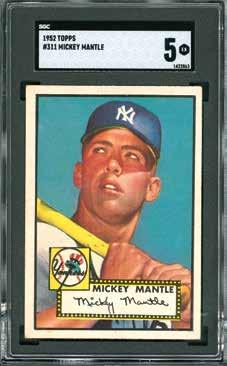
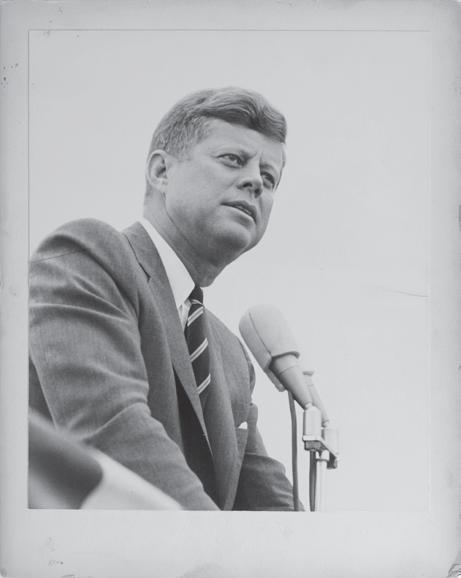
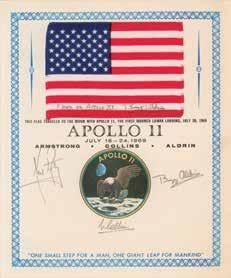
For 50 years, relationships have been the backbone of RR Auction. We have made it a priority to keep our consignors informed and involved, encouraging them to share their voices, to instill their knowledge, and to forge a partnership based on our shared passion for history. With a mutual desire to achieve greatness, these relationships are at the heart of our success.