Council floats ‘special district’ idea for Orchard Mesa Pool
Brandon Leuallen
The Business Times
City Council workshop on Feb. 2 about the future of the Orchard Mesa Pool widened into a broader conversation about whether Orchard Mesa and south Grand Junction need a dedicated taxing structure to have better representation and to fund recreation and community amenities.
Multiple council members floated the idea of a “special district” that could extend beyond city limits and ultimately go to voters. The discussion comes as the city prepares for the planned 2026 opening of the new Community Recreation Center, whose voter-approved ballot measure did not reference the Orchard Mesa Pool, 2736 Unaweep Ave., and that its closure and user base were factored into the budget assumptions.
The discussion emerged as council reviewed four potential paths forward for the Orchard Mesa Pool, whose current operating agreement expires at the end of 2026 and after which demolition of the pool would proceed under existing agreements. While the pool itself was the immediate focus, several council members said the options raised larger questions about longterm investment, attention and how recreation services are funded in different parts of the city.
See story Page 5
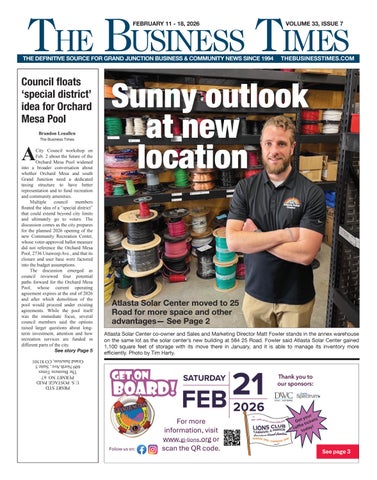
Sunny outlook at new location
Atlasta Solar Center moved to 25 Road for more space and other advantages— See Page 2
Atlasta Solar Center co-owner and Sales and Marketing Director Matt Fowler stands in the annex warehouse on the same lot as the solar center’s new building at 584 25 Road. Fowler said Atlasta Solar Center gained 1,100 square feet of storage with its move there in January, and it is able to manage its inventory more efficiently. Photo by Tim Harty.
Solar company sees the light on 25 Road
Atlasta Solar Company continues to grow, and its new location can accommodate it
Tim Harty
The Business Times
More space and the ability to operate with less overhead and greater efficiency are what Atlasta Solar Center got with the January move of its headquarters and operations to 25 Road.
Another appealing part of the change is Atlasta Solar Center owns its new building at 584 25 Road, where it is flanked to the north by Amigo Animal Clinic, flanked to the south by Canvas Products and sits across the road from 970 Marine.
Matt Fowler, an Atlasta Solar Center coowner and director of sales and marketing, said there was nothing wrong with 1111 S. Seventh St., its home since 2012, but its new location comes with more space for a growing business that can use it.
“We’ve got an additional 2,100 square feet of yard storage space, outside yard storage space,” Fowler said. “We have an additional 3,300 square feet of office space. That’s huge. That’s critical for our team. Our operations department has grown significantly. We’ve brought our engineer back in-house; since COVID, he’d been working from home. And then we also have a service department established.”
Atlasta also got an additional 1,100 square feet of warehouse space.
“So, 3,300 office, 1,100 warehouse, those are both really big improvements,” Fowler said, “and to boot, we’re saving money on overhead, paying a mortgage versus rent. So we’re able to pass some of those savings on to our customers, which we’re really happy about.”
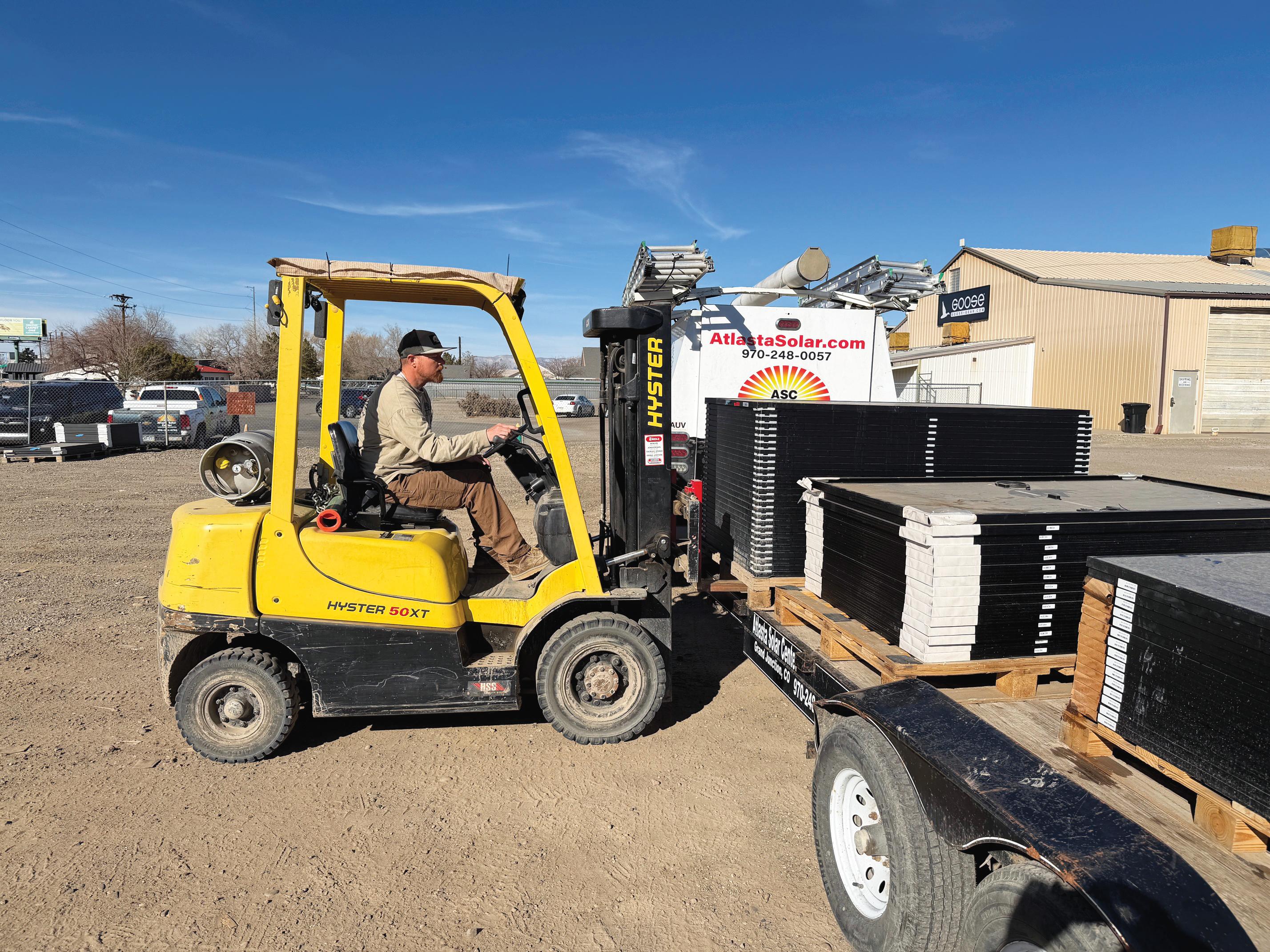
Atlasta Solar Center co-owner and journeyman electrician Todd Sheveland operates a forklift to move some solar panels from a flatbed trailer. The center’s new location has 2,100 square feet of additional yard storage space, and Sheveland said, “We’re happy to be over here, and in a few more weeks I think we’ll really be settled in.”
Photo by Tim Harty.
Fowler said the service department services existing solar systems, which is important to customers and sets Atlasta Solar Center apart from many solar-installation competitors. Some solar companies do the installation, he said, then are never seen again by the homeowner or business.
“We’ve got an in-house, dedicated service department,” Fowler said. “And we work on anybody’s systems. We don’t just work on our own systems. There are solar companies out there that will only service systems that they’ve installed. We service what are called orphaned solar systems.”
Fowler also made it a point to mention one of Atlasta’s lead installers, Ian Lafferty, is now a master electrician.
“It’s very noteworthy,” Fowler said. “He worked very hard on doing that, passed the test his first time (taking it), which not very many people do.”
The 25 Road location’s additional storage comes with the benefit of an annex warehouse that allows Atlasta Solar Center to separate its solar-specific inventory from its electrical-specific inventory.
As a result, Fowler said, “We’ve improved our efficiencies internally with our inventory.”
Inside the main building, Fowler thinks customers are going to like the “new and improved showroom” and the additional meeting space.
“We’ve always had a showroom,” said Fowler, adding that’s not common for solar companies to have one. “We’ve always been a company where you can walk in and actually look at the products that are going to go up on your roof. It’s very important for our customers … and we’ll have more space to show our products.”
Another thing customers tend to like is places to park, and Fowler said there’s much more customer parking now than Atlasta had previously.
Employees have reason to smile, too, when it comes to extra office space, and Fowler pointed out it’s no small detail that the new location has one more bathroom.
Moreover, there will be extra bodies in the building soon.
“We are still in a position of growth,” he said. “We’ve got a couple job openings right now. We got a couple spots to fill on our team, both sales and installation.”
Important date for commercial tax credit
While the end of 2025 brought an end to the sizable tax credit that residential solar customers used to enjoy, commercial solar customers still have a 30 percent tax credit through the end of this year.
But Atlasta Solar Center co-owner and Sales and Marketing Director Matt Fowler said commercial customers need to keep July 4 front of mind.
“This is very important,” he said. “If a commercial entity puts a 5 percent down payment before July 4th of this year, they have two years to install the project. It’s called Safe Harbor, and they will get the 30 percent tax credit.
“If they wait till after July 6th, they have to install the system this year to get the tax credit, which is virtually impossible. So, any commercial entity that is considering solar, it’s a refundable 5 percent down payment, to a point – once we’ve spent that money on permits and things, we can’t refund it – but it’s a refundable 5 percent down payment. If a commercial entity is considering or has considered solar, now would be a good time to lock in that tax credit, and then they have two years to figure out all the details.”
Fowler added, “And there are people doing that.”
No tax credit, no problem
Residential solar customers may not have the incentive of a tax credit any more, but Fowler said Atlasta Solar Center is offering something they may want to seize upon.
“We’re having a, call it a moving sale, if you will, long term,” he said “It’s 20 percent off whatever price we would have quoted you. So, what that means is it’s basically back when we had the tax credit, the tax rate was 30 percent of the system cost got credited to you on your income taxes. … Now it’s a 20 percent discount. So, instead of paying $10,000, you pay $8,000. … You’re paying 20 percent off the sticker price, if you will. That’s one thing that we definitely want to announce and let people know.”
MORE ABOUT ATLASTA SOLAR CENTER
Council starts planning process to hire permanent city attorney
Brandon Leuallen The Business Times
The City of Grand Junction has begun outlining how it may proceed with hiring a permanent city attorney. The action follows a discussion stemming from the Grand Junction City Council’s Jan. 5 decision to appoint Assistant City Attorney Jeremiah Boies as interim city attorney after the retirement of longtime City Attorney John Shaver.
During a Feb. 2 City Council workshop, council members discussed potential options for the process and timing of filling the city attorney position on a permanent basis.
City Manager Mike Bennett told council the workshop was scheduled
at council’s request to discuss “if, how and when” to conduct a permanent hiring process. He noted the city attorney is one of the few positions that reports directly to the city council rather than through the city manager.
Bennett emphasized the council is not under immediate pressure to act.
“We are not in a rush,” he said. “We have some time.”
Bennett also told council that no hiring process will begin without explicit direction from council, describing the workshop as a threshold discussion rather than a decision point.
Clarifying which positions council appoints
During the discussion, council member Scott Beilfuss asked whether the hiring of the assistant city attorney should be compared to the assistant city manager position, noting the assistant city manager had gone through a national search. He questioned why a similar process was not used in that case.
Council member Anna Stout and Mayor Cody Kennedy responded by explaining the council does not
determine the hiring process for those positions. Neither the assistant city attorney nor the assistant city manager is appointed by council. Both are hired administratively by department leadership.
Boies added that while an application process was used when he was hired as assistant city attorney, it followed the city’s standard hiring procedures.
“It was just a standard job posting that’s on the city website like all the other city jobs,” he said.
Bennett further clarified that Shaver made the hiring decision for the assistant city attorney position, and the city’s human resources department handled the posting and application process. That came in the year before Shaver’s retirement announcement that led to Boies being appointed by council in a public meeting as the interim in January 2026.
Council signals support for an external search
Multiple council members expressed support for conducting a full external search and using a recruitment firm to assist with the process.
“I would be supportive of a full external search,” Stout said, adding she participated in similar processes previously. “It has been extremely beneficial for us as a city.”
Other council members echoed that sentiment, including council member Ben Van Dyke who cited recent external recruitment efforts for the fire chief position.
Executive session proposed to define position, priorities
Stout said that once the council agreed on the broad framework, the next step should be an executive session to discuss specifics of the position and the recruitment process.
Stout said the council should move into an executive session to discuss details of the hiring process, saying the goal is to avoid giving potential candidates a competitive advantage, not to withhold information from the public.
Bennett said staff would support that session.
“We would likely have our HR director or a representative from HR in that executive session,” Bennett said, adding that staff from the city’s purchasing department could also assist with procurement-related questions tied to issuing a request for proposals for a recruitment firm.
Bennett said the executive session would focus on defining priorities and guardrails for the recruitment effort, with the resulting framework later returning to the public agenda as part of the formal hiring process.
The Business Times reached out to the city of Grand Junction to ask if Boies, a potential candidate, would be in attendance at the executive session. City Communications and Engagement Manager Kelsey Coleman responded that Boies would not sit in on that conversation.
Timeline: a months-long process
As the discussion turned to timing, Bennett said the process could take several months once initiated.
“You could easily be anywhere from a really swift three months to probably more like a four to six-month process,” he said.
Mike Bennett
Anna Stout
Council floats ‘special district’ idea for Orchard Mesa Pool
Continued from Page 1
During the meeting, Grand Junction Parks and Recreation Director Ken Sherbenou said a consultant study commissioned by the city during the planning process for the new Community Recreation Center concluded that the Orchard Mesa Pool facility has reached the end of its useful life. The study found that nearly all major systems, including mechanical, electrical, plumbing and filtration systems are original to the 1983 construction and beyond expected service limits, meaning continued operation would require significant capital investment simply to maintain current conditions.
Financial pressures were central to the presentation. According to the consultant analysis, approximately 73 percent of Orchard Mesa Pool users live outside the Orchard Mesa neighborhood, raising concerns that the majority of those users would likely shift to the city’s new Community Recreation Center once it opens. That migration would leave the Orchard Mesa Pool with sharply reduced attendance while still requiring a substantial operating subsidy to cover the ongoing losses.
At the same time, the operating budget and revenue projections for the new Community Recreation Center were built on the assumption that the Orchard Mesa Pool will close. The consultant’s presentation shows the center’s operating model already includes approximately $1.3 million per year in dedicated tax revenue to support operations that won’t be covered by memberships or other fees collected.
If the pool remains open, the city will face a dual financial impact: a higher peruser subsidy at Orchard Mesa as attendance declines; and additional pressure on the Community Recreation Center’s budget if some expected users and revenue stay in Orchard Mesa.
During the meeting, four options were presented to council including the idea of a special district.
The four options outlined in the staff report included:
A. Allow the pool to close when the new Community Recreation Center opens, consistent with current operating assumptions.
B. Continue city operation of the pool beyond 2026, which would require significant capital investment and ongoing subsidy out of the city’s general fund.
C. Issue a request for proposals to seek a public-private partnership to operate or redevelop the facility.
D. Ask voters to approve a Title 32 special district in Orchard Mesa to take over ownership, operations and maintenance.
After the meeting the city posted on Facebook that council directed staff to begin exploring next steps for Option C and to gather additional information on Option D. Staff will also speak with School District 51, which owns the land and
building, before returning to the council with more information at a workshop next month.
The pool issue was the trigger, but option D, the district concept, was discussed in depth as council members also described Orchard Mesa as an area that has been left behind, with fewer amenities and less visible investment than other parts of Grand Junction.
‘District’ idea evolves beyond the pool
As the conversation progressed councilmember Anna Stout, said a district approach could provide a broader recreation and community vision for the south end of Grand Junction rather than focusing narrowly on a single facility.
“It’s not just about the Orchard Mesa pool,” Stout said, pointing to long-standing recreation gaps on the south end of the city and the need for a larger planning framework that could include additional amenities and undeveloped parks.
Stout said a ballot measure to fund the pool could shift the decision away from seven council members and toward voters.
“I don’t see a better way to do it than literally asking the public for their input via the ballot box,” she said.
Stout cautioned that finding a partner or public private partnership to fund and/or manage the pool could be tough.
“Option C is looking for a unicorn,” she said, adding that informal efforts in the past by the city, Mesa County and School District 51 had not produced interest from a viable operator willing to take on the pool given the costs involved.
‘Double taxing’ concerns and a push to get creative
During the discussion, council member Ben Van Dyke, who said he also supports the city finding a solution, raised concerns about creating a special district specifically to keep the Orchard Mesa Pool open while those same residents are also paying increased taxes for the new Community Recreation Center. He said that approach could amount to “double taxing” residents who are already helping fund the Community Recreation Center through the citywide sales tax approved by voters in 2023.
Van Dyke framed Orchard Mesa as one of the city’s areas that seems to get less attention.
Robert Ballard, who represents Orchard Mesa on council, expressed frustration for the Orchard Mesa residents and said the city should not move toward closure without first exhausting all alternatives to preserve the site as a community asset.
“I don’t think this facility is designed to be owned and operated just by the city,” Ballard said. “We’re looking at some major renovations that need to happen, and even if we were able to fix it up, we don’t have the ability to continue maintaining the operations costs.”
See POOL on Page 6
Continued from Page 5
He said he is in favor of the city moving forward with the RFP process to potentially find a partner where both parties could benefit.
City limits, county involvement and who would pay
Stout raised one complication: Orchard Mesa is not entirely inside city limits, and the city’s parks and recreation funding is heavily tied to city sales tax.
“Lots of Orchard Mesa is not incorporated,” Stout said. “There are residents who live there and use city services, but they are not paying the city sales tax that funds Parks and Recreation. If we were to look at a district, it allows us to focus on the geography of service needs rather than just city boundaries, and to think about who is actually being served and how that should be funded.”
Jeremiah Boies, interim city attorney, said if council pursued a district that includes unincorporated areas, the process could shift into county territory. During the workshop, staff said the form of the district, boundaries and funding mechanism would determine whether it is primarily a cityled ballot issue or “actually a county
commissioner issue rather than a city council issue.”
Timing and next steps
Council members asked whether a district ballot question could realistically be ready this year. Boies said if council moved quickly, it probably could reach the November ballot, but he emphasized it would be a heavy lift and would depend on the district structure and funding details.
Cody Kennedy, mayor of Grand Junction, cautioned against rushing the process. He said council would rather extend operations and be “really deliberate” with community communication than rush a near-term ballot measure.
By the end of the workshop, staff outlined potential next steps, including preliminary conversations with Mesa County about district formation, drafting and refining an RFP for partnerships, and opening discussions with District 51 about whether the current operating agreement could be extended to allow more time for public input.
Grand Junction City Manager Mike Bennett said staff will plan to return to council as early as March with more developed options.
Mesa County DMV’s hours affected by software upgrade
Mesa County Department of Motor Vehicles offices will temporarily adjust services in mid-February as the Colorado Division of Motor Vehicles completes a statewide software upgrade designed to improve customer service and system reliability
Beginning Feb. 14, online DMV transactions and kiosk services will be unavailable through Monday, Feb. 16, while the new system is implemented. All Mesa County DMV offices will close at 3 p.m. on Feb. 13.
All Mesa County DMV offices will be closed Monday, Feb. 16, for the Presidents Day holiday, and closed Tuesday, Feb. 17, to allow staff time for system preparation and training.
On Wednesday, Feb. 18, the main DMV office, 200 S. Spruce St., will reopen by appointment only. Appointments will help ensure customers are served efficiently as staff transition to the upgraded system. The Clifton DMV office will be closed.
All offices will be fully open Thursday, Feb. 19. Customers should plan for longer wait times that day as employees continue becoming familiar with the new software.
“This upgrade is an investment in better service for our customers,” Mesa County Clerk and Recorder Bobbie Gross said. “We appreciate the public’s patience as our staff completes training and works to ensure a smooth transition.”
Residents are encouraged to complete time-sensitive transactions before Feb. 13 when possible and to check the Clerk and Recorder’s website for updates and appointment information.
Feb. 13: All Mesa County DMV Offices will close at 3 p.m.
Feb. 14-16: Online DMV transactions and kiosk services unavailable.
Monday, Feb. 16: All Clerk and Recorder offices closed for Presidents Day.
Tuesday, Feb. 17: All Mesa County DMV offices closed for staff system preparation. Wednesday, Feb. 18: Main DMV office open by appointment only, 200 S. Spruce St. Wednesday, Feb. 18: Clifton DMV office will be closed.
Thursday, Feb. 19: All Mesa County DMV offices open; longer wait times expected. More information is available on the Clerk and Recorder’s website.
Know what’s new before tackling your taxes
Tim Harty The Business Times
January is in the books, and most people have their W-2 or 1099 forms in hand, ready to tackle their taxes like any other year.
But a few things are different this year and worth your awareness, according to Chris West, CEO of DWC CPAs and Advisors, 464 Main St. in Grand Junction.
West said President Donald Trump’s One Big Beautiful Bill “certainly made an impact for both individuals and business owners,” but to go through every piece of legislation change would be “probably overwhelming.”
So, he picked out several key changes he thinks will be most helpful for individuals and businesses.
On the individual side, he singled out three items as fairly sizable.
First, he pointed to “something that’ll be a big benefit for those age 65 and older,” and that’s a new additional standard deduction of up to $6,000 for an individual and $12,000 for a married couple.
“The higher one’s income goes, they potentially lose out on that $6,000 deduction, but a lot of our senior citizens, age 65 and older, will see a benefit from that,” he said.
TAX PROFESSIONALS’ VALUE GOES BEYOND TAXES
DWC CPAs and Advisors CEO Chris West said a good CPA and tax professional “should be able to help you navigate not just the tax picture, but your whole financial picture, whether you own a business or not. And so tax planning, estate planning, your financial planning, a good CPA will help their clients navigate all of those elements.
“That’s just an important thing in my opinion. I like to get on a soapbox every now and then and just preach to our people how important it is for us to be more than accountants, but to be well-rounded, money advisors, not just taxes.”
Next, West mentioned the deduction related to tip income, which is new for 2025 tax returns and will go through 2028.
For taxpayers in the hospitality industry – waiting tables, serving in hotels, “any profession or business where they are receiving tipped income from customers,” – West said up to $25,000 of tipping income can be deducted.
“And again, at the higher income levels, that starts to fade away,” he said, “but at the lower income levels that will be a nice increase or tax benefit.”
West’s third item is the new deduction related to overtime pay, and like the deduction for tipping income, it affects tax returns from 2025 through 2028. Single tax filers can deduct up to $12,500 and joint filers can deduct up to $25,000 of their qualified overtime pay against their taxes.
After those Big 3, West threw in a fourth: The limit of the deduction for state and local
taxes, also called the SALT limit, increased from $10,000 to $40,000 in 2025. West said that change is “a big benefit for those that pay a lot in state income taxes.”
West said the four changes he mentioned are relatively straightforward, and a tax filer using a software program at home should be able to handle them without difficulty.
However, for the increased SALT limit, he said higher-income taxpayers who own businesses may be able to implement a strategy that allows a deduction greater than the $40,000 “by utilizing your small business to do what is in essence a workaround of this rule.” West said the workaround is “very legitimate and allowed by most states,” but in his opinion those business owners would benefit from seeking professional help with their tax return.
For businesses, West said the One Big Beautiful Bill brought a couple notable changes, “and kind of the biggest one in my opinion for small businesses is what’s called the 100 percent deduction for qualified property, or what’s called the 100 percent bonus depreciation deduction.” He said it impacts small businesses that are buying heavy equipment, buying vehicles, spending money within their business on capital improvements.
“And the definition of qualified property, what is qualified gets very technical, so getting professional help is important,” he said. “The help of a CPA or tax professional, in my opinion, would be dollars well paid to get the necessary help to make sure you’re maximizing that deduction.”
West said there also is a deduction that has been around for quite a while, and it was made permanent: the Qualified Business Income deduction.
“It’s a 20 percent deduction for all owners of S Corporations and LLCs, which is how most small businesses are structured,” he said. “And there can be some nuances and complexity to how that 20 percent deduction is calculated and utilized, depending on the type of business that you have. And the way it’s calculated involves some complexity that I believe a tax professional can add a lot of value in helping a taxpayer navigate the QBI deduction.”
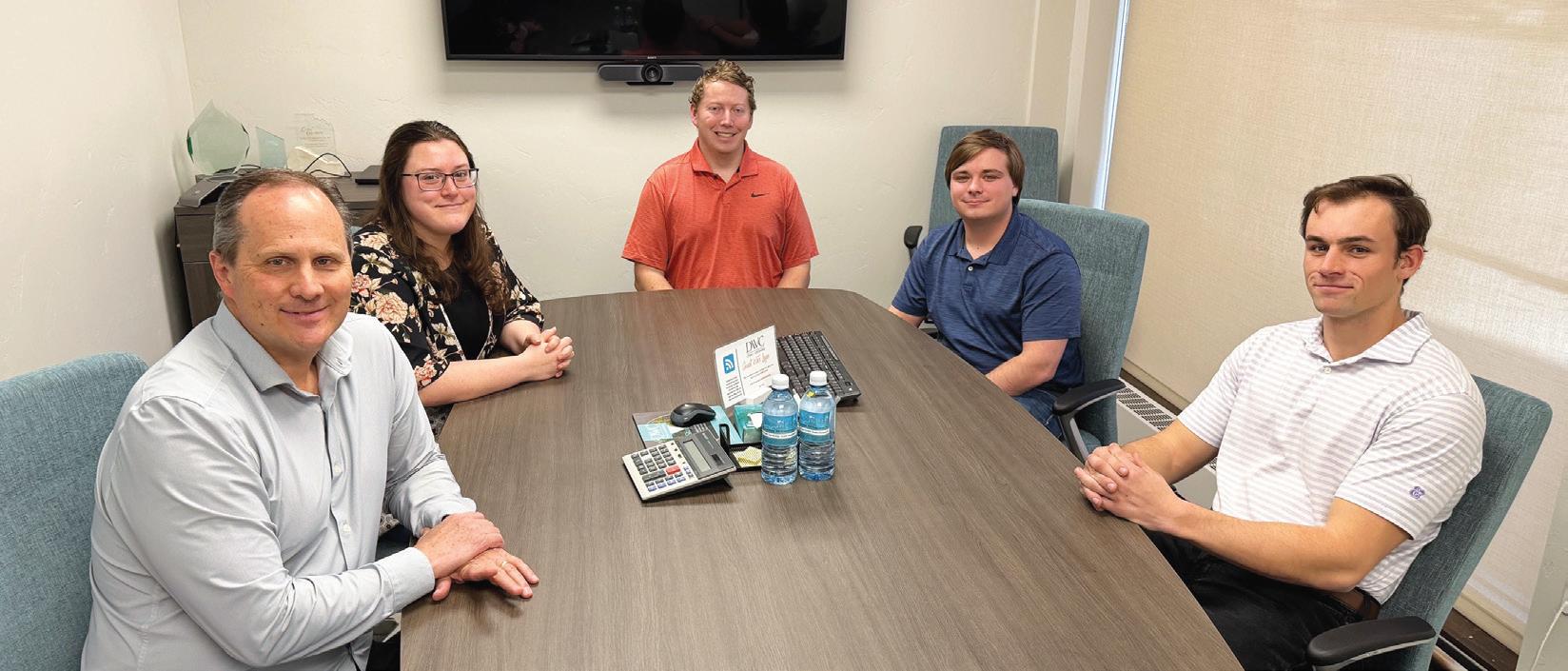
Clockwise from front left, DWC CPAs and Advisors CEO Chris West, tax supervisor Megan Lawson, tax manager Seth Knighton, tax staffer Remington McLean and tax staffer Joel Deardorff gather in a conference room of the DWC CPAs and Advisors office building at 464 Main St. in downtown Grand Junction. Photo by Tim Harty.
Chevalier’s painting chosen to represent Winefest
Jessica Chevalier’s painting “Grand Valley Vintage” was the winning entry in the art contest to represent the 35th Anniversary Colorado Mountain Winefest in September.
The Colorado Association for Viticulture & Enology announced the top three places who were selected by the public through online voting. They are:
• First Place: “Grand Valley Vintage” by Jessica Chevalier.
• Second Place: “Winery Gem” by Carmella Wilson.
• Third Place: “Wildflower Trail Toast” by Monica Marquez Gatica.
Chevalier will receive a cash prize of $700, and “Grand Valley Vintage” will be featured on the festival’s promotional items and in nationwide marketing for the 35th Anniversary Colorado Mountain Winefest. Prints of “Grand Valley Vintage” will be available for purchase at www.
WineColorado.org and in the CAVE office later this spring.
“I’m truly honored to have my painting selected as the winning piece for the
Colorado Mountain Winefest Art Contest,” Chevalier said. “This work was inspired by the vineyards, mountains and deep sense of community that make Colorado’s Western Slope so special.
“I wanted the piece to feel like a moment you could step into. Colorado Mountain Winefest represents more than wine; it’s about place, people and tradition. I’m looking forward to sharing new original works at The AppleShed Gallery in Cedaredge, where my exhibition will be on view from March through May 2026.”
The annual Colorado Mountain Winefest Art Contest is open to any Colorado resident and takes place each January. Artists are asked to capture the essence of the state’s wine industry. For more information about this event or to be included in the Call for Art in the future, email info@coloradowinefest.com.
F
Starr elected to national municipal law board
Mesa County Attorney Todd Starr has been elected to the Board of Directors of the International Municipal Lawyers Association, a national organization representing local government attorneys across the United States, Canada and other jurisdictions worldwide. IMLA supports excellence in municipal law through legal education, advocacy and collaboration among public-sector attorneys. The organization also participates in appellate litigation, including amicus briefs before the U.S. Supreme Court, and addresses legal issues affecting cities and counties nationwide.
As a member of the board, Starr will help guide IMLA’s strategic direction, educational programming and policy priorities that impact local governments. Board members also support the organization’s role as a national voice for municipal and county attorneys.
Starr has served as Mesa County attorney since 2021. He first became a county attorney in 2000 in Dolores County and has also served as county attorney for Archuleta, Rio Blanco and Saguache counties. His professional background includes experience in governance, land use, employment law, litigation and public administration, plus work in courts across the country.
“Local governments face increasingly complex legal challenges, and I’m honored to contribute to IMLA’s national efforts while bringing a western Colorado perspective to issues affecting communities across the country,” Starr said.
“Grand Valley Vintage” by Jessica Chevalier took first place in the CAVE art contest.
Todd Starr
Starr has Directors of the Municipal Association, organization local attorneys United States, and other worldwide. supports municipal through legal collaboration among organization also including Supreme Court, cities and Starr will direction, policy governments. support the voice for County became a county County and has Archuleta, counties. His experience employment law, administration, plus increasingly and I’m national Colorado communities
From invisible to unforgettable: How to stand out in crowded market
If you’re a business owner in Grand Junction, chances are you’ve felt it: The market feels crowded. New businesses are popping up, competitors offer similar services, and it can feel harder than ever to get noticed.
Lauren Jobe
Many business owners respond by trying to do more – more ads, more posts, more promotions. But standing out isn’t about being louder. It’s about being clearer.
Businesses that rise above the noise aren’t necessarily the biggest or the most expensive, they are distinct, consistent and memorable. The good news? You don’t need a massive marketing budget to get there. You just need to know what makes you the choice, not just a choice. Be the choice, not a choice
When potential customers are comparing businesses, you want to make their decision easy. If your message sounds like everyone else’s, you blend in. If your message is clear and specific, you stand out.
Start by asking yourself a few honest questions:
• Who do I serve best?
• What problem do I solve better or differently than others?
• Why do customers choose me once they find me?
Differentiation doesn’t always mean doing something different. Often, it means doing something familiar intentionally. You might specialize in a certain type of client, offer a more personal experience, or simplify a process that feels overwhelming elsewhere. When you clearly communicate that
difference, people recognize your value faster.
Let your personality work
One of the biggest advantages small, local businesses have is personality. You’re not a faceless corporation. You’re a real person serving real people in your community. That matters.
Your brand voice should sound like you. Whether your tone is warm and conversational, professional and steady, or bold and playful, consistency is key. When your personality shows in your website copy, social media posts, and customer interactions, people feel like they know you, and trust grows from there.
In the Grand Valley, relationships matter. People remember how you made them feel. Businesses that show up authentically – sharing their story, their values and even their imperfections – are far more memorable than those trying to sound “polished” at all costs.
Use visuals to reinforce
Visuals are often the first impression someone has of your business. If your branding is inconsistent or unclear, it creates confusion, even if your service is excellent.
You don’t need a high-end design package to stand out, but you do need visual consistency. Choose a color palette, a font style and a general look, and stick with it. When your social posts, website, signage and printed materials all feel connected, your brand becomes recognizable.
Local businesses that “shine” visually often do so by being intentional, not extravagant. Clean design, quality photos and consistent branding go a long way in building trust and professionalism, especially in competitive markets. Lead with values, not just services
What you believe in matters more than you think.
Customers today want to support businesses that align with their values, whether that’s community involvement, family ownership, sustainability or simply doing business with integrity.
When you talk about why you do what you do, you invite customers to connect with you on a deeper level. Value-driven messaging helps attract the right customers. The ones who become loyal advocates for your business.
I see this often with local brands that prioritize community connection. Businesses that support local events, collaborate with other Grand Valley companies and show up consistently are the ones people talk about and recommend. Real differentiation happens over time
Standing out isn’t a one-time marketing move. It’s the result of showing up consistently, communicating clearly and staying true to who you are. Over time, your brand becomes familiar, trusted and unforgettable.
If you’re feeling invisible right now, don’t be discouraged. Visibility grows when clarity leads the way. Focus on what makes your business unique, let your personality and values shine through, and stay consistent, even when growth feels slow.
In a crowded market, the businesses that stand out aren’t chasing attention. They’re building connection. And in a community like Grand Junction, connection is what turns first-time customers into long-term supporters.
Lauren Jobe is the owner and creative director of Salt N Light Design, a Grand Junction–based marketing and branding studio that helps small businesses clarify their message, strengthen their brand, and stand out with purpose.
Why Western Colorado’s economic future runs through Shoshone
For more than a century, the Shoshone water rights have quietly done something extraordinary for Western Colorado: They have kept the Colorado River flowing when it matters most.
Bobbie Daniels
Those senior rights, first established in the early 1900s, are far more than a hydropower plant in Glenwood Canyon. They are one of the most important pieces of economic infrastructure in our region. Shoshone keeps water in the river for Mesa County farms and orchards, protects municipal drinking-water systems, sustains fish and wildlife, supports recreation economies and helps Colorado meet its obligations under the Colorado River Compact.
In dry years, when every drop counts, the Shoshone call is often the difference between stability and scarcity on the Western Slope.
For business owners, that stability is not abstract. Water reliability is one of the most important inputs into agriculture, food processing, manufacturing, tourism, outdoor recreation, real estate and community growth. When water is predictable, businesses invest. When it is not, risk rises, financing tightens, and long-term planning becomes impossible.
America understood this long ago. At the turn of the 20th century, leaders recognized the West could not reach its full potential without water. Much of this land was beautiful, but without reliable irrigation it could not support the families, farms and businesses that would one day make it thrive. So our country made a bold choice: invest in water infrastructure, so opportunity could take root.
Here in Mesa County, that vision became reality through the Grand Valley Project. What had once been open sagebrush was transformed into a living, working landscape: rows of cottonwoods lining newly flowing canals; orchards heavy with peaches and apples; vineyards climbing the hillsides; and fields where livestock and crops could finally thrive. Around that water grew farms and ranches, then mom-and-pop businesses, Main Street storefronts, schools, our college, our airport and the communities that call this valley home.
That federal investment did more than move water; it gave rise to a way of life and built the economic foundation that still sustains Mesa County today
The Shoshone water rights are part of that same story. They have quietly anchored the river system that feeds our canals and sustains our communities for generations. Protecting them is not about changing how the river works; it is about preserving what has always worked.
Over the past three years, helping secure those protections has been one of the most important responsibilities I’ve carried as your county commissioner. This work has unfolded in water board hearings, in Washington, D.C., in negotiations with utilities and state agencies, and in the steady building of a coalition that reflects how deeply this river connects our economy and our way of life.
When Xcel Energy and the Colorado River District signed their $99 million agreement to transfer the Shoshone water rights, I was there in support, lending my voice to that historic moment. I shared what so many of us on the Western Slope know: that this would be an answered prayer. It was not just a sale. It was a chance for Western Colorado to do what earlier generations did: invest in the foundation that makes growth possible.
Mesa County committed $1 million to that effort, because protecting Shoshone protects billions of dollars in agricultural production, municipal water systems, recreation revenue and energy infrastructure. But we also insisted on something else: Western Colorado must have a real voice in how these powerful rights are managed.
That principle was put to the test before the Colorado Water Conservation Board this past fall. Front Range water providers wanted the state to have sole control over when and how the Shoshone call could be relaxed. I made clear that if joint management between the River District and the state was not adopted, Mesa County would withdraw its support, not out of politics, but because anything less would fail the farmers, ranchers, orchardists, businesses and communities we serve. The board agreed and voted unanimously for shared stewardship.
One piece of the puzzle still is in front of us: the release of $40 million in federal funding already committed by the Bureau of Reclamation.
In September, I traveled to Washington, D.C., to meet with the White House Office of Intergovernmental Affairs and senior leaders at the Department of the Interior and Bureau of Reclamation. I made the case that Shoshone is not just a local project, it is a continuation of the same federal partnership that made Western Colorado possible in the first place.
This fall, I hosted Congressman Jeff Hurd at the Old Courthouse and brought together water managers, farmers, ranchers, orchardists and recreation leaders from across the Grand Valley. These weren’t talking points; they were the living story of our valley, shaped by the water that runs through it. The purpose was simple: so our Congressman could carry those voices back to Washington, to federal agencies, to his colleagues in Congress and to everyone with the power to shape this decision. When decisions are made in D.C., they should be grounded in the real communities they affect, and that is exactly why we brought Mesa County to the table.
Just this past week, I wrote a letter, and our Board of County Commissioners, through
a public vote, approved our formal request urging Interior and Reclamation leadership to release those funds, so this historic project can be completed.
Protecting Shoshone does not take water from anyone. It preserves the system that has kept this river functioning for more than 100 years. It keeps Western Slope agriculture productive, supports outdoor recreation and tourism, protects federally required endangered-species habitat and maintains the hydrologic stability that allows Colorado to meet its interstate commitments, which protects our economy from costly legal and federal intervention.
This is what smart, long-term investment looks like. For a fraction of what instability would cost, we can secure a foundation that allows Western Colorado to grow, compete and prosper.
The Colorado River has given our region its character, its economy, and its way of life. Protecting the Shoshone water rights is how we honor that legacy, and it’s how we ensure the river that built Western Colorado will continue to sustain it for generations to come.
Bobbie Daniel is a Mesa County Commissioner, representing District 2.
Mesa County Republicans, doing work so democrats won’t (soon) have to
And no, the work being done isn’t in a good way.
Yes, you are free to complain and ask why I am writing and criticizing a party I am not a party to, and I’d agree it’s a quality question worth asking. Well, here’s why. The main thing I’m about to write about is one of the main reasons I left the party I’m writing about. The other reason is it appears the main goal of local Republicans is not to unite the party, but rather to divide it, so it’s as successful as the beloved Republicans are on the state level. Or control, which is the more likely culprit.
And just in case you haven’t been paying attention, the Republican party doesn’t do so well on the state level, and locally it’s an on and off disaster on the city level in Grand Junction and Palisade. So, just how long can the county hold out?
As history tends to repeat itself, especially in politics, I’d say not long. And that’s despite the fact yet today one could run for any county-wide position as a Republican while on life support in any of our amazing, local hospitals and still win in a landslide. Heck, Lauren Boebert wins Mesa County even if she’s bound to bring her puff and petting to a theatre near you.
But in politics, nothing lasts forever. So, I wonder why Mesa County Republicans are hell-bent on speeding up the process? Splitting rails locally, Abe-ly, if you will.
But here we go again. We have a primary where none should exist, and this time it’s over the position of Mesa County treasurer. Think about that. Is the position of Mesa County treasurer so important the Republicans need two candidates? Or is the real question: Why does the position mean so much to Mesa County Republicans that the party would cast aside one of its best foot soldiers it has seen recently to basically endorse a previous party player who just moved back from across the hills?
Before I delve in, let me qualify where I’m coming from. I’m going to vote FOR whoever survives this fracture (because that’s what it is) and ends up on the ballot. That’s mostly because I never vote to put democrats in charge of tax money, but also because I know both candidates and know they are good people. I also know both have a right to run as Republicans. But as things went with the puppet planting of JJ for local power brokers over Janet, it doesn’t make their running against one another a good thing in the long-term.
Let’s ferret this out candidate-wise as well. I know Greg Haitz a little bit. I know his wife, Andrea, a little better. He subscribes to the paper, and his wife as a school board member has been the subject in more than a few stories in my paper the past few years. I believe if Andrea could have run under a party banner for school board it would unquestionably be the Republican one. They both are staunch conservatives, so everything makes perfect sense related to Greg’s candidacy.
That said, I’ve known Rose Pugliese for years. I consider her a friend. She’s helped me through the legal stresses of my divorce and my dad’s estate. We’ve spoken often, and while we’ve lost some contact when she moved across the way, there’s no question about Rose’s conservative values in her time as Mesa County Commissioner and in the
Colorado Legislature or in anything else she does. I get why she’s running for office as a Republican to continue her public service.
So, for me, this doesn’t come down to why either of these fine folks are running. It’s why are Mesa County Republicans allowing two Republicans to run for the same office that’s a guaranteed win? How does this not split the party locally? Local Republicans are turning a walk-in-the-park race into another Tina Peters moment, because it’s impossible to not have a Greg wing on one side and a Rose wing on the other. What’s one thing Independents always say? Two wings of the same bird when it comes to democrats and Republicans in government, and it’s never in a good way.
The same thing happened with Janet and JJ and is still happening with the Tina sycophants.
All this kind of maneuvering (and that’s what it is) does is create Independents. It’s time Republicans learned it isn’t virtue to allow all comers to run or allow all voters to vote in primaries regardless of party (un)affiliation? I mean, how much more screwed up could this coming election’s gubernatorial posse that the party is allowing to destroy our chances of any Republican winning statewide be? Eventually, the antics catch up with you. And unlike Lauren carpetbagging to a new district, there’s no other voter-safe state to run for governor of Colorado in.
And even though Mesa County is still safe for Republicans running for countywide office, why didn’t the local party just say, “Sorry, Rose, we already have someone, who has given time and talent above and beyond, running for that position. Maybe next time or another office?” Because you can’t argue Greg hasn’t been and done all that the past several years.
Must be a control thing to local Republican leadership. It sure isn’t about membership. Because what good is being done for loyal, faithful, active members who decide to become candidates if the party doesn’t jump and back you 100 percent from the get-go? After all, that’s what the democrats do. And the more democrats do it, the more they win.
One other thing democrats love to do is back primary Republicans they know can win primaries but not general elections. There’s a whole book about it (and other democrat strategies in taking over Colorado) called The Blueprint, written by Republicans who figured this all out; however, way too late.
Which begs one question: What’s going to happen to Republicans in Mesa County if they keep doing business as usual? If history is any indication, it won’t turn out well in the end. We can only hope the Independents they’ve created are filling the void and not democrats. Then again, if history (and Grand Junction and Palisade council voting) is any indication, that won’t be the case.
Winning too easily will do that to a party.
In Truth and freedom. F
Craig Hall is owner and publisher of The Business Times. Reach him at 424-5133 or publisher@thebusinesstimes.com
Craig Hall
n Coldwell Banker honors agents with international awards
Coldwell Banker Distinctive Properties recognized the exceptional accomplishments of several of its agents who are recipients of the company’s distinguished 2025 International Awards.
Jen Pedersen was recognized with the Coldwell Banker International President’s Premier award, presented to agents who produce a minimum of $650,000 in Closed Adjusted Gross Commission Income or 95 Total Units.
Cindy Ficklin and Amy Ashcraft were recognized with the Coldwell Banker International President’s Elite award, placing them at the top 2 percent of all Coldwell Banker agents internationally.
Nikki Metiva was recognized with the Coldwell Banker International President’s Circle award, placing her in the top 5 percent of all Coldwell Banker agents internationally.
Keenan Coit, Kenzie Ross, Skyler Kraai, Michelle Evans, Erika Saenger and The Shafer Team have been recognized with the Coldwell Banker International Diamond Society award, placing them in the top 10 percent of all Coldwell Banker agents internationally.
Don Almond, Angela Ingle and Justin Webber were recognized with the Coldwell Banker International Sterling Society award placing them in the top 16 percent of all Coldwell Banker agents internationally.
“We are incredibly proud of this talented group of real estate professionals. Each one is focused on providing exceptional service to home buyers and sellers, and these awards directly reflect their skills, knowledge and professionalism,” said Todd Conklin, CEO of Coldwell Banker Distinctive Properties.
n Palisade Lions accepting donations for annual yard sale
Palisade Lion’s Club will host its 5th Annual Community Yard Sale at Palisade Gym, 711 W. Seventh St., on March 14 from 9 a.m. to 3 p.m. Proceeds will be used for Palisade community projects.
Lions Club members will be at the Palisade Gym on March 13 from 1 to 5 p.m. to accept donations of gently used items for the sale. To donate earlier, call 260-7490 or email afoxlocks@gmail.com.
n Christi Reece Group’s Circle Fund marks major milestone
The Circle Fund, the charitable-giving arm of Grand Valley real estate company The Christi Reece Group, surpassed $500,000 in donations when it gifted $16,000 to three area nonprofits. Since its inception in 2019, The Circle Fund has contributed $513,000 to local nonprofits, and its most recent donations were: $8,000 to Kids Aid – The Backpack Program; $5,000 to RiversEdge West; and $3,000 to
Every quarter, 2 percent of The Christi Reece Group’s earnings are donated to local nonprofits. Nominations for the nonprofits are provided by the community via The Christi Reece Group’s Facebook and Instagram pages, then their real estate clients vote from those nominations to choose the quarterly recipients of The Circle Fund.
“What an incredible feeling,” Team Leader Christi Reece said. “One of the reasons we went independent seven years ago was so that instead of paying a big brokerage, we could put that money towards helping our community. That we’ve reached the half million mark already is a testament to our team and all of our incredible clients.”
To learn more about The Circle Fund, visit www.christireece.com/pages/the-circle-fund.
n Banff Film Festival returns to Grand Valley, Delta
The Banff Centre Mountain Film Festival World Tour returns to Western Colorado, bringing four nights of adventure, exploration and storytelling to audiences across the Grand Valley and Delta.
Hosted by the Rotary Club of Grand Junction, this year’s festival runs Feb. 11–14 with screenings at:
• Avalon Theatre – Thursday and Friday, Feb. 13–14 at 7 p.m.
Each night features a lineup of films from the Banff Mountain Film Festival World Tour. The festival showcases stories that span the globe, from mountaineering and environmental advocacy to cultural exploration and human resilience.
Tickets are available at banff-gj.com.
Proceeds benefit several local nonprofits, including: Museums of Western Colorado; Colorado Canyons Association; COPMOBA; Eureka! Environmental Institute; Riverside Educational Center; Colorado National Monument Association; Western Colorado Conservation Corps; and Colorado Mesa University Center for Global Learning and Engagement and CMU Outdoor Program.
Follow the festival on Facebook, @BanffMountainFilmFestivalGJ, and Instagram, @gj_banff_film_fest.
n Candidate forum for Palisade trustees Feb. 26
The Palisade Chamber of Commerce will host a public candidate forum this month for voters to hear directly from candidates seeking seats on the Town of Palisade Board of Trustees.
The Board of Trustee Candidate Forum is scheduled for Thursday, Feb. 26, at the Palisade High School auditorium. Doors open at 6 p.m., and the forum begins at 6:30 p.m.
According to the Palisade Chamber of Commerce, the evening will feature moderated, equal-time question-and-answer sessions with mayoral and trustee candidates, followed by an informal Q&A and networking opportunity. The event is intended to give community members a chance to learn about candidates’ priorities and visions for Palisade’s future ahead of the upcoming election.
The forum is open to the public.
n County takes walk-ins for flu vaccine on Fridays in February
Influenza continues to circulate in Mesa County, and Mesa County Public Health wants to remind residents it is not too late to get a flu vaccine as respiratory illness season in Mesa County typically lasts through March.
Mesa County Public Health is offering walk-in flu vaccinations in its Public Health Clinic every Friday in February from 8 to 11 a.m. Most insurance plans are accepted, and staff will work with individuals who do not have insurance to ensure cost is not a barrier to care.
“We want to make it as easy as possible for people to get vaccinated,” said Kelly Geyer, Mesa County Public Health clinical services manager. “Getting a flu shot can help reduce the risk of severe illness and hospitalization. Our nurses are vaccine experts and are here to answer questions.”
For those unable to attend during walk-in hours, appointments are available. Community members are encouraged to call 970-248-6906 to schedule an appointment. Or they can visit Mesa County Public Health’s Vaccine Services webpage for more information about the vaccines. Has your business recently hired, moved or made changes? The Business Times welcomes submissions for free publication in Business Briefs. Email stories and photos
Colorado, across the
Feb. 11–14
Festival World mountaineering and
Colorado; Riverside Colorado Learning and Instagram, month for Trustees. 26, at the 6:30 p.m. moderated, followed community Palisade’s future
February Public Health illness season Health Clinic staff will care. said Kelly can help experts and Community they can visit vaccines.