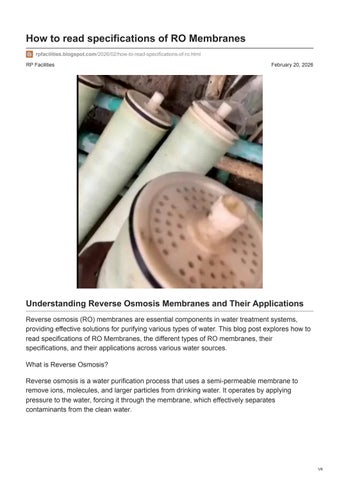
Types of Reverse Osmosis Membranes
RO membranes can be classified based on their application and the type of water they are designed to treat. Below is an overview of the main types of RO membranes:
1. Brackish Water Membranes
Brackish water membranes are designed for treating water with moderate salinity levels, typically between 1,000 ppm and 10,000 ppm of total dissolved solids (TDS). These membranes are ideal for various industrial applications and domestic water treatment.
2. Seawater Membranes
Seawater membranes are specifically designed to treat high salinity water, such as seawater, which typically hasTDS levels around 35,000 ppm. These membranes are crucial for desalination processes and coastal water supply
3. Specialty Membranes
Specialty membranes cater to specific applications, including high-temperature operations or treating highly contaminated water. Some examples include:
Acid-Resistant: built with resistance to chemical degradation,Acid recovery and decolorization
Fouling-Resistant: Reduces biofouling and scaling
High-Temperature: Operates at elevated temperatures especially in Industrial processes requiring heat.
When selecting an RO membrane, several specifications are critical to ensure optimal performance:
a.ActiveArea
Measurement:Typically measured in square feet (ft²) or square meters (m²).
Importance:Alarger active area allows for higher water production rates.
b. Rejection Rate
Definition:The percentage of dissolved salts and contaminants that the membrane can remove from the feed water.
Typical Values: High rejection rates (above 99%) are standard for most RO membranes.
c. Flux Rate
Definition:The volume of permeate produced per unit area of membrane per time, usually expressed in gallons per day (gpd) or liters per hour (L/h).
Importance: Higher flux rates indicate more efficient membranes.
d. Operating Pressure
Measurement: Usually measured in psi or bar.
Significance: Membranes designed for higher pressures are typically used for seawater applications, while brackish water membranes operate at lower pressures.
e. Chemical Resistance
Consideration: Membranes must withstand various chemicals present in the feed water without degrading.
BW for brackish water
SW for seawater.
ULP; Ultra Low Pressure
HTfor high-temperature processes
LP: Low Pressure
ULP: Ultra Low Pressure
XLP: Extra Low Pressure
FRLE: Fouling Resistance & Low Energy;
HRFR: High Rejection & Fouling Resistance
HR: High Rejection
GR (Great Rejection)
R (High Rejection): (e.g., LG SW 400 R)
XHR: Extra High Rejection
FR: Fouling Resistance (Features a specialized surface to prevent organic and biological buildup).
AF (Anti-Fouling)
HRLE: High Rejection Low Energy
XFR: Extra Fouling Resistance
LE: Low Energy
XLE: Extra Low Energy
ES (Energy Saving)
8040: Refers to the dimensions of the membrane, specifically its diameter (8 inches) and length (40 inches).
4040: Refers to the dimensions of the membrane, specifically its diameter (4 inches) and length (40 inches).
400HR: Indicates the specific model characteristics, where “400” often refers to the active area (in square feet), and “HR” stands for “High Rejection.”
ESPA(Energy Saving Polyamide)
CPA(Composite Polyamide): The industry standard for high-purity applications, offering the highest salt rejection for brackish water desalination.
LFC (Low Fouling Composite): Features a neutral surface charge and hydrophilic properties to reduce organic and colloidal fouling in challenging feed waters.
ESNA(Energy Saving Nanofiltration): Nanofiltration membranes designed for softening and the removal of organics and specific ions at low operating pressures.
HYDRACoRe (Color Removal): Sulfonated polyethersulfone membranes used primarily for color removal (organics) from water while allowing salts to pass through.
Applications of Reverse Osmosis Membranes Based on Types and Conditions
RO membranes are widely used across various sectors due to their versatility and effectiveness in treating different water types. Here’s a comparison table that summarizes the different water types and the corresponding reverse osmosis membranes suitable for each.
Water Type TDS Level (ppm)
Brackish Water 1,000 –10,000
Recommended Membrane Type
Brackish Water Membrane
Seawater 30,000 –35,000
Seawater Membrane
Key Features TypicalApplications
Water often contains organic matter.
Moderate pressure operation, high rejection rate required.
Water often contains various dissolved salts. High pressure operation, very high rejection rate
Effective removal of contaminants, leading to cleaner discharge and compliance with environmental regulations in Industrial and domestic water treatment.
SW: Utilized for converting seawater to potable water through desalination.
HR: High rejection rates ensure the removal of salts and impurities, making the water safe for consumption.
Surface Water 50 –500
Low-Pressure Membrane
Groundwater 500 –2,000
Low-Pressure Membrane
Variable quality, may contain sediments, color, pollutants, and organic materials. Low operating pressure, suitable for low salinity
ULPmembranes are effective for treating tap water and groundwater. High flux rates at low pressures reduce energy costs, making water treatment more economical.
Drinking water purification, municipal supply
Salinity varies, often has minerals and may contain contaminants. High flux, effective for moderate salinity
Drinking water purification,Agricultural irrigation
Wastewater Varies Specialty FoulingResistant Membrane
Acidic Solutions (special application)
HighTemperature Water (special application)
Varies Acid-Resistant Membrane R – series for highly contaminated sources.
Varies HTfor hightemperature processes
High levels of organic and inorganic contaminants, often requires specialized treatment. Reduces biofouling, chemical resistance
Resistant to chemical degradation
Industrial wastewater treatment
Operates at elevated temperatures
Acid recovery, industrial processes
Industrial processes requiring heat
This table provides a clear overview of which RO membranes are appropriate for different water types, making it easier to select the right technology for specific applications.
Key:
TDS Level:Total Dissolved Solids concentration in parts per million (ppm).
Recommended Membrane Type:The type of RO membrane best suited for the specific water type.
Key Features: Highlights of the membrane’s capabilities and characteristics.
TypicalApplications: Common uses for the membrane in various industries.
For more information on reverse osmosis membranes and their applications, feel free to reach out to RPFacilities Limited. We are here to assist you with your water treatment solutions!
Reverse osmosis membranes play a vital role in modern water treatment technologies. Understanding the different types of membranes, their specifications, and applications helps in selecting the right membrane for specific water treatment needs. By utilizing RO technology, we can ensure access to clean, safe water across various sectors, contributing to better health and environmental sustainability.
For more information on water treatment solutions, stay tuned to our blog!
Sewage Treatment Plant
Best Price for Reverse Osmosis Machine in Lagos, Nigeria