The 3D Pollen Library Collection at NIH3D: From Humble Beginnings to the Largest Open-Source Collection of Online 3D Pollen Models Worldwide
Plumbing the depths: a close look at some microscopic sea-creatures
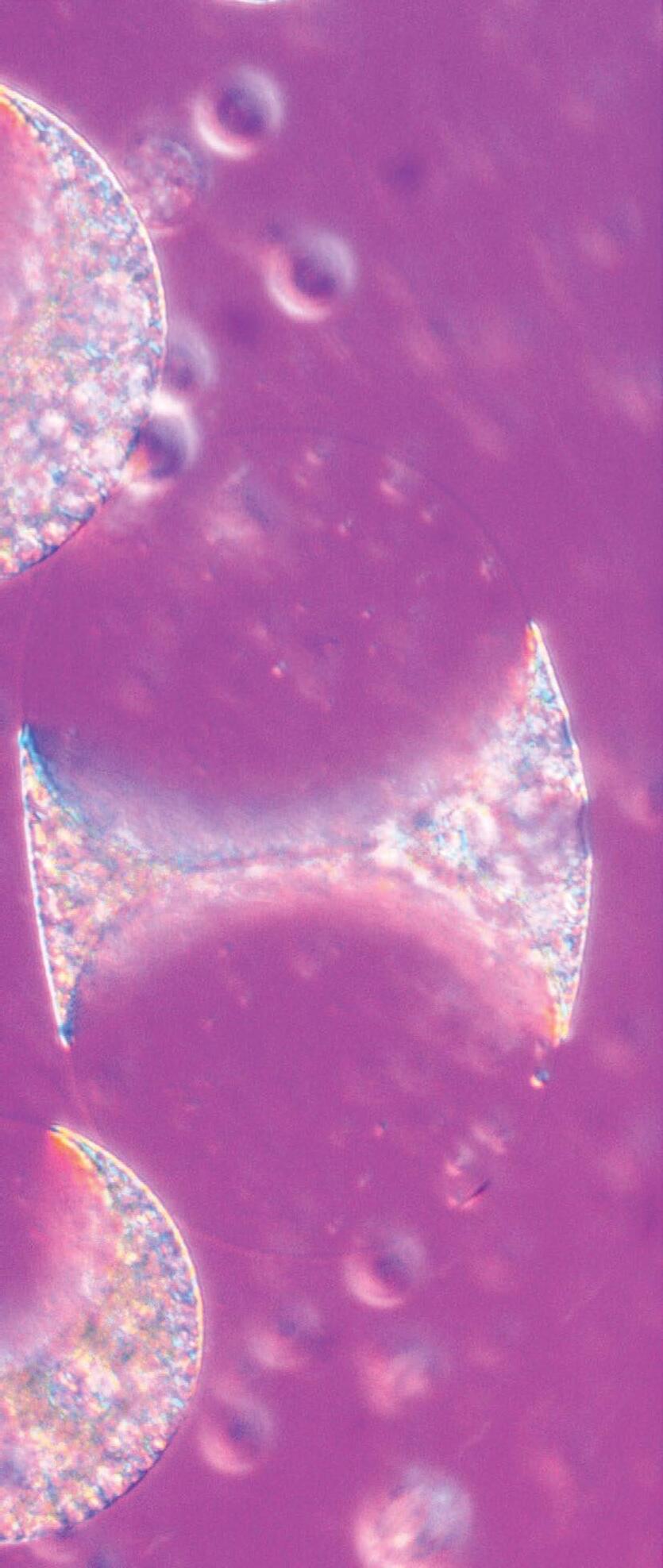
A new web resource for diatom optical microscopy
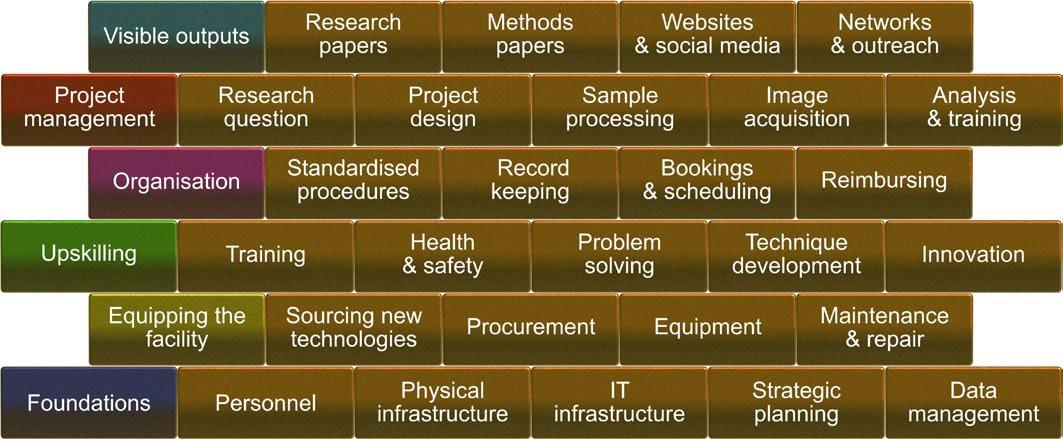
Creating an EM facility: A dual perspective
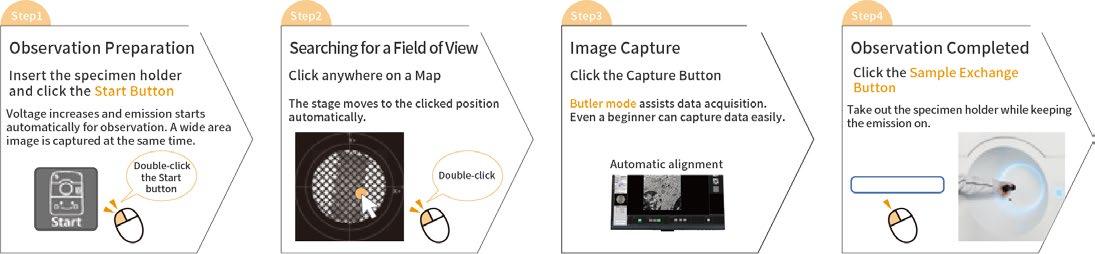
Specimen observation in 4 steps
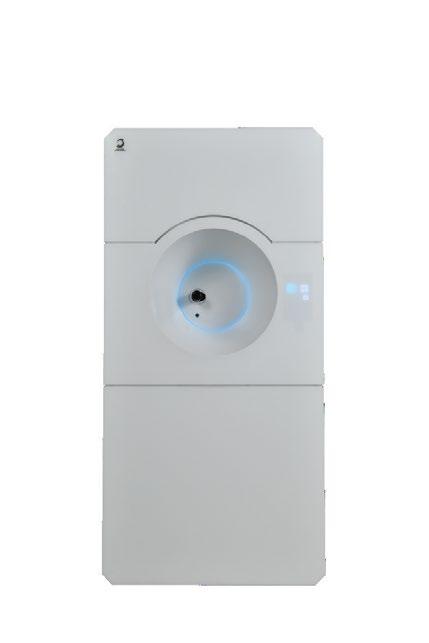
We developed the JEM-120i with the concept of "Compact", "Easy To Use", and "Expandable". With the new external appearance, this instrument has evolved into a useful tool that anyone can use easily, from operation to maintenance.
It takes only 4 steps from loading a specimen to completing observation. The JEM-120i is equipped with an enhanced TEM control system and fully automated apertures, eliminating the need for switching magnification modes and selecting an aperture. Observation operations can be performed more smoothly than with previous models.
www.jeol.com • salesinfo@jeol.com 978-535-5900
infocus is the Magazine of the Royal Microscopical Society (RMS) –the only truly international microscopical society. The RMS is dedicated to advancing science, developing careers and supporting wider understanding of science and microscopy.
infocus is published four times per year by the RMS. Designed and produced by Creative Design. Reproduction in whole or in part without permission from the RMS is forbidden. Views expressed in the Magazine are those of the individual contributors and do not necessarily reflect those of the RMS.
FROM THE SCIENTIFIC EDITOR
Dear Readers,
It’s a well-worn cliché as the festive season hoves into view, but time certainly does seem to be flying!
Here we are already, with our fourth and final issue of infocus for 2024 – and (if we do say so ourselves) we have a bit of a ‘Christmas cracker’ for you to round off the year.
On a ‘unicellular’ theme, we have two excellent articles shining their respective lights on tiny organisms which have captured the imagination of generations of microscopists. RMS History Committee Chair John Hutchison takes us on a journey through time, charting the early fascination with foraminifera, and their diverse shell forms. Several beautiful examples are discussed – from the bottom of the deepest oceans to the abundant micro-fossils found in chalk and limestone.
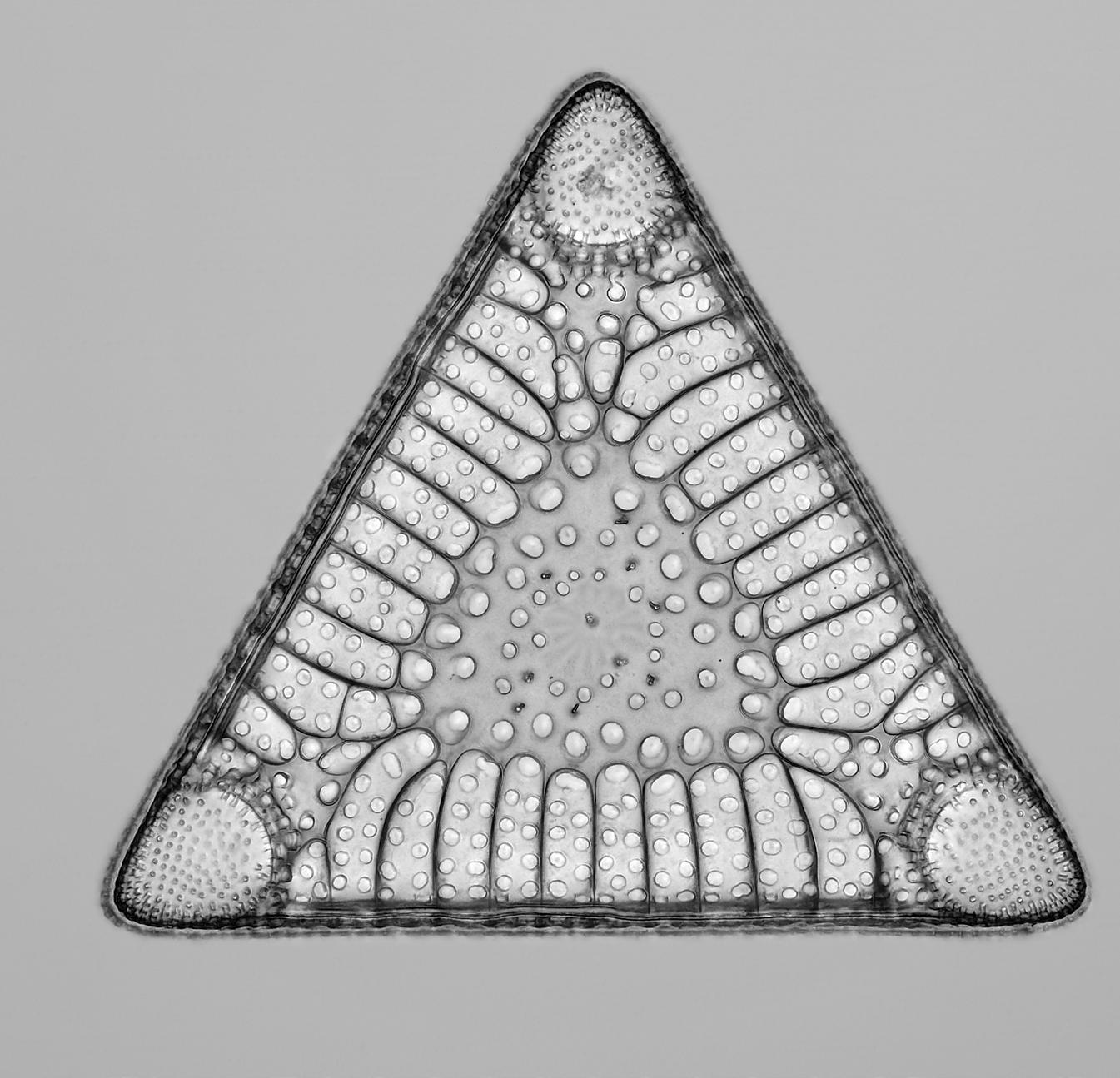
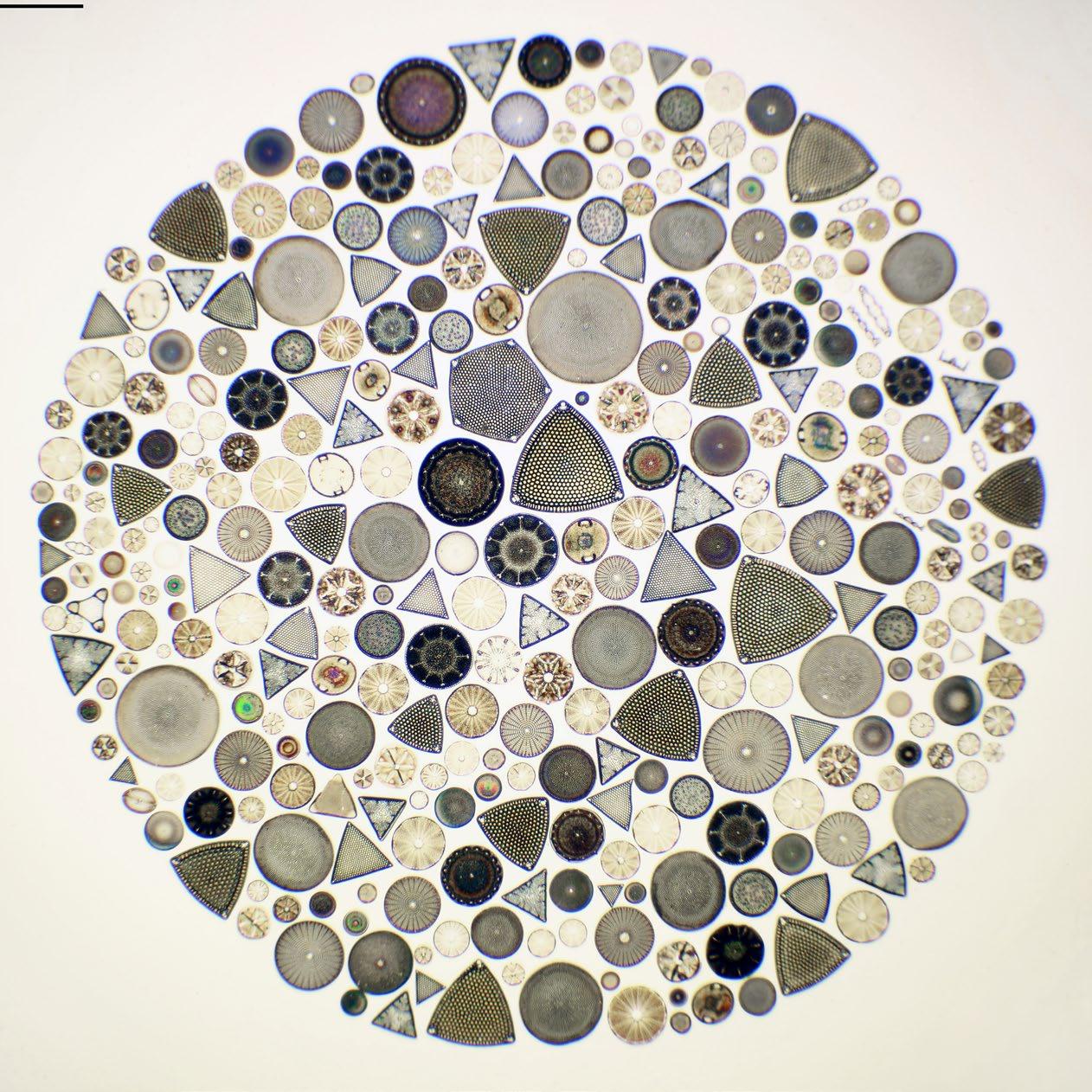
Meanwhile Jonathan Crowther provides a fascinating overview of his recent project to create a web resource – or perhaps more accurately, an online museum - of eye-catching diatom images. Jonathan’s interest in diatom slides began as a means of testing the resolution of his microscope, but his fascination with “the little marvels” soon took on a life of its own.
Another colourful – and highly impressive – resource has been created by Tony Hayes and colleagues at Cardiff University’s Bioimaging Research Hub. At the time of writing, the 3D Pollen Library Collection contains more than 160 published 3D models of pollen grains and spores from 150+ species of plant! In this issue, Tony explains how the project came about and how it is helping drive research, teaching and science engagement.
Elsewhere, we hear dual perspectives from Jon Moss and Erin Tranfield on the trials and tribulations along the road to setting up an electron microscopy facility. We are also treated to some words of wisdom from former RMS Council Member Kim Findlay, as she looks ahead to her retirement in this issue’s ‘spotlight’ interview.
I hope you enjoy reading all our December content, and wish you a very happy Christmas and new year. Slàinte!
Leandro Lemgruber
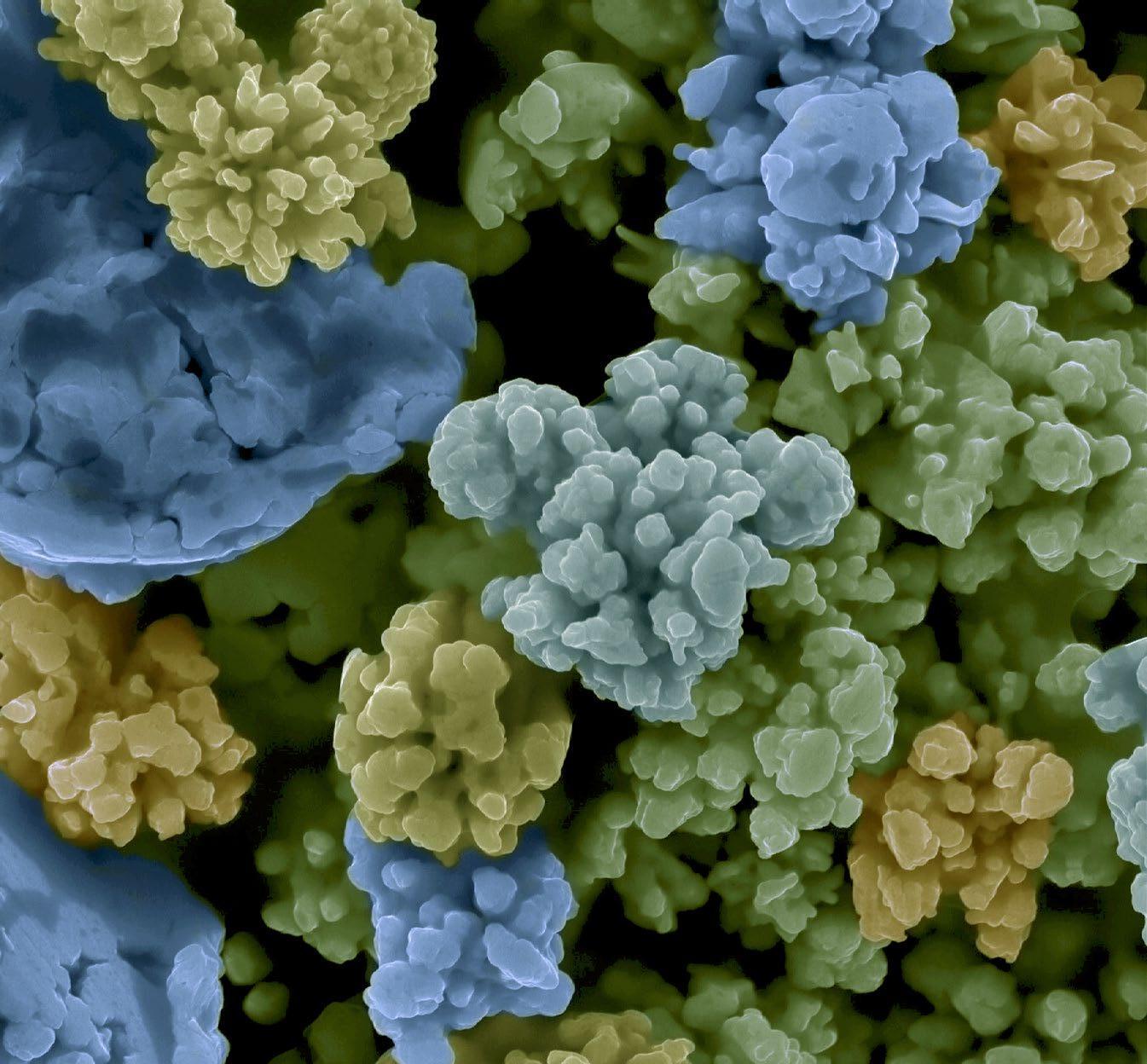
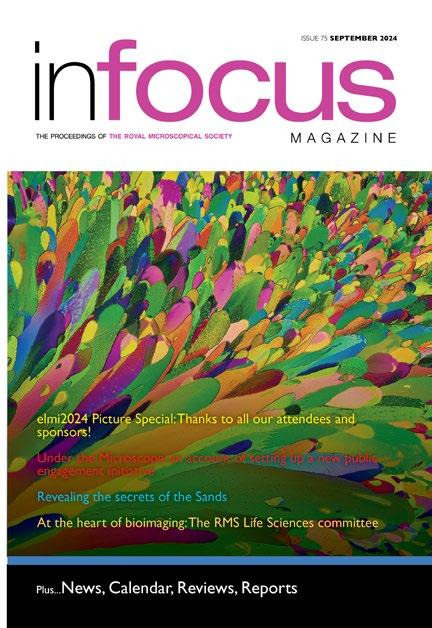
COVER IMAGE: Mercury Detection, by María Carbajo Sánchez, Universidad de Extremadura.
Shortlisted entry to the 2023 RMS Scientific Imaging Competition (Electron Microscopy, Physical Sciences category). The image corresponds to printed gold and carbon electrodes modified with gold nanoparticles, used for voltammetric mercury detection. Due to its toxicity, new electroanalytical methodologies are being investigated for the determination of mercury in different environmental matrices (rainwater, river water, wastewater, atmospheric dust and soils). Scanning Electron Microscope Quanta 3D FEG (FEI Company). Secondary electron imaging. 5000x magnification.
The 3D Pollen Library Collection at NIH3D: From Humble Beginnings to the Largest Open-Source Collection of Online 3D Pollen Models Worldwide
Anthony J. Hayes, Bioimaging Research Hub, Cardiff School of Biosciences, Cardiff University, Cardiff CF10 3AX.
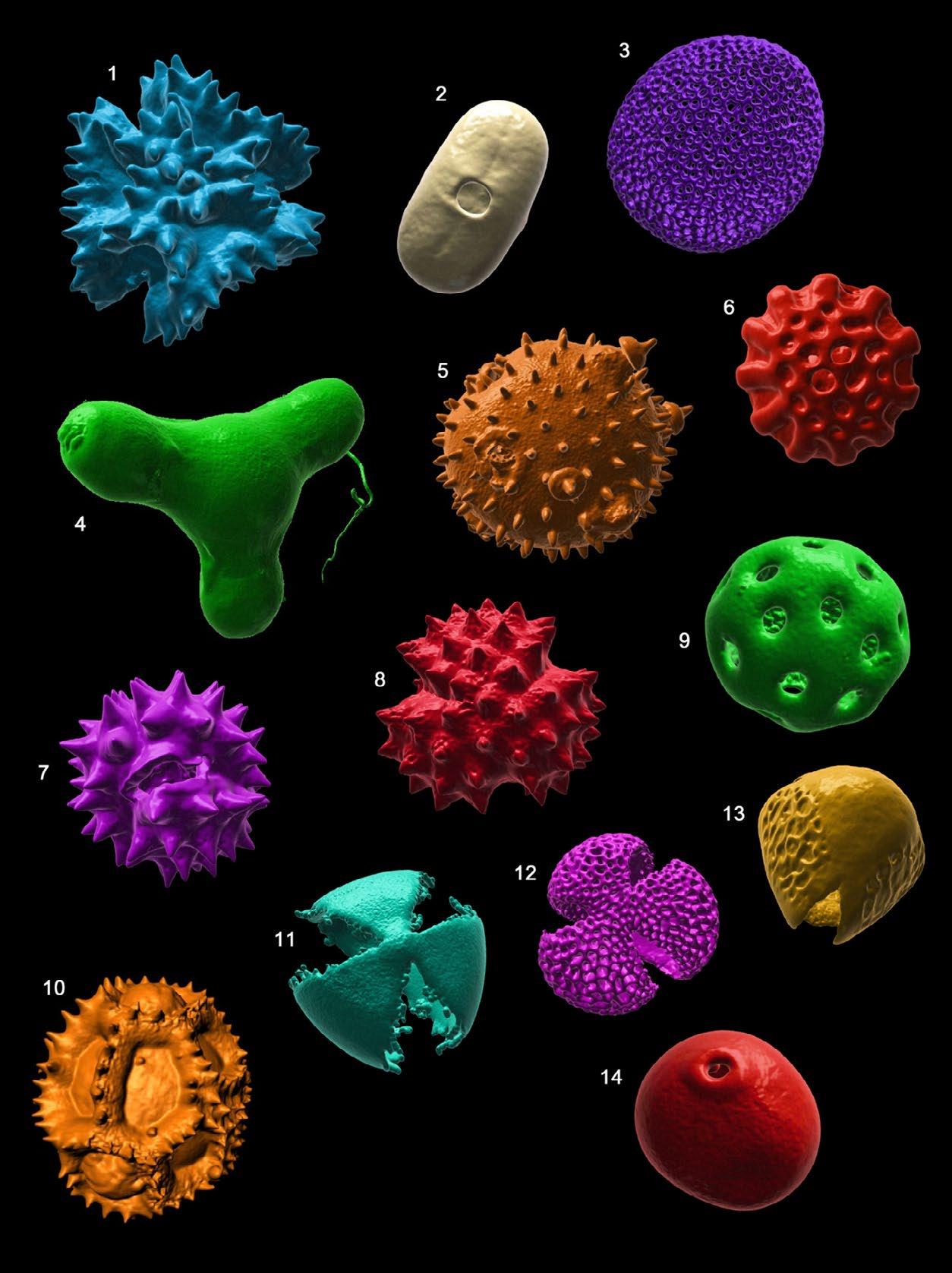
Pollen Counts: A selection of 3D pollen models from the Bioimaging Hub’s NIH3D Pollen Library Collection curated by Dr Tony Hayes. The collection currently comprises 173 published, DOI-referenced surface-rendered 3D models of pollen grains and spores from 158 species of plant. All models are 3D printable and compatible with virtual reality and augmented reality immersive technologies. 1. meadow goat’s beard (Tragopogon pratensis); 2. cow parsley (Anthriscus sylvestris); 3. seaside arrowgrass (Triglochin maritima); 5. pumpkin (Cucurbita pepo); 6. heath milkwort (Polygala serpyllifolia); 7. common daisy (Bellis perennis); 8. common groundsel (Senecio vulgaris); 9. thyme-leaf sandwort (Arenaria serpyllifolia); 10. common dandelion (Taraxacum officinale); 11. green field speedwell (Veronica agrestis); 12. cuckoo flower (Cardamine pratensis); 13. bastard-toadlax (Thesium humifusum); 14. creeping bentgrass (Agrostis stolonifera).
A fine dust to the naked eye, exquisite in microscopic form and fundamentally important to life on earth. Pollen grains contain the male gametes (i.e., sperm cells) from a flower’s anther that are essential for reproduction in seed-bearing plants thus are pivotal to the ecosystems and foods that we take for granted. As well as being critical to life, pollen records the evolutionary course of plant taxa in the geological strata, allowing scientists to understand and map environmental change; has relevance to forensic science, serving to establish links between objects, people and places; and represents a powerful allergen, causing hay fever in up to 30% of the world’s population. Without overstating the obvious, pollen counts.
Pollen grains come in a staggering variety of shapes and sizes. Their outer surface, or exine, is often highly ornamented with unique structural features that allow palynologists – the scientists who study pollen and spores - to accurately identify the parent species.1 Pollen identification is a highly skilled process requiring years of training and experience. Characterising and classifying pollen
using a compound light microscope is not a trivial task. The shallow depth of field at high objective magnifications means having to focus through the volume of multiple grains in differing orientations to construct a mental picture of their overall 3D morphology. Conveying this information, particularly to a non-specialist, via a 2D photomicrograph or schematic presents further challenges as the brain is more adept at directly processing 3D spatial information than it is in having to extrapolate volume from flat 2D images.
Scanning electron microscopy (SEM) and confocal laser scanning microscopy (CLSM) have emerged as powerful analytical tools in palynology as they allow an appraisal of 3D form at high resolution. Whilst SEM provides excellent depth of focus and extremely high (nanometre; nm) resolution of surface structure, CLSM has several practical advantages. First, CLSM is compatible with standard palynological slide preparations and does not require complicated preparatory procedures. As a fluorescence-based imaging technique, CLSM can exploit the intrinsic fluorescent properties (autofluorescence) of the pollen exine to image
1
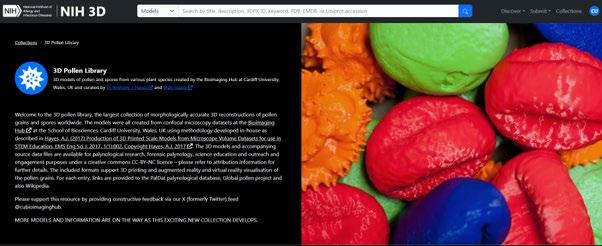
Figure 1. The 3D Pollen Library collection at NIH3D. Screenshot of the web interface. NIH3D is the foremost open, community driven portal to download, share and create bioscientific and medical 3D models for 3D printing and interactive visualisation.
The interested reader is directed to ‘The Illustrated Pollen Terminology’ (Halbritter et al., 2018) for comprehensive descriptions of pollen grain types and morphologies.
microstructure, thus readily facilitating taxonomic discrimination in a non-disruptive manner (Castro et al., 2010). Furthermore, many of the pollen stains routinely used in palynological research are also highly fluorescent (Atlagic et al., 2012), therefore archival pollen samples from herbarium collections are also amenable to this technique. Second, the optical sectioning capability of CLSM allows pollen grains to be sequentially sectioned through their volume at sub-micrometre (µm) intervals, or z-steps2, yielding a dataset of image slices, or ‘z-stack’, that permits visualisation of both internal and external structure. Third, the volume information contained in the z-stack can be digitally reconstructed in any given 3D orientation, thus facilitating comprehensive appraisal of 3D form. Four, when surface rendered as a 3D polygon mesh and provided the correct file format, CLSM data is compatible with 3D printing and immersive technologies such as virtual reality and augmented reality (VR and AR, respectively), thus offering the potential for powerful 3D learning experiences within research and educational contexts.
The 3D Pollen Library: a palynology resource not to be sneezed at
We have developed and refined workflows as outlined above, to accurately 3D model pollen grains as well as other biological samples at various levels of scale. The resultant surface-rendered 3D pollen meshes have been curated into the largest publicly accessible collection for palynological research, educational purposes and scientific outreach worldwide. At the time of writing, the 3D Pollen Library Collection hosted via NIH3D contains 173 published, DOI-referenced 3D models of pollen grains and spores from 158 species of plant (Figure 1). All the 3D pollen models are free for download for non-commercial usage under a CC-BY-NC
licence, together with source CLSM data, supporting methodology and associated image art. Each entry is linked to major palynological databases (PalDat, Global Pollen Project and PollenWiki) as well as the Wikipedia website for general information about individual plant species. The surface-rendered 3D digital meshes are readily scalable and can be used in STEM activities including 3D printing and both AR and VR, thus offering a multitude of sensory learning experiences within educational, research and science outreach and engagement contexts. The 3D printed outputs are effective pedagogic tools that facilitate haptic learning experiences with immediate relevance to blind or partially sighted individuals.
This article reviews the development and progress of this 3D pollen resource and provides examples of how it has been used in a multitude of collaborative projects, for education, public engagement and also for societal enrichment purposes.
Big journeys begin with small z-steps
Anyone who suffers from hay fever appreciates that pollen is literally everywhere. The sheer ubiquity of pollen, coupled with its striking diversity of form and prominent autofluorescence make it particularly attractive from a microscopical perspective. It was these properties that made pollen ideal for the methodology we were developing in 2015 aimed at creating tangible, physical 3D replica models of microscopic samples. The experimental approach we adopted was reasonably straightforward. The autofluorescent profile/fluorescent staining characteristics of the pollen exine can easily be mapped using lambda (l; spectral) scanning (Donaldsen, 2020) thus CLSM acquisition parameters can readily be optimised for fluorescent signal collection. Z-stacks of optical sections are hence taken through grains at high
2 Z, refers to the focal axis of the microscope. The x-and y-axis represent the first two dimensions (width and height); the z-axis, the third dimension, denotes depth.
material removed. The choice of colour is entirely arbitrary.
resolution, observing Nyquist sampling criterion to capture accurate volumetric information for 3D reconstruction. In our hands, a z-step of around 0.3µm (i.e. 300nm) is typically employed using a x63 Plan-Apochromat 63x/1.4 oil immersion objective of a Zeiss LSM880 Airyscan confocal microscope, however this value can vary depending upon the size of the pollen grain being imaged, with most grains occurring within a size range of 10-70µm in diameter. The resultant z-stack data is then surface rendered as a 3D digital polygon mesh, to reflect the surface topography of the pollen grain, and the digital output converted into a format conducive to 3D printing and AR/VR visualisation (e.g., the virtual reality modelling language world file format, wrl) using Bitplane’s Imaris image analysis software (Oxford Instruments). The surface rendered output is further processed in MeshLab to reduce the size of the mesh and to remove visible scan lines via decimation and Laplacian smoothing, respectively, taking care to preserve topology. Digital meshes are highly reproducible and scalable thus the models can be 3D printed to specification within the hardware constraints of any 3D printer. We have used affordable fused filament deposition (FFD) 3D printing technology for our work; however, the meshes can be fabricated into physical models using other additive manufacturing techniques (see Zhou et al., 2024). Despite the underlying simplicity of the technique, it was a huge thrill when our first 3D
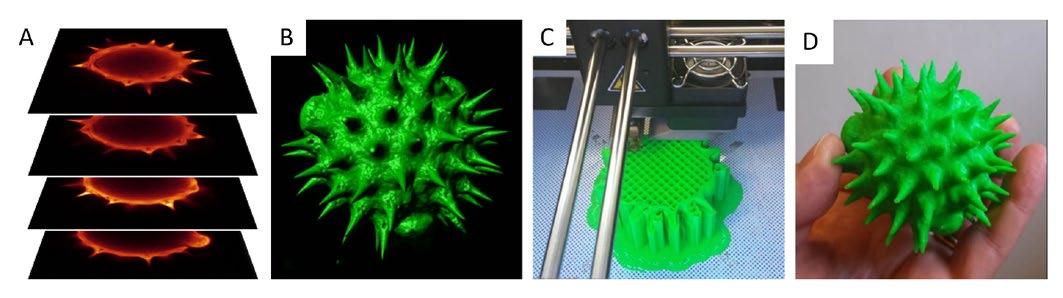
print - a pollen grain from the common sunflower, Helianthus annuus - emerged from its supporting scaffold: a perfect doppelganger of a microscopic grain supersized from roughly 1/50th of a millimetre in diameter to the dimensions of a medieval mace ball! (Figure 2).
Kinaesthetic learning: getting in touch with palynology
After demonstrating the initial proof of principle, I wrote a short blog article on the Bioimaging Hub’s news site to showcase the technique (Web link: IN-FOCUS: Bigging It Up: 3D Printing to Change the Shape of Microscopy) where I mused that a physical, tangible model would allow improved 3D conceptualisation of these microscopic structures and would have considerable relevance in an educational environment, particularly for the partially sighted or blind, by permitting kinaesthetic (i.e., tactile) learning experiences. Serendipitously, the article was read by a PhD student at the School of History, Archaeology and Religion at Cardiff University who then approached us for our help in generating 3D printed models of prehistoric pollen grains identified in soil strata sampled from archaeological sites in south Wales3. The research was part of an ongoing public engagement project, entitled ‘Footprints in Time‘ that addressed climate change patterns in local coastal environments. This presented an exciting opportunity to
3 the study of ancient pollen grains is referred to as paleopalynology; whilst palynostratigraphy deals with the description and interpretation of vegetational successions based on the identification of pollen in geological strata.
Figure 2. Supersizing pollen: from microscopic grain to medieval mace ball. A. Pollen grain from sunflower (Helianthus annuus) is optically sectioned by confocal microscopy. B. Dataset is surface rendered as a 3D digital model; C. digital model is 3D printed (N.B., the crosshatch pattern is the internal scaffold, the outer struts are the external supports); D. the finished 3D print with external scaffold
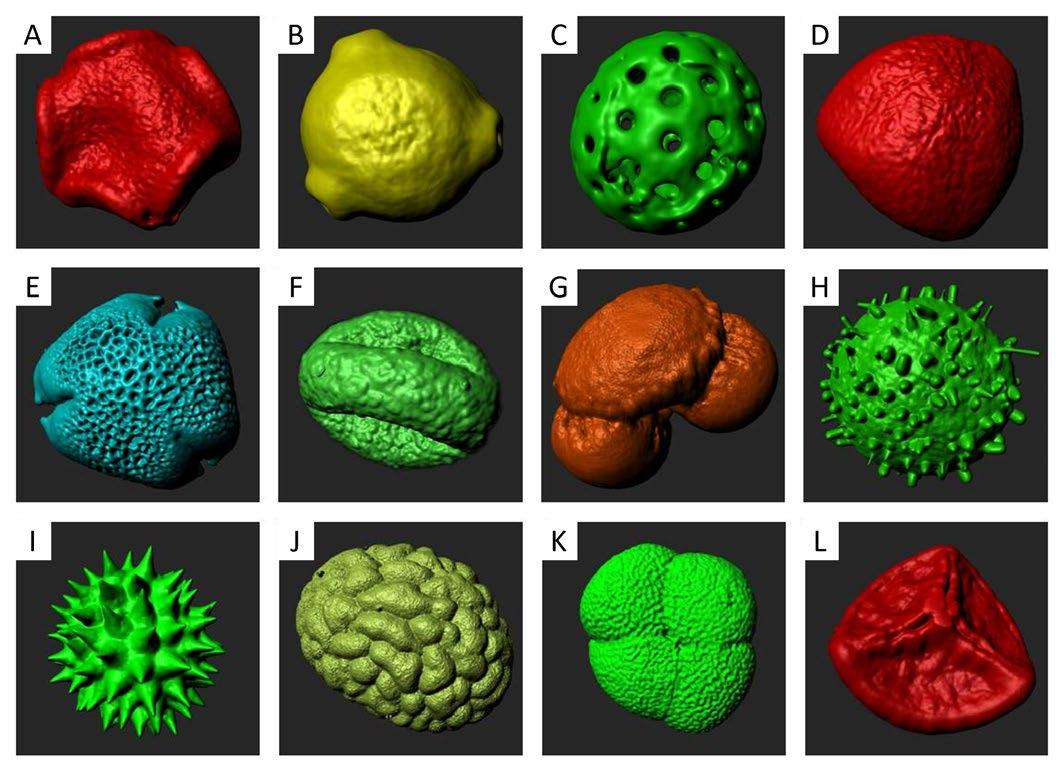
further showcase the methodology and led to the establishment of a small 3D pollen reference collection (Web link: IN-FOCUS: Development of a 3D Printed Pollen Reference Collection) which was used for science outreach and public engagement activities both within and outside Cardiff University (Figure 3).
More interest followed from Cardiff University’s School of Pharmacy with requests for 3D prints of pollen species identified in locally sourced honey as part of the Pharmabees nutraceutical research programme4. Buoyed by the interest and the growing potential for 3D printing, due to the increasing affordability and reliability of the technology, I published a short methodology paper in 2017 allowing researchers to create their own bespoke models of microscopic samples via optical
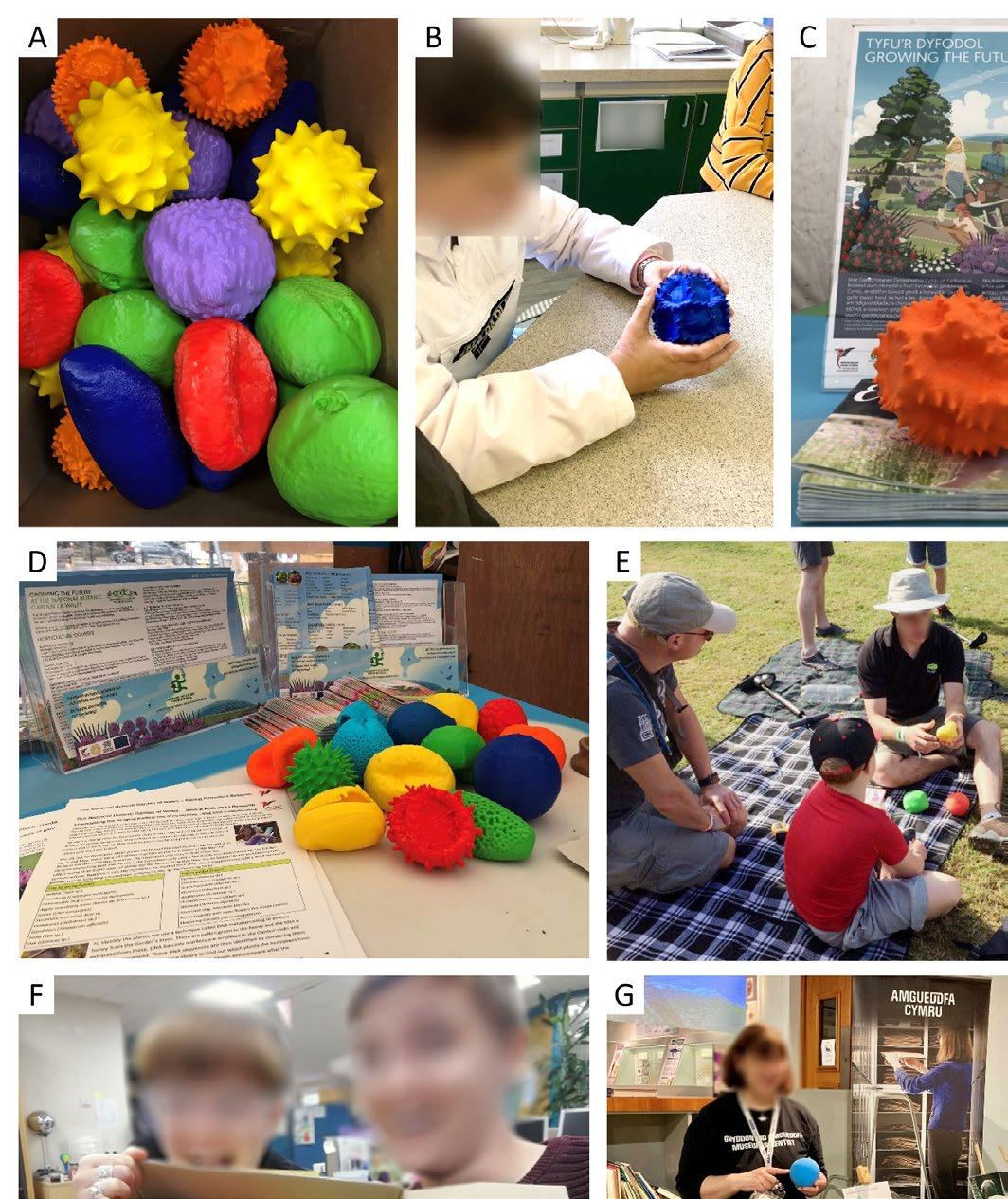
sectioning microscopy (e.g., confocal, multiphoton and lightsheet imaging modalities).The paper utilised a variety of samples, including pollen, and exploited both fluorescence and reflectance microscopy to generate the 3D models. This helped to increase the profile of our work and was followed by several external collaborations with public organisations requiring 3D pollen models. These included the National Botanic Garden of Wales (Web link: IN FOCUS: Plastic Fantastic – Making Pollen for The National Botanic Garden of Wales), the UK Met Office (Web link: IN FOCUS: 3D Pollen Prints Not To Be Sniffed At - Printing Pollen for the Met Office), as well as the Smithsonian Institution’s National Museum of Natural History in the US (Figure 4). In each instance, I created bespoke collections of 3D pollen prints based on the species and print specifications required.Typically, this meant sampling
4 melissopalynology is the field of palynology concerned with the study of pollen in honey to help identify the geographical location and genus of plants that
Figure 3. Examples of some of the initial 3D pollen/spore reference collection created for the Footprints in Time project at Cardiff University. A. black alder (Alnus glutinosa); B. silver birch (Betula pendula); C. white goosefoot (Chenopodium album); D. common hazel (Corylus avellana); E common ivy (Hedera helix), F. common oak (Quercus robur); G. Scots pine (Pinus sylvestris); H. European white water lily (Nymphaea alba); I. common daisy (Bellis perennis); J. common fern (Polypodium vulgare); K. common bulrush (Typha latifolia); L. peat moss (Sphagnum sp.)
honeybees have visited.
Figure 4. The Bioimaging Hub’s 3D pollen models out in the wild. Examples of how the 3D pollen prints have been used for pedagogy and science outreach and engagement. A. 3D models of assorted honey pollen species created for the PharmaBees programme at Cardiff University. B. 3D pollen model being used in a classroom environment (year 7) as part of the Pollen8 Cymru initiative. C-D. Pollen models created for the National Botanic Garden of Wales. C. Model of a dandelion (Taraxacum officinale) pollen grain being exhibited at the Royal Welsh Show. D. 3D pollen models used for public engagement at the Growing the Future Cymru Pollinator festival. E. The Met office explaining the link between pollen and hay fever at the Bluedot festival. F. Science Made Simple staff show off some of our 3D pollen models ahead of the Glastonbury festival. G. Heather Pardoe explains the importance of pollen at the After Dark science event at Amgueddfa Cymru (National Museum of Wales). Photographs courtesy of Mike Pascoe (B), Faye Watson (C, D), Felicity Liggins (E), Jack Laird (F) and Heather Pardoe (G).
pollen in the field, performing the imaging and 3D modelling and then generating the finished 3D printed output on the facility’s UltiMaker FFD 3D printer.The collections produced were used by each of the above organisations in their public outreach and education programmes and exhibited at various culturally significant national and international events such as the National Eisteddfod of Wales, The Royal Welsh Festival, Glastonbury, as well as smaller, local festivals, events and initiatives (e.g.,
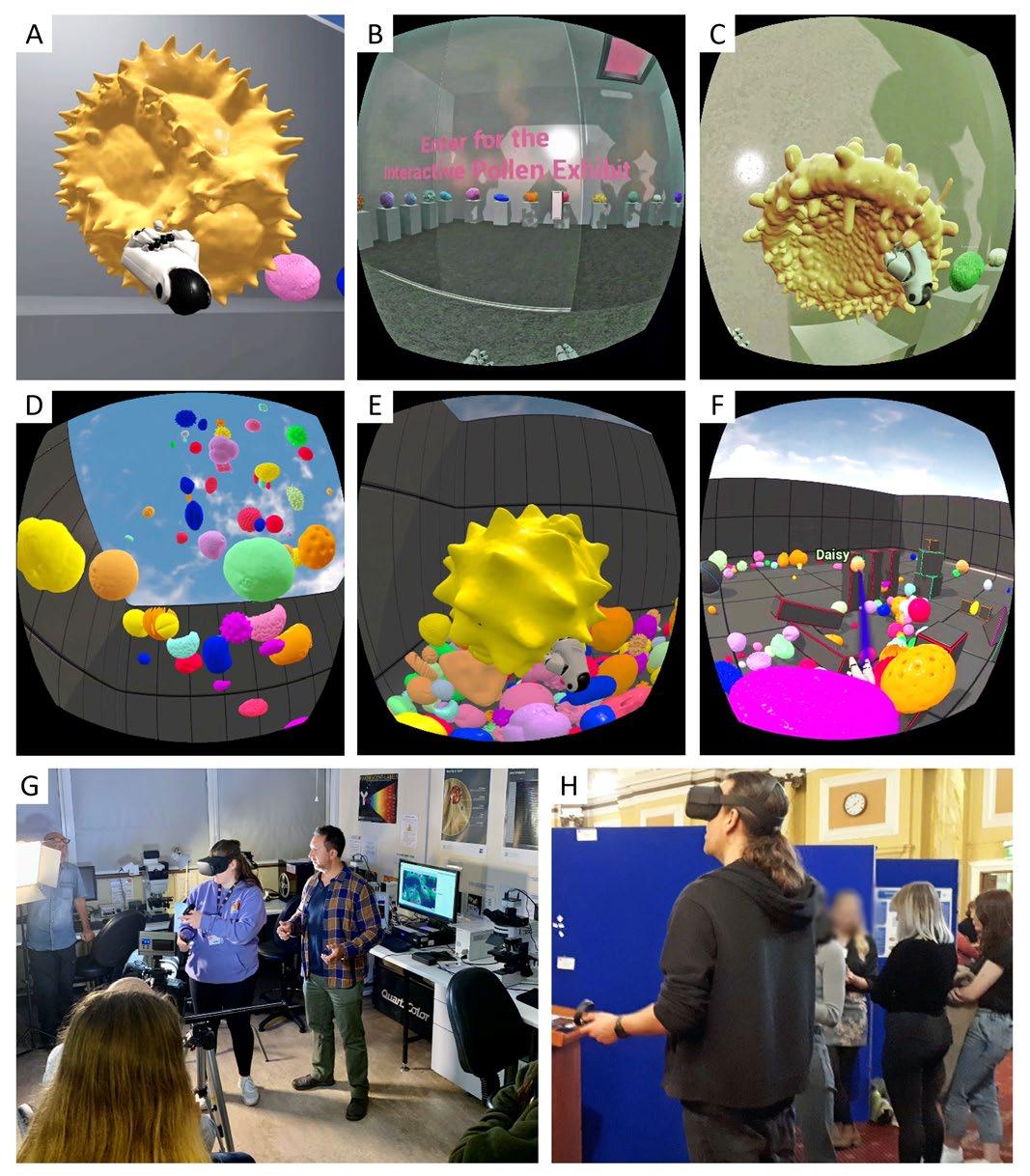
Figure 5. Virtual reality (VR) pollen resource developed by the Bioimaging Research Hub. The VR resource allows users to interact with pollen grains and other 3D objects in different virtual learning environments. A-C. Interactive 3D pollen exhibit. A. Working prototype using the firstgeneration Oculus Go headset (2019) – one hand and three degrees of freedom movement (pitch, yaw and roll). B-F. updated and improved version using the second-generation Oculus Quest headset (2020) – two handed and six degrees of movement (also includes surge, heave, sway). D, E. Fun VR learning environments designed for children: 3D pollen pit, F. 3D pollen cannon. Unreal engine coding by Marc Isaacs and Angelina Murphy. G. An undergraduate student gets to grips with the VR controls during filming of a promotional video for Cardiff University at the Bioimaging Hub. H. Testing the VR at a research day at City Hall, Cardiff. Figure 4G courtesy of Rhys Jones, Cardiff University.
Between the Trees, Pollen8 Cymru, etc) generating significant interest from the public. Feedback from these was shared on the Bioimaging Hub’s X (formerly twitter) feed @cubioimaginghub.
Immersive learning: probing the reality of nature
In 2019, the Bioimaging Research Hub began developing workflows that would allow virtual reality (VR) interaction with our surface rendered
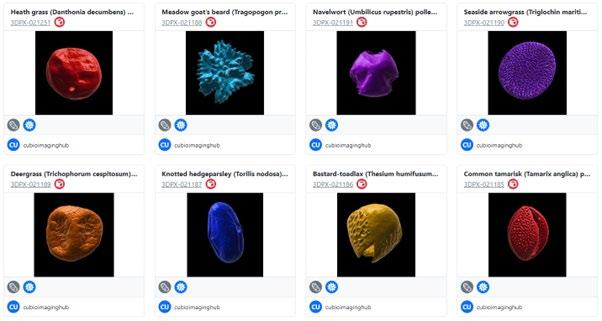
Figure. 6. Screenshot from the 3D Pollen Library collection showing a small selection of thumbnails of 3D pollen models available for download. The collection currently holds 173 published, DOI-referenced models of pollen grains and spores from 158 species of plant, together with source data (confocal z-stacks), published supporting methodology, and links to major palynological databases for cross-referencing. The models and supporting data are free to download and to use for non-commercial purposes under a CC-BY-NC copyright licence.
3D digital models (Figure 5). This coincided with the release of the Oculus Go VR headset, which was the first affordable untethered headset to take VR mainstream. We used this device, and the later Oculus Quest headset, in conjunction with the Unreal Engine to create and populate VR environments with our entire range of 3D digital models (Web link: IN FOCUS: Immersive microscopy – 3D Visualisation and Manipulation of Microscopic Samples Through Virtual Reality). In addition to the 3D pollen models, we were also experimenting with 3D photogrammetry techniques in collaboration with the Wales Centre for Anatomical Education to create highly realistic 3D models of anatomical samples for use in anatomy teaching (example here).
The VR pollen resource, along with the 3D prints, were employed for public engagement activities within the School of Biosciences during Cardiff University open days, UCAS visits etc until March 2020. And then covid happened.
The consequence of covid: the 3D pollen library collection and augmented reality
The covid pandemic had enormous societal impact worldwide, profoundly affecting human interaction and resulting in a huge shift to the digital realm. The lockdowns and subsequent social distancing measures introduced by the Welsh Government over this period effectively prevented us from utilising the 3D printed pollen models or the VR headset for public engagement or pedagogy in group-based learning environments due to the infection risks posed. A different approach was therefore necessary. Up until this point, all our 3D digital pollen models were held on the Bioimaging Hub’s internal server, thus it made sense to now make them freely available for non-commercial usage, under a Creative Commons CC-NY-NC licence, via the recently redeveloped NIH3D website (formerly the NIH3D print exchange). The NIH3D website is the foremost open, community driven portal to download, share and create bioscientific and medical 3D models for 3D printing
and interactive and immersive visualisation. This decision made the collection truly international in its scope. Interested parties could download the models, together with supporting metadata, directly to their computers or personal devices for 3D visualisation, 3D printing or immersive experiences from anywhere in the world without the infection risk associated with a shared physical resource. We were also able to work collaboratively with the NIH3D development team and contribute to the look and feel of the new site.This partnership led to the curation of our datasets into a special 3D Pollen Library collection (Figures 6 and 7).
A second consequence of covid was that it pushed us into developing new workflows to allow AR visualisation of our 3D pollen models (Figure 8). Critically, unlike VR, this technology does not require a head set and hand controller(s), only a personal smartphone or tablet, thus overcoming the potential risks associated with equipment sharing. AR also allows users to experience a photorealistic environment via the smart device’s camera output, with generated perceptual information overlaid upon it, thus providing a more natural immersive experience than the artificial environments of VR. Furthermore, freed from the physical encumbrance of a VR headset, the user has a greater awareness of
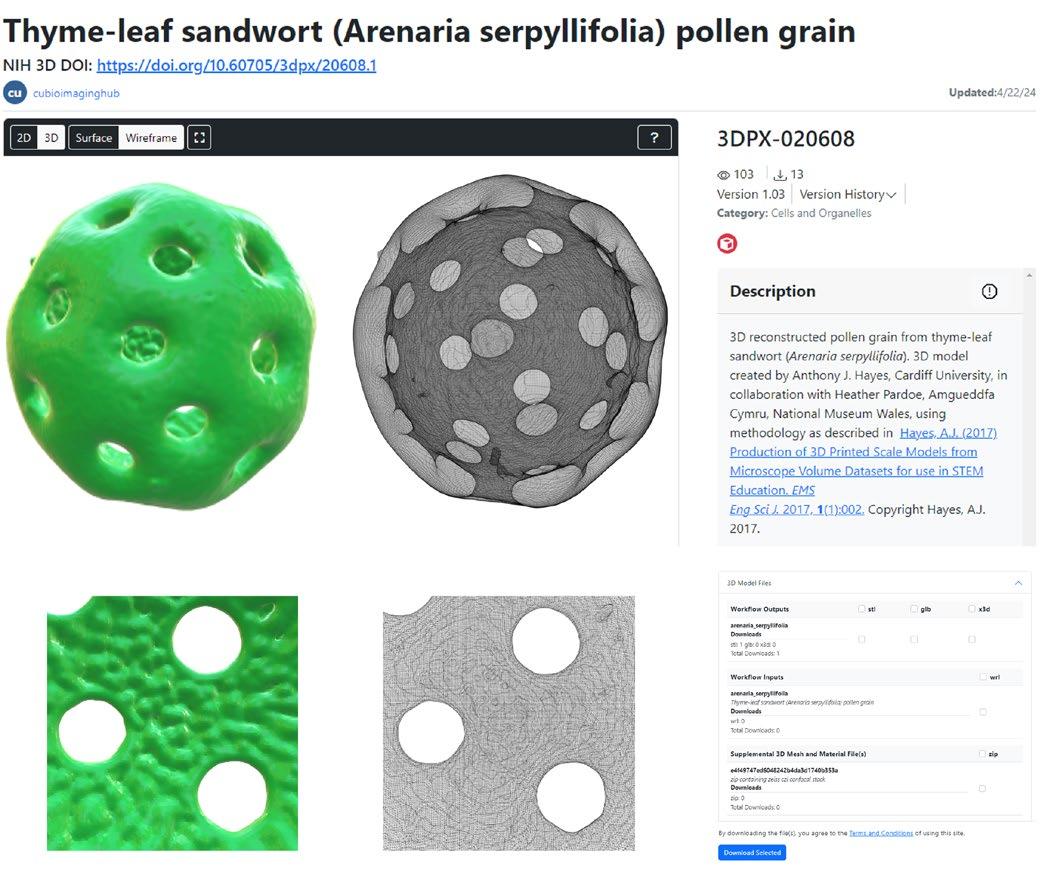
presents the option of viewing the pollen grain as a surface rendered
or
mesh). Both views are shown here. The 3D model can be manipulated on screen into any desired orientation via rotate, drag, and zoom controls allowing visualisation of both external and internal structure (internal detail shown in lower figures). Description and links shown top right; download options, bottom right.
Figure 7. The 3D engine for model visualisation on the NIH3D website. This example shows a pollen grain from thyme-leaf sandwort (Arenaria serpyllifolia). The display can be toggled between 2D and 3D modes. The 3D display
model (green)
wireframe (polygon
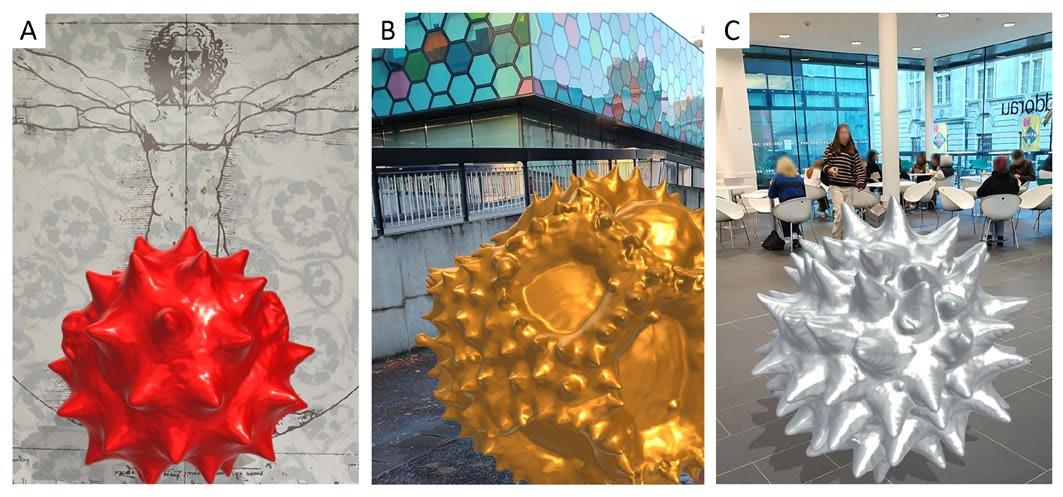
Figure 8. Augmented reality (AR) visualisation of pollen grains. A-C. Snapshots taken from an android smartphone running a free AR app. Ambient lighting and shadow effects make for a highly realistic immersive experience. The 3D pollen models can be freely moved, rotated and zoomed via the smartphone’s touchscreen interface and also circumnavigated and explored - both externally and internally - via directional information from the device’s sensors (i.e., accelerometer, gyroscope and compass). A. a pollen grain from ox-eye daisy (Leucanthemum vulgare) skews the proportions – whilst protecting the modesty - of Leonardo’s Vitruvian man. B. a dandelion (Taraxacum officinale) pollen grain, supersized as a gilded colossus. C. a pollen grain from common daisy (Bellis perennis) skinned in metallic silver.
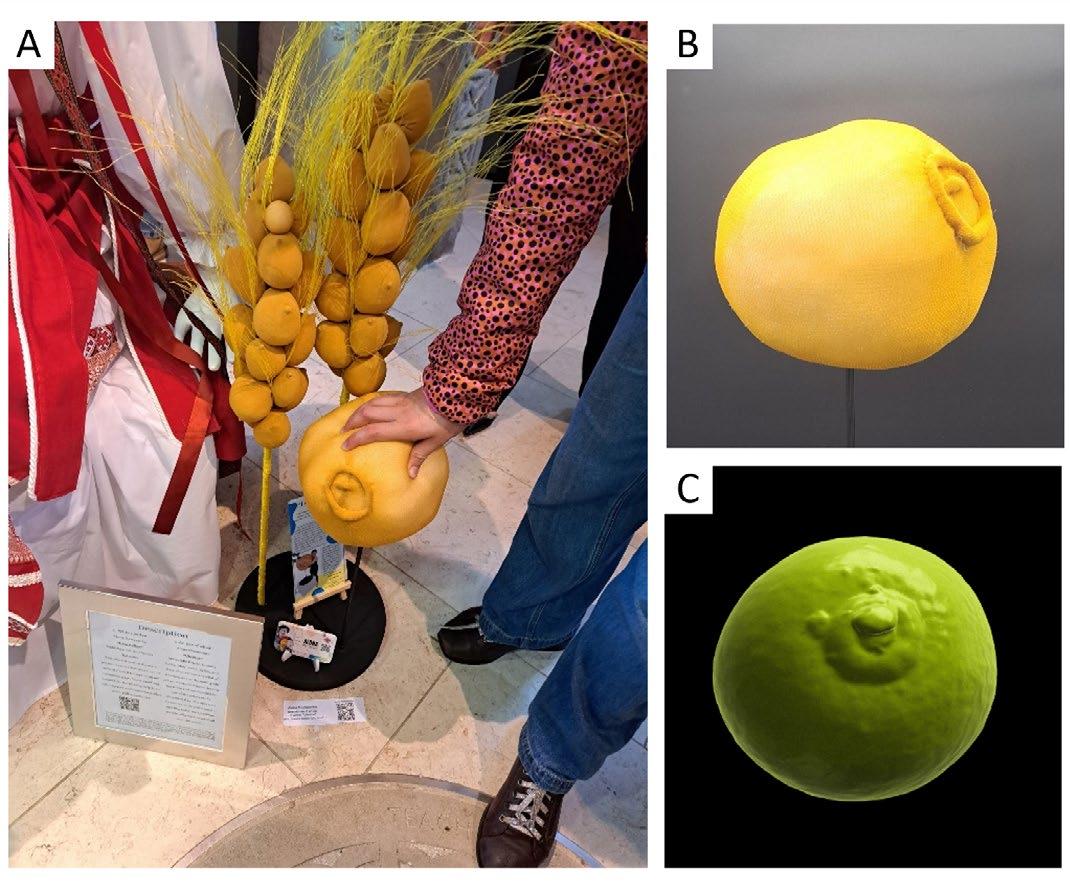
Figure 9. A, B. Exhibit showing wheat pollen plush for visually impaired and blind. The exhibit, created by Alona Nesterenko, was part of the Ukrainian refugee art exhibition at the These3Streams Art festival at Llantwit Major. C. Surface rendered digital model of pollen grain from wheat (Triticum aestivan) which the plush was based upon. The pollen plush is approximately 20cm in diameter, whilst the pollen grain is approximately 50µm in diameter. Photographs A & B courtesy of Alona Nesterenko.
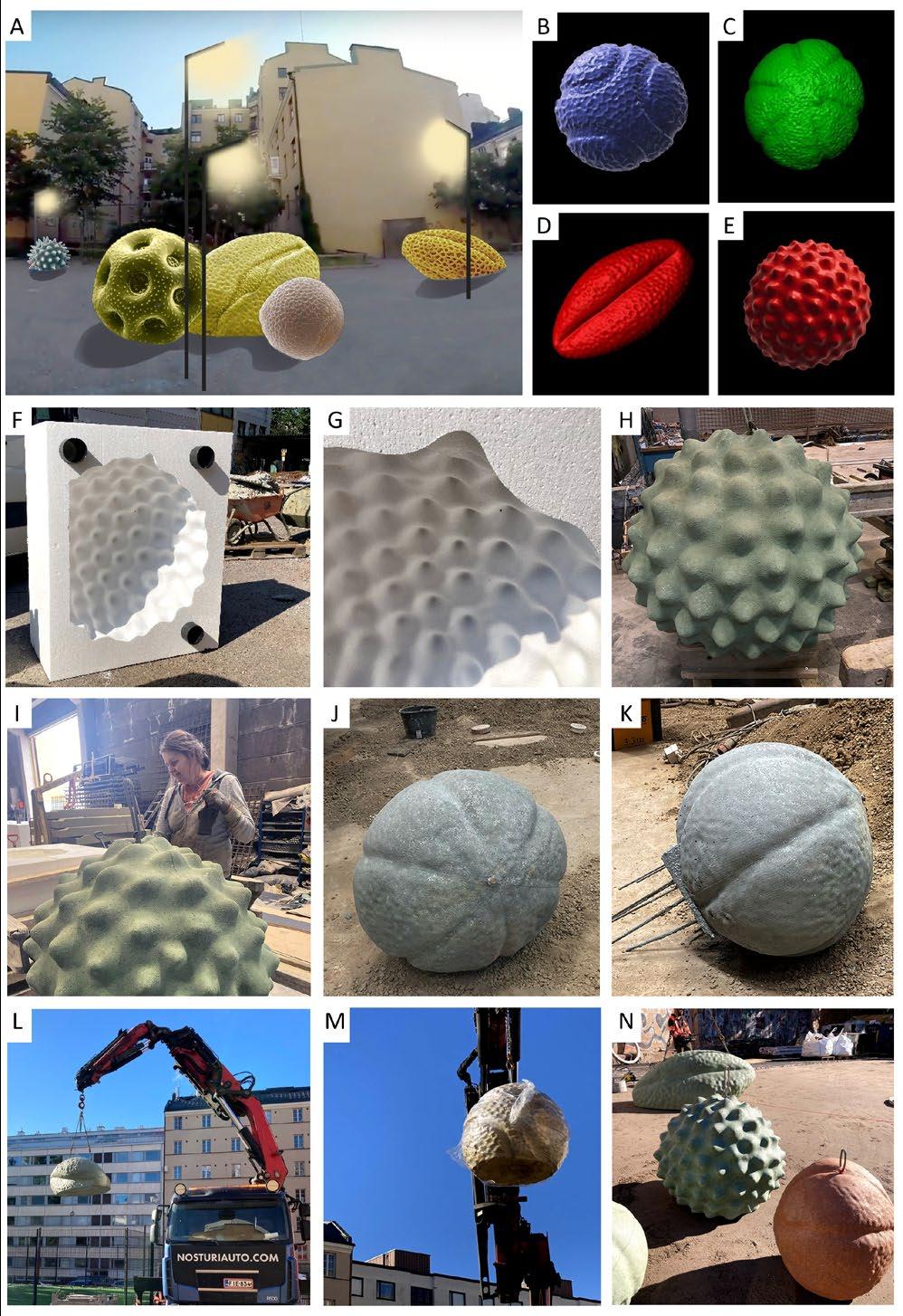
Figure 10. Breaking the mould: supersizing pollen grains into gigantic public art sculptures. A. Concept art for the 3D pollen sculptures, copyright Saara Ekström. B-D. 3D pollen models from the NIH3D pollen collection to be made into concrete sculptures: B. blue passionflower (Passiflora caerulea), C. thyme (Thymus vulgaris), D. black elderberry (Sambucus nigra), E. ragweed (Ambrosia sp.). F, G. Examples of the casting moulds for the ragweed pollen sculpture. CAD (computer Aided Design) software is used to program a sculpting tool that mechanically carves a negative form of the pollen grain out of high density styrofoam blocks to create the moulds. A flat base, visible in F, is introduced into the mould to ensure that the sculpture remains stable. Eco-friendly natural concrete is poured into the moulds for each of the pollen species. When cured, the moulds are removed from the concrete sculptures. H-K concrete sculptures of ragweed (H, I) and thyme (J, K) pollen. The ragweed pollen sculpture (H-K) is one metre in diameter weighing approximately one and a quarter tonne. The individual shown in I demonstrates the enormous scale of the sculpture (approximately 500,000x larger than the source grain). Steel reinforcing rebar is visible in K. After the sculptures are freed from their moulds, they are hand finished and a coloured protective coating is added. L-N. The sculptures are then transported to the exhibition site and carefully lowered into place under ambient lighting, as demonstrated in concept art. Photographs A, F-N courtesy of Saara Ekström.
their surroundings and is less likely to experience motion/simulation sickness (Web link: IN FOCUS: AR Palynology: Probing the Reality of Nature/ Nature of Reality).
Amgueddfa Cymru: digitising the National Museum’s palynology collection.
Over the last year, the Bioimaging Hub has collaborated with Heather Pardoe, the principal botany curator and senior palynologist at Amgueddfa Cymru (the National Museum of Wales), to digitise their archival pollen collection. This successful collaboration has significantly increased the number of pollen models that are now available through the 3D pollen library collection, almost doubling our content, and these have been incorporated into a subcollection of the library, Amgueddfa Cymru, National Museum of Wales, palynology collection. I have also curated a small selection of models to highlight the range of interesting pollen morphologies present within the broader collection, 3D Pollen Library highlights.
Usage of the NIH3D Pollen Library
Following the establishment of the 3D Pollen library collection at NIH3D, the supported models and their supplementary metadata (confocal z-stacks etc) have been viewed and downloaded many hundreds of times. Other than the number of views and downloads per 3D mesh, we rely on direct feedback from the user community to inform where and how our models are being used. Feedback from users indicate that the resource is being used worldwide for a variety of purposes. Two recent usage examples include the University of Medellin, Columbia who have utilised some of our 3D pollen models for their palaeoecology classes, and the Beringia Interpretive Centre, Yukon, Canada, who have exhibited our models as part of an interactive display featuring pollen from pre- and post-glacial periods. Recently we have supported local artist, Alona Nesterenko, in her studies at Cardiff College Art Academy, who has drawn inspiration from our
3D pollen models to create sensory plush models for the visually impaired and blind. One of these, a wheat pollen plush, dedicated to Ukraine, was recently exhibited at a local arts festival (Figure 9).
Currently, we are collaborating with Finnish visual artist and film maker, Saara Ekström, who is supersizing four of our 3D pollen models into gigantic concrete public art sculptures for an elementary school in Helsinki (Figure 10) – a brilliant way to enrich communal spaces, stimulate young (and old) minds and to increase awareness of the unseen natural world. This work was commissioned by the City of Helsinki and will be administered by the Helsinki Art Museum who are responsible for the city’s public art collection (Web link: IN FOCUS: Breaking the mould: Supersizing Pollen Grains as Gigantic Concrete Public Art Sculptures).
Current and future directions
The 3D pollen library collection at NIH3D has been an effective mechanism for dispersal of our 3D pollen models at an international level and we hope to improve and develop the site going forward. We are continuing with our ongoing collaboration with Amgueddfa Cymru and are open to new partnerships to exploit and expand the 3D pollen resource for novel applications, activities and events in research, teaching and science engagement, as well as for societal enrichment purposes (e.g., public art, exhibitions etc). As a microscopist, unveiling the unseen beauty of the microscopic world and stimulating and promoting scientific enquiry remains a passion. There are now many publicly accessible science discovery centres in the UK dedicated to STEM learning, with the longest established centre, Techniquest, being based at Cardiff Bay. These discovery centres are united by a national charity, the Association for Science and Discovery Centres (ASDC), which plays an important strategic role in the nation’s engagement with science. I am currently looking into collaborative opportunities and partnerships that would allow the 3D pollen models to be utilised in novel STEM activities in these public learning environments. One exciting
area might be the development of new workflows to facilitate mixed reality immersive imaging of pollen grains. For example, the new Meta Quest 3 mixed reality VR headset has opened the potential for next level immersive experiences. The headset combines the advantages of VR and AR, with full colour, high-resolution ‘passthrough’ technology which enables mixed reality (i.e., the blending of the real and computer-generated worlds) with enhanced hand tracking features, thus reducing the need for a hand controller and allowing a more natural immersive experience. New additive manufacturing techniques also offer the potential to 3D print at large scale at much higher print resolutions, and advances in computer aided design (CAD) open up new possibilities in the analysis, modification and optimisation of 3D design for STEM in the development of scientific learning resources, and also for public engagement and societal enrichment through ‘Sci-Art’. Lastly, new 3D imaging modalities providing faster speeds, higher throughput and greater resolution, coupled with AI deep learning will provide a step change in palynology research, allowing high throughput screening and rapid phenotyping of pollen samples across multiple scientific disciplines. It’s fair to say that the pollen forecast is looking good!
Acknowledgements
Thanks to Bioimaging Research Hub staff, Marc Isaacs, and Claire Gealy, for contributions to the development of the 3D pollen resource and proofreading of this manuscript. Thanks also to Iain Perry, Jenn-Yeu Szeto and Peter Watson for assistance with the 3D printing. The Unreal Engine coding for the VR pollen resource was by Marc Isaacs and Angelina Murphy. A big thank you to Heather Pardoe for making the Amgueddfa Cymru archival pollen slide collection available to this project. I am also grateful to the following people for providing the feedback and usage examples highlighted in this manuscript: Faye Watson (National Botanic Garden of Wales), Mike Pascoe (School of Pharmacy, Cardiff University), Felicity Liggins (UK Met Office), Jack Laird (Science Made Simple), Heather Pardoe
(Amgueddfa Cymru), Rhys Jones (School of Biosciences, Cardiff University) and artists Saara Ekström and Alona Nesterenko. Last, but certainly not least, I would like to thank Kristen Brown at NIH3D for her help and ongoing support in the development of the 3D Pollen Library resource.
References
1. Halbritter, H., Ulrich, S., Grimsson, F., Weber, M., Zetter, R., Hesse, M., Buchner, R., Svojtka, M., Frosch-Radivo, A. (2018) Illustrated Pollen Terminology. Second edition. Springer ISBN: 9783-319-71364-9 (e-book); doi: 10.1007/978-3-31971365-6.
2. Donaldson, L. (2020) Autofluorescence in plants. Molecules 25(10): 2393. DOI: 10.3390/ molecules25102393
3. Castro, A.J., Rejón, J.D., Fendri, M., JiménezQuesada, M.J., Zafra, A., Jiménez-López, J.C., Rodríguez-García, M.I., Alché, J.D. (2010) Taxonomical discrimination of pollen grains by using confocal laser scanning microscopy (CLSM) imaging of autofluorescence. In: Microscopy: Science, Technology, Applications and Education (pp.607-613), Edition: 2010. Chapter: 13. Publisher: Formatex. Eds: Méndez-Vilas A., Díaz, J.
4. Atlagić, J., Terzić, S., Ana Marjanović-Jeromela, A. (2012) Staining and fluorescent microscopy methods for pollen viability determination in sunflower and other plant species. Industrial Crops and Products 35 (1): 88-91. DOI: 10.1016/j. indcrop.2011.06.012.
5. Zhou, L., Miller, J., Vezza, J., Mayster, M., Raffay, M., Justice, Q., Tamimi, A.A., Hansotte, G., Sunkara, L.D., Bernat, J. (2024) Additive Manufacturing: A Comprehensive Review. Sensors 2024, 24: 2668. DOI: 10.3390/s24092668.
6. Perry, I., Szeto, J-Y. A., Isaacs, M.D., Gealy, E.C., Rose, R., Scofield, S., Watson, P.D., Hayes, A.J. (2017) Production of 3D printed scale models from microscope volume datasets for use in STEM education. EMS Eng Sci, 2017, 1(1):002.
Calendar
We are very pleased to continue offering a range of ‘in-person’ and virtual events this year, in order to maximise accessibility and provide opportunities to those who might not otherwise be able to attend.
The following information was correct at the time infocus went to print but could potentially be subject to change in the coming weeks. Please visit our event calendar at www.rms.org.uk for the latest updates.
If you have any questions about a booking you have already made for an event, or need any help or advice, please contact us at info@rms.org.uk
2024
December
5 – 6 Virtual European Flow Core Meeting 2024, (Online)
6 Super-resolution in the North 2024, Leeds, UK (RMS-hosted event)
11 Probing Magnetic Topologies with Corrected Lorentz STEM, London, UK
2025
January
6 – 7 UK Light Microscopy Facility Meeting 2025, Bristol, UK
8 – 9 Flow Cytometry Facilities Meeting 2025, Edinburgh, UK
February
6 – 7 EM-UKI 2025, Liverpool, UK
March
3 – 6 Virtual Flow Cytometry Data Analysis Course Spring 2025, (Online)
10 Virtual Flow Cytometry Data Analysis Course Spring 2025 - Clinical Module, (Online)
24 – 27 Physics of Life, Harrogate, UK (RMS Exhibiting at event)
14 – 16 Advanced imaging techniques in biomineralisation research Faraday Discussion, Edinburgh, UK (RMS sponsored event)
June / July
9 – 10 Light Microscopy Summer School 2025, York, UK
11 – 12 Getting the most from your Confocal Course 2025, York, UK
30 June – 3 July
mmc2025: Microscience Microscopy Congress 2025, Manchester, UK
For further information on all these events, please visit our Event Calendar at www.rms.org.uk
Featured RMS events
EM-UKI 2025
6 – 7 February, Liverpool, UK
Committee Chair and 2025 Hosts: Heath Bagshaw and Alison Beckett, University of Liverpool
The EM-UKI community meetings are an open forum for discussion of the latest developments and challenges in the field, suitable for both academic and commercial microscopists. The
Virtual Flow Cytometry Data Analysis
Course Spring 2025
3 – 6 March (Online)
Scientific organisers: Dan Payne, James Cook University Hospital; Derek Davies, Derek Davies Cytometry; Karen Hogg, Peter O’Toole and Sukhveer Kaur Mann, University of York
This course will run over four half-days from Monday 3 March to Thursday 6 March 2025, plus one optional additional Clinical Module on Monday 10 March 2025. The course will cover the basics of analysis for a number of different applications including antibody phenotyping, DNA and cell cycle kinetics, cell proliferation and death, and functional studies. There will also be the opportunity to explore high-dimensional analysis using dimensionality reduction and clustering techniques.
meeting will include Techno Bites, talks, and discussions, and also hosts the RMS annual EM lecture.
This year’s programme will include the following sessions:
• RMS EM Lecture
• Updates from the EM Community
• Funding
• Careers & Outreach
• Interactive Methodology
Pre-recorded lectures will be provided in advance of the course with live small group practical sessions in the afternoons. It will run in the afternoon UK time to make it more accessible to those in other time zones (14:00 GMT/15:00 CET/09:00 EST). The Clinical Module on Monday 4 March 2024 will be a full day UK time (09:00 GMT/10:00 CET/04:00 EST).
Delegates will be able to use data files (which will be provided) and follow along with directed analysis by the course demonstrators. Analysis will be performed in either FlowJo or FCS Express and applications specialists will also form part of the demonstrator team.
This course is open to all and is suitable for those who are relatively new to flow cytometry and those who wish to expand their experience with applications and specific analysis.
This meeting will consist of themed plenary sessions with talks from invited speakers. There will also be parallel scientific workshops organised by members of the cytometry
Electron Microscopy Spring School 2025
31 March – 4 April, Leeds, UK
Scientific organisers: Louie Aspinall, Nicole Hondow, Rik Brydson, University of Leeds
community and parallel commercial workshops. There will be a large exhibition and the opportunity to network with flow and image cytometrists from all over Europe and beyond. The meeting will highlight advances in flow and image instrumentation, high content screening, cancer and stem cell biology, applications of clinical cytometry and the development of novel probes and approaches in many areas of biomedical research.
The Electron Microscopy Spring School aims to provide a basic training in both the theory and practice of scanning electron microscopy (SEM) and transmission electron microscopy (TEM). The course covers imaging, diffraction and chemical microanalysis as well as the highly important area of sample preparation.
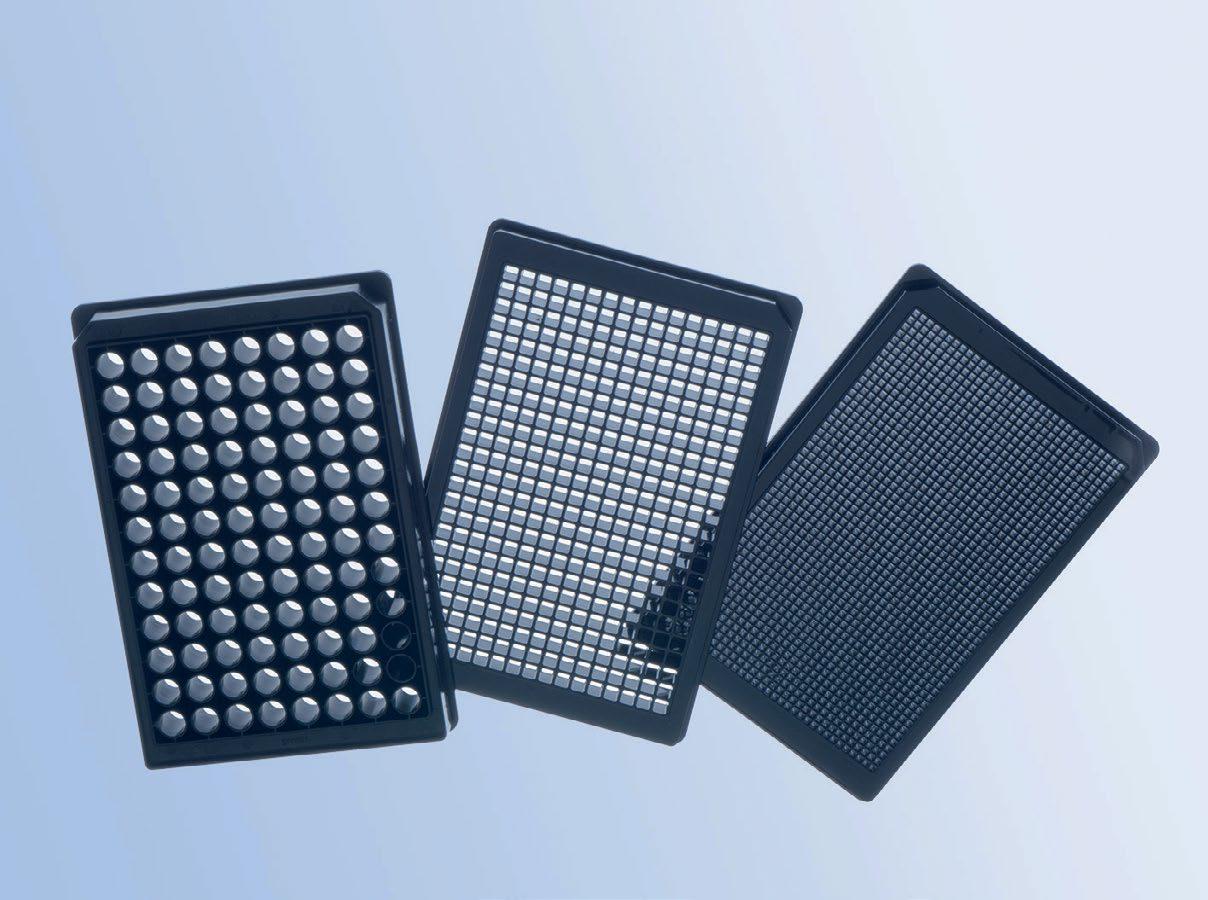
Cycloolefin and Glass based
OUTSTANDING IMAGERY
SCREENSTAR & CELLview MICROPLATES
&
For high-resolution microscopy
SCREENSTAR: 96 / 384 / 1536 well format. For sophisticated microscopic applications and high content screening. Highly transparent cycloolefin film bottom. Adherent TC surface treatment.
CELLview: 96 well format. Outstanding image quality and resolution.
Cycloolefin-based frame with 0.17 mm glass bottom. Recessed well bottom facilitating the use of lenses with low working distance and high aperture.
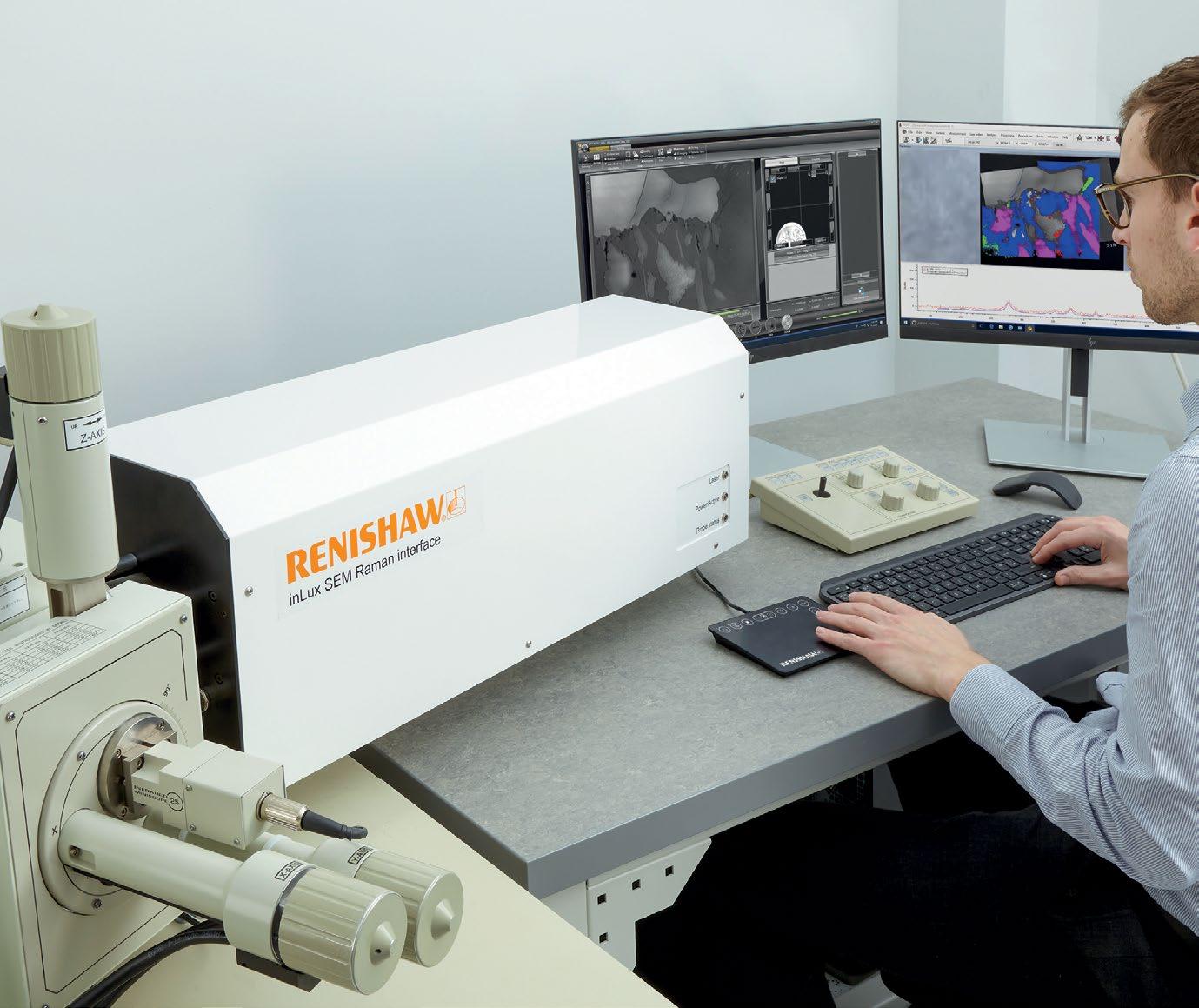
With the inLux™ SEM Raman interface, Raman imaging can simultaneously reveal chemistry and structure within your scanning electron microscope (SEM) chamber. Bring it all together for truly correlative materials characterisation.
2 October, Royal Society of Chemistry, Burlington House, London
The RMS would like to thank everyone who attended Microscopy: Advances, Innovation, Impact 2024 - incorporating the RMS AGM & Section AGMs. The free event, held in the heart of London at the Royal Society of Chemistry on 2 October, featured AGMs for each of the Society’s Science sections, fascinating talks from leading researchers, and a number of award presentations. It also included a series of quick-fire talks from the shortlisted candidates for the RMS Early Career Award – with the winner announced at the close of the meeting (see below).
More than 70 people attended in person with a further 50 logging on to follow proceedings online, as part of efforts to make the event as accessible as
possible to both RMS members and non-members.
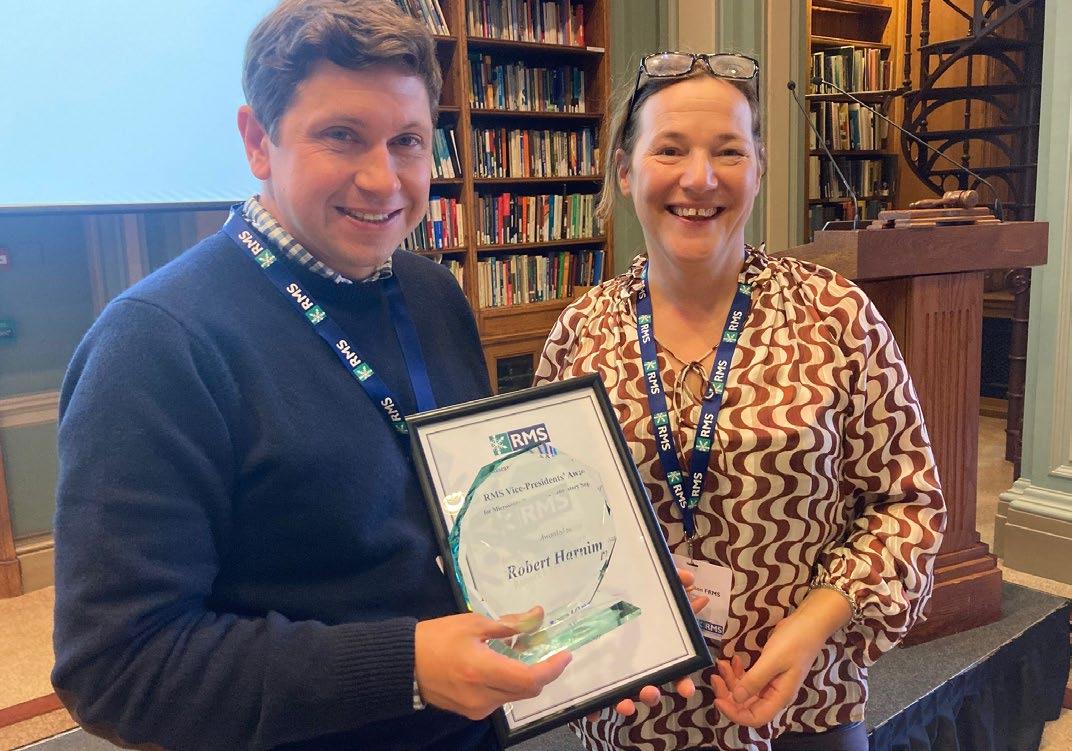
Invited speakers included Dr Rob Harniman of the University of Bristol, who received the RMS Vice President’s Award for his work leading the Atomic Force Microscopy (AFM) facility at Bristol University’s School of Chemistry.
We also heard fascinating scientific talks from
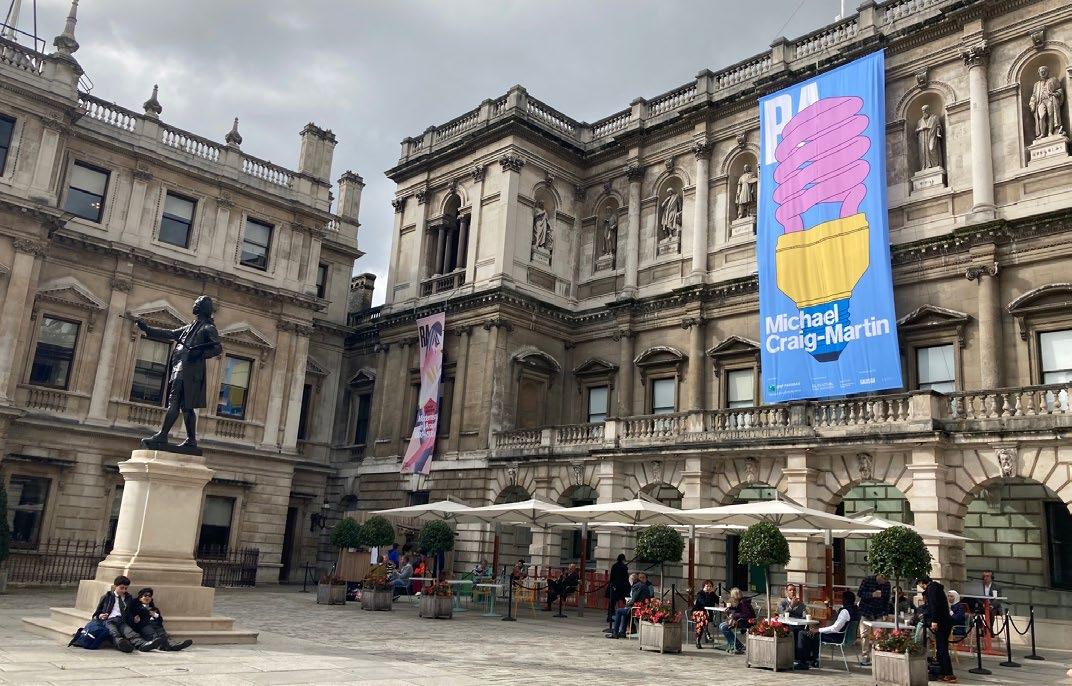
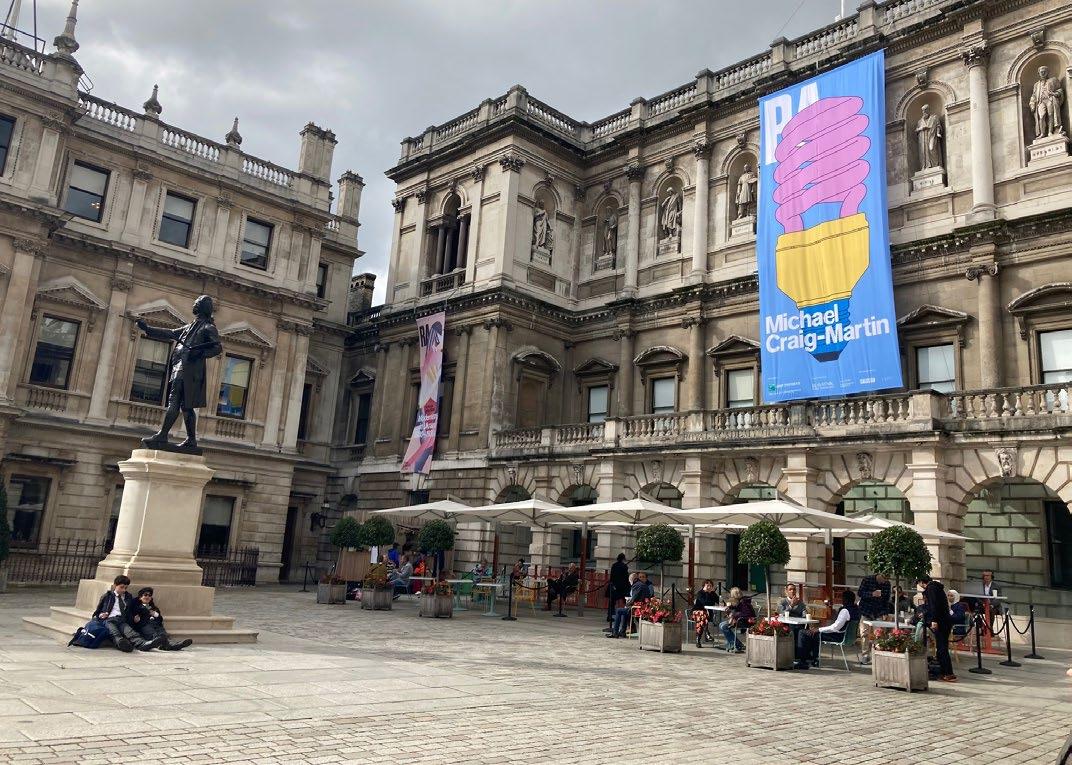
The courtyard area outside the Royal Society of Chemistry, within Burlington House.
Giulia Zanetti of Birkbeck College, Adriana FloresLangarica (University of Birmingham) and George Heath (University of Leeds). Elsewhere, an equity, diversity and inclusion-themed talk was delivered by
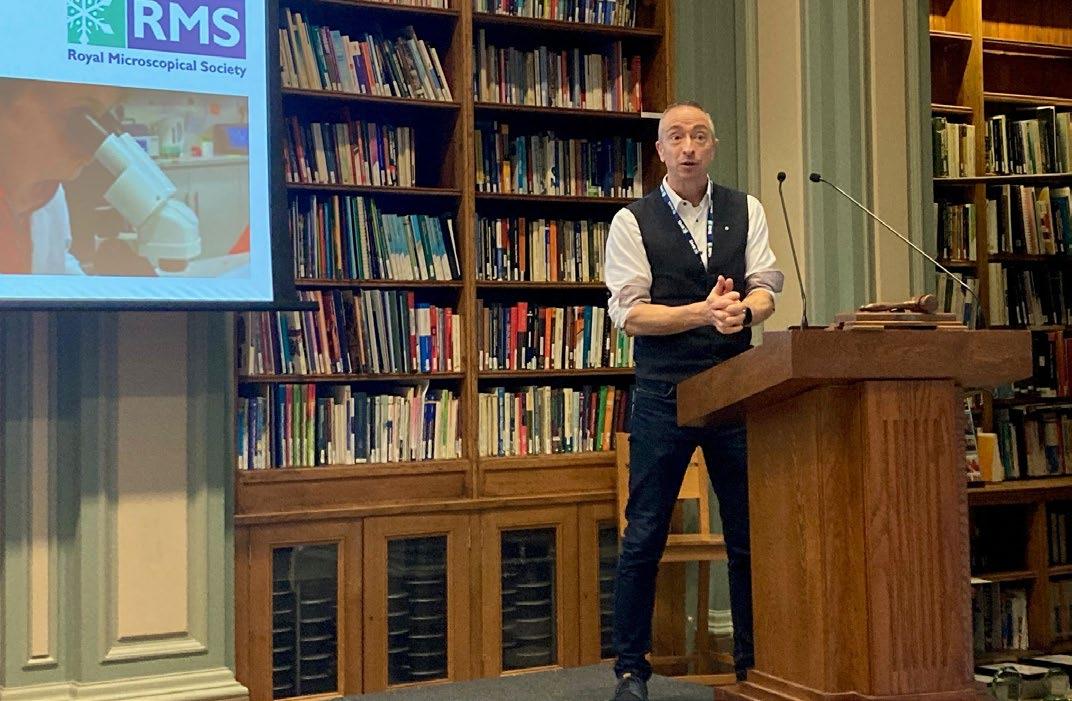
RMS President Peter O’Toole welcomes attendees.
Rob Harniman receives the RMS Vice President’s Award from former Vice President Susan Anderson.
The courtyard area outside the Royal Society of Chemistry, within Burlington House.
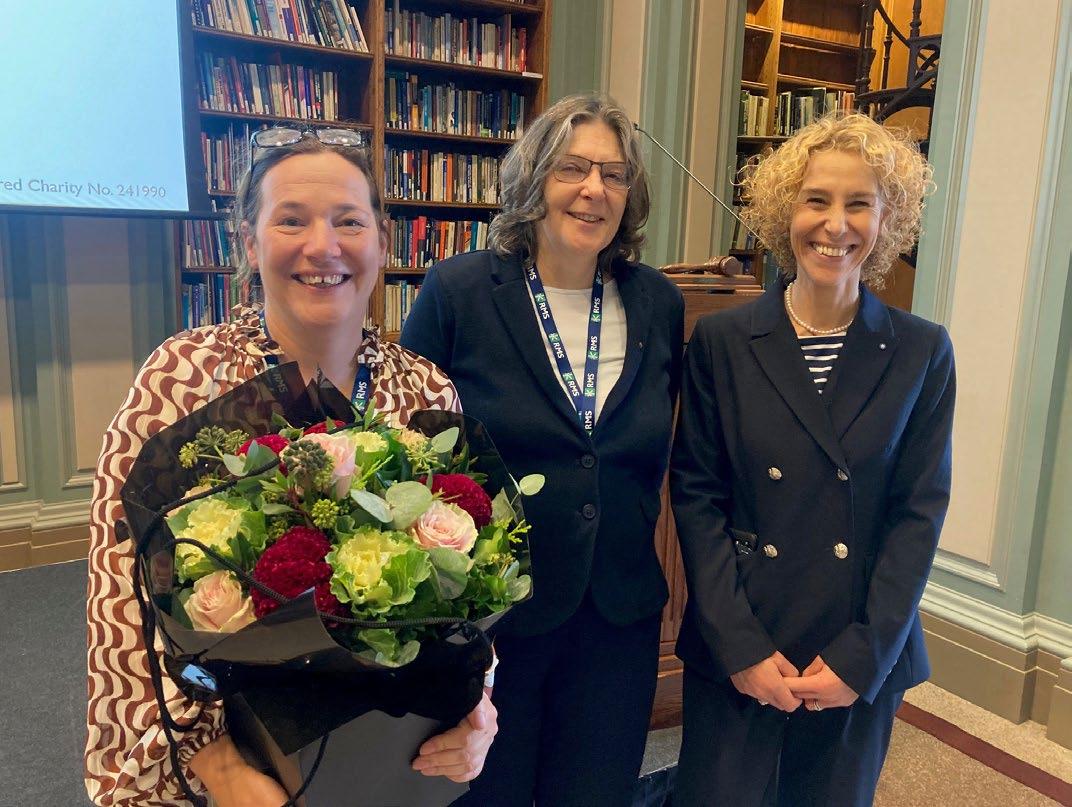
Susan Anderson (left) receiving a gift from RMS Executive Honorary Secretary Michelle Peckham (centre) and Chief Executive Sali Davis, after stepping down from the RMS Executive Committee.
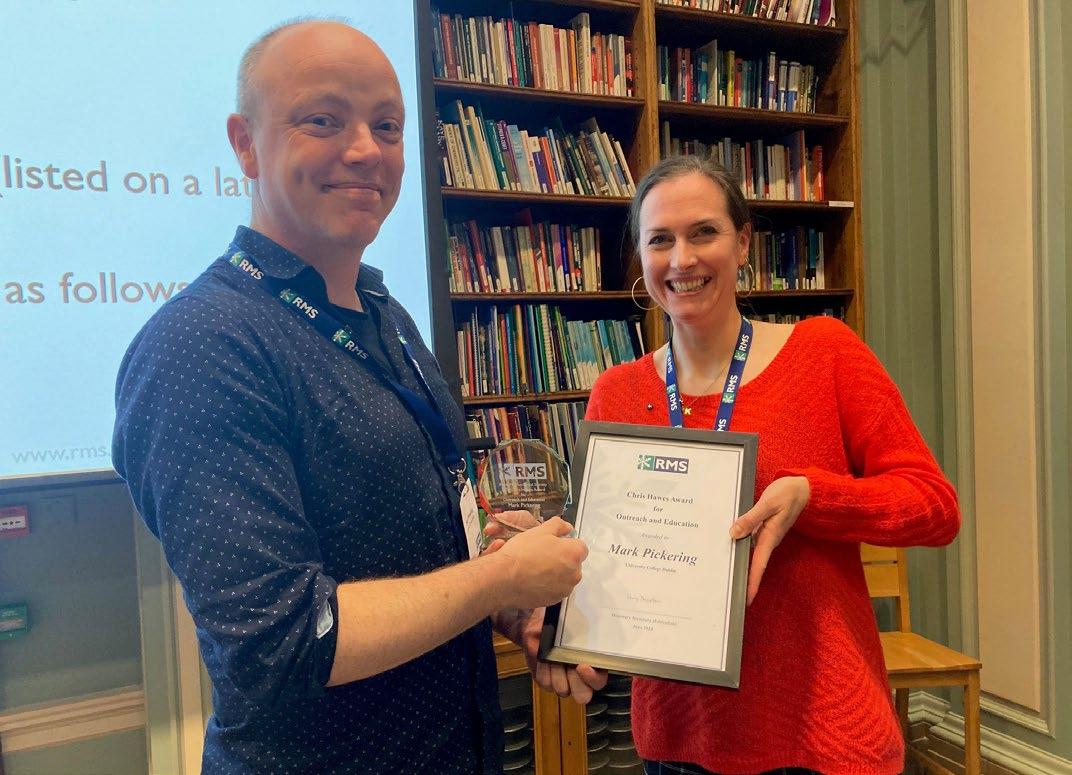
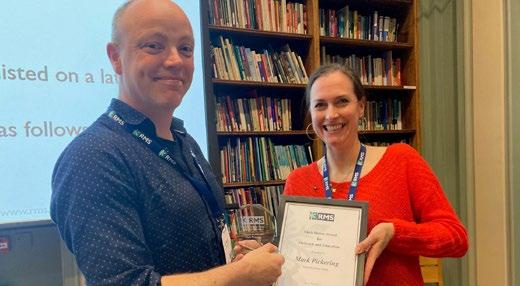
Mark Pickering (left) receiving the 2024 RMS Chris Hawes Award for Outreach and Education from RMS Hon Sec for Education Kerry Thompson.
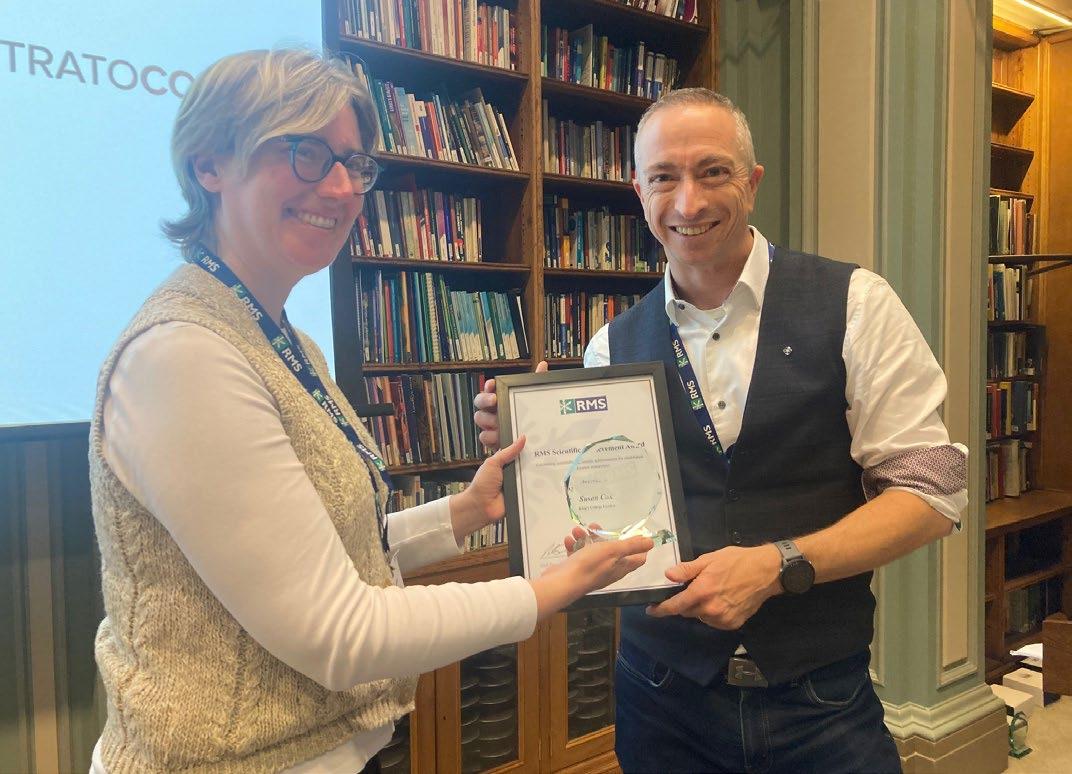
Susan Cox receiving the RMS Scientific Achievement Award from Peter O'Toole.
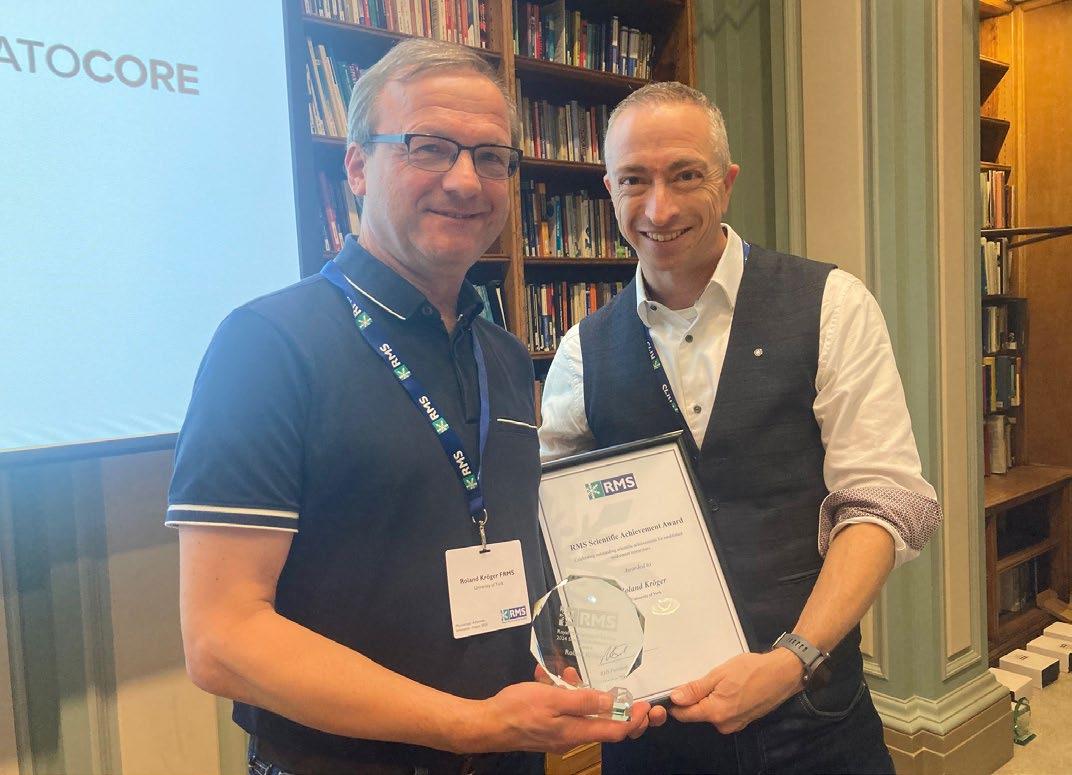
Roland Kroger receiving the RMS Scienetific Achievement Award.
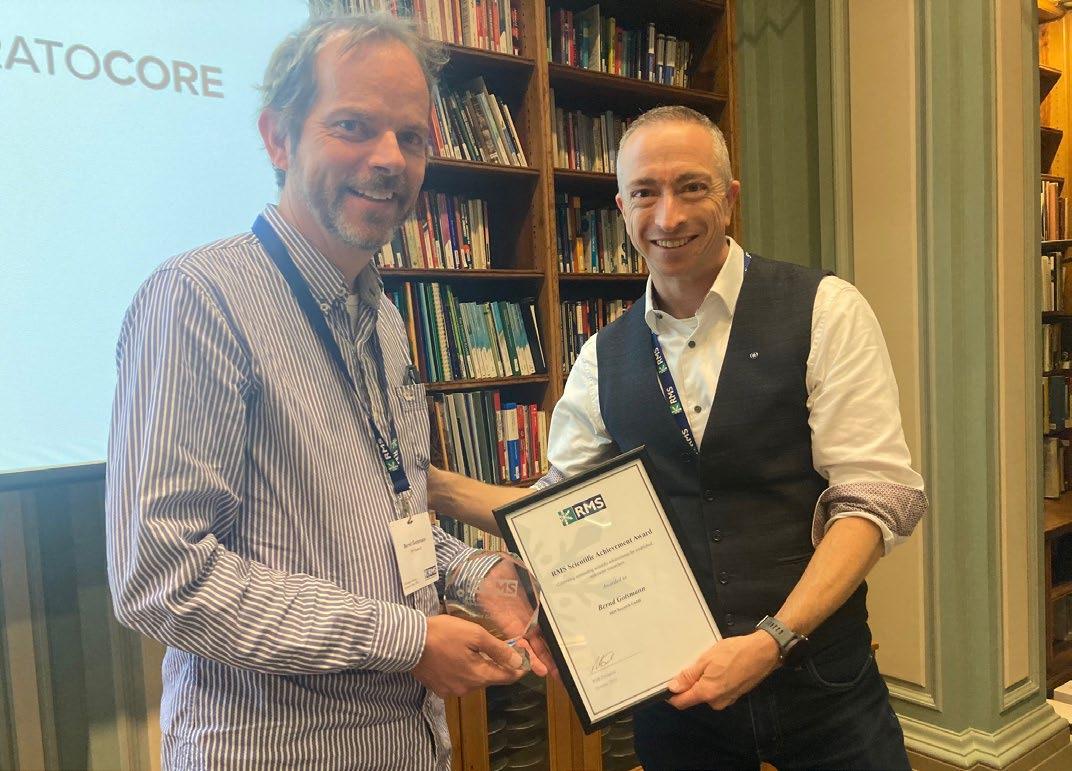
Bernd Gotsmann was also among the RMS Scientific Achievement Award-winners to receive their award in person.
Dr Georgina Fletcher of BioimagingUK, examining gender, class and other biases within the scientific community.
We were delighted to welcome three of our 2024 Scientific Achievement Award-winners – Dr Susan Cox (King’s College London), Professor Roland Kröger (University of York) and Dr Bernd Gotsmann (IBM Research GmbH) to receive their awards. Meanwhile, Dr Mark Pickering (University College Dublin), received the 2024 Chris Hawes Award for Outreach and Education.
In addition, special presentations were made for Professor Susan Anderson, who has stepped down from the RMS Council and Executive Committee
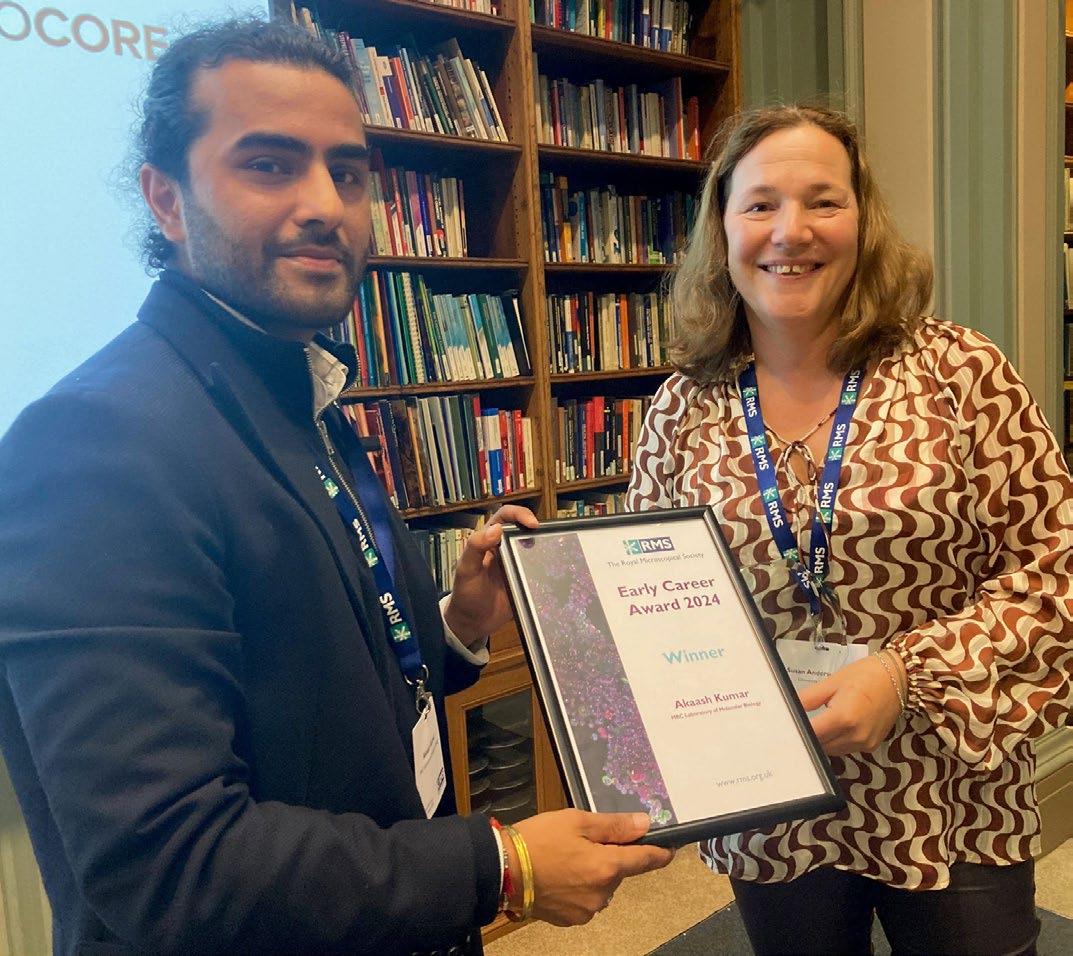
after 15 years’ service; and RMS Events Director Tor Masters, who recently marked her 20th anniversary at the Society. The event concluded with the climax of the 2024 RMS Early Career Award Competition, in which three shortlisted candidates – Dr Akaash Kumar (MRC Laboratory of Molecular Biology & University of Cambridge), Dr Liam Rooney (University of Strathclyde) and Harshith Bachimanchi (University of Gothenburg), gave talks about their research. After some tricky deliberations by the judges, Akaash emerged as the winner for his presentation about his PhD work on multispectral imaging.
Akaash Kumar receives the 2024 RMS Early Career Award from Susan Anderson.
RMS Annual General Meeting & Section AGMs
3 October 2024
Report by new RMS Early Career Committee Chair, Katherine Paine
The RMS Annual General Meetings took place on Wednesday 3rd October 2024, as part of Microscopy: Advances, Innovation, Impact 2024. This was a great opportunity for each of the Science Section Chairs to give updates on their communities and welcome new members. I attended as a member of the Early Career Committee, and will now be taking over duties as chair from Liam Rooney. Liam has been a brilliant chair and contributed so much to the early career imaging community. He has been a member of the committee since it started in 2019 and has shaped it into a welcoming and dynamic committee. Our committee is enthusiastic about providing resources for early career researchers to get the most out of the RMS, including opportunities to attend or present at our mini symposium that is attached to mmc2025, partake in the Early Career Award, and other workshops that the RMS offers. I am hoping I can keep up the brilliant work Liam has done going forward and I am grateful to still have him around as cochair for the next year!
We were also treated to scientific talks in between meetings. Coming from a membrane trafficking background, I particularly enjoyed Giulia Zanetti’s talk on vesicle transport. I enjoyed hearing about the ways she was using microscopy to address her biological questions. Georgina Fletcher from Bioimaging UK also spoke about her work on Equality Diversity and Inclusion (EDI). This sparked discussion in the room about ways in which people have benefitted from privilege and how race and class intersect. I felt this was an important discussion to have and I found it particularly interesting to hear someone speak about regional accents and the connotations attached to them in the UK.
Katherine Paine.
This award is organised by the Early Career Committee and aims to showcase contributions of early career researchers to the field, whether that is a scientific contribution or their work within the community. It is always interesting to hear about the work others are doing and celebrate their achievements. We had great flash presentations from the three finalists: Liam Rooney, Harshith Bachimanchi and Akaash Kumar. It was really tough judging such amazing contributions to the field. Akaash won with his talk on his work
developing 8 channel simultaneous live imaging. He spoke about the story behind the development and, whilst listening, I couldn’t help but imagine how I could use this technology in my research and the ways in which it could benefit me!
The meeting finished with a drinks reception which was a great opportunity to catch up with others and discuss the day’s talks. I always leave these meetings feeling inspired and this occasion was no different.
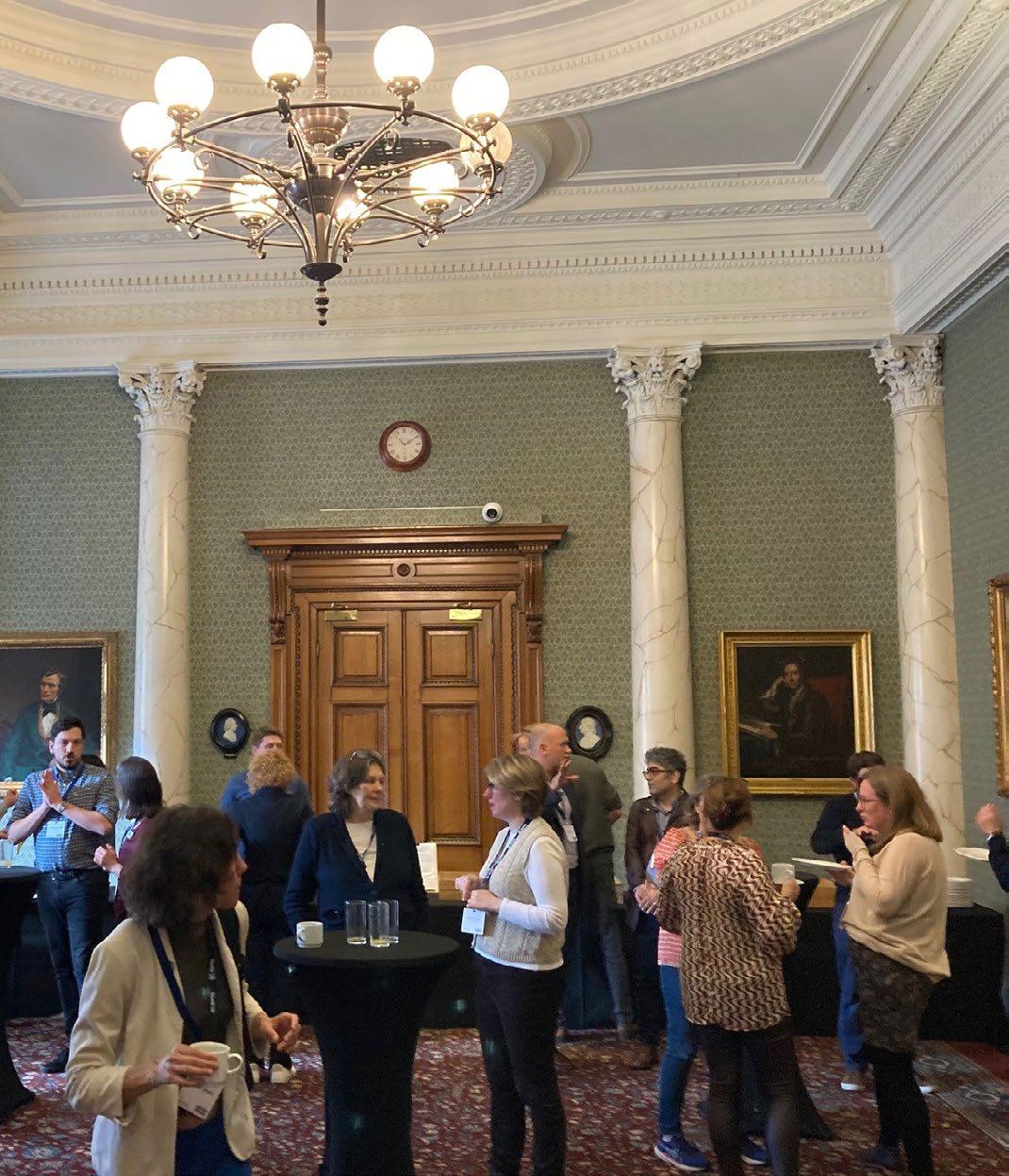
Attendees chat during the lunch break at the RMS AGMs.
Continuous Leadership in CMOS Camera Technology
Smaller pixels higher speeds, more compact
E
Smaller pixels, long exposures, hybrid binning, OEM optimized
Plumbing the depths: a close look at some microscopic sea-creatures
Dr John Hutchison, Hon FRMS
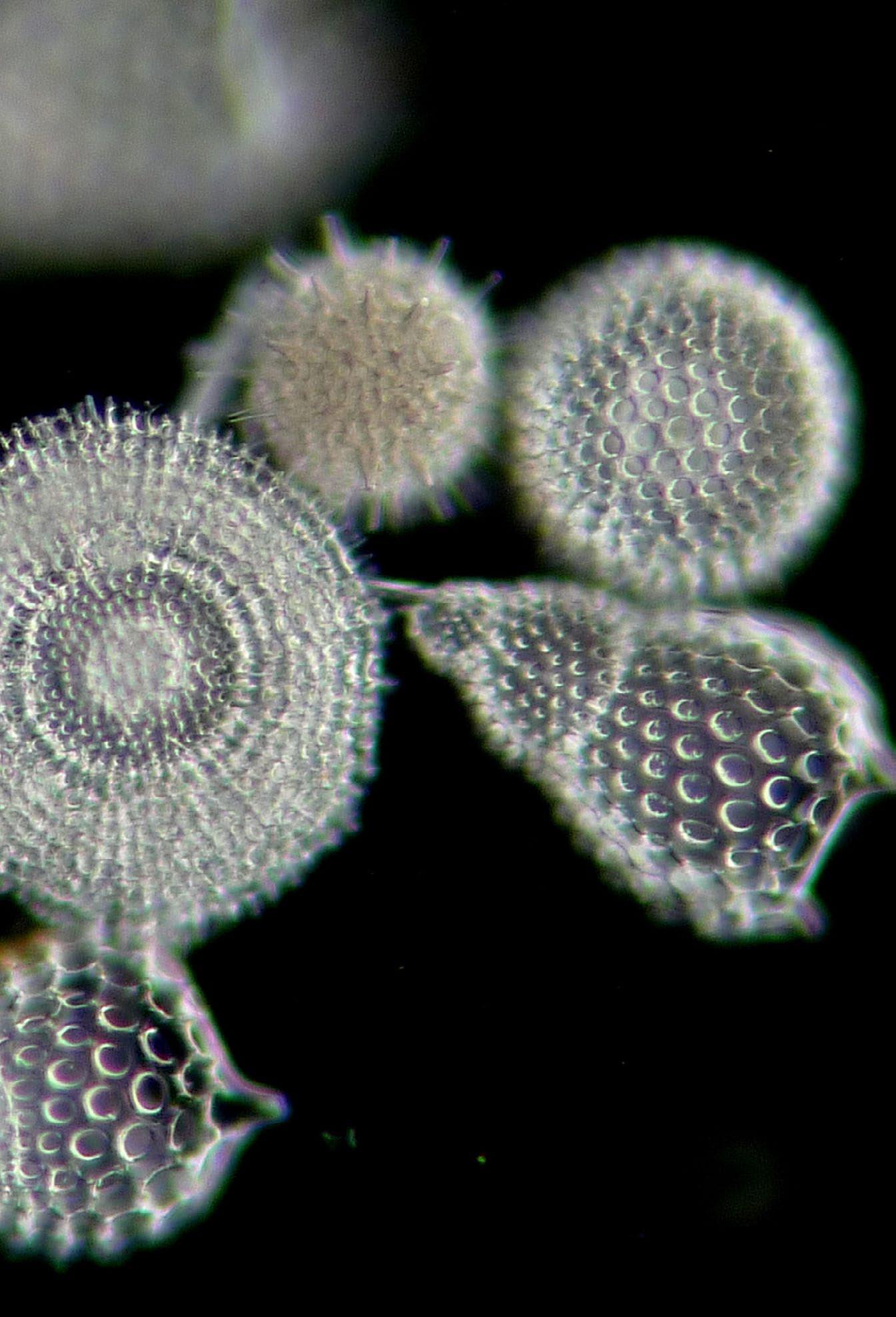
In a previous article (infocus 70 pp. 4 - 15) I described some amazing structures produced by single-cell amoeba known as diatoms. Their sub-microscopic, silica shells became very popular microscope specimens in the 19th Century, and a large number of carefully mounted slides survive today, some of which are keenly sought-after. Another class of unicellular creatures occurs, foraminifera, that are found from the bottom of the deepest oceans right up to intertidal zones. They also occur as prolific micro-fossils in chalk and limestone. The huge chalk cliffs in Southern England are made up almost entirely of foraminifera shells, known as tests, which consist mainly of calcium carbonate. They are also important indicators in oil exploration, where careful study of rock cores can reveal likely oil deposits. In contrast to the microscopic diatoms, most foraminifera tests are in the range 20 to ~ 200 micrometers in size, although some, found in the deepest ocean depths and also as fossils, may be up to several cm in size. And remember, these are the homes of single-cell organisms!
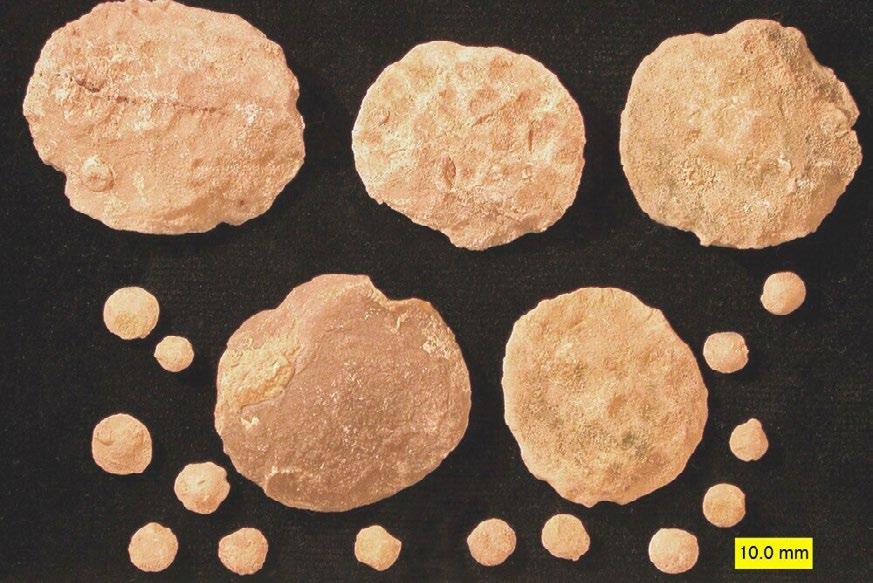
Foraminifera were first ‘discovered’ about 2000 years ago! The pyramids in Gizeh, Egypt, are in part built out of a Palaeogene limestone which contains huge numbers of Nummulites gizehensis, a large, disc-shaped foraminifera species that grew up to several centimetres across.
The geographer and philosopher Strabo (64 BCAD 25), who came from Asia Minor but lived most of his life in Greece, wrote about these fossils, although he did not of course realise what they were. He described them as follows:
“One
extraordinary thing which I saw at the pyramids must not be omitted. Heaps of stones from the quarries lie in front of the pyramids. Among these are found pieces which in shape resemble lentils. Some contain substances like grains half peeled. These, it is said, are the remnants of the workmen’s food converted into stone; which is not improbable”.
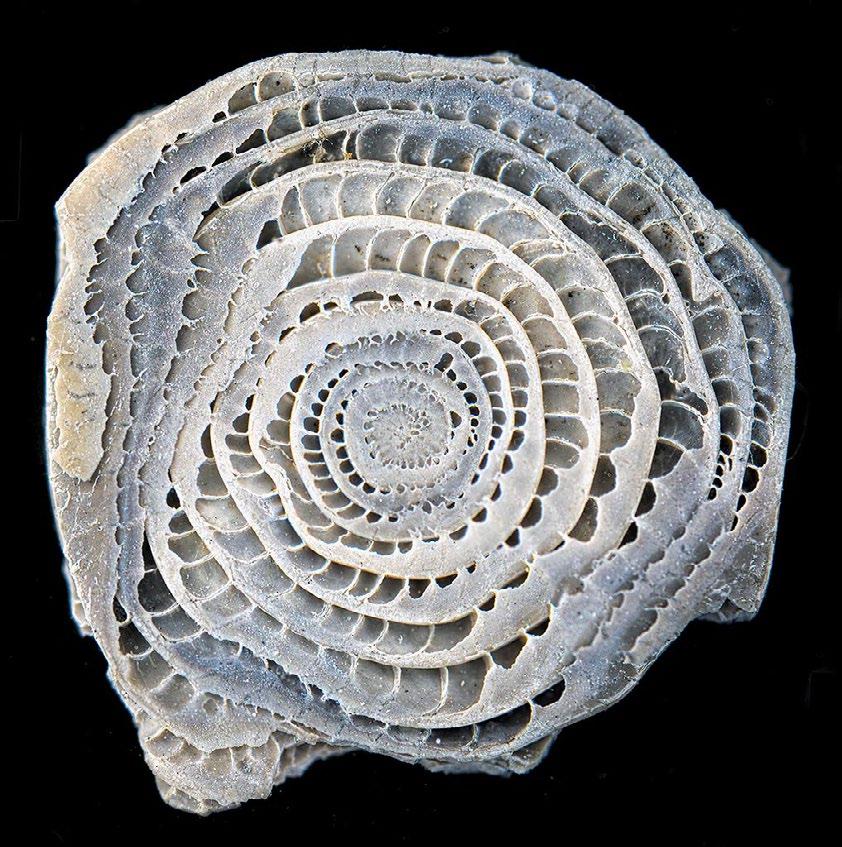
Although these fossils appear on the outside to be simple, disc-shaped pieces of rock, when cut as sections they reveal a remarkable internal arrangement of linked chambers, as shown in Figure 3. These chambers often contain crude oil –hence their value in oil exploration. In addition, the appearance of particular species in rock samples may also indicate likely oil deposits.
Now fast-forward several hundred million years, to the mid-19th Century.
With diatom slides gaining in popularity with Victorian microscopists who were also keen to see other wonders, and as samples of foraminifera
Figure 1. An example of a nummulites fossil from the limestone chips at Gheza. This one is just over 2 cm in diameter.The term derives from Latin (“nummulus”, meaning “coin”) as they were thought to have been used by the Egyptians as coins.
Figure 2. Typical nummulites fossils showing the range of sizes. Image credit: Wilson44191_
Figure 4. Foraminifera tests from "the coast of Australia" and "North Pacific".
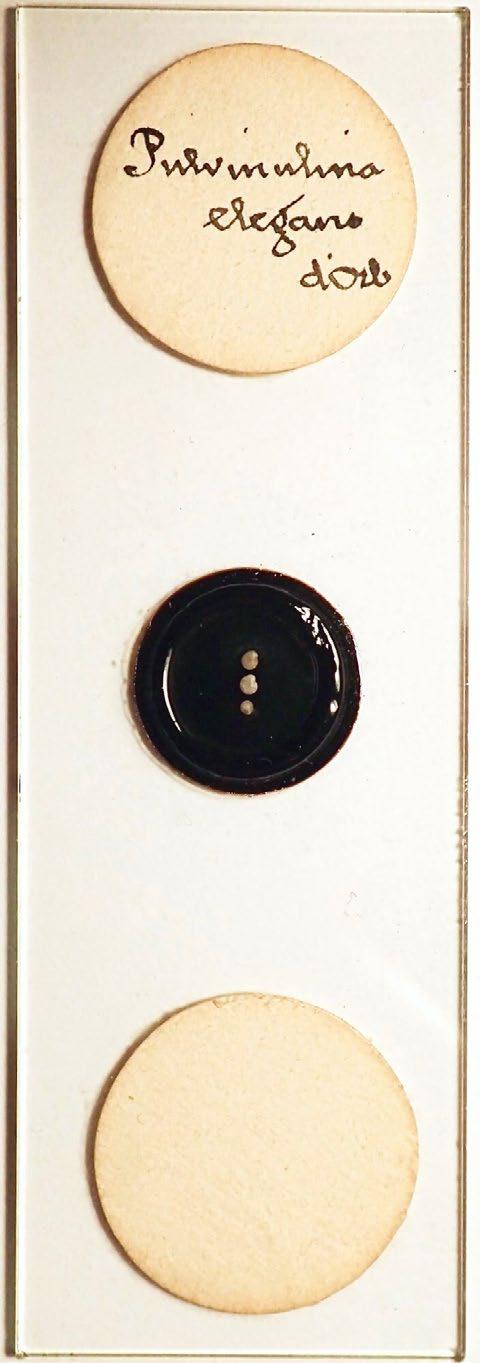
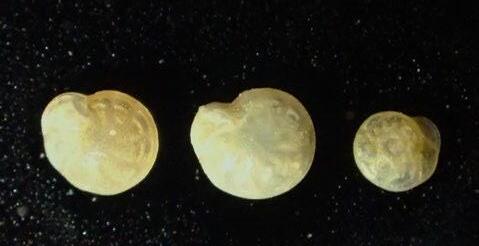
Figure 5. Three examples of a single species, Pulvinicula elegans (first identified in 1826) neatly arranged in a row. Again, no indication of where they were found, nor the mounter’s name, were added.
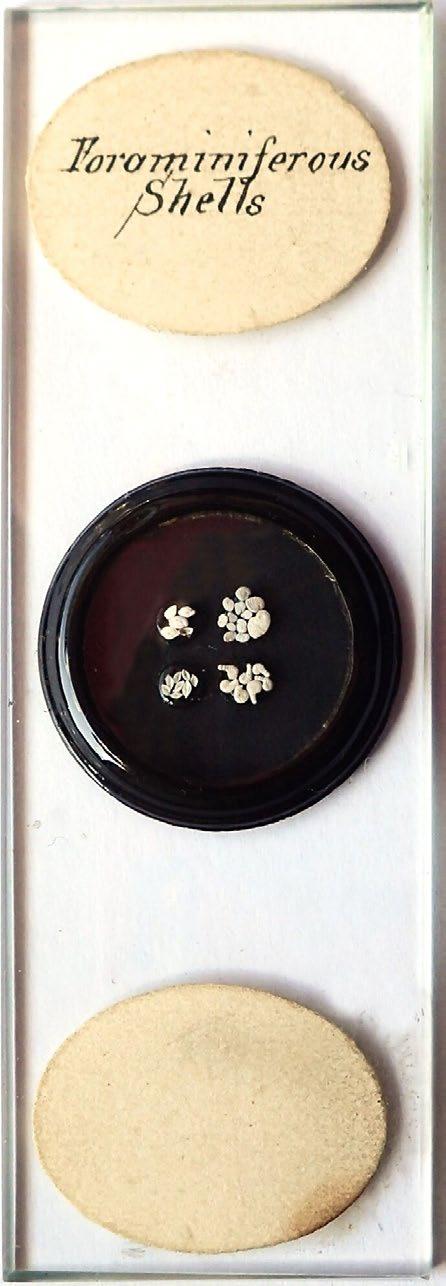
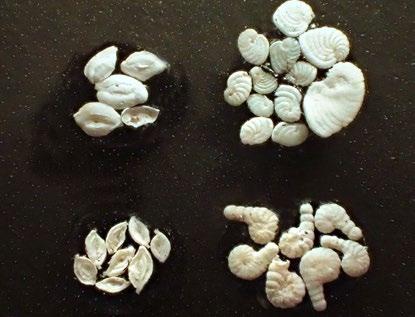
Figure 6. Four groups of foraminifera, arranged this time as separate species, illustrating the variety of forms.
Figure 7. Other arrangements are more carefully planned, as shown here.
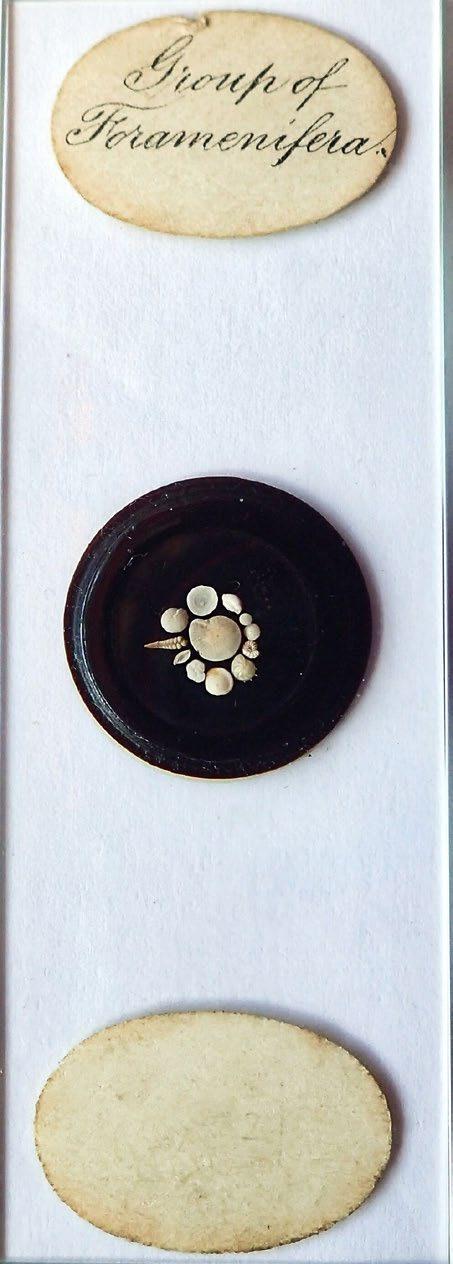
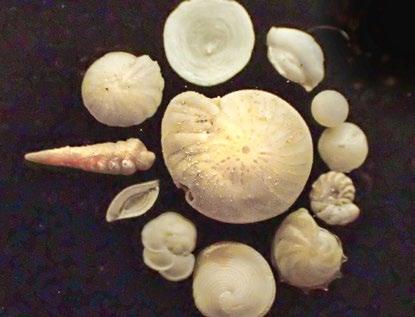
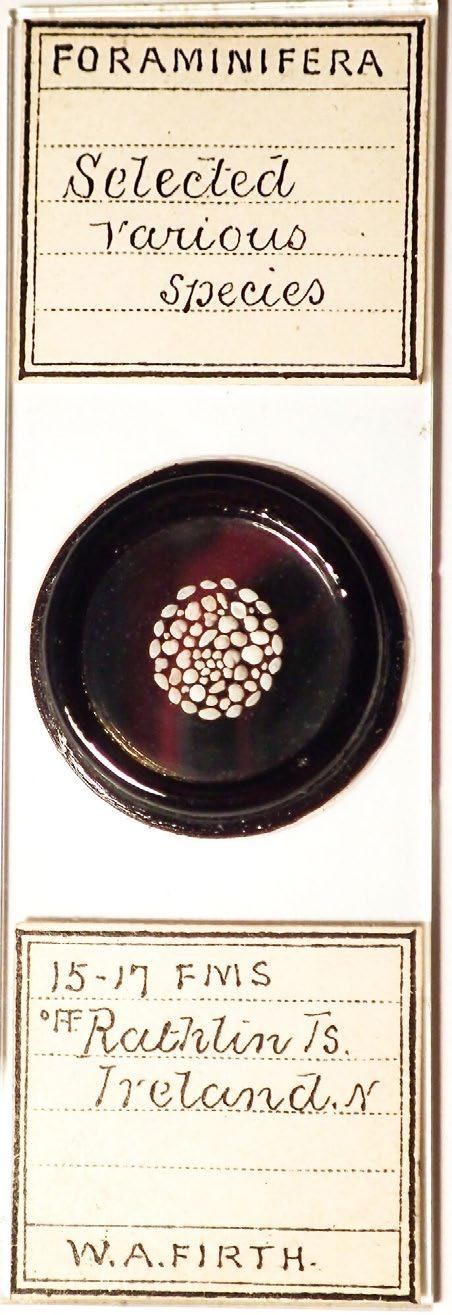
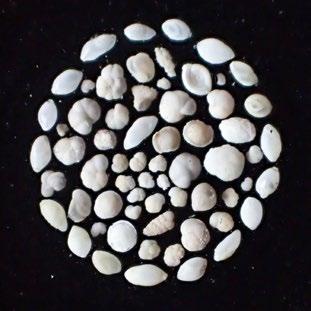
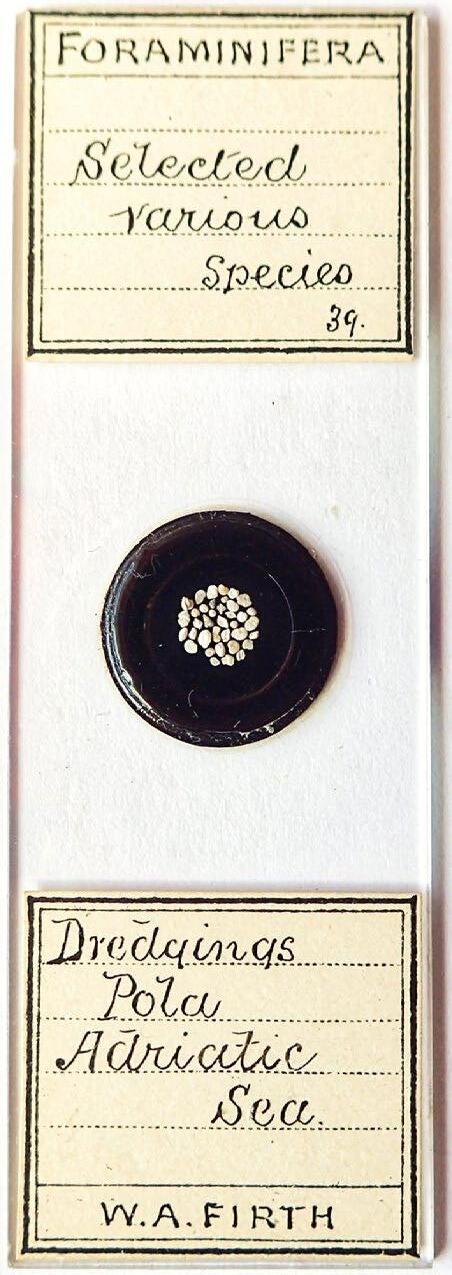
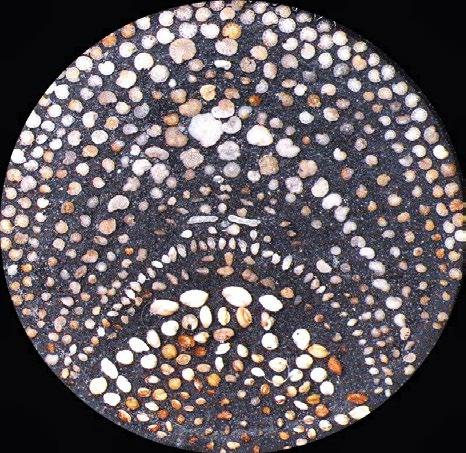
Figure 8. Firth has selected a variety of species and arranged them carefully in a circular pattern. In this case they came from a relatively shallow (15-17 fathoms) seabed off Rathlin Island, N. Ireland.
became available, mounted specimens became popular objects for study. Unlike diatoms which are mainly transparent silica, foraminifera tests are opaque and often white. Consequently, for microscope slides they were usually mounted on black supports, for viewing with incident illumination. Many of the earliest examples simply showed random arrays of tests, often indicating only very approximately where they were found, as in Figure 4. Note that where the following illustrations show complete slides, these are all the standard RMS 3 x 1 inch in size.
In this example no attempt has been made to separate them into individual tests, or arrange them.
In other examples considerable efforts were made to arrange the tests.
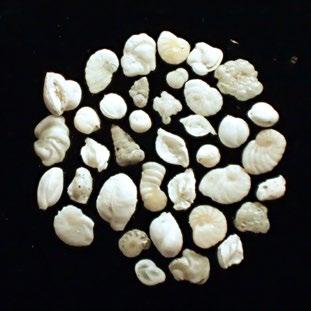
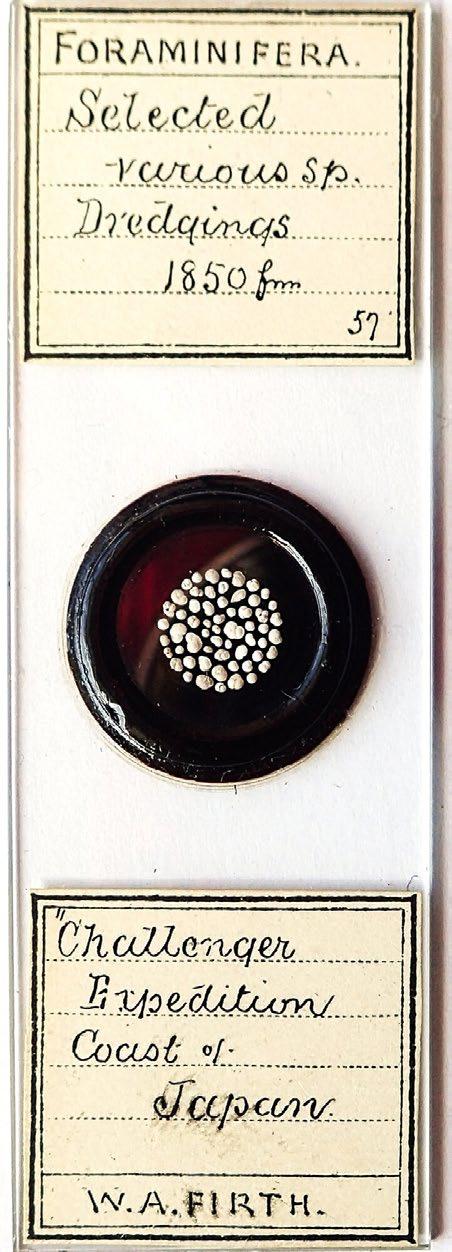
William Firth (of diatom fame, see infocus 70 p4) was a well-known mounter, and some of his work shows his skill in selecting and mounting a wide variety of foraminifera tests, as shown in Figures 8, 9, 11 and 12.
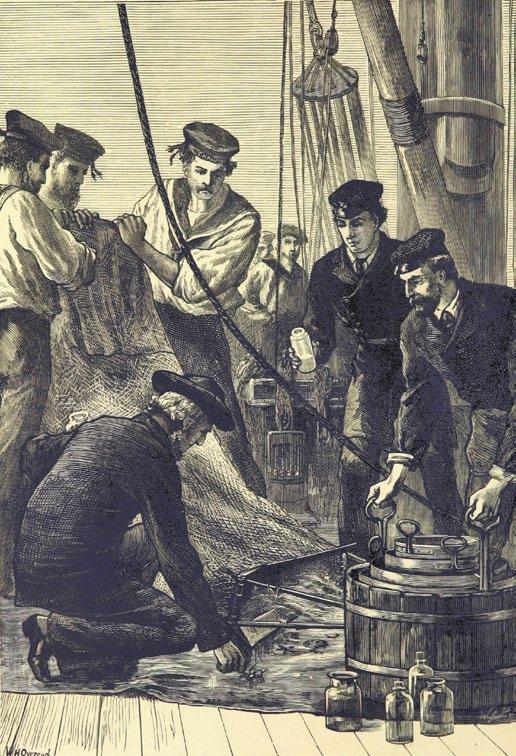
The historic expedition of HMS Challenger (1872 -76) explored many of the world’s oceans and produced a rich harvest of new data, as well as many hitherto unknown organisms including foraminifera, see Figure 10.
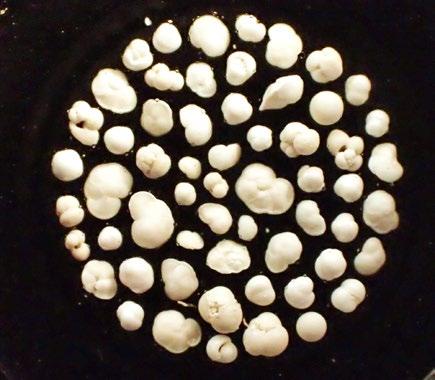
From off the coast of Japan samples were brought up from 1850 fathoms (11,100 ft.) which included many new species. Foraminifera from this location are shown in Figure 11, prepared by Firth with his characteristic skill.
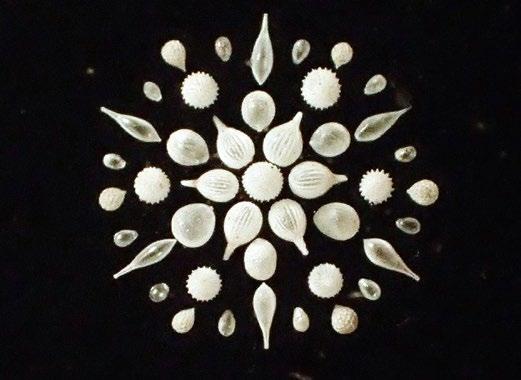
Firth also displayed his skill in creating spectacular slides as shown in Figure 12. Here various Lagena species are arranged symmetrically to form an attractive pattern.
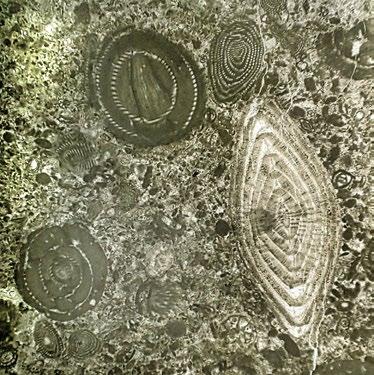
Carefully prepared thin sections of chalk and limestone also show fossilised foraminifera, as shown in Figure 13. In this slide several examples of Alveolina are visible. This variety of foraminifera are elliptical or spherical – the largest one here, shown in cross-section, being ~5 mm in length.
Figure 9. In this example Firth has assembled a wide variety of tests to illustrate the variety of shapes. Again, the location is indicated.
The Society’s own, direct links with the world of foraminifera are with a former President – Edward Heron-Allen, a lawyer who retired from his family’s law firm at the age of 50 and moved to Selsey where he embarked on a lengthy study of the foraminifera that abounded on the intertidal zone of its sandy beaches. An interesting character, he was originally named Heron Allen, but later called himself “HeronAllen”, perhaps to add some cachet! He was a true polymath with an astonishing range of interests, and published many books on archaeology, Buddhist philosophy, violin-making, Persian – he translated the entire Omar Kyayyam poem into English - and chiromancy (palmistry). He also wrote a book on how to grow good asparagus! Along with Arthur Earland he published numerous papers in the Journal of the Royal Microscopical Society (now the Journal of Microscopy) as in 1915 p 547; 1917 pp 1 – 104 and 1930 pp 359-365. He was elected President of the RMS in 1916, followed by Fellowship of the
Fig 10. Collecting the material dredged from the bottom of the ocean. Firth has assembled a wide variety of tests to illustrate the variety of shapes.
Figure 11. Foraminifera from the Challenger Expedition.
Figure 12. Various species of the Lagena genus, arranged symmetrically. Figure 13. Thin section of chalk from near Trieste.
Journal in 1930.
recognised by a Blue
and also by the Eward Heron-Allen Society – a group of enthusiasts who still hold regular symposia where they discuss some of the more esoteric aspects of his work.
Royal Society two years later in recognition of his seminal work on foraminifera.
He and Earland identified and classified huge numbers of different species, showing the wide range of shapes and sizes.
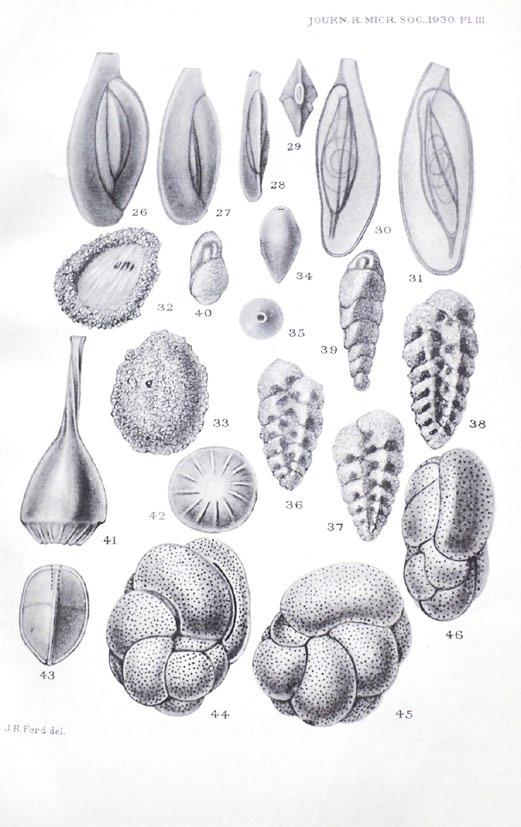
Figure 14. Illustration of some of Heron-Allen’s foraminifera published in our
Figure 15. Edward Heron-Allen’s work is still
Plaque
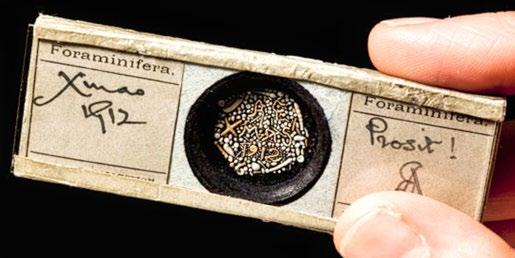
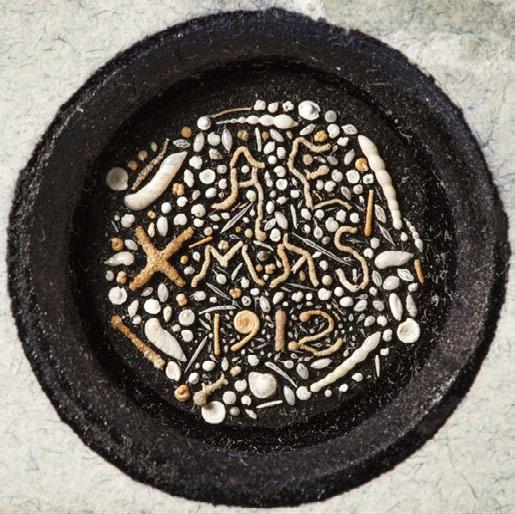
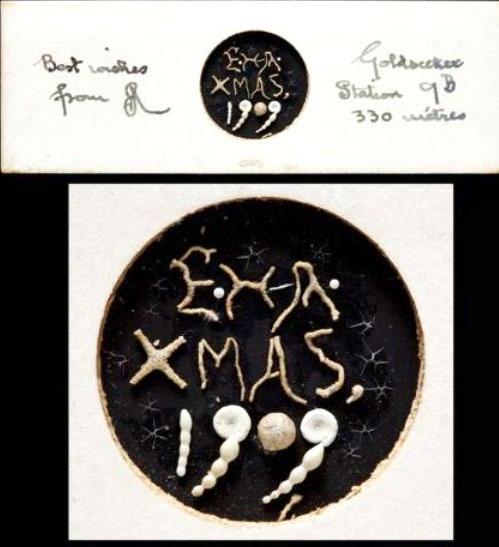
Figure 16. “Christmas greetings” slides from 1909 and 1912, now in the Natural History Museum.
Heron-Allen - perhaps surprisingly – did have a sense of fun, and rather than send Christmas greeting cards to his friends, his collaborator Arthur Earland often made slides for him containing “seasonal” arrangements of foraminifera as shown in Figure 16.
The letters and numbers in these arrangements are made of foraminifera tests. The particular species that lived in these tubes, having ‘selected’ fine sand grains and glued them together to form tubules of varying lengths and curvatures in which they could live safe from predators.
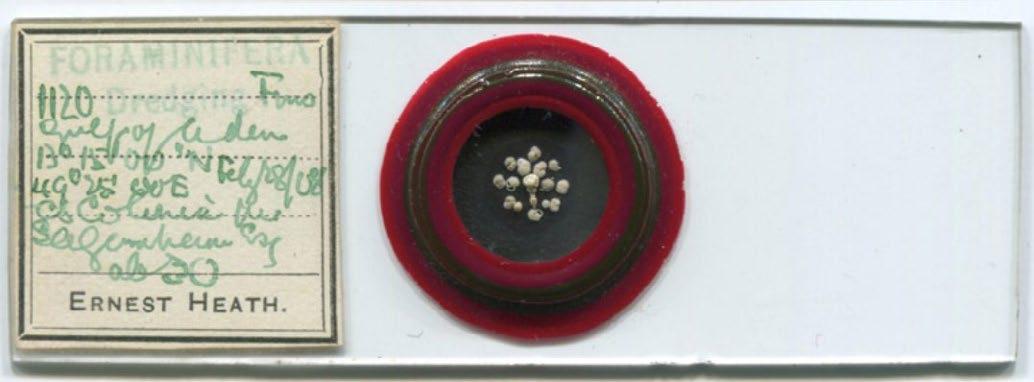
One of our early Fellows, Ernest Heath,(1860 –1942) also produced a wonderful collection of
arranged slides in the early 20th century, now held in the Museum of Wales, Cardiff. Although he donated much of his collection to the museum, they note that:
“We
don’t know much about him, apart from that he was a fellow of the
Royal
Microscopical
Society, somehow got hold of deepsea mud from around the world, and must have had a lot of time on his hands!”
He was a Fellow in 1909, and most of his output was from that period.
Just like the diatom slides in my previous article (infocus 70) these foraminifera tests provide a wonderful window into the past, attesting to the considerable skills, insatiable curiosities and perhaps even the eccentricities of those who created them.
Some of these beautiful objects are highly soughtafter collectors’ items, and it is not difficult to understand why. Looking down the microscope more than 100 years after their creation, I suspect the sense of wonder for today’s viewers remains every bit as powerful.
Dr John Hutchison, Hon FRMS
Figure 17. Examples of Ernest Heath’s work, now in the Museum of Wales. a) Slide prepared in 1908 and b) details of an elaborate arrangement.
Graphene liquid cells at a click
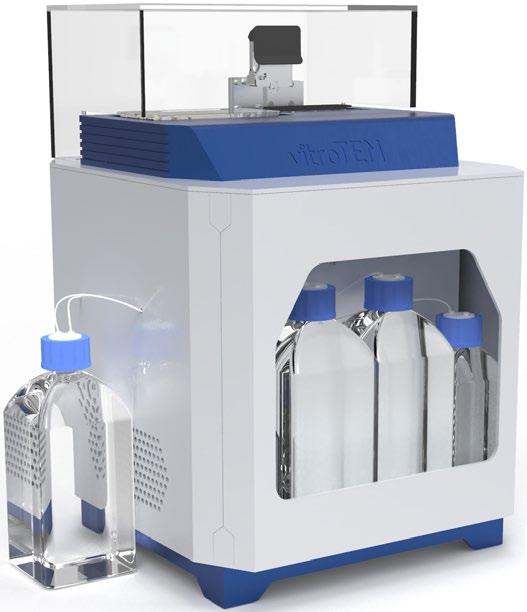
At VitroTEM, we specialize in the manufacturing and marketing of the state-of-the-art Naiad system, which fabricates graphene liquid cells. These cells enable dynamic analysis of materials and processes in real time at unprecedented resolution within standard electron microscopy systems.
GLC fabication system
High resolution LPEM imaging GLCs assembly in 3 minutes GLC density: 10-100/μm
High-yield production
Low contrast and beam sensitive samples
Naiad
Microscopy Journal of
The Journal of Microscopy publishes top quality research articles, review articles and Hot Topic papers covering all aspects of microscopy and analysis. This includes cutting-edge technology and innovative applications in physics, chemistry, material and biological sciences.
You can read the latest Early View papers online at www.journalofmicroscopy.org
They include:
ORIGINAL ARTICLE
Imaging and observation of microcirculation in bowel mucosa using sidestream dark field imaging
Sidestream dark field (SDF) imaging is a tool for assessing microcirculation, commonly used for early diagnosis and monitoring of sepsis. In this study, we used SDF imaging to observe and assess the microcirculation of the intestinal mucosa during bowel surgery. We also compared different performance between normal mucosa and diseased mucosa using SDF imaging. SDF imaging was conducted in 13 patients to evaluate microcirculation parameters. All patients were assessed at distances of 0, 1, 2, 3 and 4 centimeters (cm) from the edge of the mesentery, respectively. Microcirculatory parameters such as microvascular flow index (MFI), proportion of perfused vessels (PPV), vascular density (VD), total vessel density (TVD), perfused vessel density (PVD) and heterogeneity index (HI) were measured in these patients. Compared to normal intestinal mucosa, the diseased intestinal mucosa exhibited higher values for VD (p = 0.044), TVD (p = 0.006) and PVD (p = 0.007). No significant differences in PPV, MFI and HI were observed between the two groups. The microcirculation parameters (MFI, PPV and PVD) of the intestine at the distal distance of
3 cm were significantly lower than those at a distance of 2 cm (MFI 1.5 (0.75) vs. 3 (0.5), PPV 57.6 (9.1) vs. 97.1 (8.6)% and PVD 11.395 (3.082) vs. 20.726 (4.115) mm/mm2). In conclusion, SDF imaging is an advanced technique that provide real-time visualization of intestinal mucosal microcirculation. It has the potential to assess the blood perfusion of the intestine during surgery.
ORIGINAL ARTICLE - Open access
In situ isotropic 3D imaging of vasculature perfusion specimens using x-ray microscopic dual-energy CT
Stephan Handschuh, Ursula Reichart, Stefan Kummer, Martin Glösmann
Microscopic 3D imaging of the vasculature of laboratory animal models such as the mouse can help to identify and understand vascular disorders. Microscopic x-ray computed tomography is one of the most widely used imaging techniques for this purpose. High-resolution insights are typically gained from the tissues of dead animals, where an x-ray dense contrast agent was postmortem supplied to the
bloodstream. This work presents sample preparation and imaging protocols that allow to depict and analyse microvasculature in the structural context of mineralised (bone and teeth) and non-mineralised (e.g. brain) tissues, thus expanding the toolkit for the quantitative analyses of vascular morphology.
METHODS AND PROTOCOLSOpen access
Innovative sample preparation using alcohol dehydration and high refractive index medium enables acquisition of two-channel superresolution 3D STED image of an entire oocyte
Michaela Frolikova, Michaela Blazikova, Martin Capek, Helena Chmelova, Jan Valecka, Veronika Kolackova, Eliska Valaskova, Martin Gregor, Katerina Komrskova, Ondrej Horvath, Ivan Novotny
Super-resolution (SR) microscopy is a cuttingedge method that can provide detailed structural information with high resolution. However, the thickness of the specimen has been a major limitation for SR methods, and large biological structures have posed a challenge. To overcome this, the key step is to optimise sample preparation to ensure optical homogeneity and clarity, which can enhance the capabilities of SR methods for the acquisition of thicker structures.
Oocytes are the largest cells in the mammalian body and are crucial objects in reproductive biology. They are especially useful for studying membrane proteins. However, oocytes are extremely fragile and sensitive to mechanical manipulation and osmotic shocks, making sample preparation a critical and challenging step.
We present an innovative, simple and sensitive approach to oocyte sample preparation for 3D STED acquisition. This involves alcohol dehydration and mounting into a high refractive index medium. This extended preparation procedure allowed us to successfully obtain a unique two-channel 3D STED SR image of an entire mouse oocyte. By optimising
sample preparation, it is possible to overcome current limitations of SR methods and obtain high-resolution images of large biological structures, such as oocytes, in order to study fundamental biological processes.
Lay Abstract: Super-resolution (SR) microscopy is a cutting-edge tool that allows scientists to view incredibly fine details in biological samples. However, it struggles with larger, thicker specimens, as they need to be optically clear and uniform for the best imaging results. In this study, we refined the sample preparation process to make it more suitable for SR microscopy. Our method includes carefully dehydrating biological samples with alcohol and then transferring them into a mounting medium that enhances optical clarity.This improved protocol enables high-resolution imaging of thick biological structures, which was previously challenging. By optimizing this preparation method, we hope to expand the use of SR microscopy for studying large biological samples, helping scientists better understand complex biological structures.
RAPID PUBLICATION
Electron microscopy of seismic waves
Shaoqing
Chen, Mengyao Wang, Dong Sheng He
Changes in the surrounding environment,if transmitted to the electron microscope, are frequently perceived as noise that diminishes the quality of the images. However, in fact, ‘noises’ contain rich information about the environment.This work reports a very rare event where aberration-corrected HAADF-STEM images were acquired during the impact of seismic waves, resulted from a mild earthquake. By analysing these images, we found that the drift and vibration of the sample are detectable and quantifiable. Despite many potential challenges, this work demonstrates the utilisation of electron microscopes in detecting and monitoring seismic waves with high spatial resolution, which may lead to unique applications in the low-frequency regime.
ORIGINAL ARTICLE
Neural network-assisted localization of clustered point spread functions in single-molecule localization microscopy
Pranjal Choudhury, Bosanta R. Boruah
Single-molecule localization microscopy (SMLM), which has revolutionized nanoscale imaging, faces challenges in densely labelled samples due to fluorophore clustering, leading to compromised localization accuracy. In this paper, we propose a novel convolutional neural network (CNN)-assisted approach to address the issue of locating the clustered fluorophores. Our CNN is trained on a diverse data set of simulated SMLM images where it learns to predict point spread function (PSF) locations by generating Gaussian blobs as output. Through rigorous evaluation, we demonstrate significant improvements in PSF localization accuracy, especially in densely labelled samples where traditional methods struggle. In addition, we employ blob detection as a post-processing technique to refine the predicted PSF locations and enhance localization precision. Our study underscores the efficacy of CNN in addressing clustering challenges in SMLM, thereby advancing spatial resolution and enabling deeper insights into complex biological structures.
ORIGINAL ARTICLE - Open Access
LiveLattice: Real-time visualisation of tilted light-sheet microscopy data using a memory-efficient transformation algorithm
Zichen Wang, Hiroyuki Hakozaki, Gillian McMahon, Marta Medina-Carbonero, Johannes Schöneberg
Light-sheet fluorescence microscopy (LSFM), a prominent fluorescence microscopy technique, offers enhanced temporal resolution for imaging biological samples in four dimensions (4D; x, y, z, time). Some of the most recent implementations, including inverted selective plane illumination microscopy (iSPIM)
and lattice light-sheet microscopy (LLSM), move the sample substrate at an oblique angle relative to the detection objective’s optical axis. Data from such tilted-sample-scan LSFMs require subsequent deskewing and rotation for proper visualisation and analysis. Such data preprocessing operations currently demand substantial memory allocation and pose significant computational challenges for large 4D dataset. The consequence is prolonged data preprocessing time compared to data acquisition time, which limits the ability for live-viewing the data as it is being captured by the microscope. To enable the fast preprocessing of large light-sheet microscopy datasets without significant hardware demand, we have developed WH-Transform, a memory-efficient transformation algorithm for deskewing and rotating the raw dataset, significantly reducing memory usage and the run time by more than 10-fold for large image stacks. Benchmarked against the conventional method and existing software, our approach demonstrates linear runtime compared to the cubic and quadratic runtime of the other approaches. Preprocessing a raw 3D volume of 2 GB (512 × 1536 × 600 pixels) can be accomplished in 3 s using a GPU with 24 GB of memory on a single workstation.Applied to 4D LLSM datasets of human hepatocytes, lung organoid tissue and brain organoid tissue, our method provided rapid and accurate preprocessing within seconds. Importantly, such preprocessing speeds now allow visualisation of the raw microscope data stream in real time, significantly improving the usability of LLSM in biology. In summary, this advancement holds transformative potential for light-sheet microscopy, enabling real-time, on-the-fly data preprocessing, visualisation, and analysis on standard workstations, thereby revolutionising biological imaging applications for LLSM and similar microscopes.
ORIGINAL ARTICLE - Open Access
Geometric characteristics of stromal collagen fibres in breast cancer using differential interference contrast microscopy
Suzan F. Ghannam, Catrin Sian Rutland, Cinzia
Allegrucci,
Melissa L. Mather, Mansour
Alsaleem, Thomas D. Bateman-Price, Rodhan Patke, Graham Ball, Nigel P. Mongan, Emad Rakha
Breast cancer (BC) is characterised by a high level of heterogeneity, which is influenced by the interaction of neoplastic cells with the tumour microenvironment. The diagnostic and prognostic role of the tumour stroma in BC remains to be defined. Differential interference contrast (DIC) microscopy is a label-free imaging technique well suited to visualise weak optical phase objects such as cells and tissue. This study aims to compare stromal collagen fibre characteristics between in situ and invasive breast tumours using DIC microscopy and investigate the prognostic value of collagen parameters in BC. A tissue microarray was generated from 200 cases, comprising ductal carcinoma in situ (DCIS; n = 100) and invasive tumours (n = 100) with an extra 50 (25 invasive BC and 25 DCIS) cases for validation was utilised. Two sections per case were used: one stained with haematoxylin and eosin (H&E) stain for histological review and one unstained for examination using DIC microscopy. Collagen fibre parameters including orientation angle, fibre alignment, fibre density, fibre width, fibre length and fibre straightness were measured. Collagen fibre density was higher in the stroma of invasive BC (161.68 ± 11.2 fibre/µm2) compared to DCIS (p < 0.0001). The collagen fibres were thinner (13.78 ± 1.08 µm), straighter (0.96 ± 0.006, on a scale of 0–1), more disorganised (95.07° ± 11.39°) and less aligned (0.20 ± 0.09, on a 0–1 scale) in the invasive BC compared to DCIS (all p < 0.0001). A model considering these features was developed that could distinguish between DCIS and invasive tumours with 94% accuracy. There were strong correlations between fibre characteristics and clinicopathological parameters in both groups. A statistically significant association between fibre characteristics and patients’
outcomes (breast cancer specific survival, and recurrence free survival) was observed in the invasive group but not in DCIS. Although invasive BC and DCIS were both associated with stromal reaction, the structural features of collagen fibres were significantly different in the two disease stages. Analysis of the stroma fibre characteristics in the preoperative core biopsy specimen may help to differentiate pure DCIS from those associated with invasion.
Submit to the Journal of Microscopy
1. No submissions fees
2. No page or colour charges
3. No page limit
4. Simple online submission
5. Helpful, friendly editorial team
6. Average time from submission to first decision is less than 50 days
7. High readership figures
8. Online tracking system – authors can easily check the status of an article in production and receive emails at key stages
9. Rapid publication with Early View papers published online in advance of print, significantly shortening time from acceptance to publication
10. Free electronic offprints
Journal of Microscopy App Available for iPhone and Android
Search for Journal of Microscopy on the App Store or Google play and access your personal or institutional subscription wherever you are, whenever you want.
Submit online at https://mc.manuscriptcentral.com/jmi
View the Guidelines for Authors and full submission details online at: www.journalofmicroscopy.org
Journal of Microscopy News
Imaging ONEWORLD: New call for papers for JoM Special Issue!
Second volume of popular Special Issue to be titled ‘Microscopy at a Glance’
The Journal of Microscopy is pleased to announce a ‘Call for Papers’ for a second volume of the recently published Imaging ONEWORLD poster special issue.
The second volume of poster articles, to be titled ‘Microscopy at a Glance’, will be guest edited by Kirti Prakash, Carlas Smith, Fei Xia, Nabanita Chatterjee, and Christian Franke.
It follows the success of the first volume, which featured a diverse range of articles by speakers from the Imaging ONEWORLD talks series which was held between 2020-2023.
We are now welcoming poster articles for the second volume. The deadline for submissions is 30 June 2025.
Find out more, including submission guidelines
New special issue in the Journal of Microscopy from the RMS Data Analysis in Imaging committee!
We are pleased to announce the publication of a new special issue (December 2024) which features papers on the theme of Data Analysis in Imaging
The special issue was guest edited by Rocco D’Antuono (The Francis Crick Institute and University of Reading, UK), Laura Murphy (University of Edinburgh, UK) and Chas Nelson (Fjelltopp, UK).
The idea for the issue came from discussions at the RMS Data Analysis in Imaging science section meetings. In the introduction to the special issue, Rocco, Laura and Chas write: “Image data analysis is essential across many fields of scientific research. A thorough knowledge of different methods and software tools is critical for the
The first volume of the Imaging ONEWORLD poster special issue was published in November.
success of many research projects.
“The availability and reproducibility of workflows, familiarity with state-of-the-art algorithms, and appropriate training are vital for researchers who need to employ data analysis in imaging.
“With these community needs in mind, in 2018, Dominic Waithe started the efforts to build a community of scientists working in this field. This developed into an RMS Image Analysis Focused Interest Group in 2018 before graduating to become the ‘Data Analysis in Imaging’ (DAIM) RMS Science Section in 2021.
“Once established, we launched an open call to the community for papers with a focus on tools and workflows for image analysis and image data management.” (‘Data analysis in imaging (DAIM) – A new RMS science section’ Rocco D’Antuono, Laura Murphy, Chas Nelson, https://doi.org/10.1111/ jmi.13366)
The issue features the following papers: ModularImageAnalysis (MIA): Assembly of modularised image and object analysis workflows in ImageJ Stephen J. Cross, Jordan D. J. R. Fisher, Mark A. Jepson
Comparison of the SMLM technique and the MSSR algorithm in confocal microscopy for superresolved imaging of cellulose fibres
Josué David Hernández-Varela, Susana Dianey Gallegos-Cerda, José Jorge Chanona-Pérez, Liliana Edith Rojas Candelas, Eduardo Martínez-Mercado
Bridging imaging users to imaging analysis – A community survey
Suganya Sivagurunathan, Stefania Marcotti, Carl J Nelson, Martin L Jones, David J Barry, Thomas J A Slater, Kevin W Eliceiri, Beth A Cimini
Annotation and automated segmentation of single-molecule localisation microscopy data Oliver Umney, Joanna Leng, Gianluca Canettieri, Natalia A. Riobo-Del Galdo, Hayley Slaney, Philip Quirke, Michelle Peckham, Alistair Curd
CellProfiler plugins – An easy image analysis platform integration for containers and Python tools Erin Weisbart, Callum Tromans-Coia, Barbara Diaz-Rohrer, David R. Stirling, Fernanda Garcia-Fossa, Rebecca A. Senft, Mark C. Hiner, Marcelo B. de Jesus, Kevin W. Eliceiri, Beth A. Cimini
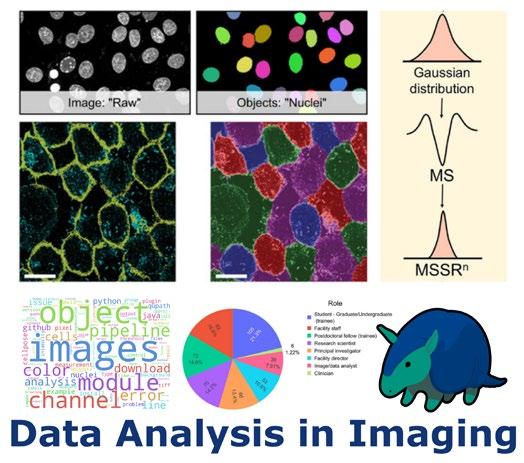
Cover image shows:
• Fluorescence microscopy image and cell nuclei labelled with MIA software for modular image analysis [Cross, Fisher, and Jepson, 2023].
• Cell membrane receptors automatically analysed with deep learning models for single molecule localisation microscopy [Umney et al., 2024].
• Mean-Shift Super-Resolution (MSSR) applied to analyse images of biomaterials [HernándezVarela et al., 2024].
• Wordcloud of searched topics on image.sc that led to the implementation of CellProfiler plugins [Weisbart et al., 2024].
• Pie chart of the roles of the respondents to the joint COBA, BINA, and RMS-DAIM survey on biomedical and physical imaging community [Sivagurunathan et al., 2023].
• The armadillo is the adopted logo of the Data Analysis in IMaging (DAIM) RMS section.
• Cover created by: Rocco D’Antuono (The Francis Crick Institute)
infocus welcomes submissions of articles of general interest to microscopists.
You provide the text and images and we take care of the rest. It’s the ideal way to share your work with the microscopical community.
Full submission information and guidelines are available at www.infocus.org.uk
To submit an idea or if you have any questions about the process please email the Editor (editor@infocus.org.uk)
Outstanding mid-career researchers receive recognition for their work
The RMS is delighted to reveal the winners of its 2024 RMS Scientific Achievement Awards. Open to applicants worldwide, the award celebrates outstanding scientific achievements in any area of microscopy or flow cytometry for established mid-career researchers.
RMS President Dr Peter O’Toole said: “It is a real privilege to announce these awards and to give richly deserved recognition to some of the leading scientists currently working within microscopy. Our winners have all made immense and sustained contributions within their fields over many years, as a great number of people within the microscopy community will know. My warmest congratulations go to them all.”
The winners of this year’s Scientific Achievement Awards are as follows:
Dr Justin W. Taraska
National Heart, Lung, & Blood Institute, National Institutes of Health (NHLBI, NIH)
Justin is a leading cellular biophysicist and microscopist who specialises in imaging the molecular structure of cells with advanced light and electron microscopy.
He has dedicated his research career to filling a fundamental gap in our understanding of how proteins assemble multi-component complexes at the nanoscale inside living cells.
Justin has focused the majority of his attention on organelle trafficking, where he has been a true
innovator and leader in the field for nearly 20 years. His lab at the NIH has developed many new imaging and analysis tools for quantitative live cell, superresolution, electron, cryogenic, and correlative light and electron microscopy.
The overall impact of Justin’s work emerges from his keen ability to identify key biological questions and address them through the development of new microscopy tools. This fusion of question and technology has resulted in progress in visualizing healthy and diseased cells in ways not previously possible.
By pushing the boundaries of microscopy and cellular biophysics, Justin is uncovering the architecture of the cell at the nanoscale. The approaches developed in his lab are applicable to a wide range of biological questions and systems and his impact goes well beyond the trafficking field.
His work is always at the cutting edge, driving a new era of understanding how cells work.
Professor Roland Kröger University of York
Roland’s impressive interdisciplinary research has broken new ground in applying transmission electron microscopy and spectroscopy techniques to the study of nanomaterials, electronic materials, soft materials and unique bio/materials - truly bridging both the life and materials sciences.
He has achieved great success through bringing advanced materials physics techniques into a range of different fields such as biology, archaeology and environment. His contributions to elucidating the 3D nanoscale organisation of bone has found strong resonance and help to pave the way for a full understanding of bone formation, a field of great significance in biomedical sciences.
Roland’s liquid phase microscopy research using novel in situ platforms permit the real-time assessment of dynamic reactions in liquid environments. His establishment of in situ characterisation methods at York extend beyond transmission electron microscopy and include multi-technique methods,
combining TEM with in situ Raman microscopy in order to explore the behaviour of biomaterials under challenging complex environments combining liquid and stress.
Roland has been the major TEM/STEM collaborator in significant interdisciplinary programs and scientific publications that have explored bone structure and properties, which have led to a range of unique research collaborations on bone diseases, studies of new bone-like materials, and mineralised tissue regeneration. He is now working with NHS Hospitals in York and Scarborough on the potential role of microcalcification in wound healing.
Roland has also been extremely active in the Royal Microscopical Society for many years, where he has also championed interdisciplinary materials research activities, particularly in non-traditional areas.
Dr Bernd Gotsmann
IBM Research GmbH
Bernd is a prolific contemporary scientist working in scanning probe microscopy (SPM), expanding it way beyond the nanoscale topographical imaging the original STM provided.
His research has uncovered unique SPM benefits that neither light nor electron microscopies can provide, namely - direct imaging, measurements, and manipulation of nanoscale physical properties of studied objects.
Throughout his career, Bernd has demonstrated unparalleled dedication and innovation in advancing our understanding of nano-thermal properties through the development and application of cuttingedge scanning probe techniques. His contributions have significantly enriched the field, paving the way for groundbreaking discoveries and advancements in nanoscience and nanotechnology.
Bernd’s expertise and leadership in nano-thermal characterisation have been instrumental in addressing fundamental questions and challenges in various scientific disciplines, including materials science, physics, and engineering. His pioneering research has not only expanded our theoretical knowledge but has also led to practical applications with profound implications for technology development and industry.
In addition to his remarkable scientific achievements, Bernd is widely respected for his mentorship and collaboration within the scientific community. His passion for knowledge sharing and his commitment to fostering the next generation of scientists make him an invaluable asset to the field of microscopy and beyond.
Dr Susan Cox King’s College London
Susan has an international reputation as an expert in the analysis of single molecule light microscopy data to create super-resolution images.
She has a strong background in programming, data analysis and maths, which has enabled her to develop a number of exciting new methods. She uses her microscopy and programming expertise to work with other groups to apply these new methods and make new discoveries in cell biology.
Her position in the field can be seen from both her publications and a high number of invited talks, including talks within the last few years at Focus on Microscopy, Methods and Applications in Fluorescence, and the American Society for Cell Biology - all major international meetings. Her work has been recognised with the RMS Light Microscopy medal, the SEB President’s medal, and the Howard Lecture.
Her paper output is impressive, including final author papers in Nature Methods, Nature Communications, and the European Journal of Cell Biology.The Nature journal papers are both based around achieving accurate and reproducible results in super-resolution imaging, a field in which she is now one of a small number of internationally recognised experts.
Susan has recently been focusing on cell interactions with matrices, and the big data, deep learning approaches required to enable these studies, while maintaining her single molecule standards research. This approach is likely to produce a substantial amount of high-impact work, and to prove highly beneficial to microscopists and cell biologists worldwide.
Latin America Bioimaging Meeting and LABIxSuperres
Rio de Janeiro, Brazil 18 – 23 August 2024
During the week of 18-23 August 2024, I participated in the Latin America Bioimaging (LABI) Meeting in Rio de Janeiro (Brazil). I presented our new initiative, Global BioImage Analysts’ Society (GloBIAS), as well as contributing to “LABIxSuperres” – a workshop on super-resolution microscopy, reporting on our software suite of computational methods for super-resolution.
These initiatives allowed the exchange of expertise between more than 100 scientists from Latin America, who work as facility staff or use advanced bioimaging for their research.
LABI (https://labi.lat/) is the network that aims to improve education and training on bioimaging in Latin America and the Caribbean. Moreover, it aims to facilitate access to the latest technologies for the scientists in the region.
The LABI meeting began with Program Coordinator Andrés Olivera introducing the activities and opportunities for training and career development available to all members.This was followed by Imaging 4 All (i4A) project manager, Deniz Saltukoglu, who announced the funding opportunities for Imaging Scientists provided by Global BioImaging.
As co-PI and steering committee member, I presented the initiatives of the Global BioImage Analysts’ Society (GloBIAS) for networking, training, and education
of bioimage analysts around the world. GloBIAS is supported by a grant of the Chan Zuckerberg Initiative, to become a self-sustaining scientific society that allows knowledge exchange between members, develops a curriculum for bioImage analysts, creates and maintains repositories for training materials, and consolidates standards for bioimage analysis.
During the networking session I learned about the activities of the different LABI Working Groups and took part in discussions on the common needs of imaging scientists and how to transform needs into actionable ideas, and finally into results. Some useful insights offered by the LABI include its focus on governance and sustainability of the network, by assuring co-leadership for a smooth transition
(Left) Rocco D’Antuono presenting the Global Bioimage Analysts’ Society at the Latin America Bioimaging Meeting. Middle) Prof. Kildare Miranda, local organiser of LABI Meeting 2024, leading the visit to Advanced Microscopy Unit at the CENABIO. Right) Jessica Marques, Aldenora Vasconcelos and Jander Guimarães, from University of the State of Amazonas (UEA), meeting local school students during the LABI outreach activity.
Participants of the Latin America Bioimaging Meeting and LABIxSuperres – Rio de Janeiro, Brazil, 18-23 August 2024, Photo credit: https://x.com/ LatamBioimaging/status/1826693086161842567/photo/1
between chairs, and the profound involvement of the community, with the goal of improving the sense of belonging to the LABI network.
One session that I particularly enjoyed was titled “Exploring Open Science in Bioimaging”, during which examples of successful labs championing the use of open source software and hardware were showcased, such as the presentation of the Latin American Hub for Bioimaging Through Open Hardware (LIBRE Hub) in Chile, led by Tobias Wenzel.
As a great way to end the meeting, we visited the core facilities at the National Center for Structural Biology and Bioimaging (CENABIO), hosted by the local organisers. Finally, the LABI meeting included the involvement of bioimaging researchers in the outreach activity at Jardim Botânico (Botanical Garden), where we could all speak to local school students to explain our job in science, and perhaps motivate them to become researchers.
The second part of the week was dedicated to the LABIxSuperres meeting, which started with the report of the Fluorescence Nanoscopy in Bioimaging Foundational Project, aimed at Expanding Global Access to Biomaging in Latin America (presented by Mariano Buffone, IBYME, Argentina).
A history lesson covering 10 years of super-resolution microscopy, held by Adán Guerrero (UNAM, Mexico), set the scene for the following showcase of applications of super-resolution microscopy in Latin America, including single molecule imaging, STED, SMLM, and computational methods.
I had the opportunity and honour to contribute to the session “Expanding worldwide access to Super Resolution Microscopy”, which included a plenary talk on pioneering open-source AI technologies, presented by Ricardo Henriques (IGC, Portugal) and another plenary talk on democracy in microscopy with
affordable fluorescence microscopes, presented by Ali Shaib (Universitätsmedizin Göttingen, Germany). In my talk, I reported on the progress in developing napari-superres, a suite of computational methods for super-resolution microscopy based on fluorescence fluctuations, a collaboration with the group of Adán Guerrero, at the National Laboratory for Advanced Microscopy (UNAM, Cuernavaca, Mexico).
The LABI Meeting and LABIxSuperres 2024 delivered valuable lessons in bioimaging, physics, facility management, and biological projects, but beyond that, there were some great moments of unscheduled scientific discussions and networking, while riding on the bus or dining out. I would certainly make the case for choosing in-person meetings, when possible, and fully engaging with the community without the distraction of emails or other virtual calls. The hybrid way of running conferences does have the potential to bring a wider group together, but in my view, it can reduce focus, and limit the capacity for in-depth brainstorming.
Such engaging meetings are not possible without the efforts of organisers, supporting staff and students, attentive funders, and the commitment of the community members. Therefore, it’s imperative to mention at least one representative of each category: as a speaker and participant, thank you to Kildare Miranda, Andrés Olivera, Lía Pietrasanta, Adán Guerrero, Haydee Hernández, Celina Terán, Vladimir Ghukasyan, Jander Guimarães, to name a few.
I would like to thank the Royal Microscopical Society, GloBIAS and the LABI network for the support to attend these meetings, allowing me to interact with all the great Latin American scientists.
Rocco
D’Antuono FRMS, Principal Microscopist and Image Analyst, Crick Advanced Light Microscopy STP, The Francis Crick Institute, London, UK
A new web resource for diatom optical microscopy www.diatomimaging.com
Dr Jonathan Crowther, FRMS
When I started on my journey into microscopy in 2020, the initial aim was to make a UV transmission microscope for my research into sunscreens ( previously written about in Crowther, 2021). Very soon I found myself in need of something to help me determine the resolution of my microscope and this was where I was introduced to the wonderful world of diatoms. For those of you who are not familiar with these little marvels, diatoms are algae that produce silica structures to live in. Some species are currently alive, and others are present in fossil deposits. The silica structures are amazingly intricate and come in a myriad of shapes and sizes with structures present in the micron and nanometer scale. For my UV work, I approached a couple of slide makers, and after supplying them with fused silica slides and coverslips, had some diatom slides made which I used to help with development and testing of my microscope (Crowther, 2022).
Diatoms have been a subject for microscopy since the 1800s and a huge range of slide makers had produced slides with them on. Some of these slides are strews (with a scattering of different material from a location), some were examples of selected diatoms, and some were amazing arrangements of tens or even hundreds of individual diatoms. I became fascinated by their widely varying structures and started to obtain slides to image. Soon I found myself looking out for specific makers and certain species to try and build my collection, and bit
by bit the number of slides grew. All the while I was capturing images and gradually refining my technique, and as a result was building up a large collection of high resolution images. After sharing these images online (usually through the Diatom Images Facebook Group) a number of people had asked me what I was going to do with the photos. Initially I thought about a photobook, but then decided to create a website where I could share them, along with photos of the slide and details on how the images were captured.
20μm
1. Arachnoidiscus ornatus by Mike Samworth. From Santa Ana, California. Olympus BHB microscope using 450nm LED light. 63x Leitz Pl Apo NA 1.40 objective, oil immersion. Olympus Aplanat Achromat condenser, oil immersion, slightly oblique lighting. Image provided by Dr Jonathan Crowther FRMS, JMC Scientific Consulting Ltd (https://diatomimaging.com/).
Figure
20μm
https://diatomimaging.com/).
Figure 2. Auliscus stöckhardtii by WA Firth. From Allan’s Farm, Oamaru. Olympus BHB microscope using 450nm LED light. 63x Leitz Pl Apo NA 1.40 objective, oil immersion. Olympus Aplanat Achromat condenser, oil immersion, oblique lighting. Image provided by Dr Jonathan Crowther FRMS, JMC Scientific Consulting Ltd (
20μm
Figure 3. Triceratium morlandii by Klaus Kemp. From Oamaru, New Zealand. Accepted name Entogoniopsis morlandii. Olympus BHB microscope using 450nm LED light. 40x Leitz Pl Apo NA 1.00, oil immersion. Olympus Aplanat Achromat condenser, oil immersion, brightfield lighting. Image provided by Dr Jonathan Crowther FRMS, JMC Scientific Consulting Ltd (https://diatomimaging.com/).
(https://diatomimaging.com/).
Figure 4. Large arrangement from St Peter’s, Hungary, by Watson and Sons Ltd. Olympus BHB microscope using white LED light. 3.2x Zeiss Semiplan NA 0.10 objective with no substage condenser lens. Image provided by Dr Jonathan Crowther FRMS, JMC Scientific Consulting Ltd
The site (www.diatomimaging.com) was launched earlier this year. At the time of writing this article, it has around 400 images on it and I am regularly adding more content.
The goal with the site was to create an online museum, where images of the diatoms themselves could be viewed in high resolution. It was important to me to show the slides as well. These are amazing creations, especially the large arrangements, and the makers need to be celebrated. As I am a scientist, details on how the images were taken have also been shared, especially as I haven’t really found anywhere which shared all these aspects of the slides at the same time.There are plenty of websites which show wonderful artistic representation of diatoms, but I wanted to create something more scientifically orientated. While I do not consider myself an expert in taxonomy, I try to put any new names in with the discussion, and also in the few instances where the slides are mis-named, correct that.
For imaging I tend to use fairly basic techniques – brightfield and oblique lighting, along with occasionally using dark ground. I often use a homemade 450nm LED light for illumination as the short wavelength helps with optimising resolution. The microscope is an Olympus BHB from the 1970s or 80s. For objectives my ‘go to’ ones are 4x, 10x and 20x Nikon Plan Apo, along with 40x, 63x and 100x Leitz Pl Apo ones which are oil immersion. The cameras are SLR or mirrorless, a couple
of which have been converted to monochrome primarily for my UV work. Image stacking is done in Zerene, and I move the stage manually to collect the images for these stacks. One thing I wanted to do was show what can be achieved with relatively modest equipment (although I really do recommend to invest in the best objectives you can for imaging diatoms).
While the site has been developed with a scientific focus in mind, I’m sure it will be of interest to a wider audience, including those who just enjoy the wonders of nature. If nothing else I hope it will prompt others to share their collections as well. There must be many slides in people’s collections which would be useful for the world of research if they could be made available. I am always on the lookout for slides to image, so if you have ones available which you are looking for a new home for, please feel free to contact me.
References
“UV transmission microscopy – optical imaging without glass”, Jonathan Crowther infocus magazine (Royal Microscopical Society), 2021, 64, 4-15.
“Ultraviolet imaging of diatoms”, Jonathan Crowther, Quekett Journal of Microscopy, 2022, 44, 273-284.
The Royal Microscopical Society would like to welcome our new members who have joined us in the last three months. We hope they enjoy a long and rewarding membership with the RMS.
Mr Ian Cardillo-Zallo
Jake Richardson
Mr Jonathan Amara
Dr Hongyu Wang
Innes Clatworthy
Mr Arkapravo Das
Dr Cristina Martínez González
Dr Mehrnoosh Neshatian
Mr Ross Walsh
Miss Emma Westlund
Dr Merve Açikel Elmas
Ms Vasiliki Tsioligka
Miss Emilia Coward
Miss Laura Davidson
Dr Maciej Trzaskowski
Mr Jan Majer
Miss Emma Long
Mr Pasindu Eranga Raigama Arachchige
Dr Dongsheng He
Ms Sara Salgueiro Torres
Dr Inna Goliand
Dr Iestyn Pope
If you know of anyone who might be interested in becoming a member of the Royal Microscopical Society and if you would like us to contact them, please send their details to our Membership Administrator, Debbie Hunt – debbie@rms.org.uk
Application forms are available to download at www.rms.org.uk/membership
Don't forget you can now log into the RMS website and check your membership status, renew and download receipts. If you have never logged into the RMS website, please enter the email address that is linked to your membership and then click 'forgotten password'.
If you have any queries or questions about your membership please contact Debbie Hunt debbie@rms.org.uk
Member Profiles
Name Arkapravo Das
Tell Us About You?
I completed my schooling at Don Bosco School, Liluah, and am currently pursuing an undergraduate degree in Zoology (Honours) at the University of Calcutta. I am a research enthusiast and an aspiring biologist with a deep passion for learning and a dedicated approach to my studies. I am eager to contribute to the Royal Microscopical Society as an Undergraduate Member, leveraging my knowledge and skills to advance our understanding of the microscopic world.
Why did you become a member of the RMS?
So that I can contribute as a member of society to the microscopic bio world. And learn a lot of things as a member. "Microscopic biology unveils
the hidden architecture of life, where the smallest structures define the grandest functions."
How do you feel being an RMS member benefits you?
Becoming a member of the Royal Microscopical Society will not only provide me with valuable access to cutting-edge research, resources, and a community of experts in the field, but also allow me to contribute meaningfully. This membership will facilitate the acquisition of knowledge and insights with ease, helping me stay updated with the latest advancements and best practices in microscopy and biological sciences. Additionally, I look forward to sharing my perspectives, participating in discussions, and contributing to the society’s initiatives, thereby supporting the collective growth and innovation within the field.
Name Pasindu Eranga
Tell Us About You?
I'm an undergraduate in Zoology, with minors in Chemistry and Microbiology, focused on computational biology. I specialise in highmagnification insect photography for entomology and am interested in darkfield, metallurgical, phase contrast, and confocal microscopy, especially with large working distance objectives. Through RMS, I aim to connect and expand my knowledge in these areas.
How do you feel being an RMS member benefits you?
Joining the Royal Microscopical Society has already been a rewarding experience, opening up professional networking and learning opportunities. With an efficient registration process, I received my membership quickly, giving me access to a range of valuable resources. As an RMS member, I look forward to connecting with researchers, learning about new developments, and exploring advanced microscopy techniques that can enhance my studies and research.
Through RMS, I hope to build connections that will enrich my work in computational biology and high-magnification photography. The chance
to engage with a diverse scientific community, attend events, and access resources aligns with my goal to stay at the forefront of microscopy advancements. I believe RMS membership will support my growth as a researcher and help me contribute to the wider scientific community.
You provide the text and images and we take care of the rest. It’s the ideal way to share your work with the microscopical community. Full submission information and guidelines are available at www.infocus.org.uk
To submit an idea or if you have any questions about the process please email the Editor (editor@infocus.org.uk)
Spotlight on… Kim Findlay
In this issue we speak to Kim Findlay, Head of Bioimaging at the John Innes Centre (JIC) in Norwich, UK, as she looks ahead to her retirement – an impressive 38 years after joining the organisation.
A well-known and highly respected scientist within the microscopy community, Kim is a former RMS Council member and long-standing Ambassador for the Society. She was also awarded the inaugural RMS Vice President’s Award in 2015, for her outstanding contribution to microscopy research and laboratory support.
Her expertise is in both scanning and transmission electron microscopy and sample preparation of plant and microbial specimens for EM, especially cryo methods. Her facility at the JIC offers a wide range of services including imaging and custom sample preparation, training and technical support in a variety of microscopy techniques.
Kim’s first sense of being drawn to the world of science came on (or around) the 21st of July 1969, as she watched the iconic, grainy footage of Neil Armstrong and Edwin ‘Buzz’ Aldrin, exiting the ‘Eagle’ lunar module in slightly ungainly fashion to become the first humans to walk on the surface of the moon.
She recalls: “My first feeling was that I wanted to be an astronaut. I was so young – only four – but I can remember it vividly, being fascinated by the thought of discovering other worlds out there, and exploration that involved such an amazing amount of human ingenuity and overcoming technological challenges. At the time everybody was excited about space travel, and to bring that story to the watching public was amazing.”
While the desire to ‘boldly go’ has remained a staple of childhood dreams ever since the idea of space travel was first popularised in science fiction novels,
for a young girl in the late 1960s, it was, perhaps, an unlikely aspiration.
Kim explains: “I had a sister but no brother, so there was no real understanding that females were not really expected to pursue that sort of thing. Most women would not have considered technical careers but I definitely fell in love with science. I went to an all-girls school which also helped, I think, because it meant I never felt I was held back by boys – or in competition with them.”
Kim took A-Levels in maths, physics and biology, drawn to both the theoretical and experimental aspects of those subjects. Through biology, she also found an outlet for her love of nature, animals and plants. As she pondered a future career however, it was her passion for engineering and technology that came to dominate her thinking, and almost led her into a career in the air force – a similarly maledominated calling at that time.
Kim says: “I had heard that if I joined the RAF to become an officer, they would sponsor me through university – where I was thinking of doing electronic engineering - and during summer vacations, students got an opportunity to go flying. But when I went to the interview and said I wanted to sign up for a 20 year officers’ commission, they said ‘we don’t allow women to do that.’ So I thought ‘stuff you, I’ll do something else' ”, she adds, chuckling.
Eventually, after graduating from King’s College, London with a joint degree in biology and physics, Kim was offered – and initially accepted - a job working in the university’s biophysics department at Drury Lane. But after a few days’ reflection at her family home in Norfolk – and in something of a ‘Sliding Doors’ moment - she picked up the phone to inform her would-be employers that she wouldn’t be coming back to London after all. It was the decision that set Kim on course for her long career at the John Innes Centre.
Kim presenting her first scientific poster at the 1991 Botanical Microscopy Meeting.
She says: “I really enjoyed London as a student, and the job was going to involve doing TEM which I loved, but once I got home to Norfolk, I realised that living permanently in a big city like London just wasn’t for me. So I ended up without a proper job for a few months, until I saw a Research Assistant job advertised for the John Innes Centre. It involved working for Clive Lloyd on the plant cytoskeleton, in the Cell Biology department headed by Keith Roberts – who was renowned among biology students, and still is, as a co-author of the textbook Molecular Biology of the Cell."
Having secured the post, Kim quickly gained a huge amount of experience working both with TEM and light microscopy techniques including immunofluorescence. One memory which stands out from her first year, is the time she was tasked
with finding a way to preserve intermediate filaments in plant cells, so they could be viewed properly through the light microscope. Previously, the group had only been able to visualise them as collapsed bundles, but Clive believed they should be a filamentous network.
“I just loved that challenge”, she says, “and one day cracking it and seeing what nobody had seen for the first time. I think everyone who enjoys microscopy loves that feeling. And that has happened several times throughout my career; it’s a wonderful feeling.”
She adds: “I thought the TEM was such an amazing instrument and I enjoyed the engineering and technical side of it and the fact it used electrons, not light – it all seemed really cool and clever. I just
Kim working on the SEM.
thought this was an amazing machine and we could see such details that we couldn’t see with anything else.”
Within a few years, the JIC had begun moving towards a ‘core’ model and wanted a microscopist to work for all groups, rather than attached to the individual research groups.This was the early 1990s, and effectively the birth of an imaging ‘core facility’ as microscopists have come to know it today.
Kim moved sideways into this core-funded post. She recalls: “We had TEM, SEM and an early confocal, and GFP technology was only just taking off. They wanted someone to help look after the microscopes and be able to do microscopy for other people.
I immediately started doing cryo-SEM and
ultramicrotomy, and service work came flooding in from lots of people across the institute.”
“My boss, Brian Wells, retired within five years and I have been head of Bioimaging ever since then. It has grown beyond all recognition and I have had some great people in my team throughout that time. We are now a team of six running the facility.”
Reflecting on her long career at the JIC, Kim singles out a number of significant advances in microscopy – and the challenges attached to moving with the technological times.
She says: “I’ve been really fortunate to have been alive during so many major leaps forward
Kim receiving the RMS Vice President’s Award from Debbie Stokes in 2015.
in microscopy. When I started, I saw the birth of confocal microscopy, GFP Technology, and they were just starting to talk about high pressure freezing; now I have a high pressure freezer in the lab.”
“Cryo-EM wasn’t possible then, and now we’re doing single-particle analysis with cryo-EM, as well as Volume EM, so it’s just been amazing. And of course computing has just revolutionised everything we do, providing the power to handle all these massive data sets we have to deal with now.”
“I can also remember the early days of having to develop and print film. When digital cameras became available for microscopes, everyone was initially sceptical about whether they could do as well as real film, so that was a huge revolution. And now we even have a direct electron detector on our TEM! It’s also been very exciting to see this massive resurgence in EM, because when I first started, it had kind of fallen out of favour, and people thought it had found its limits in biology, but now it’s back with a vengeance. And of course there’s super-resolution microscopy - we also have that technology in the facility now. Just being able to break the diffraction limit has been mind-boggling. I never believed when I first started here that I was going to see all these incredible things.”
She adds: “There have been so many revolutions and advances in my time, that perhaps the biggest challenge has been to keep up with it all, and to make sure you have enough equipment and knowledge to do all the work that needs to be done.There’s never a dull moment that’s for sure. One day I might be trying to fix a vacuum leak behind an EM, and the next, I might be giving a lecture or looking down the microscope at something for the first time.”
Kim’s first brush with the RMS came in 1991, when she attended the Botanical Microscopy Meeting in Durham. It was the first time she had presented a scientific poster, and happily for this infocus
interview, the experience was captured on camera! (see p67)
She recalls: “There were several wonderful, eminent microscopists who came up to me and I had no idea who they were, but they were important folk. They were so friendly and fully engaged in what I was talking about, and I thought – ‘I love this’! I saw that the imaging community was just such a friendly and open community.”
Kim soon became a regular at a number of different RMS events – both as an attendee and as an invited speaker. Her first ‘Microscience’ (now the mmc series) meeting was in 1994 at Earls Court and she has been a regular fixture at the event ever since.
She says: “The community have always been so welcoming to me, and you just can’t beat mmc for having great opportunities to network with the trade representatives and imaging scientists. Nowadays I take my team too, to see the company reps and meet new people. Everyone is so welcoming and the RMS does a great job.”
Kim has also been a mainstay of the RMS Botanical meeting series since 1991, kindly volunteering to host the event last year at the JIC. It was a particularly poignant meeting, the first since the death of former RMS President, Professor Chris Hawes, a key figure in the history of the event.
She says: “It was a real honour to be asked to organise it, and also to write the introduction to the Special Issue of the Journal of Microscopy to come out from that meeting. Chris was such a significant figure, and so popular within the community. It was wonderful for everyone to be able to share their memories.”
As a teacher, Kim has trained hundreds of people to use microscopes over the years – including on the RMS Cryo-EM Course and the EM School at Leeds. In 2014 she also helped establish a new RMS course on how to colour EM images using Photoshop. At the JIC she has always championed education and outreach projects – notably setting up an annual schools’ microscopy day from 2008 with RMS funding support. In the late 1990s she
even co-presented a cell biology-themed stage show for children called ‘Cell City’, which ended up reaching an international audience.
She explains: “It involved a mixture of live demos, video clips and microscopy, and it was so successful we decided to take it to the Edinburgh International Festival of Science. Then we took it to a science festival in Leeds and there was a talent scout looking for shows to take to the Canberra Science festival in Australia. We ended up taking it to Canberra, Sydney, Melbourne and Adelaide. That was just wonderful – putting on an event like that to educate children - and definitely a fun highlight in my career.”
Another memorable moment for Kim came in 2010, when she was invited to appear on a special episode of Gardeners’ World, looking into the ‘science of gardening’. The show’s researchers approached Kim for her scientific expertise – but as an avid gardener and devotee of the show, she had even more reason to relish the invitation.
“I watched Gardeners’ World religiously, and then I found myself driving down to Carol Klein’s garden to do a bit of filming. They wanted someone to talk about leaf adaptations and the shape and morphology of plants and that sort thing. They had no idea that I was a gardening fiend!”
In 2015 Kim received the inaugural RMS Vice President’s Award for her outstanding contributions to electron microscopy. The citation also made reference to her extensive outreach and education activities, and her ability to “inspire the next generation”. Four years later she was invited to join the RMS Council, on which she served until 2023, despite (in characteristically self-deprecating fashion) initially questioning the appointment.
She explains: “Sometimes when I reflect on my career, I just can’t believe my luck. I don’t have a PhD and I’ve always had that little bit of self-doubt – so when I’ve been asked to sit on committees or
panels, my first thought is usually – ‘are you sure you want me?’
“I was the first in my family to go to university and didn’t really know what a PhD was, so I just thought ‘I‘ll go and work in a lab’. I loved being at the bench and doing practical things, and amazingly my career path has brought me to this position where I’m lucky enough to have got over 100 publications through the role that I do.”
As Kim approaches retirement, she is as busy as ever - mentoring new staff members as well as laying the groundwork for her successor to head the Bioimaging facility. Perhaps inevitably, she has become increasingly mindful of the roles and responsibilities of tomorrow’s microscopists. What words of wisdom, for instance, might she have for anyone embarking on a career such as hers?
“Never underestimate the power of seeing something under the microscope for the first time”, she says. “Being able to visualise something, to see something with your own eyes - I think microscopy is the best of all the fields because of that. It’s all very well looking at little Eppendorf tubes and someone telling you that the little white blob at the bottom is DNA, but actually seeing it down a microscope and seeing what’s going on inside cells; you can never replace that.”
She adds: “I don’t think scientists always realise the power they have and how responsible you must be for the younger generation. Every time you teach them something you can either turn them off or you can really inspire and motivate them, so being a good teacher is really, really important.
“Every year we take on work experience students and it’s just wonderful to see their faces when they look down these high-end microscopes and they can’t help but go ‘wow’. A few of them have even written back to say the experience has inspired them to pursue a career in science. That’s probably the most rewarding thing of all.”
From the RMS President
Dear Readers,
It has been another busy few months since our last issue of infocus, with a host of RMS meetings, conferences and courses covering a huge range of topics in microscopy, imaging and flow cytometry.
As it happens, I’m writing on the day of our inaugural Frontiers in Physical Imaging meeting in London, focusing on recent advances and improvements in electron and X-ray microscopy, as applied in the physical sciences. This new initiative follows the success of the long-established Frontiers in BioImaging, held in Oxford earlier in November. We really appreciate the ongoing support of attendees at RMS events - despite the difficult economic circumstances affecting many of our universities at the present time. On that note, I should also mention our September Flow Course, which attracted its largest number of participants for 10 years.
It was great to meet up with friends and colleagues in London at the RMS Annual General Meetings – including the majority of our Science Section AGMs. These took place in early October as part of Microscopy: Advances, Innovation, Impact 2024, which incorporated a range of brilliant talks from some highly engaging invited speakers. When attending our Section AGMs – which cover all branches of microscopy, data analysis and flow cytometry - I am always struck by just how much each committee is actually delivering for the microscopy community on a global scale. The event also featured
the climax of the RMS Early Career Award and a series of award presentations recognising some of the latest outstanding achievements in microscopy (see p52). Congratulations to all our recent winners.
As a society, we are very mindful of the need not only to deliver for our academic membership, but also for our corporate members. To that end, we have a highly engaged Corporate Advisory Board, and a number of developing initiatives, such as our collaborative, RMS-hosted Corporate Member Events. These webinars are making available some fantastic, free content to members and nonmembers alike.
Looking ahead to the coming year, and mmc2025 is already on the horizon! I would encourage everyone to save the dates (1-3 July) and start making plans for travel and accommodation. Don’t forget the RMS offers support in the form of travel bursaries for early career members or those working in a support role in microscopy or cytometry. As always, mmc will have something for everyone with an interest in microscopy, imaging or flow cytometry, and is not to be missed!
Finally, as we approach the year’s end, I feel it is important to recognise the efforts and dedication of the RMS staff, volunteers and committee members who enable the Society to carry out all its activities, while embracing new ideas and ways of working along the way. Despite a swiftly changing – and challenging - environment in both academia and industry, plus all the uncertainties in the wider world at present, they somehow manage to keep delivering for the microscopy community, and it is a great credit to them all.
I would like to wish you all a very happy Christmas and new year, and look forward to seeing you in 2025.
Dr Peter O’Toole, RMS President.
Dr Peter O'Toole.
Dr Mark Pickering receives RMS Chris Hawes Award for Outreach and Education
Congratulations to Dr Mark Pickering, who received the 2024 Chris Hawes Outreach and Education Award at the Society’s recent AGM.
A neuroscientist, microscopist and educator at the University College Dublin School of Medicine, Mark’s main area of research is focused on understanding the factors underpinning the structure and function of the nervous systems.
Alongside his research activities at UCD, public and community engagement and involvement in science are cornerstones of his work. By not only informing and engaging the broader community about science but also empowering them to become active participants in the process of science themselves, he aims to democratise the process of discovery.
Throughout his career Mark has actively engaged with both the scientific and lay communities. He is an eloquent advocate for the importance of Microscopy and STEM initiatives from primary to tertiary education, and beyond. He has contributed
to many national and international public outreach and engagement initiatives including: The Dublin Maker Festival, Skype-a-Scientist, the ‘JellyLab’ and the ‘Science by the Sea’ YouTube series.
Created in honour of the late Professor Chris Hawes, former President of the RMS, for his contributions to the Society and work on showcasing to the public the many benefits of microscopy, the RMS’ Outreach and Education Award is given annually to those seen as keen advocates for science and microscopy as a whole, and who’ve inspired people to take a keener interest in the subject.
Akaash Kumar receives RMS Early Career Award 2024
Congratulations to Akaash Kumar of MRC Laboratory of Molecular Biology (LMB), who received the RMS Early Career Award following his winning talk at the Society’s Annual General Meeting (Microscopy: Advances, Innovation, Impact 2024) in October.
The award, which recognises the achievements of early career researchers in microscopy, image analysis or cytometry, was hotly contested on the day, with excellent talks from all three shortlisted
entrants – including Liam Rooney (University of Strathclyde) and Harshith Bachimanchi (University of Gothenburg).
Akaash has been working with Emmanuel Derivery and James Manton in the LMB’s Cell Biology Division and has now begun a postdoctoral placement. His talk outlined his recent work to develop a novel, versatile imaging system capable of rapid livecell imaging of up to eight biological components simultaneously.
Akaash’s work has previously been recognised with the Ph.D. Student Award for Applied Research from the Cambridge Society for the Application of Research (CSAR) and Best Talk Awards at the Warwick-Cambridge Quantitative Cell Biology Meeting (2024) and Frontiers in Bioimaging (2022) conferences.
mmc2025: Great response as exhibition space goes on sale!
The RMS would like to thank the corporate community for a fantastic response after exhibition space for mmc2025 went on sale in October. More than 80 per cent of available space has already been snapped up by companies eager to be part of the event next summer. Sales were initially opened with an exclusive window for Corporate Members, before being opened to all companies.
In total, 1,188sqm of stand space has now been sold to 64 different companies and other exhibitors. Sales for the remaining space remain open to all companies - please refer to the updated floorplan before submitting a booking.
RMS Chief Executive Sali Davis said: “We want mmc2025 to be one of our best ever congresses,
and the response has been fantastic since the exhibition stands went on sale. We would like to thank the corporate community for its support and encourage all companies to book their place at what promises to be a great exhibition.”
Please contact exhibition@rms.org.uk if you have any questions or require assistance.
‘Microscopist Profiles’ launched on RMS website
Submit your profile and read about the roles of others in microscopy
If you work in microscopy we want to hear more about your role!
Microscopy skills and knowledge are used in a wide variety of jobs and careers, from developing microscopes and using them for research, to selling or repairing them.
Now you can share details of your role with fellow microscopists using the RMS website, and help inspire others to pursue careers in microscopy, imaging and flow cytometry.
All you have to do is visit our profiles page and fill in the simple form - including a profile photo. Submit your profile
RMS staff team welcomes Kitty Ng!
A very warm welcome to Kitty Ng, who has joined the RMS team as Event Exhibition Assistant.
Kitty will be helping deliver the many exhibitions associated with the RMS’s busy events schedule, working closely with colleagues in the RMS Events team and with our sponsor companies.
Kitty recently moved to the UK from Hong Kong, where she worked for 15 years for an events agency, staging conferences and
exhibitions on behalf of IT companies.
She said: “I’ve really enjoyed my first few weeks here, getting to know my new colleagues in the RMS team as well as our commercial partners.
“This is a new area for me and I’m really looking forward to learning more about the microscopy community and contributing to the important work of the RMS.”
Kitty Ng.
RMS partners with global database for jobs, events, tools and training
MicroscopyDB resources now accessible on RMS website
A global database for jobs, events, tools and training is now available on the RMS website, making it easier than ever before to access microscopy resources and information.
The Society’s partnership with Microscopy DB, a community-driven repository of online microscopy resources, will also unlock a wider range of materials and information from around the world.
The database enables users to share events, job
vacancies, tools and education resources with a global community, providing a one-stop shop for all levels of microscopy user.
RMS website users will still be able keep track of all the Society’s upcoming meetings, conferences and courses by visiting our Events Calendar.
RMS training survey attracts more than 500 responses!
Prize-draw winner receives £100 gift voucher!
The RMS has successfully completed a comprehensive survey aimed at identifying current demands and gaps in microscopy training.
With more than 500 responses, the survey provides valuable insights into the practical preferences of professionals in the field.
The 15-minute survey, designed to inform future RMS course offerings, garnered significant participation from the microscopy community with responses from all corners of the globe – 46 countries to be exact!
As an incentive, participants were offered the chance to win a £100 Amazon voucher in a random prize-draw, and we’re pleased to announce the lucky winner was Pier Andrée Penttilä from the LMB in Cambridge.
Georgina Fletcher, the RMS contact for the survey, said: “On behalf of the Professional Training and
Development - Focused Interest Groups (PTDFIG), I’d like to say how grateful we are for the overwhelming response.”
She added: “The Society aims to use these findings to tailor its training programmes, ensuring they meet the evolving needs of microscopists across various sectors.”
The results of the survey will be published on the RMS website in due course.
For more information, contact georgina@rms.org.uk
RMS Council Member Paul Verkade elected to European Microscopy Society (EMS) Executive Board
The RMS is very pleased to learn that Professor Paul Verkade has joined the Executive Board of the European Microscopy Society (EMS).
Paul, who is a long-standing member of the RMS Electron Microscopy Committee and a current member of the RMS Council, was elected to his new post during the EMS General Assembly at emc2024 in Copenhagen.
The EMS Executive Board is comprised of members representing a number of different countries across Europe, drawn from different areas of microscopy within Material, Life Sciences and Instrumentation areas.
Paul said: “It’s a real honour to be asked to join the board, and I look forward to working with my new colleagues in support of microscopy across the whole of Europe. The EMS is a key organisation -
bringing together a number of different microscopy societies – including the RMS - and helping to build a dynamic community covering all branches of microscopy and across the sciences.”
Paul is a Professor of Bioimaging at the University of Bristol, UK. He has been working in the field of microscopy from the start of his scientific career and over the last 15 years has established himself as one of the leaders in the field of Correlative Light Electron Microscopy (CLEM).
European Microscopy Society (EMS) launches 2024 Outstanding Paper Award
Prize will be awarded to papers containing original work in the field of microscopy
The Executive Board of the European Microscopy Society (EMS) is very pleased to announce the “Outstanding Paper Award” (OPA) for papers published in 2024.
The prize will be awarded to papers containing original work in the field of microscopy which will be judged on scientific merit, technical and general quality, expected impact, originality and relevance to microscopy. One paper will be chosen from each of the following categories:
• Instrumentation and Technique Development
• Materials Sciences
• Life Sciences
The prize consists of €1,000 plus a glass award plaque for the first author(s) (per awarded paper) for each category and certificates for all authors. These glass award plaques will be presented during the next EMS extension: 17th Multinational Congress on Microscopy to be held in Portorož, Slovenia on 7 – 12 September, 2025. Find out more about the rules and how to enter.
RMS Technical Specialist
Job Shadowing Program Report: Advanced Imaging Resource, Institute of Genetics and Cancer
By Daniel Thédié, post-doc at the University of Edinburgh
My one-week visit to IGC is coming to an end, and it has been a great week filled with new experiences and interesting discussions!
I am a post-doc at the University of Edinburgh's school of biological sciences, working on DNA repair and bacteria. I use a lot of microscopy and image analysis, and I have been wanting to transition towards a facility position - assisting users with their image analysis questions, testing new tools, implementing new workflows. I therefore applied with Ann Wheeler's help to the Royal Microscopical Society's technical job shadowing scheme, and got to spend a week at the Advanced Imaging Resource at IGC. I had a great time shadowing the bioimage analyst Laura Murphy, and meeting with IGC staff working in and around image analysis.
I really enjoyed sitting with Laura and looking at different images and queries she received from users. I find the variety in the projects she's working with really motivating, from histopathology wholeslide imaging to nuclear protein organisation, to single-molecule super-resolution, and more. During the week we held a drop-in clinic session, where researchers could bring their microscopy images, and I enjoyed working out with them what was the best approach to answer their biological questions with the data they collected.
I also had the chance to get into an image analyst’s
shoes by benchmarking a new software for singlemolecule localisation on two of the facility's image analysis computers. This was great hands-on experience of installing and testing software with potential users in mind, and gave me an opportunity to discuss ways of improving the computing power of the facility's virtual machine with Brian Wallace from Information Services.
A major part of the shadowing experience was meeting with other IGC staff, discussing their professional experiences and their everyday work. Highlights of this were a particularly informative discussion with Murray Wham on designing web applications for researchers, and chats with Fiona Inglis, Leo Leplat and Alan O'Callaghan on the development of QuPath.These discussions made me want to learn more about software development, and left me with multiple new concepts and avenues to explore in the future.
All through my visit, I got to see what a vibrant and friendly place IGC is. Researchers interacted easily in formal meetings as well as informal encounters, creating a pleasant and stimulating environment. This was particularly clear at the pizza party organised by the IGC social committee, which was
really cheerful. The atmosphere made me feel very welcome during the whole week, which allowed me to make the most of my visit.
I would like to heartily thank Ann Wheeler and Laura Murphy for welcoming me this week, taking the time to show me around, and organising meetings so I could get the best experience possible in this short time. I would also like to thank all the people who
gave me some of their time, let me peek over their shoulder at what they were doing, and explained the joys and challenges of their everyday work. And finally, thank you to the Royal Microscopical Society for allowing me to have this job shadowing opportunity through their funded program. It has been a truly enriching experience, and I would recommend it to anyone who is curious to learn more about different careers or workplaces.
Daniel spent a week at the Advanced Imaging Resource at IGC, shadowing bioimage analyst Laura Murphy, with whom he is pictured here.
Hocus Pocus
By Lola Molina Fernández, Centro de Instrumentación Científica, University of Granada
Image shortlisted in the 2023 RMS Scientific Imaging Competition (Electron Microscopy, Life Sciences category). This is an SEM image showcasing the morphology of Freesia x hybrid stigma cells, from which flowers grow. The magical aspect of this image is the substances in the stigma's glandular tissue, which detect compatible pollen. The cell texture's brightness indicates the distribution of elements like calcium, phosphorus, and sodium.
This picture is the result of the overlay of secundary and backscatter electron images.
Creating an EM facility: A dual perspective
Erin M Tranfield, VIB BioImaging Core, Ghent, Belgium (formerly Electron Microscopy Facility, Instituto Gulbenkian de Ciência, Oeiras, Portugal)
Jon Moss, 3D Volume Electron Microscopy Capability (Proteomics and Metabolomics Facility), Roslin Institute, University of Edinburgh, Scotland
How does an Electron Microscopy (EM) facility our diverse experiences founding an EM facility with come into being? For many established facilities it the hope of helping others on a similar journey. Jon feels as though they have always existed, sewn into is in the midst of the process and Erin is 11 years the fabric of institutes, departments and universities. down the line but still learning as she goes. But scratch beneath the surface and there are
Managing an electron microscopy facility is as varied a myriad of stories, of struggles and successes, of and interesting as it is complicated and challenging. shrewdness and invention that go into making a Bringing a facility from vision to reality presents its facility work well. In this article we hope to share
Erin Tranfiel.
Jon Moss.
own unique set of challenges, particularly when follow Jon and Erin will compare and contrast their you don’t know where to turn for advice. Our experiences setting up their electron microscopy hope is that through this article we can demystify facilities. They hope this dual narrative is helpful, or the process of founding and running a (successful) at least entertaining. The sections below will be electron microscopy facility by sharing our own written in a first-person narrative, with the person experiences and reflections on what has gone well speaking identified at the start of the section. and badly for us, with an overarching goal of making things easier for those who are tasked with doing
Facility
inception through to the same thing in the future.
readiness
Jon: My first involvement with the new EM Before we start, we should introduce ourselves. capabilities was in the summer of 2021, helping We first met at the 2023 Microscience Microscopy with the procurement of the electron microscope Congress (mmc) in Manchester. The RMS excels at and associated equipment. The technical needs getting people together and our collaboration is a were dictated by three key questions: Q1: Which great example of that. Jon was interested in joining workflows did we want to provide? Q2: What the TechEM Seminar series that Erin had discussed portfolio would be of most use to the local and in her talk at the congress, and he mentioned wider scientific community? Q3: Could we fill a to her that he was one year into setting up EM technical niche that existed in the local area? We capabilities at The Roslin Institute at The University focussed on two main workflows: serial blockof Edinburgh. Little did he know that he was in the face scanning EM (SBF-SEM) and correlative array midst of a kindred spirit, as Erin had done the same tomography (CAT), as neither of these workflows thing 10 years previously, at the Instituto Gulbenkian were available in the local vicinity and both would de Ciência in Lisbon. augment many existing research projects. We Jon and Erin both trained in EM during their PhDs; identified comparable technologies from different Erin at the University of British Columbia under Dr. companies, and evaluated them against each other David Walker and Jon at the University of Oxford to find the best option. As a result, an order was under Prof. Paul Bolam. After each completing placed in December 2021 for the scanning electron two post-doctoral fellowships, they were invited microscope (with SBF and transmission EM imaging to set up their respective EM facilities, and this capabilities), light microscope (for correlative work), is where the story will begin. In the sections that ultramicrotome (for tissue preparation), computer
Building a facility brick by brick: Although the critical path for a facility is that of project management, from research question through to visible outputs, there are many (often unseen) facility activities that aid its smooth progression. These evolve over time with the demands of projects and the personnel and equipment available. Each activity can be broken down further; for instance, ‘Health & safety’ includes writing and updating risk assessments, training staff in good practice, logging reagent usage and expiry, inspections and audits. Additionally, ‘Networks and outreach’ includes conferences and specialised seminar series such as the TechEM Seminar Series, and ‘Problem solving’ includes optimisation of protocols.The result of every process invariably feeds back to itself and other processes to improve and refine overall performance.
hardware and software (including an analysis Consequently, we can provide our investigators workstation), consumables (such as diamond with everything they could ever want to know knives), and a 4-year service package. about the work. This level of tracking is not hard to set up and once it is in place, it takes only a little
Getting this equipment, however, is only a fraction effort to maintain but it builds a very complete of the story when it comes to readiness to provide documentation system within the facility. If we a service, and 2022 saw the equipment arrive in the wanted to reconstruct this in hindsight it would Spring, me arrive in the Summer, and basic training be almost impossible to do. Spending the time to to be completed by the Autumn. We then sourced define how we wanted to work and implementing a additional equipment (vibratome, sputter coater, robust system that is always open to improvements and critical point dryer) to bring all processing was one of the best things we did at the start of our in-house and remove hour-long trips to other facility. If I could go back in time and change just one campuses. Before these arrived in Spring 2023, we thing, I would have a tracking system for the model got other important things in place. We defined a organism, and the technique(s) used. This would fair costing structure, ordered consumables, tested allow me today to easily find a previous project protocols (provided by others in the volume EM that is similar to one we are about to start so I can community), wrote risk assessments, and met with compare protocols and avoid reinventing the wheel. multiple researchers to start projects. All this meant that, when the final machines were installed, we had samples ready for them and could immediately
Growth of networks
Jon: Keeping track of protocols for use with future begin producing project outputs. projects is a tip I shall be taking from Erin. It is If I were to do it again, I would be more rigorous in definitely not a case of one-protocol-fits-all. Landing identifying earlier which extra pieces of equipment on the right protocol for a specific sample wasn’t would help to improve the efficiency of the straight-forward for either of us at the beginning workflows. I would also ask for more advice from of our facility management journeys. We have both those who had done the same before. There are so relied on our collaborative contacts to guide us many small details to consider when starting from along the right track. scratch that it is easy to miss something of real It was at the RMS BioImagingUK meeting in importance along the way. September 2022 that I first met many like-minded
Facility organisation people from other microscopy facilities. They were more than happy to give advice and put me in touch
Erin: In 2013 when we started the IGC EM Facility, with the right people or protocols. Being aware of we invested a lot of time planning how we would who is best to ask about a certain technique or track experiments, communicate project progress technology is a valuable skill and before long you and archive completed experiments. We started a will become the one with knowledge to share. sequential sample numbering system and a database These community bonds are strengthened with that detailed the requesting scientist, the sample every connection made (and every piece of advice details, the sample preparation protocol used, the given or received), and properly-cultivated, they experimental date, the facility technical expert flourish into a better understanding of how best to responsible and the experiment number for every perform our roles. single sample that came to the facility. In parallel to this we have an inventory of all our reagents and These chances for face-to-face interactions run a history of the lot numbers of those reagents. hand-in-hand with several online initiatives. Indeed, This system has served us very well over the last my fellow co-author, Erin, pioneered the TechEM 11 years and we have made only a few changes in online seminar series to keep conversations about response to evolving needs of our community and EM techniques, technologies, and training going in constructive feedback. the times of the COVID-19 pandemic. So valuable
Useful networks for starting a Bio-EM facility: These are a few of the key networks we have learnt from and give back to, that have helped us along the way, giving support and guidance on anything from sample preparation to publicising achievements.
were these discussions, the TechEM Seminars have Institute campus of the University, famed for its persisted longer than any lockdown, and now offer work on Dolly the sheep, and can thus be deeply many stimulating presentations on a variety of EM- involved in both veterinary science and the use of related subjects. Many other groups and resources animal models to better inform on human health. support the imaging community and the table above Therefore, I need look no further than the projects lists some of those we have been (or intend to be) landing in my inbox, for the special skills I can work involved with. on developing. To date, I have had enquiries about Erin and I both agree that microscopy facilities tissue or cells from nematodes, zebrafish, mice, rats, should not operate in isolation. It is through a chickens, sheep, pigs, horses, dolphins and humans. strong network of colleagues that experiences can Every sample I work with has its own intricacies be shared, and challenging projects overcome. and I thoroughly enjoy trying to get the most out of the sample for the collaborating researchers. But
Defining the facility
project-type is only one way of defining a facility. Jon: Meeting people through these networks I will still need to decide on the balance between has shown me how diverse the specialties of EM academic and commercial projects and which facilities can be. The question then becomes: Where techniques benefit the greatest number of scientists. do I fit into all of this? I can’t do everything. Do I What I have already experienced is that, through need a ‘special skill’ to best serve researchers or is equipment and training, I can pivot to adapt to the it better to do the simple things well? demands of new projects.
As is the answer to many things, the conclusion I Erin: I fully agree with what Jon has written above came to was ‘a bit of both’. By showing I can do and I would like to add an important emphasis the relatively simple things well I earn the trust that I strongly believe a facility must be defined by of the community, and that then gives me the the needs of the community it serves. The perfect freedom to express some individuality in defining facility not only serves the needs of the vast majority the focus of our operations. One benefit of setting of its users, it also has the talent of incorporating up EM capabilities in the same university I’d been new technologies that will enhance the scientific working at for the last five years was that my capabilities of the research community. contacts with certain networks, particularly the Edinburgh Neuroscience community, were already
Marketing the facility
well established. Many projects have now resulted Erin: I believe the two essential things needed for from these long-term relationships built on mutual marketing a facility are excellent work quality and appreciation. Equally, I am based at the Roslin an informative, easy to find website.
Since the IGC facility started in 2013, we have always that as well as scientific dissemination, protecting aimed to help scientists address their biological the health and well-being of the facility staff, questions on the shortest timeline, tightest maintenance of equipment, growth of the facility, budget with the highest quality work possible. fairness to all people wanting to access the facility In our experience, word spread quickly that the as well as defining and implementing low-cost facility provided high-quality, full-service support access that allows full cost accountability to the in electron microscopy for anyone in the research leaders of institutes. Unfortunately, when working in community. As groups shared their experiences a small facility of 2-3 people, this wish list of roles is by word of mouth or scientific presentations, almost impossible. My way of trying to balance the more people asked the facility team for technical wished-for support with what we can realistically support. I was invited to teach in many Masters and do is to support the work that keeps the scientists PhD Programs in the Lisbon area which further answering their questions, and keeps the equipment broadened the awareness of the range of techniques being used. Yes, we could invest our time analysing and the nature of the technical support we provide data but then who is supporting the work at the to the local scientific community. Overall, I feel the microscopes? If we are modelling results, then who excellence of our work was a very effective self- is training users or doing sample processing? Yes, perpetuating marketing tool. we could teach in every course we are invited to but an empty facility with no support staff helps no The second point - our website - was essential in one. Therefore, I tried to strategically pick where describing the range of projects we can do and I we invest our time aiming to support our facility frequently received email inquiries from the website vision, fulfilling the mandate we received from in the first 6 years. Recently the institute changed our leadership and keeping our key performance the website to a less informative, more corporate indicators (number of usage hours, number of website and I noticed the number of inquiries for projects, number of output papers) as high as the facility decreased. I connect these two things. possible. This usually means I am unpopular with The decreased website contact did not cause a some of our facility users, but that is a situation I worrying drop in facility usage because after 11 years have learned to accept. the facility is well known in the community but it is clear to me that we had a lot more interest in the past when we had a more informative and detailed
website the community could access. Making
Chance for innovation and
development
Erin: Core facilities exist to provide service to the information accessible, simple and understandable scientific community so I believe providing excellent was very useful in attracting people to the facility service should be the main work that is done by the and attracting projects. core facility team. Yet to provide excellent service
Jon: Erin makes a good point about the quality of we also need to be aware of new techniques that are work being a good marketing tool. Many enquiries I being developed, we need to optimise procedures receive about new projects come via word-of-mouth and ensure technical team members are trained to recommendations from previous collaborators. do techniques with accuracy and efficiency. Protocol optimisation and team training take time away from Responsibilities standard services, yet I think they are time well Erin:At times it feels that facility users expect facility invested when the result is we are growing the staff to be responsible for sample preparation, breadth of techniques we can provide, and planning experiment coordination and project management. for the overall operation and longevity of the facility. Facility staff should also help with data storage, These projects can also be very important for the data analysis, standardisation of protocols, training, skill development and motivation of each team teaching, as well as chemical and radiation safety. member. For a 2-3 staff facility like ours, we aim for The facility head should be responsible for all 70% routine work, 20% technique optimization /
reagent testing and 10% innovation.
substantial time commitment to give the work a chance of being successful and leading to technical When technical facility teams are in the range steps forward. There is no point in investing a small of 10-12 people, there may be time to invest in effort in development projects because the lack of technique innovation and development but this outcomes will most probably bring the value of that needs to be in line with the overall mandate of that investment into question. Invest fully or not at all. specific core facility and the broader vision of the institute's direction. One last thing I would like to emphasise is that development efforts require a
Lessons we have learned
Erin
1. Take on one new challenge at a time. I advise that you do not try to implement 10 news things at the same time. Instead, pick one, implement it well, then move on to the next item on your list.
2. Quiet users = happy users. People do not often give compliments or show appreciation for your work. However, if no one is complaining then people are happy.
3. Document everything very well. Regardless of intent, experience suggests you will not remember what you did six months ago.
My overall advice if you are setting up a new facility is to know your user community, know their scientific needs, the available budgets for facility usage and then trust your instincts. I presume you are an expert in your technology with a lot of experience using it. Let that experience guide you. Build the facility that would best support the research community around you.
On top of that, find someone who works differently from you, and make sure your facility model works for them too.
Jon
1. At first, lessons come thick and fast. I am not the same person I was three months ago and I’m sure I will be different again three months from now. Be willing to adapt and learn amid the shifting sands.
2. Build a strong network of technical experts.You do not need to know all the answers, but it helps to know who has the answers.
3. Don’t expect perfection from Day One. It is tempting to measure yourself against those you admire. It’s only after talking with them that you appreciate how long and winding their journeys were.
Overall, I would say keeping an open mind to new opportunities and being adaptable when solving problems (methodological and logistical) would hold you in good stead. If you can grow hand in hand with the facility then that can benefit you both.
Also, being proactive in every activity will serve you well. Facilities that just tread water will fade to obsolescence. Engaging with networks and volunteering to take on extra tasks will benefit you greatly, sometimes in ways you won’t first envisage.
High School student steals the show at M&M 2024 Poster session
A16-year-old student made a special appearance as the youngest poster presenter at Microscopy & Microanalysis (M&M) 2024 – the premier microscopy event in the United States.
Jonas Cruz was the star turn during the final poster session of the congress, engaging with fellow attendees and discussing his paper, titled ‘Astonishing soft tissue permanence in surfacecollected Triceratops horn shards from Hell Creek, Montana’.
His appearance at M&M 2024, in Cleveland, Ohio, followed two spells of fieldwork as an intern with the Dinosaur Soft Tissue Research Institute
(DSTRI), working alongside the paper’s co-author, Mark Armitage. Excavations at the Hell Creek site have famously yielded examples of soft tissue elements from a number of bone samples, sparking widespread interest and scientific debate.
Jonas’s poster featured a series of eye-catching micrographs, referencing the presence of osteocytes, nerve filaments, vessels and collagen-filled shards following the latest analyses of bone fragments.
Jonas, of El Paso,Texas, said: “I have had an interest in dinosaurs, probably since I was five years old. When I was around eight or nine, my mom took me to my first dinosaur symposium at the university, and that captured my interest.
“So I have always been interested in dinosaurs but
Jonas attended M&M 2024 with his mum, Jennifer, and sister, Aria.
there was never really a proper connection until I went on the dig, which was a dream to me.”
Commenting on the findings reported in his poster, Jonas said: “I think it shows dinosaurs in a different light in terms of the fact that these aren’t rocks –they are still bone, so there is more of an immediate connection.
“It’s very inspiring to think that maybe one day it might be possible to find DNA or chromosomes, or for instance, what this might tell us about the past in terms of how the bone structure compares to modern birds.”
Still a high school student, Jonas plans to study biology for his undergraduate degree, and is particularly interested in genetics and exploring forensic science. One potential area of research he would like to become involved in is the prevention of genetic disorders before birth.
He said: “I originally wanted to be a palaeontologist; however, I found that I didn’t like the geology aspect of it at all, although I loved everything else about the fieldwork. Adding and learning microscopy has given me more options in terms of how I can
interact with palaeontology from a more biological perspective. Microscopy is a well-rounded field of science, and also opens up other areas of interest like forensics and genetics.”
Reflecting on his appearance at M&M 2024 Jonas added: “It was extremely inspiring and I saw for myself how many career opportunities there are in microscopy and how it is so multi-disciplinary. Everything was memorable about M&M –particularly the level of diversity, and the amount of collaboration on display. It certainly opened my eyes in terms of career choices and opportunities.”
Jonas holding a triceratops bone fragment.
Jonas presenting his poster at M&M 2024.
‘The podcastMicroscopists’ tackles mental health in special episode
Candid interviews with leading researchers shine light on important subject
Apopular podcast presented by RMS President Peter O’Toole has turned its attentions to the pressing issue of mental health within the research community.
In the special episode of ‘The Microscopists’ (produced by Bitesize Bio, the University of York, and sponsored by Zeiss), Pete interviews two internationally renowned researchers, Dr Beth Cimini (Senior Group Leader at the Broad Institute of MIT and Harvard) and Dr Kedar Narayan (Group Leader at the Center for Molecular Microscopy), about their experiences with depression.
They are later joined by Jason Rodgers (Podcast Producer at Bitesize Bio and Postgraduate Researcher at Liverpool John Moores University), who shares his experience with debilitating anxiety.
The three researchers speak candidly about their mental health struggles and the impact on their work. By encouraging an open dialogue, the episode aims to inspire cultural change and practical support for mental health in scientific research environments.The discussion also highlights the fact that mental health problems can affect scientists at all stages of their careers.
Pete said: “I thought this was a really important topic to cover, and credit should go to Beth, Kedar, and Jason for being brave and open to discussing their history, especially as, for some, this was the first time that they had spoken about it,”
He added: “Despite being a very serious issue, the guests kept things entertaining and, at times, lighthearted. It shows that mental health issues do not need to get in the way of being highly successful scientists. It was great to hear how they, or those around them, realised that they needed to seek support.”
Dr Nick Oswald, Founder and Director of Bitesize Bio said: “The pressures of working in research are well-known, but the mental health consequences are not widely spoken about. That’s why, at Bitesize Bio, we don’t just focus on improving technical skills;
we have championed researchers’ well-being and mental health for over 15 years and set out to raise awareness of the harms that can result from the pressures of the research environment.”
Daniel Hartmann, Marketing Specialist for Microscopy in the Life Sciences at ZEISS, added: “The Microscopists podcast always inspires candid, fun, and engaging conversations. While this episode tackles a more serious topic, I hope it will encourage listeners to seek help if they are struggling.”
In addition to shedding light on the challenges of scientific research and seeking to reduce the stigma associated with mental illnesses, the podcast also reflects a broader commitment by Bitesize Bio, the University of York, and ZEISS to champion research environments where researchers can thrive professionally and personally. As mental health continues to be a global concern, initiatives like these highlight the importance of support systems and open communication in mental health recovery.
The Microscopists Mental Health Special with Beth Cimini, Kedar Narayan, and Jason Rodgers is available now on the Bitesize Bio website and all popular podcast platforms.
About Bitesize Bio:
Bitesize Bio is an online community dedicated to providing bioscientists with high-quality resources and educational content. With a mission to encourage knowledge sharing and collaboration in science, it offers a wealth of practical advice, tips, and insights that are easily accessible and applicable to everyday lab work. The company’s vision is to become the premier global platform for mentoring, practical knowledge sharing, and accessibility in bioscience. Find out more at: www.bitesizebio.com
Telight welcomes Antony Edwards!
Telight is pleased to introduce their new colleague responsible for developing sales in the UK market. Antony Edwards is a Fellow of the Royal Microscopy Society. With extensive expertise in advanced biological and electron microscopy, he brings valuable experience in sales management, business development and the sale of highly specialised scientific equipment. Antony Edwards sold the first commercial two-photon microscope to the University of Bristol back in 1996 when he worked for Bio-Rad Laboratory in the UK. At Thermo Noran UK, he increased sales and secured the first sale of the OZ confocal microscope with a video stage outside the US. Later, at Image Solutions UK Ltd, he managed the successful integration of DeltaVision into GE Healthcare, leading to its significant economic growth in Western Europe.
www.telight.eu
Biologists @ 100 conference, 24-27 March 2025, ACC Liverpool, UK
2025 will mark the 100-year anniversary of The Company of Biologists. As part of our celebrations, the Company will be organising Biologists @ 100, a unique conference that will bring together our different communities.
The conference will incorporate the Spring Meetings of the British Society for Cell Biology
(BSCB) and the British Society for Developmental Biology (BSDB). It will further include a Society for Experimental Biology (SEB) one-day Satellite Meeting ‘Experimental biology and impact: solutions to climate change and biodiversity loss’, the Journal of Experimental Biology (JEB) Symposium ‘Sensory perception in a changing world’, and a one-day Disease Models & Mechanisms (DMM) programme ‘Interdisciplinary approaches to combatting antimicrobial resistance’.
In the plenary sessions, the keynote speakers will consider topics of importance to the whole biological community: climate change and biodiversity, health and disease and emerging technologies.
Registration and abstract submission are now open. To view the programme and register your interest, visit https://biologists.com/100-years/conference.
Nikon Europe B.V. (Nikon) is pleased to announce the opening of three Nikon BioImaging Lab (NBIL) sites in Europe
The NBIL is a Contract Research Organisation (CRO) that provides microscope-based imaging and analysis services to the biotech, pharma, and larger research communities, offering contract research services from the company that knows imaging. The new NBIL sites, located at BioLabs Heidelberg in Germany, iCITY Basel in Switzerland, and Babraham Research Campus in Cambridge UK, are an expansion of the NBIL Europe main hub located at Leiden BioScience Park in the Netherlands.
BioLabs Heidelberg, iCITY Basel and Babraham Research Campus are three hubs for outstanding science. All establishments have been designed with life science researchers in mind and offer flexible spaces for biotech companies, big and small, making them perfect locations to partner with Nikon on this expansion.
“‘Nikon are very excited to expand the level of research support we can offer to the scientific community through opening three new NBILs at these prestigious facilities. We hope it strengthens our collaboration with BioLabs, iCITY and Babraham, and enhances the research capabilities offered to the drug discovery and biotech companies throughout Europe.” said Daniel Ciepielewski, General Manager
at Nikon Europe B.V.
NBILs provide contract research services for assay development as well as microscope-based imaging and analysis to the biotech, pharma, and larger research communities. The opening of these three new labs expands the full-service capabilities Nikon can offer to scientists and researchers, which now includes access to cutting-edge microscopy instrumentation and services of expert biologists and microscopists, who are available to provide quality cell culture, sample preparation, data acquisition, and data analysis services.
The NBILs at BioLabs Heidelberg and iCITY Basel are now open. NBIL at BioLabs Heidelberg will hold an engaging introductory workshop on 11th September with guest speakers and hands-on sessions with the ECLIPSE Ji Digital Microscope. Registration for the event at BioLabs is open now here. The lab at Babraham Research Campus is due to open on 23rd September with an exciting opening event, including talks from leading researchers and panel discussions.
Jaromír Gumelec, an advanced user of our microscope from Masaryk University, got the opportunity to present his research as a webinar for the EuroBioimaging scientific infrastructure, of which we are part of the industrial council. His research focuses on the mechanical properties of cells and their influence on cancer progression. He uses the Q-Phase instrument to monitor shear stress in cells and their deformation. The advantage of this method is that it allows the analysis of large numbers of cells. Watch the full webinar in the following link.
FocalPlane – a site for the microscopy community
FocalPlane is an online community site for anyone who uses microscopy in their research. Since its launch in 2020, the site has become a platform for bringing together the microscopy community.
Our blog posts are a key feature of FocalPlane.These posts fall into several categories including ‘News’, ‘Tools’, ‘How to’ and ‘Interviews’. Anyone from the community can post, allowing them to showcase their research and tools in an informal way, and to a broad audience. The in-house team also highlights the latest research in a fortnightly preprint list, as well as hosting a regular series that showcases core facilities and their staff. Our team of FocalPlane correspondents have also contributed a range of posts, including interviews that highlight scientists from across the global microscopy community.
FocalPlane also runs a regular webinar series. We recently hosted talks on outreach, education, open microscopy, data management and reproducibility, as well as a webinar celebrating the Journal of Cell Science Special Issue: Imaging Cell Architecture and Dynamics. You can view the recordings of our webinars on FocalPlane or on The Company of Biologists’ YouTube channel. We are in the process of planning our 2025 schedule, so please let us
of researchers with microscopy expertise including developers, imaging scientists, bioimage analysts and biologists, is another important feature of our community site. We encourage you to join and use the Network to facilitate promotion and networking within the community and to search for conference speakers, committee members, reviewers or collaborators.
More recently, we added jobs and events boards to FocalPlane. We now host microscopy boards as part of the MicroscopyDB partnership, and cell biology-specific versions with our host, Journal of Cell Science. You can also search for community resources, educational resources and tools in our MicroList resource database, thanks to our recent merger with MicroList.
Finally, please remember that FocalPlane is your site. Once registered, you can freely publish blog posts, resource cards and cell biology jobs and events. If you have any comments, suggestions or requests, please get in touch at focalplane@biologists.com
https://focalplane.biologists.com/
If you would like your Company News to appear on these pages, please contact infocus Magazine at advertising@infocus.org.uk
The announcements in this Section are compiled by the manufacturers. They in no way represent a recommendation by the Royal Microscopical Society for any particular instrument or equipment. The Royal Microscopical Society does not endorse, support, recommend or verify the information provided on these pages.
Mini2P
Miniature Two-Photon Microscope
Compact Design Featuring On-Board Electronics for Scanning and Signal Detection
Spontaneous Neuronal Activity in the Somatosensory Cortex of a Mouse Expressing GCamp6 Imaged with the Mini2P
Mini2P Miniature Two-Photon Microscope
Designed for Calcium Imaging in Freely Moving Specimens
Thorlabs’ Miniature Two-Photon Imaging System (Mini2P) is a fast, high-resolution miniscope designed for in vivo two-photon imaging of freely moving specimens. The lightweight, head-mounted design allows for stable calcium imaging without impediment to the sample. The Mini2P enables hundreds of neurons to be monitored in a single field of view, while visualization of up to a thousand cells is achievable with multiplane imaging controlled through the built-in microtunable lens.
Product Features
Simultaneous Measurement of Hundreds of Neurons is Possible
High-Sensitivity Detection with an On-Board, Dual-Color SiPM
Fast Multiplane Imaging with a Microtunable Focusing Lens
Two MEMS Laser Scanning Options: 40 Hz Fast Scanning or Large 0.25 mm2 Field of View
Multiple Interchangeable Objectives
View Full Product Details at www.thorlabs.com
imagingsales@thorlabs.com
Elevate Your Microscopy and Metrology with Vision Engineering’s New Innovations
We’re thrilled to share exciting news about our latest product developments. Our design team has been hard at work, incorporating valuable customer feedback to expand our range and cater to a broader spectrum of applications and budgets.
We’re delighted to introduce a new line of microscopy and metrology products from Vision Engineering, designed to make our technology more accessible than ever. These innovative solutions are carefully crafted to help you boost your productivity, accuracy, and efficiency.
NEW!
➔ OPTA: a new entry point for high-quality stereo viewer
You can now experience exceptional image quality, ergonomic design, and ease of use at a more affordable price.
Available for just £900 with a choice of stands and lenses.
➔ EVO Cam Series: expanded digital microscope options:
Benefit from enhanced choice with EVO Cam ICON, featuring a new software configuration and ergonomic stands.
Choose the perfect EVO Cam system to meet your specific digital inspection needs.
➔ Lynx EVO accessible to a wider audience.
Enjoy stunning 3D stereo imaging. Optimised for high magnification assembly and rework tasks.
A new, fixed magnification variant is now available, making the Queen’s Award winning Lynx EVO accessible to a wider audience.
➔ Swift PRO EDGE: Zoom system - precision measurement made easier
Experience quick and precise magnification changes to accommodate awkward or complex parts.
Benefit from a 6.5x zoom and user-friendly Metlogix software.
visioneng.com
LightSpeed Mode for UltraMicroscope Blaze™: Faster than ever, precise as always
Experience unprecedented 3D imaging speeds with the LightSpeed Mode, a groundbreaking advancement in the UltraMicroscope technology.
Powered by over a decade of innovation and customer feedback, this game-changing feature delivers the fastest acquisition rate ever seen with the UltraMicroscope. This innovation achieves unparalleled speed through a synchronised stage and camera, without compromising image quality or resolution.
The LightSpeed Mode can speed up image acquisition by up to 60 times compared to the classic high-resolution mode (Dynamic Focus), making the UltraMicroscope Blaze the fastest light sheet microscope on the market.
This impressive speed is achieved by continuously moving the UltraMicroscope stage while the camera captures images simultaneously. This
synchronisation eliminates the need for the stage to stop and restart, significantly reducing the time required to capture a 3D image stack, even for large samples. The image quality and resolution remain unaffected throughout this process.
All datasets generated in LightSpeed Mode can be stitched and processed using our new software, MACS iQ View - 3D Large Volume. The software provides dedicated post-processing workflows and batch processing capabilities, enabling users to queue and initiate various workflows across multiple datasets. This feature proves invaluable when dealing with large volumes of data and imaging multiple samples, ensuring a smooth and efficient processing workflow.
For more information visit here www.miltenyibiotec.com
New Performance-Enhanced Marana BSI sCMOS Camera
Oxford Instruments Andor, a world leader in scientific imaging solutions, has announced the launch of a performance-enhanced back-illuminated sCMOS camera, further strengthening its broad portfolio of cameras for Physical Sciences and Astronomy.
Marana 4.2B-6 Back-illuminated sCMOS: Now Even Faster, More Sensitive and with Long Exposure Capability
The performance of the Marana 4.2B-6 backilluminated 4.2 Megapixel sCMOS model has been significantly enhanced to widen its application appeal within Physical Sciences and Astronomy. A new Low Noise Mode reduces the read noise to 1.0e-. When combined with market-leading -45°C vacuum cooling and 95% QE, this pushes the limits of detection further, even under the most challenging, light starved imaging applications, enabling tracking of smaller Space Debris or NEOs, shorter exposures, lower illumination powers to protect photosensitive samples or the detection of trace
concentrations of species.
A new High-Speed mode has been implemented to meet the needs of fast imaging applications such as trapped ion/atom quantum computing, solar astronomy, fast spectroscopy or hyperspectral imaging. By combining this mode with a 2-lane CoaXPress connection, 135 fps of sustained and stable high-speed operation is now possible.
Furthermore, a new Long Exposure Mode has been implemented which markedly enhances the exposure flexibility of Marana 4.2B-6. Amplifier glow has been a problem that has plagued most sCMOS sensors on the market.This new mode goes a long way to suppressing the effect of amplifier glow under longer exposure conditions. This is particularly relevant for fields such as astronomy and low light luminescence detection.
A ‘Global Clear’ mode has now been implemented for the Rolling Shutter sensor type. This mode purges charge from all rows of the sensor simultaneously at the exposure start. It can be used alongside a pulsed/triggerable light source, such as LED or Laser, to simulate a Global Shutter mechanism, useful for achieving tight synchronisation with other equipment and minimising exposure ‘dead times’.
https://andor. oxinst.com/
Wiley and Digital Surf release new end-to-end software solution that unifies microscopy and spectral analysis workflows
Wiley, one of the world’s largest publishers and a global leader in research and learning, and Digital Surf, editor of analysis software solutions for microscopy and spectroscopy, have announced the release of Wiley Surface-to-Spectral Analysis, a complete correlation & spectroscopy analysis software solution for microscopy.
Wiley Surface-to-Spectral Analysis provides a comprehensive, powerful solution to process, combine, and analyse images and data from various spectroscopic techniques. Designed to make labs more efficient, in a single interface it features:
• Spectral processing and analysis
• Spectral map and image processing
• Correlative analysis
• 3D visualisation of 2D compositional data Users can even take their analysis a step further by sending spectra to Wiley’s KnowItAll software* to search against spectral libraries for further investigation.
Graeme Whitley, Director of Data Science
Solutions at Wiley, highlighted the value, “Being able
to go from microscopic and hyperspectral images to spectral analysis across multiple microscopies and spectroscopies in a unified workflow creates tremendous efficiencies for your lab. Wiley Surface-to-Spectral Analysis, combined with Wiley’s KnowItAll spectral analysis software and comprehensive, quality databases, equips labs with an unmatched end-to-end solution from surface to spectral analysis.”
Renata Lewandovska, product manager for spectral applications at Digital Surf, added, “We’re very excited to collaborate with Wiley and to bring a stand-alone software product for complete spectral analysis to the users of their innovative solutions.”
Wiley Surface-to-Spectral Analysis supports microscopic images from Raman, TERS, IR, nanoIR, fluorescence, photoluminescence, cathodoluminescence, EDX/EDS and XPS, so even when switching between instruments or microscopes, analysis workflow remains intact.
Introducing the Quantum Diamond Microscope from Quantum Catalyzer
The NEW Quantum Diamond Microscope (QDM) is a premier imaging tool based on nitrogen vacancy (NV) centres in diamond — providing non-invasive magnetic imaging with high spatial resolution and wide field-of-view. And it’s available through Quantum Design UK and Ireland.
Developed in the labs of QDM.IO co-founders Roger Fu and Ronald Walsworth, the QDM enables widefield imaging of magnetic fields, with applications spanning geoscience, bio-imaging, electronics, materials characterisation, and quantum research.
Features:
Image millitesla to nanotesla magnetic fields
Tuneable spatial resolution down to less than one micron and field-of-view up to four millimetres in a single image. Larger samples can be readily mapped by tiling multiple images.
Correlate Magnetic and Optical Images
Collect magnetic and optical images of samples using the same optical system for straightforward coregistration.
Vector Measurements
The diamond sensor enables reconstruction of the
magnitude and direction of magnetic fields, providing superior reconstruction of magnetic source distributions.
Quantum-Grade Diamond
Manufactured by QDM.IO partner Element Six, with properties optimised for microscale magnetic field mapping applications.
Robust and Easy to Use
Operates with no cryogenics, vacuum systems, special infrastructure, or power requirements.
Applications
Biomagnetism
Photovoltaics
Electronic Components
The QDM has unlocked deeper understanding of our terrestrial world and solar system, rapidly becoming a valuable tool in remanent magnetisation studies of geological samples. As an example, magnetic imaging of magnetic grains in 4-billion-year-old zircons and meteorites has better constrained our understanding of the magnetic geodynamo of both Earth and Mars. QDM analysis of modern speleothems has also enabled more reliable interpretation of a new paleoclimate proxy.
Modern deconvolution software has limitations: to deal with noise and background, it relies on a-priori assumptions about the sample structure that are frequently inaccurate and may therefore produce artifacts.
abberior now launched TRUESHARP image boosting, a deconvolution software that resolves this shortcoming. By incorporating information about noise and background, it reliably removes these disturbances without falsifying the images and increases resolution.
Dealing with noise in post-processing is not trivial. Standard procedures tend to amplify noise, and countering this with regularisation means making assumptions about the sample structure. Proceeding from this guesswork, the algorithm tries to remove noise. The resulting image may look good. However, the sample may not meet the assumptions and, as a consequence, processing pushes the result in the wrong direction, generating undetectable artifacts.
TRUESHARP takes a different approach. It makes use of a simple physical fact: noise is random. TRUESHARP identifies noise by its randomness and separates it from the structure’s signal. This way, it can reliably remove noise without making
any assumptions about the sample’s properties and without introducing artifacts.
Another challenge is background removal. In every recorded image, signal and background are mixed, and standard deconvolution algorithms cannot fully distinguish between the two.
TRUESHARP solves this problem by analysing signal and background separately. It has three ways to identify background: it can apply an estimation algorithm to separate background from structure. Or, even better, TRUESHARP can work in information that was physically measured with abberior’s MATRIX array detection and TIMEBOW lifetime imaging.
Lifetime data recorded with TIMEBOW allows to e.g. separate autofluorescence background or lowresolution STED data based on different lifetimes. The MATRIX detector picks up signal from different angles simultaneously and in this way is able to differentiate between background and infocus signal.
Enha ncing Widefield Fluorescence with 4-channel LED Illumination
LED Illumination has become the go-to choice for widefield fluorescence microscopy, but it’s not always easy to choose the right light source when retrofitting or choosing a new microscope setup.
CoolLED can help simplify this decision with the four-channel pE-400max. Designed as the best allrounder, it has four powerful LEDs covering DAPI through YFP to Cy5 (365-635 nm), and here are just a few advantages:
Enhanced image clarity – Intense, stable illumination delivers clear and detailed images even in the most demanding applications.
Flexible fluorophore choice – Compatibility with all popular fluorophores from DAPI to Cy5 (including enhanced YFP coverage) suits a range of experiments now and in the future.
Optimised for live cells – Achieve precise control with 0-100% intensity modulation and individual channel switching, all designed to minimise photodamage and capture dynamic events in real time. Control options include TTL, USB, and a manual pod.
Fast multi-colour imaging – Capture more data points faster, thanks to high-speed TTL triggering and Pinkel filter sets, with the option to house excitation filters at each LED.
For simple lamp replacements, the white light pE400 offers identical LEDs to the pE-400max and is ideal for providing widefield capability on confocal setups.
www.coolled.com/products/pe-400series
High-throughput 3D imaging with the UltraMicroscope Blaze™:
Stain, clear, and image up to 48 organoids, 12 xenografts, or 8 whole mouse brains in one go The UltraMicroscope Blaze is renowned for its full automation and spacious chamber size, making it ideal for imaging multiple samples. With the high-speed LightSpeed Mode, imaging on the UltraMicroscope Blaze is now faster than ever.
With the new MACS® UltraMounts, the latest release from the expert imaging engineers at Miltenyi Biotec, harness the full power of the UltraMicroscope Blaze. You can now image up to 48 organoids or 12 xenografts in a single run. Their ingenious design enables you to perform tissue labelling and clearing while your samples are loaded into the holders, so you can batch both tissue clearing and imaging into one easy workflow. Bring high-throughput imaging into your lab with the new
MACS UltraMounts and the UltraMicroscope Blaze! Your samples can be visualised as a single image file or segregated by individual wells as independent image files. As always, you can transfer your image files into MACS iQ View 3D to utilise the software’s batch image processing for downstream image stitching and 3D deconvolution with just a click of a button!
Watch videos showcasing this potential:
MACS® UltraMount 48 organoids holder imaged in 3D with the UltraMicroscope Blaze™ Eight adult mouse brains imaged with UltraMicroscope Blaze™ and MACS® UltraMount 8 Sample Holder
www.miltenyibiotec.com
MACS® iQ View – 3D
Large Volume: Light sheet microscopy image processing software – unlocking superior quality with just a few clicks
MACS iQ View – 3D Large Volume is a user-friendly light sheet microscopy image processing software tailored for managing, stitching, and processing large 3D datasets captured by the UltraMicroscope Blaze™. It empowers you to gain meaningful insights and enhance image quality with ease. Its user-friendly interface simplifies navigation and operation, making it accessible to users of all skill levels.
Effortless and streamlined processing workflow
The software includes a comprehensive suite of processing modules optimised for the UltraMicroscope Blaze that can be used to perform a variety of tasks, including 3D cropping, destriping, denoising, deconvolution, stitching, and contrast compression.
The image processing workflow facilitates the straightforward assignment of processing modules in a proposed step-by-step sequence, enabling automatic execution of each step. This streamlined
approach ensures ease of operation and eliminates the need for manual intervention at every stage.
Batch processing
The software supports batch processing, allowing users to queue and initiate various workflows across multiple datasets. This feature proves especially valuable when dealing with extensive datasets and imaging multiple samples using the UltraMicroscope Blaze, particularly in the LightSpeed Mode, ensuring a smooth processing workflow.
Compatible output file
The output data is presented in the widely compatible .ome TIFF format, ensuring seamless integration with a variety of imaging analysis software.
For more information visit our website www.miltenyibiotec.com
LiveCodim has a new algorithm!
Our software team in Paris, working with Prof. Lionel Moisan from Université Paris Cité, has successfully completed a new imaging algorithm called H3. We now have two methods to calculate the image from the measured data from the instrument, which allow us to achieve even better results. This algorithm enables us to distinguish more accurately between scattered light emitted from outside the
focal plane and light captured from samples in the focal plane. The structures reconstructed using the H3 algorithm, shown on the image on the right below, are significantly sharper than when using the original Nesterov algorithm (left, below). LiveCodim is now available in the UK, contact us for more info!
If you would like your new product information to appear on these pages, contact infocus Magazine at advertising@infocus.org.uk
The announcements in this Section are compiled by the manufacturers. They in no way represent a recommendation by the Royal Microscopical Society for any particular instrument or equipment. The Royal Microscopical Society does not endorse, support, recommend or verify the information provided on these pages.
NESTEROV
H3
RMS Ambassador Rob Kesseler captures the wonder of seeds in his latest book
Seeds Time capsules of life
By Rob Kesseler & Wolfgang Stuppy Hardback
ISBN: 978-1-906506-75-9
A fascinating new book co-authored by RMS Ambassador Rob Kesseler captures the artistic and scientific wonder of seeds – at a microscopic level.
Rob, who is a renowned visual artist and Emeritus Professor of Arts, Design & Science at Central Saint Martins in London, has published a new edition of Seeds: Time Capsules of Life, an eye-catching collaboration with seed morphologist Dr Wolfgang Stuppy.
Rob and Wolfgang take the reader on a captivating
The book presents a comprehensive natural history of seeds, illustrated with stunning close-up photographs and scanning electron micrographs revealing the beauty and sophistication of some of the tiniest examples.
The origins of seeds are traced back 360 million years, with Rob and Wolfgang examining how they evolved into highly sophisticated structures that have enabled plants to colonise the worldconquering almost every habitat from the Antarctic to the hottest deserts. It explores the role of seeds as ‘time capsules’ of new life - sometimes travelling thousands of miles and waiting many years before germinating to bring forth a new plant.
Examples in the book range from the giant Seychelles nut that weighs twenty kilos to the tiny dust-like seeds of orchids. They also include the mesmerising blue seeds of the Malagasy Traveller’s Tree, the perfectly aerodynamic, wafer-thin gliders of the Monkey Pod and, perhaps most extraordinarily, the seeds of the parasitic Desert Hyacinth that resemble a miniature honeycomb.
The front cover of Seeds: Time capsules of life features the Caiophora arechavaletae (Loasaceae) – native from Brazil to Uruguay – balloon seed displaying the most extreme form of the typical honeycomb pattern found in wind-dispersed seeds.
Double-page spread from the book showing (left) the tree medick fruit, (Medicago arborea - Fabaceae) viewed from the bottom end; and (right) the blackdisk medic (Medicago arbicularis – Fabaceae) also viewed from the bottom end. Both are native to the Mediterranean.
This book not only captivates and enlightens those interested in the natural world, but also anyone drawing inspiration from the wonderful and endlessly fascinating world we live in.
A fascinating talk about their work, given by Rob and Wolfgang to the Tree Council, is available to view on Youtube.
About the authors:
For the past twenty years, Rob Kesseler has worked with botanical scientists and molecular biologists around the world to explore the living world at a microscopic level. Using a range of complex microscopy processes, he creates intense, large format photographs that extend the traditions of botanical art into a contemporary field.
He has a long association with the RMS as an ambassador for the Society, and gave a plenary talk at mmc2021 on The use of Energy Dispersive X-ray Spectrometry (EDS) and Scanning Electron Microscopy (SEM) to examine pollutant particles on leaf surfaces.
Wolfgang Stuppy is a globally recognised seed specialist. He began his career in plant conservation
upon joining the Royal Botanic Gardens, Kew in 1999. In 2002, he transitioned to Kew’s Millennium Seed Bank at Wakehurst, dedicating fifteen years to the meticulous study of seeds from all over the world. He currently holds the position of curator of the Botanic Garden at Ruhr-University in Bochum, Germany.
Rob Kesseler.
XTrace 2
New X-ray source for micro-XRF on SEM
XFlash® FlatQUAD The benchmark in EDS analysis
ANALYZERS
Discover the QUANTAX Family
Bruker’s unique range of analytical tools for electron microscopes enables researchers to analyze the composition and structure of materials on the micro- and nanoscale. The QUANTAX measurement systems include EDS for SEM and TEM, WDS, EBSD and micro-XRF on SEM. Seamless integration of each tool within the comprehensive ESPRIT software allows easy combination of data obtained across these complementary techniques. The QUANTAX family empowers researchers to see the whole picture and get the best results.
For more information please visit www.bruker.com/quantax
A look back at FlowCytometryUK 2023
16 November, Cambridge, UK
The Royal Microscopical Society
FlowcytometryUK 2023 meeting welcomed delegates to the Babraham Institute in Cambridge in November. As the first in-person meeting since the pandemic, it was exciting to be together again for this productive meeting, with delegates from across the country enjoying insightful talks which sparked stimulating discussion.
RMS Honorary Fellowship: J Paul Robinson
The meeting was also special in that it saw Professor Paul Robinson welcomed as an RMS Honorary fellow. Robinson, Distinguished Professor of Cytometry at Purdue University, has been immensely influential to the flow cytometry research we do today. The application of some of his work was much discussed at this meeting as he was a member of the Purdue University engineering team that invented spectral flow cytometry.
Robinson gave a stimulating, if mind-perplexing, talk on the concept of Quantum Flow cytometry; proposing that we have reached the bounds of spectral flow technology, and that in order to expand to more parameters, we need to develop the technology to detect a different unit than light, coined “Quantum Flow Cytometers”, the next generation of spectral cytometers. This would include advanced laser technology, new detectors, and bandwidth diffraction elements, leaving delegates contemplating the future of the Cytometry field.
The RMS Flow Cytometry Section Medal winner Christopher Hall
Christopher Hall was honoured with an RMS Flow Cytometry Section Medal and gave an inspiring talk on his career journey. He has made a great contribution to the teaching of flow cytometry in the community, through societies, educational resources and open-source scripts and analysis workflows. Indeed, I have benefitted personally from his expertise and willingness to help; without his input my own work would have progressed far more slowly (if at all).
From AI and automation to non-traditional flow cytometry applications
With speakers from many disciplines, the meeting showcased the variety of applications to which flow cytometry can be used. The powerful technology of flow cytometry is often thought of as only useful for Immunological-based research; the talks throughout the day challenged this misconception, with speakers
J Paul Robinson signs the book of RMS Honorary Fellowship as RMS President Peter O'Toole looks on.
highlighting research from protein homeostasis, marine biology and the study of microplastics.
A running theme throughout the meeting was the need for flow cytometry processes to evolve in line with the rapid growth of panels. Bench side delegates were excited by technologies which automate the generation of antibody cocktails, saving time and eliminating user error. For example, the I.DOT can prepare a 25-colour panel including full stain, FMOs, and single stain cells and beads,
which would normally take 2-3 hours, in just 20 minutes! Emphasis was also placed on the teaching of the data packages and algorithms developed to streamline the analysis and interpretation of flow cytometry data, with its increased parameters and complexity.
Overall, the event brought together cytometry enthusiasts and experts in person again with great success, and the Flow CytometryUK 2025 meeting will be held at the University of Newcastle.
Christopher Hall receiving his award from former RMS Flow Cytometry Section Chair, Karen Hogg.
Delegates enjoying some 'break-out' time during the event.
Enhance your research with high-resolution, large-FOV sCMOS cameras and broad spectrum LED illumination solutions.
• Powerful LED illumination
• Whisper quiet operation
pco.edge 10 bi CLHS
• Next-level sCMOS camera
• Broad spectral coverage from DAPI to Cy7
• Low maintenance and mercury free X-Cite XYLISTM II
• Back illuminated image sensor with high MTF
• High resolution: 4416 x 2368 pixel
• High frame rate: 122 fps (fast scan)
• Typical readout noise: 0.7 e- (median)
Enabling the future through light.
Submission Guidelines
infocus is the Royal Microscopical Society’s (RMS) vibrant and striking quarterly magazine for members. It provides a common forum for scientists & technologists who use any form of microscope, including all branches of microscopy. Published four times a year, infocus is free to members of the RMS. infocus features articles on microscopy related topics, techniques and developments, an events calendar, news, event reports, book reviews, new product information, and much more. infocus welcomes submissions of:
Articles - Full articles or reviews of general interest to microscopists, of approximately 30004000 words (excluding references), with images/ figures (as many as appropriate, 4-8 as a guide). Longer articles can also be considered.
Short Articles - Short topical articles, review articles or articles providing hands-on help for microscopy methods.
Primer Articles - Short general articles that are focussed on specific techniques.
Debuts - Student articles publishing emerging results from a project. Results may still be incomplete, but areas of progress/problems should be highlighted, with the aim of provoking feedback.
Book Reviews – if you are a member of the RMS and are interested in writing book reviews for infocus, please contact Owen Morton owen@rms.org.uk.
Please see recent issues of infocus for examples of articles and reviews. To request a sample copy of infocus contact owen@rms.org.uk
If you are interested in submitting to infocus, contact: editor@infocus.org.ukj
Article Text
• Text should be in a standard font (e.g. Times New Roman or Arial) at a size of 12 pt.
• Articles should begin with a brief summary, which accurately summarises the content and is intelligible without reference to the text.
• Footnotes and appendices should not be used unless absolutely necessary.
• The hierarchy of headings within the text should be clear.
• Spelling should conform with The Concise Oxford Dictionary and SI units must be used.
• Abbreviations should be used sparingly and only if a lengthy name/expression is repeated throughout the article. When used, the abbreviated name or expression should be cited in full at first usage, followed by the abbreviation in parentheses.
• Authors should provide a photograph, brief biography as well as contact information that will be published.
References
References in the text should be in the form Joy (2000) or Joy & Williams (2000). For three or more authors, use the form Echlin et al. (2000). The reference list should:
• be listed in alphabetical order of first authors’ surnames.
• (where a journal is cited) - include authors’ surnames and initials, date of publication, title of paper, name of journal, volume number, and first and last page numbers.
• (where a book is cited) - include authors’ surnames and initials, title of book, year of publication, edition, followed by publisher and town, county/state (and country if necessary) of publication.
• (where a URL is cited) – include authors’ surnames and initials, year of publication, title of page, URL and date accessed.
Images / Figures
• Figures can be one column/half page width, 65.5 mm or two column/full page width, 135 mm.
• Larger images may fill the page/spread. A full page of the magazine is 170 x 250 mm, a double page is 340 x 250 mm.
• Text in figures (labels, axis labels, legends, etc) should be Helvetica or Arial, 8pt size.
• Figure and table captions should be listed numerically at the end of the article text
• Line weights and line strokes should have a maximum value of 1 and a minimum of 0.25.
• For graphs and plots, whenever possible, please submit vectorized images.
• As much as possible, please avoid white spaces.
• All images must be high resolution – 300dpi or more.
• Submission files should be in CMYK format and can be supplied as tiff, jpeg or eps files.
• Images MUST include scale bars or field widths where relevant.
Double page of magazine, 340 x 250mm (Trim size)
• Total number of images/figures/tables should not exceed 15 including tables.
Proofs
Prior to publication, authors will be sent a PDF of the article by email for approval.
Authors should ensure articles are thoroughly checked before submission – proof amendments should be limited to minor corrections only.
Offprints
Five hard copies of the issue in which the article is published will be sent to the author, together with an emailed PDF of the article.
Copyright
Authors are requested to assign copyright to the RMS. However, authors may make copies of their own articles without seeking permission from the RMS, provided that such copies are for free distribution only (they must not be sold) and provided that infocus is properly acknowledged (issue number, month and page number should be given). Permission to reproduce material from infocus in other publications will not be given to third parties except with the consent of the authors concerned.
Authors are responsible for obtaining permission to reproduce copyright material from other sources. Approval for reproduction/modification of any material (including figures and tables) published elsewhere should be obtained by the authors before submission of the manuscript and the source of the material should be properly acknowledged. Authors are responsible for any copyright fee involved.
One column/half page width, 65.5mm
Authors are requested to complete and submit a signed copy of our copyright sign-off form. This is available on the RMS website (www.infocus.org.uk).
Figure 1. Width of figure or table confined to one column.
Figure 2. Width of figure or table spanning full width of page.
Two column/full page width, 135mm
NEXT LEVEL CORE FACILITY MANAGEMENT
STREAMLINE OPERATIONS & BOOST PRODUCTIVITY WITH OUR SAAS SOLUTION
• Intuitive Scheduling: Effortlessly manage equipment bookings and resources
• Seamless Service Tracking: Simplify service requests and enhance user satisfaction
• Proactive Maintenance: Keep your instruments running and reduce downtime
• Full Project Management: Gain complete control and visibility over project lifecycles
• Automated Billing: Set dynamic pricing and generate invoices automatically
• Actionable Insights: Optimise resource allocation and improve decision-making
• Impactful Analytics: Access reports to see your facilities’ performance
• Advanced Integration: Included SSO user authentication and ERP financial integration
UNMATCHED SUPPORT: Benefit from full onboarding and unlimited 24/7 global assistance
“The Stratocore solution allows us to have at-hand the strategic tools to manage research costs, equipment, maintenance contracts and staffing provision.”
— Steve Bagley, Ph.D. Head of Imaging & Flow Cytometry, Cancer Research UK Manchester Institute, University of Manchester
Mention “InFocus” when contacting us for a special extended free trial offer!
JOIN OVER 250 CLIENTS ENHANCING EFFICIENCY WITH STRATOCORE PPMS
Guaranteed no hidden fees with our all-inclusive offer