1 JULY 2024 TO 30 JUNE 2025
AcompanyincorporatedbyRoyalCharter(RC000478) A registered charity (charity number: 206888)
UniversityCollege London GowerStreet London, WC1E 6BT
1 JULY 2024 TO 30 JUNE 2025
AcompanyincorporatedbyRoyalCharter(RC000478) A registered charity (charity number: 206888)
UniversityCollege London GowerStreet London, WC1E 6BT
The TrusteesoftheRoyalHistorical Societyarepleased topresent their Annual Report alongwiththeSociety’sauditedaccountsfortheyearended30 June2025.Thisreport provides us with an opportunity to highlight the ongoing value of the Society’s charitableactivities, toourFellows,Members,colleaguesandthehistoriancommunity more broadly.
Theyear underreport has beena positive one,and wearepleased to expand hereon theextentofourinitiatives. Aprincipal themeofthesecondhalfofthisyearhasbeen speaking with and listening to the Society’s membership: to learn more about our members’ prioritiesandwishes for the Society. These discussionshaveinformed the contentandfocuson theSociety’snew Strategy,to belaunchedinNovember 2025, which will inform and guide the Society’s activities over the coming three years.
This focuswill be vital given the ongoingshocksanddisruptions thatareaffecting many who work in our discipline especially in higher education but also in other often under-fundedandunder-valuedsectors,suchasheritage,museums,andarchives.The professional security ofmany ofour colleaguesand theirhomedepartmentscontinues to be at risk. Organisations like the Royal Historical Society are those to which many historians, facing prolonged disruption and uncertainty, turn at such times. If the Society is to best fulfil its role, ‘supporting history and historians’, it requires clear understanding ofitsown priorities both to champion and celebratehistorical practice and expertise, and to challenge the mistaken narratives about the value of a history degree which prevail in many circles.
In this year’s Annual Reportwe highlight the Society’s work in the areasofadvocacy and professional support, lectures and events, publications, awards and charitable giving. Here we are pleased to note the publication and positive reception of the Society’s briefing, The Value of History (October 2024); the growing profile of the Society’s journal Transactions,as itcontinuesits evolutionand development;and the introduction of two new funding programmes to foster closer ties between historians working in and beyond higher education, and to support the communication of new research by historians.
Before concluding our report on the formal structures and policies that govern the Society,aswellasthe Financial Statementsforthe year2024-25,wealso reporton the growth and sustainability of our Fellowship and Membership, for whom many of our activities are provided, and upon whom the Society relies for its financial security.
Theyearinquestionsaw continued,andgrowing,turbulenceinthehighereducation sector. As a result, the pattern of cuts and closures to courses and staffing intensified in2024-25in theUKandelsewhere. Inresponse, theSociety’sadvocacy workhasalso developed:asweseektobe moreproactiveindemonstrating the value ofhistory,especiallyasadegree choice,andto counterprevailing mythssurrounding outcomes from studying history, and other humanities subjects, at university.
In October 2024, the Society published ‘The Value of History in UK Higher Education and Society’ This briefing drew on the Society’s close work with historians in UKHE during the 2020sand provided a summary of ourdata andanalysis. This included the resultsofa recentRHSsurveyofitsmembers (2024) whoworkasacademichistorians in the UK. These made clear that the extent and impact of cuts is far greater than the Society’spreviousworksuggests.Thesurvey confirmedhownegativechangehasbeen concentrated in departments at post-92 universities; it is now being felt more widely.
Whilenewsofcutsinhistorydepartmentsmadefordifficultreading,itisfarfrom being the full story. As the briefing showed, history is, and remains, a major subject in UK higher education, while student enrolments for history at GCSE and A-Level are increasing significantly. For those studying history at university, the experience is positive. Having entered the labour market, and contrary to popular rhetoric, history graduates perform strongly in terms of employability and earnings.
‘The Value of History’ also considered what we risk losing if cuts continue. Cuts have been hittinghardestin history departmentsin post-92 universities. These departments play a distinctive and vital role in maximising the diversity, opportunity and value of historyinUKhigher education. Asdepartmentsshrink, mergeandsometimesvanish, we risk history becoming more concentrated inselected universities, andincreasingly the preserve of students with greater mobility, wealth and family experience of higher education.In turn,thebriefing highlightedagrowingdivergencebetween thepopularity of history as a subject of study and public interest and the security of historians within UK higher education, and the need to better demonstrate the centrality of expertise and specialist research for the popular histories that many consume and enjoy.
Publication of this briefing ledinitially toarticles in WonkHe and Times Higher Educationandthesehavebeenfollowed,in2025,undertheSociety’snewPresident, by commentaries on the state and health of history within UK higher education for History Workshop, BBC History Magazineand BBC History Extra.
Alongside more proactive and public advocacy, the Society has maintained its confidential discussionswith historiansconcerned forthefuture of their courses,
departments, students and careers. In this reporting year, the Society has made representation to senior managers at five UK universities where cuts threatened a significant depletion in theprovision ofhistory at the institution and in the region.
This year the Society has also engaged closely and in concert with fellow organisations the Institute ofHistorical Research, History UKand the Historical Association, as well as other humanities networks and international historical associations to better co-ordinateour advocacywork in areas oforganisational expertise. Related activitiesincluded the Society’s sponsorship ofa panel, attheNorth American Conference on British Studies (November 2024), on the crisis facing the humanities, and, in June 2025, ourhosting of a second annual meeting with headsof UK history societies which this year considered effective advocacy.
With reference to professional support, much ofthe Society’s focus this year has been onresponding toandinterpretingdevelopmentsintheResearch ExcellenceFramework (REF2029). In March,the Society issued a public statement expressing concern over recruitmentplansfortheSubjectPanelinHistory, and accompaniedthiswitha training eventforthoseconsideringanapplication. Thiswasfollowedin Spring2025withpanel representation by members of the Society’s Council on the ‘People, Culture and Environment’ (PCE) pilot for history.
During the year under report, the Society has also maintained and extended its advocacy resources in the form of its ‘Toolkit for Historians’, providing RHS and externally-sourced information, and summary and analysis of current data relating to historyinUKhighereducation aspublished bytheUKgovernment,Officefor Students andtheHigher Education Statistics Agency (HESA). In 2025 the Societyalso recommenced its programme of visits to history departments and in May met with historians, studentsand managers atthe PenrynCampus,Cornwall,oftheUniversity of Exeter. Planning for visits later in the year, to Aberdeen, Suffolk, the Institute of Education / London School of Hygiene and Tropical Medicine, and Sheffield Hallam University was also undertaken.
The Society’s programme of meetings, lectures, workshops and events, forms a core component of the delivery of its charitable goals, in support of research dissemination and professional development within the discipline.
Each year the Society delivers two larger flagshiplectures in conjunction with its other annual meetings:
● On3July2024,PeterFrankopan(UniversityofOxford)deliveredourannualProthero Lecture: ‘On the Challenges and Purposes of Global History’.
● On 22 November 2024, alongside the Society’s Annual General Meeting, the incoming Society President, Professor Lucy Noakes, presented her Presidential Lecture ‘War andPeace.Mass Observation,MemoryandtheEndsof theSecond WorldWar in Britain’ From2024 on, the Society will hosttwo Presidential Lectures
within the term of each President, with the other two years reserved for the new ‘AnniversaryLecture’deliveredbyspeakersinvited bythePresidentandfirstheldin November 2025.
Throughouttheyear,aspartofourstandardlectureseriestheSocietyhostedthree further meetings:
● 13September 2024: ‘How Indigenous Americans Discovered Europe’,Dr Caroline Dodds Pennock (University of Sheffield)
● 7 February 2025: ‘DangerousJourneys:Framing Women’sMovementin the Medieval World’, Dr Natasha Hodgson (Nottingham Trent University)
● 2 May 2025: ‘RememberingRebellioni nthe Tudor South West’,Professor Mark Stoyle (University of Exeter)
TheSociety expands thereach andimpactof two keystrandsof itseventsprogramme by partnering with organisationswhich share theSociety’s goals:
● On 5 November 2024, in partnership with Gresham College, the Society presented its ‘Public History Lecture’ (also known as the Colin Matthew Memorial Lecture): ‘Why Writing Women Back into History Matters’ delivered by Dr Janina Ramirez (University of Oxford).
● On21January2025,in partnershipwiththeGermanHistorical InstituteLondon,the Society presented its annual ‘Global History Lecture’: ‘Raise, Reuse, Recycle: Global Historyand Marine Salvage in theNineteenthandEarlyTwentieth Century’, with Professor Roland Wenzlhuemer (LMU Munich).
The Society also continued its partnershipwith TheNational Archives and the Institute of Historical Research in hosting the annual day conference ‘History and Archives in Practice’. This year’s event on 5March 2025,at the Universityof London was on the themeof‘WorkingwithMemory:StorytellingandPracticesofRemembrance’and was followed by an additional series of online panel sessions after the main conference.
Aspartofits programmeofonlineworkshopsandpanelevents,on 17 July2024the Society considered the impact of Generative AI in a panel on ‘AI, History and Historians’with contributionsfromProfessorHelenHastie(University ofEdinburgh), Professor Matthew L. Jones (Princeton University)andDr Anna-Maria Sichani (University ofLondon)and chaired by ProfessorJane Winters (Vice President for Publications and University of London).
This was followed on 23 October 2024 with a roundtable discussion marking the centenary oftheformationofthefirstLabourgovernmentin Britain.Taking parton this panel discussion, ‘Histories of the British Political Left’, chaired by Professor Clare Griffiths(RHS VicePresidentand Cardiff University),were Professor Laura Beers (American UniversityWashingtonDC),DrLyndsey Jenkins(Universityof Oxford),Dr
ColmMurphy(QueenMary,UniversityofLondon), andProfessorAndrewThorpe (University of Leeds).
The Society’s professional training for historians focused, in early 2025, on preparations for the Research Excellence Framework (REF) with a panel, and accompanyingpublishedguides,on ‘BecomingaMemberoftheHistorySubject Panel for REF2029’, with Professor MargotFinn (UCL), Professor ClaireLanghamer (Institute of Historical Research), Professor Jonathan Morris (University of Hertfordshire), Professor Greg Walker (Universityof Edinburgh), and chaired by Professor Lucy Noakes (RHS President andUniversity ofEssex).
In the following month the Society launched a new occasional series of training seminars, ‘WritingWell’whichofferguides to goodhistoricalwriting.Thefirst session in thisnew series considered ‘Writing Together:Co-Productionand Collaboration with Fellow Historians’ and wasled by ProfessorPaul Readman (King’sCollege London) and Dr Jasmin Kilburn-Toppin (Cardiff University).
Finally, during the Society’s visits programme the following lecture was presented:
● On 21 May 2025, at the Society’s visit to the Cornwall Campus, Penryn of the University of Exeter: ‘Cultural Memory and the Two World Wars in Britain’, Professor Catriona Pennell (Exeter) and Professor Lucy Noakes (University of Essex).
Transactions of the Royal Historical Society
InNovember2024,theSocietypublished Volume2 oftheSeventhSeriesofitsjournal, Transactions of the Royal Historical Society. Thisvolume contained 22 research and comment articles (compared with the 16 for the previous volume), 19 of which were received directlythrough external submission with theremaining3articlesoriginating as Society lectures delivered in the previous year.
SinceAugust2024,andfollowinganagreementwith thejournal’spublisher,Cambridge UniversityPress,all contentpublishedin Transactions hasappearedOpenAccess,and therefore free to read and with no charge to the individual author. As part of this new arrangement, all publishing costs will be covered by institutional ‘read and publish’ deals or a CUP waiver scheme for those not at institutions holding ‘Transformative Agreements’ with CUP.
In January2025, the current editorof thejournal, Dr JanMachielsen(CardiffUniversity) was joined in post by a co-editor,Professor Paul Readman (King’s College London) following anopen callforthe co-editorshipfrommembers ofthe Society’s Fellowship. In this year, the journal’s editors continued to besupported by a UK editorial and an international advisory board drawn from the Fellowship.
The year saw publication of the following two volumes in the Society’s Camden series of scholarly editions of primary sources:
● Volume68: The Household Accounts of Robert and Katherine Greville, Lord and Lady Brooke, at Holborn and Warwick, 1640-1649, edited by Stewart Beale, Andrew Hopper and Ann Hughes (November 2024).
● Volume69: The Papers of Admiral George Grey,editedbyMichaelTaylor(June 2025), and published Open Access following a subvention by the Society.
Volume 69 is the first of three volumes, rather than the previous two per year, that will appear in the series in 2025 and 2026. The Camden Series continued in this year to be edited by Dr Richard Gaunt (University of Nottingham) and Professor Siobhan Talbott (Keele University). Activities to promote the Series included a launch event for Volume 68 held at Warwick Castle on 8 April 2025.
TheSociety’sbookseries,NewHistorical Perspectives,published fivetitlesin thisyear. In each case, new volumes were published in Open Access, Manifold reader, and paperback print editions by University of London Press.
● Designed for Play: Children’s Playgrounds andthe Politics of Urban Space, 1840–2010, by Jon Winder (July 2024)
● Mapping the State. English Boundaries and the 1832 Reform Act,byMartin Spychal (September 2024)
● Adulthood in Britain and the United States from 1350 to Generation Z,editedby Maria Cannon and Laura Tisdall (December 2024)
● Voice, Silence and Gender in South Africa’s Anti-Apartheid Struggle. The Shadow of a Young Woman,by RachaelE.Johnson(March2025)
● Reading, Gender and Identity in Seventeenth-Century England,byHannahJeans (April 2025)
The New Historical Perspective Series continued in this year to be edited by Professor Elizabeth Hurren (University of Leicester) and Dr Sarah Longair (University of Lincoln) with the support of a 12-person editorial board.
Inlate2024,the Societylaunchedanew publishing series, ‘Elementsin Historyand Contemporary Society’, in association with Cambridge University Press. This new series,partofCUP’sElementspublishingprogramme, comprises shortmonographsof up to 30,000 words on subjects of contemporary relevance and resonance for historians.
‘ElementsinHistoryandContemporary Society’will coverawide rangeoftopics across geographical regions and historical periods, while addressing the following four principal themes: uses of the past in contemporary politics, ideology, or public policy; contemporary institutions of historical knowledge; new technologies and historical
knowledge; and memory, mass culture, and public opinion. Contributions to the series will address questions of the use, understanding and value of history in contemporary society, and be open to discussion in any culture or region worldwide.
Commissioning ofnew titles beganinNovember2024with the firstvolumesexpected in Spring 2026. The Society seeks to publish four titles per year with all volumes published Open Access, funded by the Society, to ensure the widest possible circulation and readership. The series continued in this year to be edited by ProfessorRichardToye(UniversityofExeter)andDrVivienneXiangweiGuo(King’s College London).
On 31December2024, the Society endedits formal relationshipwith the Bibliography ofBritishand Irish History(BBIH).The Bibliography continuesasaresearchand publishing project of the Institute of Historical Research, University of London, and Brepols. Thanks to a decision by the Bibliography’s publisher, Brepols, Fellowsand Members of the Society will continue to receive substantial discounts on individual subscriptions to the Bibliography.
In this year the Society’s Council agreed to revise the format of its prizes awarded to early career historians.Forthe 2025 awards,theformer Whitfield and Gladstone Book Prizeswererenamedas theRHSFirstBookPrize (withtwoawardsperannum)whilethe formerAlexanderPrizewasrenamedasthe RHSEarly Career ArticlePrize,againwith two annual awards.
This year also saw changes to the terms of both prizes. Entry for consideration in the First Book Prize moved to author self-nomination, from the former policy of publisher nomination, whiletheterm limitfor applicationsfor the articleprize wasextended from two to three years following completion of a PhD at a UK or Irish university.
This year saw 65 submissions forthe First BookPrize (anincrease of20on theyear 2023-24),from25different publishers. The winners fromthisapplication roundwere:
RHS First Book Prize
● Royal Justice and the Making of the Tudor Commonwealth, 1485-1547,byLaura Flannigan (Cambridge University Press, 2024)
● Segregated Species: Pests, Knowledge, and Boundaries in South Africa, 1910–1948, by Jules Skotnes-Brown (Johns Hopkins University Press, 2024)
RHSEarlyCareerArticle Prize
Thisyearsaw67articles,publishedin57journals,submittedfortheRHSEarlyCareer Article Prize. The winners from this application round were:
● “Youaregoingto be my Bettman”: Exploitative Sexual Relationshipsandthe Livesof the Pipels in Nazi Concentration Camps’, by William Jones, published in The Journal of Holocaust Research (2024)
● ‘TheSelfin theShadow oftheGuillotine:Revolution,Terrorand Trauma ina Parisian Diary’, by Michaela Kalcher, published in History Workshop Journal (2024)
As a registered charity, a key component of the Society’s workis to provide funding in support of the education, research and professional development of our community. For many years the Society has supported historians during their postgraduate education/training andtheearlystages oftheircareers.We continuetoprovide thisvia a numberof scholarship,grantand fellowship programmes, including those focused on supporting those from groups currently underrepresented in history in UK academia.
In recent years, the Society’s Council has also considered how to support more established colleaguesbeyondthe ‘earlycareer’stage whonolongerhave access to the financial resources needed to complete theirresearch as they may once, if ever, havehad.In2024-25,theSocietycontinues,forasecond year,itsprogrammeofOpen Research Support Grants to supporthistorianswhoareatlater stagesof their careers. These grants, togetherwith our Workshop Grants, Funded Book Workshopsand Jinty Nelson TeachingFellowshipsoffer fundingopportunitiestohistoriansatmidandlater stagesoftheir career. To these schemes,weaddtwo morein2024-25, madepossible thanks to a generous subvention, in August 2024,by the Scouloudi Foundation. This has enabled creation of new grant offers in public history and for the formation of conference panels.These will encourage collaborative working betweenhistoriansin higher education and in other sectors, professional and community based, and facilitate those without access to institutional funding to take part in academic conferences.
In developingandawardingeachoftheseschemes, theSociety’sCouncilisveryaware ofthe cuts to ‘small pot’ fundingthatmany historians arenow experiencing, and of the limiting effectof thisfor researchand promotionofhistoricalwork. Ata time of growing calls for research support, the Society remains committed to having the greatest impact with its professional and research schemes as possible. With this in mind, the Societyhascontinuedtopursueitsprincipleoffundingthosewiththegreatestneed.In the current reporting year, the Society was pleased to award grants totalling just under £150,000to75 recipientsaseitherindividual researchersorleads forlargerresearch or teaching projects.
In 2024-25, the Society was able to support two 6-month Doctoral Fellowships, hosted by the Institute of Historical Research, for PhD students who have completed 3 years of study and are in the final stages of researching and writing their dissertation. These two awards the RHS Centenary Fellowships were awarded to:
● Angelina Andreeva (Lancaster University) with the thesis topic: ‘Mapping Lives: Ego Documents and Urban Experiences in London c. 1650-1690’
● Joel Mead (University of Liverpool) with the thesis topic: ‘Breaking and Remaking the British Egg: Intersections of Class, Health, Gender and Animal Welfare, 19411999’
Forthisreportingyear,theSociety’sRHSMarshall Fellowships,supportingtwofurther doctoral students, didnot run. The Society was very sorry to learn of the death in this yearof Professor PeterJ. Marshall, a former Presidentof theSociety (1996-2000), who established the Marshall Fellowships in 2005and provided generousfunding for this programmefor20 years.Peter’sgenerosity supported theacademiccareersofmore than 30 early career historians in this time and his very considerable contribution is greatly appreciated by the Society.
In the year ending 2025, the Society continued the scholarship scheme launched in 2022-3,in supportof students undertakinga Master’slevel degree, who originate from groups currently underrepresented within the historical discipline in UK higher education. Each scholarship recipient receives £5,000 in supportof their postgraduate education, is provided with free RHS Postgraduate Membership for the year, and receivesmentoring from the Society’s Secretary for Education and other members of the Council to support them in achieving their education and career goals.
Within the year under report, with generous support from the Past & Present Society and the Scouloudi Foundation, the Society was able to fund eight scholarships, which were awarded to:
● AlanaAssis,to studyforanMPhilin African Studiesat theUniversityofCambridge
● MeganBarber, tostudy foran MAinHistoryat theUniversityof Winchester
● NicoleButler,to studyforan MAin Social &Cultural HistoryattheUniversityof Leeds
● Peter Eakin,to studyforan MAin Classicsand AncientHistoryattheUniversityof Manchester
● DarcyGill, tostudy foranMAinHistoryat Queen MaryUniversityofLondon
● AvinHouro,to studyforan MStin GlobalandImperialHistoryattheUniversityof Oxford
● Sophie Mattholie, to study foranMAin PublicHistoryat theUniversity of York
● LucasRadford,to studyforanMAinMaritimeHistoryattheUniversity ofPlymouth
The Society seeks to continue this programme, applying where available subventions from external organisations to maximise the number of postgraduate studentsweareable to support.For theyearendingJune2026wearevery gratefulfor continued support from the Scouloudi Foundation for this scheme and welcome any similar contributions to funding additional placements.
RHS Workshop Grants offer funding for historians, at any career stage, to organise and host a day-long meeting to further a project relating to historical research or practice. These grantsfill a gap in existingfunding structures by providing awardsthat may be
used for events of the recipients’ choosing. These categories extend beyond the traditional conference orsymposium, to includea wider range ofactivities necessary for the health of academic life.
Workshopfunding may thereforebeusedtobringtogetherhistorians foroneor moreof thefollowing:to testa research idea,leadingto afuture project; developnew teaching practices; pilot work relating to the teaching, research or communication of history; plan and write a grant application; or undertake networking and building of academic communities.
Within the reporting year the following eight recipients, and their projects, were awarded funding:
● BarnabasBalint (independentscholar) for‘TracingtheHolocaust:Usesand Challenges of the International Tracing Service Archive’
● WilliamCarruthers (UniversityofEssex)for‘HeritageBureaucracy’
● EghosaEkhator (UniversityofDerby)for‘African InternationalLegal History:Interdisciplinary Perspectives’
● GabrielLawson(King’sCollegeLondon)for‘LivedExperienceAdvisorsinHistorical Research’
● Anna McEwan(UniversityofPotsdam&UniversityofGlasgow)and EliskaBujokora (University of Potsdamand New Brunswick) for ‘Behind the Pages: Livesof Early Career Historians – Resource Sharing and Podcast Production Workshop’
● FearghusRoulston(UniversityofStrathclyde)andLucyNewby(Manchester Metropolitan) for ‘Troublesin Irelandand Britain (c.1969-1998)’
Jinty Nelson Teaching Fellowships
Fellowships support historians in higher education who wish to introduce new approaches and initiatives to their teaching, and for which funding is required to make thispossible. Fellowships mayalso support thoseseeking to undertakea short study of an aspectofhistoryteachinginUKhighereducation:for example,within adepartment or more widely.
The Society defines approaches to teaching broadly and may include: creation of a wholly new courseoraspectsofanexisting course; provisionofnewactivities within an established course; or assistance for students to undertake project work as part of a course. Also welcome are applications that pilot or test new ideas in teaching, and which may not at this time become a feature of courses in future years.
By awarding Teaching Fellowships,the Society seeks to supportinstancesof creative teaching practicethatmay be communicatedand adopted byothersacross historyin higher education. Upon completion of the Fellowship, recipientsareasked to submita short report (for example, for the Society’s blog and online Teaching Portal) offering guidance on their new approach to teaching.
Within the reporting year the following nine recipients were awarded funding:
● Katie Carpenter (University of Leeds) for ‘BrickByBrick:AHistoryC o-Creation Project’
● Henrice Altink and David Clayton (University of York) for ‘Pilotingthe Responsible andEffective Use of AI in Undergraduate History Teaching’
● Matthew Hefferan (University of Nottingham) for ‘Using formative assessment activities to support undergraduate transition into history degrees’
● Linsey Hunter (University of the Highlands & Islands) for a ‘Shortpilotstudyt o explore best teaching practice of student-led co-design of undergraduatehistory modules at the University of the Highlands and Islands’
● Sundeep Lidher (King’sCollegeLondon)for ‘Archivesagainst the Grain’
● Lydia Plath (Warwick) for her project ‘Enablingstudentstofeel “Emboldened and Enthralled”: Co-creating learning resources for digital databases’
● Lowri Rees (Bangor) for ‘InnovativeApproachesinTeaching Welsh History’
● Elaine Sisson (Institute ofArt,Designa nd Technology, Dublin)for ‘Archives and Public Engagement’
TheSocietyisverygrateful totheScouloudi Foundation foritssupportoftheTeaching Fellowships programme in 2024-25.
Funded Book Workshops
Launchedin 2023, theSociety’s Funded BookWorkshopsawardssupport historians, currently working on a second or third major research project, and which will lead to publication of a monograph. The Book Workshops enable an author to bring together fellow scholars to discuss and develop the manuscript ofa scholarly monograph. The programme seeksto addressalackofintellectual supportthatmany historiansfacein mid career. Thislack of supportis often in contrast to that providedwhen studying fora PhD, and writing first articles or monograph derived from a doctorate.
Workshop funding enables recipients to bring together up to six scholars of their choosingforaday-longeventhostedbytheSociety,todiscussanddebatea secondor third major research project which will result in a monograph, currently at the draft manuscriptstage.In thisway,theinitiative extends tothoselaterintheir careers the Society’s existing New Historical Perspectives scheme of author workshops for early career historians.
The reporting year saw publication of the first two books supported by this scheme:
● JenniferAston (Northumbria University) forherbook: Deserted Wives and Economic Divorce in 19th-Century England and Wales, which was published in November 2024
● Tim Grady (University of Chester) for his book: Burying the Enemy. The Story of Those who Cared for the Dead in Two World Wars, which was published in April 2025
Workshopswerealsoheld in thisyear for thefollowing two recipients:
● JodiBurkett(UniversityofPortsmouth)forherproject:‘International Studentsin Post-Imperial Britain: Experiences of Activism, Community, and Racialisation, c.1960-1990′, in May 2025
● SelenaDaly(University CollegeLondon)forherproject:‘The Worldis Our Homeland: A Global History of Italian Emigration’, in June 2025
In 2024-25,two further awardswere made to the following authors to hostworkshops in the next 12 months:
● RachelBright (KeeleUniversity) forherproject‘BecomingBritish? Adigitalhistory of women’s migration and naturalisation in early twentieth century Australia’
● MarkWilliams(CardiffUniversity) forhisproject‘TheUneasy World:ACultural History of the East IndiaCompany, 1600-1757’
Thankstoa generoussubventionfromtheScouloudi Foundation,theSociety wasable in this reporting year to establish two new funding programmes to support public history and the formation of panels at academic conferences. Both programmes are designed to bring together historians working on shared projects across different sectors, including higher education, heritage, public history and archive collection.
Launchedin early2025,our PublicHistory Grantsfollowa seriesofworkshops,‘Doing History in Public’, run bythe Societyin 2024to considerhowitmight bestsupport the many of forms of public history. Grants support historians, working both within and beyond higher education, to pursue projects thatinvolve and are designed for public audiences and address subjects of public interest.
Grantsareawardedforprojectsthatrequiresmall-scalefundingto beginandcomplete adefinedphaseofwork,orcontinueto anextdefinedphaseofalargerproject.Forthe purposes ofthese awards, the Society defines publichistoryas collaborative activities that bring together, in a co-productive relationship, historians working in higher education with those employed or engaged in the Galleries, Libraries, Archives and Museums (GLAM) sector or with community history groups. In offering this new programme,theSocietyseeksto encourageworkofthiskind,and to providenecessary financial support for non-academic participants which is often unavailable through existing funding schemes.
Within the reporting year the following eight recipients were awarded funding:
● Rachel Dishington (University of Nottingham) and Sarah Colborne (University of NottinghamArchives),‘LivingandWorkingAlongtheLeen’
● Iqbal Singh (The National Archives) and Eleanor Newbigin (SOAS), ‘Participatory workshops on colonial history for historians in higher education, the GLAM sector and community history groups’
● Kathleen McIlvenna (University of Derby) and Kate Crossley (Arkwright Society), ‘Re-interpreting Florence Nightingale in Derbyshire’
● Rachel Delman (University of Oxford) and James Spellane (The Charterhouse), ‘London’s Watery Heritage: Co-producing New Knowledge about the Charterhouse Water Maps’
Launchedin early2025,our Panel Grants supportthe formationof panels to present, in-person, research on a shared historical theme at an academic conference, or equivalentevent,in historyora cognate discipline. The scheme supportsthe creation of panels, of up to four principal participants, whose formation would not otherwise have been possible, in their entirety, due to an absence of financial support.
In establishing this programme, the Society seeks to make possible collaborative conference participation and research disseminationata time when budgets for event attendance and travel have been cut. The scheme also aims to support panel membership by independent historians with no access to funding for conference participation.
Within thereporting year the following two panels,and their participants, wereawarded funding:
● ‘CommonsandCommunities:Celebrating Professor AndyWood’, with speakers
Lily R. Chadwick, Mark Hailwood, Susannah Ottaway and Steve Hindle: to enable Lily Chadwick (Woodbrooke Centre, Birmingham) to participate in the panel, to take place at the 2025 meeting of the North American Conference on British Studies (NACBS) in Montreal in November.
● ‘ContinuitiesandChallenges:Women’sPoliticsandActivismin1970sBritain’, withspeakersJessica White,CaitríonaBeaumont,RuthDavidson,LyndseyJenkins, and Laura Beers: to support members of the panel without alternative means of institutional financial support to participate in the panel, to take place at the 2025 meeting of the North American Conference on British Studies (NACBS) in Montreal in November.
TheSociety’sResearch SupportGrantsprogrammeisa coreelementofoursupportof thehistoriancommunity.RecipientsofPostgraduateandEarlyCareerResearch Grants may use the associated funds to support a visit to an archive or historic site and/or to conduct interviews. Since 2023-24, the Society has offered Research Support Grants forhistoriansatalater stage oftheir career. ThisOpen Research Grant programme first ran in2023-24, attracting considerableinterest,andhasrun again in this reportingyear. Open Research Support Grants,for historians more than five years on from their PhD, provide funds that support similar activities to those for earlier career recipients but may also be used to support travel to academic conferences.
In2024-25,theSocietyawarded atotalof23Research Grantstohistoriansacrossall career stages.
Inthe sameyear,theSocietyalsoawarded:
● 12 Early Career Research Fellowships to support recent postdoctoral historians complete a discrete project (for example, completion of an article) over six month period
● 1 Martin Lynn Scholarship for a postgraduate historian working in the field of African history
● 2 David Berry Fellowships for historians at any career stage working on the history of Scotland and the Scottish people
The Society is very grateful to Alice Clarkfor hersupport of the annual Martin Lynn Scholarshipandto David Crowtherof the HistoryofEnglandPodcastforhis fundingof two annual Early Career Research Fellowships to support the study of English local history.
Membership
The Society’s Fellows and Members are central to the Society and its work. The Society’s membership includes historians of all kinds and stages of career and research, frompostgraduate students to established figures in academia and many other sectors.Thegreatest numberof the Society’s membershipisto befoundteaching and researching historyin higher education, within the UKand Ireland and worldwide, thoughsectors such asheritage,publichistory,archives,conservation,publishing and broadcasting are well represented, as are the many historians who practice independent of institutional affiliations. The Society’s is also an international membership, with Fellows and Members found in 79 countries worldwide, with the greatest share after theUnited Kingdomand Ireland beingin North America, Europe, and Australasia.
The Society’s Fellows are professional and practising historians who have made a documented and material impact on the discipline and scholarly understanding of the past. Our Fellowsarealsothe Society’s corporate members, able to castformal votes in elections, on resolutions at general Meeting, and are the body from which our Trusteesaredrawn.NominationsforFellowshiparemade to theSociety’sMembership Committee and are carefully reviewed to ensurethat they meet the necessary criteria for entry.
While such criteria ensure the professional standing of the Fellows, the Society recognisesthevaluethatdiversityofprofessionalexperiencebringstotheSociety,and in recent years has expanded the ways by which potential Fellows may demonstrate their contribution to scholarship. Elections to fullFellowship are made by the Council, under the recommendation of the Committee.
For thoseworkingin sectorsandorganisationsaligned with, but adjacent to,academia (e.g. the Galleries, Libraries, Archives and Museums [GLAM] or heritage sectors), the
Society offers Associate Fellowship This is also the home for professional historians whose careers are not yet sufficiently established in terms, for example, of researchbased publications or activities to demonstrate their eligibility for full Fellowship. Our Postgraduate Membership category offer isopen to all undertaking postgraduate trainingoreducation inhistory,oranhistoricallyinformed subject.Thoseoutsideofthe professional study of the past, or in postgraduate study, are offered our ‘Member’ category.
The Society recruits Fellows and Members with focused campaigns, and through its ongoing programmeof publiclyavailableactivities (e.g. lectures and events). Theyear under report saw1,064new Fellows and Members join the Societyafter election.For those already within the Society’smembership,the Society reported a92.3% retention ratefor2024-25,whichexceedsthesectoraveragefor membershiporganisations.We are very grateful to those coming to the Society in this year, and welcome them, and thank those who continued their membership of the Society in 2024-25.
TheSociety’smembership for thereportingyearis thereforeas follows:
● NumberofFellowsandMembersasof30June2025: 7,207*
● NewFellowsandMembersjoiningin thereporting year: 1,064**
o of whom,are:
● Increase in
members (comparedwith 2023-24)
* Calculatedasthetotalnumberof Fellows andMembers whopaidtheirannual subscriptionfeeforthe year2024-25.
** Calculated as thosenew Fellows andMembers whojoined and paidtheir subscriptionfeefortheyear 2024-25.
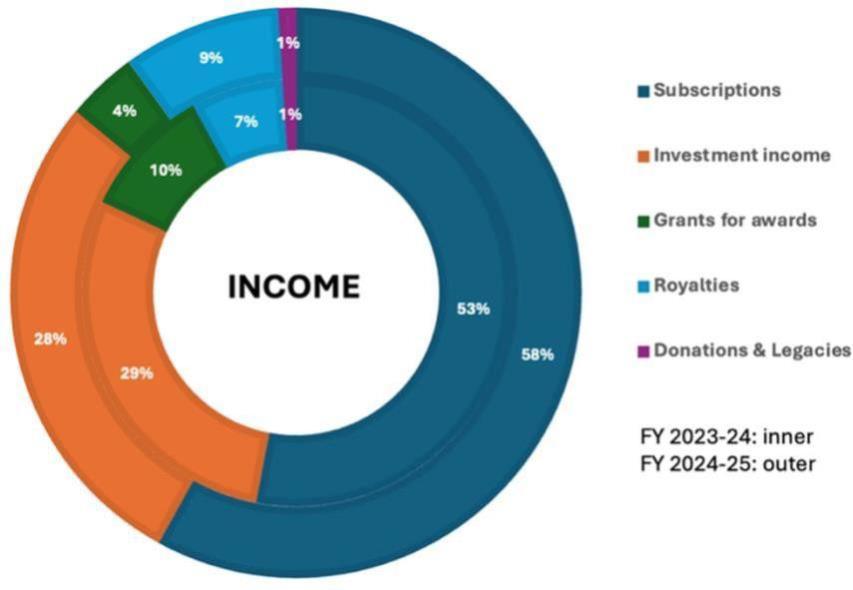
The Society’s Fellowship and Membership reinforce the Society’s financial security, with subscription fees accounting for 58% of our annual income, and providing direct support for our programmes of research funding, publications and scholarly communications, events, data provision, advocacy and promotion of the discipline. July 2024 saw the implementation of a revised and expanded structure of fees. This includedamodestannualincreasein subscription levels,following proposalsadopted by general resolution atthe Society’s AnniversaryMeeting (AGM)in November 2023.
Thesechanges,effective from 1July 2024,also enabledmembersto choose whether to receive the Society’s annual journal, Transactions, in print or online formats with an accompanying variation in subscription rates. In this current reporting year,we setout to Fellows and Members the considerable costs now being incurred by the Society to printand shiphardcopiesofanannual journal which,onaccountofitssuccess,isalso increasinginits pageextent per volume. In2024-25, Fellows and Memberswere invited
to opt-in foronlineaccess to thejournal and,withthis, receive a reduced membership fee. A switch to online-onlyispossibleto Fellowsand Membersatany time:ifyou have joined theRHS Members’ Directory you may make this change via that platform;if not, you may ask for the change to online access by contacting membership@royalhistscoc.org and asking Office staff to make the change on your behalf.
Other notable activities in 2024-25 relating to membership include the launch, in September 2024, of the Society’sonline Members’ Directory Fellowsand Members of theSocietyarewelcometoaddtheirdetailstotheDirectory,andthelistingisavailable to all RHS members regardless of whether they join or not.
As of 30 June 2025, the Directory included listings for just over 3,900 Fellows and Members of the Society andissearchablebya range offacetsincluding research area, geography, chronology, and the country / region in which a Fellow or Members practiseshistory.ItishopedthattheDirectorywill,asitdevelops,providenewwaysfor RHS members to identify and make connections with other historians.
In Spring 2025, the Society undertook a major survey of its membership to better understand their interests and concerns, and to gather advice on what members appreciate aboutthe Society,andwhat could bedone betterorbe undertaken as new initiatives. We are grateful to all those who took the time to participate and provide comments on the Society’s future.
The survey was followed by a series of member focus groups to consider areasof priority, such as advocacy and membership, in greater detail and to represent key sectorsoftheSociety includingearlyand mid-career members,international members and historians working independent of institutional affiliations. The findings help to shapetheSociety’s Strategy for2026-2028which isreleasedinNovember2025. Weare again verygrateful to those who gavetheirtimeandadviceatthese meetings, andhave subsequently offered to support the Society and its work in the first phase of its new strategy.
In this year, the Society has continued to communicate its activities, and those of the widerhistorical community,throughitswebsite,mailings andsocialmedia platform.In November 2024, the Society’s Council voted to end engagement on the social media platform X (formerly Twitter) and to archive its account. In its place, the Society adoptedBlueSkyas its social mediaplatform.Activityonthe sitehas grownsteadilyin 2024-25, resulting in c.18,000 followers by 30 June 2025. In addition, the Society has created a set of BlueSky ‘Starter Packs’ to bring together resources of interest to historians working in the UK and internationally and continues to maintain these.
Forthereportingyear(1July2024to30June2025),theSociety’scommunicationsand social media channels recorded the following levels of engagement:
BLOG
E-CIRCULAR
WEBSITE
36new articles/53,510sessions (33%increaseon 2023-24)/ 57,962views(36%increase on 2023-24)
48weeklymailings /c.450externalhistoryeventsreported /4565% open rate
248,413pageviews (2%increaseon2023-24)/134,066 sessions (2%increaseon 2023-24)
YOUTUBE 14,600views(8%increaseon 2023-24)
Inthecomingyear,theSocietywilllaunchandimplementitsnew Strategytoinformits activities for the period 2026-28. The Strategy draws on consultations and conversations with Fellows and Members of the Society in 2025 to best reflect the concerns, interests and priorities of the membership and the wider historian community.
In line with its Strategy, the Society seeks to champion the expertise and craft of historical scholarship;to convey this more effectivelyto the many who enjoyhistoryas a popular pursuit; to engage more closely with our membership as an asset in core areas such as advocacy and professional support; and to consider how the Society bestprovidesforandinvolvesitswide-rangingmembership, withparticularattention to international Fellows and Member and ‘independent’ historians who choose, or who are required, to practice without institutional support.
Morespecifically,activities ofnotein the coming year include:
● In partnership with other national organisations working for history and the humanities,we willengageina programme ofworkingwithemployers to better communicate the skills of a historical training and/or a history degree.
● We will develop a programme of training and discussion-led events thataddress the pressures and realities currently faced by many in the historical profession, with a focus on career development within and beyond education.
● We will build on the insights at the Society’s recent symposium on Generative AI and history teaching to identify the ways in which the Society best supports its members and the wider historian community to engage with this subject.
● Wewill continueto monitor,interpretand commenton both positiveandnegative outcomesfromdevelopmentofREF2029,andtoassertthevital importanceofQR funding for viable and sustainable history teaching and research as a UK-wide discipline.
● We will continue to monitor the cost to the Society of large-scale print publication andshippingof Transactions of the Royal Historical Society Thisistoensurethat in an eraof rapidly declining margins, following wholesale moves to Open Access publishing models royalty income to the Society remains as healthy as possible, for as long as possible. We will also consider options for mitigating a trend that is affecting publishing income across the learned society sector.
● Working with journal’s co-editors,wewill undertake reform of the editorial board of Transactions to ensure this best reflects the composition of the Society’s
Fellowship,especiallyin terms ofinternational and independentmembers,and so providesan array of scholarlyexpertise to support thejournal’sdevelopment.
● Wewilloversee thelaunchof theSociety’snew ‘ElementsinHistoryand ContemporarySociety’ series,withthefirsttitlesto bepublishedin2026.
● We will provide clearer guidance, for new and existing RHS Fellows and Members, on the benefits to behad from involvementwith the Society and how to make use of these opportunities.
● We will consider ways to bring the Society’s membership together more often and effectively, at in-person events, across the UK regions and to emphasise contact with fellow members as an asset of RHS membership.
● We will extend opportunities for meeting with fellow members by relocating one of the Society’s three ‘London’ lectures, along with one of our annual Council meetings, toa venuebeyond Londonandthe South-East. Thisisin addition to the Society’s ongoing programme of visits to historians across the country, accompanied by public guest lectures.
● We will look to build the Society’s Fellowship and Membership by identifying those professional sectors, in which historians work, where awarenessof the Society and its work is currently less developed.
● We will completean independent reviewofthe Society’sgovernance structuresand procedures, and then implement required reforms based on the recommendations provided to ensure the RHSis governed and managed efficiently and effectively, and that the resources of the Council and Office are wholly directed to meeting the Society’s charitable purposes.
● We will implement new forms of financial oversight relating to banking procedures to ensure all required levels of expenditure have multiple levels of approval.
● We will undertake a review of current expenditureand seek reductions in areas such as third-party softwares, where more economical options can be found without loss of service to the Society’s membership.
● We will increase our work to diversify the sources of income that support the Society’s activities in the light of trends in publication royalties in the learned society sector. This will include an enhanced focus on fundraising to enable dedicated areas of research support and funding.
TheRoyalHistorical Society wasincorporatedby RoyalCharteron23November1868 and gained itsprotected royal statusin1872.In1897theRHStookovertheCamden Society (itself established in 1838 for the publication of primary source scholarly volumes).
The Society’s activities are governed by a Council of Trustees (Directors) drawn from within theacademichistory sector,and by the‘By-Lawsof theRoyal Historical Society’ whichwerelastamendedby Special ResolutionoftheFellowsata general meeting in November 2021.The day-to-dayrunning of the Societyisoverseen bythe RHS Office. Society staff work closely with Society Trustees.
The Society has referred to the Charity Commission’s general guidance on Public Benefit when reviewing its aims and objectives and in planning its future activities. In particular, the Trustees consider how planned activities will contribute towards the aims and objectives they have set. The Society has not formally adopted the Charity Governance Code but the following summary of its structure, governance and management explainshowthe Society addresses theprinciplesof good governanceset out in the Code.
The Society remains the foremost Society in the United Kingdom promoting and defending the scholarly study of the past. It promotes the discussion of history by means of a full programme of public lectures, workshops, and events, and further disseminatestheresultsofhistorical researchand debatethroughitspublicationsand online communication channels. It represents the interests of historical scholarship both within and outside of the academy. It also speaks for the contribution made by history and historians for the benefit of the public.
TheSociety offersmonetarygrants,fellowships,and scholarships,bothdirectlyand via subventions to selected partners,in supportof primaryresearch and research training on historical subjects, as well as annual prizes for publications. Where possible, the Society aims to fund those with the greatest need.
The Society publishes one academic journal, Transactions of the Royal Historical Society, and the Camden Series of scholarly editions of primary sources with Cambridge University Press, and the New Historical Perspectives book series with University of London Press. From autumn 2024, in partnership with Cambridge UniversityPress,theSocietylaunched‘ElementsinHistoryand ContemporarySociety’, a short-form monograph series covering key topics in historical scholarship.
TheSocietyworkswitha selectionofrelatedlearnedandprofessional societies, universities and other key partners to advocate for the position and continued
importance ofhistorical scholarshipand supportshistorians bothwithin andoutsideof the higher education sector.
TheOfficers,togetherwith12Councillors,constitutethe governingbodyofthe Society and are its Trustees/Directors.
In November2024, thetermof theformer President,ProfessorEmma Griffin (Queen Mary UniversityLondon) came toan end,as specified bytheSociety’s By-Laws. Professor Griffin’s successor, Professor Lucy Noakes, took up the Presidency on 22 November2024afterservingasPresident-Electandasanon-votingmemberofCouncil from January of that year.
WithintheyearunderreporttheOfficersDr JohnLaw(Treasurer)andProfessorJane Winters (Vice President for Publications) left the Council. The following were duly elected by theCouncil ata meetingheldon7 February2025 andwill be ratifiedatthe Anniversary Meeting(Annual General Meeting)tobeheldon 21November 2025:
• ProfessorMatthiasNeumann(UniversityofEastAnglia)asTreasurer
• DrKateBradley (University ofKent) asSecretaryfor Publications
Additionally,attheAnniversaryMeeting(22November2024)ProfessorSimonMacLean (Councillor), DrEmilyRobinson (Councillor),andDr Andrew Smith(Councillor)retired fromtheCouncil.Thevacanciescreatedwerefilled byDrCatherineFeely(University of Derby), Professor Karen Harvey (University of Birmingham), and Dr Jesús SanjuroRamos (University of Strathclyde) who were duly elected as Councillors.
A full listing of Trustees can be found on page 27. All Fellowsof the Society are able, and encouraged, to nominate prospective Councillors who are then elected by a ballot of the Fellows and confirmed as members of the Council at the next Anniversary Meeting(Annual General Meeting,AGM).Officerpositions,drawn fromtheFellowship, are elected directly by the Council.
Inaccordancewith Society By-LawXIXthePresidentshallhold officefora termoffour years, following a year as President Elect, during which continuity and handover activities take place.
Duringtheperiod coveredbythisreport,inaccordancewith By-LawsXXandXXI,the Officers of the Society shall hold office for an initial term of two years, with the opportunity for an extension to a maximum of four years. Following the conclusion of theirterm ofoffice,theyshallnotbe eligible for re-electionto the same position before the Anniversary Meeting of the year after they step down.
Due care is given to the overall skill set of the Council in relation to the business of the Society. Where matters arise that are not sufficiently covered, guidance is provided by the RHS Office and/or external consultant experts if prudent.
Trustees are elected from the Fellows of the Society, and therefore have an initial familiarity with its workings. Following election, new Trustees are given a formal introduction by the President, and induction by the RHS Office, and other staff as required.
Trusteesreceiveagovernancehandbookincorporating theCharterandBy-Lawsofthe Society,aswell as reference material on the Society’s activities from the previous year, plans for the coming year, and financial position. They are provided with guidance material on the role of a trustee, related rights and responsibilities, best practice in charitygovernance,andthe Society’s variouscodesof conduct. Training isavailableto Trustees who express a desire to reinforce their skills in areas related to their role, or whereenhancedfamiliarity with regulatory mattersisessential,forexample,inCharity Finance.
The Councilis supported byseven sub-committees to whomresponsibilityforin-depth discussion, and in some cases, decision making, relating to their respective areas of subject focus are delegated. All sub-committees are composed of Trustees. With due referencetotheresponsibilityofthosewithin governancepositionsto referto specialist expertise where appropriate, the Finance Committee also has members co-opted for their knowledge and specialist skills in thisarea.Committees are routinelyattended by members of the senior management within the RHS Office in an advisory capacity, however decisions/resolutions are made solely by the elected Trustees. Thecurrent sub-committees andareasoffocus are:
● FinanceCommittee,which overseestheSociety’sfinancialandinvestment strategy, as well as leading on the consideration of business risk and staff remuneration;
● Publications Committee, which has oversight of the Society’s publications portfolio,althoughdecisionson commissioningand editorial policy aredelegatedto the Editors of each publication, as specified by related Editorial Agreements.
● ResearchPolicyCommittee,withoversightofmattersrelatedtoresearch policy, assessment, ethics, and efficacy within a higher education context.
● Education PolicyCommittee, whichoversees the Society’s engagement in teaching in higher education, scholarships and grants for innovative teaching initiatives.
● General Purposes Committee, which overseesthe Society’s lecture and events programme,as well asspecific mattersofgovernance,aheadof their consideration by the Council.
● Membership Committee, which has oversight of the Society’s Fellowship and Membership programme,including recommendationsforstrategicrecruitmentand elections to all categories.
● ResearchSupportCommittee,whichoverseestheSociety’sresearchgrant activities.
TheTrusteeshave delegatedtheday-to-day runningandmanagementof theSociety’s activities to the RHS Office, with the Director reporting directly to the President and other Trustees as appropriate. All employees have a senior staff member as line manager, except the Director who is line-managed by the President.
TheSocietyholdsa registerofrisksandassociated mitigating activitiesin linewithits Risk Management Policy. Management of this Register is delegated to the Finance Committee and theappropriate member ofRHSOffice staff,notifying the Trustees of any key changes in the risk profile where necessary. The Council reviews the Risk Register in full, once per calendar year.
TheTrusteesaresatisfied thattheyhaveconsidered themajorriskstowhich thecharity is exposed and have sufficiently implemented proactive and planned reactive strategies for mitigating the impact of these risks.
Intheyear covered by thisreport,theSociety received 58%ofitsfundsfrom Fellowship and Membership subscriptions. Other key sources of income included: royalties, organisational subventions and income derived from the Society’s investments portfolio.
TheSocietyalso receivedanumberofdonationsasoutlinedonpage 32.Donationscan also be given by Fellows and Members at the point of subscription renewal. Within the year under report, the Society did not employ third-party fundraisers. We follow the Charity Commission’s and Institute of Fundraising’s guidance on best practice in fundraising. As at the time of writing, within the reporting period and in previousyears,theSocietyhasnotreceivedanycomplaintsregardingourfundraising approach, from the general public, or institutions and foundations with whom we engage.
The Society relies on volunteers among its Fellows to act as appointed Officers and elected Councillors. Officers and Councillors give their services freely,although they are reimbursed for reasonable expenses incurred during the performance of their duties,withintheexpensespoliciesoftheSociety.Theseexpensesareusuallytravel and accommodation costs. The Society offers an annual payment of £12,000 to the institution of the President to compensate the institution for time spent on Society matters. In the yearunderreport,theSocietymade oneadditional paymentof £10,000 to the institution of the former President of the Society for their term 2023-24.
DuringtheFinancial Year1 July2024 to30 June2025,theSociety employedanaverage of five staff members. The Society has adopted the non-clinical pay scales used in London Universities which ensure salaries are both attractive and equitable. This policy,alongwithother key staffpolicies,will be reviewed shoulddevelopmentsin the
structure of the Society,aswellasongoing developmentsbetween the relevant unions and sector bodies, require it. Within these parameters, benchmarking is undertaken and used as an evidence-based marker for any changes to remuneration or implementation of new roles, ensuring the Society remains a competitive employer within thelearned society and professional bodycharity sector. All material changes to the staffing budgetare proposed to,andauthorised by the Finance Committee,acting as a de facto Remunerations Committee.
ProfessorLucyNoakes BA,DPhil
ProfessorEmma Griffin BA,MA,PhD
Dr M John Law BA, MA,PhD,ACA
Professor Matthias Neumann BA,MA,PhD
ProfessorJaneWinters MA,PhD
Dr Kate Bradley BA, MA, PhD
DrAdam Budd BA,MA,MA,PhD
ProfessorBarbara Bombi BA,PhD
Dr Stefan Bauer MA, PhD
Professor Simon MacLean BA, MPhil, PhD
Dr Emily Robinson BA, PhD
Dr Andrew Smith MA, MLitt, MBA, PhD
Professor Caitriona Beaumont BA, MA, PhD
Dr Melissa Calaresu BA, MA, PhD
Professor Rebekah Lee BA, MPhil, DPhil
Dr Emilie Murphy BA, MA, PhD
DrHelenPaul MA,MLitt,PhD
ProfessorOlwenPurdue BA,MA,PhD
ProfessorMarkKnights BA,DPhil
ProfessorIftikhar Malik MA,MA,PhD
Dr Catherine Feely BA, MA, PhD
Professor Karen Harvey BA, MA, PhD
Dr Jesús Sanjuro-Ramos BA, MA, PhD
DrStellaFletcher BA,PhD
DrDavidHitchcock BA,MA,PhD
ProfessorCatriona Pennell BA,MSc,PhD
President(from22Nov.2024)
President(to22Nov.2024)
Treasurer (to 14 Oct. 2024)
Treasurer (from7Feb.2025); Secretary for Professional and Public Engagement(from22Nov.2024to7Nov. 2025)
Vice-President, Publications (to 22Nov. 2024)
Secretary for Publications (from 7 Feb. 2025)
Secretary forEducation
Secretary forResearch
Councillor (to 25Sept. 2024)
Councillor (to 22 Nov. 2024)
Councillor (to 22 Nov. 2024)
Councillor (to 22 Nov. 2024)
Councillor (to21Nov. 2025)
Councillor (to 21 Nov. 2025)
Councillor (to21Nov.2025)
Councillor (and Chair of the Membership Committee)
Councillor
Councillor (and Chairof theResearch Support Committee)
Councillor
Councillor
Councillor (from 23 Nov. 2024)
Councillor (from 23 Nov. 2024)
Councillor (from 23 Nov. 2024)
Councillor (from 21Nov. 2025)
Councillor (from 21Nov. 2025)
Councillor (from 21Nov. 2025)
Director PhilipCarter MA,DPhil
Registered Office
UniversityCollegeLondon Gower Street London,WC1E6BT
Telephone 02038215311
Email administration@royalhistsoc.org
Website www.royalhistsoc.org
RoyalCharter Number RC000478
Charity Registration Number 206888
Auditors
Investment Managers
Bankers
Accountants
HakimFry 69-71EastStreet Epsom Surrey, KT17 1BP
Cazenove Capital 1LondonWallPlace London, EC2Y 5AU
BarclaysBankPLC 27 Soho Square London,W1A4WA
Xeinadin NightingaleHouse 46/48 East Street Epsom Surrey, KT17 1HQ
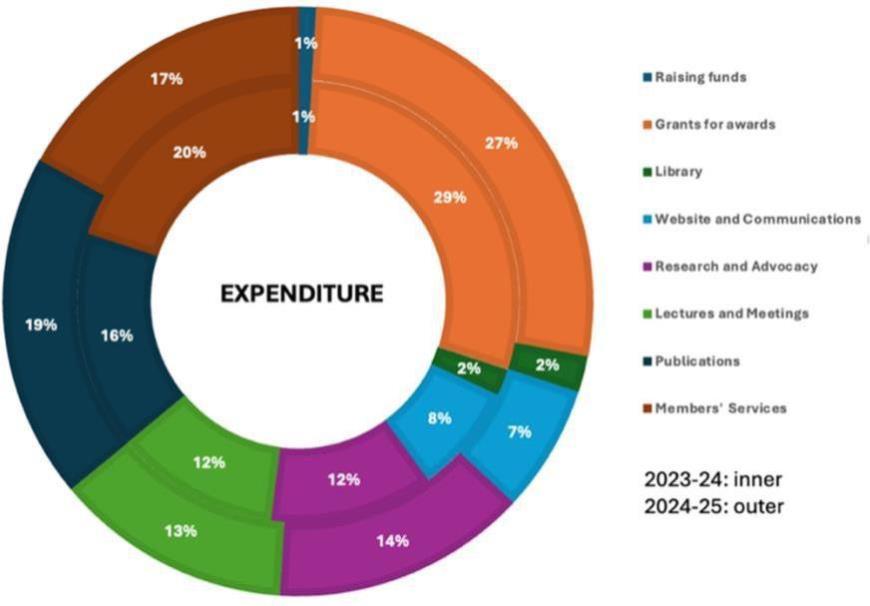
For the year underreport,ended 30June2025, theSociety undertooka productiveyear in each of its principal areas of activity.These include research funding, publications, lectures and events, advocacy, information circulation and other member services. Spendingandprovisionin eachoftheseareasincreasedduringtheyear.Of particular noteis a30%increase in expenditureon advocacy and campaign work,in response to the growing level of cuts experienced by historians working in higher education and other sectors. This focus on advocacy included survey work on the state of the discipline, publication of two briefings, including ‘The Value of History’ (October 2024), newresourcesin response to the Research ExcellenceFramework 2029, anda greater allocation of resources within the RHS office to data gathering and campaigning.
This year also saw an 8% increase in spendingon research funding, and a one-third increaseon publicationsduetothereleaseofanadditional thirdvolumeintheCamden Series of primary sources which appeared in an Open Access format in Spring 2025.
Overall, there wasan18%increasein the Society’sexpenditureonitscharitable activities compared with 2023-24.
Incometothe Societyin the sameperiodrose by12%.This increase wasas a resultof the modest rise in membership fees, effective from 1 July 2024 and approved at the Society’s November2023 AGM;anincrease in the numberofnew members joining the Society,coupledwitha continuedhighretention rate forexisting Fellowsand Members; anda higherthan forecast royalties return following a one-offsaleofthe digital archive of selected RHS publications.
Despite this welcome outcome for our publishing, we expect royalty income to continueto declineinthecomingyears asformanylearnedsocieties,givenchanges theongoingimpactofOpen Accesspublishing models.Thiswillincreasetheshareof total income received from our main source, membership fees, and will therefore necessitate future work to diversify the Society’s income base.
Expenditurein thereportingyearwashigherthanfor2023-24 dueto severalone-off payments. These included planned expenditure in areas such as the additional Camden volume;designandlaunchoftheMembers’Directory (September2024);and compilation and creation of several titles relating to advocacy. In addition, a further one-off paymentwas required to redress a historical deficitin employer contributions to the staff pension fund, which was identified in 2025.
After taking all these matters into account, the Society recordeda deficit of£97,000 on its unrestricted operations in the reporting year.
Thereportingyearalso sawseveral staffingchangesintheRHSofficeandwhichwere followed by a restructure. With the Society’sinfrastructure now returned to full
capacity, we will focus over the coming twelve months, 2025-26, on reducing expenditure on administration while continuing to provide members, and the wider historian community, with the fullextent and range of services currently available. With this focus, we plan to reduce the annual deficit and move closer to operating a balanced budget in future years.
Theyearunder report was challengingand unpredictable forinvestmentsdue,in large part, to policies emerging from the United States. The value of the Society’s investmentsfell£64,000intheyearto30June2025.Insummary,theSocietyreportsa netlossof £170,000 on unrestricted funds for theFinancial Yearended 30 June 2025.
TheCouncil records the generous subventions madein supportof specific charitable activities from:
● TheScouloudi Foundation,in support oftwo Master’sScholarships,threeawards to the Jinty Nelson Teaching Fellowships, and the creation of the RHS PublicHistory Grantsand RHS Panel Grants (see pages 14-15).
● ThePastandPresentSociety,insupportoftwoMastersScholarships(seepage 11).
● TheHistoryofEnglandPodcast(via SwincombeLtd),insupportof twoEarlyCareer Fellowship grants (see page 16).
● MrsAliceClark,insupportoftheMartinLynnScholarshipin AfricanHistory(see page 16).
TheCouncil recordswithgratitude the benefactions madeto the Societyby the following:
RonaldAitchison
Albab Akanda
Olga Akroyd
Gerben Bakker
Geof Bassford
Gillian Bennett
KathleenBronwynNeal
Perry Brown
David Cairns
Donald Clark
John Conen
SirDavidEastwood
Carolyn Davison
Kate Dimancescu
NigelEdwardMorecroft
Tad Fitch
Lionel Glassey
Ralph Griffiths
Shalini Grover
BarbaraHarvey
Helen Hickey
Edmund King
StevenLindley-French
Stuart McBratney
Gavin Miller
Laurence Mussio
Roger Paul Bartlett
Jill Pellow
Stefan Petrow
Ulrich Poehlmann
ElizabethRobertsPedersen
Bernard Sharp
Neil Smith
RosemarySweet
Don Watson
HugoWong-Berard
Sharon Wright
Susannah Wright
Marcus Wuest
TheSocietyholdsitsinvestmentsin theCazenoveSustainableMulti-AssetFund,which aims to provide income and capital growth in line with the Consumer Price Index plus 4% perannum (net offees) overrollingten-yearperiods, byinvestingin equities,bonds and alternative assets worldwide. The fund hadachieved a total return of 2.4% for the year.
The Sustainable Multi-Asset Fund is managed in line with a robust Sustainable Investment Policy which: ‘avoids harm’ by excluding harmful sectorsand screening companies’ environmental, social and governance practices; ‘benefits society’ by allocating asignificant portionto companiesthatcreateoverallpositiveoutcomesfor their stakeholders, such as employees, communities and the environment; ‘contributes to solutions’ by including an allocation to areas of environmental and
social needs;‘influencescompanies’and manager throughencouragementand voting, to encourage responsible business practices; and, ‘collaborates’ with other charity investors to identify areas of mutual concern.
The Trustees consideritappropriateto hold cashreserves equivalentto 6 months of budgeted operating costs,with an upper tolerance of8 months,anda lower tolerance of 4 months. The Trustees believe this to be a sufficient buffer against unforeseen events impacting upon expected Society income.
Asat 30 June2025,theSocietyheldunrestrictedassetsof£4.40million, whichis predominantly held in the Society’s investment portfolio. The Trustees consider it prudenttoretain sufficientinvestmentassetstoensurethegenerationofincomethat funds our charitable expenditure.
The Society also holds a number of funds where the donor has imposed explicit restrictionsontheuseofthefunds,whichislegally binding.Furtherdetailon these funds can be found in Note 17 in the Financial Statements below.
TheTrusteeshave considered possible eventsorconditions thatmightcastmaterial doubt on the ability of the charity to continue as a going concern. In particular, the Trustees have considered the charitable company’s financial forecasts; the long-term implications of Open Access journal publishing on publications-related income; forecasts for membership retention and growth in the immediate to near term; the Society’s investments; and have reviewed future expenditure of infrastructure. The Trustees have concluded that there is a reasonable expectation that the Society has adequate resources to continue in operational existence for thenexttwelve monthsat least.
The Trusteesare responsible forpreparing the Trustees’Report and Financial Statements in accordance with applicable law and United Kingdom Accounting Standards (United Kingdom Generally Accepted Accounting Practice).
The lawapplicable to charities in England and Walesrequires Trusteesto prepare financial statements for each financial year which give a true and fair view of the state of the affairs of the charity,andof the incoming resources and applicationof resources of the charityfor that period. In preparing these financial statements, the Trustees are required to:
● Select suitable accounting policies and then apply them consistently
● Observe the methods and principles of the Charities SORP
● Make judgements andestimatesthatare reasonableand prudent
● State whether applicable accounting standards, including FRS 102 have been followed, subject to any material departures disclosed and explained in the financial statements
● State whether a Statement of Recommended Practice (SORP) applies and has been followed, subject to any material departures which are explained in the financial statements
● Prepare the financial statements on a going concern basis unless it is inappropriate to assume that the charity will continue in business.
The Trustees are responsible for keeping properaccounting records that disclose with reasonable accuracy at any time the financial position of the charity and enable them to ensure that the financial statements comply with the Charities Act 2011, the Charity (Accountsand Reports)Regulations2008 and the provisionsof the Royal Charter. They are also responsible forsafeguarding theassetsofthe charity and thence fortaking reasonable steps for the prevention and detection of fraud and other irregularities. The Trustees are responsible forthe maintenance and integrity of the charity and financial information included on the charity’s website.Legislation in the UnitedKingdom governing the preparation and dissemination of financial statements may differ from legislation in other jurisdictions.
In determining how amounts are presented within itemsin the Statement of Financial Activitiesand BalanceSheet, the Trustees havehad regardto the substance of the reported transaction or arrangement, in accordance with generally accepted accounting policies and practice.
The Trusteesofthe Royal HistoricalSocietyapprove this report and thefollowingfinancial statements on the 11 November 2025 and were signed on its behalf by:

Signed, ProfessorLucy Noakes President, Royal Historical Society
We have audited the financial statements of Royal Historical Society (‘the charity’) for the year ended 30 June 2024 which comprise the Statement of Financial Activities, the Balance Sheet, the Cash Flow Statement and notes to the financial statements, including significant accounting policies. The financial reporting framework that has been applied in their preparation is applicable law and United Kingdom Accounting Standards, including FRS 102 The Financial Reporting Standard applicable in the UK and Republic of Ireland (United Kingdom Generally Accepted Accounting Practice).
In our opinion, the financial statements:
• give a true and fair view of the state of the charity’s affairs as at 30 June 2024 and of its incoming resources and application of resources for the year then ended;
• have been properly prepared in accordance with United Kingdom Generally Accepted Accounting Practice; and
• have been prepared in accordance with the requirements of the Charities Act 2011.
We conducted our audit in accordance with International Standards on Auditing (UK) (ISAs (UK)) and applicable law. Our responsibilities under those standards are further described in the Auditor’s responsibilities for the audit of the financial statements section of our report. We are independent of the charity in accordance with the ethical requirements that are relevant to our audit of the financial statements in the UK, including the FRC’s Ethical Standard and we have fulfilled our other ethical responsibilities in accordance with these requirements. We believe that the audit evidence we have obtained is sufficient and appropriate to provide a basis for our opinion.
In auditing the financial statements, we have concluded that the trustee’s use of the going concern basis of accounting in the preparation of the financial statements is appropriate.
Based on the work we have performed, we have not identified any material uncertainties relating to events or conditions that, individually or collectively, may cast significant doubt on the charity’s ability to continue as a going concern for a period of at least twelve months from when the financial statements are authorised for issue.
Our responsibilities and the responsibilities of the trustees with respect to going concern are described in the relevant sections of this report.
The trustees are responsible for the other information contained within the annual report. The other information comprises the information included in the annual report, including the trustees’ report, other than the financial statements and our auditor’s report thereon.
Our opinion on the financial statements does not cover the other information and, except to the extent otherwise explicitly stated in our report, we do not express any form of assurance conclusion thereon.
In connection with our audit of the financial statements, our responsibility is to read the other information and, in doing so, consider whether the other information is materially inconsistent with the financial statements, or our knowledge obtained in the course of the audit, or otherwise appears to be materially misstated. If we identify such material inconsistencies or apparent material misstatements, we are required to determine whether this gives rise to a material misstatement in the financial statements themselves. If, based on the work we have performed, we conclude that there is a material misstatement of this other information, we are required to report that fact.
We have nothing to report in this regard.
Matters on which we are required to report by exception
We have nothing to report in respect of the following matters in relation to which the Charities (Accounts and Reports) Regulations 2008 require us to report to you if, in our opinion:
• the information given in the trustees’ report is inconsistent in any material respect with the financial statements; or
• sufficient accounting records have not been kept; or
• the financial statements are not in agreement with the accounting records; or
• we have not received all the information and explanations we require for our audit.
As explained more fully in the trustees’ responsibilities statement set out on page 31, the trustees are responsible for the preparation of the financial statements and for being satisfied that they give a true and fair view, and for such internal control as the trustees determine is necessary to enable the preparation of financial statements that are free from material misstatement, whether due to fraud or error.
In preparing the financial statements, the trustees are responsible for assessing the charity’s ability to continue as a going concern, disclosing, as applicable, matters related to going concern and using the going concern basis of accounting unless the trustees either intend to liquidate the charity or to cease operations, or have no realistic alternative but to do so.
We have been appointed as auditor under Section 144 of the Charities Act 2011 and report
in accordance with the Act and relevant regulations made or having effect thereunder. We have carried out this audit in accordance with regulations made under Section 154 of the Charities Act 2011.
Our objectives are to obtain reasonable assurance about whether the financial statements as a whole are free from material misstatement, whether due to fraud or error, and to issue an auditor’s report that includes our opinion. Reasonable assurance is a high level of assurance, but is not a guarantee that an audit conducted in accordance with ISAs (UK) will always detect a material misstatement when it exists. Misstatements can arise from fraud or error and are considered material if, individually or in the aggregate, they could reasonably be expected to influence the economic decisions of users taken on the basis of these financial statements.
The extent to which our procedures are capable of detecting irregularities, including fraud is detailed below.
• the engagement partner ensured that the engagement team collectively had the appropriate competence, capabilities and skills to identify or recognise noncompliance with applicable laws and regulations;
• we identified the laws and regulations applicable to the charity through discussions with trustees and other management, and from our commercial knowledge and experience of the charity sector;
• we focused on specific laws and regulations which we considered may have a direct material effect on the financial statements or the operations of the charity, including the Charities Act 2011, data protection, anti-bribery, employment, environmental and health and safety legislation;
• we assessed the extent of compliance with the laws and regulations identified above through making enquiries of management and inspecting legal correspondence; and identified laws and regulations were communicated within the audit team regularly and the team remained alert to instances of non-compliance throughout the audit.
We assessed the susceptibility of the charity’s financial statements to material misstatement, including obtaining an understanding of how fraud might occur, by:
• Our audit has been carried out on a substantive testing basis. We have calculated materiality and performance materiality for each area of the Financial Statements. All items above performance materiality have been tested and items below are tested on a sample basis. We consider this approach to be capable of detecting material irregularities and fraud;
• making enquiries of management as to where they considered there was susceptibility to fraud, their knowledge of actual, suspected and alleged fraud;
• considering the internal controls in place to mitigate risks of fraud and noncompliance with laws and regulations; and
To address the risk of fraud through management bias and override of controls, we:
• performed analytical procedures to identify any unusual or unexpected relationships;
• tested journal entries to identify unusual transactions;
• assessed whether judgements and assumptions made in determining the accounting estimates set out in Note 1 were indicative of potential bias;
• investigated the rationale behind significant or unusual transactions.
There are inherent limitations in our audit procedures described above. The more removed that laws and regulations are from financial transactions, the less likely it is that we would become aware of non-compliance. Auditing standards also limit the audit procedures required to identify non - compliance with laws and regulations to enquiry of the trustees and other management and the inspection of regulatory and legal correspondence, if any.
Material misstatements that arise due to fraud can be harder to detect than those that arise from error as they may involve deliberate concealment or collusion.
A further description of our responsibilities for the audit of the financial statements is located on the Financial Reporting Council’s website at: www.frc.org.uk/auditorsresponsibilities
This description forms part of our auditor’s report.
This report is made solely to the charity’s trustees, as a body, in accordance with Part 4 of the Charities (Accounts and Reports) Regulations 2008. Our audit work has been undertaken so that we might state to the trustees those matters we are required to state to them in an auditor’s report and for no other purpose. To the fullest extent permitted by law, we do not accept or assume responsibility to anyone other than the charity’s trustees as a body, for our audit work, for this report, or for the opinions we have formed.

NileshPatelFCA(Senior StatutoryAuditor) forand on behalf of Hakim Fry Chartered Accountants Statutory Auditor
69-71 East Street, Epsom Surrey, KT17 1HQ
Date: 11 November 2025
FOR THE YEAR ENDED 30 JUNE 2025
FOR THE YEAR ENDED 30 JUNE 2025
The statementof financialactivities includes allgains and losses recognised in the year. Allincome and expenditure derive from continuing activities.
AS AT 30 JUNE 2025
4,737,379
The financial statements were approved by the trustees on 11 November 2025
Professor Lucy Noakes President of the RoyalHistorical Society
STATEMENT OFCASH
FOR THE YEAR ENDED 30 JUNE 2025
FOR THE YEAR ENDED 30 JUNE 2025
FOR THE YEAR ENDED 30 JUNE 2025
1 Accounting policies
1.1 Accounting convention
The financialstatements have been prepared in accordance with the charity's governing document, the Charities Act 2011, FRS 102 "The Financial Reporting Standard applicable in the UK and Republic of Ireland" and the Charities SORP "Accounting and Reporting by Charities: Statement of Recommended Practice applicable to charities preparing their accounts in accordance with the Financial Reporting Standard applicable in the UK and Republic of Ireland (FRS 102)". The charity is a Public Benefit Entity as defined by FRS 102.
The financial statements have departed from the Charities (Accounts and Reports) Regulations 2008 only to the extent required to provide a true and fair view. This departure has involved following the Statement of Recommended Practice for charities applying FRS 102 rather than the version of the Statement of Recommended Practice which is referred to in the Regulations but which has since been withdrawn.
The financial statements are prepared in sterling, which is the functional currency of the charity. Monetary amounts in these financial statements are rounded to the nearest £.
The financial statements have been prepared under the historical cost convention. The principal accounting policies adopted are set out below.
In preparing financial statements it is necessary to make certain judgements, estimates and assumptions that affect the amounts recognise in the financial statements. In the view of the Trustees, in applying the accounting policies adopted, no judgements were required that have a significant effect on the amounts recognised in the financial statements nor do any estimates or assumptions made carry a significant risk of material adjustment in the next financial year.
At the time of approving the financial statements, the trustees have a reasonable expectation that the charity has adequate resources to continue in operational existence for the foreseeable future. Thus the trustees continue to adopt the going concern basis of accounting in preparing the financial statements.
The trustees have considered the Charity's position as a going concern having reviewed its assets and expected income and expenditure over the coming years. Whilst the accounts for the year to 30th June 2025 show a deficit the assets are sufficient to meet the ongoing commitments ofthe Society and accordingly the Trustees consider the Charity to continue to be a going concern.
Unrestricted funds can be used in accordance with the charitable objectives at the discretion of the Trustees.
Designated funds are unrestricted which have been set aside by the Trustees for specific purposes.
Restricted funds can only be used for particular restricted purposes within the objects of the charity. Restrictions arise when specified by the donor or when funds are raised for particular restricted purposes.
Permanent endowment funds must be held permanently by the Trustees and income arising is separately included in restricted funds for specific use as defined by the donors.
Further explanation of the nature and purpose of each fund is included in the notes to the financial statements.
Accounting policies
1.4 Income
(Continued)
All income is recognised in the Statement of Financial Activities once the charity has entitlement to the funds, it is probably that the income will be received and the amount can be measured reliably.
Donations and other voluntary income
Donations and other voluntary income are recognised when the Society becomes legally entitled to such monies.
Grant Income
Grant income is deferred only wherethe donor has specified that it may only be used for future period or has imposed conditions that must be met before the charity has unconditional entitlement to the grant.
Subscription Income
Subscription income is recognised in the year it became receivable with a provision against any subscription not received.
Royalties
Royalties are recognised on an accruals basis in accordance with the terms of the relevant agreement.
1.5 Expenditure
Liabilities are recognised as expenditure as soon as there is a legal or constructive obligation committing the Society to that expenditure, it is probable that a transfer of economic benefits will be required in settlement and the amount of the obligation can be measured reliably. Expenditure is accounted for on an accruals basis and has been classified under headings that aggregate all cost related to the category. Where costs cannot be directly attributed to particular headings they have been allocated to activities on a basis consistent with the use of resources.
Grants payable are recognised in the year in which they are approved and notified to recipients. Grants offered subject to conditions which have not been met at the year end date are noted as a commitment but not accrued as expenditure.
Cost of raising funds
The cost of generating funds are those costs of seeking potential funders and applying for funding.
Allocation of costs
Indirect costs are those costs incurred in support of the charitable objectives. These have been allocated to the resources expended on a basis that fairly reflects the trust use of those resources within the organisation.
Tangible fixed assets are initially measured at cost and subsequently measured at cost or valuation, net of depreciation and any impairment losses.
Depreciation is recognised so as to write off the cost or valuation of assets less their residual values over their useful lives on the following bases:
Fixtures and fittings
Computers
10% on cost
25% on cost
The gain or loss arising on the disposal of an asset is determined as the difference between the sale proceeds and the carrying value of the asset, and is recognised in the statement of financial activities.
1 Accounting policies
1.7 Fixed asset investments
(Continued)
Fixed asset investments are initially measured at transaction price excluding transaction costs, and are subsequently measured at fair value at each reporting date. Changes in fair value are recognised in net income/(expenditure) for the year. Transaction costs are expensed as incurred.
1.8 Impairment of fixed assets
At each reporting end date, the charityreviews the carrying amounts of its tangible assets to determine whether there is any indication that those assets have suffered an impairment loss. If any such indication exists, the recoverable amount of the asset is estimated in order to determine the extent of the impairment loss (if any).
1.9 Cash and cash equivalents
Cash and cash equivalents include cash in hand, deposits held at call with banks, other short-term liquid investments with original maturities of three months or less, and bank overdrafts. Bank overdrafts are shown within borrowings in current liabilities.
1.10 Financial instruments
The charity has elected to apply the provisions of Section 11 ‘Basic FinancialInstruments’ and Section 12 ‘Other Financial InstrumentsIssues’of FRS 102 to all of its financial instruments.
Financial instruments are recognised in the charity's balance sheet when the charity becomes party to the contractual provisions of the instrument.
Financial assets and liabilities are offset, with the net amounts presented in the financial statements, when there is a legally enforceable right to set off the recognised amounts and there is an intention to settle on a net basis or to realise the asset and settle the liability simultaneously.
Basic financial assets
Basic financial assets, which include debtors and cash and bank balances, are initially measured at transaction price including transaction costs and are subsequently carried at amortised cost using the effective interest method unless the arrangement constitutes a financing transaction, where the transaction is measured at the present value of the future receipts discounted at a market rate of interest. Financial assets classified as receivable within one year are not amortised.
Basic financial liabilities
Basic financial liabilities, including creditors and bank loans are initially recognised at transaction price unless the arrangement constitutes a financing transaction, where the debt instrument is measured atthe present value of the future payments discounted at a market rate of interest. Financial liabilities classified as payable within one year are not amortised.
Debt instruments are subsequently carried at amortised cost,using the effective interest ratemethod.
Trade creditors are obligations to pay for goods or services that have been acquired in the ordinary course of operations from suppliers. Amounts payable are classified as current liabilities if payment is due within one year or less. If not, they are presented as non-current liabilities. Trade creditors are recognised initially at transaction price and subsequently measured at amortised cost using the effective interest method.
Derecognition of financial liabilities
Financial liabilities are derecognised when the charity’s contractual obligations expire or are discharged or cancelled.
1.11 Taxation
The charity is exempt from tax on its charitable activities.
1 Accounting policies (Continued)
1.12 Retirement benefits
The charity operates a defined contribution pension scheme. Contributions payable to the charity's pension scheme are charged to the Statement of Financial Activities in the period to which they relate.
In the application of the charity’s accounting policies, the trustees are required to make judgements, estimates and assumptions about the carrying amount of assets and liabilities that are not readily apparent from other sources. The estimates and associated assumptions are based on historical experience and other factors that are considered to be relevant. Actual results may differ from these estimates.
The estimates and underlying assumptions are reviewed on an ongoing basis. Revisions to accounting estimates are recognised in the period in which the estimate is revised where the revision affects only that period, or in the period of the revision and future periods where the revision affects both current and future periods.
3 Income from donations andlegacies
4 Income from charitable activities
TOTHE FINANCIALSTATEMENTS (CONTINUED) FOR THE YEAR ENDED 30 JUNE 2025
4 Income from charitable activities (Continued)
Grantsreceived included in the above, includes £36,000 from the PJ Marshall Fellowship and £23,450 from other sources.
5 Income frominvestments
6 Expenditure on raising funds
NOTESTOTHE FINANCIAL STATEMENTS (CONTINUED)
FOR THE YEAR ENDED 30 JUNE 2025
7 Expenditure on charitable activities
NOTESTOTHE FINANCIAL STATEMENTS (CONTINUED)
FOR THE YEAR ENDED 30 JUNE 2025
7 Expenditure on charitable activities (Continued)
2025
8 Grants payable
All grants were paid to individuals. The charity makes three types of grants:
- Fellowships for Early Career Researchers to support historians who are completing a PhD
- Research support grantsfor postgraduate, early career historians to support visiting an archive or historic site, and conducting interviews
- Research support grants for mid-career historians to support visiting an archive or historic site, conducting interviews, and visiting academic conferences
- Scholarships for Masters’ Students from groups currently under-represented in academic history
- Grantsto supportthe pursuit of workshops projectsfor shared interest
- Book workshop grants to support historians working on a second or third major research project which will lead to publication of a monograph
- Jinty Nelson Teaching Fellowships to support the introduction of newapproaches and initiatives to their teaching
- David Berry Fellowship to historians studying the history of Scotland and the Scottish people
- Martin Lynn Scholarships for postgraduate historians studying the history of Africa.
Ofthe grants awarded in the year £46,137 (2024 - £52,472)related to research support, £98,799 (2024 - £84,347) related to fellowships and scholarships.
NOTESTOTHE FINANCIALSTATEMENTS (CONTINUED) FOR THE YEAR ENDED 30 JUNE 2025
9
Charitable activity costs are apportioned by the charity on thebasis of staff time.
10 Net movement in funds The
movement in funds is stated after charging/(crediting):
THE FINANCIAL
FOR THE YEAR ENDED 30 JUNE 2025
During the year travel expenses were reimbursed to 15 (2024: 19) Councillors attending Council meetings at a cost of £5,275 (2024: £3,144).
Last year one Trustee was paid £270 as a grant for admin support on aresearch project, this yearthere was no remuneration made to any Trustee
The
monthly number of employees during the year was:
The number of employees whose annualremuneration was more than £60,000 is as follows:
60,000 - 69,999
Remuneration of key management personnel
Total remuneration paid to key management personnel during the year amounted to £154,916 (2024: £159,413) for 2 (2024: 2) employees.
TOTHE FINANCIALSTATEMENTS (CONTINUED) FOR THE YEAR ENDED 30 JUNE 2025
NOTESTOTHE FINANCIALSTATEMENTS (CONTINUED) FOR THE YEAR ENDED 30 JUNE 2025
NOTESTOTHE FINANCIALSTATEMENTS (CONTINUED) FOR THE YEAR ENDED 30 JUNE 2025
Endowment funds represent assets which must be held permanently by the charity. Income arising on the endowment funds can be used in accordance with the objects ofthe charity and is included as unrestricted income. Any capital gains or losses arising on the assets form part of the fund.
TOTHE FINANCIAL
(CONTINUED) FOR THE YEAR ENDED 30 JUNE 2025
21 Endowment funds (Continued)
AS Whitfield Prize Fund
The A S Whitfield Prize Fund is an endowment used to provide income for an annual prize for the best first monograph for British history published in the calendar year.
The David Berry Fellowship Trust
The David Berry Essay Trust was an endowment to provide income for annual prizes for essays on subjects dealing with Scottish history. During the reporting year the Charity Commission approved a petition to change the Trust and its purposes to: The David Berry Fellowship Trust which is a grant for historians at any career stage undertaking meaningful research into any aspect of the history of Scotland and the Scottish People/ Diaspora.
22 Restricted funds
The restricted funds of the charity comprise the unexpended balances of donations and grants held on trust subject to specific conditions by donors as to how they may be used. At 1 July 2024
THE YEAR ENDED 30 JUNE 2025
22 Restricted funds
AS Whitfield Prize Fund Income
Income from the A S Whitfield Prize Fund is used to provide an annual prize for the best first monograph for British history published in the calendar year.
P J Marshall Fellowship
The P J Marshall Fellowship is used to provide a sum sufficient to cover the stipend for a one-year doctoral research fellowship alongside the existing Royal Historical Society Centenary Fellowship at the Institute of Historical Research.
The David Berry Essay TrustIncome
Income from the David Berry Trust was to provide annual prizes for essays on subjects dealing with Scottish history. Henceforth it will be for providing funds in support of 'The David Berry Fellowship' as indicated above.
The Martin Lynn Bequest
This annual bequest is used by the Society to give financial assistance to postgraduates researching topics in African history.
The unrestricted funds ofthe charity comprise the unexpended balances of donations and grants which are not subject to specific conditions by donors and grantors as to how they may be used. These include designated funds which have been set aside out of unrestricted funds bythe trusteesfor specific purposes.
At 1 July 2024 Incoming Resources Transfers Gains and At 30 June
NOTESTOTHE FINANCIALSTATEMENTS (CONTINUED) FOR THE YEAR ENDED 30 JUNE 2025
NOTESTOTHE FINANCIALSTATEMENTS (CONTINUED) FOR THE YEAR ENDED 30 JUNE 2025
during the
(2024 - none).
28 Analysis of changes in net funds
The charity had no material debt during the year.