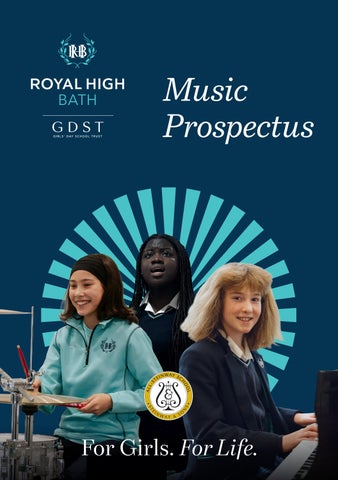
RHB Music Prospectus 2026

Page 1


Music Prospectus

‘Our musical educational philosophy focuses not only on the development of technical skills and knowledge of music theory, but also on fostering creativity, self-expression, and emotional intelligence. By providing students with a well-rounded musical education, our aim is to empower students to become critical thinkers, confident performers, and lifelong learners who appreciate the beauty and power of music in their lives and the world around them’.

Introduction

As the Director of Music, I pride myself on the successful and inclusive Music Department Royal High School Bath has become. Regarded as one of the country’s leading centre’s of excellence for Music both nationally and internationally, we achieve this by having a clear direction in which ALL members of the department contribute to attaining the highest level of musicianship, and the opportunity for pupils regardless of age or ability to reach their musical aspirations.

Academic and musical excellence is not just encouraged; it is an integral part of our pupils’ musical journey. I believe that a well-rounded education includes a strong foundation in music theory, history, and critical analysis. These high standards continue to position Royal High Bath as one of the leading schools alongside other prestigious music schools. I believe Music at Royal High Bath is not just about preparing pupils to be performers, but life-long musicians.

Partnerships play a pivotal role in the success of our music department. As a Steinway Music School (one of the 180 schools globally), students are regularly treated to workshops, masterclasses and recitals by leading artists – most recently, Joanna MacGregor, Charles Owen and

Lise de la Salle. We actively seek collaborations with professional musicians for example, Bath Philharmonia and Bournemouth Symphony Orchestra. Likewise, we continue to build links with all the major conservatoires and invite key Music Professors to visit and work closely with students to ensure they are fully prepared for upcoming auditions and interviews.

As we know, not all pupils are performers. The music industry has changed dramatically over a very short space of time through the development of technology and its ease of accessibility. As we have seen, technology has seamlessly integrated into music education and one that has been developed fully and embraced at Royal High Bath. Virtual collaborations, online tutorials and digital resources ensure every pupil can access the tools needed for musical expression. This adaptability reflects our commitment to inclusivity, allowing pupils to engage with music on their own terms. Developing the recording facilities at Royal High Bath has enabled a new era of pupils to embark on a journey of discovery on the opposite side of the microphone.

Students flourish creatively in our stateof-the-art professional recording studios

studying A Level Music Technology and have taken the next step in their journey, gaining places into top universities and conservatoires.

I do feel there is scope for further opportunities for ALL. For example, the Samba Band and African Drumming Group have brought together musicians of all ages and abilities, helping to diversify the range of musical activities offered here. More opportunities for composers, songwriters, and conductors to showcase their work and skills in specific concerts and collaborative projects are being programmed regularly. The Community Choir involving local residents, parents and staff formed 10 years ago perform alongside the Music Department’s programme of events.

In summary, I believe the continued success and inclusivity of RHSB’s outstanding Music Department relies upon teamwork, partnerships, and academic excellence. Through strong collaboration, external connections, we cannot only attract and nurture talented musicians of the future, but also empower pupils to become well-rounded individuals.

Facilities and Opportunities

Delivered and housed in our purposebuilt Music School with state of the art facilities, students have the opportunity to reach their full potential by participating in many of our highly established ensembles such as; Orchestra, Concert Band, Chamber Choir, Totally Vocally, Brass Ensemble, Wind Ensemble, Chamber Ensemble, String Ensemble, New Music Group, Percussion Ensemble, ‘Gig Night’ Bands, Song-Writing Club, Theory Club, and our newly formed Music Tech Club for those with an interest in the recording industry.

As a Steinway Music School, we are pleased to house our very own fleet of 10 Steinway pianos – one of which is a beautiful Model B resident in our 60 seater Recital Room. Being part of the prestigious Steinway family enables our students to participate in masterclasses and concerts delivered by artists and ensembles endorsed by this wonderful manufacturer of fine instruments.

Over the years, the school has enjoyed many overseas tours to Barcelona, France and Germany. It is envisaged that the tours over the next few years will involve concerts at the Steinway Halls in London, New York and Beijing.

The Role of Music in the

Curriculum

Music has a great deal to offer all students within the school, both in its own study and in developing learning strategies. It is an excellent forum for developing self-aware and independent learners. Broadly speaking, it develops creative,

Creative

Teaching Students are set structured compositional tasks in all key stages and learn progressively to appreciate the demands of writing in key styles of music.

Benefits Responding to a brief and structuring ideas accordingly benefits a range of learning environments – not least the demands of preparing coursework.

Analytical

Teaching An ‘elements‑based’ toolkit helps pupils analyse links between musical styles. They develop a listening and analytical framework with vocabulary to support this. Pupils are encouraged to express their views, and opinions are considered valid when supported by evidence.

Benefits Pupils move beyond description into analysis through structured exercises. This approach not only enables access to a wider range of music, but also fosters a more independent learning style.

Numerical

Teaching Learning notation and working as an ensemble, pupils become familiar with rhythmic and metrical patterns and understand the role these play in coordinated work.

Benefits Through notation exercises and games, they also appreciate the importance of mathematical processes in context.

Linguistic

Teaching Aspects of lyric writing in KS3 develop pupils’ understanding of accents and stresses in text. Pupils also explore how syllable counts relate to poetic convention.

Benefits Becoming more aware of the metre and rhythm in language, which enables the analysis of poetry and dramatic writing.

Presentational

Teaching All pupils are given numerous opportunities to perform in a wide variety of settings, including public performances.

Benefits Taking responsibility for preparing and delivering a performance despite apprehensions is a vital skill in life. Routine performance and constructive, supportive feedback in almost every lesson allows pupils to develop the habit of being in front of an audience, breaking down fears and building self‑esteem.

Evaluative

Teaching Every lesson features evaluation in some form, whether it is teacher questions to individuals, formal self, and peer evaluation at the end of the project, or through evaluation in a plenary session. The assessment methods of the department also encourage this.

Benefits By routinely assessing their own and others’ work, pupils identify what is needed to make progress. This is a useful strategy in other subjects.

Social

Teaching Work in different size and constituent groups. Extra curricular opportunities.

Benefits Pupils mix with a variety of their peers from different age groups and disciplines. They learn how to work constructively with a range of people.

Motor

Teaching Aspects of instrumental technique are taught throughout all years. This develops motor skills in all students.

Benefits The type of finer motor skills fostered in a musical environment can benefit a wide variety of other disciplines.

Structured learning through curricular music making

As a department, we encourage pupils to develop a sophisticated understanding of the processes at work in our medium. Using Bloom’s revised taxonomy as a framework, our approach to pupils’ progress through our schemes of work may be defined thus:

Remembering

Key terms are introduced through listening exercises where students study particular styles and genres in some depth, with the elements of music as a starting point.

Understanding Pupils can make comparisons between music in the same and related styles through further listening.

Applying

Pupils have the experience of performing music in a wide variety of styles and genres and are accustomed to experimenting with solo and ensemble skills. They also have access to relevant music technology throughout the curriculum.

Analysing

Through performance, students achieve a fuller sense of stylistic features and are able to apply terminology more effectively. They also develop a keener awareness of the role of different notation methods in both Western and non-Western cultures. An awareness of the role that technology plays in modern music is also fostered through performance using such equipment.

Evaluating/Creating

All performances in class and on recorded media are evaluated. In the initial stages of the project, this evaluation is heavily teacher led but, as pupils develop more analytical skills, they take a more active and independent role in the evaluation process.

Evaluation also feeds into creative work where students can borrow from their experiences of performing and listening when creating music in a similar genre or style.

Overarching Aims in Curricular Music Year 7

Appraisal

Elements focused upon

Timbre, dynamics tempo and metre, structure, rhythm, melody, instrumentation.

Every topic covered will incorporate listening and appraising for students to gain a thorough insight and understanding of the historical and social aspects of each particular style and genre. These skills and knowledge will culminate in a portfolio of work.

Performance

Ensemble skills

Working as a whole class and smaller groups to create instrumental and singing performances based on specific repertoire associated with the styles & genres studied.

Composition

Pairs and small groups

Highly focused, composition projects are integrated into every topic to enhance understanding of key features and improve theoretical knowledge. All compositions will be created using Sibelius 7.5 and Logic Pro X.

Throughout the year, students’ theoretical knowledge will be developed to grade 2 level.

Music Technology

Sibelius Ultimate and Logic Pro X

Introduction to the key functions of both Sibelius Ultimate and Logic Pro X. Topics covered throughout the year, will introduce specific techniques which will encourage students to be creative and confident.

We construct our curriculum with a clear sense of how we wish pupils to progress each year and term. This, in turn is tied in closely with aims and objectives in the Lower School.

Year 8 Year 8

Appraisal

Elements focused upon

Timbre, dynamics tempo and metre, structure, rhythm, melody, instrumentation.

Every topic covered will incorporate listening & appraising for students to gain a thorough insight and understanding of the historical and social aspects of each particular style and genre. These skills and knowledge will culminate in an end of year examination.

Performance

Ensemble skills: Whole Class/small group/individual performance

Working as a whole class to create instrumental and singing performances.

More sophisticated notation is introduced.

‘One to a part’ performance in small group work.

Composition

Pairs and small group

Medium length group composition projects are introduced, with highly defined parameters.

Throughout the year, students’ theoretical knowledge is enhanced to a level of Grade 3/4.

Music Technology

Sibelius Ultimate and Logic Pro X

Continuing from the skills learnt from Year 7, students will learn how to apply more detailed techniques using Sibelius Ultimate and Logic Pro X.

Year 9

Appraisal

Elements focused upon

All elements covered but used in a more interpretive way to analyse styles of music.

Composition

Small group but with much more of an emphasis on individual contributions

Pupils learn to implement key stylistic features but alter them to suit their taste, eg, riffs, vocal lines new ostinati in polyrhythmic textures.

By the end of year 9, all students will have reached grade 5 level in music theory.

Performance

Ensemble skills and more opportunities to perform solo roles

Within extended group projects, pupils take on specific solo roles so that they can develop self reliance and practice strategies.

Pupils also perform their own arrangement of a favourite piece.

Music Technology

Sibelius Ultimate and Logic Pro X

Continued knowledge and skills of both Sibelius Ultimate and Logic Pro X are developed. By the end of the year, all students will be of the level to fully utilise all components of the software – this is demonstrated through the quality of work produced in composition.

Year 10

Appraisal

Developing stylistic awareness

Close study of the stylistic features of 2/3rds of the listening syllabus.

Developing ability to critique performances and compositions.

Evaluation of compositions and performance using musicological terminology.

Learning general listening/appraising terms.

Much emphasis is placed upon exploring the language for learning from specification and from wider afield.

Performance

Developing ensemble skills

Much emphasis is placed in class and in an extra curricular context on the importance of group performance.

Developing ability to improvise in a structured way.

Looking at strategies for structure, keys, melodic devices etc.

Developing solo performance skills. Many opportunities are given to students to perform solos and compositions in a variety of contexts from performances to peers to formal concerts.

Composition

Developing a basic understanding of rhythm, functional harmony, melody, texture and structure

Pupils prepare a number of pieces to explore basic techniques – homophonic and 2 part setting of text.

Using appraising skills to develop own and pastiche work.

Music Technology

Full use of Sibelius Ultimate and Logic Pro X

All composition coursework is prepared on Sibelius, so students become rapidly familiar with this.

Logic Pro X software is used as a medium to teach Minimalist techniques.

Year 11

Appraisal

Developing stylistic awareness

Close study of the stylistic features of remaining 3rd of syllabus.

Developing ability to critique performances and compositions.

Evaluation of compositions and performance using musicological terminology taken from syllabus.

Learning general listening/appraising terms.

Analysis of ‘What is the Question Asking’ forms the basis for all revision work.

Performance

Developing ensemble skills

Much emphasis is placed in class and in an extra curricular context on the importance of group performance and this is used as a vehicle to learn theory.

Developing ability to improvise in a structured way.

Learning the melodic writing, structure and harmonic skills needed to take the ‘terminal task’ examination.

Developing solo performance skill.

Many opportunities are given to students to perform solos and compositions in a variety of contexts, from performances to peers to formal concerts.

Composition

Developing a more sophisticated understanding of rhythm, functional harmony, melody, texture and structure

Pupils refine pieces and consider texture and harmony in greater depth – thereby accessing the higher skills needed for success at GCSE.

Using appraising skills to develop their own and pastiche work.

Pupils are shown how to use extant material to create a composition brief and follow this through the composition process.

Pupils also commonly improvise work in class to model styles within the syllabus.

Music Technology

Sibelius 7.5 and Logic Pro X

All composition coursework is prepared on Sibelius 7.5.

Revision sessions, past papers and online resources such as BBC Bitesize to aid understanding.

Year 12

Appraisal

Developing understanding of context

Pupils learn about the various features of different periods and styles of music and learn to ask themselves why a composer has made certain choices in their context.

Developing ability to critique performances and compositions.

Evaluation of compositions and performance using musicological terminology taken from syllabus.

Learning general listening/appraising terms.

Analysis of ‘What is the question asking’ forms the basis for all revision work.

Learning Analytical Techniques for Set Works.

Pupils learn a variety of analytical strategies driven by function and post romantic harmony.

They learn how to analyse the development of melody, rhythm and key textural features. Some aspects of chromaticism are covered.

Performance

Developing Independent Working

Pupils are given key deadlines for performances and are given positive feedback to enable them to make progress.

Many opportunities are given to students to perform solos and compositions in a variety of contexts from performances to peers to formal concerts.

Composition

Learning about writing in a variety of textures including imitative. Learning how to control chromaticism within a modulation scheme. Learning stock harmonic and melodic devices and how toapply these

Pupils give more consideration to the way that ideas are structured within a composition using the techniques above to make key creative points within a coherent whole. They consider what they want to ‘say’ in their compositions and how they can do this.

Using appraising skills to develop their own and pastiche work.

Pupils are shown how to use extant material to create a composition brief and follow this through the composition process.

Pupils learn the fundamentals of 4 part Baroque harmony, including cadential progressions, writing bass lines and rules of counterpoint.

Pupils study Bach Chorales as a model and learn how to consider both part writing and harmony to create a coherent whole. They learn about the fundamentals of harmony including Dom 7ths and suspensions.

Music Technology

Sibelius 7.5

All composition coursework is prepared on Sibelius 7.5.

Year 13

Appraisal

Developing wider stylistic awareness

Pupils study key features of Western music from 1400 – present day. Pupils also learn key features of major world styles, popular music and jazz.

Developing ability to contextualise set works and make links to key trends. The ability to recognise links is encouraged. No longer is analysis about description. It is now important to understand the interrelatedness of musical ideas from a wide variety of contexts.

Developing a way to analyse the successfulness of compositions.

Pupils analyse and evaluate their own and each other’s work with specific reference to the higher skills exercises: texture, melodic integration, harmony, structure.

Performance

Developing Independent Working

Pupils are given key deadlines for performances and are given positive feedback to enable them to make progress. Pupils prepare programme notes for a recital.

Many opportunities are given to students to perform solos and compositions in a variety of contexts from performances to peers to formal concerts.

Composition

Using compositional tools to support creativity rather than adhering slavishly to rules.

Pupils make the transition from applying harmonic/melodic/rhythmic/structural rules and now pull together a variety of freer techniques.

Application of skills derived from study of different styles.

Pupils are encouraged to use postmodernist techniques – deriving ideas from a variety of sources to find their own voice.

Pupils learn more about the subtleties of counterpoint, controlling chromaticism and modulation schemes in a Baroque four part harmony context.

Extended harmonisation work is undertaken, into which is introduced: augmented and diminished chords, double suspensions, transitory and pivot modulations, more advanced use of stock cadences, use of chord III and VII in prescribed contexts.

Music Technology

Sibelius 7.5

All composition coursework is prepared on Sibelius 7.5 so students become rapidly familiar with this.

Extra-Curricular Music Making

We feel that extra-curricular music activities are fundamental to the realisation of our aims in music education. Our extensive range of activities allow our students to develop their musical skills, but also provide a strong sense of community and foster self-esteem in our pupils.

Providing a context for music making

Through rehearsals and performances, pupils learn a great deal about the role music plays in our society and the conventions and skills linked to performance.

Creating a sense of community within the school

We believe that the social aspect of performing in a group is something that cannot be overlooked. It forms one of the few chances for pupils of all ages to work together creatively.

Developing an enthusiasm for performance

We aim to make our ensembles friendly and fun whilst at the same time working towards exciting and stimulating performances. Pupils therefore enjoy learning with others and have a focus for their practice, which in turn helps them to sustain a sensible routine to enable them to make progress on their instrument.

Building self-esteem

Through the process of preparing for and performing in a concert, pupils are left with a real sense of achievement and a model of dedication and commitment that serves them well in their future lives.

Stretching gifted and talented students

Many of our ensembles are auditioned or have a minimum entry requirement (Orchestra, Concert Band, Chamber Choir) and therefore tackle more demanding repertoire, thus meeting the needs of gifted and talented students.

Including less experienced musicians and fostering new talent

Through inclusive ensembles (Totally Vocally), we aim to include children who would, perhaps, not naturally find their way into ensembles. Using alternative notation, or learning music by ear, pupils are encouraged to develop musical skills without having formal training on an instrument. This often acts as a pathway into a real enthusiasm for the subject.

Organisation of Extra-Curricular Activities

Distribution of Extra-curricular Musical Activities by Type:

Inclusive ensembles

Orchestra

Weekly Rehearsals

All inclusive ensemble for students of every ability.

An ensemble designed for woodwind, brass and percussion players of every ability. Y7–13.

String Ensemble

Weekly Rehearsals

All inclusive ensemble for all string players in Y7–13. Repertoire covers a broad range of classical and non classical styles.

Jazz Band

Weekly Rehearsals

This ensemble is for all abilities. Repertoire covers a variety of trad Jazz and Latin styles.

‘Totally Vocally’

Weekly Rehearsals

Inclusive choir for girls in Y7–8.

Music Technology

Weekly Sessions

Opportunity for students to learn the intricacies of a professional recording studio

Music Theory

Weekly Sessions

Progressive classes for students wishing to achieve Grade 5+ in theory.

Brass Ensemble

Weekly Rehearsals

This ensemble is for all Brass players. Regular performance opportunities at ALL major concerts.

Sax and Clarinet Ensemble

Weekly Rehearsals

A specific ensemble for all Sax and Clarinettists. Regular performance opportunities at ALL major concerts.

Ensembles for more advanced musicians

Chamber Ensembles

Weekly Rehearsals

Invitational ensembles for advanced players to work collectively on various repertoire.

V20

Weekly Rehearsals

Auditioned choirs for girls in Y7–13. Repertoire based on a wide range of pop/ rock styles.

Chamber Choir

Weekly Rehearsals

Auditioned choir for girls in Y8–13. A range of SSA repertoire for experienced singers/ music readers.

Ensembles for pupils from a non-classical background

Pop/Rock Band Coaching

Weekly Rehearsals

Pupils who do not readily fall into the mainstream ensembles on offer: particularly those who learn music from tab or do not read music notation confidently. GCSE and A level music is increasingly aimed at this cohort.

Departmental Teaching Staff

Mr Mark Bradbury (Director of Music)

BA Mus, PPRNCM, Dip Mus

Mrs Nicola Pocock (Classroom Music Teacher)

B.Mus (Hons) PGCE

Visiting Instrumental Staff

Mrs Hilary Barnett Piano

Mrs Anna Bernard Vocal Studies

Mrs Beri Diver Clarinet/Sax

Mr George Fradley Piano

Mr Harry Fradley Vocal Studies

Mrs Katja Fradley Cello

Mrs Vanessa Hammond Oboe

Ms Jade Hamzelou Harp

Mr David Kniveton Flute

Mr James Ladd Guitar

Mr Adrian Millard Vocal Studies

Mrs Camilla Seymour Violin

Mr David Seymour Piano

Mrs Pam Wendzina Piano

Mrs Hannah Wilkins Brass

Music Scholarships

Opportunities for practice, performance and the study of Music in our Steinway Music School are considerable, and the standard of musicianship at Royal High School Bath is exceptional. Music Scholars’ timetables are tailored and continually monitored to accommodate their musical interests and practice time.

In addition to regular teaching and rehearsals, scholars are encouraged to travel to performances outside of Bath, and to attend recitals and masterclasses within the school. Music Scholars enjoy specialising in music throughout their school career and perform in a range of internal and external concerts and recitals over the academic year. Musicians are also taken on tour, both nationally and internationally.

High achieving Music Scholars are able to record their performances in our professional standard recording studio. They have the opportunity to perform as soloists in concertos, and many attain diplomas before leaving school. For some, music is simply an important pastime, however several students have recently gone on to read Music at university and conservatoire, and subsequently pursued a professional career.

Steinway International Music Scholarship

• Regular masterclasses by Steinway Artists and leading musicians.

• Access to Steinway recital venues worldwide.

• A series of concerts, performing alongside professional musicians.

• Termly Scholars’ concerts and recitals to showcase and nurture progression and development.

• Links with all major Music conservatoires.

• Regular one to one meetings with the Director of Music to track progress and discuss career aspirations.

• Alexander Technique sessions to develop posture, anxiety, and mental well being.

• Performance techniques – how to address an audience, public speaking, and concert programming.

• Instrumental Lessons delivered by specialist musicians.

• Leadership opportunities in choirs and instrumental ensembles.

• Conducting Classes.

• Theory Classes.

• Composition Classes.

• Business skills within the music industry.

Entry Requirements

Year 7

Grade 5+ (UK ABRSM) on one or more instrument.

Year 9

Grade 6+ (UK ABRSM) on one or more instrument.

Grade 5 Theory (UK ABRSM)

Year 12

Grade 7+ (UK ABRSM) on one or more instrument.

Application Process

Music applicants will be asked to perform two pieces on their main instrument. They will also be given some aural tests and sight reading commensurate with the standard expected of the age group.

There will be a short interview with the Director of Music during which candidates are asked about their musical experiences and interests to determine their commitment to music in a broader context.

A written statement and portfolio of achievements will also be requested in which the candidate should make clear why they are interested in music and why they want to be a Music Scholar at Royal High School Bath.

Video recordings of performances are acceptable, and interviews can take place using TEAMS, Skype, or Google Chat.

Royal High Bath, GDST

Lansdown Road

Bath BA1 5SZ

United Kingdom

royalhigh@rhsb.gdst.net

+44 (0)1225 313877

2025–26

Turn static files into dynamic content formats.

Create a flipbook