
Lahav plays Shostakovich
conductor and piano Lahav Shani
Paul Dukas (1865–1835)
The Sorcerer’s Apprentice (1896-97) Scherzo after a ballad by Goethe
Dmitri Shostakovich (1906-1975)
Suite for Variety Orchestra No. 1 (c. 1956)
• March: Giocoso. Alla marcia
• Dance I: Presto
• Dance II: Allegretto scherzando – Poco meno mosso – Tempo I
• Little Polka: Allegretto
• Lyrical Waltz: Allegretto
• Waltz I: Sostenuto – Tempo di valse – Poco più mosso
• Waltz II: Allegretto poco moderato
• Finale: Allegro moderato intermission
Dmitri Shostakovich
Piano Concerto No. 2 in F major, Op. 102 (1957)
• Allegro
• Andante
• Allegro
Richard Strauss (1864–1949)
Till Eulenspiegel’s Merry Pranks, Op. 28 (1895)
After the Old Rogue’s Tale, Set in Rondo Form for Large Orchestra
concert ends at around 16.00
One hour before the start of the concert, Pepijn Meeuws will give an introduction (in Dutch) to the programme, admission € 7,50. Tickets are available at the hall, payment by debit card. The introduction is free for Vrienden.
Cover: Photo Krystal Ng (Unsplash)
Most recent performances by our orchestra: Dukas The Sorcerer’s Apprentice: Oct 2021, conductor Adam Hickox
Shostakovich Suite for Variety Orchestra No. 1: Oct 2007, conductor James Gaffigan
Shostakovich Piano Concerto No. 2: Oct 2021, piano Yuja Wang, conductor Lahav Shani
Strauss Till Eulenspiegel: Jan 2014, conductor François-Xavier Roth
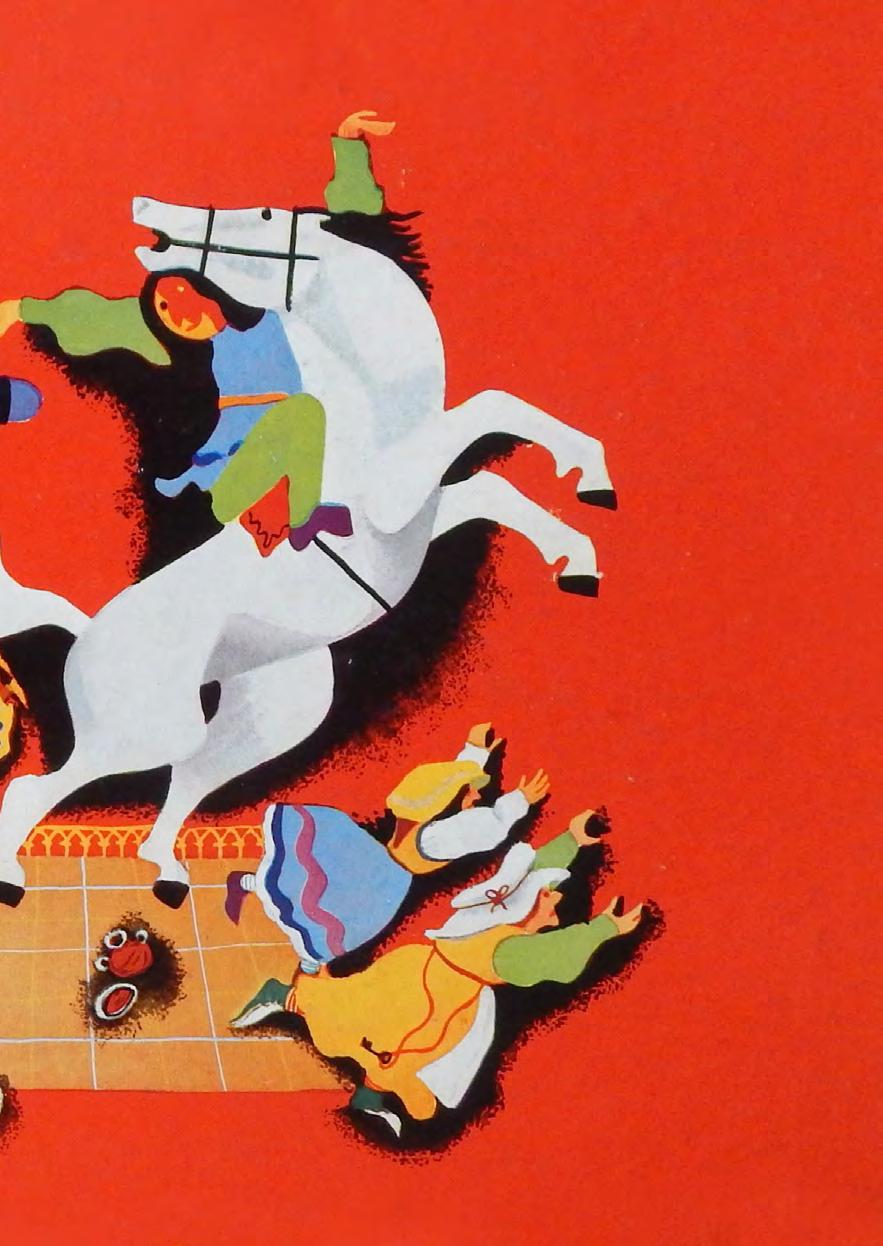
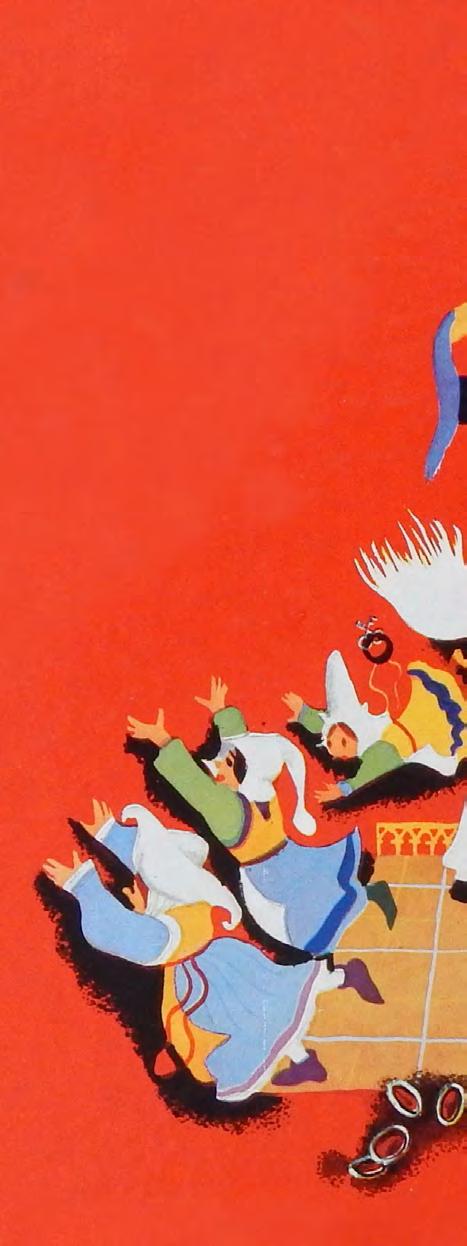
Till Eulenspiegel gallops into the market. Illustration for the cover of a Victor record (1946)
Many composers told stories with their music. Sometimes literally, such as Dukas, who set Goethe’s ballad The Sorcerer’s Apprentice to music, and Strauss, who retold the folk tales about Till Eulenspiegel in his own unique way. But also in a more associative sense, as was often the case in Shostakovich’s work.
In 1897, Paul Dukas brought Goethe’s The Sorcerer’s Apprentice to life in an inimitable way. In the absence of the great sorcerer, the experimental young man has to tidy up his workshop. He starts experimenting himself, with all the consequences that entails. Musically, too, Dukas delightfully throws everything into disarray. Thanks to the animation in Walt Disney’s Fantasia, we have images to go with it forever: the enchanted broom, played by the bassoon, and the ever-increasing buckets of water (the strings) thunder over each other more and more dramatically until the sorcerer returns
home and restores everything with a few tutti strokes. The young, overly enthusiastic pupil expresses his regret through the solo violin and all is well again. As if he wants to say, with Goethe: youthful enthusiasm is fine, but you need the wisdom of the ‘grown-up’ adult to steer it in the right direction.
Dmitri Shostakovich knew all too well that those adults can also go off the rails and suffer from delusions of grandeur. The composer, who continued the narrative musical tradition of Russian Romanticism, regularly clashed
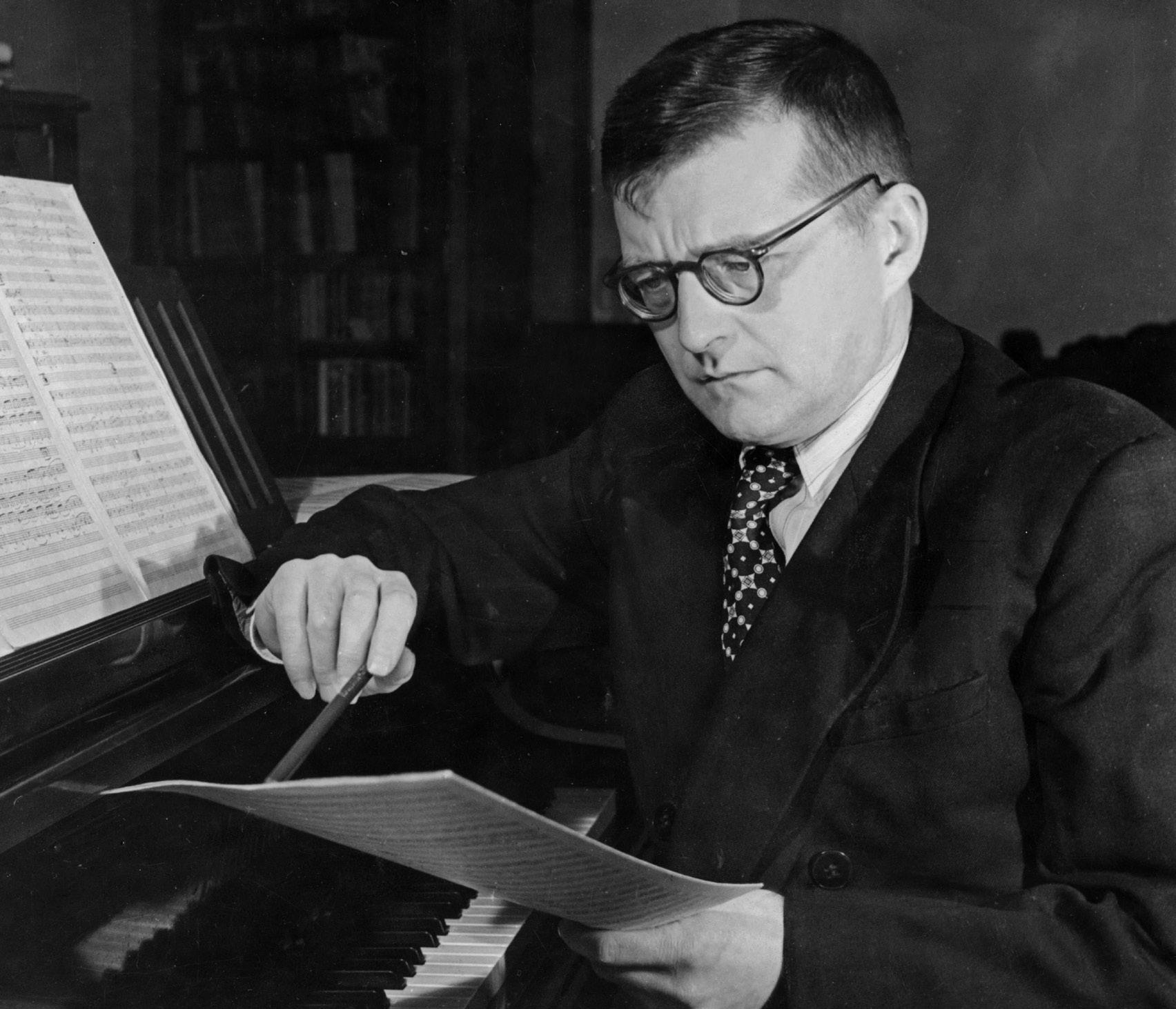
with the increasingly dictatorial regime. He was repeatedly reprimanded because his social criticism, packaged in symphonies, did not escape the attention of the Soviet leaders. With his ‘innocent’ music for ballets, films and theatre works, the composer then took the pressure off again. Shostakovich knew the world of light music very well. In his younger years, he accompanied silent films, and he was also no stranger to jazz. Based on pieces from his light oeuvre, Shostakovich’s good friend Levon Atoymyam compiled a suite for variety orchestra. The penultimate movement, based on music from
Shostakovich’s film score for The First Echelon from 1955, would become world famous under the title The Second Waltz.
Shostakovich’s ability to strike a lighter note alongside his profound seriousness and biting irony is also evident in his Piano Concerto No. 2. He wrote the work in 1957 for the nineteenth birthday of his son Maxim, who was studying piano at the Moscow Conservatory at the time. Maxim played the concerto on 10 May 1957 during his graduation concert. Because it also had to be playable by the conservatory
orchestra, the concerto has relatively modest technical requirements. The composer therefore downplayed the work in a letter to his composition student Edison Denisov. The Second Piano Concerto was said to have ‘no artistic value’. Whether Shostakovich was once again thumbing his nose at many official Soviet clichés when it came to the assessment of music is not known. The fact is that the reasonably light-hearted concerto – more in line with a Mozart concerto than with the heavier works Shostakovich was writing at the same time, such as his Tenth and Eleventh Symphonies – quickly became one of his most popular works with the general public. The hectic but always light outer movements, with scale-like references to his son’s studies in the finale, include a middle movement in variation form that sounds like a loving embrace.
Till Eulenspiegel’s Merry Pranks began as an opera. In 1894, Richard Strauss wrote an overture for an opera entitled Till Eulenspiegel bei den Schildbürgern. The opera never materialised, but a year later one of his most concise and best-known symphonic poems was born. Franz Wüllner, who would be the conductor at the premiere, asked the composer for a written programme. Strauss replied that this was impossible, because little of the musical wit would remain if it had to be put into words. ‘Shall we for once just let the listeners crack the nuts themselves that the rogue offers them?’
Strauss contented himself with pointing to the horn theme after the orchestra’s short ‘once upon a time’ introduction and the brief clarinet theme that follows it. Both serve as a leitmotif for Till Eulenspiegel and recur in various guises and variations throughout the work. The symphonic poem can be read
as a free rondo form in which the episodes represent various ‘pranks’ by the main character, ending with his death sentence –after which the epilogue makes it clear to us that the hero has eternal life.
Strauss was willing to explain one passage to Wüllner. ‘The episode in A minor is his graduation from the self-important professors, in Prague I believe, where Till causes complete Babylonian confusion (the fugato) with his incomprehensible propositions. He enjoys it to the fullest and then mockingly makes his escape. But please consider this a confidential explanation. My comments in the score, such as glowing with love, will undoubtedly contribute further to the understanding of what is happening in the various episodes.’
The hectic outer movements include a middle movement in variation form that sounds like a loving embrace
Later, Strauss reversed his earlier decision and provided a detailed table of contents of his symphonic poem. In it, we read that Till gallops into a market on horseback and frightens the market women. That he dresses up as a priest and anoints the sick. That he pretends to be a nobleman and thus wraps the most beautiful girls around his finger. And indeed, with these clues, you can recognise these scenes in the music. Nevertheless, Strauss was right in his letter to Wüllner. A joke always becomes less funny once you explain it; it is much nicer to crack the notes yourself.
Paul Janssen
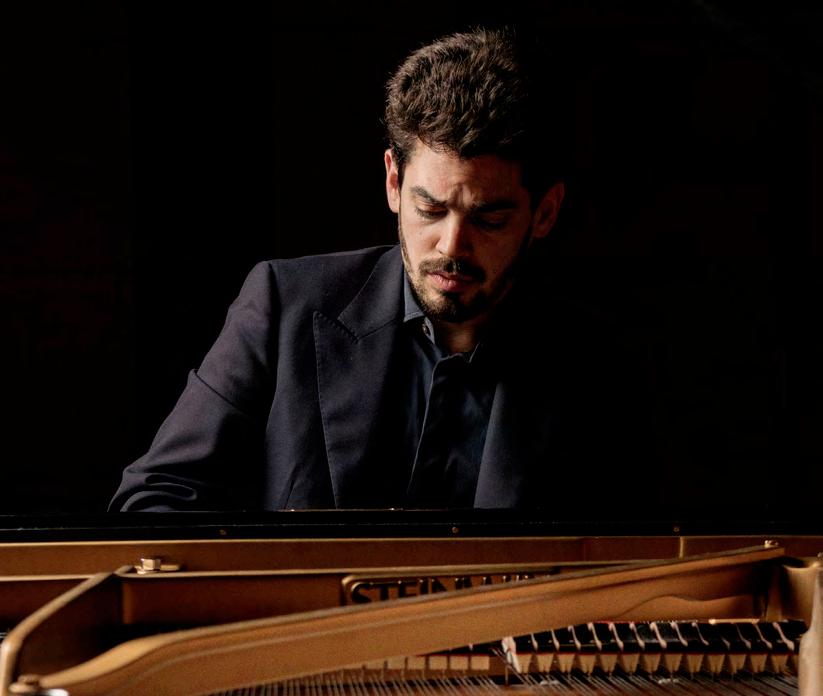
Lahav Shani • conductor and piano
Born: Tel Aviv, Israel
Current position: chief conductor Rotterdam Philharmonic Orchestra; music director Israel Philharmonic Orchestra; chief conductor designate Münchner Philharmoniker
Education: piano at the Buchmann-Mehta School of Music Tel Aviv; conducting and piano at the Academy of Music Hanns Eisler Berlin; mentor: Daniel Barenboim
Breakthrough: 2013, First Prize Gustav Mahler International Conducting Competition in Bamberg
Subsequently: guest appearances Wiener
Philharmoniker, Berliner Philharmoniker, Gewandhaus Orchester, Münchner Philharmoniker, Symphonieorchester des Bayerischen Rundfunks, London Symphony Orchestra, Boston Symphony Orchestra, Chicago Symphony Orchestra, Philadelphia Orchestra, Royal Concertgebouw Orchestra
As a pianist: play-conduct with the Rotterdam Philharmonic, Wiener Philharmoniker, Royal Concertgebouw Orchestra, Philharmonia Orchestra, solo recitals and chamber music at Verbier Festival, Aix-en-Provence Easter, Jerusalem Chamber Music Festival Debut Rotterdam Philharmonic: 2016
Thu 12 March 2026 • 20.15
Fri 13 March 2026 • 20.15
Sun 15 March 2026 • 14.15
conductor Santtu-Matias Rouvali
cello Senja Rummukainen
Rimski-Korsakov Capriccio espagnol
Elgar Cello Concerto
Shostakovich Symphony No. 6
Desplat Conducts his Film Music
Fri 20 March 2026 • 20.15
Sat 21 March 2026 • 20.15
conductor Alexandre Desplat
Desplat Music from Godzilla, The King’s Speech, The Shape of Water and other films
Thu 2 April 2026 • 19.30
Fri 3 April 2026 • 19.30
Sat 4 April 2026 • 19.30
conductor Leonardo García Alarcón
soprano Sophie Junker
alto Wiebke Lehmkuhl
tenor (Evangelist) Moritz Kallenberg
tenor (Arias) Mark Milhofer
bas (Vox Christi and Arias) Andreas Wolf
chorus Laurens Collegium, Nationaal Jongenskoor
Bach St. Matthew Passion
Proms: The Four Seasons
Recomposed
Fri 10 April 2026 • 20.30
violin/leader William Hagen
Richter The Four Seasons
Chief Conductor
Lahav Shani
Honorary Conductor
Yannick Nézet-Séguin
Principal Guest Conductor
Tarmo Peltokoski
First Violin
Marieke Blankestijn, Concert Master
Vlad Stanculeasa, Concert Master
Quirine Scheffers
Hed Yaron Meyerson
Saskia Otto
Arno Bons
Rachel Browne
Maria Dingjan
Marie-José Schrijner
Noëmi Bodden
Petra Visser
Sophia Torrenga
Hadewijch Hofland
Annerien Stuker
Alexandra van Beveren
Marie Duquesnoy
Second Violin
Charlotte Potgieter
Frank de Groot
Laurens van Vliet
Elina Staphorsius
Jun Yi Dou
Bob Bruyn
Eefje Habraken
Maija Reinikainen
Babette van den Berg
Melanie Broers
Tobias Staub
Sarah Decamps
Robin Veldman
Viola
Anne Huser
Roman Spitzer
Galahad Samson
José Moura Nunes
Kerstin Bonk
Janine Baller
Veronika Lénártová
Rosalinde Kluck
León van den Berg
Olfje van der Klein
Jan Navarro
Cello
Emanuele Silvestri
Gustaw Bafeltowski
Joanna Pachucka
Daniel Petrovitsch
Mario Rio
Eelco Beinema
Carla Schrijner
Pepijn Meeuws
Yi-Ting Fang
Killian White
Paul Stavridis
Double Bass
Matthew Midgley
Ying Lai Green
Jonathan Focquaert
Arjen Leendertz
Ricardo Neto
Javier Clemen Martínez
Marta Fossas Mallorqui
Mario Fernández
Flute
Juliette Hurel
Joséphine Olech
Manon Gayet
Flute/Piccolo
Beatriz Baião
Oboe
Karel Schoofs
Anja van der Maten
Oboe/Cor Anglais
Ron Tijhuis
Clarinet
Julien Hervé
Bruno Bonansea
Alberto Sánchez García
Clarinet/
Bass Clarinet
Romke-Jan Wijmenga
Bassoon
Pieter Nuytten
Lola Descours
Marianne Prommel
Horn
David Fernández Alonso
Felipe Freitas
Wendy Leliveld
Richard Speetjens
Laurens Otto
Pierre Buizer
Trumpet
Alex Elia
Adrián Martínez
Simon Wierenga
Giovanni Giardinella
Trombone
Pierre Volders
Alexander Verbeek
Remko de Jager
Bass trombone
Rommert Groenhof
Tuba
Martijn van Rijswijk
Timpani/ Percussion
Danny van de Wal
Ronald Ent
Martijn Boom
Jesús Iberti Rubira
Harp
Albane Baron