

The Health(y) Issue

MANAGEMENT
SPRING 2021: THE HEALTH(Y) ISSUE
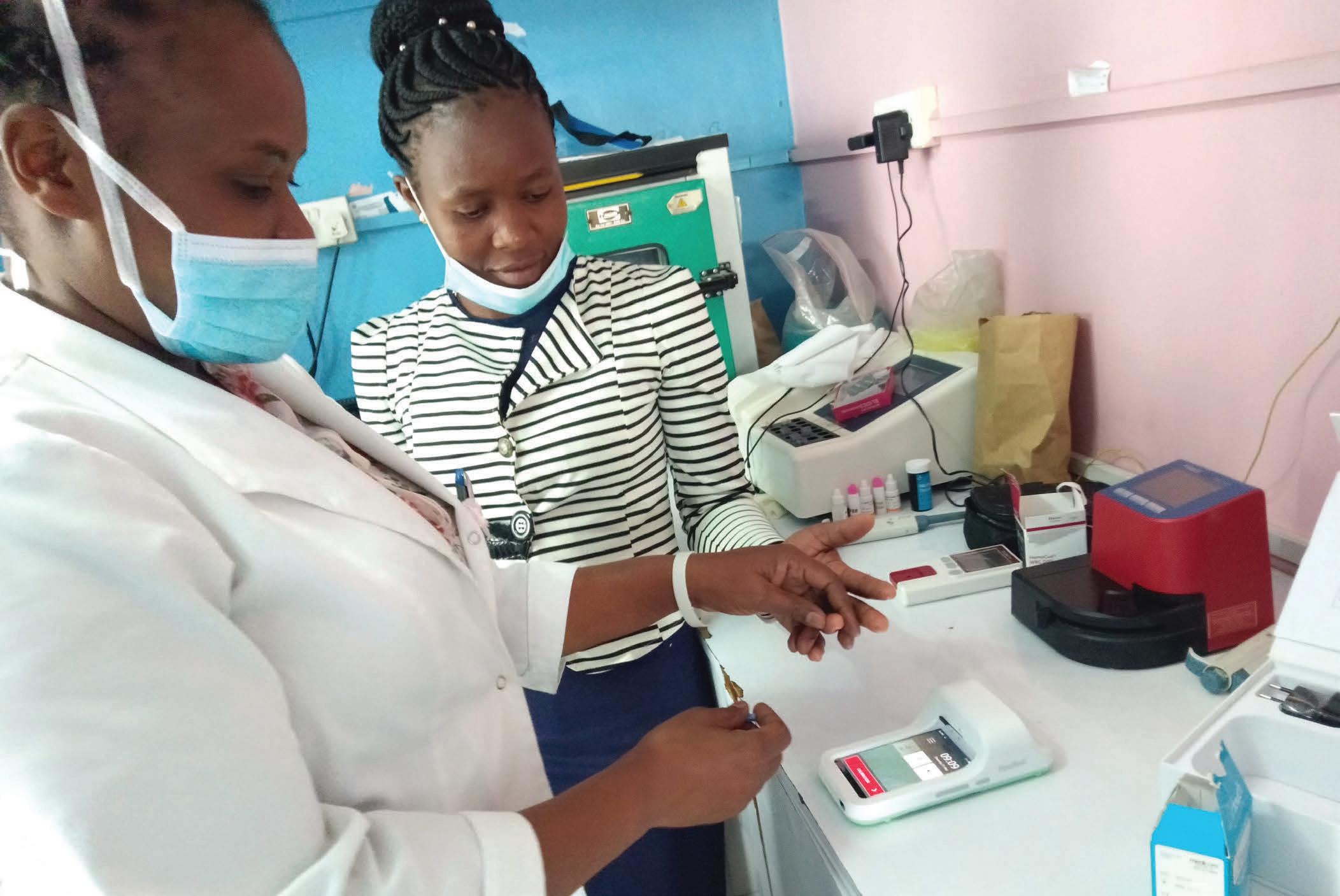
Based in sub-Saharan Africa, Ilara Health is one of 28 graduates of the Creative Destruction Lab’s Recovery Program, which is facilitating the world’s recovery from the pandemic. Ilara’s COVID-19 Readiness Package helps identify patients who are susceptible to serious complications from the virus, playing a crucial role in patient triage at the primary care level. For more about the CDL Recovery Program, see page 6.

6 Leading The Way to Recovery: The Creative Destruction Lab’s Moonshot by
Karen Christensen
Last March, CDL’s leaders pivoted, redeploying their resources to focus on solutions to the global crisis.

20
The Next Normal: Trends That Will Define 2021 and Beyond by
Kevin Sneader and Shubham Singhal
COVID-19 has changed the world, and its effects will last. Business leaders should consider 13 factors as they prepare for the next normal.
26
Managing the Most Complex Organizations On Earth
Interview with Brian Golden Peter Drucker called hospitals “the most complex form of human organization ever”. Here’s why.
32
Learning While Leading: The Digital Leadership Challenge by J. Okada, E. L. Hering and R. McManus
The digital revolution requires leaders to think differently about strategy, investment, culture — and themselves.
50 Crisis Management: Lessons from the C-Suite by Tony
Comper
The long-term economic implications of COVID-19 are not yet understood, but lessons from earlier crises can guide those responsible for the recovery.
38 The Unstuck Mind and The Power of Not Knowing Interview with Jay Cone
A leadership expert who has spent 30 years working to create a vaccine against closed-mindedness shares the tools of his trade.
44
Gender Analytics: How Gender-Based Insights Create Value by Sarah Kaplan
Gender-based insights can inform innovative new ways of working, doing business, and designing policy.

56 Managing Mental Health: A Behavioural Approach by Renante Rondina, Cindy Quan and Dilip Soman
Mental health policy needs to start embracing models and frameworks from other disciplines — in particular, the field of Behavioural Science.
68
Powering a Strong Recovery: An Economic Growth Plan for Canada by Robert Asselin and Ross Laver
Laying the foundation for a safe and sustainable recovery requires a focus on three pillars of the economy: people, capital and ideas.
76 Macro Disruptors: Seven Themes That Could Reshape the Global Economy by Frances
Donald
As we begin to emerge from the COVID-19 pandemic, seven ‘new normal’ ideas merit the attention of investors.
62
Unlocking Employee Potential: A Framework for Success by Janet Krstevski, Sonia Mathur and Sarah Berger
Companies can support workers’ well-being by focusing on six principles, positioning themselves for a stronger future.

84
Rewriting the Rules of Corporate Governance by Lynn S. Paine
As boards look to the post-COVID era, they will need to assess their readiness to meet three new demands.
In Every Issue
Leader Interview: Anita M. McGahan
by Karen Christensen





Idea Exchange
“We live in a very selfish culture — and that is amplified within organizations”
–Martin Lindstrom, p. 91
Rotman Management
Spring 2021
Published in January, May and September by the Rotman School of Management at the University of Toronto, Rotman Management explores themes of interest to leaders, innovators and entrepreneurs, featuring thought-provoking insights and problem-solving tools from leading global researchers and management practitioners. The magazine reflects Rotman’s role as a catalyst for transformative thinking that creates value for business and society.
ISSN 2293-7684 (Print)
ISSN 2293-7722 (Digital)
Editor-in-Chief
Karen Christensen
Contributors
Ajay Agrawal, Angèle Beausoleil, Mark Britnell, Brian Golden, Sarah Kaplan, Eric Kirzner, Mara Lederman, Anita M. McGahan, Renante Rondina, Laura Rosella, Dilip Soman
Marketing & Communications Officer
Mona Barr
Subscriptions:
Subscriptions are available for CAD$49.95 per year, plus shipping and applicable taxes.
Contact Us/Subscribe:
Online: rotmanmagazine.ca
(Click on ‘Subscribe’)
Email: RotmanMag@rotman.utoronto.ca Phone: 416-946-5653
Mail: Rotman Management Magazine, 105 St. George Street, Toronto, Ontario M5S 3E6, Canada
Subscriber Services:
View your account online, renew your subscription, or change your address: rotman.utoronto.ca/SubscriberServices.
Privacy Policy: Visit rotman.utoronto.ca/MagazinePrivacy
Design:
Bakersfield Visual Communications Inc.
Copyright 2021. All rights reserved.
Rotman Management is printed by Dollco Print Solutions Group.
Rotman Management has been a member of Magazines Canada since 2010.



FROM THE EDITOR Karen Christensen
The Health(y) Issue
IF THERE WAS EVER ANY DOUBT that successful economies depend upon a healthy population, it has likely been erased in the past year. COVID-19 has shown us that societal issues are not just legitimate areas of concern for business — they are sources of both risk and opportunity. Like market forces, societal forces can profoundly affect the competitive environment.
This crisis has further validated the Business Roundtable’s pre-pandemic statement on corporate purpose, when 181 CEOs pledged a commitment to five stakeholder groups: customers, employees, suppliers, communities and shareholders. As we have seen, if one member of this group is too weak to play its role, the entire system can quickly crumble.
In this issue of Rotman Management, we put the spotlight on what has become the Holy Grail for organizations, economies and individuals alike: Health.
We kick the issue off on page 6 with Leading the Way to Recovery, the story of how the Creative Destruction Lab — founded by Rotman Professor Ajay Agrawal and now running at nine locations worldwide — redeployed its resources last March to focus on finding solutions to the global crisis.
While the long-term economic implications of COVID-19 are not yet fully understood, former Bank of Montreal CEO Tony Comper argues that lessons from earlier crises can guide those responsible for the recovery, in Crisis Management: Lessons from the C-Suite on page 50.
On page 62, Accenture’s Janet Krstevski, Sonia Mathur and Sarah Berger show that by supporting six dimensions of well-being, companies position themselves for a stronger future, in Unlocking Employee Potential: A Framework for Success.
Elsewhere in the issue, Sandra Rotman Chaired Professor in Health Sector Strategy Brian Golden argues that healthcare is a key driver of prosperity on page 26; NYU Professor Pamela Newkirk shares key insights from her book, Diversity Inc. with
Rotman Professor Sonia Kang on page 94; Globe and Mail columnist André Picard says it’s time to start respecting our elders on page 97; and Rotman alumna and GE Canada CEO of Heather Chalmers looks at the challenges of leading through a pandemic on page 110.
As COVID-19 continues to linger for longer than many of us had hoped, we must remind ourselves that it has been during times of disruption and chaos that we have seen some of the biggest changes in our economy and society.
During her presentation to the Creative Destruction Lab’s Vision Council last fall, Canadian author and Vision Council member Margaret Atwood pointed out that, “Historically, crises cause great rearrangements.” She went on to say that ours could include a redistribution of wealth and a widespread reconsideration of how we interact with the natural world.
What exactly will the forthcoming rearrangement look like? While we don’t yet know, the good news is that if you are reading this, you can help to shape the answer. We hope this issue gets you thinking about the healthier future that we all want to create.
Karen Christensen, Editor in Chief editor@rotman.utoronto.ca
Twitter: @RotmanMgmtMag