Congratulations to Prof. Susan Christoffersen whose track record of transformational leadership continues in her new role as Dean of the Rotman School.

Congratulations to Prof. Susan Christoffersen whose track record of transformational leadership continues in her new role as Dean of the Rotman School.

The apparel sector is the world’s second-biggest polluter, right after oil. Eileen Fisher, founder of the eponymous fashion brand (‘EF’), poses with the Positive Change Award, presented to her by designers Dao-Yi Chow and Maxwell Osborne at the CFDA Awards. Through its Circular By Design initiative, EF encourages clients to return their old clothes so they can be ‘upcycled’ into new products. Since 2009, EF has taken back 1.6 million garments. For more about the rise of the ‘conscious business’, read Navi Radjou’s article on page 32.

6
360º Governance: Leadership Guidelines for a World in Crisis by
Sarah Kaplan and Peter Dey
Today’s world is making demands on corporations that the standards of 25 years ago are not equipped to address. It’s time for some new guidelines.


18 Strategic Foresight: How to Think Like a Futurist by
Amy Webb
Navigating the chaos that characterizes periods of rapid change demands tools that prepare your organization for an uncertain future.
26
Power for All: Why It’s Everyone’s Business by Karen
Christensen
Rotman Professor Tiziana Casciaro shares insights from her new book, Power, For All: How It Really Works and Why It’s Everyone’s Business.

32 The Rise of the Conscious Business by Navi Radjou
In the post COVID-19 world, purpose-driven and empathy-centred enterprises are destined to be industry leaders.






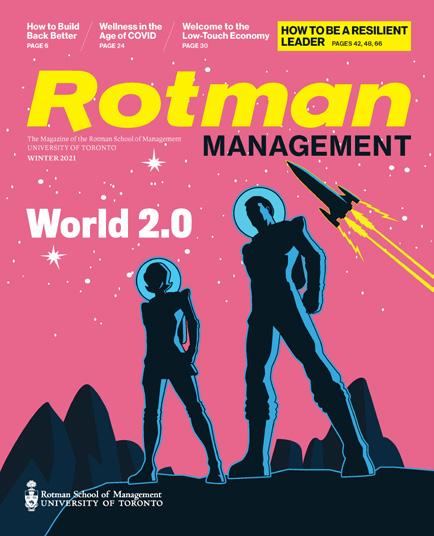
40 Leadership Forum: How to Build Back Better

Compiled by R. Cheung, A. Latour and K. Christensen
Our pre-pandemic state of ‘normalcy’ was not great for many people. Rotman alumni and faculty are finding ways to build back better.

54 Risk: A Behavioural Perspective by Lisa Brenneman and Laura Goodyear Research from TD Wealth and Behavioural Economics in Action at Rotman (BEAR) shows the importance of understanding the risk tolerance of investors.
76 Innovation 2.0: Experimenting to Improve, Not to Prove by Jean-Louis Barsoux, Cyril Bouquet and Michael Wade
The purpose of experimentation should always be twofold: to test an assumption and to learn from the testing in order to improve on the idea.
46
Post-Pandemic Career Paths and Reskilling by R. Strack, O. Kovács-Ondrejkovic, J. Baier, P. Antebi, K. Kavanagh and A. López Gobernado
Going forward, top talent will be most attracted to companies that help employees continually remake themselves for the jobs of the future.

60
Creativity in the Age of Virtual Collaboration by Leigh Thompson
The shift to remote work can actually help groups generate better ideas — and more of them.
68 Cryptocurrency 101: Navigating The Digital Goldrush by Karen Christensen Rotman Finance Professor Andreas Park discusses the pros and cons of cryptos and where opportunities lie within the realm of digital currency.

82
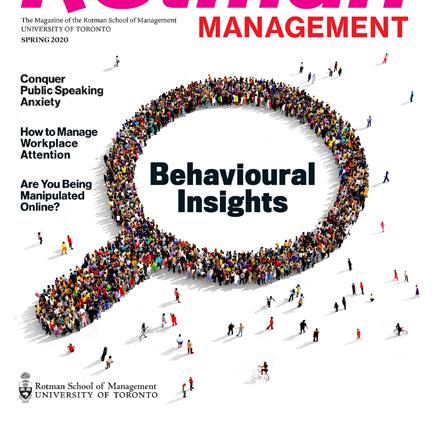
Humanizing Financial Services: The Role of Behavioural Insights by J. Howe, A.Henderson, J. Nachshen and S. Reid
Behavioural Science tools support the achievement of both organizational goals and customer goals. More businesses should embrace them.
88 Preparing for COVID-29 by Joshua Gans
With COVID-19, multiple failures in obtaining and applying the right information to key decisions led to economic and social calamity. For potential COVID-29s, we need to do better.






“Enduring systemic racism in Canada means BIPOC of all genders need targeted recovery policies.”
–Carmina Ravanera, p. 108
Published in January, May and September by the Rotman School of Management at the University of Toronto, Rotman Management explores themes of interest to leaders, innovators and entrepreneurs, featuring thought-provoking insights and problem-solving tools from leading global researchers and management practitioners. The magazine reflects Rotman’s role as a catalyst for transformative thinking that creates value for business and society.
ISSN 2293-7684 (Print)
ISSN 2293-7722 (Digital)
Editor-in-Chief
Karen Christensen
Contributors
Tiziana Casciaro, Ken Corts, Peter Dey Ramy Elitzur, Joshua Gans, Camille Hebert, Sarah Kaplan, Julie McCarthy, Andreas Park, Carmina Ravanera, John Trougakos
Marketing & Communications Officer
Mona Barr
Subscriptions:
Subscriptions are available for CAD$49.95 per year, plus shipping and applicable taxes.
Contact Us/Subscribe:
Online: rotmanmagazine.ca
(Click on ‘Subscribe’)
Email: RotmanMag@rotman.utoronto.ca
Phone: 416-946-5653
Mail: Rotman Management Magazine, 105 St. George Street, Toronto, Ontario M5S 3E6, Canada
Subscriber Services:
View your account online, renew your subscription, or change your address: rotman.utoronto.ca/SubscriberServices.
Privacy Policy:
Visit rotman.utoronto.ca/MagazinePrivacy
Design:
Bakersfield Visual Communications Inc.
Copyright 2021. All rights reserved.
Rotman Management is printed by Dollco Print Solutions Group.
Rotman Management has been a member of Magazines
since

FROM THE EDITOR Karen Christensen

A YEAR-AND-A-HALF since the global pandemic turned our lives upside down, we continue to navigate the choppy waters that it has wrought. Some have observed that COVID-19 has been a great equalizer, affecting us across the board whether we work in the C-suite or on the frontline. But at the same time, it has put the spotlight on widespread inequality and power imbalances in our society that demand our collective attention.
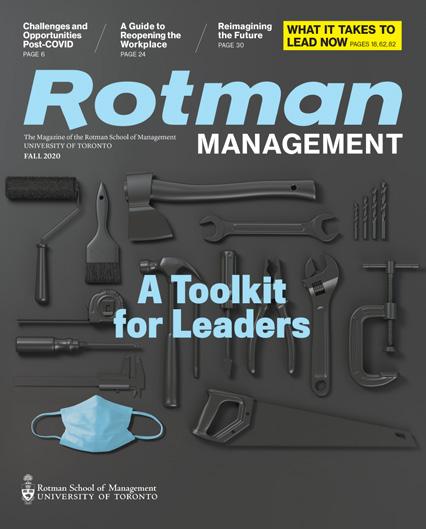
For leaders eager to seize this unique moment in history to jumpstart their organizations, the question is, Now what? In this issue of Rotman Management, we will explore some of the mindsets, approaches and operating principles that will be required to thrive in the post-pandemic world.
Amidst all of the uncertainty, one thing is clear: Today’s world is making demands on companies that traditional governance standards are simply not equipped to address. On page 6, Rotman Professor Sarah Kaplan and Executive-in-Residence Peter Dey present a new set of corporate guidelines.
The pandemic has served to highlight significant imbalances of power in our economy and society. On page 26, Rotman Professor Tiziana Casciaro shares insights for addressing this from her new book, Power, For All: Why Power is Everyone’s Business
Elsewhere in this issue, economist and 3M board member Dambisa Moyo is featured in our Thought Leader Interview on page 12 ; Navi Radjou argues on page 32 that empathy-centred enterprises are destined to lead the way in the post-COVID-19 world; and we feature seven members of the Rotman community who are helping our society build back better on page 40. In our Idea Exchange, Paula Davis explains how to avoid burnout on page 96; Raja Rajamannar describes ‘quantum marketing’ on page 111; and we feature the latest research insights from Rotman faculty John Trougakos, Julie McCarthy and Camille Hebert
Leaders are accustomed to focusing on the horizon, anticipating opportunities, challenges and disruptions for their organization, and acting accordingly. But a disruption of the magnitude of COVID-19 has necessarily broadened the scope of focus for leaders across industries.
The true economic and societal impact of COVID-19 will take years, if not decades, to ascertain. But the top-level finding from the 2021 Edelman Trust Barometer applies right away: Business leaders and investors are being called upon to show greater ambition in helping to fight societal ills and ever-worsening inequality. Looking ahead, their priorities must include both risk mitigation — to avoid things getting worse — and innovative, sustainable solutions that expand economic growth and create opportunities for all. We hope this issue can serve as a compass to help orient you for the quest ahead.
Karen Christensen, Editor in Chief editor@rotman.utoronto.ca Twitter: @RotmanMgmtMag