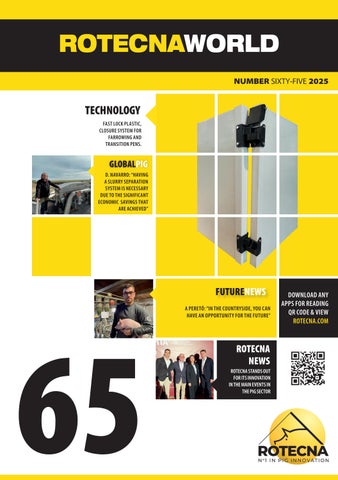
ROTECNAWORLD NUMBER SIXTY-FIVE 2025
TECHNOLOGY FAST LOCK PLASTIC, CLOSURE SYSTEM FOR FARROWING AND TRANSITION PENS.
GLOBALPIG D. NAVARRO: “HAVING A SLURRY SEPARATION SYSTEM IS NECESSARY DUE TO THE SIGNIFICANT ECONOMIC SAVINGS THAT ARE ACHIEVED”
FUTURENEWS
65
A PERETÓ: “IN THE COUNTRYSIDE, YOU CAN HAVE AN OPPORTUNITY FOR THE FUTURE”
ROTECNA NEWS ROTECNA STANDS OUT FOR ITS INNOVATION IN THE MAIN EVENTS IN THE PIG SECTOR
DOWNLOAD ANY APPS FOR READING QR CODE & VIEW ROTECNA.COM
Scan the QR code with the mobile camera.
Nº 65
December 2025
LETTER FROM THE EDITOR Generational change is one of the main strategic constraints for the future of the pig sector. In a context in which many young people choose to stay away from rural areas, it is especially pertinent to highlight the trained professionals with a vision for the future and a firm commitment to the professionalisation of farms. Its incorporation represents a guarantee of the continuity of large families and, at the same time, a decisive boost to more sustainable, efficient and technically advanced production models, in line with modern pig farming demands. On this path of transformation, biosafety remains an essential pillar of farm profitability and sustainability. In this edition of Rotecna World, cleaning and disinfection are approached from a strategic perspective. Beyond being operational tasks, they constitute the first line of defence against the entry of pathogens and are a key tool in disease prevention. Investing in hygiene is investing in health, animal welfare and productivity. Having clear protocols, adequately trained personnel, and reliable management is essential to guarantee health and safety, the efficiency of the production system, and its profitability. In 2025, we strengthened our presence at leading business conferences and fairs, both nationally and internationally, further consolidating our commitment to innovation and knowledge exchange. It has been a year characterised by growth and strengthening relationships with clients and professionals. With a clear focus on 2026, we remain determined to continue offering cutting-edge technological solutions and equipment that help drive more efficient, sustainable, and future-ready farms.
CONTENTS 4. Rotecna News
Rotecna stands out for its innovation in the main events in the pig sector.
6. Something About
“La quina”: The most popular spirit of Catalan Christmas.
8. Technology
Fast Lock Plastic: Closure system for farrowing and transition pens.
10. Global Pig
D. Navarro: “Having a slurry separation system is necessary due to the significant economic savings that are achieved”.
14. Biosecurity
P. Peña: “It is better to invest in cleaning than in antibiotics”.
18. Future News
A. Peretó: “In the countryside, you can have an opportunity for the future”.
Rotecna World Director: Antonio Pinos. Editor: Francisco García, Tamara Lombardo. Translation: Sam Smith. Print: Imprenta Barnola.
L-41-2007 Rotecna's World's editors accept no liability for contributor's opinion.
Antonio Pinos, CEO, Rotecna.
DIGITAL VERSION /issuu.com/rotecnapress 3
ROTECNANEWS ROTECNA STANDS OUT FOR ITS INNOVATION IN THE MAIN EVENTS IN THE PIG SECTOR During the last quarter of the year, we attended various events that gave us firsthand insight into the trends shaping the industry.
Rotecna team at Porc d’Or Awards . Photo: Rotecna.
The final stretch of the year has been characterised by intense activity to strengthen Rotecna’s presence in the main forums and conferences of the pig sector at both national and international levels, which brought together leading industry experts. These spaces enabled the identification of emerging trends that define the future of pig production, specifically in digitalisation, operational efficiency, and animal welfare, as strategic pillars for continued progress.
SEPOR 2025 During the last quarter of the year, Rotecna participated in SEPOR 2025, one of the most important fairs in the Spanish pig sector. The meeting, held in Lorca, brought together professionals, companies, and institutions from the sector, serving as a starting point for analysing trends and revamping the industry. 4
Within the event framework, the company’s Commercial Director, Óscar Toledano, focused his speech on the role of artificial intelligence and digitalisation in the day-to-day management of large, modern companies. These technologies enable improved management precision, optimised food processes, animal condition monitoring, and decision-making based on real data.
Porc d’Or Awards Once again, Rotecna proved a firm and ongoing commitment commitment to excellence in the pig sector by sponsoring the Porc d’Or Awards, one of the most prestigious awards in the Spanish pig industry. With its sponsorship, the company supported an initiative that promotes technological advancement, professionalisation, and good practices in the sector, reaffirming its commitment to trustworthy, innovative production.
Porciforum Latam 2025 In the last days of the year, Rotecna has also been present at PorciFORUM Latam 2025, held in Miami, where readers from the Latin American pig sector gathered to debate the challenges and opportunities of an industry in thoroughgoing transformation. The meeting highlighted the importance of applied innovation and the need to move towards more sustainable, competitive production systems. On this occasion, at Rotecna, we demonstrated how technologies aimed at animal welfare directly affect the productivity, competitiveness, and sustainability of farms. From intelligent power systems to environmental control solutions, technological tools are allowing Latin American farms to operate with greater precision and efficiency. The company’s participation in this meeting reaffirms its commitment to modern, innovative, and responsible pig farming, as well as its ability to adapt to current market and consumer demands.
333 LATAM Experience Rotecna’s commitment to Latin America has become evident at the 333rd LATAM Experience Congress 2025, held in Cali this year. Colombia continues to prove itself as one of the countries with the most remarkable vigour and innovation in pig production in the region, thanks to its capacity to adapt, its professionalisation and the marketing of its products through cuttingedge technological solutions. During the event, Rotecna received the award for Best Innovation at the Workshop Innovation Show organised by 333 Latin America, in recognition of BodyCheck. This pioneering system automatically detects sow condition
Rotecna won Best Innovation at the Workshop Innovation, organized by 333 Latam. Photo: 333.
using imaging. This tool facilitates accurate body condition evaluation, optimises nutrition, and improves overall farm efficiency, reinforcing the company’s technological application and its contribution to modernising the sector.
Committed to the evolution of the sector Rotecna’s presence at the main events in the pig sector, both in Europe and Latin America, reflects its continued commitment to promoting knowledge transfer and the industry’s professionalisation. By offering cutting-edge technological solutions and a strong commitment to innovation, the company continues to work with producers and technicians to adopt more efficient, safe and sustainable production models. 5
SOMETHINGABOUT “LA QUINA”: THE MOST POPULAR SPIRIT OF CATALAN CHRISTMAS
This long-standing tradition continues to unite generations through shared moments and laughter.
A lively quina night, where tradition, laughter, and good luck come together.
6
When the Christmas holidays arrive in many towns and cities in Catalonia, there is a tradition that cannot be missed: going to the quina. This game, similar to bingo but with a much more festive community spirit, has become one of the most endearing and anticipated traditions of these holidays. With cards in hand and eager to have a good time, entire families and groups of friends fill the pavilions hoping to enjoy a different afternoon full of humour, music and surprising prizes.
became a popular social activity, especially during Christmas festivities.
A game with history
Much more than a game
The word “quina” comes from the French “quine”, which represents a combination of five numbers in the lotus game. The origin of this entertainment dates back to the 16th century in Italy, with the lotto, which later evolved into modern bingo. In Catalonia, however, the game adopted its own personality and, over time,
The beauty of the quina is not so much in the game itself as in the atmosphere that is created. People of all ages can participate: children learning to write numbers, grandparents who already know the announcer’s jokes by heart, and young people who go for fun or in hopes of winning something truly memorable.
Although today the “quinas” are mainly associated with Christmas, in the past they were also organised at other times of the year, such as during major celebrations or in support of charities. As time went by, the Christmas season, full of family gatherings, free time and community spirit, made the quina a typical tradition for these dates.
The system is simple: each player buys one or more cards with a combination of numbers. An entertainer or announcer, the soul of the party, sings the numbers that come out of a bass drum. Still, unlike traditional bingo, the announcer does not sing them in a monotonous manner; he sings them with wit, humour and improvised comments. Each number can have a nickname: 22 is “the two little legs”, 15 is “the pretty girl”, 90 is “the grandfather”... and so on. The laughter is constant, and so are the public’s comments. If someone makes a mistake and pipes “quina!” beforehand, the pavilion laughs and applauds. It is a lively party where competition takes a back seat to the good atmosphere and collective complicity.
“quina!” and it is checked if they really have all the numbers marked. If the combination is correct, collective joy explodes. In addition, there is a final round called “the super quina” or “the grossa”, with an exceptionally spectacular prize.
the passage of time. In a time when many popular festivals have been transformed or lost, the quina remains an intergenerational meeting point that preserves its popular essence and continues bringing families and neighbours together year after year.
Solidarity and community spirit
More than just a wide game
Beyond entertainment, many quinas have a specific purpose. Organisations, local entities, sports clubs, or cultural associations can make funds available for town projects or charitable causes. This social aspect further emphasises its community character: the quina is an excuse to meet, laugh and share memorable moments with the entire community.
We can say that quina is an analogy for Catalan Christmas: popular, happy, full of complicity and with a touch of homemade humour.
This collective spirit is what has allowed tradition to survive
When the first number comes out, there is a special allure in the air. It reflects a culture in which people know how to laugh, share, and celebrate small things. Perhaps that is why, year after year, the quina continues to fill pavilions and hearts throughout the country.
Prizes for all fancies The quina prizes are another of its great attractions. There are all kinds: hams, Christmas lots, cheeses, nougats, bottles of wine, toys, small appliances and even bicycles or televisions. In other places, the prizes have a humorous or local touch, such as a sack of potatoes or a basket of local products. The most anticipated moment comes when someone yells
The quina card, essential to a festive night.
7
Technology
FAST LOCK PLASTIC
SECURE LOCK
PLASTIC BRACKETS
8
In modern pig production, efficiency and biosecurity go hand in hand. Every component of the facilities can directly impact productivity, animal health, and overall ease of daily management, and longterm sustainability.
What is the Fast Lock Plastic system?
In this context, the Fast Lock Plastic closure system, designed for farrowing and transition pens, represents an improvement over traditional metal closures.
The PVC fencing is finished with closure profiles using ultrasonic welding, which guarantees a seamless finish, essential for preventing the accumulation of waste and facilitating cleaning. This system is designed for use in both the farrowing and the transition phase.
The Fast Lock Plastic is a closure system for modular pens with PVC fencing, offering an adaptable, highly hygienic solution. The brackets are made of highly durable, highly resistant technological plastic. They are specially designed to facilitate handling of the fencing, with a system that allows quick, effective opening and closing of the pens.
CLOSURE SYSTEM FOR FARROWING AND TRANSITION PENS FEATURES •
Made of technical plastic.
•
High rigidity and break resistance.
•
Safety lock to prevent accidental opening.
•
Designed to avoid dirt accumulation.
•
Easy to use.
Maximum hygiene One of the main problems with traditional metal fences is that they don’t fit perfectly into the plastic profiles to which they are attached. This allows organic matter to accumulate inside, making it impossible to clean and disinfect the hardware, thereby posing a health risk. Thanks to its design, the PVC fence system with Fast Lock plastic closure prevents dirt accumulation, significantly improving pen hygiene. Furthermore, its smooth surface facilitates thorough cleaning and disinfection, thus reducing the risk of disease.
Quick and modular installation This modular construction system allows the creation of pens fully adapted to each farm’s needs. Installation is quick and easy, and adjustments can be made without specialised tools. Its versatility makes it an ideal choice for both new installations and complete or partial renovations of existing farms seeking to improve biosecurity, facilitate handling, and reduce facility maintenance.
Guaranteed durability The materials used are entirely resistant to humidity, harsh cleaning products, and daily use.
Weaning pens with Rotecna PVC fences. Photo: Rotecna.
9
GLOBALPIG D. NAVARRO: “HAVING A SLURRY SEPARATION SYSTEM IS NECESSARY DUE TO THE SIGNIFICANT ECONOMIC SAVINGS THAT ARE ACHIEVED”
The Hinaga farm, with a capacity of 3,500 sows, has a solids separator and a Tecnapur acidifier, enabling it to process more than 18,000 m3 of slurry per year.
David Navarro, manager of the Hinaga farm. Photo: Rotecna.
Intending to meet the new environmental requirements and reduce the economic costs of slurry management, the owners of the Hinaga farm in Sariñena (Huesca) decided to invest in the installation of the Tecnapur solids separator, which they were already working with in another farm, and go one step further with the installation of an acidifier. David Navarro, head of the Hinaga farm, with a capacity of 3,500 sows, explains what they do daily to ensure proper slurry treatment and achieve savings of up to 40%. What is the origin of this farm? It is a newly built farm launched in 2023 with a capacity of 3,500 sows. Since 2015, we have already had a farm with the same capacity in Monzón, and we decided to build this one to double the number of sows, incorporating modern and efficient systems. 10
How is the farm distributed? It is organised into three buildings: first, a maternity building with 25 rooms of 36 places each, for a total of 900 farrowing pens; a second building for mating-gestation; and a third building for rearing, mating, and gestation of first-time sows. Why decide to install on the farm the Tecnapur solids separator? Having a solids separator, like the one in Tecnapur, installed on the farm results in significant economic savings in slurry management. In addition, for several years, we have had a separator on the farm in Monzón that works very well for us, so when we built this farm, we decided to install one as well, following the same effective approach we already trusted to maintain consistent and reliable performance.
How do you carry out the slurry treatment process using the separator? This facility consists of three buildings, all connected by a slurry extraction system with pipes leading to a collection well. Inside this well, we have an agitation and pumping system that raises the slurry to the Tecnapur separator for solid-liquid separation. What do you do with each of the fractions? The liquid portion exiting the separator is directed to the Tecnapur acidifier, where sulfuric acid is injected to lower the slurry’s pH and fix ammonia nitrogen, thereby reducing ammonia emissions into the atmosphere. This liquid phase is then collected
in a storage pond with a floating expanded clay cover, where it remains until final disposal. From this pond, the liquid phase is pumped to irrigation hydrants on nearby plots, where it is applied as fertiliser by injecting it into the sprinkler irrigation system. This allows us to use the precise dose required by the crop at any given time. The portion of the liquid phase not applied through this system, as well as the solid phase, is removed by a waste management company for use as fertiliser. How many cubic meters of slurry do you treat per day? With this management system, we are processing approximately 150-200 m3 of slurry per day.
“The liquid phase is pumped to irrigation hydrants on nearby plots, where it is applied as fertiliser.” Alongside the separator, you installed the Tecnapur solids compactor. What advantages does using with these solutions? Due to the large volume of slurry generated at this facility, we decided to incorporate the Tecnapur compactor at the outlet of the solids separator to increase the separator’s slurry treatment flow rate and, in addition, improve separation of the liquid from the solid fraction.
Image of the slurry treatment facility with the solids separator and compactor. Photo: Rotecna.
11
GLOBALPIG What percentage of solid and liquid fraction do you obtain after separation? Regarding the initial slurry volume, which is about 18,000 m³/year, we separate about 6-7% of the solid fraction, depending partially on the source of the slurry (farrowing or gestation). The remaining 93-94% is the liquid fraction obtained after separation.
“Installing a slurry management system on the farm can save up to 40% on slurry processing costs.” The processing system they you installed, therefore, includes a solids separator, a compactor, and an acidifier. What are the most significant benefits of having this type of installation? The benefits are primarily economic and environmental. Transporting slurry by tanker or truck is very costly. In contrast, installing a slurry management system on the farm can save up to 40% on slurry processing costs, resulting in an approximate payback period of 5 years for the equipment. Furthermore, 12
it’s important to note that regulations for this type of farm require the application of Best Available Techniques (BAT) for environmental farm management, including techniques to reduce gas emissions into the atmosphere. This installation model substantially reduces ammonia volatilisation through acidification and lagoon emissions, thanks to the floating expanded clay cover. Finally, it should be noted that by separating the solid portion, we also substantially reduce odour
emissions, as separation prevents the putrefaction of organic matter, which generates methane and other gases that cause unpleasant smells in the surrounding area. Is investing in a system like this affordable for livestock farmers in the sector? Yes. Furthermore, nowadays, having a slurry separation system is essential for any livestock farm, as it provides significant cost savings and helps reduce the environmental impact of slurry through proper management.
WithPigs the Tecnapur system, between and 200 m³ easily adapt to thethey Sf3Dtreat feeder. Photo:150 C. Pitty. of slurry per day. Photo : Rotecna.
13
BIOSECURITY P. PEÑA: “IT IS BETTER TO INVEST IN CLEANING THAN IN ANTIBIOTICS” Keeping facilities pathogen-free is key to preventing disease, optimising productive performance, and ensuring farm sustainability.
Patricia Peña is a director of biosafety consulting and auditing. Photo: P. Peña.
In a context where animal health is a decisive factor in the sustainability and competitiveness of pig farms, cleaning and disinfection are fundamental to biosafety processes. Beyond being part of the daily routine, these approaches constitute the first line of defence against the entry and elimination of pathogens, protecting both animal health and farm productivity. To delve deeper into its importance, we spoke with Patricia Peña, consultancy manager for auditing and training in swine genetic transfer and biosafety centres, who shares our vision and experience on the need to implement effective cleaning and disinfection strategies in pig farms. Why is cleaning and disinfecting our pig farms necessary? Cleaning and disinfection are essential parts of biosecurity; basically, it is what we know as hygiene, because everything has to be washed and disinfected. Cleaning and disinfection 14
protocols have to be stabilised for everything, be it people, vehicles, facilities, tools, etc., mainly because we have to train staff to carry out that process and have the minimal possible variations for it to work. One always has to follow the procedures. Sometimes steps are skipped, things are seen as clean, and the cleaning procedure is skipped to go directly to disinfection, and this cannot be. Cleaning is basic, regardless of whether the pen looks clean or not, because biofilm exists, something that you do not see. Still, it is there: viruses hide there, and bacteria produce it; consequently, they act more aggressively, protected by it. What are the benefits of cleaning and disinfection as key biosafety tools? There are only advantages. Suppose we do not have a clean facility when we fill it with animals. In that case, the health problems that may have existed previously will reappear, so it is better to invest in cleaning than in antibiotics and the other costs associated with an infectious process on the farm. For this reason, it is essential, for example, to have a verification methodology to ensure that the facilities are immaculate and disinfected. Unfortunately, sometimes biosafety is not given
the importance it deserves. For a biosafety strategy to work, I always recommend a clear protocol and a biosafety manager who audits all processes. This is a job the farm manager cannot perform because they will be focused on production, objectives, weaned piglets, etc. On the other hand, if we have someone responsible for cleaning, they may decide to postpone filling a maternity ward until the facility is spotless. With this motion alone, we will not directly achieve better profitability from the farm; still, we do guarantee that the animals are healthier and reach weight sooner, or, in the case of females, that they tend to have better reproductive results. These data can affect beneficiaries and the farm’s profitability. What are the most critical areas on farms? Everything that happens inside the farm. We pay a lot of attention to who enters, vehicle entry mode, etc., but on the other hand, people think nothing happens to what is inside. And this is not the case, because the most critical point of the farms is the facilities themselves: they must be spotless, and every time they are cleaned to make a new call, all the moving parts are dismantled, be they curtains, feeders... You have to perform a deep cleaning: remove dust, cobwebs, and any other organic matter that accumulates, and, if possible, clean under the slats, depending on the type of installation. Are there cleaning and disinfection protocols to correctly perform these tasks? Yes, and they must exist on farms. Ideally, to uphold quality cleaning on the farm, there should be an SSOP (Standard Sanitation Operating Procedure). A good SSOP should specify who will perform the cleaning, which tools and disinfectants or detergents will be used, their concentrations, dosages, waiting times, etc., and detail the tasks to be carried out
in each phase. For example, during weaning, you have to remove all organic matter, any remains of excrement and urine, dismantle the feeders, unscrew the water drinkers... And, obviously, it’s essential to have everything written down in a visual way that is easy to understand. What role do staff play in the cleaning and disinfecting of facilities? Their role is essential. Above all, they must be made aware of the dangers and risks posed when facilities are not adequately cleaned. In addition, they must be trained to understand and perform the washing and disinfection processes, use the different tools, and confirm that the facilities are clean. It is essential to invest time in training personnel for this task and not assign it to those who have been on the farm the least or have the least experience, because this is one of the most common mistakes. Regarding the use of disinfectants, what recommendations should be considered? There are many disinfectants on the market, and they vary widely depending on use. I would emphasise the importance of assessing farm
Cleanliness is an essential part of biosecurity. Photo: P. Peña.
15
BIOSECURITY
“We also to raise awareness among farm owners, so that they make sure they have the necessary resources and invest them in cleaning and, therefore, in biosecurity.”
Clean and disinfected facilities ensure that the animals will be healthier. Photo: Rotecna.
water quality and conducting bacteriological and physicochemical analyses at least once a year. Therefore, the first step in using disinfectants is to know what type of water we have, whether it is hard or not, etc. That way, we will know which disinfectant to use and how to use it. Then we have to understand what we are facing, what diseases we have or what threatens us, to apply the most appropriate formula. The time the product is left in the repository and the proper use of an adequate concentration to prevent dilution and loss of effectiveness are also noteworthy. We have talked about cleaning processes, product use, and staff training... What are the most common mistakes made when talking about cleaning? There are many errors, but one of the most recurring concerns is staff training. Often, new farm employees are sent to wash, thinking it is the most straightforward process, when, in fact, it is one of the most important, because everything begins there. When other errors occur, such as failing to meet the time requirements for each step, failing to verify that all of it has been removed, or failing to wait the required drying time before applying the 16
disinfectant, etc... In this sense, it is essential to coordinate closely with those responsible for maintenance, washing, biosafety, and production to ensure these requirements are met before reintroducing animals and to eliminate viruses and bacteria. Finally, another of the most common mistakes is the use of porous materials in facilities that retain more dirt and are more challenging to clean; to the extent possible, these materials must be replaced with ones with fewer pores, less susceptible to dirt, and more suitable for cleaning. What challenges remain in this area? I often talk about the need to raise awareness among staff, but we also need to raise awareness among farm owners, so that they make sure they have the necessary resources and invest them in cleaning and, therefore, in biosecurity. While things are running smoothly, we assume everyone is doing a good job and don’t really check whether biosecurity measures are implemented adequately until a health problem arises on the farm. That’s why we insist that cleaning protocols must be in place and applied consistently, not just when there’s an outbreak on the farm. So, the biggest challenge is raising awareness, ensuring that biosecurity is given the importance it deserves, which is significant within the production system. Investing in cleaning and disinfecting farms is investing in prevention.
VISIT OUR WEBSITE
www.rotecna.com Follow us on our social networks
17
FUTURENEWS A. PERETÓ: “IN THE COUNTRYSIDE, YOU CAN HAVE AN OPPORTUNITY FOR THE FUTURE”
At only 22 years of age, Adrià decided to continue his family’s legacy and is committed to agriculture and livestock.
the livestock sector. Two years ago, when I was 20, I decided to join the family business. It was a step I was very clear about, because for me it was not just about continuing with the farm, but about following the path I have always seen at home and am passionate about. Adrià Peretó in the farrowing ward of the family farm. Photo: Rotecna.
18
Generational change is a significant challenge for the pig sector. In a context where many young people leave rural areas in search of a future in big cities, some choose to do the opposite, staying in the countryside to support their family’s business. This is the case of Adrià Peretó, a young man who, at 20, decided to join the farm his parents built. Two years later, he tells us about his experience and shares his vision about the role of offspring in the future of the pig sector.
Although many young people choose other paths, you decided to stay home and continue working on the family farm. What led you to make that decision? I decided to stay because I saw it as a good option for the future. In the countryside, if you really like it, you can have a chance for the future. Here you have the opportunity to grow, do things your way, and continue a family project that has been running for years. Plus, it motivates me to think that I can apply my vision and slowly improve what my parents started.
How did you start your relationship with the pig industry? Since I was a child, I have been closely connected to the world of pigs. My parents started this farm, and it has been present in my daily life. When I was little, it was obvious that I wanted to devote myself to agriculture, but at home, we had always combined agriculture and livestock. So, naturally, I also felt part of
What is the most challenging thing about being young in the countryside and, specifically, in the pig sector? Possibly, it is the dedication that caring for animals requires. They need constant attention and do not understand schedules. However, it is a gratifying job. Knowing that your effort contributes to feeding people and that you are an essential part of society gives you great satisfaction
Does society really understand what a modern, professional pig farm looks like nowadays? There is still a lot of ignorance about farm workers. Most people cannot imagine the level of technology we use or the extent to which it helps us take better care of animals, monitor their well-being, and operate more efficiently and sustainably. For this reason, I would like society to be more interested in our daily lives and understand that animal welfare is a priority for us. We comply with one of the most demanding standards in the world, and behind each farm, there is a lot of work, professionalism and respect for the animals. In the end, our goal is to produce quality food and do it in the best way possible. What changes or support would be necessary so that more young people are encouraged to stay in the countryside and work in the pig sector? Above all, the administration needs to make it easier for us, especially by reducing bureaucracy, which often hinders progress. More aid and facilities would also be required for those of us who want to continue or start in this sector. It is challenging for a young person to set up a farm from scratch without financial support. That is why it was essential to expand targeted programs that encourage young people to stay in the countryside and invest in livestock farming. What advances or best practices would you like to enable on your farm in the coming years? Looking forward, I would like the farm to be more automated. Technology allows us to have greater control over everything that happens in the facilities from our mobile phones, which makes daily work much easier. Our goal is to continue advancing in this direction to optimise processes and, at the same time, decrease manual work hours, since our days are usually
“Knowing that your effort contributes to feeding people and that you are an essential part of society gives you great satisfaction.”
very long. On the other hand, some are very aware of the environmental impact our activity has, and we want to continue working to minimise it. Sustainability is one of our primary concerns, and we believe that automation and process control can also help us be increasingly respectful of the environment. What makes you most proud to be part of the pig sector? What makes me most proud is having a job opportunity in a rural area, without having to go to the city to work. Being able to live and develop professionally here in my environment is of enormous significance to me. Furthermore, it is gratifying because, in the end, what we do is produce food and contribute to something as basic and necessary as feeding people. Knowing you are part of that makes you feel good and gives you reasons to keep going every day. What message would you send to young people about their professional future who do not know the opportunities pig farming offers? To young people considering joining the sector, I’d tell them that the most important thing is to be clear about it and really like it. This job requires dedication and commitment, but when you are passionate about it, it is gratifying. The pig sector offers many opportunities for the future and allows you to live in rural areas with a good quality of life. If you like the countryside and animals, it is a worthwhile path. 19
OWN DESIGN AND MANUFACTURE 30 YEARS DEVELOPING HIGH RESISTANCE PLASTIC (POLYPROPYLENE) FEEDERS
FEEDERS GROW FEEDER MAXI
Fattening, WTF
TR4 FEEDER
Weaning
GROW FEEDER MINI
Weaning
TR5 FEEDER
Weaning
SOW FEEDER
Farrowing
TR2 FEEDER
Fattening
SWING R3 DUO SWING R3 WET
Weaning, Fattening, WTF Weaning, Fattening, WTF
TR3D FEEDER
Fattening
SF3D FEEDER
Fattening, WTF
SWING R3 TUBE
Weaning, Fattening, WTF
TR7D FEEDER
Weaning
SOW BOWL FEEDING BALL
Farrowing, Fattening, Gestation Farrowing, Gestation
ANTI-STRESS FEEDER ANTI-STRESS CHAIN
PANS MAXI PAN
Adaptation pan - Weaning
MAXI HOPPER PAN
Adaptation pan - Weaning
MAXITAINER para MAXI PAN
Tank for liquids
TECNA PAN Plato 1ª edad
Adaptation pan - Farrowing
EASY PAN Plato 1ª edad
Adaptation pan - Farrowing
WALL PAN
Adaptation pan - Farrowing
MINI PAN
Adaptation pan - Farrowing
MINI HOPPER PAN
Adaptation pan - Farrowing
MINITAINER
Tank for liquids
Rotecna, s.a. Polígono Industrial, s/n, nave-3 · 25310 Agramunt (Lleida) SPAIN · Tel: +34 973391267 · Fax: +34 973391232
COVERS AND NI-2 NI-2 CORNER
Farrowing
NI-2 MOBILE
Farrowing
NI-2 WEANING 5W LED LAMP
ELECTRONIC FEEDING MANAGEMENT SYSTEMS DOSITRONIC M
DOSITRONIC G EVOFEED
Farrowing
Gestation Transition
SILOTRONIC
DRINKING BOWLS & VRH-3 VALVE
DISPENSERS
VRH
Gestation and farrowing
CLUTCH DISPENSER
VRH-3D
Gestation and farrowing
DOSIMATIC
SWING DRINKER
Weaning and fattening
SIMPLEX D-2
EASY DRIKER MINI
Farrowing (piglets)
FOUR
Weaning
FIVE
EASY DRIKER MIDI
STAINLESS STEEL DRINKERS Sows, weaning and fattening
SIX-D SIX-S SEVEN
Gestation and farrowing
THE MOST EXTENSIVE RANGE OF PRODUCTS FOR PIG EQUIPMENT
DOWNPIPES 60 2 x 60Ø / 75Ø mm 60Ø / 63 - 70Ø mm
CHAIN AND DISK SYSTEM • • • •
Shock absorbing teeth system. Easy adjustable chain tensioning system with graduation scale. Corners with easy aperture system. Silo extraction system with an agitator.
CORNER 50Ø / 60Ø ULTRA-RESISTANT CHAIN 38Ø / 44Ø mm
GEAR MOTORS
AUGER SYSTEM
The silo outlet system consist of a silo boot, a transfer unit and a slide gate assembly that allows horizontal and inclined installation.
EXTRACTION SINGLE / DOUBLE
TRANSFER UNIT
SPIRALS 55Ø / 75Ø / 90Ø mm
www.rotecna.com
DOWNPIPES 50 - 60 - 90 63Ø mm
SLATS
measurements in cm
WEANER 10
10X40
WEANER
10x50
20X40
BLIND
60X40
60X50
60X60 60X80
60X40
60X50
60X60
10% OPEN
SOW
60X60
60X20 60X30 60X40
60X60
20X60 60X80
TRAP SLAT
60X40*
WEAN TO FINISH
20X60
60X40
60X50
ELECTRIC PLATE
60X40 120X40
120X50
120X60
WATER PLATE
60X40 120X40
120X50
120X60
CAST IRON
60X40
60X60
FERROCAST LEVEL BED
60X60 120X60
FERROCAST RAISED
100X60
120X60
PANELS BLIND PANEL 1200X1000 VENTILATED PANEL 1200X1000 PANELS MADE TO SIZE PROFILES FOR PANELS DOORS POLIAMID UNION BRAKETS FOR PANELS
FLOOR PVC PVC PROFILES (50,25,10 cm) CLOSE PVC PEN DIVIDERS OPEN PVC PEN DIVIDERS DOORS FAST LOCK BRACKETS U BRACKETS SOLID GRIP
DELTA BEAM PROFILE T PROFILE
135 / 120 Perfil 120 / 90
DELTA NET SYSTEM
Raisable flooring system
ERGOFIX
Bracket for plastic and concrete grills
BASIC POST BEAM
Stand for pig grill support beams
CLICK-IN
Insert to blind concrete grills
THE MOST EXTENSIVE RANGE OF PRODUCTS FOR PIG EQUIPMENT
COMPONENTS OF THE TECNAPUR SYSTEM
ELECTRONIC FLOW METER
SOLIDS SEPARATOR TP-01
AGITATOR
PHYSICAL-CHEMICAL REACTOR
SUBMERGIBLE VORTEX PUMP
TECNAPUR is a product by Rotecna, S.A. Pol. Ind. N-3 · 25310 Agramunt (Lleida) Spain • Tel. (+34) 973 39 12 67 • www.rotecna.com • rotecna@rotecna.com
Scan the QR code with the mobile camera.
CONTROL PANELS