
“D&T in schools gives fledgling scientists, engineers, linguists, lawyers and businessmen an experience of how the world works, of how things are made and how to think differently.”
Dick Powell, Founder, Seymour Design
“Design Technology is a rigorous and challenging subject that builds a bridge between academic learning and its usefulness, relevance and application to the world.”
Dick Powell, Founder, Seymour Design
The new GCSE qualification (examined from June 2019 onwards) is modern and relevant, so students can learn about contemporary technologies, materials and processes, as well as established practices
The new GCSE places greater emphasis on understanding and applying the iterative design process, a cyclic process of prototyping, testing, analysing, and refining. Students will use their creativity and imagination to design and make prototypes that solve real and relevant problems, considering their own and others’ needs, wants and values.
With links to Maths, Science, Geography, Computing, Engineering, Business and Economics, as well as social, moral, ethical and environmental issues, pupils learn through a combination of practical application and more traditional theory based lessons.
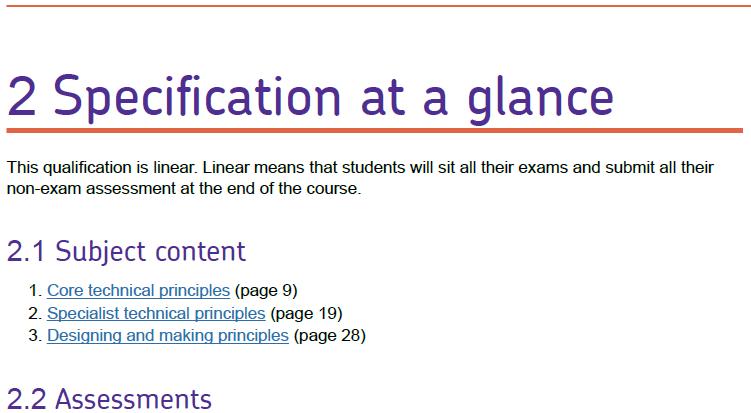
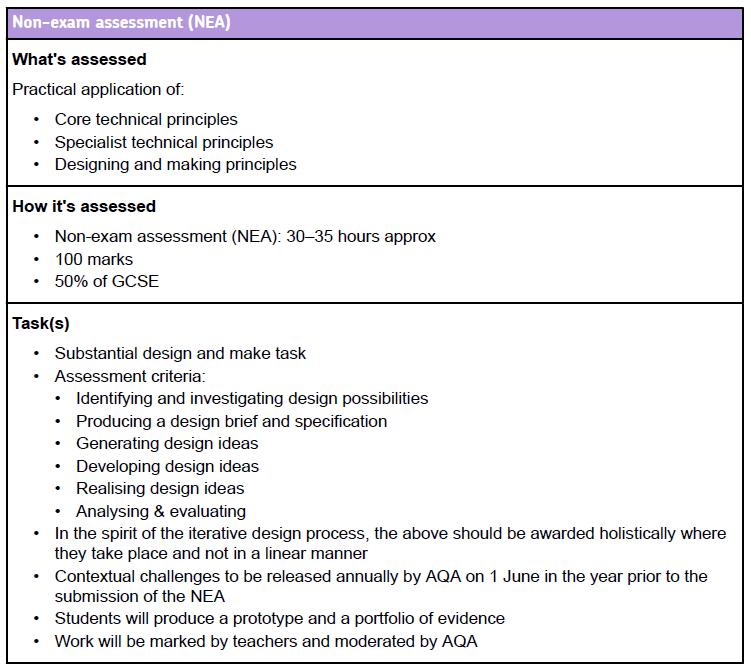
The qualification consists of:
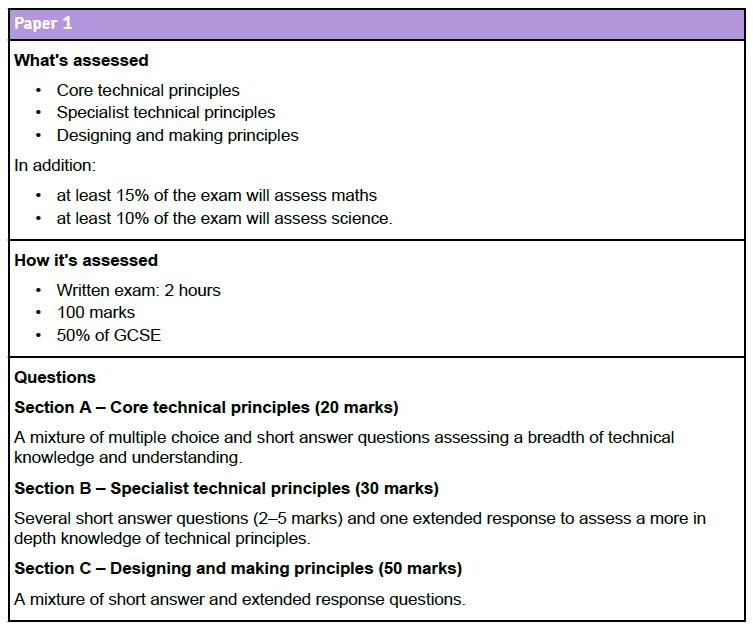
50% Written Exam - Paper 1 (Year 11)
50% Non-Exam Assessment - NEA (1st June Year 10 - Year 11) (see specification breakdown on page 4)
Year 9 students will:

● Complete three design and make/skills based projects covering elements from the written exam as well as preparation for the non-exam assessment
○ Section B ‘Specialist Technical Principles’ - focus on Textile based materials
○ Section C ‘Designing and Making Principles’
● Begin to cover theory elements of Section A of Paper 1 ‘Core Technical Knowledge’ for the written exam.
Year 10 students will:
● Complete a garment project to increase Section A ‘Core Technical Knowledge’.
● Complete a set of tasks intended to develop the skills required for the NEA
○ Section B ‘Specialist Technical Principles’
○ Section C ‘Designing and Making Principles’
● Complete a short adaptation project on either a garment or a bag
● Cover theory content for Section B ‘Specialist Technical Principles’.
● 1st June - Contexts for Non-exam assessment (NEA) are released by the exam board
Year 11 students will:
● Complete their non-exam assessment (under supervised conditions in school time): September - March.
● Continue to cover theory content from Sections A - C.
● Revision
As a subject, Design and Technology has the ability to support the development of a wide range of transferable skills beyond its immediate subject content, with opportunities for:
● Creative thinking
● Innovation and enterprise
● Problem solving
● Using initiative
● Being analytical
● Decision making
● Independent and critical thinking
● Team work
● Good communication
● Planning and organisation
● Taking design risks and challenging yourself
● Reflection and Evaluation
Design and Technology provides the opportunity for logical application of knowledge and understanding in practical contexts developing young peoples’ knowledge of how and why the products, buildings and objects they are surrounded by and use every day are made and developed. Combining design with technology is what makes the world work.
Have you ever wondered what designers actually do?
Have you ever wondered how things move or work?
Have you ever wondered why some things go together and some things clash?
Have you ever wondered how products can be more environmentally sustainable?
Have you ever wondered how a product continues to stay popular?



Paper 1 Section A
● New and emerging technologies
● Energy generation and storage
● Developments in new materials
● Systems approach to designing
● Mechanical devices
● Materials and their working properties.
Paper 1 Section B
This Section is taught in greater depth through at least one material category Textiles students will learn about the different properties of materials, new and emerging materials, how to work with materials and their impact on the environment.
Students are encouraged to explore and develop a multi-material approach to their NEA practical prototype, working with a range of materials and components which could include textiles, timbers, metals, plastics, electronics, modern and smart materials, CAD & CAM.
For more information visit the AQA Design Technology website: https://www.aqa.org.uk/subjects/design-and-technology/gcse/design-and-technology-8552
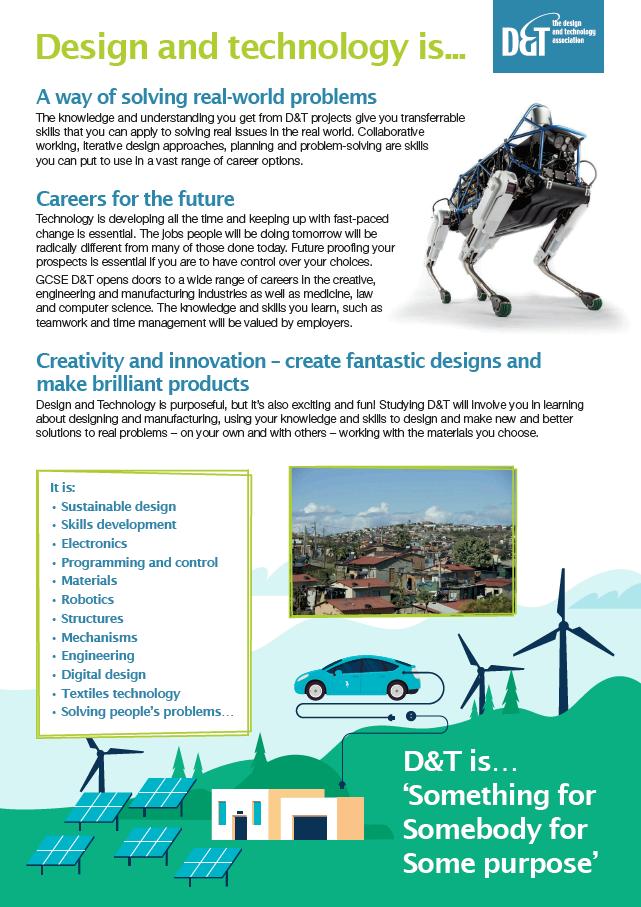
In order to support both the written exam and NEA aspects of the course, as well as to promote independent study, we encourage students to visit a range of museums, factories, shows and exhibitions throughout Year 9 to Year 11 as well as being inquisitive about design beyond the classroom.
Some of these visits will be arranged through school and it is hoped that students have at least one industrial or design based visit per year
School visits may include:
● The V&A
● Harry Potter Studio Tour (including a costume design workshop)
● London Fashion Week
● The London Design Festival (NEA research)
All examination candidates should also try to visit exhibitions relevant to their chosen area of study.
Independent visits could include:
● Fashion and Textiles Museum
● The London Textile Fair
● The Design Museum
● The London Design Festival
● 100% Design
● The Knitting and Stitching Show
● Clerkenwell Design Week
● Areas related to their user/client for their NEA to gather research
● Design Lectures or webinars
Monthly design recommendations:
Each month the department will publish a list of design based recommendations to encourage students to be more inquisitive about the world of design beyond the classroom. This will typically include:
● Podcasts
● Online Webinars/lectures/talks
● News articles
● TV shows
These can be found on our google site: https://sites.google.com/rosebery.surrey.sch.uk/dtrosebery/monthly-design-recommendations
Design Technology award:
This award was launched in September 2022 and encourages students to complete a range of activities and tasks beyond the classroom in order to achieve a Bronze, Silver or Gold award. More information can be found on our google site: https://sites.google.com/rosebery.surrey.sch.uk/dtrosebery/design-technology-award
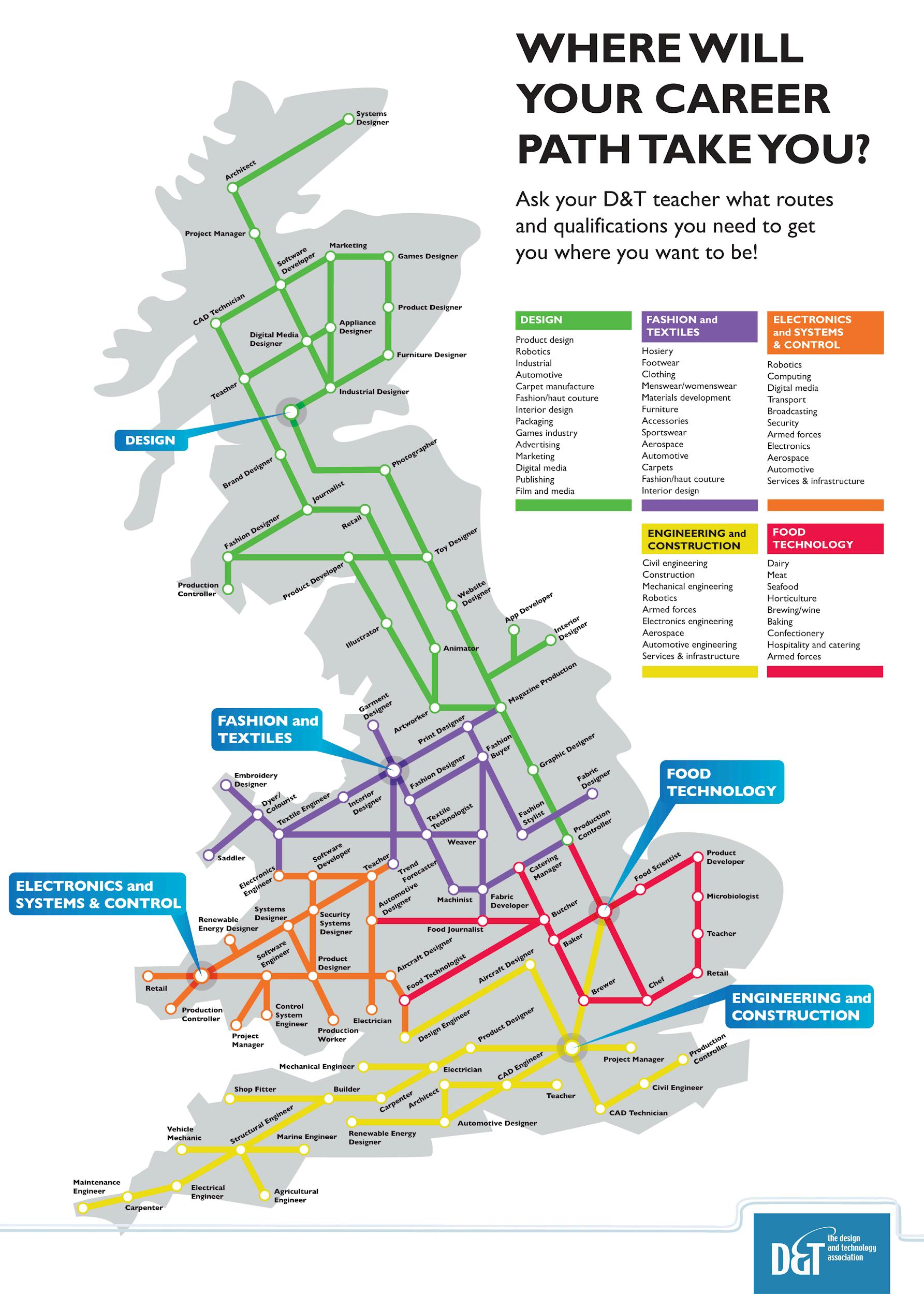
Pupils who show an interest and application for Design and Technology: Textiles will be directed to potential career options such as:
Fashion Design
Millinery
Textiles Design
Surface Pattern Design
Fashion Journalism
Fashion Buying
Merchandising
Architecture
Theatre Design
Set and Props Design
ScreenSkills https://www screenskills com/
Costume/Performance Design
Fashion Photography
Technical Textiles
Sportswear Design
Fashion Promotion
Fashion Communication and Styling
Footwear Design
Computer Aided Design
Tailoring
Lingerie Design
ScreenSkills focuses on all the careers related to the film and TV industry ranging from the costume department to production design department to make-up and hair department to set decorators to marketing
British Fashion Council https://www britishfashioncouncil co uk/
The British Fashion Council comprises a body of appointed members from the fashion industry and beyond who are instrumental in jointly overseeing, supporting and advising on key issues facing the British designer industry The BFC also supports the National Saturday Club: Fashion & Business to introduce 13 - 16 year olds to the opportunities within the creative sector (the closest location is Kingston University). In addition, the BFC runs the Fashion Studio Assistant apprenticeship scheme.


Design Technology and STEM Careers (Science, Technology Engineering & Maths)




borntoengineer.com www.madeherenow.com raeng.org.uk careers.atkinsglobal.com
All exam candidates are made aware of Design and Technology related competitions or opportunities, including:
This competition gives students the opportunity to experience the power of design and technology in solving real world problems, at home, in school, or locally – leading to a new design solution. In teams, students are invited to choose from three contextual challenges that ask critical questions about the issues shaping our world. The competition last year included these challenges:
RESTORE: How might we use design to restore our connections to the world around us? Can we restore our relationship with nature and breathe new life into materials, objects and buildings?
PLAY: How might we use design to encourage more play and playfulness in our lives? How might we ensure playing is accessible for everyone?
SENSE: How might we design with our senses in mind, to support us to all explore the world around us, experience joy and wonder, and connect with each other?
The judging panel for 2019/2020 comprised Fashion Designer Phoebe English, Chef Proprietor Monica Galetti, and Chief Operations Officer for Brompton Bicycle Paul Williams.
This competition runs every year: sometimes there is a specific brief, at other times it just requests the submissions of example pages of existing projects.
The 2024 competition (accepting submissions until 13th May) for Years 7 & 8, 9, 10 & 11 and 12 & 13 is based on Reduce, Reuse, Recycle.
Choose a classic fashion staple garment and consider how you could REUSE OR RECYCLE to help REDUCE the implications that throwaway ‘fast fashion’ continues to have on our environment. The environmental cost in manufacturing fast fashion from CO2 emissions, cheaper synthetic fabric production, the impact of transportation and the sheer volume of fashion filling landfill sites continues to be the fashion industry’s largest issue.
Consider how you could REDUCE waste by taking a classic fashion item to reinvent into something new for the teenage consumer As young designers, we have a responsibility to think about the impact that we all have on our environment. Produce and email the following:
● Page ONE - Research your chosen classic fashion staple garment and the ways in which you could REUSE and RECYCLE
● Page TWO - Explore techniques that you could introduce such as patterns and print, fabric manipulation and construction ideas
● Page THREE - Produce FOUR Design Ideas that include your chosen classic fashion staple garment and link the techniques that you have explored.
Email your THREE pages as PDF files for our judges to see! Submit by 13th May 2024. GOOD LUCK!
Please have year group and name included in the email subject and which centre you are applying to (south or midlands/north) please only apply to the centre closest to you, you may only apply once.
Further competition information: https://www youngfashiondesigneruk.com/competition-2024
Previous South Centre judges include Marina South (Creative Director and Founder of Then & Now Studio and We are Formless), Catherine De Crevecoeur (stylist, fashion and image consultant) and Tracy James (international costume maker).