Volume 51 • Issue 1 • October 2014
Northwest Guilford High • 5240 NW School Road • Greensboro, NC
What’s Inside News
14 new staff members come to Northwest
page 3
Spread
Seniors share their high school regrets
page 8-9
Arts & Culture
The fun foods of fall
page 13
Index
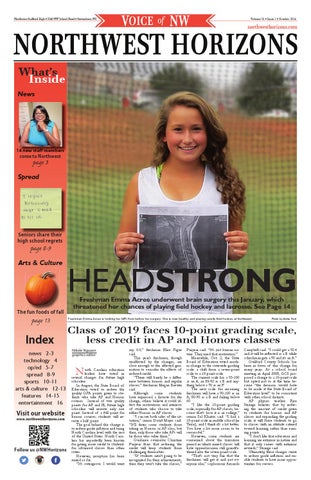
HEADSTRONG Freshman Emma Acree underwent brain surgery this January, which threatened her chances of playing field hockey and lacrosse. See Page 14
Freshman Emma Acree is holding her MRI from before her surgery. She is now healthy and playing varsity field hockey at Northwest.
Class of 2019 faces 10-point grading scale, less credit in AP and Honors classes
my 6.0,” freshman Elise Pigue Puryear said. “It’s just human nature. They need that motivation.” said. Meanwhile, Oct. 2, the State This year’s freshmen, though unaffected by the changes, are Board of Education voted anothclose enough to the affected gen- er change to the statewide grading orth Carolina education eration to consider the effects of scale: a shift from a seven-point scale to a 10-point scale. leaders have voted in reduced credit. The current scale has a 93-100 “There will barely be a differseveral changes for future high ence between honors and regular as an A, an 85-92 as a B and anyschoolers. In August, the State Board of classes,” freshman Megan Brewer thing below a 70 as an F. The new scale for incoming Education voted to reduce the said. Although some students freshmen will have a 90-100 as an quality GPA points given to students who take AP and Honors have expressed a distaste for the A, 80-90 as a B and failing below courses. Instead of two quality change, others believe it could af- 60. “I like the 10-point grading points for AP and IB, future high fect the motivations and interests schoolers will receive only one of students who choose to take scale, especially for AP classes, because that’s how it is in college,” point. Instead of a full point for either Honors or AP classes. “I can see both sides of the sit- senior Sol Khaitas said. “I had a honors courses, students will rewww.northwesthorizons.com uation,” junior David Mayes said. 10-point scale in middle school [in ceive a half point. The goal behind this change is “It’ll deter some students from Texas], and I think it’s a lot better. to reduce grade inflation and bring taking an Honors or AP class, but You have a lot more room to be North Carolina level with the rest then, only those who take APs will successful.” However, some students are of the United States. North Caro- be those who value them.” Guidance counselor Christine concerned about the transition lina has reportedly been known for giving more credit to students Puryear fears that reducing the period in which mixed classes will advanced classes than other credit will keep students from have upperclassmen still grandfaFollow us @NWHorizons for thered into the seven-point scale. challenging themselves. states. “That’s not very fair that the “If students aren’t going to be However, reception has been Like us: Northwest Horizons freshmen will get it and not evrecognized for their achievements, Follow us: @NWHorizons Like us: Northwest Horizons Like us:us: Northwest Horizons mixed so far. : @NWHorizons Follow hwhorizons Follow us: hwhorizons Follow us: hwhorizons “It’s outrageous. I would want then they won’t take the classes,” eryone else,” sophomore Amanda
news 2-3 technology 4 op/ed 5-7 spread 8-9 sports 10-11 arts & culture 12-13 features 14-15 entertainment 16
Visit our website
Photo by Annie Ford
Nikole Nguyen graphics editor
N
Campbell said. “I could get a 92.4 and it will be reflected as a B while a freshman gets a 90 and it’s an A.” Guilford County Schools has been in favor of this change for many years. At a school board meeting in April 2008, GCS proposed a change to a 10-point scale but opted not to at the time because “the decision...would have to be made at the State Board of Education level” to be consistent with other school districts. AP physics teacher Rice Strange believes that by reducing the amount of credit given to students for honors and AP classes and expanding the grading scale, it will force students to go to classes with an attitude catered toward learning rather than earning points. “I don’t like that education and learning are extrinsic in nature and that it only comes with extrinsic rewards,” Strange said. Ultimately, these changes strive to reduce grade inflation and enable students to have more opportunities for success.
northwesthorizons.com northwesthorizons.comnorthwesthorizons.com
Page 2
October 2014
New lab removes computers from media center
Why some electives were canceled
Paige Nehls staff writer
Mackenzie Mitchell staff writer
This summer 30 computers and one printer were moved out of the media center to a new lab in Room 454. The room has been empty for the past six years and was already wired for computers, leaving no additional expense for the school to set up as a lab. The decision, ultimately made by Principal Ralph Kitley, was in accordance with Guilford County recommendation that high schools have 21 computers in media centers. “We were in dire need of another computer lab due to increased online testing,” Kitley said. “We had a huge need to supervise up to eight students per period that were taking [Odyssey] classes as credit recovery on a computer.” Ten new computers purchased by the Parent Teacher Student Organization (PTSO) were put in Room 133 for Odyssey students. The PTSO had a goal to furnish an entirely new computer lab but was not able to meet it. “We are really grateful to the PTSO because they worked really hard for two years to get computers for the students,” media specialist Katrina Hunter said. “Wherever the computers are, they are a benefit to the students.” Kitley believes that the new lab has been a benefit to teachers, as well. “Teachers have loved having accessibility of the lab in the new building,” Kitley said. “Of our labs, at least two of the three, if not all three, are filled often. I think it has been beneficial. I have not heard any complaints at all.” However, not all teachers are enthusiastic
Photo by Paige Nehls
(Left) Students work in the library, now with fewer computers than before. (Right) Students work in the newly formed computer lab in Room 454. The creation of the lab allows more classes per period to have access to the school’s computers.
at the cost of which the new lab was created. “While I do believe that another computer is necessary for a school our size, I am not sure removing the computers from the media center is the ideal solution,” English teacher Jennifer Humbard said. “In a perfect world, we would have a budget that would support a new lab and maintain the computers in the media center.”
Even with the addition of another lab, if the student demand for computer access increases, Kitley will respond. “If we did have students that really wanted more [computer] access I’d figure out a way to make it happen,” Kitley said. “If I had to open up a lab in the morning, I’d do that, because I don’t want our students to do without.”
Ice Bucket Challenge in hot water Melanie Jenkins staff writer With over $112.4 million donated to the Amyotrophic Lateral Sclerosis Association (ALSA), the ALS Ice Bucket Challenge has helped raised both money and awareness for a good cause; however, there is controversy regarding how that money is being spent within the organization. With more than a fourth of donations being directed towards ALSA’s company expenses, 70 percent of all donations are put toward actual ALS functions. From there, that 70 percent is split up among five other categories, resulting in 28 percent of all donations being directly contributed to the cure and treatment for ALS. “I’m kind of disappointed in them,” senior Jocelyn Linder said. “It seemed like such a good idea to fundraise for. [The ALSA] really missed an opportunity.” With 28 percent of all funds being spent toward ALS research, the end result is $7.2 million spent on the research for curing ALS. In order to help public awareness, 32 percent, or $8.2 million, is being used toward raising the public awareness about ALS and early intervention. The ALSA is also under fire from many branches of the public for promoting stem cell research. Unknown to much of the public, however, there is only one team of researchers under the ALSA who are actively searching for ALS treatment though embryotic cells.
Photo provided by Emily Pearson
Freshman Emily Pearson undergoes the Ice Bucket Challenge, a social media trend intended to raise money for the Amyotrophic Lateral Sclerosis Association. With the influx of unprecedented funding, the ALSA has been subject to controversy regarding where the money is going.
Since receiving many complaints about the method of research, the ALSA has added an option where donors can choose how their money is spent, and toward which type of research. With the ALS Ice Bucket Challenge, the ALSA will be able to use the recent boost in donations toward more efficient research methods, as well as helping raise the public awareness about the effects of
ALS. So far, the ALSA has been able to pinpoint a possible gene mutation that ALS has been linked to, and the organization has created more effective therapies that can help relieve the onset of ALS symptoms. “[The Ice Bucket Challenge] helps raise awareness,” sophomore Thomas Brown said. “It’s so that more people help donate.”
Two electives in the English department, creative writing and multicultural literature, commonly referred to as “humanities”, were cut this year due to low enrollment. “I cried a lot [when I saw my schedule],” senior Jacey Hensley said when she found out multicultural literature was no longer being offered at Northwest. Two years ago, the NC Department of Instruction changed the humanities course from an English elective to a social studies elective. To take its place, “multicultural literature” was offered, and many students did not realize they were not receiving a humanities credit. Furthermore, the elective had seen low enrollment numbers in recent years. “I couldn’t justify having a class of 15 students when two AP English sections would have had 37-38,” Principal Ralph Kitley said. “I had to add another section of AP 11.” English teacher Scott Walker was surprised when he learned creative writing was canceled. “[Administration] told me I wouldn’t be teaching creative writing anymore,” Walker said. “There were so many [English] sections, I needed to teach all five of them.” However, Kitley says he recognizes the need for the creative writing elective and hopes to restore the course next year based on student enrollment. “There are a lot of talented writers in this school,” Walker said. “It’s good to have a place for them to grow.” Although two English courses were eliminated, an additional science elective was added to the curriculum. This marks the first year that forensics is being taught in Guilford County. “I’m super excited about [teaching forensics],” AP environmental science and forensics teacher Jessica Bracken said. “It’s a great, real-world class.” However, according to Kitley, enrollment was still an issue during registration, causing many class sizes in the science department to exceed 35 students. “Course offerings are based off student interest and registration numbers,” Kitley said. “A hundred kids wanted forensics, marine science and APES.” To compensate for the inflated science numbers, an additional teacher was not hired. Instead, three science teachers agreed to teach a sixth class in place of their planning period. Due to budget constraints, these teachers are not being paid an additional supplement. “I volunteered to do it,” AP environmental science teacher Richard Thomas said. “I wish there were more teachers around; [the schedule] would be easier to figure out without teachers having to teach six classes.” With changing student body demands, combined with the formula of teacher allotment provided to Northwest by Guilford County Schools, Kitley says he has strived to do what’s best for students when choosing which classes to offer and which to omit. “My goal is to, number one, give students what they need to prepare for life and college,” Kitley said. “Secondly, I want to offer what they’re interested in, too. Sometimes due to budget and allotments, it’s hard to balance.”
October 2014
Page 3
New to the family
Northwest welcomes new staff members Patrick Sams
Position: Biology and Earth and Environmental Science Years of Experience: 10 Favorite Place to Visit: Western North Carolina Mountains
Jennifer Loveday-Donovan
Position: Civics and Economics, Honors American I Years of Experience: eight Favorite place to visit: Boulder, Colorado
Jared Rolfes
Position: math in the EC department Years of Experience: 10 Favorite place to visit: Columbus, Ohio (when an Ohio State University game is in progress)
Jimmy Jiles
Position: Teaches US History and Civics Years in position: 19 Favorite place to visit: Phuket, Thailand
Officer Matt Parsons
Position: School Resource Officer Years in position: 16 years as an officer; 11 years as a high school SRO. Previous schools include Ragsdale, Eastern Guilford and Southern Guilford Favorite place to visit: “I would say the mountains; I love Blowing Rock.”
Rachel Holmes-Watson
Position: Orchestra Years of Experience: 12 Favorite place to visit: The beach
Elizabeth Lucas Christina Victory
Teaches: Business Education Years of Experience: four Favorite Place to Visit: Cancun, Mexico
Position: 10th grade counselor Years of Experience: Counselor for eight years at Colfax Elementary School and first year as a high school counselor. Favorite place to visit: “I love Disney, but I also love the beach. It’s a toss-up.”
David Card
Position: Math II, Math III and Foundations of Math III. Years of Experience: 11 Favorite place to visit: “Syracuse is my home and favorite place to visit, but I love seeing my kids and grandchildren in Colorado.”
Kari Winicki
Position: Parenting and Childhood Development, Early Childhood 1 & 2 Years of Experience: 14 Favorite place to visit: the beach
Todd McComb
Position: Math I Teacher Years of Experience: two years at Ragsdale; before that, college football coach Favorite place to visit: “My favorite place to visit is Florida, and I especially love Disney World.”
Brenda Cullinan
Dalton Alexander Davis (1998-2014)
Northwest High School sophomore Dalton Alexander Davis, 16, passed away Sept. 20, 2014. He is survived by his parents Sandy and Ricky Davis, his brother Tyler, and his sisters M’Kenzie and Jessica. Dalton was born Sept. 15, 1998 in
Greensboro, North Carolina. He was an affectionate and caring young man who enjoyed swimming, riding his dirt bike and spending time with his family and friends. “He was the kind of person who, the minute you met him, was your friend,” Dalton’s English teacher Monica ClarkFrancescini said. “He really liked to laugh; he was always smiling.” Dalton was an active member of Morehead United Methodist Church, and he was particularly involved in the Youth Group. A memorial service was
Position: Assistant Principal Years of Experience: seven as an assistant principal Favorite place to visit: The beach
Chandra Bethea
Position: Marketing and Sports Marketing. Cullinan leads DECA, preparing students as future leaders and entrepreneurs. Years of Experience: four Favorite place to visit: “I like the Boone area; it’s where I went to school.”
In Memoriam:
Kim Gilyard (pictured on the front page)
Position: Honors Entrepreneurship I, Principals of business and Honors business law. Years of experience: four years at the high school level Favorite place to visit: “I love the beach, any beach, Florida, Panama area.”
held at this church Sept. 24, officiated by Rev. A. J. Thomas and Dr. Bryant Wilbourne. Those wishing to honor Dalton's memory may do so by making a donation in his name to the Morehead United Methodist Church Youth Group or College Scholarship Fund, 3214 Horse Pen Creek Road, Greensboro, North Carolina 27410. Forbis and Dick Guilford Chapel served the Davis family. Online condolences may be directed to www.forbisanddick.com.
Page 4
October 2014
Printing in high def: CTE department receives new 3D printer Liz Hubbard arts and culture editor Imagine having the ability to turn ideas and drawings into reality with only the click of a button. It might seem unfathomable, but with 3D printers constantly becoming more advanced, this idea is within reach. 3D printing was invented in 1983 and was originally used exclusively for printing prototypes. Since then, the technology has advanced significantly and is now even capable of producing functional parts for racecars. While 3D printing becomes increasingly important in the engineering world, it is beneficial for future engineers to have an idea of how the technology works. Northwest High School drafting students now have the opportunity to use such technology this school year. “Our drafting work has evolved from 2D drawings into 3D drawings, so we visualize our end product and create our sketches to be in 3D,” drafting teacher David Lambert said. Using 3D printing is a long process, the first step of which is to create a virtual
blueprint of the object the designer wishes to print using digital modeling. The program divides the blueprint into digital sections so the printer can easily control object’s exact size and shape. Once the design is completed, the information is sent to the printer, the material it will be printed in is chosen and the object is printed by depositing filament layers on top of filament layers until it is completed. The Association for Career and Technical Education purchased the printer for Northwest’s drafting department so that students in the class who aspire to be engineers can have a hands-on experience with the technology. “[I took drafting] because I wanted to learn how to use different programs and maybe become an engineer one day,” sophomore Joshua Jones said. Jones hopes to have a military career and later get a job as an engineer, and his aspirations are reflected in his interest in designing military-related prototypes. It is students like Jones and many others that the printer will be most beneficial to as they pursue engineering careers in the future.
Photo by Assistant Principal Bert Webb
The new 3D printer comes with several preset objects that can be printed and is located in the CTE building. Students can design objects and print them out on-the-spot to see exactly how they would look in real life.
Newcomer to the orchard: The PowerSchool Pandemic Marvin Kohn receives large amounts of e-mails Apple releases iPhone 6 Alexis staff writer every day from frustrated students requirBassam Bikdash science and technology editor In the 21st century, when one thinks of the word “apple,” the juicy, crispy fruit is not the only thing that comes to mind. Innovative and world-famous corporation Apple just announced the release of its newest devices on Tuesday, Sept. 9 as part of a marketing strategy designed to increase consumer excitement and anticipation. The new line of devices includes two new iPhones and the long awaited Apple smartwatch, called Apple Watch. “I think [the new iPhone is] a nice upgrade from the iPhone 5c. It’s going to have HD and a better camera,” junior Guillia Cavalcanti said. “Apple still has one of the better phones out there.” The iPhone 6 is larger, thinner and features a glass front with an aluminum body as well as a 4.7-inch screen. It boasts a Retina HD display of over one million pixels, a longer battery life and a new A8 microprocessor. The A8 chip is more power efficient and has a faster and more powerful CPU and graphics processing than the A7 chip. In essence, graphically intensive games and videos at higher frame rates can be enjoyed for longer periods of time. In addition to the A8 chip, the new M8 coprocessor gathers information from its barometer, accelerometer and gyroscope to accurately gauge movement and position. Apple’s iSight camera on the iPhone 6 has also been enhanced. It includes 1080p HD, 240 fps (frames per second) slow motion and image-stabilization functionality. “I think that the iPhone 6 will have a lot of cool, new capabilities for iPhone users,” junior Sydney Nixon said. Apple’s second iPhone, the iPhone 6 Plus, features a 5.5-inch screen and a display with over two million pixels but the same microprocessor and camera as the iPhone 6. According to CBS News, “The technology giant has much riding on the popular reception to its new iPhone, sales of which drive most of the company’s
profits and which account for more than half of its revenue.” Apple hopes to attract customers with its new lineup of devices and services. With that said, Apple CEO Tim Cook introduced a new mobile payment tool, called Apple Pay, which allows consumers to make purchases from their iPhone or Apple Watch. Apple Pay uses short distance wireless technology, a system already built into many Android phones. Apple has collaborated with big financial companies like American Express, MasterCard and Visa. After several months of rumor and speculation, Cook finally presented the Apple Watch, Apple’s new wearable technology which is set to be released in early 2015. The watch comes with six interchangeable bands of different styles: a regular version, the sports version and a gold-cased version called Edition. Users navigate the watch by tapping or swiping the face as well through the use of a crown to zoom or access the home screen. “I like Apple because Steve Jobs had a very practical point of view of what people needed and his genius allowed him to see it and follow through with it,” sophomore Haleigh Cadd said. Several concerns about Apple have risen from the recent announcement of their products. Even though the value of Apple’s stocks continues to increase, the latest iPhones and iPads have only seen incremental advances—simple refinements that contrast drastically with the early big leaps of the company. “It looks like [Apple] is trying to copy Samsung. They’re following instead of leading like they used to,” junior Cole Peterson said. Until recently, Apple hadn’t released a totally brand new product category in four years, since the release of the iPad in 2010. With Apple’s competitors innovating in other fields, there are concerns that, without Steve Jobs, Apple risks losing the vision that led to its rise. “I think that Apple is running out of ideas, but they keep trying to make new products,” Nixon said.
ing password resets and parents wanting to It was supposed to be an innovative new know why they can’t see their child’s grades way for students and their parents to review in the computer any more. The passwords grades online. It was meant to make the lives have a 90-day reset period, so students aren’t of teachers and faculty a whole lot easier. able to use their old codes after that time PowerSchool was supposed to be an amaz- is up. ing program, but so far it’s only caused frus“People are being prompted to reset tration and complaint. passwords, and do not know why,” Kohn “It’s a way [for teachers] to manage all said. their students in a more efficient and easy However, for some students, the proway,” Northwest High School data manager gram has been very helpful with being able Randall Kohn said. Kohn is in charge of to see their progress. managing PowerSchool, among other pro“It worked perfectly for me,” sophomore grams, for the school. Theresa Beitzell said. “My mom can see More than a few my grades and she can tell schools in North CaroThere were several me what assignments I still lina and other states problems with upperclassneed to do. It helps your experienced issues with men as the program didn’t grades.” PowerSchool since Pear- show their class ranks and The program itself is son updated NCWise af- staff had to figure them working, but students find ter 14 years. State funds out by hand. It’s fixed, but it hard to use, and the comused to operate NCWise that was rough, and stuplexity of the program is are now being used to dents still seem to be havtoo much for high school purchase and implement ing problems logging in. students. PowerSchool. “I went in one time and The state is paying it was fine,” junior Jasmine social studies teacher $7.1 million a year to Fuchs said. “Then I went in Elizabeth Russell Pearson Inc. for use of another time and it locked the PowerSchool student information sys- me out, so I changed my password. It still tem that has been causing so many issues wouldn’t let me in. So I made an account recently. for my dad and it wouldn’t work so I’m just The frustration with PowerSchool began done with it.” when students had trouble logging into their The frustration with PowerSchool accounts. The requirements for personal doesn’t end with students. passwords are more detailed than any other “It wasn’t that much of an improvement social media platform. This is because the for teachers,” teacher Elizabeth Russell said. program displays all of the students’ person- “There were several problems with upperal information, including all of their grades. classmen as the program didn’t show their “The passwords are very unique,” Kohn class ranks and staff had to figure them out said. “They require a capital letter, a number by hand. It’s fixed, but that was rough, and and a symbol.” students still seem to be having problems He believes that since the passwords logging in.” were so detailed, students were not writing Guilford County is not the only school them down and therefore forgot them. district experiencing problems with Power“It’s an operator error,” Kohn said. School. Carteret County in Beaufort, North Over the summer, administrators were Carolina experienced problems with incorrequired to shut the program down and re- rect student information for transcripts, start it when school began. When people grade point averages, student enrollment tried to access their accounts, they were un- and athletic eligibility. able to because of the shutdown. “The rollout of PowerSchool has been “PowerSchool never stopped working, a train wreck,” Charlotte-Mecklenburg Suand the county even posted that it wouldn’t perintendent Heath Morrison said to the be available during the summer,” Kohn said. Raleigh News & Observer.
“
”
October 2014
Page 5
Lunchroom changes:
Students react to government mandate for healthier meals Lindsey McGuirk managing editor Since the beginning of the year, students have been more than vocal about their problems with the changes to the lunch menu. “It’s irritating,” senior Peyton Warner said. “It’s not nearly as good as it used to be.” But in reality, hardly any changes were made. The fact that alterations were made to the most popular items on the menu, such as the cookies and the chicken boxes, seems to be causing most of the controversy. “There is nothing that’s changed with our lunch except for the mega meals,” Lunch coordinator Pamela Goad said. But the question lingers: what provoked these changes? The food initiative called the Healthy, Hunger-Free Kids act is part of the First Lady Michelle Obama’s “Let’s Move!” campaign to reduce childhood obesity. In 2012, studies showed that one-third of adolescents in America were obese. With the multitude of long-term health complications that accompany obesity, such as type two Diabetes, strokes, heart disease and difficulty breathing, it’s of no question why someone would want to help change that statistic. The mandate requires that school meals include fruits and vegetables, whole-grain foods, low-fat or fat-free milk, portion con-
trol and a lower amount of saturated fats, trans-fats, sugars and sodium. Yet, even with all of these modifications, the only way our country will see obesity decrease is if people want to change. Without the drive to better themselves, taking away sugar from one of their daily meals isn’t going to solve anything. Students in public schools across America have turned towards social media using #thanksmichelle to express their outrage toward how deplorable the new food is. At Northwest, some students share those sentiments. But, what some students don’t understand is that the Northwest cafeteria has already implemented these requirements for years “Michelle Obama is pushing for whole grains and less snacks,” Goad said. “We are ahead of the game; we have been doing whole grain for a long time.” Nevertheless, it is near impossible to change someone if he doesn’t want the help. Anger seems to be the clearest side-effect of these changes, not weight loss. Because of the seemingly sudden changes, the people in the cafeteria have been taking the brunt of the complaints. It’s not them you should be mad at, however. “We’re fighting this, but we can’t fight it alone,” Goad said. “Until [the USDA] gets 50 million complaints, this is staying.” If you feel compelled, call the USDA at (866)-632-9992; your voice is what will make things change.
Photo by Lindsey McGuirk
Students react to the new changes in the high school cafeteria. Healthier food options were introduced at the beginning of this year due to First Lady Michelle Obama’s “Let’s Move” campaign.
staff editorial
Racism’s continued prevalence in today’s society From the 1600s up until the late 19th century, slavery was prevalent in the United States, and racism was a dominating factor in the development of American culture. Citizens claim that we are now a postracial society and that everyone is judged by their merits, not by the color of their skin; however, this seems to be inaccurate when describing our current generation, even if we do have an African-American president. In fact, several countries around the world have called us out for our blatant rudeness towards the President. They suggest that though America is a successful country, we are still evolving as a society when it comes to defeating stereotypes. William Thomas, a Canadian and the author of a blog entitled “The Fifth Column” writes, “America, you know not what you have. The man is being challenged unfairly, characterized with vulgarity and treated with the kind of deep disrespect to which no previous president was subjected. Given the opportunity, Canadians would trade most of our leaders for Obama in
a heartbeat.” The underlying problems of racism have However, contrary to common misconcep- still not been solved in America, and after the tions, every person in America is a target for rac- occurrence of a few minor racial incidents ism, whether they around school, they have are Caucasian, not been resolved Diversity is a great thing clearly African American at Northwest, either. or another mi“One of my prito have in a school envinority. orities as principal is “When I first ronment. However, this to make sure all stumoved to Amerdents feel respected, environment can only ica from South supported and safe Korea, I seemed throughout the school be created by a variety different from community,” Princieveryone because pal Ralph Kitley said. of people who stand I couldn’t speak “We don’t sweep these English very things under the rug.” together to fi ght against well,” sophoNorthwest’s adminmore Jisoo Kim the issue of racism. istration handles racsaid. “Though I ism with severity and senior Josh Dasnoit haven’t personally has zero tolerance for been the target racial incidents or slurs for severe racism, I feel hurt when I see people of of any kind. All comments or acts of racmy race, or just all races in general, being stereo- ism should be reported directly to the office. typed or looked upon as inferior to one another.” Senior Josh Dasnoit, along with several oth-
“
”
NORTHWEST Adviser Melanie Huynh-Duc Principal Ralph Kitley Editor in Chief Willa Ma News Editor Sarah Colby Op/Ed Editor Jackson Parrish Spread Editor Mackenzie Mitchell Sports Editor Sarah Boggins Features Editor Clare Kilmartin
Arts & Culture Editor Liz Hubbard Science & Technology Editor Bassam Bikdash Entertainment Editor Nick Loschin Managing Editor Lindsey McGuirk Webmasters Austin Drake Noah McCormick Graphics Editor Nikole Nguyen
er Northwest students, attended the National Conference for Community and Justice (NCCJ) to help them dispel racial labels and understand the different cultures of people around them. “I am able to look at everyone with an open mind, rather than judging or stereotyping them,” Dasnoit said. “Furthermore, I am confident in speaking out against hate and prejudice directed towards all types of people, regardless of their beliefs.” Dasnoit, as well as the most of the community at Northwest, aims to uphold diversity and unity within the student body. “Diversity is a great thing to have in a school environment,” Dasnoit said. “However, this environment can only be created by a variety of people who stand together to fight against the issue of racism.” It is crucial to treat one another with dignity and respect, even if backgrounds and opinions differ. The moment everyone realizes that in the end, we are all humans and are all equal, racism will fade away into history as a problem that once prevailed.
HORIZONS Staff Writers Jenny Blackburn Annie Ford Melanie Jenkins Alexis Marvin Harley Nefe Paige Nehls Katie Lee Parrish Satoria Ray Faith Rickerts William Royal Alexis Rutledge Shalini Sharma Lilac Rain Thompson Sophie Vazquez
Policies and Intent
Serving as the primary printed and online forum for student opinion, Northwest Horizons publishes five issues each year by the staff at Northwest Guilford High School. The paper is supported through community advertisers. Staff Editorials are unsigned. The stance of each editorial is voted upon in staff meetings, but it requires the approval of the majority of the editorial board. All members of the school community are encouraged to use Northwest Horizons to express their views. Letters must be signed when submitted.
Find us online: @NWHorizons Visit our website: www.northwesthorizons.com
Page 6
October 2014
HEAD-2-HEAD: Michael Brown Aug. 9, 2014: African-American teenager Michael Brown was fatally shot by police officer Darren Wilson in Ferguson, Missouri. Brown and a friend were walking down the middle of the street when Wilson drove up and asked them to move to the sidewalk. A struggle between Brown and Wilson through the police car window broke out, and Wilson’s firearm, either intenionally or unintentionally, was discharged. Brown fled, though reports differ over what occurs next-- specifically concerning when and if Brown had his hands raised or if he was moving back toward Wilson in a threatening manner. Nevertheless, several shots were fired by Wilson, and Brown died, dividing the small town of Ferguson and sending the nation into chaos and controversy over possible police brutality, racial profiling and a search for the truth.
Justice is not just Satoria Ray staff writer There are at least three sides to every story, and this story is no different. There is Mike Brown’s side, Darren Wilson’s side, and then there is the truth. The truth, like in most stories, is the hardest side to come by. Was Brown surrendering when he was shot and killed? Did he try to take the officer’s gun? Was the gun fired out of defense or racial discrimination? These are a few of the many questions being asked about what happened in the shooting that led to the death of teenager Mike Brown in Ferguson, Missouri. It’s hard for the true story of what really happened to come out when the Ferguson Police Department is giving vague answers in interviews, Brown is dead and Wilson is in hiding due to death threats. For now, it’s just he said, she said. Nevertheless, the exact details are minor when it comes to what the real problem is. This is not an attack on all police officers. In fact, most police officers do not abuse their power. They defend and protect their people as they should. However, there are some who misuse the power they are given and mistreat, abuse, and even kill the people they’re supposed to protect. It should be noted that these kinds of police officers are rarely punished for their actions, either. The death of Mike Brown is one of many countless deaths caused by the latter of the police officers mentioned above. In a 2012 study about “justified” shootings by the Police, 313 of the people killed were black men. Of these men, 136 were unarmed. “No killing of an innocent, unarmed, civilian is just,” senior Hannah Kassahun said. John Crawford was shot a week and a half after the murder of Mike Brown. The death of Mike Brown took place a week after the killing of Ezell Ford in Los Angeles, which was months after the choke-hold death of Eric Garner in New York. This took place years after unarmed Amadour Diallo and Sean Bell were also killed in New York, which took place years after the shooting death of unarmed and hand-cuffed face down Oscar Grant in Oakland. Let’s not forget the death of unarmed Kendrec McDade in Pasadena, a decade after the killing of Johnny Gammage. Something all of these men have in common with Mike Brown? They were innocent, unarmed black men who did nothing to warrant death. We are told to believe that these men were “dangerous” and that the officers were protecting themselves. We’re told they would still be alive if only they had surrendered or obeyed. “Why is a police officer’s life more valuable than a citizen’s?” senior Mariyka Auber said. The fault is rarely placed on the police. They never lose their temper, they never make a mistake. It’s undeniable; however, that racial profiling still prevails. “Racial profiling was the foundation of everything that happened [in Ferguson],” Kassahun said. Furthermore, why have peace keepers spent more time in jail than Darren Wilson? Why is Darren Wilson on a paid vacation, instead of behind bars, despite six different eye-witness accounts? These are questions that need answers. “Authority is corrupt, and justice is not just,” senior Alicia Andrews said.
Light of the innocent William Royal staff writer An unarmed black teen and a white shooter. The story of Michael Brown is a tragic and unfortunate one, and nationwide tension and chaos sprung up as a result. Rioting overtook Ferguson during the summer of 2014. Eric Holder, the Attorney General of the Department of Justice who has since resigned, was sent to investigate the Ferguson Police Department. This summer, the town of Ferguson was split in half. One side rallied behind the victim, and the other supported the officer. Brown’s supporters have said that since the officer was white, and Brown was black, it was an act of racial discrimination. They then reference the 2012 shooting of Trayvon Martin. The problem with using the Martin case is that the shooter was a civilian. George Zimmerman had called the police and shot Martin after getting beaten. In the Brown case, Wilson was an officer of the law, and had a right to shoot, as he felt threatened. Because of the violent actions taken by Brown, he was shot. The supporters of Brown have also argued that the police force in America is becoming too much of a brutal, blood-thirsty paramilitary force. While this could be said for the Special Weapons and Tactics teams of the police, it cannot be said for your average, everyday police officer. “I’ve had too many friends that I know that are in the police department,” AP United States history teacher Ray Parrish said. “I know that there are bad guys. At the same time, the people I know are very fair-minded and want to serve the public. I’ve known way too many who are good guys.” To really solve the issue of police brutality, we must determine the frequency of the instances of which police brutality shows its teeth. Are they isolated? Or are they mainstream, with cases taking place daily? More often than not, it is overwhelmingly isolated. Another common argument from Brown’s supporters is that because of how many shots hit Brown and the close proximity of the gunshot wounds, officer Wilson was a trigger-happy police officer with zero regard for human life. “I think that the police officer [Darren Wilson] was really trying to defend himself,” senior Madison Lohr said. “He was under a lot of stress and made a split second decision. I think that he did what his training taught him to do. He was justified.” Police officers are not brick walls; they are human beings. They can feel pain, fear and anxiety, all of which went into officer Wilson’s decision. He panicked, his training kicked in and he shot Brown. Graphic by Nikole Nguyen Due to the magnitude of the violent killings of unarmed black men in recent years, we are trained to side with the victim and weep for his death; we do not take the shooter’s story into account, and we most certainly ignore the virtues of objectivity and innocence until proven guilty. Brown getting shot was undeserved, but Brown certainly did nothing to help his chances of surviving. In this time of immeasurable sadness, we must show kindness and respect to both the victim’s family and Darren Wilson. This event will go down in history, not as an abhorrent piece of civil rights violation, but as an unfortunate tragedy.
October 2014
Page 7
Isolationism or Supremacy?
American foreign policy from World War I to today Nick Loschin and Jackson Parrish entertainment and op/ed editors In 1796, George Washington gave his Farewell Address warning America to stay out of other nations’ affairs and instituting America’s policy of isolationism. His advice was used for over 100 years until the early 1900s. “I believe after the struggle and eventual success of the American Revolution, the founders leaned towards isolationism,” senior Phillip Berger said. This ideology was tested in a major way in the 1910s. Afraid to enter World War I, America quickly reinforced the idea of isolationism after they witnessed the horrors of the war and the destruction that engulfed the whole world. For this reason, the Senate rejected Woodrow Wilson’s idea of a League of Nations, and America kept to itself for another decade. “The foreign nations were example enough of what happened when a country attempts to become dominant on a global level,” Berger said. However, Dec. 7, 1941, Pearl Harbor rattled America. From then on, the United States never again left the world stage. With the rise of Communism, America had no choice but to take lead in the world. Fighting Communism in the Korean War and the Vietnam War, America acquired the role as the world’s police
Photo taken with permission from the U.S. Federal Government
These U.S. soldiers are on patrol in the Middle East. Currently, there is much debate over whether or not more troops are needed to combat new terrorist threats.
force. However, losing the Vietnam War after not completely cleansing the world of Communism made many question if America should even be involved in other nations’ affairs. The United States bolted into several other wars such as the Persian Gulf War and the War in Afghanistan. America was now trying to instill Democracy all across the world. Now, in the present day, the U.S. con-
flict in the Middle East has escalated due to the barbaric actions of the new terrorist group ISIS. After beheading two American journalists and keeping many individuals hostage, the U.S. has demanded a response from President Obama and his administration. The question now is what response this will be. America can either take an isolationist stance that has been utilized only a few times since the Vietnam War, or it can return to its su-
premacist stance that was so prominent during the World Wars and Cold War. Overwhelmingly, the latter seems to be the best option for the current administration. After the president’s statement on the ISIS threat on Sept. 9, a Washington Post-ABC News Poll reported a significant shift of public opinion in support of airstrikes in Iraq and Syria with 71 percent of Americans in favor. Additionally, nine in 10 Americans view ISIS as a serious threat to vital U.S. interests. “[U.S. involvement with ISIS] will either more solidify the U.S. presence in the Middle East or it will return us to our isolationist standpoint,” social studies teacher Phil Coley said. Due to an extraordinary amount of public support and rare bipartisan agreement, it is obvious that some sort of military action will take place in the Middle East in response to ISIS’s actions. Overall, this is the best choice for America. Though all-out war and boots on the ground are both reckless and highly unfavorable, air strikes, military training of allies in the region, and Special Forces operations can all be used to effectively contain the ISIS threat and minimize the damage they cause across the world. “The United States is still looked at as the unilateral watchdog of the world,” Coley said. “If anything, we’re going to stick to our guns and wipe out [ISIS] strongholds wherever they are.”
Dress code: A school necessity that reinforces misogynistic culture Sarah Colby news editor “Young lady, is what you’re wearing appropriate?” These words, as patronizing and demeaning as they are, hold a large amount of weight in today’s society. A dress code is designed to promote professionalism in the school system. However, when it is truly only targeted at the girls of the school, it’s sexism. This year, there were multiple changes made to the dress code. Not so surprisingly enough, most of these changes were for the girls of the school. The biggest change that has been the worst in the heat, which comes from living in the South as well as it being summer, is that shorts must now go to mid-thigh. This is a Herculean task to overcome. Have you ever been in the junior’s section of any large department store? Have you ever been to any kind of young woman’s store? It’s difficult to find shorts that go past your fingertips, let alone mid-thigh. There is a difference, however, between school appropriate and ridiculous. Fingertip length is appropriate. Mid-thigh length is not. “Well, just wear pants,” you say? Why should what a girl chooses to wear have an effect on the people around her? Someone’s decision to wear a certain type of clothing is theirs and theirs alone. If a girl wants to wear high-waisted shorts and a crop top, where none of her stomach is showing, that should not be a problem. ‘But how could the dress code be sexist?’ you may ask. ‘I know guys who have gotten in trouble because of not following dress code.’ You will rarely see a boy be pulled out of class, told to change, or be sent home for what he is wearing and in result, taken away from his learning because what he was wearing is too distracting toward the other students of the class. For example, a brand of shorts, Chubbies, is not mid-thigh. However, because the legs of a young man are not sexualized by the media, and therefore everyone else in today’s society, it’s not “inappropriate” to see their legs. Is this because a boy’s education is valued more than a girl’s? That sure seems to be the case if you look at the wage gap, prevalent in every industry around the globe.
Graphic by Mackenzie Mitchell
A teacher scolds a girl who is dressed contrary to what the Northwest dress code permits. The dress code was modified for the 2014-15 school year to ensure that female students are properly covered and that their clothing choices are not a distraction to others.
“What makes me mad is that girls have to suffer because of boys’ inability to focus,” senior Olivia Constantinidi said. “[I’m] sorry my shoulder is showing, but that is no excuse to pull me out of my learning time to go to ISS, call my mom or go home to change. It is sexist and unfair.” Dress codes helps to enforce the idea that women must constantly skirt around men, trying to control a man’s actions with her own. The excuse “boys will be boys” just helps to perpetuate this idea. Boys are people and must be held accountable for their actions and should not be allowed to act in a way that is violent and accepted in this society. Remember the young man who killed six women before taking his own life because he could not get a date? Thousands came to his defense, men and women alike saying if the women had only gone on a date with him,
it never would have happened. The excuse that these women should be blamed for their own deaths is absurd. Many may try to argue the fact that a dress code is in place to help young girls not be stared at and sexualized. However, this is like putting IcyHot on a broken arm rather than having it fixed. The problem may seem to be better, but it is not. It’s often asked “what was she wearing?” when a rape or assault is in question. It does not matter what a girl was wearing. The excuse “she was asking for it” is not a valid reason. Unless a woman explicitly says “rape me” or “assault me,” it is not excused, and it is still rape or assault. By enforcing this dress code unfairly to the girls rather than the boys, it continues to perpetuate the idea that clothes are what constitute consent. It says that what a girl is wearing is more important than her decisions, choices and education.
In high school, we range from 13-14 years old to, at the oldest, 19 years old. What that means is that an extremely large majority of students attending are minors and examining their clothing choices is innapropriate. “Isn’t it the least bit concerning that 14-year-old girls are being sexualized?” senior Emma Halchin said. The only way to overcome and combat this society in which victims rather than the attackers could be blamed is by actually teaching respect for each other and seeing females as people. While the 19th amendment allows women’s suffrage, we’re not nearly where we should be. As the land with “Liberty and Justice for all,” maybe we should start practicing what we preach. This starts with teaching boys and men alike that women are not objects to be sexualized or “protected” by dress codes that actually keep them down.
I regret...
Page 8
Page 9 Each student of Northwest’s senior class was asked to write his or her biggest high school regret. Two faculty members offer insight as to why students wrote what they did. Mackenzie Mitchell spread editor
When seniors take a look at their transcripts with grades from years past, many of them will probably cringe at their scores from freshman year. Almost every high school student experiences some sort of academic or social regret in school. Among the many regrets that seniors reported to have, the more common ones were a lack of educational interest in freshman year, the inability to find their unique voice and failure to get involved with sports, clubs and other organizations. Stacy Garner, chair of the counseling department, believes that a maturity factor plays a large role in not taking freshman year as seriously as it should have been taken. “It’s the transition from middle school to high school,” Garner said. “[High school responsibilities] are hard for a 15-year-old to take in.” The realization of just how different high school is from middle school catches most students off guard; however, social conflicts are also a part of the equation. “It’s so much more important when you’re entering a new school that you establish yourself socially,” AP psychology teacher Phil Coley said. “Academics take a backseat in freshman year, and that results in people not putting their best foot forward.” Socially speaking, focusing too adamantly on fitting in with the crowd is a common regret of upperclassmen. “It stems from insecurity,” Coley said. “Everyone wants to be liked and valued for exactly what they are. When other people like us, we like ourselves.” Worrying only about how peers perceive one another can barricade students from discovering their own voice. “It’s the natural high school experience,” Garner said. “It takes a couple years to find your own personality.” The guilt of failing to enroll in more challenging classes and multiple clubs or organizations bothers a large portion of high school students, as well. “Students are running out of time in the evening to study,” Garner said. “The time constraint makes it hard to juggle all of those [classes and organizations].” The questions “should I have finished with a higher GPA?” or “could I have received a scholarship to college?” are frequent among students who think back on not placing themselves in AP or Honors classes. “There are too many cases where intelligent people don’t take [higher level] classes and settle for something less,” Coley said. “[These students] didn’t put themselves on a track that would’ve challenged them or made them try their best.” These observations are similar when dealing with missed sports opportunities. “[Students] wish they would have seen what they were able to do,” Coley said. “If you try and fail, at least you tried; if you never try at all, it’s a failure from the get-go.” It is difficult to find a student who regrets absolutely nothing about their four-year experience. Three huge components of high school include academics, sociality and extracurricular activities, and a large array of seniors were found to have had regrets about at least one of these things. “Some seniors, all they focused on was making that A,” Garner said. “They left out service learning, leadership, and extracurricular activities—those are what open the doors to college.” To avoid missing out on valuable opportunities like these, the best action anyone can take is to seize chances that will be beneficial to a bright future. “If you try, at least you can get rid of the what-if ’s,” Coley said.
To see more regrets, visit our website at northwesthorizons.com.
Photo by Mackenzie Mitchell
Page 10
October 2014
Are they really sports? Cheerleading NO
Harley Nefe staff writer When sitting in the stands at a football game, you see many things: the players on the field, the band playing music and the cheerleaders right in front of you. These cheerleadersdo flips and different moves catching attention at the football game. They are together during every cheer and they make sure they chant loudly so everyone in the stands can hear and feel their spirit. However, do these things make cheerleading a sport? “I don’t think sideline cheerleading is a sport,” junior and varsity cheerleader Haley CombrikGraham said. “A sport is an activity involving physical exertion and skill in which an individual or team competes against another or others for entertainment.” Sideline cheerleading at Northwest focuses more on supporting the school and entertaining those at the game. The team also participates in a jamboree in August, pre-states and states, where the cheerleaders compete other high schools. Jamboree is an event in the summer where the cheerleading team competes at the Greensboro Grasshopper stadium on the baseball field. The cheerleaders prepare a routine beforehand that they compete with against other high schools in the same division. Pre-states is a competition that prepares the cheerleaders for when they go to states. They present their routine, however, it isn’t scored. States is the biggest competition of the season and will take place in Raleigh this year. “People just think of [cheerleading] as doing cheers, and it’s not like we’re constantly running or something,” junior and varsity cheerleader Lacy Hylton said when asked why others don’t classify cheerleading as a sport. In competitive cheerleading, there are no cheers. It focuses more on tumbling on a spring floor. This type of cheerleading also takes place all indoors. “High school cheerleading and sideline cheerleading wouldn’t fully be considered a sport be-
Marching Band YES
cause all you do is stand there and stomp, clap and scream,” senior and varsity cheerleader Emily McCall said. “Anybody can do that. If you get into the competitive side of it and start stunting and tumbling with 36 people on the floor, it can be very dangerous.” The cheerleaders for Northwest start practicing before school begins in August for two weeks, where they practice twice a day for two hours. They are required to
run at least four miles a week. During the summer practices, they run through routines and practice stunts in preparation for jamboree. Once school starts, the cheerleaders continue to practice twice a week for two hours. They start practices with a 100-count workout, and then they go over stunts and practice cheers. Combrik-Graham is also on a competitive cheer team that practices twice a week for two hours. The competitive cheerleading team has an additional tumbling class, as well. “Competitive cheerleading requires endurance because it is an intense non-stop routine that includes tumbling, stunting and dancing,” Combrik-Graham said. “I think the tumbling part is [a sport], but not the sideline cheering.”
Sarah Boggins sports editor
Marching band. Just the name evokes the image of nerds sitting in the bleachers, blasting music and screaming things about football they don’t know. Sure, only four out of 10 marching band students know how the game of football works, but that doesn’t mean it isn’t a sport. Many skills are needed to be in the
Northwest Guilford Marching Viking Band: the ability to play an instrument while executing complex movements, balance and strength. To be able to achieve these things, you must have lots of time. “First you must come to at least a relative degree of mastery of a musical instrument,” senior drum major Elizabeth Amos said. “And then be able to tolerate physical exertion while utilizing musical skills.” Marching band requires intense dedication; much of this dedication must be put into spending countless hours perfecting drill (the layout of the show that shows you where to go on the field) and music. The band spends two hours after school Monday practicing, three hours on Tuesday and another three hours on Thursday. Then there are
football games on Friday until 11 p.m., followed by getting up the next morning at 5 a.m. for a competition, spending all day at the competition and getting back home between 1 a.m. and 2 a.m. in the morning. “The amount of time necessary to meet goals set by the group is incomparable to other sports at Northwest,” senior Katie Groves said. Marching band is also one of the first sports to start up. “Band camp” – a time where every marcher learns basic marching skills and the drill for the upcoming season – starts three weeks before school begins in August. In those three weeks, the band spends eight hours a day, five days a week practicing. Like in any other sport, marching band requires detailed technique. “It takes as much conditioning, training and hard work for a marching band to be champions as it does for a football team to be champions,” junior Michael Brotherton said. There are studies that have proven marching band is just as physical as other sports. “There is actually documentation from Purdue University that states they did athletic research with breathing apparatuses in drum core kids to measure their heart rate,” band director Brian McMath said. “The breathing capacity of a quad player in the marching band was the equivalent to a long distance runner, and the heart rate was the speed of a sprinter.” Northwest’s marching band competes, like other sports, and has an impressive winning history. “We have the longest history of tradition of excellence in winning for over 30 years,” McMath said. “If people actually considered this a sport, we would have been undefeated conference champions for 30 years.” Like in football, marchers have to make the correct moves to the correct spots, or everything falls apart. With all of these factors added in, the marching band is one of the most respected programs at the school. “It is because of our work ethic, our success and the character of our kids,” McMath said. “This isn’t a walk in the park. It’s a march,” senior Kailyn Akers said.
Photos by Sarah Boggins and Melanie Jenkins
Boys’ Cross Country Matt Bomkamp Grade: 12 How do you prepare for a meet?: “I like to get in the zone, listen to music and go through all my stretches.” What are you trying to accomplish this season?*: “I definitely want the school record. I’m seven seconds off right now. Maybe top 10 in State?” *Bonkamp beat the school record with a time of 15:42 and is now fifth in the state.
Sports Profiles Girls’ Cross Country Hannah Hamilton Grade: 12 How do you prepare for a meet?: “Before each race, all the girls on the team pray together.”
Varsity Football Mark Garner Grade: 12 How do you prepare for a game?:
What are you trying to accomplish this season?
“We go and eat our pre-game meal.”
“I hope to improve my time.”
What are you trying to accomplish this season?: “We are trying to be a team and stick together.” Information compiled by staff
Page 11
October 2014
Football kicks off the new season with Coach Rolfes Katie Lee Parrish staff writer
Almost every Viking has one
universal understanding: Northwest has a rivalry with Northern Guilford High School. Many were concerned when the Nighthawk assistant coach, Jared Rolfes, became head coach of the Viking football team. “I was hesitant to apply at first, but then once I started to pursue it, it wasn’t a big deal,” Rolfes said. Rolfes put the rivalry behind him and came to Northwest to jump on the opportunity of becoming head coach of the Northwest Varsity football team. “When you see professional opportunities that are good ones, you always have to pursue them and see if they are a good fit,” Rolfes said. “Once I got here and had a
chance to meet with former Coach Woodruff, the Athletic Director John Hughes and the principal, I got to see that it was a really good fit for me and my family.” Rolfes was a head coach in Ohio for five years and an assistant coach for one year at Northern. He understands that a football team is not meant to have only the goal of winning, but to also the goal of building the young men into men of character and integrity. “The big thing is that we give them [the football players] a platform and show them how to obtain character and how to do things the right way and just learn to become high producing members of society,” Rolfes said. “A lot of people say that, but I mean that.” He says he accomplishes this by taking his firm belief in his faith and creating it as a base for the team.
“I am a strong believer in faith and that radiates out of me, but I don’t push it on people and I don’t ask the kids to do certain things,” Rolfes said. “That is where the character and all the integrity come from, that being the foundation.” The coach has started taking his goals and putting them into action with the Vikings this season. As of Friday, Oct. 10, Northwest has a 5-2 winning streak. Rolfes has also influenced many of his Varsity players, such as sophomore Austin Scott. “Coach Rolfes is a great coach and an even better man,” Scott said. “He doesn’t expect perfection, but a perfect effort from his players. His love for the team is contagious and makes me strive to be the best player I can be. He loves God whether we win or lose and is a great influence for the Vikings.”
Photo by Sarah Boggins
New head football coach Jared Rolfes walks through the players as they begin practice. The Vikings beat Ragsdale at the Homecoming Game Friday, Oct. 10, bringing Northwest’s winning streak to five games this season.
Balancing time and sports:
Student athletes find ways to manage the demands of athletics and academics Willa Ma editor in chief
3:50. The bell rings.
Student athletes rush to the locker room to change and get ready for practice. Whether it’s soccer, cross country, field hockey or tennis, sports in high school can be difficult to manage with practices after school and games every other day. “Soccer in high school was a bit of a struggle because we would practice ‘til 6:30, then the next day we would have a game and I would put off my homework ‘til after the game and then it would just get piled up,” senior field hockey and soccer player Hannah Johnson said. Balancing sports and school may be hard at times, but junior tennis player Zaina Kuseybi sees the benefits of sports in high school. “With sports, you have that natural ability to work for something, and it also forces you to manage your time,” Kuseybi said. However, Kuseybi also prioritizes academics even in the midst of her tennis season. “I look at [tennis] as more of an extracurricular, just something I can do for fun,” Kuseybi said. “My coach always says that if you sign up for a team, it has to become one of your priorities, but he still says that school should
“
come first, then your team, then what you do outside of school.” Playing sports and also having to do homework and worry about classes places student athletes on a tight time schedule. “If you know that you can’t handle it, then I don’t recommend playing sports only because if the sport becomes more important than your school work then you got your priorities all out of order,” Kuseybi said. While sports are time con-
“I study harder and manage my time better because of sports,” Johnson said. Time management is key for any student athlete. For Johnson, doing homework in the evening after practice and then finishing the following morning is the schedule she has adapted to, while Wirtz comes home from practice, eats, showers and gets ready for bed before finally sitting down to complete all of his homework. While having a schedule may be effective during the season, once the season ends, some athletes don’t always feel a reprieve. “When cross country season ends and I have the winter to just do whatever I want, I feel like I don’t have more time to do homework,” Wirtz said. Even with the tight time schedule that emerges due to managing athletics and school work, many students still play sports. “I think it’s really important to at least try out if you are interested because that gives you a great sense and a great welcoming to the school,” Kuseybi said. Northwest offers many sports opportunities from walk-on teams to junior varsity and varsity options. “I think it’s a great thing, with any sport, to just get involved whether or not you are competitive in it,” Kuseybi said. “It really gives you a good release and also gives you something to work on and things to strive for.”
With sports, you have that natural ability to work for something, and it also forces you to manage your time.
”
junior Zaina Kuseybi suming, student athletes do 10 percent better in math, science, social studies and English courses than other students, according to a study conducted by researchers at Michigan State University. “When you play a sport, you have to be able to schedule well,” sophomore cross country runner Nick Wirtz said. “Scheduling and keeping organized really help in school, and physical activity keeps your whole body, including your mental side, healthier and better.” Kuseybi and Johnson, who both take many AP courses, have noticed that there are many athletes in those rigorous classes, too.
Senior Hannah Johnson demonstrates the difficulty of juggling academics with athletics. Many students find it challenging to excel at both schoolwork and sports when both require dedication and time.
CAFF IENDS B
R
E W
E D
Coffees,Teas, Pastries, Shakes, Cakes and Smoothies
Announcing our new all occasion basket company
BasketCases
2203 Fleming Rd., Greensboro, NC 27410 (Food Lion Shopping Center) 336-763-3810
Bring this coupon in for $2 off Total Purchase
Photo by Annie Ford
Page 12
October 2014
Traditionally Terrifying: E xciting Halloween customs for Northwest students Alexis Rutledge staff writer As you walk under the 10-foot arch and through the foggy graveyard, chills run down your spine. Goose bumps pop up as you pass Frankenstein, Dracula and the Headless Horseman. As you knock on the door, you grin from ear to ear. Welcome to the Stutts Family Halloween Party. The Stutts family of Greensboro loves Halloween, and each year they throw a party to celebrate. They decorate the outside of their house with life-sized figures of superheroes and Halloween monsters that their father makes himself. They have a graveyard and a fog machine in the front yard under a hand-made, 100-pound arch. Michaela Stutts, a sophomore at Western Guilford High School who knows many Northwest students from her time at Kernodle Middle School, said it takes time, money and hard work to set up. H e r family
and Spanish teacher Mark Goldsmith says one of his neighbors in Jamestown annually builds a haunted house extension out to the street. “It is dark, and it has glow-in-the-dark things inside, and it’s got little things that will pop out at you,” Goldsmith said. Each year, the Jamestown resident invokes the help of his extended family members and takes time off from work to build the haunted house prior to Halloween. He accepts canned goods as “payment” for entrance and donates the food to the local food pantry. “They’ve done it for three or four years,” freshman Sean Goldsmith said, “but I’ve only been once.” Halloween is a holiday that brings people together, whether it is at a huge party, a neighborhood haunted house or at The Jollys. “My dad sees Halloween as a way to get the community together and celebrate such a great holiday,” Stutts said.
has to pay for the cost of the supplies used to make the decorations such as paint, “monster mud” and plywood. “We spend about three weeks setting up for the party,” Stutts said. “It’s a lot of heavy lifting. The hardest thing to set up is Batman because not only does he weigh 300 to 400 pounds, but we have to put him on the roof.” Every Halloween, nearly 300 people come to 3415 Deep Green Drive to enjoy the free-of-charge, open-to-the-public Halloween bash. “It is a lot of hard work, but it’s worth it because people enjoy it. The little kids think it’s scary, and the teenagers think it’s cool,” Stutts said. Not many people go as “all out” for Halloween as the Stutts family, but they still love to decorate their house for the trickor-treaters. Sophomore Lauren Grigg likes to visit The Jollys, who have zombie decorations and hire people in the neighborhood to jump out and scare the kids. “They live in my neighborhood and do Halloween pretty big,” freshman Peyton Haack said. “They go pretty hard at Halloween; it’s crazy.” Teachers enjoy going around and visiting decorated houses, as well. Lacrosse coach
Graphic by Nikole Nguyen
FIND YOUR FRIENDS in the NWO’s Student Profiles section CATCH GAME HIGHLIGHTS on our Facebook, Twitter & Youtube KEEP UP WITH YOUR COMMUNITY in the NWO YOUTUBE LOGO SPECS
www.nwobserver.com PRINT main red
gradient bottom
C0 M96 Y90 K2
C13 M96 Y81 K54
@mynwobserver PMS 1795C
standard
black
C0 M0 Y0 K0
C100 M100 Y100 K100
BLACK
/northwestobserver on dark backgrounds standard
Northwest Observer
PMS 1815C
white
WHITE
on light backgrounds
no gradients
no gradients
October 2014
Page 13
Pumpkin spice and everything nice Faith Rickerts staff writer
Crisp air, colorful leaves and the distant cries of football fans aren't the only things that autumn brings. Along with the sweaters and leggings, pumpkin spice permeates the season of fall. With the vast realm of all things pumpkin, here are plenty of fall food items from which to choose.
PUMPKIN SPICE LATTE: Pumpkin does not only come in pies and rolls. Starbucks' Pumpkin Spice Latte is a definite favorite among the students at Northwest. Senior Eric Szychowicz says the smell is his favorite part about the drink. Starbucks' latte contains 288 calories with whole milk and no whipped cream.
PUMPKIN MUFFINS: “I love the texture of pumpkin muffins,” sophomore Jewelie Roberts said. Freshman Stevie Holland says it's the taste that makes this pumpkin dish her favorite. Both girls agree that store bought trumps homemade muffins. The average store-bought pumpkin muffins contains 470 calories, whereas a homemade muffin has about 160.
PUMPKIN PIE: The original autumn staple that none of us could live without and one of Northwest's favorite treats. There is a division, however, in which is better: homemade or store-bought? “I love the smell of pumpkin pie baking,” sophomore Anna Claire Willey said. “I like the taste of store bought pumpkin pie better,” freshman Jaiden Davis said. Freshman Madison Powers agrees as just one slice of Marie Callender's pumpkin pie contains 300 calories--as many as an entire homemade pumpkin pie. It always seems that the more unhealthy something is for you, the better it tastes.
PUMPKIN CREAM CHEESE ROLL: Junior Nicholas Potkay was the only representative for this fall favorite. “I love the taste of my pumpkin rolls,” Potkay said. “The filling is so thick and creamy; it's delicious.” Most recipes for pumpkin rolls with cream cheese filling are about 300 calories. If childhood memories of 'scooping pumpkin innards' from carving jack-o-lanterns have tarnished your taste buds toward all things pumpkin, then you can always capture the fragrance of fall by purchasing a zerocalorie pumpkin spice candle. Photos by Faith Rickerts
(From left to right:) Delectable treats for fall include pumpkin lattes, pumpkin muffins, pumpkin pie and pumpkin cream cheese rolls. Homemade treats are usually healthier than store-bought varieties.
Page 14
October 2014
Headstrong:
Freshman overcomes the impossible with brain surgery Clare Kilmartin features editor
In January 2014, freshman Emma Acree was face-to-face with death. Acree had a concussion in May 2013, and after the symptoms didn’t go away, she knew something was wrong. “There was a chance I could die,” Acree said. “I was scared of dying.” Acree was nearing the end of seventh grade at Northwest Middle School when she got a concussion in a lacrosse game and was diagnosed with post-concussion syndrome. After her symptoms didn’t go away, she went to several doctors who didn’t know what was wrong with her. “I had a migraine for seven months,” Acree said. Eventually she was sent to an adult neurologist and was told she needed an MRI as soon as possible. She then found out she had a rare condition called Chiara. Chiara is a structural defect in the cerebellum, the part of the brain that controls balance. “They really don’t know a lot about Chiara,” Acree said. “There is no cure.” Chiara develops when the bony space is smaller than normal, causing the cerebellum and brain stem to be pushed downward into the foramen magnum and into the up-
9
per spinal canal. This causes pressure on the cerebellum and brain stem, which may affect some functions of this area. “Basically, my brain was protruding through my skull,” Acree said. “This was crushing my spinal cord and was stopping my spinal fluid from flowing.” After being diagnosed, Acree had to stop her passion; playing lacrosse and field hockey. A few doctors told Acree she would never play sports again. Acree was terrified. “I hated seeing her tired and in pain,” freshman and friend Alyssa McGuire said. “I knew she missed playing all her sports.” Acree turned to her friends, family and church. Acree’s church and youth group supported her tremendously throughout the process. The congregation made meals, ordered purple bracelets in support for Acree, made banners and prayed for her every day of her journey with Chiara. “I was shocked, confused and upset that one of my best friends was having to struggle with something so difficult,” freshman and friend Sidney Branham said. “I was nervous for her, yet I was also confident that Emma would be okay. She’s the strongest girl I know.” Jan. 15, 2014, Acree had surgery for her condition. Prior to the surgery, Acree was so scared she was shaking. There was a possibility she could die due to the surgery. However, the doctors safely went in and shrunk Acree’s cerebellum.
before
after
Photo contributed by Emma Acree Above are Emma Acree’s MRI images. The photo to the left is Acree’s MRI before her surgery. In this photo, you can see Acree’s Chiara. The photo the the right is Acree’s MRI after her brain surgery. Chiara is a rare condition in the brain with no cure.
“I was trying my best not to focus on the fact that it could be my last moments,” Acree said. “I wanted to get through this and survive.” Acree was admitted into the hospital on a Wednesday and discharged to go home early on a Friday. Acree had a difficult and painful four months of recovery. “It felt like my head was ripping open,” Acree said of the pain. “It was terrible.” Unfortunately, because Acree got Chiara at such a young age, it is likely she could get it again later on in life.
“My fear today is that it’s going to happen again,” Acree said. “I got through it once, I can get through it again, but it’s hard knowing that.” Despite the fact Acree was told she would never play sports again, she started playing lacrosse and field hockey again after she recovered. Sports are a big part of Acree’s life, and it was natural to go back and play. “My biggest struggle after surgery was getting back into sports,” Acree said. “My skill level was lower, which was discouraging. I pushed through it and continued
training.” Today Acree is playing on the Northwest Varsity Field Hockey team and hopes to play field hockey in college. “I am more determined,” Acree said. “I know I can do anything I put my mind to.” Now that Acree has survived her journey and is living a healthy and happy life, she has a different a view on life. “My life has more value,” Acree said. “Everyone’s time is limited, and you don’t know how much time you have. So make the most of it.”
Reasons you know you’re from Northwest From short lunches to fancy cars, here is a list of reasons you know you’re from Northwest High School.
1.
2.
Half the student population can be found at Young Life on Monday nights.
The student parking lot has nicer cars than the faculty one.
5. Kiha is the go-to restaurant after exams and early release days.
6.
3.
7.
School gets canceled for less than an Almost every student has an inch of snow. iPhone.
4. The McDonald’s in Oak Ridge has taken most of your money.
You can scarf down a meal in under 20 minutes.
8.
9. The student section at games is sweaty and packed like sardines.
Northern is the bane of your existence.
Graphics by Mackenzie Mitchell
October 2014
Page 15
Snapping memories one photo at a time Junior Reid Anderson pursues career in photography
Photo contributed by Reid Anderson Junior Reid Anderson, an aspiring photographer, photographs his friend and model, Emma Nolta. Anderson took this photo at the O’Henry Hotel in Greensboro.
Harley Nefe staff writer Imagine yourself traveling to places like Orlando, Los Angeles or New York doing photo shoots and being part of an international tour. This is the life of junior Reid Anderson, and he’s only 16 years old. Anderson first started with acting, and then moved into working behind the scenes, and now he has his own photography website, called Reid Anderson Photography. “I was surprised that he was going to be a photographer because I never even imagined him doing it, but once he started, I couldn’t see him doing anything else,” junior Payton Landry said. Landry is one of Anderson’s models that he uses in his work. Anderson has a job with CreaTour, where he does fashion photography and modeling. CreaTour is an international tour that creates and produces meet and greet style events for fans to meet their favorite Internet famous teens. “One day, I saw a girl that I knew in Greensboro, who did photography, and I messaged her saying, ‘Hey, I really love what you do, can I do something with you?’ She said, ‘Yeah, sure.’ She got me started,” Anderson said. “And now I love [photography].” When Anderson began photography at the beginning of last year, he had his friends model for him. Soon enough, others started contacting him wanting pictures taken.
“Reid is a special circumstance, because what’s funny is that he really has never had any formal training on how to use his camera,” art teacher Beth Herrick said. “He said to me, ‘um, I don’t feel very comfortable using my camera, do you think you could show me a few things?’ I said, ‘Reid, you’ve been doing something right this whole time.” The process for Anderson’s photo shoots is laid back. First, Anderson discovers a concept or idea. Then, he finds a model and location that both fit the theme. “He’s just not afraid,” Herrick said. “He went to the O’Henry hotel and went to the manager and said, ‘I really love the way your rooms and the design of the hotel looks, and I want to do a photo shoot. Can I please use one of your rooms today to do a photo shoot?’ The manager said, ‘well sure, let me take you up.’ Most people wouldn’t think to ask something like that.” At photo shoots, junior Fufu Obi-Rapu helps with hair and make-up. Anderson plays music to get the models relaxed and comfortable because natural movement is best in a picture. “Reid’s work is very unique,” Landry said. “It is very easy to work with him, in the way that he motivates you and helps you with the different poses or forms or lighting.” Anderson was able to do a photo shoot with Sam Boggs, a celebrity on social media. This led to a town manager coming across the photo, who then started following Anderson and asked him to be a part of CreaTour.
Anderson has been with CreaTour since the beginning of August when he had his first event in Orlando. “It’s really weird being on tour with them, because each person has bodyguards whenever we go somewhere,” Anderson said. “There’s like big-muscled dudes behind them, and then it’s weird how girls react to them because they’re just teenagers, too.” Anderson was invited to The Social Slam Awards in October, which is an award ceremony for social media stars in Los Angeles. Along with photography, Anderson also has to make room for school. Photo shoots tend to go over a weekend, and it can be difficult to manage schoolwork at the same time. Anderson has decided to graduate early so he can be out in Los Angeles or New York next year. Therefore, he has been taking classes online to receive all his necessary credits. “Some things tell me to be out there for a week or two, but I just can’t do that because I need to focus on schoolwork right now,” Anderson said. “Some opportunities will make me miss school, but I’m trying to fit it in.” Anderson plans on majoring in photography and keeping it as a career in his future. “What Reid has done so far is incredible, and I think a lot of people hold back because of their age, and they don’t think they can do it,” Landry said. “I think a big part of why we don’t get as far in life is because we think it’s too soon. I honestly think if you want to do it, now is the time to do it.”
Page 16
October 2014
Behind the curtains Three Northwest members share their experiences on set
Jackson Parrish, Paige Nehls & Shalini Sharma op/ed editor & staff writers
Daniel Morrison
A dressing room. Hair. Makeup. Cameras and lights focused on you. For the average teenager, being in a movie is nothing but a dream. Senior Daniel Morrison, however, is not the average teenager. Two years ago, he played a minor role in the film “Goodbye to All That,” which was filmed locally in Winston Salem. Others’ dreams were, for him, a reality. “It was cool to be on the movie set and see how organized it was,” Morrison said. “It was the first time I had been involved with anything like that.” Besides the movie, Morrison also has participated in local theatre for eight years and is a member of Northwest’s drama class. He’s been in chorus all four years of high school, as well. “I love the theatre,” Morrison said. “It’s where my friends are. I relate to people there the most.” Morrison specifically enjoys being able to think in different frames of mind and portray a wide variety of characters. His wide range of productions that he has been a part of has allowed for him to become everything from Javert in “Les Miserables” to Gaston in “The Beauty and the Beast.” “I was an overweight woman this past summer,” Morrison said. “Where else do you get to do that? That’s the theatre.” M o r r i s o n ’s future plans include the arts, as he plans to continue to participate in com-
munity theatre. “I definitely want to continue to participate in theatre productions, but it will probably be more of a hobby than a career,” Morrison said. “Theatre has been a part of my life so long that I can’t imagine not being involved in it in the future. It’s my passion.”
Lisa WorthingtonGroce
Lisa Worthington-Groce, or “Frau W,” is known at Northwest for teaching German and has been working at the school for nearly a decade. What you may not know about her is that she has been on her share of movie sets. This past summer Worthington and her 8-year-old daughter were extras on the set of “Ashby,” after Worthington learned about the role on “southerncastingcall.com.” “I basically got to play myself,” Worthington said. Worthington and her daughter played fans at a high school football game whose school colors were red, white and black, not much unlike Northwest’s. The film’s stars, Nat Wolff and Emma Roberts, filmed on a football field while Worthington and her daughter sat in the stands only feet away. The scene was shot at the football stadium of South Mecklenburg High School in Charlotte. In order to make the casting call at 6:30 a.m., Worthington had to leave her home at 4 a.m. “The experience was fun but definitely not glamourous,” Worthington said. “The day was exhausting as we sat in the hot sun from 7 a.m. [until] 6 p.m.” Worthington was only required to wear the team colors to set, do her own hair and makeup and email of her intention to take part in the filming. Although she and her daughter did not have lines or receive pay, they were provided a free lunch and entertainment by a magician/comedian. “[We did get] the chance to win prizes like lunch with the cast and a GoPro,” Worthington said. “We won a free t-shirt.” Worthington participated in high school theatre and still participates in community theatre. Her daughter also loves performing and takes part in a musical theatre camp each summer. Other relatives of Worthington, including her mother
and husband’s cousin, have also appeared in film/television. “We are very fortunate to live in North Carolina which has many opportunities to foster participation in film and arts projects,” Worthington said. “Ashby” is set to release in 2015.
Alyssa Dumont
Have you ever had someone follow you around constantly and examine your every move through a camera lens? This is what sophomore Alyssa Dumont experienced when she starred in the music video for “Dream Cave,” a song by Australian Indie Rock Band Cloud Control. “Filming was really exciting, and everyone was so nice,” Dumont said. “However, when you are on set, it takes a lot of patience; you have to be in the same position in the same scene for hours, and you can’t touch your hair, makeup or clothes.” Dumont seized the rare, memorable opportunity of auditioning for the music video after her mother found the casting call for the band. “I auditioned because I love music, and as I listened to their music more, I began to really enjoy it,” Dumont said. “Once I tried out for the part, though, the directors liked me and wanted me to be in it.” Filmed in a ‘50s-themed diner and an old race track in Trinity, the music video was about a young boy who loved a girl, but the only way they could be together was in his dreams. The young actress’s role was “flag girl,” and she had to wave around an American flag while sitting in the back of a truck. “The director’s vision [of flag girl] was one that shows the glory of winning, and the frustration of losing,” Dumont said. “Flag girl— at least in the script—represented the positive aspects of winning while generating compassion for the main character, ‘The Nerd’ who longed for the girl’s attention.” Dumont’s remarkable first experience on set has left her wanting to star in another music video or film if given the chance. “My mom and I are close friends with the director, and my mom is watching out for the different casting calls,” Dumont said. “If the role applies to me, and I am able to do it, then I’ll definitely try to take on the script.” Graphic compiled by Nikole Nguyen