Northwest Guilford High • Greensboro, NC
What’s Inside News
Student runs marathon for charity
Volume 51 • Issue 3 • February 2015
ABLE
page 3
Sports
Girls basketball team remains undefeated
page 11
Features
Student shares his experience as a film director
page 14
Index
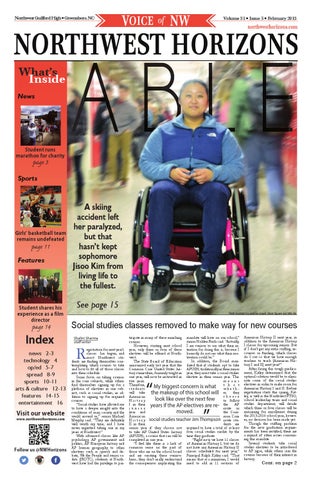
A skiing accident left her paralyzed, but that hasn’t kept sophomore Jisoo Kim from living life to the fullest. See page 15 Photo illustration by Jasmine Lenard, Nikole Nguyen and Willa Ma
Social studies classes removed to make way for new courses
ticipate in many of these enriching mandate will have on our school,” junior Holden Ruch said. “Actually, courses. However, starting next school I am curious to see what their inegistration for next year’s year, only three or four of these tention for doing this is, because I classes has begun, and electives will be offered at North- honestly do not see what their monews 2-3 tivation could be.” most Northwest stu- west. technology 4 In addition, the Board manThe State Board of Education dents are finding themselves contemplating which courses to take announced early last year that the dated that if students opt to take op/ed 5-7 and how to fit all of those classes Common Core United States his- APUSH, traditionally in their junior tory curriculum, formerly taught in year, they must take a social studies into their schedule. spread 8-9 Some focus on taking courses one year, will now be instructed in elective in their senior year. This means in the core subjects, while others two years. sports 10-11 t h a t find themselves signing up for a Therefore, arts & culture 12-13 plethora of electives in one sub- s t u d e n t s My biggest concern is what w h e t h they ject, such as social studies, in ad- will take the makeup of this school will er features 14-15 choose dition to signing up for required American look like over the next few to follow History courses. entertainment 16 AP “Social studies have allowed me I in their years if the AP electives are re- the route or to have a deeper insight into the j u n i o r moved. the Comof man, society and the year and Visit our website conditions mon Core world around us,” senior Michael American www.northwesthorizons.com Murphy said. “They are definitely H i s t o r y social studies teacher Jim Thompson route students are well worth my time, and I have II in their never regretted taking one in my senior year if they choose not required to have a total of at least to take AP United States history four social studies credits by the years at Northwest.” With advanced classes like AP (APUSH), a course that can still be time they graduate. “Right now, we have 11 classes psychology, AP government and completed in one year. “I feel like there is a lack of of American History I, but we do politics, AP European history and AP human geography to other common sense on the part of not have any American History II Follow us @NWHorizons electives such as speech and de- those who are on the school board classes scheduled for next year,” bate, We the People and junior ca- and are creating these curricu- Principal Ralph Kitley said. “That means that at a minimum, I would lums; they don’t really northwesthorizons.com understand detsNorthwest (JROTC), students NorthLike us: Northwest Horizons Follow us: @NWHorizons Like us: Horizons Likeat us: Northwest Horizons : @NWHorizons Follow us: hwhorizons Follow us: hwhorizons Follow us: hwhorizons northwesthorizons.com west have had the privilege to par- the consequences implicating this need to add in 11 sections of
Shalini Sharma staff writer
R
“
”
American History II next year, in addition to the American History I classes for upcoming juniors. But if I don’t get any extra staffing, resources or funding, which classes do I cut so that we have enough teachers to teach [American History I and II] next year?” After facing this tough predicament, Kitley determined that the optimal solution would be to eliminate some of the social studies electives in order to make room for American History I and II. Before registration starts this spring, Kitley, as well as the Northwest PTSO, school leadership team and social studies department, will decide which three or four classes will be remaining for enrollment during the 2015-2016 school year; however, no decision has been made yet. Though the staffing problem for the new graduation requirements has been rectified, there are a myriad of other issues concerning this mandate. Several students take social studies electives to be introduced to AP rigor, while others join the courses because of their interest in history.
northwesthorizons.com Cont. on page 2
Page 2
February 2015
State of Our Schools: How GCS is progressing
Jenny Blackburn staff writer
T
he State of Our Schools meeting was held downtown Jan. 22 at the Carolina Theatre. During this well-planned event, reporters were on the scene to interview various administrators and business leaders and hear the strategic plan for the Guilford County School system. Superintendent Maurice “Mo” Green mentioned the five markers of academic achievement and character development for appropriate progress: 1. Graduation rate: In 2014, the graduation rate was at 88.5 percent which was higher than state rate of 83.8 percent. 2. ACT (American College Test): All juniors are provided with the opportunity to take the standardized test. 3. College Courses: In 2014, 35% of GCS students were able to earn college credit through AP or IB testing. 4. Industry certification: ACT WorkKeys, a national credential assessment, increased from 3,000 to 4,600. 5. Character Education: Service Learning was at its highest level ever in 2014
with 914 participants. Green discussed Guilford County’s strategic plan of personalizing learning, closing the achievement gap, and community partnerships. Dealing with years of budget cuts, business and community alliances are necessary for student success. One particular organization, Say Yes to Education, may choose GCS to be the next Say Yes community and provide every student access and financial support in completing a college or postsecondary education. In addition to the funding challenges, Superintendent Green discussed the school board’s concern over the state wide school performance grading scale that will soon be introduced. All schools will be given a grade of A-F based on exam proficiency and student growth. The change in testing standards with the implementation of Common Core has caused the proficiency levels of all schools to drop significantly. The Board of Education passed a resolution calling for a repeal of this legislation. Green believes this labelling is ill advised. The meeting concluded with a reminder for school funding, thanks to the many community, faith and business partners and a final quote: “When children’s futures are at stake there is no room for complacency. Our children deserve excellence, and GCS intends to deliver.”
GCS Choice Showcase presents alternatives to traditional school Alexis Marvin staff writer
T
he GCS Choice Showcase took place Jan. 24 at the Greensboro Coliseum Special Events Center. At this event, GCS students and families were able to explore all the available options to traditional schooling by learning more about the 54 application-based magnet programs available within GCS. The crowd of people in attendance all moved forward in a wave, each person eagerly waiting to speak with representatives from the different schools. Students themselves weaved through the crowd and spoke on behalf of their desires for alternative public schooling. Although Northwest may arguably be the best high school in the district, there are still numerous high schools to choose from for middle school students and even high school transfers. GCS offers magnet and high school options that feature 14 different areas of career and technical education. Some of the alternative choices include: •Early/Middle Colleges at GTCC Greensboro, Jamestown and High Point: The Middle College at GTCC offers students a more relaxed schedule with a later start to the day and less work for students who struggle in a regular classroom setting. The Early College offers a more rigorous schedule. Both programs allow students two years of college credit by graduation. •Andrews Aviation Academy: This is one of only 50 high school aviation pro-
grams in the United States. The school also offers college credit with tuition and books included, student-assigned laptops, an annual trip to the Air & Space Museum in Washington, DC, job shadowing opportunities and scholarships. •Andrews Early College Academy of Health Sciences: Students in the program complete a intense high school curriculum during their first three years of high school to prepare them for dual enrollment as high school seniors. During the student’s senior year, he or she is awarded a scholarship equivalent to tuition and books at GTCC. Andrews Early College of Health Sciences offers an opportunity for motivated students to prepare for a future career in the field of health sciences to include nursing, biotechnology, respiratory therapy, physical therapy, pharmacy or medicine •Page IB/Grimsley IB: The International Baccalaureate (IB) Program encourages both personal and academic achievement, challenging students to excel in their studies and in their personal development. •Dudley Academy: Dudley High School provides a nurturing environment that prepares students for the transition from high school to college. Students are given the opportunity to explore various curricula in vocational and extended core classes. •The AP Academy at Western: This program allows students challenging advanced classes with a chance to take exams at the end of the year to earn college credit. •Weaver Academy: A school for the arts, students can audition for either dance, theater or singing while exploring other studies at the school.
Social studies, cont. from page 1 Whatever the reason may be, once the variety and the number of electives available will recede, some kids may see a reduction in their GPA when they are forced to take classes in a subject in which they are not as strong. “My biggest concern is what the makeup of this school will look like over the next few years if the AP electives are removed,” AP European history teacher Jim Thompson said. “Kids that want to get into Duke, Chapel Hill or State, for example, will have to decide, now more than ever, if they should go to a school like Early College, where more AP classes would be offered than at Northwest, in order to distinguish themselves among competitors.” In fact, AP social studies classes are specifically designed by AP Central as the best way to introduce students to the pace of college classes in a high school environment. If the decision to remove these courses is made, more than a decline in GPA could affect students. “As a parent in the Northwest community, I believe my daughter should be able to have a college-like experience in these AP courses, and to have the opportunity to be able to learn as much as she possibly can so she is ready for college and ready for life; however, now, that opportunity might not be available for her,” Thompson said. “It’s a shame. All of it is a shame.” Moreover, students tend to find their “family” in social studies electives, like speech and debate, JROTC and We the People. Though it is still undecided whether these courses will be affected, losing these electives could possibly hinder students’ abilities to fit in and find their sense of unity at school. “I totally understand. [Social studies electives], like art electives, are where kids find their niche,” Kitley said. “Those are the ‘fun’ classes that motivate kids to come to school and help them do better in school overall. That is why this unfunded mandate is so unfortunate. All it does is hurt kids.” Each subject influences the way students perceive and behave in the world. Speech and debate teacher Scott Bennett realizes the impact social studies has on the development of a student, and how that may change if any of the electives are to be removed. “Social studies doesn’t have a monopoly on teaching unique skills, but many Northwest students have a particular passion for digging into politics, economics, history, psychology and current events,” Bennett said. “In an optimal educational climate, we would be able to offer such a variety of courses that would satisfy this passion and curiosity. When electives in any discipline are cut, students lose these vehicles to explore and develop.” Graphic by Willa Ma
Page 3
February 2015
26.2 for Guatemala: ‘Bandsintown’ helps teens Senior trains for marathon to support youth education
Paige Nehls staff writer
L
Scan here to donate to VisionTrust
Photo contributed by Jake Strauss
Senior Jake Strauss has been a runner for Northwest’s track and cross-country teams since his freshman year, but has taken a break to train personally for a marathon in March. His purpose is to raise money for Guatemalan education through the organization VisionTrust.
ast summer, senior Jake Strauss went to Guatemala on a mission trip organized by VisionTrust, a nonprofit organization. While there, he visited the municipality of Villa Canales. Strauss was able to meet some of those citizens, most of whom didn’t have access to adequate schooling. As a result of what he witnessed during his stay, he decided to help make education more accessible to the people he met by raising money to pay teachers. Strauss will be running the Tobacco Road Marathon in Carey, North Carolina, March 15. He self-titled his run “26.2 for Guatemala.” “For the past couple of years I’ve wanted to run a marathon,” Strauss said. “I started running in seventh grade for track, and I just fell in love with it. [To train] for the marathon, I’m following a training plan that recommends how many miles you should run every day.” Although running a marathon would be accomplishment enough for many, Strauss also plans on raising $2,000 before his run to send back to Villa Canales. “[The people] there are really struggling. They’re surrounded by poverty,” Strauss said. “VisionTrust is trying to set up a learning center there because right now they just have a feeding program for the children. They want to be able to both feed and [educate] the children to [secure] their future.” Cruz Blanca, where Strauss went for his mission trip, had already received years of support from VisionTrust. The programs they used to reduce the level of destitution in the area proved to be effective and long-lasting. When Strauss left Guatemala, he realized that although he witnessed the destitution in Villa Canales, he hadn’t done anything about it. “When we left Villa Canales, it resonated with me that we didn’t actually do anything there, and there are so many kids that need help,” Strauss said. “I had always wanted to run a marathon, so a couple of months ago I just [thought] I would look into it and see if I could raise money. The learning center is basically set up, but they need money to pay teachers.” To support the education center in Villa Canales donations can be given directly to Jake Strauss, and he will send it in to VisionTrust on the donor’s behalf. Additionally, you can use the QR code to the left to make donations digitally through his fundraising page at http://visiontrust.givezooks.com.
find local concerts
Sarah Colby & Satoria Ray
news editor & staff writer
E
ver listen to an artist and crave to see them live, only to find out that they just had a concert in your area and you missed it? This problem can be alleviated. “My sister told me to get [the app Bandsintown],” senior Emma Halchin said. Bandsintown Concerts is a free app that allows users to discover concerts near them. The app is available on iOS and Android devices. It allows fans to track their favorite artists and receive notifications when they are in town. “It’s made it so much easier because you don’t have to look through pages on the artist’s site to possibly find your venue,” Halchin said. Junior Mac Renslow agrees. “I don’t use it that much, but it has all types of music and highlights the popular stuff,” Renslow said. The app will scan users’ music library then it shows concert dates for the artists that they have on their phone, as well as similar artists. “I’ve seen some bands on there that sound interesting, but I’ve either listened to a lot of them or they’re not my taste,” Halchin said. “It syncs with your music library,
so it’s pretty on point.” The app has various features, like “RSVP” so that fans can see other people that are attending the show. It also provides users with ticket prices, the line up for the show and the venue. “It’ll tell you a band’s whole schedule— like where they’re going on tour and when,” Renslow said. There is Bandsintown Manager which is the version of the app for artists. It allows them to show tour dates, promote events and have direct interaction with their fans. Once an artist puts the date of their show into Bandsintown Manager, it is turned into a Facebook event that can then be synced to Twitter, Tumblr and other personal websites. There is an Auto Promote feature that will send concert reminders to fans periodically as well. Shakira, Coldplay and Skillrex are just a few artists who use Bandsintown Manager. Renslow is not enthusiastic of this feature. “I usually find the bands and then look up their schedule,” Renslow said. “It’s hard to search people and know what kind of genre they are.” Halchin, however, is an advocate for this app. “I love that I don’t have to search Google for 10 years to find a band, and that it tells you how many people are going or if any of my friends are,” Halchin said.
Photo by Sarah Colby
The Black Keys performed at the PNC Arena in Raleigh, Dec. 5. Many other bands’ performances such as this one can be found using the Bandsintown app.
Page 4
February 2015
A new vision for the future Developments in virtual reality technology allow people to see the world in a new manner
William Royal staff writer
T
he year is 2015 and we are closer than ever to the “stuff ” of science fiction. Technology you would see on a Star Trek episode from the 1960s may soon be attainable in the very near future. “Anything that is technology-oriented is never going to be ‘there’,” physics teacher Rice Strange said. “[Technology] will continue to evolve in its uses and adapt to other applications.” However, Virtual Reality (VR) technology has recently gained popularity among many, ranging from game developers to Glass Explorers at Google to gamers. The possibilities are exciting, allowing us to do a variety of activities like playing video games and getting directions in real-time. Three examples of VR tech have surfaced recently: Oculus Rift, Google Glass and Project Morpheus. “I don’t really see that much use in Virtual Reality,” said junior Alex Kenion. “Virtual Reality is only being used for gaming. It’s currently not really being used for anything practical.” Oculus Rift is a set of gaming equipment that is composed of goggles and head tracking technology. There is even a treadmill-like platform you can stand on while using the device, which gives you the feel of virtual
running. Inside the goggles is an OLED (organic light-emitting diode) displays, and you can use everyday game controllers like an Xbox or Playstation gamepad to execute commands in the game. “The Oculus Rift is a new virtual reality headset that lets players step inside their favorite games and virtual worlds,” Oculus VR says on its website. “The combination of the wide field of view with head-tracking and stereoscopic 3D creates an immersive virtual reality experience.” Although the Oculus Rift has some useful functions in everyday life and gaming, it does have some drawbacks. It is intended for developers and carries a hefty price tag of $350. Users have also reported seeing the pixels in the display, which ruins the feel of VR. Another piece of VR technology making the news is Google Glass. Google Glass is a pair of glasses manufactured by Foxconn that has an amazing amount of potential for future use. You can take a picture or a 720p video with a blink of your eye, get directions on the fly, chat with a friend using Google Hangouts, send an e-mail, scan QR codes and much more. There is a touchpad on the side of the device, used to navigate the device’s menu and perform functions. Unlike the Oculus Rift, Google Glass uses a Liquid Crystal on
Silicon LED display. Even the medical community has begun to test Google Glass. However, with prices ranging from $300$1500, the demand just isn’t here yet. In addition to the previously mentioned VR tech, Project Morpheus is a codename for a recent endeavor by Sony into the VR industry. First announced by Sony at the 2014 Game Developer’s Conference in San Francisco, Project Morpheus is a pair of goggles that is designed for use with Sony’s Playstation 4 console. The device features stereoscopic 3D, high FOV (Field-Of-View), and output to a TV so that others may watch what the wearer sees. Of all the devices, Sony’s Project Morpheus seems the most promising due to the large number of features like the Stereoscopic 3D, output to a TV and a powerful console in which to use the device. Sony is the kind of business that could really land this piece of VR tech on shelves in as little as three years. Virtual Reality even has some major foothold in our nation’s military. Since the 1980s, different branches of the U.S. military have been testing different variants of VR tech. “I could see Virtual Reality being useful for training [purposes],” said Kenion. “I really don’t want our military being too dependent on Virtual Reality.”
In the Marines, the Future Immersive Training Environment (FITE) is a common training method which allows a soldier to have full awareness of his squadmates to enemy combatants in a 3D environment. All of this is possible with goggles and motion tracking technology. The Navy has parachute simulations, the Army has combat training like FITE, and the Air Force has realistic flight simulators. “Any time you are able to put together a training environment where you remove inherent risks before you put somebody in real danger, then that’s a plus,” Strange said. “It’s an idea that NASA started with the Apollo missions.” Systems like Oculus Rift, Google Glass, Project Morpheus and FITE all have different applications and goals, but they are unified in a central aspect: they allow us to modify our bodies and minds in an effort to prepare us with what life will throw at us. From an average pedestrian taking a video to a soldier immersing himself in an Urban Combat scenario, VR is a step in the right direction towards a new horizon of technological applications and the future. Graphic by Nikole Nguyen
Since its invention in the late 20th century, virtual reality has played an increasing role in aircraft safety, military training and soon, daily lives. This graphic, inspired by Oculus Rift and Google Glass, depicts a futuristic city through a pair of glasses.
Drone industry takes off, targets the commercial market Bassam Bikdash science and technology editor
M
ilitary-purposed technology has once again entered the domestic and commercial world, and this time it has landed in the form of drones. These commercialized drones or Unmanned Aerial Vehicles (UAVs) were absolutely abuzz at the Consumer Electronics Show (CES) from Jan. 6 to 9 in Las Vegas, Nevada. The convention acts as a sneak peek for next generation innovations as they are introduced to the global marketplace. “Typically, drones are used for surveillance and reconnaissance in the military and recreation for civilians,” junior Collin Kilmartin said. Most commonly, drones in the media have referred to heavy Reaper drones armed with high definition cameras and powerful missiles and capable of flying long distances for reconnaissance, surveillance and tactical missions by a remote operator. The technology has evolved into the small quadcopters we see today. The most common commercial drones are small and use a set of four rotors to hover and propel themselves through the air.
They are typically controlled with a remote or smart phone or they can be programmed to follow a predetermined flight path with little to no human intervention. Currently, drones are relatively cheap with prices ranging from $50 to $1,300 for high quality drones used by professionals. “I think drones have the potential to be versatile tools; however, their ease of access means they can be abused by individuals,” senior Eric Ceron said. The applications of small commercial drones are seemingly endless. They can be used to produce stunning photorealistic 3D renderings of buildings. Retail giant Amazon is experimenting with drones as a possible method of delivering small packages. There is an appeal to farmers, as well, since drones can be used to more accurately apply pesticide, saving money and reducing environmental impact. Along with other useful applications, the technology has taken selfies to a whole new level. “From a filming perspective, drones are useful because they can be used to get different, hard-to-get angles,” junior Forest Chilton said. The industry is likely to take off accord-
ing to a CBS News report, where the nonmilitary drone industry is expected to top $13.5 billion in the next three years and will grow to more than $80 billion between 2015 and 2025. Despite its benefits, the main obstacle preventing greater commercialization of drones involves questions of safety and regulation. In the U.S., the Federal Aviation Authority’s (FAA) stance from 2006 has been that such commercial activity is illegal. However, in a court case between Pirker and the FAA March 6, 2014, a judge ruled against the FAA’s claims, effectively affirming that model aircraft are not covered by FAA rules. Other concerns arise about privacy violations as a result of people using drones to spy on other people since most of the aircraft are equipped with cameras. “I think that drones do pose a privacy threat because they can be used by anyone which means their surveillance capability can be abused,” Ceron said. “If drones are used by trained individuals then the privacy and safety threat that they pose is minimal.” Despite these consequences, drones and their applications in the real world are unlikely to decrease as their industry surges forward.
Photos contributed by Forest Chilton
The DJI Phantom Aerial UAV Drone Quadcopter (pictured) is one of the many drones currently available for commercial purchase. It is controlled via a remote control and includes a mount for a GoPro camera.
February 2015
Page 5
Befriending an age-old foe:
U.S. normalizing relations with Cuba
who have a high state in Florida—I think they’ll be difficult,” Connor said. “Plus the fact that it was done by Obama, I think that simply because of the fact that it’s Obama, they’ll try to limit executive power.” Critics of Obama’s policy argue that Obama is rewarding President Raul Castro, even though Cuba’s Communist regime is still in place, and while Obama understands their reasoning, he says he believes this is the best step the U.S. can take. “I respect your passion and share your commitment to liberty and democracy,”
Obama said, addressing his critics in his announcement. “The question is how we uphold that commitment. I do not believe we can keep doing the same thing for over five decades and expect a different result.” Obama offers a compelling argument: there will not be a change if we continue on the path of isolation like we have for the past 50 years. If we ease restrictions on trade and travel, however, Cuba’s economy will improve immensely and, as a result, so will the lives of its people. “Across the board if you want people in the country to go towards capitalism you need to introduce that,” Connor said. “It allows for innovation; show them how it will lead to a better economy.” While the U.S. government is reluctant to take action until the intentions of the Cuban government are confirmed, the embargo will most likely be lifted at some point in the future, and such a great change will impact the lives of the Cuban people regardless of if Castro intends to take steps toward democracy. Cubans will be able to experience capitalism, and as the Castro regime is possibly nearing its end as the younger of the brothers is now 83, the people may be calling for change by the time a new ruler is in power. Although change in Cuba may not be evident within the next few years, normalizing relations between the United States and Cuba provides far more potential for a better Cuban society and government in the future. “Today we are making these changes because it is the right thing to do,” Obama said. “Today, America chooses to cut loose the shackles of the past so as to reach for a better future—for the Cuban people, for the American people, for our entire hemisphere, and for the world.”
open computer in the library or the computer lab. Northwest Horizons was given permission to keep and use the old computers to an extent. The staff can only use Microsoft Word on them. This is extremely difficult for an award-winning newspaper and a staff of 27. As the school newspaper, it’s fundamental to have computers available for research, writing articles, working on the pages’ design on programs such as InDesign and Photoshop and maintaining our website. Not only that, but we compete with other papers across the state and country, and in order to win and bring home prestigious awards to Northwest, it’s difficult to do so when we lack the necessary technology needed to create
our paper. Although we do understand there was very little we could do to keep the computers, there is still a sense of under appreciation for what we do. As young and aspiring journalists, we aspire to provide our student body with moving stories, to inform them of breaking news, to provoke thoughts through our opinions and to entertain with our cartoons and features stories. With the recent attack on journalists in Paris against a satirical magazine, it is more important now, than ever, to continue to be daring and courageous journalists. And in this world full of information, despite having fewer resources, Northwest Horizons will continue to inspire and stand up for past, present and future journalists.
Liz Hubbard arts and culture editor
A
fter nearly 54 years of hostile relations, President Obama announced in mid-December his plans for normalizing the relationship between Cuba and the United States. “I believe that we can do more to support the Cuban people and promote our values through engagement,” Obama said in his announcement of the new policy. “These 50 years have shown that isolation has not worked. It’s time for a new approach.” Obama’s plans for change came shortly after his negotiation Dec. 16 for the release of American prisoner Alan Gross along with a Cuban individual who assisted the U.S. in convicting several Cuban intelligence operatives—three of whom were returned to Cuba as part of the agreement. This was the first presidential engagement between the U.S. and Cuba in more than 50 years, and areas of potential cooperation between the two nations were also discussed. Although there may not be an immediate change in Cuba’s human rights record, Obama hopes that by normalizing relations, the United States will be more capable of influencing their government in the long run. “I don’t think we’ll see success right away; it’ll come with time,” social studies teacher Kate Connor said. “Ultimately, I think the hope would be better job opportunities and ability for [Cuban citizens] to travel more easily.” Along with plans to re-establish diplomatic relations with Cuba, Obama has also announced that his administration will be working to lift restrictions on commerce, travel and banking. The largest obstacle in normalizing re-
Graphic by Sarah Colby
Both the American and Cuban flags are shaking hands. Obama has reopened discussing relations with Cuba for the first time since the Cold War.
lations will be the embargo that has been in place for more than 50 years. It is upheld by law and can only legally be lifted by Congress. As of January 2015, both chambers of Congress are being controlled by Republicans, and, unfortunately for Obama and his supporters, most Republicans are opposed to normalizing relations with Cuba and have pledged to block all efforts to lift the embargo, as well as blocking funds for an embassy and the confirmation of an ambassador. “We have the Republican House, and I think there are especially people like Marco Rubio
staff editorial
W
hat is journalism? Journalism is the occupation of reporting, writing, editing, photographing or broadcasting news and conducting any news organization as a business, in its conventional definition. But, it’s so much more. Northwest Horizons has been Northwest’s official high school paper for eight years and has made huge leaps since reconstructing the school’s former paper, The Northwest Express, in 2007. Throughout its eight years, Northwest Horizons has received awards for its layout, design and stories written by our dedicated staff at national, regional and state conventions. In 2012 and 2013, Northwest Horizons received the Tar Heel Award, the most prestigious award given to a high school pa-
per in North Carolina, from the North Carolina Scholastic Media Association. With all its accomplishments, our paper has continued to grow in so many ways to create the best publication it can for its audience—Northwest’s students and faculty. This year our staff increased in size. We also expanded and updated our website, giving it a new and modern look. However, we have also been downsized. Our staff has lost four valuable computers that provided us with printing abilities and access to the Internet due to a Guilford County contract with Dell. Only one computer with access to the Internet and the capability to print is left. Now imagine 27 passionate and dedicated journalists fighting for that computer. After that fight, the others are forced to search for an
NORTHWEST Editor in Chief Willa Ma Managing Editor Lindsey McGuirk News Editor Sarah Colby Op/Ed Editor Jackson Parrish Spread Editor Mackenzie Mitchell Sports Editor Sarah Boggins Features Editor Clare Kilmartin Graphics Editor Nikole Nguyen
Staff Writers Jenny Blackburn Annie Ford Science & Technology Melanie Jenkins Editor Bassam Bikdash Alexis Marvin Harley Nefe Entertainment Editor Paige Nehls Nick Loschin Katie Lee Parrish Webmaster Satoria Ray Noah McCormick Faith Rickerts Tech Support William Royal Austin Drake Alexis Rutledge Adviser Melanie Huynh-Duc Shalini Sharma Lilac Rain Thompson Principal Ralph Kitley Sophie Vazquez Arts & Culture Editor Liz Hubbard
HORIZONS Policies and Intent
Serving as the primary printed and online forum for student opinion, Northwest Horizons publishes five issues each year by the staff at Northwest Guilford High School. The paper is supported through community advertisers. Staff Editorials are unsigned. The stance of each editorial is voted upon in staff meetings, but it requires the approval of the majority of the editorial board. All members of the school community are encouraged to use Northwest Horizons to express their views. Letters must be signed when submitted. Northwest Horizons Northwest Guilford High School 5240 NW School Road Greensboro, NC 27409
Find us online: @NWHorizons
Visit our website: www.northwesthorizons.com
Page 6
February 2015
HEAD-2-HEAD iTunes
vs
Spotify
Graphics by Mackenzie Mitchell
Mackenzie Mitchell spread editor
A
pple’s iTunes has been a leading music application ever since its launch in 2001, but over the years it has met competition with other major markets such as Amazon Music, Pandora, Google Play Music, Beats Music and, possibly its biggest rival yet, Spotify. With over 800 million iTunes users today, it is the world’s most popular music store and has been a revolutionary way to purchase media of all kinds. “iTunes has a lot of variety of music and other things, such as movies, music videos and games,” sophomore Ralph Wierwille said. The numbers and the diversity are impressive: more than 40,000 music videos, 3,000 television shows, 50,000 audiobooks, 45,000 movies, more than one million podcasts and a staggering 43 million songs available for download. Spotify holds 30 million songs and no other media of any sort. “iTunes is easy to understand and download stuff,” freshman Joe Duffy said. “My mom can do it, and she barely knows how to work her own phone, so that’s pretty good.” iTunes easily allows you to create an account on any device, absolutely free, thus being able to purchase music, games, movies and more all at your own will. A Spotify account is free, but if you want to rid yourself of the many limitations, you’ll have to pay about $10 per month for a premium subscription. But even then, will you be able to safely download music for your own use? Unfortunately not. First of all, the two music apps are very different in the way a user is able to play music. iTunes requires purchase and Spotify requires data usage—extreme data usage, if you will. The reason for this is 3G streaming. Spotify uses 1.2 to 2.4 MB per minute of mobile streaming, so for one three-minute song, that’s about 3.6 to 7.2 MB. With a one GB plan, that’s only 14 hours of streaming per month, a two GB plan is 28 hours, and so on. Upon purchasing a premium membership, the number of songs you can keep in each device’s Spotify library are limited to 1,333. Only about four to five MB are needed to download a song via iTunes, and after that is done, there is absolutely no further data usage when simply listening to the songs you’ve downloaded to your library. The only limit to the number of songs you can store on your devices, therefore, is your device’s storage capacity. One iTunes sale is worth about 33 streams on Spotify; therefore, artists are more directly influenced with your purchase on iTunes. “iTunes pays artists more than Spotify does,” senior Richard Jimbo said. According to Yahoo! Music, Taylor Swift pulled her music from Spotify because she felt that it did not “fairly compensate the
writers [of songs],” and she does not support the idea that “music has no value and should be free.” A definite plus to using an iTunes account is that you are able to upload the CDs from your childhood and your parents’ old music collection straight into your library. “You don’t always have your CD on you; you have your digital library,” Jimbo said. A premium membership on Spotify allows you to sync music that is then “available offline” and listen without advertisements. Those are nearly the only benefits to paying for a membership that isn’t even guaranteed to be safe. What does that mean? There is a huge glitch about which many Spotify users have complained. If you sync music for offline listening to more than three devices, all of your personalized playlists will be erased. If you leave Spotify in offline mode on any device for over 20 days, your music will be eradicated from each of your devices. Gone. Never to be restored. On the other hand, with iTunes, it takes a little more effort to completely wipe your entire music library. Even if you accidentally do so on one device (or that device crashes, etc.), your media library is still available on any of your other mobile accessories, giving you much more serenity and security. iTunes music and other media can easily be moved to other devices, and your library is always safe, secure and ready when you need it. It also gives each user the freedom of trying different music services without losing music along the way. It is possible to import some of your iTunes songs to a Spotify playlist, but it is impossible to export your Spotify music to your device’s music library. If you decide to quit iTunes and download music from other applications, the songs you’ve downloaded onto your library from iTunes will still be there, not to be lost. However, if you’ve synced music over Spotify but you decided to move on from the site, absolutely nothing you’ve “saved” is actually available for use. The most probable reasoning behind this inability for users to export their Spotify music is the desire to keep users trapped in the site; once you pay for a premium membership and create playlists, you are bonded to this invisible contract. In fear of losing your valuable music and playlists, you blindly let Spotify take your money. Whether you are a non-paying or premium member of Spotify, you are taking a risk; the longer you use it and spend hours upon hours finding music and creating playlists, the more of a threat it is to you if the app is suddenly shut down or a glitch occurs; you would lose everything. Your iTunes library contains songs you purchase and own on your phone’s, tablet’s, computer’s, etc., hard drive, not to be deleted upon some unforeseen circumstance. There is definitely a safety in spending your money on music for these reasons. Apple’s music innovation becomes much more of an option for people who value their data usage, music and peace of mind.
Noah McCormick web master
N
ever in the course of human history has the art of music played a bigger role in our society than it does today. Nearly everyone that you meet will claim that it’s a necessity to inspire and aid us through our daily lives. As a result, shouldn’t this key cultural element be as accessible to people as possible? Well, Spotify is making that happen. “I absolutely love Spotify,” senior Corey Wilson said. “It lets me listen to all the music I want without having to break the bank in doing so.” However, now more than ever, there is much controversy regarding the justifications of Spotify’s streaming service. Even with its 10 million paid subscribers, some don’t believe their artists are receiving the proper compensation for their work. By the numbers, consumers must pay up to $1.30 to download a single song to their device using iTunes or Amazon, while for $9.99 a month, you can stream and download an unlimited amount of songs via Spotify. It’s clear that for a music lover like myself, Spotify is a significantly better deal, but the profit margins that artists receive don’t look so pretty. I could sugarcoat it as much as possible, but simply put, rising/aspiring musicians cannot expect to make a living off of the money they make from Spotify. In comparison, when an artist’s track on Spotify plays roughly 5,000 times, they will earn approximately $20 for their work, as with iTunes, they make a fraction of the price from each purchase made. In reality, though, isn’t it more gratifying for one’s music to reach as many people as possible as opposed to the personal money gained from it? The Merriam Webster’s Dictionary defines art as: something that is created with imagination and skill that expresses important ideas or feelings to others. Junior Daniel Amparo agrees. “I don’t see how Spotify is really in the wrong here,” Amparo said. “Its service helps millions of people enjoy the music they can’t afford any other way in a fluent and legal process.” Regarding its accessibility, Spotify is initially a free streaming service with the addition of advertisements. From there, you are given the option of upgrading to “premium” for $9.99 a month. This allows you to listen to whatever you like on any device without ads. It’s on nearly every television sold in America today to meet its own demand while iTunes sticks to its Apple “counterpart.” Spotify’s unique pricing system has proven itself remarkably effective by generating more money than its streaming competitors such as Pandora, SiriusXM, Slacker and iHeartRadio over the course of nine years, being valued at $4 billon by Bloomberg Business Week.
Though you could argue the victor between Spotify and iTunes for days, Spotify unquestionably triumphs in the user-interface category. Receiving frequent updates, the operating system is constantly renewed to match the facile gestures and layout of its current platform. You can easily swipe vertically and horizontally to browse through your gargantuan library of playlists, artists, genres and albums without having to stretch the comfort out of your thumb. Thus Spotify is a user-friendly experience with one hand. On the contrary, iTunes forces you to navigate through its “fluid” application by finding tiny icons and utilizing unresponsive gestures. Sorry, iTunes, but no landscape exhibit of cover art will prevent me from switching. Additionally, on no other music source are you able to customize the sound you listen to with an equalizer and other dynamic settings. The app’s features allow you to alter the amount of bass, treble, quality and crossfade in between tracks. “Having devoted my life to music, it amazes me how much I can adjust the settings on my phone to get the sound I want,” local guitar instructor Jeff Swanson said. “After awhile, you forget to care that you’re spending $10 on something so versatile.” And once you find you’re “song-of-a-lifetime” in the 80-million track library, Spotify lets you share your excitement with their incredible social integration. Not to mention Spotify’s “radio” feature. It works just like Pandora, except for the ads (with a premium subscription), allowing you to browse and listen to new titles in a more simplistic fashion than iTunes Radio. But wait, there’s more. Additionally, you can filter your search through not only genres, but “moods” as well. For example, Spotify knows exactly what you’re looking for when it’s time for you to raise the roof or kick back with some slow jazz. With over 30 categories, you won’t be let down. Ironically, some of the most successful artists in the business are making a stand against all streaming services since their lack in payment is supposedly “killing the music industry.” Hypothetically speaking, if Taylor Swift decided to keep her music on Spotify, it’s not like her prolific record deals or world tours would make up for the slightly less amount of money she’d be generating otherwise. Some artists agree with these claims, portraying that the [continuously] rising song prices on iTunes is a more rational alternative. Fortunately, in recent years, they’re beginning to fall into the minority of sourcing preferences. Although, with today’s dynamically influential demographic, anything can happen. At the end of the day, living as a musician isn’t something you should do for the money; that simply degrades everything artistry stands for. But when big names and role models use hierarchical diffusion in an attempt to light some sort of “movement,” the music industry truly suffers.
Page 7
February 2015
Man on the Street: Student opinions on a woman presidency Sarah Boggins sports editor any nations in the world, like England and Germany, have become very successful because of a female leader. Why hasn’t the United States had this experience? “Women’s rights were delayed for a long time, therefore delaying women from running for president,” junior Nick Peaslee said. “Also, not many women have really made a strong run at president.” Women did not gain their right to vote until 1890 – this suffrage for women was
M
only granted in the Wyoming constitution at first. It is true that women have not given as much effort as men when it comes to running for president, but it is also true that it is much harder for women to find these leadership positions in today’s society. One of many reasons is our image in the media. “It’s hard to escape stereotypes,” sophomore Isabelle Holmes said. “The women we have had [in leadership positions] are usually mocked in the media.” One accusation people have made restricting popularity for a female president
“We need a feminine opinion in the White House. It can put perspective into the role of the president.”
is that women go through their menstrual cycle once a month, which could “affect” her duty as president. A poll of Northwest students reveals that three out of 10 males think a woman’s menstrual cycle will affect a her job as president, while zero out of 10 females believe this. This single characteristic of a woman’s life should not limit possible female presidents; a woman qualified enough to become president of the Untied States would not let her menstrual cycle get in the way of her job. “I think many people are opposed to [having a female president] because they
“I think it’s about time.” senior Vichelle Buck
sophomore Chris Smith
do not think America is ready for a female president,” junior Hayley Russo said. “Sadly, some people in our country believe that a president of a different gender, race or ethnicity is not fit to be president.” Next year may hold an election where a woman will run for president. The results are hard to predict, but hopefully people will start to see the benefits a female president could possess. “Yes, [I would vote for a female president],” sophomore Nathan Adams said. “I think a good leader is a good leader, regardless of sex.”
“We’ve had enough middle-aged white men controlling the country.” sophomore Jewelie Roberts Photos by Alexis Marvin
Economic success or environmental disaster? The Keystone XL Pipeline Controversy
Nick Loschin entertainment editor oth the United States and Canada have copious amounts of gas and oil pipelines that encompass miles of land; however, none have brought with them as much controversy as the Keystone XL Pipeline. With the proposal from the TransCanada Company in 2005 came a spark of protest with the effects it can make. “There already is an entire series of pipelines throughout the United States,” Environmental Science teacher Richard Thomas said. The biggest fear comes from the environmental impacts the pipeline may have if approved. For starters, the processes by which the oil is extracted either leading to deforestation mainly in the Alberta forests or toxic runoff that flows into rivers, harming biodiversity. Moreover, the petroleum being extracted holds with it far more dangers than the conventional gas and oil in the other pipelines. Though many counter arguments have the idea that America needs to become more energy efficient, the fact of the matter is that we live in a world where we live in a global economy. One decision, especially about gas, may have a disastrous effect on our economy. “It is promoting a form of fossil fuel, that in the process of extracting, shipping and burning them are even worse than oil,” Thomas said. Opponents claim that the construction
B
Graphic by Nikole Nguyen
This map shows the possible location of the proposed keystone pipeline. The project could cause potential economic benefits at the cost of environmental harms, and it is a controversial topic in Congress as well as across the nation.
of the pipeline will lead to a magnitude of jobs and overall pacify the economy; however, according to President Obama, it would only create about 2000 jobs in its construction and then maybe 100 afterwards. Even if the construction offers more jobs, they are only temporary and offer no stability to those that take them. In the long run, it is more sensible to try
and create jobs that focus on sustainable projects that offer more potential. Supporters claim that the technology does not exist for us to try and create these jobs; however, alternative energy is moving at an exponential pace with many technologies already at our fingertips. By approving the construction of the pipeline, America would take a step back rather than forward in
sustainability. As a world power, it is the United States’ responsibility to lead the way in conservation and protecting the environment. Constructing the pipeline sends the wrong message to the world with disastrous results. “Overall, the cons far outweigh the small creation of jobs, and I think it is being used as a political football,” Thomas said.
The Millennial Melancholy
Northwest reflects on 2014 and the future of this generation
Nikole Nguyen graphics editor
H
istory is taught so that the same mistakes are never repeated again. Marked with the patterns indicative of conflict, war and revolution, the year of 2014 was filled with all three. However, the question is the generation pioneering these conflicts. There are several names for them – the millennial generation, the apathetic generation, the trophy generation, and, to some, the generation of change. “I feel like this generation is stuck in the mindset that there’s always an answer to every problem,” United States history teacher Kimberly Deyton said. “Almost nothing is organic, really.” Some, like Deyton, have noted that as more standards are set and expected results are made that independent thought continues to be sacrificed in exchange. Apathy follows, and then, misinformation. “Being unable to think for oneself – I’m sure there are many still capable of doing it. But with this kind of world, that must have hurt those who were unique from the beginning,” Deyton said. Thus, when a year of protests across the world passes by, others fear for the worst. “If everyone gets in on the wrong cause, and it’s a global phenomenon – kids want to be important and want to have a cause,” English teacher Sarah Hutchinson said, “but they never research exactly what they’re fighting for.” In other words, passion has no place if it is misinformed. With hordes of children who can’t think for themselves, any
cause seems to lead them on – or so they say. “I understand human nature is flawed, but when I see so many students who are beyond themselves, and not the average teenager, just that right away says something,” AP United States history teacher Ray Parrish said. “That’s a seed planting here for a great generation.” However, the strength of this generation doesn’t lie only in a youth filled with passion, but technology and social media as well. Worldwide activism would have been impossible were it not for the help of popular websites such as Twitter, which had played its part in various protests. Various protests against the Venezuelan government and the subsequently violent ends some activists met, as well as Nigeria’s ‘Bring Back Our Girls’ campaign gained significant bouts of attention from Twitter alone. “As a generation of technology, we’re constantly striving to be more up to date on social issues and to be more intelligent and hardworking than any other generation prior to us,” junior Shannon Rigsbee said. And yet, what of the children who abuse social media, constantly texting and tweeting and snapchatting to what seems to be no end? Some students themselves have considered it abusive. “We’re so engrossed in technology these days,” junior Ashlyn Cornelius said. “It gets in the way of human relations, despite the fact that technology was designed as a research and informational network.” The millennial generation has more access to any sort of information in the world. Despite this, many argue the majority of these children hardly
know how to use it. “It’s a great thing to have access to what’s going on in the world, but with all the technology, there is entirely so much misinformation,” Hutchinson said. “There are people spouting off opinions and leading movements, but have no idea what’s really going on, and every apathetic child just jumps right on.” But at the same time, the world continues to change. Arguably, technology has matured students rather than force them backwards. “Social media makes kids grow up faster,” senior Mariyka Aubur said. “Today, the internet gives everyone a voice. A 12-year-old has the same voice as a 30-year-old online. It means we’re surrounded by information all the time, and we’re maturing faster, for better or for worse.” The beauty of social media and the technology of this generation is that the world is ever more connected to itself – people entire oceans away, connected by a simple fiber wire or a satellite signal, spreading important information from their hometown and learning of opportunities unheard of in different countries. And these people are almost always young – the millennial generation with all the blame to boot. “Human nature is always trying to be perfect, but never quite getting there,” Parrish said. “At the same time, we can see all these little patterns that have repeated many times before, leading up to something that will be so different and large.” However, are these worldwide movements and protests the results of just history, constantly repeating itself? Is there really no significance in
them at all? “Protests are always led by young people,” Deyton said. “I don’t know what it is, but in every era leading up to this one – from the founding fathers to the hippies in the ‘60s – you’ve seen it all and it’s nothing new.” Hutchinson echoes the same concerns. “I don’t think this is any different from any time in the world. It’s always been young people who have been in the majority, but it seems like it’s happening now because we’re watching it, because it’s in our world,” Hutchinson said. There are two sides to the same coin, and that is indicative of a hundred things. There is technology to tie the world in a neat string, but children too mindless to use it; the millennial generation is either impassioned or lost; that every land boundary has been crossed for young people to be connected to one another, and yet, they are so distant from their own dinner table. “Every generation is shaped by a dramatic event that shapes a whole people’s futures together,” AP government teacher Phillip Coley said. “In some ways, these protests show that young people across the world are just trying to learn about who they are.” The enigma of the millennial generation now neatly fits the title of tragic hero. A hundred contradictions later, and the answer is an identity crisis. What does the millennial generation search for, if anything at all? Technology ties the generation together, sure, but what about humanity? “We’re just looking for that definition of equality,” senior Clarisse Rodriguez said. “We’re passionate and we want to make it a worldwide
“We’re just looking for that definition of equality. We’re passionate and we want to make it a worldwide thing. We just don’t want anybody to get hurt anymore.” -senior Clarisse Rodriguez
thing. We just don’t want anybody to get hurt anymore.” But then, some students think differently. “Really, we are just a generation of overconfidence,” sophomore Ben Lenn said. The world, however, continues to turn under billions of feet, searching for an answer. In the midst of LED screens and fast food, of budding virtual reality and holograms, the millennial generation is forced upon a journey. Problems from the past fall upon their shoulders. From global warming to possible nuclear warfare to governments run by the old and ignorant, the millennial generation has been tacked with dozens of names that fall under the category of complacent and apathetic. What does it all mean in the end? “You guys are searching for your motivation, but you can’t find it. You just need a collective focus,” Coley said. “In short, I believe you guys are searching for the meaning of your existence.”
“I understand human nature is flawed, but when I see so many students who are beyond themselves, and not the average teenager, just that right away says something. That’s a seed planting here for a great generation.” -AP United States history teacher Ray Parrish
Graphic by Nikole Nguyen
Butterflies and flowers represent change and growth. As they surround an iPhone, they signify how society will evolve--hopeful for change.
Page 10
February 2015
Team Prayer: Jackson Parrish op-ed editor
T
hough public schools are usually void of strong religious expression, Northwest athletics break this norm. With traditions and customs that date back years, team prayers, in which members come together and pray collectively, represent a departure from secular ideals in public high schools. Kaitlin Brown and her teams are perfect examples of this departure. “Team prayers are a regular occurrence for the girls field hockey
and lacrosse teams,” coach Kaitlin Brown said. “Before every game, both teams circle up and say the Our Father. The prayer is usually the last thing that happens before the girls take the field.” Though not many have taken issue with in-team prayer during practices and before and after games, the doctrine separation of church and state has clearly been taken to mean that public school and religious practices should be individual worlds with few exceptions. In the Supreme Court case Santa Fe Independent School District v. Jane Doe (2000), for example, student led prayers before football games were ruled uncon-
The tradition of divine reverence in Northwest athletics
stitutional and determined to be a coercion of students into following one specific religion. Teams like those of Brown break this wall of separation when they pray, and the effects include a strong unification of team members in a unique way. “Praying together before games is a great way for the girls to bond spiritually,” Brown said. “I am an advocate for team bonding, and I do my best coordinating outside events, but team prayer is something the older girls lead and it is wonderful to see their passion for prayer carry on from year to year.” Team prayers don’t just benefit the players, however. The coaches,
life is like for coaches Behind the net: Whatand their spouses than being preoccupied with guilt for not always being around. “You feel torn in which way you should go,” Burdzy said. “To have a uring a sports season, spouse support you, it just changes most people give all the everything.” glory to the coaches Before becoming a physical and their endeavors. While their education educator at Northwest, feats are noteworthy, the majority coach Randall Alexander lived of people forget about those that at Lincoln Green Apartments in stand in the background to support Greensboro. It was there, while dothe coaches. ing laundry, where Alexander met Basketball and volleyball coach his future wife, Laura. Darlene Joyner has coached her fair When Alexshare of sports. ander came to “I did softball Northwest 10 for probably 15 or years ago, he 19 years,” Joyner started coachsaid. “Cross couning the boys’ try, tennis, boys and girls’ tentrack and girls nis teams. Since track.” tennis is a sport But standing where there is behind her, and no maximum in some cases, on play time, many the bench beside of the games her, is Joyner’s high end when it is school sweetheart, dark. Bobby Joyner. “[Laura] has Joyner met her no complaints husband at Northabout me comwest when she ing home late at was a junior; they dated and have Photo contributed by Randy Alexander night,” Alexanbeen married for Coach Randy Alexander and his wife Laura pose for a picture while on vaca- der said. “[She] has no complaints 34 years. He is now tion. They have been married for 34 years. about practices; the assistant coach she’s always askfor the varsity girl’s cheerleading team, and her hus- ing what the score was.” basketball team. “He’s just a huge fan of North- band supported her while she was Being the coach of a team is no easy feat. Having a spouse that west, myself, and athletes in gen- the coach. “He came to the games,” helps out, makes all the work the eral,” Joyner said. Joyner and her husband have Burdzy said. “[He] would bring me coaches put into the team worth it. two kids, and their lives have re- coffee because I’d been up all day; “As a marriage, whenever you volved around the sports season. he would bring the girls coffee. It have things in common and you share a common passion, it’s a lot Bobby Joyner was an athlete him- was very much like a family.” self and understands how taxing Like Joyner, having her hus- easier to hang out with each other being the head coach of a team can band’s support made it easier for outside of what you already have,” her to focus on coaching rather Joyner said. be.
Lindsey McGuirk managing editor
D
“He’s been around it all his life,” Joyner said. “He encourages not only myself, but also the kids as well.” Science teacher Diana Burdzy worked as a nurse at the Wesley Long Emergency room. It was there where she met her husband of 22 years, an electrician named Joe. After quitting her job as a nurse, Burdzy came to Northwest and was at one point the cheerleading coach for the JV and varsity
Quick Facts:
Northwest students share their favorite sports brands
in seeing their players unified, are significantly impacted upon when their team comes together in such a powerful way. “I enjoy stepping back and taking it all in,” Brown said. “It is a special moment before every game, and each prayer is very unique from year to year due to the different players that make up the teams. It is the best 30 seconds to remind me of why I do what I do.” Some, on the other hand, though taking no issue with team prayer, find independent times of religious reverence more meaningful than team-wide prayers. “[The football team] says the
Lord’s Prayer after every game,” senior football player Mark Murphy said. “Coach Scott says a prayer at pre-game meals, and Coach Rolfes usually says a prayer right before games. It makes no difference to me, but I usually pray individually inside my own head as well.” Team prayers persisting in the world of public school athletics has evoked diverse emotions and opinions, but it remains as one of the few remaining cracks in the wall dividing the church and the state. Whether or not this crack will be filled by future lawsuits or cases remains to be seen, but the engrained tradition, for now, is here to stay.
Special Sports profile: Athletes involved in non-school sports
Annie Ford staff writer
R
owing. It’s a sport that involves determination, stamina, teamwork and finesse. While it is fairly unknown at Northwest, it is growing in popularity across the nation. Senior Kim Pollard takes part in racing for High Point Rowing Club instead of playing a sport for the school. “Rowing is about doing the same thing over and over again, each time trying to make it more perfect than the last,” Pollard said. “It’s never just ‘gently down the stream’; it’s pushing through so much pain to get to the finish line before all the other teams.” A typical athlete who plays a sport for the school spends around two hours a day after school, and possibly longer depending on how dedicated he or she is to the
team. Pollard is no exception. She spends two hours at practice every day through spring, summer and fall. It doesn’t end there, either. In winter, her team trains indoors. Much like other student athletes, juggling the stresses of school with practice every day can be difficult. With the addition of a 30-minute drive home from High Point, Pollard is, on occasion, forced to pick between practice and homework. However, despite her demanding schedule, she is able to maintain her schoolwork. Due to the fact that few schools have rowing programs, High Point Rowing Club draws from several different high schools in the area, even as far as Raleigh and Charlotte. “Many of my best friends are on my team, mainly because I have to trust them so much during races,” Pollard said. “Rowing not only relaxes me, but it also shows me that I can push myself to accomplish monumental feats in all aspects of my life.”
Photo contributed by Kim Pollard
I am wearing “ When something with the
swoosh on it, I feel like I’m an athlete.
”
-sophomore Trevor Mitchell
Graphic by Nikole Nguyen
The graphic above is out of 50 randomly polled Northwest students. The most preferred brand is Nike. Information compiled by Katie Lee Parrish and Jenny Blackburn
Page 11
February 2015
Undefeated:
Girls’ basketball continues winning streak, advances to state playoffs
Scores:
11/25 Northern Guilford 55-52 12/02 Northern Guilford 51-41 12/03 Southeast Guilford 55-41 12/05 Page 63-36 12/09 S. Alamance 69-28 12/11 Western Guilford 77-28 12/16 S. Alamance 64-24 12/18 Varsity Opponent 77-16 12/19 Grimsley 65-34 12/26 Ragsdale 73-28 12/27 Greensboro Day 57-41 12/29 Northern Guilford 48-38 1/06 Lexington 67-30 1/07 Varsity Opponent 49-31 1/09 Ragsdale 56-17 1/16 High Point Central 63-18 1/20 Glenn 65-31 1/23 Southwest Guilford 66-46 1/27 East Forsyth 62-28 1/30 Ragsdale 68-15 2/03 High Point Central 66-19 2/06 Glenn 50-36 2/10 Southwest Guilford 64-21
The girls’ basketball team huddles at the end of a weekend practice. After an undefeated season, they will go into playoffs Feb. 24.
Annie Ford staff writer
U
ndefeated. There have been 24 wins and 0 losses. As of Feb. 10, USA Today’s High School Sports ranked the Northwest girls’ basketball team 15 in the nation. “We made our goal at the beginning of this season to be undefeated until playoffs,” junior Toni Tucker said. “I am extremely proud of this team.”
Led by Coach Darlene Joyner, the team has had 726 points scored against them, approximately half of what they have scored against other teams this season: 1,474 points. The team’s winning record can be attributed to its hard work. The girls practice two hours every day running through drills, plays and conditioning. The players also say their close-knit bond with one another sets them apart from other teams. “[There’s] a family-type
atmosphere on and off the court,” freshman Bria Gibbs said.“[I’m] very grateful to be a part of this team.” Though this season is not yet over, many are already looking to the future of this team. Several of the star players are juniors, which could indicate a strong team for next year. In fact, several of the juniors have already been contacted by colleges to commit to their basketball teams, as well. “I’m committed to play at Campbell University,” junior Hayley Barber said. “I’m really
excited; it’s my top choice.” Coach Joyner has also been recognized as a notable coach. Her win-loss ratio is currently 266-71. The playoffs begin Feb. 24 and will take place over three rounds. With an undefeated record, the Lady Vikings are hopeful to make it to the state championship March 14. “Going into playoffs, we are going to keep playing to the best of our ability and never let up,” junior Toni Tucker said. “If we play as a team, the success will take care of itself.”
One family, one sport: Harley Nefe staff writer
Y
ou see the black-and-white ball coming down the field, and you know it’s up to you to slow down the opponent’s offensive attacks. This is your moment. You give it your all because that’s the only thing you are thinking about right that second. During an encounter, you hear someone yell, “Red card, red card!” from the sidelines. You know the voice, which causes your adrenaline to be renewed. It’s your dad’s voice. Better yet, it’s junior Rachel Kizito’s dad. And this is her reality. Kizito’s parents are from Uganda. Her father, John Kizito grew up playing soccer, and her mother had brothers who played the sport. From the beginning, soccer ran through the Kizitos’ blood. Rachel and her two other brothers, Josh, 21, and Jonathan, 12, all take part in the family’s passion. “It’s like how the kids in America, whenever they are really young, they pick up t-ball or whatever just because it’s like an American sport,” Rachel Kizito said, “Well in Uganda, it’s like every little kid picks up and plays soccer.” In Uganda, John played soccer in school as a recreational activity; however, he was not as serious into playing as Rachel is now. “It’s literally a part of me; I’m much more comfortable in soccer clothes, and I feel much more comfortable out on the soccer field and with a soccer ball,” Rachel said. Rachel has been playing soccer for 12 years and started on a team when she was four years old. She currently plays for the Piedmont Triad Football Club (PTFC) as a defensive midfielder and central midfielder. The team’s practices are three times a week and there are games on both Saturdays and Sundays. Rachel isn’t the only family member who is serious about playing the sport. Her little brother Jonathan has the same feelings. Rachel’s older brother, Josh, is more like John, who
Photo by Sarah Boggins
Photos contributed by Rachel Kizito, graphic by Nikole Nguyen
2/13 East Forsyth 44-27
Stats: Most total points: Morgan Pointer Most rebound points: Morgan Pointer Highest two-point percentage: Toni Tucker Highest three-point percentage: Toni Tucker Most steals: Hayley Barber Most assists: Hayley Barber
How one athlete’s family inspired her to love soccer considers it a hobby. “The only reason why I’m more competitive than him is because I always want to beat him at everything,” Rachel said. “I purposely try to be the best soccer player I can be just so I can beat him.” Nevertheless, Josh and the rest of Rachel’s family are always there at her games cheering and supporting her. “[My dad’s] the loudest one on the sidelines,” Rachel said. “It’s so embarrassing; one time, the referee came up to my coach and said, ‘Hey, can you please tell that man to stop yelling?’ and it was my dad!” The game of soccer isn’t just in Rachel’s immediate family. Her grandfather played for the Uganda national team and later quit to become a doctor for the team. He has inspired Rachel to be as good of a player as she can be. However, just because soccer is in her family’s history, it doesn’t mean she is any different than any other soccer player. Even she has pre-game jitters. “I pray a lot,” Rachel said. “It helps me to calm down, and just talking to my teammates when I am nervous. Then they can give me advice or help me out, telling me what I can do better, and that’s what I focus on in the game. Also, seeing my family on the sideline makes it so much better.” Rachel’s current soccer team has been together since fourth grade. “We all know each other back to front,” Rachel said. “We are such a close team. We are all sisters. After the game, even if we lose, we talk about things we need to work on. But if we win, it is the best feeling in the world, like you accomplished what you set up to do.” And for Rachel it is just that. It is her life. Soccer allows her to meet new people and make new friends. She tends to meet different people from all over the country in tournaments and that is what she loves the most. “Soccer is a universal sport,” Rachel said. “It is larger than life.”
February 2015
Page 12
Faith Rickerts staff writer
Omelet in a mug
What you need: • One large egg • 2 tbsp. cheddar cheese • 2 tbsp. diced ham • 1 tbsp. diced green pepper • Salt and pepper to taste Spray a mug with non-stick cooking spray, combine ingredients and microwave for one minute. Stir, and return to microwave until eggs are completely cooked.
Can you mug it? T
ired of getting your kitchen messy to bake an entire batch of brownies when you really just wanted one? Or what about when you really want breakfast, but you don’t have time to fry an egg? Have no fear, mug recipes are here! These recipes that can be made in a mug are fun and simple, and they’re just as tasty as something made on the stove or in the oven, but take half the time to prepare and are perfect for just one serving.
Cinnamon roll in a mug
What you need: • 2 tbsp. applesauce • 1 tbsp. vegetable oil • 1 tbsp. buttermilk • ¼ tsp. vanilla extract • ¼ cup and 1 tbsp. all-purpose flour • 2 ½ tbsp. brown sugar • ¾ tsp. ground cinnamon • A dash of nutmeg (optional) • ¼ tsp. baking powder • 1/8 tsp. salt • Cream cheese icing Combine all ingredients (excluding the icing) in a mug until nearly smooth and microwave for a minute. Check to see if the cake is done. If not, microwave for an additional 15 seconds. Apply icing to the top and serve warm.
Brownie in a mug
What you need: • 4 tbsp. flour • 4 tbsp. sugar • 2 tbsp cocoa powder • 2 tbsp. vegetable oil • 2 tbsp. water • A dash of salt Add dry ingredients together in a mug and mix together. Then, add the water and oil and stir thoroughly. Microwave for a minute. (The center should still be gooey when done.)
Mac and Cheese in a mug
What you need: • 1/3 cup pasta • ½ cup water • ¼ cup milk • ½ cup shredded cheddar cheese Combine pasta and water in a mug. Microwave for two minutes, and then stir. Repeat for two to four more minutes, stirring at two-minute intervals. The water should completely absorb into the pasta for it to be cooked. (If all the water has been absorbed but the pasta is not cooked, add a tsp. of water and repeat.) Remove cooked pasta from the microwave and add the milk and cheese. Microwave for a minute, and then stir. Photo by Faith Rickerts
Do’s and don’ts of the zombie apocalypse
DON’T BURN THE ZOMBIES: Unlike vampires, zombies take a long time to burn and are essentially walking fire hazards once lit.
DO GET CREATIVE: Anything can be a weapon in a time of crisis! Think outside the norm.
DON’T USE CHAINSAWS: They’re heavy, impractical and loud. Using a chainsaw is practically a death wish.
DO BRING READING MATERIAL: The zombie apocalypse may take a while, so make sure you won’t get bored camping out in your zombie-proof fortress.
DO LEARN TO SHOOT: Though noisy and unreliable, a gun can be a very handy asset.
DON’T ENTER THE CITY: Where there were once people, there are going to be zombies.
Graphics by Mackenzie Mitchell, compiled by Lilac Rain Thompson and Melanie Jenkins
FIND YOUR FRIENDS in the NWO’s Student Profiles section CATCH GAME HIGHLIGHTS on our Facebook, Twitter & Youtube KEEP UP WITH YOUR COMMUNITY in the NWO YOUTUBE LOGO SPECS
www.nwobserver.com PRINT main red
gradient bottom
C0 M96 Y90 K2
C13 M96 Y81 K54
white
black
C0 M0 Y0 K0
C100 M100 Y100 K100
@mynwobserver PMS 1795C
WHITE
on light backgrounds standard
on dark backgrounds standard
Northwest Observer
PMS 1815C
BLACK
/northwestobserver
no gradients
no gradients
February 2015
Page 13
FAST FOOD FACTS:
A GUIDE TO YOUR FAVORITE RESTAURANTS WHEN YOU’RE ON THE GO Paige Nehls staff writer
F
ast food can be great because it’s, well, fast. The cheap prices don’t hurt either. However, while the food may be tasty and convenient, it’s not necessarily as good for your body as it is for your wallet and schedule. McDonald’s is often criticized for its unhealthy menu and can be seen as a symbol of American gluttony in cartoons from around the world. A small order of French fries contains 230 calories with 100 from fat. It does not have any cholesterol but it does have 130 milligrams of sodium. A six-count order of Chicken McNuggets contains 280 calories with 160 from fat. It also contains 40 milligrams of cholesterol and 540 milligrams of sodium. Wendy’s receives less bad press for the healthiness, or unhealthiness, of its food. However, its six-count order of chicken nuggets is only ten calories less than McDonald’s and has one gram of fiber and 14 grams of protein. Its
French fries actually contain more calories than McDonalds. A small order of fries has 310 calories with 130 from fat and 330 milligrams of sodium. Burger King’s six-count order of chicken nuggets contains 280 calories with 150 from fat, 30 milligrams of cholesterol and 540 milligrams of sodium. A small order of French fries has 270 calories with 100 from fat and 300 milligrams of sodium. Last but not least, Chick-Fil-A. An eight-count order of chicken nuggets contains 270 calories, 13 grams of fat, 70 milligrams of cholesterol and 1060 milligrams of sodium. A small order of their waffle potato fries contains 310 calories, 16 grams of fat and 140 milligrams of sodium. The next time you’re low on cash and in a rush, think about what you’re putting into your body and the long-term consequences of your decisions. Choose your fast food wisely; after all, in Oak Ridge, Wendy’s and McDonalds are only on opposite sides of the street.
What’s your favorite fast food restaurant?
“I like Wendy’s; I could eat their chicken nuggets all day.” --senior Anna Fletcher
“Cookout is the best because of their milkshakes.” --freshman Leia Renslow
Graphic by Nikole Nguyen, ratings created by Satoria Ray
Each fast food restaurant was given a rating out of 5. Chick-Fil-A received a bonus for its exemplary customer service.
Page 14
February 2015
“I made a movie!” One student’s personal experience Noah McCormick webmaster
M
y name is Noah McCormick, and I have the rare opportunity to be able to say that I’ve made a movie. For the past 18 months, I had the pleasure of co-writing, directing and producing a full-length motion picture. Multiple SD cards, arguments and phone calls later, the film was screened Jan. 19 at Countryside Cinema in Kernersville, North Carolina. So you may be wondering, “How?” To ever succeed as an aspiring filmmaker you need two things: passion and connections. “When looking back, I think we did a pretty good job of maintaining an organized production, but we’ve certainly learned a lot,” coproducer and junior Forest Chilton said. As opposed to the traditional birth of a screenplay, our film “Black Alpha” is a four-year-old idea. After dedicating the time and effort into recreating what we’d started, Forest and I dove back into the archives, taking a second swing at something that could be an actual movie. But first thing’s first, making a movie is incredibly difficult. It builds new relationships, engenders an overwhelming amount of stress and requires a ridiculous amount of planning and money. Although overcoming these obstacles was no walk in the park, the end result was truly gratifying. The screenwriting began and took approximately three months from start to finish. Creating a world controlled by the keyboards of our computers working in unison with our imaginations was a comical yet tremendous experience.
“‘Black Alpha’ was a hilarious script to edit since the movie’s comedic aspects had us spit balling random jokes back and forth,” Chilton said. “And regardless of how successful the jokes were, we died laughing nearly every time.” Breaking it down into a short synopsis, “Black Alpha” is an action comedy that follows two young adults who become drafted into the military when all hell breaks loose. As unconventional as that sounds, it was a gold mine for solid punch lines which worked exceptionally well in our favor. Phase two of the process was the preparation. This meant our budget, props, costumes, actors, makeup and just about anything you could think of when creating a film. Once our budget was fully accounted for, approximately $5,000 was respectably spent on the filming equipment, software and props necessary to create a somewhat professional motion picture that looks like teenagers didn’t film it. April 26 was not only our first day of shooting, but also our first adventure filming with a cast and first attempt trying to control them. However, after a proper amount of bonding and patience, the actors and crew worked together in sync. “Overall, our cast was a moderately-dynamic and excellent group to work with throughout the film,” actor and junior William Hanna said. “Involving myself with these people over the summer was one of the best experiences of my life.” Collectively, “Black Alpha” was shot in our private woods, a national corporation’s office space, a daycare, additional woods, a restaurant and even more woods. “What could go wrong?” you
Photo contributed by Noah McCormick
Junior Noah McCormick (far right) takes a selfie with his cast, (from left to right) juniors Forest Chilton, Nate Brown, Nick Peaslee and William Hanna. McCormick spent 18 months producing his movie, “Black Alpha.”
may ask. The answer to that is quite simple: literally everything. For example, when the camera battery dies or the co-director breaks his wrist, your well planned schedule will inevitably become altered. “We faced many set backs while filming the movie, but giving up was our biggest enemy. And not once did we let it get the best of us,” Chilton said. Even though the filming process was occasionally irksome, it brought endless memories that will last a lifetime. “Acting with everyone and ac-
tually getting to be in a movie was an unforgettable experience,” actor and senior Nate Brown said. It wasn’t until early January that we finished filming, but that didn’t keep us from the fourth stage: editing. Editing this film was nearly as challenging as filming it; except rather than coping with conflicts of broken weaponry and the inability to construct a tent, we suffered from the anxiety of actually producing the final product onto one file. After the entire project was finished, the amount of relief from
finishing what we had started was unfathomable, but nothing can compare to how exhilarating it was seeing our work on the big screen. Though immense loads of stress and late-night headaches often times made me wish I had learned how to play the flute or not suck at video games instead, I’ve learned one important thing. When you have a dream, don’t live with the reluctance of failure. You may never get another chance at it, so plunge straight in and take the initiative of turning that cliche saying about your dreams into a reality.
Down the rabbit hole: Sophomore shares experience as lead role in drama production of “Alice in Wonderland”
Photo contributed by Sophie Vazquez
Sophomore Sophie Vazquez (right) performs the lead role of Alice in the Northwest drama production, “Alice in Wonderland.” The production took place at 7 p.m. in Northwest’s auditorium Jan. 16 and 17.
Sophie Vazquez staff writer crew member asks before the curtain goes up: “Are you nervous?” “Not even a little,” I smile sheepishly and fluff my blue satin skirt and apron. Months of work all for one night—as crazy as it seems, was absolutely worth performing in front
A
of my friends and family. It’s a lot of pressure being the lead. There is so much memorization, having to be familiar with others and my own lines and blocking, wanting to do a great job for my cast-mates and director, and --in my case-- living up to a Northwest mini-legacy. I am so grateful to have gotten this part because it’s also a family continuation of the lead in the children’s play as a
sophomore. My oldest sister, Kenleigh, was Charlotte in “Charlotte’s Web” in 2007, and my middle sister, Shaunee, was Cinderella in “Cinderella” in 2010. The story of “Alice in Wonderland” means a lot to me; as a kid I read the book and the sequel (“Alice Through the Looking Glass”) with my oldest sister multiple times, and it was the book my mother read to my middle sister while she was in a
coma in 2012. I was ecstatic upon hearing that this was the production our theatre class was going to perform. There are so many interesting and important roles, but I knew which character I wanted to be. I relate to Alice’s curiosity and innocence, and it was fairly easy to become her because she and I would respond in similar ways to situations. It was so much fun getting into character, adding my own flare to her personality and movement and really embodying a proper, sassy little girl. I missed the entire week of casting and auditions. I read two short scenes as Alice, which worried me, but I told myself it would be a lot of fun as any part. The day the cast list went up, my theatre friend informed me of my position as “Alice” in first period, and my other friends who saw the list congratulated me throughout the day. Studying, memorizing and understanding the script was pretty difficult, and as Alice, I often said the same thing in multiple different ways. This play in particular, the lines were frequently nonsensical and random, making it hard to remember. I enjoyed running lines with my friends. Junior Arianna Needham (who played Card Two) was a big help in helping me become familiar with the script; we ran it over and over until it stuck in both of our heads. My favorite person with whom I ran lines was my sister Kenleigh because she is so funny and has such great voices. She also makes wild, interesting character
choices while she is reading onthe-spot. I also practiced with my uncle, Piper Kenny, who is a working actor in Manhattan. He taught me a lot about Alice’s motivation and backstory. Show night went wonderfully; I’m happy with my performance and had so much fun getting ready, showing off and being goofy in front of an audience. Each actor did a fantastic job, and all of our hard work really paid off. I’ve heard only good things about the play and just absolutely loved doing it. I’ve watched my ever-talented drama teacher, Abby Cockman, put on shows my entire life, and I’m grateful to have finally been involved in the production. People don’t realize how much hard work and emotional dedication that goes into producing a performance. The tech crew, especially, deserves recognition because they are responsible for creating the backdrops and the props, helping with backstage, adorning actors with makeup and keeping everything in order, yet they do not get the applause at the end of the night like the stars in the spotlight. I also want to extend my admiration to the other cast members and sophomore Caroline Buáron (who performed the role of “Alice” Sat. night); we stressed together, laughed together, practiced together and encouraged each other when we got nervous or discouraged. I had so much fun working with my friends, running the wacky scenes and meeting new people I would’ve never expected to be close with. It was a tremendous experience.
Page 15
February 2015
Sophomore finds strength ABLE: after accident There, she was prompted by many people to sit in the wheelchair. “The first time I got on a wheelchair I [thought], ‘why am I on this wheelchair?’ because I didn’t know then [that I was paralyzed],” Kim said. “I remember the wheelchair was really heavy and I couldn’t move it. That made me really upset.” It was in the rehab center that Kim learned the extent of her in-
used to everything,” Kim said. “I can’t travel back in time, and I can’t change anything, so why would I stay depressed? That’s just hard on myself. It’s good to be positive; there’s no other way.” In the ninth grade, Kim was presented the Kelso Award, an award given to those who rise knew that my legs weren’t above hardships. Kim is able to moving, but I didn’t know succeed despite the odds being that I was paralyzed,” stacked against her. sophomore Jisoo Kim said. “That helped me to know that It started off as a normal JanuI had become stronger, and ary day skiing for Kim in that I had beat my circum2012. All of a sudden, after stances,” Kim said. an accidental swerve into a Kim also found inspiraditch and hitting her back on tion from her old roommate a rock, Kim found herself in the ski lodge emergency unable to move from the center. He had suffered from quadriceps down. a concussion and was placed “I was thinking ‘I need in the same room as Kim. to get up,’ but I couldn’t… One day, Kim met him in I [couldn’t] move my legs,” the hallway and he confided Kim said. in her that she was a great A teacher who had been source of inspiration for him. skiing at the same time as “I realized that I had Kim came to her aid. He found a purpose for what I asked Kim various questions, had been through,” Kim said. attempting to keep her con“Ever since I was young, I scious until the paramedics knew that I wanted to be a arrived. doctor, but since [my acciKim was put on a sled dent] I started thinking that I and brought to the emergenwanted to be a neurologist. I cy center in the Blue Mounfound a meaning for my actain Lodge. She was placed cident. It was meant for me in a room with a man who to help other people.” was recovering from a conKim has also developed cussion. After being given a passion to help others unnumbing medicine, Kim was derstand that disabled people then flown to the Lehigh aren’t any different from Valley Hospital in a helicopthose who don’t have dister. abilities, and they deserve to There, Kim was given a be treated as such. CAT scan to see what exactly “I can’t stand it when peohad happened to her back. Photo by Sarah Boggins ple make fun of people with “I had to just lay there Sophomore Jisoo Kim (center) plays the violin during her orchestra class. Kim was paralyzed from the quadriceps down in Janudisabilities,” Kim said. “Espewith my hands over my head ary 2012 due to a skiing accident. cially people who can’t defend for an hour. My shoulder popped out, and since then my juries. After hitting her back, Kim Hospital. There she underwent want to deal with me anymore,” themselves. I want that to end.” Kim strives for people to acshoulder will dislocate sporadi- had shattered her spine from lev- many different therapies, includ- Kim said. “I was so jealous that els T-11 to L-1, permanently para- ing respiratory therapy and speech other people could walk. I was knowledge that everyone, no matcally,” Kim said. For Kim, it was one obstacle lyzing her from her legs down. therapy, to make sure that nothing mad at myself [and] the world that ter his or her circumstances, can “I had asked [my doctor] what else was affected from her injury. after another, but her worst memI couldn’t, and I didn’t understand live a successful life. “I can be independent,” Kim ory about that day was not of her had happened, and he told me From 9 to 5 for five days a why that had happened to me.” I was paralyzed,” Kim said. “I week, Kim received occupational injuries. Kim began to feel like a burden said. “I can go to college by my“The worst thing about that [thought], ‘Okay, I’m paralyzed; therapy, musical therapy and phys- and had a hard time getting back self. I can live by myself when I’m older. I can get married. I just day was seeing my parents,” Kim it’s probably temporary.’” ical therapy at Shriners Hospital. into the rhythm of everyday life. But despite Kim’s positive out- After three months at the spinal said. “My nose was bleeding and I “I became depressed,” Kim want people to know that.” Through determination and couldn’t wipe it by myself, so my look, the doctor denied her hopes. cord injury center, Kim was al- said. “That’s the only way I can hard work, Kim knows that she dad was crying and wiping it for He told her that she would prob- lowed to return home. describe it.” ably never walk again. me.” “The first day I got home, In the summer of seventh can achieve anything she sets her “I can’t describe [what I was I went to see a movie with my grade, Kim’s depression contin- mind to. Later that day, Kim was tak“I’m going to keep working en into surgery where she had a feeling],” Kim said. “And I don’t friends,” Kim said. “I was so ex- ued, but within a few months, she metal rod fused into her back. In want to.” cited.” began to make peace with her new hard, and I’m going to reach my After learning this, Kim conthree days’ time, after having time However, once getting to the reality. Kim became determined to goals,” Kim said. “Even though to recover from her injury and re- tinued to live at the rehab center, movie theater, Kim’s excitement succeed in school, having found a there will be lots of obstacles, I know I’ll be able to do it. I know cent surgery, Kim was transported re-learning how to perform ev- started to dissipate. new passion. eryday tasks. She learned how to to a rehab center. “I had to sit in the spot desig“I eventually started getting that I am capable of anything.” Katie Lee Parrish & Faith Rickerts staff writers
I
25
%
off
for
wash her face, brush her teeth and sit up on her own without back support. “That was crazy,” Kim said of the latter. “I remember that the physical therapist had to support me. It took all of my arm strength to just sit on my own.” Two weeks later, Kim was transported to a bigger rehab center—the biggest spinal cord injury center in America—Shriners
s
yee
2n
dr
ide
!
2
plo Em S GC ns! for etera f f o V 5% and
nated for wheelchairs, and it just wasn’t the same,” Kim said. “I noticed people looking at me differently, and my friends were looking at me differently.” This greatly affected Kim, who said she had never experienced something like that before. Kim began to slowly ostracize herself from her classmates. “I lost all my friends in seventh grade because I felt like they didn’t
Page 16
February 2015
He said Nick Loschin entertainment editor
W
hen it comes to dating, high school is the place for many to begin to experience different types of people and discover what they are looking for in a companion. Each gender is looking for different qualities, and every person has his or her own preferences. However, when it comes down to the root of the relationship, many people are looking for the same traits. “Although I would like for the girl to be prettiest in my eyes, the most important attribute I usually look for is the inner personality and the characteristics of the girl,” senior Yong Su An said. In the pursuit of finding that special someone, everyone eventually creates an image of what he or she wants their soul mate to look like, whether it is based on height, fitness, hair color or even facial hair. It is something everyone does, but at the end of the day, personality always comes first. “I look for a good sense of humor, a pretty smile and just an overall kind-heartedness,” senior Patrick Phillips said. Although physical appearance is what guys often notice first about a girl, it is typically a smile or a laugh that draws their full attention. Everyone has his or her list of physical traits optimal in a significant other, and even if someone has all
those traits, it will not matter if the person has a rotten personality. Long blond hair and eyes as blue as the Pacific do not make a relationship. Just because you find someone attractive does not mean he or she is capable of holding a strong relationship. “The most important part of a relationship is becoming friends before you start dating,” senior Mark Murphy said. “You need to make sure that the other person really cares about you and that you two get along.” With the pressure and stress put on high school students every day, it can be hard to find time to truly commit to a relationship. Thus, some people wait until they are older to pursue relationships. But a relationship in high school can be successful if done correctly. “The most important thing is trust,” senior Lyndon Cozart said. “A relationship built on lies will always fail.” Dating is a challenge for everyone and something that takes practice and possibly several attempts before fully understanding what you are looking for and what is truly most important to you. “A lot of people in high school jump into relationships that don’t work out because they didn’t really know who the other person was or what they’re about,” Murphy said. “I’d rather be friend-zoned than thrown into a relationship with someone whom I’ve never really talked to before.”
She said Annie Ford staff writer
B
YS
VS
G RLS
W
hether it’s the hair, the eyes or the jaw line, there are many positive traits that the other gender possess that girls just seem to love. But appearance aside, the Northwest female population has a few qualities that they look for in boys. Kindness, courtesy and humor are among the highly valued traits. ‘[I like] guys who are considerate,” sophomore Savannah Newton said. This gives boys a few options. Gifts don’t have to be expensive to mean something. Sometimes, remembering a small detail that was barely discussed in conversation can be much more impressive than one of those Pandora bracelets. “All I wanted all summer was a Coke with my name on it,” junior Hannah Rouse said. “[My boyfriend] searched all summer for it and gave it to me on my birthday.” But beyond gifts, being considerate could mean a needed hug or a good luck note for the quiz coming up next period. It isn’t hard to be nice, and it can make a girl’s day. “I prefer guys who can cheer me up when I’m sad,” senior Hannah Godat said. Showing off a talent or skill is a quick way to get acquainted with a girl. You will feel more comfortable in your element and, who knows,
maybe she will be impressed. “The other day we were just hanging out and I asked him to play [guitar] for me,” Rouse said. “He got up and played my favorite song.” If you aren’t musically inclined, don’t worry. Chances are you have some kind of skill. Even just having strength can be impressive. “My favorite trait in boys is strength” said senior Casey Kirchner. “While being able to ‘sweep a girl off her feet’ through words is great, a man who can literally sweep a girl off her feet will always have the advantage in winning her heart. Hands down.” At some point, looks are going to go, and all that is left will be a personality, and a girl can only hope that the person they chose to hang out with for their whole life has a good one. Having the same sense of humor makes conversation much easier, and boys will always get kudos for their ability to make a girl laugh. “I’d have to say humor [is the most important],” senior Becky Parsons said. “Like a good sense of humor and the ability to take a joke.” So, boys, you may not look like Zayn Malik, or be as strong as Luke Kuechly or as rich as Ryan Gosling, but when it comes to the ladies, as long as you show off your own talents and your true self, you can’t lose. There is someone out there for everyone; you just have to look.
Graphic by Mackenzie Mitchell, information compiled by staff
Northwest Horizons polled 130 juniors and seniors, 65 girls and 65 boys, to determine what traits they prefer in a significant other.