Volume 51 • Issue 2 • December 2014
Northwest Guilford High • 5240 NW School Road • Greensboro, NC
What’s Inside News
Darryl Williams, custodian by day, entreprenuer by night
page 3
Spread
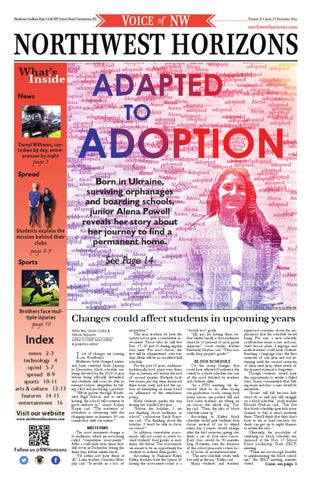
Born in Ukraine, surviving orphanages and boarding schools, junior Alena Powell reveals her story about her journey to find a permanent home.
Students explain the mission behind their clubs
page 8-9
See Page 14
Sports
Brothers face multiple injuries
page 10
Graphic by Willa Ma
Changes could affect students in upcoming years
instruction.” “double test” grade. This year, teachers do have the “[A] pro [to having them beoption not to give a cumulative as- fore winter break] is that midterms sessment. Those who do will test won’t be 10 percent of your grade Dec. 17, 18 and 19 during regular anymore,” social studies teacher class time. For most classes, the Kimberly Deyton said. “They norots of changes are coming test will be administered over two mally drop people’s grades.” news 2-3 to Northwest. days; there will be no modified bell technology 4 Midterms have changed names schedule. BLOCK SCHEDULE and have switched from January For the past 10 years, midterms Of the many changes that op/ed 5-7 to December; block schedule was traditionally took place over three could have affected Northwest, the being debated for the 2015-16 year days in January just before the end switch to a block schedule was one spread 8-9 before being officially debunked; of second quarter. Students took of the most debated by teachers and students will soon be able to two exams per day, were dismissed and students alike. sports 10-11 exempt courses altogether by tak- three hours early and had the op"In a PTO meeting, we disarts & culture 12-13 ing a test and producing a product. tion of exempting an exam based cussed what to do after losing “We’ve grown through North- on adherence to the attendance our graduation coach, seeing how features 14-15 west High School, and as we’re policy. many classes are packed full and leaving, the school will continue to Many students prefer the way how some teachers are taking on entertainment 16 grow without us,” senior Aadam testing was handled last year. six classes the whole day," KitHaque said. “The evolution of “Before the holidays, I am ley said. "Then, the idea of block education is advancing with the not thinking about midterms or schedule came up." changing times in America. It’s our school,” sophomore Sarah BurstAccording to Kitley, block www.northwesthorizons.com connection with our nation.” ein said. “I’m thinking about the schedule would give students four holidays. I won’t be able to focus classes instead of six to attend MIDTERMS on school.” every day. Courses would change The most imminent change is In addition, cumulative assess- after the first semester, giving stuto midterms, which are now being ments will not count as much to- dents a set of four new classes. called “cumulative assessments.” ward students’ final grades as mid- Each class would be 90 minutes After a staff-wide vote, these tests terms did before. The assessments long. However, over the duration will occur in December during the are meant to be an opportunity for of the school year, each course losFollow us @NWHorizons three days before winter break. students to redeem their grades. es 32 hours of instructional time. “I’d rather not have them at According to Principal Ralph "The new schedule works well, all,”Northwest Latin teacherHorizons Christina Kitley, teachers have the option but only in theory," Kitley said. Like us:ofNorthwest Horizons Follow us: @NWHorizons Like us: Like us:MurNorthwest Horizons : @NWHorizons Follow us: hwhorizons Follow us: hwhorizons Follow us: hwhorizons northwesthorizons.com northwesthorizons.com phy said. “It results in a loss of having the assessment count as a Many students and teachers
Index
Willa Ma, Sarah Colby & Nikole Nguyen editor in chief, news editor & graphics editor
L
Visit our website
expressed concerns about the implications that the schedule would bring. For one, a new schedule could reduce exam scores and constrict lesson plans. Language and math teachers could have students finishing a language class the first semester of one year and not returning until the second semester of their next year, when much of the learned material is forgotten. Though students would have the opportunity to retake a failed class, many commented that falling exam and class scores would be inevitable. "Scores will fall because kids won't do as well and will struggle on a block schedule," math teacher Rhonda Hudson said. "The fact that block schedules give kids more chances to fail, it won't motivate them. They'll think that they don't have to try as hard because students can get up to eight chances to retake the class." Ultimately, the possibility of switching to block schedule was dimissed at the Nov. 17 School Based Leadership Team (SBLT) meeting. “There are not enough benefits to implementing the block schedule,” the SBLT meeting minutes stated. Cont. on page 3
northwesthorizons.com
Page 2
December 2014
North Comparing Carolina Students share experiences living abroad heads to court
cultures
Paige Nehls staff writer
S
ydney Smith and her family left North Carolina in July of 2011 for a new home in Waterloo, Belgium, because of her father’s job. About to be a high school freshman, she would spend the next three years living in Europe with trips back to Greensboro every six months. This past summer, she returned to the States to finish her high school career at Northwest. “We were supposed to come back after two years,” Smith said. “But my brother just finished 11th grade, and he wanted to graduate from that school. So, my dad asked if he could just extend [our stay] there. We could have stayed for one more year, but I was ready to come back. I wanted to experience American high school and American football games and see all of my friends.” Smith’s friends were glad to see her return for senior year. “Sydney is amazing,” senior Hannah Schneider said. “When she told me she was moving to Belgium, I was devastated. Luckily, we kept in touch the entire time. We Skyped and sent lots of Facebook messages. Every time she came to visit we got together as often as we could. I’m so glad she was able to experience another country, but I’m also super happy that she’s home.” However, Smith’s experience in Belgium did not start off as well as it ended. “The first year was really hard because my mind set was totally wrong,” Smith said. “I was like ‘this is temporary; don’t make friends.’ I knew how hard it was to leave my American friends, so I didn’t want to deal with that loss again.” Eventually, Smith did make friends in her three years at St. John’s International School and grew accustomed to her new house. “The first six weeks we didn’t have our stuff,” Smith said. “We’d sit on packing paper and cardboard boxes as our chairs. We didn’t have heat, so Lindsey McGuirk managing editor
A
few weeks before the 2014-2015 school year started, junior Jonah Godehardt moved from his home in south Germany to Greensboro. Unlike other students who move due to their parents’ jobs, Godethardt moved for the simple reason of starting fresh. “We wanted to see something new,” Godehardt said. He had lived in Germany all his life. Now, he resumes his life in a different town with different people. Moving from a foreign country to America has
we actually bought one of those kettles you plug in, and filled it up and poured it in the bathtub. After three days, we got hot water and it got much easier.” As her new life got easier, the language barrier was broken down. “The first time I went to the grocery store I was like ‘this is so cool; everyone’s speaking French,’” Smith said. “And then after it just became routine. I ended up being able to speak with people, and I still talk to [my friends] on Facebook in French.” For Smith, routine also meant horseback riding. “A big part of my life is that I ride horses,” Smith said. “I had a horse here for three years before I moved, and rode for seven years prior to our move. When I went there I really wanted to ride again. I went to a stable but they didn’t speak a lick of English. My horse trainer could kind of speak a tiny bit. I tried to take my lessons in French, but of course I fell off the first time because I had no idea what [the horse trainer] was saying.” Even after learning one of Belgium’s three official languages, Smith had to accommodate to the dietary habits of the Europeans.
“They don’t put ice in water,” Smith said. “They do have bubbly water, like carbonated water, and when I first drank that I was like ‘this is gross,’ but now I cannot drink flat water. I have to have bubbles in my water. They also serve small portions and a lot of raw meat. Also, they didn’t refrigerate the milk until they opened it, so I didn’t drink milk for three years.” However, Smith didn’t spend all of her time just avoiding milk. In her three years of living in Europe, she travelled to Switzerland, Germany, France, the Netherlands, Austria, Italy, Hungary, Bulgaria, Greece, Scotland and England. “Italy was my favorite place to vacation because the people were super nice and the sun,” Smith said. “I just love the sun so much- we don’t get a lot of it in Belgium. I went to Bulgaria and Greece for YoungLife. We built a playground for little kids. We left the day before Easter; then on Easter Sunday, we had a service on the beach. It was so beautiful.” With a passport full of stamps, Smith learned a thing or two about the world. “Now, with the news, I really want to know what’s going on [in the world],” Smith said. “I know a lot more about the economy, the Eurozone and the Euro. Moving has helped me really come out of my shell and learn a lot about different cultures.” Smith’s new perspective and strengthened character have made her stand out to her teachers. “[Smith] is very conscientious,” statistics teacher Catherine Brown said. “She’s the kind of person you know you can immediately trust; she never does anything half-way, she just shines in everything she does-and all of that I’ve learned in the nine weeks I’ve known her.”
Photo contributed by Sydney Smith
Senior Sydney Smith rides an elephant while on vacation in Thiland while living in Belgium. She left America before her freshman year and returned three years later.
been no walk in the park. The immigration process is, according to Godehardt, the most difficult part about coming here. “It takes a long time because you have to pay $1,000 just to apply for [a green card],” Godethardt said. “It takes a lot longer than any other country.” What Godehardt misses the most about Germany might not be what one suspects. As others may miss the lifestyle or people, Godehardt misses the food. “It’s a lot healthier and there is a lot more variety,” Godehardt said. Although the German and
American cultures are different, Godehardt seems to be assimilating comfortably in America. He plays football for the Vikings and notices how enthusiastic Americans are about their football. “They’re fanatic about football, even old people,” Godehardt said. Most teenagers cannot imagine picking up their lives in middle of high school and moving to another state, let alone another country. The process is not easy, but he says it is worth it. “Greensboro is a nice place,” Godehardt said. “It’s not too big, but it’s not too small.” Photo contributed by Jonah Godehardt
Junior Jonah Godehardt (left) poses with a friend on their way to football practice in Germany. Godehardt moved to Greensboro this summer.
Alexis Marvin staff writer
T
he gay rights movement, which has been considered controversial by many for a very long time, recently came to North Carolina in the fight for equal rights. North Carolina Amendment One, passed in 2012, made it unconstitutional for the state to recognize or perform same-sex marriages or even “civil unions.” Although it does not directly affect Northwest students yet, many believe the amendment is a direct example of their core beliefs. “I’m completely against the idea of gay marriage, but I don’t have anything against the people,” sophomore Catherine Gray said. “In the Bible, it says marriage is between a man and a woman, but there’s no point in hating them because it’s not going to change who they are.” The Defense of Marriage Act, which barred the federal government from recognizing same-sex marriages legalized by the state, was ruled unconstitutional by the Supreme Court in a 5-4 vote. Some citizens were angered and shocked when Amendment One was overruled by the Supreme Court. Others were pleased to hear the news. “I’ve been very active in this movement for many years,” junior Natalie Whitehead said. “After the amendment was passed, I thought that it was final because it was written as a law.” Other Northwest students were happier with the original restrictions. “When it was illegal before, I thought it [the amendment] was fair,” sophomore Dorothy Kyei said. The movement has succeeded in prompting teenagers and adults to speak out for what they believe in, as well as becoming more active in politics. “I’m all for it,” sophomore Blake Parsons said about the recent overturn. “I didn’t agree with Amendment One when it was passed because love is love.” Being a predominantly “red state”, some people were simply shocked to hear about the overturn of the gay marriage ban. “When it became legal, it was very uplifting and exciting to see this in a place called the Bible Belt,” Whitehead said. As for those who do not support the recent changes, the news was a bit more unsatisfactory. While the news is a huge breakthrough, there are still limitations in place. Officials can refuse to issue same-sex marriage licenses by claiming the union violates their first amendment rights to religious freedom. “That’s fair,” Gray said. “If the official doesn’t support it, that’s their religion.” The Supreme Court has started putting its foot down on gay marriage bans, and people may see more states than just North Carolina’s decision being overturned.
Ebola outbreak: Is it a threat to US? Jackson Parrish op/ed editor
M
arch of this year, the deadly Ebola virus that originated in the Democratic Republic of the Congo almost 30 years ago made a return in numerous West African countries. Thousands of diagnosed cases and deaths have been recorded in the area this year, and medical specialists across the world are working together to end the outbreak. Cases were first found in Sierra Leone, Liberia and Guinea. Doctors have been working to keep the disease contained in these countries, and for the most part, local containment in West Africa has been successful. There have, however, been a handful of cases in developed countries such as Spain and the
United States that have been identified. Some worry about the possible failure of future efforts to contain the Ebola virus. “The [Ebola] virus can be contained,” social studies teacher Dana Hilliard said. “We have good safeguards in place. We just have to trust the system.” So far, there have been [four] diagnosed cases of Ebola in the United States, with [three] deaths. These individuals are or were contained effectively within the victims’ respective hospitals, and it is highly unlikely that the disease will spread within the U.S. The Ebola virus has been such a large media talking-point, though, that many have irrational fears of an Ebola outbreak in America. “The media is blowing up the Ebola issue so much,” Hilliard said.
“More people will die from the flu this year in the United States than from Ebola.” It’s a different story in the developing West African nations, however. This year, there have been 9,911 confirmed or probable cases of Ebola, and 4,868 confirmed deaths: more than the previous 30 years combined. The Center for Disease Control has calculated an approximate 54 percent death rate amongst infected victims. As the Ebola problem in West Africa steadily increases, developed countries become more susceptible to risk. “If Ebola goes unchecked, it could be dangerous to developed countries like the United States,” senior Alex Wirtz said. “As of right now, though, it’s not something that we should be particularly worried about.”
Graphic from the Center for Disease Control
Ebola outbreaks have been confined to the western coast of Africa. New outbreaks in the United States have been limited in number.
Page 3
December 2014
Darryl Williams:
Custodian by day, entrepreneur by night Faith Rickerts staff writer
M
any students dream of opening their own business someday. While some may achieve their dream of entrepreneurship, others may not due to fear of failure, lack of money or others shutting down the idea. But for one Northwest staff member, the dream of running his own business is a reality. Custodian Darryl Williams is the head of not one, but two companies. He also works a part-time job at his church every other Saturday in addition to his duties at Northwest. He started his first company, The People’s Limo Service, in 2003. “It wasn’t really hard [to get started],” Williams said. “I took some of my retirement money and started my company, and I built it slowly, vehicle by vehicle, so I wouldn’t have a lot of debt. Most businesses operate off of debt, trying to make profit. Most of what I make is straight profit, and it goes to me. I just put it back into my business so I’m able to buy new cars and give my employees bonuses.” Williams, a graduate from Grimsley High School, worked many jobs before coming to Northwest. He worked in cus-
“Changes” continued from page 1 Some students and teachers, however, were in support of block. “A block schedule opens up more opportunities,” sophomore Anisha Khanna said. “Kids could take additional classes and electives.” Students would have more time to study, as four classes' worth of material could be more manageable compared to six. "To me, block schedules are more representative of a college course," English teacher Rakia Barr-Kirby said. "In college, you go to class about two or three times a week, about an hour each. The focus is about the preparation outside of class." Though block schedules lead to fewer instructional hours, Barr-Kirby was confident that it could possibly benefit students more than hurt them. "I think block schedules promote quality over quantity more so than traditional schedules do," Barr-Kirby said. "It's about improving the quality of teaching rather
tomer service for 16 years, and before that, he held many manager and assistant manager jobs at various establishments. “At Coca-Cola I gained a lot of my skills from customer service, like working with people and managers of stores, and I used that to continue---only at a transportation level versus a sales level,” Williams said of starting his company. “But it’s kind of the same thing because I have to give an excellent sales pitch on the phone in order to get someone who has never seen me in person to book a ride, give me their credit card number, their home address; I get everything except their social security number.” Williams’ limo company sees a lot of business. Even celebrities have paid to be chauffeured in Williams’ fivestar vehicles, such as: Aries Spears from FOX’s “Mad T.V.”; Joseph Marcell, the butler from “Fresh Prince of Bel-Air”; and more
that Williams cannot name because of legal reasons. Williams works seven days a week, and often until the early hours of the morning because of his many jobs. “About three-fourths of my business is on the weekends,” Williams said. “There can be times where I end up working three or four weeks straight without a day off. With my other jobs, depending on what we have going on, I could be out until two or three in the morning.” But Williams serves Northwest every week day from 6 a.m. to 2 p.m. Most students think that custodians are hired solely to clean up after the students; however, that is not the case. “We do a whole lot more than clean up,” Williams said. “We help look after the teachers and the building, and we also help supervise and keep the kids in order. We try to show them a couple things and lead by example.” Many are surprised that Williams’ job as a custodian
is not his primary work. “[People treat me differently] based off of what it is they perceive that I do,” Williams’ said. “Once they find out [you own a business], they look at you a little differently.” Because of careful planning and spending, Williams is able to give his customers the best service possible. “Where other companies will charge you for every little thing, I own every bit of my business, so I can throw in all the bells and whistles and offer deals that other people can’t,” Williams said. Williams’ business, which he plans to pass on to his kids, does in fact offer some of the most affordable deals in the Triad. There is a 25 percent discount for Guilford County Schools employees, as well as a 25 percent discount for recurring customers. “In high school, I worked a lot of restaurant jobs in the kitchen. So I didn’t think I would be where I am today,” Williams said. “Follow your dreams, and don’t let anybody tell you what you can’t do and what you can’t achieve because with hard work, dedication and perseverance, you can achieve anything in life.”
than how much work we give to students." Despite the potential benefits, the majority of teachers did not endorse the change, which is why it was ultimately debunked Nov. 17. Whether this discussion will resurface in future years is yet to be determined. “If I lost 32 hours of instructional time, I would also lose the opportunity to get in depth with subject material. Teachers [wouldn’t] have the autonomy to go more deeply into their lessons," Latin teacher Christina Murphy said. CREDIT BY DEMONSTRATED MASTERY A test can now be administered to students who wish to place out of a class. It is called Credit by Demonstrated Mastery, or CDM. Students can opt to take a test along with presenting a project or artifact, and if they pass, they will not have to take the course for the year. “It’s more of a process than just a test,” curriculum facilitator Susan Orr said. The first step is to take a comprehensive exam like the EOC and receive a raw score of 95 or higher. The second step is to give presentation in front of a panel of teachers,
where teachers can ask questions to the student. “The assessment is not easy,” Kitley said. “You have got to know the material.” Students would have to take their own time and resources to master the material of a certain course. Teachers are not allowed to offer tutoring for the purpose of exempting a course. Murphy doesn’t anticipate a significant change with this new opportunity for students. “I don’t think this will affect [teachers] that often,” Murphy said. “There’s a high standard to pass, and if a student wants to get out of a class, perhaps we will have smaller classes.” Murphy also sees some benefits. “It might be a benefit for teachers and other students that if a student knows the curriculum well enough to place out of a class; then teachers can spend their time focusing on the kids who don’t,” Murphy said. Orr also doesn’t see much of an effect at the high school level. “The biggest impact would be at the
middle school because they can take English 9 in the middle school and come here and [start with] English 10,” Orr said. Orr also doesn’t see a huge advantage of taking this test because students wouldn’t be able to ask for help from teachers; however, it may be beneficial for students wanting to get ahead and take more difficult classes in their school year. CDM may give students a chance to take more elective classes. “If the goal is extra learning, I can see it as being beneficial,” English teacher Joan Baer said Finally, CDM may allow some students to graduate early. However, most students will likely be unaffected and continue to pursue a traditional high school curriculum. “For a very small percentage of students [I see a benefit]; for every student, no,” Orr said. “I don’t think it’s something that every student should even think about pursuing.” With all the changes being discussed at Northwest, some students wonder if this school will be recognizable in years to come. “The school is finding its identity, just like we have been the past four years,” Haque said.
Photo contributed by Darryl Williams
Custodian Darryl Williams stands in front of one of his vehicles. He started a limo service and has chauffeured many celebrities.
Page 4
December 2014
Noah McCormick webmaster
I
n similarity to many of the technological innovations of the 20th century, modern-day devices and software have completely changed the way we live our lives. Prior to the texting revolution, if someone walking down the street saw as many heads pointed down towards their phones as we do today, they’d probably think the world’s gone crazy. In reality, innovators and engineers from all over the world have been creating seamless, intuitive and blazingly-fast products to aid our hectic lives with a bit more ease. “Being able to carry around a mobile camera in my pocket without the addition of a separate clunky device is something that I don’t think I could live without,” junior Daniel Amparo said. Not only do the majority of smartphone owners take features such as their camera for granted, but since the accessibility of these features have become so accommodating towards our society, we’ve reached a point of altering the culture around us as a result. One of the most idiosyncratic characteristics of modern-day technology is that its progress grows at an exponential rate. Over the course of 30 years, the world went from 12 inch plasma monitors and floppy disks to 80 inch OLED (organic light-emitting diode) and 4k television displays, smartphones and tablets. As developers and major hardware corporations announce new automations and commodities to boost their reputation,
Graphic by Noah McCormick and Nikole Nguyen
the limits we are held to regarding innovation are made smaller and smaller while the public’s excitement surrounding the subject only becomes greater. “Every year when an Apple event comes around, I’m always excited to see what the company has done next to change the current standards of mobile technology,” junior Forest Chilton said. However, this sense of ever-growing technology doesn’t deliver without
any downsides. For example, with an overwhelming amount of competition, too many phones, laptops, etc. end up being released, resulting in the failure of many tawdry and unnecessary products. Additionally, we get too used to the new norm, being the speedy growth of innovation from product to product. Factors like this are often seen when “next year’s iPad” features 1000 additional pixels as opposed to a video-projecting hologram, or
when the “Samsung Galaxy Note 4” features a metal infrastructure as opposed to mindreading capabilities. Though none of this is honestly expected in a year’s time, we surely get our hopes up. “Since every enterprise tends to focus on making their devices cheaper, thinner or technically faster, you don’t see much revolutionary change occur regularly,” Chilton said. “But when it does, we all go crazy, and I love it.”
Declining fossil fuels promote search for alternative energy
Bassam Bikdash science & technology editor
H
ow old do you think you will be when the world’s sources of petroleum and coal are depleted? What do you think you will be doing when news headlines blare “Coal and Oil: Gone”? Coal, oil and natural gas are the three most common forms of combustible fossil fuels that humans use as a source of energy. These fossil fuels are an incredibly dense form of energy, and it took millions of years to form these reserves. When they have been depleted, they are gone forever, on a human timescale, at least. “I think we need to lower our dependence on fossil fuels because if we don’t, we will be confused and helpless when they run out,” sophomore Sydney Kugel-Humphrey said. Several scientific studies have confirmed that the deposits of fossil fuels, that they are aware of, will last approximately until the year 2088. The date may seem far away now, but it will leave humans in frantic search of alternative sources of energy causing possible social unrest and anarchy. This forces humans to use renewable sources of energy: biofuels, solar power, wind power, hydropower and hydrogen, to name a few.
SOLAR POWER
Solar power has the highest potential as a renewable energy source, more than any other method. Photovoltaic cells are the most common method of using solar cells to convert energy from the sun into electricity. Photons from the sun strike a silicon material to excite electrons, which are then used to create an electrical current.
Solar cells are very versatile and can be used anywhere there is sunlight: space craft, buildings or other devices. As their use becomes more common, their prices are projected to decrease. Solar energy is plentiful, the Earth receives approximately 174 million billion watts of power from the sun at any given moment, most of which is absorbed by the earth. It produces negligible waste, has little need for maintenance and has low operating cost. Even though the most efficient solar cell today can only convert about 43 percent of the sun’s solar energy into electricity, efficiency is rapidly increasing. The solar cells would not work during nighttime or heavy shade, forcing users to either store some of the energy collected in batteries for use at a later time or get some of their energy elsewhere.
HYDROGEN
The prospect of hydrogen as a source of renewable energy is very promising. Hydrogen gas is highly flammable and is a very clean source of energy. It was used as fuel by the Space Shuttle during several space missions. Recombining hydrogen and oxygen can be done on a small scale without burning through the use of a hydrogen fuel cell to produce electricity and water. “Provided we address safety concerns associated with hydrogen explosions, there
are no other drawbacks,” science teacher Rice Strange said. Additionally, current methods of obtaining hydrogen usually involve using fossil fuels, thus making it a carbon-neutral source of energy. This means that the net carbon released is zero; the amount of carbon burned is the same amount that would be saved by burning the hydrogen instead of carbon. The technology is also expensive because of the use of rare earth metals, such as platinum and palladium, in order to facilitate the reaction between hydrogen and oxygen in a fuel cell. Hydrogen has great potential as a sustainable source of energy if it can be produced without burning fossil fuels.
HYDROPOWER
Hydropower involves using water pressure to create energy. The most common method of gaining electricity from water is through a hydroelectric dam. By building a dam on a river, water is forced through an opening that uses the water pressure to turn turbines that generate electricity. Hydropower does not cause large amounts of pollution; it is reliable and is flexible in terms of how much energy it can produce. “I like hydropower; it’s just that it’s not a viable source of energy without a large body of water nearby,” junior Alex Kenion said. However, the dams needed to produce
hydroelectric power are often expensive to build and maintain. They damage the environment by limiting reservoirs and destroying fish habitats within the river, as well as flooding areas around the dam by creating a lake.
WIND POWER
This source of energy has been in existence for more than 100 years. Originally, the power of wind was used in wind mills to grind wheat. Since that time, we have made a few improvements to the technology. Generally, the mechanical energy in wind is converted into electrical energy by turning massive blades to rotate a turbine that is hooked up to a generator that produces electricity. The Netherlands, through the use of 1975 wind turbines, achieved the European Union goal of producing nine percent of its electricity from renewable sources by 2010. “I believe that wind is a very useful source of energy because it doesn’t seem like it will ever run out,” junior Nicole Moore said. Wind power is a clean source of energy; it is cost effective, renewable and produces no pollution. Wind is an indirect form of solar energy, generated by the uneven heating of the Earth by the sun, and is therefore a perpetual resource that will not be depleted on a human timescale. However, wind turbines can cause noise and visual pollution; they require an initial large investment and can harm avian wildlife. Graphic by Nikole Nguyen
Solar, hydropower and wind energy are represented above empowering the battery. Each method has advantages and disadvantages as well as geographical areas where it would be most useful.
December 2014
Page 5
College applications cause stress for seniors Mackenzie Mitchell spread editor
S
eniors crowd the computers in the library, working in a frenzy to complete their college applications. Just a couple of months ago, it was the bulk of the worries of upperclassman. The first nine weeks of the school year is application time for seniors everywhere, and students at Northwest were having an overwhelming and tense first quarter. “[Sending college applications] is a new experience,” senior counselor Chris Puryear said. “It’s always stressful the first time you do them.” The process is out of students’ normal routines, not to mention there is a lot riding on the fact that they get all of their applications done in a brief period. Senior Caitlyn Counsilman says that the time crunch specifically has been the most taxing part of the application procedure. “The thing that [students] are unaware of is the amount of time it takes to go through the entire process,” senior English teacher Joan Baer said. “Students need to have dedicated time during the weekend, like one day of the weekend during the first nine weeks of their senior year, to sit down and go through their college things.” Puryear advises rising seniors to apply early and keep on top of deadlines to reduce disorder. The lengthy process of applying for colleges obliges students to fill out the actual applications, write the mandatory essays, acquire recommendation letters and/or counselor statements, forward their transcripts and send
Photo by Mackenzie Mitchell
A senior works on her college application. Hundreds of students at Northwest have gone through this process this year and have experienced the stress that goes along with it.
their standardized test scores (the SAT or ACT). Regardless of how much students complain about how the application process is difficult for them, most of them do not realize that Puryear has an extremely stressful job, as well. “I have 480 seniors,” Puryear said. “I want to give personal time and interest in each of them, but there are not enough hours in the day.” In addition to time-management, seniors struggle with the lengthiness of applications.
“Filling the applications themselves out on CommonApp[.org] is stressful,” senior Lucas Moore said. “They’re so long, and the details you have to get are frustratingly stupid.” Indeed, college applications ask many questions that students may think are trivial and strange. “People don’t realize [these questions] are part of the process,” Baer said.
staff editorial
I
t’s the day after Halloween, a.k.a. the day that candy goes on sale. Naturally, you go straight to the closest grocery or drug store to pick up a few bags, but before you even get to your candy, you are assailed with Christmas spirit and joy. Oh, yes. The smell of Capitalism. The true meaning of Christmas seems to be lost when Santas, elves and reindeer replace Jesus and Mary. “It’s definitely too commercialized,” senior Michael Murphy said. “It shows our society is more focused on superfluous things.” Gifts have clearly become a key aspect of the holiday, and the blame can go largely on the big man in the North Pole. Writing a wish list for Christmas is a normal holiday festivity. “Now it’s all about presents and what kids are going to get,” sophomore Savannah Newton said. “I don’t think we’ll ever be able to change that.” This may not be completely bad, though. Half of the gifting process is the giving, and many people say that they enjoy giving a gift more than getting one. “It’s better to give a gift,” senior Becky
Graphic by Mackenzie Mitchell
The focus of Christmas has shifted from traditional Christian values to capitalism. This graphic represents this change with Mary focusing on the presents rather than Jesus.
Parsons said. “It’s way better than receiving one.” A Christmas spirit, though not necessarily stemming from Christian values, has developed. “[It’s] more of a family get together holiday for me,” senior Jessica Critchley said. So, a spirit of giving and being around fam-
ily is associated with Christmas too, as a redeeming factor for the blatant, in-your-face commercialization. Not to be forgotten is that Christmas is often abbreviated to X-mas, literally taking away the only part of the word that has any religious connotation. Christmas isn’t the only victim in this
NORTHWEST Adviser Melanie Huynh-Duc Principal Ralph Kitley Editor in Chief Willa Ma News Editor Sarah Colby Op/Ed Editor Jackson Parrish Spread Editor Mackenzie Mitchell Sports Editor Sarah Boggins Features Editor Clare Kilmartin
Arts & Culture Editor Liz Hubbard Science & Technology Editor Bassam Bikdash Entertainment Editor Nick Loschin Managing Editor Lindsey McGuirk Webmaster Noah McCormick Graphics Editor Nikole Nguyen Tech Support Austin Drake
Parents have to step in and help because most students don’t know things like their parents’ license numbers, who has possession of the house and when parents were registered to vote. “Parents need to realize that it is a collaborative effort between students and them,” Baer said. “It alleviates some of the stress.” Of course, none of the application process could be possible without the list of perfect colleges for each student. “The most stressful part of applying for college would probably be finding the actual college you want to go to,” senior Brendon Fallquist said. “You have to look at a lot of things.” Degrees, majors, fees, location, size and campus are only a few of the factors students must deeply consider, and all of this requires an even greater consummation of time. Current or rising seniors can always count on their counselor and teachers to give them vital and professional advice. “Follow up to make sure colleges have received everything they need by the due date,” Baer said. Sending applications and transcripts electronically is what most schools prefer today. “Some schools for most of North Carolina apply through CFNC.org or CommonApp. org,” Puryear said. “Paper is the least recommended way, if possible—save a tree.” Both Baer and Puryear stress that it is necessary to look carefully at the application requirements for each college. For instance, some schools call for teacher recommendations and some will disregard them completely if they are sent with the application. “Read carefully what each college wants,” Puryear said. “Every school wants something different.”
commercialization scheme, either. Valentine’s Day is seen as a “poser holiday,” only created by the greeting card and candy companies. In contrast, Thanksgiving is the forgotten holiday, simply because it doesn’t have the capacity to be exploited like Halloween or Christmas. Imagine the holidays as family members. Halloween is your kind-of sketchy cousin who is still really cool and you like to hang out with. Christmas is your grandma. You love Grandma; she’s nice to you. And right in between those family members that you both like is Thanksgiving, that aunt who smells like she’s been baking all the time, but not in a good way. You don’t really want to talk to her, but do anyway because she’s there and you feel kind of bad because no one really cares about her. Sometimes that aunt can be interpreted as under-appreciated. With similar basic values of family time, the distinction between Christmas and Thanksgiving is obvious: the importance of a holiday is based on the amount of money that can be profited from it. Exploitation versus being forgotten. It’s hard to tell what’s worse.
HORIZONS Staff Writers Jenny Blackburn Annie Ford Melanie Jenkins Alexis Marvin Harley Nefe Paige Nehls Katie Lee Parrish Satoria Ray Faith Rickerts William Royal Alexis Rutledge Shalini Sharma Lilac Rain Thompson Sophie Vazquez
Policies and Intent
Serving as the primary printed and online forum for student opinion, Northwest Horizons publishes five issues each year by the staff at Northwest Guilford High School. The paper is supported through community advertisers. Staff Editorials are unsigned. The stance of each editorial is voted upon in staff meetings, but it requires the approval of the majority of the editorial board. All members of the school community are encouraged to use Northwest Horizons to express their views. Letters must be signed when submitted.
Find us online: @NWHorizons Visit our website: www.northwesthorizons.com
Page 6
December 2014
Head-to-Head: GLOBAL WARMING
Undeniably human caused Nick Loschin entertainment editor
T
he grossly problematic debate of global warming is no longer about its existence, but whether or not it is natural or man-made. Although the earth does go through the natural process of heating and cooling, in the recent years, it has completely diverged from the natural cycle path. The natural causes of global warming, such as the melting of permafrost and the artic tundra, which contain carbon dioxide and other greenhouse gases, do play a role in the warming of the earth; however, this is not substantial enough to reflect on the climate change occurring right now. The effects of climate change also cause melting, which releases even more carbon dioxide and methane. Every notable environmental and governmental agency also agrees with this. The two main contributors to this climate change are the burning of fossil fuels and deforestation across the globe. “It’s the science behind it,” AP Environmental Science teacher Richard Thomas said. “Since the Industrial Revolution, we have been producing more fossil fuels.” Forty percent of carbon dioxide emissions in the United States originate from electricity production alone. Another three percent in the United States comes from automobiles and other methods of transportation that emit carbon dioxide. A single gallon of gas puts roughly 19 pounds of carbon dioxide into the atmosphere. The majority of scientists have concluded that the warming of the earth comes from the burning of coal, oil and gas. Along with carbon dioxide emissions is the plethora of deforestation that occurs across the globe, meaning there are fewer trees to absorb the gas. Even if we were to cut down fewer trees, the amount of carbon dioxide being emitted would continue to be too great. “What has been happening in the last 100 years is way past the normal fluctuation of normal CO2 levels,” Thomas said. Carbon dioxide is the most abundant greenhouse gas in the atmosphere. With this being said, the more carbon dioxide there is, the more the atmosphere thickens, and more heat is absorbed. Compiled data over the last 40 years has shown almost a correlation between the amount of carbon dioxide that originate from fossil fuels being emitted, and the temperature of the earth. The biggest concern is not just the amount of carbon dioxide, but the rate at which it is being emitted. The earth’s natural processes cannot keep up and bal-
ance the carbon dioxide in the atmosphere because of the loss of carbon sinks. Trees and the Earth’s oceans are the main carbon sinks in nature, with both being damaged by the effects of global warming. “Already things have occurred that are past fixing, and some things cannot be changed,” Thomas said. As the Earth continues to rise in temperature, the humidity also rises. Moreover, this humidity then leads to an increase in water vapor, which is also a leading greenhouse gas. The warming potential of carbon dioxide is then doubled. With global warming comes major storms, droughts and habitat loss, especially for artic species. Every year, hurricanes become more dangerous and droughts, such as the one in California, last longer and become more frequent. Tides in cities, such has Miami, have places where the high tide reaches into parts of the city. Alaskan natives have had to abandon their homes because of the melting of the ice caps causing habitat destruction. Biome destruction is already occurring on a global scale and some of it is irreversible. “I fear I won’t be able to enjoy the beauty of the seasons, and I won’t be able to smell clean, fresh air again,” senior Lynton Martin said. However, all hope is not lost. Switching to sustainable energy and educating the public on healthy environmental practices and conservation can lessen the effects of global warming. “I do believe in the long run that it will become obvious and actions will be taken,” Thomas said. The world has come together before to solve environmental crises, such as when the Montreal Protocol helped to repair the ozone layer by lowering CFC emissions. All it takes is one nation to lead the way on sustainability. “The earth is an amazing place, and humans are an amazing race,” Martin said.
Graphic by Mackenzie Mitchell
Entirely natural
William Royal staff writer
I
n the political and economic landscape of America, the problem of global warming has been blamed on the common man. Whether it is CFC usage or the depletion of fossil fuels, the green crowd has been stagnant in its push to eradicate the gasguzzlers and other sources of pollution and to further pressure the governed citizen. “The Earth is warming, but whether or not man is contributing to that, I don’t know,” history teacher James Thompson said. “I think it’s less than most people think.” In 2014, we use hybrids, we have killed the usage of CFCs and we have cut down drastically on pollution through the federal government, pressuring corporations to clean up their act. Refer to the actions taken with the Clean Air Act of 1970, all the way up to the 1990s to cutdown on CFCs, and you will see that a change of gigantic proportions has taken place all over the United States. Expanding upon this issue, the need for “harmful” fossil fuels will not go away. We can make cars safer for the planet, but we will never erase the usage of fossil fuels. Scientists have estimated that, by the middle of the 21st Century, we will run out of the Jurassic elixir that lets us go anywhere. “Gasoline is one of most variable costs for any business, and when you’re trying to run a business, you want as much fixed costs that you possibly can have,” Thompson said. “I think that being able to plug in an electric car is coming. I think that at the end of the day, if you can save a ton of money, the market and human needs care less about the environment and more about their pockets.” If fossil fuels really are a contributing factor to global warming, could we see a resurgence in other energy technologies? “[Nuclear energy] is a solution in the short term until we can get solar [energy] going in a much more efficient way,” Thompson said. “The obvious problem with nuclear energy is
Photo from NASA.gov
with the water waste. That [waste] stays radioactive for thousands of years.” It looks like we are stuck with petroleum for a long time due to the danger that other sources pose to humans. It would not be in our best interests to risk a Fukushima or a Chernobyl incident in an urban environment on U.S. soil, even with increasingly better nuclear regulation than Japan and the former Soviet Union. Pollution has been routinely ignored. Should we focus our efforts more on keeping emission and waste out of the air and water? “I think so,” biology teacher Tara Culbertson said. “I think that’s the source [of global warming].” Global warming has been taking place naturally, not as a result of human activity. The wonderful planet that we inhabit both warms and cools itself naturally. The 80,000-yearlong Ice Age and many other warm periods are proof of this. In fact, over the past 10,000 years, we have been in a cooling period. The explanation? The cycles bring the amount of solar force on our climate up and down, causing temperatures to rise and fall. This, in turn, causes the amount of greenhouse gases released into our atmosphere to change. None of this cycle is due to human intervention with Mother Nature’s process. “I don’t think [global warming] is a top-tier issue to be discussed,” Thompson said. “We have pollution controls in most Western countries for things like air and water, that, if implemented the correct way, should help to end the correlation between global warming and pollution, if it exists.” Does the usage of harmful chemicals and other pollutants speed up the process of global warming or cooling? Science supports that theory, but it is absolutely not the entire problem. Saying that these products are being used actively is a half-truth. Most of the usage of pollutants has been stopped. Have we been on track to destroying the environment? Maybe, but this does not necessarily place the blame on the people. If natural global warming is the case for rising and falling temperatures, human beings cannot be punished. “[The government] over-publicize and blow the issue up,” Culbertson said. “I would say that it has hurt the issue.” My message to the politicians and activists is to let go of your previous origins as treehuggers and come together with the other side. Conservatives have been doing this for many years to end the infighting of partisan structure and to leave behind a 50-year struggle for selfish authority. In the end, this issue of global warming is in direct exhibition of government over-involvement and distrust of the citizens. If the U.S. government would stop hovering, the economy would thrive under laissezfaire economics, and the goal of a democratic government would do the most good for the constituency. Do as 40th president of the United States, Ronald Reagan, once said by, “getting the government off the backs of the American people.”
Page 7
December 2014
Places to take a leak:
Three different ways to handle your car issues Triad Auto Honda Service and Repair
Photo by Jackson Parrish
Jackson Parrish op/ed editor
T
riad Auto Honda Service and Repair has been reliably serving me and my family for years. The employees there never fail to be kind and considerate when we come in, and their work never ceases to adequately solve any car troubles that we have. “We’ve been in business since August of 1978,” part-owner Terry Wagner said. “We specialize in Hondas and Acuras and have all the special tools needed to do necessary service and repairs.” What makes Triad Auto different is that their primary goal isn’t to make money, but to meet customer satisfaction at the most affordable price. For instance, when my family needed body work done on our minivan, they told us of a different auto repair shop to go to so that we could get the work done for a better price. Most businesses today will do anything possible to get the maximum amount of money from their customers, which makes Triad Auto so unique and different from the current mainstream business world. “Our goal is to do a job better than anyone else at a reasonable price and keep our background Christ-oriented,” Wagner said. I strongly recommend any students at Northwest who own Hondas or any other vehicle to take their business to Triad Auto to receive quality service in a great environment. The shop’s address is 7208 Cessna Dr, Greensboro, and anyone who goes there to have work done on their car will not be disappointed.
Kernersville Chrysler Dodge Dealer
Annie Ford staff writer
Photo by Annie Ford
I
f you like being insulted and not getting what you asked for, Kernersville Chrysler Dodge is the place for you. Jeeps are problem cars to begin with, and mine has spent its fair share of time in the shop. Being a frequent visitor, you would think that the man who fixes up my car would recognize me, but apparently not. One day, my mother and I brought in my car without my dad present, and there was an immediate, obvious change in the attitude of the workers. This time, I needed to replace my stabilizer bar because the last one that the shop had put on was the wrong size. Instead of listening to what we had to say, the workers disregarded us, acting like we knew nothing about our own vehicle. Then, they forgot about my car and didn’t have it ready in time. After they acted like that was completely our fault and not theirs at all, we paid for the fix and I went to get my car and drive away. That was when I was stopped, was told I looked like a 12-year-old and was not allowed to take my car. Despite offering my license, it took my mom validating that I could indeed drive my own car home to get the man to let me leave. Then I got lost in the parking lot. I would not recommend this dealership for repairs.
At home remedy: A cost-effective alternative to auto repair shops Sarah Colby news editor
T
he experience I had with my car was one with a lot of struggle; however, it wasn’t due to a bad experience at a repair shop. My car has had one bad thing happen to it after another. It all started with a team sleepover for the Northwest lacrosse team. We stayed up late, everyone talking with all the lights on outside. When we got up the next morning, a mom came inside to pick one of the girls up and told me my Jeep was leaning to one side. Going outside, I realized one of my tires had been slashed by someone in the middle of the night, unknown to me. My dad, being a man of do-it-yourself mentality, taught me how to change the tire myself with the spare and had me put on the replacement when we got it. This life skill helped me out about a year later when one of my tires popped after I hit a curb too hard after an away football game at Grimsley. After that crisis was resolved, the next weekend, the journalism class went to a regional conference, SIPA, the Southern Interscholastic Press Association in Columbia, South Carolina. While riding down with three other students, my car began to overheat and warn me that I had low coolant. We pulled over, got more coolant only to find that the levels were fine in my car but my engine was still too hot. When we arrived to the hotel, my car barely made it into the
Photo by Sarah Colby
parking spot, it was so overheated. We enjoyed that weekend, and I didn’t drive at all, and when it came time to head home, I was sure to get more coolant and to not drive too fast, just in case. Everything was fine until we reached I-85 and all the traffic that came with it. As soon as we start-
ed slowing down, my heat began to rise. In the traffic, my car became dangerously hot, and I was forced to pull off to the side of the highway and wait. As soon as we got moving again, the heat went down, but only after my parents came to pick us up. Turns out the radiator fan had
broken and that there was a bubble in my coolant line that had caused it to overheat. Learning at-home fixes to my car is such an important skill to me. I am now able to be in a situation where there might not be a mechanic nearby, yet I’ll be able to fix my car, or at least get it to be drivable again.
Disc Golf
EnergyWise
FBLA
“[We made the club because] we like to play disc golf, and we wanted to create a club where fellow disc golfers could hang out and play together. We hope that it will be continued over the course of several years by aspiring young disc golfers”
“Students try to make people more energy conscious and save the school time, money and energy while attempting to reduce our ecological footprint.”
“FBLA, or Future Business Leaders of America, is a CTEbased club that involves service-learning opportunities, field trips that expose us to business careers and competitions at the regional, state, and national levels.”
-seniors John Drawbaugh and Jake Strauss
-senior Lindsey McGuirk
-sophomore Nick Wirtz
Asian Culture Club Friends of Red Dog Farm Club
Anime Manga and Media Club
Battle of the Books
Health Occupation Student Association
Happy Not Mad
German Club
Books and Breakfast at Stokesdale
Buddies to Buddies
Book Club
Human Relations Club
Crafty Club “Crafty club meetings consist of collecting donated art supplies, creating various crafts and setting goals for future projects.”
“Books and Breakfast at Stokesdale is all about helping elementary students become better readers. We go to Stokesdale to communicate with the students and help start their day off in a cheerful mood.”
-junior Heather Trainor
-junior Savannah McCormick
Atheist Club
Cosplay Club
DECA
“Our club is about discovering new thoughts and ideas about religion and sharing opinions with people who share your beliefs.”
“We’re a club that focuses on the art of cosplay. We create costumes in the likeness of our favorite comic book and gaming characters and wear them to conventions.”
“If you have any ambition of going into the business field, experience from DECA is vital for you.”
-junior Madison Godwin
-senior Jenny Heimke
-senior Alex Wirtz and sophomore Mason Jenkins
Student club presidents at Northwest explain the mission be High IQ/Quiz Bowl
Key Club
“Quiz Bowl is competition revolved around a four-on-four trivia. We travel to various schools trying to answer the trivia type questions to the best of our abilities in order to win the round. If you watch ‘Jeopardy,’ ‘Are You Smarter Than a 5th Grader,’ or other trivia type game shows, the team would be perfect for you.” -junior Andrew Cunningham
League of Legends Club Random Acts of Kindness
“We help kids in our community and out of the community so we can reach the common goal of helping them thrive whether it’s school based or not. We did trick or treat for UNICEF for Halloween and raised money for helping kids around the world.” -senior Mikayla Potkay
Mentoring Program SAVE/SADD
National Spanish Honor Society “[In National Spanish Honor Society] we recognize excellence and dedication in the Spanish language. We apply Spanish to the community through tutoring, Spanish activities and by furthering Spanish learning.”
Military Mission Club
Second Harvest Food Bank Club
-senior Bianca D’Souza
Model UN
Service Learning Ambassadors
SHINE
FCCLA
Fellowship of Christian Athletes
French Club
Gay-Straight Alliance
“FCCLA is a heartfelt, service-oriented club that strives to do projects that make lasting connections with the people we help.”
“At FCA, we fellowship with other believers, and we have a message that really helps throughout the rest of the week which really starts your week off right.”
“We play games and eat a lot of food. It’s very relaxed and a fun place to hang out each month.”
-junior Hannah Cook
-junior Dan Kefer
“The reason for the club is to spread awareness and acceptance of the LGBTQ community. I want more people who need it to be aware and benefit from it.”
-seniors Casey Kirchner, Caroline Coble and Sydney Cheek
Chess Club
Cube Club
iGeneration
Interact
Every Life Matters
-senior Mariyka Auber
Fearless Vikings
International Thespian Honor Society
Fishing Club
Investment Club
Latin Club
N-Dub Ping Pong Squad
HOPE “HOPE club strives to help others who are in need. We did a book drive last year and got 500 books.”
“We are the best ping pong club at Northwest and can beat everyone else.” -juniors Stefan Bello and and Alex Baumeier
-senior Casey Kirchner
Guitar Club
Ultimate Frisbee
Linguistics Club
“We sit around, be friends and play instruments together.”
“I am dissatisfied with ethnocentric and unilingual Americans.”
- senior Richard Jimbo
-senior Johnathan Kerans
“We love Frisbee.” -juniors James Einwaechter and Mac Renslow
ehind their organizations. NW Horsepower
Science Olympiad
Science Through the Looking Glass
“Horsepower is an organization where the volunteers can come help disabled children and adults, and we give them therapy by riding horses. It helps them with stress and calming down. I get to see the same students every week progress and develop, and I see a lot of joy on kid’s faces.”
“We here at Science Olympiad aim to promote the competitive and scholarly applications of science to anyone willing to work through our doors.”
“We visit Pearce Elementary School once a month in order to aid fourth and fifth graders with science concepts, go over their curriculum and do fun experiments with them. Our goal is to help the students better understand science, have fun, and do well on their science EOG.”
-senior Jake Mayer
-senior Sydney Smith
National Art Honor Society Sierra Club
-junior Clare Kilmartin
National German Honor Society Spanish Club
National Honor Society
Speech & Debate
National Technical Honor Society
Students Helping Students
Young Life
Photos and information compiled by staff
Page 10
December 2014
Brothers face multiple football injuries Paige Nehls staff writer
A
lmost every Friday night this fall, senior Weston Haack was playing either as linebacker or wide receiver for the Northwest Vikings Varsity football team. Peyton, his freshman brother, played on the offensive line Thursday nights for the JV team. With two boys playing football, and an athletic athletic brother in college, the Haack household has seen it all: crutches, wheelchairs and hospitalization. “The day before we got pads, I dislocated my shoulder and tore my labrum,” Weston said. Recovering from two torn ACLs last season, he said, “My goal this season was to stay healthy.” Although football season is over, Weston is awaiting the decision if he must have surgery for his labrum. His brother Peyton similarly endured a physical setback this season. During the Oct. 30 game, Peyton was tackled and suffered a compound femur fracture. When complications led to internal bleeding, he had to be hospitalized for several days. “It has been difficult watching them all get injured,” the boys’ mother Jill Haack said. “I cry often, I pray without ceasing and hold my breath through each season.” Jill said that Peyton’s injury was “by far the biggest medical emergency.” He had to receive two blood transfusions to compensate for more than two liters of blood loss and is now on crutches. Before Thanksgiving, he was only able to attend half-days at school. “Many people ask, ‘Why do you still let them play?’ I would love to put them in bubble wrap, to keep them safe in everything they do, but that would be such a disservice,” Jill said. “[But] seeing pain in your child’s eyes is one of
the most difficult parts of motherhood.” Coaches and teachers have noticed the Haack brothers’ perseverance in sports despite their obstacles. “I learned very quickly of a couple things about Weston, which include his strong faith, his battles with injuries in sports and his strong leadership presence,” Varsity football coach Jared Rolfes said. “Weston was selected as a captain for leading with character, integrity and by example. I am blessed to have the chance to work with and be influenced by such a strong young man of faith, character and leadership.” Similarly, freshman English teacher Melanie HuynhDuc is impressed by Peyton’s positive outlook. “It’s incredible how Peyton returned to school with a smile on his face after two weeks of being out,” HuynhDuc said. “He has worked hard not to get behind academically, and he didn’t let this injury hamper his incredible spirit.” The Haacks attribute their ability to get through difficult times to their faith. “I’m a strong Christian,” Peyton said. “I don’t ask why, I just see this as part of God’s plan for me.” His mother agrees. “These injuries have forced all of us to put life into perspective,” Jill said. “My boys are healthy and will make a full recovery. Many mothers can’t say that. I thank God for each moment I have with my beautiful boys.” Weston has also found that the comraderie of the football team has helped him endure his multiple setbacks with grace and determination. “When times get hard, you have to remember that the man next to you is counting on you, and you can’t feel sorry for yourself,” Weston said. “I love the brotherhood we all have because we spend so much time with each other.” Now that the football season is over, Jill says she hopes to stop counting the injuries her sons have had (five in total). But with two uncles who played football in college and a cousin who’s currently the punter for Arizona State, football runs in the family. “I want [football] to stay as something I do for fun,” Weston said.
Photos provided by Weston and Jill Haack
Concussions: The misconceived injury
Sarah Boggins sports editor
C
oncussions are one of the major threats to high school athletes. According to a study by the Institute of Medicine of the National Academies, high school football players are almost twice as likely to get a concussion compared to college football players. This study goes on to say that high school football players experience 11.2 concussions for every 10,000 games, compared to 6.3 concussions for college players. Often, not all high school football players know the risk of concussions associated with football. Concussions are much more likely to happen than what many players think. However, there are certain techniques used to prevent head injuries like concussions. “We talk about correct positioning on tackling and blocking in reference to being safe and avoiding head injuries,” head football coach Jared Rolfes said. “We also address it in parent meetings and how we will follow correct medical procedures if there are signs of a head injury.” Many athletes at Northwest have experienced concussions.
“I had to go to school the next day, and all I could remember was that the lights were so bright,” junior and varsity football player Connor Doak said. “Every small noise would hurt my head.” Doak is recalling the time he got a concussion last year during a Young Life activity. Although the concussion did not happen while playing football, it affected his playing the rest of the season. “I couldn’t play the last few games,” Doak said. Although concussions are so common, some players are more worried about other injuries. When playing a game of football, getting a concussion is not the main fear when being hit. “It’s kind of in the back of your mind,” senior Mark Murphy said. “It’s very rare, so you kind of deal with it like it’s part of the game.” According to the Centers for Disease Control and Prevention, 1.6 million to 3.8 million concussions happen every year. Murphy also suffered from a concussion, and like Doak, it was not while playing football. Murphy was playing recreational soccer when he got his concussion. “I’ve been playing football for 13 years and have never gotten one, but then I fell on my head and got one while playing soccer,” Murphy said.
Like many other athletes, some football players are thinking about continuing their career in college. Although statistics say more concussions happen in high school football, the higher level of intensity in college football can make players more aware of the risk of concussions. “Everyone is bigger and better in college,” Murphy said. If a player were ever to suffer from a concussion, there are specific measures taken to guarantee the player recovers correctly. “A doctor or trainer determines if a player has a concussion, then a medical doctor must clear the player to play,” Rolfes said. “Once they are cleared, they must go through a multiple day program to ensure no signs or symptoms re-surface. If they go through the program with no signs or symptoms, then they are permitted to return to play with no restrictions.” Concussions, to some students, seem to be a minor issue, but statistically they are more of a threat than they are assumed to be. Although they happen so often in high school football, any athlete can be a victim to a concussion. “I do not stress [concussions] anymore in football than I would in any other sport, as I think they can happen just as often in other sports,” Rolfes said.
Graphic by Nikole Nguyen
The infographic above shows the areas in which traumatic brain injuries are most common. Falls are the greatest cause of these brain injuries. The statistics above were provided by www.cdc.gov.
CAFF IENDS B
R
E W
E D
Coffees,Teas, Pastries, Shakes, Cakes and Smoothies
Announcing our new all occasion basket company
BasketCases
2203 Fleming Rd., Greensboro, NC 27410 (Food Lion Shopping Center) 336-763-3810
Bring this coupon in for $2 off Total Purchase
Page 11
December 2014
Wrestling with weight: Shalini Sharma staff writer
M
any things occur around school every day: a boy breaks up with his girlfriend over a text, a teacher yells at his students for not knowing the answer to a simple question and a yellow jacket finds its way to the corner of the room while everyone stares at it. In the midst of it all is a young wrestler who, despite being distracted by this chaos, cannot ignore the sound of his grumbling stomach and the fact that it is weigh-in day. In order to ensure a fair match so that the opponents are equal in build, wrestlers can only compete against each other if they fall into the same weight range. “Everyone decides which weight class they want to be in during the season that will allow them to fight their best,” senior Tristan Dean said. “But you cannot go over or under the limits by a single pound, and if you do,
you will be ineligible for that day’s match.” With regard to maintaining their weight in the given ranges, many wrestlers are forced to change their eating habits in the hopes that they will lose enough pounds by the competition. “Last year, I had to lose about 20 pounds over the course of the wrestling season,” Dean said. “But it’s not like I starved myself; you just have to watch your weight on the days leading up to the match, and on the day of the match, you have to be extremely careful that you don’t overeat to remain within your weight class.” Contrary to popular belief, not all wrestlers have to eat less to compete. Some, like senior Cary Miller, are allowed to eat essentially anything they want as long as they meet their goals. “I was about 208 pounds last year, and I needed to be around 225 pounds,” Miller said. “To achieve this, I had to work out every day, sometimes twice a day, while eating a diet high in protein. Coach Ron Bare, Northwest's
head wrestling coach, promotes a healthy, secure environment for all of his wrestlers. "I have been coaching here for the past 25 years, and I've never had issues with anyone becoming overly dehydrated or sick from eating less," Bare said. "In fact, we have national guidelines that we follow to protect the boys from becoming unhealthy. This includes a weight loss calculator that figures out exactly how much they can safely lose each day according to their current weight and where they need to be." In addition, the wrestlers are discouraged from actually starving themselves because it will cause them to have hardly any energy for competing. However, they still have to ascertain that they eat healthier and less often, if necessary. "When you try to starve yourself, your body begins to save your fat for energy that you'll need later," Bare said. "So basically, all you lose is water weight, which isn't even actual body fat. The kids who try to do it the wrong way find out really fast that they can't
New kids on the block:
F
reshman Temple Sizemore is a shy, quiet girl. She can go unnoticed in a class of 32 students because she rarely speaks up and quietly does her work. When the school year began, she found herself anxious about meeting people and making new friends. “I was nervous about having people from other schools coming into Northwest [High] and mixing in with other grade levels unlike middle school,” Sizemore said. However, when she attended her first Northwest Viking football game on Sept. 5, things began to change. “[I was able to] meet more friends and open up to more people,” Sizemore said. “I went with one friend and then met her friends, then we became a big group of friends who went to Homecoming together.” Cheering on the team and sitting closely with other students, Sizemore said it was hard not to feel the football fervor. In the moments when Northwest scored a touch-
down against Northern, everyone came together to cheer on what they had in common – their team. As football season comes to an end, other freshmen have similar reflections on the joys of participating in the student section for their first time. “I got to hang out with more friends and felt the spirit of how high school would be,” freshman Dakota Jones said. Many of the football players themselves say they have found a family by being on the team, particularly the freshmen on JV. “Football means everything to me,” freshman Trevor Hartman said. “I don’t know where I would be if I wasn’t on the team.” The freshmen are just starting out in high school and have many years to go, but upperclassmen who are almost done remember what it was like to be the new kid on the block. “I met new people [at the football games] and I knew what people were talking about when they came to school Monday,” junior Rachel Kizito said. “I had more school pride.” In high school, at times it is easy to feel the separation between the different grades of students. However, at football games it doesn’t matter if you are a freshman or a senior – everyone is a Viking.
weigh-in before matches
starve themselves and be any good at the sport. Instead, it takes a while for them to realize that they have to eat and drink healthy, in addition to getting exercise." According to USA Today, ancient Greek instructions on how to wrestle have proved that it is the oldest sport on record; from the ancient world to today, wrestling has touched the hearts of its participants as they learn discipline, perseverance and loyalty. “I love the whole one-on-one experience," sophomore Blake Weaver said. "When you win, the victory falls solely on you, and you realize
that even though you had to suffer, it was definitely worth it." Many wrestlers go on to compete offseason, a mark of their devotion to the sport even if they have to forgo consuming certain foods. "If you really like the sport, you have to sacrifice by eating less food if you want to do well," Dean said. "But there is a sacrifice for every sport—some more than others—like giving up your free time."
Photo by Shalini Sharma
Anthony Dew (front wrestler) and Jake Boggs (wrestler in back) demonstrate a wrestling move. Wrestling has been a sport at NW for more than 25 years.
Athletic director wins distinguished service award
How football games welcomed freshmen students Jenny Blackburn staff writer
Members of the wrestling team
Sophie Vazquez staff writer
T
he man behind everything sports at Northwest, athletic director John Hughes, has been recognized at the state level by the North Carolina High School Athletic Association (NCHSAA). Hughes recently won the Charlie Adams Distinguished Service Award for “regularly [going] above and beyond the call of duty both at the local and state levels,” according to a Guilford County Schools press release Sept. 26. “I’m humbled by the formal honor and give thanks to all of the incredibly hardworking coaches I oversee at our school,” Hughes said. “The coaches make my job easier.” Hughes’ behind-the-scenes work
includes creating and distributing a weekly schedule of athletic events at Northwest, handling sports financing, figuring out the transportation of teams and decisively hiring new coaches, with the help of Principal Ralph Kitley. “He is a leader amongst atheltic directors,” Kitley said. “His role as athletic director extends far past our campus.” In addition to his regular responsibilities, Hughes has voluntarily hosted events. His assistance with the NCHSAA regional basketball tournament in recent years contributed to this recPhoto by Lifetouch ognition. “John is one of the more experienced athletic directors in GCS and does a great job managing a very large athletic program,” Leigh Hebbard, GCS director of athletics said in the press release. “He is well-deserving of this honor.”
Sports Profiles: How to cope with pre-game stress
Name: Jaylen Gore Grade: 11th Sport: Boys’ varsity basketball
Name: Caroline Rau Grade: 11th Sport: Girls’ varsity winter track
Name: Alex Holmes Grade: 10th Sport: Boys’ varsity swimming
Name: Hayley Barber Grade: 11th Sport: Girls’ varsity basketball
Name: Sarah Geib Grade: 11th Sport: Girls’ varsity swimming
“[I] listen to music to get my mind right for the game [and] I take deep breaths.”
“I remind myself that I can do it. The nerves come from some of the people I run against. I remind myself that I’ve worked hard enough.”
“When I get pre-game jitters, I think about how well I’m going to do. I only think positive thoughts.”
“I usually don't get pregame nerves because I know no matter what happens everything will be fine. I just try to focus and get my team ready by encouraging them.”
“When I get nervous before each of my races, I stretch it out and listen to music.”
Information complied by staff
Page 12
December 2014
Greensboro Ballet performs The Nutcracker
F
alling snow, a grand high school dancers performing have had five to seven party, a nutcracker years of experience. The production also includes three doll, evil mice, sugar professional dancers. plum fairies and the land of “Some of our dancers who are performing solos this sweets are some things and year remember when they were just mice in the battle places you will experience when scene,” Mayfield said. “Some of our little kids who are you join Clara on her adventure doing mice this year can’t wait until they get to be in the at the Greensboro Ballet’s “The party scene.” Nutcracker.” For the dancers, “The Nutcracker” is the performance “Many families in our comof the year. This holiday tradition gives a tremendous munity and other communities amount of support to the arts and the Greensboro Ballet. in this country start their fam“I just think it's important to understand how much ily holiday season by attending it really means to the people on stage,” Laird said. “For ‘Nuts’ with their families,” arthe dancers, nutcracker really holds a special place in their tistic director and CEO of the hearts.” Greensboro Ballet Maryhelen From rehearsal to performances, the dancers have creMayfield ated a bond like no other. Most high said. school dancers have danced together “This since they were mice in the battle I just think it’s imporhas bescene. come a “I made my closest friends there,” tant to understand how holiday traLaird said. “The memories we make much it really means to dition in Greensand in the dressing rooms the people on stage. For backstage boro.” are just priceless.” the dancers, Nutcracker “The Nutcracker” is a “The Nutcracker” is also a very ballet performed during the important part of growing as a proreally holds a special holiday season, and since the fessional dancer. Those who have place in their hearts. mid-1900s has become very participated throughout the years popular, not as much as ballet, feel it is important for their artistic senior Marcy Laird but more as a family event. development. “The show is lively, the music is “[The dancers] also learn a great familiar and because of the mix of deal about working as a team, taking kids and professional dancers on the stage it is fun for the care of their individual responsibilities,” Mayfield said. “I entire family,” Mayfield said. think important life skills are learned by participation in However, a lot has to be done before the curtain goes this event.” up in order for it to be successful. Before the audience can Not only are the dancers an important factor in prowatch Clara on her adventure with her Nutcracker Prince, ducing a show, but the set, costumes and music are crucial the Greensboro Ballet is hard at work rehearsing in order in producing this holiday tradition. to provide the community this holiday tradition. “We also are blessed with beautiful scenery and cosThe Greensboro Ballet spends around six to eight tume designs,” Mayfield said. weeks and 280 hours producing the show. This involves Last year, the Greensboro Ballet was able to have the auditioning dancers, teaching choreography, making cosGreensboro Symphony accompany them in “The Nuttumes, hiring the orchestra, publicizing, fundraising and cracker” for the first time in many years. The Greensboro much more. Symphony will be accompanying them this year, also. “I think it is an extremely well-produced Nutcracker “Having the live music adds to the experience for the for a community of this size,” Mayfield said. dancers and the audience,” Mayfield said. The dancers seen on stage such as Clara and the NutAfter all the hard work involved in producing “The cracker are required to rehearse at least 180 hours over the Nutcracker,” the Greensboro Ballet is expecting a successcourse of eight weeks. ful production again as they offer the community a beau“Rehearsals are really intense, I could be at the theatre tiful ballet and a Christmas tradition this holiday season. from 5 until 10:30 every day,” Northwest senior and for“It's a perfect way to spend time with friends and family mer dancer for the Greensboro Ballet Marcie Laird said. around the holidays and support the arts in our commu“It's just a lot of hard work, but that's what makes the nity at the same time,” Laird said. performance so great.” The Greensboro Ballet’s “The Nutcracker” is performThe youngest dancers performing are around 8 years ing now until Dec. 14 at the Carolina Theatre. Tickets are old and have had one to two years of dance training. The on sale at the Carolina Theatre Box Office.
Clare Kilmartin features editor
“
”
Photo by Catharine Carter, reprinted with permission from Triangle Youth Ballet
Did you know?
• • • • •
The Nutcracker is performed in more than a dozen countries every year. The Nutcracker ballet was based on the book “The Nutcracker and the Mouse King” by E.T.A. Hoffman. Music for The Nutcracker was composed by Tchaikovsky during the early 1890s. The first performance of the ballet took place in Russia in 1892. In 1944, the first American production was performed by the San Francisco Ballet.
FIND YOUR FRIENDS in the NWO’s Student Profiles section CATCH GAME HIGHLIGHTS on our Facebook, Twitter & Youtube KEEP UP WITH YOUR COMMUNITY in the NWO YOUTUBE LOGO SPECS
www.nwobserver.com PRINT main red
gradient bottom
C0 M96 Y90 K2
C13 M96 Y81 K54
@mynwobserver PMS 1795C
standard
black
C0 M0 Y0 K0
C100 M100 Y100 K100
BLACK
/northwestobserver on dark backgrounds standard
Northwest Observer
PMS 1815C
white
WHITE
on light backgrounds
no gradients
no gradients
December 2014
Page 13
Creative Christmas gifts that won’t break the bank The gift-buying season is here again, and as everyone considers what to purchase for friends, family and special someones for the holidays, many people find that their budgets may not be enough for the “perfect gift” they imagined. Below is a list of great gifts that won’t leave you penniless, as well as some ideas for people who may have a bigger budget.
Graphic by Nikole Nguyen, information compiled by staff
Page 14
December 2014
Adapted to Adoption Junior reveals her journey of being taken in by multiple homes
Harley Nefe & Katie Lee Parrish staff writers
A
bandoned at birth, taken in by multiple families, having numerous “moms” and experiencing loss at a young age. This was the reality of junior Alena Powell’s childhood. Shortly after being born in Simferopol’ Crimea, Ukraine, Alena was abandoned by her birth mother at the hospital where she was born. To this day, she doesn’t know why she was left, nor will she ever know who her birth parents were. She was put into the Yolachka Orphanage. “The food was terrible, and my pajamas had holes in them,” Alena said. “All we had was moldy bread.” After 27 months, a single mom named Elizabeth Powell, who lived in Lenoir, North Carolina, adopted her. “My mom told me that when she first saw me in the orphanage, I screamed and cried,” Alena said. “The more she would visit me, the more I became used to her and got more comfortable with her.” Life was good the first two years living with Elizabeth; however, when Alena was 4 years old, her adoptive mother developed breast cancer. Due to her young age, Alena doesn’t remember many details about her mom going through cancer at that time. Elizabeth overcame breast cancer; however, when Alena was 8 years old, Elizabeth’s breast cancer metastasized, and she developed bone cancer. “We had to switch roles with the house cleaning, and I had to take care of her,” Alena recalled. Alena watched as her adoptive mother battled cancer for another three years. “It was very painful seeing my mom suffer,” she said. Elizabeth Powell passed away Sunday, Aug. 17, 2008 at 12:01 a.m. “When I found out, I was shocked at first,” Alena said. “I didn’t know what to think. I just sat at church crying.” Bill and Sherry Wall, who were church family friends, took in Powell for one year. However, it was not a permanent home for her. “They said they couldn’t keep me anymore and that they had their own family and grandchildren,” Alena said. “I was scared, and I didn’t want to move.” Next, she went to stay with Jim and Wanda Echerd, who had previously met Elizabeth at an adoption party. (An adoption party is where adopted children celebrate their adoption.) Jim and Wanda had an adopted daughter, Brianna, from Bulgaria. “Brianna and I did not get along; we would always fight about things,” Alena said. “Jim and Wanda would sit us down and would try to talk to us about why we fought. I would never say anything because I was afraid of what Brianna would say or do to me.” Multiple times Brianna pressured Alena into attempting to run away together from home, and that propelled Alena to confront her parents about leaving. “Running away with Brianna made me scared because I did not want to be with her in an unfamiliar place,” Alena said. “One day, Jim and Wanda sat down with me, and I told them how I wasn’t happy there, and I wanted to move away. It was later decided that I needed help verbalizing and dealing with
my emotions, and Crossnore was an option.” On June 15, 2011, Powell moved into a boarding school in Crossnore, North Carolina for kids who aren’t in good situations and need help. Each child has a personal counselor and case manager. All students are separated into different cottages by gender. In the cottages, there are two sets of Residential Counselors that switch every week. “I was nervous and frightened at first because I did not want to go to a foreign environment; I just wanted to be in a permanentplace for once,” Alena said. “But overall, I was glad I went.” With the help of Crossnore counselors, Alena learned how to express her emotions and develop a closer relationship with God. She was happy at Crossnore “One day at a meeting with my counselor, case manager, RC, and Jim and Wanda, I was told by Jim and Wanda that I was going to be put up for adoption,” Alena said. “When I was told that, I was devastated. At that moment I felt alone, abandoned and unloved.” This was a drastic change for Alena because she knew she was going to leave her “home,” Crossnore, and everything with which she was familiar. Now, she would have to re-adjust to a new family and area. On May 25, 2012, Alena met Roy and Lisa Jones, and their children Erin, Caleb, and Joshua. They felt a calling from God to adopt a child, so they looked at children put up for adoption at Crossnore. Alena started getting to know the Jones family. Through the summer, she would visit their home and see their lifestyle. About four months later, on Aug. 20, 2012, she officially moved in with the Jones family. The first year was a hard adjustment. She had to adapt to living with siblings and missed Crossnore. Over time, however, things began to get better. Alena felt like part of the family and was more comfortable. The adoption was finalized Aug. 27, 2014. She is now Alena Powell Jones. “I thank God every day for giving me those hard times, which have made me stronger,” Alena said. “I hope that my story will impact and give people hope to come to God. Today, I am very happy where I am. I am very blessed to be with my family. They mean the world to me.” As a junior at Northwest, no one would know from sharing a class with her that she had endured such struggles. “To rise from abandonment, and to achieve excellence, is the path she has chosen,” English teacher Sherilyn Little said. “For those who know her story, she is an inspiration, and for those who don’t, this new awareness of her most unfortunate beginnings will surely bring inspiration. She is an amazing young woman. “That’s the power of Alena. She doesn’t search for the spotlight. She doesn’t complain. She just digs deep and rises above.”
ALENA’S TIMELINE:
From Ukraine to Northwest
She doesn’t “search for the
SPOTLIGHT. She doesn’t
COMPLAIN. She just digs deep and
RISES ABOVE.
”
English teacher Sherilyn Little
Graphic by Nikole Nguyen
December 2014
Page 15
Tree-mendous Christmas favorites: Students share their favorite things about the holidays
Jenny Blackburn & Lilac Rain Thompson staff writers
C
hristmas. A holiday beloved by Christians and celebrated by retail stores. It has become an annual tradition, often regardless of one’s religious beliefs. “It’s about spending time with your family, not receiving presents,” junior Emery Kent said. Of the Northwest student body, 50 students were polled and asked their favorite thing about Christmas, which was sorted into three categories: family, food and holiday spirit. Students said presents weren’t the most important thing about Christmas.
For most students, it’s about spending time with their families, having a variety of different foods and the spirit that comes with Christmas. “My favorite thing about Christmas is the smell [of fresh baked cookies],” freshmen Caleb King said. The traditions of making specific foods for the Christmas season brings warmth to the kitchen and floods houses with the delicious smells of baking in the Christmas season. Most students in all grade levels at Northwest stated that the foods of Christmas was their favorite part. It wasn’t quite surprising that teenagers throughout the school chose food over everything else. “The lights around Christmas time make it festive,” senior Maris Marini said.
The spirit of the holidays can be seen throughout many members of the student body. Students decorate their bookbags with lights or ribbons, and tacky sweaters come back in season. People go home and decorate their houses with lights and have their Christmas trees full of ornaments. The Christmas season adds smiles and happiness to the life of the community. “The Christmas season brings everyone together,” sophomore Sarah Burstein said. Throughout the season, it is spent with doing family activities such as chopping down and decorating a tree or simply baking Christmas cookies. No matter what, the season is intended to bring people together in joy.
“My favorite thing about Christmas is spending time with friends and family.”
“My favorite thing about Christmas is the Christmas music.” junior Emery Kent
junior Griffin Gonzalez
Graphic by Mackenzie Mitchell
The Christmas tree above represents a random survey of Northwest’s favorite things about the holiday season by grade level. Northwest Horizons’ favorite things can be shown at the stump of tree.
Sweater weather: Northwest students show their holiday spirit Sarah Boggins, Lilac Rain Thompson, & Alexis Rutledge sports editor & staff writers
N
orthwest has many enthusiastic students when it comes to the holidays. Every Friday of December, students wear tacky Christmas sweaters to show their holiday spirit. Some students are so excited about the holidays that they wear sweaters on days other than Friday. “Last year I wore one every single day of December,” senior Mallory Peterson said. “I have about 19 or 20 Christmas sweaters.” To show holiday spirit, sweaters with Christmas themes specifically are not the only option. “It doesn’t just have to be Christmas sweaters,” Peterson said. “I have a ton of sweaters with snowmen on them – any type of wintery sweater.” Every student has his or her own reason for showing holiday
spirit. “It reminds me that Christmas is more than just giving gifts,” Peterson said. “I like the spirit of Christmas.” When the time for sweaters comes around, many students have trouble finding them. The
“
Last year I wore one every single day of December. I have about 19 or 20 Christmas sweaters.
”
senior Mallory Peterson
students who don’t miss a day wearing sweaters have tips to those who are looking to join in on the holiday spirit. “I get mine from Goodwill and other people,” senior John Drawbaugh said. Goodwill is a popular place to get sweaters, but it is not the only way you can collect them. “My grandma lives with me, so
I have a lot of her big sweaters,” Peterson said. Although students wear their sweaters during the winter, to get the best sweaters, they had to go during the opposite season – summer. “I started collecting them sometime last year,” sophomore Shelby Spalding said. Sweaters are not the only way students at Northwest show their holiday spirit. Another popular holiday fashion is to sport lights on backpacks. “It’s festive and it gets me ready for the holiday itself,” senior Colin Lamb said. “Also, people stop me in the hallway because of it.” Wearing holiday items started in 2010, and it was formally established by seniors Elizabeth Fogleman and Lexi Riggs as “Christmas Fridays.” For many students, tacky sweaters and lights are a way to bring the holiday spirit alive, and because of this, it will most likely be a tradition for years to come.
Photos by Sarah Boggins
Seniors Sarah Colby (left), Mallory Peterson (right) and sophomore Shelby Spalding (far right) show off their favorite Christmas sweaters. Many students have donned tacky sweaters daily since Dec. 1.
Only
$10!
Page 16
December 2014
Trends of By Melanie Jenkins staff writer
A
year defined through six-second Vines, superhero movies and catchy pop music. As the last month of 2014 fades out like a proud “Winter Soldier,” Northwest students look back on the top trending moments from this year. One can’t help but wonder if it’s just “The Fault in Our Stars” that 2014 will be remembered by people crying ‘Timber!’ as Miley Cyrus’ career plummeted. There weren’t any “Guardians of the Galaxy” around to help her learn from the “Future Past” until it was too late. On the other hand, hopefully nobody will have “Amnesia” and forget how cool it was to see the “Godzilla” sized sequels, “The Amazing Spider-Man 2” and “How to Train Your Dragon 2,” be “Neighbors” on the big screen. Music was definitely “All About that Bass” this year, letting songs like “Anaconda” rise to the top of the charts. Vine certainly seemed to be Northwest students’ “Cinnamon Apple” this year as popularity had a huge “Turnip.” This could be due to the fact that Vine had proven to be both educational and amusing by teaching kids that “9+10=21.” Maybe next year, everyone can be happier and achieve their resolutions of dressing more “Fancy,” being more “Divergent” and learning to “Shake It Off ” when times get rough. As 2014 falls into an “Age of Extinction,” all the “Cool Kids” are ready to “LEGO” of the past and “Jump Street” into 2015.
Graphic by Austin Drake and Nick Loschin; Information compiled by staff
Northwest students were randomly surveyed to determine the above Top 10 lists of movies, music and Vines from 2014.