Northwest Guilford High • Greensboro, NC
What’s Inside News
Why gas prices fluctuate
page 3
Op/Ed
Volume 51 • Issue 4 • April 2015
"More AMERICAN than anything else" Senior shares how his immigration status affects his future in college
To attend prom or not to attend prom?
page 5
See page 14
Arts & Culture
Photo by Annie Ford
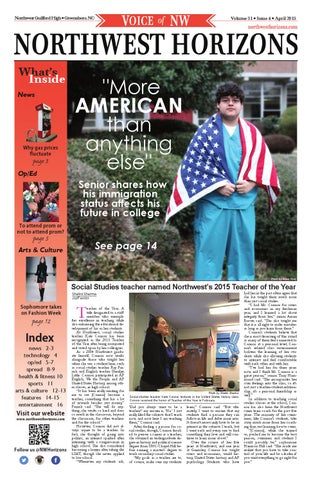
Social Studies teacher named Northwest’s 2015 Teacher of the Year Shalini Sharma staff writer
Sophomore takes on Fashion Week
T
eacher of the Year. A title designated to a staff member who exemplifies excellence in teaching while also enhancing the educational development of his or her students. At Northwest, social studies teacher Kate Connor has been recognized as the 2015 Teacher of the Year after being nominated and voted upon by her colleagues. news 2-3 As a 2004 Northwest graduate herself, Connor now works technology 4 alongside those who taught her op/ed 5-7 when she was a student here, such as social studies teacher Ray Parspread 8-9 rish and English teacher Sherilyn Little. Connor participated in AP health & fitness 10 English, We the People and AP United States History, among othsports 11 er classes, in high school. “It has been really exciting for arts & culture 12-13 Photo by Shalini Sharma me to see [Connor] become a Social studies teacher Kate Connor lectures in her United States history class. features 14-15 teacher, something that has a lot Connor received the honor of Teacher of the Year in February. of rewards besides just money,” entertainment 16 Parrish said. “She will do any- ‘Did you always want to be a learn,” Connor said. “But ultithing; she works so hard and does teacher?’ my answer is, ‘No.’ I just mately, I want to ensure that my so much in the classroom, beyond really liked the subjects that I teach students find a passion they can the classroom, for other teachers now, and now here I am teaching follow in life and delve more into. www.northwesthorizons.com and for the school.” them,” Connor said. It doesn’t necessarily have to be an However, Connor did not alAfter finding a passion for so- interest in the subjects I teach, but ways aspire to be a teacher. In cial studies, though, Connor decid- I want each and every one to find fact, she thought of going into ed to pursue a career as a teacher; something they love and will conpolitics, an interest sparked after she obtained an undergraduate de- tinue to learn more about.” interning with a congressman in gree in history and political science Over the course of her five high school. She also considered degree from UNC-Chapel Hill be- years at Northwest, and one year Follow us @NWHorizons becoming a lawyer after taking the fore earning a master’s degree to at Grimsley, Connor has taught LSAT, though she never applied teach secondary social studies. civics and economics, world histo law school. “My goals as a teacher are to,Northwest tory, UnitedHorizons States history and AP Like us: Follow us: @NWHorizons Like us: Northwest Horizons Like us: Northwest Horizons : @NWHorizons hwhorizons Follow us: hwhorizonsFollow us: hwhorizons northwesthorizons.com “Whenever my Follow students us: ask,northwesthorizons.com of course, make sure my students psychology. Students who have
page 12
Index
Visit our website
had her in the past often agree that she has taught them much more than just social studies. “I had Ms. Connor for civics and economics in my freshman year, and I learned a lot about integrity from her,” junior Amari Brown said. “She also taught me that it is all right to make mistakes as long as you learn from them.” Connor’s students believe that she is most deserving of this award as many of them feel connected to Connor at a personal level; Connor’s relaxed class environment bolsters the learning of her students while also allowing students to interact and feel comfortable with each other and with her. “I’ve had her for three years now, and I think Ms. Connor is a great person,” senior Tony Hammond said. “She incorporates her own feelings into the class, so it’s not just a teacher-student relationship; it’s a personal friendship as well.” In addition to teaching social studies classes at the school, Connor has also been the Northwest swim team coach for the past five years. The majority of her swimmers, like Connor’s students, take away much more from her coaching than just learning how to swim. “[Connor], while she trained us, pushed me to become the best person, swimmer and student I could possibly be,” sophomore Harrison Hill said. “She made me realize that you have to take control of your life and be a leader if you want everything to go right for you.”
northwesthorizons.com
Page 2
April 2015
Northwest pilots online registration, mixed reviews with first trial Shalini Sharma staff writer
I
n the 21st century, schools have begun to incorporate technology into all facets of public eduction. This year, Guilford County Schools modernized the registration process by allowing students to sign up for next year’s classes through the PowerSchool portal. “[Online registration] is very 21st century, and that is what we need to be doing— working 21st century,” 10th grade guidance counselor Elizabeth Lucas said. “Change is something that people have to adjust to, but I think students these days are very savvy and can click on a dropdown menu to select the right classes.” Northwest, along with Ragsdale, was chosen by the county to pilot the online registration so its effectiveness could be tested before instituting it throughout the district. “The county probably chose us partly because of our size,” counseling department chair Stacy Garner said. “Since this [process] is a challenge, they most likely thought that if we could get it done with our large population, any school could.” After dealing with budget cuts, though, there has been confusion about several classes and whether or not they will be available next year. In addition, some students faced trouble signing up for certain classes that may not
have been listed in PowerSchool. “I already go to Weaver for one period a day on a block schedule, and last year I signed up for the classes I wanted to take for the first and second semester together,” sophomore Vijay Purswani said. “But this year, PowerSchool only let me sign up for one semester, and I couldn’t choose a course for the second semester.” Also, people without internet access, those who have had trouble making a PowerSchool account or students who are not motivated to register for classes unless forced to, affect the results of this trial. “I think we need to go through this procedure once, and then we’ll be able to say, ‘All right, this happened last year, so I think it will be a great idea if you could get into the [computer] lab with your class, in the middle of the [registration] process, and make sure that everyone who hasn’t registered does so,’” Lucas said. However, this process aims to give students more control by allowing them to think carefully about course options before enrolling in them; previously, students who had not decided which classes to take had to spontaneously determine their schedule when they met with their counselor. Many believe it also fixes some other flaws present in the old registration process. “In the past, the counselors had to put in each student’s course request into the system
Teacher wins Speech and Debate Coach of the Year for second time Jackson Parrish op/ed editor
F
or the second time in four years, speech and debate coach and social studies teacher Scott Bennett received The National Speech and Debate Association’s Coach of the Year award for North Carolina, deeming him the most effective, efficient and best overall speech and debate coach in the state. Colleagues and students alike have admired Bennett’s leadership, organization and coaching abilities. “Mr. Bennett is one of the most influential people in my life,” senior speech and debate captain Sarah Williams said. “He has guided me throughout my high school career, not only in Speech and Debate, but in everyday life as well.” Bennett was presented the award March 7 at the state speech and debate tournament in front of other schools, coaches and team members. “[Mr. Bennett] is the only person I can think of that deserves
such a great honor, and his success has only made our team want to continue to thrive,” Williams said. Throughout his 11th year of advising speech and debate, Bennett has led his students to qualify for district and national tournament bids, including three this year. Bennett has also received several local tournament awards and hosted many tournaments at Northwest himself. Besides medals and trophies, however, a significant aspect of Bennett’s coaching is his help in developing critical abilities in students that are useful in the real world. Public speaking and articulating ideas in a professional manner benefit competitors not just at tournaments, but throughout their entire lives. “Being able to be a part of [students’] development of lifelong skills, getting them to think about big ideas, getting them to see that this world is bigger than Oak Ridge and Greensboro is why I [coach],” Bennett said. Photo by Alexis Marvin
by hand,” Lucas said. “So, since mostly future users. everyone is already in [the system] after online “I think [PowerSchool] will make it easier registering, that would probably save us weeks for the parents and the students because of time that we can now spend working with it allows them to complete the process of students instead.” registration together on their own time,” math In addition, when the counselors meet teacher Catherine Brown said. “Students, with students individually, a majority of the parents, teachers and counselors can have technological errors should be dispelled; they meaningful conversations about the student’s will ensure that each student is signing up for curriculum choices, and then the student and the correct courses, including zero periods parent can register online at their convenience, and online courses, which were not available making their final decisions together.” through PowerSchool. “PowerSchool is a very effective tool, but it doesn’t replace us meeting with the students,” Garner said. “If a student, for instance, accidently registers for honors pre-calculus, when they only needed advanced functions and modeling, we are able to clean that up.” Most of the time, with change comes some difficulties, especially if technology is involved; assuming that Guilford County decides to keep Photo by Shalini Sharma the online registration, Haleigh Cadd looks at the course offerings on Powerit is projected to become Sophomore School. This year, Northwest was one of two high schools to pilot online faster and simpler for regristration.
In Memorium: Julia Newman Pitts
F
(Dec. 21, 1941-March 10, 2015)
ormer guidance counselor at North- and joined the faculty at Northwest High west High School Julia Pitts passed School as a guidance counselor. She retired in away March 10 after a battle with 2003 but returned six months later to continue cancer. She was 73 years old. working. She officially left in 2009 after 42 Pitts was born and raised in Henderson, years of service to the Northwest community. Tennessee where Preston Powell, Northshe attended Chester west graduate from the County High School Class of 1997, remembers and Freed Hardeman Pitts fondly. College. She received “[She] was a huge part of her Bachelor’s in Edmy college planning process ucation from Union during high school,” Powell University and later, said. “She always took a pertwo Master’s degrees, sonal interest in those who one in education and made the effort to get the one in counseling, college choice right. I will from NC A&T Unialways remember Ms. Pitts versity. as a strong example of hard At the time of her work and kindness.” passing, she was a She is survived by her resident of Kernersdaughter Jeannie Starr, son ville, North Carolina. Jody Pitts, three grandsons Photo provided by Cherie Graham In 1967, she beand her sister. Pitts, second from the left, poses with gan working as a Julia A visitation was held at the guidance department. (December 2002) physical education Pierce Jefferson Funeral teacher at Northwest Guilford Middle School and Cremation Services Chapel in Kerners(then known as Northwest Junior High). She ville from 6-8 p.m. Friday, March 13. also served as the girls’ basketball coach and Funeral services took place at 2 p.m. Sunled her team to the state championship on day, March 15 at Shackelford Funeral Home more than one occasion. in Henderson, Tennessee, where she was inIn 1986, she received her second master’s terred.
How the decision is made:
The factors that influence students’ college choices Paige Nehls staff writer
C
hoosing which college to attend has been considered one of the most important decisions a person can make in his or her lifetime. College is where you will potentially meet your spouses, life-long friends and colleagues. College is the place where people figure out what they want to do with their lives. As a result of the importance of this decision, the process usually isn’t taken lightly. Several factors, including cost, course offerings and location, are considered when deciding which college to attend. “My parents encouraged me to start the applications over the summer, which I was at first very against,” senior Rory Howard said. “I worked through the fall and deep into the winter polishing off applications for colleges, honors colleges and scholarships alike. Overall, the appli-
cations stressed me out to a very high level Collegeatlas.org also lists factors one as I spent many days and nights working should consider before deciding which and worrying. Still, I discollege to attend. These covered how to work effactors include accreditaficiently and craft an eftion, academics, faculty, fective essay, which only location, cost, size and increases my confidence majors that are offered. about my ability to do One influencing factor well in college.” that is not mentioned is There are ways to rewho you will have to live duce the stress of the with. process, however. “I found a pretty awe“I wish I had known some potential roommate not to apply to those colfor NC State, and as bad leges that you’re applying as it sounds, that’s playto ‘just cause,’” senior ing a small influence in Concetta Errichiello said. my decision,” Errichiello “Don’t waste your time senior Concetta Errichiello said. on schools that you are What a school is positive you aren’t going to; it can be an known for can also sway a stuexpensive mistake. College applications dent’s decision. aren’t cheap. It would have been great to “For me, reputation was one of my know about the website colleges.startclass. most important criteria for schools,” secom to decide which schools to apply to.” nior Bianca D’Souza said, who has cho-
“
Don’t waste your time on schools that you are positive you aren’t going to; it can be an expensive mistake.
”
sen to attend Duke University in the fall. “Duke is a stellar academic school that has world [renowned] travel abroad and sports activities. Duke has a large array of majors and opportunities that fit my interests well, so [it] was a perfect fit.” While several factors influence a student’s final decision, the ACT website lists location as one of the most important factors in choosing a college. “I definitely wanted a school close to home,” Howard said. “I wanted to stay close to my family, which helped me choose schools that were located in North Carolina or Virginia.” D’Souza also believes that Northwest has prepared her for the years of higher education to come. “I feel very prepared for college,” D’Souza said. “The opportunity I have had to take AP Classes, Spanish and constitution classes at Northwest [have] greatly prepared me for my future endeavors, although I know I have much to learn.”
Page 3
April 2015
Highs and lows of gas: Why gas prices fluctuate
Faith Rickerts staff writer
T
his year was off to a start with gasoline under or around $2 a gallon, which had many breathing a sigh of relief and the rest holding their breath for the increase in price that was sure to come. Luckily, prices haven’t rocketed yet, although we may see some inflation later on. “It’s all based on supply and demand of the global economy,” AP government teacher Phillip Coley said. Demand is usually highest in the summer months and lowest during winter, which could help to explain the drastic drop. “I also think the push to go electric with hybrid vehicles has affected the supply and demand of the worldwide market,” Coley said. Even with new electric vehicles taking the streets, the United States still consumes an average of 178 million gallons of gas a day. That’s enough gasoline to take you around the earth 7,148 times. Most students don’t drive the circumference of the earth, however--just drive to and school. “I’m excited [to drive],” junior Alyssa Osborne said. “As long as I have a job.” Many students at Northwest do have jobs and spend most of their extra mon-
ey to pay for gas. “The prices are okay,” senior Adam Venable said. “I’m not worried about them because I have a job. My dad and I have a deal: he pays for my car, I pay for gas.” Gas prices are constantly changing, either rising or falling, whereas income is on a relatively flat line. In relation to each other, income can affect the supply and demand of gasoline. If the price increases, less people will be able to purchase as much as they would with lower costs. “I think we’ve done a pretty solid job of keeping gas prices and income equal,” Coley said. “There have been times that we haven’t—the Bush Administration, for example. That was a time when prices doubled and income didn’t.” With the constant fluctuation and unpredictability of the gas market, it can be safe to assume that these low prices won’t last. But it all depends on the demand for the fossil fuel, and the amount of crude oil countries have to sell. “[Gas prices are] like the tides of the ocean,” Coley said. “Sometimes hard tides come in, but then they always go back out.”
NEWS BEATS
• CHORUS: The NC High School Choral Music Performance Adjudica-
tion took place at Wake Forest University March 12. Led by choral director Trés Ward, the women’s chorus, the concert choir and the honors vocal ensemble received straight superiors from all three judges in the on-stage performance of their prepared pieces and in sight-singing. In addition, senior Corey Wilson was selected in the North Carolina High School Honors Chorus. Sophomore Marcia Lacopo and seniors Julio Lingao and Corey Wilson were selected to participate in the Mars Hill University Choral Festival in February. Finally, seniors Hannah Hamilton, Mackenzie Walter and Michelle Overcash, and sophomores Bailey Shubert and Connor Clary, were selected to participate in the North Carolina All-State Choral Festival coming up in May 2015.
• BAND: Led by director Brian McMath, three band classes traveled to
Asheboro High School to perform in adjudication the week of March 23. Concert band and symphonic band earned an overall rating of “excellent” with a “superior” in sight reading, and the wind ensemble earned a “superior” rating in all captions. Jazz ensemble has been invited to perform at many functions this year, including the NC Symphony Orchestra and the Guilford Education Alliance Education Summit.
• WINTER GUARD: The Varsity Winter Guard competed in the Winter
Guard International and was a third-place finalist at the Charlotte Regional. The team broke school records at the Norfolk, Virginia Regional, placed second in finals and earned a score of 81.45, higher than any previous winter guard at Northwest. The team broke another school record by becoming Scholastic ‘A’ Silver Divison Class Champions at the March 28 competition at Winthrop University, bringing home Northwest’s first gold medal for winter guard. They will compete in the World Championships in Dayton, Ohio April 16. The group is currently ranked 27th in the nation out of 117 groups.
• DRAMA:
Drama teacher Abby Cockman’s students attended the NC Thespian Festival in February where the play “The Other Room” received a Superior rating. Critics’ Choice Award Winners included senior Mariah Glynn in Monologue Performence and junior Parker Ard and senior Weston Crutchfield in Short Film. Both entries can now move on to the national level.
• ORCHESTRA: Honors Orchestra attended North Carolina’s Western Region Orchestra Festival March 20 in Shelby, NC. They performed Grade VI (the highest level music) and received Superiors from all three judges.
• BATTLE OF THE BOOKS: Led by English teacher Monica Clark and media specialist Trina Hunter, Northwest’s Battle of the Books Club took third place behind Weaver Academy and Grimsley High School.
• VARSITY GIRLS’ BASKETBALL:
Northwest’s girls’ basketball team, led by Coach Darlene Joyner, set a school record by ending the regular season undefeated 24-0. They advanced to the final four of the NCHSAA State Playoffs, making the first time in the history of the school for any basketball team to achieve either.
• SCIENCE OLYMPIAD: Northwest’s Science Olympiad team took third place at the regional competition and will move on to compete at the state level April 25.
• PHOTOGRAPHY: Art teacher Beth Herrick’s photography student junior Kendall Holbrook received the Scholastic Art & Writing National Medal for photography. His photo will be on display at Carnegie Hall in New York City.
• PENNIES FOR PASTA: Facilitated by English teacher Alex
Wertz, Northwest raised $3,745.16 for the Leukemia and Lymphoma Society through a fourth period classroom challenge.
• JOURNALISM: Photo by Satoria Ray
Senior August Howerton fills up her car with gasoline. Gas prices have fluctuated recently, and they are set to rise soon.
Northwest Horizons received the highest rating of “All-Southern” at SIPA, the Southern Interscholastic Press Association, March 1.
Information compiled by Sophie Vazquez
April 2015
Page 4
History of common technologies Have you ever wondered how the most common technologies work or how they were created? Northwest Horizons delves into four facets of technology that many students take for granted.
The Camera Noah McCormick webmaster
W
e carry them around with us everywhere we go. The camera is a technology that many take for granted but has completely revolutionized the modern world; yet less than half of those equipped with this beautiful tool can speak intelligibly regarding how it operates. Creating artists from nowhere, innovation has built a community of virtuosos around the camera lens in hopes to voice their feelings. “I admire photography because I get to express myself through an image without using words and my camera helps me achieve that,” junior Ashley Tomlin said. But before the idea of artistry could have even been associated with photography, Johann Zahn had to envision the concept first in 1685. Within a contraption of various sizes, one would pull a trigger to activate a shutter, then open a small hole called the aperture. However, a key second element was required:
film, which for all you youngsters out there is a span of plastic coated in a chemical material comprised of silver bases capturing light. When the aperture opened, light would flow through the lens causing a reaction when it came in contact with the film. Several trips to the drug store and hundreds of years later came the digital camera. With intentions to implement a more convenient alternative towards carrying around a huge device wrapped in thick aluminum; this model replaced film with a small electronic component called a charge-coupled device or CCD. As light flows through this much smaller aperture, its rays impact the CCD thus forming millions of pixels. And the best part is that you can make your masterpieces tangible within the comfort of your own home. “It amazes me how much photography has developed over the course of its history,” junior Travis Christman said. “It feels like we rely on them every day to communicate with each other.” Thanks to thousands of engineers, the camera has been able to branch off into multiple platforms such the camcorder, cell phone, GoPro, drone, tablet and much more.
Graphic by Astrocog from Commons.Wikimedia.org
Above is a graphic of a digital camera and all of its operating features.
Air Conditioning
Bassam Bikdash science & technology editor
T
he bustling city of Las Vegas receives abundant sunshine 310 days out of the year. On average, 134 of those days have highs in excess of 90 degrees and 74 have temperatures more than 100 degrees. Without proper air conditioning, it is unlikely that this famous city would have survived. Heating, ventilation and air conditioning (HVAC) is one of the most important technologies used today, designed to provide thermal comfort and acceptable indoor air quality. “I think [HVAC] is very important,” junior Nathan Richardson said. “It allows us to live in places of extreme climate conditions, and you don’t really appreciate it until it breaks and you start to sweat profusely.” Air conditioning is actually very simple; it merely transfers heat from indoors to outdoors. By taking heat away from the inside of a building, the air becomes cooler. The same process is used in your refrigerator. The process starts with a special liquid, called a refrigerant, which can transfer heat from one place to another. The refrigerant starts at a compressor, which pumps the refrigerant to a high pressure and tem-
perature to a coil outside of the building. When the refrigerant is pressurized, it becomes hotter than the surrounding air outside of the building which allows it to lose heat and become the same temperature as the air outside of the building. Once the refrigerant has removed the excess heat, it remains at high pressure and returns back to the building where it is depressurized in a chamber. Once the gas is depressurized, it expands to fill the chamber, and its temperature decreases to a point lower than the interior temperature of the room. Since the gas is of a lower temperature than the interior air, it absorbs heat from inside the room, and sent back to the compressor to begin its cycle all over again, resulting in a cooler interior. The New Building at Northwest, built in 2002, has a four-module HVAC system built by the Trane Company. “I think the air conditioning makes people less tolerant to the heat and it gives them something to run to. You need heat,” custodian Leroy Prather said. “However, air conditioning is necessary to help students learn, especially on hot days.” These inventions have allowed the southern and western United States to flourish while also allowing a new generation of machinery to enter existence. “I would say [air conditioning] is pretty unappreciated,” freshman Trace Wilson said. “Especially in the South, air conditioning helped to attract many people and create an economic boom.” 1. Refrigerant is sent at high temperature and pressure to coils outside of the building to dump its heat in the cooler oustide air. 2. Once the refrigerant has dumped its heat outside it moves to a chamber where it expands causing it to become colder than the air inside the building. 3. The cooler refrigerant is moved around the building where it absorbs heat inside the building. This causes the building interior to become cooler than the temperature outside. 4. The refrigerant goes back to the compressor and begins its cycle all over again. Graphic by Ilmari Karonen from Commons.Wikimedia.org
The Internet Nikole Nguyen graphics editor
T
hough it is a comparatively new innovation, the Internet plays an undeniably pivotal part in modern society. How it works, however, is as complex as it is fascinating. First, there is the hardware-- anything that can carry information from the cables to the computer. Some hardware acts as Internet connections, like routers and cell phone towers, while other hardware are endpoints, like smartphones and computers, display the information that you read. Also crucial to the internet are servers, which are just specialized computers, designed specifically to process requests and commands. Everyone’s computer must be able to access these servers. To access the information, there are common sets of protocols, or a set of rules that machines must follow in order to complete tasks. Protocols allow for not only a common method, but also a uniform language that machines may use to transmit data.
‘Hypertext transfer protocol’ is what the ‘http’ at the front of a web address means. “These aren’t typically things that I think about when I’m using the Internet,” junior Hannah Rouse said. There are also transmission control protocols and Internet protocols, which, at their basic level, establish rules for how information passes through the Internet and provide a common language between two computers in order to facilitate the connection. Together, they are called TCP/IP protocols. When a computer sends an electronic request over the internet, it travels via the Internet service provider (ISP), which routes the request along the chain of the internet. It will then reach a domain name server, and direct the request toward the server’s IP address. Here, the server responds by sending a series of packets. Packets are pieces of a file that are relatively small, not exceeding 1,500 bytes. They are ‘pieces’ of websites which correctly display the website in all of its glory. Through a series of protocols, the packets are arranged in order to produce the webpage in a small amount of time.
Graphic by Luduvic.ferre from Commons.Wikimedia.org
In order to connect to the internet, users must pass through various networks of hardware and software to reach the location of the stored website data.
The Electronics Display
Willa Ma editor in chief
T
elevisions, phones, computers and tablets. The electronic display is everywhere in our growing technological world. It may be all around us in our lives, but many do not know how it works. “Electronic displays are important because they are used with computers to display readable human information,” sophomore David Slakter said. “These displays add the capability for the user to view an interface and use input devices to interact with what they see on the screen.” The most popular and widely used display in TVs, laptops and phones is the liquid crystal display (LCD). Within this category are three types of LCDs. The most common is twisted nematic (TN) where light must pass through four filters. First, light goes through the polarizing filter, which aligns waves in a single direction. Then, the TN liquid crystal twists the light 90 degrees. Next, light passes through the color filter. Each TN panel is composed of a red, green and blue subpixel, tinting the light to produce many hues. The first polarizer
light in
liquid crystal molecules
last filter is another polarizing filter that is placed 90 degrees to the first one. Northwest has this type of LCD for the computers in the school. However, since TN panels produce poor color and limited angles for viewing, Hitachi developed In-plane switching (IPS), another type of LCD used in iPads, iPhone 4s and Amazon Kindle Fires. While an IPS panel is much like the TN panel, it has a different crystal structure with the crystals aligned horizontally. IPS displays allow less light to pass through, causing the display to be dimmer. Rather than turning vertically, the crystal rotates 90 degrees in parallel with the flat display. Then voltage is applied letting more backlight through. Lastly, the vertically aligned (VA) LCD has a different crystal structure and is lined perpendicular to the display. When a charge is applied, the crystals align horizontally, letting light through. Electronic displays date back to the 1920s, starting with the cathode ray tube. Over the last century, developments have been made to improve the color and energy efficiency of these devices used in our daily lives. Slakter also hopes to see screens that are completely transparent in the near future. “Improvements to the electronic display for the future may include smaller screens that have the capability of outputting high resolutions,” Slakter said. “I think that flexible display technology will be introduced in the future for smart phones and tablets.”
second polarizer
color light coming out
red, green, and blue filters
For a twisted nematic (TN) LCD: 1. Light goes through the first polarizing filter, aligning it in a single direction. 2. Then the TN liquid crystal turns the light 90 degrees. 3. Light goes though the second polarizer, the color filter with panels of red, green and blue, tinting the light to produce many different hues. 4. By controlling the intensity of the light that goes though each color filter, the polarizer can be used to create almost any color. Graphic from Commons.Wikimedia.org
April 2015
Page 5
To Prom or not to Prom:
Students speculate whether the time-honored tradition is overrated Melanie Jenkins staff writer
O
ne night spent dancing in fancy clothes and living out every teenage-movie stereotype at the infamous after party. It’s a time for drama, awkward dances and some pretty great stories to tell in the years to come. But at the end of the night, some people will still consider everything wasted if they don’t fulfill one specific prom tradition: bringing a date. “I wasn’t going to go, but the reason that I’m going now is because I asked my boyfriend,” senior Megan Critchley said. It sometimes feels like society pressures teenagers to take a date to prom. In films, there’s the archetypal story of the guy getting the girl, who looks stunning in her dress, and they both go happily off to prom in a very expensive-looking vehicle. In real life, the story is less cut-and-dry. Sometimes the guy doesn’t get the girl, or the girl doesn’t get the guy. Some promgoers are seeking same-sex dates, or the average high school student decides that he or she is okay going alone or winging it with friends. Regardless of having a date or not, some people just don’t feel like going to prom. Whether it’s because of the cost or
Photo provided by Madison Parnell
From Left to right, junior Liz Hubbard, senior Tori Smith, senior Katherine Hubbard, homeschooled junior Madison Parnell, senior Ashley Shatz, freshman Hannah Phairas and junior Lynton Martin. Students pose before attending the 2014 Northwest prom, circus-themed and entitled “The Greatest Prom on Earth.”
because they’re just not up for large social events, plenty of juniors and seniors have fun spending prom night relaxing by themselves. Maybe, instead of putting that $200 toward dinner, fancy clothes and a ticket, go
staff editorial
see a really good movie and treat yourself to a nice dinner with some friends. “I don’t want to go to prom, but if I did go, I would totally go to just go out for dinner,” junior Andy Dunkirk said. “That’s the best part, honestly.”
There are always two sides to an argument, so where some students may say that prom is overrated, there are also people who are waiting on pins and needles for May 16. A month in advance, students are starting to plan out the best way to ask out their date, final touches are being put on their outfits and parties are starting to call dibs on what restaurants they’ll be eating at. Already, the 2015 prom theme has been announced as “Roaring ‘20s,” so when May 16 rolls around, it’s truly going to be a night of fun at the Airport Marriot, where prom is being held this year. “I’m definitely looking forward to going [to prom], mainly because it’s a time where you get to dress super fancy and hang out with all your friends at the same time,” senior Anna Fletcher said. “I mean yeah, you spend an ungodly amount of money on a dress that you only wear once, but I think it’s kind of worth it.” In the end, prom night should be spent doing what makes you happy. Whether you spend it single, in a group, with a date or at home with your laptop, what matters is that you’re enjoying yourself. Junior and senior year is when students really have to buckle down in preparation for college, so it’s nice to let loose for one night of dancing.
We the People wins second place, controversy looms around state competition
W
e the People: a class about honor, integrity and, as its motto states, “pursuing truth in the company of friends.” Utilizing the Constitution, our class worked for the last five months writing papers and met with local professors to enhance our understanding about the Constitution’s past, present and future. Practicing our papers numerous times at town halls and universities, the class as a whole walked in on competition day March 13 at Duke Law School with high hopes for a first-place finish and a chance to compete at nationals. Each unit presented two papers in front of three judges, and by the end of the day, confidence in our performance filled the room as we waited for awards. “Good luck at nationals,” one judge said privatly to Unit 3 upon completion of its presentation. Unlike in previous years when various schools received unit awards to ensure no team went home empty-handed, the unit awards went to the top scoring. Unit 1 received our only unit award; the rest went to Raleigh Charter. Then it was finally time to reveal the top two teams. And we placed
Photo provided by Hannah Godat
The 2014-2015 “We the People” team poses for a picture at the state competition at Duke Law school. The team finished second, but there are several concerns regarding how the competition was conducted.
second. Shock covered the faces of all 37 members as we received the heartbreaking news. It was over. The competition for the class of 2015
was over. For days we looked for reasons why we didn’t win, asking ourselves if the competition was fixed. Further investigation
NORTHWEST Adviser Melanie Huynh-Duc Principal Ralph Kitley Editor in Chief Willa Ma News Editor Sarah Colby Op/Ed Editor Jackson Parrish Spread Editor Mackenzie Mitchell Sports Editor Sarah Boggins Features Editor Clare Kilmartin
Arts & Culture Editor Liz Hubbard Science & Technology Editor Bassam Bikdash Entertainment Editor Nick Loschin Managing Editor Lindsey McGuirk Webmaster Noah McCormick Graphics Editor Nikole Nguyen Tech Support Austin Drake
proved a mistake was made in calculating scores. Unit 2’s scores were added up incorrectly, costing them the unit award. They actually earned 159 points, rather than the 119 that put them in second place. One mistake was caught, but were there others? In the end, no matter what we did, nothing would get us to nationals. It was time to move on. But even with the disappointing ending to the competition, We the People is not over. It is time for us to leave our legacy. Each student has selected a book to take notes on and leave his or her mark for later years. In addition, it is our plan to present our papers in front of local universities in hopes of finding a sponsor for next year’s competition. This class has changed the lives of all the students who have passed through it. It’s about bringing people closer to the Constitution and its founders and realizing the still prevalent impact on today’s society. It’s about not being afraid to share your views and being open minded enough to accept others’ views. But most of all, We the People is about the pursuit of truth in the company of friends -- and family.
HORIZONS Staff Writers Jenny Blackburn Annie Ford Melanie Jenkins Alexis Marvin Harley Nefe Paige Nehls Katie Lee Parrish Satoria Ray Faith Rickerts William Royal Alexis Rutledge Shalini Sharma Sophie Vazquez
Policies and Intent
Serving as the primary printed and online forum for student opinion, Northwest Horizons publishes five issues each year by the staff at Northwest Guilford High School. The paper is supported through community advertisers. Staff Editorials are unsigned. The stance of each editorial is voted upon in staff meetings, but it requires the approval of the majority of the editorial board. All members of the school community are encouraged to use Northwest Horizons to express their views. Letters must be signed when submitted.
Find us online: @NWHorizons Visit our website: www.northwesthorizons.com
Page 6
April 2015
HEAD -2- HEAD Minimum Wage Workers need more money William Royal staff writer
U
pon entering 2015, the United States had over 46.5 million people, or 15 percent of the U.S., living below the poverty line. I’m sure we’re all too familiar with these frightening statistics; we hear about them every day. The issue remains one of constant political importance with the Democrats in Washington. Little do most people know just how many of these people are hard-working employees and how greatly they would benefit from raising the national minimum wage. The minimum wage was established with the Fair Labor Standards Act of 1938, a bill signed by President Franklin Delano Roosevelt. The law stayed true to FDR’s New Deal programs and the alleviation of the Great Depression. It also brought into mind what happened in the late 19th and early 20th centuries in industrialized America. Sweatshops and monopolistic firms would make workers labor for hours with little pay. Over the course of the next 77 years, the United States has seen several pieces of legislation zigzag through committees on Capitol Hill. “As we progress into a more technological age menial labor is becoming less and less available and, therefore, when people work fewer and fewer hours a week they don’t take any kind of hit at all,” senior Michael Murphy said. “I think that we should have a federal standard that encourages states to raise the minimum wage.” In addition to all of this political attention, the executive branch of our government has seen numerous presidents endorse raising the minimum wage. President Barack Obama even supports it, making it a substantially large talking point in his 2015 State of the Union Address. “...To everyone in this Congress who still refuses to raise the minimum wage, I say this: If you truly believe you could work full-time and support a family on less than $15,000 a year, go try it,” President Obama said in the address. “If not, vote to give millions of the hardest-working people in America a raise.” Regardless of your political leaning, the Obama administration’s stance on this issue is, for once, correct. According to a report by the Congressional Budget Office, raising the minimum wage from $7.25 to $10.10 would lift 900,000 people out of poverty immediately, and there is no telling how many more Americans could be affected. More than 1.5 million people on public assistance programs would also no longer need them, reducing government expenditures-possibly eliminating some of the programs that conservatives dislike. In addition to all of this, raising the minimum wage will not have any major effect on the economy. The minimum wage in California is over $9. By 2016, it is expected to lead the nation in sales. A minimum
wage increase would also raise the salaries of workers already earning more than minimum wage. Most business would be able to adjust to these changes rather well, having a more stable and responsible work force. “I support raising the general minimum wage because it marginally impacts the lower class and doesn’t impact the price of goods very much,” Murphy said. “It allows [the lower class] more buying power in our economy.” If there are no major threats to the economy and it cures some poverty, then why not raise the minimum wage? Many in this country would be brought out of poverty. “A slight increase to the minimum w a g e wo u l d n o t hurt t h e economy,” social studies teacher Dana Hilliard said. “I truly believe that if people are happier, then they work harder for you.” There is also a quite alluring factor that brings in the conservatives and the right-wingers. If we raise the minimum wage, then there could be more incentive to work harder at jobs. This, in turn, would increase personal responsibility which is a great thing for those believing that this country lacks personal accountability. Family life will most assuredly improve for a minority of Americans living with minimum wages and also raising children. Improving the lives of our next generation is a tune that we can all dance to. “[In states where] the standard of living is comparable to what we have here, then the poverty threshold needs to be brought up a little bit,” Hilliard said. To make the lives of our people better for decades to come, all it takes is some bipartisan cooperation on Capitol Hill and an appreciation for how hard the bottom 10 percent of America works just to live. If a bill makes it through committee in the capital, and the president signs it, as President Obama has said he would, only then will progress be made. “No business which depends for existence on paying less than living wages to its workers has any right to continue in this country,” said President Franklin Roosevelt in 1933. “[And] By living wages I mean more than a bare subsistence level-I mean the wages of a decent living.”
Higher wages hurt economy Sarah Colby news editor
D
uring President Obama’s 2015 State of the Union Address, he proposed raising the federal minimum wage from the current $7.25 by nearly 40 percent to $10.10. Proponents of the raise say that this increase will help the economy, increase job availability and decrease reliance on social welfare. Though there is a federal minimum wage, the minimum wage followed by companies is often set by the states in which people live. There is an inconsistency already on how the minimum wage is applied. Twenty-one states, as well as the District of Columbia, already have minimum wages above the federal standard. T h i s idea of a minim u m wage i n crease helping those living in povertyis not correct. The increase will only help those with jobs already, not those without one already. Of the 16.5 million people in poverty in the United States today, only about 900,000 of them will be affected greatly by a higher minimum wage. “There’s no incentive for someone to better themselves and seek a higher education that would lead to a lifelong and stable job,” senior Audrey Wheeler said. This is due to the fact that relatively few people working these jobs are actually in poverty. Of the families in poverty, about seven percent have a full-time worker. The problem with poverty is not that the people are not being paid enough; they are not working enough hours to actually support themselves. “What’s the point of trying to do better when you can still be paid a wage that’s enough for a family?” Wheeler said. While a federal minimum wage increase would have positive short-term results, the long-term effects would cause the increase to be evened out in the long run. When a business must pay its workers earning minimum wage almost three dollars more an hour, there would be less money to pay each worker, resulting in job cuts and an increased level of unemployment. “It usually leads to laying people off, taking the profits that they [small businesses] might’ve been making for expansion and
putting that into labor costs,” civics and economics teacher Jim Thompson said. “Because they can’t expand, it can actually retards [slows] hiring, because expansion means hiring.” Though large corporations have the ability to pay their workers more by cutting out of the profits, this increase hurts local businesses. “[For a large] corporation like Wal-Mart, Lowes Foods, or whoever… labor costs are one of their main concerns; however, they can absorb an increase [in the minimum wage] because their profits are pretty large, whereas, a small mom-and-pop store or small restaurant doesn’t have a lot of corporate money floating around” Thompson said. “For them, it’s very difficult to absorb that.” Even if a company decides to keep all of its minimum wage employees, the money would need to come from somewhere in order to pay those workers. To compensate and still earn profit, a company would need to raise prices. This wouldn’t just occur from store to store, however. This would happen across the entire market, causing inflation and weaken the buying power of the dollar. “Most businesses are going to pass that cost onto consumers, which means consumers buy less, which means the economy is retarded because the prices of goods go up,” Thompson said. If the minimum wage goes up, the people who already make that amount will be looking for a raise. “Usually, if the [price] floor goes up-let’s say you’re making $10 an hour and now, all of a sudden, everyone is making nine dollars an hour at minimum wage, naturally, you’re going to want $12 an hour,” Thompson said. “The cost of labor is going to grow across the board for everybody, which will cause inflation.” In some places, like less metropolitan states, the raise will have more of an affect on the workers rather than workers in large cities that must pay more already. “It’s not a specific set of rules,” Thompson said. “Like for one group of people raising the minimum wage really is going to either a) put them under or b) make them have not as good service which will make them not do well as a business.” Though it seems that we are stuck in a roundabout way of society, where no matter how high we raise the minimum wage, those earning less will always earn less, this is not the case. Perhaps a 40-percent increase immediately is not the way to go about it. “A rise from the minimum wage where it’s currently at to $10.10 would shock the economy,” Thompson said. “Most people don’t quite understand that.” If we gradually increase the minimum wage, the market will be able to resist economic shock and support higher pay for millions of Amaericans. Graphic by Mackenzie Mitchell
Are vaccines still effective in the medical world today?
Faith Rickerts staff writer
‘T
he happiest place on Earth’? Not anymore, apparently. Recently, Disneyland has been overrun with an outbreak of measles—a disease that had been declared eliminated from the U.S. by the CDC in 2000. “I think it’s because somebody didn’t get their vaccine,” sophomore Kristina Clifton said. “I think this should be noticed but not blown up.” Many suspect that parents who refuse to vaccinate their children have caused this outbreak, among many others. Actress Jenny McCarthy appeared on Oprah to state that she believes vaccines caused her son’s autism, and went on write about it. This un-backed fact has made its rounds among parents and caused a big panic.
“It really scared the public,” biology teacher Amy Dunn said. “So of course people were very concerned about getting their children vaccinated.” However, many major medical groups have disproved this theory. “It’s been totally debunked,” Dunn said, “[Scientists] have done many studies to show that there is no correlation between vaccinations and autism.” Vaccines work by injecting a weakened or changed virus into your body to allow your immune system to mount a defense against the foreign substance, and for it to remember the virus later on. This allows your body to have a much quicker response to the actual virus, should you encounter it, and prevents you from getting sick. “I believe you should get vaccinated for your safety and others’,” Clifton said. It’s possible to see side effects after receiving vaccinations, ranging from a slight
fever, to fatigue or a mild rash. “The side effects are so tiny, the benefits tremendously outweigh [them],” Dunn said. In North Carolina, you are required to receive your Tetanus shot before you’re allowed to enter the sixth grade. There are many other states that have different requirements for children before they are admitted into a public school, which benefits the United States’ vaccination reputation. Other countries don’t have these conditions for their students, however. “You have these people coming into the United States who are unvaccinated, and they can sometimes be the ones who are carrying in these diseases, such as measles,” Dunn said. However, immigrants and the infamous autism scare are not the only reasons we see outbreaks of these viruses. Age restrictions also play a big role in how sickness is spread. “Sometimes you can’t get a vaccination until a certain age,” Dunn said. “There’s going
to be a vulnerable time [for infants] from about six to eight months to about one year until you can get that vaccination.” Babies are born with some of their mother’s immunity to certain diseases, but this starts to wane once the child reaches about six months of age. Because the measles vaccine is recommended for children one year and older, infants will be susceptible to the disease until they receive the shot. It is also possible for a vaccinated adult’s immunity to start to fade after a certain number of years. If they do not get regular booster shots, then they, too, will be prone to illness and possibly become a carrier of a disease. “Vaccinations work,” Dunn said. “It’s the people who don’t vaccinate, the people who come into the United States that aren’t vaccinated, the very young and the older people whose immunity isn’t as effective. Those are the main problems.”
Page 7
April 2015
International education leaves America in the dust Mackenzie Mitchell spread editor
C
ountries all over the world await their annual test results, but when the United States looks upon its status compared to 65 other nations, it seems that its marks are as unimpressive as they have been in the past several years. In 2012, the United States scored below average in mathematics and slightly above average in science and reading on the Programme for International Student Assessment, or PISA test. These scores have actually dropped since 2000’s test, giving clear sight to the fact that these other countries’ education systems are advancing much faster than ours. But what are these advancements we have failed to take on? Asian and European schools are faring much better not only in analysis of the PISA test, but also in that their students are simply learning more— effectively learning more, that is. Schedules might be the first answer to that question. “I’m a big fan of the German schedule,” German teacher Lisa Worthington-Groce said. “So when you think about your science classes, where here we might say, ‘Okay, one year of chemistry and you’ve satisfied your chemistry credit,’ in Germany, they have kind of a modified block schedule.” Germany, like many European schools, implements a schedule in which students take many classes per year—much more than the required six in the United States— attending only a fraction of those classes each day. While Monday’s schedule may differ from Tuesday’s and Wednesday’s, the weekly schedule repeats itself throughout the school year. “I think [this schedule] does definitely allow students to gain not only a wider breadth, but to go deeper into the material than a typical American high school student would be able to do after one year of taking a subject,” Worthington-Groce said. Having such a modified schedule requires maturity within students to be able to tackle all of the classes during one school year, and that leads itself into kids possessing the maturity to truly care about their academic progress. “I think the focus on grades here [in America] puts a lot more stress on [students],” junior and five-year student of an
Graphic by Mackenzie Mitchell
Education for United States’ students pales in comparison to the success of other nations such as Canada, Japan and Finland. Inferior scheduling, treatement of teachers and elongated breaks have contributed to the United States falling behind in many areas of instruction.
international school in Switzerland Miranda Cecil said. “Kids cared more in and of themselves about their grades [in Switzerland], and here it’s more like, teachers tell you that you have to make good grades.” In addition, grades in both Asian and European schools are not majorly reliant on standardized testing, which is seen frequently in America. “There is definitely a lot more focus on response questions [in Germany], not just written but also orally,” Worthington-Groce said. “The idea of multiple-choice standardized tests is not common.” Critical thinking questions composed much of the PISA test, but aside from that, this kind of critical thinking that is being taught in schools around the world is exactly what is essential in post-secondary schools and, later on, jobs. Language is also a quite important difference between America and the rest of the world. Sophomore Justine Wielemans, a student who lived in French-speaking Belgium her entire life until this year, said that it is vital to learn multiple languages, as Belgium is a country with three official languages: Dutch, French and German. “I started Dutch in pre school,” Wielemans said. “I’d have one lesson a week just to get familiar with it, and I had Dutch for all
of my primary school and secondary school. The languages are easier to learn then than when you’re older.” Basic knowledge of another language gets one used to words like “indirect object” and “past participle,” terms normally taught until about eighth or ninth grade, then forgotten about in order to focus more on literature. In a way, learning a foreign language fortifies understanding of one’s own mother language, which could be beneficial to American students. “For my school, a big difference is here, the teachers have more of a personal relationship with you,” Cecil said. “My teachers here—I wouldn’t say they know me better, but they care more about how I feel about stuff.” Wielemans expressed the same feelings. “The first day I was here, it was so hard because I didn’t speak English, and all of my teachers were so nice with me and so welcoming,” she said. “They all tried to help me.” There is always room for improvement. What practices should we as Americans advocate to apply into our schools? First of all, teachers are treated with much more respect in Asian and European countries. In certain parts of Asia and Finland, obtaining a teaching degree is just
about as hard as working for a doctorate degree. Teachers are paid much, much more than they are here in the States, resulting in more incentive to do all that they can to use class time wisely and appeal to each student’s learning experience. Countries and cities that scored exceptionally high on the PISA test, including Shanghai, Hong Kong and Singapore, were noted on providing each of their students with an equal learning environment, encouraging everyone to learn at the same level so that nobody was left behind. Countries of Asia sincerely believe in hard work and perseverance. “There have been studies here in America about the amount of material lost; we have these big two-and-a-half month-long summer breaks,” Worthington-Groce said. “Personally, I wouldn’t mind seeing a shorter summer and a few more breaks throughout the year. That would be more conducive to student learning.” If the citizens of America are educated on the rest of the world’s stellar academic feats and are willing to impose, at the least, some form of those practices within their school systems, the next generation may be able to bring the United States up from “average” and into a world of more possibilities.
A country of immigrants continues to impede immigration Liz Hubbard arts & culture editor
A
merica is traditionally referred to as a melting pot because it welcomes people from a variety of unique countries, races, religions and cultures, but despite their wide array of differences, the many people who migrate to the United States each year all share one thing in common: a desire for freedom, new opportunities and a better life. “America has set a precedent for itself as being the land of opportunity, and there’s no reason why that mantra should lose its meaning,” senior Aadam Haque said. However, as the nation has grown and more immigrants have come to the United States, it has become increasingly important to create a more effective system that can successfully regulate immigration rates and prevent foreigners from entering the country illegally. “Our immigration system is more outdated than the first [generation] iPhone,” Haque said. “Reform definitely needs to happen, and Congress needs to find a way to somehow correspond on this issue and avoid decent conceptual ideas—like those put forth by the infamous ‘Gang of Eight’— [being] written off solely due to political association.” While it is undeniable that immigration has been a major issue for decades, there is still controversy over how the issue should be resolved. Many people argue that immigration laws should be regulated exclusively by the states, but without federal laws, the immigration system will not be effective. “The federal government [should make immigration laws] for uniformity and con-
sistency,” social studies teacher Phil Coley people who already live in the U.S., but the said. “If the states do it, you’re going to have cultural and economic contributions immidifferences and people are going to find the grants make are far more important than any weak states to exploit.” negative impacts they might have. The most infamous state attempt at regu“Immigrants could put a strain on factors lating immigration might be Arizona’s S.B. such as healthcare and aid, but they bring 1070, which was signed into law in 2010. with them the priceless entity of culture, Four of the most controversial elements which, whether within our education system were blocked by a federal judge, including or in our cities in general, is a positive mark the requirement that of the outside world anyone the police that encourages greater stop or suspect is in awareness of other perthe state illegally must spectives,” Haque said. have their immigra“At the end of the day, tion status checked. those here legally do Other states, such as pay reasonable taxes Oklahoma and Utah, and also may take on have passed laws with jobs that some Carolinsimilar requirements. ians are eager to avoid.” Many of the state’s In fact, Hispanic imlegislatures addressing migrants’ labor contriimmigration, including butions and low wages North Carolina’s, mansupport entire indusdate the use of E-Veritries including meatfy to check whether job packing, agriculture and applicants are eligible. textiles, and Hispanic North Carolina’s Social studies teacher Phil Coley labor in industries such population has grown as construction creates very significantly in the last two decades; jobs in complimentary industries which confrom 1990 to 2000, it had the largest percent tribute to the state economy through income growth (274 percent) of the immigrant pop- tax, sales tax and property tax. ulation of any individual state in the country, North Carolina’s immigration laws inwith Hispanic residents accounting for a ma- clude the “Secure Communities” program jor portion of these immigrants. which is a federal program requiring that all “If you’re going to stop [illegal immigra- arrestees are fingerprinted and run through a tion] you’ll need more laws to implement,” federal database which checks their criminal Coley said. “For a long time the only way record and immigration status as well as a you were truly going to slow it down to a law that requires all new state government trickle is to build the Great Wall of Mexico, hires to be screened for verification of legal otherwise you’re going to have people come residence. across the border all the time.” State immigration laws should not be the Many people worry that the addition of center of focus because the current immiso many immigrants to the population will gration system is fairly consistent across the hurt the economy and take away from the country; the issue, however, is that the sys-
“
We either need to revamp the laws to welcome immigrants, or we need to take a hardline stance and enforce the system that was put in place years ago.
”
tem is still not successful enough to prevent more illegal immigration from occurring, and significant changes need to be made. “We need to stop taking sort of a weak middle ground on it,” Coley said. “We either need to revamp the laws to welcome immigrants, or we need to take a hardline stance and enforce the system that was put in place years ago, crack down on people that are illegally employing these illegal immigrants— actually deport [immigrants] if that is your hardline stance. Otherwise, go the opposite direction.” Attention must be given to the many illegal immigrants who already reside in the United States and how we are going to assimilate them into our society. While some immigrants are deported, the issue becomes far less simple in certain situations such as when the illegal residents are parents of children who are citizens by birth. The US government has an immense need to create a system which will allow and encourage people from across the globe to migrate to the country legally rather than attempting to simply prevent illegal immigration from occurring. America itself was the creation of immigrants, and as a land overflowing with varying cultures and opportunities, America should be a place that benefits and is built off of the immigration that has been prevalent throughout its history. “We didn’t raise the Statue of Liberty with her back to the world, we did it with her light shining as a beacon to the world,” President Obama said in his 21 Nov. speech on immigration. “And whether we were Irish or Italians or Germans crossing the Atlantic, or Japanese or Chinese crossing the Pacific; whether we crossed the Rio Grande or flew here from all over the world – generations of immigrants have made this country into what it is. It’s what makes us special.”
I
I
AM NFLUENCED. The media can uplift some people, but to others, it can be hurtful.
T
he media can evoke various thoughts and feelings among members of society, and there are numerous sources, from newspapers and magazines to television shows and music, or anything that can be found or shared on the internet. This ubiquitous influence can have good or negative effects on someone. Even if it might just be for pure entertainment, influences from media bring with them larger effects on society. These two articles explore the positives and the negatives of the media, whether they are inspiring or impairing to society as a whole.
Photo by Sarah Boggins.
Senior Christy Doyle poses with makeup applied to only one side of her face. This depicts how one naturally looks compared to how the media may present someone.
Photo by Brenna Profit
“[The characters in the novel ‘Dream of Me’ by Quinn Loftis] speak to me and make me want to be a more generous person.”
-junior Stephanie Rowland
“’The Blind Side’ inspires me to fight through tough times.”
-sophomore Cole Pickford
“I like the song ‘A Little Too Much’ by Shawn Mendes because it shows that whatever situation you are in, you can get through it and many people have hard times.”
-sophomore Caitlyn Miller
The media... Inspiring
or
Nikole Nguyen graphics editor
T
he “media” is a perfect example of society giving a word the ability to live and breathe. Of course, with any action, there are good and bad consequences that take place as a result. It is difficult to refer to the media without becoming vague. Media in the form of newspapers, news radio stations and popular news channels on television have received generally positive feedback. But in a culture where media is held upon a higher pedestal, some have argued that its presentation is uniquely significant to this modern time period. Many have commented that the media has also allowed younger generations to be desensitized to violent imagery, strong language and drugs. It creates a message suggesting bending societal norms is “cool.” “Although it is an amazing stress reliever, the media has become more about numbers and sales rather than to educate,” English teacher Sarah Hutchinson said. What’s more is that many have access to these less-desirable pieces of the entertainment industry, including children. “Since there have been so many technological improvements over the past century, there has been more of an influence on the newer generation and they absorb these things so much more than older people do,” junior Heather Trainor said. At the same time, the dilemma is whether or not this influence is good. “When I grew up with television, I was aware of the line that divided what really is and what really isn’t,” environmental science teacher Dr. Richard Thomas said. “But I wonder if children nowadays have this exchange with their parents.” But there is a balance to everything. “I believe that the entertainment industry promotes diversity, acceptance and creativity,” senior Anna Watkins said. Art in American society is
Impairing?
Alexis Marvin staff writer similar to that of pushing society’s definition of what is accepted and normal compared to what is not. “The media now provides for children a more accessible hero-- someone to look up to that doesn’t have to be a politician, but presents, for them, a moral guide,” Hutchinson said. At the same time, however, it provides a moral conflict that is certainly questionable. “Celebrities who are relatable and follow the status quo are famous, but the same can be said about those who fall very far from the status quo – in both a good and bad way,” Trainor said. But what the media brings to the table, in spite of its blood and gore and warped teen role models, is inspiration. Not only inspiration to become a specific part of the industry on its own, but also inspiration in the form of being able to wake up the next morning, to being able to produce a work that pulls heartstrings. “Movies can make you feel very strongly about certain issues and pressure the viewers to change them,” Watkins said. Films and television are extremely effective methods of garnering attention for societal problems. One popular example is the film “Avatar,” which ignited concern for the environment and drew parallels to 20th century imperialism. “Media pushes past artificial boundaries in a good way,” Thomas said. “Publicizing interracial marriages, for example.” The media is a fickle creature, however. The positive fruits of media come with the negative ones, but in the end, it is a product of society and, in order to change, it will take a group effort. “Media is now a reflection of what the consumer wants. Instead of informative news articles, for example, we’re inundated with articles on Beyoncé and whatever nonsense there is because it is what the consumer wants,” Hutchinson said. “No one wants to hear the tough stuff.”
freshman Kaiti Moore: “The media has set unrealistic beauty standards for life, and many people are seen or see themselves as not beautiful because of it.”
M
edia has played, and probably always will play, a crucial role in most people’s lives. Whether that role is good or bad is controversial. With all the stereotypes imposed on people through ads, movies, and television shows, it’s no wonder that the media has caused some massive effects on both boys and girls and the way they see themselves. “They’re broadcasting an image that is completely false,” sophomore Bailey Davidson said. Only a portion of the population feels comfortable in their skin, leaving many people to feel like they need to change their bodies. This arouses the question: ‘Who are you trying to please?’ by having the socalled ‘perfect’ body. Girls and boys of all age groups go through their daily activities wondering how they can change themselves to be better, or look a certain way. And this is brought upon them by the things they see every day, whether it be ads, magazines, commercials or otherwise. The media presents people who look a certain way, and because of the obvious success of these people, those who see them desire to look the way they do. While there are several companies that would rather advertise a false image, there is still a light at the end of the tunnel. Corporations like Dove actually create campaigns that specifically target the self-esteem of the viewing people. They also work hard to incorporate people with different body types and of different races into their commercials. Even celebrities understand how the media manipulates their image. Recently, untouched photos were leaked of Beyoncé, showing an uneven complexion with blemishes. These photos demonstrate how even the most esteemed stars are real people; through airbrushing and Photoshop, the media has a tendency to put forth an image of these celebrities as having an unattainable
senior Rachel Zawadzki: “The media often portrays unmeetable standards that can be detrimental to people’s health.”
level of perfection. “In today’s crowded media landscape, the stories that the media chooses to tell about women and girls often present a narrow view of what beauty is,” says Dove on its website. “Without widening that definition of beauty and expanding it to include attributes beyond just physical appearance, our daughters will miss out on an opportunity to see a diverse variety of inspiring, intelligent and thoughtful women that they can relate to.” While Dove targets girls, sometimes even boys struggle in this media-dominated world. “The media presents people at a higher standard, and it causes us to want to achieve what we see, and when we don’t reach that goal, it causes self-esteem issues,” sophomore Dylan Morris said. Among high school students, 44 percent of girls and 15 percent of guys are attempting to lose weight. This is a huge social barrier that prevents people from living their lives to the fullest of their ability, and most of the time the problem goes unnoticed by family. “Our parents don’t really notice these issues; they don’t agree with the influence of media, but they don’t really try to stop it either,” Morris said. There are more issues than just body image presented to young people. Popularity and academic standards are set very high and often cause stress for people trying to achieve them. “It’s just really hard to meet those standards, no matter what,” Davidson said. Ultimately, the media presents issues to already struggling teens, and gives them such high standards to meet that when they don’t, they become upset. To avoid the issue, teens and anyone who struggles with the problems presented by media’s standards should take a closer look and realize that everyone is different. No matter what grades one makes, how many friends one has or how one looks, he or she is a unique individual and should celebrate his or her individuality.
sophomore Austin Benson “Cyber bullying affects the media and makes people feel uncomfortable.”
Page 10
April 2015
Reverse crunches:
1
This season’s best new ab exercise
Roll out a yoga mat, or something that will provide cushion, and turn on the TV to distract you from the burning sensation that is in the near future!
2 3
Begin by lying on your back and putting your hands by your sides. Raise your legs up in the air and cross them at the ankles.
Lift your entire lower body into the air, letting your legs lead the way. Once you have lifted yourself as high as you can, lower yourself back down and repeat 50 times. Combine with other core exercises, and your abs will be showing in no time. Photos by Sarah Boggins
Berry Blast Smoothie Ingredients: ½ cup frozen blueberries
Step 1: Grab your blender and begin adding in the ingredients. Order does not matter in this recipe, and if you feel like you would like more or less of one ingredient, adjust it to your preference.
Step 2:
Turn the blender on once you have all of your ingredients in and blend until well combined.
Step 3:
Pour into your favorite glass and enjoy!
½ cup frozen strawberries
½ cup orange juice
Photos by Sarah Boggins
1 individual container (5oz.) plain or vanilla yogurt
Quick tip:
Organic foods are an excellent way to begin eating healthy. All of the foods used in this recipe are organic, so you will feel much better knowing what you are putting into your body. Most people turn away from oragnic foods because they don’t know what they are. The only difference between nonorganic foods and organic foods is that organic foods are not sprayed with harmful pesticides. So from now on when you are shopping in the grocery store, take a look at the organic section.
Page 11
April 2015
Snow daze: How snow has affected winter and spring sports
Sarah Colby news editor ith cancellations and delays due to snow, most students would be rejoicing at the idea of missing nearly two weeks of school. “Because of the snow, we missed a full week of practice,” senior lacrosse player Michael Ha said. “Then when we had our first practice the following Monday, we had to cancel the rest of our practices that week due to snow.” To Ha, however, this doesn’t just mean that the team didn’t get to practice. “Essentially, we were already two weeks behind schedule and two weeks where our team could have gotten better,” Ha said. With the season being pushed back, the first few games of the season were pushed back, as well. “We had to skip our first game which was supposed to be Tuesday [March 3] against Glenn, and [it] has been postponed until April,” Ha said. For track and field, this is a different matter. “The only thing that was pushed
W
back was the start of the season,” runner and junior Zach Sanger said. “Thankfully none of the meets had to be made up because none of them were scheduled for those two weeks.” For girls lacrosse coach Kaitlin Brown, she took initiative and decided to hold practice on Saturday, two weeks in a row to make up for lost time. “I held Saturday practice because of the weather conditions,” Brown said. “With the rain and snow, the fields have been too wet for us to practice outside.” Ha believes there are ups and downs to Saturday practices. “From a player’s point of view, I think that it is important that we have time to rest and recover whenever we have the time,” Ha said. “So I think that weekend practices would have its perks but would, in the end, take a toll on everyone, even the coaches.” For now, the season is just about getting better. “We already missed a bunch of practices and a couple of games, and now it is a matter of putting in the time and effort to get better as a team,” Ha said.
Photo by Sarah Colby
Senior Karsyn Parent shivers in the cold during lacrosse practice. Inclement weather this school year has affected winter and spring sports, causing many games and practices to be canceled or rescheduled.
team ratios of junior and senior players Juniors vs. Seniors : Northwestpredict next year’s team outcomes Katie Lee Parrish staff writer
D
ata taken from baseball, girls’ lacrosse, girls’ soccer and rugby present a sample of the ratio between junior and senior players on Northwest’s sports teams. Teams that have a large number of juniors may have an advantage for next year’s season when recruiting new players. These teams have many current juniors, so next year they may not have difficulty finding new players. This will apply to baseball, girls’ lacrosse and rugby because much of their team consists of current juniors. “I think it is better to have an even split [of junior and senior players]because you don’t want your team to be made primarily up of seniors,” junior varsity soccer player Marissa Millard said. However, girls’ soccer has more seniors than juniors, so perhaps next year they will open up their team to younger players. “Although we will be losing several strong graduating seniors, Graphic by Nikole Nguyen and information compiled by Katie Lee Parrish I’m confident rising upperclassThe graphic above depicts the number of juniors verses the number of seniors on four school sports. The blue bar represents the juniors on each team while the red shows the men will be able to step up and do number of seniors. the job,” freshman varsity lacrosse player Montana Murphy said.
Special Sports profile: Athletes involved in non-school sports
ping and tumbling, and [diving incorporates these things],” Zawadzki said. Zawadzki says he was slightly nervous when he began diving. orthwest does have a diving team, but “I had no idea what I was doing,” Zawadzki said. freshman Noah Zawadzki has taken this “I was kind of afraid of heights when I first started, water sport to a whole but I eventually got over that.” other level. Zawadzki practices for more than three hours a Zawadzki has been day, five days a week. Howdiving for more than ever, Zawadzki says that six years. He recently diving does not affect his attended the Huntschool work. ersville National Invi “We have some breaks and tational, and while he on the way to practice, I can freshman Noah Zawadzki was there, he placed do work and study,” Zasecond overall, setwadzki said. ting two personal re Zawadzki says he has cords. chosen not to participate in the school’s diving team “I was a swimmer at first and I saw [the divers] because of the time commitment required by the come into practice,” Zawadzki said. “I also loved team he is already on. being in the water.” “Diving on my team takes all my time, so I can’t Although Zawadzki enjoys swimming, it bedevote any time to the school’s team,” Zawadzki said. came too much to handle because he has asthma. Although some students end their athletic activi “I wanted to try diving, and I tried it and loved ties in high school, Zawadzki wishes to continue his it,” Zawadzki said. diving career; he is hoping to gain a scholarship in When Zawadzki was two years old, he parcollege for it. ticipated in gymnastics. He believes that it has “I am planning to start my own diving team, or behelped him in his diving career. come a coach for a diving team at a college in another “I have always done something with flipstate or in North Carolina,” Zawadzki said.
Sarah Boggins sports editor
N
Picture provided by Noah Zawadzki Freshman Noah Zawadzki stands second from the left on the top row after winning second place at the Huntsville National Invitational. Zawadzki has been diving for for more than six years and hopes it will lead him to college schlarships.
“
I wanted to try diving, and I tried it and loved it.
”
Page 12
April 2015
Spring Photography Contest 2nd place: “The Earth at My Hands” by sophomore Bailey Davidson. “I was out on a walk, and I saw these beautiful flowers blossoming from the ground. They made me think that spring was soon to come and winter’s troubles would soon be in the past.”
1st place: “Dew drops on roses” by sophomore Catherine Gray.
3rd place: “Daffodils rising” by junior Hannah Cook.
“I took this photo because I love how pretty the dew looked on the roses. It made the roses seem to sparkle in the sun and gave them a soft look.”
“Daffodils are my favortite flowers, and I look forward to seeing them every spring. They are a bright reminder that winter does not last forever.”
Northwest sophomore now From the halls to the runway: Former works as a professional model Jenny Blackburn staff writer
I
magine walking down the runway in New York City during Fashion Week. As the doors open and the crowds are watching, you keep a straight face and walk out with your head held high, trying to make an impression, wearing clothes that easily cost more than $1,000 per article. This is the life of former Northwest sophomore Avery Blanchard. During the fall of 2014, Blanchard made the decision to seriously pursue modeling. She began working with IMG Models and K Starr Management and traveled to New York City to attend to a few casting calls. As a result, she was selected to participate in several fashion shows, and her career has been blossoming ever since. The 5’10,” blue-eyed, blonde 16-year-old has gained the attention of high profile fashion designers. Though still a permanent resident of Greensboro, her modeling career has taken her to Europe and Japan in recent months. “It’s hard having your best friend in different countries all the time, but I’m happy for her and can’t wait to see where it takes her,” sophomore Anna Farrell said. During Blanchard’s time in New York, she walked the run-
way for the fall and winter Fashion Week. She has had the opportunity of donning varying designers including Tommy Hilfiger and Coach. After working in New York, Blanchard traveled to London, Milan and Paris to participate in their fashion weeks. In late March, she also walked a show in Tokyo, Japan. She has gained the attention of social media, as well. “We told you keep an eye out for her,” tweeted Metrovelvet, a New York-based media outlet that focuses on the fashion industry. The tweet included a photo of Blanchard modeling Stella McCartney. She also made the Daily Front Row’s list of breakout stars and was named one of the “top newcomers” by models.com. The industry requires immense hard work and dedication, however. “It’s not all glam,” Candace Blanchard, Avery’s mom, said. She has also had to take a leave from traditional school while she pursues this endeavor. Blanchard officially withdrew from Northwest in January and now takes classes online. “Avery was a great student; she did all her work and was very intuitive,” English teacher Sarah Hutchinson said. “She was not a bragger. Avery was very humble, and she only talked about modeling when I specifically talked to her.” Due to her busy schedule, Blanchard could not be reached for comment.
Photo from IMG Models promotional website
Avery Blanchard, a former student at Northwest Guilford High School, models for many famous designers. Blanchard withdrew from Northwest this January and is now pursuing a career as an international model.
FIND YOUR FRIENDS in the NWO’s Student Profiles section CATCH GAME HIGHLIGHTS on our Facebook, Twitter & Youtube KEEP UP WITH YOUR COMMUNITY in the NWO YOUTUBE LOGO SPECS
www.nwobserver.com PRINT main red
gradient bottom
C0 M96 Y90 K2
C13 M96 Y81 K54
white
black
C0 M0 Y0 K0
C100 M100 Y100 K100
@mynwobserver PMS 1795C
WHITE
on light backgrounds standard
on dark backgrounds standard
Northwest Observer
PMS 1815C
BLACK
/northwestobserver
no gradients
no gradients
April 2015
Page 13
Movie Mayhem
Read the quotes below and try to guess which movie they are from! Answers are at the bottom of the page.
1) “I’ll never let go, Jack!”
12) “Life finds a way.”
2) “Show me the money!”
13) “How far would you go to get your answers?”
3) “Wise men say forgiveness is divine, but never pay full price for late pizza.”
14) “I’m sorry, Dave. I’m afraid I can’t do that.”
4) “Intelligence. Nothing has caused the human race so much trouble as intelligence.” 5) “Napoleon, don’t be jealous that I’ve been chatting online with babes all day. Besides, we both know that I’m training to be a cage fighter.” 6) “I don’t want to be just one thing. I can’t be. I want to be brave, and I want to be selfless, intelligent, and honest and kind.” 7) “Coincidence? I think NOT!” 8) “A god can be human. A god is someone who controls his destiny. Sometimes, there’s things you can’t control. You win some; you lose some.”
15) “I always leave one bullet, either for myself or for my enemy.” 16) “Get busy living or get busy dying.” 17) “Here’s Johnny!” 18) “I’ve got a bad feeling about this.” 19) “The world is not in your books and maps. It’s out there.” 20) “The sixties weren’t good to you, were they?” 21) “We’ve all got both light and dark inside us. What matters is the part we choose to act on. That’s who we really are.”
9) “Come back and make up a good-bye at least. Let’s pretend we had one.”
22) “You have to make the right choice. As long as you don’t choose, everything remains possible.”
10) “It turns out that lonely people are all the same.”
23) “You is kind. You is smart. You is important.”
11) “Take a lesson from the dead. If we don’t come together right now on this hallowed ground, we too will be destroyed, just like they were.”
24) “Everything we need is right in front of us, if we just have the courage and kindness to see it.” 25) “Run, Forrest! Run!”
Graphic by Liz Hubbard
1) Titanic (1997) 2) Jerry Maguire (1996) 3) Teenage Mutant Ninja Turtles (1990) 4) The Rear Window (1954) 5) Napoleon Dynamite (2004) 6) Divergent (2014) 7) The Incredibles (2004) 8) A Better Tomorrow (1986) 9) Eternal Sunshine of the Spotless Mind (2004) 10) Happy Together (1997) 11) Remember the Titans (2000) 12) Jurassic Park (1993) 13) Prometheus (2012) 14) 2001: A Space Odyssey (1968) 15) The Killer (1989) 16) The Shawshank Redemption (1994) 17) The Shining (1980) 18) Star Wars Episode IV (1977) 19) The Hobbit: An Unexpected Journey (2012) 20) Cars (2006) 21) Harry Potter and the Order of the Phoenix (2007) 22) Mr. Nobody (2009) 23) The Help (2011) 24) Cinderella (2015) 25) Forrest Gump (1994)
April 2015
Page 14
My life as an immigrant: Senior shares how his status affects his future in college
Clare Kilmartin & Harley Nefe features editor & staff writer
S
enior Aaron Aguilar may seem like any other teenager at Northwest. He takes part in extracurricular activities, plays the alto saxophone, enjoys reading and playing video games and is an honor student. When asking Northwest band director Brian McMath to describe Aguilar, only positive traits came up. “Conscientious, a hard worker,” McMath said. “He’s a good musician.” However, many are unaware how Aguilar is different than most students at Northwest. Aguilar is an immigrant. “I’m legal in the country under this thing called the Referral Act,” Aguilar said. “As long as I’m studying, I can stay here without fear of getting deported.” Aguilar was born in San Jose, Costa Rica to parents Vinny Aguilar and Mirna Granados. Initially, Aguilar’s parents came to the States in 1994 to find work; however, they returned to Costa Rica to have Aguilar. In 2000, at the age of three, Aguilar and his parents returned to the States. “My dad wanted a better life and to live in a place that’s more secure,” Aguilar said. Aguilar’s mom cleans houses five to six days a week, and his dad works as an electrician. Aguilar’s parents were in the process of attaining their citizenship through the Sponsor Law. This law allowed for immigrants to stay in the country while working toward citizenship. However, after 9/11, the process was canceled due to security issues. “My parents were working on it,” Aguilar said. “[Then the government] made it 100 percent more difficult to get citizenship.” With the help of the Dream Act and the Deferred Action for Childhood Arrivals (DACA) program, Aguilar is protected and able to remain in the country as long as he is studying and working toward an education. He, along with other DACA recipients, was issued a social security number, employment authorization and is able to receive a driver’s license. Unfortunately, because Aguilar is not a U.S. citizen, in the state of North Carolina, he cannot apply for in-state tuition or scholarships. Therefore, Aguilar cannot afford college. “I understand it. But I don’t necessarily agree with the fact that he’s not allowed the same opportunities in the sense of applying for scholarships,” McMath said. “In other states, if you’re there for ‘x’ number of years, then
you’re allowed to pay in-state tuition, and if that’s the case with everybody else, then that same right should be afforded.” An undergraduate in-state resident at the University of North Carolina at Chapel Hill pays around $3,211.50 for tuition per semester. Though Aguilar has lived in North Carolina for more than 15 years, he will have to pay the out-of-state price of $14,102.50. That is more than four times as much. “It really disappoints me,” senior and Aguilar’s girlfriend Anna Fletcher said. “It’s kind of sad because he deserves everything.” Aguilar was planning on attending Appalachian State University to study nursing. “It’s hard because people are already getting accepted to college,” Aguilar said. “I had a plan, and it got shut down.” Although Aguilar is an honor student and could attend prestigious colleges and universities, he most likely will attend GTCC. He hopes to be able to transfer those credits to a university later on in his college career. “I got really mad at the system,” Aguilar said. “I’m more American than anything else.” Throughout Aguilar’s life, he has dealt with obstacles pertaining to immigration. While Aguilar has a social security number, he is often bothered in dealing with immigration papers and legalities. “Laws are draconian, and it’s abusive to a point,” Aguilar said. “[The government] is shutting down not only mine, but a lot of other people’s dreams.” Aguilar is restricted in many ways as an immigrant. Every two years, Aguilar has to fill out many papers. He also is unable to travel outside of the country to see family in Costa Rica. “I don’t remember anything but here,” Aguilar said. “I haven’t been able to see where I was born.” More than 16 other states have enacted legislation, which allows for DACA residents to be eligible for in-state tuition, and others have adopted policies to offer aid for the DACA residents. Aguilar has a cousin living in New Jersey who is also an immigrant; however, he is not facing the same difficulties as Aguilar in paying for college. In December of 2014, Aguilar traveled with Northwest’s marching band on a trip to Disney World in Orlando, Florida. A week prior to that of the trip, Aguilar found out that his family needed to renew their immigration papers, and the due date for the papers was the last day of the marching band’s trip. Aguilar, then, had a choice: either skip the trip or he fly back a day early. Choosing the
second option, Aguilar’s mother booked him a flight back to North Carolina, and with the help of McMath, Aguilar was able to make it to the airport in time for his flight back home. “I was happy to help out with that,” McMath said, “I made sure he got there and got everything sent in and good to go.” Although Aguilar and his parents are not applying for citizenship now, he is optimistic that he will be recognized as a citizen one day. “I’d like to see my parents become citizens as much as myself,” Aguilar said. Recently, President Obama and Congress have been working towards immigration reforms to the Dream Act. Although Aguilar sees the reforms as a step forward, he is frustrated with the recent changes. The changes only are applicable for people whose kids were born in the U.S., unlike Aguilar. “I feel like there’s more he could have done,” Aguilar said. “[I want the government] to open their eyes. There are people who want to go to college, to study and to better themselves.” At times, Aguilar questions whether he would be better off in Costa Rica. Although his parents came to the States for the ‘American Dream,’ he often feels put down by the government. “The American Dream is alive for the people who were born in this country,” Aguilar said. “There’s not much opportunity for immigrants in the country.” Furthermore, he has been subjected to racist treatment in the United States. Strangers have made derogatory comments because he is Hispanic. “Many people believe that every Hispanic person is Mexican and just put us all into this group of just ‘Mexican,’” Aguilar said. “Sometimes people here assume that Hispanics are just a bunch of lazy people, and some are, but a majority is just the average person. They have as much a right as I do being here.” Despite Aguilar’s situation, he doesn’t let it affect his academics. “It’s an undue stress, obviously, that he should not be having to go through, as well as his parents,” McMath said. “But I haven’t seen it affect him in what he does here. It’s not like his playing [music] has decreased. It’s not like he has a behavior problem. I would have never of known this was going on, which shows his character.” Through it all, Aguilar continues to keep a positive attitude and is making the most out of it. “I’ve decided that everyone has to start somewhere,” Aguilar said. “I will work as hard as I can.”
Photos contributed by Aaron Aguilar; Graphic by Nikole Nguyen
April 2015
Page 15
shares her family’s My dad is a Congressman: Junior journey to Capitol Hill Sarah Boggins sports editor
T
he votes are in and now you wait. Only, you aren’t waiting to see if your favorite candidate is going to win; you’re waiting to see if your dad will. “My dad began his political journey after attending the Republican National Convention in Tampa, Florida in 2012,” junior Rachel Walker said. Mark Walker started his run for North Carolina’s 6 District when he went to this convention, and by winning the election for congressman, he assumed former Republican Howard Coble’s position. “My father was both encouraged to run, as well as having it as his own passion to do so,” Rachel said. “He was tired of people being angry about what they believe. He believes that conservative values can be shared in a way that brings hope rather than condemnation.” Mark’s previous job was working as a choir director at Lawndale Baptist Church. When Rachel found out about her father’s possible future as a congressman, she knew that his work with other people at the church would contribute to his ability to work with the people of North Carolina. “I wasn’t really shocked,” Rachel said. “My dad has always been
someone who stands up for people when they do not have a voice.” Rachel did not worry much while he was campaigning, but she realized how much dedication and time it took. “I did worry a little about how tired he was getting during the campaign,” Rachel said. “His campaign was exciting but nerve-racking at times because he had to do three elections in less than a year.” As congressman, Rachel’s father has many tasks to complete and supervise. His job includes serving on the Committee of Homeland Security, along with other safety and security measures. Mark now lives in Washington, D.C., but only part time. He has an apartment that he stays in from Monday to Thursday. “It’s a little hard to get used to, but I know it is for a good cause,” Rachel said. As any time-consuming job will do, a toll is put onto Rachel and her family. However, her family is aware of how they must deal with the transition within their family. “The position does add some stress to our family,” Rachel said. “We have to be careful and watch more closely of our surroundings for people who want to make a statement.” Although Mark’s new job is an adjustment that will take time to get used to, Rachel has now had many experiences that most of us will never have.
Photo contributed by Rachel Walker
Junior Rachel Walker (third left) watches her father, Congressman Walker, sware into office. Speaker of the House, John Boehner (center), swore Congressman Walker Jan. 6, 2015.
“When my dad was sworn in, I met a lot of really interesting people,” Rachel said. “[These people included] the speaker of the house, John Boehner, the majority whip, Kevin McCarthy, and many other congressmen and women.” One thing her dad hopes to pass a legislation concerning hu-
man trafficking. “He wants to bring awareness and attention to the horrible crimes of sex and labor trafficking,” Rachel said. North Carolina will most likely continue to see much of Mark Walker in its future. He plans to serve for 10 to 12 years, after his
first term of two years. With his term just beginning, North Carolina will likely see many changes with the help of its new congressman. “I am very proud of my dad because of how hard he has worked and how much he cares about other people,” Rachel said.
NW’s top five most annoying people in the hall Sarah Colby & Alexis Rutledge news editor & staff writer
W
e have all been there before. You’re going to be late to your next class and, of course, you get stuck behind those frustrating people in the hall. This is a shout-out to all the annoying people in the hallways.
1) The Couple
Of course these adorable lovebirds need time to hold hands and kiss intensely, but the middle of the hallway is not the place. “We decided to just block off that whole corner [of the art hallway] to keep people from using it [for PDA],” senior Audrey Wheeler said.
2)
The Gang
This is the group of six to 10 people who stand in a huge circle and chat, clogging up the hall. “The people who walk in
25
%
off
for
2n
packs tend to go slow, so you’re just standing there,” senior Emilee Jones said. “I don’t get it.”
3) The Zombies
Seriously, could you walk any slower? Some people have to get to their lockers or use the bathroom before class. “It’s really annoying when you only have six minutes to get to class,” Jones said.
Everyone knows the different types of students who roam the hallways during class changes. In these pictures, the nuisances of various walkers are depicted.
4) The Wrong Side
ide
!
2.
Stay to the right, please. “We learned how to stand in a line in kindergarten, so I think people can navigate a hallway,” Wheeler said.
5) The Old Yeller
You’re at the other end of the hallway, but we can all hear you coming. “Yelling doesn’t bother me unless its something stupid like girls are fighting or guys are being ridiculous,” Jones said.
3.
4.
5. Graphics by Mackenzie Mitchell
ees
dr
1.
ploy S Em ! C G ns or off f etera 25% and V
Page 16
April 2015
Nick Loschin entertainment editor
O
riginating in 1934, DC Comics captivated the world with superheroes such as Superman and Batman. With these introductions, most notably Superman, the world was plunged into the universes and lives of each character. Superman accessories began flying off the shelves, and every kid started tying bed sheets or towels around their necks to make capes. However, when Marvel was introduced in 1939, the battle between who could formulate not only the best universes but also the greatest character began. DC has superman, with a plethora of powers including super strength, the ability to fly, laser vision and invincibility. Marvel has tried countless times to copy Superman with characters such as Superior, Blue Marvel and Gladiator, to no avail. “[DC Comics] include more diversity with characters of multiple ethnicities,” junior Ben Learn said. Furthermore, was the formation of the Justice League for DC Comics and Marvel’s The Avengers as the ultimate team. Any one of the characters in the Justice League except for maybe Batman or Aquaman can take on the Avengers solo. The only threat that the Avengers have is the Hulk, who could easily be taken on by Superman alone. When it comes down to clashes between the entire universes, the only group that could possibly battle the Justice League would have to include heroes such as Blue Marvel or the Gladiator. “The Justice League is on call 24/7, and is always watching over the world, whether it be from the base on the earth or the watchtower in the atmosphere,” senior Julia Williams said. When it comes to actual pro-
Jackson Parrish op/ed editor ductions of the comics on TV and in movies, the real competition begins. Marvel has always been known for their movies. Most recently, “The Avengers” rocked the box office; however, even with the DC flops such as “Green Lantern,” DC has shown great potential with the recent reboot of Superman. And who can forget the “Batman” Trilogy with Christian Bale captivating audiences movie after movie? DC movies are always more real-world and have an edgier feel to them than Marvel movies. With TV shows, there is no comparison. Shows such as “Arrow” and “The Flash” on The CW, along with “Gotham” on Fox, DC skyrockets past Marvel’s “Agents of Shield” and “Agent Carter.” With crossovers between shows, viewers can’t help but tune in for episodes, while Marvel’s TV shows are on the decline. “You get to see the twists and interpretation of the producers on the superhero stories you know and love,” senior Adekale Ande said. With more DC shows in the making such as “Daredevil”, and copious movies coming soon, the future is looking bright for the universe. Even with flops on previous movies DC has shown exponential growth and potential for the future. Whichever side you choose, the battle between the two is a major part of the fun. Everyone grows up reading or watching different comics, and ultimately it is whichever universe you connect with best. “DC is better than Marvel in my opinion because I like the characters better, and I feel like they stand for something greater,” Williams said.
I
VS
n the past few years, Marvel has dominated superhero entertainment with venerable heroes, cunning supervillains and successful movie franchises. From the ruthless but reckless Incredible Hulk to the courageous leader Captain America, the Marvel universe has contained enough heroic figureheads, conflicts and plotlines to keep fans entertained for almost a century. Marvel’s advantage over DC Comics can be seen most prominently in today’s movie industry. Several successful motion picture series, including Iron Man, Captain America and Thor movies, have dominated the entertainment industry for almost a decade. The best example of this is the 2012 production of “The Avengers,” which grossed $1.518 billion in box office sales, the third-highest grossing film of all time. “I like [‘The Avengers’] because it’s a very good combination of action and a comedic feel that goes throughout the whole movie,” junior Nathan Richardson said. The renowned comic franchise has not been a stranger to such popularity. Created in 1939 by Martin Goodman under the name of Timely Publications, classic Marvel superheroes began to emerge as early as 1941, in which Captain America first appeared in response to American involvement in World War II. Historical connections with Marvel don’t end there, however. In the midst of the Vietnam War, Cold War and Red Scare, Marvel comic writers incorporated allusions to Communism as enemies of various Marvel heroes. It is this implementation of real-world occurrences in the pages of Marvel’s comic books that made the fran-
chise so unique. “In the world of DC Comics’ Superman comic books, Communism did not exist,” comic book historian Mike Benton said on the History of Marvel website. “Superman rarely crossed national borders or involved himself in political disputes.” “From 1962 to 1965, there were more Communists in Marvel comics than on the subscription list of Pravada. Communist agents attack Ant-Man in his laboratory, red henchmen jump the Fantastic Four on the moon and Viet Cong guerrillas take potshots at Iron Man,” Benton said. This involvement with realworld issues was popular amongst readers in the late 20th century. In 1965, Spiderman and the Hulk made Esquire magazine’s list of 28 college campus heroes alongside President John F. Kennedy and Bob Dylan. By 1968, 50 million comic books were being sold annually by Marvel. Years later, writer Geoff Boucher reflected that this comic revolution was similar in comparison to The Beatles and the British Invasion of the music industry. “[The Marvel movies] seem more realistic than DC movies,” junior Jorge Capote said. “I enjoy the Marvel franchise for that reason. I appreciate the real-world connections.” Whether it’s the movie theatres currently or comic book stores half a century ago, Marvel comics have been entertaining readers for generations. As a sequel to “The Avengers” is getting prepared for release, in addition to the beginnings of promising TV series such as “Marvel’s Agents of S.H.I.E.L.D.” and “Agent Carter,” one cannot help but wait in anticipation for what the creative minds of Marvel have next up their sleeves for their hundreds of thousands of fans.
Graphics drawn by Mackenzie Mitchell, Willa Ma and Lindsey McGuirk