A
D
›
D
C
›
C
B
All intermediate forms are possible
›
B
› ›
E
›
E
F
G
F
h
›
i
›
co p r py ot rig ec h te t d
A
›
26
Groups within a herd. Every herd has a social structure. Most of the time, each animal is part of a group of ten to twelve animals. This group often contains animals that are of the same age and were reared together. This small group is then part of a larger group of fifty to seventy cows. It is thought that this is the maximum number of animals that a cow can remember. In the wild, herds consist of more groups: adult cows and calves, heifers, and sometimes young bulls. These herds have a tendency to fall apart when they exceed two hundred animals.
Complex order (competitive environment)
›
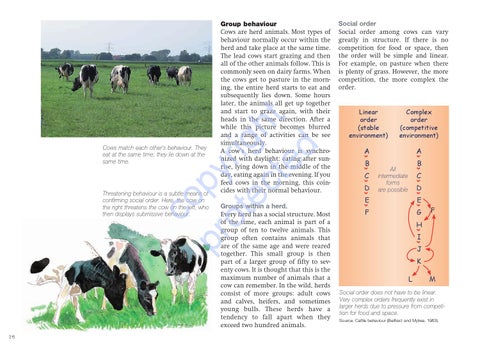
Threatening behaviour is a subtle means of confirming social order. Here, the cow on the right threatens the cow on the left, who then displays submissive behaviour.
Linear order (stable environment)
›
Cows match each other’s behaviour. They eat at the same time; they lie down at the same time.
Social order Social order among cows can vary greatly in structure. If there is no competition for food or space, then the order will be simple and linear. For example, on pasture when there is plenty of grass. However, the more competition, the more complex the order.
›
Group behaviour Cows are herd animals. Most types of behaviour normally occur within the herd and take place at the same time. The lead cows start grazing and then all of the other animals follow. This is commonly seen on dairy farms. When the cows get to pasture in the morning, the entire herd starts to eat and subsequently lies down. Some hours later, the animals all get up together and start to graze again, with their heads in the same direction. After a while this picture becomes blurred and a range of activities can be see simultaneously. A cow’s herd behaviour is synchronized with daylight: eating after sunrise, lying down in the middle of the day, eating again in the evening. If you feed cows in the morning, this coincides with their normal behaviour.
j k L
M
Social order does not have to be linear. Very complex orders frequently exist in larger herds due to pressure from competition for food and space. Source: Cattle behaviour (Beilharz and Mylrea, 1963).