CHAPTER 8:
ht
pr ot
ec
te
d
Transfer
rig
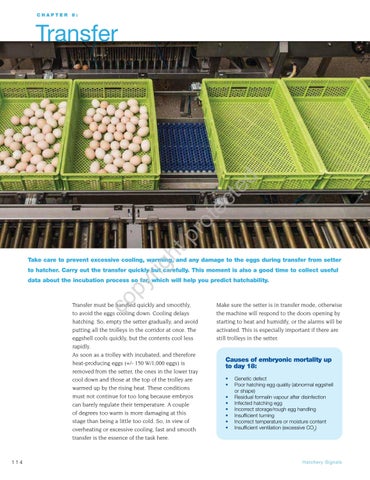
Take care to prevent excessive cooling, warming, and any damage to the eggs during transfer from setter to hatcher. Carry out the transfer quickly but carefully. This moment is also a good time to collect useful
co
py
data about the incubation process so far, which will help you predict hatchability.
Transfer must be handled quickly and smoothly, to avoid the eggs cooling down. Cooling delays hatching. So, empty the setter gradually, and avoid putting all the trolleys in the corridor at once. The eggshell cools quickly, but the contents cool less rapidly. As soon as a trolley with incubated, and therefore heat-producing eggs (+/- 150 W/1,000 eggs) is removed from the setter, the ones in the lower tray cool down and those at the top of the trolley are warmed up by the rising heat. These conditions must not continue for too long because embryos can barely regulate their temperature. A couple of degrees too warm is more damaging at this stage than being a little too cold. So, in view of overheating or excessive cooling, fast and smooth transfer is the essence of the task here.
114
Make sure the setter is in transfer mode, otherwise the machine will respond to the doors opening by starting to heat and humidify, or the alarms will be activated. This is especially important if there are still trolleys in the setter.
Causes of embryonic mortality up to day 18: • • • • • • • •
Genetic defect Poor hatching egg quality (abnormal eggshell or shape) Residual formalin vapour after disinfection Infected hatching egg Incorrect storage/rough egg handling Insufficient turning Incorrect temperature or moisture content Insufficient ventilation (excessive CO2)
Ha tc he ry S i gnal s