•
• •
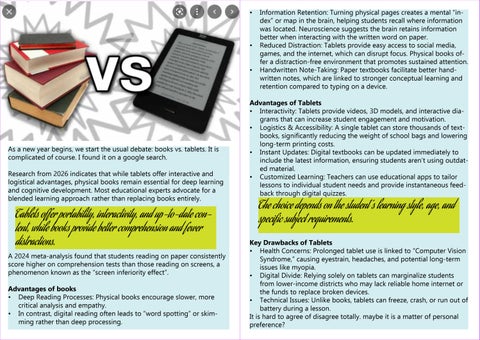
As a new year begins, we start the usual debate: books vs. tablets. It is complicated of course. I found it on a google search. Research from 2026 indicates that while tablets offer interactive and logistical advantages, physical books remain essential for deep learning and cognitive development. Most educational experts advocate for a blended learning approach rather than replacing books entirely.
Tablets offer portability, interactivity, and up-to-date content, while books provide better comprehension and fewer distractions.
A 2024 meta-analysis found that students reading on paper consistently score higher on comprehension tests than those reading on screens, a phenomenon known as the “screen inferiority effect”. Advantages of books • Deep Reading Processes: Physical books encourage slower, more critical analysis and empathy. • In contrast, digital reading often leads to “word spotting” or skimming rather than deep processing.
Information Retention: Turning physical pages creates a mental “index” or map in the brain, helping students recall where information was located. Neuroscience suggests the brain retains information better when interacting with the written word on paper. Reduced Distraction: Tablets provide easy access to social media, games, and the internet, which can disrupt focus. Physical books offer a distraction-free environment that promotes sustained attention. Handwritten Note-Taking: Paper textbooks facilitate better handwritten notes, which are linked to stronger conceptual learning and retention compared to typing on a device.
Advantages of Tablets • Interactivity: Tablets provide videos, 3D models, and interactive diagrams that can increase student engagement and motivation. • Logistics & Accessibility: A single tablet can store thousands of textbooks, significantly reducing the weight of school bags and lowering long-term printing costs. • Instant Updates: Digital textbooks can be updated immediately to include the latest information, ensuring students aren’t using outdated material. • Customized Learning: Teachers can use educational apps to tailor lessons to individual student needs and provide instantaneous feedback through digital quizzes.
The choice depends on the student’s learning style, age, and specific subject requirements.
Key Drawbacks of Tablets • Health Concerns: Prolonged tablet use is linked to “Computer Vision Syndrome,” causing eyestrain, headaches, and potential long-term issues like myopia. • Digital Divide: Relying solely on tablets can marginalize students from lower-income districts who may lack reliable home internet or the funds to replace broken devices. • Technical Issues: Unlike books, tablets can freeze, crash, or run out of battery during a lesson. It is hard to agree of disagree totally. maybe it is a matter of personal preference?