A REMOTE REEF OF RICHES
Once a destination for refugees and asylum seekers from across the Timor Sea, Australia’s Ashmore Reef also holds great ecological importance, and no one knows that significance more than marine biologist Juliana Coffey
STORY BY RODERICK EIME
OOriginally from Newfoundland in Canada, Juliana developed a love of seabirds at an early age, a passion that followed her through several degrees and academic achievements, into research and tourism vocations. Apart from environmental studies that take her literally to the ends of the Earth, Juliana also finds time to interface with travellers aboard expedition ships as they explore many of the planet’s delicate environments, such as Ashmore Reef.
Part of the Australian Territory of Ashmore and Cartier Islands, about 220 km south of West Timor, Indonesian fishers have accessed this area for hundreds of years, as evidenced by their oral history and the remains of their material culture on the three small emergent sand cays, to supply Asian markets with commercial fish resources, such as trepang.
Their traditional access rights have been a matter of contention over the years, now covered by Memorandum of Understanding No. 74 (MOU 74) between Indonesia and Australia, which includes provisions for visitation to ancestral graves on the islands. From further afield, the journey across the Timor Sea to Ashmore Reef was once acclaimed as a pathway through Australia’s back door towards peace and prosperity for undocumented immigrants seeking asylum from nations in conflict. This arduous route over land and sea provided a glimmer of hope for many fleeing persecution and hardship.
“What is lesser known about Ashmore Reef, however, is the astounding natural beauty and ecological importance of the marine and terrestrial resources, significant on a global scale,” says Juliana. “Ashmore is influenced by the ‘Indonesian Throughflow’ — a westerly flowing current originating in Asia that brings nutrient-rich waters from regions to the north.”
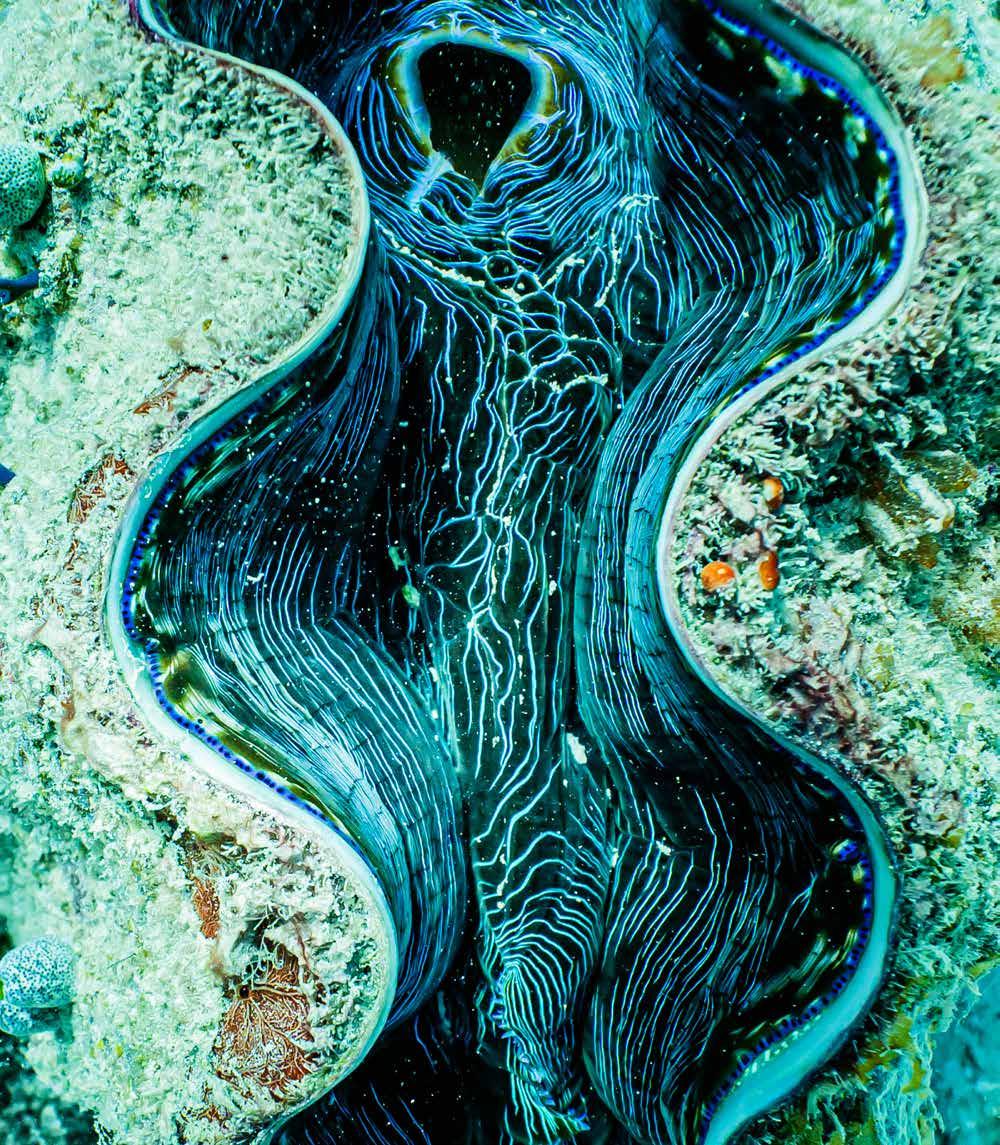
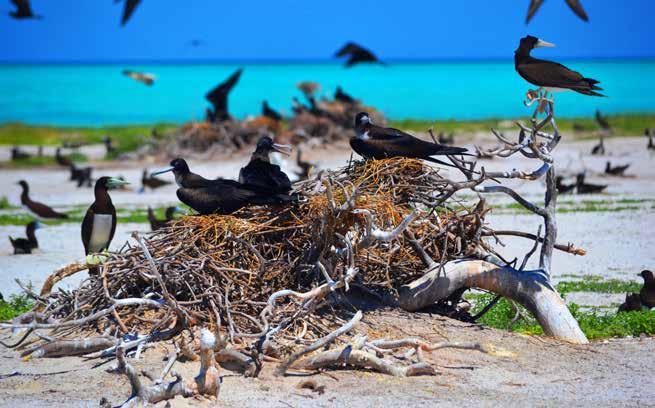
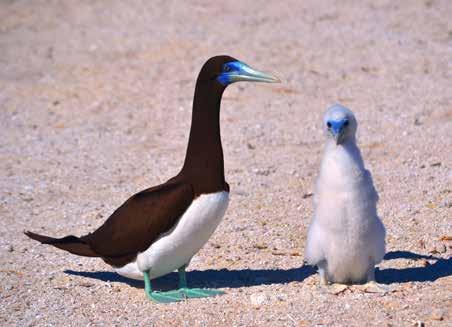
These nutrients support a staggering diversity of corals and marine invertebrates, numerous fish species, sea snakes, sharks, thousands of nesting and foraging sea turtles and a small — but potentially genetically distinct — population of dugong. The emergent sand cays are equally impressive, providing critical nesting habitat that supports over 100,000 breeding pairs of at least 17 seabird species, and function as a bi-annual foraging and resting area for thousands of shorebirds replenishing fat reserves before undertaking long-distance migrations to their northern hemisphere breeding grounds.
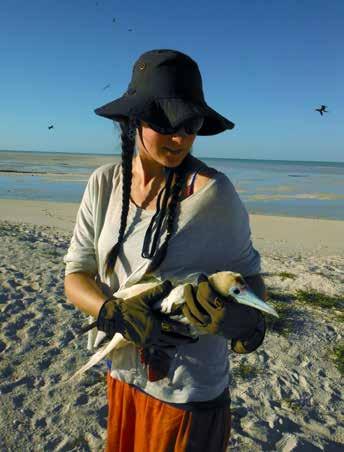
Juliana’s words don’t come from just reading academic papers and writing arms-length reports. She was part of a research team that spent several weeks going ashore on these remote cays, tagging and measuring seabirds and assuring the success of on-going conservation efforts.
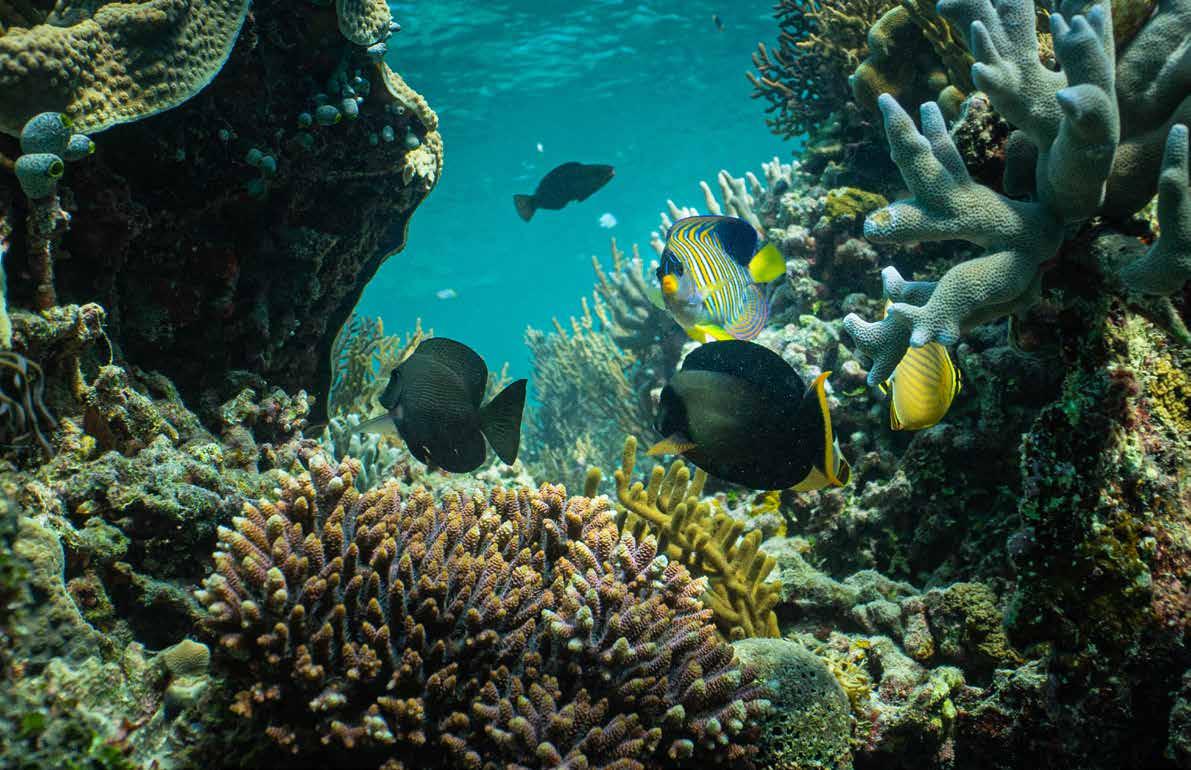
In recent years, Juliana has joined teams of naturalists and scientists aboard expedition ships that have visited Ashmore Reef as a bonus detour as part of Kimberley Coast itineraries, where she can impart her expert knowledge to guests keen to see the reef’s beauty for themselves.
“Seabirds often return to the colonies where they were born, to nest and raise their own chicks, and the success of conservation efforts here is easy to see,” Juliana tells guests from Seabourn Pursuit as she navigates a Zodiac tender through crystal-clear turquoise waters to within a stone’s throw of the shore. At the same time, boobies, frigatebirds, terns, noddies and tropicbirds swirl overhead in cacophonous masses. “Seabirds are the only animals to have conquered air, land and sea, and their role in circulating nutrients between these realms is critical for the
proper functioning of ecosystems. As a result, so many other organisms rely on the health of these populations.”
While flourishing today, periodic visitation, monitoring and research conducted during the last century revealed evidence of resource depletion, through factors such as overfishing, illegal harvesting of seabirds and their eggs and the presence of invasive species. To address these concerns, Ashmore Reef was declared a nature reserve in 1983, a milestone bringing awareness to the ecological importance and vulnerability of this unique ecosystem and setting the stage for the restoration of habitat and the recovery of native species.
Since that time, human access to terrestrial areas has been restricted and is permitted only to those conducting research and conservation efforts, such as the eradication of invasive rats in
From Top: Ashmore Reef, part of the Ashmore and Cartier Islands, is famed for its marine biodiversity; Juliana Coffey has always been fascinated by birds and her passion has led her around the world.
the 1980s. Simultaneously, surveillance patrols of nearby waters increased, and a permanent presence of border patrol officials was established, intended to intercept unlawful immigrants, act as a deterrent for prohibited activities and as a means of enforcement. The comeback story doesn’t end there. Ashmore Reef also enjoys prestigious global recognition as both a BirdLife International Important Bird Area (IBA) and a Ramsar-listed Wetland of International Importance. Both are statuses not given arbitrarily, but are evaluated through established and rigorous processes, ensuring the ecological importance of such areas is recognised. Though these designations don’t carry any legal ramifications, they can leverage conservation rationale and help to prioritise ecosystems that deserve special attention.
While at Ashmore Reef, Juliana’s research team was based on a chartered power catamaran from which they visited the islands daily to deploy tracking devices on seabirds, conduct surveys, take measurements and collect samples. Given the nature of the research, the team would occasionally have to work overnight on one of the islands, with minimal shelter from the elements.
“It is not always a glamorous job,” Juliana explains, “In the daytime we were working in extreme heat, sometimes collecting seabird regurgitation consisting of half-digested fish for further research, and at nighttime our equipment and ourselves were often being smeared in guano and investigated by hundreds of hermit crabs. But to be amongst this secret seabird society for a while, to observe their interactions with their chicks and each other, and to gaze at the sheer beauty of a night sky not polluted with lights while surrounded by turtle hatchlings making their
What is lesser known about Ashmore Reef, however, is the astounding natural beauty and ecological importance of the marine and terrestrial resources, significant on a global scale
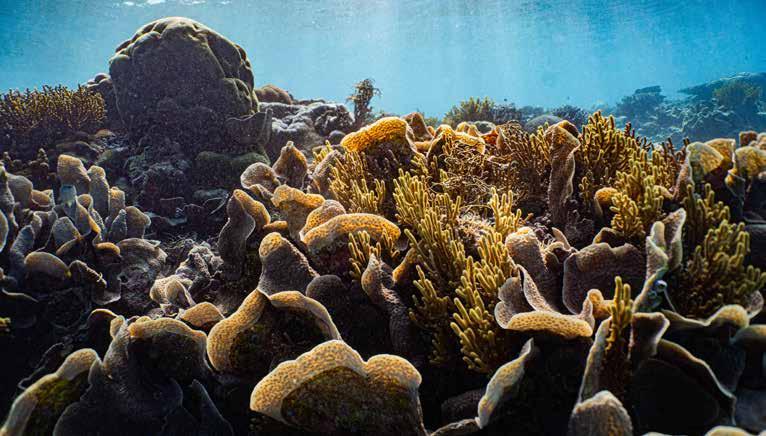
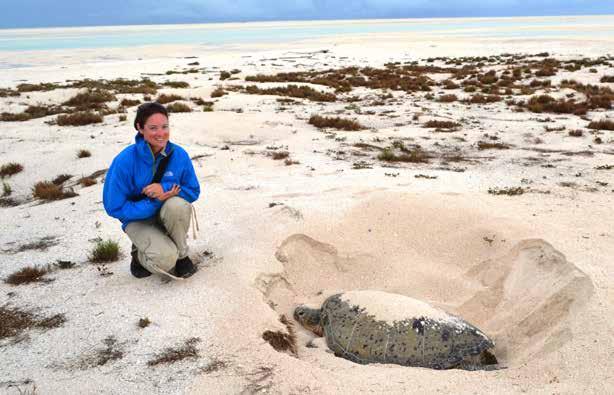
Clockwise from top right: Juliana during a research visit to Ashmore Reef; the cays offer a vital retreat for seabirds and their young; the surrounding reefs are home to an abundance of marine species, including dugongs; the importance of seabirds in the marine environment is something Juliana is hoping to increase awareness of.
way to the sea, far outweighed any of the hardships we could have experienced.”
Unlike many environmental activists marching in rowdy parades and waving placards, Juliana takes her intimate knowledge of seabirds and their precarious status into the field, contributing to the valuable bank of knowledge that is fundamental to their survival.
“Due to its extreme remote location and regulations, very few will ever have the opportunity to visit Ashmore Reef, and only a handful will ever have the chance to step ashore,” she says.
“Seabirds are not just ecological connectors; they also unite nations through their transboundary movements. However, given that they travel vast distances across borders, they aren’t always afforded the same protected status or habitat quality throughout their ranges, highlighting the need for international cooperation on the conservation of wide-ranging species. Globally, seabirds are declining rapidly due to various threats such as habitat loss and invasive species at their breeding colonies; however, the efforts at Ashmore Reef are proving to be effective and ensuring they have a safe place to call home.”
Juliana Coffey is a Marine Biologist and Ethnobiologist with a Master’s of Resource and Environmental Management from Dalhousie University (Canada). She has worked on various marine and terrestrial environmental projects internationally, ranging from the high Arctic to Antarctica. When not working on ecological projects, she is an expedition guide, PADI Divemaster and a member of the International Society of Women Geographers.