Digital Output Feb 2026

Page 1


7 } Head of the Class Top Marks for 2026 Winning vendors share top products. by Melissa Donovan 18 } Sti as a Board Rigid Substrates for High-Speed Flatbed and Hybrid Printing Successfully print direct to board with any type of ink. by Cassandra Balentine

21 } Di erentiating Factors Perf and Non-Perf Window Media Options Where and when each media type excels. by Cassandra Balentine

Subscriber Power

Digital Output’s goal every issue is to provide you, the subscriber, with content you are interested in. The first few weeks of 2026 we polled readers about hot topics, trends, and more—and asked what do you hope to learn when paging through the publication?

Digital Output’s goal every issue is to provide you, the subscriber, with content you are interested in.

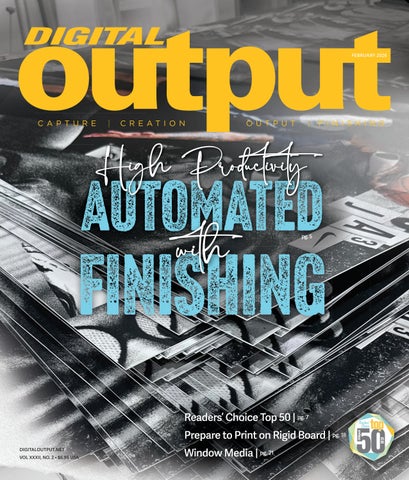
Nearly 30 percent of those who participated in the survey admitted to preferring spotlights on users of the technology. The cover story this month, Precision Cut, addresses this—with a look at Atlas Print Solutions Inc. and its implementation of multiple automated pieces of equipment from Colex Finishing Solutions, Inc.

This edition of the magazine is the perfect illustration of the power of the reader. Our annual readers’ choice top 50 feature outlines the top 50 companies—and ten honorable mentions—as chosen by you thanks to data generated from our lead generation system, DODirect.net.

The article includes information on each winner’s top or newest products, whether it be hardware, software, media, or services, in addition to some quick, fun facts like how many times each company has been bestowed the honor.

EDITOR IN CHIEF

Thomas Tetreault ttetreault@rockportpubs.com

EDITOR

Melissa Donovan mdonovan@rockportpubs.com

ASSOCIATE EDITOR

Cassandra Balentine cbalentine@rockportpubs.com

WEB EDITOR

Melissa Mueller

ART DIRECTOR

Sarah M. White swhite@rockportpubs.com

CONTRIBUTORS

Marco Boer, Olivia Cahoon, Tim Greene, Melinda Tetreault, Amber Watson

ADVERTISING SALES

PUBLISHER

Thomas Tetreault

NATIONAL ACCOUNT EXECUTIVES

Amanda Doyon adoyon@rockportpubs.com 978-921-7850, Ext. 170

Subscribe online at digitaloutput.net

CORPORATE & PUBLISHING OFFICE

300 Newburyport Turnpike, Ste. 11 Rowley, Massachusetts 01969

ROCKPORT CUSTOM PUBLISHING, LLC CHAIRMAN

Jeffrey Jensen

PRESIDENT & CEO

Thomas Tetreault

Digital Output is published monthly by Rockport Custom Publishing LLC. ©Rockport Custom Publishing, LLC 2026. Reproduction by any means of the whole or part of Digital Output without written permission from the publisher is prohibited. Views expressed in the editorial pages do not imply our endorsement.

Vendors: We welcome your product news. Include prices, slides, photos, and digital files with your press release. Please forward product samples and media kits to Reviews Editor, Digital Output, 300 Newburyport Turnpike, Ste. 11, Rowley, MA 01969. We cannot be responsible for unsolicited product samples.

SUBSCRIPTION RATES

U.S.: $82.95 per year; $165 for 2 years; single copies: $6.95; Canada and Mexico: $99.50 per year (U.S.D.); Other international subscriptions: $275 per year (U.S.D.)

POSTMASTER

Please send address changes and form No. 3579 to: Digital Output, 300 Newburyport Turnpike, Ste. 11, Rowley, MA 01969. Periodical Class postage rates paid at Rowley, Massachusetts and additional mailing offices.

CHANGE OF ADDRESS NOTICE

Six to eight weeks prior to moving, please clip the mailing label from the most recent issue and send it along with your new address (including zip code) to: Digital Output magazine, change of address notice, 300 Newburyport Turnpike, Ste. 11, Rowley, MA, 01969. Attention: Circulation Department.

Cheers,

Precision Cut

Hitting All the Angles with Digital Finishing

Business models change and companies adapt to succeed. Look no further than Atlas Print Solutions Inc., which started out as print broker KR Concepts in 1996. In 2010, the company realized it had to evolve in tandem with the industry and it began offering custom digital printing and professional installation services.

Today Atlas operates a 15,000 square foot production facility out of Freeport, NY and a sales and marketing office in New York, NY. With a team comprised of 36 professionals, the print provider offers custom large and small format graphic printing, CNC routing, custom fabrication, and full-service brand activation such as event and retail installation. Clients are spread out across Canada, the Caribbean, North America, and Puerto Rico.

To offer the array of services it does, Atlas operates flatbed as well as roll-to-roll printers. It’s not vendor dependent. Two flatbeds are 3.2-meter Agfa Anapurna printers and an additional set of flatbeds is from Mimaki USA, Inc. Six, 64-inch roll-to-roll printers are divided evenly between two Canon U.S.A., Inc. Colorado printers, two Epson SureColor S9170 devices, and two HP Latex 800 printers.

Managing Skill with Consistency

While we’ve always been proud of our skilled production sta , the increasing demand for high-volume, precision-cut graphics required us to scale operations and improve turnaround time.
— Ken Rosenberg, CEO, Atlas

A portfolio of diverse printers demands a finishing process that can handle all of their differences, complement each piece of output that comes off a device, and manage to do so efficiently. Before automating the finishing portion of its production workflow, Atlas staff hand cut and mounted its graphics, something Ken

Rosenberg, CEO, Atlas admits is a “labor-intensive process. While we’ve always been proud of our skilled production staff, the increasing demand for high-volume, precision-cut graphics required us to scale operations and improve turnaround time.”

Kathleen Tan, director of finance, Atlas, adds “we needed the ability to process more complex materials like Dibond, wood, acrylic, foamboard, and other rigid substrates—and to do so at a consistent level of accuracy.”

Enter Colex Finishing Solutions, Inc. In March 2015, Atlas made its first investment in automated

finishing with a Colex Sharpcut CNC router to meet the aforementioned needs. Business grew and Atlas looked for more automated finishing support, it added a Colex Sharpcut SX1631 in 2019.

“Our goal has always been to maintain high-quality standards while increasing efficiency, and Colex has allowed us to do just that,” admits Tan.

Not only do the machines perform, Rosenberg can’t say enough about the support the vendor offers.

“The Colex team was helpful with training and problem solving when we installed our first Sharpcut in 2015. Since then, we

have had a great relationship with Colex and have really never been down without a solve for more than 24 hours. Its phone support is top notch and when a technician is needed, they react quickly.”

In 2025, Atlas added a 67x126inch Sharpcut SX1732 to meet the increasing volume and diversity of projects. Rosenberg notes that because of the success of the prior installations the addition of a third Colex made sense, citing cost effectiveness, versatility, ease of use, and reliability as what makes Colex stand out from competition.

“The addition of the Sharpcut SX1732 has helped us further

streamline production, maintain quality, and expand our capabilities in large format and specialty fabrication,” adds Tan.

Impossible Made Possible

An example of the Colex Sharpcuts being integral is Atlas’ work in September 2025 for Nike. It was tasked with rolling out graphics for 900 stores that promoted the launch of new JA3 (Ja Morant) basketball shoes. 3,550 sheets of oversized material ranging from eflute, styrene, Sintra, PVC, magnet, and cover stock were printed over ten days using a mix of Agfa Anapurna and Canon Colorado printers. The Colex Sharpcut SX1631 and SX1732 cut and finished.

Key to finishing the job, the Colex Sharpcut’s triple interchangeable tool head, which allows operators to quickly and seamlessly transition between routing, knife cutting, and kiss cutting.

Finishing Simplified: KalaXY Automatic XY Cutters from Supply55

Engineered and manufactured in Europe, the KalaXY cutter/trimmer reduces labor and increases profits by eliminating the time-consuming task of manually cutting printed digital images. Our line of automatic XY cutters are the ideal solution for processing a wide range of media including wallpaper, paper, direct to film, canvas, laminated/encapsulated films, banner material, polycarbonate, and other non-woven roll goods. Increase your output while reducing operation costs with KalaXY Cutters. For more information visit supply55.com, call 734-668-0755, or email sales@supply55.com. Simplify your finishing operation today with KalaXY cutters/trimmers. INFO# 1

UNINET Xpress DTF Printer

The UNINET Xpress direct to film (DTF) printer addresses common challenges faced by small business owners and startups in the garment printing industry. Its compact design, measuring only 31 inches in width, allows it to fit through standard doorways, making it ideal for small workspaces. Operating on a standard 110V power outlet, it eliminates the need for costly electrical installations. Equipped with eight industrial-grade Ricoh GH2220 printheads, the UNINET Xpress delivers high-quality prints at speeds of up to 42 feet per hour. The patented wet cap docking system prevents printhead clogging, ensuring low-maintenance operation and consistent performance. Learn more at printerbiz.com. INFO# 256

The final graphics were delivered to all 900 stores ahead of schedule—a feat not possible without automated finishing in the mix. This job included “tremendous cutting and finishing details. We produced hundreds of custom v-cut pedestal wraps, for example, that needed to fit over existing furniture in the stores. The final pack out consisted of over 100 elements per store in varying sizes and materials,” explains Rosenberg.

Real Example

The Nike job is one of many that illustrates Atlas’ capabilities. It is an ideal example of the type and volume of work the print provider is able to handle thanks to its three Colex Sharpcut devices. D

SUPPLY55, INC.
PRINTERBIZ

ith the advent of the new year, it’s time to honor the top 50 vendors and ten honorable mentions chosen by Digital Output’s readership.

Annually we rely on our lead generation system, DODirect.net, as a means to calculate interest in products and services covered in our print publication as well as online at digitaloutput.net, our weekly eNewsletter, and webinars.

CLASS

Readers’ interactions with editorial content, advertisements, and product/company announcements fuel the �inal result.

Readers’ Choice Top 50

We asked the 2026 winning vendors to provide information on their top and/or newest products that currently address the wide format graphic arts, with a mix of hardware, software, media, and various services making the list.

Digital Output Sta

3A Composites | DISPA is a 3/16-inch thick, 100 percent paperboard featuring a unique core—engineered for exceptional panel stability and surface smoothness to readily meet the industry’s standard thickness for retail framing and sign applications. It also provides additional stability and rigidity, making it ideal for premium hanging signage and point of purchase (POP) displays that maintain �latness and structure while providing outstanding graphic clarity and color vibrancy. DISPA is blue bin recyclable—well suited for high-quality, eco-friendly seasonal signage and campaigns.

Advanced Greig Laminators, Inc. | The Fast-Trac 72 is built to increase production output by enabling fast, high-capacity lamination at a maximum speed of 100 feet per minute without

compromising precision or consistency. Its proprietary nip roll design, heat-assist system, motorized side-lay alignment, and inline web cleaning work together to eliminate silvering, improve adhesion, and ensure �lawless results on every run, even with a single operator. With rugged engineering, pneumatic controls, and advanced safety and monitoring systems, the Fast-Trac 72 delivers reliable, repeatable quality control for today’s demanding wide format work�lows.

Alpina Manufacturing | Cloudlight outdoor-rated LED light box snap frames are now water resistant. These �lip frames work when completely immersed underwater. The company offers frames for outdoor, marine, 12V, and 24V wet environments. This includes any custom size or color, made to order, in any quantity. Alpina’s frames emit a bright, warm white light at 6,000K, with a long life and low energy consumption. The frames are ideal for C-store exteriors, sports stadiums, and QSR restaurants. The illuminated graphics draw attention day or night.

ASLAN | HoloWave ASLAN SE 73 and HoloStripe ASLAN SE 74 are two new effect �ilms. HoloWave ASLAN SE 73, with a dynamic wavy design and HoloStripe ASLAN SE 74, with an elegant striped pattern, combine the shimmering rainbow effect of Holographic ASLAN SE 72 and bring fresh momentum to shop windows, trade fair stands, and event designs.

Avery Dennison Graphics Solutions | MPI 1105 Easy Apply RS Digital Wrapping Film is a versatile �ilm for branding, vehicle and commercial wraps, as well as architectural applications and signage. MPI 1105 delivers three-dimensional (3D) conformability, printability, and durability for applications with complex surfaces. The Easy Apply RS adhesive makes installation easy, with air egress, repositionability, and slideability.

Banner Ups by Budnick Converting | Banner Ups’ EZ Mount allows for handling signs in

1) Canon’s 3.4-meter Colorado XL series is designed to provide versatility, productivity, and future-proof design. 2) Panel Processing provides a specially formulated, water-based coating, Eco-Finish, which is environmentally friendly and provides an excellent printing surface for high-quality

seconds—no holes, tools, or hassle. Skip drilling, screws, and messy hardware. Made from 3M Dual Lock, EZ Mount features a permanent adhesive on one side and snap-together mushroom fasteners on the other, providing a strong, clean, and recloseable hold.

Beaver Paper & Graphic Media

Inc. | TexStyles fabric media is designed for visual impact and production ef�iciency. Its balanced weave structure and uniform coating ensure even light diffusion, rich saturation, and �lawless drape for banners, retail graphics, and backlit applications.

Brand Management Group | HP

Removable Adhesive Fabric, 2-in Core is available for HP DesignJet printers with two-inch spindles, including the new T Series printers for pigmented ink. HP Removable Adhesive Fabric, 2-in Core can be mounted to indoor or outdoor surfaces without leaving a residue and repositioned repeatedly without losing its adhesive qualities. It is a non-PVC product that meets strict environmental and safety standards and is certi�ied �lame- and slip-resistant and REACH compliant. The applications for this adhesive-back fabric are endless—custom wall murals, indoor and short-term outdoor signage, wall cut outs, signage, displays, window graphics, decals, �loor graphics, décor, and event graphics.

Caldera | PrimeCenter is a prepress solution. It automates �ile preparation and helps grow a business by cutting down repetitive manual tasks, meeting client

#7
#4

QUICK FACTS FOR THE 2026 READERS’ CHOICE TOP 50

deadlines, and reducing media costs. The �iles generated by PrimeCenter are fully compatible with CalderaRIP or any RIP software on the market. CalderaRIP is a �lexible RIP solution for large format printing and cutting.

12 percent of the winning companies honored this year were included in the top 50 for the first time

40 percent of the winning companies honored this year consider themselves primarily media vendors

30 percent of the winning companies honored this year have been in the top 50 over ten times 1 2 3

Canon U.S.A., Inc. | Canon’s 3.4-meter Colorado XL series is designed to provide versatility, productivity, and future-proof design. It brings Canon’s proven UVgel technology to the ten-foot segment, enabling print providers to handle both �lexible and rigid media with ease. Its modular platform allows businesses to start with what they need today and scale up later, with the ability to add options like white ink and specialty �inishes without replacing the printer. Speeds of up to 2,271 square feet per hour in Gloss Express print mode; support for substrates up to two inches thick; and advanced innovations like TRIdrive, UVgel FullBeam Curing, and DynamicMotion Control, allow the XL series to deliver productivity.

Colex Finishing, Inc. | The newly designed SXC3232 Sharpcut �latbed cutter, manufactured at Colex headquarters in NJ, offers versatility and speed by handling roll material up to 126 inches wide in addition to both signage and rigid boards. The interchangeable tool head

3) HoloStripe ASLAN SE 74, with an elegant striped pa ern, combines the shimmering rainbow e ect of the Holographic ASLAN SE 72 and brings fresh momentum to shop windows, trade fair stands, and event designs. 4) Available in an expansive selection of vivid colors, eye-catching pa erns, and specialty finishes, Gri ’s versatile vinyl empowers sign makers to bring any creative vision to life.

can accommodate a heavy-duty textile knife, �ive-inch creasing wheel, and/or router in addition to a variety of tools for speci�ic work�low to cut and rout a range of materials and work�low. An optional motorized heavy duty feeder with edge control is also available. The SXC3232 offers Production Automation software to load jobs automatically via quick response code; a material library; imports over 40 �ile formats; features overcut compensation, automatic bridging, and scaling; as well as distortion correction.

Continental Grafix USA, Inc. | XTreme is for tough-to-stick places. When frustrated with graphics that won’t stick, see how X-Treme performs. Its proprietary, removable, high-tack adhesive is a match for low surface energy substrates. This smooth, white vinyl solution creates bold graphics and puts your brand in a good light. Install X-Treme in extreme cold or heat, from +5 degrees Fahrenheit to +122 degrees Fahrenheit. No more peeling edges or falling graphics. X-Treme sticks to the unstickable.

Delivery Signs | operates as YardSignsResellers.com as a wholesale trade-only printer offering products such as yard signs, rigid substrates, magnetics, banners, adhesive vinyl, and poster paper.

Durst Image Technology | The Durst P5 500 TEX iSub represents a unique solution in the market, combining �ive-meter wide sublimation printing with fully integrated inline �ixation.

This superwide dye-sublimation (dye-sub) printer ensures excellent color consistency along with sharp details in images and text in the most sustainable and ef�icient manner.

Enfocus | Botus, a PitStop Chatbot, is designed to guide users in getting the most value from PitStop’s extensive features through fast, conversational assistance. By adding AI-driven, real-time support directly inside the PDF proo�ing and pre�light solution, Enfocus aims to streamline troubleshooting, learning, and work�low optimization for print professionals. Alongside Botus, the PitStop 25.11 update brings macOS 26 (Tahoe) compatibility, a new Layer panel that enables more ef�icient layer editing by offering an overview of all layers and their properties, the ability to select unnecessary clipping objects, improved detection of thin objects, and a host of bug �ixes.

Epson | The Epson SureColor G6070 compact direct-to-�ilm (DTF) printer is a versatile solution for embellishing a variety of materials, engineered to deliver reliability, ease of use, and minimal maintenance. It features a front-loading media design that supports a 35.4-inch print width to �it more transfers per roll and enables the production of oversized graphics. Leveraging a PrecisionCore Micro TFP printhead with Nozzle Veri�ication Technology coupled with new UltraChrome DF inks, it consistently delivers professionalgrade prints with vibrant colors and crisp, detailed clarity.

#9

FDC Graphic Films, Inc. | Lumina by FDC 7227 Print Media: Intermediate is a premium, five year outdoor durable gloss white film with gray adhesive for blockout. It is ideal for

slightly curved surface applications and excellent for use in medium-term promotional, POP displays, trade show/exhibit displays, outdoor signage, and banners.

Fisher Textiles | DD1001 Impression Backlit is an advanced printable polyester fabric designed for backlit framing systems. Though it appears muted initially, it delivers stunning vibrancy when backlit—thanks to low ink absorption and excellent color depth. Designed for high-speed, cost-sensitive environments, it uses significantly less ink without compromising quality. Soft, stretchy, and smooth with minimal fuzz, it also resists ink rub-off for cleaner production.

At 5.9 ounces per square yard and 126 inches wide, it is compatible with dye-sub—transfer and direct—and UV-curable printing, offering a premium alternative to traditional knit backlit fabrics.

5) The Kongsberg Ultimate is a modular digital cu ing table designed to grow with business. 6) Jessup TenaciousTac 2CR delivers the highperformance construction needed to take on demanding environments. 7) The Durst P5 500 TEX iSub combines five-meter wide sublimation printing with fully integrated inline fixation.

Flatbed Tools | In addition to providing top-tier compatible consumables—blades, bits, conveyor belting, and routing underlayment, as well as service support for major OEM digital �latbed cutters, Flatbed Tools is now a Summa sales and service partner. The company offers Summa’s lineup of �latbed, laser, and vinyl roll cutters.

Flexcon | FlexMark House Vinyls deliver exceptional print quality and durability for a range of graphic applications. These versatile �ilms are ideal for popular out-of-home advertising applications, including walls, windows, shelves, signage, �loor graphics, and vending graphics, offering reliable performance indoors and out. For faster, bubble-free installation, FlexMark offers an air egress option that simpli�ies application and enhances ef�iciency.

Fluid Color | The Fluid Color ZH126 hybrid printer is the ultimate solution for shops that need the �lexibility to print to both rigid and roll materials without compromise. Its generous 126inch width accommodates everything from standard boards to large format roll media. Equipped with high-performance Kyocera printheads, the ZH126 delivers striking image quality and blazing fast print speeds—its wide print swathe ensures faster throughput and consistent results across every substrate. From rigid panels to �lexible banners, it’s built to perform day after day.

GBC/SEAL | Easy Dot is an innovative product that saves time and money when creating

and installing wall, window, and trade show graphics. The key to its ease of installation is the special dot patterned adhesive, which creates air channels that allow for a bubble- and wrinklefree installation. No special tools are needed—not even a squeegee. This 4-mil, self-adhesive vinyl is available in your choice of a white matte or clear �inish.

General Formulations (GF) | GF’s Economy Print & Laminate Solutions offer affordable quality, made in the U.S. They offer costeffective, dependable graphic solutions for short-term signage. Available in both gloss and matte, the 3-mil pressure-sensitive �ilms feature durable, permanent acrylic adhesive for strong, lasting bonds to common substrates and are compatible with solvent, eco-solvent, latex, and UV inks.

Graphic Finishing Partners, LLC (Gfp) | The Gfp 663TH 63-inch Top Heat Laminator empowers print and sign shops to tackle virtually any wide format job with con�idence and ease. Its expansive 63-inch width accommodates the most common applications—from signs and vehicle wraps to POP displays, trade show graphics, and photo mounting—making it a versatile solution for high-demand environments. At the heart of its design is a sleek ten-inch tabletstyle LCD display, delivering an intuitive interface that simpli�ies operation and reduces training time. Ef�iciency is built in with three swing-out shafts for rapid �ilm changes, while the integrated onboard printer keeps track of partial roll inventory.

7

Gri Paper and Film | Elevate every project with Griff self-adhesive decorative �ilm, engineered speci�ically for the demanding needs of sign and graphics. Available in an expansive selection of vivid colors, eye-catching patterns, and specialty �inishes, this versatile vinyl empowers sign makers to bring any creative vision to life—whether it’s bold branding, intricate lettering, or standout décor installations. From classic opaques and metallics to specialty �ilms, the Griff catalog offers a wide color and pattern selection.

HP Inc. | The new HP Latex FS70 W Printer is designed to transform the way you work—bringing next-level productivity and scalability to print operations. It delivers stunning image quality across a range of signage and décor applications, enabling businesses to con�idently handle high-volume jobs without compromising on color consistency. It’s powered by a scalable

platform, the printer can be upgraded as business grows to get signi�icant improvements in productivity and image quality.

Infinite Motion Control (IMC) | Easy-to-operate, IMC’s sheet feeders and stackers are the perfect complement for printing and

�inishing automation needs. For nearly 20 years it’s designed and built reliable, user friendly, and low-maintenance feeders and stackers. The equipment features heavy-duty thick gauge steel construction and is built with trusted brand name components.

Infinity Media Company | GlassApeel Bubble-Free �ilms are now available in clear and frost versions. Engineered with advanced micro-suction technology, these peel-and-place �ilms install effortlessly without adhesives and remove cleanly with zero residue. Fully printable with UV, latex, and solvent inks, they deliver crisp, vibrant graphics on any glass surface—making them

the ideal choice for retail, commercial, and specialty display applications where precision and ease of install matter most.

Jessup Manufacturing Co. |

TenaciousTac 2CR is built for tough, long-lasting labels and decals with high-performance construction needed to take on demanding environments. This 3.5-mil white vinyl features a higher coat weight, chemically resistant acrylic adhesive designed to anchor graphics securely to challenging surfaces— from low surface energy plastics and powder-coated metals to textured industrial substrates. Created for harsh, real-world conditions, TenaciousTac 2CR offers excellent chemical resistance, strong moisture tolerance, and dependable adhesion

where durability is non-negotiable. Its cold-temperature application capability and wide operating range ensure con�ident installs on refrigerated equipment, outdoor assets, and variable climate locations.

Kongsberg Precision Cu ing Systems | The Kongsberg Ultimate is a modular digital cutting table designed to grow with customers’ businesses. The table handles even the most demanding materials and maintains consistency and precision at speeds of more than 165 meters per minute, with 2.7G acceleration. Designed to address the unique challenges faced by digital display operators, the Ultimate features dedicated tool stations that eliminate delays when ful�illing continuous high-volume,

multi-batch production jobs. As a result, users can maximize their uptime, meet demand for faster turnaround, and achieve a competitive advantage.

Lintec of America, Inc. | 100 percent recycled PET �ilms for sustainable window graphics are now available as a part of the LINTEC ECO series. These optically clear �ilms are made in clean-room environments, ensuring distortion-free clarity even at 100 percent recycled content. ECO-2104ZC Recycled maintains a 2-mil recycled face �ilm but adds a thicker 4-mil PET liner for better tracking and print handling.

Mactac | Gruv Slideable is a 2-mil gloss white, highly conformable, and repositionable cast vinyl. The micro-channel liner is essential to no-show pattern and bubble-free installation. Gruv Slideable provides a clear edge in performance. Easy to install with repositionable adhesive, it is ideal for full or partial vehicle wraps, trailers, and �leet. Gruv Slideable is used for outdoor signage and longterm use compatible with most wide format printers.

Mimaki USA, Inc. | The UJF-7151 plusII e UV LED �latbed printer enables increased 3D texture production through ink layering and improved jetting accuracy to diverse shapes like curved and uneven surfaces. Its high resolution of up to 1,800 dpi, combined with the use of light cyan and light magenta inks in addition to standard four-color printing, reproduces delicate color tones

8) The new HP Latex FS70 W printer is designed to transform the way you work—bringing next-level productivity and scalability to your print operations.

like �ine gradations and subtle tints with smooth results.

Mutoh America, Inc. | The XpertJet (XPJ) 1641SR Pro II 64-inch eco-solvent printer features the new AccuFine HD Pro printhead, delivering up to 60 percent faster print speeds and improved dot placement. An updated front dryer increases drying capacity by 20 percent, while the new smart take up unit automatically starts and stops with printing to support long, unattended runs. With accurate media handling and consistent color reproduction the XPJ 1641SR Pro II supports a range of applications including vehicle wraps, signage, wall and �loor graphics, decals, banners, and posters. Its four-stage printhead height adjustment and multi-stage pressure roller system help maintain print quality across different media types and thicknesses.

Nekoosa | NextBond High Bond Opaque delivers exceptional performance on any surface, in any season. Its unmatched opacity provides a true blockout solution without messy gray adhesives, while superior adhesion sticks to even the most challenging surfaces. Durable and weather-resistant, NextBond High Bond Opaque can be applied in temperatures as low as -10 degrees Fahrenheit.

Newlife Magnetics LLC | PressMag is a new, pre-magnetized media for HP Indigo, dry toner, and UV offset presses. Press-Mag has a photo-quality PP print surface for photo-quality results. It

can be run through most presses pre-magnetized, eliminating the need to magnetize post print. It will stack, jog, and cut just like paper media, all while magnetized. Available in most standard sheet sizes from 12x18 up to 28x40 inches.

Presto Tape | PrestoTex is a digitally printable wall media compatible with solvent, eco-solvent, latex, and UV inks. Available in 10- and 17-mil thicknesses, the peel-and-stick removable and repositionable version of the wallpaper leaves no residue behind. A polyester fabric, it is safe and non-toxic, free of phthalates and PVC.

PrinterBiz | The UNINET DTF XPRESS printer with automatic cutting oven is a DTF printer with a two year warranty including printheads. There is a patented, automatic wet cap system to eliminate white printhead clogging and the entire system runs on 110V power. With the new automatic cutting oven, the XPRESS prints and cuts sheets as easy as a copy machine. This signi�icantly reduces material waste and labor time.

SAi | Flexi DTF Pro is an advanced DTF work�low designed to help shops produce reliable, high-quality apparel graphics with fewer steps and less guesswork. It combines precise color tools, optimized white ink handling, and streamlined production controls in one platform, making it easier for users to get consistent, professional results every time. Flexi DTF Pro gives shops a dependable way to add

COMPANY CLASSIFICATIONS

In the chart below, each winner was asked to choose the category that best describes their company. In addition, learn how many years a vendor has been on the readers’ choice top 50 list. Definitions of each segment included here:

Inaugural - First year on the readers’ choice list.

Old Hand - Up to and including nine years on the readers’ choice list.

Veteran - Ten years or more on the readers’ choice list.

or expand DTF services without dealing with complicated setups or fragmented software.

Significans Automation | SLaunch standardizes job submission with con�igurable, automated forms that eliminate errors. The smart, work�low-enabled solution

is built for the print, label, and packaging industries.

Signs365 | Offered by Signs365, DTF is a versatile transfer material that allows full-color, highdetail prints to be heat pressed onto garments. It works on cotton, polyester, and blends,

HONORABLE MENTIONS

These winners just missed the top 50, but we want to honor them with a quick mention of their top/newest product.

ANCI, INC. | Sycltex non-PVC printable banner material.

AXYZ | Loadline Series of sheet loaders for CNC routers.

DIGITECH | TruFire LTX2 printer.

DREAMSCAPE | Suede textured printable wallcovering media.

FELLERS | CheetahPCC protective color change film.

GRAPHIC WHIZARD | Guillotine cu er.

MONADNOCK PAPER MILLS | Stello printing paper.

PANEL PROCESSING, INC. | Eco-Finish digital print media.

PHOTO TEX GROUP | Photo Tex polyester self-adhesive inkjet fabric.

TVF | PureNight Pro 8668SDWGFS eco-friendly blockout fabric.

offering strong adhesion, stretch, and durability with a soft feel after pressing.

Summa | The Summa F1625 is spot on. This high-performance �latbed cutter handles everything from signage to packaging across rigid and �lexible materials. Intelligent features streamline work�low, rapid tool swaps maintain productivity, and precision cutting delivers �lawless results. With performance, precision, speed, and fast return on investment, the F1625 is more than a cutter; it’s a growth engine.

Supply55, Inc. | The KalaXY PRO XY Trimmer is engineered for high-volume print environments that demand precision, speed, and labor savings. It handles the most challenging materials from delicate thin �ilms to rigid 0.030-inch magnetic �ilm while delivering consistent, clean cuts. Featuring an advanced telescope roll correction system, the KalaXY PRO eliminates manual trimming, reduces waste, and ensures accurate �inishing even

on imperfect rolls in demanding applications such as butt joint wallpaper. Its automation and reliability make it an essential upgrade for wide format work�lows focused on productivity and pro�itability.

Supreme Color Graphics | Bollard Sleeves are one of Supreme Color Graphics’ top-selling solutions for high-impact, on-site marketing. Crafted from durable, four-millimeter Coroplast, each sleeve measures 48 inches tall by 39.6 inches wide and is scored to form a crisp, threesided display with a secure interlocking closure. Designed for both indoor and outdoor use, these sleeves transform standard bollards into powerful branding opportunities. The lightweight yet rigid construction ensures easy installation, vibrant print quality, and dependable performance in a variety of weather. For custom sizes, specialty designs, or highvolume orders, a custom quote form is available to tailor Bollard Sleeves to any requirement.

swissQprint | The swissQprint Generation 5 �latbed printers allow for tackling bigger, more complex jobs faster without compromising quality. Built on the proven Kudu frame, Generation 5 combines rock-solid stability with modern engineering. Nyala, Topi, Impala, and Oryx now leverage this foundation to provide higher throughput and more �lexibility to take on more orders, impress clients, and grow business.

Trotec Laser | Speedy 100 Cross is a fast diode laser, delivering exceptional precision and detail on metals and plastics. It also effortlessly cuts thin organic materials such as paper, cardboard, and wood. With a generous 12x24inch working area and 40 watts of power, it’s a versatile solution ideal for a range of industries and applications—including industrial marking, product personalization, and educational use.

Ultraflex Systems, Inc. | ReSource Backlit Event T202 combines sustainability, print quality, and reliable performance in one versatile fabric. Made from 100 percent GRS-certi�ied recycled yarns, it eliminates spider cracking, smooths out under tension, and delivers sharp, high-resolution graphics with dye-sub transfer. Available up to 126 inches wide, it’s a smart, eco-forward choice for premium backlit displays.

Vision Engraving & Routing

Systems | A new drag knife and creasing wheel option is available for its CNC routers. The new drag knife enables cutting

a range of thin, �lexible materials, including but not limited to vinyl, rubber, paper, cardboard, corrugated plastic, and leather. With the creasing wheel, create sharp, consistent folding lines on corrugated plastic, cardboard, and similar materials to make boxes, displays, and various folded products.

XCEL | Xanita board is a �iberbased rigid board manufactured from used cardboard boxes. This product is composed of recycled content and is 100 percent recyclable with traditional paper products. Xanita is more rigid and lighter weight than alternative plastics, MDF, wood, and metal. Xanita is ideal for structural applications including POP displays, exhibit, hanging signage, shelving, and 3D lettering.

Zund America, Inc. | The Zünd Q-Line digital cutter was developed for demanding industrial applications. It offers maximum ef�iciency, superior precision, and reliable automation. The QLine substructure is made from a highly stable mineral casting. It can handle any load level, and even at extremely high speeds ensures exceptionally smooth operation and maximum cutting accuracy.

Editor’s Note

Congratulations to all of this year’s winners! If you want to learn more about the vendors, visit digitaloutput.net in February, where pro�iles on both the top 50 and honorable mention companies are included in a web-exclusive article. D

196 Bre Martin bre martin.com

197 Calsak Plastics calsakplastics.com

198 Coastal Enterprises/Precision Board precisionboard.com

199 Coroplast, an Inteplast Group Co. coroplast.com

200 Corplex corplex.com

201 Crescent crescentcardboard.com

202 Curbell Plastics, Inc. curbellplastics.com

203 DGS Digital Graphic Systems dgs-usa.com

204 DUNA-USA dunagroup.com/usa

205 Duraluxe duraluxepanels.com

206 E&T Plastics e-tplastics.com

207 Eastsign Inc. eastsign.com

208 Falconboard by Hexacomb, a PCA Co. packagingcorp.com

209 Flech Paper Products flech.com

210 The Gilman Brothers Company gilmanbrothers.com

211 GOEX Corporation goex.com

212 GPA gpa-innovates.com

213 The Gri Network thegri network.com

214 Inteplast Group inteplast.com

215 K&R Plastics, Inc. krdigitalplastic.com

216 Kommerling USA, Inc. komasheets.com

217 Laminacorr Industries Inc. laminacorr.com

218 Laminators Inc. laminatorsinc.com

219 Lamitech, Inc. lamitech.com

220 Mac Papers and Packaging macpapers.com

221 Monadnock Paper Mills, Inc. mpm.com

222 Multipanel UK Ltd multipaneluk.com

223 Neenah Wide Format neenahpaper.com/wide-format

Nudo Products nudo.com

Oppboga Bruk oppboga.com

Pacific Mount Inc. pacificmount.com

Palram Americas palram.com/us

Processing, Inc. panel.com

Piedmont Plastics piedmontplastics.com

Plaskolite plaskolite.com

PlyVeneer Products plyveneer.com

Polymershapes polymershapes.com

polyvantis.com

primexplastics.com

recrylic.com

Rocheux International rocheux.com

Tricel Honeycomb tricelcorp.com

Ultra Partners, LLC ultrapartnersllc.com

United Industries UltraBoard ultraboard.com

Xcel Products, Inc. xcelproducts.com

The continued adoption and evolution of high-speed wide format printing on �latbed and hybrid devices leads to demand for rigid substrates proven to handle inks with dimensional stability, surface readiness, and consistency.

Arturo Cuellar, market development manager, performance materials, Spartech, LLC, stresses that printers expect reliable substrates that—combined with their printing and service solutions—offer

end customers the response time and quality that they expect. “Defects on surface treatment, dimensional stability, or uneven �latness lead to poor quality results. The printed pieces are likely to present defects leading to low customer satisfaction. Everyone in the value chain—from the suppliers to printers—want to deliver the best customer experience. This is accomplished when products are delivered on time and with quality expected at a reasonable cost.” Le ) Example of a rigid sign

Rigid substrate manufacturers formulate and engineer their offerings to ensure consistent performance on high-speed, wide format flatbed and hybrid printers.

Amplifying Performance

Many substrate properties are critical for optimal print performance, including flatness, surface energy and readiness, dimensional stability, and optical quality.

Flatness, or what Chuck Kunze, director, product management and marketing, 3A Composites USA, refers to as “lack of bow and resistance to warping” is a necessity, as is the thickness of the board and gauge consistency. “This is especially critical in applications like UV printing where boards are subject to a significant heat profile during printing, and the boards must be designed and manufactured to maintain core physical characteristics when subjected to thermal or physical stress.”

“Poorly controlled flatness is the leading cause of mis-registration, printhead crashes in digital printing, and feeding issues in automated lines. Even with perfect surface energy, a sheet that curls, bows, or has high internal stress compromises print quality and runnability. Customers repeatedly tell us that ‘if the sheet isn’t dead flat coming off the pallet, nothing else saves

the job,’” comments Kenyon Utterback, printing operations supervisor, Spartech.

“Materials need to lay flat to reduce production issues along with maintaining surfaces that allow for high-quality ink adhesion,” adds Tim Bolton, president, UltraPartners LLC.

As for surface energy or receptive surfaces, Utterback says consistent, high surface energy— typically less than or equal to 42 to 50 dynes, depending on the ink system—remains essential for ink adhesion.

While Utterback admits that dimensional stability, gauge uniformity, and low static are also important, they rarely cause print failures when flatness and surface treatment are truly dialed in. “Today’s faster presses and higher resolution printheads have made any compromise in those two areas immediately visible and costly. So, in order of real-world impact for us—flatness first, treated sheet second— everything else is manageable if those two are right.”

“We have tightened tolerances in our product specifications as high-speed printers are sensitive to substrate changes and imperfections,” says Cuellar. “Materials like PrintMax ECON—high-impact polystyrene—include standard

corona treatment at a dyne level of 46 to ensure ink adhesion. We also have enhanced our promotion of available customized levels of corona treatment up to a dyne level of 60, which provides superior, long-lasting ink adhesion making it a great fit for high-performance printing and lamination.”

In addition to surface readiness and flatness/dimensional stability, print providers consistently look for optical quality, especially for brands and designers who expect true color representation.

Testing for Compatibility

Print providers rely on tried and true mediums. Therefore, substrates tested for compatibility are ideal.

“The engineering team at 3A Composites works with material suppliers and our manufacturing processes to develop products with exceptional physical properties that are robust in challenging applications and deliver the full speed and print performance of the latest technology with no trade offs,” explains Kunze.

As a full-line supplier of rigid substrates like FOME-COR, DISPA, GATORFOAM, GP-APEX, SMARTX, SINTRA, DIBOND, POLAR, and SWEDBOARD, 3A Composites collaborates with major printer manufacturers to test and qualify its rigid substrates to ensure that they deliver the full print quality and productivity capabilities of existing and new printer technologies and systems.

Bolton says it is essential for media providers to work with

the OEMs. “They know their equipment best and allowing them to profile substrates will enable them to create the correct process for the print provider. I have had great success working in collaboration versus walking it alone.”

Michael Pasierb, new product development engineer, Polyvantis, says the company maintains an extensive internal testing program that evaluates performance across a range of UV and hybrid printer technologies, ink types, and production settings. “Our teams conduct adhesion tests and stress finishing processes. We also monitor feedback from print service providers using our material across different workflows. This gives us a real-time understanding of how ACRYLITE digital print acrylic performs in the field.”

Additionally certifications and partnerships with printer and ink providers are available to ensure compatibility.

Bolton says this is the correct way to move materials into the market. Ideally, creating partnerships that allow the ink, printer, and substrate to collectively perform at their best level is the key to long-term success.

Rigid Response

Flatbed and hybrid systems successfully print to rigid substrates to handle a range of applications. Substrate providers work to ensure these solutions meet rigorous demands in terms of adhesion, stability, and quality.

indow graphics are printed on perforated or unperforated media. While both options support branding and marketing goals, they deliver distinctly different performance benefits.

“Perforated films provide one way vision, meaning you can see out from the inside, but people cannot see in when the interior lighting is darker than the exterior. This helps create privacy during daytime hours

without the space inside feeling closed off. Light balance changes in the evening so the privacy effect of perforated films goes away and the vibrancy of the exterior graphic is reduced,” offers Laura Antenucci, marketing director, Continental Grafix USA.

Unperforated film options excel when one way viewing isn’t required. “These are great for high-impact, vivid window graphics,” suggests Bekie Berg, senior product manager, Flexcon.

To Perf or Not to Perf

Many types of unperforated media, including optically clear, opaque, and translucent, support a range of window graphic applications.

Optically clear films allow for portions of the printed graphics to remain fully transparent, creating cutouts without the labor of installing many separate pieces. “It’s perfect for storefronts that want to create a whimsical,

playful, or intricate visual theme,” says Antenucci.

Alternatively, opaque films completely block the view behind them. “These films are typically gray or white to create bold, full coverage graphics on walls or windows when the ability to see out is not a factor,” adds Antenucci.

Translucent films can bridge the divide between perforated and opaque. “While you can’t see through them, they allow light to pass through to create a mild amount of privacy when applied to windows,” shares Antenucci.

For first- or second-surface installs and push/pull graphic effects where clarity and color density matter, Jason Maricle, midwest sales manager and product manager, perforated window films, General Formulations, says non-perforated solid or clear films are ideal. “Most large façades

end up using a mix of both—perforated film on view-through areas and solid or clear film on unused windows or partition glass.”

Unperforated films are preferred when image quality, opacity, or readability is the priority. For example, when you need dense color, fine detail, or legible text viewed at close range—like interior-facing promotions, privacy graphics, or brand visuals that must look ‘poster quality’ from outside— solid, optically clear, or white films are the better choice. They’re also preferred where privacy or complete block out is required,” comments Dennis Leblanc, senior product and business development manager, Drytac.

Perforated film is ideal when a graphic display is wanted on the outside while preserving seethrough visibility from the inside.

“It’s perfect for retail front windows, vehicle wraps, and transit shelters. Perforated films make installation easier for large panel

window graphic installations such as building wraps,” shares Berg.

Maricle agrees, noting that perforated film is the right choice when you need one way vision, natural light, and a full graphic on active windows with high visibility like storefronts, doors, or vehicle glass.

Dave Hawkes, media product manager, Roland DGA, says perforated film is a media with opposite objectives. “On one hand, we want privacy; on the other, we want visibility. If you are considering perforated vinyl, you know you need it for privacy and visibility.”

Printing Technologies

All major ink systems—UV, latex, and solvent—work well when paired with films designed specifically for the technology, says Maricle. “The bigger difference is not the ink but considerations of the film’s top coating, liner design, as well as how a finished piece is cured, handled, and if it is laminated. Film type and ink compatibility along with finishing matter more than the ink chemistry.”

Hawkes agrees, noting that print performance is based on the manufacturer’s media “recipe.” “The manufacturer should provide ink compatibility, longevity, and color profiles.”

While it is true that all three technologies can be successful on both perforated and unperforated

films, Leblanc points out that each has their strengths. For example, “solvent and latex tend to conform well to flexible PVC perforated films and can offer good outdoor durability, especially on vehicles and building exteriors.”

Latex, in particular, has become very popular for perforated window materials due to its balance of flexibility, durability, and relatively quick turnaround.

UV is excellent for speed and surface durability, “but with unperforated clear or highly glossy films, you have to manage ink film thickness and layering to maintain optical clarity. Thicker UV ink can create slight texture or haze, which may be undesirable for ‘view through’ or premium optically clear applications. That said, many modern UV systems and optimized profiles produce very good results when properly tuned,” says Leblanc.

Maricle points out that perforated film without dual-layer liners can create challenges, especially with UV ink, which commonly bridges the holes. “Dual-layer liners will catch excess UV ink so it drops into a recessed channel instead of forming a solid ink sheet across the perforations. Latex and solvent inks don’t usually face these same challenges with perforated film, while UV output benefits most from the upgraded liner.”

White, non-perforated films support UV, solvent, latex, and aqueous inkjet, depending on the coating, shares Berg. These films can generally work with higher ink densities than perforated

2) Among its portfolio, Drytac offers unperforated media for window graphics.

films. They handle standard orientation, meaning no reverse print is required.

To achieve a comparable visual effect of traditional perforated film with optically clear polyester, UV printing technology is ideal, according to James Halloran, VP sales and marketing, Lintec of America. “UV printing allows for precise, controlled ink layering—utilizing white and black ink layers on opposing sides of the image—to simulate the one way vision effect associated with perforated materials. This level of ink control and opacity management is difficult to achieve consistently with latex or solvent technologies, making UV printing a preferred and the most effective method when producing a perforated-style appearance on clear polyester films.”

Unperforated films tend to behave like standard vinyls or PET films, offers Leblanc. “You have a continuous surface, so color builds and gradients are more predictable. With UV, latex, and solvent, typical curing or drying settings generally apply, but unperforated optically clear films benefit from careful control of ink laydown and heat to avoid orange peel, hazing, or distortion. In all cases, proper curing is key to long-term adhesion to the film and any overlaminate.”

Drying/curing properties apply to all window media types. “UVcurable ink traditionally needs 24 hours post-cure before trimming or laminating; over curing may lead to brittleness. Solvent inkjet must be fully dried— checked via a blocking test—before wrapping or further processing to

avoid curling or adhesive failure,” explains Berg.

Hawkes says curing and drying are related to the ink type. “A profiled media should provide the amount of dry time required for the perforated film.”

File Preparation

It is appropriate to consider image density, color compensation, and bleed for window output.

“For unperforated clear films, you may need white ink layers—flood white, selective white, or multilayer builds—to hold color. That requires careful layer setup in the file and clear communication with the RIP on how those channels are used. On unperforated, you do not need to avoid very fine text or hairline elements that you

would on perforated films; they can disappear into the perforation pattern,” comments Leblanc.

With perforated, Maricle suggests avoiding fine text or details that will disappear in the hole pattern. “You may also consider a slight saturation boost to counter the ‘screen door’ effect. Be mindful of how window frames and mullions cut through the artwork, especially on large façades. With solid or clear films, file preparation depends on first- or second-surface printing and whether white ink or an opaque layer is needed to achieve the right viewing effect.”

Berg recommends converters maintain a maximum ink density of 250 percent and leave approximately a quarter-of-an-inch margins to accommodate shrinkage.

“We also recommend printers monitor image density transitions to prevent large dark/light zones that can overheat glass and risk breakage,” adds Berg.

Overlaminating

Overlaminating window media is sometimes recommended, but is not always necessary.

“To laminate or not to laminate, that is the question,” quips Antenucci. She says environmental factors like intense UV rays, freeze/ thaw weather cycles, or chemical exposure can challenge a film without overlaminate protection.

“Overlaminates can be critical for applications requiring enhanced durability beyond that of the base film or where additional protection from environmental

elements is desired, like water and dirt settling into perf holes and vehicle window applications,” explains Antenucci.

However, for short-term applications like retail campaigns, when the correct base film is chosen, additional protection and the related cost and labor of an overlaminate isn’t a necessity, admits Antenucci.

Vehicle window graphics and longer term perforated window film applications may require an

overlaminate to keep water and dust from settling into the holes, which can block vision, creating a hazardous or undesirable view, notes Antenucci.

Specific to perforated films, Berg says overlaminating is required for transit window applications to reduce water build up in the perforation and optimize visibility. “An optically clear cast overlaminate is preferred.”

Overlaminating is optional for all other perforated window applications, but can help extend the life of the graphic if it faces high abrasion or UV exposure. “Choose based on exposure and aesthetic needs,” cautions Berg.

Maricle says exterior or vehiclemounted perforated window media almost always needs an optically clear laminate to protect the print and keep holes from collecting water and dirt.

Hawkes feels that lamination of perforated film can almost double the life expectancy of a print. “Customers often anticipate a longer life expectancy for perforated film images than they do for typical sign applications. With this in mind, it’s never a bad idea to consider laminating. For outdoor applications especially, lamination is a ‘must’ in most cases.”

Leblanc believes lamination is more situational for unperforated window media. “It’s recommended for high-traffic or long-term installs, or when you need added durability and chemical resistance—cleaning agents, squeegee abrasion, etc. For short-term indoor graphics or where ultrahigh optical clarity is required, an unlaminated approach might be chosen—provided the ink system and environment allow it.”

Lamination is generally not recommended if it will introduce haze, reduce transparency, or distort the optics of a specialty clear film, adds Leblanc.

“Optically clear films often do not need a laminate—and using the wrong one can reduce clarity,” cautions Maricle.

For unperforated media, Berg says overlaminating is recommended if the material will be applied outdoors for protection against abrasion, UV, moisture, and chemicals,

particularly outdoors. Gloss/ matte finishes are common.

“Always consult with the manufacturer and experts to make an educated decision about laminates and other protections for applications,” recommends Antenucci.

Perf Patterns

For perforated media, one may wonder if perforation patterns make an impact on ink usage and color accuracy on press.

Hawkes admits that the perforation of a film impacts the perceived color of the image. “Typically, the image appears ‘lighter’ than an image on an opaque media. The higher the perforation percentage, the lighter the image typically appears. It’s best to review the options and offer samples to demonstrate the difference. If the perforated film requires a modified image to compensate for a color shift, there may be increases in ink usage, but the difference is typically minimal.”

“Print setup doesn’t change much between 80/20 and 60/40 perforated films, but the perceived color density does. The larger the hole area the more a printed graphic will appear lighter as any extra ink will end up in the liner rather than on the film surface. What changes for the viewer is how much printed area remains after installation,” offers Maricle.

Berg feels that lower perforation ratios—for example 60/40— provide less print surface but increased visibility through the printed graphics. “Colors will not be as vibrant or bold as graphics printed on 70/30 or 80/20 films.”

Higher material content—for example 70/30—delivers more image real estate, but light transmission and visibility is reduced, according to Berg.

Installation Techniques

The required skills and tools are the same for installing both perforated and non-perforated media.

Skills include understanding how the adhesive behaves—removable, repositionable, high-tack; readying the surface—glass, frames, fritted areas; and knowing when to use primers, edge sealers, or trimming techniques to ensure a professional finish, suggests Leblanc.

Additionally, the ability to manage liner removal without contaminating the adhesive and maintaining alignment throughout application; skilled razor cutting for clean borders after application; and pressure control—knowing when to apply light versus firm squeegee pressure, especially near edges is important, offers Berg.

In all cases, preparation is essential prior to applying the media to glass surfaces. “Windows are typically framed, which often results in dirt and debris gathering at the corners. It’s best to use an isopropyl cleaner—85 percent—and a lint-less cloth to clean the window before installation. Always avoid ammonia-based cleaners as they leave a residue that can impact adhesion and visibility,” suggests Hawkes.

Maricle notes that perforated films are always dry apply only and require firm, even pressure so the adhesive sits around each hole without distorting the film.

“A dry application method is common, requiring careful liner removal in stages while squeegeeing in rows from the center outward,” comments Berg.

Solid films—especially clear—can be wet applied, but all window graphics demand a pristine clean surface, good alignment, and temperature awareness, adds Maricle.

Unperforated films span a broader range—standard monomeric PVC, high tack, optically clear PET—so techniques vary. “For clear films, dust, fibers, and trapped moisture are much more visible, so meticulous cleaning and sometimes wet application techniques are needed,” notes Leblanc.

best. For long term and outdoor applications, it is recommended to seal edges with clear tape or liquid edge seal,” says Hawkes.

Berg points out that vinyl-based material has a “memory,” meaning if stretched during installation, it will relax over time, causing lifting or failure. “Installers must avoid stretching the material,” explains Berg.

Perforated or specialty films often require additional care to maintain optical clarity and alignment. “Borders of one-eighth to one-fourthof-an inch are suggested to avoid applying right up to moldings, reducing edge failure risk,” shares Berg. For non-precut graphics, lighter squeegee pressure near the edges prevents distortion.

“You should also take surface temperatures into consideration—surface temperatures between 40 and 80 degrees Fahrenheit work the

Installers need sharp blades— never use carbon on glass, dependable squeegees, and for perforated film, edge tape around the perimeter is recommended.

Squeegees are used to apply graphics in overlapping strokes, starting from the center and working outward, explains Berg.

Razor knifes assist in trimming edges after installation.

Tape sometimes helps in positioning before adhesion.

Consumer Shifts

Maricle says window graphics printed on both perforated and non-perforated media are growing in popularity. “Perforated film still dominates large exterior, one way vision applications, while clear and optically clear films continue

gaining traction indoors. Designers increasingly choose films based on the experience they want inside the space—not just on the size of the window. As a result, both categories are growing but in different lanes.”

Antenucci sees demand for perforated window media. “It’s a cost-effective and easy-to-install solution for many businesses. It’s the go-to medium for retailers, building wraps, and vehicle window graphics.”

Leblanc believes there is demand for both types of media, but points to a noticeable push toward higher quality unperforated solutions—particularly optically clear and easy-install films—for interior environments and retail where brand presentation and shopper experience are paramount. “Customers are asking for cleaner sightlines, less visual ‘noise,’ and materials that can be installed and removed with minimal disruption.”

“We believe clearer, optically improved unperforated films are influencing market preferences. In particular, unperforated films manufactured from recycled polyester—such as those derived from post-consumer water bottles—are gaining increased attention. For Lintec, this shift is especially significant, as it aligns improved optical clarity and performance with sustainability goals. The combination of enhanced aesthetics, nonPVC construction, and recycled content is resonating strongly with customers and has become an important driver of recent market adoption,” agrees Halloran.

Sustainability does play a role. “There’s an increase in interest for non-vinyl alternatives, driven by brands prioritizing eco-friendly solutions and compliance with

sustainability goals. These options often align with corporate ESG initiatives and appeal to environmentally conscious consumers. Non-vinyl films are gaining traction for their recyclability and lighter environmental footprint, without sacrificing print quality or durability,” comments Berg.

Despite this shift, Berg admits perforated films remain a staple for high-impact retail and promotional campaigns where one way visibility and bold graphics are essential. “Their ability to deliver vibrant storefront messaging while maintaining interior visibility keeps demand strong.”

Optically Improved

Are clearer, optically improved unperforated films changing market preferences?

Maricle says the quick answer is, yes. “Modern optically clear PET films are so transparent that unprinted areas can practically disappear, letting designers use white ink selectively instead of defaulting to perforated film or cut vinyl. The optically clear film enables two way visibility where unprinted and crisp, premium graphics are imagined.”

However, it is important to note that they can’t replace the benefits of perforated film. “This is when you need largescale, continuous one way vision, especially on exterior building façades,” explains Berg.

Antenucci notices rising demand for optically clear films that perform, especially for architectural and retail signage applications. “Optically clear films offer flexibility with unlimited design options to create transparent cutouts, full coverage, or partial coverage graphics. These films create vibrant graphics with depth when white ink is printed behind color.”

Advances in optically clear PET and specialty adhesives have made it possible to deliver window graphics that look almost like direct-to-glass printing when installed correctly. “As these materials become easier to print and install—more end users are willing to move away from perforated solutions when they don’t absolutely need see through. That’s shifting some demand toward high-clarity

unperforated films for both shortterm campaigns and longer term branding,” comments Leblanc.

Standing Out

Print providers differentiate themselves in the window space with expert knowledge in techniques, materials, and finishing.

“Shops stand out by offering smarter material recommendations—clear ‘good/better/best’ window media options—and pairing them with disciplined finishing, clean panel alignment, and the right lamination. Shops can also ‘level up’ with layered printing techniques, white ink effects, or day/night builds that elevate the design. Strong service, including site surveys, permitting help, and seasonal change-out programs often become the real competitive advantage,” comments Maricle.

Leblanc sees leading providers differentiating themselves through a combination of material expertise and application know-how. “They’re not just offering perforated window or window vinyl; they’re recommending specific constructions—perforated versus optically clear, removable versus high-tack, PVC versus PVC-free— based on dwell time, location, and viewing expectations.”

Options Abound

When it comes to window graphics, unperforated film options offer high impact but lack the ability for one way visibility that a perforated material can provide. Print providers need to be knowledgable of the benefits of each, as well as the best production and installation techniques for success.

5) Continental Grafix’s panoRama TwoWay Vision solution is engineered to keep graphics looking vibrant day and

Turn static files into dynamic content formats.

Create a flipbook