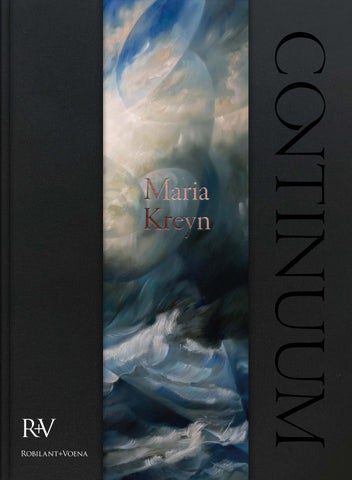
Maria Kreyn: Continuum

Page 1


MARIA KREYN

26 March – 8 May 2026

Introduction | Introduzione

The exhibition Maria Kreyn: Continuum represents an inevitable piece within the broader aesthetic and intellectual mosaic of Robilant+Voena’s work as a gallery: bringing together artists who, though distant in time and geography, are nevertheless kindred in sensibility and in the themes they investigate. Beginning with the exhibition Gold. Gothic Masters and Lucio Fontana, inaugurated in February 1999 at the Sperone Westwater gallery and curated by Marco Voena, the gallery has consistently devoted ample space to a practice that was once radical and provocative and has since become widely adopted across fields: the creation of dialogues – both formal and conceptual – that highlight how art history is, in reality, a continuum.

The great themes upon which human beings – and therefore artists – are called to reflect remain, despite occasional and fleeting fluctuations linked to taste, feeling, or particular circumstances, essentially the same. It will therefore be interesting to observe how certain artists of this century or the last – today celebrated by the art system and the market as witnesses to epochal, and at times even ethical, transformations – may in the future appear anachronistic, or at least confined to the narration of a brief span of time and a limited emotional spectrum. Birth and death, eternity, violence, eros, faith: these are among the themes that have always shaken the artist: like arrows shot by a god, piercing and overwhelming, flowing into the pre-rational sphere and giving rise to the great questions. And it is precisely through reflections – more or less profound – on these themes that, by placing side-by-side the work of artists who lived in different eras or geographical areas, one can attempt to understand the history of humankind, its countless nuances, how the past influences us – if and when it does – and how, ultimately, regardless of where and when we are born, our hearts are akin to those of the person beside us, of those who came before us, and of those who are destined to traverse creation after us.

La mostra Maria Kreyn: Continuum costituisce un tassello inevitabile rispetto al grande mosaico estetico ed intellettuale che riflette l’operato della galleria Robilant+Voena: accostare artisti che, se distanti per epoca e area geografica, risultano invece affini per sentire e temi investigati. A partire dalla mostra Gold. Gothic Masters and Lucio Fontana, inaugurata nel febbraio del 1999 presso la galleria Sperone Westwater e curata da Marco Voena, la galleria ha sempre dedicato ampio spazio ad una pratica un tempo radicale e provocatoria, ormai diffusa trasversalmente: la creazione di dialoghi di natura formale e contenutistica che evidenzino come la storia dell’arte sia in realtà un continuum.

I grandi temi su cui l’essere umano, e quindi l’artista, è chiamato a riflettere sono – malgrado qualche effimera oscillazione legata al gusto, al sentimento, o a situazioni peculiari – sempre i medesimi. E sarà pertanto interessante notare come alcuni artisti di questo secolo o del precedente, oggi venerati dal sistema e dal mercato dell’arte poiché testimoni di cambiamenti epocali e talvolta anche etici, risulteranno in futuro anacronistici o, quantomeno, delimitati al racconto di un breve lasso temporale e di un ristretto spettro emotivo. Nascita e morte, eternità, violenza, eros, fede: questi sono alcuni dei temi che da sempre scuotono l’artista, come frecce scoccate dal dio trafiggono, travolgono, sfociano nella sfera pre-razionale fino a suscitare i grandi quesiti. Ed è proprio attraverso riflessioni più o meno profonde su questi temi che, accostando il lavoro di artisti vissuti in epoche o zone geografiche differenti, si può cercare di comprendere la storia dell’Uomo, le mille sfumature che la contraddistinguono, come il passato ci influenza – se e quando un’influenza esercita – e come, in fondo, a prescindere dal luogo e dal tempo in cui veniamo al mondo, il nostro petto è simile a quello di chi ci sta accanto, di chi ci ha preceduto e di chi è chiamato a solcare il creato dopo di noi.

The Alchemist at Sea (detail), 2026. Oil on panel. 45.7 x 61 cm (18 x 24 in.)

Tracing the landscape

Continuum

In 1492, Leonardo da Vinci arrives in Milan, and with him comes a stylistic transformation in painting: landscape ceases to function as a mere theatrical backdrop, but is instead itself considered to be worthy of investigation. Nature loses its decorative role, and painting begins to intercept what happens within the individual, what lies in one’s chest: i moti dell’anima – the motions of the soul

This is the historical and geographical origin that underlies Maria Kreyn’s painting, and the conditio sine qua non for grasping her work. There is no attempt to force genealogies – only the desire to recognise a consonance: an obsession with atmosphere understood as a space in which matter and perception blur until they fuse. Indeed, Maria Kreyn’s work is marked by a constant pursuit of an inner movement that, through painting, is distilled and takes form. Here the landscape does not aim to convey peace, stillness, or silence, but rather tension, instability, unease. The painted surface holds and releases the energies of an event that is not only meteorological, but also entropic, intimate, and bodily; it is as though the water and air that pervade Kreyn’s compositions were, at once, natural phenomena and states of mind.

In the eighteenth century, the Grand Tour turned this emotional and visual tension into lived experience. Travellers crossed the continent and rediscovered –and indeed revelled in – classical antiquity; but also sought, almost feverishly, nature at its most eloquent and dangerous point, where it spilled beyond human boundaries. It is hardly surprising that among the most visited and therefore most represented landscapes was the great hulk of Vesuvius, often seen at night. In PierreJacques Volaire’s View of Vesuvius Erupting at Night (1771, Art Institute of Chicago, fig. 1), the volcano becomes the ideal subject for extreme chiaroscuro: flashes of fire, rivers of lava, columns of smoke rising into the dark sky causing a radiant illumination.

Tracciare il Continuum del paesaggio

Nel 1492, Leonardo da Vinci arriva a Milano e con lui arriva una trasformazione stilistica nella pittura: il paesaggio cessa di fungere da semplice quinta teatrale ma è invece considerato esso stesso degno di indagine. La natura perde la sua funzione decorativa, e la pittura comincia ad intercettare ciò che accade dentro l’individuo, ciò che alberga nel suo petto: i moti dell’anima

È questa l’origine storica e geografica che sottende la pittura di Maria Kreyn, e la conditio sine qua non per cogliere il lavoro di quest’ultima. Non vi è alcun tentativo di forzare parentele, solo l’interesse nel riconoscere una consonanza: l’ossessione per l’atmosfera intesa come luogo in cui la materia e la percezione si confondono fino a fondersi. C’è infatti, nel lavoro di Maria Kreyn, la costante ricerca di un moto interno che, mediante la pittura, si distilla e prende forma. Qui il paesaggio non mira a trasmettere pace, quiete, silenzio, ma tensione, instabilità, inquietudine. La superficie pittorica, difatti, trattiene e rilascia le energie di un evento che non è solamente meteorologico, ma anche entropico, intimo e corporeo: è come se l’acqua e l’aria che pervadono le composizioni di Maria Kreyn fossero, al contempo, fenomeni naturali e stati della mente.

Nel Settecento, il concetto di Grand Tour trasforma questa tensione emotiva e visiva in esperienza: si attraversa e si riscopre, si celebra anzi, la classicità; ma si cerca anche, in maniera quasi febbrile, la natura nel suo punto più eloquente e pericoloso, quello che esonda dai confini umani. Non stupisce infatti che, tra le mete più visitate e pertanto più rappresentate, vi siano panorami notturni in cui si staglia il Vesuvio. Nella Veduta del Vesuvio in eruzione di notte di Pierre Jacques Volaire (1771, Art Institute of Chicago, tav. 1), il vulcano è soggetto ideale per chiaroscuri estremi: lampi di fuoco, fiumi di lava, colonne di fumo che svettano nel cielo scuro fino ad illuminarlo.

Left: Siren Songs in a Storm, 2025. Oil on linen. 203.2 x 152.4 cm (80 x 60 in.)

The Eruption of Vesuvius, 1771. Oil on canvas, 116.8 × 242.9 cm.

The Art Institute of Chicago, 1978.426

Or again, by the same artist, the View of the Solfatara at Pozzuoli (1774, Museo di Capodimonte, fig. 2), where the landscape, rather than exploding, seethes, and the smoke rising from the ground reveals nature as a kind of magical force.

Other artists, too, pursued a manner of painting governed by light. The views of Joseph Wright of Derby, marked by combustions and flares, show how light can

Oppure, sempre del medesimo artista, la Veduta della Solfatara di Pozzuoli (1774, Museo di Capodimonte, tav. 2), dove il paesaggio, anziché esplodere, ribolle ed il fumo che dal terreno si alza evidenzia la natura come forza magica.

Ci sono anche altri gli artisti che indagano la pittura dominata dalla luce. Le vedute di Joseph Wright of Derby, caratterizzate da combustioni e bagliori,

Fig. 1: Pierre-Jacques Volaire (1729–1802)
Fig. 2: Pierre-Jacques Volaire (1729–1802)
View of the Solfatara at Pozzuoli, 1774. Oil on canvas, 145 x 279 cm. Museo e Real Bosco di Capodimonte, Naples, Q1832

be both knowledge and devastation (fig. 3): an element that reveals, yet consumes. The apocalyptic visions of John Martin – the Romantic painter celebrated for compositions in which nature manifests its majesty –and especially the fires that tear through his visions of Babylon, a city transformed into a warning, amplify the theatrical dimension of the sublime, where landscape and architecture become signs of a catastrophe that is not only historical, but moral as well (fig. 4).

With J. M. W. Turner comes a turning point: he anticipates Impressionism through his investigation of light and atmospheric perception. Nature enters the composition as a flash of energy, and it does so through vapour, wind, light: the image becomes the place where that force is made visible and perceptible. Mists that loosen boundaries, storms that fracture form, tempests in which light seems almost to become substance. This is not a mere exercise in technique, but expressive poetics, deliberately sought. In Turner, landscape assumes the very qualities of an atmospheric phenomenon: something that happens and entails change, something that involves the viewer even before it is understood.

denotano come la luce possa essere insieme conoscenza e devastazione (tav. 3): un elemento che rivela, ma consuma. Le visioni apocalittiche di John Martin –pittore romantico celebre per compisizioni in cui la natura si manifesta nella sua maestosità – e gli incendi che dilaniano Babilonia, città trasformata in monito, amplificano la dimensione teatrale del sublime, dove paesaggio e architettura divengono segni di una catastrofe non solo storica ma anche morale (tav. 4).

Con J. M. W. Turner, la svolta: egli è colui che anticipa l’Impressionismo grazie alla sua indagine sulla luce e sulla percezione atmosferica. La natura entra nella composizione come baleno di energia, e lo fa attraverso il vapore, il vento, la luce: l’immagine è ora il luogo in cui tale forza si rende visibile e percepibile. Nebbie che rendono labili i confini, burrasche che spezzano la forma, temporali in cui la luce sembra quasi farsi sostanza: non un semplice esercizio di tecnica, ma una poetica espressiva ricercata. In Turner, il paesaggio assume le qualità proprie di un fenomeno atmosferico, ovvero di qualcosa che succede e comporta cambiamenti, che coinvolge l’osservatore prima ancora che quest’ultimo lo comprenda.

Fig. 3: Joseph Wright of Derby (1734–1797)
Vesuvius from Portici, c. 1774–76. Oil on canvas, 101 x 127 cm.
The Huntington Library, Art Museum, and Botanical Gardens, San Marino, 97.27

In this same direction – from landscape as view to landscape as experience – stands the technical and atmospheric virtuosity of Ivan Konstantinovič Aivazovsky, an ideal alter ego of Maria Kreyn: between them there is a genetic, historical, and cultural bond, an entire shared imaginary of colours and forms (fig. 5). Aivazovsky painted the ocean obsessively, transforming it into a body that breathes, exhales, threatens.

It is within this territory, where nature is energy and the visible becomes experience, that Kreyn’s work finds its creative and expressive necessity. And in doing so, it proves itself both heir to a centuries-old tradition and fully contemporary: nature, today, is also an intimate, mental construction. Figuration is not abandoned, but placed in dialogue with a geometric grammar that functions like a score and evokes the universe of Kandinsky. Ovoid signs, parabolas and linear tracings surface like diagrams, traces of an internal logic in the artist’s sensibility: at times the echo of a golden ratio more intuited than demonstrated, at times the memory of a Renaissance project, as if nature were traversed by an invisible architecture and the artist were called, insofar as possible, to grasp it, and then to tell it.

In questa stessa direzione – dal paesaggio come veduta al paesaggio come esperienza – si colloca il virtuosismo tecnico e atmosferico di Ivan Konstantinovič Ajvazovskij, alter ego ideale di Maria Kreyn: vi è tra essi un legamene genetico, storico e culturale, un intero immaginario di colori e forme che condividono (tav.5). Ajvazovskij dipinge l’oceano in maniera ossessiva, trasformandolo in un corpo che respira, sbuffa, minaccia.

È all’interno di questo territorio, dove la natura è energia e il visibile esperienza, che il lavoro della Kreyn trova la propria necessità creativa ed espressiva. E nel farlo, risulta sia parte di una tradizione secolare che attuale: la natura, oggi, è anche costruzione mentale, intima. La figurazione non viene abbandonata, ma posta in dialogo con una grammatica geometrica che funge da partitura e richiama l’universo di Kandinskij. Segni ovoidali, parabole e tracciati lineari affiorano come diagrammi, come tracce di una logica interna al sentire dell’artista: talvolta l’eco di una sezione aurea più intuita che dimostrata, talvolta la memoria di un progetto rinascimentale, proprio come se la natura fosse attraversata da un’architettura invisibile e l’artista è chiamata a tentare, per quanto le risulta possibile, di coglierla per poi raccontarla.

Fig. 4: John Martin (1789–1854)
The Great Day of His Wrath, 1851-53. Oil on canvas, 196.5 x 303.2 cm. Tate, London, N05613
Fig. 5: Ivan Konstantinovič Aivazovsky (1817–1900)
Ship on stormy seas (detail), 1850s. Oil on canvas, 20.5 x 28.5 cm.
Private collection.

The necessary humanism L’umanesimo necessario

The erasure of the classics

Our country is an unbalanced one, proceeding through removals and oppositions. Until the 1960s it was entirely oriented toward humanistic culture, with the consequent and evident deficit in scientific and technological culture due to multiple historical and ideological causes. These included the absence of an Enlightenment and of a positivist tradition, delayed industrial development, prolonged idealist hegemony, political disinterest alongside popular ignorance and religious mistrust. Today, this same country, now fully subjugated to technological monotheism, is enacting a true erasure of humanistic studies, particularly classical ones, under a double accusation: that they are conservative and useless. Thus persists, with inverted judgments, the disastrous and anachronistic fracture between the so-called “Two cultures”: a theory upheld by those who ignore that languages are many, but culture is one.

In our time, the rupture and censorship of the notum of history, of the classics, of our fathers and the masters appear glaring when set against the dominance and intrusiveness of the novum, of novelty, news, discoveries, and technologies that shape our lives.

The predominance of the technology/economy pairing is clearly issuing a double verdict: the end of memory and the end of politics. In this perspective, Ancient and Present, Classical and Modern, rather than meeting and dialoguing, risk moving separately and divorcing one another.

Certain questions thus become unavoidable and urgent: can science and technology do without the humanities? Will Prometheus, the prophet of technology, and Socrates, the prophet of humanism, manage to coexist? Put bluntly: will there still be a need for us, or will we be dethroned by the machine?

La rimozione dei classici

Paese squilibrato, il nostro, che procede per rimozioni e contrapposizioni. Fino agli Anni Sessanta tutto proiettato verso la cultura umanistica, con conseguente ed evidente deficit di cultura scientifica e tecnologica, al quale hanno contribuito molteplici cause storiche e ideologiche: assenza di cultura illuministica e positivistica, tardivo sviluppo industriale, prolungata egemonia idealistica, disinteresse politico abbinato all’ignoranza popolare e alla diffidenza religiosa. Ora, questo stesso Paese, tutto asservito al monoteismo tecnologico, mette in atto una vera e propria rimozione degli studi umanistici, in particolare classici, all’insegna della duplice accusa: sono conservatori e inutili. Perdura, in tal modo, a giudizi invertiti, la sciagurata e anacronistica frattura tra le cosiddette “Due culture”: teoria propria di chi ignora che i linguaggi sono molteplici, ma che la cultura è una.

Fin troppo evidenti appaiono ai nostri giorni la cesura e la censura del notum della storia, dei classici, dei padri, dei maestri a fronte della prevalenza e dell’invadenza del novum della cronaca, delle scoperte, delle tecnologie che plasmano la nostra vita.

Il predominio del binomio tecnica/economia sta decretando con tutta evidenza una duplice sentenza: la fine della memoria e la fine della politica. In questa prospettiva, Antico e Presente, Classico e Moderno, anziché incontrarsi e dialogare, rischiano di procedere separatamente e di divorziare.

Obbligate e urgenti diventano alcune domande: scienza e tecnica potranno fare a meno delle humanities? Prometeo, il profeta della tecnica, e Socrate, il profeta dell’umanesimo, riusciranno a coabitare? Detto brutalmente: ci sarà ancora bisogno di noi o saremo spodestati dalla macchina?

Prometheus and Socrates

Welcome, technology: an advanced form of knowledge and a marvelous word (composed of téchne, “technique”, the Latin ars, and lógos, “the thought that dwells in speech”); and welcome its maker, Prometheus, who rises as lord of the present time and, above all, of the time to come, fully expressing the power and potential of his very name: Prometheus, he who “understands (metis) beforehand ( pro)”, the “farsighted one”. The language of Prometheus is clear and unambiguous: entirely oriented toward the novum, it adopts the substitutive paradigm of forgetting; it intervenes in life understood as biology (zoé ); it provides immediate answers; it knows that it knows; it is competent in answers; it follows common opinion (doxa) and fosters dominant thinking; it inscribes itself in space; it identifies the most effective means; it simplifies complexity; it masters specialized languages; it familiarizes itself with non-things. By violating the pillars of nature, it defines the human being no longer as what one ought to be, but as what one wishes to become.

But does such a monocultural imprint not risk producing a half-professional, a half-citizen, a half-human being? What becomes of Hippocrates’ principle, according to which where there is philotechnía, care for technique, there must also be philanthropía, care for the human being? And of Plato’s perspective, who in the Protagoras subordinated technique (demiourgikè téchne) to politics ( politikè téchne), the faber to the civis? What becomes of memory, of historical knowledge, of the Socratic and Augustinian question: “Who are you?”

If we wish – using Montaigne’s expression – to form “well-made” minds and not merely “well-filled” ones, then alongside Prometheus, prophet of technology, we must place Socrates, prophet of humanism: the inventor of dia-logos, the professor of ignorance (“I know that I do not know”), the relentless interrogator, the competent poser of questions. A friend of time and an apostle of a thought that refers back to the notum, to the memory of our fathers and of history, he adopts the cumulative paradigm of memory; he conceives life as individual existence (bíos); he listens to the voice of the daímon; he follows scientifically-grounded thought (epistéme); he scrutinizes ends; he interprets complexity; he knows the common (koinós) language of the polis. Out of fashion, countercurrent, heretical (átopos, “out of place”) for

Prometeo e Socrate

Benvenuta tecnologia: forma avanzata di conoscenza e parola mirabile (composta da téchne, “tecnica”, ars latina, e lógos, “il pensiero che abita la parola”); e benvenuto il suo artefice Prometeo, il quale si erige a signore del tempo presente e soprattutto di quello a venire, esplicitando tutta la potenza e potenzialità del suo étimo: Prometeo, colui che “comprende (metis) prima ( pro)”, “il lungimirante”. Il linguaggio di Prometeo è chiaro e univoco: tutto proteso al novum, adotta il paradigma sostitutivo della dimenticanza; interviene sulla vita intesa come biologia (zoé ); dà risposte immediate; sa di sapere; è competente nelle risposte; segue l’opinione comune (doxa) e favorisce il pensiero dominante; si iscrive nello spazio; individua i mezzi più efficaci; semplifica la complessità; conosce i linguaggi specialistici; familiarizza con le non-cose. Violando i cardini della natura, egli profila l’uomo non più quale deve essere, ma quale vuole diventare.

Ma tale impronta monoculturale non rischia di formare un professionista dimezzato, un cittadino dimezzato, un uomo dimezzato? Che ne è dell’istanza di Ippocrate, il quale teorizzava che là dove c’è philotechnía, la cura della tecnica, c’è anche philanthropía, la cura dell’uomo?

E della prospettiva di Platone, il quale nel Protagora subordinava la tecnica (demiourgikè téchne) alla politica ( politikè téchne), il faber al civis? Che ne è della memoria, del sapere della storia, della domanda socratica e agostiniana «Tu chi sei»?

Se vogliamo, per usare la formula di Montaigne, formare teste “ben fatte” e non solo teste “ben piene” a Prometeo, profeta della tecnica, è necessario affiancare Socrate, il profeta dell’umanesimo: l’inventore del dia-logo, il professionista dell’ignoranza («so di non sapere»), lo stalker interrogante, il competente nelle domande. Amico del tempo e apostolo di quel pensiero che rimanda al notum, alla memoria dei padri e della storia, egli adotta il paradigma cumulativo della memoria; concepisce la vita come esistenza individuale (bíos); ascolta la voce del dáimon; segue il pensiero scientificamente fondato (epistéme); scruta i fini; interpreta la complessità; conosce il linguaggio comune (koinós) della polis. Fuori moda, controcorrente, eretico (átopos, “fuori posto”), per Platone e universale (kósmios) per Plutarco: «non sono né Ateniese né Greco, ma del mondo»), Socrate è colui che, secondo Cicerone, «per

Plato, and universal (kósmios) for Plutarch (“I am neither Athenian nor Greek, but of the world”), Socrates is the one who, according to Cicero, “first called philosophy down from the heavens, brought it into cities, introduced it into homes, and made it concern itself with life, with customs, with good and evil”.

An alliance with humanistic thought thus appears both natural and necessary, for it comes to the aid of technical thinking with a threefold benefit: critical thinking, an understanding of time, and a vision of the whole.

Critical consciousness is formed precisely by considering the classics not only as foundational but also as antagonistic to our present: as such, different and outdated. From this perspective, they are always current; the question is whether we are. Only a different, perspectival gaze can grasp the complexity of reality. ChatGPT generates convergent, standardized answers and questions, modeled on the notum, on established schemas, paradigms, and acquired knowledge. To blaze the unexplored paths of the novum, we need divergent and creative human thought. Science itself has always been the outcome of critical and self-critical thinking, divergent rather than convergent with doxa and communis opinio

Equally urgent is our need to make peace with time, now sidelined and humiliated by space (www). While space, closed and static, is the sum of present forces and realities, time, open and dynamic, reweaves the threads of the past – and thus with them the memory of and gratitude toward those who came before us –and likewise those of the future, and thus of intention (“forward thrust”) and responsibility toward those yet to be born. Can we endure the contradiction of being giants and planetary with respect to space, yet dwarfs and provincial with respect to time? Those who pay the highest price for this rupture and censorship of time are the young, who find the plug of history pulled out and who suffer the impact of a simultaneity as absolute as it is ephemeral. Without any sense of distance, the pathos of difference, the eros of otherness, they remain ensnared in the coils of the present and live in “the Hell of the Same” (Byung-Chul Han). Tradition, as Mahler taught us, is not the worship of ashes but the “preservation of fire”.

primo ha richiamato a gran voce la filosofia dal cielo (devocavit e caelo), l’ha trasferita nelle città, introdotta nelle case e portata a interessarsi della vita, dei costumi, del bene e del male».

Naturale e necessario appare l’alleanza col pensiero umanistico, il quale soccorre il pensiero tecnico con un triplice beneficio: il pensiero critico, la nozione del tempo, la visione dell’insieme.

La coscienza critica si forma proprio considerando i classici non solo fondativi ma anche antagonisti del nostro presente: cioè diversi e inatuali. Da questo punto di vista loro sono sempre attuali; chiediamoci se noi lo siamo. Solo uno sguardo diverso e prospettico può cogliere la complessità del reale. ChatGPT genera risposte e domande convergenti, standardizzate, modellate sul notum, sugli schemi, sui paradigmi e sulle conoscenze acquisite. Per battere i sentieri inesplorati del novum ci vogliono i pensieri divergenti e creativi dell’uomo naturale. La scienza è stata sempre l’esito del pensiero critico e autocritico, divergente e non convergente con la doxa e la communis opinio

Altrettanto urgente il nostro bisogno di fare pace col tempo, oggi messo all’angolo e mortificato dallo spazio (www). Mentre lo spazio, concluso e statico, è la sommatoria delle forze e delle realtà del presente, il tempo, aperto e dinamico, riannoda i fili sia del passato – e quindi della memoria e della riconoscenza verso i trapassati – sia del futuro, e quindi del progetto (“lo slancio in avanti”) e della responsabilità verso i nascituri. Possiamo sopportare la contraddizione di essere giganti e planetari rispetto allo spazio, nani e provinciali rispetto al tempo? A pagare il prezzo più alto di questa cesura e censura del tempo sono i giovani, i quali trovano staccata la spina della storia e scontano l’impatto di una simultaneità tanto assoluta quanto effimera. Senza più la cognizione della distanza, il pathos della differenza, l’eros dell’alterità, restano avvolti nelle spire del presente e vivono «l’Inferno dell’Uguale» (Byung – Chul Han). La tradizione, come ci ha insegnato Mahler, non è la venerazione delle ceneri ma la «salvaguardia del fuoco».

Finally, humanistic thought – through the languages of poetry, literature, the arts, history, philosophy, and politics – offers us a “vision of the whole” (Ulrich von Wilamowitz), the “art of synthesis” (Umberto Eco), the “science of the whole” (Massimo Cacciari), the “connecting of the dots” (Steve Jobs). Jobs himself reminded us that “it is in Apple’s DNA that technology alone is not enough. It is technology married with the liberal arts, married with the humanities, that produces the results that make our hearts sing”. To the great visionary and inventor of Apple – who, concerned with the limits of the computer scientist, invoked the figure of the “renaissance engineer” – is attributed the striking remark: “ I would trade all my technology for an evening with Socrates”.

This was confirmed in 2006 by Georgette Yakman, who enriched and extended the STEM acronym into STEAM, where the A stands for the arts and, more broadly, the humanities. Adolf Loos had already perceived this in his definition of the architect: “An architect? A bricklayer who knows Latin”, a figure who fuses the culture of the hand with that of the mind, ars with ingenium, technology with the humanities.

Infine, il pensiero umanistico – con i linguaggi della poesia, della letteratura, delle arti, della storia, della filosofia, della politica – ci consegna la «visione dell’insieme» (Ulrich von Wilamowitz), l’«arte della sintesi» (Umberto Eco), la «scienza dell’intero» (Massimo Cacciari), «la connessione dei puntini» (Steve Jobs). Proprio Steve Jobs ci ha ricordato che «è nel DNA di Apple che la tecnologia da sola non basti. È la tecnologia sposata con le arti liberali, sposata con le scienze umane, che produce i risultati che fanno cantare il nostro cuore».

Proprio al grande visionario e inventore di Apple – il quale, preoccupato dei limiti dell’informatico, invocava la figura dell’“ingegnere rinascimentale” – è attribuita la fulminante battuta: “Baratterei tutta la mia tecnologia per una serata con Socrate”.

Lo ha confermato nel 2006 Georgette Yakman arricchendo ed estendendo l’acronimo STEM in STEAM, dove la A sta per arti e più in generale per saperi umanistici. Lo aveva già intuito Adolf Loos con la sua definizione di architetto: «L’architetto? Un muratore che sa di latino», cioè una figura che salda la cultura della mano con la cultura del cervello, la lezione dell’ars con quella dell’ingenium, la tecnologia con le humanities

Quid nunc? (Or: And now?)

But here comes the absolute novum, the unexpected and unprecedented: today the new Prometheus, with the discovery of the latest version of fire – Artificial Intelligence – seems to assert itself definitively, relegating classical Prometheus to oblivion, the Prometheus bound of Aeschylus, according to whom “technique is far weaker than destiny” and “to believe oneself immortal is blind hope”. Now he appears to overcome those two limits, becoming stronger than destiny and death.

Hence the question: will the new Prometheus, who promises to lead us beyond all the Pillars of Hercules, still need the old Socrates? Will there still be a need for classical and humanistic knowledge? Will there still be a need for us?

The answer is affirmative if we remain mindful of and faithful to what Aristotle called our two distinguishing marks: lógos, the thought that dwells in speech; and the polis, the community to which we are all called – or, if you will, condemned – and which includes neither God nor beast alone.

We must first rediscover the word, in a world increasingly dematerialized into non-things, permeated by words shaped by space, solitude, and isolation, conditions we personally experienced above all during Covid. Consider social media, which is in fact the exact opposite and negation of the true meaning of the word “social”; Lockdown, “confinement”, internalized to the point of marking a psychological rupture; smart working, an emergency now oscillating between opportunity and opportunism; distance learning, a didactic mode that proved a nerve gas for our youth; social distancing, which reveals our obsession with “immunity” and our neglect of “community”. These are words that deny our nature as social beings, bound by a shared destiny.

We need new words.

Words that generate thoughts of sociality, civic sense, and communion. Words not marked by solitude, isolation, and distancing, but by cum: communicate, meaning to share (cum) with others our function, duty, and gift (munus); compete, in its original sense of “moving toward the same goal” ( petere) together (cum); contest, which bears the noble meaning of “bearing witness” (testari, testis) together (cum) with others. This is the time when

Quid nunc? (oppure E ora?)

Ma ecco il novum assoluto, l’inatteso e l’inaudito: oggi il novello Prometeo, con la scoperta dell’ultima versione del fuoco – l’Intelligenza Artificiale – sembra affermarsi con tutta evidenza in modo definitivo e mandare in soffitta il Prometeo classico, il Prometeo incatenato di Eschilo, secondo il quale «la tecnica è molto più debole del destino» e «credersi immortali è una cieca speranza». Ora egli sembra superare quei due limiti ed essere più forte del destino e della morte.

Di qui la domanda: il nuovo Prometeo, che ci promette di condurci oltre tutte le Colonne d’Ercole, avrà bisogno del vecchio Socrate? Ci sarà ancora bisogno del sapere classico e umanistico? Ci sarà bisogno di noi?

La risposta è affermativa se poniamo mente e rimaniamo fedeli a quelle che Aristotele chiamava le nostre due marche distintive: il logos, il pensiero che abita la parola; e la polis, la comunità, alla quale tutti siamo chiamati o se vogliamo condannati, e della quale non fanno parte solo Dio e la bestia.

Dobbiamo riscoprire anzitutto la parola, in un mondo sempre più smaterializzato e dematerializzato di noncose, caratterizzato da parole improntate allo spazio, alla solitudine e all’isolamento, che abbiamo scontato anche personalmente soprattutto durante il Covid. Pensiamo a social, che, amputata della lettera finale, è diventata il contrario e la negazione di “sociale”; lockdown: “confinamento”, introiettato fino a segnare una cesura psicologica; smart working, un’emergenza che ora oscilla tra opportunità e opportunismo; DAD, modalità didattica rivelatasi un gas nervino per i nostri ragazzi; distanziamento sociale, che mostra tutta nostra preoccupazione per l’“immunità” e la non curanza della “comunità”». Sono parole che negano la nostra natura di esseri sociali, comunitari, vincolati da un destino comune.

Abbiamo bisogno di parole nuove.

Parole che producano pensieri di socialità, di senso civico, di comunione. Parole che siano non nel segno della solitudine, dell’isolamento, del distanziamento, ma parole contrassegnate dal cum: come comunicare, vale a dire condividere (cum) con gli altri la nostra funzione, il nostro dovere, il nostro dono (munus)”; competere, nel suo valore originario di “andare nella stessa direzione” ( petere) insieme (cum)”; contestare, che porta con sé il nobile

we should not passively endure but actively interpret and orientate the collective, indeed universal, call: to “contest” what we experience as beautiful, just, and true, and what we suffer as ugly, unjust, and false. It is striking that young people, in particular, have abdicated their natural role as “contestants”, as if paralyzed and anesthetized by uncertainty, fear, and adult cynicism.

We need politics.

Faced with technology and economy – which are global, feed themselves on the basis of profit, and are unconcerned with ends because they are ends in themselves – who else can identify goals, draft laws, and establish the common good (bonum commune) if not politics?

What will become of justice and freedom, which Plato placed at the foundation of coexistence and political orders?

Will the reduction of labor lead to a concentration or a redistribution of said labor? Will it benefit a few or everyone? Will we strive to create a world of exemplary and free intelligence, or of a gregarious and enslaved intelligence?

Precisely at the moment when the world appears out of balance and even out of control, it may be connections that save us, as we are reminded by a poem attributed to Borges: “You do not quite know whether life is a journey, a dream, awaiting expectations, or a plan unfolding day by day, without your noticing except when you look back. You do not know whether it makes sense. At certain moments, sense does not matter. Bonds do”.

It is necessary to bring back lógos from exile and give ourselves a moment to reflect. To this end, as Alexander Langer wisely urged us, it would help to overturn the famous Olympic motto – “faster” (citius), “higher” (altius), “stronger” ( fortius) – into its exact opposite: “slower” (lentius), “deeper” ( profundius), “more gently” (suavius).

Only in this way may we rediscover ourselves and others, and protect ourselves from the risk of becoming one day, Montaigne warns us, “scientists without knowledge, magistrates without jurisdiction, and actors without a play”.

significato di “testimoniare” (testari, testis) “insieme” (cum) agli altri. È, questo, il tempo in cui tutti dovremmo non subire ma interpretare e orientare la chiamata collettiva, direi universale: “contestare” ciò che di bello, di giusto e di vero sperimentiamo, e ciò che di brutto, di ingiusto e di non vero scontiamo. Colpisce che in particolare i giovani abbiano abdicato al loro ruolo naturale di “contestatori”, come bloccati e anestetizzati dall’incertezza, dalla paura e dal cinismo degli adulti.

Abbiamo bisogno della politica.

A fronte della tecnica e dell’economia – che sono globali e che si autoalimentano sulla base dell’utile e che non si pongono il problema dei fini perché entrambe sono fine a sé stesse – chi individua i fini, redige le leggi, stabilisce il bene comune (bonum commune) se non la politica?

Che ne sarà della giustizia e della libertà, che Platone poneva alla base della convivenza e degli ordinamenti politici?

La riduzione del lavoro comporterà una concentrazione o una ridistribuzione del lavoro? Sarà un vantaggio per pochi o per tutti? Ci adopereremo per creare un mondo di Intelligenze egregie e libere oppure gregarie e schiave?

Proprio nel momento in cui il mondo appare fuori equilibrio e addirittura fuori controllo, a salvarci potrebbero essere proprio i legami, come ci ricorda una poesia che alcuni attribuiscono a Borges: «Non sai bene se la vita è viaggio, / se è sogno, se è attesa, se è un piano che si svolge giorno / dopo giorno e non te ne accorgi / se non guardando all’indietro. Non sai se ha senso. / In certi momenti il senso non conta. / Contano i legami».

È necessario richiamare dall’esilio il logos e imporci una pausa di riflessione. A questo proposito gioverà, come ci ha saggiamente esortato Alexander Langer, rovesciare il famoso motto olimpico “più velocemente” (citius), “più in alto (altius), “più forte” ( fortius), nel suo estatto contrario: “più lentamente” (lentius), “più in profondità” ( profundius), “con più dolcezza” (suavius).

Solo così potremo ritrovarci con noi stessi e con gli altri, e tutelarci dal rischio di diventare un giorno, come ci ammonisce Montaigne, «scienziati senza conoscenza, magistrati senza giurisdizione e comici senza commedia».

ARTWORKS

Joseph Mallord William Turner (1775–London–1851)

The Splügen Pass, c. 1842–43

Inscribed ‘BAINS/...’ (lower centre)

Pencil and watercolour heightened with bodycolour and scratching out on paper

29 x 45 cm (11 3/8 x 17 3/4 in.)

Continuum, 2026. Oil on linen. 127 x 152.4 cm (50 x 60 in.)
Ascending Portals Through Silky Oceans, 2026. Oil on panel. 61 x 45.7 cm (24 x 18 in.)
The Birth of Venus Through a Prism, 2026. Oil on panel. 61 x 45.7 cm (24 x 18 in.)
Siren Songs in a Storm, 2025. Oil on linen. 203.2 x 152.4 cm (80 x 60 in.)
Self-Generating Labyrinth, 2026. Oil on panel. 61 x 45.7 cm (24 x 18 in.)
The Alchemist at Sea, 2026. Oil on panel. 45.7 x 61 cm (18 x 24 in.)
Cloud Atlas, 2026. Oil on linen. 203.2 x 152.4 cm (80 x 60 in.)

Maria Kreyn (b. 1987) is an American artist known for evocative paintings that merge figuration, abstract geometries, and elemental atmospherics. Self-taught in painting, she studied mathematics and philosophy at The University of Chicago. She builds upon these disciplines in her works, combined with interests in neuroscience and mythology, producing atypical and polymathic connections between disparate fields, and offering stirring visual metaphors for complex scientific ideas. Steeped in the western tradition of painting, Kreyn distils these references into a personal vocabulary of forms and geometries that result in hybrid compositions situated at the intersection of formalism and Romantic painting. Her expansive canvases are emotionally charged meditations on nature, the body, and the mystery of deep time.

Kreyn’s work has been featured in publications including Vanity Fair, The Wall Street Journal, The Art Newspaper, The Financial Times, and many others. Housed in collections internationally, Kreyn’s public works include a cycle of eight monumental paintings based on plays by Shakespeare, which were commissioned by Andrew Lloyd Webber and are now on permanent display in the lobby of London’s historic Theatre Royal Drury Lane (2021). Kreyn’s solo exhibition during the 60th Venice Biennale in 2024 was presented by the M.O.N. Art Foundation, staged at St. George’s Church in Venice, Italy.

Maria Kreyn lives and works in Brooklyn, New York.

Solo exhibitions

2025

Hyperobject, M.O.N. Art Foundation, The Fitzrovia Chapel, London

2024

Chronos, M.O.N. Art Foundation, St. George’s Anglican Church, Venice 2023

Untune a String, The Hole, New York (NY)

Lensing a Storm, Ministry of Nomads, London

2021

The Shakespeare Cycle, permanent public installation: Theatre Royal Drury Lane, London (commissioned by Andrew Lloyd Webber)

Maria Kreyn: Recent Works, Hillsdale College of Art, Hillsdale (MI)

2018

Polyphony, Heist Gallery, Welsh Chapel, London

How to Become a Cloud, Fabien Fryns Gallery, Marbella

2017

May you live in interesting times, Booth Gallery, New York (NY)

2012

However vast the darkness, we must supply our own light, End of Century Gallery, New York (NY)

2011

Messengers, Pan Galleri, Oslo

Group exhibitions

2025

The Long Now, Saatchi Gallery, London

The Cloak of Dreams, SWCAC, Shenzhen

A Mysterious Vision, Robilant+Voena, New York (NY) and Milan

2024

Who’s Muse, Palo Gallery, New York (NY)

Something Woman This Way Comes, Patricia Low, Gstaad

Arcadia and Elsewhere, James Cohan, New York (NY)

2023

Femme F(r)iction, C1760, New York (NY)

2022

Influences of Time, C1760, New York (NY)

2019

She Persists: 20 Female Voices of Rebellion, Celebration, and Resilience, Heist Gallery, Palazzo Benzon, Venice

2018

Summer of Love, Freight + Volume, New York (NY)

2017

Psychological Realism, Booth Gallery, New York (NY)

Et in Arcadia Ego, William Rolland Gallery of Fine Art, California Lutheran University (CA)

2016

Et in Arcadia Ego, New Museum, Los Gatos (CA)

Point of Origin, The Lodge Gallery, New York (NY)

In the Raw, Untitled-Space, New York (NY)

2015

60 Americans, Elga Wilmer Gallery, New York (NY)

Magica Sexualis, Stephen Romano Gallery, New York (NY)

2014

Close Up: Contemporary Portraiture, Leila Heller Gallery, Southampton Art Center (NY)

Voyeur, Lyons Wier Gallery, New York (NY)

Look at Me, Leila Heller Gallery, New York (NY), curated by Beth DeWoody and Paul Morris

Giants Among Us, Corey Helford Gallery, Los Angeles (CA)

2013

Incarnations, Highline Loft, New York (NY)

ACOPAL, Tianjin Art Museum, Tianjin

ACOPAL, Hubei Province Museum, Wuhan

ACOPAL, Zhejiang Province Museum, Hangzhou

ACOPAL, Shanghai Art Museum, Shanghai

2012

ACOPAL, Beijing World Art Museum, Beijing

ACOPAL, Dalian Modern Museum, Dalian

Double Dirty Dozen, Freight + Volume, New York (NY)

Crucifixion, Corey Helford Gallery, Los Angeles (CA)

Hookers, Corey Helford Gallery, Los Angeles (CA)

2011

ACOPAL, Butler Institute of American Art, Youngstown (OH)

Catalogue of the exhibition

Maria Kreyn. Continuum at Robilant+Voena, via della Spiga 1, 20121, Milan 26 March – 8 May 2026

All texts © the Authors

Maria Kreyn artwork and studio images © the Artist

Designed by Footprint Innovations ltd

Edited by Helen Record

Translations by Alice Lazzaroni

Turn static files into dynamic content formats.

Create a flipbook