






























TUBE
Page
Page
Page 8
Page 9
Page 10 ACTING ON ASSAULTS
Page 13
RMT
Page 14 OFFSHORE
Page 23
Page 24
Page
Page 28
Page 29
Page 30 PRIZE CROSSWORD
It is great to start with good news for a change, including the fact that members have won an inflation-proof three-year deal on London Underground which guarantees wage increases under the Retail Price Index (RPI).
In the maritime sector RMT has secured pay rises of up to 37 per cent for workers at the British Antarctic Survey.
RMT has also welcomed the Bus Services Act which has been introduced to tackle the continuing decline of the sector following decades of privatisation, deregulation and disinvestment.
We can also celebrate the creation of Great British Railways (GBR) which will finally reunite train and track under one company after 30 years of experimentation with privatisation and fragmentation.
The first person I thought of when legislation began going through Parliament to establish GBR was the late Bob Crow.
He spent much of his political life campaigning against rail privatisation and never gave up on the belief that working people could defeat it.
He also understood that the Tories had privatised the railways under EU directive 91/440 which demanded the breakup of the industry and to regain control of our railways and our economy we needed to confront the EU.
Yet, when he was told these things couldn’t be done as they were minority views, his response was typically funny and penetrating: “I’ve been in a minority all my life”.
However, the creation of GBR will not be a panacea but just the start of the campaign to end fragmentation and outsourcing. Tens of thousands of workers are sub-contracted on our railways, including cleaners, caterers, security guards, revenue protection and infrastructure maintenance, renewal and engineering workers.
As a new RMT report has found, the widespread use of outsourcing has increased costs and delayed projects due to fragmented contracts, risk aversion and compensation claims.

The Office of Rail and Road’s (ORR) productivity measures are also not fit for purpose, focussing narrowly on labour costs, encouraging job cuts and short-term savings whilst ignoring broader economic outcomes and structural inefficiencies.
But the creation of GBR is an opportunity for rail to become a strategic pillar of national productivity revival operating under a unified, public-sector-led model.
By redefining productivity, reintegrating the network, and investing in domestic capabilities the transport sector could become a vehicle for national renewal and reignite broader economic growth.
To achieve this, the government must move beyond the flawed legacy of privatisation and adopt a long-term, public-interest-driven approach.
Under GBR, West Midlands Railways will follow c2c and Greater Anglia into public ownership in February. Govia Thameslink Railways services will be taken in-house by June and Chiltern and Great Western Railways are expected to follow before the end of 2026.
Avanti West Coast, Cross Country and East Midlands Railways services are planned to be nationalised by the end of 2027 when GBR is expected to actually come into being.
One of the ways the government can continue to develop GBR is by investing in its most productive assets, the workers who operate and maintain the sector and, ultimately, create the conditions for national growth.
Transport workers are worth it.
Finally, I want to pay tribute to all the transport workers and emergency staff who had to deal with the horrific mass stabbing on our rail network, just the latest in a growing number of violent attacks.
I am sure everyone would join me in calling for cuts to the British Transport Police to be reversed and for urgent action to deliver a safer, properly staffed and effectively policed transport network.
Eddie Dempsey
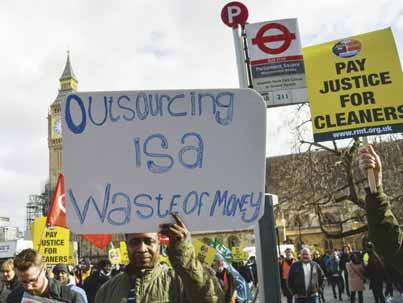
RMT is demanding the suspension of the procurement process for Transport for London (TfL) cleaning contracts.
contract could be renewed a third time by the same methods as could have been used in the past.”
The call comes after the union obtained legal advice from Michael Ford KC, which has raised serious concerns about the advice given to the mayor by senior TfL executives.
RMT general secretary Eddie Dempsey wrote to the London mayor and the Transport for London Board: “I am concerned that the mayor may have been misled as to his options in relation to the future of the pan TfL cleaning contract.”
RMT had been in formal discussions with TfL over a possible insourcing of the cleaning contract, following the mayor’s instruction in October 2024.
However, the process was delayed by TfL and only began four months later. Only two meetings were held before RMT was told in August that the review would not continue.
“A further meeting was expected to be held but in August, we were informed by the mayor that TfL had told him it was now too late to stop the re-tendering process and that no further contract extension could take place, which might have allowed more time for a genuinely objective options appraisal process,” said Mr Dempsey.
The union sought legal advice which suggested that this guidance was not accurate and that the mayor was acting under a misunderstanding of the options available to him.
“Our advice is that the
The union also challenges TfL claims that the cancellation of the procurement process was no longer possible.
The legal advice indicates that this was not the case and that a contracting authority enjoyed a very broad discretion when it came to decisions to abandon contract award procedures and provide the service in-house.
The union is calling for no new contract to be signed and to allow for a genuine review of the options open to the Mayor of London.
“This is a major TfL service, employing upwards of 2,000 staff and if it is tendered out it will be a contract worth £700 million
over five years.
“These are workers who put their lives on the line during the pandemic and worked every day to make the Underground safe for key workers to travel on.
“Their current treatment under ABM is a continuing stain on the reputation of TfL and the Greater London Authority.
“The cleaners are denied a decent pension in retirement and left to depend on pension credit, denied sick pay and overworked to make up for de-staffing to subsidise ABM’s profits. ABM paid out a £30 million dividend last year to their US owners,” wrote Mr Dempsey.
The union has also highlighted the record of both bidders on the contract. While ABM paid £30 million to shareholders, rival bidder
Mitie plc recently paid out £54.5 million in dividends – its largest payout in over 12 years – while also spending £104 million on share buybacks to inflate shareholder returns.
In September, the TUC called on the mayor to convene a summit to improve industrial relations, end outsourcing, and retain ticket offices on the Elizabeth Line.
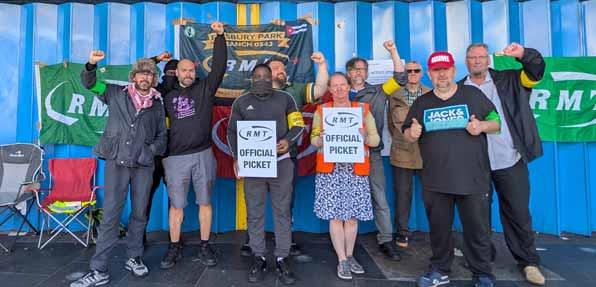
RMT has won a three-year pay deal on London Underground following strike action and sustained negotiations with the employer.
The union also secured commitments addressing work-life balance among staff, including ‘fatigue friendly’ rosters, further discussions on staff travel, and a consistent Boxing Day payment of £400.
The deal will keep pace with the Retail Price Index of inflation, protecting the value of RMT members’ wages over the next three years.
RMT general secretary Eddie Dempsey said that the deal was a clear demonstration of the effectiveness of strike action and strong negotiation by members.
"It is significant that RMT has secured a long-term RPI deal that departs from the recent industry approach of linking pay to flawed productivity discussions and
measures of inflation that do not include housing costs known as CPI.
"More widely, RMT members will expect to see a similar approach in other parts of the transport industry.
"I want to congratulate our members for securing an inflation-proof pay rise until 2028, and we look forward to working with the employer in moving forward on fatigue and staff travel provision," he said.
Under Boxing Day arrangements which covers 80 per cent of staff, there will be a £400 payment in addition to normal salary to all staff who work a rostered duty or authorised overtime.
LUL will continue its discussions with the Rail Delivery Group regarding staff leisure travel. Further discussions have also taken place over the issues of fatigue, rosters and vacancies.
LUL confirmed that it is actively filling vacancies in
Customer Operations and arrangements are in place for training new starters. Stations vacancies will be filled through two upcoming recruitment campaigns.
LUL has also agreed to withdraw the current 95 per cent cap on headcount in Fleet and 100 positions will be filled. In accordance with existing collective
arrangements, LUL has committed to ensuring that an annual headcount review takes place in all functional areas going forward.
An initial review will take place in the new year and any issues which are identified will be referred to the relevant Functional Council.
Year 1 – 3.4 per cent increase, backdated to April 1, 2025 (equivalent to February 2025 RPI)
Year 2 – RPI at February 2026 increase, effective April 1, 2026, with a guaranteed minimum award of three per cent
Year 3 – RPI at February 2027 + 0.2 per cent increase, effective April 1, 2027, with a guaranteed minimum award of 2.5 per cent
A minimum uplift of three per cent in 2026 and 2.5 per cent in 2027 offers the possibility of a further above RPI increase, should RPI fall significantly. These minimums provide a degree of certainty up to 2028.
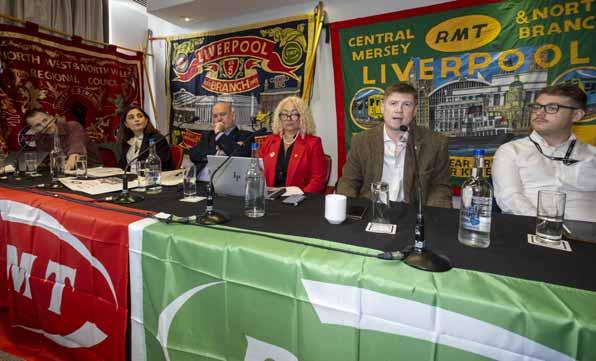
RMT held another highly successful fringe meeting at Labour Party Conference in Liverpool highlighting the need for insourcing and public ownership.
RMT’s annual fringe around transport has become a regular fixture in the conference calendar and gives the union the opportunity and profile to make the case for public transport and public transport workers.
This year under the theme ‘is Labour Delivering on Public Transport?’ the packed-out meeting discussed a wide range of issues including the case for insourcing, the
government’s policies on rail public ownership and bus services and the case for stronger legal protections for transport workers from assaults.
The discussion was kicked off by RMT general secretary Eddie Dempsey by exposing the fact that rail privatisation had driven up costs and weakened the sector’s ability to deliver long-term value.
“The widespread outsourcing of cleaning, security, construction and maintenance work has increased costs and delayed projects due to fragmented contracts, risk aversion and compensation claims.
“The creation of Great British Railways (GBR) is an opportunity for rail to become a strategic pillar of national productivity revival operating under a unified, public-sectorled model.
“By redefining productivity, reintegrating the network, and investing in domestic capabilities the rail sector could become a vehicle for national renewal and reignite broader economic growth,” he said to applause.
The panel of speakers included Mick Whelan, Aslef general secretary, Maryam Eslamdoust, TSSA general secretary, Marcus Johns, Senior
Research Fellow Institute for Public Policy Research and Chris Hayes, chief economist at the Common Wealth think tank.
RMT Parliamentary Group member and local Labour MP Kim Johnson chaired the meeting and local RMT branches organised another fantastic display of union banners.
Thanks also to all the Labour Party delegates and unions who after the fringe meeting joined our union’s protest against rail and tube workers facing job losses under the government’s new immigration rules.
The union has cancelled industrial action ballot at Isle of Wight ferry company Wightlink after the company withdrew its threat of redundancies.
The company’s original restructuring proposals included ‘efficiency’ plans that threatened 160 jobs and undermined safety on board.
This included cutting Deck Officer and Port Operator grades, close overnight onboard retail and reduce crewing levels across vessels.
However, after members backed industrial action, the company withdrew its proposals and committed to discussions on workforce
development, including upskilling and improvements to working practices with no compromise on safety standards.
RMT general secretary
Eddie Dempsey said that it was a successful outcome for RMT members at Wightlink who stood together and showed the company that they would not accept threats to their jobs or safety.
"RMT is always prepared to engage in genuine talks about improvements, but we will never accept changes that put jobs or safety on the line.
“Cutting safety-critical roles and crewing ferries at bare minimum levels in one of the
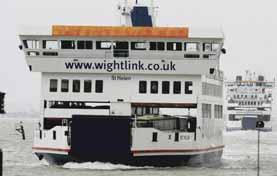
for passengers and for RMT members alike.
“Wightlink workers have


given years of service keeping the Solent moving and deserve better than threats to their jobs and conditions,” he said.
Strike action at Cross Country has been suspended following talks with the company to resolve issues regarding the undermining of safety-critical roles and threats to safety and jobs.
The company has provided proposals aimed at resolving the issues at the heart of the dispute which will require approval from the Department for Transport.
RMT general secretary Eddie Dempsey congratulated the membership for their steadfast support for the union.
“While the union remains in dispute, we now expect to see tangible progress made by November 19 in order to reach an agreement on all outstanding items,” he said.
RMThas called for cuts to the British Transport Police (BTP) to be reversed and for urgent action to deliver a safer, properly policed railway following the horrific mass stabbing in Cambridgeshire.
New figures show the number of full-time equivalent (FTE) BTP officers has fallen to just over 0.8 per million passenger journeys, down from over 0.9 per million last year — an 11 per cent drop and almost a third fewer than in 2009/10, when there were 1.2 officers per million journeys.
Theunion celebrated a major win in the maritime industry after securing pay rises of up to 37 per cent for workers at the British Antarctic Survey (BAS).
The union has been in intense negotiations with the employer and has now won agreement on a new pay scale and wage rates.
Pay increases range from 10 per cent to 37 per cent with a huge chunk of members receiving a 26 per cent pay rise.
As part of the deal, specialist allowances and endof-year performance payments have also been secured for staff.
The BAS is a world-leading centre for polar operations recognised for scientific excellence and innovation in extreme environments.
In the latest report to the British Transport Police Authority (BTPA), the Chief Constable warned that the force was now “operating at the limits of safe headcount reduction”.
This year alone, 522 BTP posts have been cut, with another 51 expected to go over the next two years through natural wastage.
RMT said that over 1,000 additional officers were needed to ensure a visible police presence on stations and trains.
At the same time, BTP data
shows rising crime and antisocial behaviour across the rail network:
• Overall crime up 5.4 per cent last year
• Antisocial behaviour incidents requiring urgent response up nine per cent
• Violent offences up 14 per cent
• Offences involving women and girls up 12 per cent RMT general secretary Eddie Dempsey said that the horrific mass stabbing on board a train diverted to Huntingdon station had shocked the whole
country and underlined why safety and security for rail workers and passengers must be the top priority.
“We need a properly resourced British Transport Police and a visible presence of officers on stations and trains to reassure passengers and protect staff all year round.
“The BTP has seen officer numbers fall by almost a third since 2009, at the same time as violent crime and antisocial behaviour have risen sharply on the rail network,” he said. (see page 10,11).
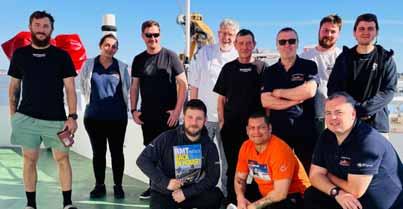
RMT general secretary Eddie Dempsey said that it was a fantastic win for members and congratulated them and their negotiators for securing it.
“We have won substantial
pay increases and secured a new allowance system based on union involvement and proper recognition of experience and skill for all those contributing to the BAS. "This result shows the
value of strong union organisation and how determined negotiations can deliver results, particularly in the maritime industry,” he said.
RMT has welcomed the introduction of the Bus Services Act as a step towards stemming the decline of the industry but called for further action.
The Bus Services Bill was introduced in recognition of the continuing decline of the sector following decades of privatisation, deregulation and disinvestment.
RMT general secretary Eddie Dempsey said that privatisation had been disastrous for national bus networks, leaving communities poorly served.
“We welcome some elements of this legislation such as the removal of the ideological ban on new municipal bus companies.
“However, we are concerned that the provision of decent bus services could continue to be a postcode lottery.
“The government clearly needs to go much further to deliver a national plan for high quality properly funded bus services which put passengers before profits.
“It is also regrettable that the government has
ignored previous recommendations of the transport select committee to put in place national arrangements that would have increased protections for the jobs and safety for bus workers and improved services to passengers,” he said.
Buses remain the most used form of public transport across England, but around 300 million fewer miles were driven by bus services in England in 2024 compared to 2010, with passengers suffering from sudden route cuts and a lack of accountability.
Over 5,000 bus routes have been lost since 2010 and the number of bus workers has reduced by nearly 20,000, nearly a quarter of the entire workforce.
Transport committee chair Ruth Cadbury MP said that the government’s approach lacked ambition particularly to improving services in rural and underserved communities.
“A number of our recommendations regarding the DfT’s role in helping local areas to up their game have been misunderstood.
Meanwhile, its plans for ‘socially necessary routes’, which by their nature are commercially unviable, are in danger of being left without enough funding to be effectively implemented.
“Throughout our inquiry we heard about the consequences of poor connectivity. Young people unable to get their first jobs or taking exhausting journeys to reach school or college. Older and disabled people feeling isolated and depressed, and high streets starved of customers.
“Any serious attempt to revive services and make public transport equitable across the country will need new funding. And yet the most targeted proposals for how to provide funding where it would make the most difference are shrugged off with a suggestion that no decision will likely come before the next Spending Review – not for another three years.
“The Bus Services Act is a positive and necessary start to the work of reviving bus services, but it cannot be the
last word. Local authorities need more opportunity, funding and incentives to grow their networks and passenger numbers,” she said.
However, the government said that passengers would benefit from more reliable and dependable journeys as part of its national ‘Plan for Change’.
Transport Secretary Heidi Alexander said that the Act would make it easier for local leaders to take control of buses and put passengers first, improving access to jobs, education and tourism opportunities which were all vital to growing the economy.
A government statement said that it would end the risk of routes being scrapped at short notice by tightening the requirements for cancelling vital routes.
The Act also includes plans to mandate staff, including drivers and those based at bus stations, to undertake training to recognise and handle incidents of anti-social behaviour and crime, including violence against women and girls.
Since the launch of the union’s Action Against Assaults campaign, RMT has employed various strategies to highlight the need to tackle violence against workers and passengers.
RMT has exposed the prevalence of violence and abuse on public transport with evidence from transport workers and official statistics revealing that it is becoming more of a problem.
As part of the campaign the union has surveyed members with shocking results and is demanding additional legal protections for public transport workers.
The extent of this growing violence and abuse stems from several factors, including concerted efforts to implement policies such as Driver Only Operation and ticket office closures that significantly reduce staffing and have made lone working commonplace, putting both passengers and staff at risk.
These attacks on staffing have been accompanied by a lack of action taken against perpetrators and insufficient support from many employers for staff who are victims.
Declining services arising from the fragmented and
underfunded transport network and ongoing cuts to British Transport Police and police forces often means that perpetrators often face insufficient deterrents for their unacceptable behaviour.
Trends on public transport also clearly reflect wider trends in the prevalence of anti-social behaviour.
The industrial element of the campaign has focussed on increasing employer action to reduce assaults including ending lone working and minimising late-night working. This has involved supporting health and safety reps and officers to effectively address these issues.
This part of the campaign will also involve work to establish effective arrangements in industry bodies, including the new Great British Railways, to reduce assaults and violence.
Political actions have included campaigning for a standalone offence of abusing or assaulting public transport workers, alongside building alliances with NGOs, women’s groups and disabled people’s organisations.
The union is also campaigning to protect and increase staffing levels and for
a reversal of the cuts to British Transport Police.
The union recently surveyed members working across public transport in rail, bus, London Underground, metro, passenger ferry and taxis to ask about their experiences of violence and abuse at work.
Over 6,000 public transport workers found that:
• Nearly two-thirds (63 per cent) experienced workplace violence in the past year.
• Of those, over 85 per cent experienced violence multiple times.
• The most common form of violence was verbal abuse
RMT DEMANDS
(92 per cent), followed by threats of violence or assault (63 per cent).
• Nearly a quarter had been physically assaulted.
• Members also reported experiencing a wide range of abusive behaviour including being assaulted with weapons; racial harassment; sexual harassment or assault; LGBT+ harassment and being spat at or targeted with bodily fluids.
• Of those who experienced workplace violence, 60 per cent were lone working at
• Stronger legal protections for public transport workers who are assaulted at work.
• Proper staffing levels and an end to lone working.
• More action from employers to protect workers from assault
• Opposing cuts to the British Transport Police
the time.
• Nearly 60 per cent had witnessed violent and/or abusive behaviour targeted at passengers.
• 75 per cent of those who experienced workplace violence reported the incident to their employer, but only a third of those were satisfied with their employer’s response to the incident.
• Of those who did not report it, nearly 70 per cent said it was because such incidents are considered ‘part of the job’.
• 70 per cent of members thought that workplace violence had increased in the past year, and just three per cent thought it had decreased.
• 95 per cent of public transport workers support the creation of a standalone offence of abusing or assaulting public transport workers at work.
• 87 per cent of members working in rail, metro and London Underground said that an increase of staff at stations and on trains would help reduce violence.
• Nearly 80 per cent of members would be prepared to take industrial action over workplace violence, if they felt their employer was not protecting their safety.
The experiences of RMT members are backed up by official data. BTP statistics show between 2021 and 2024 there was a year-on-year increase of both violent and serious public order offences against rail staff. In 2024, there were 7027 recorded offences, an increase of 2257 (47 per cent) from 2021.
During 2023/2024 Transport for London recorded 10,493 incidents of workrelated violence and
aggression, a five per cent increase from the previous year.
Reports of sexual assaults and harassment on trains have also risen by more than a third over the past 10 years, according to data requested by a BBC investigation.
There were 2,661 incidents reported across England, Scotland and Wales last year, where one in 10 were children - with some younger than 13.
In its response to the Crime and Policing Bill Committee, the Rail Delivery Group referenced a range of evidence including research by the RSSB from 2021 which found that the prevalence of post-traumatic stress disorder (PTSD) in rail staff was more than double the rate in the general population.
The Crime and Policing Bill RMT is calling for additional legal protections for public transport workers who are abused or assaulted at work.
Strengthening legal protections would support workers in reporting incidents, deter perpetrators and improve the rate of action taken against them. In recognition of the risks they face as frontline workers, similar legislation already exists for emergency services workers, and in Scotland legislation also exists for retail workers.
The UK government has recognised the importance of strengthening legal protections for frontline workers and is using the Crime and Policing Bill, currently in the House of Commons, to create a new offence of assaulting a retail worker at work.
RMT has developed a Parliamentary amendment with Rachael Maskell MP which seeks to create a specific offence of abusing or assaulting a public transport worker at work and extend the maximum sentence from six to twelve months.
In Parliamentary debate, Rachael Maskell highlighted
The Action Against Assaults (AAA) campaign is asking you to contact your MP and calling on the government to introduce stronger legal protections for public transport workers.
The Crime and Policing Bill is currently making its way through Parliament having completed its second reading in the House of Lords.
RMT is urging the government to amend this Bill to create a standalone offence of assaulting a public transport worker at work, mirroring the new standalone offence for retail workers it is creating through the Bill.
Members can go to the RMT website, go on the AAA page and write to your MP today and ask them to put their name to our open letter to the government calling on them to amend the Bill - it only takes a couple of minutes. If you have any questions, please email actionagainstassaults@rmt.org.uk.
the impact of violence and abuse on RMT members, including citing previous surveys on this subject:
“Out transport workers will not be safe unless more measures are included in this legislation. We should also look at the work RMT has done. It has surveyed its women workers, and 40 per cent of transport workers who are women have been sexually harassed in the last year, and that, too, is on the rise,” she said.
In Scotland, where this is a devolved matter, the union has also been undertaking activity in support of
legislative change. Legislation already exists creating a standalone offence of abusing or assaulting retail workers, and RMT has said to the Scottish government that this existing legislation would cover certain transport workers.
As a result of RMT pressure, Transport Scotland has convened a working group with the unions, BTP and ScotRail to look at legal protections for rail workers in Scotland, including a specific session on extending the retail worker protections to rail workers, and the union will continue to make the case for additional legal protections.
“I’ve been spat on, shoved and punched”
“Verbal assaults are frequent and extremely aggressive behaviour is increasing”
“Sexual harassment, assaulted with CO2 Extinguisher, Verbally harassed, grabbed by passengers”
“I was stabbed with a needle!”
“Threatened to be stabbed in the head with a blade”
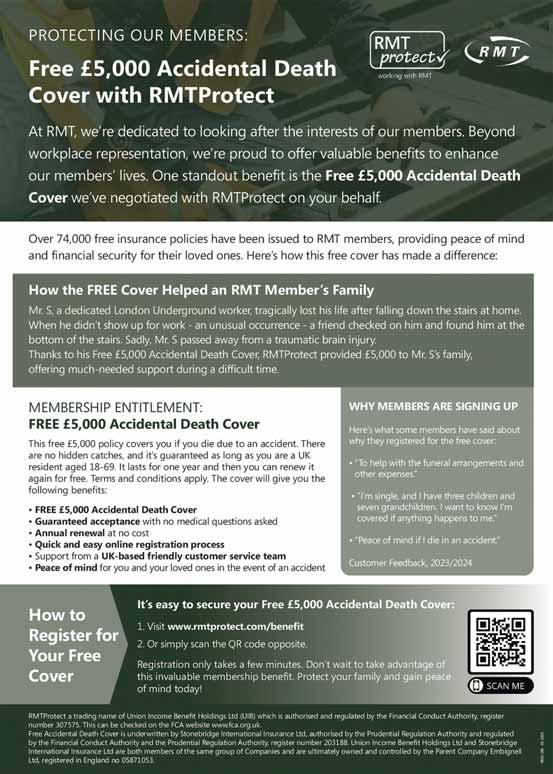
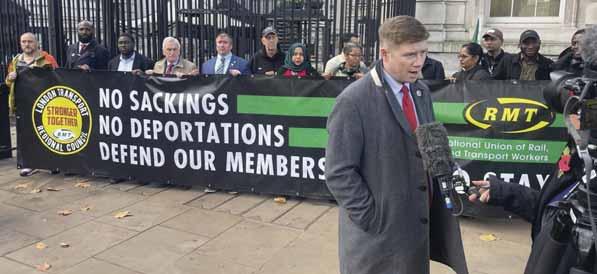

The government took an arbitrary decision this year to remove key frontline roles from the visa list including station assistants, without consultation, and with no regard for the workers affected.
Backed by PCS President Martin Cavanagh and MPs Bell Ribeiro-Addy, Apsana Begum John McDonnell and Diane Abbott, one protest heard from RMT general secretary Eddie Dempsey, who condemned the move as “an attack on loyal workers doing vital jobs on our railway.
“Our members joined this industry in good faith; on the understanding they could build a life and a career here.
“The government has ripped that up without notice,” he said.
He praised Mayor of London Sadiq Khan for his stance after the union
permanent contracts of employment and were told you will be remaining in Britain, have built lives here, started families, from the November 7, will begin to receive letters telling them they have to leave the country.
"That is an absolute disgrace.
"I do not care where people have come from, the
changes, full protection for staff already in post and meaningful consultation with unions and the transport industry.
“These reforms were rushed through with zero consultation and virtually no parliamentary scrutiny,” added Mr Dempsey.
“It’s a complete failure of governance and basic decency. These are not just
begun to speak out.
One testimony by an at-risk RMT member read: "I do not want charity. I just want a fair chance to work, live and stay here, helping to keep our great capital moving because at heart, I am a Londoner just like everyone else.
“But now that could all be ripped away from my family and I,” he wrote.

RMT’s campaigning has delivered a major step forward for offshore and maritime workers with the government committing itself to closing long-standing loopholes in employment law and boost investment in skills and training.
This is part of a government announcement of plans to deliver 400,000 extra jobs in the clean energy sector by 2030.
RMT general secretary Eddie Dempsey said that this was proof that when workers are organised and demand change, real progress can be achieved.
“RMT welcomes the government’s commitment to closing loopholes in maritime and offshore employment law, which should in turn create domestic opportunities in coastal communities that support the entirety of the offshore wind supply chain.
"This plan has the potential to create hundreds of thousands of good jobs across the UK, offering real opportunities for those
wishing to transition from oil and gas and for a new generation of workers in their own communities.
"It is important that these commitments are enshrined in legislation covering our supply chains, if we are to stop bad employers undercutting pay and conditions.
"That means effective enforcement of minimum standards on wages and working conditions, clear rights for every worker, and collective bargaining at the heart of any changes so that workers have a real voice."
Mr Dempsey also highlighted the need to deal with flags of convenience and the gaps in protections for offshore workers needing to be closed.
"We have the chance to lead the world in clean energy, which will only be achieved through long-term investment that develops and protects a skilled UK workforce,” he said.
RMT national secretary Darren Procter said that the announcement was a direct
result of pressure from RMT members, many of whom have been exposed to widespread exploitation in the industry.
“We are still seeing jobs advertised in the renewables sector paying below the minimum wage.
"These are aimed at workers with the right to work in the UK, but with no legal protections on pay or conditions.
"That is exploitation, not the quality jobs we were promised in a just transition.
"That’s why we welcomed Ed Miliband’s pledge of a Fair Work Charter – guaranteeing decent wages, collective bargaining for RMT, and protections whether you are onshore, offshore, on land or at sea.
"This is a step forward that comes from your union’s campaigning. And we must stay vigilant to make sure promises are turned into law, with enforcement that stops rogue bosses exploiting our people," he said.
He highlighted the strong
national collective agreements like ODIA, COTA and ESA, which benefit members and create a level playing field.
"We believe these frameworks should be extended into renewables to ensure jobs in the transition are good, union jobs," he added.
RMT Scottish offshore organiser Ann Joss said that RMT’s organising approach relied on everyone in the sector getting involved.
“If you’re not yet a member, join us. If you are, play an active role. For reps, that means leading on recruitment and building strong workplace organisation.
"We’ve achieved real progress, but our campaign won’t stop until offshore workers have the same rights and protections as those on land.
"RMT will continue to push the government to turn commitments into lasting change delivering secure jobs, fair conditions and a better future for our members,” she said.
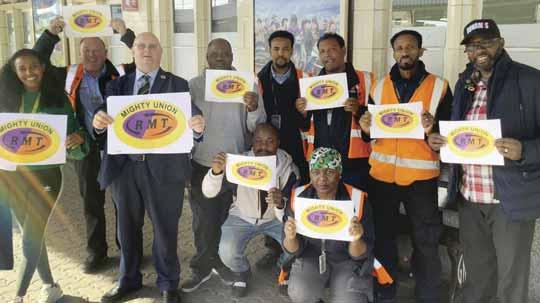
RMT has launched an intense national organising drive to recruit members working on outsourced contracts on the rail network run by facilities management giant Mitie.
The campaign is focussing on improving pay and conditions for outsourced workers, particularly cleaners and security staff at Network Rail stations.
RMT now has recognition on Network Rail Mitie cleaning contracts at Edinburgh Waverley, Glasgow Central, Leeds City, Liverpool Lime Street, Manchester Piccadilly, London Waterloo and Bristol Temple Meads.
The company has also accepted that recognition at London Liverpool Street and London Charing Cross and the union is making progress at Birmingham New Street and London Bridge.
A national leaflet has been
produced by the union and distributed throughout the country.
London Anglia regional council recently ran recruitment drives on Mitie station contracts including King’s Cross and Euston led by NEC member Primrose Jeanton and regional organiser Kathy Mazur.
This has led to recognition at Liverpool Street station and increased membership elsewhere.
One of the pressing issues is against the imposition of the Merlin system, a monitoring system the firm is implementing without RMT consultation even though it is the recognised union in most of the workplaces.
RMT lead officer for Mitie contracts Craig Johnston said that the Merlin System was deeply unpopular amongst Mitie members.
“Our members feel they are under surveillance using the system and are under constant pressure from the company to finish tasks,” he said.
Key demands also include the Real Living Wage, company sick pay and decent holidays.
“Ultimately, these workers and their roles should be insourced to give them the
benefit of collective time bargaining on terms and conditions, better pay and sick pay provision and access to a proper occupational pension scheme - as well as other potential benefits like staff travel.
“Cleaners deserve better and RMT is determined to win that for them,” said Craig Johnston.

It is now clear that rail privatisation has fragmented the industry, created inefficiencies through outsourcing, sub-contracting, and rising transaction costs while Network Rail's private debt further drags down productivity.
That is why Great British Railways (GBR) could become a powerful driver of productivity and growth. Expanding the rail network has the triple benefit of improving efficiency, assisting overall public wellbeing and helping to safeguard our environment.
RMT’s new report Great British Railways and the Productivity Puzzle outlines the potential of GBR to address Britain's productivity challenges and highlights issues stemming from the legacy of rail privatisation.
Ultimately chronic underinvestment by the private sector has led to low productivity and GBR offers an opportunity to mitigate this by boosting high-value manufacturing and creating higher productivity jobs.
The rail sector contributes £41 billion to the economy, supports 640,000 jobs, and generates £14.2 billion in tax revenue. Moreover, rail investment has a multiplier effect, generating £2.50 for every £1 spent.
GBR could also expand high-productivity train manufacturing, reduce reliance
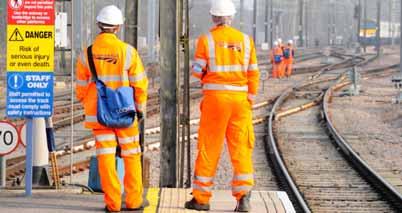
on foreign multinationals, and rebuild domestic manufacturing capacity.
Another way GBR could improve productivity is by insourcing renewals work, reducing reliance on lowproductivity construction models, and directly managing enhancements and megaprojects.
Greater integration is required across GBR operations to reduce wasteful transaction costs. Insourcing work would eliminate profiteering and improve efficiency. Establishing a rolling stock arm would reduce leasing costs and promote UK manufacturing.
GBR has the potential to drive higher productivity in the UK economy but must address the inefficiencies caused by privatisation and adopt a more
integrated, strategic approach to rail operations and investment.
The transition to GBR is a critical opportunity to turn the tide. With the right reforms, GBR could become a powerful driver of UK productivity and economic growth.
Rail already contributes an estimated £41 billion in Gross Value Added (GVA) to the national economy, supports 640,000 jobs, and generates £14.2 billion in tax revenue, according to analysis by Oxford Economics.
Rail productivity, measured in GVA per worker, is 38 per cent higher than the national average.
These figures dismantle the myth that rail is merely a public service expense and instead position it in its rightful place, as a national
asset.
Flawed productivity measures also encourage cuts instead of investment. The Office of Rail and Road (ORR) uses crude input-output metrics that focus on labour costs, obscuring the role of investment and the social and economic impact of rail as a public service. Yet frontline workers in maintenance and operations have continued to deliver more for less. That is why over 40,000 Network Rail members have now gone into dispute after years of falling real-term wages despite major productivity improvements delivered by staff across the railway.
Since 2021, cumulative RPI inflation has soared by approximately 27 per cent but pay settlements for Network
Rail staff have only amounted to 17 per cent.
This 10 per cent real term pay cut means that many workers are worse off now than they were just four years ago.
Meanwhile contractor profit extraction is estimated at around £200 million annually adding up to an astonishing £5 billion since the late 1990s.
In contrast, staff costs have fallen as a proportion of Network Rail’s total expenditure.
Workers are doing more with less, as money continues to leak out of the railway through outsourcing and profit margins. It’s time the people who make the railway run got paid their due.
RMT is urging GBR to reintegrate rail operations and infrastructure to end fragmentation, reform how productivity is measured to reflect social and economic value and to insource renewals to make efficiencies and
improve delivery.
My union also wants to see the creation of a national apprenticeship scheme and strategic workforce planning programme, treating workforce development as capital investment, not an operational cost.
The industry needs to fire the starting gun on a genuine debate about what productivity really means in rail and how a strong, unified railway can help grow Britain’s economy.
RMT's outlook is about improving our members pay and conditions. But we are also here to offer expertise to challenge and fundamentally rethink how we value railway work.
Skilled labour under public ownership must not be seen as a cost to be cut, but an investment that delivers longterm returns in job creation, connecting the country and improving national resilience.
Outsourcing, fragmentation
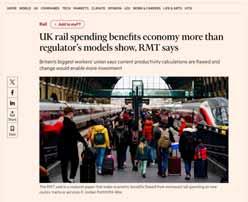
RMT general secretary Eddie Dempsey told the Financial Times: “Expanding the rail network has the triple benefit of improving efficiency, assisting overall public wellbeing and helping to safeguard our environment”.
and short-termism have drained billions from the railway over the years. And in the era of public ownership, we must stop wealth leaving the industry.
GBR gives the government
a once-in-a-generation chance to put that money back where it belongs into public service and properly reward those workers who keep the railways running every day.
RMT’s new report outlines the potential of Great British Railways (GBR) to address Britain’s productivity challenges and highlighted issues stemming from the legacy of rail privatisation. Key points include:
• Britain’s Productivity Problem: Chronic underinvestment by the private sector has led to low productivity. GBR offers an opportunity to mitigate this by boosting high-value manufacturing and creating higher productivity jobs.
• Economic Footprint of Rail: The rail sector contributes £41 billion to the economy, supports 640,000 jobs, and generates £14.2 billion in tax revenue. Rail investment has a multiplier
effect, generating £2.50 for every £1 spent.
• Train Manufacturing: GBR could expand highproductivity train manufacturing, reduce reliance on foreign multinationals, and rebuild domestic manufacturing capacity.
• Infrastructure Maintenance and Renewal: GBR could improve productivity by insourcing renewals work, reducing reliance on lowproductivity construction models, and directly managing enhancements and megaprojects.
• Flawed Productivity Measures: The Office of Rail and Road (ORR) uses crude input-output metrics that focus on labour costs, obscuring the role of
investment and the social and economic impact of rail as a public service. RMT recommends adopting broader measures of productivity, including budgetary efficiency, organisational productivity, and effectiveness.
• Legacy of Privatisation: Rail privatisation has fragmented the rail industry, creating inefficiencies through outsourcing, subcontracting, and rising transaction costs. Network Rail’s private debt further drags down productivity.
• Recommendations: Greater integration is required across GBR operations to reduce wasteful transaction costs. Insourcing work would eliminate profiteering and improve efficiency.
Establishing a rolling stock arm would reduce leasing costs and promote UK manufacturing. The creation of a centralised apprentice scheme and workforce planning would retain skills and knowledge. Treasury rules must be reformed to prioritise public transport investment.
GBR has the potential to drive higher productivity in the UK economy but must address the inefficiencies caused by privatisation and adopt a more integrated, strategic approach to rail operations and investment.
*The new RMT report Great British Railways and the Productivity Puzzle is available on the RMT website under Policy Hub, Rail.

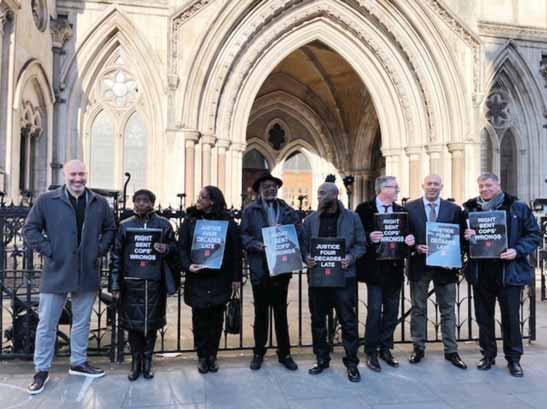
On July 17, 2025 the Court of Appeal posthumously quashed Errol Campbell’s 1977 conviction for theft and conspiracy to steal.
Campbell, sentenced to 18 months, was a British Rail employee at the Bricklayer’s Arms depot in South London. The Bricklayer’s Arms depot, a closed shop of nearly 600 NUR members, was a goods depot for more than 100 years until it closed in 1983.
Campbell died in 2004. His case follows last years’ posthumous quashing, of two other British Rail workers at the same depot, Basil Peterkin and Saliah Mehmet, codefendants in the same 1977 case.
All were framed by the racist and corrupt British Transport Police (BTP) officer, Detective Sergeant Ridgewell, who prosecuted them for
conspiring with other black and Turkish Cypriot employees with re-labelling mail parcels, directing them to new addresses, and then selling their contents for profit.
The cases against them were based on what turned out to be corrupt police evidence from DS Derek Ridgewell, along with DC Douglas Ellis and DC Alan Keeling, who in 1980 were convicted for stealing from the very same depot, £364,000 worth of items. The officers went to prison for seven years, six years and two years respectively.
Why did it take so long to quash the British Rail workers convictions?
It was not for want of trying. Winston Trew as part of the Oval 4, fitted up by Ridgewell in 1973, has been
fighting for 50 years to clear his name. The brilliant recently parted crime journalist, Duncan Campbell, was writing about his case for Time Out in the 1970s. Not until 2019 was Trew’s conviction quashed.
Back in 1973 the primetime BBC documentary programme ‘Nationwide’ presented an excellent expose of Ridgewell’s methods identifying 16 young black men arrested and prosecuted in similar circumstances, relying on police testimony only, with no independent witnesses.
All professed their innocence including complaints against the police about beaten confessions. The BTP responded to the programme by taking Ridgewell off general duty, to work in their headquarters, the very place where complaints
were being sent about his conduct.
Ridgewell was later put back out on duty where he was able to continue his corrupt racist activity including fitting up the British Rail employees at the Bricklayers Arms.
The Court of Appeal in 2024 recognised ‘some force’ in the argument that Ridgewell should have been sacked in 1973 and that his cases should have been reviewed in 1980 after he went to prison.
In Campbell’s judgement the Court went further stating: “Mr Campbell (Junior) describes his father coming home from police detention beaten and bruised. Mr Campbell (Senior) maintained his innocence for the rest of his life.
“He regarded himself, with
justification, as a victim of racism. The effect on him can readily be understood. In addition, his conviction cost him the job which he held for many years and which he had enjoyed …
“We regret that this court cannot now undo all that the late Mr Campbell suffered. We can however, and do, allow the appeal brought on his b
behalf and quash his convictions. We hope that that will bring some comfort to Mr Campbell’s family who survive him”.
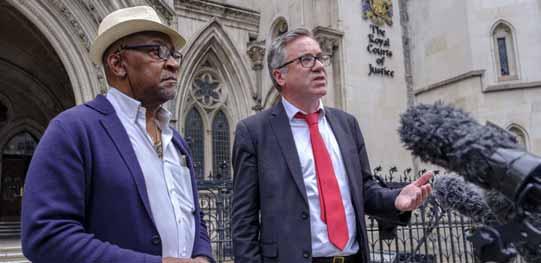
Outside of Court, Errol Campbell Jnr added: “My dad always said he was innocent, and today that’s finally been confirmed almost 50 years later.
“My father came in the
Windrush generation and worked for years for British Rail … I’m angry that Ridgewell is not alive for this day, and that he never went to prison for all the people he fitted up. He never answered his crimes,” he said.
At the legal charity APPEAL, we are supporting the families call for a simple reform. If a police officer is imprisoned
there should be an automatic independent review of their files for wrongful convictions, imposed at sentence.
• Matt Foot is Co-Director of the legal charity APPEAL which seeks to overturn wrongful convictions. If you have any information about Det Sgt Ridgewell or his squads, please contact himmatt@appeal.org.uk
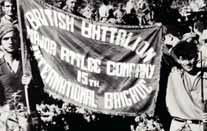
A new full-illustrated joint publication by RMT and the International Brigade Memorial Trust (IBMT) tells the untold story of the union’s historical fight against the rise of fascism in the 20th Century.
Using archive material held by RMT and the IBMT this latest union pamphlet reveals the full extent of the involvement of transport workers in the fight against Oswald Mosley’s Blackshirts in Britain and the struggle against fascism in Spain.
Many more workers also fought the fascists on the streets of Britain and NUR general secretary John Marchbank even took on Mosley in the courts and humiliated him.
Over 100 seafarers and rail workers volunteered to fight in the legendary International Brigades that fought Nazi-backed forces in Spain while European governments looked the other way in the hope of a fascist victory.

We have audited the financial statements of the National Union of Rail, Maritime & Transport Workers [“The Union”] for the year ended 31 December 2024 which comprise the Income and Expenditure account - Combined Funds, Income and Expenditure Account - General Funds, Income and Expenditure accountOrphan Fund, Income and Expenditure Account - Political Fund, the Balance Sheet, Cashflow Statement, Statement of Movement in funds and notes to the financial statements, including significant accounting policies. The financial reporting framework that has been applied in their preparation is applicable law and United Kingdom Accounting Standards, including FRS 102 The Financial Reporting Standard applicable in the UK and Republic of Ireland (United Kingdom Generally Accepted Accounting Practice).
In our opinion the financial statements:
- Give a true and fair view of the state of the Union's affairs as at 31 December 2024 and of its income and expenditure for the year then ended; and
- Have been properly prepared in accordance with United Kingdom Generally Accepted Accounting Practice.
We conducted our audit in accordance with International Standards on Auditing (UK) (ISAs (UK)) and applicable law. Our responsibilities under those standards are further described in the Auditor's responsibilities for the audit of the financial statements section of our report. We are independent of the Union in accordance with the ethical requirements that are relevant to our audit of the financial statements in the UK, including the FRC’s Ethical Standard, and we have fulfilled our other ethical responsibilities in accordance with these requirements. We believe that the audit evidence we have obtained is sufficient and appropriate to provide a basis for our opinion.
In auditing the financial statements, we have concluded that the National Executive Committee’s use of the going concern basis of accounting in the preparation of the financial statements is appropriate.
Based on the work we have performed, we have not identified any material uncertainties relating to events or conditions that, individually or collectively, may cast significant doubt on the Union's ability to continue as a going
concern for a period of at least twelve months from when the financial statements are authorised for issue.
Our responsibilities and the responsibilities of the National Executive Committee with respect to going concern are described in the relevant sections of this report.
The other information comprises the information included in the Annual Report other than the financial statements and our auditors report thereon. The National Executive Committee is responsible for the other information contained within the Annual Report. Our opinion on the financial statements does not cover the other information and we do not express any form of assurance conclusion thereon.
Our responsibility is to read the other information and, in doing so, consider whether the other information is materially inconsistent with the financial statements or our knowledge obtained in the course of the audit, or otherwise appears to be materially misstated. If we identify such material inconsistencies or apparent material misstatements, we are required to determine whether this gives rise to a material misstatement in the financial statements themselves. If, based on the work we have performed, we conclude that there is a material misstatement of this other information we are required to report that fact.
We have nothing to report in this regard.
MATTERS ON WHICH WE ARE REQUIRED TO REPORT BY EXCEPTION
We have nothing to report in respect of the following matters where the Trade Union and Labour Relations (Consolidation) Act 1992 (Amended) requires us to report to you if, in our opinion:
- A satisfactory system of control over transactions has not been maintained; or
- The Union has not kept proper accounting records; or
- The financial statements are not in agreement with the books of account; or
- We have not received all the information and explanations we need for our audit.
As explained more fully in the Statement of Responsibilities of the National Executive Committee, the National Executive Committee is responsible for the preparation of financial statements
and for being satisfied that they give a true and fair view, and for such internal control as the National Executive Committee determine is necessary to enable the preparation of financial statements that are free from material misstatement, whether due to fraud or error.
In preparing the financial statements, the National Executive Committee are responsible for assessing the Union's ability to continue as a going concern, disclosing, as applicable, matters related to going concern and using the going concern basis of accounting unless the National Executive Committee either intend to liquidate the Union or to cease operations, or have no realistic alternative but to do so.
Our objectives are to obtain reasonable assurance about whether the financial statements as a whole are free from material misstatement, whether due to fraud or error, and to issue an auditor's report that includes our opinion. Reasonable assurance is a high level of assurance, but is not a guarantee that an audit conducted in accordance with ISAs (UK) will always detect a material misstatement when it exists. Misstatements can arise from fraud or error and are
considered material if, individually or in the aggregate, they could reasonably be expected to influence the economic decisions of users taken on the basis of these financial statements.
Irregularities, including fraud, are instances of non-compliance with laws and regulations. We design procedures in line with our responsibilities, outlined above, to detect material misstatements in respect of irregularities, including fraud. The extent to which our procedures are capable of detecting irregularities, including fraud is detailed below:
Based on our understanding of the union and the environment in which it operates, we identified that the principal risks of non-compliance with laws and regulations related to Trade Union legislation, data protection regulations and employment law, and we considered the extent to which non-compliance might have a material effect on the financial statements. We also considered those laws and regulations that have a direct impact on the preparation of the financial statements such as the Trade Union and Labour Relations (Consolidation) Act 1992 and corporation tax regulations. We evaluated managements incentives and opportunities for
fraudulent manipulation of the financial statements (including the risk of override of controls), and determined that the principal risks were related to inappropriate journal entries in respect of revenue recognition. Audit procedures performed by the engagement team included.
• Inspecting correspondence with regulators and tax authorities;
• Discussions with management including consideration of known or suspected instances of non compliance with laws and regulation and fraud;
• Evaluating management’s controls designed to prevent and detect irregularities;
• Identifying and testing journals, in particular journal entries with unusual descriptions; and
• Challenging assumptions and judgements made by management in their critical accounting estimates.
Because of the inherent limitations of an audit, there is a risk that we will not detect all irregularities, including those leading to a material misstatement in the financial statements or non-compliance with regulation. This risk increases the more that compliance with a law or regulation is removed from the events and transactions reflected in
the financial statements, as we will be less likely to become aware of instances of non-compliance. The risk is also greater regarding irregularities occurring due to fraud rather than error, as fraud involves intentional concealment, forgery, collusion, omission or misrepresentation.
A further description of our responsibilities is available on the Financial Reporting Council's website at https://www.frc.org.uk/auditorsrespo nsibilities. This description forms part of our auditor's report.
This report is made solely to the Union's members, as a body. Our audit work has been undertaken so that we might state to the Union's members those matters we are required to state to them in an auditor's report and for no other purpose. To the fullest extent permitted by law, we do not accept or assume responsibility to anyone other than the Union and the Union's members as a body, for our audit work, for this report, or for the opinions we have formed.
HaysMac UK LLP Statutory Auditors
10 Queen Street Place London EC4R 1AG
Date: 30 July 2025
We are required by the Trade Union and Labour Relations (Consolidation) Act 1992 (amended) to include the following declaration in this statement to all members. The wording is as prescribed by the Act.
"A member who is concerned that some irregularity may be occurring, or have occurred, in the conduct of the financial affairs of the union may take steps with a view to investigating further, obtaining clarification and, if necessary, securing regularisation of that conduct. The member may raise any such concerns with such one or more of the following as it seems appropriate to raise it with: the officials of the union, the trustees of the property of the union, the auditor or auditors of the union, the Certification Officer (who is an independent officer appointed by the Secretary of State) and the police. Where a member believes that the financial affairs of the union have been or are being conducted in breach of the law or in breach of rules of the union and contemplates bringing civil proceedings against the union or responsible officials or trustees, he should consider obtaining independent legal advice.”
The key to the RMT Credit Union is 'keeping it simple'
You just save a minimum of £5 per month and then after a short time, you can borrow from us. As you pay down your loan amount each month, you only pay interest on the outstanding balance.
There are no hidden costs to saving and borrowing with the RMT Credit Union. If you pay up early you simply pay the balance and any interest due at the time. NO Handling or Administration charges and NO penalty charges.
We have accounts to help you put money aside for your holidays, Christmas or even encourage your children to save. For more information, check the RMT Credit Union Website or fill out the application form on inside back page. Run by RMT members for RMT members and their families.


020 3535 5820

An RMT member and his wife successfully secured compensation following a harrowing road traffic incident outside their home.
Late one night, the couple approached the driver of a parked car who had been blasting loud music for over an hour, politely asking him to lower the volume. In a shocking turn of events, the driver responded by reversing into the member’s wife, then accelerating forward and striking the member—forcing him through a brick wall.
The driver fled the scene but was later identified and convicted of dangerous driving and attempted grievous bodily harm. He is now serving a prison sentence.
RMT’s legal partners Thompsons Solicitors pursued personal injury claims on behalf of the member.
Despite the couple being entirely innocent, the driver’s insurers initially refused to accept liability, forcing the case into court proceedings. It was only after determined negotiations by Thompsons
that the insurers agreed to settle.
The compensation secured included £8,500 for the RMT member after suffering multiple soft tissue injuries to his leg, knee, ankle, toe, shoulder, and elbow.
The member’s wife was awarded £3,000 after suffering psychological trauma and an aggravation of a pre-existing knee condition. Thanks to the union’s legal guarantee, both received their full compensation amounts with no deductions.
An RMT member secured a compensation settlement of more than £12,300 after being involved in a serious road traffic accident while on duty.
The member, an experienced train driver, was correctly proceeding through an open level crossing under a green signal when a car ignored a red light and drove into the side of her train. The collision caused significant damage to the train, rendering it immobile.
As a result of the incident,
the member sustained injuries to her back, neck, and shoulder, and was also diagnosed with post-traumatic stress disorder (PTSD). She was unable to work for nearly two months and required extensive physiotherapy and counselling as part of her recovery. Thompsons Solicitors pursued a personal injury claim on her behalf.
The claim was met with delays and resistance from the responsible driver’s insurers, who disputed the value of the case. This led to formal court proceedings being issued and the case proceeded all the way to trial where the Judge awarded the member just over £12,300 compensation, significantly more than the insurers had been willing to offer. In accordance with the union’s legal promise, the member received the full compensation amount with no deductions.
An RMT member secured compensation of nearly £1,300 following a road traffic accident while travelling to a
work site.
The member was a passenger in a Network Rail van when the vehicle was struck from behind by a large truck. The impact caused the member to be jolted violently, aggravating a pre-existing neck and shoulder condition, which became significantly more painful. In addition, the member sustained a chest injury and developed situational anxiety because of the incident.
The union’s legal partners Thompsons Solicitors pursued a personal injury claim on the member’s behalf. Liability for the collision was accepted by the truck driver’s insurers, allowing the claim to be resolved without the need for court proceedings. In line with the union’s legal promise, the member received the full amount with no deductions.
All these traffic accident cases underscore the importance of RMT legal support in ensuring members receive the maximum compensation they are entitled to following incidents at work.
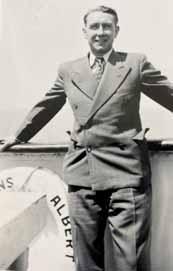
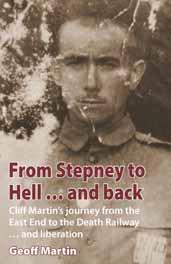
Former RMT press officer Geoff Martin’s book about his father is one of the most important books you will read on the experiences of ordinary soldiers who endured the horrors of the ‘Forgotten War’ in the East during World War Two.
The fact that the author had to publish it himself in the middle of celebrations of the 80th anniversary of ‘Victory in Europe’ is just one more indictment of a scandal that did not end in 1945.
After suffering long years in captivity, starvation, disease and torture, Cliff Martin had to fight on for another half a century before finally getting his War Pension in 1993.
It is hard to believe that successive governments could have been so petty, callous and vindictive toward the hardy few who had survived such unimaginable hardships over so many years in Japanese captivity whilst serving their country.
After joining the army, Cliff Martin found himself in Shanghai in 1938 where he rose in the ranks to sergeant-major. But by 1942 he was retreating down the Malay Peninsula and surrendered to the Japanese Army at the Fall of Singapore.
This defeat was so comprehensive, brought about largely by military brass incompetence, it may well explain why, even today, it is largely overlooked by the media and political elites alike.
But surrender was only the beginning of Cliff’s ordeal as he was enslaved to work on the ’Death Railway’, a rail line linking Bangkok and Rangoon, running through some of the most inhospitable terrain in the world.
Prisoners endured hard physical work 18 hours a day, malnutrition, malaria, starvation and routine beatings by sadistic Japanese guards. Anyone who tried to stop the torture was given even worse treatment.
Those to sick to stand were denied rations and medical staff that demanded equipment to care for the sick also faced casual, routine, unimaginable violence.
Having survived the Death Railway, Cliff faced a fresh nightmare on the Hell Ships which shipped prisoners to Japan to slave camps like Mitsushima, yet another hell on Earth.
Little is known today about these terrible convoys made worse by the fact that the Japanese inexplicably failed to mark the ships with the Red Cross in contravention of the Geneva Convention.
As a result, many were torpedoed by US submarines who picked up survivors and the first stories of the horrors suffered in captivity began to circulate.
Facing invasion from US Forces, the Japanese issued the infamous ‘Kill All Prisoners’ order but once the Japanese
REDEMPTION-
Cliff Martin surviving against all the odds

emperor announced complete surrender this call for mass murder was only partially carried out.
Such was the terrible condition of the men that when the end of the war finally came, leaflets were dropped warning prisoners not to eat large quantities as it would kill them.
It is difficult here to convey the depth of deprivation Cliff and his comrades suffered and endured for so long but there is redemption here to.
US forces that liberated Mitsushima watched as Sergeant Cliff Martin lead his men in formation out of the camp to freedom. Indeed, what is perhaps the most incredible part of this story is that he not only marched out of captivity but went on to create a loving family with his wife and children.
However, the trauma of these experiences clearly never left him, along with the physical scars and constant headaches, and he felt a deep sense of injustice that continued to inform his world view.
It seems that Cliff clearly understood that he came from a class who were often dealt the rough end of things, but he never buckled under and fought back fiercely on behalf of his family for the rest of his life.
That is something worth fighting for and it is certainly something worth writing about. Buy this book, read it and remember.
Brian Denny
From Stepney to Hell … and back: Cliff Martin’s journey from the East End to the Death Railway…and liberation by Geoff Martin, is available in paperback on Ebay for £10 or from Printed Matter, 185 Queens Road, Hastings TN34 1RG.

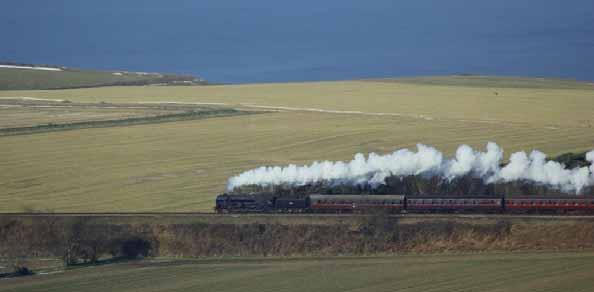
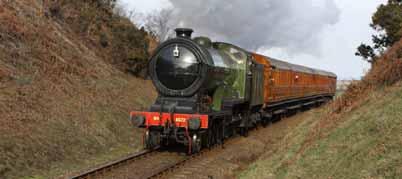
The heritage North Norfolk Railway (NNR) - known as the Poppy Line - is widely recognised for its contribution to the local economy.
The main station in the coastal town of Sheringham is smack bang in the centre of town and local businesses support the NNR as it would not be the bustling conurbation which it is without stream trains making a regular appearance.
The Poppy Line runs between Sheringham and Holt with two request stops between them – Weybourne and Kelling Heath which boast lots of fantastic walks through the woods.
Steam trains only stop there on the journey from Holt as the hill is too steep for them on the way to Holt to get started again, diesel services stop both ways of course.
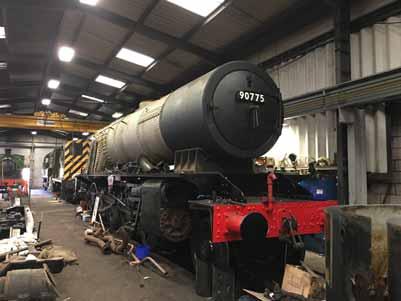
Trains cut through the countryside to the east of Weybourne with views of its windmill and passes through the well-preserved country station which also houses a locomotive shed together with
a carriage maintenance and restoration centre.
The line, which is just over five miles long, once formed part of the Midland and Great Northern Joint Railway before Beechings’ axe came down.
The railway now handles
thousands of passengers each year with many more visitors just visiting the stations and museum. The education department also hosts visits from around 100 schools a year providing historic experiences for children.
Work on rebuilding the line started shortly after closure in 1965 and by 1967, two steam locomotives were delivered.
In 1973, the railway was the scene of filming for the episode ‘The Royal Train’ of the classic TV programme
Dad's Army
By 2010 the line was reconnected to the National Rail network at Sheringham via an 'occasional use' level crossing.
The main restoration sheds at Weybourne can accommodate four standard length coaches and six large steam or diesel locomotives. New carriage storage sheds have been built near Holt with Heritage Lottery funding. These have the capacity to store the equivalent of 18 coaches.
The railway is operated mainly by around 400 volunteers, many of whom currently work on the railways or are retired rail workers, as well as around 50 staff.
There is also a junior club for members who are aged between 10 and 15. Every year there is a volunteer of the year award and for the 'junior volunteer of the year'.
The NNR organises the usual programme of seasonal
special events including two steam galas, a diesel gala, Santas, ‘Thomas’ days and an annual beer festival.
Other expansion includes the purpose-built machine shop and a boiler overhaul facility at the Weybourne Engineering works.
Holt station includes the old weighbridge from Cambridge station, a footbridge, and a ‘carriage house' to replicate the houses made with old railway
carriages in the war years.
The signal box at Holt is over 100 years old and was restored on-site. The full signalling system at Holt, with 14 signals as well as the box, was commissioned in 2009 –winning the Heritage Railway Association signalling award for that year.
It has a large model railway and a mini railway, gift shop and tearoom with picnic tables and a museum displaying artifacts from the Midland and
Great Northern Joint Railway which is incredibly interesting.
Holt station is not in the town itself which is about a mile away but there is a lovely old Routemaster bus that operates the route.
The staff are always friendly and polite and more than happy to assist. Watch out for their event days as they're a great day out whatever the weather.
For more information go to: www.nnrailway.co.uk






An RMT member who developed Hand Arm Vibration Syndrome (HAVS) has received a £35,000 settlement from Network Rail.
The member, an Electrical Control Operator, began his railway career at the age of 18 with Jarvis Rail in 2000, starting as an apprentice in Liverpool. His early years in the job involved extensive and prolonged use of vibratory tools—including Bance drills, disc cutters, Kango packers, rail drills, and impact wrenches—for track maintenance and repairs.
Throughout his 10 years with Jarvis and subsequent years with Network Rail following a TUPE transfer, the member routinely used these tools for three to five hours a day without sufficient information or training on the risks of vibration exposure.
Tool monitoring only commenced in 2018, years
after his most intense periods of tool use. In 2016, the member began experiencing symptoms including blanching of fingers, tingling, numbness, and loss of grip strength, particularly in cold weather. Initially misdiagnosed, it was not until May 2021 that occupational health professionals formally diagnosed his condition as HAVS caused by prolonged exposure to vibratory tools in his work.
Despite increasing pain and symptoms, the member continued working with tools to meet financial obligations, eventually moving into a supervisory role and later transferring to a less physically demanding position as an Electrical Control Operator in 2024, specifically to avoid returning to tool use.
Following his ordeal, the RMT member instructed
workplace injury experts at Thompsons Solicitors to bring a claim for compensation. The case was formally issued and was settled for £35,000 prior to it being listed for trial.
Thompsons Solicitors lawyer Michelle Farrell said that the case showed why it is vital for employers to proactively manage the risk of vibration exposure.
“Our client was not warned about the dangers, nor was his tool use properly monitored for many years. We are pleased that through the union’s legal service, he has now secured compensation that recognises the impact this preventable injury has had on his life,” she said.
Speaking after the settlement, the RMT member said that he was completely unaware of the risks involved in using these tools for so
many hours.
“By the time my condition was diagnosed, the damage was already done. I am grateful to the union and to Thompsons for helping me get justice and financial security so I can now continue working in a role that doesn’t cause me more harm,” he said.
Cases such as this show the value of the union’s legal service, and it is hoped that the outcome will further highlight the importance of ensuring early intervention, adequate training, and effective monitoring to prevent similar injuries among members in the future.
An RMT member and his wife successfully secured compensation following a harrowing road traffic incident outside their home.
Late one night, the couple
If you are experiencing difficulties in the workplace and need advice regarding a potential employment tribunal claim contact the union.
In the first instance, ensure that you contact your local RMT Representatives or Regional Organiser. Then complete an L2 – Request for Legal Assistance (available on-line) and send it to your Regional Office with all supporting documentation.
RMT’s legal department deals with virtually all cases from assessment to the case’s conclusion at a tribunal for members across England and Wales. The legal department has also submitted claims to Employment Appeal Tribunals.
The in-house legal department is now firmly established and employs four solicitors and continues to advise and support
Your Free legal service covers:
members in their work-related criminal cases in the Magistrates Court.
This often involves defending members against false allegations made by the public of assault, false allegations of theft and alleged driving offences. Furthermore, it continues to offer tailored advice and support for bus and taxi drivers, in respect of their licensing issues, licensing appeals before the Magistrates Court, driving offences, and in respect of appearances before Traffic Commissioners.
The In-house legal department continues to strive to deliver a first-class service to all of members. They are committed to provide a strong service to assist the union through the ever-changing legal landscape and their successes have grown yearly.
• Employment Law – provided by the RMT Legal Department
• Access to Personal Injury Lawyers – where 100 per cent of compensation is kept by members.
• Access to a basic will service.
• Access to special terms for conveyancing, probate, powers of attorney.
• Access to special terms for family law related matters.
The contact number for the legal department is 020 7084 7260 or go on-line to rmt.org.uk/about/legal-services/
approached the driver of a parked car who had been blasting loud music for over an hour, politely asking him to lower the volume. In a shocking turn of events, the driver responded by reversing into the member’s wife, then accelerating forward and striking the member—forcing him through a brick wall. The driver fled the scene
but was later identified and convicted of dangerous driving and attempted grievous bodily harm. He is now serving a prison sentence.
With the backing of the union, the couple instructed Thompsons Solicitors, legal partners of the union, to pursue personal injury claims.
Despite the couple being entirely innocent, the driver’s
insurers initially refused to accept liability, forcing the case into court proceedings. It was only after determined negotiations by Thompsons that the insurers agreed to settle.
The RMT member who suffered multiple soft tissue injuries to his leg, knee, ankle, toe, shoulder, and elbow was awarded £8,500.
The members wife, who experienced psychological trauma and an aggravation of a pre-existing knee condition received £3,000.
Thanks to the union’s legal guarantee, both received their full compensation amounts with no deductions— highlighting the fairness and strength of RMT’s legal support.
RMT is rightly proud of being one of the most democratic trade unions in the country. At every level — from the workplace to the National Executive Committee — it is our members who decide who represents them. Democracy is not a slogan for our union; it is the bedrock on which everything we do is built.
By the time this edition of RMT News reaches you, elections will be taking place right across Network Rail. Members in London Transport, Wessex and the Midlands will be voting for their National Executive Committee representatives.
In Scotland, the campaign for the position of organiser will be well underway.
Nominations for the post of regional organiser in Yorkshire and Lincolnshire will shortly be invited, and across the South, the election for relief regional organiser will be getting off the starting blocks.
For our maritime members, the ballot for RMT assistant national secretary will be in full flow.
Every one of these contests gives members a direct say in
the direction of their union and the people who will speak and act on their behalf. It is vital that every member takes part — because every vote strengthens our collective voice.
Most of our elections are currently conducted through postal ballots. The cost of printing, administration and postage can quickly add up, and while we will never put a price on democracy, we do have a responsibility to make sure that the way we run our elections is both efficient and effective.
Where the law allows, we are beginning to explore how digital voting can complement — and in some cases replace — postal ballots. This is not about cutting corners; it’s about keeping pace with how members live and work today. Many of our members now conduct their daily business online, and it makes sense that we give them the same opportunity to take part in our union’s democracy in that way too.
Our Network Rail route elections will be among the first to be conducted digitally,
and we are also giving serious consideration to running the forthcoming relief regional organiser election in the South in the same way. Early indications suggest that digital balloting can help increase turnout, making it easier for more members to participate in shaping the leadership and policies of our union.
Whether an election is held digitally or by post, the integrity of the process is paramount. Every ballot — no matter how it is delivered — will continue to be overseen by an independent scrutineer to ensure that it is fair, transparent, and secure.
When you receive your ballot paper — whether in the post or via a secure digital link — please take the time to read the accompanying materials and use your vote. It is your opportunity to shape the direction of your union, to ensure that those representing you truly speak for your workplace, your region, and your industry.
Democracy is a privilege that trade unionists before us fought hard to win. We honour that legacy every time we
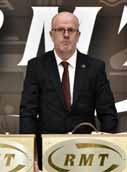
participate — by voting, by standing for election, and by encouraging others to do the same.
To make sure you don’t miss out on your chance to vote, please keep your contact details up to date, including your email and postal addresses. You can check your details or find out more about upcoming elections on the RMT website or by attending your local branch meeting.
Our democracy depends on active and informed members. Whether you’ve been in the union for months or decades, your participation is what keeps RMT strong, accountable, and member led. Finally, do get in touch and ask questions of those that are standing in elections they will value the opportunity to state their case.
George Welch
Wirral branch secretary Stuart Harris presented four members with long service awards at their workplaces.




Over 30 delegates to the South East Regional Council came as far away as Dover, Ramsgate, Birmingham and London gathered at the Railway Club in Bognor Regis.
The meeting held a minute’s silence in honour of former head office education officer and Anti-Apartheid activist Ray Spryshute who
passed away recently. Chris Rodway who knew Ray very well spoke about his comrade with fondness and pride. Chris himself was also given particular focus
following his appalling assault whilst at work four months ago, resulting in a fractured skull which has left him still off work.
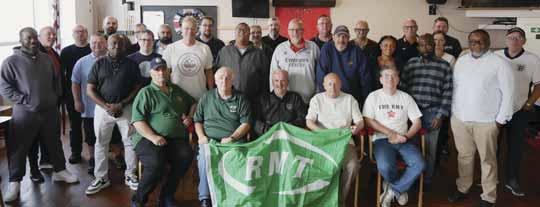
RMT South East Regional Council sent on a team of experienced recruiters to visit London Victoria station, identified as a key location for development in it recruitment plan.
The crew included membership officer, Paul Dennis, regional secretary Dan Kennedy, Churchill Company Council, John Johnstone and retired members officer for Medway and District branch.
The team moved between the Southeastern and GTR Southern areas, chatting with station grades and train crew and Network Rail staff and outsourced workers, from
cleaners to security staff.
Paul Dennis said that London terminals had specific challenges, with a wide diversity of nationalities, typically only working for about a year to 18 months, as well as long term workers and they all deserve support and attention.
“Morale is poor, and we need to develop some effective reps for the future.
“But the strategy is to have regular visits and build relationships and confidence within the workforce which will pay dividends for the future,” he said.
He said that numbers in the
region were on the rise, but much more needed to be done. “RMT is proud to be an all-grades union and as such
needs to recruit and organise all grades in all locations,” he said.
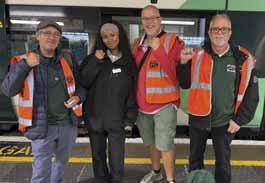
RMTgeneral secretary Eddie Dempsey and regional organiser Steve Skelly presented a number of long service badges at a meeting of Cardiff branch which took place at Cardiff Arms Park. 25-year awards were given to Neil Cordy, Barrie Willacott and David Morgan. 10-year badges were given to Jason Landa and Dawn Callaghan.
There was also a special presentation for Big Roger Fowler on his retirement after 39 years of dedicated activism.
Eddie Dempsey spoke very highly of Roger and the influence he had on him when he first joined the union and attended the South Wales and West Regional Council, when Roger was the regional council
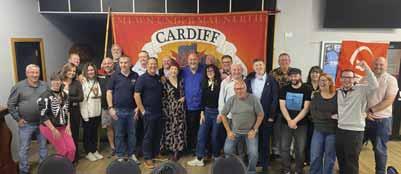
president.
He presented Roger with an engraved tankard and bottle of his favourite Grey Goose Vodka. Roger was an active member of the union’s Disabled Members Advisory Committee (DMAC) over the last six years of his career and was thrilled and humbled that DMAC members attended on the night, travelling all the way from Exeter, Liverpool and Leeds to spend the evening with him.
It was an indication of the measure of the respect and love that he has earned across the union.
RMT regional organiser John Watson presents Martin Devreede of Birmingham Engineering branch with his 50 year service badge.
Are you retired, or approaching retirement? Do you agree that people don’t have to stop being active after they retire? There’s still plenty to do – and not just in the garden!
Plenty to fight and organise for: campaigns, recruitment, as well as the pleasure of meeting up with like-minded people for social activities, without the worry of having to get up next morning for an early start!
As secretary of the South Wales & West retired members’ branch, we recruit retired workers and help with workplace recruitment in our region.
Not only have our activists got a bit more free time, they have plenty of workplace and union experience to offer as
well. And, of course, today’s workers are tomorrow’s pensioners, so it’s important that we work together and support each other.
A decent state pension is worth fighting for, and RMT recognises this – although unions have traditionally focused on occupational pensions. The UK has the lowest state pension among developed countries according to the Organisation for Economic Co-operation and Development.
Recent changes to the state pension mean that today’s workers; many of whom are in short-term, insecure or parttime employment, will probably not qualify for the full state pension which now requires 35-years of NI
contributions.
Two million pensioners in the UK live in poverty, most of them after working hard all their lives. Isn’t that worth a fight? Take a look at the RMT’s Retired Workers’ Charter and you’ll see several issues that represent the vital fight for decency and dignity in retirement.
As well as joining your local/regional retired activists’ branch see www.rmt.org.uk for details and don’t forget to apply for your RMT Retirement Benefit (form F3, available from your Branch Secretary, or on-line at www.rmt.org.uk).
Many retired members do forget to claim it or don’t know about it! The RMT Pensions Officer is Paul Norris, and you can contact him at:
p.norris@rmt.org.uk
Enjoy your retirement – but enjoy it even more by remaining an active and proud member of a union which fights for its members on all fronts.
See you on the picket lines!

Now available: order printed CIRAS posters and flyers with the RMT logo for free from the CIRAS online shop (above). Search online for CIRAS shop or go to www.willsonshop.com/collections/ciras. You’ll find the RMT poster and flyer at the end of the page.
To order click on the RMT item, add it to your basket and select how many to order. In the basket, use the code CIRMT1 in the space for a CIRAS membership number. You’ll then go to the checkout. The printed items will be posted to you completely free, no postage needed.


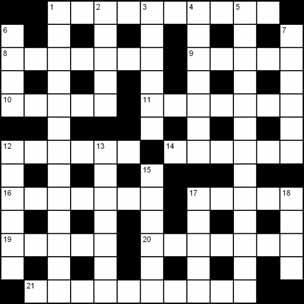
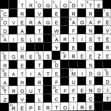
Use the QR code to join to get help at work and save money

RMT has developed a number of benefits to save members money. This includes negotiating access to savings and special offers from our approved partners.
The union has a dedicated team of elected officers and local reps to serve your interests negotiating with employers on issues from pay, hours of work, pensions and working conditions. They are supported by a team of researchers to formulate pay claims to obtain the best negotiated terms for you.
The union has a political fund to run campaigns and provide a political voice to benefit members’ interests in the workplace. RMT has a very active parliamentary group which raises issues of concern for members at Westminster, the Scottish Parliament and Welsh Assembly.
Personal injury claims cover if you suffer an accident in work or outside work. RMT underwrites settlements that would not be provided by no-win, no-fee companies. Call 08457 125 495.
Members who have suffered an industrial disease will receive free legal support to make a claim. Such claims are underwritten by the union and members will not have any deduction from their settlement unlike claims run by no-win, no-fee companies. Call 08457 125 495
Should a member find themselves unfairly
dismissed, discriminated against or have any claim which has reasonable prospects of success at an Employment Tribunal, RMT will provide legal representation and pay the fee. Even if the union is advised that the claim is unlikely to succeed, members who make a claim are eligible to receive free legal advice.
Payable if you have an accident at work or on the way to or from work. Accident benefit is only payable if you have been off for three days or more. Accident must be reported to branch secretary within 26 weeks in order to qualify for accident benefit.
Payable to any member who retires over the age of 60 or aged 55 if retired through redundancy or resettlement. Ill health retirement is also payable; proof of this must be sent with application for retirement benefit.
The union can provide a personal taxation service and will preparation service.
Payable to any member who is experiencing loss of wages through being permanently demoted or downgraded as a result of illness or injury. Payment of £300 provided that member reports this to branch secretary within 12 weeks.
The beneficiaries of this fund would be any child of a member or spouse if the member dies in service or if a members’ spouse dies and the member has responsibility of the children. Benefit is paid while a child is in full-time education up until the age of 22. Payment is made quarterly and the rate is £12.00 per week for children up to the age of 16, then £12.75 per week from 16 to 22.
Accessible savings and affordable loans from RMT’s Credit union. www.rmt.org.uk/about/credit -union
Shop online with RMTrewards.com and earn cashback savings from hundreds of retailers, like B&Q, Argos and Tesco. It’s free to join, plus you’ll get a FREE £10 Welcome Bonus in your online account! (Terms and conditions apply) www.rmtrewards.com
if you drive a company vehicle as part of your job you can join the RMT fines pool for £7 per year. The Fines Pool will reimburse members for any speeding fines, related court costs and lost time to attend a court hearing. www.rmt.org.uk/memberbenefits/fines-pool
A Death Grant of £600 is payable to the nearest relative or legal representative if a member dies through any cause prior to retirement.
Fancy cashback on your everyday shopping? Use your RMT Prepaid Plus Cashback card at over 50 partner retailers, including Sainsbury’s, ASDA and Boots, and earn unlimited cashback! It’s different to a credit or debit card - you can only spend what you load so there’s less chance of getting carried away. www.rmtprepaid.com
As a benefit of your RMT membership you can register for £5,000 Free Accidental Death Cover. Cover is for UK residents aged 18-69.12 months free cover.
Annually renewable and always FREE. This policy is underwritten by Stonebridge International Insurance Ltd. www.rmtprotect.com
For a small monthly premium you can claim cash-back on dental, optical and therapy treatments. Visit www.bhsf.co.uk
Assistance for members with their potential employment tribunal claim offered through the RMT’s In-house Legal Department.