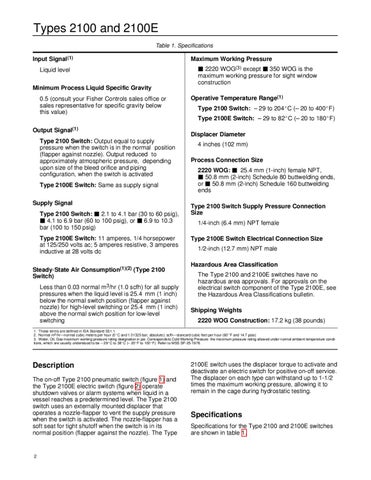
Types 2100 and 2100E Table 1. Specifications
Input Signal(1) Liquid level Minimum Process Liquid Specific Gravity 0.5 (consult your Fisher Controls sales office or sales representative for specific gravity below this value)
Maximum Working Pressure J 2220 WOG(3) except J 350 WOG is the maximum working pressure for sight window construction Operative Temperature Range(1) Type 2100 Switch: – 29 to 204_C (– 20 to 400_F) Type 2100E Switch: – 29 to 82_C (– 20 to 180_F)
Output Signal(1) Type 2100 Switch: Output equal to supply pressure when the switch is in the normal position (flapper against nozzle). Output reduced to approximately atmospheric pressure, depending upon size of the bleed orifice and piping configuration, when the switch is activated Type 2100E Switch: Same as supply signal Supply Signal Type 2100 Switch: J 2.1 to 4.1 bar (30 to 60 psig), J 4.1 to 6.9 bar (60 to 100 psig), or J 6.9 to 10.3 bar (100 to 150 psig) Type 2100E Switch: 11 amperes, 1/4 horsepower at 125/250 volts ac; 5 amperes resistive, 3 amperes inductive at 28 volts dc Steady-State Air Consumption(1)(2) (Type 2100 Switch) Less than 0.03 normal m3/hr (1.0 scfh) for all supply pressures when the liquid level is 25.4 mm (1 inch) below the normal switch position (flapper against nozzle) for high-level switching or 25.4 mm (1 inch) above the normal swich position for low-level switching
Displacer Diameter 4 inches (102 mm) Process Connection Size 2220 WOG: J 25.4 mm (1-inch) female NPT, J 50.8 mm (2-inch) Schedule 80 buttwelding ends, or J 50.8 mm (2-inch) Schedule 160 buttwelding ends Type 2100 Switch Supply Pressure Connection Size 1/4-inch (6.4 mm) NPT female Type 2100E Switch Electrical Connection Size 1/2-inch (12.7 mm) NPT male Hazardous Area Classification The Type 2100 and 2100E switches have no hazardous area approvals. For approvals on the electrical switch component of the Type 2100E, see the Hazardous Area Classifications bulletin. Shipping Weights 2220 WOG Construction: 17.2 kg (38 pounds)
1. These terms are defined in ISA Standard S51.1. 2. Normal m3/hr—normal cubic meters per hour (0_C and 1.01325 bar, absolute); scfh—stancard cubic feet per hour (60_F and 14.7 psia) 3. Water, Oil, Gas maximum working pressure rating designation in psi. Corresponds to Cold Working Pressure: the maximum pressure rating allowed under normal ambient temperature conditions, which are usually understood to be – 29_C to 38_C (– 20_F to 100_F). Refer to MSS SP-25-1978.
Description The on-off Type 2100 pneumatic switch (figure 1) and the Type 2100E electric switch (figure 2) operate shutdown valves or alarm systems when liquid in a vessel reaches a predetermined level. The Type 2100 switch uses an externally mounted displacer that operates a nozzle-flapper to vent the supply pressure when the switch is activated. The nozzle-flapper has a soft seat for tight shutoff when the switch is in its normal position (flapper against the nozzle). The Type
2
2100E switch uses the displacer torque to activate and deactivate an electric switch for positive on-off service. The displacer on each type can withstand up to 1-1/2 times the maximum working pressure, allowing it to remain in the cage during hydrostatic testing.
Specifications Specifications for the Type 2100 and 2100E switches are shown in table 1.