prevention power of
PR E V EN TION • R ESE A RCH • INNOVAT ION
SPRING 2015
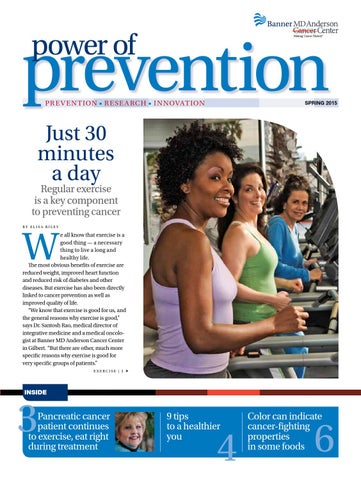
Just 30 minutes a day
Regular exercise is a key component to preventing cancer
W BY ELISA RILEY
e all know that exercise is a good thing — a necessary thing to live a long and healthy life. The most obvious benefits of exercise are reduced weight, improved heart function and reduced risk of diabetes and other diseases. But exercise has also been directly linked to cancer prevention as well as improved quality of life. “We know that exercise is good for us, and the general reasons why exercise is good,” says Dr. Santosh Rao, medical director of integrative medicine and a medical oncologist at Banner MD Anderson Cancer Center in Gilbert. “But there are other, much more specific reasons why exercise is good for very specific groups of patients.” E X E R C I S E | 2
INSIDE
3
Pancreatic cancer patient continues to exercise, eat right during treatment
9 tips to a healthier you
4
Color can indicate cancer-fighting properties in some foods
6
COVER FEATURE
FROM THE COVER
HOW MUCH EXERCISE?
The Centers for Disease Control and Prevention recommend at least 30 minutes of “moderate-intensity” exercise five or more days a week. Moderate-intensity exercise is continual movement of the body for a sustained period of time. For example, walking a dog for a half-hour would qualify, but casual window-shopping at a mall with starting and stopping would not. “It’s not just obesity,” Rao said. “There’s a big difference if you’re obese and you exercise and if you’re obese and you don’t exercise. Exercise is extremely important in terms of managing your health.” Inflammation is one of the areas that doctors routinely point to when discussing cancer. “A lot of it comes down to inflammation,” Rao said. “We think inflammation contributes to cancer, and so anything that reduces inflammation – and exercise is one of them – is important for prevention” HORMONAL RELATIONSHIP
Exercise also helps the body regulate hormones that are directly linked to cancer. Both breast and endometrial cancer (uterine cancer), for example, are often linked to higher estrogen levels. “We know that exercise helps with weight management and seems to be especially important with hormonally sensitive cancers,” Rao said. “High estrogen levels contribute to the development of cancer.” By regulating estrogen as well as hormones such as leptin and insulin, exercise can help the body naturally fight or prevent recurrence of cancer. Research shows a direct correlation between hormone-sensitive cancers like breast cancer and endometrial cancer. Although the percentage of decreased risk varies greatly from study to study (20 to 80 percent), exercise can lower the risk of breast cancer, especially for women who have routinely exercised throughout their lifetime. But even women who start exercising later in life also benefit. Similarly, exercise can directly affect the development of endometrial cancer by as much as 40 percent.
2 P OWE R O F PR E V E N T I O N S PRIN G 2 0 1 5
COLON CANCER
GENERAL HEALTH
According to the National Cancer Institute, adults who exercise more can lower their risk of developing colon cancer by as much as 40 percent. Studies compared cancer rates of those who exercised to those who did not, and showed a variety of benefits. Exercise can protect against colon cancer by balancing energy, processing hormones, regulating insulin and reducing exposure to carcinogens. Exercise also can alter a variety of inflammatory and immune system-related factors, which can influence the development of a variety of cancers.
Some of the most obvious benefits of exercise stretch beyond just cancer prevention. Exercising leads to an overall better quality of life. “People who exercise also sleep better,” Rao said. “There’s a lot of research linking poor sleep to cancer development. There’s some very specific physiological reasons why exercise helps.” And it all starts with a simple walk. “If you’re at risk for cancer, you should be exercising for 30 minutes at least five days a week,” Rao said. “Look at exercise as medicine. The bottom line is that, for a variety of cancers, exercise is very important.” • pp
PREVENTION
Making the ‘fight’ decision Pancreatic cancer patient continues to exercise, eat right during treatment BY STEPHANIE CONNER
K
athie McGuire knew something was wrong. “I looked in the mirror, and I was yellow,” she recalls. She called her insurance company’s nurse hotline, and was told: Go straight to the ER. Within a couple of hours, tests revealed the diagnosis: pancreatic cancer. McGuire was just shy of her 60th birthday. With her husband by her side, she chose to go to Banner MD Anderson Cancer Center in Gilbert. Then, she chose to fight. “When I made the decision that I was going to fight with all of my might … I also decided I would do everything I could to feed my body, my mind and my soul,” McGuire says. LIVING WELL DURING TREATMENT
McGuire’s chemotherapy regimen requires her to have weekly chemotherapy infusions. After three treatment weeks, she has a week off. Chemotherapy can take its toll, but McGuire heeded the advice of her care team. “The general advice I give to patients is to eat healthy — to get a good balanced diet and maintain their weight, which is not easy while on chemotherapy,” says her oncologist, Tomislav Dragovich, MD, who also advises patients with pancreatic cancer to increase their caloric intake so they don’t lose weight. McGuire also met with a Banner dietitian, who helped her brush up on nutrition basics and learn how to get the nutrients she needed. And because the tumor on her pancreas blocked the release of insulin, McGuire was also coping with diabetes, so she learned how to manage her carb intake too. On occasion, the chemotherapy makes McGuire nauseated.
Kathie McGuire “Many times when I’m nauseated, it’s hard to eat, but I can drink,” she says. That’s when she turns to a smoothie. For example, she might combine protein powder, banana, ice, kale and milk to help her keep her strength up. For exercise, McGuire walks her West Highland Terrier, Westin, almost daily. “Staying physically active,” Dragovich says, “helps patients improve their tolerance of chemotherapy and fight fatigue caused by the treatment.” Through Banner’s integrative oncology program, McGuire learned about complementary therapies. With her doctor’s approval, she took advantage of them. Many of these therapies, Dragovich notes, can help with side effects of chemotherapy, improving patients’ quality of life during treatment. “These people are professionals. I trusted them with my health and wellbeing,” McGuire says. “And I did my best to be the best patient I could be.” McGuire knows it’s important to nurture her soul too. She spends time outside. She listens to music. And she does positive affirmations and creative visualizations. “I visualize my body healing and the cancer leaving my body,” she says.
She is also grateful for her husband and her best friend, Judy, who takes time off work to sit beside her during every chemotherapy session. “Without their help, I don’t think I would’ve done this well,” she says. REMARKABLE RESULTS
Just how well? Every three months McGuire has a CT scan to check her tumors. “On the first CT scan, we were hoping for no growth or a 10 percent reduction,” McGuire says. “My tumors reduced 50 percent in size.” Then, on the second scan, her tumors reduced another 25 percent. “My progress has been remarkable,” she adds. Pancreatic cancer can be difficult to treat. But, Dragovich says, treatments are evolving. “With the emergence of new therapies like the chemotherapy combination Kathie’s on, we are seeing more patients have a strong and lasting response,” he explains. And throughout the treatment, McGuire has been able to live well. “A diagnosis of pancreatic cancer didn’t mean she had to stop living,” Dragovich says. “Our goal is to help patients continue to live fully while fighting cancer.” • pp
BannerMDAnderson.com 3
STAY ACTIVE
Exercise 30 minute 5 days s, a week
1 2 3
Find y our ‘w hy’: W h at m otivates you to e A better xercise? b e ac h b o dy? Play w it h g ra ing ndch ild ren? Fin d r iv ing d t he li fest yle reason b you r exe eh ind rcise in stead of focusin just g on we ig ht loss . Fun fa c to r : There a r e tons o f exercis pr o g r a m e s , bu t t h e one th nates w at r e s o it h you is t he on matters e t h at . L et a sp or t, ba ll da ncing room , h ik ing , or a ny enjoyab ot her le activ it y, be a n a nchor. Be ope n - mind ed: Once yo u r routi ne beco eas y or me s bor ing , lea r n w to adva n ay s ce or mo d if y it.
Time: ut t he n wa it o a c u o y f I -t h r u, k s d r ive c u b r ta S r e ti me fo you hav k . Qu ic exercise a ms te prog r u m 30-m in Use t he he rage. lem. b o r a re a ll t e is a p m ti g in if fi nd lity: c e re a a il you. E mbra w il l der ls a o g c sti d shor tUn rea li long a n le b a v ed, t hen Set ach ie a ne add L c , M , ls a ay ‘see it ter m go a lways s I “ . m e h act on t how it.’” s , it y sa e it: me a s u r Track t going , e g ont h, u o m y a Once k s or e e w : k es Th in oa ls g iv resu lts. ach ing g e R . . h s s y u a p na l not d otivatio m a tr x e t h at
9
Tracey McLane, physical therapist at Banner MD Anderson, offers suggestions
to get your exercise program on track.
4 P OWE R O F PR E V E N T I O N S PRIN G 2 0 1 5
4 5 6
8
Help: A p er s o na l tra iner c a n s et u p an exercise pr o g r a m . B ut a physic a l t hera pist ca n bett er help y ou stay acti ve if t he r e a re physica l li m itati ons. Reflect honest ly on you r co nd it ion a n d ask t he pros for help b e fore you sta r t.
7
: Food facts rge ca n One mea l splu workt negate a grea ance id out. Seek gu tr ition. on opti mal nu an le Lear n about ntie tr protei ns, nu es bl dense vegeta and ca lories.
tips
to a healthier you!
9
Beat fatigu e: Too ti red? Th in k about th is: pa tients w ith ca ncer tr eatment-related fatig ue of ten nap, bu t they shou ld exerci se. “You need thos e endorphi ns fr om physical activi ty to tr uly overcom e it,” McLane ex plai ned.
MORE WAYS to GET MOVING 1» Find a best friend If you’re not the gym-going type but still need a motivator to get those 30 minutes of daily exercise in, Fido might be your best bet. That wagging tail will get you out of bed and into the neighborhood for a healthy morning jaunt.
2» Download something A good, healthy walk outside or on a treadmill can be invigorating ... but sometimes a bit mind-numbing. Engage your noggin by downloading a podcast or audiobook.
3» It’s not exactly retail therapy
A casual stroll at the mall might seem like exercise, but it really isn’t. The only way to get a real benefit out of a mall walk is by continual walking for 30 minutes — not stopping every 90 seconds to see what’s on clearance.
4» More than the gym
Exercise doesn’t have to be a chore. Ballroom dancing, square dancing and line dancing are all good cardio workouts. And if you’re into a more communal experience, sign up for a yoga class and get your body moving and stretching.
5» Gadget-friendly
Now more than ever, there’s an app or device ready to measure your activity. If you like a little motivation, get a pedometer or another type of health monitor to progress your activity throughout the day. Set goals, and watch what happens. • pp
NUTRITION
Follow your rainbow Food color can be an indication of both nutrition and a food’s disease-fighting properties B Y G R E M LY N B R A D L E Y- WA D D E L L
W
ho would’ve thought that reducing one’s risk of cancer could be as easy as following the rainbow? The rainbow of foods, that is! Colorful and naturally delicious fruits and vegetables, from red raspberries to dark green spinach and orange-hued mangoes, are packed with flavor, nutrients and a number of cancer-fighting substances known as phytonutrients or phytochemicals. So it’s no surprise that “eating five servings of fruits and vegetables every day — along with other plant-based foods such as beans, nuts and whole grains – is a great way to boost your body’s natural defenses,” said Christi Kirk, a registered dietitian and board certified specialist in oncology nutrition at Banner MD Anderson Cancer Center in Gilbert. “I like to talk about cancerprevention nutrition in terms of color because it’s such an easy way
to eat – even a little kid can do it!” Kirk said. “Just pick a variety of colors, and you’re probably getting a good variety of fruits and vegetables.” REDUCING CANCER RISK
While scientists still don’t fully understand how phytonutrients work, Kirk said these chemicals have proven to work best in food form. They may also have a synergistic effect on reducing cancer risk. “Phytonutrients also boost our immune system, help the body function properly and neutralize free radicals,” she said, referring to molecules in our bodies that can damage DNA. So, are you ready to put a little more color on your plate? Here, Kirk takes a quick look at a few possible food choices – most bursting with color – and offers some background information about why they’re recommended:
COLI, ROASTED BROC IVES OL D TOMATOES AN li florets
size brocco • 4 cups bite oes cherry tomat ed lv • 1 cup ha lved ha , es iv ol k d blac • 1 cup pitte d rlic, mince • 4 cloves ga l virgin olive oi tra ex . sp Tb • 2 e st • Salt to ta on zest ly grated lem • 1 tsp. fresh taste to or on juice, • 1 Tbsp. lem hed us cr , es av le ano • 1 tsp. oreg
tly s F. lt to taste. Gen to 375 degree rlic, oil and sa . ga es , Preheat oven ut es in iv m ol s, 15 tomatoe le layer. Bake add broccoli, sheet in sing ng ki ba In large bowl, d on an ad vegetables l coated. Spre Add roasted toss until wel and oregano. e ic ju , st ze l, combine In same bow rve warm. Se . ss to ly gent ings. Makes 4 serv
6 P OWE R O F PR E V E N T I O N S PRIN G 2 0 1 5
• RED (strawberries, raspberries, watermelon, tomatoes, pink grapefruit, pomegranate, cranberries): Lycopene, the carotenoid that gives tomatoes, pink grapefruit and watermelons their reddish hues, is protective against prostate cancer. Pomegranates, strawberries, cranberries and raspberries contain ellagic acid, which may slow cancer growth. • ORANGE (carrots, sweet potatoes, pumpkin and apricots): These foods typically contain beta carotene, a carotenoid that is important to the body’s immune function. “There’s the thought that cancer is an inflammatory disease process, so the thinking is that if you reduce the inflammation, you may be able to reduce the risk of cancer,” she said. • BLUE (blueberries, eggplant, beets, plums, prunes): These foods tend to be high in anthocyanin, a flavonoid that gives them their blue or purple tints. • COLORLESS/WHITE (bananas, potatoes, onions, apple flesh): Apples and onions (as well as kale and asparagus) contain the flavonoid called quercetin, which is said to have anti-inflammatory properties and may help in the fight against cancer. Bananas are low in calories, and maintaining a lower weight is a cancer-preventative measure as well, Kirk says. • GREEN (spinach, cabbage, kale, collard greens, broccoli, Brussels sprouts, bok choy, avocado, kiwi): Most of these foods are rich in Vitamin K, potassium and folic acid, and the cruciferous veggies – broccoli, cabbage and kale, for instance – contain flavonoids known as glucosinolates and are thought to protect against breast cancer. Cruciferous vegetables also contain isothiocyanates, which Kirk said researchers believe are beneficial to the liver and may also protect against breast cancer. “Also, all these vegetables are high in fiber, and we know that a diet high in fiber helps in the fight against colorectal cancer,” she says.
FOUNDATION
A family’s loss helps others Phoenix donor gives $10,000; Leslie’s Poolmart matches
BY MICHAEL FERRARESI
GETTING STARTED
Need some help to follow that rainbow? Kirk offers these additional tips: • Take your time: “Some change is better than none,” she said. In other words, try adding one vegetable a day — or a week or even a month — to your diet. If you change how you eat too quickly, you may not stick to the changes. And start by adding in foods you like. If broccoli makes you queasy, opt for kale or an avocado! • Stay balanced: Even if you’re consuming a good mix of fruits and vegetables, you might need to improve your whole-grain or legumes intake. “We all have areas to improve,” Kirk says. • Give it a (second) chance: If you grew up on canned or pickled beets — or mushy peas or limp, overcooked broccoli — perhaps those foods don’t make it onto your plate nowadays. “A lot of times, people remember a fruit or vegetable they had when they were a kid, and maybe it wasn’t prepared the best way back then,” adds Kirk. What to do? Give that food a second chance by changing up the prep. Lightly steam the broccoli, for example, or roast some beets and then dress them up with goat cheese on top. You might surprise yourself – and your taste buds! • Make smart subs: Why use a greasy tortilla chip to scoop up that delicious, fresh guacamole (great green veggie choice, by the way) you just made? Kirk suggests using a carrot stick! And why use a jar of salsa when you can whip up a fresh batch with fresh, diced mango, red pepper, onion and tomatoes? Check out all the colors you just combined! • pp
L
ucia Marusiak was at a fundraising event for Banner MD Anderson Cancer Center in Gilbert several months ago when a presentation from a survivor spurred memories of the time her husband, Robert, spent bravely fighting stomach cancer. Bob succumbed in 2012, nearly three years after diagnosis, but Marusiak said she had positive memories of the way her husLucia Marusiak band was cared for at Banner MD Anderson. She and the couple’s sons — twins John and Charlie, she said about Bob, a longtime executive 25, and Kevin, 23 — will always be grateful of Micro-Tronics, Inc., a Valley aerospace for extending Bob’s life and giving them manufacturing firm founded by his father. more time together. Now, she wanted He and Lucia were married for 28 years. to associate Bob’s name with the cause Bob Marusiak was treated at both of beating cancer. Banner MD Anderson in Gilbert and The University of Texas MD Anderson Cancer MAKING A DIFFERENCE Center in Houston. The cancer centers At the fundraising event, Lucia heard integrated a lot of different care, including from Larry Hayward, co-chair of the alternative diet and relaxation techniques. cancer center’s Hope Starts Here camThe doctors and nurses, she said, were inpaign and chief executive of Leslie’s formative about the directions and goals. Poolmart, and learned he was offering to “They were very sensitive to what we match the first 10 $10,000 contributions — were going through, and very empathetic,” up to a total of $100,000, through his firm’s she said. “I felt they walked the journey charitable foundation. Marusiak decided with us.” to take him up on the offer, effectively Marusiak said she was encouraged and doubling the value of her contribution. coached to keep her family focused on The goal of the Hope Starts Here moving forward “and living every day” campaign is to raise $22 million in philamid treatments. anthropic support to expand clinical re“They were trying just as hard as we search, targeted treatment programs and were,” she said, even toward the end when support for cancer patients and survivors. Bob was in his final 36 hours in an assisted Marusiak addressed the group during care unit where he felt little pain, surthe fundraising event. It was the first time rounded by loved ones. she opened up like that in more than two “We felt we had our own special place,” years since her husband’s passing. she said. “It inspired me to do my part.” • pp LOVING MEMORIES
“Talking about it brought back memories of the love and support we received from Banner MD Anderson and the difference everyone made in my husband’s care,”
If you would like to learn more about Leslie’s Charitable match contact Christy Atler, director of development at 602-747-4487.
BannerMDAnderson.com 7
BANNER HEALTH 1441 N. 12th SREET PHOENIX, AZ 85006-2887
NONPROFIT ORG U.S. POSTAGE PAID LONG BEACH, CA PERMIT NO.1677
EVENTS AND CLASSES
If you no longer wish to receive Power of Prevention magazine:
Please notify us through email at powerofprevention@republicmedia.com or by phone at 602-444-2235. Be sure to include your full name, address, city and zip code as it appears on the mailing label of the publication.
PROGRAMS AND SERVICES
WE ARE ALL IN… for cancer prevention! Below are some of the services we
FOR CANCER PREVENTION
offer as well as how to contact us.
Call (480) 256-6444 to schedule an appointment for:
When it comes to cancer, we at Banner MD Anderson Cancer Center, are all in— with world-class medicine, unique clinical trials, and a team of experts dedicated to developing a customized treatment plan for each person. And we believe in the healing power of
a
supportive community. That’s where you come in.
• Genetic Counseling • Undiagnosed Breast Clinic • Undiagnosed Head and Neck Cancer Clinic
Call (480) 543-6900 to schedule an appointment for:
Go to WeAreAllIn.com and upload your words
• Mammograms • Lung Cancer Screening
of support, or send the attached postcard to let
If you have any other questions, please contact us at (480) 256-6444
a patient who’s facing cancer know you’re all in.
FOR MORE INFORMATION
On the campus of Banner Gateway Medical Center, U.S. 60 and Higley Road in Gilbert Banner MD Anderson Radiation Therapy also available at: Banner Thunderbird Medical Center, 55th Avenue and Thunderbird in Glendale, 602-865-5445 Banner Desert Medical Center, Dobson and US 60 in Mesa, 480-412-3808
To schedule an appointment, call 480-256-6444
Check out our website
BannerMDAnderson.com
Follow us on Facebook:
Facebook.com/bannermdanderson