2026

“I’M PROUD OF THE WORK OUR MEMBERS HAVE DONE.” French Hill talks about his role as Chairman of the Financial Services Committee.


2026
“I’M PROUD OF THE WORK OUR MEMBERS HAVE DONE.” French Hill talks about his role as Chairman of the Financial Services Committee.
by JACOB JENSEN
PLUS: THE INFLATION THAT WOULD NOT GO AWAY
by David Beckworth
AND: THE FASTEST-GROWING STATES HAVE A FEW THINGS IN COMMON
by Jared Walczak

4 Are We in the Middle of an AI Boom or Bubble?
By Robert D. Atkinson
A quarter century after the dot-com revolution, the growth of artificial intelligence is prompting similar hopes -- and concerns -- about the future of this potentially world-changing technology.
6 The Politics of AI: Is It a Good Bet for the President?
By John Feehery
Most of the anger directed at data centers is not being manufactured by some left-wing conspiracy. Instead, it is being driven by a very real fear about the future shared by Democrats and Republicans alike. Cover Story
8 A Review of Tariffs & the Economy
By Jacob Jensen
A study found that 96 percent of the tariff burden is being absorbed by U.S. businesses and consumers rather than foreign exporters. This means that U.S. taxes increased by around $200 billion in 2025.
12 The Inflation That Would Not Go Away
By David Beckworth
Prior to the pandemic, inflation averaged 1.9 percent from 2016 to 2019. Since stabilizing in mid2023, inflation has averaged about 2.9 percent, a full percentage point above the pre-2019 trend. 15 The Fastest-Growing States Have a Few Things in Common
By Jared Walczak
Among the 15 states with the fastest economic growth over the past decade, nine forgo at least one major tax — typically the individual income tax.
that matter,
Volume 60, Number 1
(cont’d)
As Consumer Confidence Sags, Policy Prescriptions Miss the Mark
By Romina Boccia
The Conference Board consumer confidence index has fallen for five consecutive months. While politicians are taking note, their prescribed solutions are, unfortunately mostly, off base.
19 Republicans Expanded the Child Tax Credit. Now What?
By Joshua McCabe
Since the 1980s, Republicans have successfully claimed ownership of pro-family policy, and the child tax credit has long been central to that identity.
Debate - Should the government intervene in the housing market?
22 Yes, Federal Programs are Necessary
By Dennis Shea
While cities and states are on the front lines in tackling America’s housing affordability challenge, the federal government also has a critical role.
23 No, Federal Programs are Ineffective
By Roger Valdez
The cost of many LIHTC projects has risen up to $1 million per rental apartment unit, enough to buy two or three single-family homes.

For nearly 50 years, ARDA has worked alongside state officials, federal representatives, and regulatory authorities to advocate on behalf of timeshare owners and the timeshare industry as a whole.
Today, the timeshare industry supports $35 billion in direct spending, employs 423,800 full - and part-time workers, and generates $10.8 billion in tax revenues.
Nearly 10 million U.S. households own a timeshare, and over 90% of timeshare owners are happy with their ownership experience.
There are 1,500 timeshare resorts in the United States.
ARDA IS PROUD TO SUPPORT THE RIPON SOCIETY
ARDA is a nonprofit, nonpartisan trade association for the timeshare industry representing the interests of more than 350 publicly traded and privately held companies, and advocating for the rights of nearly 10 million U.S. timeshare owners through its consumer advocacy arm, the ARDA Resort Owners Coalition (ARDA-ROC). Visit www.arda.org to learn more.
THE RIPON SOCIETY HONORARY CONGRESSIONAL ADVISORY BOARD
U.S. Senators:
Shelley Moore Capito - Senate Co-Chair
Todd Young - Senate Co-Chair
Marsha Blackburn
Bill Cassidy, M.D.
Susan M. Collins
John Curtis
Steve Daines
Joni Ernst
Deb Fischer
John Hoeven
Jerry Moran
Mike Rounds
Thom Tillis
Roger Wicker
U.S. Representatives:
Frank Lucas - House Co-Chair
August Pfluger - House Co-Chair
Stephanie Bice - House Co-Chair
Mark Amodei
Jodey Arrington
Don Bacon
Troy Balderson
Andy Barr
Mike Bost
Rob Bresnahan
Vern Buchanan
Ken Calvert
Kat Cammack
Mike Carey
Buddy Carter
Juan Ciscomani
Ben Cline
Tom Cole
Jake Ellzey
Tom Emmer
Ron Estes
Gabe Evans
Julie Fedorchak
Randy Feenstra
Brian Fitzpatrick
Scott Franklin
Andrew Garbarino
Tony Gonzales
Sam Graves
Pat Harrigan
Kevin Hern
French Hill
Ashley Hinson
Bill Huizenga
Dusty Johnson
Dave Joyce
John Joyce, M.D.
Mike Kelly
Jen Kiggans
Kevin Kiley
Young Kim
Darin LaHood
Bob Latta
Laurel Lee
Julia Letlow
Celeste Maloy
Brian Mast
Michael McCaul
Carol Miller
John Moolenaar
Blake Moore
Greg Murphy, M.D.
Dan Newhouse
Zach Nunn
Jay Obernolte
Guy Reschenthaler
Michael Rulli
María Elvira Salazar
Steve Scalise
Pete Sessions
Adrian Smith
Jason Smith
Lloyd Smucker
Pete Stauber
Bryan Steil
Glenn “GT” Thompson
Mike Turner
David Valadao
Ann Wagner
Steve Womack
Rudy Yakym
Just over one year into the Trump Administration and just under nine months until the mid-term elections, The Ripon Forum examines the state of the U.S. economy and some of the challenges facing American families and businesses in 2026.
In the cover essay for the latest edition, Jacob Jensen of the American Action Forum examines U.S. trade policy and the new tariff regime that has been put in place. “The tariff outlook has drastically changed over the past year, with the effective tariff rate skyrocketing from under 3 percent before President Trump’s inauguration to 28 percent post ‘Liberation Day,’” Jensen writes, adding that the tariff rate “now sits at roughly 14 to 16 percent.”
As for who is bearing the cost of these higher rates and policy changes, Jensen points to a study released last month, which found that: “96 percent of the tariff burden is being absorbed by U.S. businesses and consumers rather than foreign exporters, supporting past research from both The Budget Lab at Yale and the Harvard Business School. This means that U.S. taxes increased to the tune of $200 billion in 2025, counteracting the Trump Administration’s pro-growth deregulatory agenda and tax cuts.”
In another essay examining what is likely to be a key issue in the upcoming campaign, David Beckworth of the Mercatus Center looks at the rate of inflation, which, he notes, has gone down over the past 12 months but is still higher than it was before the Covid-19 pandemic. “Prior to the pandemic,” Beckworth writes, “inflation averaged 1.9 percent from 2016 through 2019. Since stabilizing in mid-2023, inflation has averaged about 2.9 percent, a full percentage point above the pre-2019 trend.”
Beckworth further notes that: “Households have taken notice of this apparent shift. Inflation continues to rank as a more important problem than unemployment in Gallup polling, even though the economy is now four years removed from the peak of the pandemic inflation surge. Notably, inflation’s elevated salience breaks a three-decade pattern in which unemployment typically dominated public concern during economic expansions.”
Romina Boccia of the Cato Institute delves deeper into how people view the economy with an essay examining consumer sentiment. “The Conference Board consumer confidence index has fallen for five consecutive months,” she writes. “While the University of Michigan survey showed a slight uptick in consumer sentiment in early February, the gains were concentrated among households with significant stock holdings, as ‘concerns about the erosion of personal finances from high prices and elevated risk of job loss continue to be widespread.’”
Boccia also writes that while elected officials in Washington have taken note of weak consumer confidence, “their prescribed solutions are mostly off base. Proposals range from price controls and ‘price gouging’ crackdowns to targeted subsidies, tariff dividends, and industry-specific relief (e.g. to farmers), alongside attempts to claim that the affordability crisis is a ‘hoax.’ The administration is further doubling down on tariffs to pressure allies, despite their effect of raising consumer prices. Politicians seem more focused on reallocating costs or assigning blame rather than addressing the policies driving up prices.”
In this time of economic uncertainty, it is worth noting that not all of the economic news is bad. Jarad Walczak of the Tax Foundation recently examined the fastest growing states in the country to see what, if anything, they had in common. He found that while they didn’t share a grand plan, they did share a common philosophy. “What unites them is a belief in unleashing the power of markets,” Walczak writes.
In other essays for this edition of the Forum, Rob Atkinson of the Information Technology and Innovation Foundation examines whether we are in an artificial intelligence bubble or a boom, while veteran political strategist John Feehery assesses the politics of AI and whether it’s wise for the President to get out front on what, in this age of data centers and job losses, is becoming a very contentious issue. Joshua McCabe of the Niskanen Center looks at the success of the Child Tax Credit and where Republicans should look next with regard to family-friendly tax policy.
In the latest debate, Dennis Shea of the Bipartisan Policy Center and Roger Valdez of the Center for Housing Economics share their thoughts on the housing market and whether the government should get involved. And in the latest Ripon Profile Arkansas Congressman French Hill discusses his role as Chairman of the Financial Services Committee and why he takes so much pride in the work his members have done.
As always, we hope you enjoy this edition of The Ripon Forum and welcome your comments.
Lou Zickar,
Editor louzickar@riponsociety.org
by ROBERT D. ATKINSON
I remember the height of the dot-com boom when lobbyist Tony Podesta changed his firm’s name to Podesta.com. He was not alone in his irrational exuberance. Most investors and many entrepreneurs went along. They were not wrong; just too early. A few years later we got Google, Facebook, the iPhone, and the Internet boom.
It’s impossible to predict the future, but it’s likely AI could follow a similar path: a few hiccups now, followed by robust, sustained growth.
To be sure, AI hype is the order of the day. In 2025, we were bombarded with announcements that artificial general intelligence (AGI) could do almost anything was right around the corner. And forget jobs; they were a buggy whip relic.
But new technology hype ahead of reality is pretty common. Originally coined by Gartner, the technology hype cycle holds that most new technologies go through phases. After a new technology is introduced, there is often a phase of “Inflated Expectations” when the technology is seen as game-changing, or in the case of AI, universe changing. But most technologies follow a predictable path to the “Trough of Disillusionment” when original expectations don’t manifest themselves immediately. But many technologies keep going to the “Plateau of Productivity,” where the technology is widely used and has important benefits to society, just less than the inflated expectations.
the results they want. And there will likely be more of these “see, it’s not all its cracked up to be,” claims. What else should we expect when so many pundits and AI leaders told us that AI is more important than the invention of fire?

Robert D. Atkinson
After a new technology is introduced, there is often a phase of “Inflated Expectations” when the technology is seen as game-changing, or in the case of AI, universe changing.
There’s another aspect of the narrative around AI, though. In earlier years, technology hype was mostly about the massive benefits of a new innovation. Today, the inflated expectations are mosly about how bad things will get -- a phenomenon the Information Technology and Innovation Foundation (ITIF) has termed the “tech panic cycle.” As one tech journal wrote: “When a technology is subject to overhype, it is easy for policymakers to assume vast and unexpected impacts, many of which could be, or likely will be, negative.” This is especially true as American culture has shifted from its pro-technology, pro-business orientation to one that is decidedly negative. After all, we are regularly bombarded with (incorrect) messages that AI is biased against minorities, kills jobs, violates privacy, jacks up electric rates, concentrates power into the hands of a few tech bros, floods the internet with garbage, exploits labor, undermines learning, powers misinformation and disinformation, exacerbates economic inequality, deskills professions, powers the surveillance state, steals artist’s content, and is leading to financial/economic collapse
AI appears to be moving from “inflated expectations” to “trough of disillusionment.” Many latched onto the findings of a recent MIT study that found that most companies using AI are not getting
The reality is that new technology has always presented challenges (e.g., cars kill people, computers put typists out of work, etc.), but the benefits have vastly outweighed the costs. And America got to be number one technologically because, more than any almost any other nation, we believed that.
But what about immediate impacts? What about the benefits? Well, one benefit is the massive investment the industry is making in the American economy. According to McKinsey, the United States is expected to account for 40 percent of global spending on AI in 2025 – $592 billion, which equates to almost 2 percent of America’s GDP. And as of August 2025, $40 billion had been spent on U.S. data center construction. All of that creates jobs.
But what about AI stock prices? Are we headed for a bust or another dot.com-like crash? If I knew the answer to that question, I’d be a rich man. Stock valuation, however, is not the right question. Just as in the early 2000s, although there were some high profile dot-com bankruptices, the industry grew overall. The same is surely true today. But which exactly are the firms that will succeeed is something that only time will tell.
of the world. Since when did America not want to build? Congress should press the Federal Energy Regulatory Commmission to require utilities to include new technologies in transmission review, and to use new technology when it is the best solution. And it should pass the House Speed Act to reform NEPA.

So what should policymakers do to ensure the growth of AI? First and foremost, they should do no harm. Don’t give in to the Luddites who want to take a page out of the failed EU playbook and tax and regulate AI to keep it in its cradle. This goes doubly in response to the AI job doomers who would have us believe that we will be lucky if most of us are on the Universal Basic Income dole in a few years. The reality is that new technology has never led to fewer jobs. But it has always led to more income. What Congress should do is improve the workforce development and worker adjustment system.
What should policymakers do to ensure the growth of AI? First and foremost, they should do no harm.
Third, AI has been built on open Internet data. But the next stage requires much more data and deeper data sets, in particular applications such as health, education, robotics, urban systems, and logistics. Much of this data is locked up in data silos. The federal government should launch sector-specific data strategies to facilitate more data collection and sharing, such as by reforming restrictive data privacy laws, developing model data contracts, improving data standards, and encouraging data “donation” where individuals can contribute their personal data for the common good.
Fourth, Congress should be more vocal about standing up to foreign governments that launch attacks on U.S. AI companies just because they are American.
Pogo famously said, “we have met the enemy and he is us.” This is certainly true with AI. If we stop attacking it and instead enable it, there is no reason why the United States can’t maintain its global AI leadership and significantly boost U.S. living standards. RF
Second, we should invest in data centers. AI doesn’t work without data centers. And yet many seem to think that building data centers is the end
Robert
D. Atkinson is President of the Information Technology and Innovation Foundation.
by JOHN FEEHERY
If there is one thing Republicans and Democrats agree upon, it’s that they don’t love data centers. According to a poll conducted by Morning Consult in November of last year, 47 percent of Republicans and 41 percent of Democrats want to ban further construction of data centers in their communities.
The sentiment is hardening against data center construction. Only 34 percent of Democrats and 43 percent of Republicans wanted to ban such construction the month before.
The reasons why Americans don’t want data centers built in their neighborhoods vary by community. Some don’t want the new builds due to concerns over water use. Others don’t want to see their electricity bills go up.
There are other reasons at play. Chief among those is a general concern about where all of this technology is going. Modernity is coming fast upon us, and nobody really knows for sure how it is going to end up.

on society that most humans won’t have to work anywhere and somewhere in the distant future, the whole idea of money will become extinct. Dario Amodei, the founder of Anthropic, warns that our social structures are not ready for the abrupt change that AI will bring and that there is about a 25 percent chance of catastrophic consequences. Jensen Huang, the CEO of the world’s largest chip maker Nvidia, believes that everybody should chill out, that the end is not nigh, and that the hype is far more panicked than the reality of implementation.
Most of the anger directed at data centers is not being manufactured by some leftwing conspiracy. Instead, it is being driven by a very real fear about the future shared by Democrats and Republicans alike.
The advent of artificial intelligence raises many questions. How will it impact how we live our lives in the future? Will it destroy white and blue collar jobs? Is AI a tool that we can control or a science fiction monster that will dispense with the silly concerns of the human race? Will AI do our bidding or will humanity become a slave to the machines among us?
Among the technological elite, opinions about what AI will do to us vary. Elon Musk has opined that AI will have such a profoundly positive impact
American voters, according to polls, have a healthy skepticism about AI implementation. As Fox News reported, “The latest Fox News poll finds 6 in 10 registered voters feel the use of artificial intelligence is moving too quickly in the United States, while another 3 in 10 feels it’s progressing at the right pace. Just 6 percent say it’s moving too slowly…. Although most think the use of AI is going too fast, there are some differences along demographic lines: Women, White voters, those ages 65+, and Democrats are more likely to say things are moving too fast compared to men, nonwhite voters, those under age 30, and Republicans .”
While AI implementation may or may not be as widespread as the experts believe, it is often an excuse for multi-national conglomerates and big
tech firms to lay off workers. Amazon just recently announced it was laying off 16,000 workers after making a similar announcement last fall that it was going to lay off 14,000 workers, and it blamed AI for the layoffs. Pinterest said it will lay off 15 percent of its workforce to spend more resources on AI focused jobs. HP said it would lay off about 6,000 workers in anticipation of AI implementation.
All of these announcements don’t go unnoticed by the American voters. And the natural reaction among some will be to go after the data centers.
Peter Huntsman, in a Wall Street Journal op-ed, complaining about the populist backlash said, “Data center moratoriums are the new fracking bans. Environmental nonprofits are deploying the same playbook against data centers that they have used against oil, gas, nuclear and chemical companies over the past decade, and many business leaders are again tempted to stay silent.”
This is how the AP reported it: “About 4 in 10 voters in the Fox News poll said Trump’s economic policies have “hurt” them personally, while about the same share said the policies haven’t made a difference. Only about 2 in 10 say the president’s economic path has benefitted them — and looking ahead, 45 percent of voters say they expect the economy will “get worse” in the next year.”
The White House and Congressional Republicans have to do a better job of communicating with voters about their AI proposals. They also have to do a better job of listening to what the voters are saying about the future economy and their place in it. There is widespread unease that the technologies are moving too fast and that workers are being sacrificed too quickly in service of a tech elite that already makes trillions of dollars.

I understand where Huntsman is coming from, given his position as the CEO of an important chemical manufacturing company. But most of the anger directed at data centers is not being manufactured by some left-wing conspiracy. Instead, it is being driven by a very real fear about the future shared by Democrats and Republicans alike.
For Mr. Trump, the stakes are very high indeed. If the polling is to be believed, the American people are not only skeptical about AI, they are also far more skeptical about the President’s economic stewardship.
The President and Congressional Republicans are going all in on an AI future. They have bet their chips (so to speak) that the jobs losses that are already happening from the widespread adaptation of the new technologies will be more than compensated by better jobs and a higher quality of life for the American people.
For Mr. Trump, the stakes are very high indeed. If the polling is to be believed, the American people are not only skeptical about AI, they are also far more skeptical about the President’s economic stewardship.
There is a saying in business that when you market to the masses, you can eat with the classes. The same holds for politicians. When you have a message that works for working class Americans, you win elections.
My advice: Slow down on the AI embrace and make sure workers are protected. Communicate with the voters and, just as importantly, listen to their concerns and worries. And don’t be afraid to be a little populist now and then. The future is a little scary. Give the voters a sense that you are on their side. RF
John Feehery is Partner of EFB Advocacy, a boutique lobbying and strategic advocacy firm located right next to historic Eastern Market on Capitol Hill. He is a frequent commentator on the political landscape, widely quoted around the country and often seen on such television programs as CNN’s The Situation Room, MSNBC’s Hardball, and Bloomberg Television’s Money and Politics. He is also a columnist for The Hill.
by JACOB JENSEN

The Trump Administration’s torrent of ever-changing tariff proposals, threats, and actions made 2025 an almost dizzying year for U.S. trade policy.
Despite the persistent uncertainty for U.S. businesses and high levels of import tax collections on American consumers (or “record-breaking tariff revenue,” as those in the Administration might say), the U.S. economy has remained resilient and even surpassed expectations in a few areas. This resilience has led to critiques that many economists’ predictions about the impact of tariffs on growth and inflation
fell flat. After all, the United States has not entered the recession many financial institutions warned about. This characterization of economic projections, however, fails to note that predictions changed constantly throughout 2025 alongside the Administration’s numerous trade policy shifts.
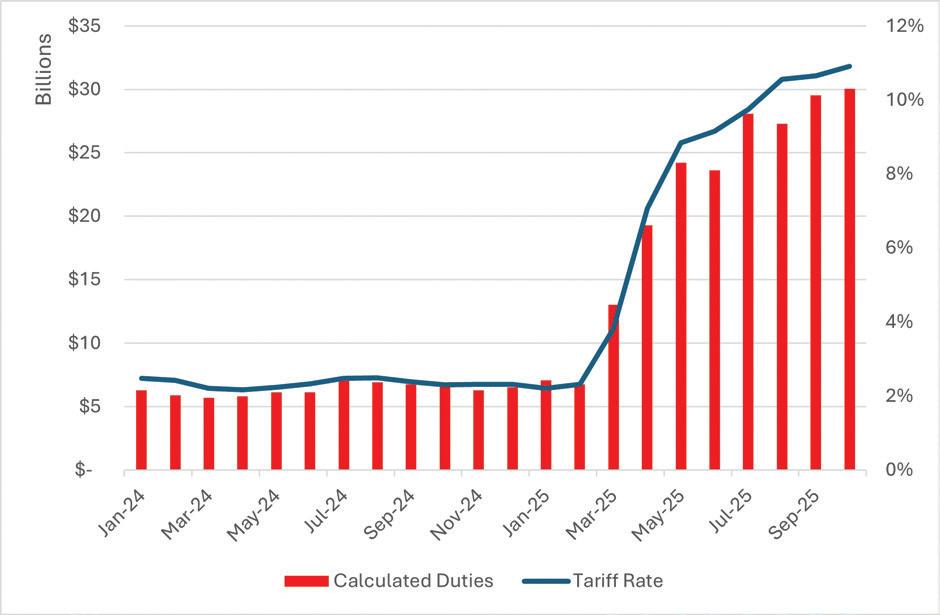
The tariff outlook has drastically changed over the past year, with the effective tariff rate skyrocketing from under 3 percent before President Trump’s inauguration to 28 percent post “Liberation Day.” It now sits at roughly
14 to 16 percent. The decline from the peak is due primarily to the pause of “Liberation Day” tariffs, which allowed for trade deals that solidified less drastic yet still elevated tariff rates.
The end of the trade war with China – which threatened tariffs of over 145 percent – alongside a few tariff exemptions for food products, semiconductors, and other imports, has also eased tariff burdens. Each of these trade policy alterations has caused tariff collection estimates, gross domestic product (GDP) growth projections, and household cost estimates to shift.
The day after “Liberation Day,” American Action Forum research put total annualized tariff costs at $366.5–391.6 billion. As of February 2026, this estimate sits around $237 billion. Factoring in other tariffs and proposals, this cost estimate approaches $284 billion annually, which is in line with the Bipartisan Policy Center’s current tariff tracker. Other tariff revenue estimates are included in Figure 2 (on the next page.)
Despite the range of estimates, there is consensus that U.S. businesses and consumers bear the vast majority of tariff costs and that 2026 will continue to see upward pressure on consumer prices as businesses pass on more costs. A recent study found that 96 percent of the tariff burden is being absorbed by U.S. businesses and consumers rather than foreign exporters, supporting past research from both The Budget Lab at Yale and the Harvard Business School. This means that U.S. taxes increased to the tune of $200 billion in 2025, counteracting the Trump Administration’s pro-growth deregulatory agenda and tax cuts. Furthemorer, 2025’s relatively mild inflationary figures are not indicative of tariffs having mild economic impacts, but instead point to other factors dampening their potency, such as low oil prices, higher productivity, and the gradual passthrough of tariff costs to consumers.
landscape. According to the Congressional Budget Office, real GDP growth projections for 2025 decreased from 1.9 percent in January to 1.4 percent in September, although 2026 estimates have increased from 1.8–2.2 percent. Notably, U.S. economic growth – at least in the first half of 2025 – is being increasingly driven by the artificial intelligence data center buildout and high-tech spending. The World Economic Forum estimates that 80 percent of the increase in final private domestic demand came from these two drivers.
Finally, there are signs that additional tariff costs passed onto U.S. businesses have resulted in a weaker labor market, especially for small businesses. Since “Liberation Day,” U.S. employment growth among small businesses has underperformed large businesses (in Figure 4 on page 11.)
A recent study found that 96 percent of the tariff burden is being absorbed by U.S. businesses and consumers rather than foreign exporters. This means that U.S. taxes increased to the tune of $200 billion in 2025.
Employment in firms with 1-19 employees fell by 62,000 while employment in firms with 20-49 employees fell by 122,000 throughout 2025, potentially as a result of cost-cutting measures. There are numerous reasons why small businesses are at a disadvantage in dealing with higher tariffs, one being they tend to have far more concentrated supply chains. Most small businesses rely on just one supplier and import a select few products, which prevents them from easily adjusting to changing tariff policies like larger firms that import from 50 or more countries.
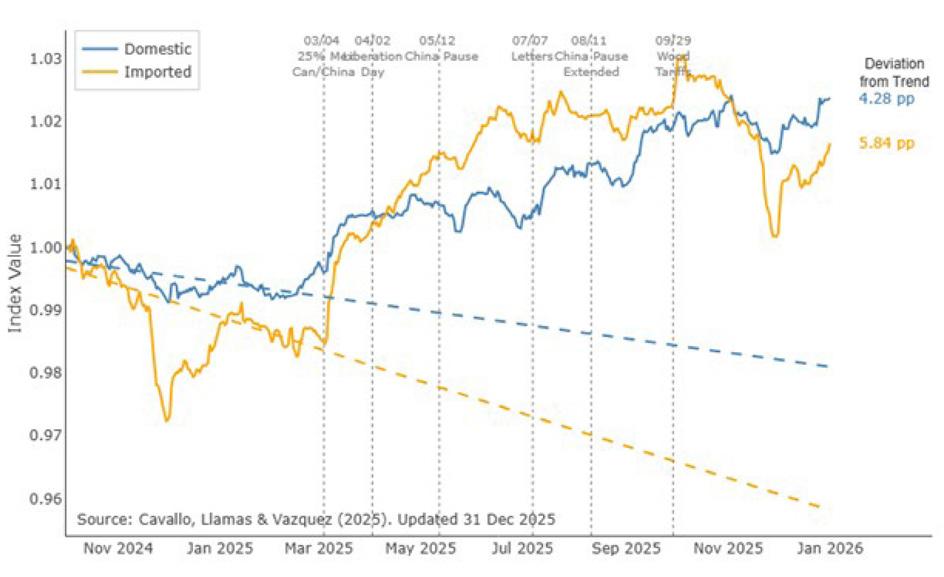
The tariff tax hike has had noticeable economic effects. First, tariffs reversed the downward trend in inflation for many goods categories, with the consumer price index remaining well above the 2-percent target. In fact, year-overyear inflation had declined from 3 to 2.3 percent between January and April last year but has since risen to 2.7 percent as of December. Additionally, four major retailers’ inflation trends were upended in the aftermath of tariff implementation as tracked by the Pricing Lab at Harvard in Figure 3 (on page 11). As a result, consumer spending on categories directly impacted by tariffs either stabilized or fell.
Second, U.S. economic growth projections contracted since January 2025 in response to the shifting trade
One recommendation for the Trump Administration would be to avoid conflating positive economic reports with tariff policy success. In many instances, tariffs have dampened the overall economic growth effects that stem from tax reductions and reduced regulatory burdens. It is in fact possible to achieve beneficial trade and investment agreements with other countries without maintaining burdensome import taxes. Lowering the effective tariff rate would remove much of the economic headwinds that are counteracting pro-growth policies.
At the very least, establishing greater certainty on the future of tariff policy is vital for businesses to plan accordingly. Furthermore, the constitutional authority to levy taxes lies in the hands of the legislative branch. If Congress has something to say about the negative consequences of tariffs, then it is time to legislate on the issue.

RF
Jacob Jensen is the Trade Policy Analyst at the American Action Forum.
Figure 1: U.S. EFFECTIVE TARIFF RATE AND CALCULATED DUTIES OVER TIME
Source: U.S. International Trade Commission
Figure 2: RANGE OF TARIFF REVENUE ESTIMATES
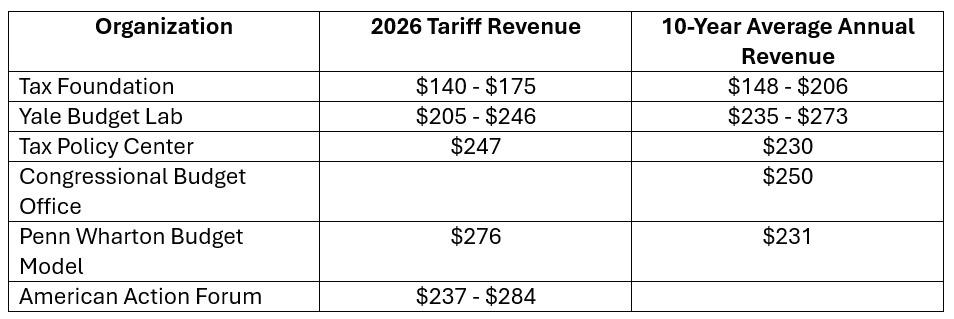
Figure 3: U.S. RETAIL PRICE INDICES WITH PRE-TARIFF TRENDS – DOMESTIC VS. IMPORTED
CHANGE IN EMPLOYMENT BY FIRM SIZE
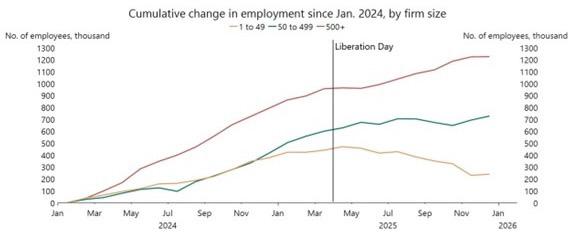
Source: Apollo Academy, Automatic Data Processing Inc.
by DAVID BECKWORTH
Inflation helped carry Donald Trump back to the White House. Running on the public’s frustration with the high prices of the pandemic era, he pledged to marshal the vast powers of the federal government to bring down the cost of living and end what he called America’s affordability crisis. So how has inflation fared under the Trump Administration over the past year?
The good news is that inflation appears anchored. The bad news is where it has settled: almost a full percentage point above the Federal Reserve’s 2 percent inflation target. Worse still, many households continue to view inflation as a major concern, shaped by the lingering trauma of the 2021–2023 inflation surge, the price effects of tariffs, and growing unease about the nation’s long-term fiscal outlook.
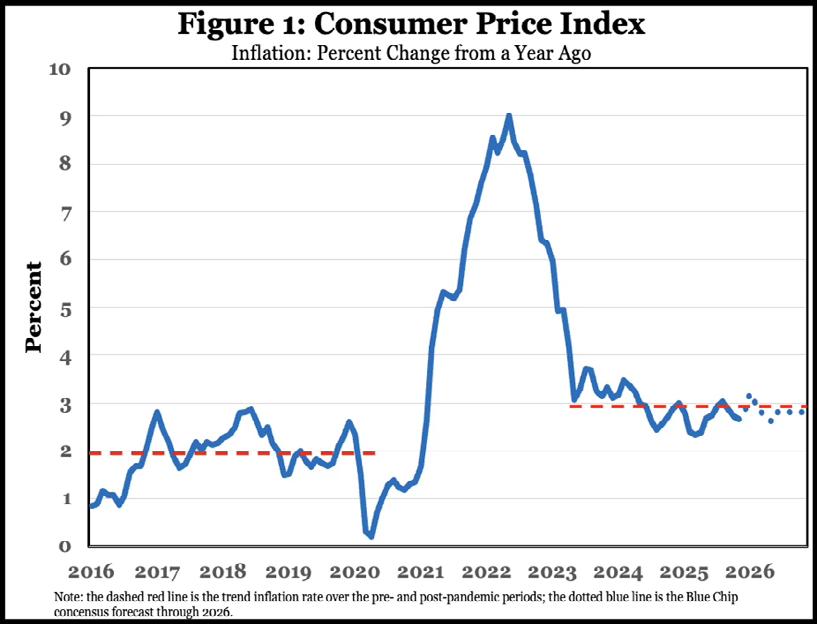
The inflation record underlying this assessment is summarized in Figure 1 (on next page). Prior to the pandemic, inflation averaged 1.9 percent from 2016 through 2019, as indicated by the left-hand dashed red line. Since stabilizing in mid-2023, inflation has averaged about 2.9 percent, a full percentage point above the pre-2019 trend. This elevated but stable outcome is widely expected to persist through 2026, as shown by the dotted blue line representing the Blue Chip consensus forecast. In this sense, President Trump has inherited and maintained an inflation regime that is meaningfully higher than what prevailed before the pandemic, raising the possibility that 3 percent has become the new 2 percent in terms of trend inflation.

David Beckworth
Prior to the pandemic, inflation averaged 1.9 percent from 2016 through 2019. Since stabilizing in mid-2023, inflation has averaged about 2.9 percent, a full percentage point above the pre-2019 trend.
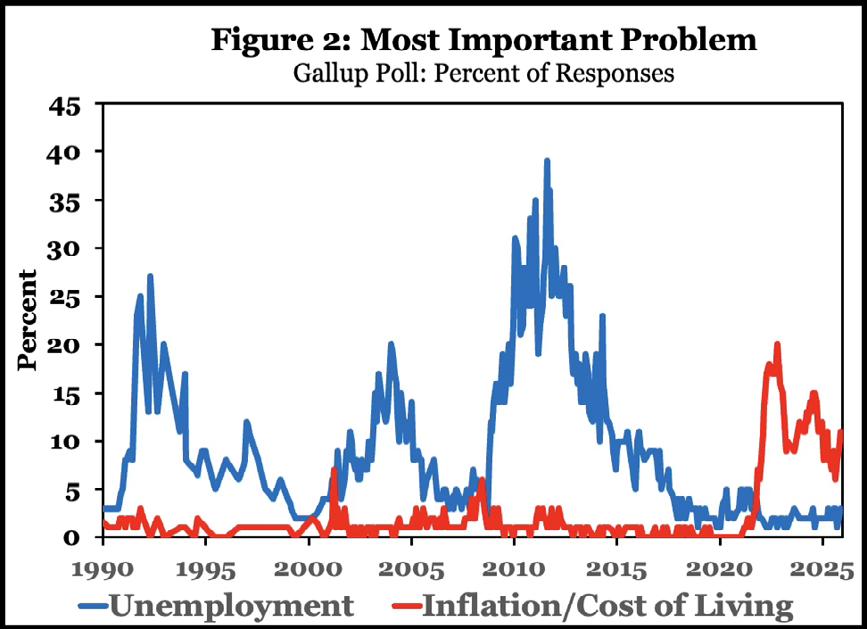
Households have taken notice of this apparent shift. As shown in Figure 2 (on page 14), inflation continues to rank as a more important problem than unemployment in Gallup polling, even though the economy is now four years removed from the peak of the pandemic inflation surge. Notably, inflation’s elevated salience breaks a three-decade pattern in which
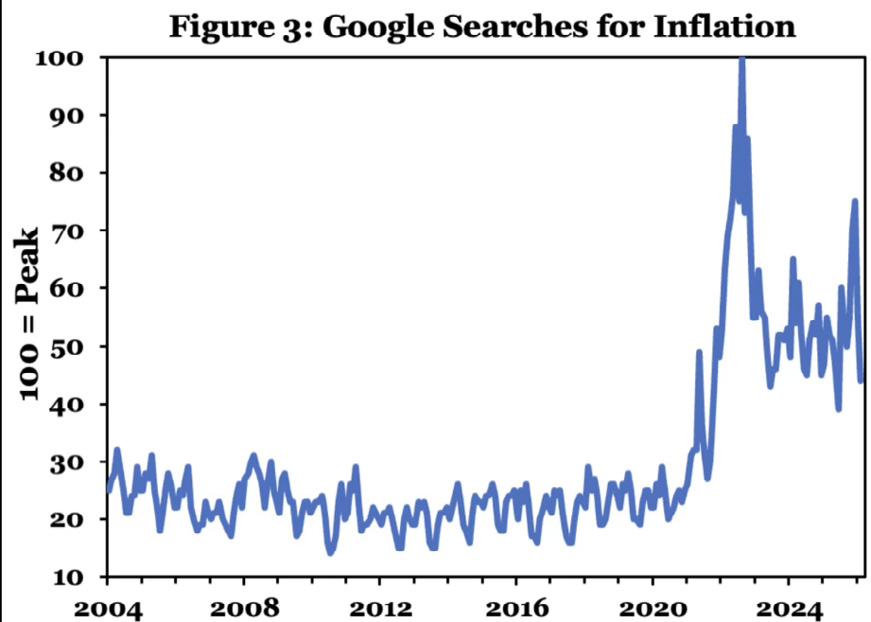
unemployment typically dominated public concern during economic expansions. Figure 3 (also on page 14) suggests that these worries extend beyond survey responses and into actual behavior. Google searches for inflation remain nearly twice as high as their pre-pandemic levels, indicating a heightened sensitivity to price changes. This heightened attention probably reflects both the scarring effects of the 2021–2023 inflation episode and the higher level of trend inflation households have experienced since mid-2023. Why, then, has trend inflation remained elevated? Some observers point to President Trump’s tariffs, which have raised the prices of imported goods. Federal Reserve Chair Jerome Powell, for example, argued at the January 2026 FOMC meeting that tariffs account for much of the recent above-target inflation and that their effects should prove transitory. That explanation, however, struggles to account for why inflation has remained persistently near 3 percent since mid2023.
Others argue that inflation remains elevated because the Federal Reserve failed to keep interest rates high for long enough to sufficiently slow spending and lower inflation. That critique cannot be dismissed out of hand, but a more compelling explanation, in my view, lies in the growing fiscal pressures now affecting the U.S. economy.
According to the Congressional Budget Office, federal deficits are projected to remain historically large over the next decade, pushing the public debt to near 120 percent of GDP. At the same time, higher interest rates have sharply increased the government’s debt-service costs, which the CBO expects to approach $2 trillion annually by the early 2030s. This deteriorating fiscal outlook increasingly constrains the environment in which monetary policy operates.
These developments suggest that fiscal dominance —
a situation in which fiscal conditions rather than the Federal Reserve’s inflation target increasingly shape monetary policy outcomes — may be on the horizon. Under fiscal dominance, the central bank may ostensibly pursue price stability, but in practice faces growing pressure to keep interest rates lower than would otherwise be necessary in order to contain government borrowing costs and preserve financial stability. Importantly, this pressure need not come in the form of formal interference or a loss of statutory independence. It can emerge more subtly, as political leaders and market participants begin to view monetary policy through a fiscal lens. President Trump’s repeated calls for the Fed to cut interest rates in order to reduce federal debt-service costs are a clear illustration of this shift, as are recent proposals in Congress to eliminate interest on reserves or loosen bank leverage rules so that financial institutions can absorb larger quantities of Treasury debt. Taken together, these developments suggest a growing risk that the Fed may tolerate somewhat higher inflation as the path of least resistance in an increasingly fiscally constrained environment.
Inflation continues to rank as a more important problem than unemployment in Gallup polling, even though the economy is now four years removed from the peak of the pandemic inflation surge.
The political irony is hard to miss. Donald Trump returned to office promising relief from inflation and the affordability crisis. Yet if fiscal pressures continue to mount, inflation may remain stuck above target — or even reaccelerate — just as voters head toward the 2026 midterm elections. In that case, the very economic issue that helped propel Trump back to the White House could once again shape the political landscape, this time not as a transient shock but as a symptom of a more deeply constrained inflation regime RF
David Beckworth is a Senior Research Fellow at the Mercatus Center at George Mason University and director of the Mercatus Center’s monetary policy program. He is the host of Macro Musings, a weekly podcast on macroeconomics, where, since 2016, he has interviewed hundreds of experts, including regional presidents of the Federal Reserve, Nobel laureates, and leading academics from around the world. He is the author of Boom and Bust Banking: The Causes and Cures of the Great Recession (Independent Institute, 2012).
by JARED WALCZAK
Among the 15 states with the fastest economic growth over the past decade, nine forgo at least one major tax — typically the individual income tax. Of the remaining six, five have a single-rate income tax, and all six have cut income tax rates in the past few years. Conversely, among the bottom 15 states for growth in gross state product (GSP), only one (Alaska) forgoes any major tax, though several other states have adopted tax reforms as they seek to escape the economic basement.
Similarly, nine of the top 15 fastest-growing states were ranked in the top third for “entrepreneurship and growth” by the Archbridge Institute in its Social Mobility in the 50 States Index, and many of the cities with the highest rates of economic growth have distinguished themselves with zoning and land use policies that facilitate rather than hinder new construction.
Americans have always been a people on the move, and that is especially true of the country’s innovators and job creators. The rise of remote work adds a new chapter to an old story for those making their way in the world: now, instead of following job opportunities, many have the option of letting the jobs follow them.
rules that let people get to work by assessing qualifications without unnecessary bureaucracy and delay; and with housing policies that recognize that the key to housing affordability and availability is to allow people to build.
Florida and Texas have long been overperformers, and their growth-oriented policies continue to attract those departing less competitive environments. But western states such as Utah, Idaho, and Arizona now routinely rank among the top in population growth, job creation, and investment, with southern states such as South Carolina, Tennessee, and Georgia also climbing. What is the secret to their success? What grand plan is paying off?

Among the 15 states with the fastest economic growth over the past decade, nine forgo at least one major tax — typically the individual income tax.
Employers, meanwhile, can locate in the cities and states they find most attractive with fewer concerns about the existing workforce, since many skilled workers can be hired remotely. (Many positions, of course, are always in-person, and these location decisions still matter greatly for local employment options.) Both individuals and businesses are better able to sort geographically on what matters to them.
People’s choices, as always, will reflect a mix of preferences, some outside policymakers’ control. But states can seize the moment with competitive, pro-growth tax codes; with regulatory environments that encourage rather than constrain innovation and expansion; with licensing
In many respects, it’s the deliberate absence of a grand plan. What unites them is a belief in unleashing the power of markets. Policymakers in these states have reformed their tax codes and delivered both individual and corporate income tax rate relief, prioritizing more neutral tax codes that avoid picking winners and losers, with low rates applied to broad bases. Notably, all six of these states cut income tax rates since 2021, sometimes multiple times. (In Tennessee’s case, the state eliminated its narrow tax on interest and dividend income, joining the ranks of states with no taxes on individual income.)
Some of the nation’s fastest-growing states have also made it easier to transfer regulatory licenses into their states, attracting workers who would be subject to lengthy recertification processes in other states. And they’ve adopted land use policies that encourage new construction while, for the most part, avoiding short-sighted property tax relief measures that shift tax costs to new construction.
If there’s one policy area that could trip up these fastgrowing states, though, it’s the property tax. Even with policies enabling new construction, dynamic economies
with rapid population growth yield significant increases in assessed values, which can easily translate into much higher property tax bills. Well-designed levy limits, which roll back rates in response to rising valuations, can keep taxes in check. Unfortunately, many policymakers are enticed by other policies that look good on paper, but “work” by shifting tax burdens to new construction and new homeowners. Those policies pull the rug out from under the rising generation and the skilled workforce states need to attract, even as the most growth-oriented states are setting out a welcome mat.
options than they did a decade ago, and are more empowered to move. People aren’t all looking for the lowest-tax option — they care about the overall cost of living and quality of life, and about schools, roads, and amenities — but states are in intense competition for increasingly mobile businesses and workers, and those that don’t realize it will pay a price.
What unites them is a belief in unleashing the power of markets.
Recent years have seen a sharp divergence between states prioritizing economic competitiveness and those focused on progressivity. On individual income taxes, for instance, the median top marginal rate is now below 5 percent — but policymakers in a few states are doubling down on high taxes, proposing rates above 10 percent. Voters in California, meanwhile, might approve a first-in-the-nation wealth tax this year.
Taxpayers have far more low-tax, low-regulatory-cost
State and city officials can’t move mountains, literally or figuratively. Utah officials can’t offer beaches and Florida lawmakers can’t deliver mountains.
But lawmakers in every state can reduce regulatory burdens, improve housing policy, and implement reforms to make the tax code more neutral and pro-growth. RF
Jared Walczak is a Senior Fellow at the Tax Foundation, where he spent five years as Vice President of State Projects, and president of Walczak Policy Consulting. He serves as a member of the faculty of the Institute for Professionals in Taxation, sits on the state tax advisory board of the Institute for State Policy Leaders, and contributes to Tax Notes State magazine.

by ROMINA BOCCIA
A year into President Trump’s second term, inflation may have eased , falling from 3 percent year-over-year in January 2025 to 2.7 percent in December, but the cost of living remains elevated for many households. This affordability challenge is the result of fiscal excess and politicized policymaking that have raised costs while undermining confidence in the U.S. economy.
Stabilizing purchasing power in 2026 and beyond will require rebuilding fiscal credibility, unwinding tariffs and other policy-driven price increases, and steering away from demandbased subsidies toward regulatory relief that allows supply to grow and prices to fall.
Current economic tensions are reflected in consumer sentiment. The Conference Board consumer confidence index has fallen for five consecutive months. While the University of Michigan survey showed a slight uptick in consumer sentiment in early February, the gains were concentrated among households with significant stock holdings, as ‘concerns about the erosion of personal finances from high prices and elevated risk of job loss continue to be widespread.’
Politicians, including President Trump, are taking note. And yet their prescribed solutions are mostly off base.
despite their effect of raising consumer prices.
Politicians seem more focused on reallocating costs or assigning blame rather than addressing the policies driving up prices.

Fiscal policy sits at the center of America’s affordability challenge. Massive pandemic-era spending, followed by a failure to restore budgetary discipline, left households coping with higher prices, rising interest rates, and uncertainty about the future. Persistent deficits above 6 percent of the gross domestic product, with federal interest payments now surpassing the entire defense budget, continue to reinforce those price pressures. When government spending grows far in excess of revenues and economic growth, the result is a rising debt burden, depressing the economy and increasing policy uncertainty that dampens confidence.
The Conference Board consumer confidence index has fallen for five consecutive months.
While politicians are taking note, their prescribed solutions are, unfortunately, mostly off base.
Proposals range from price controls and “ price gouging ” crackdowns to targeted subsidies , tariff dividends , and industry-specific relief (e.g. to farmers ), alongside attempts to claim that the affordability crisis is a “ hoax .” The administration is further doubling down on tariffs to pressure allies,
The Trump Administration has taken some steps that, in isolation, should support growth. The extension of lower marginal tax rates on work, saving and investment, through the One Big Beautiful Bill (OBBB), likely contributes to stronger economic performance . Deregulatory efforts have slowed the growth of federal rules and reduced compliance burdens in affected sectors, from energy to transportation and health care. These are welcome developments.
But pro-growth policies cannot deliver their full benefits when they are paired with actions that work in the opposite direction. The tariffs imposed over the past year have functioned as taxes on American consumers,
raising prices on a wide range of goods and inputs, offsetting many of the economic gains from recent tax legislation. Households are stretched thin by higher prices in grocery bills, housing, and childcare.
The administration is further undermining fiscal credibility with outsized spending increases for defense and homeland security in a deficit-fueling tax cut package, while adding political pressure to lower interest rates and risk higher inflation. Repeated attacks on the Federal Reserve , combined with the acceleration of large, unfunded entitlement commitments, have contributed to elevated long-term interest rates. Higher borrowing costs translate directly into more expensive mortgages, car loans, and credit-card balances, further eroding purchasing power.
Other policy choices reinforce the sense that economic outcomes are increasingly shaped by politics rather than fundamentals. Immigration restrictions have reduced labor supply in industries such as construction, agriculture, and caregiving, driving up costs in sectors that dominate household budgets. Industrial policy, from taking stakes in companies to favoring certain sectors , signals that success depends less on productivity and competition than on political access.
and distorts competition, public anger often targets businesses rather than the price-increasing policies at fault.
Sustainable affordability requires course correction. Fiscal restraint is essential. Slowing the growth of federal spending, stabilizing the debt, and restoring a credible commitment to budget discipline would ease pressure on interest rates and reduce uncertainty about future taxes and inflation.
Pro-growth policies cannot deliver their full benefits when they are paired with actions that work in the opposite direction.
Polling shows growing support for price controls. But this shift in opinion should worry policymakers not because price caps are sound policy — they are not — but because they reflect a loss of trust in the rules that make markets work. When policy constrains supply

Policymakers should also reverse the turn toward protectionism. Rolling back tariffs would provide immediate relief to consumers and businesses alike, lowering prices and improving the economy’s capacity to grow through competition and specialization. Free markets remain one of the most effective tools for raising real incomes and reducing prices through growing supply. America’s affordability problem is not a failure of markets, nor is it a “hoax.” It is the result of fiscal excess and politicized policymaking that have raised costs and undermined trust in economic fundamentals. Restoring purchasing power in 2026 will require recommitting to free markets, fiscal discipline, and policies that allow supply to grow and prices to fall. That is how policymakers can rebuild both affordability and confidence, without slaughtering the goose that lays the golden eggs: by allowing the market economy to work. RF
Romina Boccia is the director of federal budget and entitlement policy at the libertarian Cato Institute.
by JOSHUA MCCABE
With the passage of the One Big Beautiful Bill (OBBB) , Republicans are heading into the midterm elections eager to highlight their legislative accomplishments. Chief among them are the changes to the child tax credit — a focus that is both strategic and familiar. Since the 1980s, Republicans have successfully claimed ownership of pro-family policy, and the child tax credit has long been central to that identity.
The child tax credit traces its pre-history to the Reagan Administration. At the time, the tax exemption for dependent children was the primary tool for supporting working parents with the cost of raising the next generation. A prolonged period of high inflation under the Carter presidency had eroded the inflation-adjusted value of the exemption, leading to backdoor tax increases on middle class families. Reagan responded by increasing the value of the exemption and indexing it for the first time since the introduction of the federal income tax. Though controversial at the time, the move proved enduring — and became a defining element of his economic legacy, helping launch a pro-family renaissance within the GOP.

dependent exemption and child tax credit into one more generous credit and eliminated marriage penalties that had been built into the original child tax credit. For all its progress, the 2017 reform had one fatal weakness. While the dependent exemption had been indexed since Reagan, the child tax credit had never been indexed and remained that way in the wake of the new tax law.
The changes Republicans made to the child tax credit as part of OBBB marked the closing of another chapter in the credit’s long history. The new law increased the maximum credit from $2,000 to $2,200 per child and finally indexed this amount for the first time since the credit was introduced decades ago.
Joshua McCabe
Since the 1980s, Republicans have successfully claimed ownership of pro-family policy, and the child tax credit has long been central to that identity.
Soon after, Republicans shifted their focus to introducing a child tax credit as the “crown jewel” of Newt Gingrich’s Contract with America. Introduced in 1997, it quickly proved popular and the Bush Administration increased the maximum credit from $500 to $1,000 and made it “partially refundable” to expand access to more lowincome working families. Fast forward to 2017 and we can begin to see Republican efforts to close the loop on important family policy changes that began under Reagan. The Tax Cuts and Jobs Act consolidated the
The technical nature of the change eludes its importance. During the Biden presidency, middle-class families struggled to keep up with the surging cost of living. They were battered by years of high inflation that ate away at their paychecks and their tax refunds. The inflationadjusted value of the child tax credit dropped by 25% since the 2017 expansion. What Reagan did for the dependent exemption in the 1980s, Republicans did for the child tax credit in 2025 – reversing some of what was eroded by inflation and indexing it to ensure that inflation will never result in backdoor tax increases on middle class families again.
While this warrants a victory lap, it also raises the question of what is next for the child tax credit. The Family First Act , from Senator Jim Banks (RIN) and Rep. Blake Moore (R-UT), provides a useful north star for where Republicans should ultimately take the child tax credit. Their comprehensive overhaul would radically simplify the tax code for families by
consolidating a range of child-related tax benefits and expand access by phasing in the credit sooner so that more working families would be eligible for the full credit. Such an ambitious reform will require extensive education and outreach to gain broader support within the GOP. This will take time.
In the meantime, the bipartisan Stronger Start for Working Families Act , sponsored by Senators Todd Young (R-IN) and Maggie Hassan (D-NH), offers a sensible incremental answer. Their proposal would extend the credit to more low-income working families by allowing the credit to phase in starting with the first dollar of earnings, rather than requiring families to earn at least $2,500 before receiving any benefit.
full time at the state minimum wage while the other stays home to care for the kids — would see their work rewarded with a significant boost in their child tax credit . It builds on the longstanding American promise: that if you work hard and play by the rules, then you should be able to get ahead in life.
As congressional Republicans consider the next phase of the child tax credit in 2026, they would be wise to build on — and support — these efforts.
Pro-work, pro-family reforms like this have been a staple of GOP politics for decades. As congressional Republicans consider the next phase of the child tax credit in 2026, they would be wise to build on — and support — these efforts. RF
Under this approach, a married couple in Ohio with two young children — where one parent works
Joshua McCabe is the Director of Social Policy at the Niskanen Center. He focuses on issues related to child poverty and household stability. McCabe’s work has been featured in the Washington Post, the National Review, the Hill, and more.

Should the government intervene in the housing market?
Yes, Federal Programs are Necessary
by DENNIS SHEA
Millions of American families are struggling to find a home they can afford. In 2025, home prices rose more than 50 percent since 2020, with median sales prices topping $423,000, while rents increased nearly 30 percent. Nearly 43 million households—half of all renters and a quarter of homeowners—spend more than 30 percent of their income on housing, leaving little for essentials like food, child care, and health care. Even outside big cities, families in suburban and rural communities face steep costs that threaten economic stability and mobility.
The high cost of housing is drawing strong bipartisan attention in Washington, DC—and for good reason. The gap between housing supply and demand has grown steadily since the Great Recession, as the nation has “underbuilt” millions of homes. Restrictive local zoning and land use policies limit the types of homes that can be built and prevent greater housing density. Regulatory policies also increase construction costs: the National Association of Home Builders estimates that compliance adds 25 percent to a new single-family home and more than 40 percent to a multifamily property. Elevated mortgage rates have further reduced available inventory, as homeowners with lower rates stay put, locking in supply
growth relative to surrounding areas, demonstrating that local reforms can produce real results. These reforms must continue and spread to other communities to close the supply gap and make housing more affordable.
While cities and states are on the front lines in tackling America’s housing affordability challenge, the federal government also has a critical role. As a “supply-side” measure, the federal Low-Income Housing Tax Credit (LIHTC) has incentivized billions in private investment and helped finance 4 million rental homes that otherwise likely wouldn’t exist.

Dennis Shea
While cities and states are on the front lines in tackling America’s housing affordability challenge, the federal government also has a critical role.
Cities and states are responding. Many are reforming restrictive rules on lot sizes, parking, and singlefamily zoning. Others are easing restrictions on accessory dwelling units, manufactured homes, and modular housing, while streamlining permitting processes to speed construction. For example, Portland’s reforms allowing duplexes, triplexes, and small accessory dwelling units and Houston’s reduction of minimum lot sizes have led to measurable increases in housing supply and slowed rent
The recent One Big Beautiful Bill Act expanded LIHTC, which experts say will finance more than 1.2 million new affordable rental homes over the next decade. On the “demand-side,” the Housing Choice Voucher (HCV) program helps some 2.3 million families afford housing in the private rental market by closing the gap between rent and household income.
Federal legislation can also encourage local reform. The bipartisan ROAD to Housing Act, recently passed by the U.S. Senate, would reward states and communities that adopt prohousing policies. It would direct HUD to publish best-practice guidelines for zoning, create an Innovation Fund to reward communities adopting reforms like “as of right” approvals for missing middle housing, and link access to federal transportation and Community Development Block Grant funds to local housing actions. The bill also addresses federal rules that complicate housing construction—for example, by removing the permanent chassis requirement for manufactured homes and streamlining unnecessary environmental reviews for new housing construction in
(cont’d on page 24)
Should the government intervene in the housing market? No, Federal Programs are Ineffective
by ROGER VALDEZ
Housing in the United States is as simple as it is complicated. We know that when demand for housing, whether for purchase or rental, is high and supply is low, prices and rents go up. This is most painful for people who earn less money. But housing policy is not uniform. Thousands of local governments, zoning boards, planning committees, and housing offices and finance agencies, each with different values and agendas, determine our housing future. At the federal level, billions of dollars in subsidies create perverse incentives and inefficiencies. Efficiency is compassionate. Federal and state governments must take a more active role to reign in local excesses in spending and regulation.
The Low Income Housing Tax Credit (LIHTC) is a tax incentive created in 1986 originally to offset changes in depreciation rules in the tax code and to create incentives to build apartments. Over the four decades since the inception of the LIHTC, it has layered billions of dollars into multifamily projects using a complicated formula. Since 2001 cost burden in the United States has increased from 15 million households to 45 million households; that’s 30 million more households paying more than 30 percent of their gross household income after taxes on housing. That’s a 200 percent increase. Meanwhile, the LIHTC has increased as an expenditure by about 240 percent during the same period.
wide inflation of materials and labor, but are more attributable to the many rules, fees, requirements, and holding costs associated with the complexity of using LIHTC equity. And project-level data consistently show that soft costs, financing friction, compliance, and extended entitlement timelines also account for a disproportionate share of total per-unit cost in LIHTC developments.

These rising costs are due to market wide inflation of materials and labor, but are more attributable to the many rules, fees, requirements, and holding costs associated with the complexity of using LIHTC equity.
The cost of many LIHTC projects, particularly on the coasts, has risen up to $1,000,000 per rental apartment unit, enough to buy two or three singlefamily homes. These rising costs are due to market
Worse, when Congress adds more LIHTC expenditures, more ribbons are cut, and local officials can make zoning codes more restrictive, reducing supply, but can still point to LIHTC as the solution. The LIHTC ends up providing local officials something they can point to as progress while doing nothing to reduce zoning and land use codes that limit supply and push up the price of all housing which hurts people with less money the most.
Because of the Tenth Amendment, land use policy is left to states and local governments and the federal government has limited direct power over zoning and development regulation. Decades ago, the federal government tied highway funds to creating laws to raise the drinking age to 21. At the time, the states and local government had a patchwork of drinking ages. Within a short period, every state in the union had a 21 and over age requirement for consumption of alcohol. This seems counter to conservative instincts that tend toward local control, but standardization would reduce expenditures, normalize production, and create a better market economy for housing.
And preemption by state governments of local
(cont’d on next page)
(Valdez, cont’d)
rules and regulations is also often frowned on by conservatives and Republican legislators. But the landmark Dillon decision made it clear that states are the origin of local governmental units and their authority; legislatures created local government, and thus they have powers to limit local control. Why do this? Uniformity and predictability are good for business. When one jurisdiction imposes something like rent control, creating disincentives to build housing and operate it, then prices go up.
Producers of housing should be able to build whatever and wherever they can, provided what they build is safe and healthy, following the most basic science in the International Building Code.
Surrounding communities then feel the impact of people evading those high prices, then they see scarcity and high prices too. Those jurisdictions need more state resources for housing subsidies.
It really is simple. Producers of housing should be able to build whatever and wherever they can, provided what they build is safe and healthy, following the most basic science in the International Building Code (IBC).
Meeting the requirements of the IBC is complex
(Shea, cont’d)
developed areas. The bill also would encourage greater landlord participation in the HCV program by streamlining the cumbersome inspection process.
The U.S. House of Representatives is considering many similar reforms. The House Financial Services Committee recently endorsed the bipartisan Housing for the 21st Century Act by an overwhelming vote of 50 to 1. Like ROAD to Housing, this comprehensive legislation aims to improve housing affordability by streamlining regulatory requirements, modernizing existing housing programs, and expanding affordable housing finance options.
enough. Zoning, which is based on segregating uses and imposing aesthetic standards, is a 20 th century solution to a 19 th century problem, big industrial uses next to housing. That simply isn’t our problem in 2026, but lack of supply is. The Federal government can provide strong requirements for federal dollars conditioned on loosening and eliminating restrictive regulation and state governments can preempt local governments that choke housing supply with too many rules. We don’t need more affordable housing; we need more housing so that it is affordable. RF
Roger Valdez is the founder and Director of the Center for Housing Economics, where he researches, develops, and advocates for efficient and compassionate housing policies. The Center for Housing Economics also provides support to non-profits navigating the financing of affordable housing. He is from Albuquerque New Mexico and has a degree in Philosophy from the University of Puget Sound and a master’s degree in Religious Studies from the University of California Santa Barbara.
philanthropy. A sustained focus on improving affordability is essential because few aspects of our life are more important than housing. Families who can afford safe, stable homes are better able to invest in education, pursue job opportunities, and plan for the future. Access to an adequate supply of affordable homes is essential for employers seeking to attract and retain workers and for communities to grow sustainably.
An effective response to the problem of high housing costs requires an “allhands-on-deck” approach, involving all levels of government as well as the private sector and philanthropy.
Improving housing affordability is both a practical and economic imperative. By combining local reforms with targeted federal incentives, Washington can help ensure that every American has access to a home that supports their family, career, and economic future. RF
An effective response to the problem of high housing costs requires an “all-hands-on-deck” approach, involving all levels of government as well as the private sector and
Dennis Shea chairs the J. Ronald Terwilliger Center for Housing Policy at the Bipartisan Policy Center.

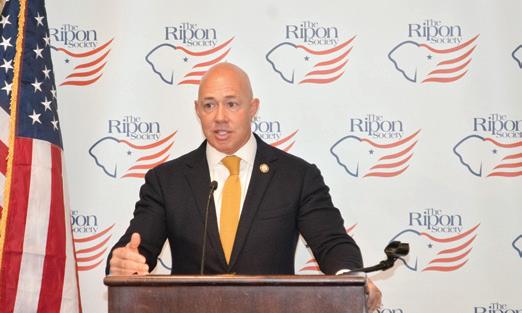
WASHINGTON, D.C. – In a speech on February 3rd before a breakfast meeting of The Ripon Society, House Foreign Affairs Committee Chairman Brian Mast (FL-21) said he believes that America is in the middle of an “AI arms race,” and that it is critical for the President and Members of Congress to do all they can to make sure that the chips that power artificial intelligence and other top U.S. technologies are not shared with China and other adversaries in the coming years.
“AI chips are essential to our national security and our military dominance, and anybody that is not treating them as such is missing something very, very important,” Mast said in remarks to open the discussion. “I don’t think Congress has any business telling our chip companies where to sell their products – full stop. But for the fact that it’s not kids playing Halo on Xbox – that’s not what we’re talking about here. We are talking about real warfare, real casualties. This is about present day and the future of warfare. It’s about real military strategy.”
these drones like a swarm of killer bees. The swarm working together is the great capability, not the individual bee. It’s that swarm working together that makes it so deadly.
“AI is being used across the board for intelligence and reconnaissance. As we speak, analysts are using AI to identify targets, translate audio and text in real time, look at battlefields, look at where there are landmines, aircraft tanks, and
“Nuclear deterrence requires operating under the enemy’s radar to deliver a decisive strike at a moment’s notice. What does AI calculate? It calculates the ability to deliver that decisive strike. But for our enemies, it’s them calculating where are the gaps in America’s defenses? Where do we have our high tactical, highaltitude area, defense systems? Where do we have Patriot batteries? Where can we defend something and where can we not defend something? That’s what they have the ability to calculate against us. All of these capabilities are powered by AI chips. I can tell you personally, I would not sell a fighter jet to China. I would not sell them an Abrams tank. And we need to be thinking very seriously before we consider selling them any of our most advanced chips.”
“I would not sell a fighter jet to China. I would not sell them an Abrams tank. And we need to be thinking very seriously before we consider selling them any of our most advanced chips.”
Brian Mast, Remarks to The Ripon Society, February 3, 2026
“Look at Russia and Ukraine’s weapon systems. Today, the battlefield is dominated by thousands of attack drones operating in coordination with one another. And in many cases, these drones operating in coordination with one another are acting totally autonomously. How does that happen? That happens because of chips and AI and this frontier of the battlefield. Think about what they’re doing with
other things as they’re moving, where they could move, where they need to refuel, everything about the supply chain. That is what’s being analyzed at the most rapid pace and then being fused from multiple sources of intelligence all together at once. Those are the stakes of what’s going on. Think about it when we look at our nuclear submarines, probably the most advanced piece of military hardware anywhere on the globe.
To that end, Mast said he has introduced legislation that is aimed at keeping U.S.-made chips and other top technologies out of the hands of the Chinese military and other adversaries around the globe. The bill is called The AI Overwatch Act. Introduced in December, the legislation would ensure that Congress has oversight over the sale of advanced AI chips to adversary nations, just as it does with arms sales. The bill would also accelerate exports of American AI to allies and partners.
“It is modeled after what we already do with foreign military sales,” the Florida lawmaker said of the legislation. “The bill uses the exact same principle that when an export shifts America’s military advantage, Congress needs to have that oversight. I think we can all agree that we are in an AI arms race.” RF

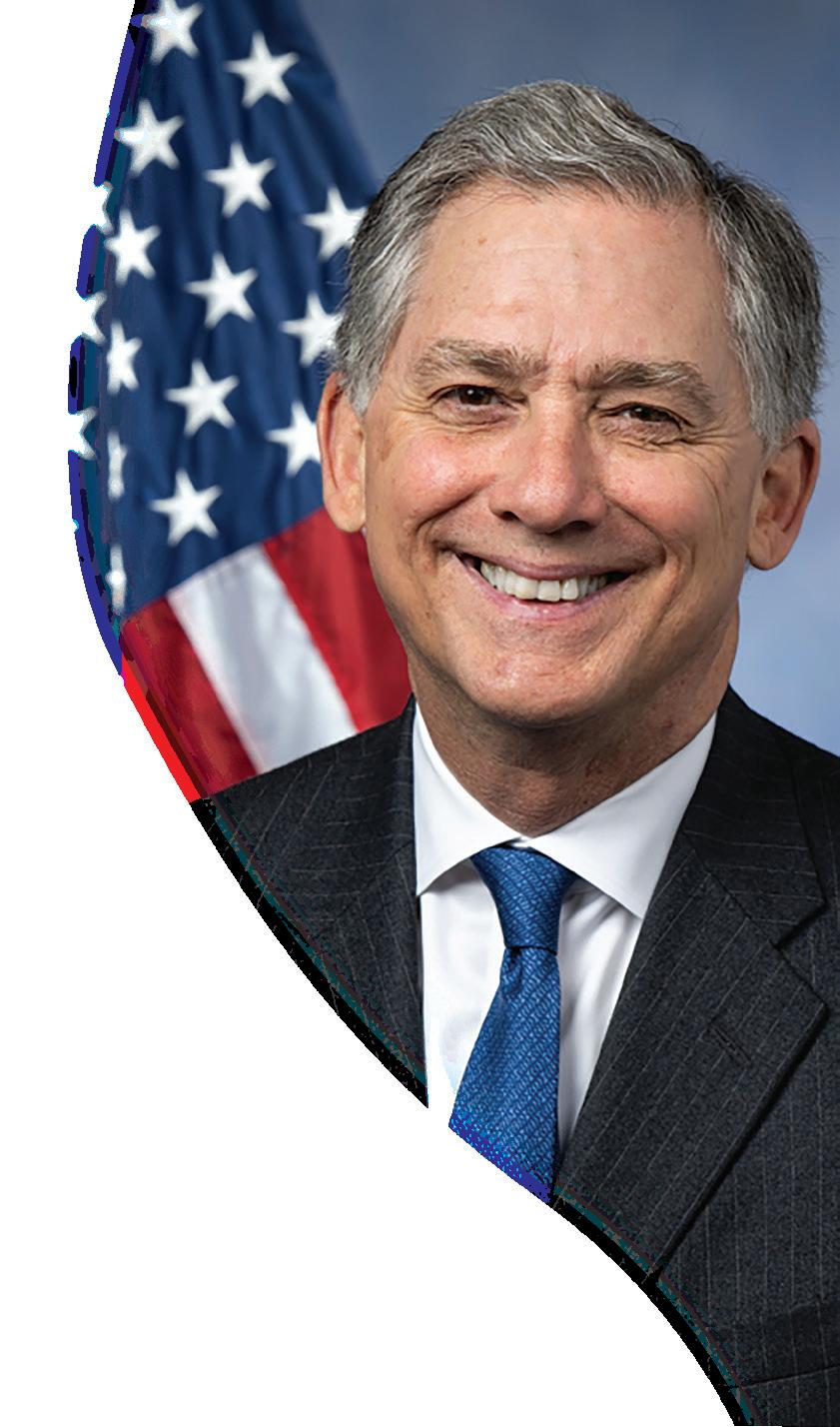
Occupation: Representative for Arkansas’s Second Congressional District; Chairman of the House Financial Services Committee
Previous Positions held: Staff of then-U.S. Senator John Tower (R-TX); staff of the U.S. Senate Committee on Banking, Housing, & Urban Affairs. Deputy Assistant Secretary of the Treasury for Corporate Finance for President George H.W. Bush; Executive Secretary to the President’s Economic Policy Council. Worked in investments and banking for three decades, including founder, Chairman, and Chief Executive Officer of Delta Trust & Banking Corporation.
As Chairman of the House Financial Services Committee, what’s one of the Committee’s top priorities, and how does it help Americans? During my first year as Chairman, our Committee has done exceptional work in strengthening our capital markets, addressing affordable housing, prioritizing community banking, and creating a market structure for digital assets. I’m proud of the work our Members have done and look forward to continuing to push forward these pieces of legislation into law.
Your father and grandfather were both bankers. What lessons did you learn from them that guide you today? My paternal grandfather had formed an investment brokerage and banking company in 1933, in which my father joined him in the late 1950s. I learned so much from them, including the value of long-term investing, the critical power of compound interest, and the importance of serving your community. I wouldn’t trade the financial literacy or the love of country that they instilled in me.
My mother’s father of Petersburg, Virginia was a commercial banker. In fact, during FDR’s “bank holiday” in 1933 —the same year Jay started Hill-Vinson & Co. — He was appointed by U.S. Comptroller of the Currency as conservator of one of the closed banks in Virginia.
With those financial genes on both sides of my family, my involvement in financial services was inevitable!
You’ve served in Congress for over a decade now. How has your approach to governance evolved, and what’s remained constant? My governance approach is anchored by identifying key partners in the Executive Branch and in the Senate for my priorities here in the House. I always encourage new members who have a legislative priority to identify and build a relationship with a Senate partner who can introduce companion legislation. and, to seek technical assistance from experts inside the relevant Executive Branch agency.
Finally, what one bill or initiative would you most like to see Congress pass for your constituents? Over the past decade, I’ve worked with the U.S. Forest Service and local stakeholders in my congressional district to add select U.S. Forest Service land to the Flatside Wilderness in the Ouachita National Forest. Successfully seeing my Flatside expansion signed into law by President Trump will be a real highlight for 2026.

mission-critical one to date.
With ~31,000 public safety agencies and organizations harnessing the network, and ~3 million square miles covered, FirstNet is the largest network for public safety and the only network built with and for first responders.
To learn how we’re supporting public safety across America, visit attconnects.com
AT&T is proud to support the Ripon Society and their mission to advance ideas and principles that help keep our nation secure.
We’re building the 5G Economy, community by community.
America boasts the world’s leading 5G networks, covering more than 330 million Americans and counting. These networks are driving our economy, creating jobs and enabling the industries and innovations of the future. They’re also bringing real competition to cable - for the past the past three years 99% of new home broadband customers chose 5G. The 5G Economy will create 4.5 million new jobs and generate $1.5 trillion in economic growth during this decade, according to Boston Consulting Group.
CTIA is proud to support the Ripon Society.