
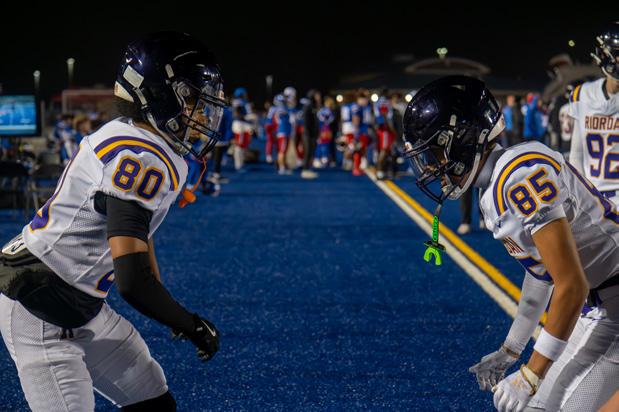

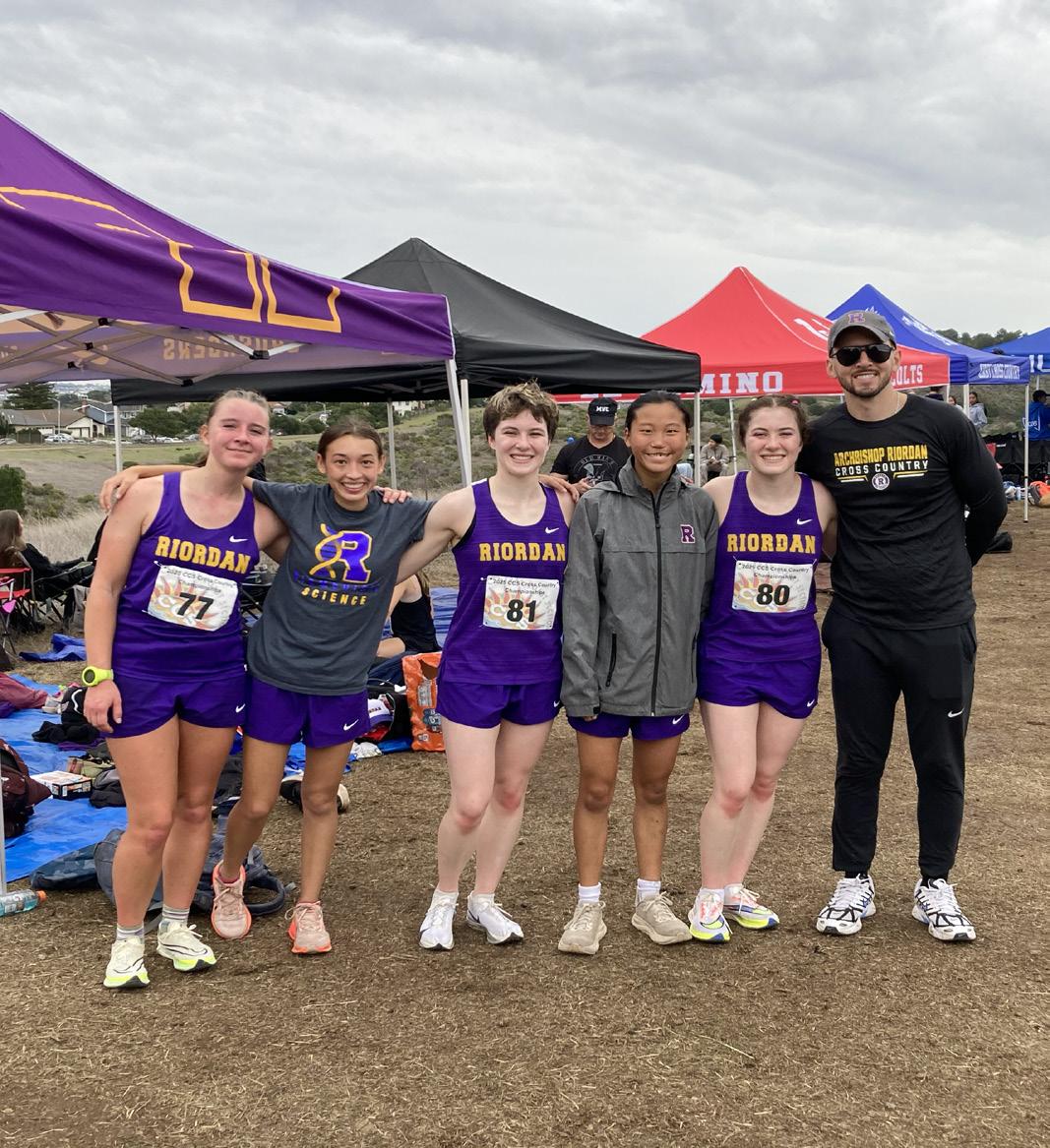
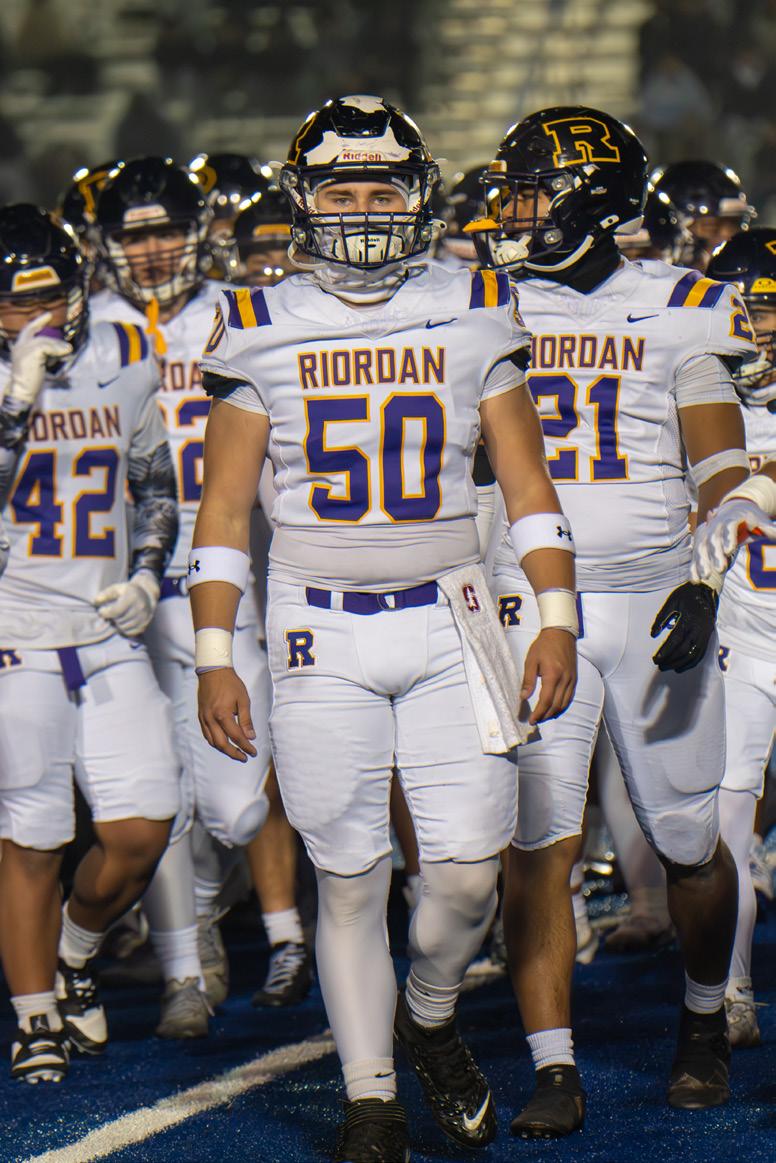
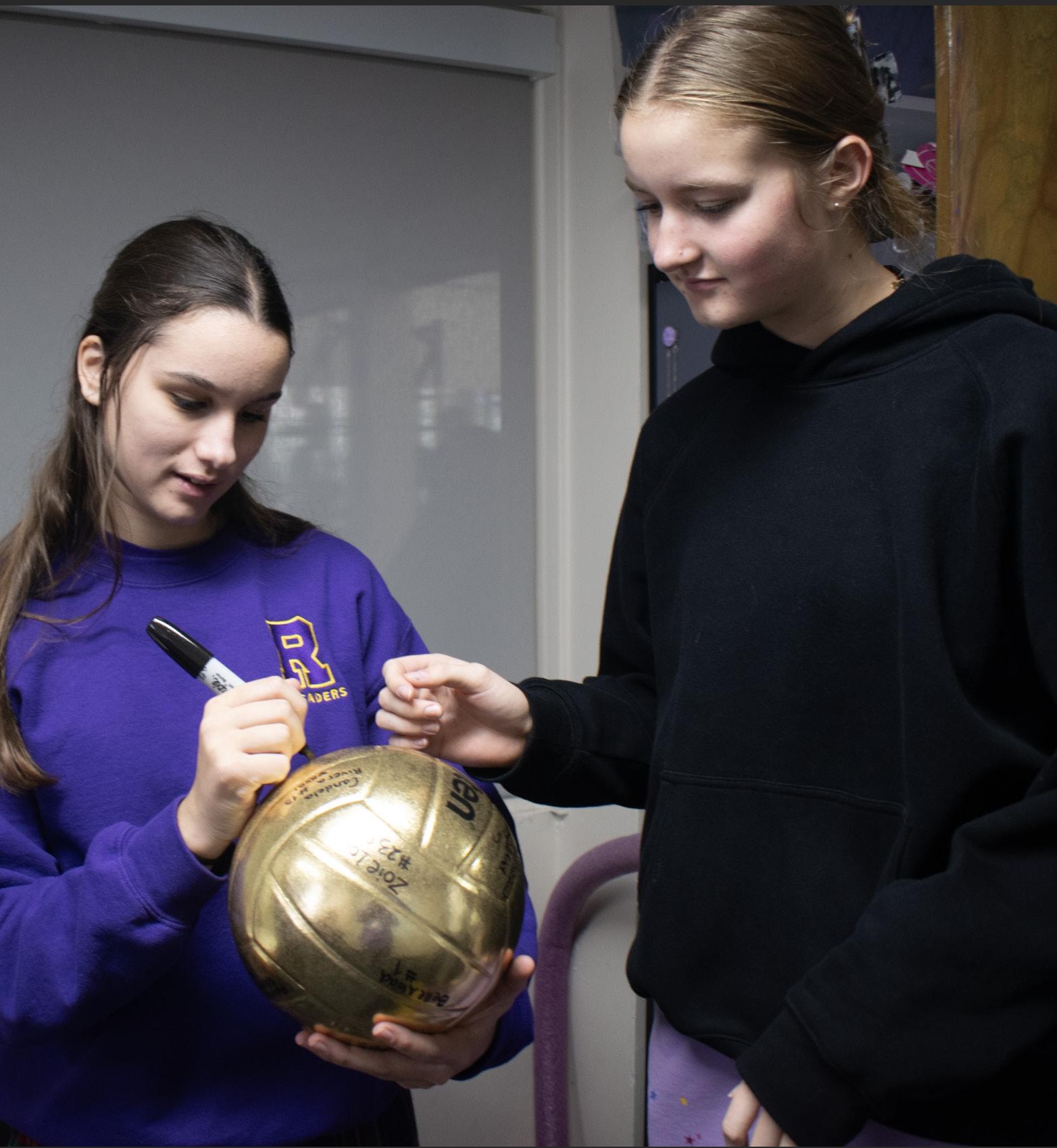
Archbishop Riordan’s girls cross country team qualified for CIF State Cross Country championship for the first time in school history, solidifying their status in sports.
For an in-depth look at Crusader Sports, please turn to pages 18-19.
By Ishaan Gupta ’26
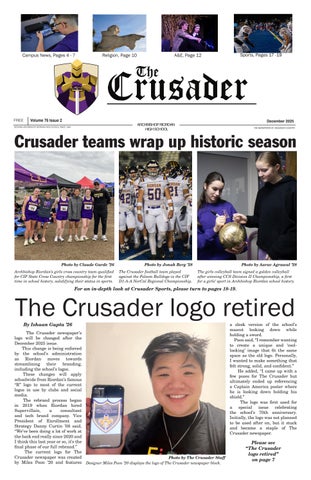
The Crusader newspaper’s logo will be changed after the December 2025 issue.
This change is being enforced by the school’s administration as Riordan moves towards streamlining their branding, including the school’s logos.
These changes will apply schoolwide from Riordan’s famous “R” logo to most of the current logos in use by clubs and social media.
The rebrand process began in 2019 when Riordan hired Supervillain, a consultant and tech brand company. Vice President of Enrollment and Strategy Danny Curtin ’08 said, “We’ve been doing a lot of work at the back end really since 2020 and I think this last year or so, it’s the final phase of our full rebrand.”
The current logo for The Crusader newspaper was created by Miles Poon ’20 and features
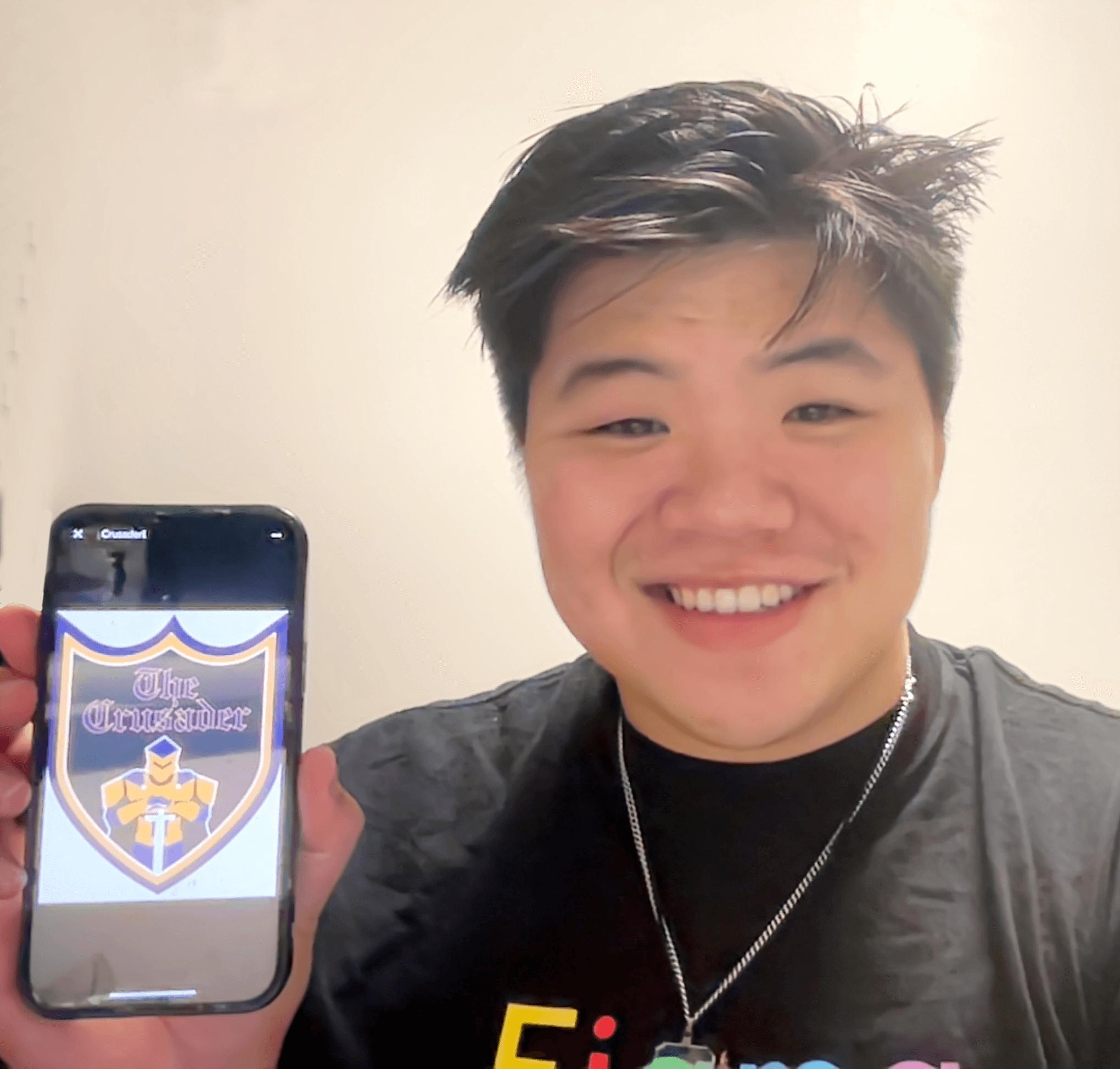
a sleek version of the school’s mascot looking down while holding a sword.
Poon said, “I remember wanting to create a unique and ‘coollooking’ image that fit the same space as the old logo. Personally, I wanted to make something that felt strong, solid, and confident.”
He added, “I came up with a few poses for The Crusader but ultimately ended up referencing a Captain America poster where he is looking down holding his shield.”
The logo was first used for a special issue celebrating the school’s 70th anniversary. Initially, the logo was not planned to be used after on, but it stuck and became a staple of The Crusader newspaper.
Please see “The Crusader logo retired” on page 7
By The Editorial Staff
With the impending arrival of the spring semester, The Crusader newspaper faces a change that few of us asked for and even fewer are ready to embrace. After nearly five years with the same logo, the Riordan administration has decided to retire it because it no longer fits the school’s marketing vision. The Riordan administration has requested that every single Riordan club change its logo, as part of a bigger plan to update the school’s image.
Our current logo was designed by former student Miles Poon ’20, a feat that was no small matter, and one that took both effort and creativity. This logo represents five years of hard work, awardwinning coverage, and a wellestablished brand. It pictures a Riordan Crusader, solemnly displaying strength while holding a sword in both hands in the downward position, representing peace.
The original intent of this logo change was to bring back a modernized version of Riordan’s logo from the early days of the student newspaper.
In the original, a horse is the main aspect, with a Riordan Crusader riding above it, sword towards the air as if ready for battle.
The logo change has seen mostly negative reviews; however, the decision of the administration will still be respected. While it’s hard to accept, their thought process of updating a logo for a studentrun newspaper is intended to be forward thinking, but it is indeed
Mission Statement for the Archbishop Riordan High School Newspaper
unwanted. While it shows that our newspaper is so impactful that it is selected for change, this is not what The Crusader needs.
The new school logo is definitely a testament to tradition; however, it does not reflect our current identity of what The Crusader is today. This issue isn’t about particular style preferences that may cause mixed reviews, but rather the larger concern is about
The mission of The Crusader is to inform, educate and entertain the readers— students, teachers, parents, members of the community—about issues that affect the students as well as citizens of San Francisco and the nation. We hope to instill a sense of understanding, responsibility, and curiosity in our readers that results in an eagerness to learn more about their peers and the world around them.



175 Frida Kahlo Way
San Francisco, CA 94112
RCrusaderNews.com
RCrusaderNews@riordanhs.org
Editor-in-Chief
Daniella Lainez ’26
Managing Editor
Ishaan Gupta ’26
Opinion Editor
Keira Wallace ’26
Campus News Editors
Emmanuelle Ng ’26
Hailey Ferrer ’26
Local & State News Editor
Erin Quan ’26
National & World News Editor
Rachel Gerke ’27
Boys Sports Editor
Miles Witte ’27
Girls Sports Editor
Emilia Ross ’26
Sports Features Editor
Isaiah Sanchez ’26
Arts & Entertainment Editor
Ciarra Mangibuyat ’27
Environment Editor
Vincy Huang ’27
Religion Editor
Logan Dee ’26
Health Editor
Isabelle Abad ’26
Science Editor
Joshua Lee ’26
Business & Technology Editor
Isabella Thumas ’26
Features Editor
Lorelai Keating-Curran ’27
Food Review Editor
Loghan Hwang ’27
Photo Editors
Loghan Hwang ’27
Ethan Ly ’26
Copy Editors
Aarav Agrawal ’28
Rose Baik ’26
Chloe DeCastro ’26
Hazel Nagata-Rampata ’26
Graphic Artists
Ivonna Tan ’29, Lindsey Yeh ’29
the loss of identity.
When we were notified of this change in October, we were informed that a team of students would be invited to work with the marketing team on the new logo, and we look forward to this process as it honors the voice of the students, which is what scholastic journalism is truly about.
Change itself is not the problem. Like all things, newspapers evolve, and student journalism thrives when new ideas emerge. While it saddens us, the prospect of future collaboration for a new logo is encouraging. The Crusader has earned its credibility through our voices and collective visions, and this will continue.
The current logo is more than a design placed at the top of a page. For five years, it has heralded milestones in school history such as the coed transition, COVID, many Riordan “firsts,” and championships. It is a symbol of consistency and a brand that Riordan students built by themselves. While the logo we hold close to our hearts will disappear, the spirit and strength of what it represents will live on.

Reporters and Photographers
Alyssa Abaunza ’26
Avery Agbunag ’26
Adriana Alvarado ’26
Julian Amann ’26
Katherine Baez Orellana ’26
Robert Bennett ’27
Jonah Berg ’28
Kaia Burris ’27
Miguel Cardenas ’27
Sasha Feliciana-Chan ’26
Mikayla Cheng ’26
Arim Choi ’26
Lucia Federico ’29
E’moni Ferdinand ’26
Delaney Flanagan ’26
Jordyn Flores ’27
Derrill Floyd ’27
Isabel Fonseca ’27
Lainey Gerke ’28
Henry Godwin ’27
Jude Kopping ’27
Alessandra Leon ’26
Lily Lincoln ’28
Grace Longaway ’27
Ivana Maldonado ’26
Exchange Editor
Ashling Greene ’26
Reporters and Photographers
Rhianna Mallory ’26
Isaac Martin ’26
Miki Maloney ’26
Isaiah Mateo ’26
Tyce Morrison ’27
Elliott Ng ’28
Matthew Nicolas ’29
Collin Noguera ’27
Sara Noguera ’27
Martin Novoa ’26
Aliyah Pasion ’26
Sofia Peña ’26
Elise Robinson ’28
Catherine Rold ’27
Natalia Sanchez ’26
Sofia Sarracino ’27
William Saunders ’26
Aiden Sommerfield ’28
Logan Tuman ’26
Oscar Wadsworth ’26
Elizabeth Walsh ’26
Crystal Wei ’26
Luna Weng ’28
Bernice Yeung ’28
Charlottie Yip ’26
Adviser
Susan Sutton, MJE
Letters to the editors will be accepted with the same deadlines as ads. These letters may come from students, staff, parents, board members, or other members of the community. The Crusader reserves the right to edit the letter for grammatical and spelling errors, as well as length, but not content unless it includes foul language, plagiarized material, or libelous content. If the claims or assertions are incorrect, The Crusader reserves the right to refuse publication of the letter.
By Oscar Wadsworth ’26

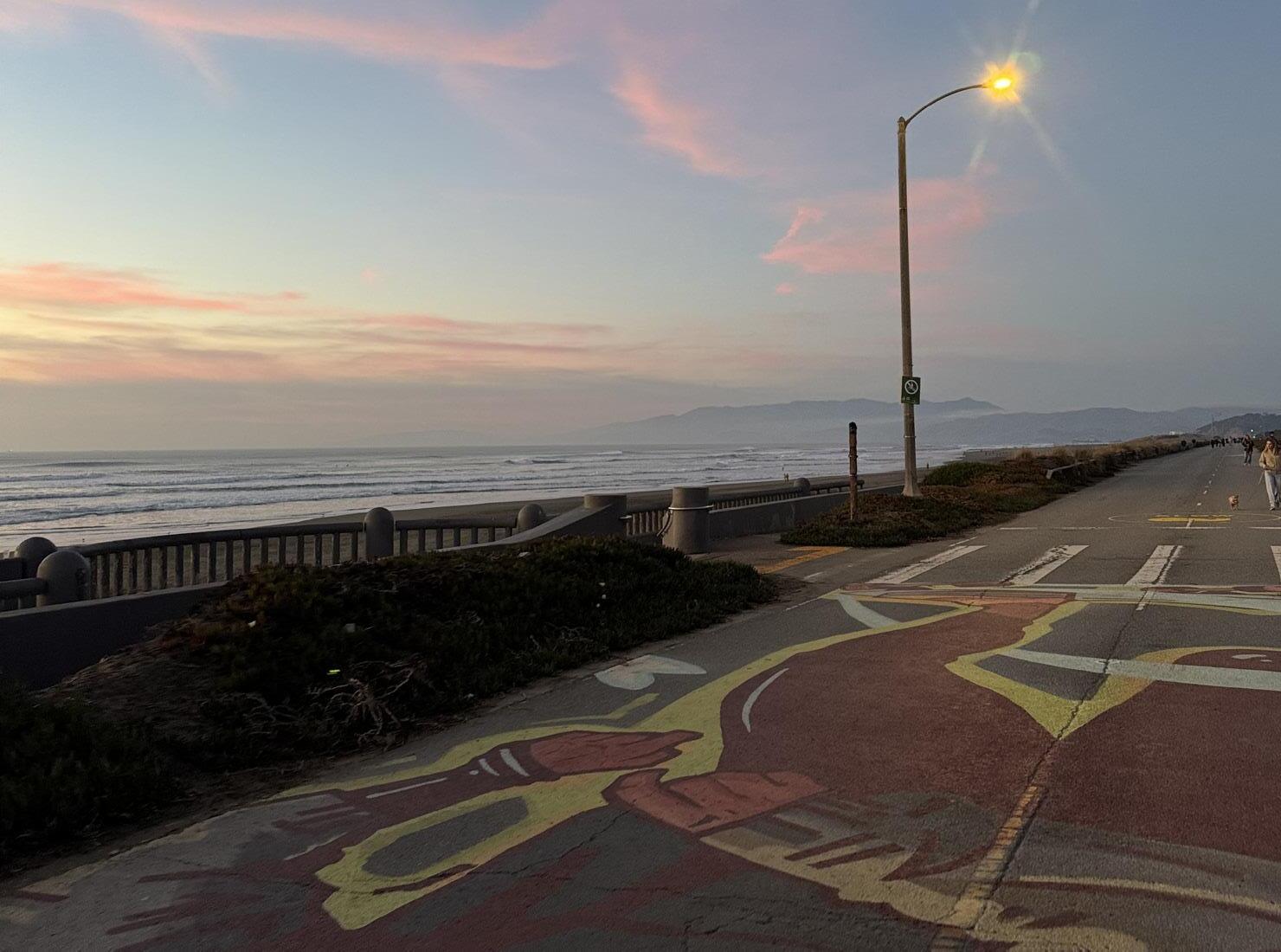
The Great Highway shutting down and becoming a walking park is one of the coolest things that has happened in recent city history.
Sunset Dunes is one of the new cornerstones of San Francisco. Being a resident of the Sunset, I believe that it is a great new addition to the neighborhood.
Having it available attracts new people to the Sunset and makes Ocean Beach an even more popular destination for San Franciscans. During COVID, we got a taste of what a closed Great Highway could bring, and it was a huge success. It brought tens of thousands of people to Ocean Beach and what would be Sunset Dunes.
Every day, many residents flock to the highway to either walk dogs or jog, and with the new addition of tables and benches, work by the beach.
As a real highway, the maintenance caused it to be closed more often than not, and closing it was the only logical solution.
Although there is certainly backlash due to The Great Highway being a main commuter road from the Sunset neighborhood to Skyline Boulevard, and from there to 280. According to SF Gate, there is a group of Sunset residents who have begun to
change their minds on the results of Prop K.
People have been saying that the traffic that was promised by haters online just isn’t there. Also, there are plenty of activities and things to do for families while in the park.
Living by the park, it is easy to see the community it has fostered and continues to grow. Sunset Dunes was a great decision, and I am proud to live next to it and use it almost daily.
Overall, Sunset Dunes was a project that began with plenty of opposition; however, slowly but surely, it has turned into a success, and it will continue to grow and expand as time goes on.

By Henry Godwin ’27
The Great Highway being turned into a walking park is the greatest mistake in San Francisco’s history.
The Great Highway was the primary highway to get from Highway 1 to the Sunset neighborhoods. It was an important aspect of traffic diversity in the Sunset. Now, all traffic north and south has to go through residential neighborhoods with four-way stops the entire way.
The other way to get around the Sunset is Sunset Boulevard; however, it is an out-of-date and slow traffic funnel that cannot easily accommodate large amounts of traffic and is prone to large traffic jams. Especially due to it not being on a different level as residential traffic, this forces Sunset Boulevard traffic to come to a stop to allow east/west traffic to pass by.
An interesting point in the voting analytics is that most people who voted to change The Great Highway to a park don’t actually live in the Sunset and would not be affected by the traffic. If only people who lived in the Sunset voted, it would have been shot down almost immediately.
Because the voters in the Sunset were overwhelmingly against the permanent park, citing traffic as a main concern, the vote should have been open only to residents of the Sunset.
Sunset residents were so infuriated by former Supervisor Joel Engardio’s support of closing The Great Highway that they mounted a successful recall effort against him, and he was voted out of office.
While it may not be feasible to completely wipe out Sunset Dunes and return the area to solely vehicles, a compromise is to open it to traffic during the week and keep it as a park on the weekends. This way, the area will serve two purposes: functionality and entertainment.
By Daniella Lainez ’26
After weeks of bipartisan ping pong played across lines of agreement and compromise without resolution, a government shutdown ensued.
On Oct. 1, without a budgetary agreement for a spending bill, the federal government shut down. What was meant to address overspending in order to ensure the maintenance of vital programs dissolved into disorderly chaos that immediately targeted the country’s most vulnerable and fundamental pillars of domestic functioning.
Who did this affect? At-risk families, such as pregnant women and children who rely on WIC, (Women, Infants, and Children’s) nutritional supplement programs.
Low-income families that depend on SNAP (food stamps), which affect in excess of 42 million households. Other sensitive populations that were affected included Americans with disability benefits and veterans.
While Democrats and Republicans held a stalemate to flex their political positioning
around the need for spending to ensure America’s most vulnerable and vital programs remain intact, they directly and immediately compromised them.
While the United States continues to flounder with an
overwhelming number of needs, politicians engaged in a rudimentary schoolyard game of chicken to address complex, urgent budgetary demands. If the issue is overspending, then review what is spent and make it more
efficient. Fight each other with innovative ideas, creative planning, revisions in productivity, and effectiveness. It should not go unnoticed that Congress members on both sides of party lines continued to collect their paychecks during the shutdown, as they receive constitutional protection to be paid by the U.S. Treasury.
While federal employees were asked to continue to show up for work to keep the country’s infrastructure running, politicians continued to be compensated for stubborn indecision.
There have been federal shutdowns in the past, ranging from one day to 34 days in 2019, but the recent shutdown surpassed 43 days.
The United States is already raw and fatigued by the recent challenges of a pandemic, civil unrest, and the cost-of-living increases.
The Republicans and Democrats’ willingness to engage in rogue children’s play has shown the country that they are tone deaf and disengaged from the heartbeat of America.
By Catherine Rold ’27
Over the past five years, Archbishop Riordan became the fastest growing Catholic school in the United States.
Additionally, according to both schools’ population reports, it has become the second largest Marianist high school in the United States, just five students away from Chaminade College Preparatory School in Los Angeles.
The reason for this increase can be attributed to many different areas, including academics and athletics, but mainly the spirit at Riordan.
This massive rise in admissions has greatly affected every part of the Riordan community, and many of these effects are easy to see.
While the hallways and classes have gotten more crowded, many believe that this change is for the better.
“It’s given a lot more space for leadership and other clubs and parts of the community to grow,”
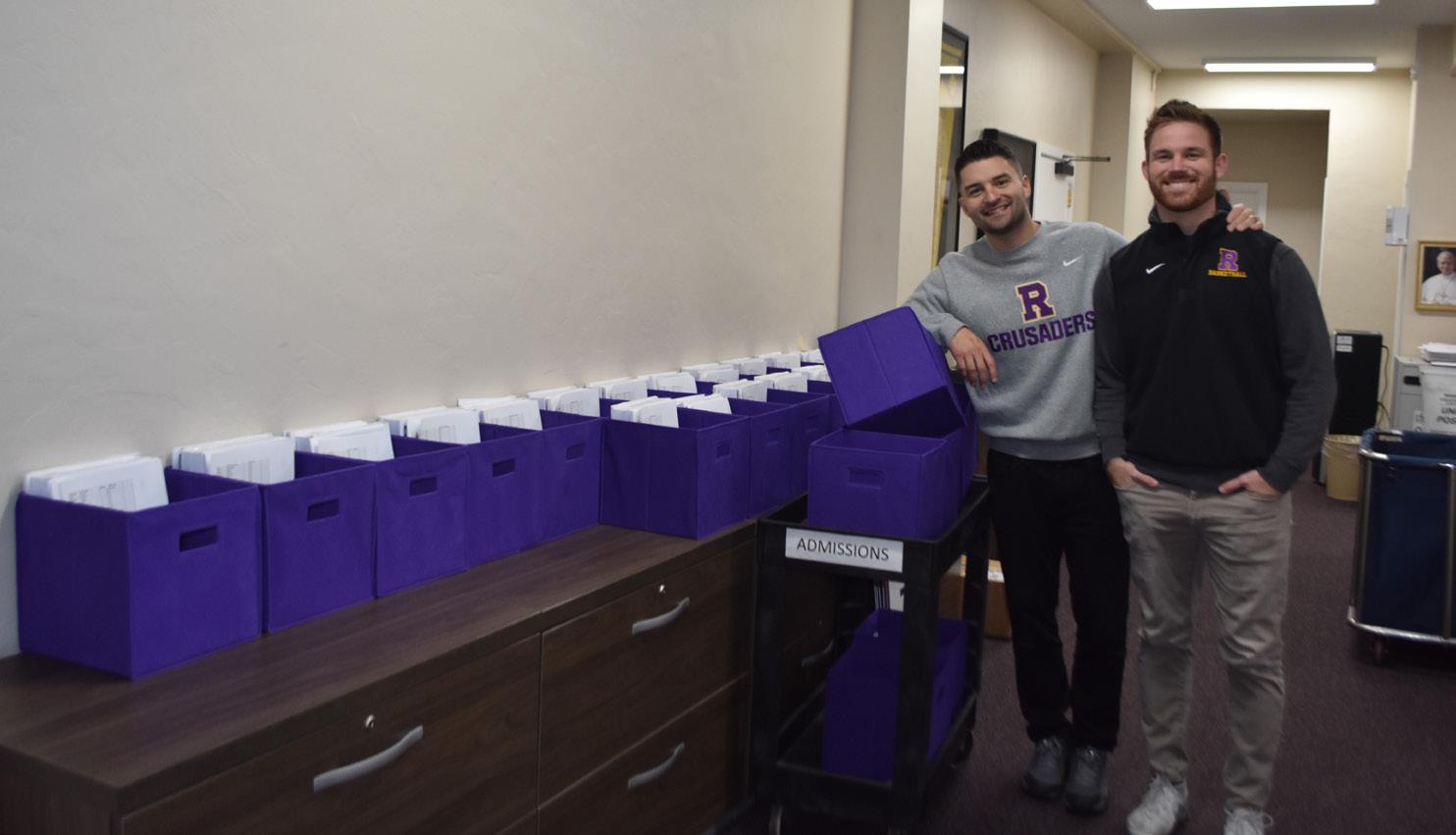
Archbishop Riordan High School is the fastest growing Catholic school over five years in the United States. Here, Vice President of Strategy and Enrollment Danny Curtin ’08 and Admissions Associate Joe Kopp display the HSPT tests.
said Ben Parker ’26, the student body president.
Last year’s first Multicultural Day and Club Rush clearly show this growth. Many underclassmen are also excited with this rise in class sizes.
Caden Hazard ’29, agrees with Parker’s sentiment and expressed, “I think I’ll be able to be part of
By Aliyah Pasion ’26
Archbishop Riordan High School introduced its newest chapter of the Science National Honor Society (SNHS), offering students a unique opportunity to pursue science, community service, and STEM exploration.
Led by student founders Ila Duong ’27 and Christopher Laszlo ’27, this new chapter hopes to spark curiosity while building a strong community of young scientists.
For Duong and Laszlo, the inspiration to bring SNHS to Riordan grew from a shared passion for science and a desire to uplift others through the subject.
“We wanted to create a community that loves science just as much as we do,” Duong explained. “We hope to give our peers the opportunity to understand what science is all about through a different lens.”
As the chapter begins its inaugural year, their leadership hopes to establish traditions that will shape Riordan’s STEM
culture for years to come.
The group is planning workshops, collaborative projects, and outreach initiatives that introduce students to different branches of science. They also hope to provide resources such as skill-building opportunities and connections to scientists and engineers.
Duong and Laszlo emphasized that SNHS is meant to be an open space for any student interested in exploring scientific ideas. They view curiosity as a foundation of the program.
“Science is something anyone can pursue as they stay curious,” said Laszlo.
With strong student leadership and growing interest from the Riordan community, the new SNHS chapter is positioned to become a lasting addition to the school’s academic programs— encouraging students to think more, do more, and be more as they explore the possibilities of science.
many different communities.”
As seen during the 2025 Club Rush on Sept. 12, the school is full of excitement and there are many clubs, all of which provide unique experiences.
This growth doesn’t just affect the students. The expansion of the school to unprecedented heights, and the rise in clubs and
“It’s given a lot more space for leadership and other clubs and parts of the community to grow.”
- Ben Parker ’26
organizations, is also a source of pride for many alumni.
Danny Curtin ’08, Vice President of Strategy and Enrollment, believes that Riordan’s ability to make many different families feel welcome is a primary cause of the increased enrollment.
Five years ago, Riordan’s student body consisted of about 820 students.
As of the new school year, 1,209 students are currently enrolled. Curtin said, “I think as an alumnus, I’m super proud of how far the school has come and the things that we’re accomplishing, but I still think that there’s room to grow and look forward to the next admission cycle.”




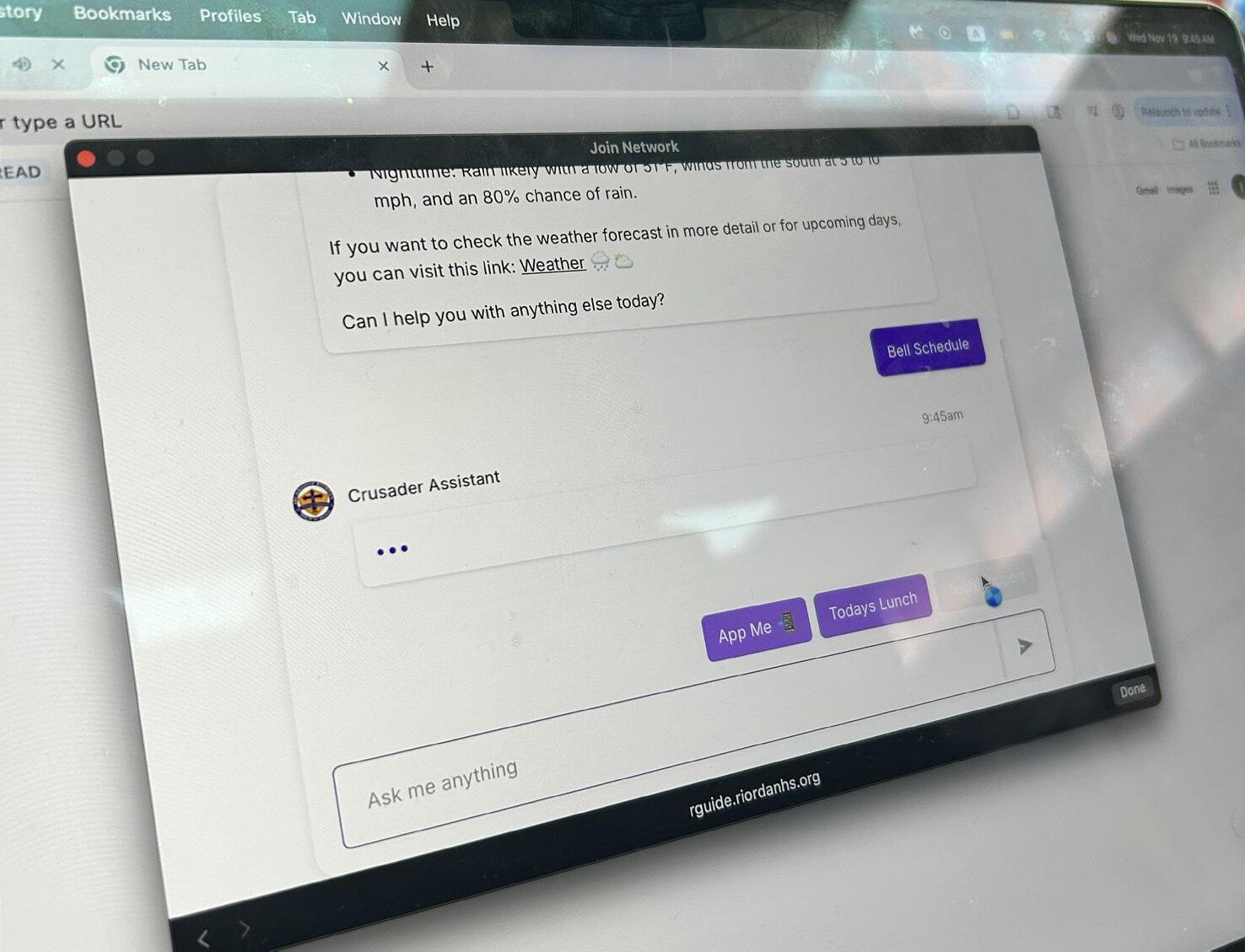
Photo by Emmanuelle Ng ’26
A new addition to Riordan this year is the Crusader Assistant using artificial intelligence. The bot is available when a device is logged onto the school’s WiFi.
By Sofia Peña ’26
After thousands of frantic emails questioning what time classes start, what new announcements are being made, and what the latest sports updates are — the Technology Department has delivered a smart solution: Riordan’s first AI chatbot.
The idea started in the summer, when Information Technology Manager Tre’Jon Bolden ’12 had the idea of creating this tool for the Riordan community while walking through a college campus, wondering how convenient it would be to have all of the school’s information in one place.
Bolden described the process of creating the chatbot: “A ton of late nights teaching myself the latest AI frameworks, built strict safety guardrails aligned with our Marianist values, and deployed it in a cost effective way.”
After the first version’s soft launch through the WiFi login, Bolden and John Wu, Director of Technology, received much appreciated feedback from students, faculty, and staff using the tool.
“We also learned a lot from what type of questions people tend to ask or want to know about. One thing that was quite popular is the weather for the day, which is something we implemented in,” Wu stated.
When working on the second version of the chatbot, Bolden made sure to take note of improvements, implement new capabilities, polish its look and speed, and make these features a reality.
Bolden described one of many new capabilities incorporated in the second version of the chatbot, saying, “It now includes a live
conversational agent with a realistic speaking avatar that is trained across all departments.”
Brisia Castillo ’26 is one of many students who has interacted with the tool’s features, such as looking up the weather to know whether it’ll be rainy or not.
“I believe that it is helpful because you can ask for the schedule, weather, lunch, and it’s also a direct launch to Schoology and PowerSchool,” Castillo expressed.
Since its creation and consistent updates, Wu described the chatbot as “almost like a tour guide of the school and its resources.”
Anybody can access this AI chatbot either by successfully logging into ARHS WiFi using their school account, or going to ai.riordanhs.org.
“As a former Riordan student myself, I know how valuable it would have been to have instant access to every piece of school information in one place,” Bolden stated.
He added, “Now that experience is finally possible, and we are only getting started.”
By Max Li ’26
Four years ago, Archbishop Riordan’s Esports program was just an idea floating around during the Covid-19 pandemic.
Today, it’s a championship winning team that competes nationally and is filled with students who find community and competition through gaming.
The program’s story began when student Santiago Maldonado ’24 approached social studies teacher Cory Nelson about starting a competitive gaming team.
Initially, Nelson rejected the idea, but Maldonado asked again his sophomore year. By his junior year, Archbishop Riordan had its first Esports team.
“It started with kids bringing their own equipment, which was a logistical nightmare,” Nelson recalled.
He added, “But Mr. (Brian) Kelly supported us with gaming laptops, and that provided an opportunity for anyone to play with their team at school. Each year we’ve tried to make incremental steps—better equipment, more recognition, and more students getting involved earlier.”
Evidently, these steps have paid off. Last year, the Mario Kart team captured a regional championship and reached the Elite Eight of a national championship featuring 64 schools.
Robert Pon ’26 recalled the experience vividly: “It was
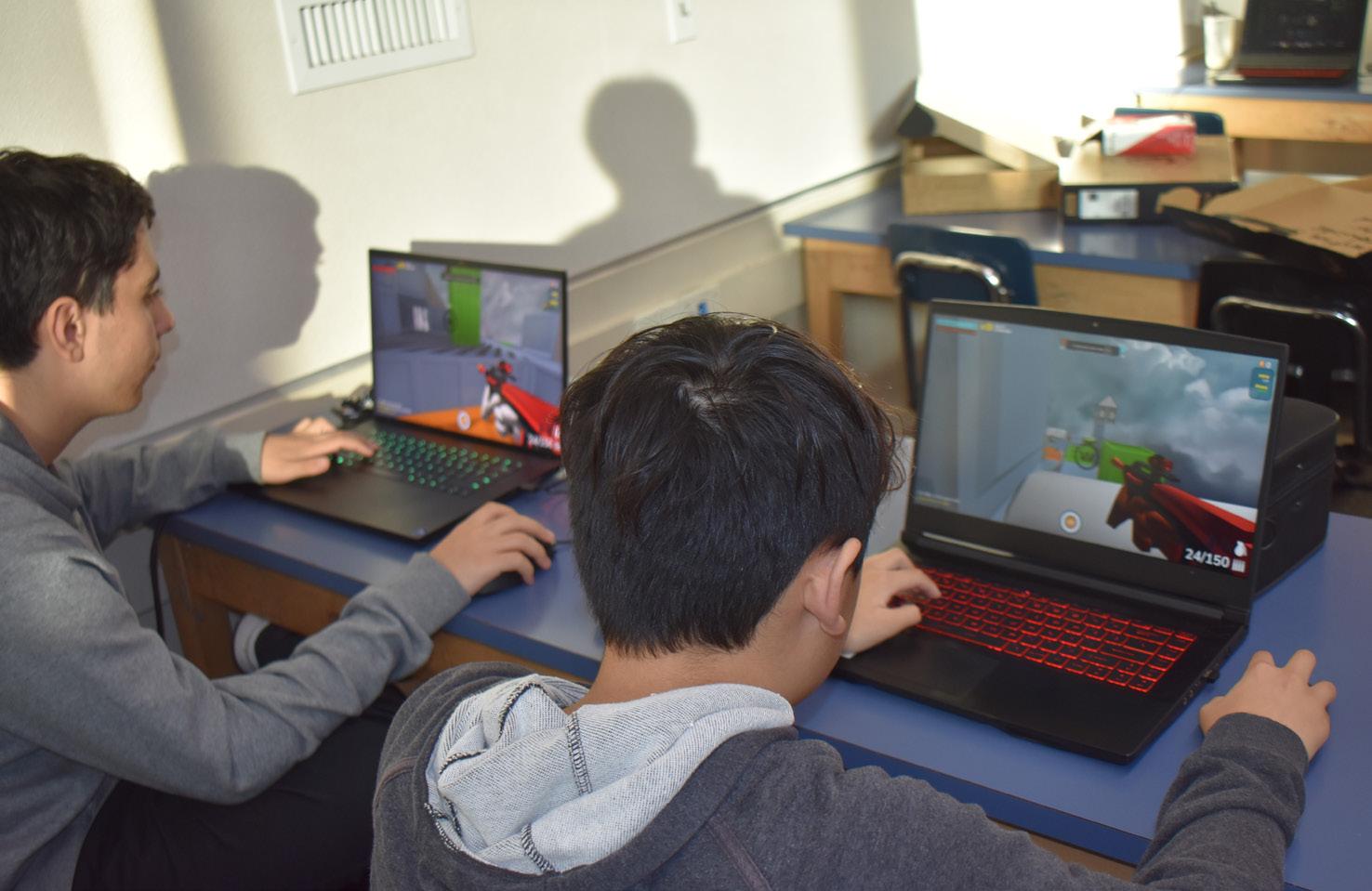
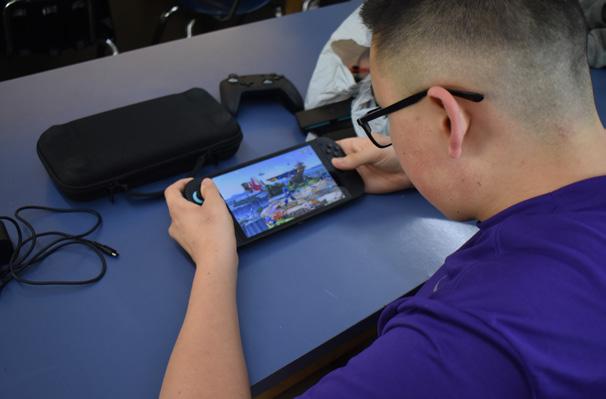
Esports has grown greatly over the past few years after the idea was introduced. Here, Giorgi Kavtaradze ’27 and Tyson Yang ’28 practice playing FPS games. further the team’s success into other games.
surreal. I saw us go from a team that was out in the first round to steamrolling opponents. I never expected that kind of success.”
Pon, who has been part of the team since its early days, said the program has completely transformed.
“We used to just recruit whoever we could,” he said. “Now we’ve got a well-rounded group of talent, and that’s changed everything. But the biggest lesson I’ve learned is humility—if you expect to be great without putting in the work, you’ll be disappointed.”
His focus now is on leading the team to a back-to-back title before he graduates.
Going beyond their success in Mario Kart, Nelson now looks to
Titles such as Valorant and Marvel Rivals, which draw huge communities and competition worldwide, is the next frontier for Riordan Esports.
Nelson hopes to see these two squads reach the same peak of success as Mario Kart.
“I want Valorant to win, I want Marvel Rivals to dominate,” he explained. “These are highly competitive games, but I know our players have the talent to succeed.”
This vision resonates with team member Tony Moreno ’26, an avid team leader and streamer.
He expressed that joining Esports gave him the opportunity
to turn his passion for gaming and streaming into reality.
“As a kid, I dreamed of being the biggest YouTuber,” Moreno explained. “I tried basketball and boxing, but I always came back to video games. Streaming was my start, but being part of a team showed me what competition really feels like.”
Moreno’s proudest moment occurred when both the Valorant and Marvel Rivals squads made the playoffs.
“Even with a substitute filling in, we pulled it off,” he said. “It showed me how strong we could be as a team.”
For Nelson, these stories reflect what makes the program special.
“We’ve had shy students come in and emerge as leaders,” he said. “Some run their team ingame, others step into student leadership roles. Beyond the skills, it gives kids a place where they belong.”
The Esports team’s progress has faced tremendous growth from being a small idea to now competing in large competitions. From national playoff runs to championship banners, and from streaming dreams to senior legacies, Riordan Esports has quickly become more than just students playing video games. It’s an embodiment of discipline, teamwork, and pride, as well as a program that continues to level up each season.


By Emilia Ross ’26
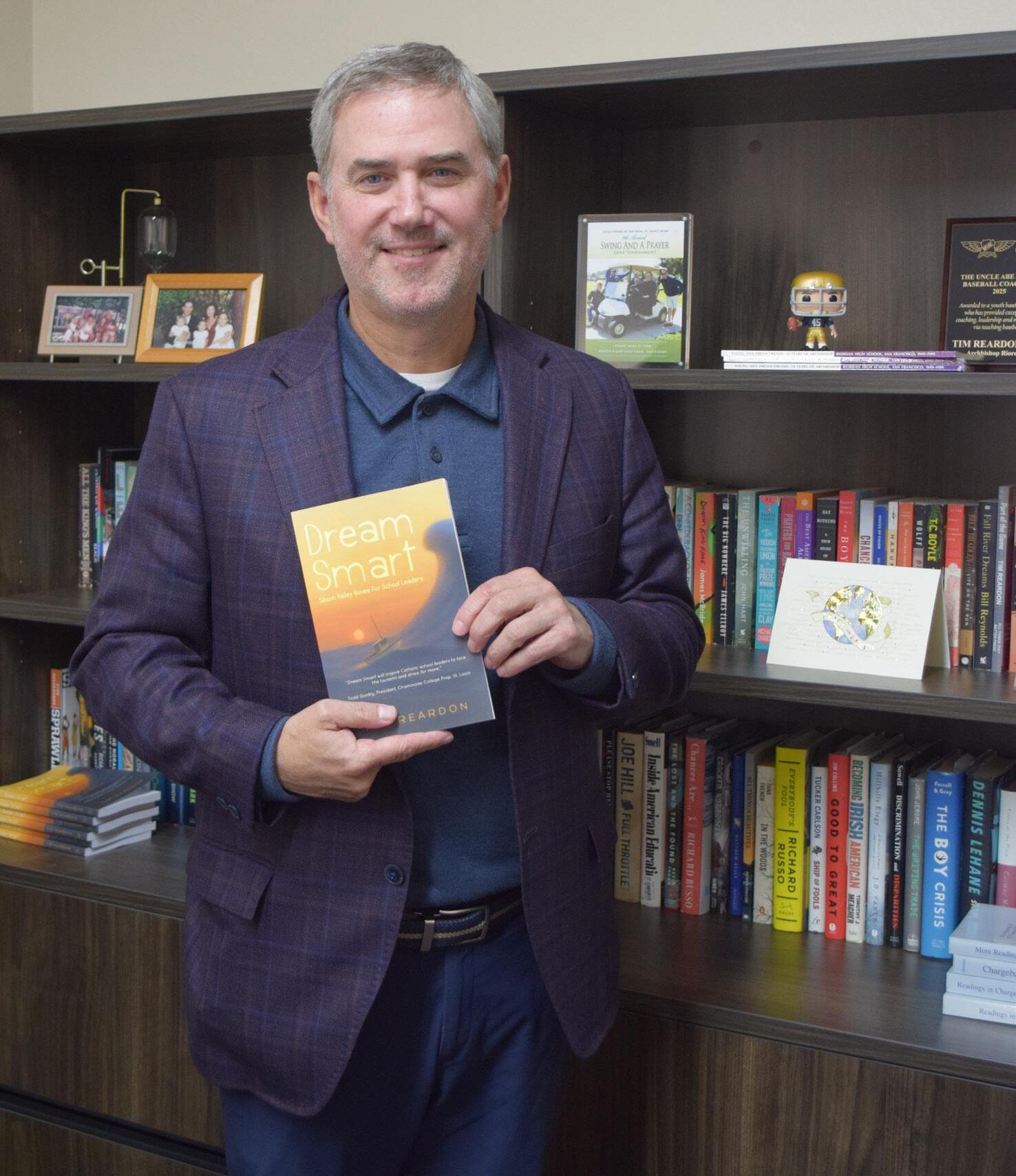
This year, Tim Reardon, President of Archbishop Riordan, released his book Dream Smart. The book brings to life the captivating behind-the-scenes story of the school in recent years as it transitioned from being on the verge of shutdown to becoming a prosperous coed institution.
The book highlights the process of making difficult decisions as enrollment numbers were dropping and the school’s budget was decreasing.
One year before Riordan became coed, Reardon and Danny Curtin ’08, Vice President of Enrollment and Strategy, attended a conference and came to the conclusion that Riordan would need to include girls in admissions.
This decision was expedited when both Mercy SF and SF Girl’s School shut down. However, the decision did not come without backlash from many parents and teachers, as they wanted to honor Riordan’s legacy as an all-male school.
When asked why he wanted to share this comeback story with the world, Reardon stated, “Catholic school presidents have to make many of the same kinds of decisions as presidents of companies, so in order to learn more about how to run a business, I read a book called Zero to One, by Peter Thiel, the founder and former CEO of PayPal [. . .]”
He continued, “As a career educator, I didn’t know a lot of the business jargon that Thiel used in the book, but I quickly realized that during Riordan’s transformation, we had employed some of the same strategies. So I figured it might be beneficial to educational leaders to see how business practices can help private schools.”
Greg Callaghan, VPA chair and theatre director, shared, “I have read most of Mr. Reardon’s previous novels, so I was excited to read his non-fiction. I had followed Riordan’s trajectory very closely from the outside and the book offered some great behind the scenes info that I wouldn’t have otherwise known about.”
Though there was a learning curve as Reardon began adopting the new business strategies, it was all worth it as he stated, “I taught English and coached basketball for 25 years, and I absolutely loved that experience, but watching Riordan grow over the past nine years has truly been the most gratifying stretch of my career.”
While the initial decision came with backlash, it is why Riordan is here today. Alumnus Joseph Zuloaga ’23 shared his experience as a student during the transition. “It’s been extremely shocking to see the growth of Riordan and I feel like all of the reservations people had about Riordan going coed have gone away. There has
been a renewed interest and desire to make Riordan the best version it can be,” he said. “While all of that has changed, I think the spirit of Riordan still remains the same: it’s a place where one can spend four transformational years and come out of it as a part
of the larger Crusader family.” Reardon beautifully explains the highs and lows of the process in his book, and whether it is an alumnus, educator, or even someone simply looking for a good, true story, Dream Smart inspires all who turn its pages.
continued from page 1
Former editor-in-chief Steven Rissotto ’20 said, “It’s the letterhead of the newspaper and it just looked good. It was different from the logos the school had previously, so it was kind of a way to differentiate ourselves from the school [Archbishop Riordan].”
After the change and throughout the years, The Crusader went on to win hundreds of awards as the logo became well recognized among the school and local community.
Risotto added, “Once you’ve had something for so long, like this logo, it’s difficult to imagine anything else on that newspaper. I’ve gotten used to it and I love the old logo.”
The new soon-to-be-introduced school wide logo is a throwback to one of the first logos used at Riordan. It features a knight on a horse with a sword and a shield, and incorporates Riordan’s purple and gold.
Curtin said, “We’re trying to limit logos that maybe aren’t necessarily conveying exactly what we want.”
The new logo for the newspaper

will be designed based on guidelines established by the administration and marketing team with student input.
Poon said, “The Crusader to me was always about the creativity, continued learning, and experiences of the students, so personally, I would love to see a new student create a design that embodies that.”
Current EIC Daniella Lainez ’26 said, “It’s very frustrating to see a student created logo be replaced, and I can only hope that whatever replaces it honors the legacy and meaning the original carried.”
The rebranding will also apply to the school’s Crusader mascot. The administration discussing a new costume to replace the current one.
Riordan’s first mascot Big Purple, which was brought back in 2023 after its “death” in the 1990s, will remain unchanged.
Curtin said, “The ultimate goal is for people to have a very clear idea of who Riordan is in 2025 and moving forward ... while also remaining true to our tradition and our colors and who we are.”
By Miki Maloney ’26
An eventful voting season has come and gone, and with it the passage of California’s contentious Proposition 50.
The bill was introduced by California Governor Gavin Newsom with the goal to reorganize California’s congressional districts in favor of Democrats. It came in response to a similar reorganization in Texas, which did not include a vote.
The vote was held on Nov. 4, and passed with a clear margin of around 20 percent, according to California’s website.
“We need to see other states, their remarkable leaders that have been doing remarkable things, meet this moment head-on as well,” said Governor Newsom to the press following the win.
The decisive victory of the bill is a major win for Democrats, accompanying several others from this November’s elections. However, the nature of this proposition’s passage continues to pose questions about the nation’s political future in its wake.
Some point to the results of exit polls, which indicated that a majority of voters supported non-partisan redistricting while also voting in favor of giving mapdrawing authority to the state’s

Proposition 50 passed with a 64.1 percent “Yes” vote majority in the special election, a victory that gives Democrats a boost in terms of congressional seats.
Democrats.
“This discrepancy suggests that many voters either misunderstood the proposition or its true
implications,” said George Gamarra ’26, AP Government student and Prop 50 opponent. Even amongst those who do not
challenge the decision of the people, there is a level of disappointment in the current electoral conditions of the nation.
“I wish (the proposition) didn’t have to happen,” commented AP U.S. History teacher Cory Nelson, “but I am happy that the people of California used democratic processes to rebut what they think was an unfair seizure.”
This year’s debate over redistricting began with the events in Texas, which stemmed from the Trump administration’s emphasis on bolstering its base of support. Many have found the circumstances leading up to the bill the greater point of concern.
“Prop 50 is inevitable. This redistricting will spread throughout the nation like wildfire and the only thing that can be done to combat what will follow is to change our own district maps,” said supporter of the proposition Jay Mata-Lee ’26.
In the wake of current political tensions, the effects of this proposition’s passage are yet to be seen. For the time being, Americans will continue to keep a careful eye on the role it will play in the future of the nation’s democracy.
Proposition 50 will go into effect starting in January 2026.
By Julian Iaconetti
From funding issues to political delays, San Francisco’s skies have remained silent of the emergency warning sirens that once wailed across the city. San Francisco officials’ intentions to go forward with the project remain unclear as of 2025, but proposals for its repair are being initiated.
San Francisco’s iconic emergency siren system went offline in December 2019 for repairs due to security vulnerabilities. This stemmed from an incident that occurred in Dallas, Texas when their emergency siren system was breached and sounded on a Tuesday night. Shortly after, San Francisco officials realized its system was just as vulnerable and took all sirens offline.
During WWII, 50 sirens were installed to warn the public of air raids as San Francisco was a probable target. In 2005, a federal grant was taken to repair and install more sirens, adding to a total of 114 to serve as a warning to residents for natural disasters or radiological attacks.
Now as costs to repair the old siren’s hardware and software increase, the project becomes more and more out of reach for San Francisco officials to take on. San Francisco Mayor Daniel Lurie has no plans to fund the emergency siren system. When pressed for questions, Lurie redirected to the DEM for further inquiries,
according to the San Francisco Chronicle who reached out to the mayor’s office in July 2025.
With the absence of San Francisco’s outdoor public warning system, the city has become reliant on notification systems such as AlertSF, an opt-in notification warning system, Wireless Emergency Alerts (WEA), the Emergency Alert System (EAS), and first responders warning residents firsthand.
DEM Executive Director Mary Ellen Carroll spoke in favor of repairing and returning the emergency siren system in San Francisco while in its inactivity.
“Having as many tools as possible to alert the public is always helpful during a critical situation.
Bringing back the outdoor public warning sirens adds an additional layer of redundancy to our overall alert and warning system in San Francisco,” Carroll said.
Given the increased frequency of incidents, it raises the question if San Francisco needs to prioritize repairing the emergency siren system. This was brought up recently in July 2025 following the Texas flash floods that resulted in 135 deaths due to a lack of warning. A lot of finger pointing was done between San Francisco officials to bring back the sirens for additional safety of San Francisco residents, but no advancements were ever made.
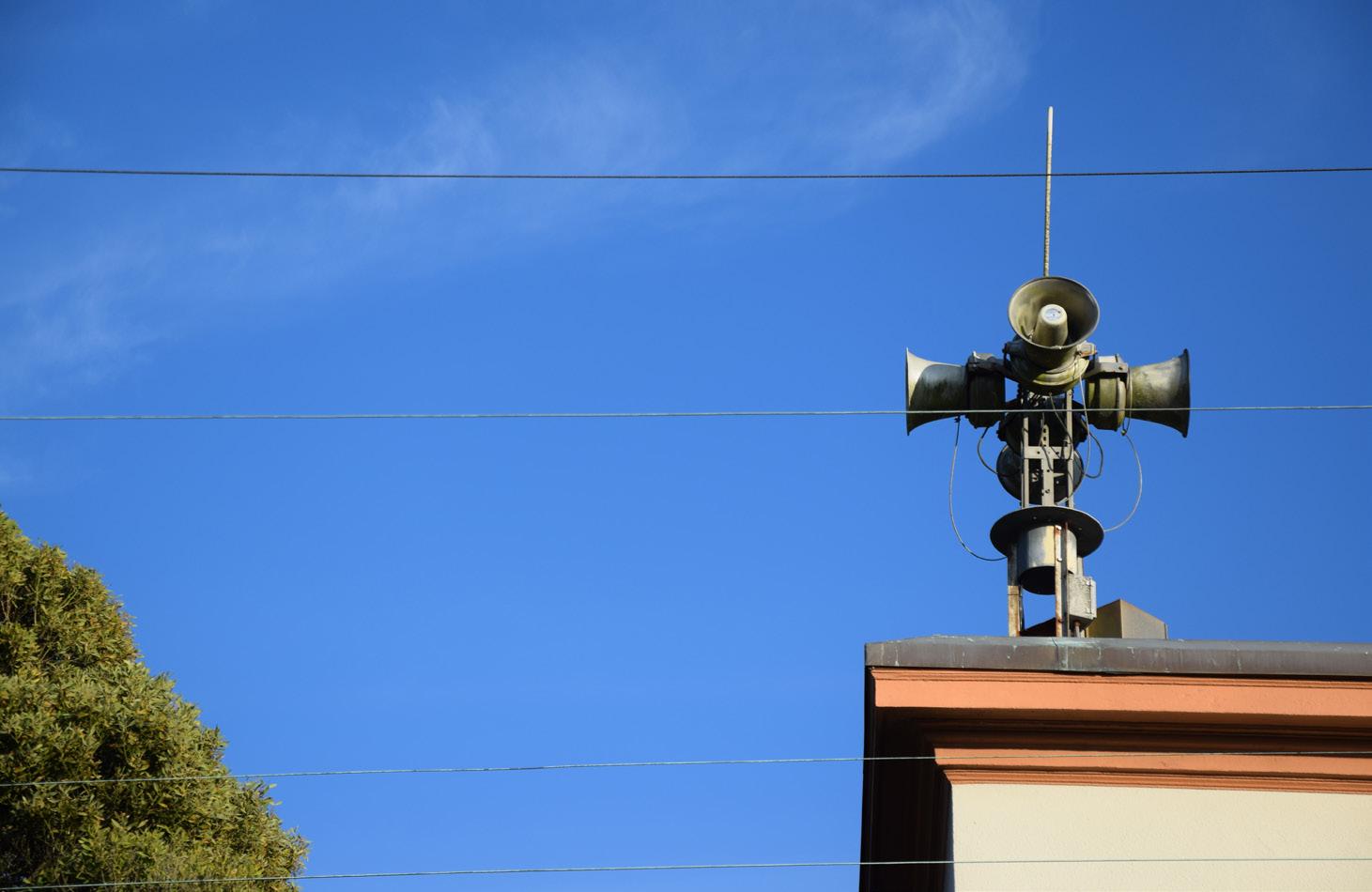
Marcelo Quinonez ’26 expressed safety concerns regarding the state of the sirens, stating, “Phone alerts are great but not everyone has access to a phone at all times and we may be relying too much on notification systems whereas the emergency sirens would reach everyone and emphasize an emergency.”
In a 2024 DEM budget hearing, a proposed budget of $7.5 million was initiated for the reactivation of the outdoor public warning system, but has yet to be approved and signs of its approval are questionable with no advocacy from San Francisco officials.
Archbishop Riordan teacher Brian Kosewic ’16 stated, “I do think it’s always better to invest in emergency preparedness and disaster prevention. I think the costs of not investing in it early end up being a lot higher than not investing in it.”
With no push from San Francisco Mayor Daniel Lurie or signs of approval for the proposed budget, the outdoor public warning system will remain off as of 2025. Now in its inactivity, questions arise whether the sirens are really needed or if it’s another feature San Francisco won’t worry about till disaster strikes.
By Daniella Lainez ’26 and Vincy Huang ’27
After 43 days, the Oct. 1 government shutdown, the longest shutdown in American history, ended on Nov. 13 after President Donald J. Trump signed the government’s funding bill into effect.
A government shutdown occurs when Congress fails to pass a spending bill for the federal government’s budget, pausing the government and creating disruption in the country.
In the most recent shutdown, the Democratic and Republican parties were unable to agree on the budget for health insurance subsidies and the Affordable Care Act.
As a part of this disagreement, the Democrats leveraged the funding for the government, refusing to pass a budget bill until the Republican party agreed to provide funding for those health insurance subsidies as a part of the bill.
These health insurance subsidies were being prioritized to be included as a part of the bill because if not, healthcare costs for lower-income Americans were expected to increase exponentially.
Subsequently, as a result of this disagreement, the deadline for passing a federal budget bill went by, funding for federal workers and programs was put on hold, and the government entered a partial shutdown.
When a shutdown occurs, all federal workers whose jobs

are deemed non-essential are furloughed, or put on leave without pay for the duration of the shutdown.
A federal worker in D.C., who did not wish to be identified, commented, “I was not working. I was not paid.”
Being unpaid for around two months was daunting and nerve-wracking for these federal workers, some of whom lived paycheck to paycheck and could barely scrape by with the little savings they did have.
However, some employees with jobs that are deemed essential are made to work throughout the shutdown. But, because the government does not have the budget to pay these workers, they are often working through the shutdown without pay.
The same federal worker remarked, “Some of my staff had to work because their work was essential.”
During this particular shutdown, air traffic control workers were expected to work
without pay as their jobs are essential to ensuring flights run smoothly and safely. However, many employees called out sick, causing flights to be delayed or even canceled.
Data analysts in charge of analyzing the economic data that policymakers use in order to make financial decisions for the nation were furloughed as well, putting most federal economic decisions on hold. This caused the U.S. economy to take a hit as well.
To save money for federal purposes, President Donald J. Trump cut back SNAP benefits, a food aid program that helps many put food on the table.
While the Democratic and Republican parties went back and forth arguing about budget cuts, millions of Americans were left on their own without nutritional assistance.
“It was a bit scary that the threat of no food, or maybe even starving, was possible for us at some point,” said Darwin Hernandez ’26. Finally, on Nov. 13, the Democrats relented and passed the budget bill without the health insurance subsidies they wanted to include, and the shutdown came to an end, with neither party having gained much over the disagreement.
Religious Studies teacher Jon Yeager said, “The shutdown clearly reflects on a pretty wide disagreement on certain policies, like the budget, and a lack of ability to talk constructively together in order to decide important things as a government.”
By Rhianna Mallory ’26
The penny, once a staple in everyone’s wallet or buried at the bottom of a purse, has stopped being produced. The U.S. Mint produced their final batch in November 2025, and the penny will gradually go away as existing ones become spent and lost, marking the end of a familiar American currency.
For generations, it was the smallest unit of money in the United States, which many put in souvenir penny press machines or tossed into a fountain with a wish.
Experts comment that in order to manufacture a single penny in 2025, it costs 3.7 cents, nearly triple its original value–meaning the government was losing more than $100 million a year producing pennies alone.
Math instructor Ray Trounday stated, “I think the end of production will actually be a benefit because the cost to produce is more than its value.”
While many use cash and coins, Julia O’Neill ’26 felt unaffected by this change. “To be honest, I
never really used pennies all too often,” she stated. To O’Neill, as well as younger generations, the discontinuation of pennies is not a major deal.
While people can still use pennies and they will be accepted at banks, stores and retailers are going to start rounding the total amount to the nearest five cents. For example, if a total was $10.32 it would round down to $10.30.
If paying electronically, there will not be any rounding and the charge will be the exact amount; shoppers who primarily pay electronically will not notice any drastic changes or differences.
As the years go on, pennies are expected to become more rare, and they may stop being in circulation. Many people have considered collecting pennies as keepsakes due to the fact that an everyday coin they never treasured has and will continue to become a piece of history.
Marcus Appleby ’26 collects pennies now as he has realized, “Pennies may soon become valuable… even if they don’t it’s still cool to hold onto for the years
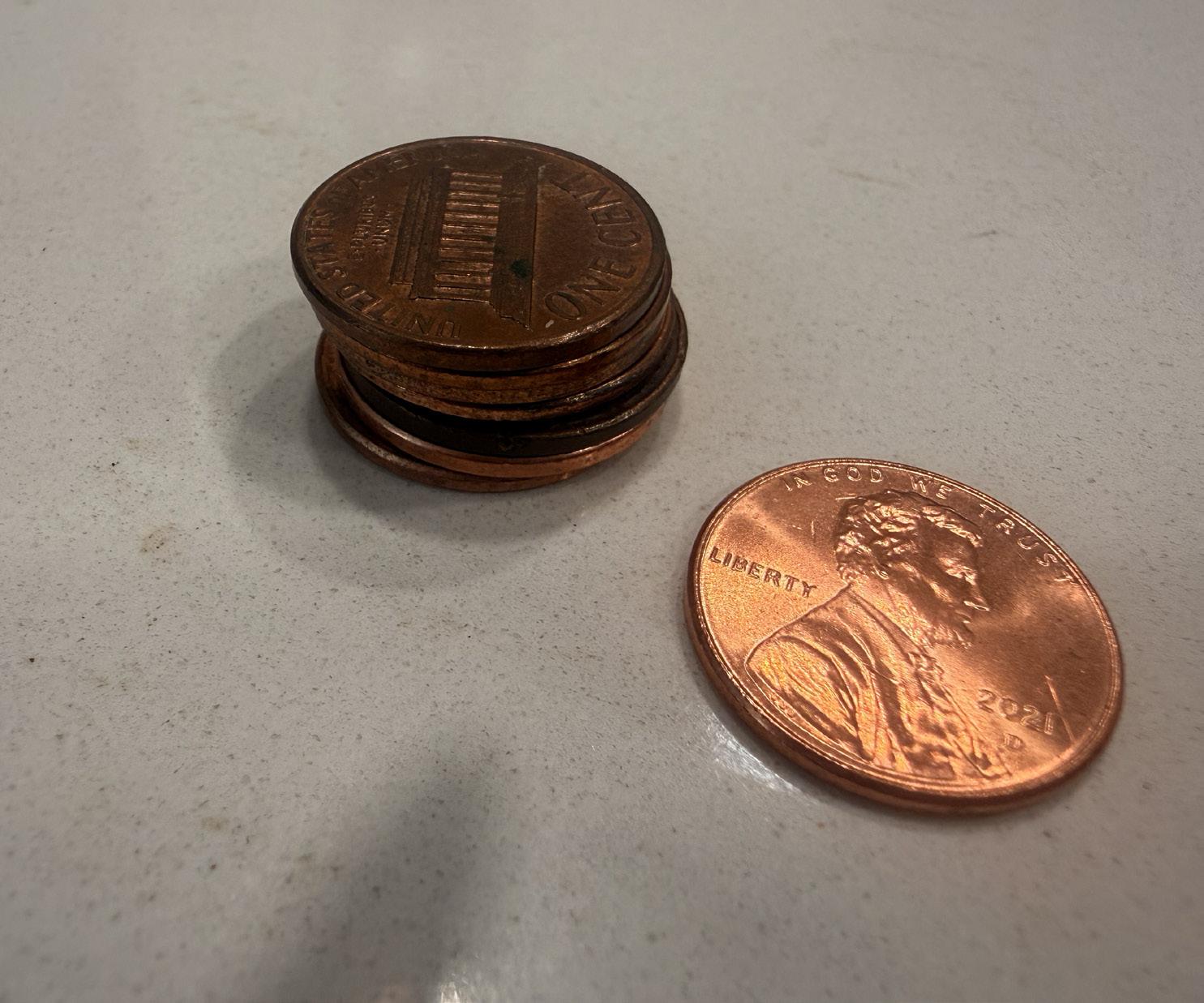
to come.”
While the end of the penny marks a shift in the United States monetary system, this change symbolizes the country’s
move toward the possibility of an increasingly digital economy with the rise of online currency, and more efficient ways of handling money.
By Erin Quan ’26
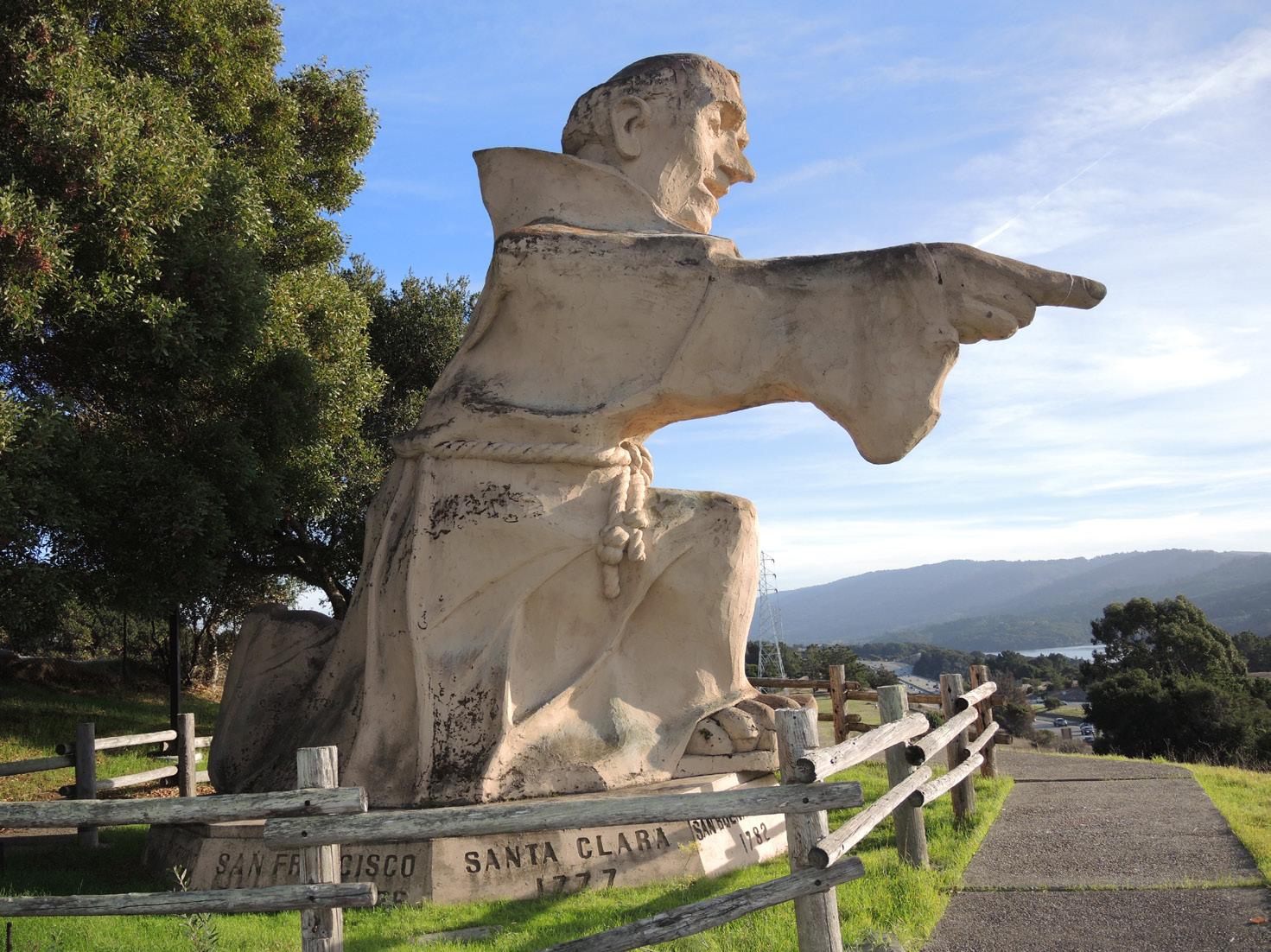
Spanish missionary Father Junipero Serra, whose statue overlooked Highway 280 for many years, was removed sometime in August.
In 2015, Father Junipero Serra became known as St. Junipero Serra following his canonization by Pope Francis in recognition of his significant missionary witness in California and Mexico. Having founded nine out of the 21 missions during his time, Serra became known as the “Apostle of California.”
Artist Louis Dubois created Serra’s 26-foot-tall statue in 1975. When established in June of 1976 at the Crystal Springs rest stop, it stood as a commemoration of his work as a missionary and as a noteworthy landmark for visitors, students, and people worldwide.
The scenic stretch of Highway 280–that runs from I-880 in San Jose and State Route 1 in Daly City–is also named after Junipero Serra.
In August 2025, only a few people noticed the statue’s disappearance–that is until a social media post went viral over it. It was then that the news was out: The Caltrans crews removed and demolished the Junipero Serra Statue on Highway 280.
“Because the installation did not meet current Transportation Art Program requirements and had been a frequent target of graffiti and vandalism,” said public information officer Jeneane Crawford for Caltrans District 4.
The removal of the statue has elicited a spectrum of responses, ranging from great support to strong opposition.
Supporters of St. Junipero Serra are deeply saddened, viewing him as a symbol of faith and heritage.
However, on the other hand, critics of Serra view him solely as the cause of a traumatizing era of colonization and mass cruelty of Indigenous people.
Mateo Hurtado ’26 commented, “It was my favorite part of that drive. It’s a shame that the state got graffitied on.”
San Francisco Archbishop Salvatore Cordileone told CBS News, “No one fought for St. Junipero Serra because apparently, officials from Caltrans and the transportation art program didn’t consult with anyone who would give them an opinion that differed from their own.”
He added, “Would we expect this treatment if it happened to be associated with another religious organization? I think not.”
““It was my favorite part of that drive. It’s a shame that the state got graffitied on.”
-Mateo Hurtado ’26
Caltrans denied that the move was secretive.
Ultimately, the Serra statue’s removal has increasingly heated the debate over Serra’s legacy, but
regardless, the statue will always remain a piece of history and a memory in many Bay Area citizens’ lives as they zip along Highway 280.
By Josh Lee ’26
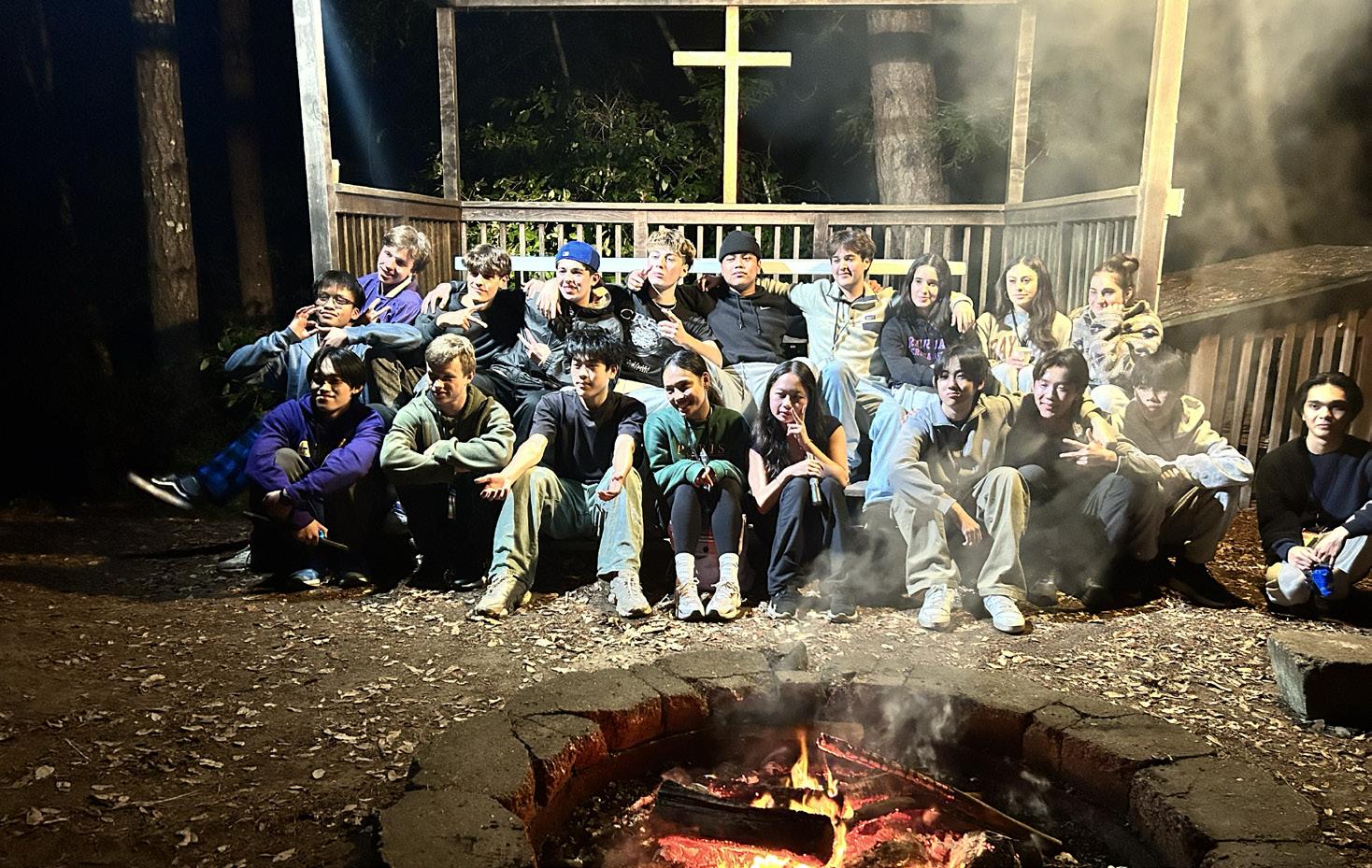
From Oct. 15 to 17, the first ever Emmaus retreat took place for Archbishop Riordan High School students.
Lasting three days and two nights, the Emmaus retreat was a chance for juniors to take a spiritual journey to become more empowered in the Marianist values.
Dr. Oliver Meneses, staff member of ARHS Campus Ministry and the program initiator, explained, “The theme of the retreat is Empowerment by Christ through Mary. The whole journey is to have Mary as a role model.”
Within the three days of the retreat, each day takes on a different purpose.
The first day is known as the road of encounter, where students come to know more about themselves and of other people.
The second day is called the road of conversion, where each participant in the retreat focuses on deepening their religious faith.
The third day concludes the experience with the road to mission, where students find the answer to how to act with the characteristics of Mary.
“The goal for the retreat was to make it Christ centered,” said Alex Datoc ’87, Director of
ARHS Campus Ministry. “...we wanted our students at Riordan to have a retreat to have more of a relationship with Jesus.”
As part of protecting the nature of this retreat, the specific activities of this three-day retreat cannot fully be disclosed. However,
by Alex Datoc ’87 Emmaus retreat members enjoy each other’s company over a campfire. many, such as leaders of campus ministry and believers in God, have gladly found this retreat a worthwhile experience of their high school life.
“The goal for the retreat was to make it Christ centered... we wanted our students at Riordan to have a retreat to have more of a relationship with Jesus.
-Alex Datoc ’87, Director of Campus Ministry
“The Emmaus retreat had many unique and special activities that made you reflect on life, your identity, and your faith,” said Brian Tin ’27, who is also a member of ARHS’s CORE Team. “...it made my high school experience more enjoyable and memorable.”
Collin Noguera ’27, another retreat participant and member of ARHS’s CORE Team, when asked about the Emmaus retreat
admitted that, “When signing up for the retreat I had no idea what to expect. All I knew was that the first Emmaus retreat would be like no other I had previously gone on.”
“The Emmaus retreat had many unique and special activities that made you reflect on life, your identity, and your faith... it made my high school experience more enjoyable and memorable.
-Brian Tin ’27, CORE Team member
Fortunately, for those still interested in this opportunity, the next Emmaus retreat is on Jan. 28 of the next year.
With this three day junior retreat, someone can reflect on themselves and learn from Mary as a role model.
For more information on this sacred retreat, check the campus ministry webpage on the Archbishop Riordan website where students can learn how to sign up to immerse themselves into the Empowerment By Christ experience alongside their high school community.
By Natalia Sanchez ’26
On Nov. 17 Archbishop Riordan High School announced an active case of Tuberculosis, an illness transmitted when airborne bacteria enters the lungs after prolonged exposure to an infected person’s cough, sneeze, or breath.
The announcement quickly became a topic of conversation on campus, prompting mixed emotions and opinions about the situation. Some have expressed worry and anxiety, while others seem to be taking it in stride.
Bella Miragalia ’26 said, “My feelings about this definitely have me on high alert. It’s scary and something I’ve never had to deal with so hopefully it won’t happen again.”
To address growing worries around the community, Riordan set up an informational Zoom meeting with the San Francisco Department of Public Health, with speaker Susannah Graves, MD, MPH, Director of the Tuberculosis Branch.
Graves hopped on to explain that if someone has been infected, it is possible to be cured with the proper course of medications. She encouraged anyone unsure about possible contamination to get tested, either through a TB skin test, or a blood test.
She explained, “It’s really important to understand your

Graphic by CDC.gov
This graphic by the Centers for Disease Control and Prevention explains how tuberculosis is spread. More information can be found on the San Francisco TB Clinic website at www.sf.gov/get-tuberculosis-specialty-services.
risk. Get a TB test if you are at risk and then get treatment if you test positive to prevent developing active TB.”
Graves also added that the San Francisco TB Clinic, “is going to provide testing and treatment and care linkage for people who have been exposed,” adding how the clinic also “encourages people to think about their own risk…so anyone who needs testing will be able to access that.”
Symptoms of TB usually include
prolonged coughs, chest pains, blood in coughs or sputum, and sometimes fatigue, weight loss, fever or chills, and night sweats.
The school is currently working diligently to keep parents informed, with the help of health officials to monitor the situation. School officials have also sent out emails that explain what to do if a student was in contact with someone who has TB.
“Unless one is immunocompromised, TB isn’t
that big of a deal...so long as you have access to treatment,” said science teacher Colleen O’Rourke.
But for now, the community should be focused on staying informed, having good hygiene, and most importantly, being compassionate and empathetic toward anyone affected.
O’Rourke added, “We should be aware of it both in order to keep ourselves healthy, but more importantly to speak out against the injustices which keep people from accessing the drugs they need to cure them.”
TB is not easily transmitted through brief contact, and students and staff are not in danger if they follow the precautions. But, health experts emphasize staying aware, getting tested if needed, and following protocols will ensure the safety of the school.
In an updated email to parents on Dec. 9, the Department of Health stated, “Students and staff who have spent at least eight hours in indoor spaces on campus fall semester 2025 prior to Nov. 10, 2025 must get evaluated for TB by your medical professional . . . during this period: Jan. 20 to Feb. 13, 2026.”
Miraglia said, “I wish whoever is going through this heals quickly and has a safe recovery.”
By Emmanuelle Ng ’26
When it comes to peanuts, people either love them or hate them. However, a large portion of the legume’s detestation comes from intolerance rather than distaste.
According to the Food Allergy Research & Education organization, peanut allergy is the third most common food allergy in adults and the most common in children. Approximately 1-2 percent of the U.S. population is allergic to peanuts.
A peanut allergy occurs when peanut proteins trigger the body’s immune system, leading to reactions that range from mild to severe. However, an extreme allergy to peanuts may result in anaphylaxis, a life-threatening reaction in which a person’s blood pressure may drop drastically.
Peanut allergies were considered rare before the 1990s, but numbers doubled in the 1990s and early 2000s. During this era, parents were warned not to introduce peanuts to their children until they were at least 3 years old. However, in 2015, studies found that exposing babies to peanuts
when they were a couple months old could reduce risk of developing an allergy by over 80 percent.
In 2017, the Prevention of Peanut Allergy Guidelines recommended introducing peanut protein to infants, and according to a paper published in the Journal of Pediatrics, the number of peanut allergies diagnosed in children has since declined by over 40 percent.
Over 15 percent of students with food allergies have had a reaction on school grounds, bringing up the topic of whether peanuts should be banned on educational premises. Currently, Archbishop Riordan has no specific food restrictions, but teachers recently received notice about not allowing food in the classroom to protect those with peanut allergies.
Veronica Tovarian ’26, who is allergic to peanuts, believes schools should restrict peanuts, saying, “Even if the kids with allergies don’t eat it [peanuts], it’s still possible for it to spread through smell and stuff, because I’ve had to take medicine for that … also, you never know what can

students from having an adverse reaction.
get mixed in with foods.”
Even students without peanut allergy conditions agree on the importance of food allergy safety precautions.
Juvenal Orozco ’26 shared his thoughts on the value of knowing how to use an Epipen, saying, “I feel like it should be taught, especially if your friends experience it … that’s a really, really big thing to know.”
For teachers and staff, a student
having an allergic reaction is a situation for which they must be prepared. Having previously worked at St. Cecilia elementary school, English teacher Beth Fergus commented, “We’re here to teach, but also, we’re kind of protectors … if someone brings food that could potentially cause a reaction for a student into a classroom, it impacts me and that student, and the whole class generally.”

By Crystal Wei ’26
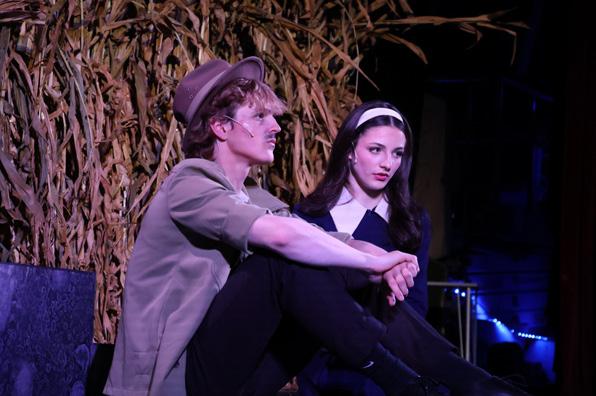
This fall, Riordan’s Lindland Theatre came alive with the stellar interpretation of “They Promised Her the Moon.”
The play tells the compelling story of Jerrie Cobb, once poised to become the first female astronaut in space. It explores her childhood, her aspirations, her obstacles, and her determination that defined her path. The production
underscores the struggles of a woman pursuing traditionally male dominated fields, and Cobb’s persistence despite the setbacks she encountered.
Reflecting on her role, lead actor Julia O’Neill ’26 shared, “[Jerrie Cobb] constantly had to prove herself as a female pilot… especially to the world that she was physically and psychologically fit to be an astronaut.”
“
Women do not have the same recognition as men . . . I chose to direct a play written by a woman because I want to produce shows that highlight underrepresented voices.
- Greg Callaghan, Riordan Drama Director
The story was beautifully conveyed through the leadership of Riordan’s Drama Director Greg Callaghan, performance of talented student actors, and the dedicated work of the stage crew.
In regards to choosing this play, Callaghan said, “Women do not have the same recognition as men . . . I chose to direct a play written by a woman because I want to produce shows that highlight underrepresented voices.”
To many in the audience, these voices were heard.
Aadi Desai ’25 concluded, “This play made me realize how unfair the experience was for women.
She added, “I can only hope that people have realized how capable women are so that everyone [will have] equal opportunity.”
Gender inequality was the major barrier between Cobb and her dreams. This inequality still persists in this world today, but there are many more problems, too. The actors hope that audience members can all learn from Cobb’s life experiences in battling and confronting adversities.
“[This play is] about the importance of reaching for something even if you know it may not be possible,” said Callaghan. He added, “Jerrie was up against a lot of obstacles, but she never stopped trying. There’s a lesson in that for everyone.”
By Erin Quan ’26
Following the popular release of “Wicked” on Nov. 22, 2024, fans couldn’t be happier with the Nov. 21 theater release of “Wicked: For Good.”
Universal Pictures launched “Wicked,” the tale of the unexpected friendship between the witches of Oz, Glinda the Good and Elphaba. One, ambitious and driven by a desire for popularity, and the other, a beginner witch who wishes to use her overwhelming powers to help others.
The two journey through Shiz University and develop a strong bond as roommates. When Elphaba discovers Madame Morrible’s deceitful plans, she is forced to choose between civil compliance and doing what’s right.
“Wicked” sure was popular, winning 57 total awards, including two Oscars for Best Costume Design and Best Production Design and a Golden Globe award for Cinematic and Box Office Achievement. It also made history, becoming the highest grossing film adaptation of a Broadway Musical and making approximately $758 million
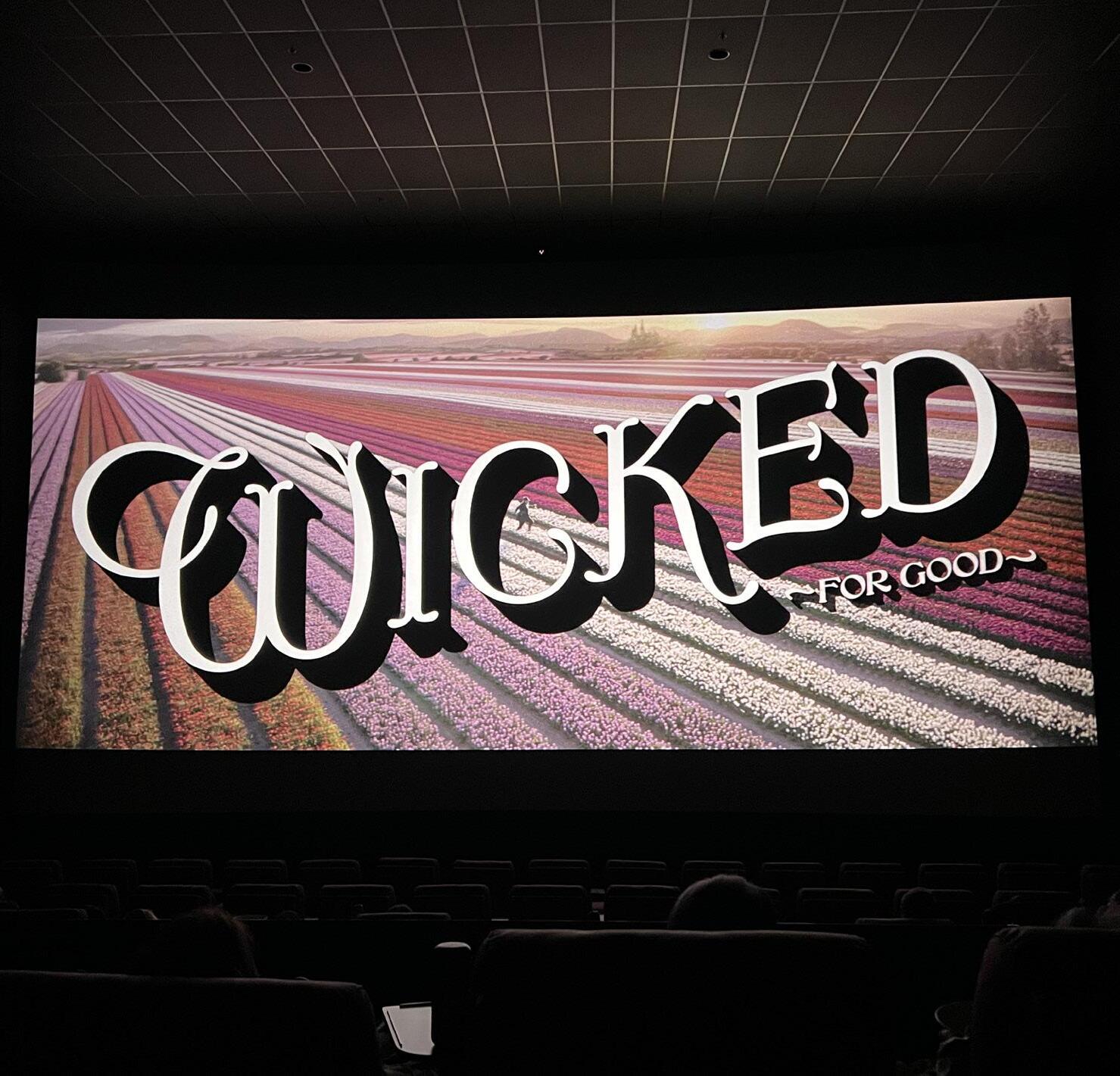
The movie “Wicked: For Good” opened in theaters on Thanksgiving
worldwide in the box office.
“Wicked: For Good” occurs after Elphaba defied gravity and details her full transformation into the Wicked Witch of the West as she tries to prove her goodness to the people of Oz. Meanwhile,
Glinda rises to the top as the ruler of Oz, but feels conflicted with her decisions when Elphaba flies back into her life. The final moments of the film leave viewers on the edge of their seats as Elphaba and Glinda come face-to-face with
As the lights dimmed in the Stonestown Regal Cinema, I settled into my reclining chair ready to be immersed by the wonderful world of “Wicked.”
a powerful reckoning that will change the course of Oz forever.
As the lights dimmed in the Stonestown Regal Cinema, I settled into my reclining chair, ready to be immersed by the wonderful world of “Wicked.” Although I already knew the plot–having seen the musical before–the storytelling and unique portrayal of each character compellingly conveyed the powerful moments, raw emotion, and genuine passion that the actors have for the musical.
Whether you are an Ozian or audience member, “Wicked: For Good” shares an unforgettable story through its memorable music and astonishing actors. Because viewers know “Wicked,” the completeness of the musical’s powerful journey will be changed for good.
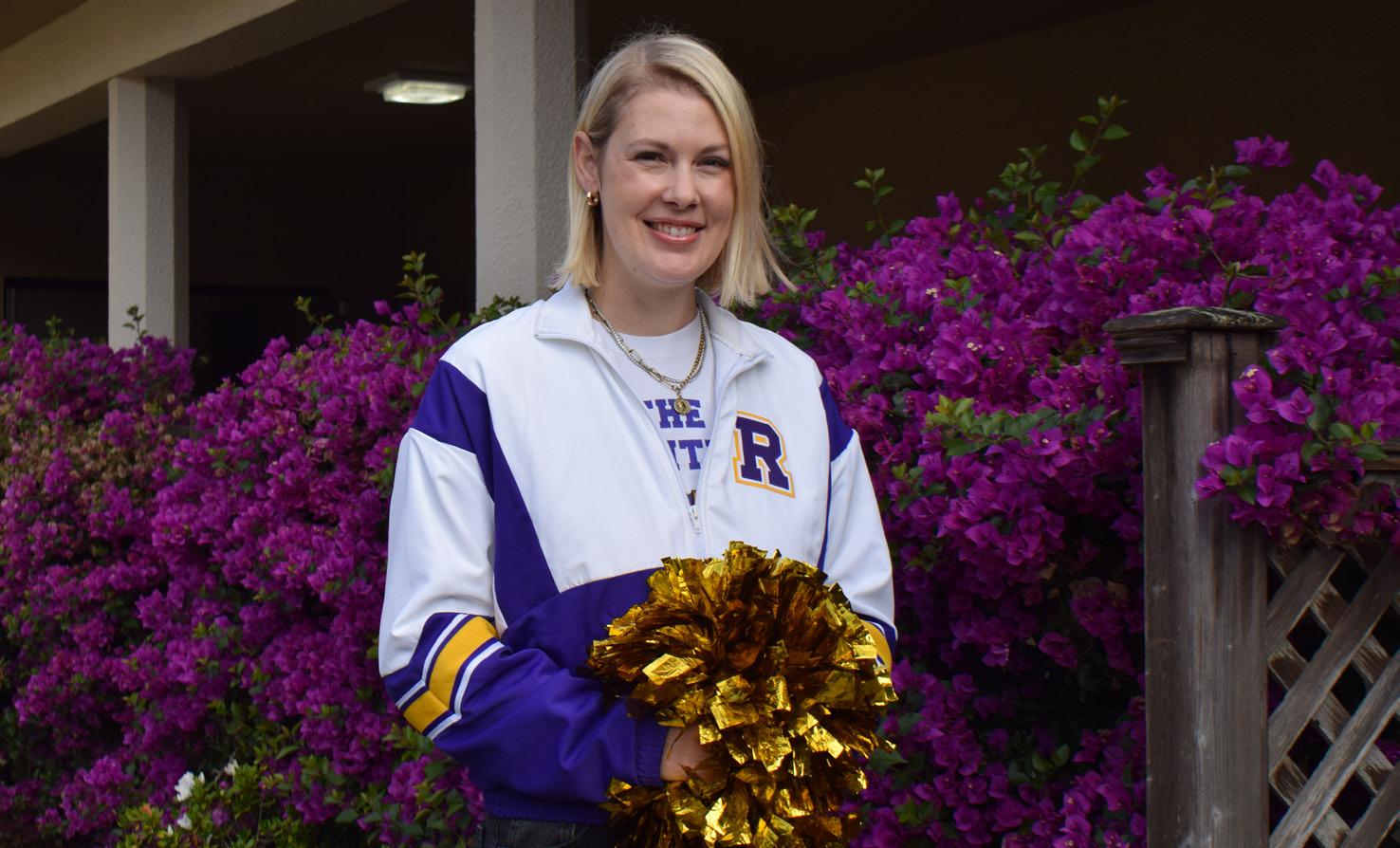
Photo by Alessandra Leon ’26
Meghan Williams is not only an English teacher, but also the dance team coach.
By Alessandra Leon ’26
With her supportiveness and encouragement towards her dancers, Meghan Williams has established great management and exposure to creativity as a coach of Riordan High School’s dance team. She also expresses her love and support for her new role as a mother, balancing being a mom, dance team coach, and English teacher.
She attended Foothill High School in Pleasanton and was involved in Color Guard with her high school’s award winning band. She did competitive dance outside of school in styles of hip hop, jazz
and ballet.
Balancing schoolwork, an outside job at a daycare, and extracurricular activities enforced her time management, as well as her motivation to go to dance and color guard practices and performances. Looking back, she wished she took more time to focus on herself and spend time with friends because she was busy in high school with her extracurriculars and schoolwork.
Williams attended St. Mary’s College in Moraga, California, where she graduated with a double major in English and dance. She enjoyed her college
experience where she was a part of the dance program they offered. With this program, she had to stay dedicated as she attended practices and educational dance classes.
Besides dance, her career focus is on teaching English to students. She has been teaching English since she was 22 years old, first at Concord High School for six years, then Las Lomas High School in Walnut Creek for two years and now Riordan High School since 2023. The 2025-2026 school year marks 10 years of teaching and it’s her third year teaching English at Riordan.
When the opportunity for starting a dance team at Riordan came up, Williams agreed to be the moderator for the team.
“Making sure what is really important to me from my college experience, that students are the focal point of leadership, and as a coach of management, safety, I wanted that creativity component from students,” Williams said.
As Riordan’s dance team coach, she is in charge of management and safety, such as organizing their performance schedule, managing uniforms, expressing behavior standards and rules, and communication between other
directors at Archbishop Riordan. Her goal for the dance team and for her students is to present their talent and dedication, as well as their creative aspects in choreographies.
The dance team expresses the school spirit at Riordan, bringing the school alive with dance.
“Being on the dance team with Ms. Williams has made me feel more confident in my dance skills and myself by always supporting us and being there for us,” said dance team member Isabella Dudum ’27.
“She is our biggest supporter in many ways, always advocating for us to perform at events. She helps us with coordinating uniforms, and supports us at practices,” said dance team member Eva Chamorro ’27.
She added, “She’s like a dance mom to us, really caring and charismatic.”
Williams offered some advice for dancers: “Do not give up on dance and keep this passion in your life in some capacity, as it will help with physical health and mental health,” Williams encouraged.
With the help of Coach Williams, she has helped build a strong foundation for the dance team to grow in the years to come.
By Lorelai Keating-Curran ’27
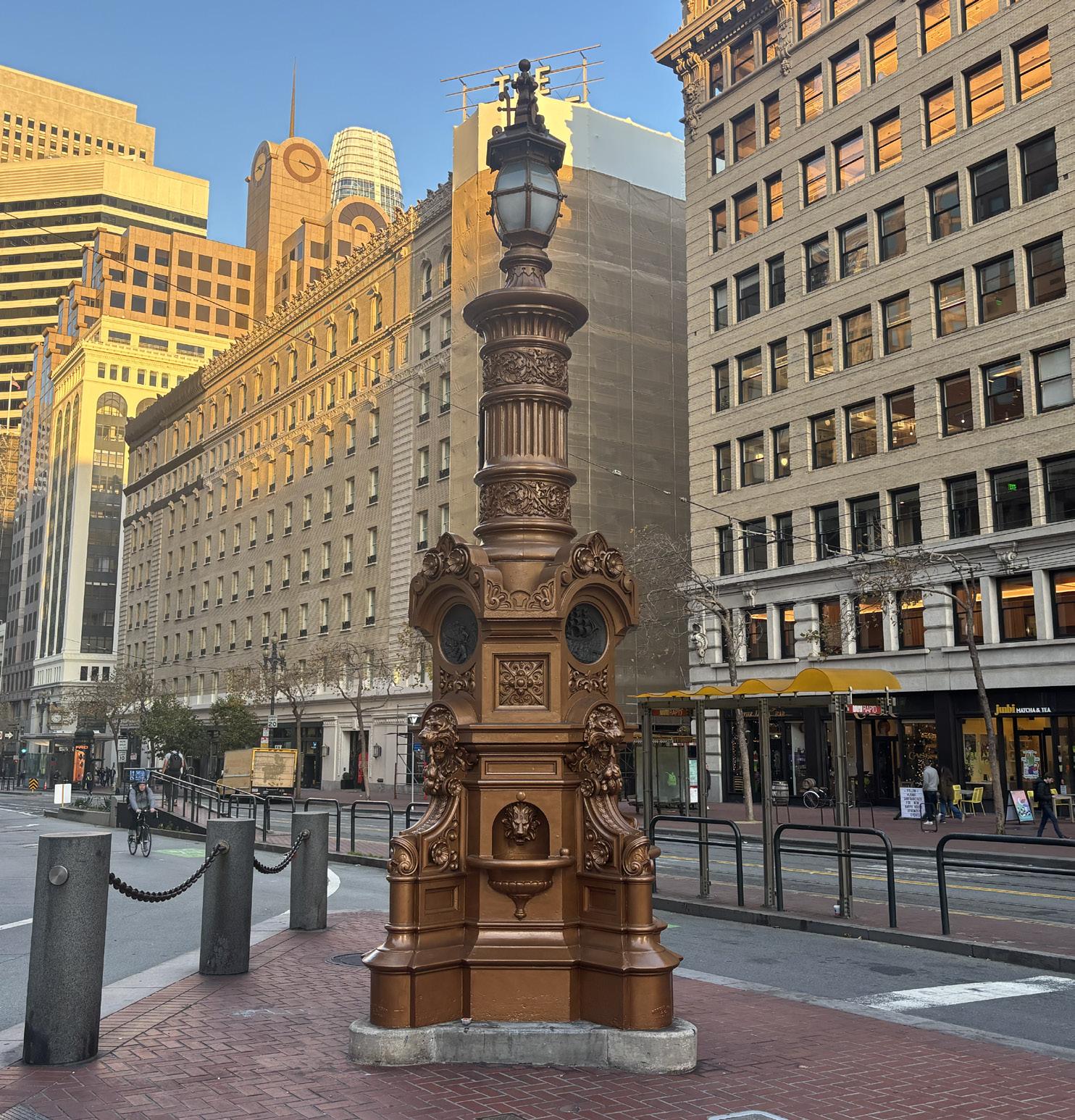
In the heart of downtown San Francisco at the busy intersection of Market, Geary, and Kearny streets stands Lotta’s Fountain, a bronze monument that has witnessed nearly 150 years of the city’s history.
This fountain is more than just a relic; it tells a story of gratitude, survival and remembrance that continues to unite San Franciscans through time.
The 1875 fountain was a gift from the renowned Gold Rush actress Lotta Crabtree to the city where her career began as an expression of gratitude for those who helped her rise to the top. With its exquisite features and lion-headed spigots, the elaborate cast-iron design also served a functional purpose as a drinking water source for admirers and their horses.
The fountain’s most enduring legacy happened years later during the infamous 1906 earthquake and fire that devastated San Francisco. Almost the entire downtown was destroyed, except Lotta’s Fountain. Survivors used it as one of the few remaining sources of drinking water, as a meeting place to find loved ones, and as a central place to post messages and share news.
What was once a performer’s gift became a symbol of resilience, a silent witness to the city’s rebirth.
Every year since then on April
18 at 5:12 a.m., San Franciscans gather at the fountain to honor the anniversary of the quake.
Even as the original survivors faded into history, the tradition lives on, a testament to the city’s enduring spirit.
Riordan President Tim Reardon fondly remembered, “My great grandfather became the President of the SF Board of Public Works just after the earthquake and remained in that position until almost 1930, so during that time of incredible growth, he was involved politically in many of the city’s major projects, including bridges and tunnels and highways.”
Lotta’s Fountain has grown and changed with her city over all these years. In 1910, principal female opera singer, Luisa Tetrazzini, sang at the fountain when the opera house was closed. In 1999, a new pillar was added to the fountain to harmonize it with Market Street’s upgraded “Path of Gold” streetlights.
Sadly, even given these changes, people seem to be forgetting about this important touchstone of our city’s past. Graydon Gambino ’26 said, “I think the younger generation doesn’t care about Lotta’s Fountain.”
I think we’ve forgotten about those parts of our city’s history or at least forgotten how to appreciate them.
- Graydon Gambino ’26
He added, “I think we’ve forgotten about those parts of our city’s history or at least forgotten how to appreciate them.”
Today, groups like SF Heritage are trying to ensure it remains a cherished landmark.
More than metal and stone, it stands as a place for socializing, for thought, memory and society. In a city popular for allure and
change, Lotta’s Fountain is a reminder that San Francisco’s character has always been one of hope, resilience and human relations.
Isaac Haymaker ’27 said, “Even if younger people today don’t know the history, Lotta’s Fountain still has the power to inspire people to learn about it as it deserves much more attention than it gets.”

By Martin Novoa ’26
In the year 2000, the International Space Station achieved a feat believed to be impossible: permanent human residency in space. For 25 years, the station has prospered, hosting tourists, facilitating experiments, and setting a foundation for scientific study.
The International Space Station began as a program involving multiple countries: the United States, Canada, Japan, Russia, and multiple European countries. During its two construction phases, the space agencies sent shuttles, contributed materials and resources to create the station, and provided astronauts and engineers to make the International Space Station a reality.
On Oct. 31, 2000, Bill Shepherd of NASA along with Russia’s Sergei
Krikalev and Yuri Gidzenko, launched from Kazakhstan. The launch succeeded and the three proceeded to live on the station for five months, making the place amicable to all.
One word describes the International Space Station: unity. In addition to multiple countries collaborating to create the station, the station hosted over 290 people from 26 different countries during its 25 years, with seven countries currently at the ISS now.
Numerous expeditions and experiments have been conducted, using its many labs and functions to the fullest. For instance, the station created the Alpha Magnetic Spectrometer to scan for cosmic rays, and tested various Earth technologies in space, such as testing tissue chips in microgravity.

For that reason, Jerard Loyola ’26, president of Archbishop Riordan’s rocketry club, sees the station as “fascinating,” and a “symbol of human ingenuity.”
Unfortunately, despite its greatness, the International Space Station carries large problems: cost and age.
Stuart Kaler, physics teacher at Archbishop Riordan, commented, “There’s a good deal of maintenance costs… send[ing] up capsules now and again [with] the basics, food stuff, resupply it with water… it’s a costly venture.”
Furthermore, NASA explains that originally designed parts still exist at the station’s core; these parts were only built for a 30-year life cycle, which ends after 2030. Continued use of the parts could result in serious danger for the spacecraft.
Therefore, with help from Space X, NASA plans to de-orbit the station in 2031, bringing the station back to Earth.
Loyola looked toward the future, exclaiming, “The space station… happened because people of different cultures…were all willing to come together and collaborate on this big dream… if NASA can really build on that unity… then we’d be able to go further.”
After the International Space Station’s de-orbit, NASA looks to allow private industries to develop new stations, whilst preparing future exploration missions to Mars.
The end of the International Space Station will mark the end of an era, but it may be the beginning of something new, something astronomical.
By Josh Lee ’26
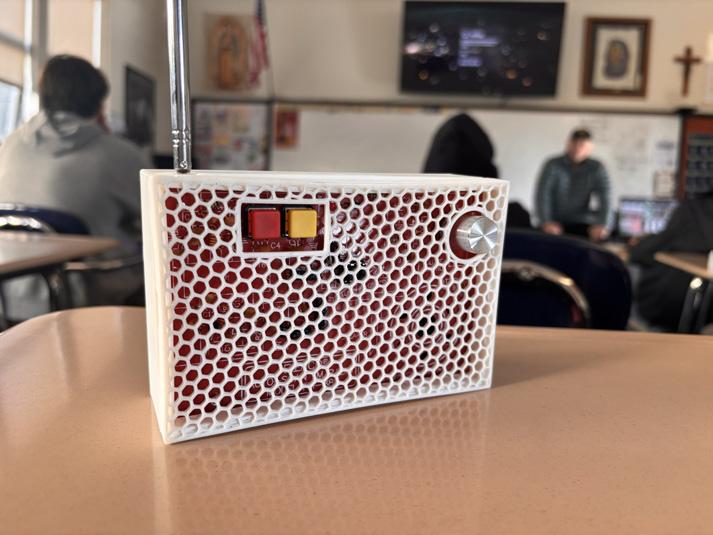
In the physics class at Riordan, students spend their time charging through the difficult fields of electricity and magnetism to take on the challenge of bringing these shocking concepts to life.
Taking advantage of Riordan’s growing approach to a more project-based learning environment and the Engineering department’s electronic equipment, an idea was conducted.
“Hence, the FM radio kit project was born,” explained Stuart Kaler, the course instructor. “They learned in class what
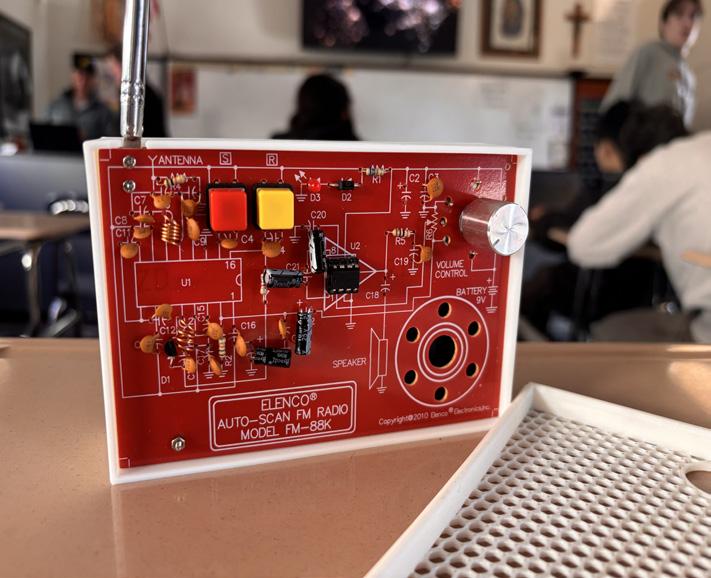
resistors, capacitors, inductors do theoretically. Now, they get to hold, handle and assemble these components onto a printed circuit board – and if lucky, turn it on and have a working FM radio.”
The FM (frequency modulation) radio broadcasts audio through the frequency of electromagnetic waves. Like the radios that play in cars, people can listen to music, news, and talk show hosts across multiple stations.
Students created the FM radios through an Amazon radio kit. Soldering capacitors and resistors onto a pre-made board, they maneuvered the creation piece by piece.
“We followed the instructions that came with the kit, soldering things where they belonged,” said Crystal Wei ’26. “Sometimes you’ll need a third hand to help you hold the capacitor or some other thing, but most of the process was easy to understand and fun to conduct.”
Out of the 26 students in the course, three-fourths of the class were able to build working radios.
“Mine definitely worked.
Although the process wasn’t that complicated, I still felt quite accomplished,” added Wei.
Even for the students whose radios failed to function, many students reported that they had learned a lot in constructing the radio.
Andy Siu ’26 commented, “I learned about all the different components needed to make a radio, what they do, and how they work. I learned the history of how capacitors, speakers, and resistors were created and how
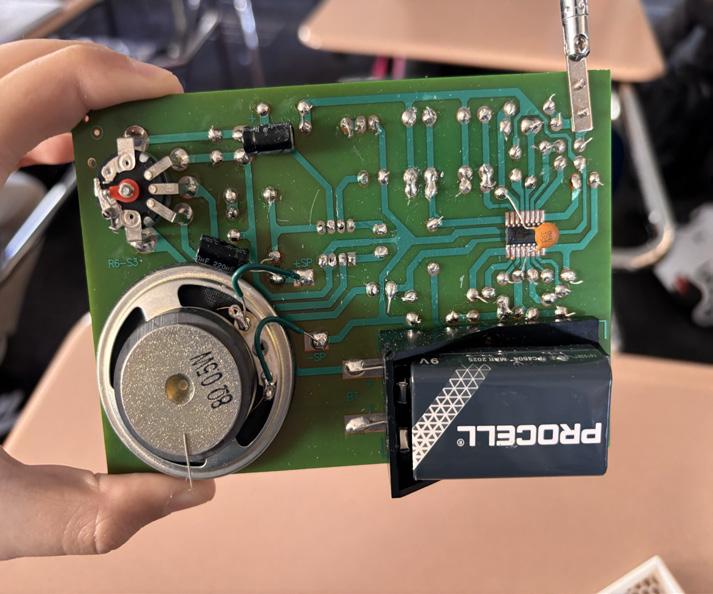
they are used in everyday electronics like a radio.”
When looking to the future, Kaler revealed the ideas he has in store for his classes.
“We can expand the use of the Engineering department to include more electrical engineering projects at this school,” he said.
“Just the sheer joy of building something – and have it work on the first try, or trouble shooting it and getting it to work – is well worth the time and effort.”
By Hazel Nagata-Rampata ’26
On a typical walk through San Francisco, you will most likely see dogs, maybe a cat on a stroll, or even a tortoise walking the hills of the West Portal neighborhood.
But, one new animal joining the bunch is the infamous black, gray, and white, furry trash panda–otherwise known as a raccoon.
Along with their defining characteristics of little grubby hands, bandit masks, and a big, fluffy, ringed tail, the size of their snouts is becoming a new characteristic defining their domestication.
Domestication syndrome, often found in animals like dogs, cats, goats, and rats, is when phenotypic (visible) traits like depigmentation, floppy and/or reduced ears, shorter muzzles, smaller teeth, docility, and more become increasingly common in species.
AP Environmental Science teacher, Michael O’Brien, commented that, “It’s important to distinguish domestication in terms of people keeping them as pets, and then turning them loose whenever they feel like they don’t want them anymore. Domestication is also where you can have wild animals like deer, which nobody could ever keep as pets. Yet, because they’re so domesticated and because they are so used to being around human beings–they’ll come and eat your rose garden.”
Urban raccoons are found to have a reduction in snout size, with a study finding that raccoons in urban areas have

a 3.56 percent snout reduction in comparison to raccoons in rural areas. Live Animal Exhibit Manager at the Randall Museum, Zach Lim, commented that he “think[s] that’s kind of a farce. I think they’re basing off a different study with a fox in the fur trade, and it doesn’t translate very well with raccoons. I think they’ve become accustomed to living around humans just because we’ve encroached on their habitat for so many years now.”
Sightings of these “trash pandas” are abundant in areas like the Presidio and Golden Gate
Park, and generally throughout the city.
San Francisco resident and Spanish teacher, Armando Castillo, said, “We need to live and interconnect alongside nature, not eliminate it, not destroy it. They [raccoons] were here longer than people were here, they should be here, with us.”
With this domestication of raccoons, a very important question arises: could raccoons be pets?
In states such as Arkansas, Florida, Illinois, New Jersey, Ohio, Oklahoma, South Dakota,
Tennessee, and Wisconsin, owning a raccoon is legal–with the exception of needing a permit and/or the raccoon being from a USDA-licensed breeder in most of these states.
Although their utterly cute fluffiness may be hypnotizing, having a raccoon as a pet does come with some drawbacks. AP Biology teacher Colleen O’Rourke explained, “They have very sharp teeth and are also prey to other animals. So, that could give them a very strong defense behavior, which could make them bite and scratch more than dogs and cats.”
Having a raccoon as a pet is not the most realistic option for most people, nor would it be the safest move due to their wild nature.
One of the safer ways to “aww” at a raccoon is at the Randall Museum. Located in central San Francisco, it is home to a female 3-year old raccoon named Lyra.
Weighing in at 11-12 pounds, this raccoon, born with a crossed jaw with an overbite, an inwardsdomed skull like a pug, and threefused vertebrae in her spine, was found abandoned by her mother in Santa Cruz.
“She’s a real special raccoon, if people want to have a pet raccoon–they shouldn’t–they should just come here [Randall Museum] and see what a raccoon is like,” said Lim.
The domestication of raccoons in urban areas will continue to be studied, with the possibility of raccoons being a more popular pet. To be noted, the ownership of a raccoon is illegal in California, with fines up to $10,000.
By Isabella Thumas ’26
On Aug. 7, the Environmental Protection Agency (EPA) announced the cancellation of the Solar For All program, a $7 billion grant program designed to help power low and moderate income households across America.
Over the past couple of years, the use of solar energy has been significantly on the rise as it has become cheaper to install and is more environmentally friendly, with it converting sunlight to electricity. Solar energy is the second biggest reusable energy source as of now, and is expected to become number one in 2026.
Solar For All first started in 2022 under the Biden administration, funded by the Inflation Reduction Act: new environmental laws that would help fight against climate change. In August of 2024, Solar For All had provided monetary grants for 60 recipients including 49 states, six tribes, and the U.S. territories.
The program also helps to cut the costs of the electricity bill, up to 20 percent for over 900,000
homes.
“I think cost is a big factor into why we can or cannot be environmentally friendly. Sometimes you don’t have a choice,” said Amisha Shankar ’26. Programs like Solar For All are also seen as a good way to remind people to be more aware of their ecological footprint, and to be more environmentally friendly.
“Solar panels are very expensive, and so by having these free forms of energy people are more willing to use it,” added Shankar.
Many in the United States have been affected by the cancellation of the program, such as the southern states. In Texas, Harris County was granted $249 million to help distribute solar and battery power to in-need neighborhoods. This grant provided workforce training for low-income workers and minorities.
The move to cut the program by the EPA was ultimately made by the Trump Administration, as they decided to cut back on federal support for solar and wind energy.

“If we cut programs like this, we’re going to use energy in ways that we’ve always had, which is not sustainable,” said Environmental Science teacher Michael O’Brien.
As renewable energy becomes
more common, decisions like these may make it harder for people in the United States to become more eco-friendly, and would ultimately contribute to global warming and climate change as a whole.
By Robert Bennett ’27
Inside Daniel’s Pharmacy in the Excelsior, pharmacist Steve Protzels, Pharm. D. stands behind the counter, greeting customers by name.
The small shop hums with movement: deliveries being packed, phones ringing, and regulars picking up prescriptions.
In a city where neighborhood pharmacies, both independent and chain locations, keep disappearing, Daniel’s still feels like a place where people actually know you.
Daniel’s Pharmacy has been part of the neighborhood for decades, run by a family deeply rooted in San Francisco. Protzels has worked here for 11 years but has spent over 50 in the field.
Before joining Daniel’s, he managed other pharmacies, including Safeway and Westward. But the difference, he says, is freedom.
“Here, you can actually make professional judgments. At a chain, there’s always a big brother watching.”
That freedom lets him focus on what matters most: the people. When a customer comes in confused about eye drops, Protzels doesn’t just point, he steps out from behind the counter to help.
“It’s all about customer service,” he said. “We go out of our way to make accommodations that
people might not get in other places.”
For Ed Nasrah ’84, one of the family owners, the mission is personal.
“We grew up in this neighborhood…Everybody feels like family. We’re the first stop for people before the doctor. It’s satisfying knowing we can help someone before a health problem gets worse,” Nasrah said.
He also emphasized the pharmacy’s innovations, such as custom bubble packs and direct delivery, which improve patient compliance and care for complex cases like hospital or HIV patients.
Nearly 70 percent of their 300–400 daily prescriptions are delivered across the Bay Area, to homes, hospitals, and senior centers.
Still, staying independent isn’t easy. Financial pressures, low reimbursement rates, and middlemen called pharmacybenefit managers, who work between drug companies and pharmacies to set and manage medication costs for insurers, threaten small operations like Daniel’s by taking too big of a cut for themselves.
“Money is the driving factor,” he said. “If you have financial problems from any angle, it’s bad.”
He worries that independent pharmacies may become “a thing of the past,” especially as
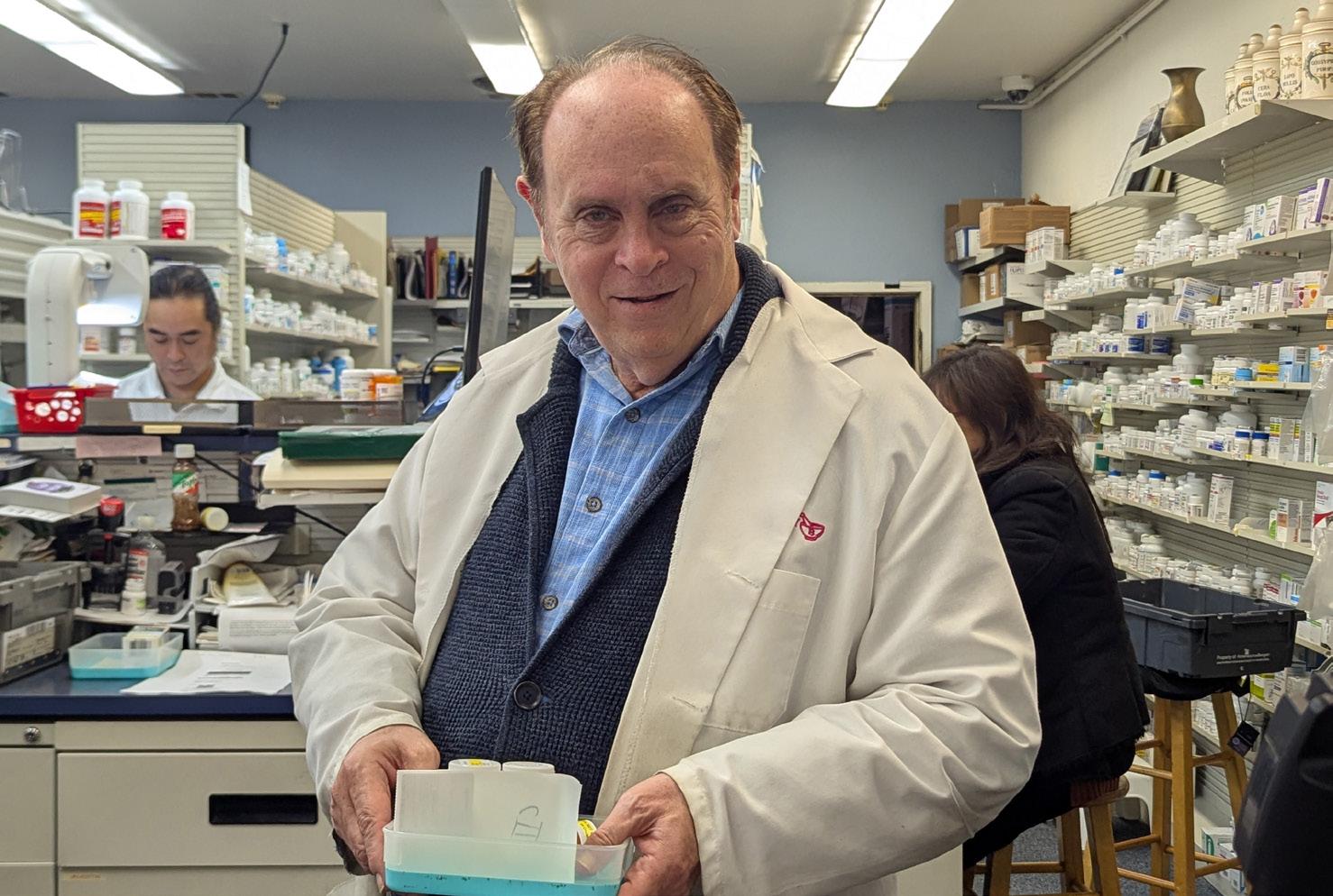
big chains shuffle pharmacists around as “floaters,” making it impossible for customers to form relationships with their caregivers.
But for customers like Mike McElligott ’68, Daniel’s is irreplaceable. “They treat you like an individual here, not just a number…So many pharmacies are caught up in greed. These guys are just doing the right things.”
For McElligott, the relationship is personal, even vital.
“If I mess up one medication, I could die,” he said. “They look at every prescription to make sure
nothing cancels the others out. They’re tremendous.” He smiled, adding, “Every time I walk in here, someone helps me out with something. They really treat you like family.”
After 50 years in pharmacy work, Protzels still laughs at the idea of slowing down. “Only been doing this for 50 years,” he said with a grin. “So I’m just getting started.”
Daniel’s Pharmacy may not be flashy like a chain store, but that’s exactly the point. It’s not just a business on the corner - it’s a reminder that care, trust, and community can still fit behind a small counter in San Francisco.
By Alessandra Leon ’26
A San Francisco staple within the grocery industry would truly be Rainbow Grocery.
Since 1975, they have been serving the community within the Mission District of San Francisco with local, natural resources of organic foods.
This year, they are celebrating their 50th anniversary to spotlight the remarkable founding by activists of the People’s Food System and its mission of being a worker owned cooperative and supporting small businesses.
Erin McDermott, Border Director of Public Relations and worker of the Bath and Body department at Rainbow Grocery, expressed her enjoyment of working at a worker-cooperative business.
“It’s a different style of business than most. There’s no bosses so everyone works as their own boss, which is nice because it’s more of a community vibe than a regular job of a top down hierarchy.”
During the 1970s, food conspiracies had a sharp decline where people would less likely buy food in bulk from local farmers to establish it as budget friendly.
A food conspiracy was a community based movement based in San Francisco where households pooled their resources to buy food in bulk. The People’s Food System was then created

throughout the Bay Area to establish local worker-owned grocery stores to implement food conspiracies like Rainbow Grocery.
Its main mission is to support its workers and employees and be open minded to hiring individuals, particularly recently paroled prisoners and refugees from Central America.
Before Rainbow Grocery, they started as a volunteer group working within San Francisco and locals would begin to purchase in bulk fresh produce and noticed the significant impact it had on the community who weren’t able
to access these food items.
Isabella Soriano ’26 said she enjoys that the grocery is unique.
“Rainbow Grocery is different because it’s employee-owned and it doesn’t belong to a really large corporation, which I think is super cool,” she said.
The business offers a variety of food options including: vegetarian, gluten free, products from local organic farmers, bakers, dairies and fresh ingredients.
Jeri Kenny, yoga instructor at Archbishop Riordan, expressed her opinion about why she loves shopping at Rainbow Grocery.
“I love the accessibility to
healthy food that the grocery store offers. When we think of small local companies we don’t always think reasonably priced and you can absolutely find nutritional food within a budget, which I absolutely appreciate.”
They’ve always been inclusive to everyone since it has been founded, including people of color and LGBTQ+.
“They are super welcoming, so kind, so friendly that it makes it wonderful to go to the grocery store and shop,” Kenny said.
Alex Rivera ’88, Achieve Senior Program director at Archbishop Riordan, expressed what Rainbow Grocery means to him in his community.
“I remember when it was on Valencia Street. It has always been part of the fabric of the community. San Francisco and the Mission District are melting pots and Rainbow has served all the members of our community. My dad is a vegetarian and I remember shopping there as a kid with him.”
The future looks promising for Rainbow Grocery because of the younger generation focusing on sustainability to support the environment.
With its long term goal to focus on giving back to the community with well made food products, the business will strive to flourish in the near future.
By Ashling Greene ’26
As another thrilling football season comes to a close, Archbishop Riordan’s varsity team showcased determination, grit, and teamwork, finishing with an impressive 12–1 record. Every game was filled with hardfought battles, standout plays, and moments that highlighted players’ dedication on the field. This season was about the talent, leadership, and heart that made the Crusaders a force to be reckoned with around the Bay.
This year is especially memorable because some of Riordan’s top football players, specifically seniors, will be taking their talents to Division I programs. Their commitment to excellence has left a lasting mark on the program and inspired teammates across the roster.
Some players are even graduating early: Tommy Tofi ’26, Cynai Thomas ’26, Michael Mitchell Jr. ’26, and Skylar Tiatia ’26.
In addition to those graduating early, other notable players who are worthy of watching are Judge Nash ’26, Sione Fanaika ’26, Michael Langi ’26, Kyle Welch ’26 and Perrion Williams ’26. Every single one of these players made a lasting impact on the team, but they are moving on to bigger things, either next semester or in the fall.
“Take it one day at a time, embrace every single moment because it goes by really fast, play
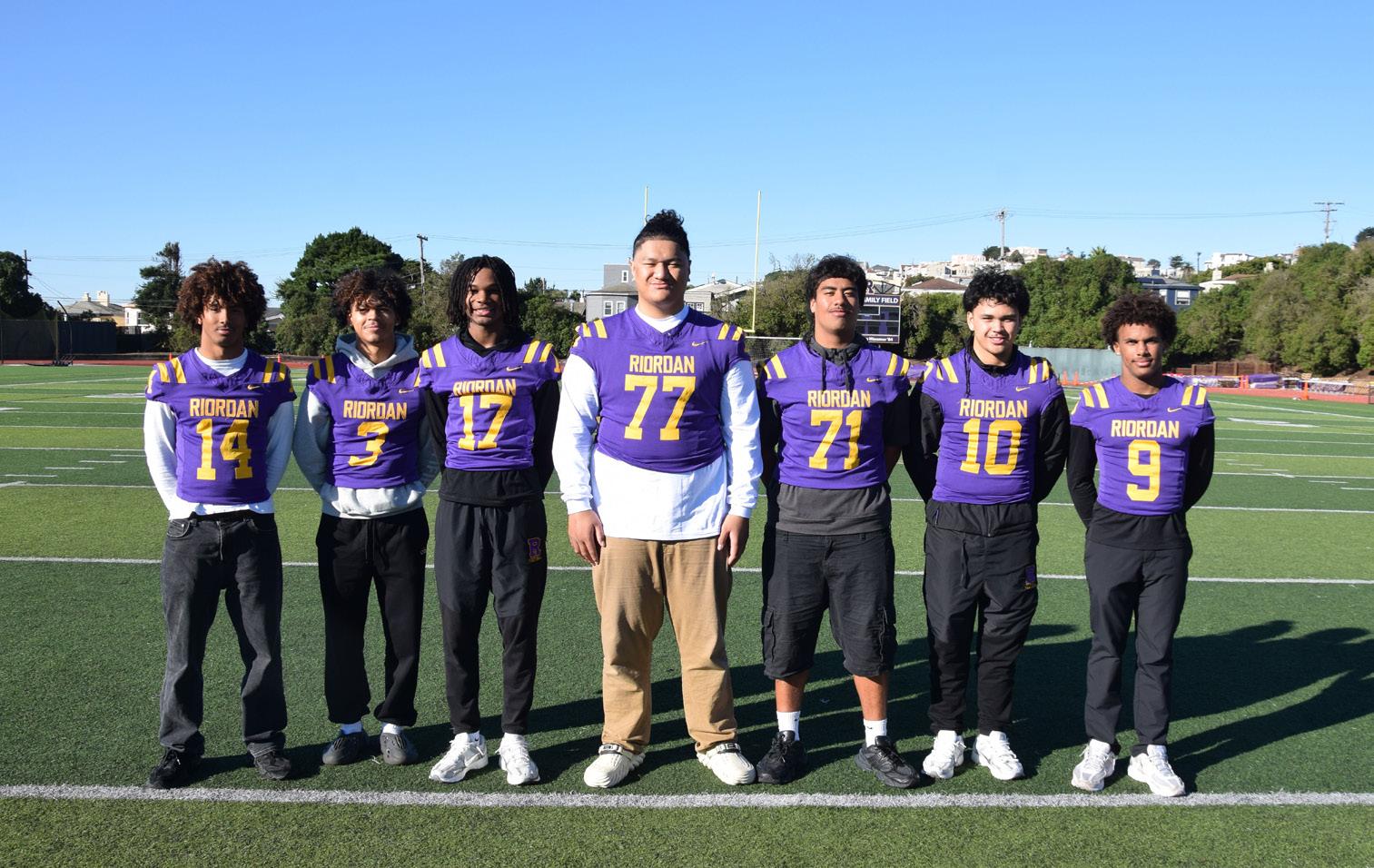
for yourself and play for your teammates,” Thomas stated.
Tofi, one of the most dominant linemen Riordan has ever seen, will be attending the University of Oregon.
“I chose Oregon because they were really the first team that actually recruited me before my whole recruiting started to blow up, and a lot of coaches who were recruiting me got fired or took another coaching job, besides Oregon. It was the clear choice for me,” Tofi said.
Riordan’s wide receiver room has been filled with elite receivers over the years, but this year it included multiple standout receivers, including Judge Nash ’26 and Cynai Thomas ’26.
Thomas, one of Riordan’s most explosive and reliable wide receivers, is committed to Oregon State, joining the Beavers next year. Thomas’ elite speed, sharp route-running, and ability to shine made him one of the team’s most dangerous offensive weapons.
“I’m going to Oregon State because that’s where I felt the most comfortable and most at home, and I feel I can have the most success there,” Thomas said. Nash will continue his academic and athletic journey at Harvard University in the fall. Nash was known on the Riordan offense for his remarkable catching ability and as an end zone threat.
In the 2025 season, he began with numerous multi-touchdown
games and he led the receiver room with the best average receiving yards per game.
On the defensive side, Tiatia, a 6 foot 1 inch, 215-pound linebacker known for his toughness, instincts, and leadership, has signed to continue his football career at San Jose State University. Tiatia has been the heart of Riordan’s defense, consistently making crucial plays and setting the tone for the entire unit.
“I’m going to San Jose State because I really loved the campus setting there and the culture,” Tiatia said.
Finally, Mitchell, a four-year Crusader Varsity quarterback, is committed to Stanford University. Mitchell has been the center of Riordan’s offense because he has been a threat to every defense with his elite running ability and arm strength.
At Stanford, he will be staying close to home while coming closer to his dream of playing professional football.
Mitchell stated, “I chose Stanford because I believe in what Coach Luck is building there and I’m excited to be a part of it! Also, you can not beat the education.”
As players hang up their Crusader jerseys, each player remembers the work they have put in these past four years and hopes to perform with passion and courageous efforts in their college careers and beyond.

By Avery Agbunag
On Nov. 14, a
occurred
in Oakland, and the famous coach featured on the Netflix series “Last Chance U,” John Beam, was
“One of my athletes was on Laney’s campus when it happened,” Terence Wood ’97 said. “So we were all affected very strongly.”
Coach Beam was 66 years old at the time of his death. His death sent shockwaves
through the football community, especially in Oakland where he coached at Skyline High School and Laney College.
The alleged suspect, Cedric Irving Jr., was arrested on Nov. 14 and will appear in court on Dec. 16.
According to KTVU 2, he was a former athlete of Coach Beam and was struggling with hardship before the shooting, such as eviction and unemployment. The exact motive is unknown at this time.
“I was very sad,” girls’ flag football coach Joe Kopp said. “The reason why is because [Coach Beam] was an icon in a city who needs an icon.”
“I felt real sorrow for people who I know were even closer to coach Beam than me,” Wood said. “Like his family, wife, daughters, and friends. All of his athletes and coaches.”
High school football players were also affected by his death. “I was shocked,” Owee Angeles ’26 said. “For one, I did watch ‘Last Chance U.’ I liked him as a coach
and a person. He cared so much for his players.”
His unique coaching technique sent over 20 players to the NFL and won his team championships. He prioritized academic achievement and used sports as a way to build his players’ characters. This paved the way for other coaches, who looked up to Coach Beam.
“There are transactional and transforming coaches,” Kopp said. “[Beam] turned players into great men, great husbands, great fathers. In JUCO football, you really have to want it. He was a coach who made sure players who wanted it got it.”
At both Skyline High School and Laney College, current and former athletes of Beam gathered together to form a memorial, honoring his life. His coaching legacy went beyond that of the city of Oakland and will forever be remembered in playbooks.
“If I knew Coach Beam, he would say, ‘It brings the community/ team together, ’” Wood said. “So be it! Ready, ready. Give me two claps!”
By Crystal Wei ’26
For the first time ever, both the Riordan’s boys and girls Cross Country team qualified for CIF State Cross Country championship after an extraordinary performance in the Division IV race at the Central Coast Section Championship.
Over Thanksgiving break, the team traveled to Fresno, the host city of the highly anticipated meet. Ultimately, the girls and boys teams each secured 21st place at State.
Head Coach Benny Willers ’08 hypothesized the girls’ success with them ranked 3rd among the teams, but the boys qualifying for state, top three at CCS, was definitely a surprise.
“[The boys] had everything stacked against them and they did everything they had to do that day to execute. Eventually they were able to pull it together, our
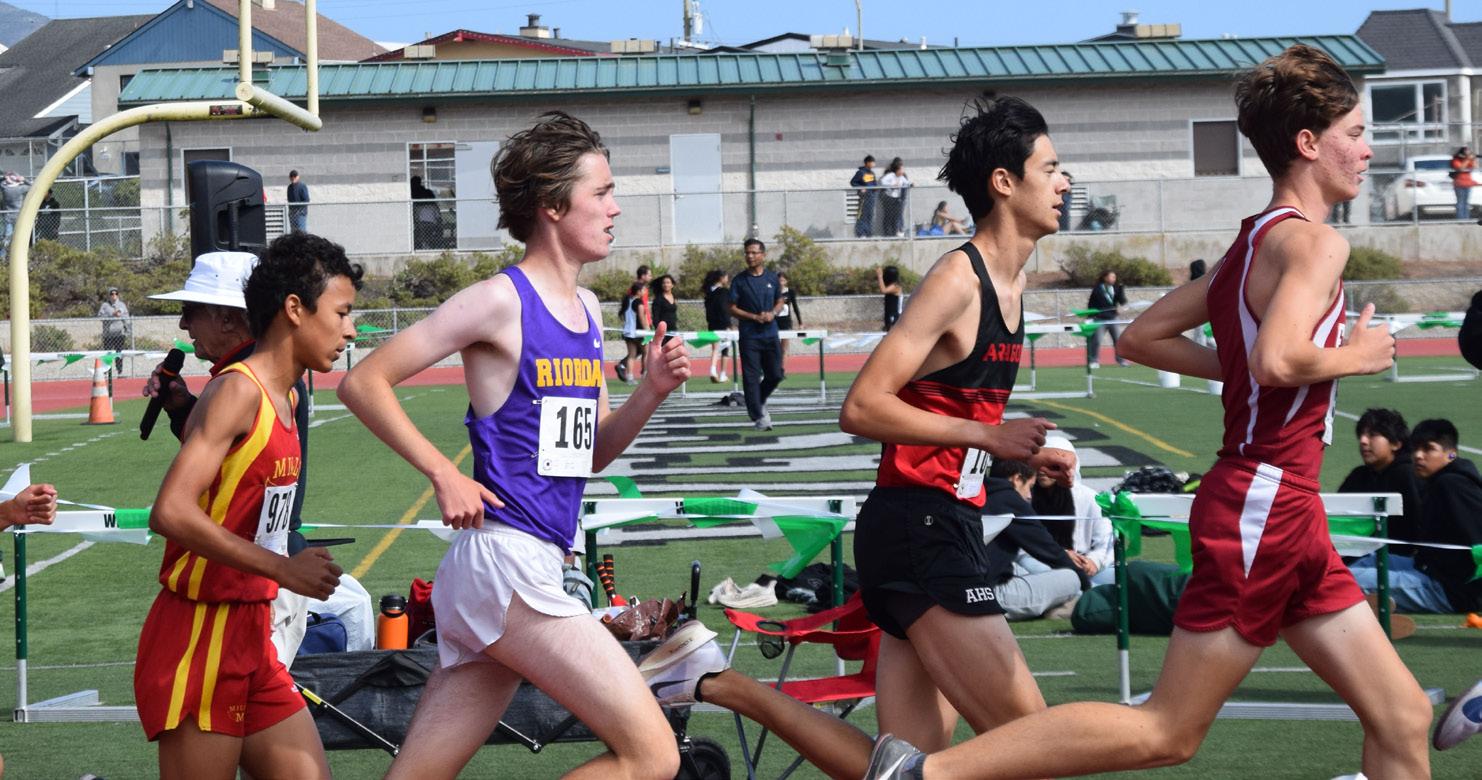
goal at the start of the season, but it was something with so much adversity [because] our top runner Brendan Grogan [’26] got hurt.”
The girls team’s top runner, Freddie Michalchuk ’26, also suffered a hip injury.
Despite the adversities, the rest of the team still managed to exceed their limits, making
Riordan history.
In a milestone moment for the program, Joseph Olson ’26 surpassed the school record of 16:14.9 for the Woodward Park course. The record had stood since the era of current cross country coach Brian Kosewic ’16.
Despite the win, Olson felt melancholy. “One of my closest friends Brendan Grogan …
probably would have been faster than me if not for a stress fracture.”
The runners cared deeply for each other, and qualifying together was emotional, a testament to the family-like bond they’ve built through months and years of shared workouts and challenges.
Placing top 10 individually, runner Georgie Michalchuk ’26 recalled the moment vividly.
“I finished the CCS race knowing l’d place well enough to qualify as an individual, but when I turned around and saw that the whole team had qualified it was super emotional.”
Team love is always evident, and this very love pushed the runners to success.
Freddie Michalchuk concluded, “I hope people remember our team as one that really worked from the ground up.”
By Aliyah Pasion ’26
After a season marked by growth, determination, and intense competition, the Riordan girls volleyball team concluded their 2025 season following their appearance in the playoffs. It was a historic year for the team, as they won the school’s first ever CCS Division III Championship for a girls sport.
The team’s hard work throughout the fall paid off as they finished the year strong. Making the playoffs was a powerful and emotional achievement for the players.
“As a team, we are grateful and blessed because we made history,” said Isabelle Abad ’26. “With Riordan now as a coed school, it felt empowering stepping into leadership roles for future girls joining the volleyball team.” From the beginning of the season, the team has focused on improving communication and
building trust on the court.
As the weeks progressed, their chemistry became more noticeable during matches. Throughout the season, the team pushed through emotional and mental challenges, especially in the final games.
“We had a go-get-it mentality and wanted to win every game,” Abad said. “But it was also emotional knowing it could be our last game, especially for the seniors. We grew so much together as a team.”
Team chemistry also played a role in the team’s success. Early in the season, the players were still adjusting to new teammates, but by the end, their connection had strengthened significantly.
On Nov. 6, the team defeated Capuchino High School at home, 3 - 0 in the CCS Division III Semifinals.
Two days later, they defeated
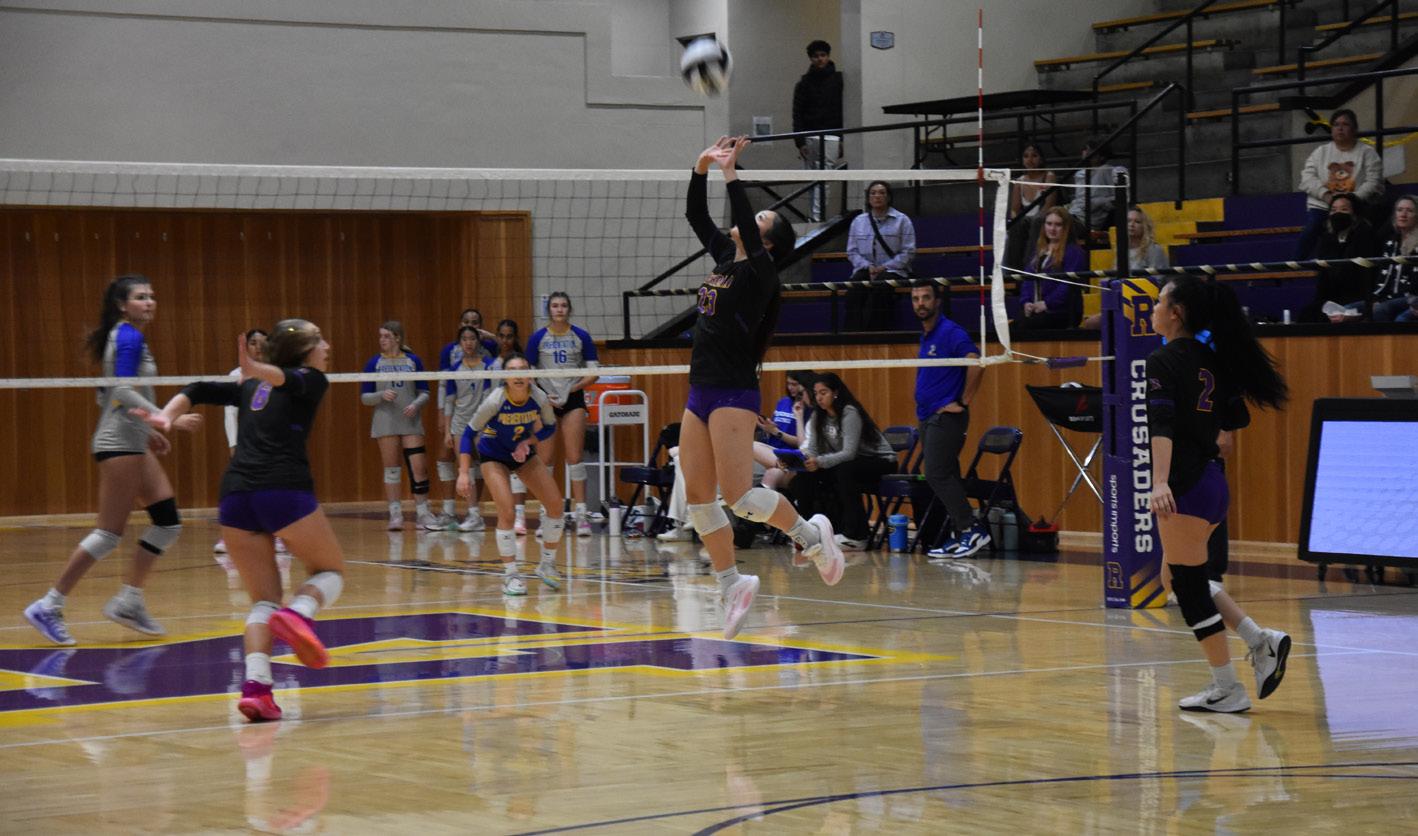
Santa Cruz High School 3 - 0 to claim the Division III crown.
The following week they defeated Sonora High School 3 - 0 in Round 1 of the Division III playoffs, but on Nov. 14, their season ended as they fell to Lincoln High School 3-2 in Round 2 of the CCS playoffs.
Although their playoff run eventually came to an end, the season left a lasting impact on the players and the school. With leadership and pride built throughout the year, the Riordan girls volleyball team finished the season stronger than ever.
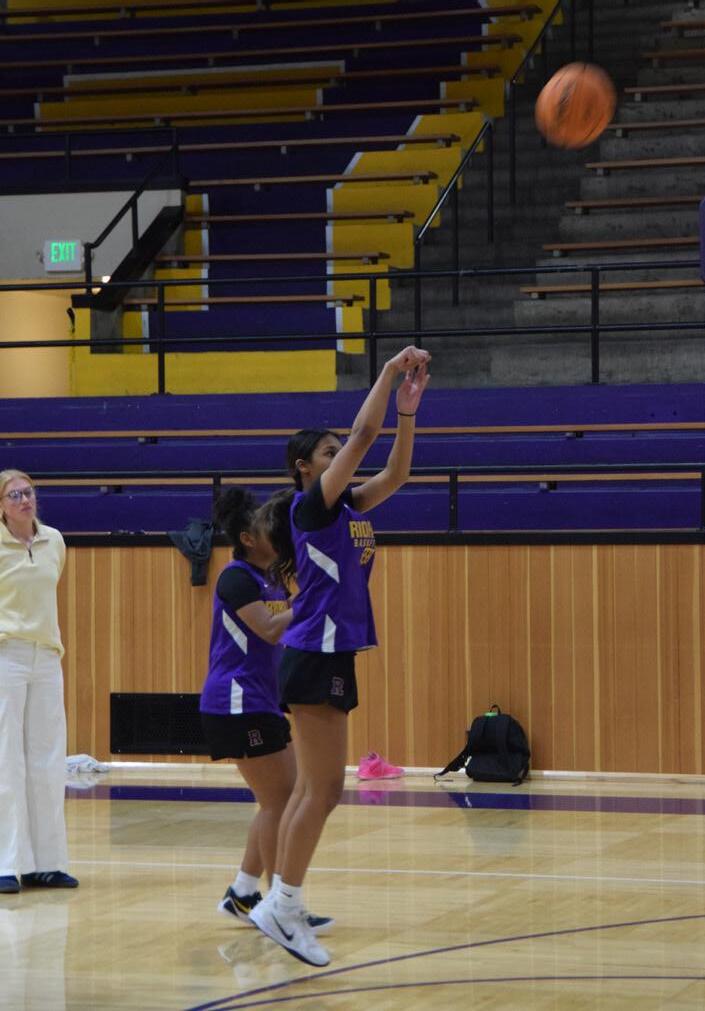
By Grace Longaway ’28 and Emilia Ross ’26
Archbishop Riordan’s girls basketball team opened their preseason games on Sept. 28 with matches between Clovis High School, and Cardinal Newman the day after on Sept. 29.
Although the team lost both games, they bounced back with a crushing win against Petaluma. The game was a boost for the team, coming back after a slow start.
Tallyah Nasol ’27 described the game, saying, “I think it was a really good game because it led to two really good wins and it felt like our team was on the same page for offense and defense. We had goals and it felt like we achieved
them that game.”
The Crusaders continued this passionate streak on Dec. 5 against Redwood with a 53-44 win. The girls demonstrated determination and energy.
Assistant coach Maddie Ennis stated, “I’m truly excited and incredibly lucky to coach this exceptional group of girls. I’m especially looking forward to navigating our competitive schedule. Coach Watkins has put together a challenging and gritty schedule that will push us every single game. Regardless of the outcome, each matchup presents a meaningful opportunity for growth, development, and advancement for our program.”
Continuing their streak, the
team defeated Saint Ignatius 5950, a matchup that brought out Riordan’s energy, teamwork, and focus that helped bring them to victory. Now sitting at a 3-2 record, the Crusaders are getting ready for the remainder of their season with confidence. Ariah Thompson ’26 stated, “I’m excited about the competition we play. We play three teams that are nationally ranked, which is good for us because it teaches us how we can foster teamwork and discipline.”
The quick improvement from the team is tangible, and although the season has just begun, the current momentum is promising for the rest of the season, as Riordan builds on its success.
By E’moni Ferdinand ’26
As the 2025 football season of the Archbishop Riordan football team comes to an end, their historic achievements have created a long lasting impact in the community.
The team had a dominant season, coming back from summer break with a 1-0 per week mentality, which set the tone for the rest of the season.
They made Riordan history, winning the West Catholic Athletic League title against the Junipero Serra Padres, 33 - 13, for the first time in 25 years, following that with another dominant win over Serra, winning 42 - 35, and claiming their first Central Coast Section (CCS) crown ever.
For many of the players, this will be their last season wearing a Riordan jersey. Many senior players and five early graduates will be moving on to Division I football at various colleges, including Stanford and Harvard.
Quarterback Michael Mitchell ’26 said, “I hope to leave behind success to the program. The main thing we talked about this year was brotherhood and playing for one another, which got us really far. I hope the future players know that’s the standard.”
Considering the historic path the team has set, it will be a challenging
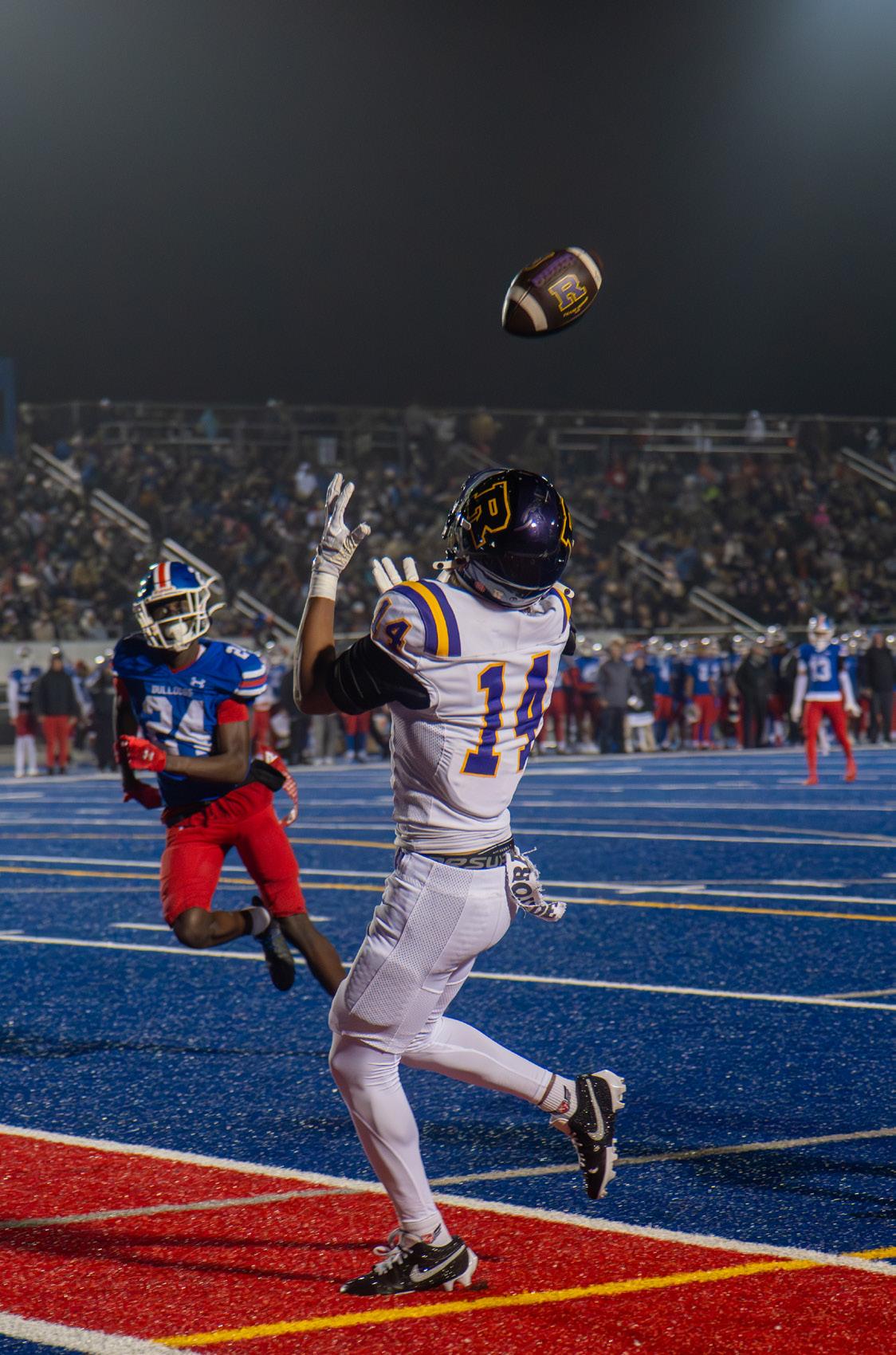
job filling in the shoes of those who are moving on.
Linebacker Isaiah Grant ’28 mentioned, “I’m looking forward to seeing the growth in not only myself, but of the football program and helping turn Riordan into a national powerhouse.”
With mindsets such as this, it’s clear that their goal is for Riordan’s legacy in football to carry on for generations.
On Dec. 6, the Crusaders took on the Folsom Bulldogs in Folsom, leading the first half 38-28. Unfortunately, the team fell short in the second half, losing 42-38.
However, the Riordan community admires and is grateful for the team, who had an amazing season regardless of the end result.
Fan Zion Mcguire ’26 said, “Watching the team play fills me with so much excitement regardless of the outcome. Whether they win or lose, I always remain loyal and hopeful for their later seasons down the road.”
Riordan football has become universally known as a team filled with fighters, and built on the core pillars of determination, spirit, and passion.
This 2025 season will go down in history as one of the most legendary seasons of Riordan football.
By Miles Witte ’27
After last year’s record breaking season, which culminated in a CIF Open Division Title and an Open Division State Championship appearance, the Riordan boys Varsity basketball team enters this season with high hopes and even higher expectations.
Last season, the team went 29-2 overall, including a perfect 14-0 in WCAL play for the second straight season. But with the graduation of many of last year’s top performers, Coach Joey Curtin ’01 is relying on the returners to step up.
“We lost a lot of great contributors and are gonna miss them, but with any team there are returners so we’re gonna rely on them. We’re gonna need the returners to step up leadership wise and continue a cycle of mentorship,” he said.
To continue the cycle of mentorship, senior Andrew Hillman ’26 has helped the new players feel more comfortable, while emphasizing teamwork and family spirit.
“Just trying to let them know coming here it’s not about them anymore. It’s about us because when you step into the R, we become brothers. And brothers got to look out for each other,” Hillman said.
In addition to mentorship, the team has also relied on a lesser known tradition to recultivate
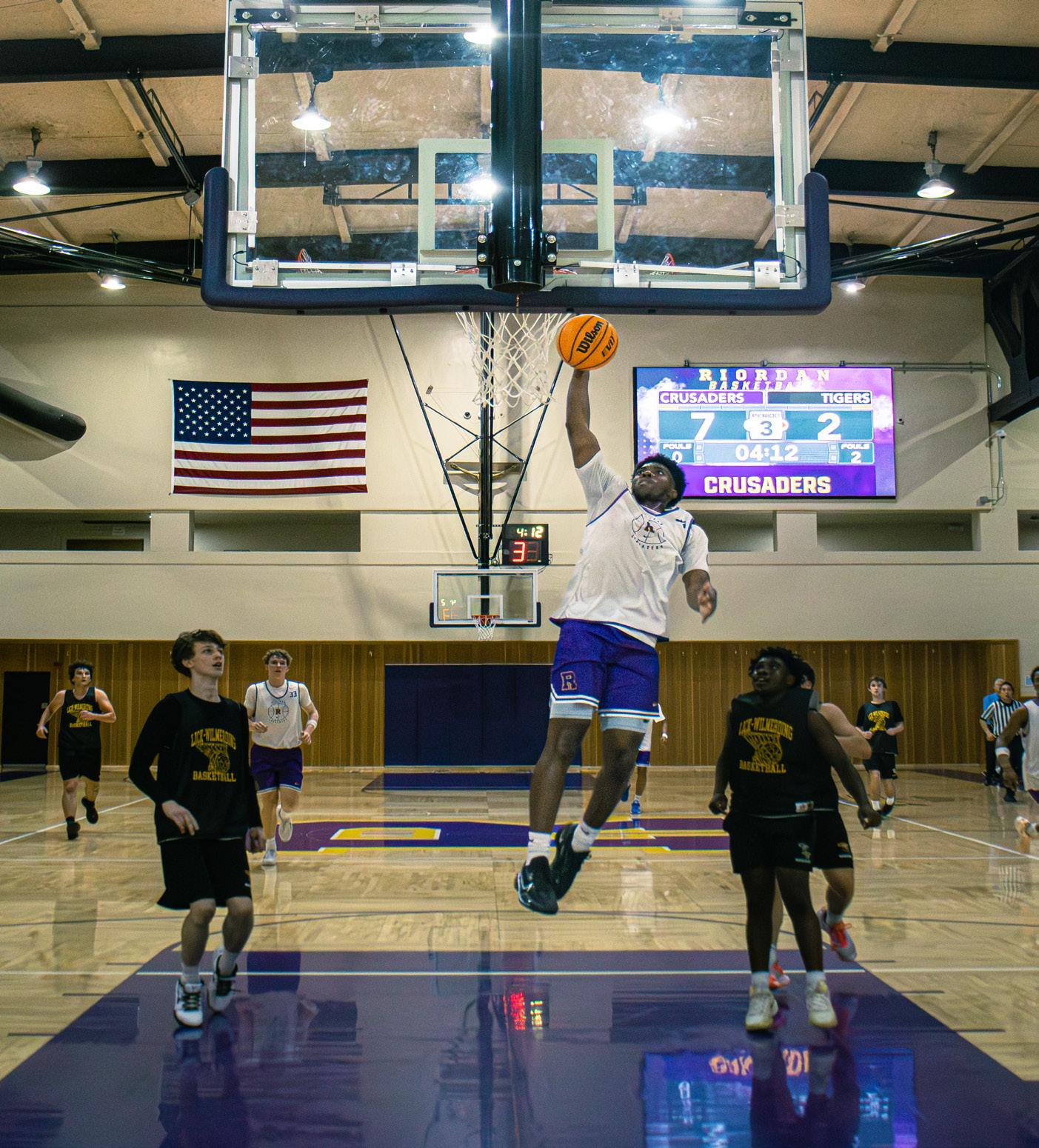
the vibes and connectivity of prior seasons.
As Coach Curtin put it, “We go away for a day during tournaments outside of the Bay Area. Getting away from campus, having a team bonding trip as well as a team dinner really helps to build family spirit.”
To the players, this tradition is extremely important.
As guard Cole White ’27 said, “To me the tradition means everything because it’s a time where we slow down, sit together, and really connect as a team. It’s not just about eating, it’s about bonding, talking, laughing,
and getting to know each other outside of the game. Those dinners make us feel more like a family and when you feel that close with people you’re playing with, it builds trust and makes us stronger on the court. It also creates a brotherhood that will live and last forever.”
Though building family spirit and connection is of paramount importance to create a positive atmosphere, one that will carry on throughout the season, it hasn’t taken away from training on and off the court.
White explained, “Honestly we’ve been grinding. On the court we’ve been locking in on the basics, getting our chemistry right and competing every day. Practices have been high energy, a lot of running, a lot of talking making sure we are all on the same page so when the season starts we are ready to hoop. Off the court, we’re in the weight room, doing conditioning and keeping our bodies right. We have been watching film too, trying to understand the game better.”
And as always, the end goal remains the same. Hillman said, “My goal as every single year is to bring a state championship. And also as a senior, I am really trying to enjoy my last year in this wonderful program.”
This is shaping up to be another electrifying season for the Crusaders, as they pursue the ever elusive state championship.
Review and Photo by Loghan Hwang ’27
On a corner of Noriega lies Golden Island Cafe, a spot that brings much nostalgia to San Francisco Sunset residents. It is a Chinese style cafe that serves snacks and desserts. On this particularly chilly night, I had a craving for something hot to satisfy my sweet tooth and I knew Golden Island Cafe could provide a remedy. As I opened the heavy door, the bell rang slightly. We were seated quickly.
Usually when I go here I get the sago, a nice refreshing dessert topped with various fruits, but it was way too cold for that. On this night I ordered hot red bean and sweet tofu and sesame paste with dumplings filled with sesame.
The order came out fast. At first glance, the red bean and sweet tofu looked very watery. I had never ordered this before so it
Golden Island Cafe 1300 Noriega St., San Francisco, CA 94122
was a shock. When I took a bite, the beans were hard and unpleasant and the combination of the tofu was peculiar. It lacked flavor, tasting like beans and sweet water. Next was the sesame paste with sesame filled dumplings. Four pearly white balls peaked out from the steamy deep gray sludge. Although it looked unappealing, this is truly an amazing comfort food. The sesame paste itself was thick and nutty while also being not too sweet. The dumplings were like mochi, filled with a liquefied sesame paste like lava.
Overall, Golden Island Cafe is a place to get comforting hot treats, especially during the winter. Although the red bean and sweet tofu was not the best, there are plenty of other desserts that are great. I would rate this a 4 out of 5 and would go back again.
’28
Situated in the heart of Daly City’s Westlake neighborhood, Westlake Joe’s has been serving the Bay Area community since 1956. A local institution, Westlake Joe’s is an iconic spot in the Bay, and is deeply embedded in San Francisco culture. Ask any local around, and they’ll most likely know this eminent spot. Featuring a retroaesthetic and mid-century modern style, Westlake Joe’s provides a family-friendly atmosphere, as well as space for its lively customers to sit back and enjoy. With their Italian-American dishes, Westlake Joe’s has an extensive menu for every meal, including dessert. Ordering their most popular dessert, the warm butter cake, we were impressed with the quality of the decadent dessert. Decorated atop the cake was a scoop of vanilla ice cream topped with blackberries,

Review and Photo by Donatella Cirelli ’28
Standing proudly on the corner of Columbus and Vallejo streets is Steps of Rome Trattoria. Its triangular shape gives the place an old San Francisco feel, but it has a spacious and newlyrenovated interior.
The striking red walls and Roman themed decor embodies the idea of what a Trattoria is, casual and welcoming but with great food and great ambiance. At Steps of Rome I sampled two magnificent warm desserts, the cannoli and the Nutella Pizza.
chocolate chips, and powdered sugar, they were presented beautifully as a trio and were just as delicious. The sweetness level was not too high, making it a perfect pick for those with and without a sweet tooth.
Original Joe’s Westlake 11 Glenwood Ave., Daly City, CA 94015
raspberries, and strawberries, and drizzled with chocolate syrup
The cake itself was piping hot, a perfect contrast to the cool ice cream. It had the perfect spongy and moist consistency, tasting as if it had been freshly baked after ordering.
Encompassing a sweet yet light flavor, hints of what tasted like honey were evident in the cake, as well as a delightful buttery aftertaste. Its accompanied berries also provide a nice distinction between the sweetness of the cake and the tartness of the fruit.
After trying this impressive treat, this cake has definitely gained fame for a reason. We rate this dessert a 5/5: the presentation, the garnishing, and the flavor of the cake were all spot on, and we would highly recommend trying this dessert when eating at Westlake Joe’s.
Cannoli are a staple in Italian cuisine. Steps of Rome revisits that staple and elevates it with a golden brown cannoli, a thick creamy filling on the inside, and a golden crunchy shell on the outside. The filling was smooth and had hints of vanilla, while the shell had a satisfying crunch.
An interesting contrast was made with the warmth of the shell versus the cool cream filling. Topped with candied fruits,
The main attraction, however, was the warm Nutella Pizza. Many restaurants have some form of Nutella calzone or pizza, but nothing compares to the splendor of the one that can be found at Steps of Rome. It came steaming out of the pizza oven; however, it was not like an average pizza. The pizza was Neapolitan thin crust, smothered with a thick layer of Nutella and topped with powdered sugar. It balanced the rich hazelnut flavor of the Nutella with the simplicity of perfect pizza dough. Every bite was heaven.
Ultimately I would rate Steps of Rome a 5/5. Everything was perfect and I will certainly be returning.