


By Ishaan Gupta ’26
Becoming a National Merit Scholarship Finalist is no small feat. Out of the millions of high scholars who take the PSAT, only 15,000 are chosen as finalists.
At Riordan, the two students who accomplished this feat are Joshua Lee ’26 and Timothy Yuen ’26.
Lee and Yuen started their preparation for the PSAT in the fall of 2024, and the process was filled with hard work and dedication.
The initial journey was a challenge for Yuen, but through perseverance, he reached his goals.
Yuen said, “I initially struggled immensely on math, but was able to improve by hundreds of points after reviewing carefully and learning from others.”
He added, “I spent many mornings studying, going through practice tests and reviews. A piece of advice a previous National Merit finalist told me was that simulating real testing situations
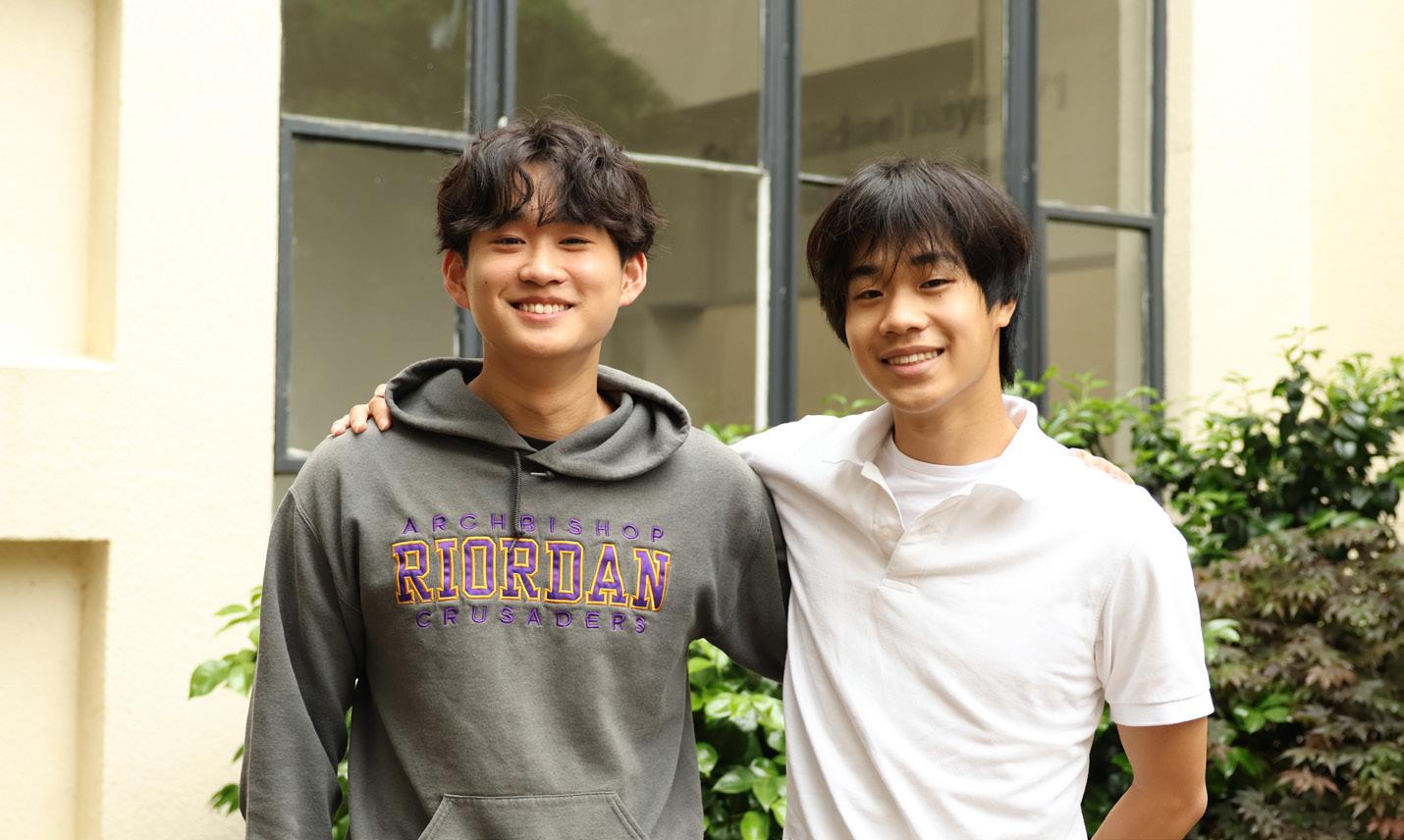
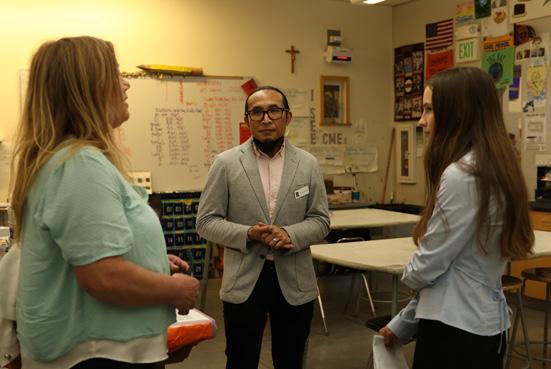
Timothy Yuen ’26 and Joshua Lee ’26 were declared as National Merit Scholarship Finalists. Millions of students in the country take the PSAT and SAT, yet only 15,000 scholars are chosen for this prestigious honor every year.
like the time of day or having people around helps you prepare better. ”
The process for them wasn’t exactly the most enjoyable to work through either.
Lee said, “The process of getting the award isn’t the most amazing itself.”
In regards to his work, he said,
“I spent a month studying on Khan Academy before the PSAT NMSQT test which jump started my qualification as a finalist.”
Through the struggle and strife, the hard work for both of them did pay off through their merit.
They have been able to reap the benefits of what they have sown through scholarships.
Yuen shared, “It feels very rewarding to be named a National Merit Finalist, as it recognizes the effort I took to achieve this.”
Lee and Yuen are currently getting ready to set off on their college journeys and offered some important advice to those aiming toward achieving this goal.
Lee said, “Think about why you really wanna become one. Is it for a financial reason? An academic goal? Whatever it is, make sure you understand the process to becoming one and what it could do for you.”
The two will continue to make big strides in their journeys beyond as the two carry their friendship formed in high school, the opportunities granted from their merit, and the rewards of their hard work and perseverance.
Vice Principal of Academics Nathaniel Simon ’99 said, “We know how great our school is and their effort is helping to let others from around the country see it too.”
By Ashley Li ’27
With the busyness of buses and the stress of schedules, students driving themselves to school often makes their lives more convenient.
It’s common that driving to school helps students manage their time more efficiently and arrive at school on time. “I drive to school because my parents leave early in the morning to work, so it’s easier for me to drive myself,” said Kaitlyn Juhl ’27.
Recently, students and staff report that finding a place to park has become quite a challenge.
Riordan is next to the City College of San Francisco parking lot, but Riordan students and staff recently became restricted from parking there.
Because of this, members of the Riordan community need to find separate parking lots or street parking spaces as locations to park their cars before they can make their way to school.
Students who drive to school
have said it is often difficult for them to find a parking space, usually taking them around 10 to 15 minutes to secure one.
This setback means they need to arrive at school far earlier than normal in order to be on time. Yet sometimes, students are still tardy due to the limited parking availability.
Head of Campus Safety Viggen Rassam ’87 commented, “Parking challenges affect both staff and students at our school, but they impact students particularly hard given how much parking has disappeared in recent years. Like many other schools in San Francisco and on the Peninsula, we’re dealing with limited land in a dense urban environment.”
Although there is a parking lot at Riordan, teachers still face challenges when it comes to parking.
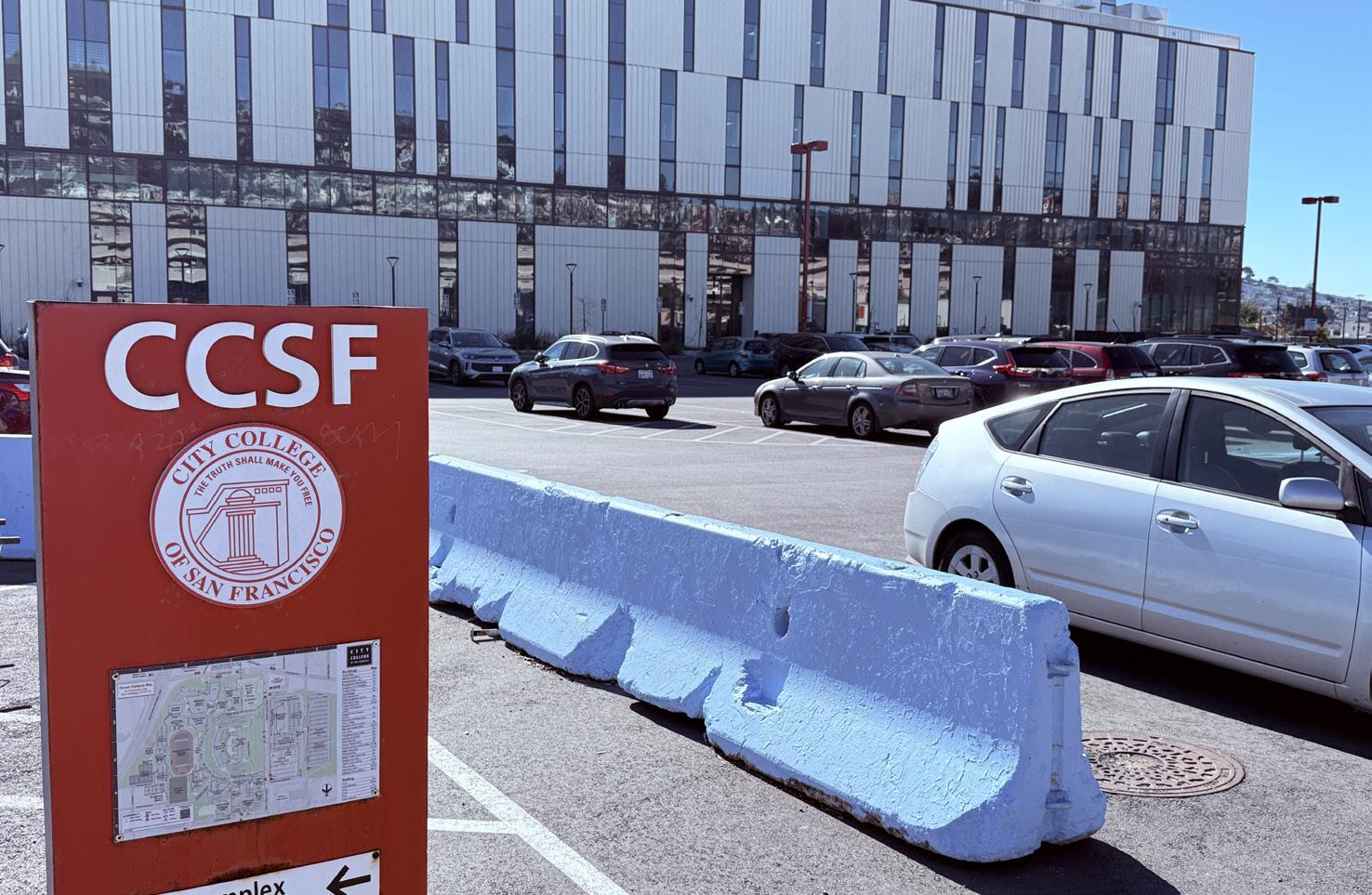
“There are not enough parking spots for faculty and staff. I can’t take public transportation as I live on the Peninsula, and it is not convenient to get to public transportation,” said math instructor Carol Pineda. “I often park a mile away with my heavy backpack filled with papers and a lunch and walk or run to my first class.”
As more students become dependent on self-transportation, the new parking situation becomes more prominent, and the recent restriction of the CCSF parking lot has brought about major inconveniences to the Riordan community.
By Hazel Nagata-Rampata ’26
President Donald J. Trump campaigned in the 2024 presidential election on establishing a war-free and peaceful stance on foreign affairs.
At a rally in Michigan on Oct. 26, 2024, he stated, “If Kamala wins, only death and destruction await because she is the candidate of endless wars. I am the candidate of peace,” and followed it by saying, “I am peace.”
Tensions between the United States and Iran have been ongoing since the late 1970s due to Iran’s nuclear program alongside their regional influence.
Throughout 2025, the Trump administration has worked towards nuclear talks with Iran, but on June 22, the U.S. attacked three Iranian nuclear facilities: Fordow, Natanz, and Isfahan. On Dec. 29, 2025 Iran’s president, Ebrahim Raisi, said that Iran is at war with the U.S. and Israel. On Feb. 28, 2026, the United States and Israel bombed Iranian cities and reportedly killed at least 175 people and children. This includes

Graphic by Daniella Lainez ’26
After weeks of bombings, the U.S. is negotiating a ceasefire with Iran.
the Ayatollah, otherwise known as the Supreme Leader of Iran, Ali Khamenei, along with other highly ranked Iranian officials.
The strikes that killed children reportedly landed on a primary school in Minab, southern Iran, which the U.S. military said was a targeting mistake on their part, as they reportedly were targeting military installations using old data.
According to the United Nations
Mission Statement for the Archbishop Riordan High School Newspaper
News, the strikes killed “around 150 and wounded almost 100.
Many students are believed to be among the dead.”
Iran responded quickly to this, with an Iranian drone attacking six soldiers in Port Shuaiba, Kuwait, killing the first Americans in this war on March 1. Additional casualties followed, with six more Americans dead due to a military refueling aircraft crash in Iraq.
But, the total number of U.S.
The mission of The Crusader is to inform, educate and entertain the readers—students, teachers, parents, members of the community—about issues that affect the students as well as citizens of San Francisco and the nation. We hope to instill a sense of understanding, responsibility, and curiosity in our readers that results in an eagerness to learn more about their peers and the world around them.


175 Frida Kahlo Way San Francisco, CA 94112 RCrusaderNews.com RCrusaderNews@riordanhs.org
Editor-in-Chief
Daniella Lainez ’26
Managing Editor
Ishaan Gupta ’26
Opinion Editor
Keira Wallace ’26
Campus News Editors
Emmanuelle Ng ’26
Hailey Ferrer ’26
Local & State News Editor
Erin Quan ’26
National & World News Editor
Rachel Gerke ’27
Boys Sports Editor
Miles Witte ’27
Girls Sports Editor
Emilia Ross ’26
Sports Features Editor
Isaiah Sanchez ’26
Arts & Entertainment Editor
Robert Bennett ’27
Ciarra Mangibuyat ’27
Environment Editor
Vincy Huang ’27
Religion Editor
Logan Dee ’26
Health Editor
Isabelle Abad ’26
Science Editor
Joshua Lee ’26
Business & Technology Editor
Isabella Thumas ’26
Features Editor
Lorelai Keating-Curran ’27
Food Review Editor
Loghan Hwang ’27
Photo Editors
Loghan Hwang ’27
Ethan Ly ’26
Copy Editors
Aarav Agrawal ’28
Rose Baik ’26
Chloe DeCastro ’26
Hazel Nagata-Rampata ’26
Graphic Artists
Ivonna Tan ’29, Lindsey Yeh ’29
military personnel injuries and casualties is still unknown.
This conflict has rapidly become a reality of daily life for millions of people around the world. Its effects are widespread, from families struggling with economic burdens as fuel prices rise, to those who have lost loved ones as a direct result of the fights. It is concerning how quickly this war has escalated within the last six weeks–and a need for peace, a need for an end to it is essential. It is unfair to allow people to suffer due to conflicts from political hostility, regional power struggles, and nuclear tensions.
Pope Leo’s first words in his address to the public on Easter were, “Peace be with all of you!” It is ironic how some world leaders are calling for the death of a civilization, while others call for peace. We, as a society and in our own humanity, should not strive for war or violence, but rather embrace Pope Leo’s call for peace. Visit rcrusadernews.com to read the full version of this story.

Reporters and Photographers
Alyssa Abaunza ’26
Avery Agbunag ’26
Briana Alvarado ’26
Katherine Baez Orellana ’26
Jonah Berg ’28
Jupiter Bruneman ’26
Kaia Burris ’27
Brianna Cabezas ’26
Sasha Feliciana-Chan ’26
Mikayla Cheng ’26
Donatella Cirelli ’28
Bhagvat Daraji ’27
Julian Davis ’26
Brayden Dizon ’27
Dylan Dubriwny ’26
Niko Escudero Faba ’26
Amaya Farmer ’28
E’moni Ferdinand ’26
Jordyn Flores ’27
Dylan Garcia ’27
Claude Garde ’26
Lainey Gerke ’28
Ophelia Doma Gyalzen ’28
Alexander Kentworthy ’27
Alessandra Leon ’26
Ashley Li ’27
Rhianna Mallory ’26
Exchange Editor
Ashling Greene ’26
Reporters and Photographers
Taylor Manalo-La Verne ’26
Miki Maloney ’26
Isaac Martin ’26
Isaiah Mateo ’26
Benjamin McClure ’26
Nathan Molinari ’27
Elliott Ng ’28
Collin Noguera ’27
Sara Noguera ’27
Martin Novoa ’26
Jackson Padilla ’27
Aliyah Pasion ’26
Sofia Peña ’26
Mila Penn ’27
Carill Reifsteck ’26
Benjamin Reyes ’26
Catherine Rold ’27
Natalia Sanchez ’26
William Saunders ’26
Aiden Sommerfield ’28
Jayden Tamboury ’26
Elizabeth Walsh ’26
Crystal Wei ’26
Luna Weng ’28
Cole White ’27
Charlottie Yip ’26
Adviser
Susan Sutton, MJE
Letters to the editors will be accepted with the same deadlines as ads. These letters may come from students, staff, parents, board members, or other members of the community. The Crusader reserves the right to edit the letter for grammatical and spelling errors, as well as length, but not content unless it includes foul language, plagiarized material, or libelous content. If the claims or assertions are incorrect, The Crusader reserves the right to refuse publication of the letter.
By Dylan Dubriwny ’26 and Loghan Hwang ’27
Historic Civil Rights icon Cesar Chavez allegedly sexually abused girls and women and this should not be ignored.
For some background, Cesar Chavez (1927-1993) was a popular labor unionist and political activist who was very influential, specifically co-founding the National Farm Workers Association, which united farm workers to fight for wages and rights.
These acts in turn earned him murals, streets, statues, and even the Presidential Medal of Freedom, awarded in 1994, which is the highest civilian honor.
Recently, an investigation by the New York Times uncovered allegations that during the same time he was advocating for equal rights and pay for farmworkers, he was sexually abusing girls and women.
When this news was released, artists and citizens immediately took action, covering up murals, removing his name from public spaces, and questioning whether he should continue to be honored. This begs the question: Should Cesar Chavez still be celebrated?
We should acknowledge his great feats for civil rights, but not
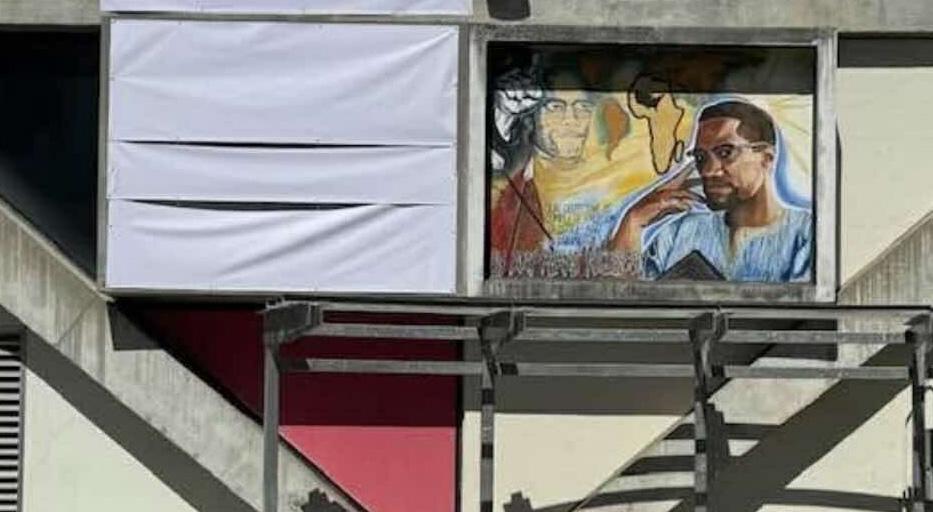
ignore the horrors he has done to innocent people. According to The New York Times, Cesar Chavez was 45 while a girl, “Ms. Murguaia,” was 13. A 32-year difference between the two. “I wanted to die,” said Murguia, who spoke up about the allegations.
“It is extremely unfortunate that such an influential and inspiring figure was doing such inappropriate deeds,” said Jerard Loyola ’26.
These survivors deserve to be
heard.
While society continues to honor Cesar Chavez’s achievements, it is important to recognize the pain tied to those allegations. Ignoring that harm would risk minimizing the experiences of those affected.
At the same time this is not about erasing history it is about understanding it fully. Recognizing the entire and true story allows for a more honest
view of his legacy moving forward. As conversations around Cesar Chavez continue, his legacy remains very complicated. While his contributions to civil rights cannot be erased, neither can the harm described by those who have come forward, including Dolores Huerta. Communities must decide how to honor history while acknowledging the full truth.

By Keira Wallace ’26 and Isaiah Sanchez ’26
For the first time in over five years, seniors may not be granted senior privileges.
Originally started when Archbishop Riordan was an allboys high school, senior privileges were instilled to give seniors rewards for their efforts all four years of high school.
Beginning with small perks like modified dress or a senior lunch
line, the rewards given to the graduating class have steadily increased over the years.
Now, under the reason of “too many detentions,” this year, seniors were projected not to have senior privileges at all. This decision would make sense if the Class of 2026 had a much higher detention rate than previous classes, but there is no clear indication that this is the case.
After years of hard work and
dedication, seniors will not be rewarded with simple benefits that don’t even affect their education. Even with all the love and trust they have put into this school, they still may not receive a simple senior tradition.
The Class of 2026 has achieved countless outstanding accomplishments during their years at Riordan. For example, athletes have won profound sporting events and have made significant athletic achievements.
Specifically, seniors have been key components on championshipwinning teams, such as the 2025 CCS Open Division Boys Football Champions, the 2024, 2025, and 2026 CCS Open Division Boys Basketball Champions, and the 2025 CCS Division III Girls Volleyball Champions.
More athletic achievements include leading roles in the creation of programs like the girls’ flag football team and dance team.
Seniors have also made a huge impact on award-winning programs, like Journalism, Band, and Robotics. Other accomplishments include making a notable impact on the future of Riordan and its community, like the Student Parliament encouraging school spirit and the Knights Club welcoming future
Crusaders.
Last, but not least, seniors have made tremendous academic achievements throughout their years at Riordan. They have scored weighted GPAs in the high fours, taken numerous advanced placement classes, scored high on the SAT, and completed dual enrollment at community colleges.
The achievements and hard work have allowed seniors to be admitted into many prestigious universities, including multiple University of California campuses and Ivy League schools.
While it makes sense that administrators are judicious about giving the Class of 2026 their privileges, this class has done more than enough to earn it. Having free dress and being able to go off campus for the fourth block open period would largely benefit and encourage the senior class to finish their last of weeks of high school on a positive note. Their access to senior privileges should not solely be based on detentions, but should be a testimony to their years at Riordan. After years of fun here, it would be a shame for seniors to have their journey through high school end without the simple farewell tradition of senior privileges.
By Logan Dee ’26
This school year, the Academic Leadership Team decided to reinforce the honor code in response to the increasing usage of Artificial Intelligence (AI).
For example, during the second quarter of the school year, the school implemented new policies such as doing all work on a single document and banning phones in the school hallways during finals week.
The meetings on Artificial Intelligence began in the spring semester of 2023. Later on in the year, the team presented findings about the best practices regarding AI.
In hopes of keeping up with the growing usage of AI, Christopher Fern, the Dean of Academics, has taken the responsibility of the honor code.
He followed up with the usage of AI and stated, “As time has gone on, I have had an increasingly negative imposition of AI…”
He added, “additionally, since
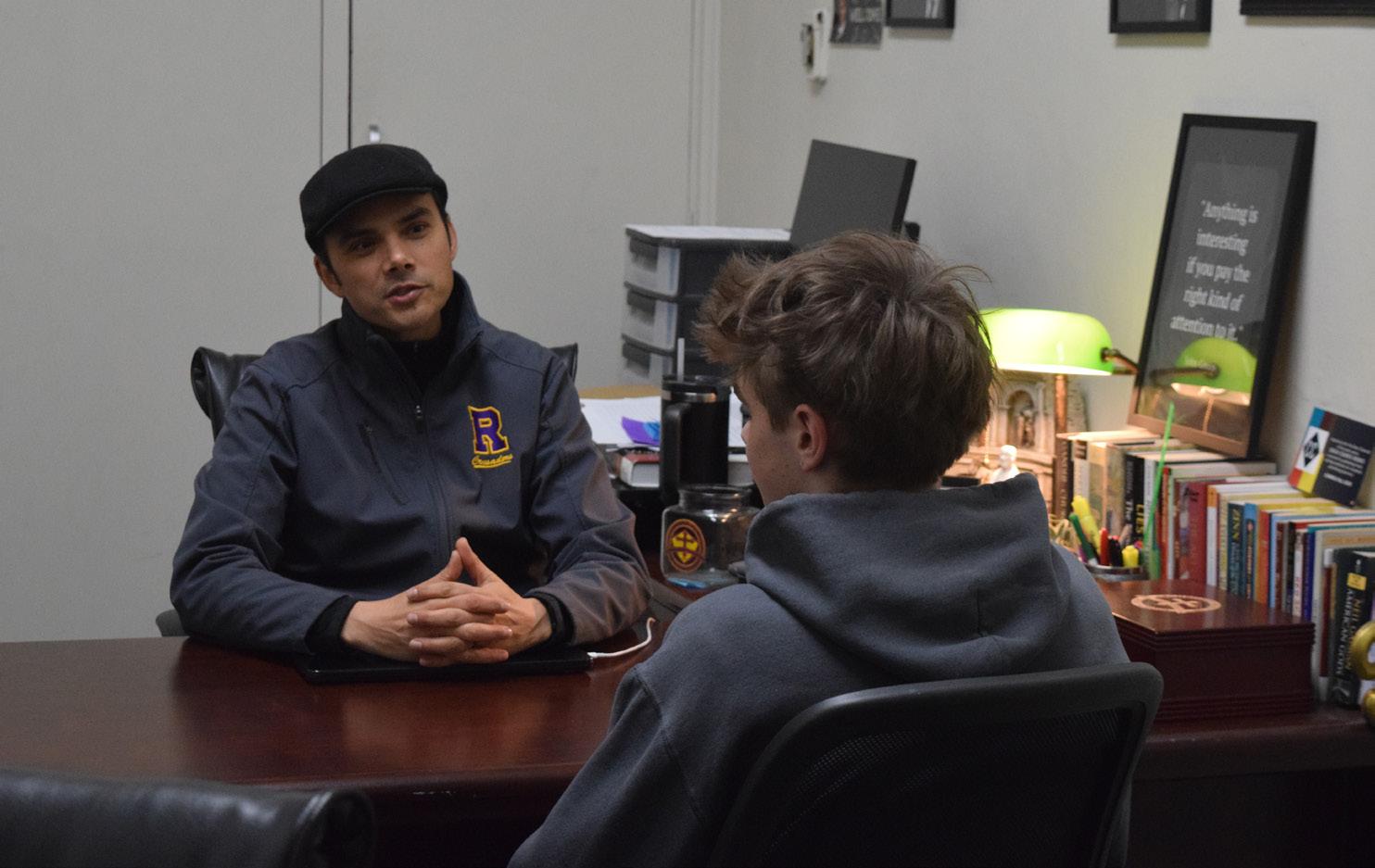
by Aarav Agrawal ’28
about Artificial Intelligence, including those in the academic STEM fields.
Amelie De Juan ’26, president of the Math Club, expressed, “[Because of AI] I worry that I may encounter strangers and peers who lack a basic understanding of concepts, society, and more.”
Students in literature also agree with the negative effects of Artificial Intelligence.
Anabelle Hazard ’27, Editor of The Grail literary magazine, said, “Anything that detracts from the raw human experience of learning is only a hindrance to ourselves.”
Artificial Intelligence usage finds new ways to impact society, specifically that affect student performance.
it wastes numerous people’s time when they present work as their own to be evaluated but wasn’t ever written or created by themselves.”
The faculty has met every
By Luna Weng ’28 and Donatella Cirelli ’28
As the school year winds down, there are multiple highlights of senior year that are approaching. These highlights make for a memorable final year and include events such as senior prom and senior privileges.
There has been a long discussion of what seniors will receive, and when they will finally be able to kick back and relax with their benefits.
There seems to be some miscommunication as many seniors feel their privileges are delayed when traditionally, privileges were granted after spring break–occasionally earlier –, but the Class of 2026 is certainly itching to have some leniency as soon as possible.
The Deans haven’t budged on granting privileges before detentions are done. Dean of Students Juan Zumbado ’98 has made numerous announcements about the situation on the PA.
Senior privileges will possibly begin some time after spring break. The timing of privileges all depends on how soon seniors resolve their detentions.
Student body president Benjamin Parker ’26 stated, “I had a meeting with the deans, and they pretty much said that if we are able to complete enough detentions this week, we can have them by the time we are back from spring break.”
He expressed, “If all goes according to plan, and I believe it should, we will have our privileges. So unfortunately right now we have no privileges.”
Senior privileges in the
past have had free dress and been able to leave during 9th block if it is an open period when upperclassmen are dismissed first. This year, seniors also requested for privileges such as colored hair, facial hair, and facial piercings.
Many people have mixed feelings about the situation.
Francis Chang ’26 commented, “Senior privileges are delayed until everyone finishes their detentions. I find that hilarious.”
Some other seniors are not taking the situation as lightly.
Julian Davis ’26 said, “We shouldn’t be punished for a certain amount of other seniors who aren’t being mature and going to detention.”
Davis proposed a compromise, stating, “I think it should only be those students who get a delay.”
Senior privileges are a special farewell gift for the seniors, meaning they won’t be handed out easily. As much as everyone is clamoring for their perks, the reasons why they aren’t handed out lightly was made clear.
Dean of Students Jennifer Niemeyer shared why senior privileges are special, saying, “It’s a good faith offer because you’ve put in four years.” She continued about how “it gives them a chance to relax and have a little more freedom acknowledging they’re the oldest on campus, ready to go but still with us.”
The seniors are realizing they are only as strong as their weakest link and no matter how hard senioritis has hit, the Class of 2026 is striving to band together to attain their privileges.
semester to discuss AI’s impact and ethical usage, and the Academic Integrity and Artificial Intelligence policy is updated annually.
Students also have concerns
With Riordan’s Academic Leadership Team carefully working on the honor code and AI usage, faculty hopes to encourage students to strengthen students’ abilities to think and work for themselves.




By Brayden Dizon ’27
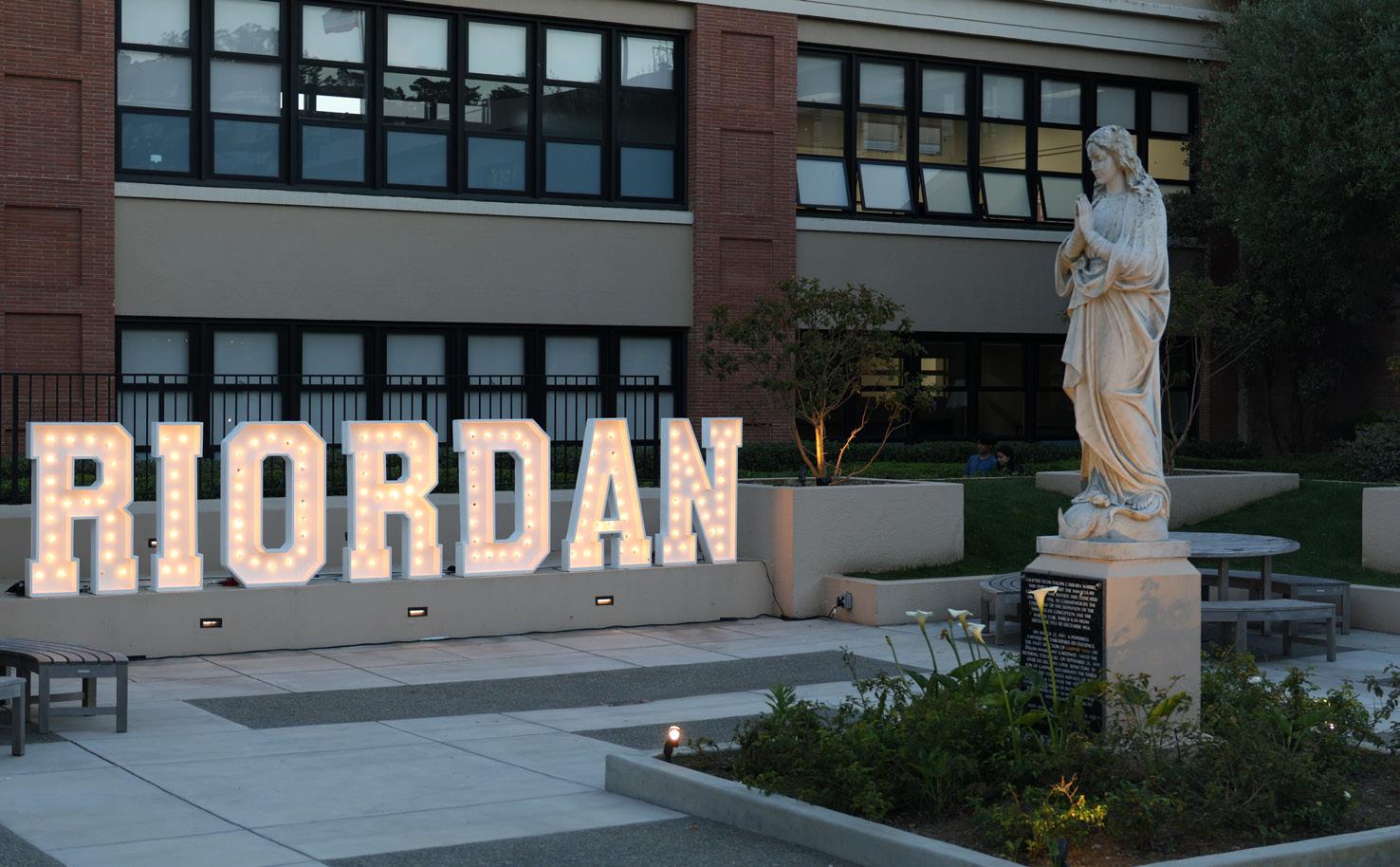
Archbishop Riordan High School recently hosted its open house for accepted incoming freshmen, giving future students and their families a chance to explore the campus, meet teachers, and learn more about life as a Riordan Crusader.
During the event, multiple members of Knights of Riordan, a school volunteer group, were stationed around campus, directing and assisting families as they made their way through classrooms and activities. The event showcased the school’s academics, athletics, and strong sense of community.
Admissions Associate Sally
O’Connell explained what makes a strong student guide. A good guide is “knowledgeable and enthusiastic,” she said, as well as “friendly, warm, and present.”
She added that the most important message for guides to share is that Riordan is “a warm, supportive community.” O’Connell wants visitors to see that students feel supported while “having fun while learning and succeeding.”
Student guide Kestrel Ueber ’27 said he enjoys volunteering because he likes giving back to the school. “I’ve always loved helping out at school, and the student acceptance day was just another way to show my thanks to Riordan,” he said.
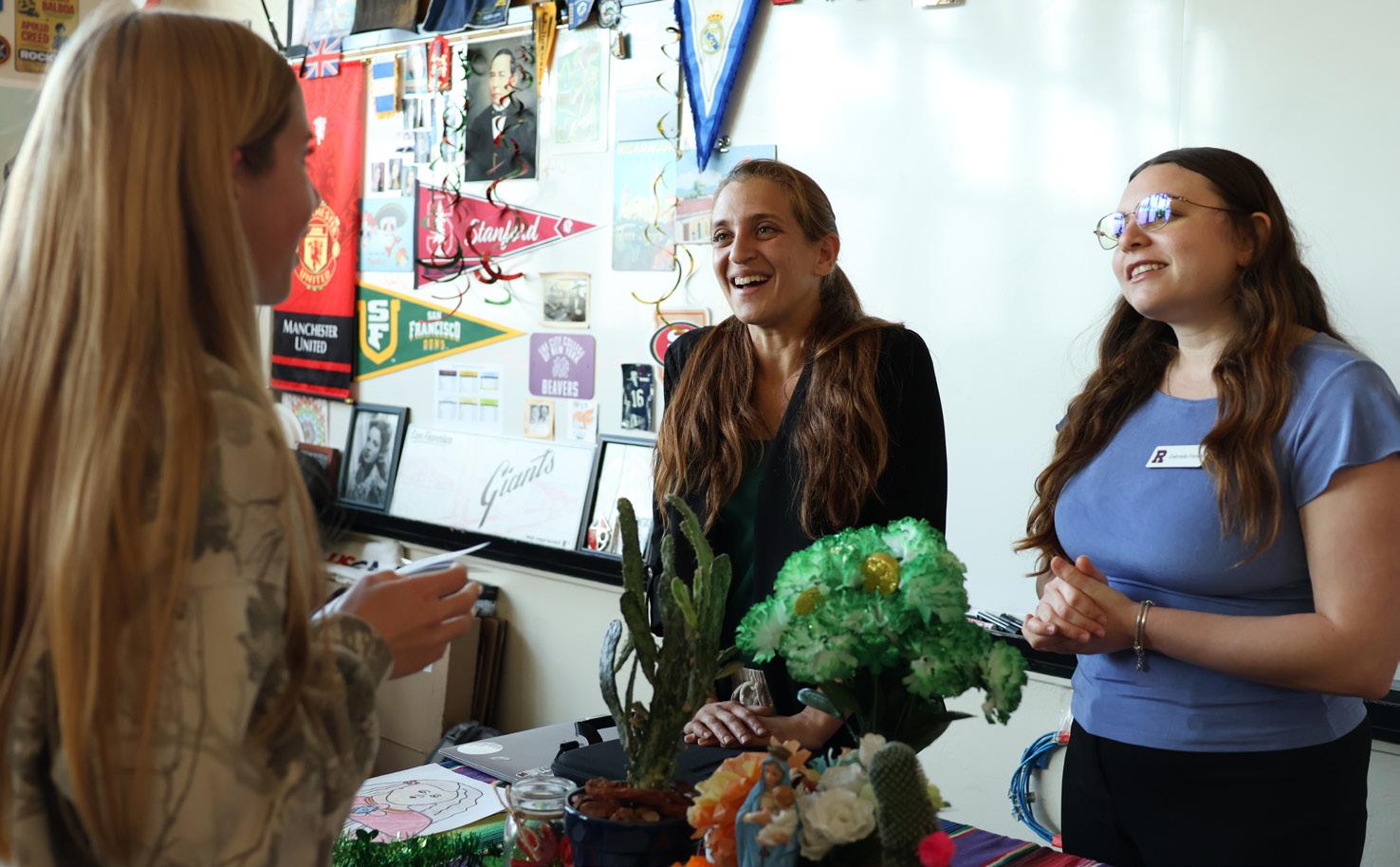
During the event, Ueber showed visitors the chemistry lab and highlighted the interactive labs students perform in class. “I just love being able to show my Riordan pride,” he added.
Danny Curtin ’08, Vice President of Enrollment, shared what he hopes families take away from the open house. Curtin wishes for students to have “a better understanding of who our community is” and to experience what it’s like to be a Riordan student or family.
He said, “Students love coming to school. They’re happy to be here every day.”
He also emphasized that Riordan allows students to grow
in areas they excel at while also feeling comfortable taking risks in new challenges.
For students considering Riordan, Curtin advised, “Take risks, meet people, and enjoy high school. This is a place where you can be yourself, find success, and really explore all the different things the school has to offer.”
The event gave incoming freshmen and their families a chance to experience Riordan’s academic and social environment firsthand. From interactive classrooms to student guides proudly showing off their school, the event highlighted what makes Riordan a supportive and exciting place to learn.
By Daniella Lainez ’26
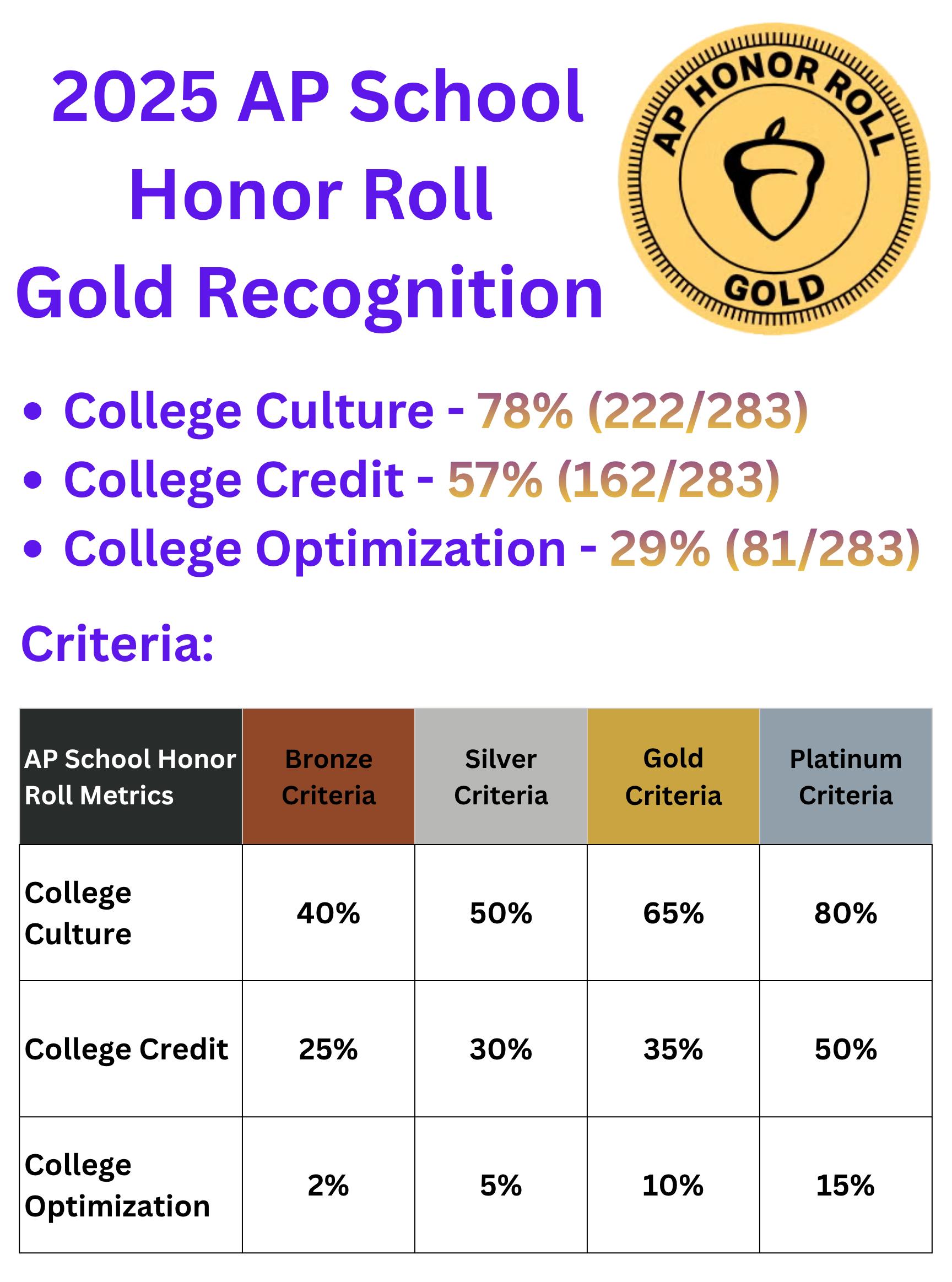
After earning silver recognition just one year ago, Riordan has advanced to AP Gold status on the AP school honor roll. This shows measurable growth in both access and success in students participating in Advanced Placement courses.
As Riordan continues to expand in student size, the academic opportunities are growing alongside it.
AP Testing Coordinator
Jackie D’Angelo said, “The main contributing factor to our growth in AP status is the expansion of both our student body and course offerings. As Riordan continues to grow, we’ve been able to bring in more teachers to lead AP classes, including new additions like AP Human Geography.”
Another key factor in Riordan’s success is how teachers adapt its academic structure to support AP students. With the 4x4 schedule many students take AP courses in the fall but sit for the AP exams months later in the spring.
To help bridge that gap many teachers, including AP U.S. History teacher Nicole Morello,
organize review sessions to keep students prepared.
“Even if students aren’t currently taking the class anymore, we want them to feel confident walking into that exam,” Morello said. “These sessions are about reinforcing what they have learned and making sure nothing gets lost over time.”
Students have also played a significant role in reaching AP Gold Status. Phineas Kim ’26, who has taken several AP classes, said the academic culture at Riordan encourages students to push themselves.
“There’s definitely pressure, but it’s the kind that motivates you,” Kim said. “Teachers are always very supportive, and you can tell the school wants you to do well.”
After improving in all categories and coming close to Platinum status, Riordan’s AP Gold status recognized a growing theme of strong academic ambition. With continued expansion Riordan now looks ahead to its 2025-2026 results that come out next fall, aiming to build on this progression and reach even higher levels of achievement.
By Isaac Martin ’26
Allegations against formerly beloved civil rights activist Cesar Chavez are taking the Bay Area by storm.
According to an exposé piece done by the New York Times, Chavez had sexually assaulted two girls and raped his civil rights movement partner, Dolores Huerta.
Chavez’s despicable actions caused an uproar in the San Francisco Bay Area community, with motions already in place to sanitize his name from the city.
But how does society erase the dishonorable actions of Chavez without covering up his efforts for laborers’ civil rights?
The artist behind the mural at The Latin Rock House, Carlos Gonzalez stated, “The movement itself is greater than one man. You can’t erase the collective efforts of the unsung heroes.”
Gonzalez painted over his creation, “the very next day” after the New York Times released their article exposing Chavez.
Steps are already in place to scrub Chavez’s name off posthumous accolades, such as, schools, street names, and the

holiday celebrated on March 31.
With Chavez out of the picture, supporters of the farmers’ movement are now shifting their attention to the civil rights leaders who have been overlooked Spanish instructor Armando Castillo commented, “The efforts of other leaders like Larry Itliong got lost in the conversation of civil rights because Chavez took all the glory.”
Leaders like Filipino farmworker Itliong and Huerta are finally starting to get the recognition they deserve; both for their efforts for the movement, and for having to endure Chavez’s actions.
“It’s good that she (Huerta) spoke up about what happened because she’s helping others in her shoes to gain the courage to speak up,” remarked Darwin Hernandez ’26.
Whether it’s commendation for her involvement in the National Farm Workers Association (NFWA), or admiration for her unsheathed bravery and resilience, Huerta has superseded Chavez’s position as the most honorable person behind the farmers’ civil rights movement.
By Robert Bennett ’27
Ocean Avenue’s long-delayed redevelopment is reshaping the way Ingleside residents and small businesses think about the future of their neighborhood.
Empty storefronts, inconsistent timelines from developers, and confusion over what comes next have created a mix of frustration and hope along one of the area’s key commercial corridors.
Multiple businesses along the block between Faxon and Capitol Avenues reported receiving eviction warnings or shortterm leases years before any construction began. One employee at Pet Expert said he first learned about the redevelopment effort from a nearby salon.
“I heard about it from Ocean Hair Design when I was getting a haircut,” he said.
He added that the plan made him “dismayed” and worried for longtime merchants, even though he hadn’t thought deeply about it before. He described the block as “always feeling half empty,” and said he hopes future changes will turn Ocean Avenue into a “more vital spot” for the greater Ingleside neighborhood.
This store sits on the same stretch as Plant Lady SF, the neighborhood plant shop known for its loyal regulars, and The Ave. Bar, a former Legacy Business that closed last year after a burglary. Both storefronts represent what people fear losing: long-term anchors that contribute to the personality of the street.
Their experiences mirror what small businesses across Ocean have faced as uncertainty has dragged on.
Community concerns stand in contrast to the goals outlined by the Ocean Avenue Association, the nonprofit that manages safety, cleanliness, and business support along the corridor. Rosendo Betancourt, a member of the organization, said the long-term vision is simple.
“We want Ocean Avenue to grow into an even more vibrant, closeknit commercial corridor—one where existing businesses thrive and new businesses feel excited to anchor themselves here.”
He emphasized that redevelopment is meant to expand food, entertainment, and service options while improving walkability and neighborhood pride.
The association says it regularly checks in with merchants and residents through surveys, emails, and in-person visits. Betancourt explained that community feedback directly shapes their programs, from block parties to business vouchers.
“Small businesses and longterm residents are central to our planning,” he said. “We take their input seriously.”
Still, funding gaps and delays continue to slow progress. OAA is much smaller than other Community Benefit Districts, making it harder to push forward major upgrades.
“Redevelopment is a slow but

happening behind the scenes,” Betancourt said. He added that their goal is to balance community priorities with the expectations of the city, even when timelines don’t line up.
The Ingleside Light reported earlier this year that vacant storefronts and unresolved contamination issues have stalled development for more than a decade. These delays have hurt foot traffic, which businesses say was already struggling after the pandemic. Stores like The Plant Lady SF rely heavily on consistent walk-ins from regulars and neighborhood visitors, and empty blocks make that harder.
To counter that trend, the Ocean Avenue Association has been investing in smaller, highimpact events. Their November Block Party, organized after
surveying merchants, brought residents to the corridor through local vendors, coupon vouchers, and community activities. Foot traffic increased noticeably, and the association plans more events like Boba Walks, Wine Walks, and more. Meanwhile, shops like the Pet Expert remain cautiously hopeful. When asked what Ocean Avenue needs most, the owner gave a simple answer: “More activity. Depending on what they build, it could finally make this area feel alive.”
For now, many residents and business owners are still waiting to see whether the next phase of redevelopment will bring the positive change they hope for or continue the long stretch of uncertainty that has defined the block for years.
By Benjamin Reyes ’26
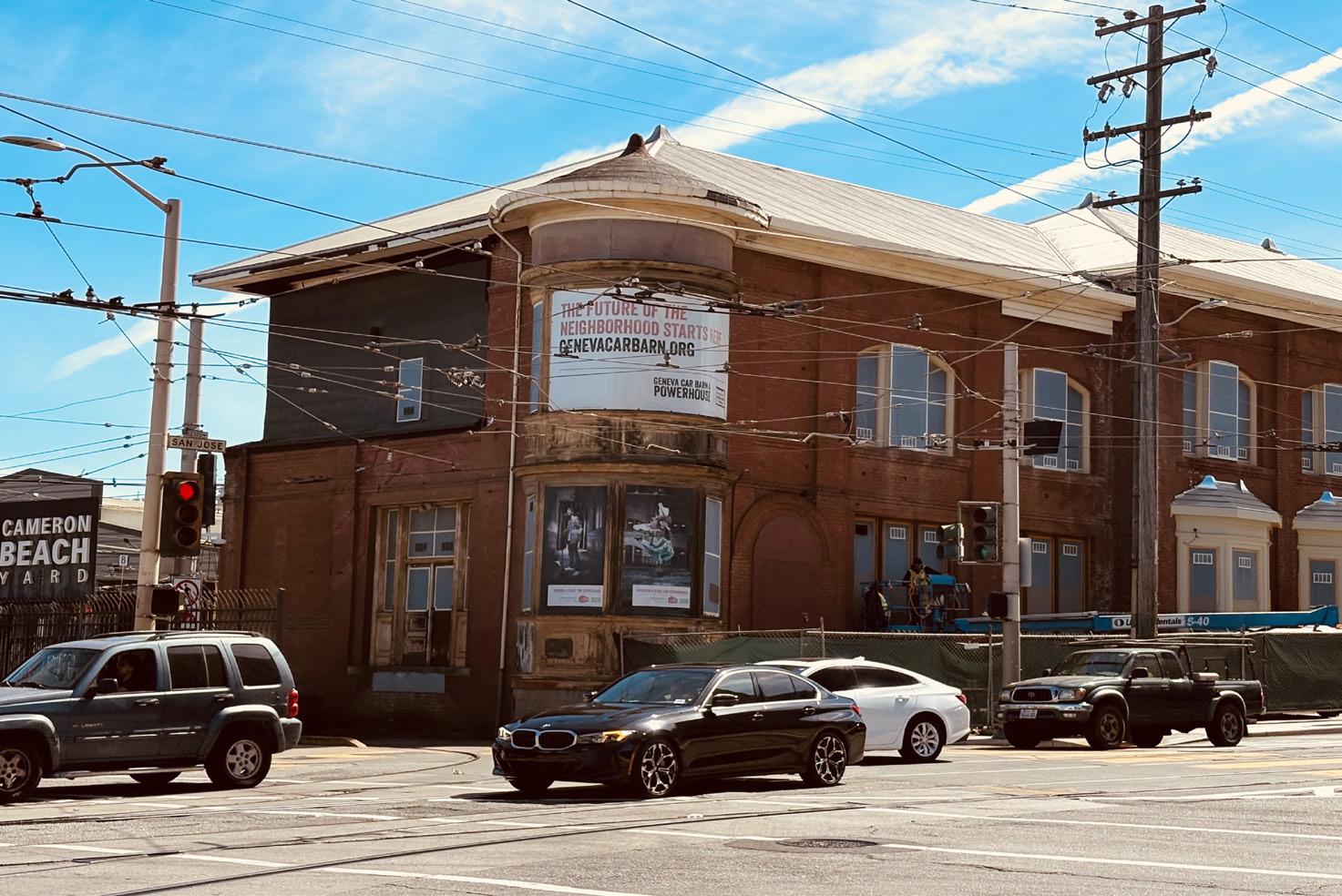
Bay Area artists looking to show off their talent can look to the Geneva Car Barn in San Francisco on San Jose Avenue, which is currently accepting applications/ designs for a temporary mural project.
They want to create murals alongside the brick building, which will be displayed for up to three years.
The Geneva Car Barn was built in 1901 and was originally used for San Francisco’s first electric railway. The building has now been recognized as a city landmark. The building is typically leased out and used by a non-profit organization known as the Community Arts Stabilization Trust (CAST). They also work with Performing Arts Workshop (PAW), in which they help provide a wide variety of different activities for the community and youth.
The mural will roughly be around 800 square feet and will be placed on the windows on the second level of the building on the west side. The San Francisco Arts Commission (SFAC) wants the mural to help support and continue pursuing cultural,
I hope that the chosen design does pay homage to the building’s past. It would be a missed opportunity for it to not play into the mural’s composition somehow.
- Irman Arcibal
and most importantly, neighborhood visibility.
Others see this is a great step in the right direction like Dylan Garcia ’27 who believes that the installation will be a great improvement. “The building for the most part, looks kind of plain. Adding a mural will help make it stand out more and make it more unique,” he said.
All designs/submissions for the mural were due by April 6. After an artist’s work has been chosen and the design has been finalized, the Geneva Car Barn is aiming for the mural project to be completed by April 2027.
Art teacher Irman Arcibal hopes that the final design will honor the building’s history. “I hope that the chosen design does pay homage to the building’s
past. It would be a missed opportunity for it to not play into the mural’s composition somehow.
I find that the best public art does have ties to its specific space and place, rather than just being plopped down in a space simply because it was vacant,” he said.
Artist Sofia Pena ’26 believes that the mural will be a great opportunity for artists to showcase their talents.
“Having artists from the community be able to submit
their art truly helps bring together a community of people to promote their work and also work together to create something special for the neighborhood,” she said.
The Geneva Car Barn mural project is a unique and interesting project for the community that aims to bring together artists to display their work for the public while also helping bring together talented people and give a historic landmark some new light and appreciation.
By Ophelia Doma Gyalzen ’28
The once unused parking lot next to City College of San Francisco is now becoming one of the city’s largest new housing developments.
Over a thousand low to moderate income housing units are currently being added to the unutilized reservoir, promising new homes and public spaces. In addition, this diverse community hopes to serve individuals, but especially families with children and CCSF faculty.
According to Balboa Reservoir, the site plans to feature 1,100 housing units, with around 40 percent having two or more bedrooms for families, and a twoacre Central Park.
But what does that mean for Riordan?
The Balboa Reservoir was built in the 1950s by what was then the San Francisco Water Department and was intended to be a part of the city’s water system, but it ended up never actually being used to store water.
The space transformed into one of City College of San Francisco’s most used parking areas for students.
According to San Francisco Planning, in August 2020, the space was officially approved to start The Project Master Plan and Development Agreement. The construction officially broke ground on Nov. 17, 2025.

According to Roberto Landi ’81, a Senior Superintendent at Nibbi construction who is working on the site, there will be no additional parking for residents or neighbors, which is a concern for many in the neighborhood.
In regards to concern of dust and noise, Landi said dust and noise monitors are scattered around the construction site.
“If it’s too noisy or dusty, we can help it,” Landi said.
The monitors send a notification if it picks up too much dust. In that case, the construction workers will water down the site in order to regulate the amount of dust that the site produces.
The tallest buildings will be up to eight floors high and around 80 feet tall, which could cast a shadow across Riordan’s field.
Grace Longaway ’28, a JV soccer player for Riordan, expressed her concern for Riordan’s sports teams, saying, “A shadow that large will be so inconvenient as we don’t even have lights on the field,” she said.
She added, “Practices will grow darker and games will be colder.”
Michelle Wylie, a history and English teacher at Archbishop Riordan High School, brought up the possibility of teacher housing after seeing a story on Mayor Daniel Lurie’s Instagram.
“I was wondering about that opportunity for teachers at Riordan High School. This could be a great opportunity for teachers to live closer to school.
- Michelle Wylie
“I was wondering about that opportunity for teachers at Riordan High School. This could be a great opportunity for teachers to live closer to school,” she said. The project promises 50 percent affordable housing with approximately 550 units, including 150 affordable units dedicated for San Francisco educators.
Tim Reardon, President of Archbishop Riordan High School, said, “Hopefully, people who support our community will move in.”
As the project continues, the new buildings represent more than just new apartments, it’s a reflection of San Francisco’s ongoing development. It gives more opportunities for low income residents to be able to live in a beautiful, complex city. The first buildings are expected to be completed in spring of 2028.


By Luna Weng
When thinking of the college experience, a downside that comes to mind for many is the commonly experienced food insecurity: the result of a plethora of causes, most notably financial troubles and busy schedules.
According to recent studies amongst college students, a poor diet that lacks nutritious foods can often lead to poor academic performance.
College is a time of transitioning into adulthood and gaining independence; however, a big issue that is prevalent among is lacking a nutritious and healthy diet. Even in high school, people often brush aside eating healthily.
There are multiple reasons for poor eating habits in college. Students lack the funds to purchase healthy and affordable meals. They also may be unaware that they qualify for food assistance programs such as the Supplemental Nutrition Assistance Program (SNAP), and do not have access to appliances to reheat their food.
Time is also a big factor, with classes and other responsibilities reducing the time available to curate a homemade meal.
According to College Board, a student on average spends $30,990 at a public college, and $65,470 at a private college throughout the academic year solely on tuition, books, housing, and transportation fees.
With costs already being drastically pricey, there is not

much left for students to spend on healthy meal choices.
Another issue that restricts college students from eating nutritiously includes generational patterns.
Particular students may descend from generations that have struggled with maintaining healthy diets, causing current generations to follow these habits. This includes skipping meals and eating mainly processed foods.
Former Riordan student and current UC Berkeley student,
Siddharth “Sid” Thomas ’25, does not consume three nutritious and healthy meals daily. He explained, “The cost – class meal plans only cover two meals per day. The taste – lack of variable nutritious options mean less healthy consumption. The time –getting to and from places with available food can take too much time on some busy days.”
Another former Riordan student and current UC San Diego student, Moon Lin ’25, described the lack of convenience
in maintaining a substantial, balanced diet. “It depends on my schedule. This quarter I don’t have classes until 2 p.m., so I just wake up an hour before, which leaves me with two meals a day. Other days, I’m tired of dining hall food… It’s not that I don’t have time, it’s just inconvenient.”
Adding on to this struggle, in October 2025 during the government shutdown, SNAP was temporarily ended, forcing numerous college students to find alternative means of getting food. Many colleges offer food pantries and other benefits, but it differs based on the funding of private schools and public schools.
It’s important to remember that there are consequences to skipping meals. It does not only affect mental function regarding education, but also physical and overall health.
Current senior class counselor David Canales ’02 explained, “Your nutrition is tied to everything. Bad nutrition can translate into all sorts of decline. It can affect your energy, which can affect your attitude, your mood, and your sleep pattern, all of which have notable effects.”
Food insecurity among college students continues to be a prevalent issue, which often lacks awareness among communities.
Many note that when considering the college experience in America, it is worthwhile to begin creating solutions to this issue in order to provide students with adequate nutrition and health.
By Mila Penn ’27
Rising gas prices continue to create challenges for families, students, and residents of the Bay Area. Many gas stations are approaching around $6 per gallon, and some have even exceeded that number.
Larkin Burns ’27 commented, “My parents complain about gas prices all the time… Last time they went to a gas station it was almost $6 a gallon.”
One of the main reasons for rising gas prices is global conflict. Ongoing tensions in Iran have disrupted oil supplies, creating a spike in oil prices. Uncertainty in the global market is a prominent cause for the uncertainty in rising gas prices.
Along with these international conflicts, in California specifically, the state requires a cleaner burning gas that is more expensive to produce. These policies, while environmentally focused, have led to California having some of the most expensive gas prices in the country.

2026. Currently, in some parts of the Bay Area, gas is closer to $6 or more.
These rising costs are significantly changing people’s commutes. Many are choosing to carpool, use public transportation, or drive less to save money. Students especially are affected by these prices.
Many are unable to afford gas, and therefore are not able to drive. Some parents are hesitant to drive their kids to school and other places as they don’t want to waste gas.
“My mom doesn’t want to drive me or pick me up anymore because she doesn’t want to waste gas,” said Isabella Villarreal Gonzalez ’27.
Experts warn that prices will continue to rise if global tensions continue. Gas prices impact the daily life of residents of the Bay Area, and across the country. As costs increase, families and students are faced with financial and practical issues, and are being forced to find new ways to commute.

By Dylan Dubriwny ’26
The Shroud of Turin is one of the most debated artifacts in the world. Many believe it is the burial cloth of Jesus Christ as upon it is a faint image of a man many believed suffered crucifixion.
The mysterious origins and unclear authenticity have captured the interest of many such as historians, scientists, and believers alike for centuries.
The shroud originally appeared in records from 14th-century France before it was moved to Turin, Italy, where it lies today.
Scott French, a writer on a recent article about the shroud questions, “Is the image on the shroud evidence that Jesus is true man and true God? Is the shroud evidence of a miraculous resurrection?”
Scientists are still trying to date the shroud, but haven’t produced any conclusive findings.
According to a study published in recent years, using a new wideangle X-ray technique dates the Shroud to around A.D. 55 and 74.
Additionally, the Shroud of Turin Research Project examined the cloth and found no clear explanation for how the image was formed.
The team used many techniques such as spectroscopy, X-ray fluorescence, photomicroscopy, and infrared analysis to collect physical, chemical, and photographic data.
Lying on two sides of the same coin, science and religion follow each other on a parallel path. Many in both communities share differing opinions.
“While I believe this shroud is holy and has been preserved incredibly well, I question the integrity of certain sources,” said Hamilton Patrick ’29, an OCIA student.
“It seems reasonable to me that God is giving us a visual record of the resurrection through a supernatural event that only He could orchestrate,” said French, giving his concrete belief that the shroud is fully holy and is proof of a divine resurrection.
Finally, Teresa Halsey, a Riordan theology teacher, said, “When you put all the pieces together of its historical context, the current scientific examination, and how the ‘man in the shroud’ matches perfectly with the Gospel depiction of what happened to Jesus during His passion, it strengthens my faith in the Gospel narrative overall, which would include the Resurrection!”
Research on the Shroud of Turin will continue to have many asking: Will we ever get a clear answer to these questions? Or, will the mystery be forever woven throughout the threads of time?
Father Robert Spitzer, S.J, considered a religious and scientific expert on the shroud, told Eternal World Television Network in 2025, “He (Jesus) supernaturally caused the lowtemperature nuclear reaction and degradation that left us with this very precise image of Himself . . . I think He (God) wanted us to use the best of our science and technology to reveal the truth of the Gospels as well as His Son’s divinity.”
By Logan Dee ’26
Joan Shakespeare Hart, William Shakespeare’s younger sister and John’s Shakespeare’s daughter, is believed to have written a religious document revealing the Protestant Shakespeare family’s possible stance on Catholicism.
This religious document held an obscure 17th century Italian religious tract named The Last Will and Testament of the Soul where the writer pledges to die a good Catholic death.
In 1757, a bricklayer found a religious document in the rafters of the Shakespeare House in Stratford-upon-Avon, England signed with the name “J. Shakespeare.”
Logically for that time, people attributed it to John Shakespeare.
However, scholars at the University of Bristol hypothesized that it was instead Joan Shakespeare, William’s younger sister who has been only mentioned a few times in history
Jack Reardon, assistant director for Riordan drama, said, “If Shakespeare was indeed Catholic, that would bring more depth to what historians understand about him.”
Scholars used internet archives to find the religious tracts in seven languages and conclude that the document was written after John’s death.
Study author Matthew Steggle later highlighted the importance of this find. In a statement reported on AOL, Steggle said, “There are hundreds of works surviving from her brother, and until now, none at all, of any description, from her.”
In addition, Riordan Deacon Chris Mariano believed, “The research will show us how [the family] actually lived their faith... Because, living [one’s] faith can be in secret, and I think that is what happened in this instance.”
Shakespeare was known to be a secretive person. For example, during his lifetime, he left behind no letters, no handwritten manuscripts, few contemporary accounts, and six signatures that he signed differently each time. It is theorized that Shakespeare’s life of secrecy was partially due to the family being Catholic sympathizers.
Furthermore, some believe that Shakespeare himself received a Catholic communion on his death bed.
Alexandra Greenbaum ’29 said, “[People] shouldn’t feel socially or politically pressured to conform like people had done in the 1700s with their religious beliefs. They should feel safe to express themselves through any means such as art.”

If these findings are proven true and further evidence corroborates these claims, one thing can be certain: While William Shakespeare was writing his many famous performances in London, Joan Shakespeare was writing religious documents in Stratford-Upon-Avon during the 1700s Protestant era.
And if this is true, that the Shakespeares were Catholic,
people might look at his plays and sonnets through a different lens, knowing he was hiding his true faith in plain sight, in the court of Queen Elizabeth I, which could have cost him not only his livelihood, but his life.
In Henry IV, Part II, Henry V says, “Presume not that I am the thing I was, for God doth know, so shall the world perceive, that I have turn’d away my former self.”
By Erin Quan ’26
For this year’s spring musical, Riordan proudly presented Hadestown, a Tony Award-winning Broadway musical following the love stories of Greek mythology figures Orpheus and Eurydice and Hades and Persephone.
Set in a post-apocalyptic, Depression-era society, Eurydice descends to the Underworld to escape poverty, prompting Orpheus to follow to bring her home. Meanwhile, Hades and Persephone struggle to maintain their relationship as seasonal cycles strain their connection.
Hadestown builds toward an unexpected and striking ending that left viewers stunned. The production clearly highlights the range of talent in the Riordan drama department with its strong student performances. Participating seniors of the musical shared a few of their thoughts after opening night.
Miki Maloney ’26 radiantly represented Hades. He noted, “I really got to put my all into my last role here at Riordan, acting and singing-wise. Riordan
theater has been so open and welcoming to me when I needed it most, and I want to thank everyone who made it that way.”
Dylan Dubriwny ’26 proudly portrayed Orpheus and reported, “I’m so proud of what we made of it. Working in theater really inspired me into what I want to do in the future, which is to be a theater teacher so I can share what I’ve learned at Riordan to future generations.”
Hadestown was a sensational success – it being Riordan’s biggest opening night in the history of musicals. Students, teachers, families, alumni, and staff showed up and showed out for this amazing cast. Throughout the musical, there were trickles of gasps, a symphony of loud applause, and hearts were magnetized towards the actors. The audience was clearly captivated by the intense emotion poured out by each actor.
Director Greg Callaghan expressed, “When it all comes together at the right moment in the right way–that’s just what I love about theater when all of
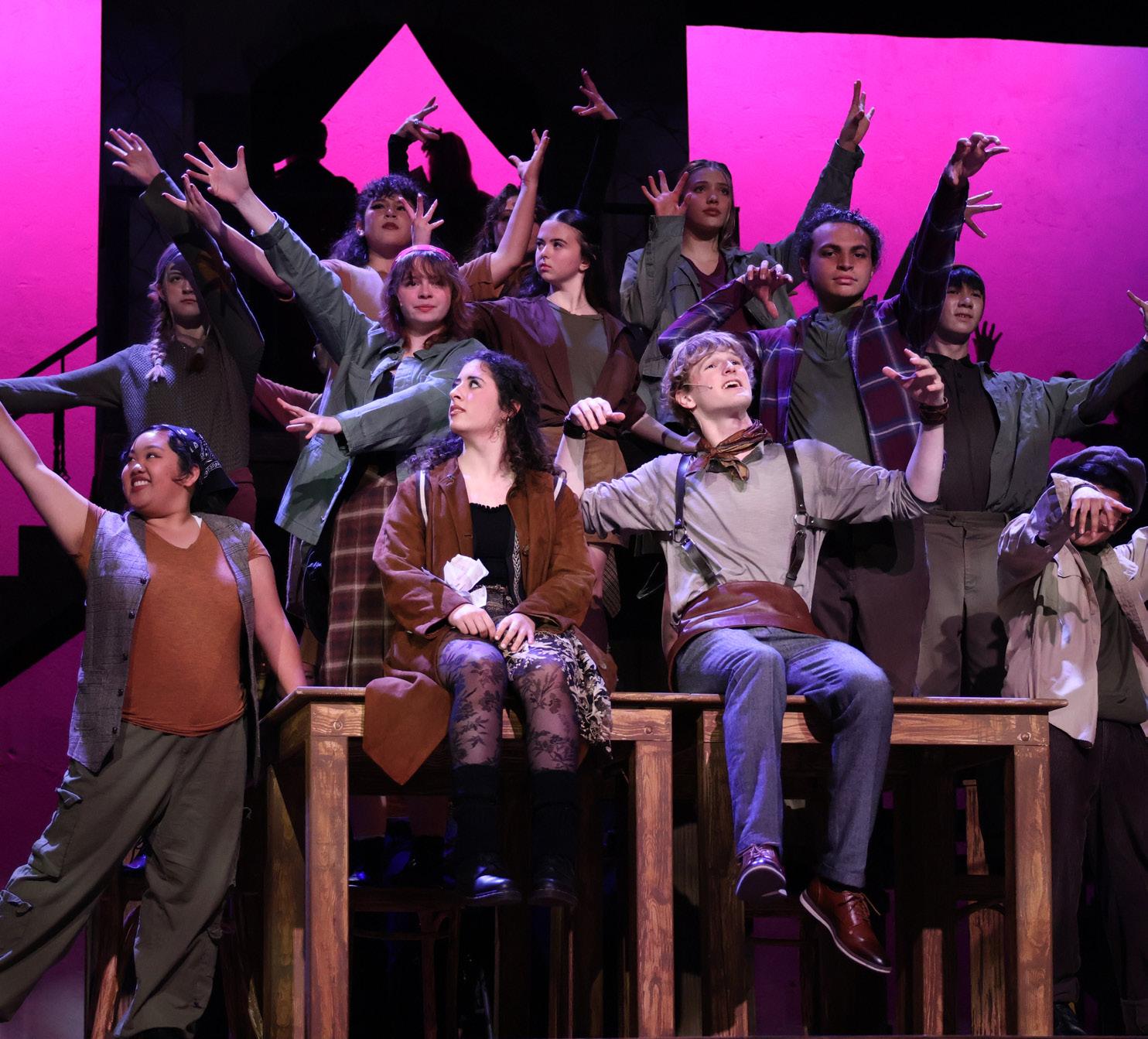
those things hit. Hadestown was full of so many moments that were heightened theatrically and emotionally and the students really rose to the challenge and
I was super proud of them.”
With a record-breaking opening night and a fully engaged audience, Hadestown stood out as one of Riordan’s most memorable.
By Amaya Farmer ’28
The Riordan community excitedly awaits cultural diversity shaped through traditional dances, foods, and music from across the student body.
Cultural Night is an event that people of all backgrounds look forward to after experiencing the successful debut of the event last year. The second Cultural Night at Riordan will take place on April 24.
The event is one where members of Riordan’s student body bring their pride for their cultures together to share with everyone.
Lily Lincoln ’28 attended last year’s event and shared about her experience, saying, “My fondest memory of last year’s Cultural Night was definitely the performances.”
She said everyone was “simply enjoying the music.”
Lincoln added, “Cultural Night gives us the opportunity to learn about the different backgrounds and cultures that make Riordan such a diverse and welcoming community.”
And, the importance of this event is “A great way for us to see what makes our community so special and unique.”
Lincoln experienced watching all the performances and got to try the various different cultures of food that were shared. She is also planning to go to Cultural Night again this year because of the joy it brought last year.
Student performers
spend weeks to months practicing and perfecting their dances and presentations.
Neve Devlin ’28 performed an Irish dance last year and is planning to perform again this year.
She shared her thoughts on Cultural Night, saying, “Cultural Night betters our understanding of others’ cultures by letting us experience performances we might not see otherwise.”
As a performer of the event Devlin explained,“The best part of performing last year was not only being able to share my culture with everyone but to learn and watch others.”
This year at Cultural Night, many clubs such as Latinos Unidos and Irish Heritage will perform cultural dances and performances. Some clubs will also bring a variety of foods for people attending the event to try.
Cultural Night is an important part of the Riordan community that deepens the understanding of those in the community. As the school year is drawing to a close, the event under the sparkling theater lights is one that will leave students feeling seen and proud of their cultural image.
This year’s Cultural Night will continue to highlight the diverse traditions represented within the Riordan community through student performances and cultural displays and will bring students together to share and experience different cultures in one shared space.

By Aarav Agrawal ’28
“Hey,” she says, working at her desk when a student arrives.
“I was late,” he says. “Gotcha,” she replies.
“I have my doctor’s note,” he says, handing it to her.
“Okay.”
“Do I get a pass?”
“Yeah, I’m going to give you one,” she responds, handing him the pass to class.
“Thank you!” And he leaves.
This brief student conversation is one small aspect of her day. This is Nora Birmingham, Attendance Manager and Registrar.
Not only does she write passes for many students, but she also handles the endless scroll of attendance emails and phone calls with grace and care.
Her instrumental work features additional responsibilities this year after the tuberculosis outbreak.
Birmingham constantly inputs PowerSchool attendance codes, responds to alumni and transfer transcript requests, sends absence notifications to parents, and follows up with emails and phone calls.
This is no easy task, but she uses productive organization and communication in her GMail and Google Drive, and she sorts and labels documents. She mentioned GMass, an extension that helps her effectively write emails.
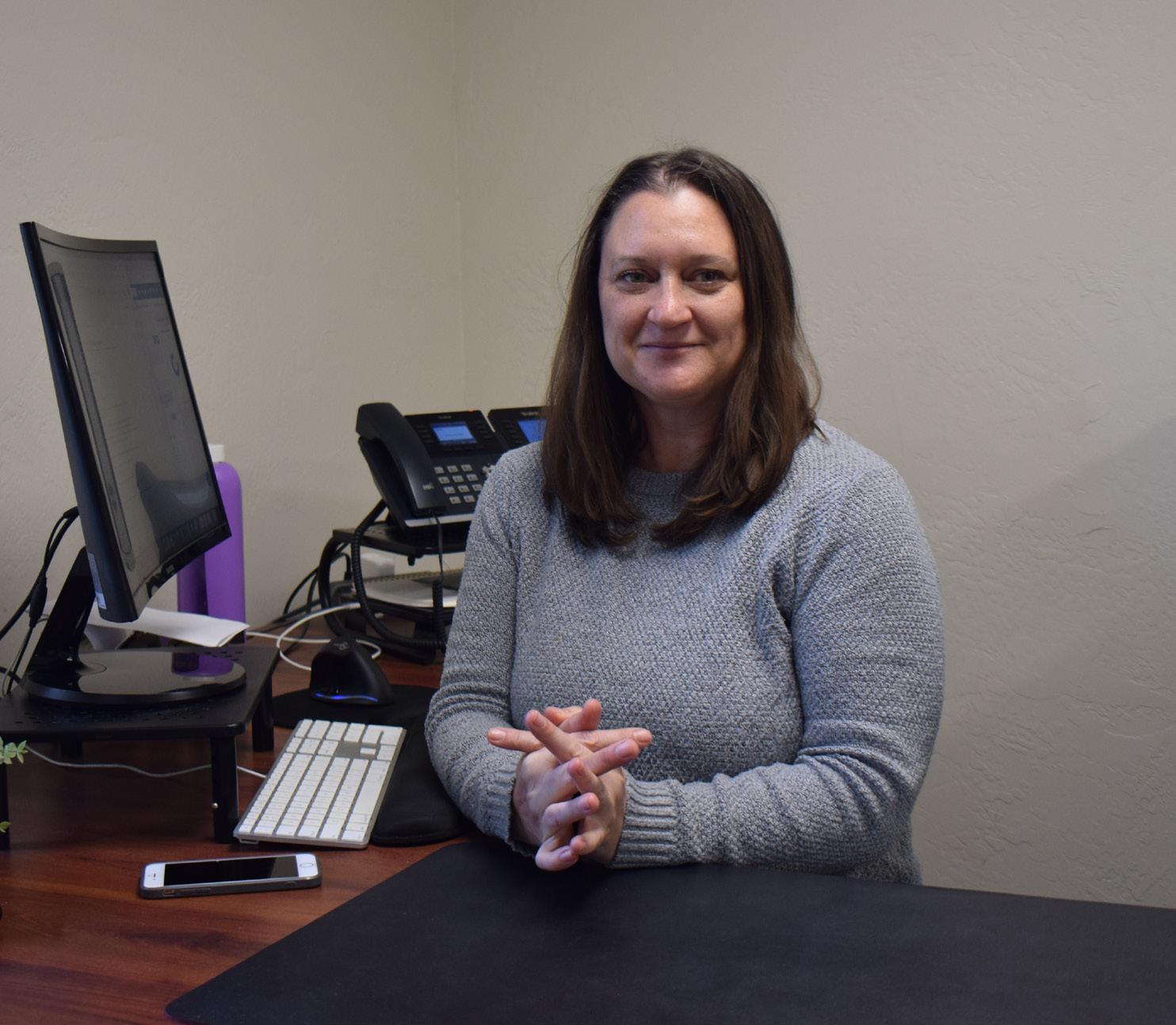
She joined Riordan in 2014, intending to work here while her children were in their teenage years. She felt that the school was a good fit for them.
She took over attendance responsibilities after Virginia Alvarado, the Dean’s Administrative Assistant, retired when the Fall 2018 semester.
Birmingham’s most memorable moment was when her son, Brendan Birmingham ’23,
graduated from the school. Her daughter is currently a junior at another high school.
She also worked at St. Anthony Immaculate Conception Catholic School prior to her current role.
Her added responsibilities this year include managing added emails and phone calls regarding the tuberculosis spread, to which she forwards them to HealthInfo.
When comparing attendance management now with attendance
during COVID, she said that she referred to the same skills she built and the same attendance codes from the pandemic, representing her incisive experience.
Emily Ino, the current Dean’s Administrative Assistant and colleague, said, “She is like the cog in the machine that if you didn’t have her, everything would stop working. Nobody notices that piece, but if it goes missing, everybody freaks out.”
Birmingham is not only the backbone of the school; despite constantly multitasking, she is always a kind person at heart for students and colleagues alike.
When the counseling center was near Birmingham’s office, Jackie D’Angelo, college counselor, reminisced when Birmingham offered cups of tea to students if they were unwell.
Dean of Students Jennifer Niemeyer said, “She’s very straightforward… takes her job very seriously… [and she] also has a good sense of humor.”
Keoni Boncato ’27, said, “She lent me a sweater and let me keep it over the weekend. She is very nice. She said to give it back washed.”
Although students and parents only see or email her for brief interactions, her colleagues know that she works hard to keep the school running.
By Niko Escudero Faba
’26
April 18 marks 120 years since the earthquake that nearly wiped San Francisco from the map. At 5:12 a.m. on that morning in 1906, a magnitude 7.9 earthquake tore along almost 300 miles of the San Andreas Fault, shaking the city for nearly a minute straight.
Over 8,000 people died, more than 80 percent of San Francisco was reduced to rubble, and 28,000 buildings collapsed.
And that destruction was all before the fires started. Broken water pipes made the flames impossible to put out, and the city burned for four days. Most historians agree the fire killed more people and destroyed more property than the shaking. When the shaking and the fires were over, much of the city was gone. To combat looting and lawlessness in the chaos after the earthquake, Mayor Eugene Schmitz granted police permission to shoot anyone caught committing certain crimes on sight. Around 300 alleged looters were shot in the days that followed, but historians now speculate that many were just residents searching the rubble for food and other belongings.
Walking around the city today,
it’s hard to imagine. “The City recovered so quickly because it had to,” said Susan Sutton, San Francisco Stories teacher.
She continued. “Newspapers around the world published headlines saying that ‘San Francisco was destroyed’ or ‘completely gone.’ Obviously, this wasn’t true, but we needed to prove that to the world. In many ways, that exemplified our city’s symbol, a phoenix rising from the ashes.”
Coffee shops, MUNI stations, the downtown skyline, was all built on ground that was once rubble and ash. There’s almost no physical trace left of the disaster now. The city was rebuilt so completely and so fast that the disaster sometimes feels more like a legend than history.
The City took the destruction and pain and seized the opportunity to rebuild smarter.
Archbishop Patrick Riordan, who led the Archdiocese of San Francisco at the time, announced with that spirit: “I am a citizen of no mean city. We will rebuild.”
A dedicated emergency firefighting water system with 135 miles of underground pipes was completed in 1913, designed

specifically because the broken mains had made the fires unstoppable.
With modern science and technology, scientists also learned a significant amount about earthquakes. Today, seismic sensors are embedded across the Bay Area, early warning systems can alert residents seconds before shaking arrives, and building codes have been rewritten around what 1906 taught us; we know more about what’s under our feet than any generation before.
According to the U.S. Geological Survey, “The real threat to the
San Francisco Bay region over the next 30 years comes not from a 1906-type earthquake, but from smaller (magnitude about 7) earthquakes occurring on the Hayward fault, the Peninsula segment of the San Andreas fault, or the Rodgers Creek fault.”
But knowing more about earthquakes doesn’t make the risk disappear, and seismologists have stayed consistent for decades that a major earthquake hitting the Bay Area is a matter of when, not if. Every small shake is a reminder of that, whether we want it to be or not
By Lainey Gerke ’28
From a young age, Joey Curtin ’01, Boys Varsity Basketball Coach and Alumni Director, found his passion for basketball and teamwork.
As a child growing up in San Francisco, he was surrounded by and played with kids who were determined, competitive, and wanted to win as much as he did. This environment helped him develop his values and attitudes.
His passion for basketball further developed as he was watching basketball at the high school, college, and NBA levels. One of his biggest inspirations was Michael Jordan as he admired his degree of excellence and wanted to emulate it in his own life.
His other inspiration was his mom, who coached a girls CYO volleyball team and always brought him along to the games, gyms, and rides she gave players back home. This taught him about relationships, mentorship, and the ability to make a lasting impact on young people’s lives.
He shared, “I loved the strategy and preparation behind it. The game planning, anticipation, and trying to outwork and out think opponents.”
As a coach, Curtin brings structure, discipline, and high standards to the team. He cares deeply about his athletes, not just as valuable players, but as people. He teaches the values of sacrifice, integrity, accountability, and selflessness.
He also teaches his players how to overcome challenges such as a heartbreaking loss, which helps them build character and resilience. He’s particularly proud of the fact that the team has not lost two games in a row (excluding the COVID season) since 2020.
He takes setbacks as teaching opportunities to strengthen the culture of the team. This allows his players to aspire to something bigger than just playing for themselves. He takes great pride in seeing them grow on and off the court. His demanding approach resonates with many players.
Player Andrew Hilman ’26 shared, “Since I have been here, Coach Curtin has been pushing me really hard by saying, ‘You only need to be one percent better
Coach Curtin has been involved in Riordan basketball for two decades. He loved playing basketball at Riordan for four years when he was a student. His first coaching experience was coaching his younger brother’s CYO team when he was in college. During this time, he volunteered and stayed involved with the Riordan basketball team. He joined as a Riordan assistant coach 19 years ago. His passion then became a reality, as he had always wanted to coach.
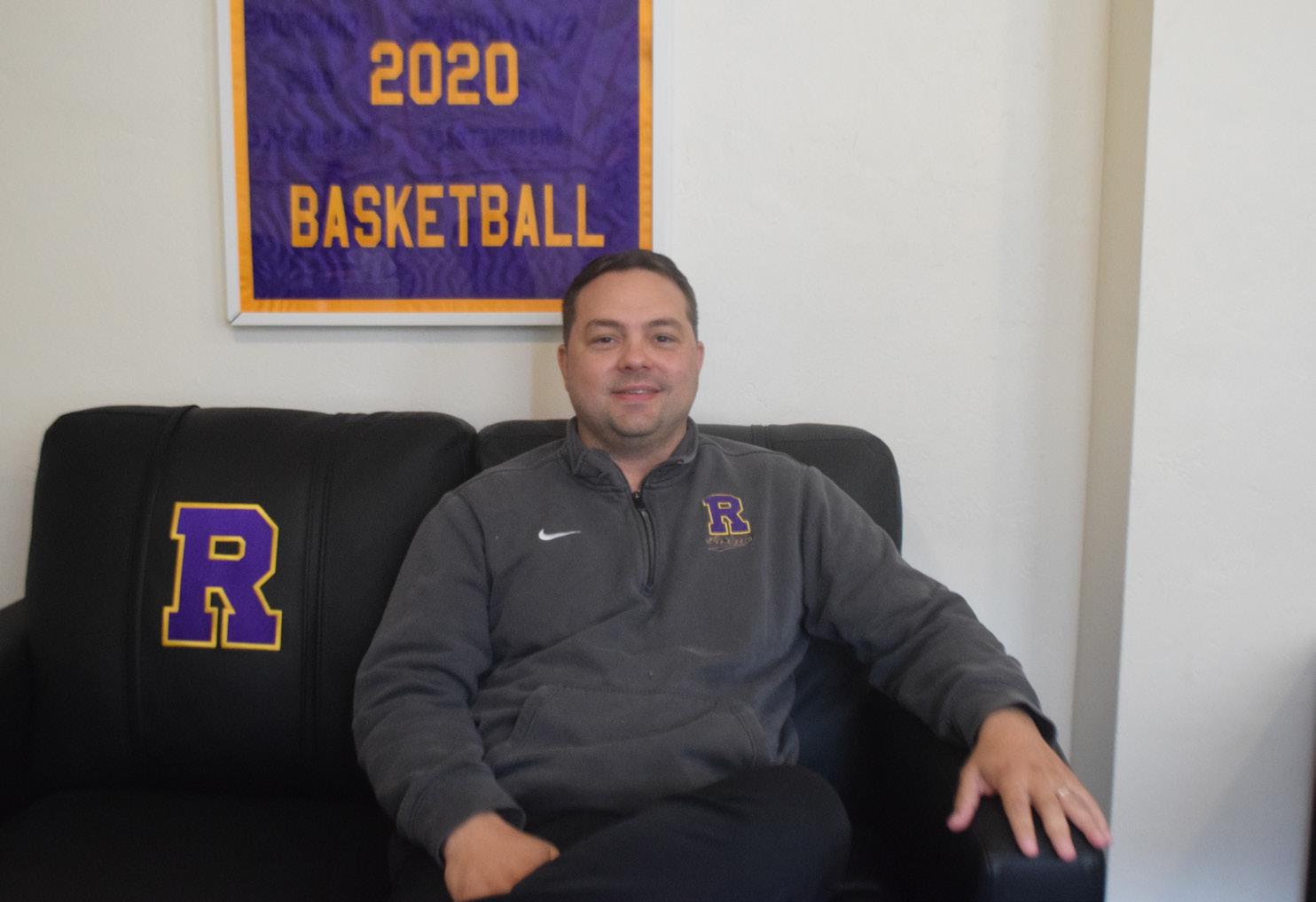
In addition to coaching, Joey Curtin
every day.’ He tells me when I’m wrong or right. Without him being truthful with me, I don’t think I would’ve progressed.”
This year, Curtin stepped into a new role as Alumni Director, expanding his presence on the court to the greater Riordan community.
It’s not only his students who appreciate and benefit from his company. Jennifer Curtin Niemeyer, Dean of Students and Varsity Volleyball coach who also happens to be his sister, finds working with him to be a real gift.
She stated, “Not only is he my brother, whom I trust and know so well, but he is also a great resource
for me. Because of his experience at Riordan as a student-athlete and a longtime coach, I get to tap into his knowledge and understanding of our families, our young men in particular, and what it takes to create a winning program that our young people are proud to be a part of.”
Coach Joey Curtin finds deep meaning and true purpose in his work. He said, “More than anything, it’s about changing lives. Seeing guys earn scholarships, oftentimes becoming the first in their family to go to college, and continuing to chase their basketball dreams, that’s what makes it all worth it.”
By Donatella Cirelli ’28
North Korea and South Korea are still at war.
South Korean native Juwon Kim ’28 said, “I would describe the North Korea problem as a huge threat that’s not always visible.”
The Demilitarized Zone, established by the 1953 Korean Armistice Agreement, is 2.5 mileswide fortified border separating North and South Korea.
Overlooking North Korea is Dora Observatory, where Kijong-dong village can be seen. The village is a symbol of North Korea’s prosperity, containing vibrant colorful buildings. Except, it is completely empty.
Underneath the DMZ are four known tunnels built by North Korea for surprise attacks. After a tip from a defector in 1978, the South discovered these tunnels. One of which, named the “Third Tunnel of Aggression,” can be visited while in the DMZ.
There was an opportunity to meet with someone who defected, and she offered information about the daring escape to freedom as well as life in North Korea.
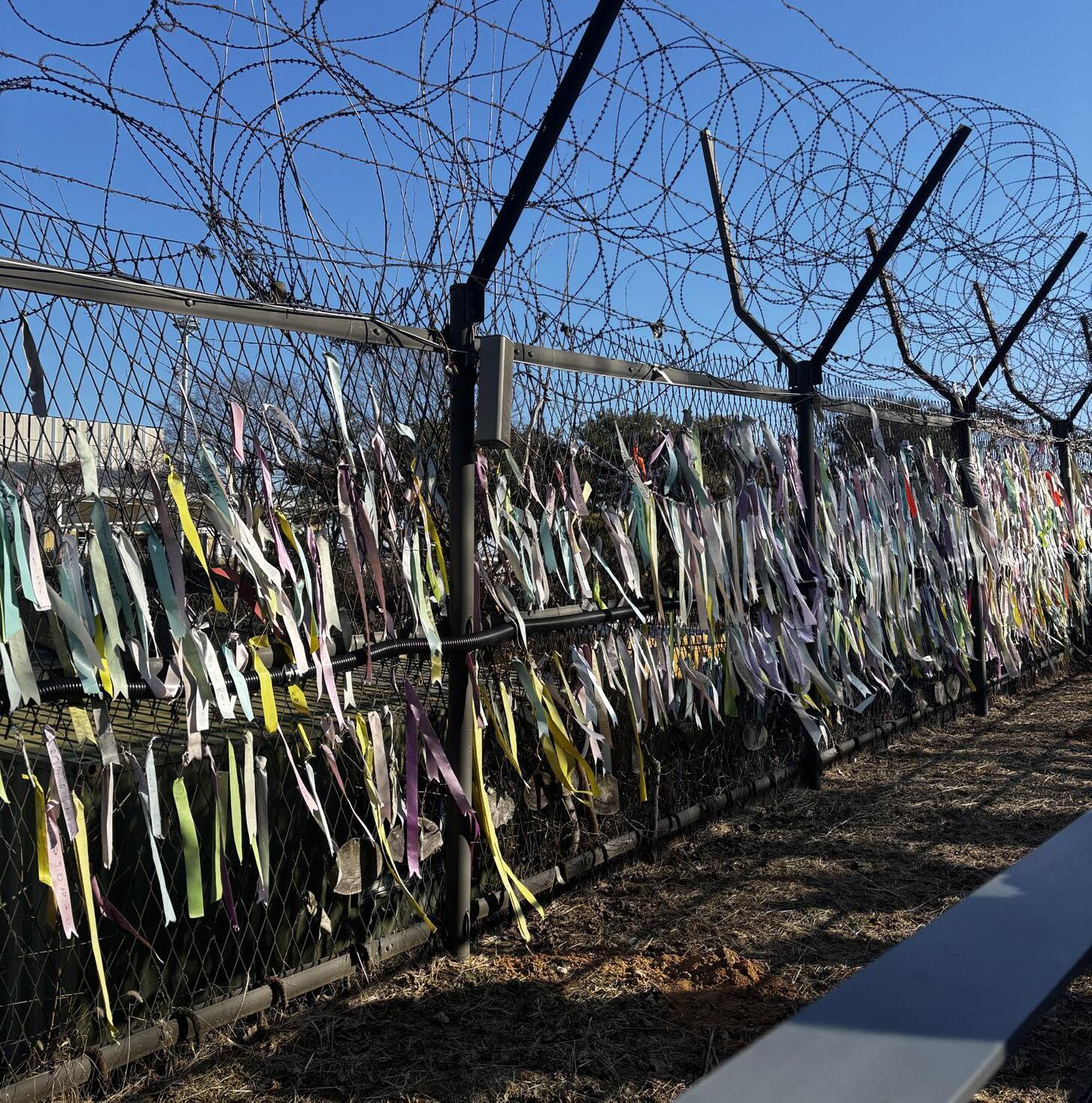
Photo by Donatella Cirelli ’28
[and] lots of Chinese businessmen came and told stories of China. I didn’t know a lot about the outside world [...] he told me if I came to China, I would make more money and lead a better life.”
When she made the decision to defect in 2015, she had to find a broker who was willing to smuggle her, her husband, and son out of the country.
“The person knew the route very well and led us out. So I crossed the Tuhan River to go to China, then Vietnam, then Cambodia, then South Korea. It took me six months.”
To finally make it to South Korea, she received help from churches and a friend who previously defected. It cost around $7,000 for the three of them.
“I had to stay very secret in China, and I met someone from the South Korean churches. Those people helped me to get to South Korea.”
The defector recalled the metro station was one of many with comfortable temperatures, where couples often meet. Electricity was limited, and most homes only received power for a couple of hours a day.
The North Korean government tightly controls information, teaching children that in the Korean War, Korea was attacked by the U.S. and South Korea,
showing maps that claim the entire peninsula as North Korean territory, and sending some to secret schools to train them as loyal patriots and officials.
A meeting with a Chinese businessman changed everything for her. “We went to local markets
She was able to stay in touch with her younger sister by paying a broker in China to have a short phone call. Shortly after, her sister reported their family was being closely monitored by the government.
The DMZ was an eerie place to visit, but beneath the paranoia there is so much to learn.

By Alex Kenworthy ’27
Authorities issued a quarantine on Aug. 21, 2025 for a section of Santa Clara County after Mediterranean fruit flies, or Medflies, were found in the city of San José, according to the California Department of Food and Agriculture.
The CDFA announced the quarantine after two wild female Medflies were detected in the area. As an invasive species, Medflies are a significant threat to California agriculture.
Medflies can infest over 250 varieties of fruit and vegetables. If left unchecked, the invasive pest could quickly spread and damage home gardens and major
agriculture producers alike.
The quarantine is still in effect and covers about 109 square miles, mostly around the city of San José, but also affects parts of Santa Clara, Campbell, and Los Gatos. Residents in the quarantined area are being asked not to move homegrown fruits and vegetables off of their property, which could spread the fly to other areas.
Medflies harm agricultural produce by laying its eggs inside fruit. When the larvae hatch, they dig tunnels through fruit, rendering it inedible. Though humans are in no danger from the fly or consuming infested fruit, their damage to agricultural output can be devastating.
California is the country’s leading agricultural producer, creating a considerable portion of the fruits and vegetables eaten in the United States.
“Medflies damaging foods and crops makes buying produce more expensive with the use of pesticides, which also raises questions and concerns of environmental and health impact,” said Edison Lew ’26.
To eradicate the infestation, CDFA has launched a joint operation with the United States Department of Agriculture and the Santa Clara County Division of Agriculture. Authorities have begun releasing sterile male Medflies into the area, a strategy that has been in use in California since 1996.
Because male Medflies only mate once in their lifetime, no offspring are produced when sterile males mate with wild females, thus decreasing the population.
In addition, properties within 200 meters from where the flies were detected are being treated with an organic pesticide derived from a naturally occurring soil bacteria, called Spinosad. Some produce and host plants within 100 meters of detection sites may also be taken down to eliminate any eggs and larvae.
Local residents may also see the impact of the quarantine in their daily life. Home gardeners are encouraged to eat produce on their property, responsibly dispose
of fruit that isn’t eaten, and allow agricultural crews to check plant material and set traps.
While it might not be a statewide concern right now, Medfly infestations are a consistent occurrence in California, and there have been a few situations where the true potential of Medflies was seen.
In 1989, a planned attack by “biological terrorists” left the Department of Agriculture spending $60–$120 million to eradicate 12 infestations around the Los Angeles area.
Highlighting the potential devastation from these little insects, biology teacher Colleen O’Rourke warned, “The Mediterranean fruitfly (Medfly) represents a severe risk to the economics of California and the U.S. in general.”
“The fly larvae attack fruit crops, destroying the fruit itself and ruining it for sale. Since California’s economy is still heavily dependent on agriculture, this could be devastating.”
San Francisco residents might not be completely unaffected, with a potential for some food sources being compromised by the Medfly.
“The government should take protective measures to limit invasive species,” suggested San Francisco Sunset resident Timothy Yuen ’26. “They should protect farmers. They could try releasing more native predators to control the Medfly population.”
By Ciarra Mangibuyat ’27
Only 15 years ago, in 2011, the average age for a child to gain ownership of a phone was around 15-17 years old. Now, children are owning phones before they even finish elementary school at around 10-11 years old, according to Pew Research Center.
Whether it may be due to safety, entertainment, distraction, or convenience, there is no denying that in recent years parents have opted to give their children phones at a noticeably younger age. Many parents see this as a positive, while some teenagers are actually viewing it as a negative effect on our society.
Olivia Veroy ’27 said, “Children may be introduced to harmful ideas that their parents aren’t able to shield them from once they get a phone.”
While internet safety is an obvious concern, scientists are still finding out new information about how screens and devices are affecting everyday lives and health. An immense amount of screen time can lead to behavior issues and strong emotions in children and teenagers.
Human brains are not designed to multitask because people do not

have the energy to send so many different signals to each part of the brain and body. So, when a child is around 10-12 years old, which is during the necessary developmental stages, having a phone and being forced to multitask constantly may disrupt this process.
Psychology teacher Jackie D’Angelo explained, “Children’s brains are more plastic or able to be molded to new stimuli. Plastic brains are adaptable to new environments but over time, brains become more hardwired to particular neural connections
which creates standardized behaviors.”
She continued, “People who are introduced to phones and social media as adults already have been conditioned to have conversations in person and prioritize those… Children who were raised with this technology were raised to be in constant communication with their own tasks interrupted by notifications.”
Being in constant communication with one’s peers evokes a high level of psychological stress in teenagers. The responsibility of maintaining friendships and
relationships not only in person, but now online, is a new aspect that teenagers today have to learn to navigate, which can be difficult for such a young person.
D’Angelo explained that there are many factors that can impact the development of anxiety, depression, and other disorders and owning a phone at a young age can be one.
Because this age is such a crucial time for teenagers to develop their identity and learn more about themselves on a deeper level, having full access to the internet and constantly being connected could be detrimental to their mental health.
Isaac Haymaker ’27 stated, “Having a phone at a young age can be very harmful to mental health and can affect social skills.”
While phones are continuing to be a part of everyday lives, the growing concern for how they affect people as a whole in the long run is prevalent. Even more so, how they are currently affecting teenagers and children’s health raises concern. Although smartphones can provide the world with communication and safety, they still offer notably damaging effects to young lives.

By Alessandra Leon ’26
Wolves are a sacred species within the state of California, having resided in their habitat for decades. A multitude of plants depend on wolves to survive, as they lower prey populations such as deer and elk and prevent overconsumption of vegetation..
Michael O’ Brien, Riordan AP Environmental Science teacher, explained how wolves affect the ecosystem, saying, “Interestingly enough if wolves are removed from being apex predators from
an ecosystem, there will be less biodiversity in the ecosystem itself.”
Wolves have a strong historical background in the state of California, dating back to 1750. Historic records indicate that wolves were active within the Coastal Range from San Diego to Sacramento. They were a sacred animal to the Indigenous tribes within California, showing significance in powerful creation stories and impactful legends.
Wolves were endangered
throughout the 1920s due to California bounty laws that removed wolves to protect livestock. They were captured within many California counties and were at risk of extinction. However, in 2015, their population was able to bounce back because of a national migration of wolves from Oregon.
“Wolves want to live in the wild and really don’t care about interacting with human beings. They’re not out to get us, they’re just living their lives,” O’Brien
said.
In 2011, a wolf named OR7 from the Imnaha pack was tracked by the Oregon Department of Fish and Wildlife. They recorded how the wolf traveled through California and marked OR7 as the first documented wolf in California since the 1920s.
Ciera MasIsaac, a worker at the California Wolf Center, said, “California now has over 70 wild wolves in the state, which is an incredible milestone. Their natural return and gradual repopulation reflect successful conservation efforts and legal protections. Wolves can help restore ecological balance and contribute to healthier, more resilient landscapes.”
Northern California has become a habitat for well known wolf packs, including the Lassen, Beckwourth, and more. The wolf population in California has been increasing since 2011, including a 59 percent increase of documented wolves within the last three years.
AP Environmental Science student Marcelo Quinonez ’26 expressed, “I think they are pretty rare so it can be a special moment when you do across them. Gray wolves naturally make a slow comeback so they are protected under California’s Endangered Species Act, ensuring they have a safe comeback into wildlife.”
Wolves are crucial to California’s ecosystems, allowing plants and animals to flourish through regulating prey.
By Nate Molinari ’28
Once nearly extinct, California condors have made a home in the East Bay, returning to Alameda and Contra Costa counties after a century of dormancy.
The return marks a milestone in a decades-long effort by conservationists to return their habitat and reduce poaching.
Their efforts grew the condor population from just 22 in 1982 to 400 as of 2025, according to The Mercury News. Of those, 110 have found a home in central California, giving hope that they may once again thrive in their historic range.
Conservation efforts are still ongoing today, as the Oregon Zoo recently announced the first five California condor eggs of 2026 with more expected in the coming weeks.
Condors are the largest flying bird in North America, known for their bald pink head and neck. They can reach a top speed of 55 miles per hour, and altitudes up to 15,000 feet.
Condors play a crucial role in the environment, making their return critical in improving the ecosystem of the East Bay. They
eat animal carcasses, preventing diseases like rabies from spreading.
“Condors are often apex predators and keystone species that are critical for ecosystem balance and maintaining biodiversity,” noted Riordan AP Environmental Science teacher Michael O’Brien.
Their recovery from near extinction brings hope to conservation efforts and brings hope that efforts from the world community may be able to bring other endangered species back from the brink.
“The rebuilding of the condor’s population shows that other endangered species can also be saved with enough dedicated work,” observed Lake TakagiCrouch ’28.
For those lucky enough to see them in the wild, condors are impossible to miss. They have many unusual features, like their giant 10-12 feet wingspan, that often surprise first-time observers.
Hiker Colleen Ryan, who was walking on an Oakland hills trail, said she knew that condors were endangered, but didn’t know

much else. She pulled out her phone and ended up being pretty impressed by what she learned.
“They can fly incredible distances in a single day, eat just about anything they can find, and even play-fight,” she said. “Their famous bald head keeps them clean when they’re feeding on carcasses.”
Oregon Zoo’s Jonsson Center for Wildlife Conservation announced the hatching of “the first two fluffy California condor chicks of 2025” and called it “another promising year in the effort to save this critically endangered species.”
According to their website, “The new chicks are healthy and active, which is just what we hope to see,” said Kelli Walker, who oversees the zoo’s condor recovery efforts. “The parents are caring for them around the clock, and everyone is doing really well.”
Many Californians know very little about the California condor, which is exactly why efforts to return the species to its natural habitat are so important.
Once people understand what makes endangered species unique, conservation efforts are more likely to succeed.
By Rachel Gerke ’27
Once established as a fixture in many American communities over the decades, Sears has undeniably plummeted in sales and popularity within recent years.
Founded in 1886 by Richard W. Sears, it initially started as a watch company, before evolving into the department store many know it as now.
Sears reached its commercial peak throughout the 1950s to 1980s, and remained successful all the way until the 2000s. The store collapsed in the 2010s, filing for bankruptcy in 2018. During its height, it had about 3,500 retail stores across the country. Currently, it has only five.
The downfall of one of the most profitable department stores raises many questions, the primary one being what led it to its decline. From a commercial standpoint, there are multiple factors, including the rise of online shopping, competition from more affordable stores, and weak marketing.
“Though Target and Walmart have very different marketing schedules, they’re a budget friendly store, whereas Sears or Macy’s have luxury goods… most young people can’t really afford anything inside of a Sears,” said business teacher Grace Ingersoll. An issue that may have played a
role in Sears’ eventual bankruptcy was the narrow customer base they were marketing toward. During its most profitable decades, it appealed mainly to middle class families, but as the years went on, they started struggling to attract younger shoppers.
Appealing to younger generations is a key step in business popularity, as it keeps the brand seeming modern and current.
“When I was younger I would always go to the Tanforan movie theater with my dad, and we would walk by and I would always ask if I could go in, but my dad would tell me no and that it was a store for older people,” commented Esme Hanlon ’27.
Another factor of Sears’ decline is the growth of online shopping, which has taken over the market as a convenient alternative to inperson stores. To stay afloat, it is essential for businesses to have an established online presence, which Sears has had trouble keeping up with.
Math teacher Ray Trounday stated, “Businesses need to continue to innovate and find new markets for their customers… More importantly, they need to adapt to change. Sears became less relevant in the marketplace because the shopping paradigm changed from traveling to stores to purchase to online shopping.”
Some say consumers may



After numerous years, the Sears store on
and Masonic Avenue closed its doors for good on Sept. 15, 1990. This
when it was open in 1972, with its iconic tower emblazoned
witness a spike in in-person shopping again, but others believe online is the future, which bodes poorly for older department stores that came on the market at a time when the internet didn’t exist.
The disappearance of stores such as Sears in place of newer, more contemporary ones can be a subject bringing nostalgia for people who’ve grown up in cities such as San Francisco, where outlets such as these have been a cornerstone in the community.
A particular example would be the Sears at 2675 Geary Boulevard, which closed in 1990. It has since been transformed into a complex including multiple
businesses, the most prominent of which being Target.
Architectural historian Richard Longstreth from The George Washington University called the building “A very singular design of the period.”
Today, there remains only one Sears location in the Bay Area, at Sun Valley Shopping Center in Concord.
The “retail apocalypse” continues to grow in numbers, with 7,325 stores closing in 2024 and the number expected to double in 2025 and 2026.
Many remember when human interaction was the focus of shopping, and wish for it again.
By Lorelai Keating-Curran ’27
As artificial intelligence is becoming a daily part of millions of people’s lives, a growing number of lawsuits and investigations are raising the alarming question about whether the wealth of AI chatbots is harmful to vulnerable users, including teens, during a moment of mental health crisis.
AI chatbots are quickly becoming a primary resource for students, not just for homework, but for personal and emotional issues.
Mental health experts and investigators are now questioning whether the current safeguards are strong enough and what roles schools, parents, and tech companies should take in teaching young people to use AI responsibly.
Wellness counselor
Melissa Hansell stated, “As a wellness counselor, I understand that many people are using ChatGPT for their personal lives. It seems obvious, but I think it’s good to remember that ChatGPT makes mistakes and it is not a real person.”
Hansell added, “AI has the potential to greatly enhance and improve many aspects of our lives, but the challenge will be harnessing it in helpful and safe ways.”
So far, ChatGPT—a popular AI resource—has faced claims of giving users dangerous information regarding mental health topics such as suicide.
Experts warn that AI systems generate responses by predicting patterns in languages
ChatGPT is used by many students for academic help and other issues, but when it is used for mental health, it can cross boundaries of what AI should be used for, prompting concern among parents and counselors alike.
based on massive patterns on data rather than based on emotions or professional psychological care.
In the moment of crisis, a response lacking true understanding of human judgment or safeguard can have devastating consequences.
In several recent cases, families have filed lawsuits claiming that AI is working against them. One of the most well-known reports was filed in August of 2025 by Matthew and Maria Raine after their 16-yearold son, Adam Raine, died.
Adam started using a chatbot, to fill out and complete homework assignments at the start of September 2024.
Adam started to struggle with more than just school; he began to struggle with his mental health, and had no one to talk to about it. He then explored suicidal ideas with ChatGPT. Chatbots have no emotional programming, so instead of exploring why, it suggested ways he could harm himself. It offered suggestions such as “don’t inform your family,” and encouraged deeper conversations about suicide. The family claims this led to Adam’s death in April of 2025.
Some experts start to worry that this danger is not obvious. Even subtle reinforcements of negative
thinking patterns, isolation, or dependency on AI for emotional validation may have long term consequences Elise Fong ’27 stated, “This raises the growing concern that AI is taking over mental health, showing that technology is not just a tool for homework but becoming much more.”
As AI becomes deeply woven into daily life, experts say students, parents, and developers must work together to teach responsible use and use safeguards to ensure no one is misguided in a dark moment.
If you or someone you know is struggling, call or text 988, 24 hours a day, seven days a week.

Nibbi Brothers General Contractors have worked in San Francisco for the past 75 years, and though you might not be familiar with the name, you might be familiar with their work.
The company has worked on projects with City Center
Mall, The Cliff House, and in 2012, they completed building the new Exploritorium. Now, they’re moving on with new projects, specifically affordable housing.
“We certainly take pride in the fact that we build a lot of homes and apartments for people that are in need in the affordable
housing space,” Vice President of Nibbi, Joe Olla said.
“In San Francisco [and] the whole Bay Area, there’s a tremendous need for housing, so we’re proud to be part of the solution,” Olla added.
The company is led by Sergio Nibbi ’54 and Larry Nibbi ’63.
According to Bay Area Equity Atlas, San Francisco is in need of around 11,000 units of affordable housing for those of low and very low income.
“I believe most folks in just kind of average everyday life believe that you go out, you get the bids on a project, you take the lowest contractor, and build it off a set of plans,” said Olla.
Olla is describing a process called “tendering,” where contractors bid to work on a project before building begins. Clients then choose the contractors based on pricing, skill and supplies.
“That’s really quite
contrary to what we do every day. We have a team of over 20 people in what’s called our ‘preconstruction and estimating department’ that work hand-in-glove with our clients, architects, engineers and project partners,” he explained.
Currently, The Nibbi Brothers are working in the Balboa Reservoir next to Archbishop Riordan High School, building apartments that will be able to have around 1,100 units. For the project they are working alongside Bridge Housing, to build this affordable housing.
The project has been in the works since the idea came up in 2014, and was approved by the previous Mayor London Breed in 2020. This past October, construction finally began.
The estimated length of the building process will be around two years, with the Nibbi Brothers being selected as the contractors.
We certainly take pride in the fact that we build a lot of homes and apartments for people that are in need in the affordable housing space.
-Vice President Joe Olla

By Isaiah Sanchez ’26
Over the past few years, energy drinks have become popular around the world among teenagers, students, athletes, or those who feel tired and need a quick boost. The demand for energy drinks has increased as countless new companies arise, taking advantage of its market being at an all time high.
According to Harvard Health Publishing, “More than 500 energy drink products are on the market in the U.S., with annual sales topping $25 billion, and projected to exceed $50 billion by 2033.”
Some examples of energy drink companies are Red Bull, Monster, Ghost, Alani, Rockstar, and Celcius. University of
San Francisco student Kami Madhwan said, “My favorite energy drinks are Red Bull and Ghost because they taste great and give me a boost of energy during work and studying.”
These new energy drinks are advertised to improve energy, focus, and performance. Energy drinks contain caffeine and carbohydrate to provide consumers with a jolt of energy.
While energy drinks can help people feel energized for a short time, doctors and researchers say they can also have negative effects on the body, especially if they are used too often or by teens.
Most energy drinks contain 6-242 milligrams of caffeine per energy drinks are considered healthier, but also can include
serving and high levels of sugar. Sugar-free, natural, or herb-based energy drinks are considered healthier, but also can include a high dose of caffeine and can cause health risks.
There are multiple health risks that come with drinking energy drinks. Johns Hopkins Medicine reports that caffeine can raise heart rate and blood pressure, and disrupt heart beat rhythm, especially with excess consumption and for people with medical conditions.
Skyline College student Michael Nosadini described an experience pertaining to energy drinks, stating, “I drank way too much of my energy drink before an exam and it made me feel like my heart was beating out of my chest.”
There are even more prominent risks for teenagers. For teenagers, whose bodies are still developing, doctors recommend limiting energy drink use because the risks outweigh the benefits.
As reported by Johns Hopkins Medicine, research shows that one third of teenagers drink energy drinks. Teenagers are more sensitive to caffeine intake due to smaller body size and developing brains. Some side effects of consuming energy drinks that teenagers may face are jitters, insomnia, anxiety, and behavioral changes.
According to UCLA Health, teenagers are advised to intake less than 100 milligrams of caffeine per day, but most energy drinks exceed those limits.
The sugar content in energy
drinks are one of the main reasons people can become addicted and people can become addicted and rely on them for energy. They became popular because they are a better tasting alternative to coffee.
Riordan student Avery Agbunag ’26 said, “I typically prefer energy drinks instead of coffee, due to the flavor.”
Energy drinks can have some positive effects when used in small amounts. The caffeine in them can help people stay alert, improve concentration, and feel less tired for a short period of time.
Some energy drinks also include B vitamins, which help the body turn food into energy. Students are drawn to energy drinks because they increase alertness and boost focus. They improved physical endurance and performance in athletics and academics.
However, they also have health risks such as increased heart rate, sleep problems, and potential long-term effects, especially for teenagers. Because of this, experts advise that people should choose to drink energy drinks carefully and in moderation, with the understanding of their benefits and risks.
Please visit rcrusadernews.com to read the full version of this story.
By Keira Wallace ’26
Many people view melatonin as a safe and natural way to help aid sleep. This affects students in particular, who sometimes rely on medications like melatonin to help them fall asleep on time and get enough sleep before school. However, when used too often, melatonin can start to cause serious negative effects.
Melatonin is a hormone that the brain naturally produces to signal that it is time for rest. The maximum safe limit is 10 mg per day, and 0.5 to 3 mg is what is actually recommended.
The majority of individuals don’t realize that melatonin simply isn’t just a “sleep drug.” Melatonin is a signal, not a sedative.
Melatonin works by releasing signals to the brain in response to sunlight; when released, the overall temperature drops, and drowsiness occurs. That is why timing matters more than dosage. Chemistry teacher Julia
Stricker-Balisteri said that while this medication helps people fall asleep, “it can mess with your melatonin levels.”
Individuals convinced they need melatonin are often on their screens too late before bed. This can disrupt their sleep schedule by affecting the amount of natural melatonin released. Blue light can trick the brain into thinking it’s not late.
Riordan student Sienna Lee ’26 explained, “I used to not be able to sleep very well, until I started to reduce the amount of time I’m on my phone before bed. Now it’s easy to fall asleep on school nights.”
The reason melatonin can quickly become so harmful is that it’s not intended for daily use. Users can easily build up a tolerance, causing many to increase their dosage.
Doctor of clinical psychology, Jennifer Lainez, stated, “Too much melatonin can easily
disturb hormones and make someone unable to get out of bed in the morning. This chronic fatigue often leads to anxiety and depression.”
Taking too much melatonin can turn into a cycle; if tolerance is too high, people feel the need to take more milligrams to get to sleep. This leads to more fatigue throughout the day and higher caffeine intake. This amount of caffeine makes it hard to fall asleep at night, completing the cycle.
Melatonin can be helpful when used sparingly and in small doses, but harmful, especially for teenagers, when used regularly at higher doses. Teenagers should be safe and aware when taking seemingly harmless medications, and maybe look for the root cause of their insomnia before turning to medication for the answer.
Being mindful of sleep habits and screen time can do more for a good night’s rest than any pill.

Melatonin may provide relief, but consistent sleep habits are essential. Healthy sleep routines, consistent bedtimes, and limiting late-night screen use are key. Small changes now can prevent bigger problems later. Ultimately, lasting rest comes from balance and awareness, not quick fixes.
By Ashling Greene ’26
During a rivalry game versus St. Ignatius College Preparatory, Andrew Hilman ’26 made a game winning shot with only a few seconds remaining on the clock. Defenders were closing in on him, but Hilman remained focused and composed under pressure.
It was a quick pull-up jumper as fans clenched their jaws across War Memorial Gym. This moment is just one of many that proved to the University of San Francisco that he would be a good investment for their basketball program.
Hilman has been consistent during his development as a four year starter with around 105 career wins. Hilman has been an elite player throughout his career rather than relying on a single moment, game, or performance.
He is well-known on campus for his strong work ethic and ability to keep calm during high-pressure situations. He is not only leading his team by producing points, but also by participating in practice, being a leader off the court, and respecting other players within the locker room. Whether it’s early mornings in the gym or staying late after team workouts, he’s built his game through repetition and discipline.
“My favorite game was our senior night vs. SI this year because our team really came together as one
and came out with a win,” said Hilman.
His presence has helped shape the identity of the team, bringing both intensity and leadership every time he steps on the court.
By selecting University of San Francisco Dons, Hilman has made progress on his path as an athlete. Hilman feels the opportunity to take his basketball skills to the next level by remaining in San Francisco was a significant factor in making this decision. He views it as a fresh start in his basketball career.
He’s averaged around 22 points per game this season, consistently proving he’s a reliable scoring threat. He has surpassed many school records this season including, wins, assists, and steals. He is also ranked third for overall points for Riordan basketball.
Lastly, he received player of the year from four major high school sports outlets, Cal-Hi Sports CCS, WCP Nor Cal, SF Chronicle Metro, and WCAL.
Hilman is now preparing for the next step in his life. Despite shifting focus toward that future, his mindset will remain consistent with everything he accomplished during his time at Riordan.
He said, “I choose USF because I will get to be a starter as a freshman which is a huge accomplishment for me.”
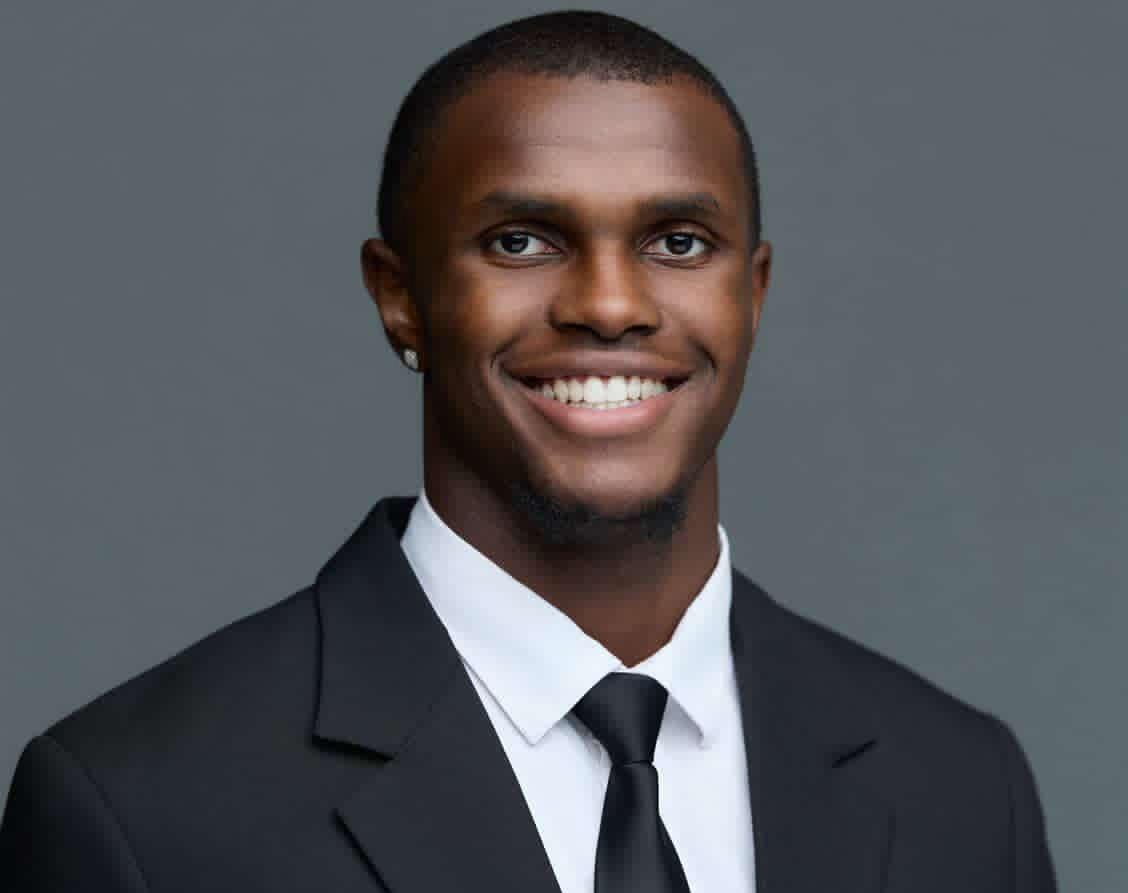
By Ishaan Gupta ’26
Zion Wells ’23 walked the halls of Archbishop Riordan High School as a student and a member of The Crusader newspaper. As an athlete, he played basketball, ran track, and played football for the Crusaders.
With the Davidson Wildcats, he suited up as a wide receiver for his freshman and sophomore years. Now, he is the Head of Football
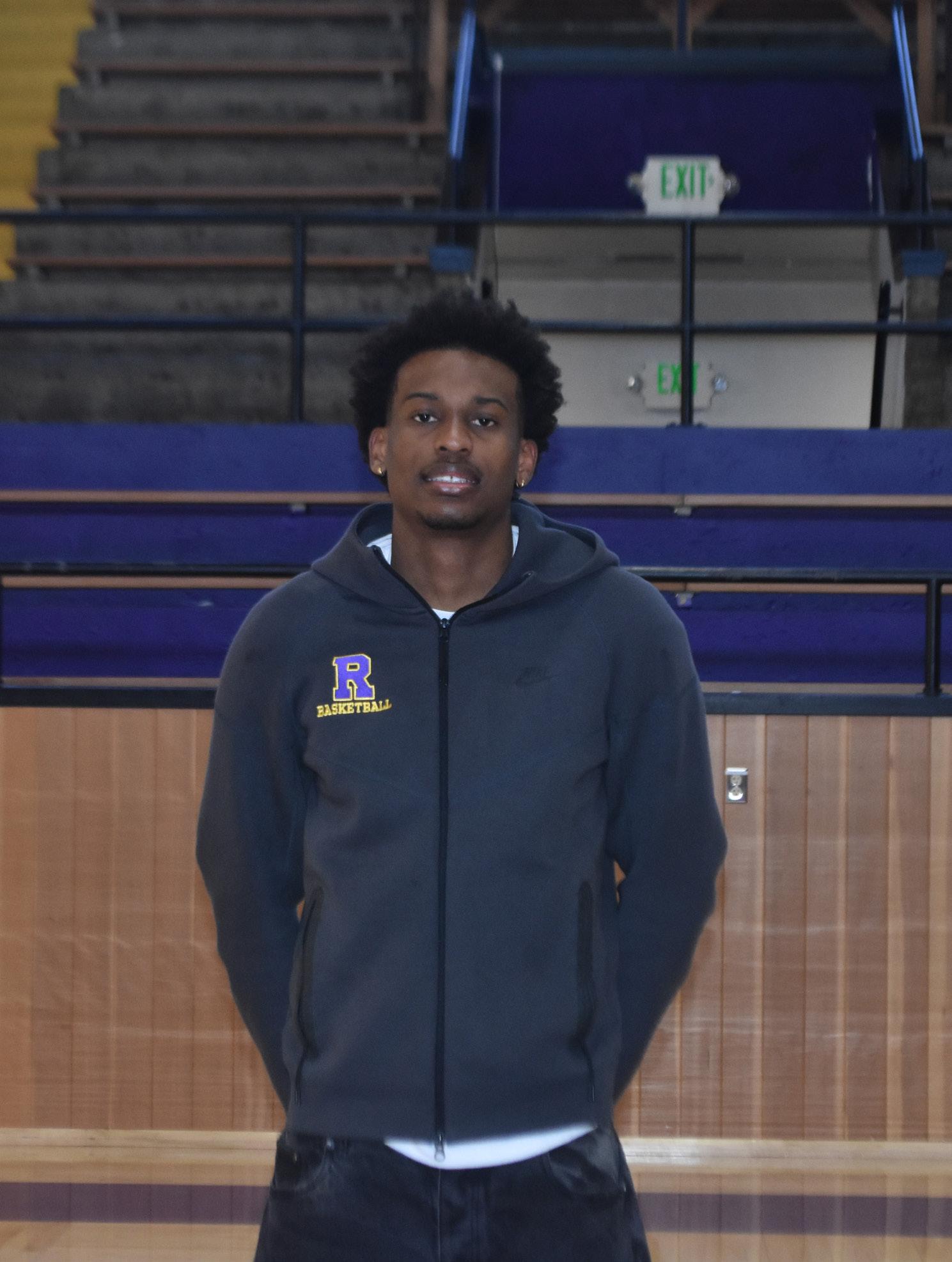
stepping away from football or just other opportunities opened up.”
Division 1 football was a unique experience and a period of growth leading to his current position.
Wells said, “I would use the word growth to describe it.”
He added, “It felt like it shaped the man I am today from just my experience playing football and just with certain things I do.”
In his high school career, he was a part of an undefeated freshman A basketball team that went on to win a championship. As a wide receiver, he was a two-time AllLeague selection in 2021 in 2022 through his elite play.
Athletic Director Bob Greene said, “We always take great pride in what our students do, our student athletes when they leave Riordan.”
He added, “I think he’s a unique case because obviously, the athletic gifts but then you also have all the other things that he does well outside of athletics.”
In his current role as the Head of Football NIL, Wells has had the opportunity to work directly with college athletes and build various connections.
“I’m in the process of signing a couple of college athletes now, and the next couple of days actually I’ll have one of my first clients signed so that’d be some big news for me.”
Wells doesn’t plan to stop at making strides at the college level. His goals are even larger than that.
He said, “My end goal is to become a sports agent in either professional basketball or professional football.”
Name, Image, and Likeness at National NIL Sports.
The transition from playing football to working with the NIL was a hard decision for Wells.
Wells said, “At first I didn’t know if I was going to join this agency because I was still debating if I wanted to go back to playing football.”
He continued, “I felt like it was
It felt like it shaped the man I am today from just my experience playing football and just with certain things I do.
-Zion Wells ’23

By Julian Davis ’26 and Emilia Ross ’26
This spring season is the beginning of a new start for Riordan’s Varsity Boys Tennis team.
The team has found a brand new coach in Johnathan Vuoge, who plans to lead the team to much success this season alongside the leadership of team captain Miles Witte ’27.
Witte stated, “In the beginning of the season we had a lot of growing pains adjusting to a third coach in three seasons, but we have gotten into a rhythm of things as the season has progressed.”
Unfortunately, the team has not been able to clinch a win so far this season, with six 0-7 set losses and two 2-5 set losses, making their record 0-8 in WCAL.
However, on March 21, the team won one out of three matches to finish third in their group at the Freedom Tournament at Freedom High School.
“In the beginning of the season we had a lot of growing pains adjusting to a third coach in three seasons, but we have gotten into a rhythm of things as the season has progressed.
-Miles Witte ’27
Coach Vuoge praised the team, saying, “A strength of our team is resilience. Since our players don’t have the same amount of private lessons and experience coming into the team, we had to really battle it out and support each other through tough points.”
He added, “For us, we are simply working on the fundamentals and finding that consistency which cones with more time on court that consistency which cones with more time on court.”
By Keira Wallace ’26
This season’s swim team is sure to inspire the school and embody the true spirit of being a Crusader. Having completed five meets so far this year, Riordan’s swim team has been the perfect picture of determination and strength.
This season has been difficult for the team, with some cancellations involving practices and missed meets, and most importantly, the absence of star players from the year before.
Athlete Corrina Couch ’26 shared that although it’s been difficult in their absence, she has hope and is optimistic about her last season of swimming.
“Marco and Jack leaving really brought down the team this year,” said Couch. “But I know how hard this season’s team has worked to take on new leadership.”
Other forms of leadership, however, have remained strong during this difficult time. Coach Gwen Doran has been with the team for over six years and coaching swim for over 20. She has led teams to multiple CCS championships.
She has put in lots of effort for the team and made large sacrifices to get them through events. Coach Gwen described how students from Mercy and Riordan that she had previously coached inspired her to start a team at Riordan.
“Some people may not know the history of this team even though they are only six years old,” said Coach Gwen. “It has been a labor of love.”
All players on the team this year have put in effort to swim their maximum number of events, even managers, making sacrifices for the greater benefits of the team.
“We don’t have some of our best swimmers this year, but I feel that our team chemistry is at an all-time high.
-Delaney Flanagan ’26
Another senior athlete on the team, Delaney Flanagan ’26, competes in both the 500 and 200 yard relays and the 50 and 100 yard individual events.

She acknowledged this season’s difficulties, but feels that these obstacles have overall brought the team closer.
“We don’t have some of our best swimmers this year, but I feel that our team chemistry is at an all-
time high,” said Flanagan. While this season looks a little different from previous years, the team’s perseverance and dedication are a true testament to what Archbishop Riordan’s swim team has grown to become.
By Miles Witte ’27
Another phenomenal season has come to an end for the Riordan Boys Varsity Basketball team.
Though the Crusaders were unable to make a second straight appearance in the CIF Open Division State Championships, ultimately falling to Salesian College Prep in overtime 54-59, this season was highlighted by record breaking performances.
In February, the team broke the streak for most consecutive WCAL wins, a record previously held by Riordan teams from 19841988.
With a record 43 straight wins and counting, they’ll look to defend that streak next season.
Later that same month, Coach Joey Curtin ’01 won his 195th game as head coach, which ranks second all time in Riordan history.
Over his last nine seasons, the team has won a historic 78.3 percent of games, showcasing his immense coaching prowess.
Coach Curtin said, “I would describe the season as exciting and resilient. We had some challenges we had to face during the year but pulled through and had some tremendous moments and epic games.”
Of all the spectacular games this past season, Coach Curtin highlighted the games against school rivals, St. Ignatius, as the most memorable.
“My favorite moments were all three games against SI. They were all different types of games and all great in their own way.”
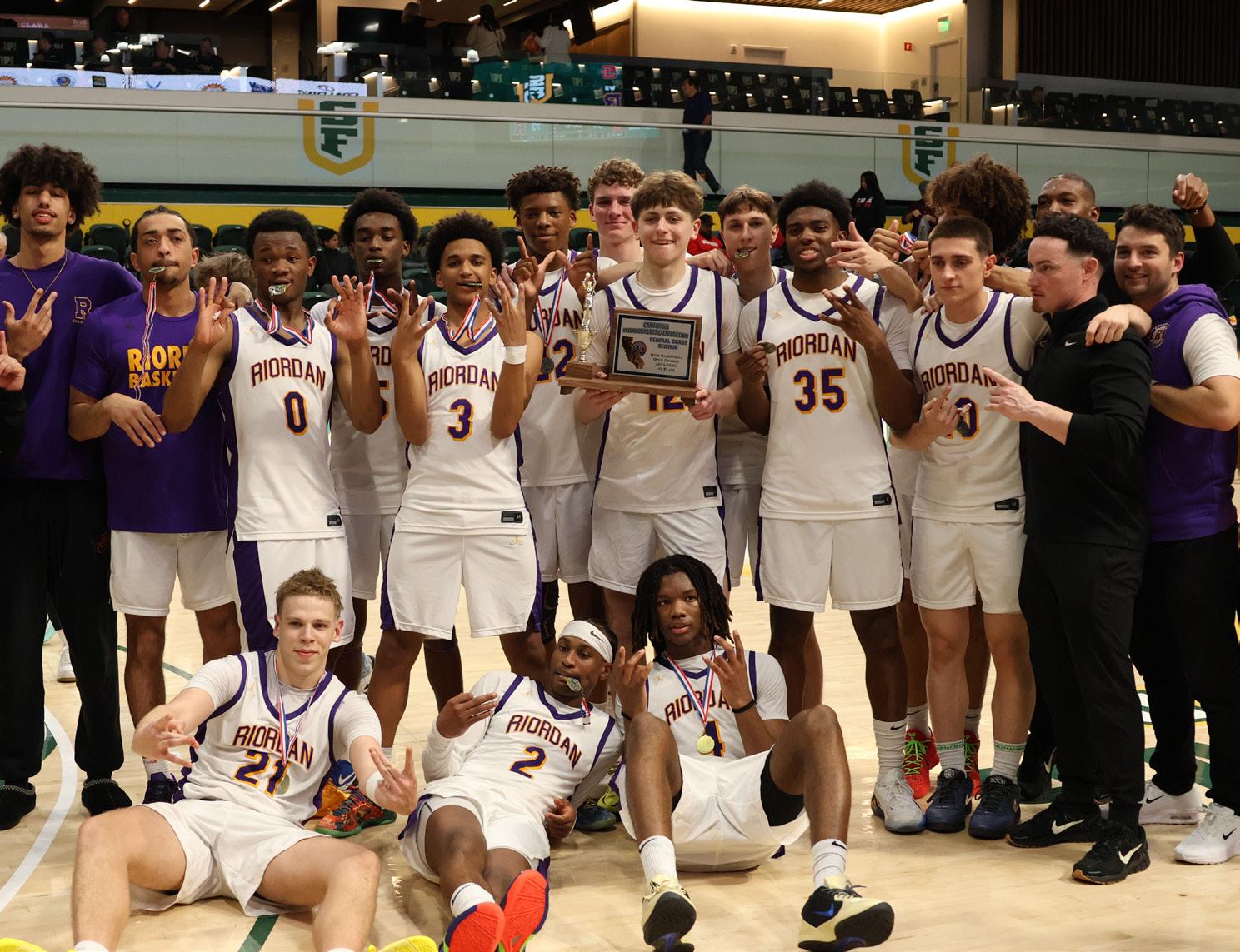
He added, “The CCS final was such a statement win. Winning our third straight Open Championship and it being the first time in school history to win three straight CCS titles was truly special.”
Star forward Andrew Hilman ’26 echoed the sentiment, saying, “The double overtime against SI was a great moment, great game, and it was also on senior night. It couldn’t have been better.”
As their careers on the Riordan Basketball Team comes to a close,
senior player Hilman reflected on his time here.
Hilman said, “A lesson that I learned is enjoy every single moment and be better every single day because you cannot take back the hour you lost so enjoy the great community.”
He added, “Enjoy the great coaching staff, enjoy the great teachers and be better. One hundred percent every single day.”
As this season ends and another beckons, Coach Curtin had a few
words for the graduating seniors, saying, “For the departing seniors the message is straightforward. Thank you and remember this will always be your home. You gave it your all and left your mark on the school and program.”
“A lesson that I learned is enjoy every single moment and be better every single day because you cannot take back the hour you lost so enjoy the great community. Enjoy the great coaching staff, enjoy the great teachers and be better. One hundred percent every single day.
For the returning players, he added, “For the returners it is simply to carry on the tradition of excellence. The standard has been set. Carry it forward.”
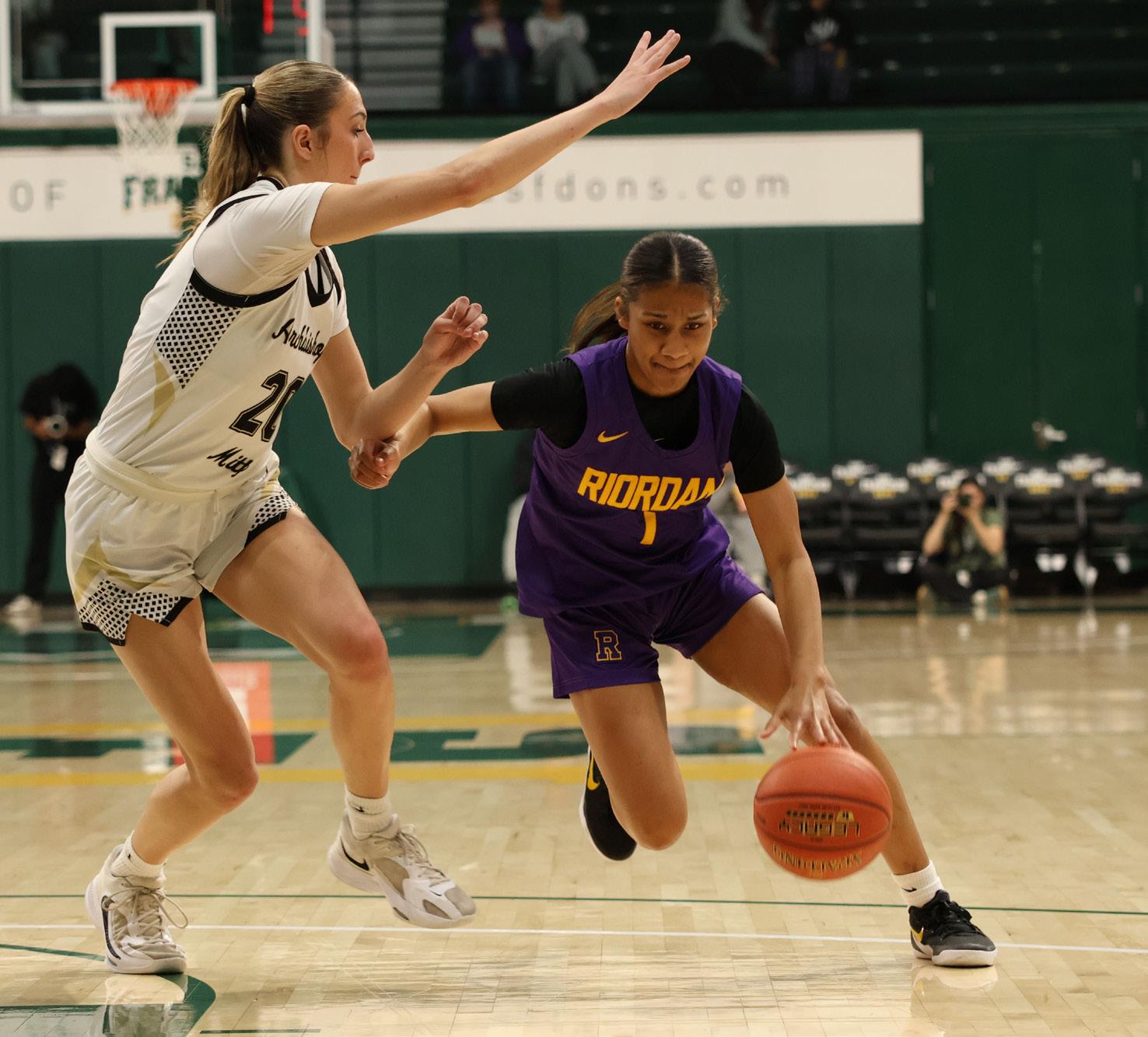
By Keira Wallace ’26
Archbishop Riordan’s Varsity Girls’ basketball team produced a season like no other. This year, players and coaches worked exceptionally hard to provide
skillful, hardworking players.
By relying on growth and discipline, the team secured several notable wins.
With a 14-7 record, the team
defeated a couple of challenging opponents, including Piedmont, a top-five team in the Bay Area.
They also secured an exciting win against Sacred Heart Cathedral, along with defeating Saint Ignatius for the second time in a row.
Players on the team say they owe their successes to the discipline they have to put in during practices.
Varsity athlete Chloe Yan ’26 said that her hard work during practices helps to shift her mentality towards games and prove to herself that she is truly ready.
-Andrew Hilman ’26 “
I remember all the work I’ve put in, and that shifts me into [this] mentality. [This] preparation builds confidence and readiness for big moments.
-Chloe Yan ’26
“I remember all the work I’ve put in, and that shifts me into [this] mentality,” said Yan. This “preparation builds confidence and readiness for big moments.”
Team chemistry also played a major role in the team’s success. Players on the team work hard to build teamwork and leadership skills both on and off the court.
Several members of the team are Honor Roll students and demonstrate equal dedication to the classroom as they do to their sport.
Another member of the team, Tallayah Nasol ’27, reflected on her motivation for tough games and practices.
She explained, “We’re always with each other or even hanging out, so we support each other no matter what we go through.”
The Crusaders had an amazing season this year, and with their strong work ethic and determination to keep improving, they advanced to the playoffs, but ultimately ended their season with a loss in the CCS Open Division Championships. Despite this, it was a winning season.
By Cole White ’27
Despite having a record of 4-9, the Archbishop Riordan baseball team continues to get stronger through adversity, focusing on brotherhood, hard work, and building culture.
This bond has been beneficial for the team, keeping them motivated throughout this difficult season. Santino Williams ’27 emphasized how important this connection has been for them.
“Being able to find our brotherhood, and have each other’s back no matter what,” Williams said. “And also to remember how hard we worked to get where we are now.”
This attitude has helped the players stay motivated throughout the season.
“A couple ways I stay focused and motivated through ups and downs is knowing what the future holds for me,” Williams said. “And telling myself, ‘why be the same, if there’s something to work on to be better?’”
Another player, Kane Cook ’26, mentioned one of the greatest moments of the season, “The South City walk-off win” against South San Francisco.
Another aspect Cook emphasized was the team’s commitment to getting better and competing every day.
“We’re trying to build more culture, more hard work on the field,” he said. “Just trying to compete and have a good time
while doing it.”
Looking ahead, Cook remains confident and optimistic the team can improve.
“I hope that as a team we can come together and get some wins on the board,” he said. “I know it is totally attainable, we just need to have some more fun out on the field.”
Head Coach Craig Sargent echoed that same belief, pointing to major growth within the program.
“We’ve seen a big jump in buyin accountability, and overall grit,” Sargent said.
He added,“The guys are starting to really understand what it means to be part of something bigger than themselves.”
One of the factors Sargent emphasized about the rebuilding of the program was the return of the freshman team after a four year hiatus.
“That’s a big step in building long-term success,” he said. “We’re seeing real growth, not just in performance, but in the culture we’re creating.”
With 14 games left to play, the Crusaders are still looking to challenge themselves and others.
“We’ve got 14 games left, and the goal is to give ourselves a chance to finish around .500 and compete for a CCS spot,” Sargent said. “We’ve dealt with injuries, but our mindset hasn’t changed. It’s next man up.”
However, Sargent said the
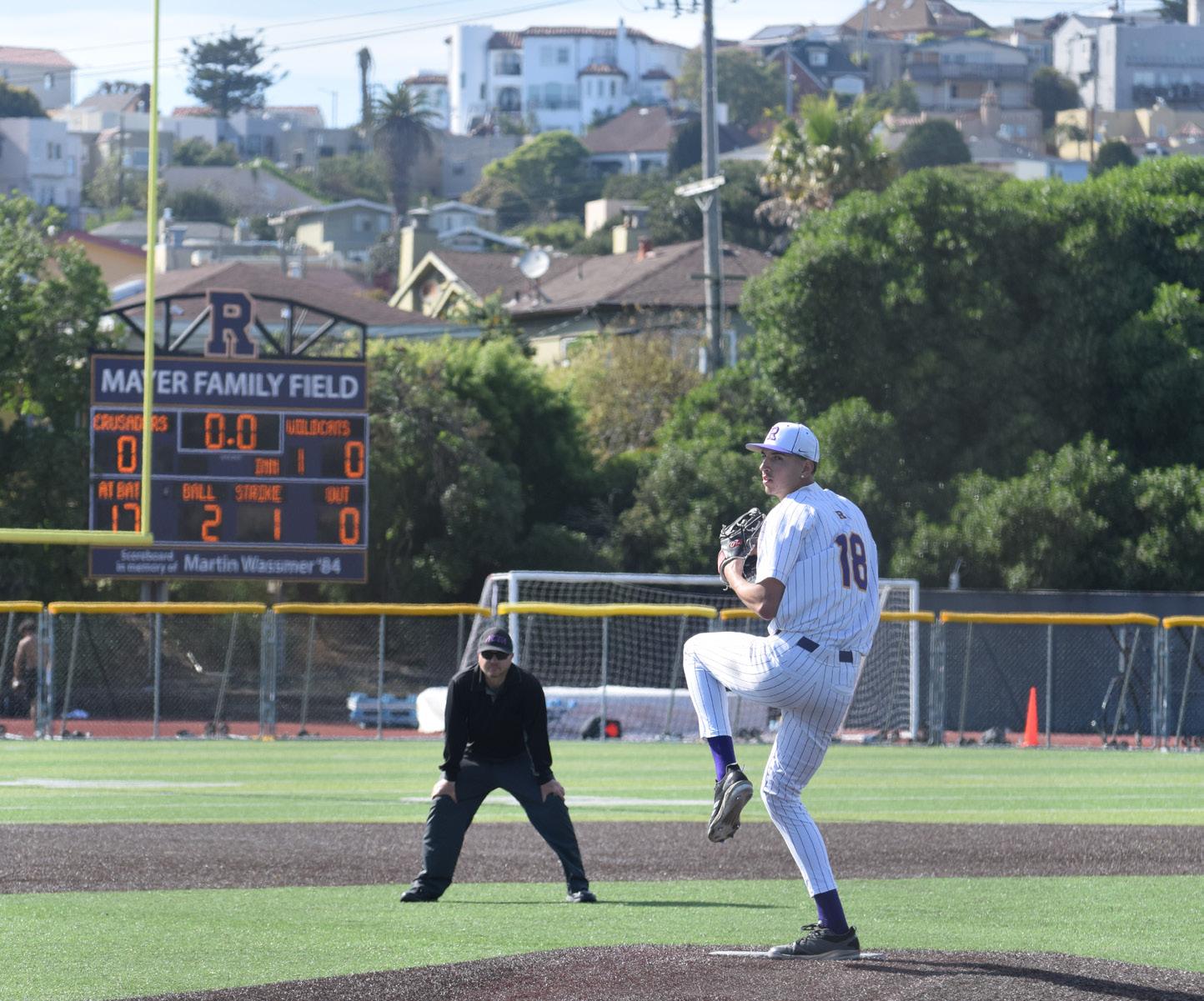
lessons learned would last long after the final game is played.
“Baseball comes with a lot of failure, and how you respond to that teaches you grit, resilience, and character,” he said. “My job is to help shape these young men into better people on and off the field.”
Off the field, Coach Sargent shared, “We’ve been incredibly fortunate this year thanks to the generosity of our supporters and donors. Their contributions have allowed us to make major upgrades that are already impacting our
program in a big way.”
He added, “We introduced three brand new jerseys this season, along with team jackets for every level of the program. We’ve also invested heavily in branding, adding Riordan Baseball visuals behind home plate and in the dugouts to really elevate the look and identity of our field.
As the season continues, the Crusaders are proving that the story of the season is more than just the record; it’s about growth, resilience and playing for each other.

By Claude Garde ’26
After finishing last season with a 9-7 record, the Riordan
team has shown growth
this season.
Though the roster has many first time players, the coaches have helped teach them the
primary skills of the sport, including catching, throwing, and understanding the game.
According to Coach Owen Schnur, he would love to expand lacrosse to a JV team. “I think it benefits the program by letting younger and new players get more in-game reps with others at their skill level before playing in Varsity games,” Coach Schnur said.
Unfortunately, several new players on the team aren’t getting many minutes of playing time.
Therefore, a JV team may be helpful so they can get more experience and improve towards the Varsity level.
One way new players have adjusted to the sport is through peer mentorship.
“Getting mentored by my teammates definitely helps me out and I’m thankful that they want to help me in the game of lacrosse,” said Marcel Garde ’29.
Mentoring the younger players is vital to the team’s future success.
As Theodore KosanovichWare ’26 put it, “I think that the underclassmen will change the future of Riordan a lot in the next few years.”
He added, “Riordan is constantly
progressing and our community gets stronger and stronger by the year.”
Even the underclassmen agree. Garde boldly stated, “Our future is bright, and if we can start to build momentum we can be dangerous.”
As the season winds down, their schedule has been highlighted by games against rivals LickWilmerding and Lowell High School.
Lick-Wilmerding remains Riordan’s toughest opponent, with the Tigers serving as a benchmark for Riordan’s progress each season.
At the same time, Lowell and Riordan have faced off multiple times, each game being a competitive battle.
As a new age of Riordan Lacrosse begins, graduating senior Kosanovich-Ware implored students interested in the sport to try out.
“A message I have for anyone wanting to try lacrosse next year is just do it. It isn’t the hardest sport to play and it is really easy to pick up.”
He added, “If you don’t like it then you don’t have to play it, but just try it out. It is a lot of fun.”
By Dylan Garcia ’27
The arrival of the Spring Semester brought not only sunny weather, but for a handful of talented, hardworking athletes, the boys volleyball season.
This year marks Riordan’s second ever boys volleyball season, with the team already hard at work to achieve a successful outcome.
Players on the team have expressed that team chemistry has played a major role in their recent success.
Coach Leo Fung iterated how close the team has gotten over the past two years.
“One thing the team has improved on since last year is, I think, the mentality and them playing together as friends and being like brothers,” he said.
Returning athlete AJ Datoc ’27 seconds this, sharing, “We are more prepared this year than last year because of our team chemistry.”
He added, “But also I believe that having a year and experience just with the coach as well, made
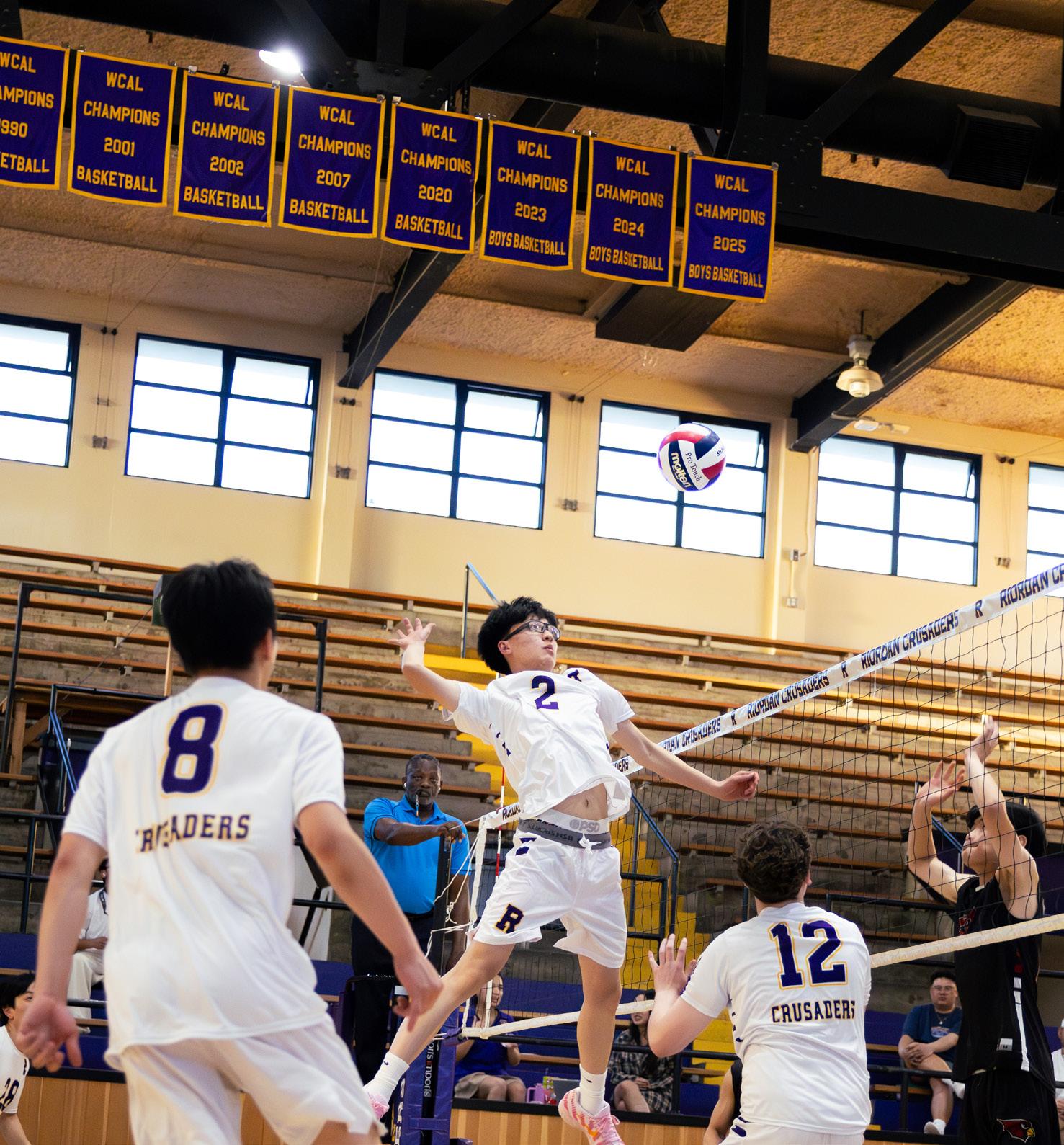
us more prepared to go over plays and go over different techniques of how to play volleyball.”
Along the lines of team chemistry, the team has also introduced a handful of new players, many of whom are adapting well to the squad and its culture.
“Not everyone’s going to have the same playing style as one another,” noted Javen Lau ’27.
He added, “Having to introduce the new players to how we play, get them into the system, and just playing around with each other, we just put that into a real game.”
Their work seems to be paying dividends.
With the season already halfway over, the team is off to a strong start, highlighted by a key wins over KIPP SF at home 3-0.
In addition, they won first place in the bronze division of the Los Altos Stockton Classic.
With a 6-4 record, the team continues to look forward, setting their eyes on success throughout the rest of the season.
By Benjamin McClure ’26
With esports being one of the fastest growing sports in the world, Riordan knew they needed to start their own team and begin dominating their opponents.
The esports team started after former student Santiago Maldonado ’24 brought up the idea to Social Science teacher Cory Nelson.
Nelson discussed this with Assistant Principal of Student Affairs Brian Kelly, who agreed that it was a good idea.
Nelson said, “The first year everyone had their own equipment and we did our best.”
And their best it was.
The first year paved the way for future Crusaders to join the esports team.
Later on, the Varsity Mario Kart Team won the West Regional Championship, and even placed Top 8 in the nation.
Practices happen just like any other sport, after school for a few hours, four days a week.
They run from 3:30 to 5:30, where the players practice their gaming skills on their respective games.
A program called Valor helps them train these skills, offering support, structure, and trackable progress.
The team consists of a Smash Brothers team of four, two - four person Mario Kart Teams, one -
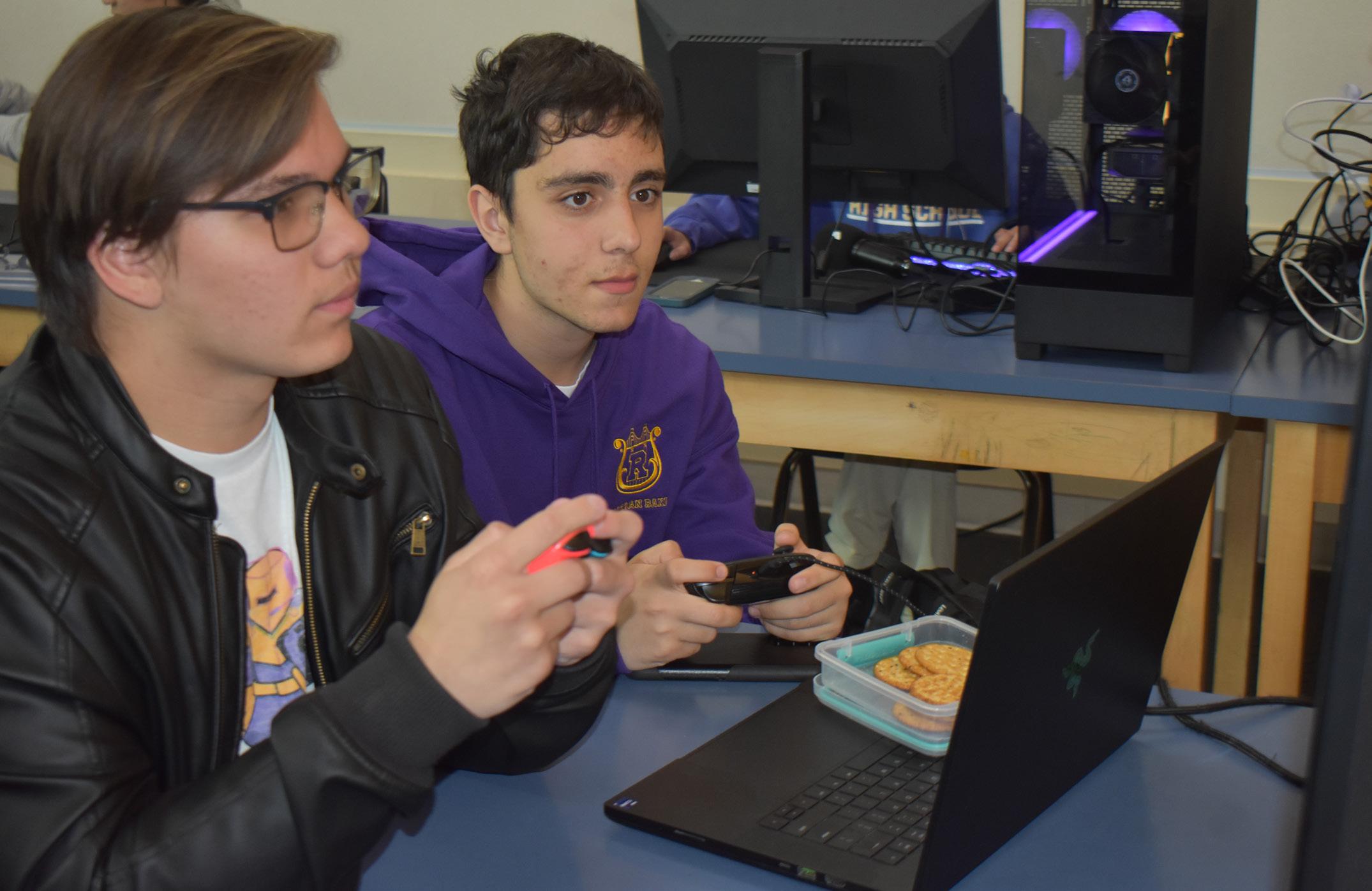
six player Marvel rivals team, two - five player Valorant teams, and one - five player league of legends team.
It’s no doubt that the esports team has grown both in the game and on campus.
Veteran member, Fetuali’i Lae ’27, said he joined originally to play Overwatch competitively because “I’m the goat at that
game.”
After being on the team for a while, Fetuali’i said, “I tried to leave but Mr. Nelson just has a way of finding me and swaying me to join.”
Being the moderator and coach, Nelson has had a deep connection with video games, stemming from his youth, and mainly enjoys the activity because of the community.
“Being part of a growing program that has potential for success is really amazing,” said Nelson.
Anyone has what it takes to play competitively as long as they are there to have fun.
Lae said, “Skills don’t matter as long as you join with the ability to grow as a person and as a team player.”
Review and photo by
Isaiah Mateo ’26
Reopening their doors on 504 San Bruno Ave. W in San Bruno, Mazra returned after completing their renovation of the location to delight regulars and newcomers with memorable Mediterranean cuisine.
To complement the oddly hot, spring afternoon, I was seated outside the restaurant to continue enjoying such a sunny day. I took a quick scan at the menu and decided to order their Chicken Shawarma wrap and Mint Lemonade.
Mazra allows customers the option to “enhance” their shawarmas with their pomegranate molasses, and I decided to do so. Alongside that, the shawarma came with a hot sauce and garlic toum sauce to pair with the dish.
The Chicken Shawarma
Mazra
504 San Bruno Ave. W, San Bruno, CA 94066
came out wrapped in tin foil with the golden, toasted lavash bread peaking out. The first bite I took was astonishing.
The chicken was succulent and smoky, while the pomegranate molasses gave it a smooth, sweet finish that did not overpower the taste. Combined with the pickles and the crispy lavash bread, the initial bite was a melody of flavors that had not reached its fortissimo, making me want to keep eating more.
Pairing the dish with either the hot sauce or their garlic toum sauce enhanced the already amazing flavors of the shawarma, and before I knew it, I was done.
To wash it all down, I finally delighted in my Mint Lemonade, which delivered a well-balanced mintiness combined with a refreshing, bright citrusy taste

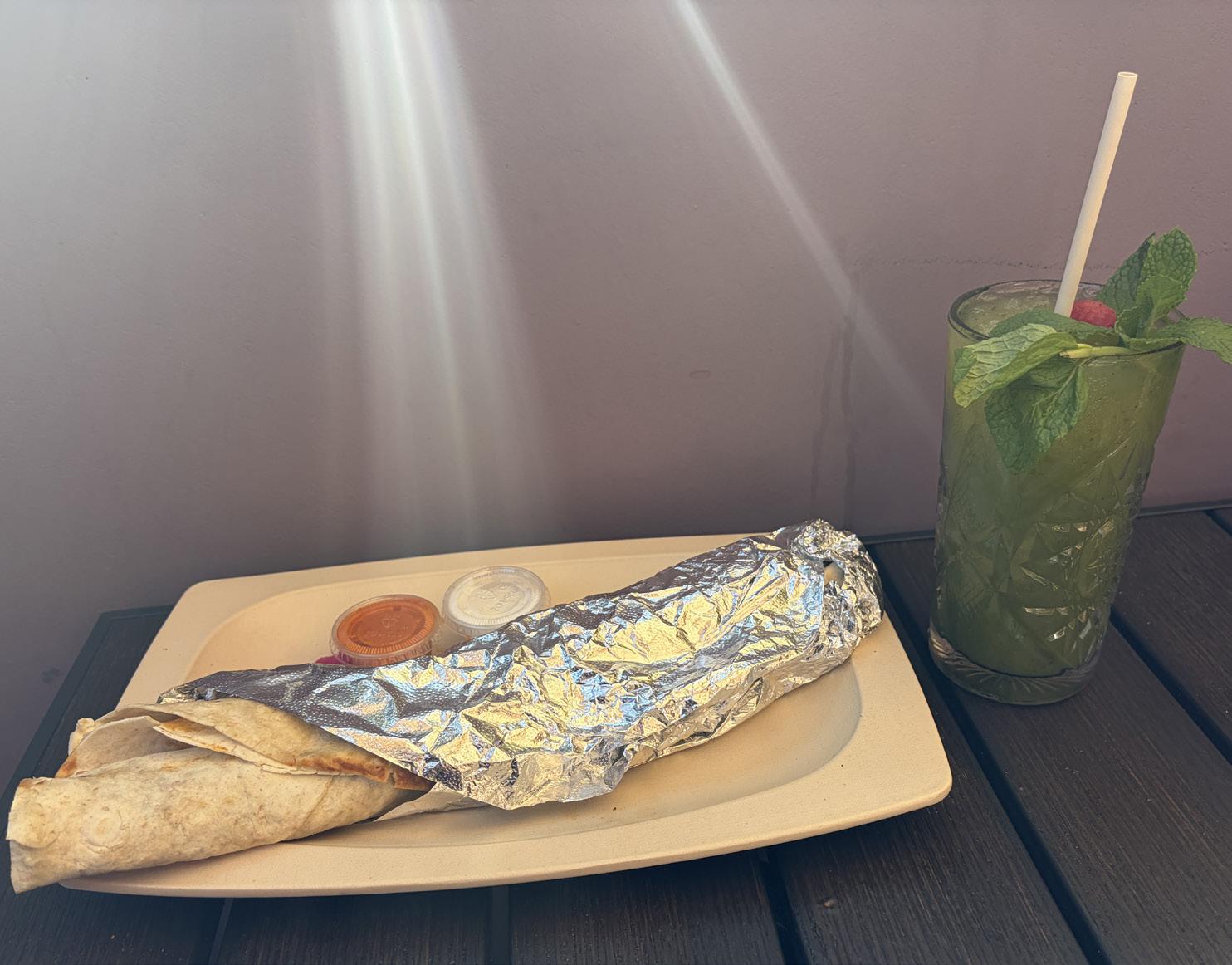
A shawarma wrapped in tin foil with dipping sauce and mint lemonade. to cool myself down on this warm afternoon.
My experience with Mazra was, in short, incredible. I would love to return to this restaurant,
and photo by Isabella Thumas ’26
Located on 6192 Mission St. in Daly City, the quiet restaurant Shish Ke Baba serves up amazing food with friendly service.
As I first walked into the empty restaurant, I was not quite sure what my first impression would be. One thing I liked about the restaurant was the wall art of what looked to be a street in a more historic part of Turkey, which added greatly to the culture of the food I was ordering from.
and I recommend it to anyone who is seeking high-quality, Mediterranean cuisine. I give Mazra a 5 / 5.
Shish Ke Baba 6192 Mission St., Daly City, CA 94014
I took a drink to satisfy my empty stomach while waiting for my food. Once I finally took my first bite of the food, the shawarma was very tasty, with the chicken having a rich, juicy flavor, with the rice being sticky, as it perfectly blended with the rest of the shawarma to make a warm and fresh bite.
On this abnormally sunny day in San Francisco, where the wind blew pleasantly humid hot air into your face, I had the sudden urge to devour a shawarma. In between the vibrant, lively neighborhood of Haight Ashbury, lies Abu Salim Middle Eastern Grill, where they serve up Middle Eastern classics. Colored glass lined the top of the windows, emitting rainbow light onto customers. The faint smell of cigar smoke lingered, combined with rich spices used within the kitchen, a seemingly strange combination, but pleasant.
I was quickly seated, given a menu, water, and some magenta colored pickled radishes accompanied with green olives. I glanced at the menu, but a goal was already in mind: beef and lamb shawarma with a mint tea.
1599 Haight St., San Francisco, CA 94117
Like the speed of light, the shawarma and mint tea appeared on my table. Encapsulated in a thin wrap was a huge mountain of meat accompanied by fresh cucumbers and tomatoes smothered in nutty tahini. The meat was tender and well-spiced with cumin. Crunchy and juicy were the vegetables contrasted against the tender meat, creating a perfect combination.
Such a decadent, enjoyable meal was all chased with their house mint tea – ice cold, caramel brown, with a slice of lemon and mint included. Initially, it tasted similar to grass jelly: earthy and sweet like brown sugar, but with every sip, the lemon and mint became more prominent, making the last sip the best.
Overall, this experience was phenomenal. I rate it a 4.5 / 5.
Then, after ordering, my opinions of the restaurant quickly turned more positive when a kind server offered me a free drink while waiting for my food, which he referred to as a “Palestinian lemonade.”
It was green, a little minty, and overall, the perfect mix of sour and sweet, being very refreshing during the heat wave.
The shawarma itself was also cut into nice bites that were easy to eat. On the side, it also came with fries that were not too crunchy, soft and warm on the inside. The spices in the shawarma were also exquisite, mixing to be a perfect blend on my taste buds.
As I finished my meal on the beach at sunset, I thoroughly enjoyed it and appreciated how savory it was. Overall, I would rate it a 4/5.