
Building Partnerships to Foster Agency and Strengthen Democracy REPORT IMPACT


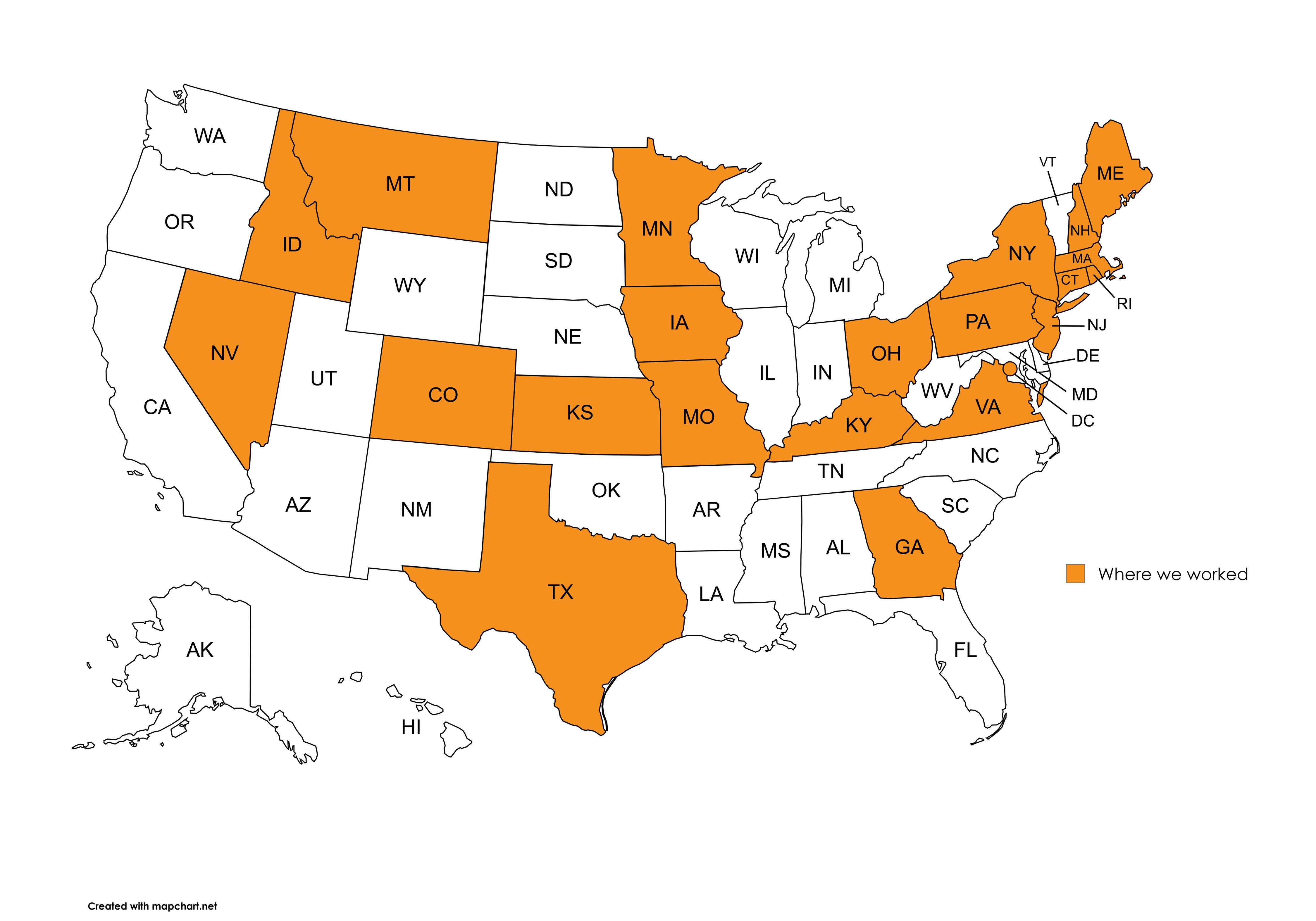
RQI’s strategy is delivered through educational institutions and organizations, legal service providers, health care organizations, social service organizations, community-based organizations, and public agencies, in all 50 states and beyond.
Each educator, service provider, legal aid attorney, or frontline worker can work with anywhere between a handful and hundreds of people a year By training people who are embedded in directly impacted communities, who in turn share RQI’s methods with the people they serve, our reach grows exponentially.
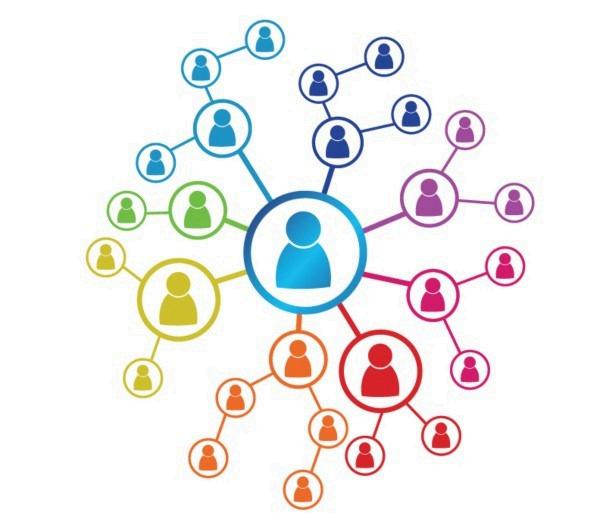
RQI’s Multiplier Effect

1,155 direct service providers in legal aid, social services, health care, adult education, and more trained through RQI’s Empowerment Program.
87,716 members of our global online network across 179 countries.

3,649 educators trained. Trained educators reported sharing RQI resources with, on average, 21 other educators.

17,342 downloads of RQI’s free resources.
448,000 estimated students impacted by RQI-trained educators.
In a time when our democracy is under great stress and challenge, when many of us question how we help bridge the gap between our country’s aspirations and its current realities, I continue to be struck by how the Right Question Institute’s mission and approach is more important and relevant than ever.
For over 35 years, RQI has worked to build a more just and equitable democracy by strengthening people’s ability to ask questions and participate in decisions that affect them And the evidence is clear from this work: Sharing the power of questions has a transformative effect that leads to greater individual agency across different ages, fields, and communities
Through both our Teaching and Learning Program and our Empowerment Program, RQI demonstrates how the Right Question Strategy fosters critical thinking and personal agency. In doing so, it helps people at different stages of their lives, in school and out, to step into their own power, both as learners and as citizens. Our Research Program seeks to capture the impact of this work in different contexts while also working with institutions of higher learning to explore how question formulation can be used to improve research across disciplines.

What’s clear is that RQI’s work is rooted in partnership and that only by developing a network of interconnecting partnerships will RQI’s big dreams be realized. In this sense, RQI works as a force multiplier, helping to strengthen and amplify the work of others aligned with a vision of promoting individual and social change.
Imagine for a moment what the world could be if the power of questions was shared and practiced in all areas and levels of society, if it was valued and developed in every corner of our country, particularly in those areas farthest from political decision making and power I believe we’d be much closer to the just and equitable democracy that drives RQI’s work
In this moment of great division and “othering,” one other aspect of RQI’s work I continue to think about is what becomes possible when we create spaces where we hear one another’s questions rather than our opinions. My experience is that hearing others’ questions as a starting point invites empathy and connection into the room. And so, for me, part of why I have always been drawn to RQI is that it enables a simple process that develops both critical thinking and empathy two traits sorely needed right now.
I hope I’ve captured a little of why I believe so strongly in RQI and why I’m proud to serve as its board president Your support and partnership fuel RQI’s daily work and its big visions for change, and we are deeply grateful Thank you for being such a vital part of RQI’s community
Sincerely,
President of the Board of Directors Right Question Institute

The Right Question Strategy clarified my thinking and helped me decide what the most important information I want [is] and role I want to have in the decision. [It] increased my capacity to advocate for myself.
- Training participant, 2025
This year, service providers, legal aid lawyers, community activists, adult educators, and frontline workers have faced a uniquely uncertain and difficult landscape that is shifting under their feet. RQI’s newly renamed Empowerment Program helps those working in lowincome communities become catalysts for the agency of the people they serve. People who feel more agency become more confident, motivated, and able to take action on their own behalf and on behalf of their
communities. Using RQI’s methods, people learn to advocate for themselves and their needs alongside service providers who advocate for them, creating a multiplier effect. RQI’s methods also help people connect decisions made in their daily interactions with public institutions and systems with decisions made elsewhere, creating new pathways to democratic participation. New pathways are needed now more than ever.
In 2025, RQI worked with a nationwide network of legal empowerment practitioners to share resources and support grassroots justice efforts, and presented at the International Access to Justice Forum.
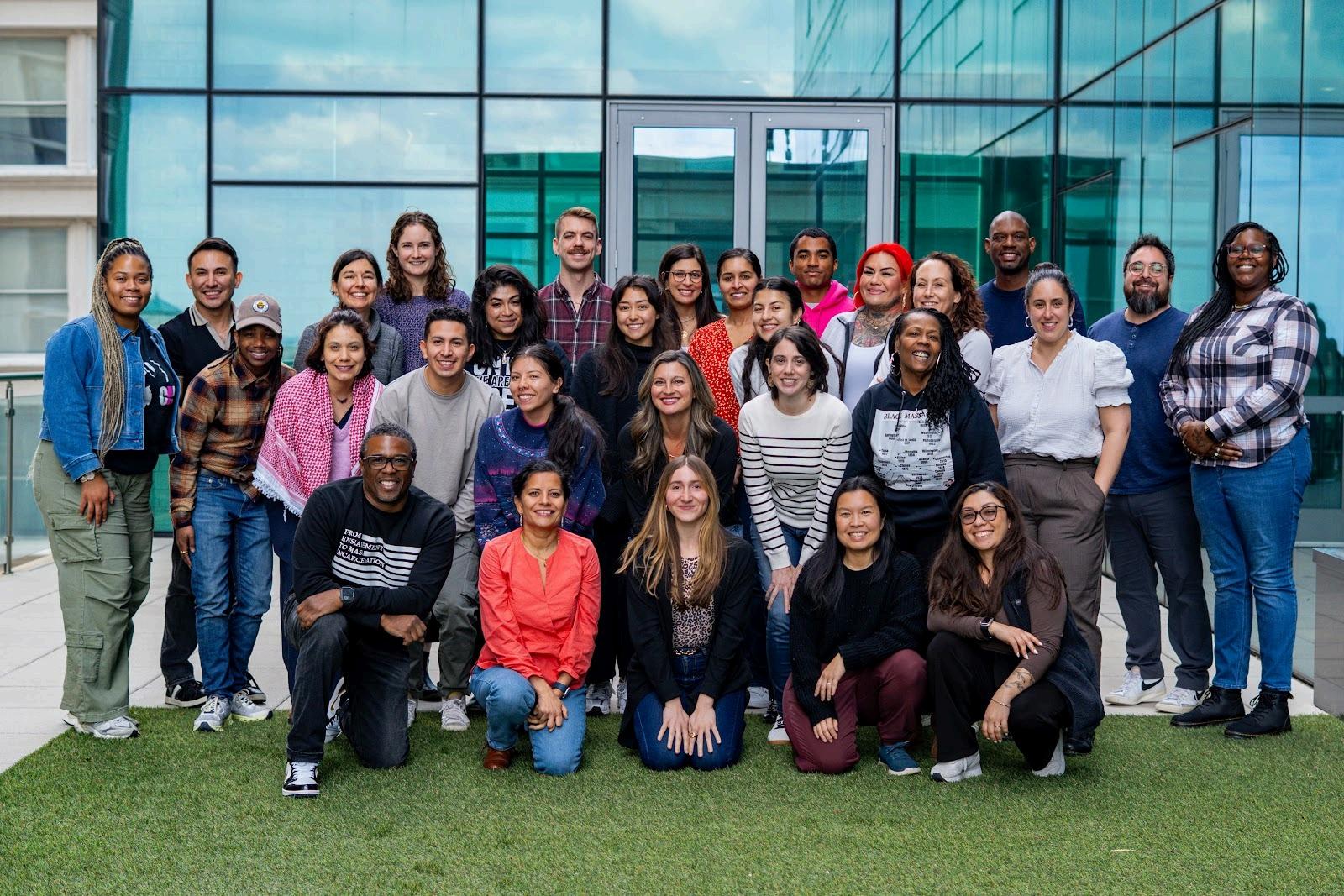
U.S. Legal Empowerment Network leadership convening
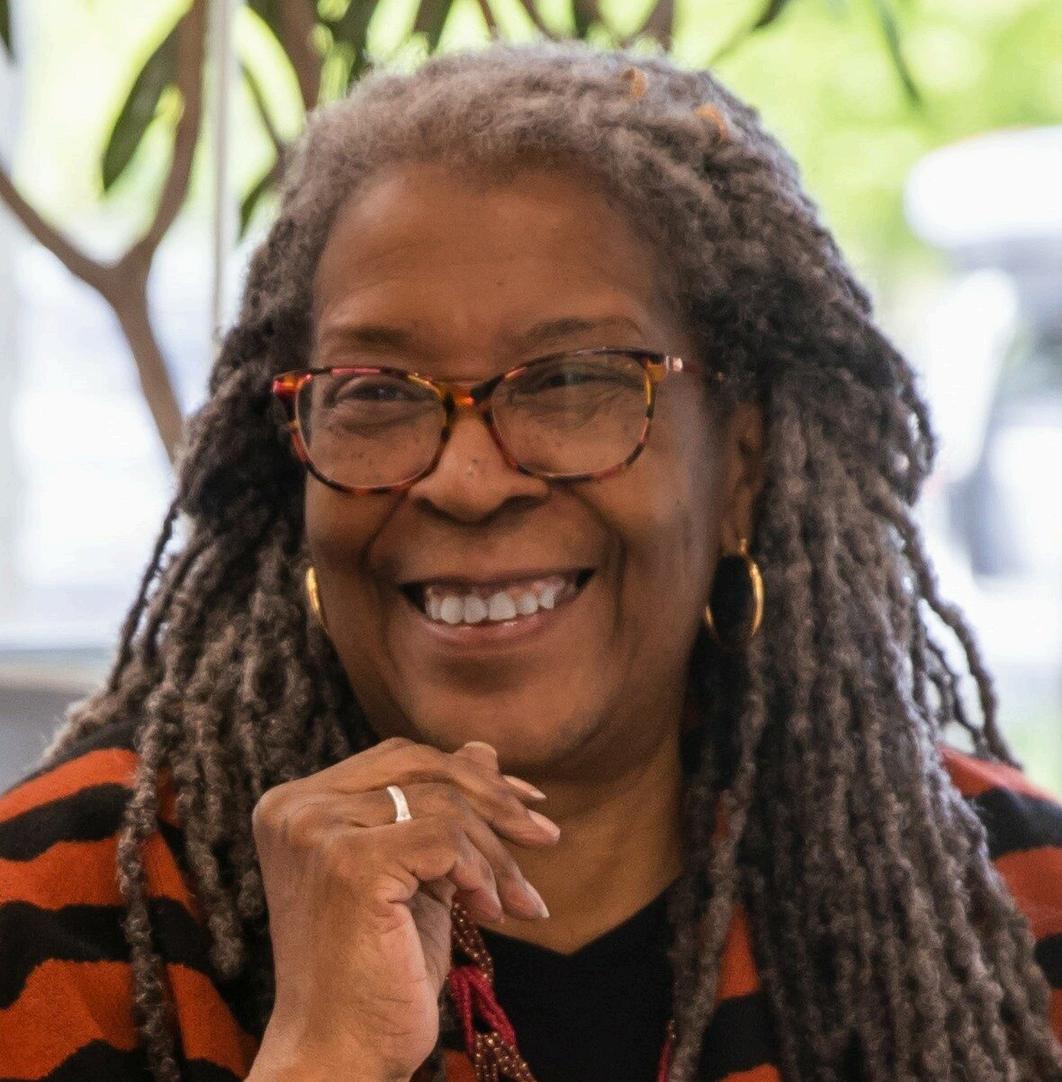
Earldine Tolbert, a restorative justice trainerfacilitator and former adult educator, first encountered RQI through a voter engagement program in Philadelphia. She has championed the use of the QFT in adult education, literacy programs, and community circles. In our Empowerment Spotlight blog series, Earldine shared how she used the QFT to help her students understand their power. “People don’t even realize they have the right to ask questions of people who make such big decisions about their daily life.”
Recounting a story of one of her students successfully avoiding an unlawful eviction, Eardine shared, “After hearing [this student’s] story, everybody started going back and asking questions. They were excited for her because she tried it in real life and it worked. They felt more empowered to ask questions on their own.”
In 2025, we partnered with the Open Door Collective of Literacy Minnesota and the Urban Alliance for Adult Literacy to create a “community of practice” of adult foundational educators. These educators are using RQI’s methods to help their students advocate more effectively for themselves and navigate systems where decisions are made that affect their daily lives and the lives of their families.
“Creating a space where people can step into their power”: Community organizing using the Right Question Strategy
Dr. Alexandra Piñeros-Shields, a professor at Brandeis University and a longtime community organizer, educator, and advocate, first learned about RQI as an adult educator working in New Hampshire. She used RQI’s strategy to teach political and economic literacy to her students, who went on to advocate for change in the state child welfare agency.
She later applied the strategy in her work as a community organizer, supporting community members in a successful police accountability campaign. As she shared with us, the strategy “creates a space where people can step into their power.” You can read more of her story in our Empowerment Spotlight blog series.

We worked with case managers in Rhode Island and Connecticut who help administer the SNAP Employment & Training (E&T) program, preparing individuals receiving public benefits for job training and seeking employment. The case managers who joined our training work in refugee resettlement, financial literacy, vocational training, and other direct service programs.
Case managers for SNAP E&T have faced enormous challenges in 2025. RQI has been working to amplify what they are able to achieve by sharing a strategy that helps SNAP participants become more effective self-advocates
and job seekers and achieve long-term self-sufficiency. As a direct service provider in Rhode Island said, “It’s great to be able to give [clients] the tools for their own self-advocacy, having them feel confident and that they have a voice, so once they no longer have that additional support, they feel confident to get the information they need.”
One financial literacy coach in the training shared how clients’ beliefs about their own capacity to address their problems shifted after using QFT, and the clients became more engaged and eager to take action on their own behalf. Here is one client’s reflection:

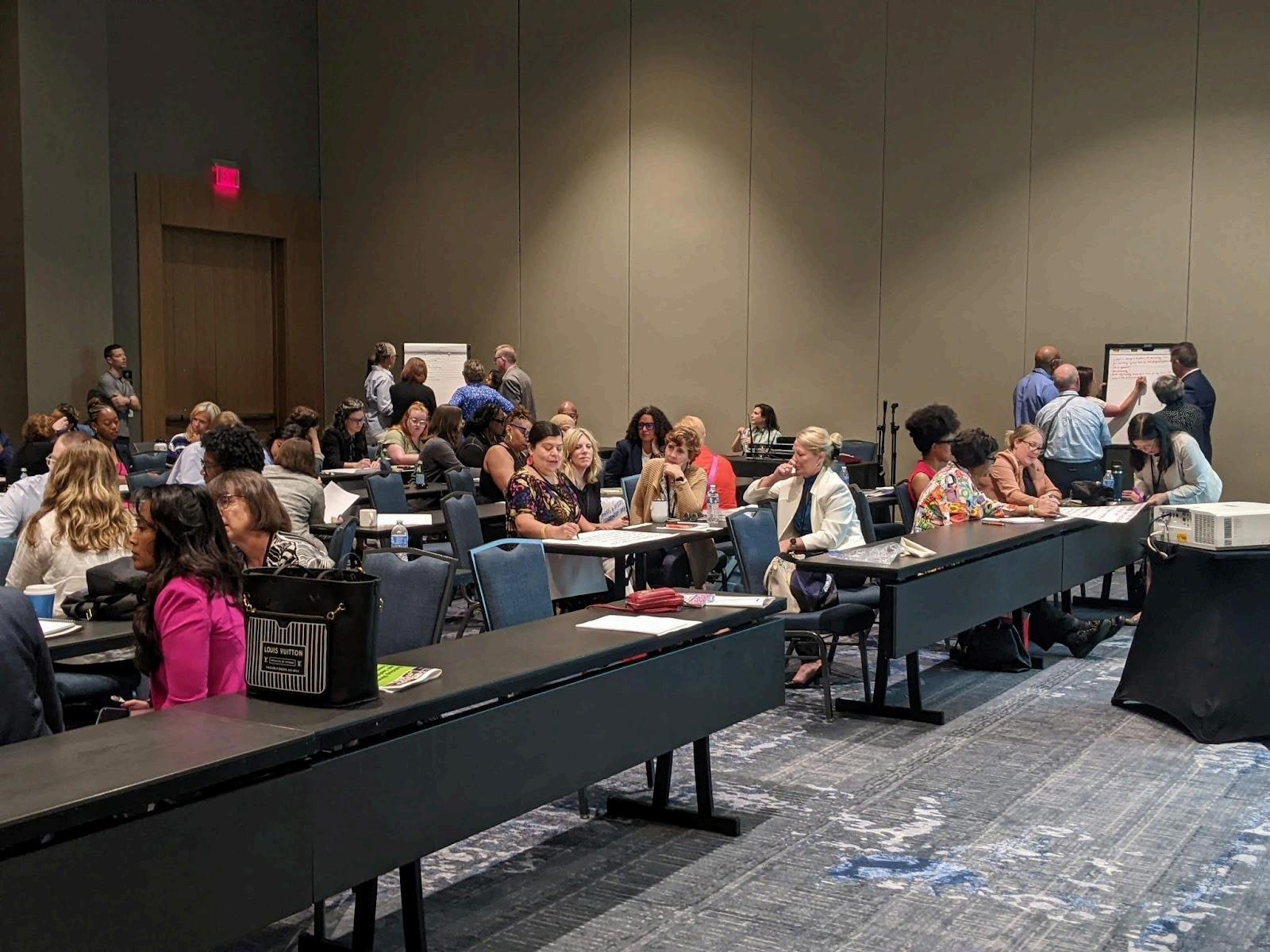
RQI’s Teaching and Learning Program partners with schools, districts, state departments of education, and other educational organizations to support educators to foster more equitable, curious classrooms in which every child feels empowered to ask and pursue their own questions. Students who ask their own questions show increased engagement, comprehension, and discovery and ultimately become more nimble, democratic thinkers who feel greater agency in their learning and in their lives beyond the classroom walls.
In 2025, we surveyed RQI’s educator network on the impact of RQI’s methods: 89% of educators reported that using the QFT has made them a more effective teacher.
It is helping me to be the kind of teacher I want to be-reducing my teacher-directed lectures and increasing student centered inquiry and research. I get to conference with them and work with them to refine questions and find answers instead of guessing what they want to know or deciding what they should know without their input or buy in.
92% of educators agreed that using the QFT improved their ability to foster student engagement.
I knew I was on the right track when my students started complaining that I was making them think too much! The Question Formulation Technique has shifted the focus from me giving answers to them actively engaging, questioning, and truly grappling with the material.
Teachers report that students who use the QFT experience:
In 2025, we advanced a special initiative to support educators in rural communities who are often underrepresented and underserved by traditional professional learning. We partnered with the six state education departments to offer virtual professional learning to more than 530 teachers in rural areas. Together, we amplified the innovative work rural teachers are doing every day to foster critical thinking through inquiry-based learning.
In Montana, teachers across the state now have access to a series of free online courses that prepare them to implement the QFT to engage students in thinking critically about primary sources and student-led historical inquiry. Courses were developed in collaboration with the Montana Office of Public Instruction, thanks to generous support from the Library of Congress Teaching with Primary Sources program.
Evaluations from Montana educators who completed the course have been overwhelmingly positive:
100% of course participants would recommend the course to a colleague. 97% were “satisfied” or “very satisfied” with their learning experience.
97% found it “relevant” or “very relevant” to their curriculum.

Montana high school social studies teacher Wesley Webb, who designed and implemented a QFT lesson featured in the course, shared:
This experience has me rethinking everything I do, or at least, it has me thinking about how to reorient the material I have such that students can take the wheel … teaching this way has transformed my perspective on what the ‘teacher’ can really do for their students more than any educational project or professional development I’ve ever participated in.
Webb’s students shared:
Instead of just absorbing the knowledge, applying questions while studying the constitution helped me think more about why it functions that way and how it does, and also to recognize its potential flaws and disconsiderations
Questioning forced me to think deeper about the content I was learning and move past surface level information.
As music composer Leonard Bernstein once wrote, “a work of art does not answer questions, it provokes them.” In 2025, we expanded RQI’s footprint in arts education by training 200 arts educators and creating new visual and performing arts resources to support them as they move into practice.
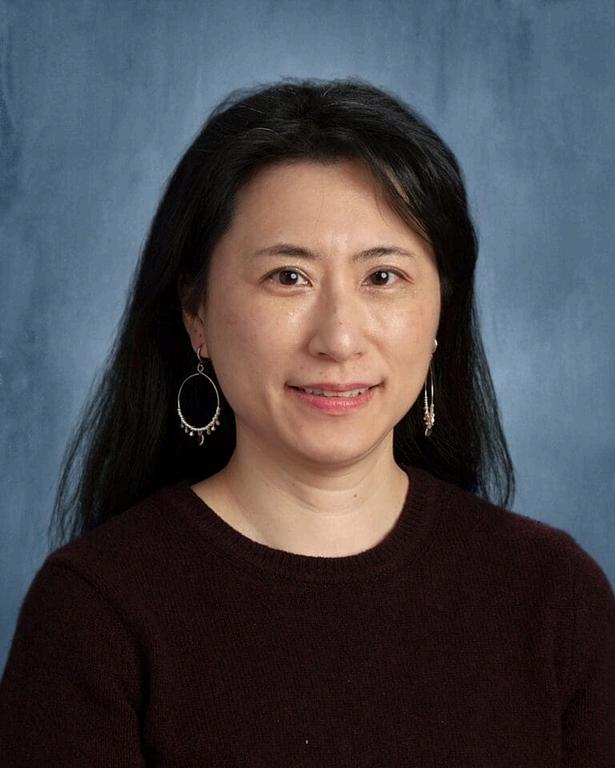
New York-based music educator, Yating Yang shared the impact of RQI’s methods on her music students:
I also witnessed firsthand how instrumental students who started as timid and reluctant to express their thoughts opened up to asking questions. High-achieving students are often afraid to give the “wrong” answers … With time, their inquisitive nature took over as they continued to sharpen their question-asking skills.
RQI launched a biannual webinar series to highlight ongoing collaborations with longstanding partners and the impact of sustainable communities of practice. Partners including the National Council of History Education and Maine Department of Education shared how they made QFT modules a regular part of their rural-focused, place-based teacher programs.
Meanwhile, RQI’s two long-running, popular online courses that run four times a year in partnership with the
Harvard Graduate School of Education trained 935 teachers from 51 countries last year. Participants in these courses have gone on to create flourishing communities of practice that reshape the educational ecosystems in which they work from Mobile, Alabama, where foreign language teacher Chelsea Lawrence created a schoolwide QFT professional learning community, to Manila, Philippines, where educator John Israel Cunanan created a pilot project to scale the QFT through the Teacher Education Council (TEC) Fellows Program.
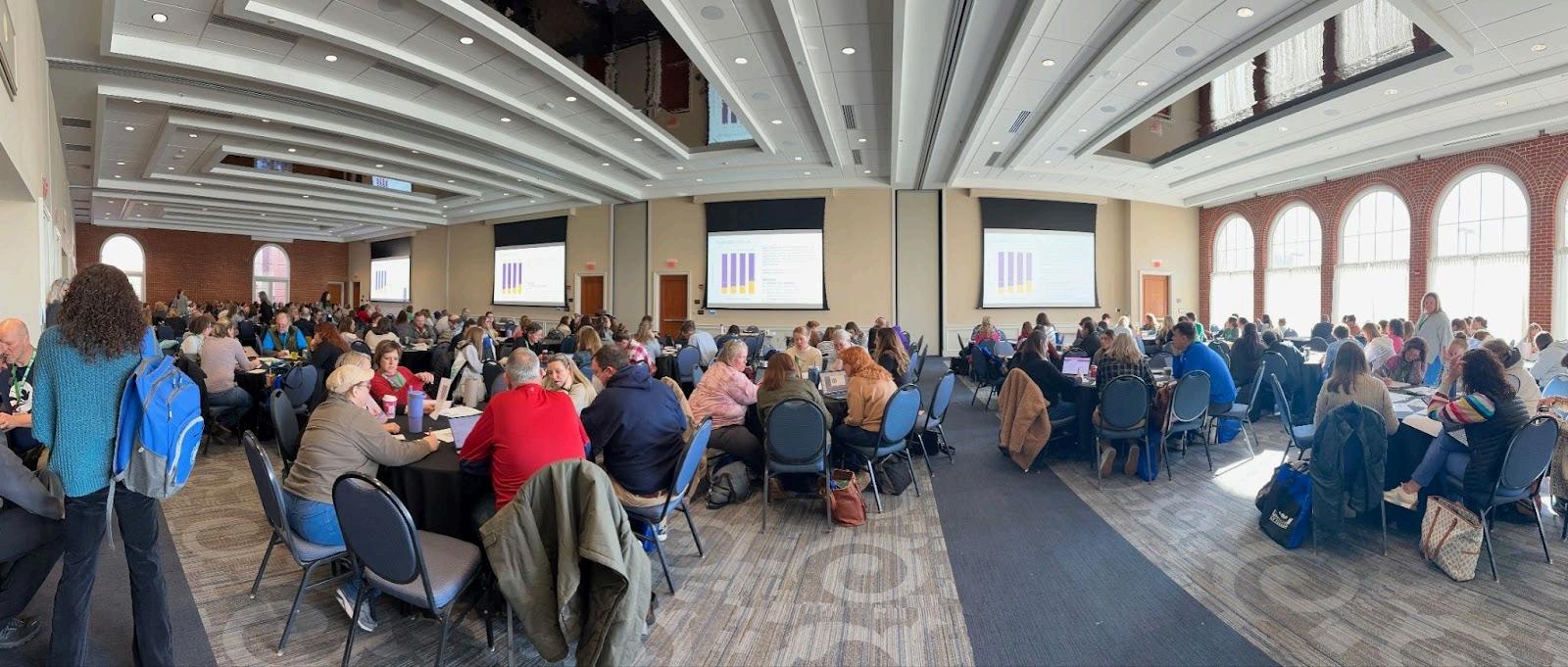
RQI leads a keynote presentation for the Science Education Council of Ohio in January 2025.

The Research Program aims to ensure that evidence drives our understanding of how people change when they learn to formulate their own questions by supporting research on the Right Question Strategy (RQS) and facilitating the dissemination of findings. The RQS has demonstrated reach across education, health, voter engagement, and beyond — and we support the growth of an evidence base, grounded in practice, to validate the transformative power of question formulation. We collaborate with researchers, faculty, practitioners, and funders who share a commitment to cultivating agency and evidence-based practice. Whether your interest is in partnership, research design, field access, or philanthropic investment, we invite you to be part of this work.
For 35 years, RQI consistently witnessed and heard significant, even transformative changes — not limited to cognitive but also affective and behavioral — taking place when people formulate questions.
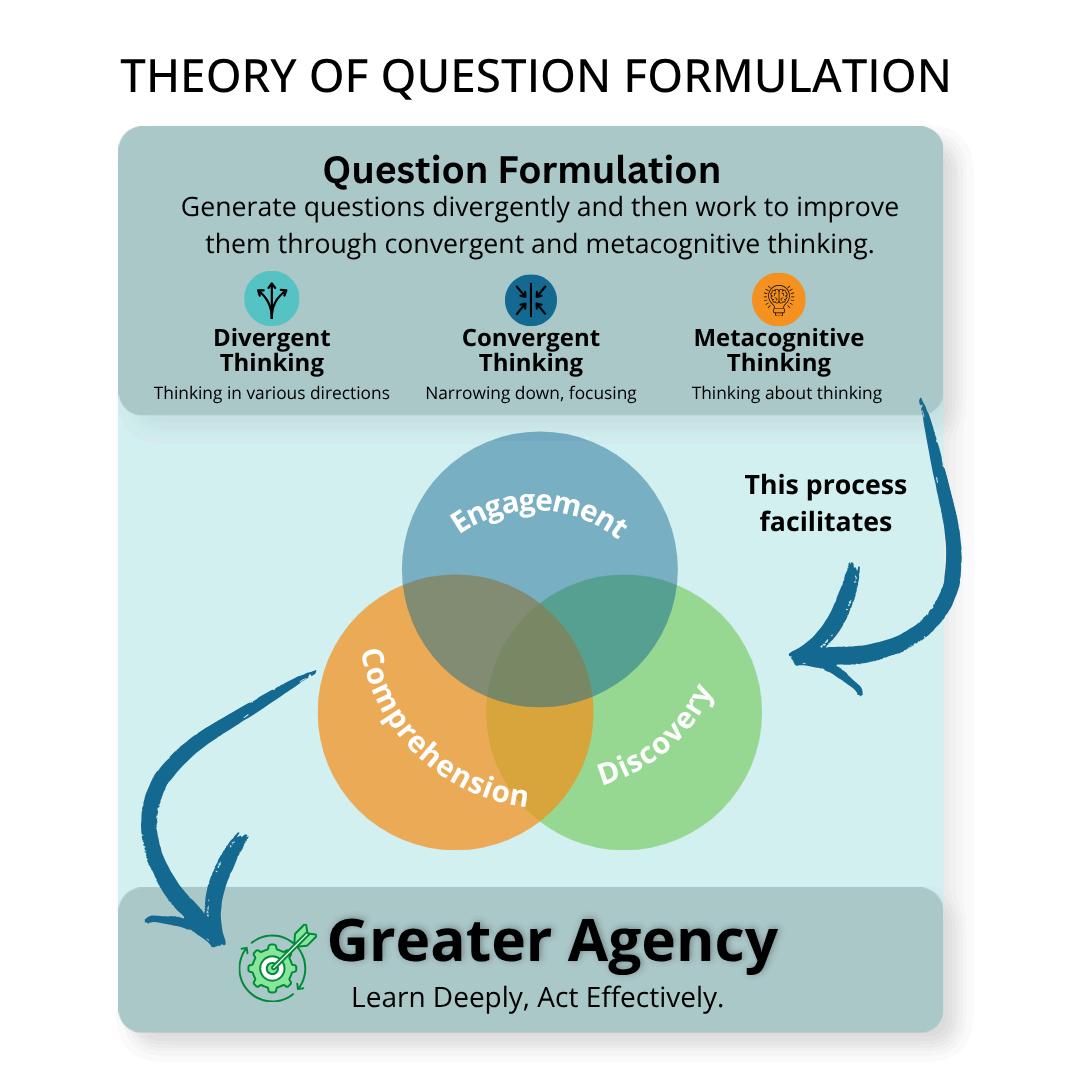
To make sense of those patterns, RQI synthesized multiple sources of evidence, including observable changes documented by facilitators, users’ selfreported changes, and existing research studies. We distilled these sources into a Theory of Question Formulation — a grounded framework that explains what consistently happens when people learn to formulate their own questions. The theory identifies three categories— engagement, comprehension, and discovery facilitated by formulating questions, leading to greater agency in thinking, learning, and taking action. Two applications of the theory explain specific changes under each category, aligning with RQI's two major outcomes: learning and empowerment.
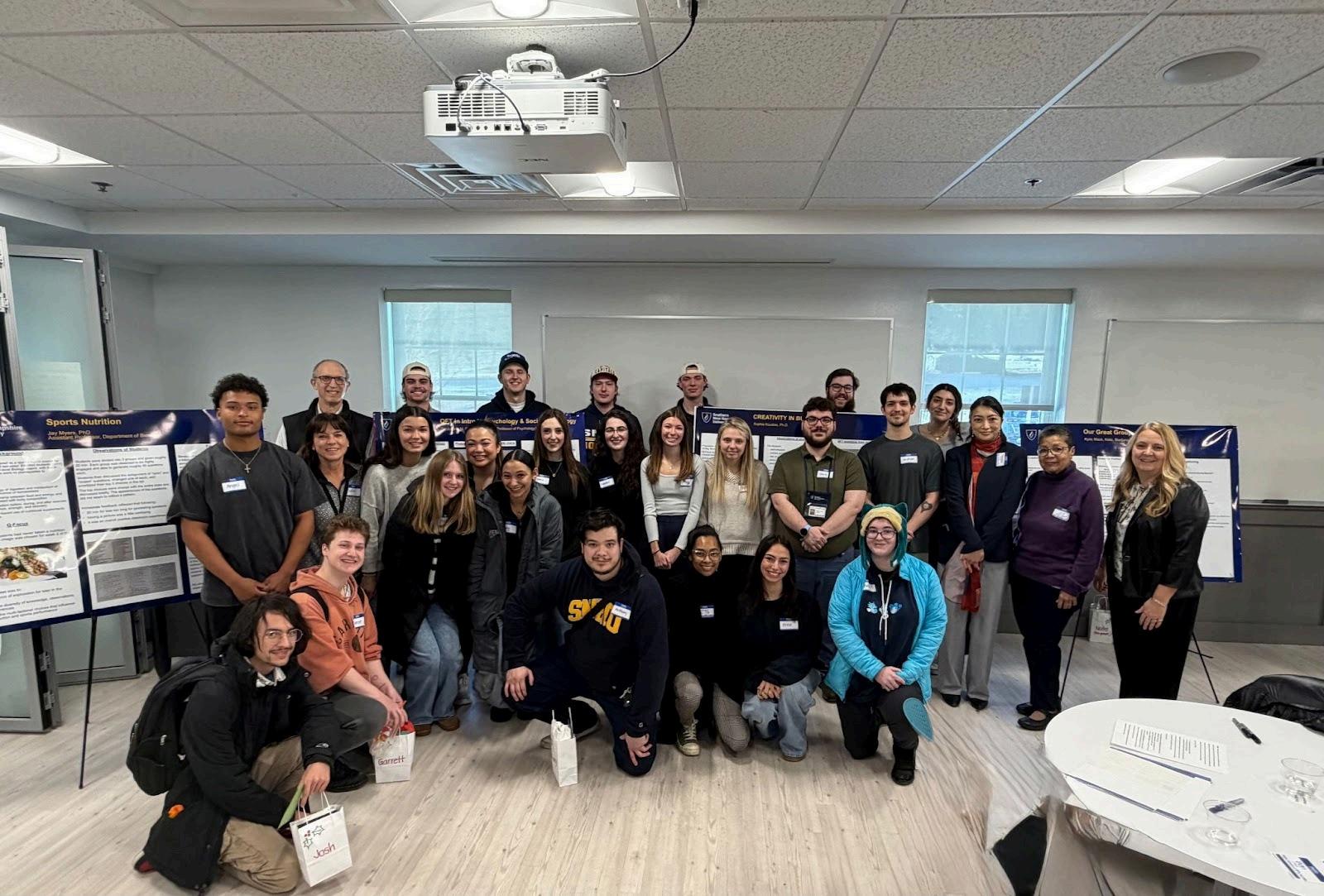
At Southern New Hampshire University, Associate Professors Chris Blais and Karin Heffernan cultivated an interdisciplinary community of practice around the QFT. Securing an internal grant, they piloted the QFT with faculty across three schools at the university, invited RQI staff to campus for an introductory workshop, and recruited eight faculty to trial the QFT and participate in a community of practice in fall 2025. Through sustained support — group sessions, one-on-one consultations, and shared resources they helped faculty adopt the QFT across disciplines. Crucially, data was collected alongside implementation, creating the foundation for rigorous analysis of the QFT's impact.
Their work culminated in a Q-Expo last December, where nine faculty members
presented posters on their implementation and its impacts, and student groups shared reflections on their learning. Students felt greater ownership and enjoyment; faculty were surprised by the depth of student engagement across disciplines.
11 faculty members
36 academic courses
676 students reached
In one semester, 11 faculty members implemented the QFT in 36 courses, reaching 676 students. The SNHU collaboration demonstrates that sustainable adoption requires more than an effective method — it requires conditions in which faculty feel supported in experimenting, learning, and sharing.
...If we could encourage students to discover and embrace their curiosity with questioning, that will be the kind of impact that can carry on with a student long after they have graduated.
–
Chris Blais, Associate Professor, SNHU

Three recently published studies reinforce the effectiveness of RQS in diverse settings.
Pineros-Shields, A. (2024). Group Work to Promote Leadership Among Undocumented Immigrant Latinas. In A Handbook of Contemporary Group Work Practice, 357-369. Oxford University Press.
This case study documents the use of the QFT in a social work context to support leadership development and agency in communities among marginalized women facing significant structural challenges.
Quinlan, J., & Edwards, M. T. (2025). Classroom Applications of Question Formulation to Support Problem-Solving in Computer Science. Journal of Computational Science Education, 16(2),10-15.
This classroom study demonstrates that in undergraduate introductory programming courses where high failure and dropout rates are often seen, the QFT helped students become more confident, more engaged, and more invested in their own learning, shifting them from passive participants to active knowledge-builders.
Irdalisa, I., Akbar, B., Fuadi, T. M., Maesaroh, M., & Kartikawati, E. (2024). RICOSRE Model With Question Formulation Technique (QFT): Enhancing Students' Higher-Order Thinking Skills (HOTS) and Science Literacy. Jurnal Penelitian Pendidikan IPA, 10(3), 1175-1178.
In a controlled study of 296 fifth-grade students across three public schools in Indonesia, those who learned with the QFT and RICORSE model, a problem-solving learning framework, significantly outperformed peers who received direct instruction on both higher-order thinking skills and science literacy.
The Yale Cultivating Conversation Fellowship invited RQI to introduce the QFT to its student fellows, representing undergraduate and graduate programs across the university. The fellows learned how to “share the power of questions” as a way to ensure that more voices are heard in community conversations, creating space for different ideas to be heard and articulated. At a second workshop open to all Yale staff, co-sponsored by Yale Learn & Grow, participants learned how to use the QFT to enhance problem-solving, decision-making capacity, and leadership abilities. One participant shared:
It made me think of the power of asking questions no matter what answers yo get Just to ask the questio can be a way to open up new avenues of thought


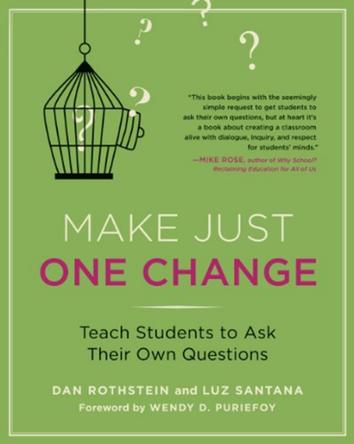
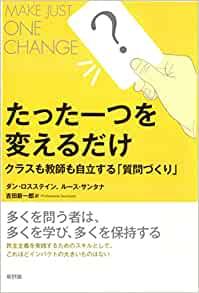
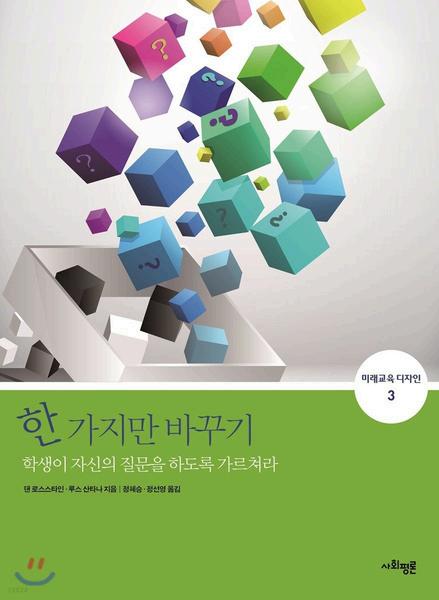
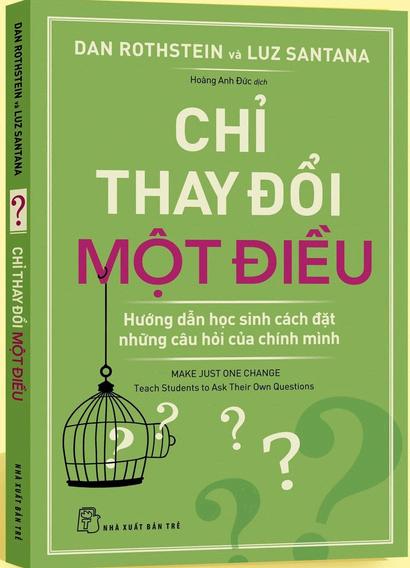
Make Just One Change: Teach Students to Ask Their Own Questions
The book that RQI founders, Dan Rothstein and Luz Santana, wrote in 2011 introduced the world of education to the Question Formulation Technique. Today, it is among the topselling books in the history of Harvard Education Press. It has sold a total of more than 70,000 copies and has been translated into eight other languages, including Japanese, Chinese, Korean, Thai, Serbo-Croatian, and most recently, Vietnamese in 2024.

Dan Rothstein
Interim Executive Director and Co-Founder
Luz Santana Co-Founder
Naomi Campbell
Empowerment Program Director
Maame Conduah
Education Program Associate
Katy Connolly
Education Program Coordinator
Alexis Lassiter
Research & Partnership Strategist
Sandy Madero
Operations Director
Chris Orchard
Former Communications Director
Tomoko Ouchi
Research Program Manager
Keila Perez
Empowerment Program Associate
Sarah Westbrook
Professional Learning Director
John Esterle
President
John Y. Campbell
Vice President (Outgoing)
Evy Peña
Vice President (Incoming)
David A. Guberman
Treasurer
McNamara Buck
Secretary
Diane Englander
Shonak Patel
Alexandra Piñeros Shields (joined March 2026)
Stephen Quatrano
Mary M. Wendell
revenue $1,202,521
and equity $2,950,384
Evy Peña is an award-winning advocate and narrative strategist with expertise in labor rights, immigration, gender equity, and children’s rights. She currently serves as Director of Advocacy and Communications at the Women’s Equality Center, where she leads political strategy and communications campaigns to expand reproductive access across Latin America. Evy has spearheaded transnational efforts to promote labor protections, mobilized civil society around global events like the 2026 FIFA World Cup, and trained hundreds of organizers and worker leaders in media advocacy. Her work blends litigation, digital organizing, grassroots strategy, and media, and has been featured in news outlets including Bloomberg, The Wall Street Journal, The Associated Press, and Reuters. Welcome RQI’s new board vice president!
Anonymous
Sara Armstrong
Nancy Beams
Lavada Berger
Ed and Estha Blachman
Kathleen Bonk
Michael Broad and Grace Massey
Macky Buck and Michael Rome
John Campbell and Susanna Peyton
Naomi Campbell
Laureen Cantwell-Jurkovic
Holly Delany Cole
Paul and Robin DiGiammarino
Kimberly Douglas
Diane Englander and Mark Underberg
John Esterle and Mary Beth Reticker
Harriet Feinberg
Karen Fifer Ferry
Susan Fish
Ellen P. Fisher
Natasha Freidus
James Gammill and Susan Alexander
Sarah Goodwin
Bryan Grandy
David and Jayne Guberman
Gaines Gwathmey
Ann and Todd Hampson
Rose Harvey
The Hummingbird Fund
Patrick Jinks
Don Jordan
David and Yael Karchmer
Michael Klein and Susan Cohen
Richard M. Kobayashi
Deborah Sinay and Charles Kravetz
Jonathan and Janet Kravetz
Israel and Charlotte Kupiec
Manuel and Maxine Lerman
Mark and Joan Lohr
William and Luz MacArthur
Sandy Madero
Susan Martin and Alan Belzer**
Alan and Helene Michel
Colleen and John Minigan*
Elizabeth Minnis
Linda Nathan
Christopher Orchard*
Mark and Patricia Ostrem
Tomoko Ouchi
Alyssa Park
Matthew Parrilli
Shonak and Molly Patel
Evy Peña
Anne Peretz
Elizabeth and Robert Pressman
Mary and Ted Wendell
Ellie Reiter
Chris Willems*
Connie and Rod Williams
Michael and Ruth Worthington
Ana Zambrano
Lee Warren
Dayna Wells
Carla Van West
Lyn Walker
Stephen Quatrano and Doreen Karoll
Odey Raviv
Susan Ritz
Carol Robey and Robert Oot
Dan Rothstein and Ana Karchmer
Nathan Rothstein and Caroline Gammill
Barbara Rudolph
Terri Swartz Russell and David Russell
S.H. Cowell Foundation
Luz Santana
Nancy Sato
Jonathan Schuster
Sandy Seufert
Rachel and Andy Shelden
Benjamin and Janet Shute
William and Deborah Strull
Richard Sugarman
Richard Thibodeau
Gary Throop
Martin Thrope
Betty Morningstar and Jeanette Kruger
Library of Congress, Teaching with Primary Sources Program
National Science Foundation
An equitable world and vibrant democracy in which all people have the agency to think and act on their own behalf
RQI advances an original educational strategy that makes it possible for all people to ask their own questions. The transformational skill of asking questions enhances learning, promotes empowerment, and strengthens democracy. People including those furthest from power can use this skill to think and learn independently, participate meaningfully in decisions that affect them, and advocate on behalf of themselves, their families, and their communities.
The Right Question Strategy (RQS) is a unique educational approach that develops people’s skills of formulating one’s own questions and focusing on decisions that affect them. The RQS includes two key methods: the Question Formulation Technique and the Voice in Decisions Technique. The strategy is delivered through educational institutions and organizations, legal service providers, health care organizations, social service organizations, community-based organizations, and public agencies, in all 50 states and beyond.