
pro grow news
Designing with Children in Mind Winter Forum and Annual Meeting Set Record Spring Container Designs



pro grow news Spring 2026

PRESIDENT
board committees
David Vetelino, MCH Vetelino Lanscape Inc. Tel: (781) 826-0004
VICE PRESIDENT
Dave Anderson Mayer Tree Tel: (978) 768-6999
SECRETARY/TREASURER
Justin Mortensen Farm Credit East Tel: (508) 635-5364
PAST PRESIDENT
Kerry Preston, MCH Wisteria & Rose, Inc. (617) 522-3843
DIRECTORS
Steve Davis, MCH Bigelow Nurseries, Inc
Laura DiCarlo, MCH Cavicchio Greenhouses, Inc.
Tim Dolan Chestnut Hill Realty
Patrick Parent Mahoney’s Garden Centers
Kelly Perry, MCH Swan Point Cemetery
EDUCATION & RESEARCH COMMITTEE
Deborah Trickett, MCH The Captured Gardens (781) 329-9698
FINANCIAL COMMITTEE (FINCOM)
Steve Corrigan, MCH — Chair
Mountain View Landscapes & Lawncare, Inc.
Tel: (413) 536-7555
GOVERNMENT RELATIONS COMMITTEE
Chris O’Brien, MCH
Howard Designs, Inc.
Tel: (617) 244-7269
HISTORY COMMITTEE
Philip Boucher, MCH — Chair
Elysian Garden Designs
Tel: (508) 695-9630
Skott Rebello, MCH — Vice Chair Harborside P.S.
Tel: (508) 994-9208
MASSACHUSETTS CERTIFIED HORTICULTURIST BOARD (MCH)
Corinne Jean, MCH — Chair Wisteria & Rose (617) 522-3843
Advisor: Jack Elicone, MCH John R. Elicone Consulting
Massachusetts Nursery & Landscape Association P.O. Box 924 Palmer, MA 01069 mnlaoffice@gmail.com www.mnla.com www.mnlafoundation.org
MEMBERSHIP COMMITTEE
David Ahronian, MCH - Chair Ahronian Landscape & Design, Inc. (508) 429-3844
Dave Anderson - Vice Chair Mayer Tree Tel: (978) 768-6999
PUBLICATIONS:
Editorial Team: Amber Ahronian MCH, Ahronian Landscape & Design, Inc.
Patrick Parent Mahoney’s Garden Centers
Trevor Smith MCH
Rena M. Sumner, MNLA Executive Director Rick Reuland, Association Publishing Partners
EXECUTIVE DIRECTOR
Rena M. Sumner Tel: (413) 369-4731 mnlaoffice@gmail.com
LEGISLATIVE DIRECTOR
John V. Fernandes Attorney at Law John@fplaw.net
pro grow news
ProGrowNews is published quarterly by the Massachusetts Nursery & Landscape Association (MNLA), P.O. Box 924, Palmer, MA 01341, tel. (413) 369-4731. Articles do not necessarily reflect the view or position of MNLA. Editorial coverage or permission to advertise does not constitute endorsement of the company covered or of an advertiser’s products or services, nor does ProGrowNews make any claims or guarantees as to the accuracy or validity of the advertiser’s offer. (c) 2014 All rights reserved. No part of this publication may be reproduced in print or electronically without the express written permission of the MNLA.
www.mnla.com pro|grow|news
The Importance of Winter Preparations for a Successful Season
By David Vetelino, MCH

Over the years, I’ve noticed that winter — once thought of as downtime — has quietly become one of the busiest seasons of the year. Snow events aside, the pace may slow, but the workload certainly doesn’t. Add conferences, planning, and repairs into the mix, and suddenly winter is just a different flavor of chaos. This article is a broad brush overview of what we do every winter to prevent downtime once the growing season begins. Have you ever heard the old principle of the seven P’s? Proper prior planning prevents… .poor performance. I’ll let you fill in the blank — it also starts with “P.” I own a small landscape maintenance and construction company on the South Shore of Massachusetts. We do provide snow services, so in heavier winters that adds another layer of madness. But even without snow, the regular day to day work somehow still fills a full day—and then some — during a season when, supposedly, nothing is happening. After a brief pause around the holidays, winter officially kicks into gear in January with budget projections and contract renewals. Hiring ads are drafted and posted. (In my next life, I plan to own a hiring platform — because clearly that’s where the real money is. But that’s a discussio \n for another article.)
At the same time, our lawn maintenance equipment is washed, winterized, serviced, and placed into storage. From there, we move directly into preventative maintenance and repairs on all vehicles, trailers, and earth moving equipment. This typically consumes most — if not all — of January, pending any surprises. Preventative maintenance is performed whether equipment appears to need it or not, with one goal in mind: minimizing downtime in the spring, when time is everything.
February brings one of the highlights of the winter season: the MNLA Winter Conference. What a fantastic event. By this point, it’s refreshing to get out of the shop and connect with others in the industry. The conference offers outstanding educational sessions, the chance to catch up with old friends, meet new ones, and — of course — get our hands on some plant material.
After that, it’s right back to reality. As February winds down, clients start to catch spring fever. Emails pick up. Phones start ringing again. Designs are drafted, sites are measured, bids are written, and we all collectively pretend we’re not already overwhelmed.
Toward the end of the month, we begin lining up outdoor work, depending on snowpack, frost depth, and whatever mood Mother Nature happens to be in that year. Around this time, I usually try to take a long weekend — just to remind myself that winter is meant to be enjoyed, not simply endured as a three month planning session. If
we’re lucky, and the weather cooperates, we might even sneak in some dormant pruning.
By March, anything not completed in the office or shop suddenly becomes an emergency. March is controlled chaos: onboarding new staff, training crews, allocating equipment, planning routes, and finishing last minute preparations.
Ag Day at the State House typically takes place early in the month, giving MNLA an opportunity to advocate for the needs and concerns of its members — and giving all of us a reason to wear slightly nicer clothes than usual. This year, join us on March 11.
By mid March, weather permitting, we hit what I call the soft start — landscaping’s version of stretching before a marathon. We ease into billable work, continue training, and, if conditions allow, maybe even fit in a team building afternoon. I like to bring everyone together for a morale boost before the season truly ramps up.
In past years, I’ve taken the crew to the Blue Hills for a hike. It’s a great opportunity to get outside, appreciate nature, and remind us why we chose this profession in the first place. It’s also a humbling way to test your fitness level after winter. Personally, I’ve incorporated a daily 20–30-minute fitness routine into my schedule to help prevent injury and build the stamina needed for the spring rush.
The soft start carries us through the end of March. Then, on April 1 — as my friend Ann calls it — “The 100 Days of Hell” begins.
Phones ringing.
Trucks rolling.
Coffee replacing sleep.
And yet, somehow, it still feels right.
Because as exhausting as those first weeks can be, there’s nothing quite like being back outside. Hands in the soil. The smell of fresh mulch. The satisfaction of seeing a plan on paper turns into something real and growing. After months of spreadsheets, repairs, and fluorescent lighting, we’re finally where we belong, working with plants, shaping landscapes, and creating something people get to enjoy every day. That’s what pulls us back each spring. The chaos fades, the adrenaline kicks in, and the passion takes over. We remember why we do this. It’s landscaping season again.
Here’s to a safe, profitable, and highly caffeinated spring — and to getting back to the work we love.
David Vetelino, MCH, MNLA President Vetelino Landscape, Inc.


Savage Farms and Pioneer Gardens
by Amber Ahronian, MCH
This edition, we will focus on our sponsors of the upcoming Down to Earth summer conference. Our Host: Jay Savage, Savage Farms and our co-supporter, Jaap Molenaar, Pioneer Gardens
Pioneer Gardens:
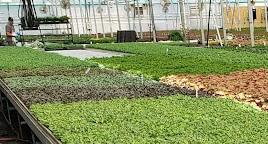
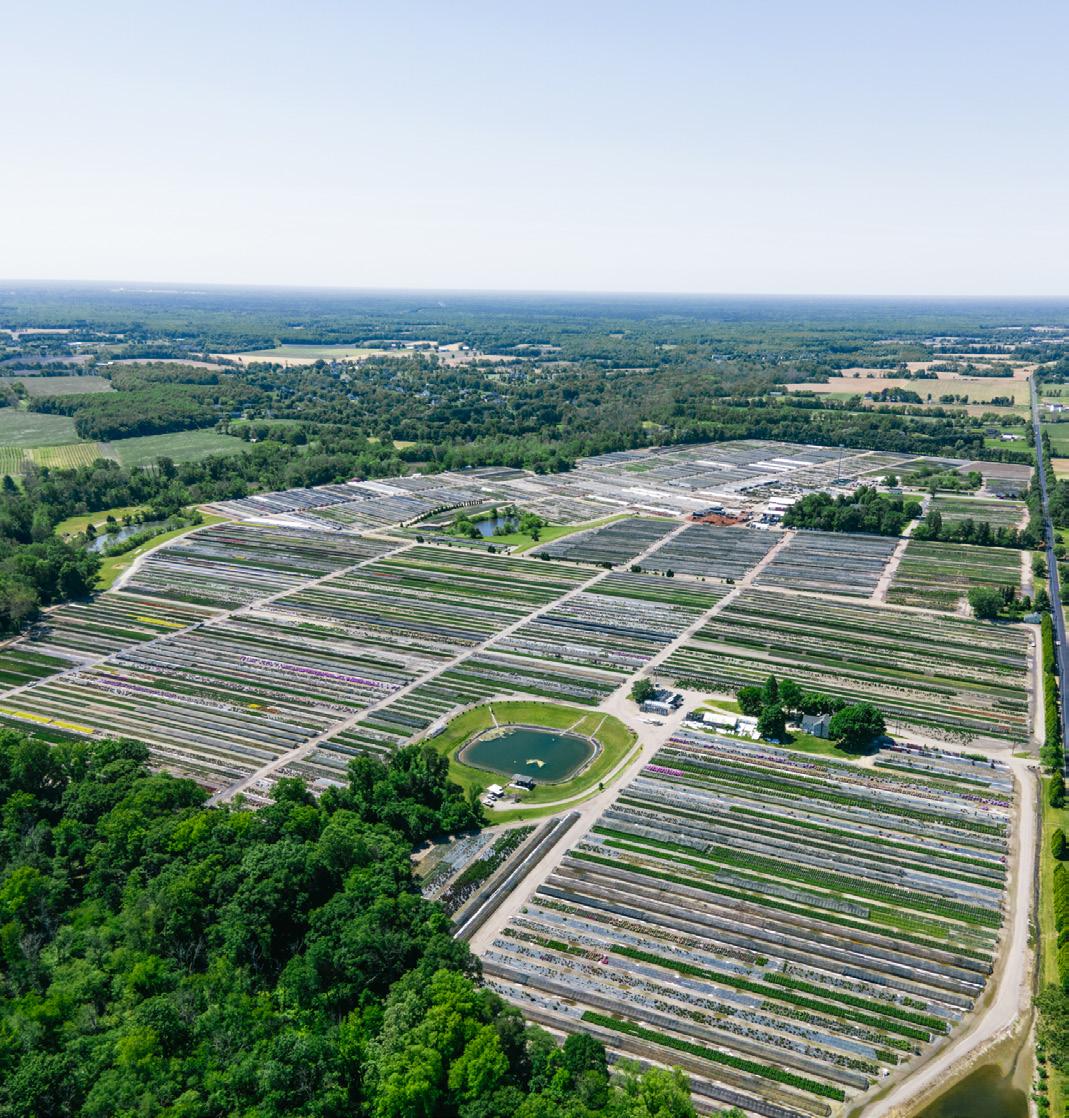
Jaap Molenaar is a co-owner of Pioneer Gardens in Deerfield, MA, alongside Arjen Vriend. Pioneer Gardens was started in 1992 to supply domestically grown perennials at a time when, Japp notes, many came from the Netherlands. They’ve grown significantly since then. Pioneer Gardens now has three main divisions. They grow perennials in about three acres of greenhouses. They grow wholesale bare root and starter plants in about forty acres of fields for other growers within the U.S. and Canada. They also grow live roof modulars for rooftops across New England. The roof modulars make up about twenty percent of the business. This exciting facet of Pioneer Gardens helps to reduce roof runoff and aids in stormwater management. Jaap notes that some municipalities, such as Cambridge, have requirements for large new construction that mandate either solar panels or green roofs. In these situations, Pioneer Gardens can step right in.
What advice would you give to a young person considering this industry for their career?
Jaap has very practical advice for young people considering this industry. First, he advises to get experience after school and experiment with multiple parts of the industry to see what is out there. He says the industry may be different than what students think while in school, so hands-on experience is critical. He notes that the green industry is production-driven with a lot of competition. If students plan to eventually start a business, he suggests having a good business plan that is financed enough to give enough information about cash flow in advance.
If you oversaw the whole industry, what would you change?


If given the chance to oversee the whole industry, Jaap would put more emphasis on meaningful internships both at the technical school and university levels. He thinks it would bring better-prepared graduates into the industry who are more aware of what they enjoy doing so they can embrace the work. He encourages thinking about the practical, not just the theoretical. Punch lists for new hires that enumerate who should know what in which position could be a great help.
Savage Farms:
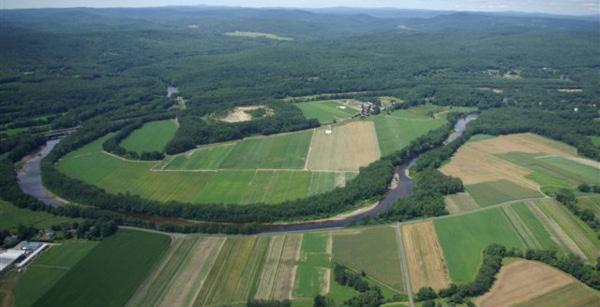
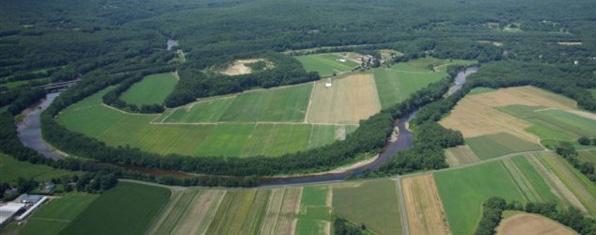
Jay Savage is the President and fourth-generation farmer of Savage Farms, Inc. in Deerfield, MA. Jay’s great grandfather started the business in the current location in 1910 as a vegetable and tobacco farm. His father introduced sod sales in 1963. Today, Savage Farms sells sod, potatoes, and corn in Massachusetts, Vermont, and New Hampshire. They are situated along the Deerfield River and have rich sandy loam soil. They produce sod for landscapers, sports turf, garden centers, golf courses, and the like. They deliver sod all over Southern New England.
What advice would you give to a young person considering this industry for their career?
Jay advises young professionals to work hard and be willing to start at the bottom and work their way up to the top. Jay notes it’s important to be willing to put in the work to learn the industry. He says you’ll get out more than you put it because there are many good people in the industry, and it is a great industry to work in.
If you oversaw the whole industry, what would you change?
Jay would like to see reduced regulations and to find laborers more easily.
Jay Savage
Jaap Molenaar
Winter Forum & Annual Meeting

MNLA Winter Forum & Annual Meeting Set New Attendance Record
By Rena Sumner
The MNLA Winter Forum & Annual Meeting marked a milestone year for the association, welcoming the largest attendance in its history and showcasing the strength, professionalism, and collaboration of the green industry.
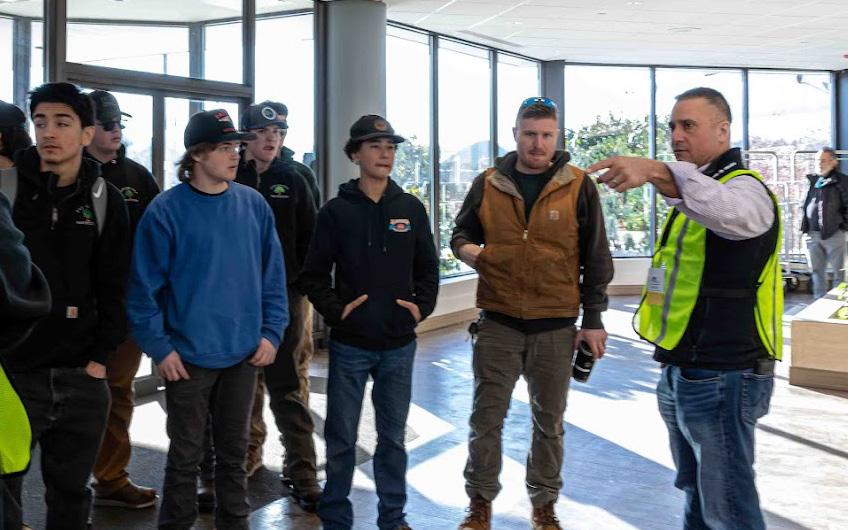
Held over two days on February 4 and 5, the 2026 Winter Forum drew more than 600 industry professionals, with an additional 150 students and educators joining the event on February 5. The expanded participation underscored MNLA’s growing impact across all career stages — from seasoned business owners to the next generation of horticulture and landscape professionals.

The Dreams & Solutions vendor showcase was supported by more than 40 vendor sponsors, whose engagement and partnership helped create a vibrant, interactive experience for attendees. Their continued investment plays a vital role in advancing education, innovation, and connection within the industry.
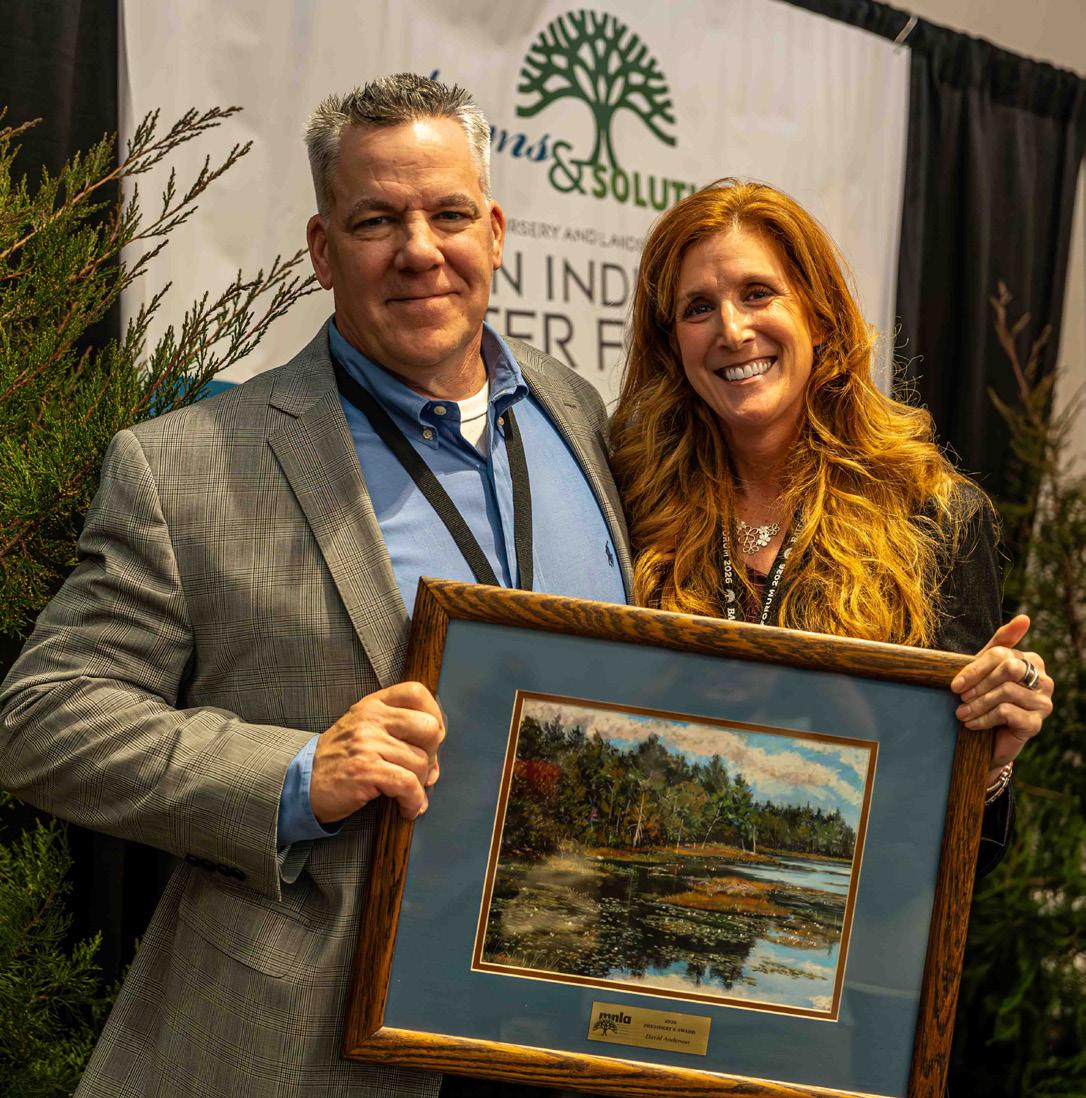
On February 4, more than 350 members and guests attended the MNLA Annual Meeting, where key association updates were shared and outstanding leaders were recognized. The President’s Award was presented to David Anderson of Mayer Tree, honoring his exceptional service and commitment to MNLA. The MNLA Young Nursery
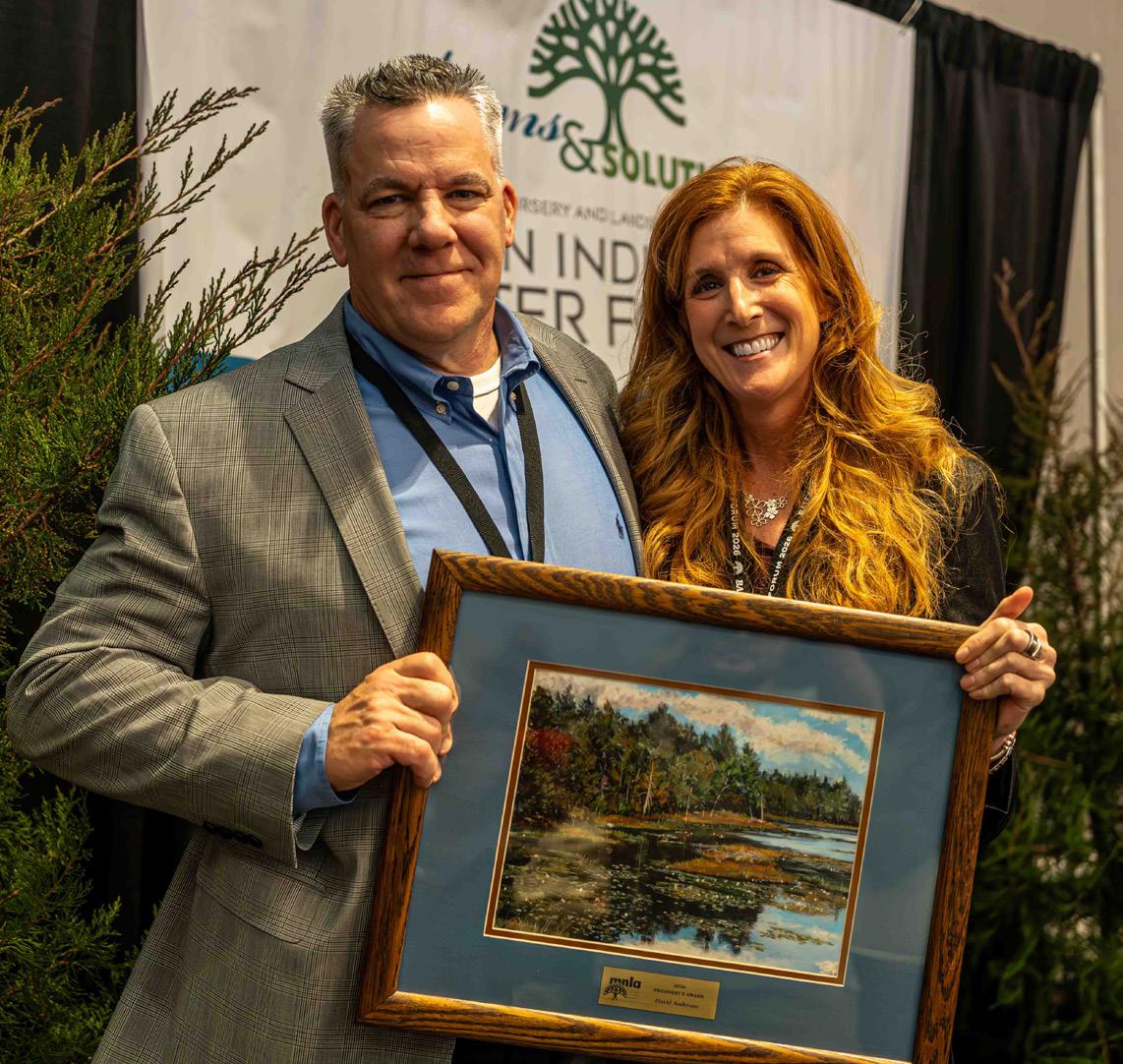
The MNLA Young Nursery & Landscape Professional Award was awarded to Nick Steiman, MCH, of Bigelow Nurseries, recognizing his leadership, professionalism, and contributions to the future of the industry.
The President’s Award was presented to David Anderson of Mayer Tree, honoring his exceptional service and commitment to MNLA.


& Landscape Professional Award was awarded to Nick Steiman, MCH, of Bigelow Nurseries, recognizing his leadership, professionalism, and contributions to the future of the industry.
The success of the Winter Forum & Annual Meeting was made possible by the dedication of MNLA’s volunteers and staff. Special thanks go to the education team — Deb Trickett, MCH; Dan Trefethen; Trevor Smith, MCH; Chris Johnston, MCH; Lauren Schmitt, MCH and Kerri Stafford — for keeping sessions running smoothly and managing the complexities of educational programming and CEUs. Appreciation is also extended to registration staff Kayla Anger and Sherrie Bellefleur, whose professionalism and calm problem-solving ensured a seamless experience for all.
MNLA extends sincere thanks to our sponsors, vendors, speakers, attendees, students, educators, board ambassadors, and volunteers. This record-breaking event truly reflected a “go team” spirit and reaffirmed that MNLA’s success is built on collaboration, dedication, and shared passion for the industry.


Winter Forum & Annual Meeting
At Massachusetts Nursery and Landscape Association’s Winter Forum Dreams & Solutions, members once again proved that the strength of our industry lies not only in plants and projects, but in people. From legislative updates to lively breakfast table discussions, this year’s gathering highlighted what MNLA is doing right — and where we are headed next.
What MNLA Is Doing Right
The most consistent theme heard throughout the Forum was simple: connection matters.
Members value MNLA’s events because they create meaningful opportunities to “rub elbows,” share ideas, and strengthen relationships. In a competitive and evolving industry, collaboration remains one of our greatest advantages. Whether at educational sessions, the trade show floor, or informal conversations over coffee, members emphasized that relationships are at the heart of success.
Education continues to be a cornerstone. Members appreciate the range of programs and professional development opportunities available throughout the year. The Youth Initiative was especially praised, with many noting how energizing it was to see so many young professionals and students participating in the Winter Forum. Scholarships and student engagement efforts are helping to build the next generation of green industry leaders — an investment that benefits us all.
Legislative advocacy was also cited as a major strength. Members recognize and value MNLA’s ongoing involvement in policy and regulatory issues that directly impact their businesses. Having a unified voice at the State House ensures our industry is represented and protected.
The Challenges of Winter
While winter is often viewed as a slower season, members acknowledged it presents its own challenges — and opportunities.
For many, the focus is on expanding the “shoulder seasons” to generate additional revenue. Offering new services, diversifying product lines, or tapping into emerging markets can help keep crews engaged and businesses stable

year-round. Some members shared innovative approaches, including investing in energy efficiency, such as heating greenhouses and office space with large wood furnaces to control winter operating costs.
Winter is also prime time for internal investment. Scheduling employee training, conducting performance reviews, and refining business plans all help set the stage for a successful spring. Rather than viewing winter as downtime, members are increasingly treating it as preparation season — a time to sharpen skills, improve systems, and strengthen teams.
Adapting to Cultural Change
Perhaps the most robust conversations centered on adapting to cultural and generational change.
Participants agreed that businesses must be nimble — not only reacting to change but anticipating it. One key takeaway: policies and procedures should be treated as living documents. Documenting norms and expectations is essential but revisiting them annually ensures they remain relevant and effective.
The consensus was clear — it is better to be proactive and occasionally stumble than to remain stagnant. Businesses that actively watch trends and position themselves ahead of them are more likely to thrive.
E-commerce was one emerging trend that sparked significant discussion. The online sale of plant material is expanding rapidly, influencing not only nursery retail but even the turf community. Members noted that understanding and leveraging digital platforms will be increasingly important in the years ahead.
Building Stronger Human Systems
At one breakfast table, a dynamic group focused their discussion on managing teams and building stronger company cultures.
Recruitment, retention, compensation, and generational expectations remain ongoing challenges. Members discussed the importance of developing better leaders, not just better managers. Building stronger “human systems” within organizations — clear career paths, leadership development,

transparent communication, and thoughtful compensation strategies — was identified as essential for long-term success.
Ideas included conducting pay studies, increasing transparency around business financials to foster employee buy-in, and creating defined career tracks to improve retention. Leadership institutes, digital learning platforms, and peer-to-peer idea sharing were all discussed as potential resources. Employee appreciation initiatives — from team outings to professional development opportunities — were also recognized as simple but powerful tools for engagement.
One example mentioned, highlighted a longtime business that came under new ownership recently that led to a successful management turnaround, strengthening both culture and profitability. Stories like this reinforce the value of strong leadership and adaptability.
Looking Ahead
The Winter Forum conversations underscored a powerful truth: MNLA members are thoughtful, forward-looking, and committed to raising the bar collectively. By investing in education, advocating legislatively, embracing change, and strengthening our human systems, we position not only our individual businesses — but our entire industry — for continued growth.
Thank you to everyone who participated and contributed ideas. The dialogue does not end here. If you have additional thoughts to share, we welcome them.



Winter Forum & Annual Meeting

Together, we continue to grow stronger.







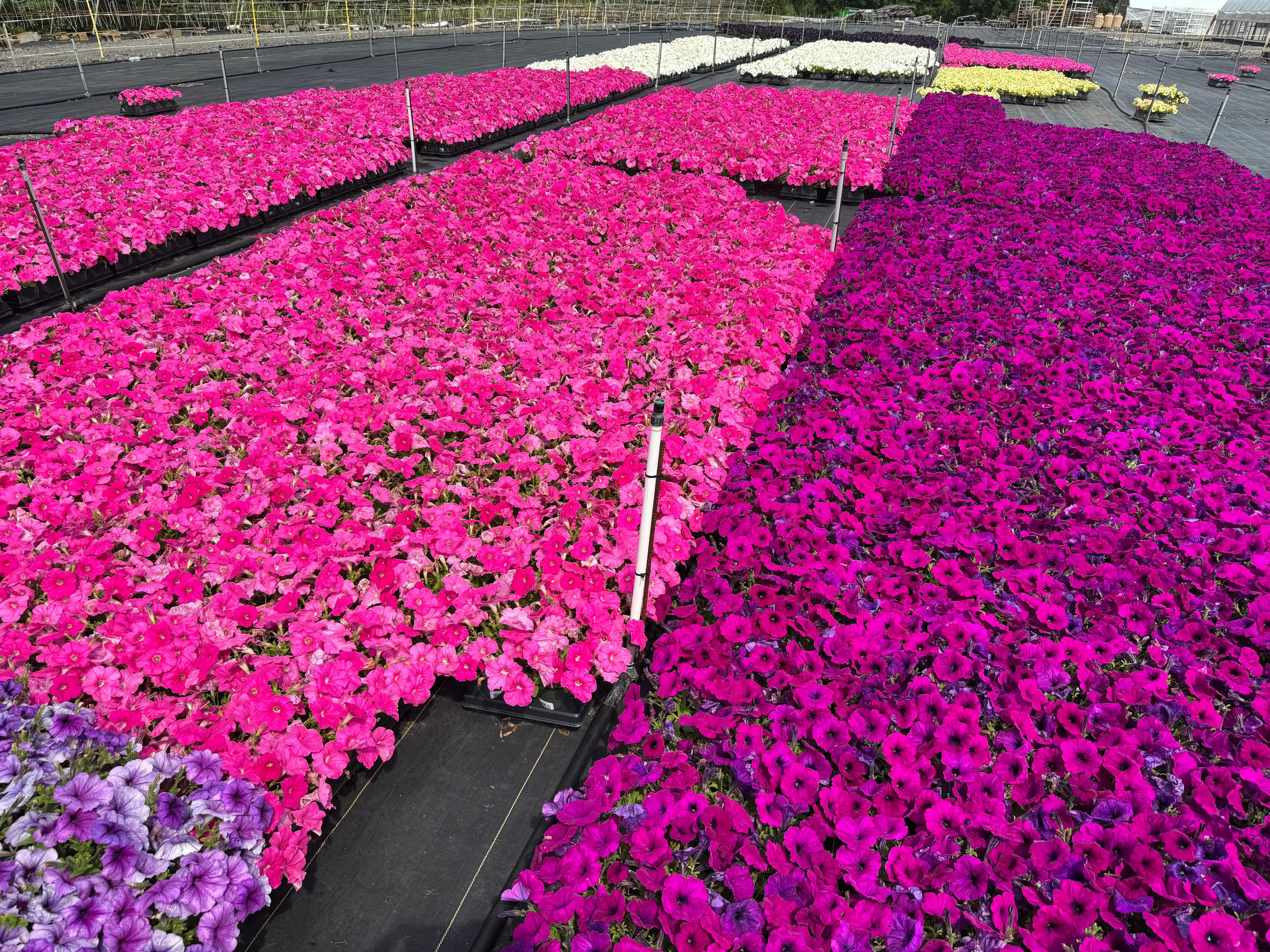
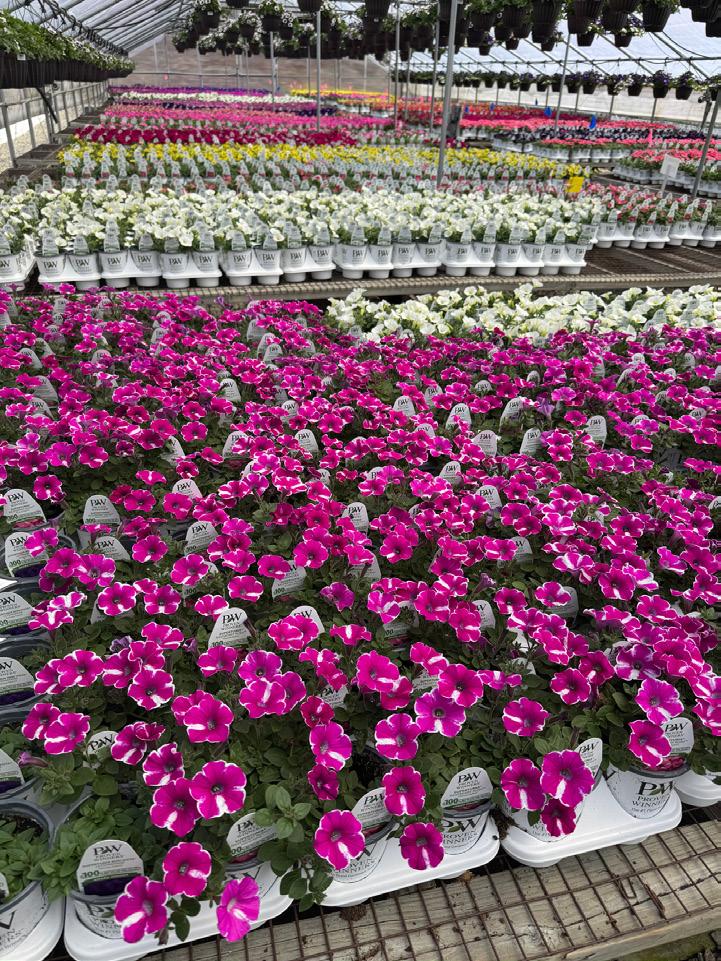






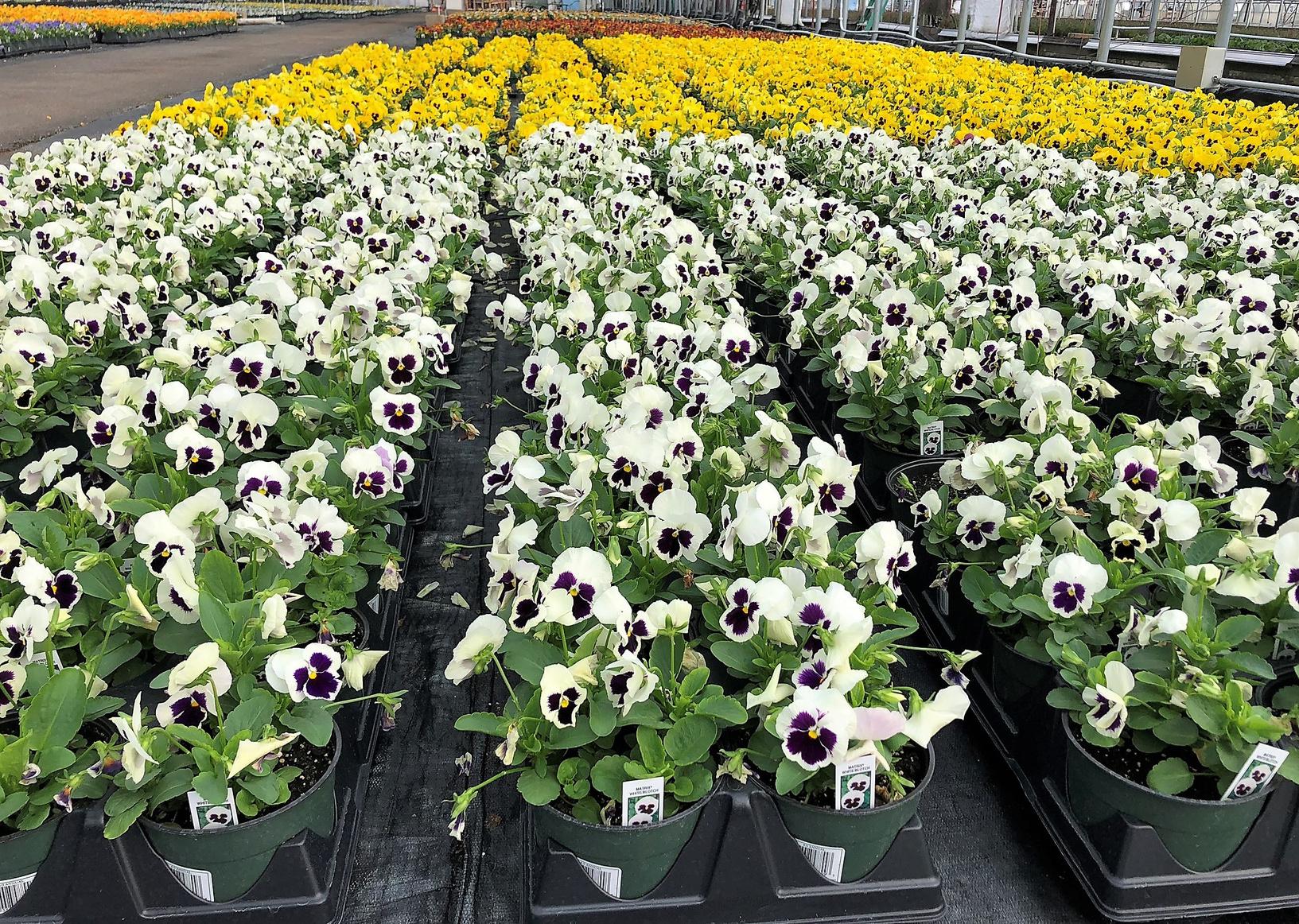
Dressing for Spring Fresh Container Design Inspiration Spring Season Begins
by Heather Prince
Our spring hopes blossom when we hit that first warm day in March and the first robins arrive to scope out nesting sites. The winter evergreens in our containers and windowboxes that were so fresh in December are weary and ready for the compost pile. Yet, it’s the Midwest and with a likelihood of April snow and a last frost date of May 15th, how do we create fabulous container designs that will survive yo-yoing temperatures and still look good?
We talked to three container designers to see how they navigate this tricky season before summer flowers arrive. They all shared their expertise.
Challenges of the Fickle Season
Besides our beloved pansies and violas, there are many more options to fill containers with color and texture. From colorful stems and branches to greenhouse-grown hydrangeas to pre-chilled bulbs, there’s lots to choose from. However, the biggest challenge of spring? The weather.
The most challenging aspect of spring containers is the volatility of the ‘transition season.’ It’s about building a plant menu that can handle a late frost, grow quickly in the cool weather, and not flower too early. Mother Nature keeps you on your toes and does what she wants.” A mix of frost-tolerant annuals, hardy perennials, and durable foliage often will keep containers lush, even in a surprise snow.
Holding up to a hard frost is the great est challenge. There have been several springs where we have had temps in the high 20s, which is usually hard on flowers. The other challenge with the
temps is trying to lessen the gap between winter decor and spring flowers. We are trying as many garden ornamentations, branches, and artificials to install earlier without the worry of frost or snow.
The most challenging part of spring containers is timing. The plants are only in the containers for about six weeks and often something doesn’t bloom when it is expected to.
Building layers of plants can keep the color fresh while blending in thoughtfully chosen accents carries structure into summer.
Bigger Can Be Better
When planting for large homes, corporate office buildings, or whimsical wizard-style college quads, scale plays an important role. Veteran container designers know that in many cases, tall architectural designs are the best way to capture attention and work with the size of the building or landscape.
Spring is tricky as many plants are small in scale or just beginning to flush out. Try to balance designs with the scale of the property or site by treating a container like a site plan in miniature. It has to have the same structural density as the architecture behind it, or it just looks like noise.
At the Wizards Academy campus. The large stone and brick buildings are meant to resemble the world of Harry Potter and are built on the scale of university classrooms and dormitories. Our buildings are HUGE, up to three stories and most spring annuals are not. We try to purchase the tallest things available and rely heavily on fantail willow, curly willow, or white birch to give the container a larger scale.
Looks at the whole picture when crafting designs for residential clients. We typically look at the height of the container and usually create an arrangement that is two-thirds of the total height. How the containers interact with walkways, scale of a specific garden, or size of the residence always determines the arrangements’ overall height and scale.
Spring Favorites and Flair
Of course we have our favorite spring flowers, as do our clients. A pansy or viola usually finds its way into spring containers. However, our designers also have some favorite plants that break away from the standards.
I love fantail willow, I feel it really plays with the ‘wizardy’ vibe I am trying to portray. I also can re-use it in my winter containers. One of my favorite plants would be delphinium. We get ‘Blue Diamonds’ in a finished one-gallon container. It is tall and brings that shade of blue that is hard to capture in the garden. I save it when I plant my summer annuals, give it a good haircut, and I can often get multiple sets of blooms throughout the summer. I also enjoy using Heuchera and Lamium as their spring colors are much different than anything else I can get. I then move them into the landscape at seasonal changeout.
I find that incorporating branches and artificials offers seasonal punch. Mixing ‘live branching’ with faux flowers is something we have always used in our containers. Selecting the right faux flower or accent is key, so that both work seamlessly together. Garden ornamentation is also something we have used to provide a unique appearance and provide a good
solid height with a colorful base.”
Some of the ways I try to take planters to the next level, is by adding a surprise. If a planter is viewed close an entryway or on a terrace, I love to tuck in a discovery element. This could be a subtle ceramic mushroom, a weathered stone, or even a hidden butterfly. It rewards the viewer for looking closer. I also like to cover the soil for early spring containers with sheet moss to eliminate the negative space. Nothing breaks the illusion of a nice design like seeing too much potting soil around spring bulbs.
As we jump into the season of spring flowers, take a look at these beautiful container designs for inspiration and ideas. Layers of different types of plants, branches and artificials for hardy interest, and thoughtful accents can bring your plantings to the next level.
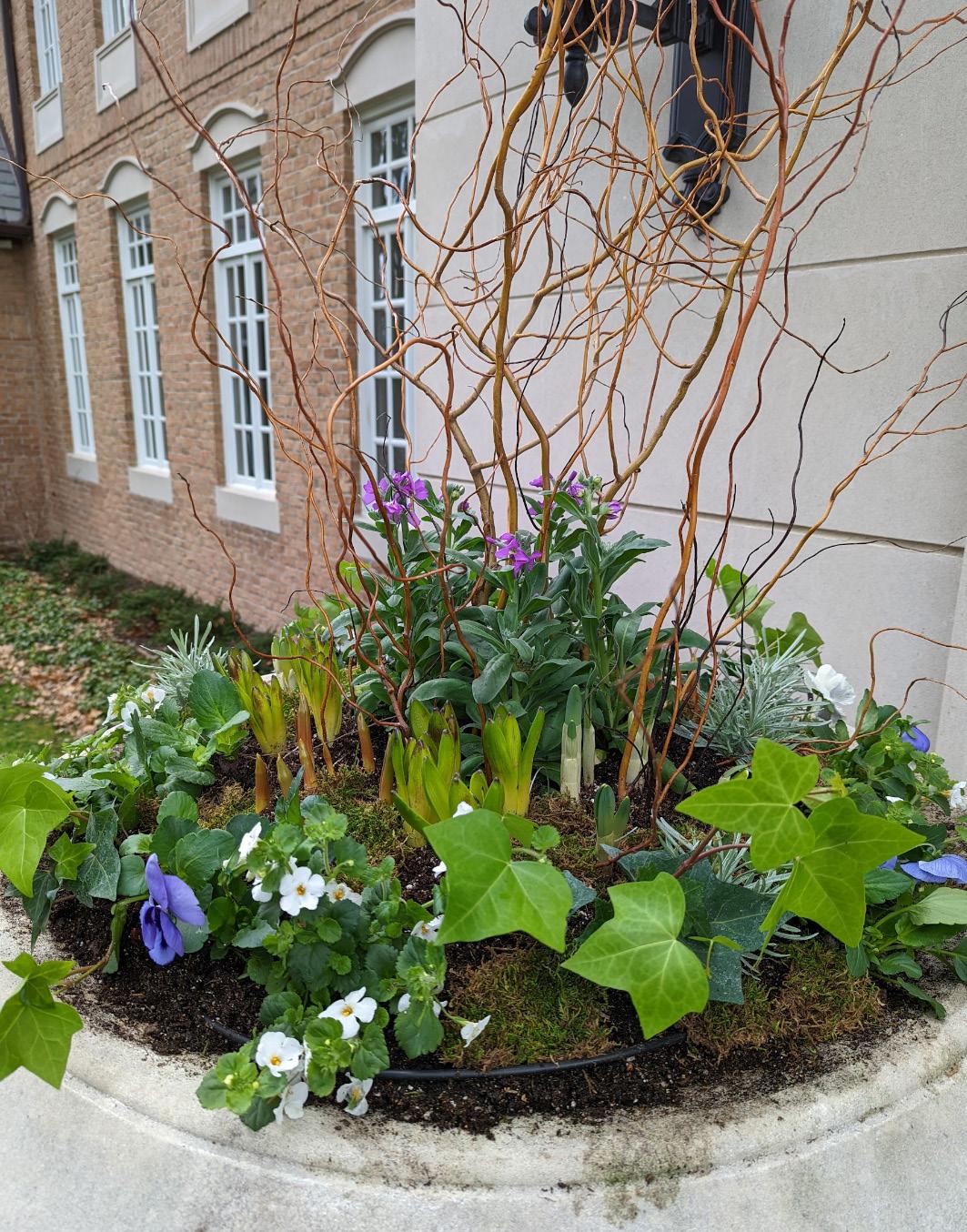
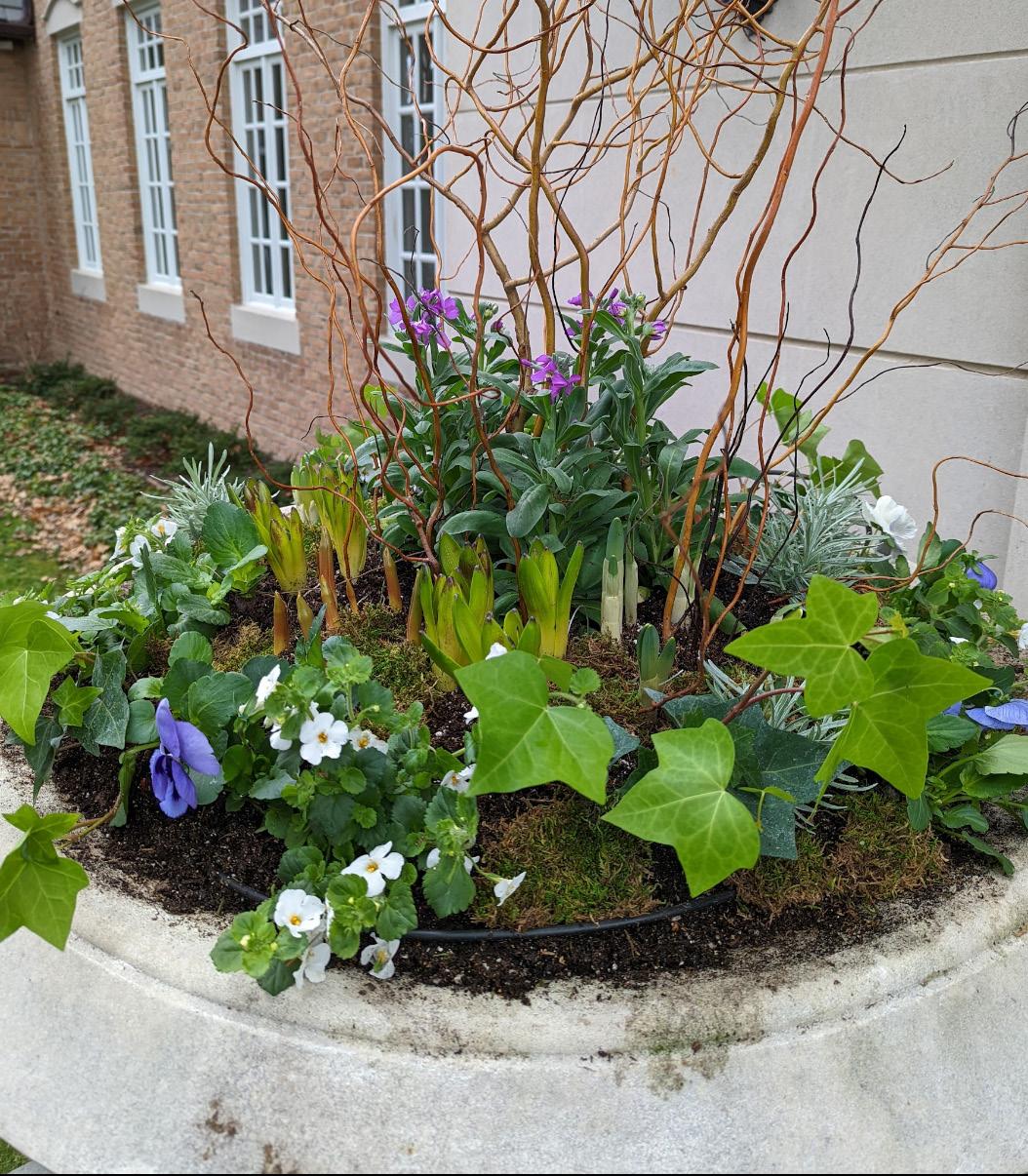
This cool concrete urn gets romantic spring treatment with the loose, woodland feel of curly willow for height. Fragrant purple stock anchors the center while English ivy will spill and weave through the mix of silver Artemisia, white-flowering Bacopa, and blue pansies. This combination from Rundblade also features fragrant hyacinth bulbs and daffodils tucked in for a progressive display and a delightful surprise.
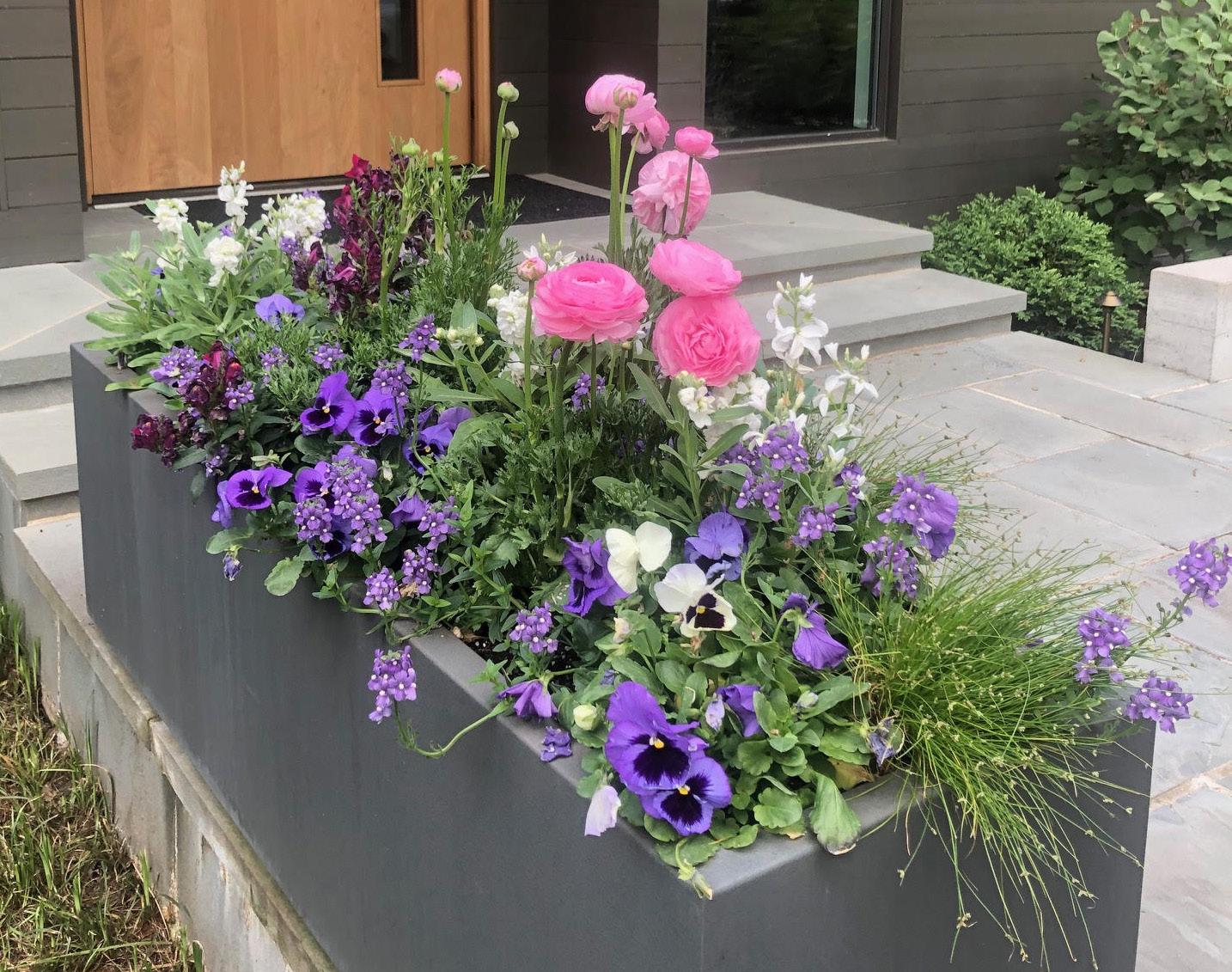
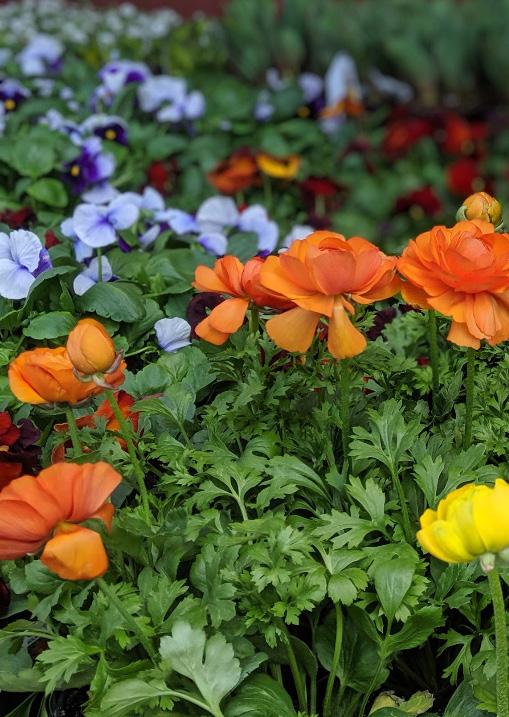
The heirloom elegance of Ranunculus flowers anchors the center of this crisp, contemporary trough. Layers of purples and whites in a bounty of different weights and shapes keep this design from looking too flat. Sprays of fiber optic grass add a modern note and bring a fresh accent to weave it all together.
Spring Season Begins
(continued from page 45)
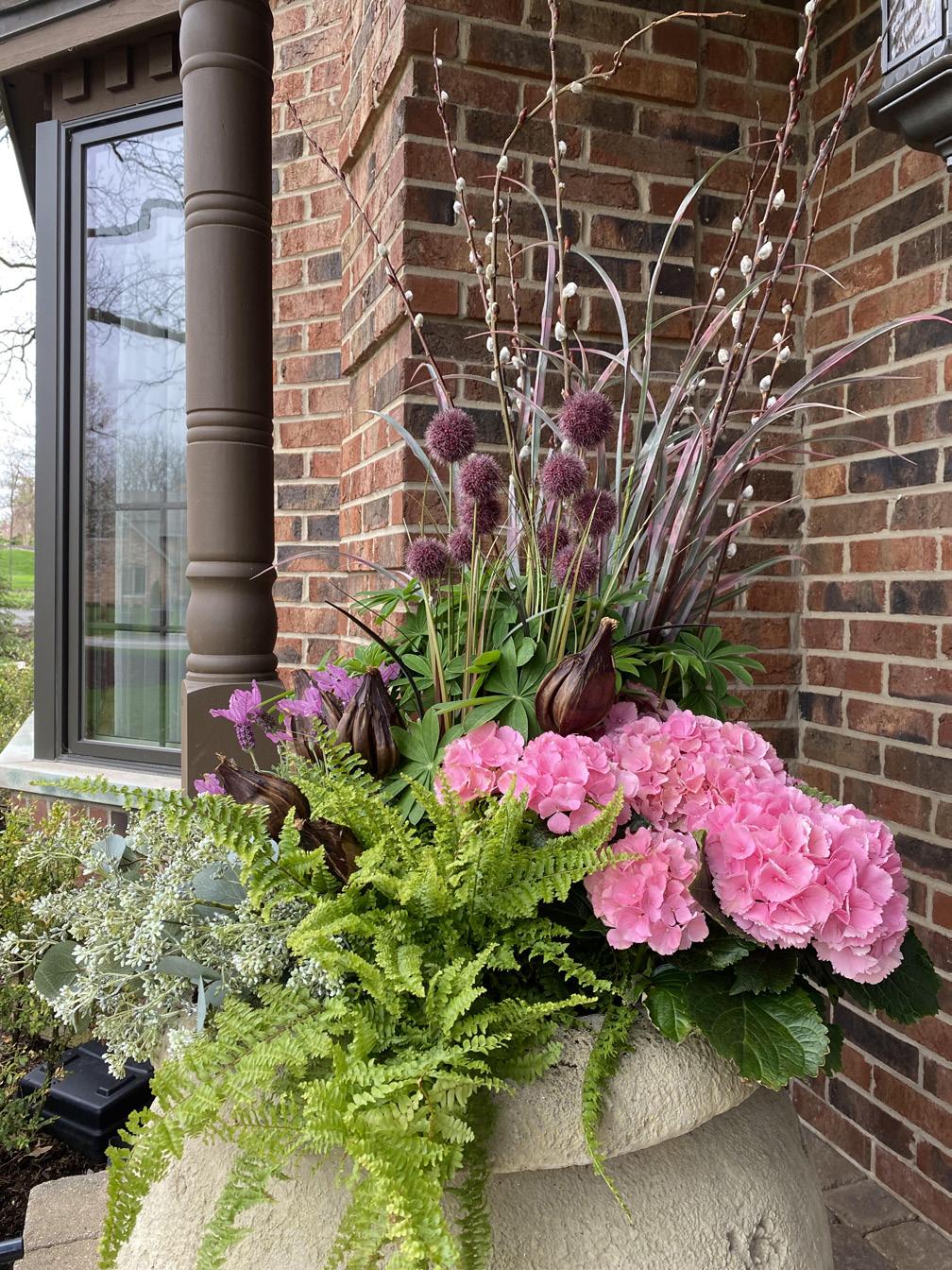
(above) Architectural pussywillow branches are combined with purple seedheads and pods to add height and drama to this layered spring design. Lupine holds the focus in the center as bright pink hydrangea draws the eye down. A splash of silvery seeded eucalyptus and a lacy fern cool the combination down while softening the edge of this contemporary urn.
(below) Fickle spring weather means horticulturists get creative. In this case, purple spray-painted allium seedheads add a froth of color amid the spiraling stems of curly willow and thoughtfully chosen artificial floral branches. Kimberly ferns anchor this classic trough and provide intriguing visual interest. A skirt of colorful pansies and fragrant alyssum add a dash of seasonal color. Pinks and purples are echoed in the small planters to tie the look together.
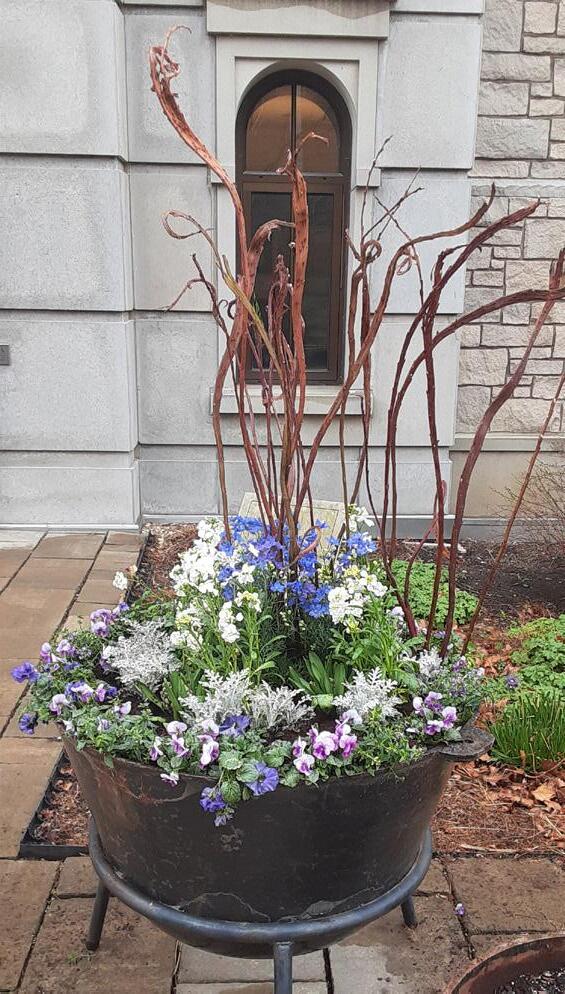
(at left)The fantastical shapes of fantail willow rise from permanent iron cauldrons at Wizards Academy. Their whimsical architecture mimics the building, while its durability means they can stay in the container from spring into fall. Blue delphinium anchors the center and sets the tone of this blue and white design. White stock adds fragrance as dusty miller keeps the color palette chill. The outer ring of pansies and Nemesia adds froth and is reminiscent of a bubbling potion.

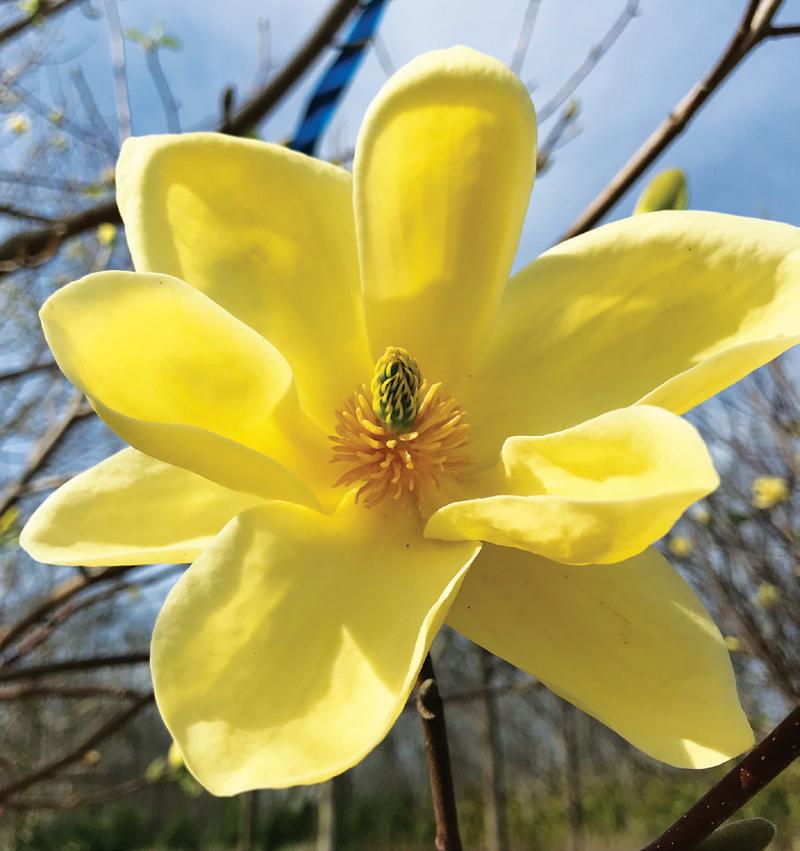
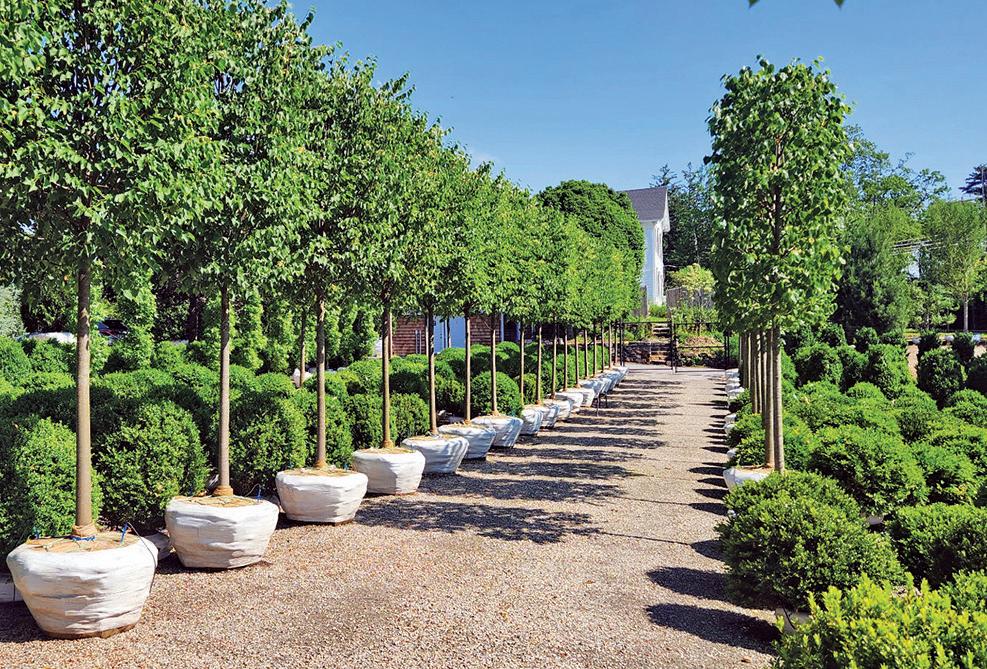

Spring Season Begins
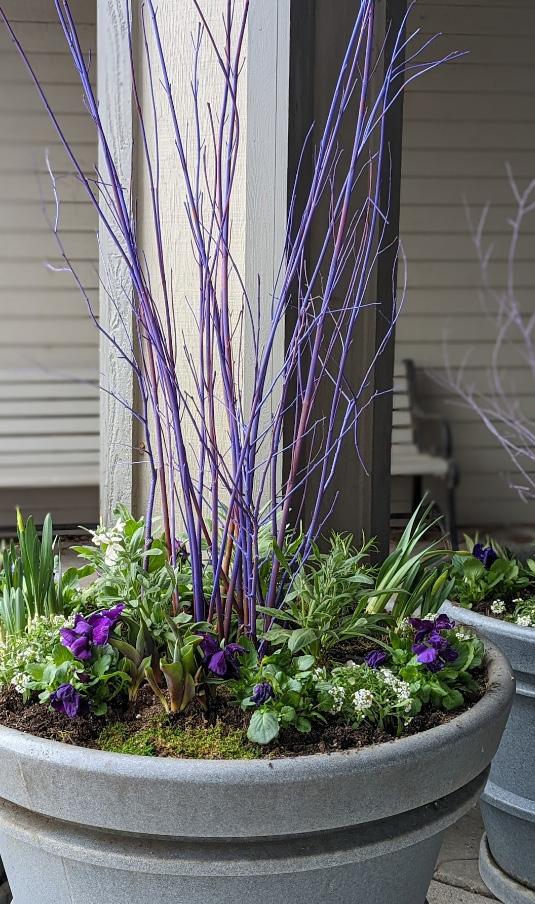
Purple painted twigs bring a welcome dash of color and much-needed height to these large planters. While purple pansies echo the vivid stems, fragrant white stock acts as a mid-range filler in the center. Tulips and daffodils will bring fun floral surprises when they open. In the meantime, a scatter of white alyssum softens the edge and sheet moss pulls together the whole design.
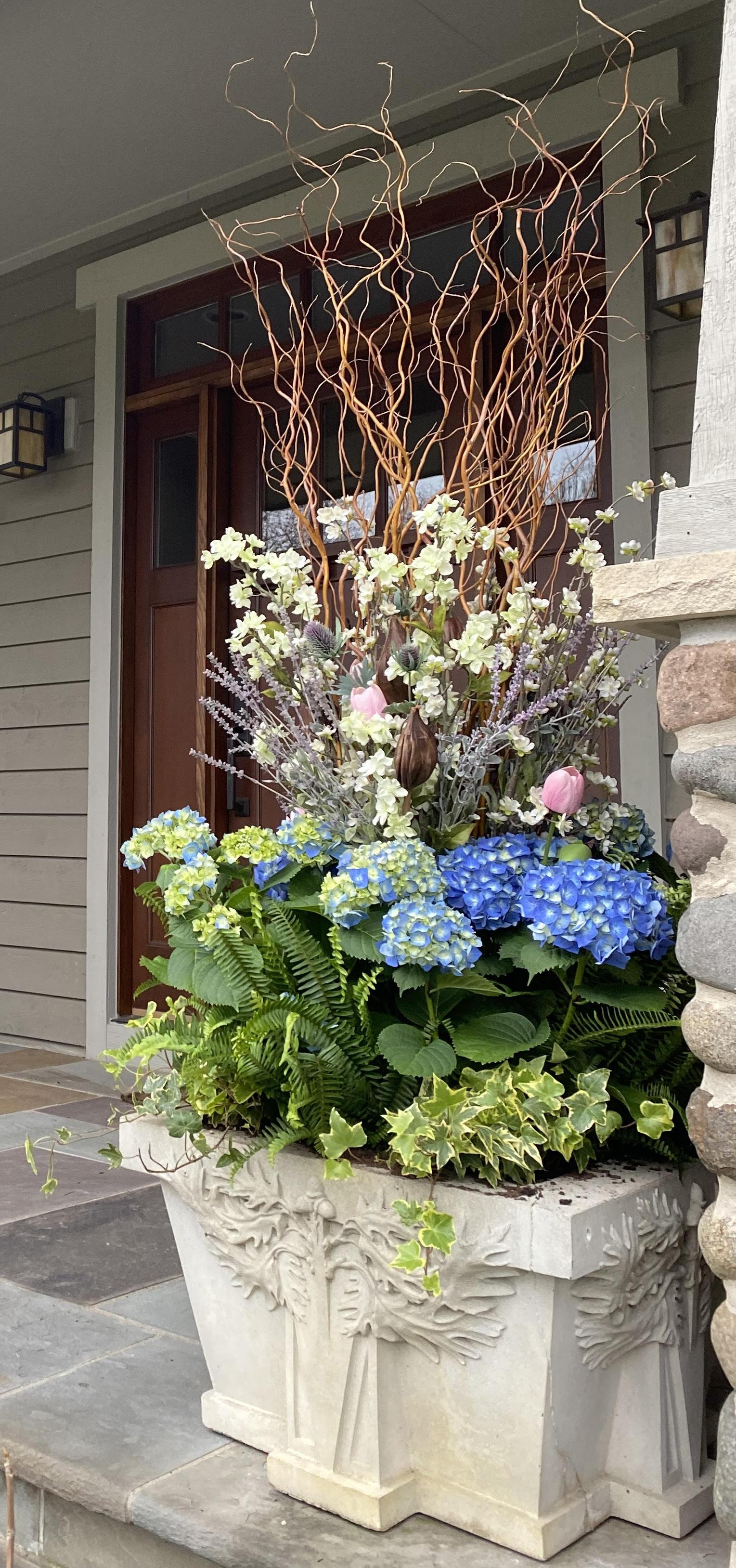
This home sets the stage for these elegant concrete planters. Versatile curly willow branches give height and a soft, naturalistic feel to the design. Artificial florals hold up against the weather and bring dainty accents to the big chunky blue hydrangeas. Ferns bring a touch of woodland glamor as variegated ivy spills over the edges.

Spring Season Begins
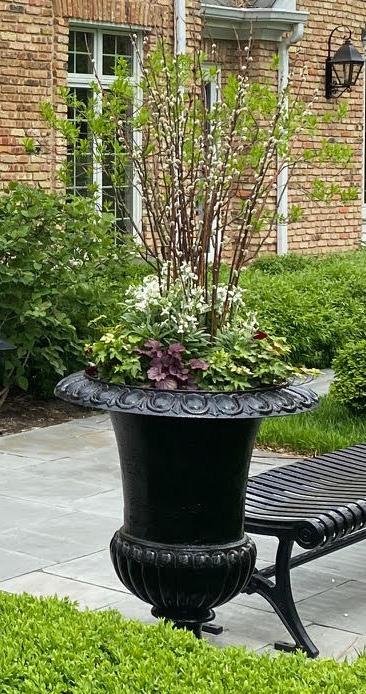
These classic black iron urns anchor the entrance of the stately brick home. A cool white color scheme is highlighted with purple heuchera while pussywillow branches offer height in keeping with the scale of the porch and patio. The urns against the house echo the color scheme, but add a different drama with fantail willow branches, artificial florals, and upright ferns.
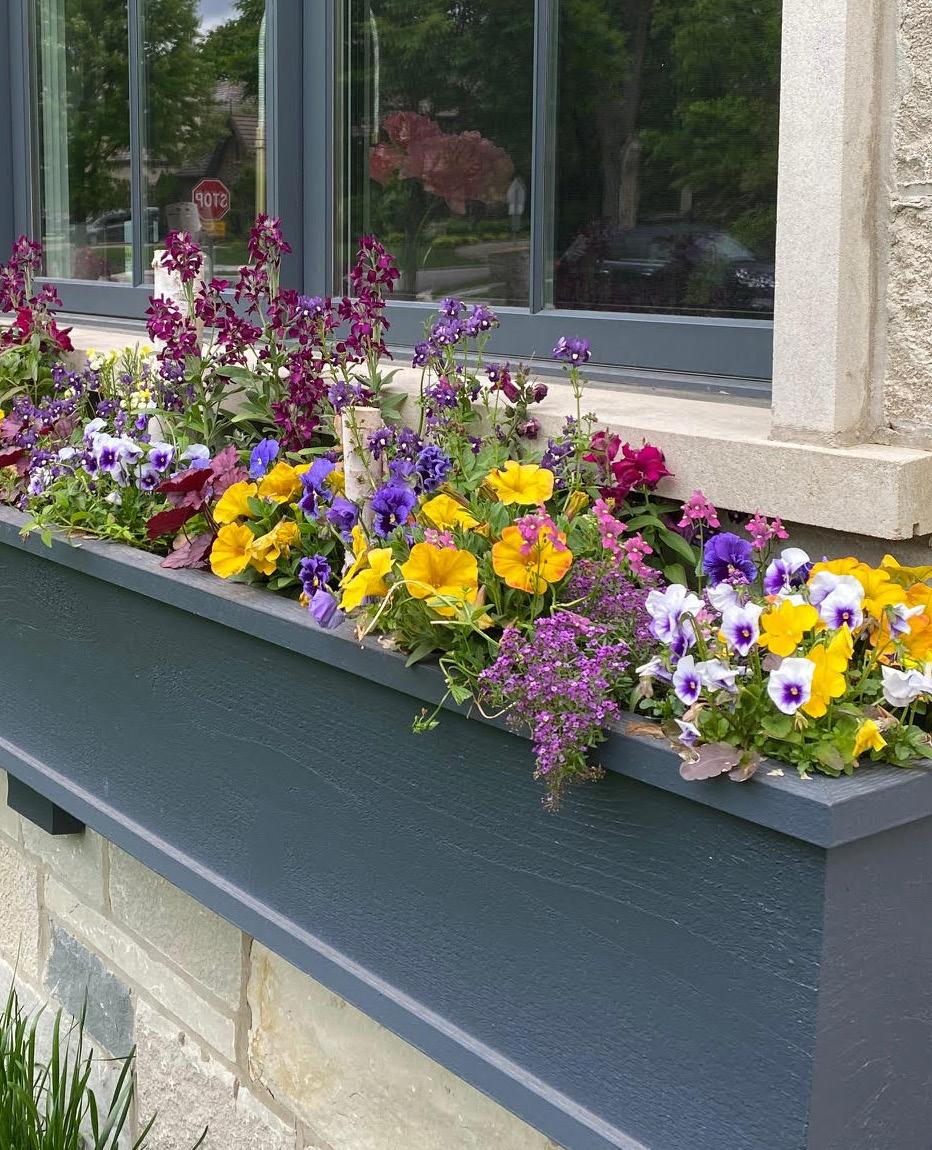
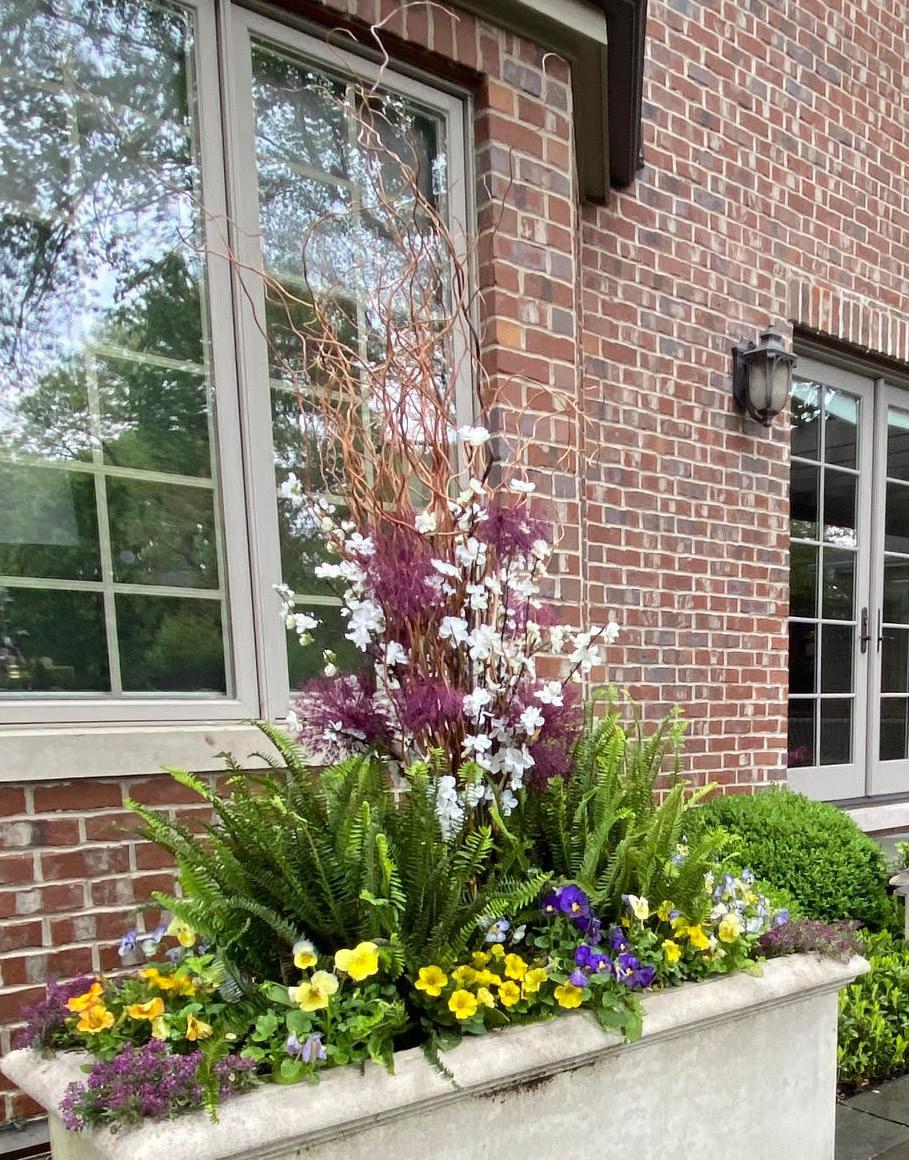
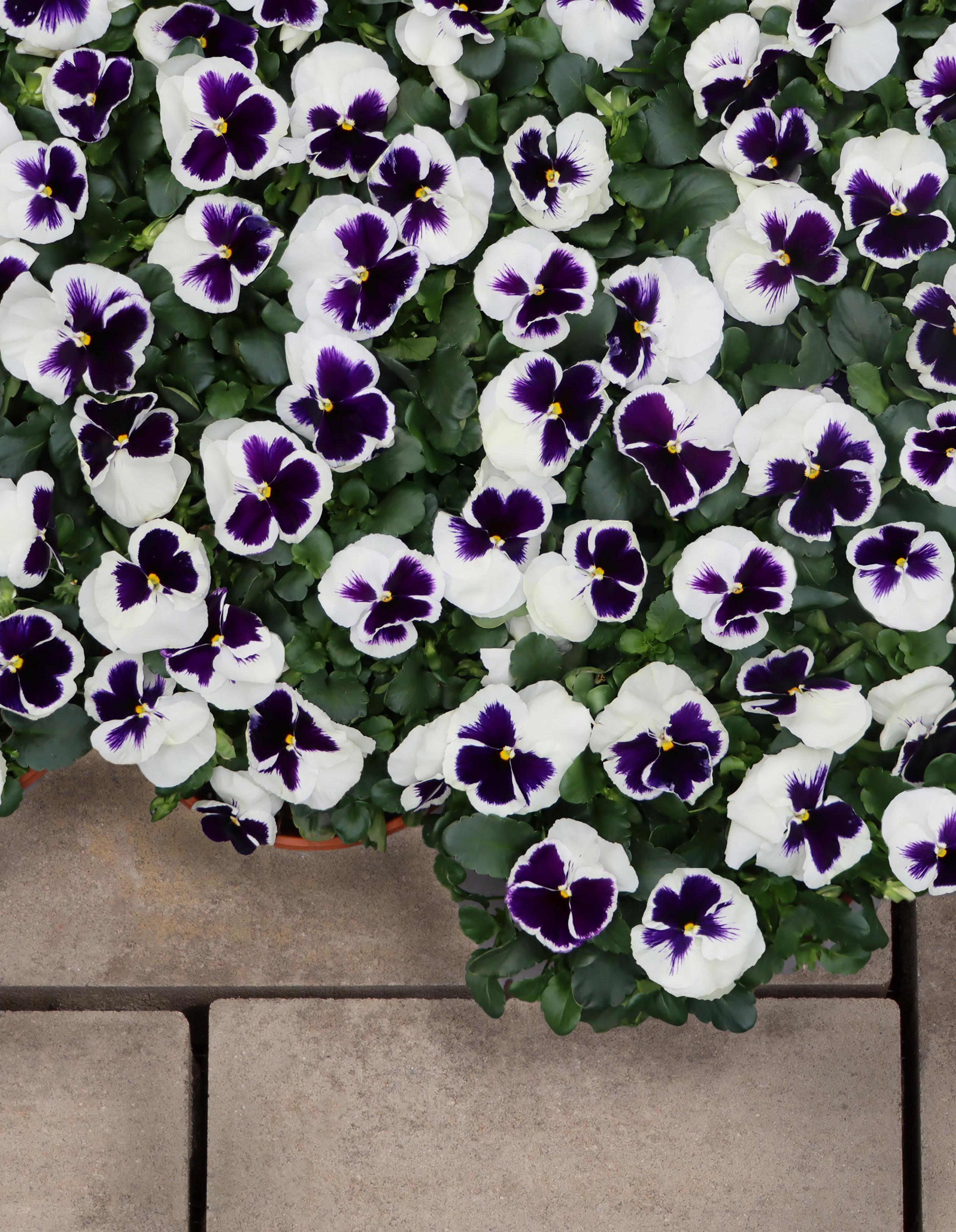
Sometimes you can’t resist the happy faces of pansies and violas. This charming window box leans into layers of delicate flowers with big punches of yellow petchoas. Purple Nemesia dances above and peeks over the windowsill. Short lengths of birch poles finish off this rustic design.
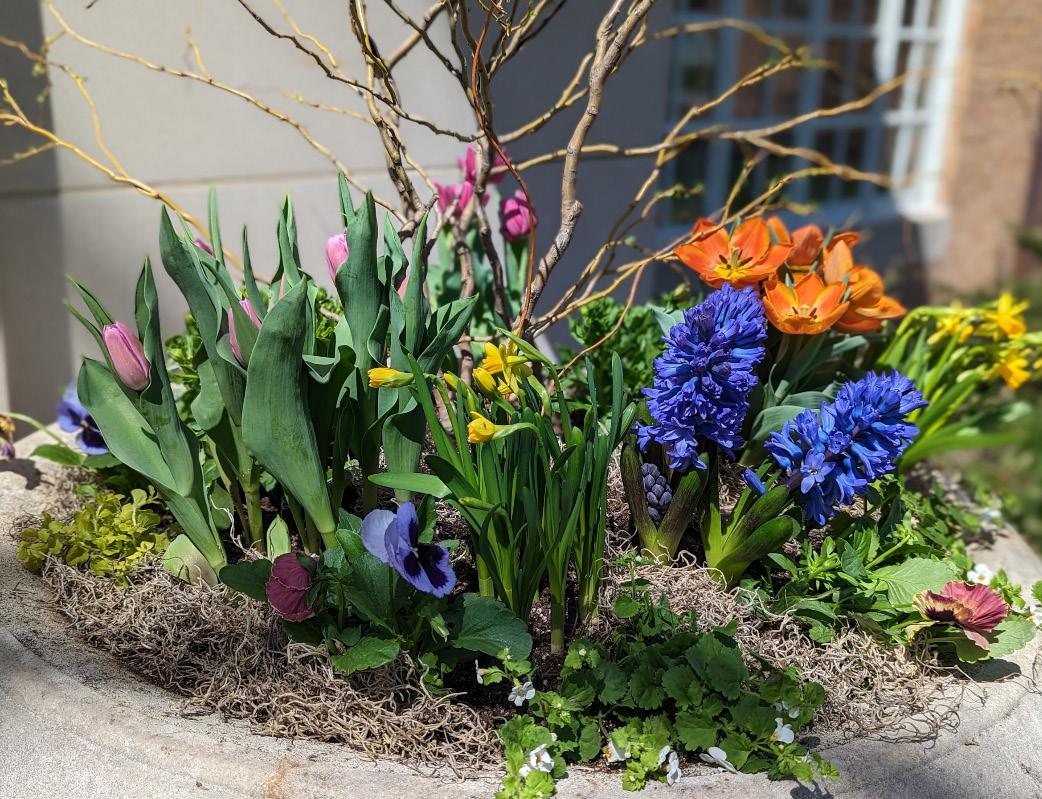
Under the wiry stems of a Japanese maple, spring comes alive in this colorful arrangement of hyacinth, daffodils, pansies, and tulips. Soon, the tiny graceful leaves of the maple will add dainty accents to these robust favorites. Creeping Jenny and white Bacopa will quickly fill in and spill over the edges. In the meantime, a layer of Spanish moss frames the flowers and brings the arrangement together.

Spring Design Ideas
Design with Children in Mind

By Mark Dwyer
The landscape design process obviously benefits immensely from significant client input regarding interests, needs, expectations and concerns. In many cases, some guiding questions from the designer will help ferret out more information on not only ornamental goals of the landscape but functional expectations as well. In my myriad interactions with clients over the years, their input ranging from not involved to over-involved, I never neglect to ask about children. Do they have or expect children (or grandchildren) and have they considered maximizing the landscape to accommodate active interest and use of an evolving landscape that is popular and engaging with children? Sometimes the kids haven’t yet entered the equation.
While it’s common to confirm expectations on outdoor entertaining, deck/patio sizes, privacy issues, etc., I believe we can more actively and directly create safe, multi-functional
landscape spaces or zones for imaginative play and use by children, and it’s not a “hard sell.” Kids DO notice beautiful spaces, and when they feel invited into the landscape, they will actively engage. Additionally, there isn’t a more important time in history to get kids outside, as we all know.
About 10 years ago, I designed a retaining wall system on a severe slope to accommodate broad terraces, steps, seating and plantings. The client had a young teenager who was fond of various winter sports like skiing and snowboarding, so he wanted a portion of the slope to include more irregular rocks and outcroppings to support snowboarding for his son. That was my first foray into combining functional erosion control with extreme sports potential! Apparently, it was a success in both regards.
Established in 1910, Cavicchio Greenhouses is a fourth-generation New England farm working more than 250 acres in Sudbury. As a horticultural grower and landscape distributor, we cultivate and supply an extensive variety of annuals and perennials, nursery stock, stone, masonry and landscape materials. With a hard-earned reputation for service, quality, selection and sustainability, we work with professionals and garden centers throughout the area to keep our region beautiful.
978.443.7177 www.cavicchio.com
Spring Design Ideas
(continued from page 40)
More often than not, clients with children will just ask for an open space in the backyard (within easy sight of the residence) to place a traditional, clunky play set. I grew up with this setting but now view it as lacking more diverse appeal. I think we can do more than that with our design skills and create spaces that are both versatile and adaptable. These “family landscapes” can also add real value to the home, particularly for families with children looking to transition into a move-in-ready setting that has already considered children.
Fun and enriching environments for children should absolutely be incorporated into the landscape although those spaces should also be attractive to adults and have the ability to evolve as the children grow
Equipment
and landscape needs and expectations change over time. Designing for both the “now” and “later” becomes the inherent challenge. Balancing both the aesthetic and functional expectations of the landscape by both adults and children is the primary goal.
Safety
A primary concern of a landscape that will be explored and enjoyed by children is safety. This includes “kid safe” elements but also the consideration of elements like privacy and screening. Parents appreciate and insist on a landscape layout that allows them to have a clear line of sight from the structure or adjacent patios/ decks to observe their children and monitor the setting. Shaded “observation points” may allow direct views of the landscape and certainly also serve as spaces for (continued on page 44)

























Spring Design Ideas
(continued from page 42) collective respite on those hot summer days.
Thoughtfully placed trees, shrubs, hedges, fences, etc. can support privacy issues from the exterior of the property and still frame the setting and not appear as a restrictive, suffocating barrier to the world outside the property. Creating privacy has always been in our design wheelhouse but should again consider the location of the most active use by children and blend har-
Incorporating options for different styles of play that also support and engage children as they grow older is a primary goal. Inputs from your clients regarding the ages and interests of their children will help guide some design development but by diversifying the options for different styles and intensity of play (both active and passive) this will maximize engagement for the entire family.
Consider creating informal “gathering zones” in the land-
Our traditional decks, patios, firepits and other features
be incorporated into an
(continued on page 46)

Spring Design Ideas


Ornamental boulders positioned in the landscape will offer visual interest but will certainly attract children and encourage interaction. Get creative and include the children in this discussion as they may have some inspiring and realistic ideas on these modifications. Input from the children creates a shared sense of interest, ownership and responsibility regarding the burgeoning family landscape.
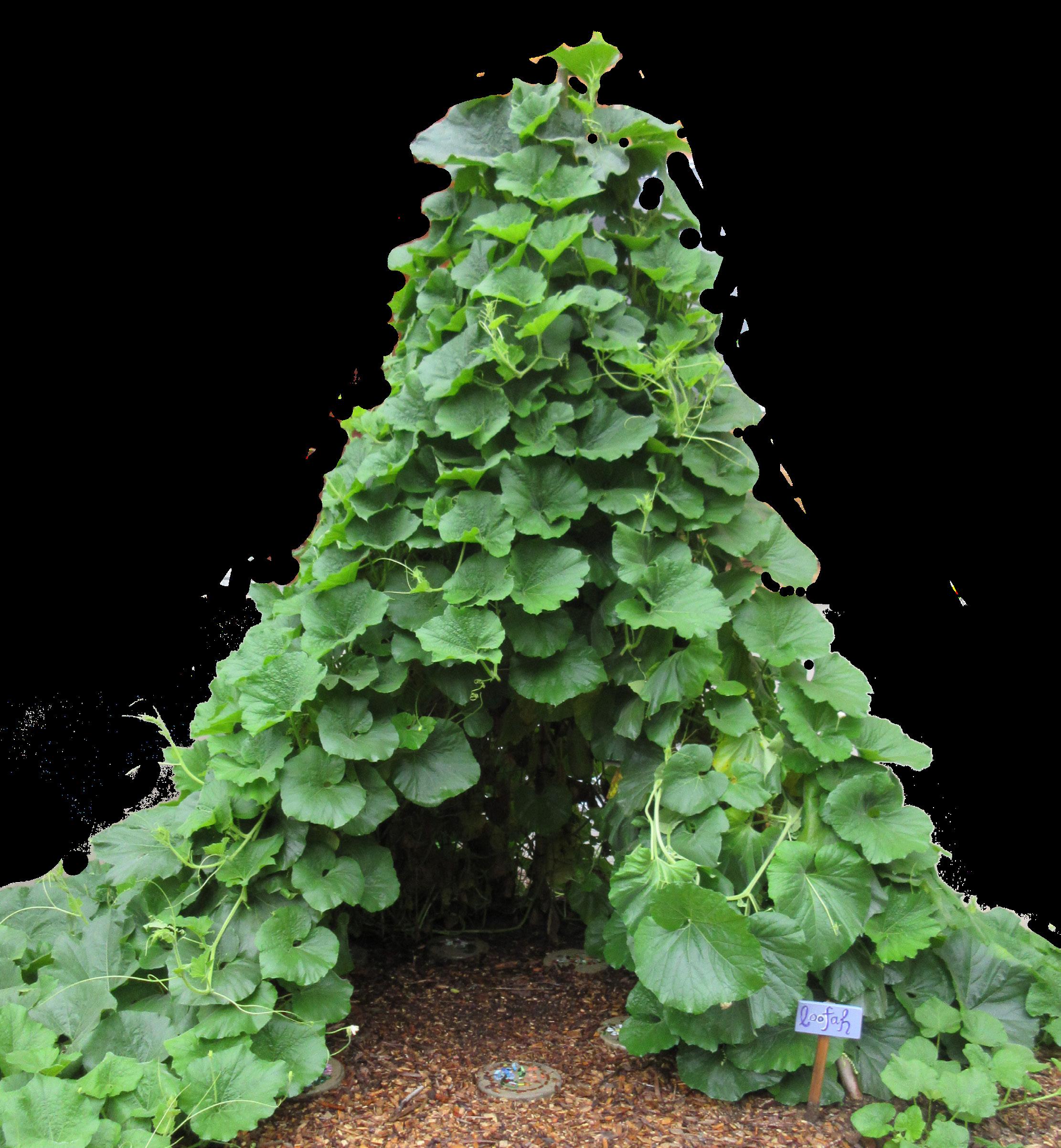
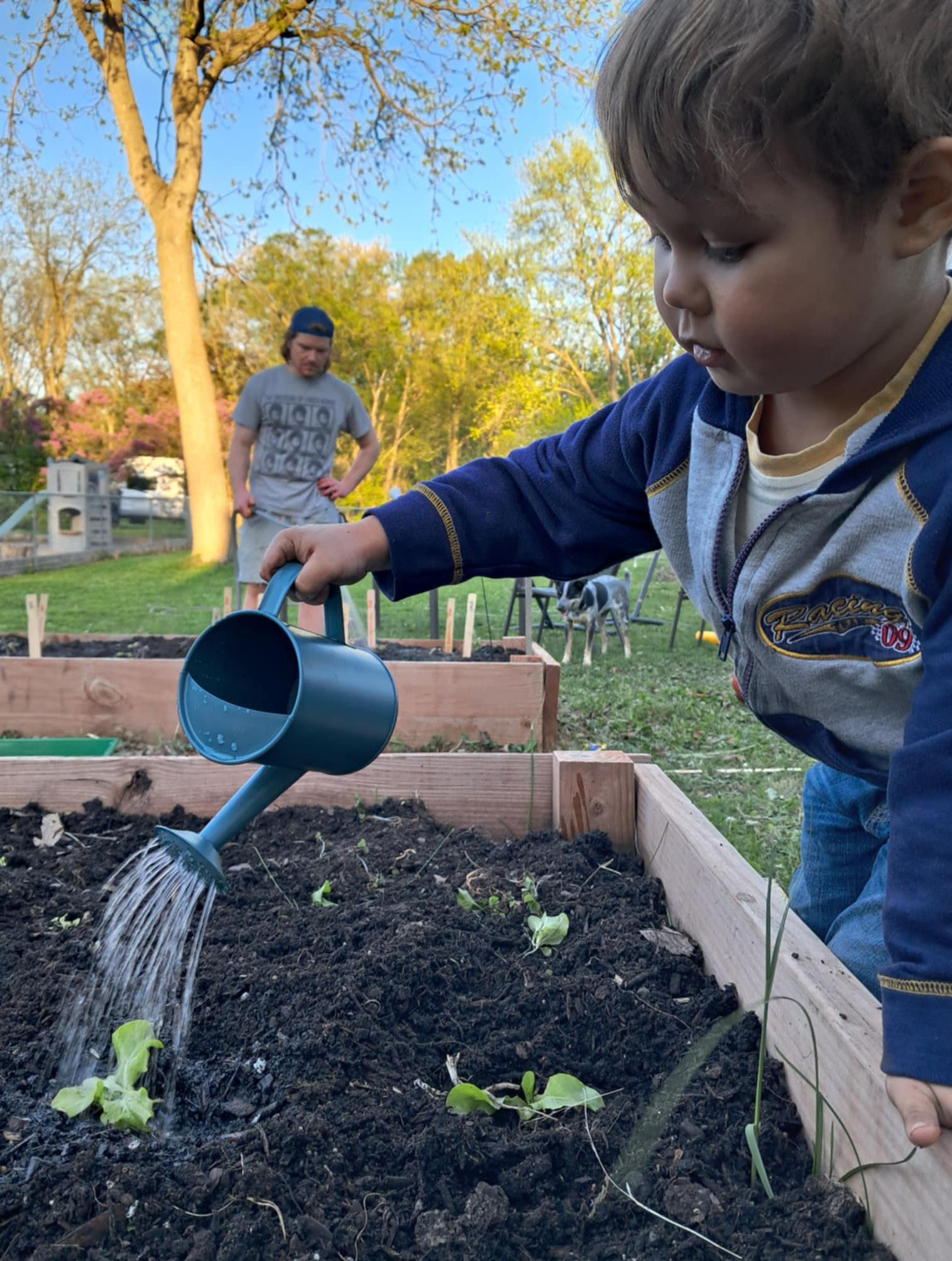
The custom, wooden playset in our backyard that was built for our daughters (now 36 and 26 years old) still stands, and after the girls outgrew it, was a support for vines, hanging baskets and other elements. Admittedly, we figured it would need to come down at some point. However, our 4-year old grandson now uses it as his sheltered “fort”, and we’ve renovated the climbing ropes, slide, monkey bars and ladders to rejuvenate this feature which also includes planters and a small raised bed for him to utilize for his favorite vegetables (he loves cherry tomatoes and basil!).
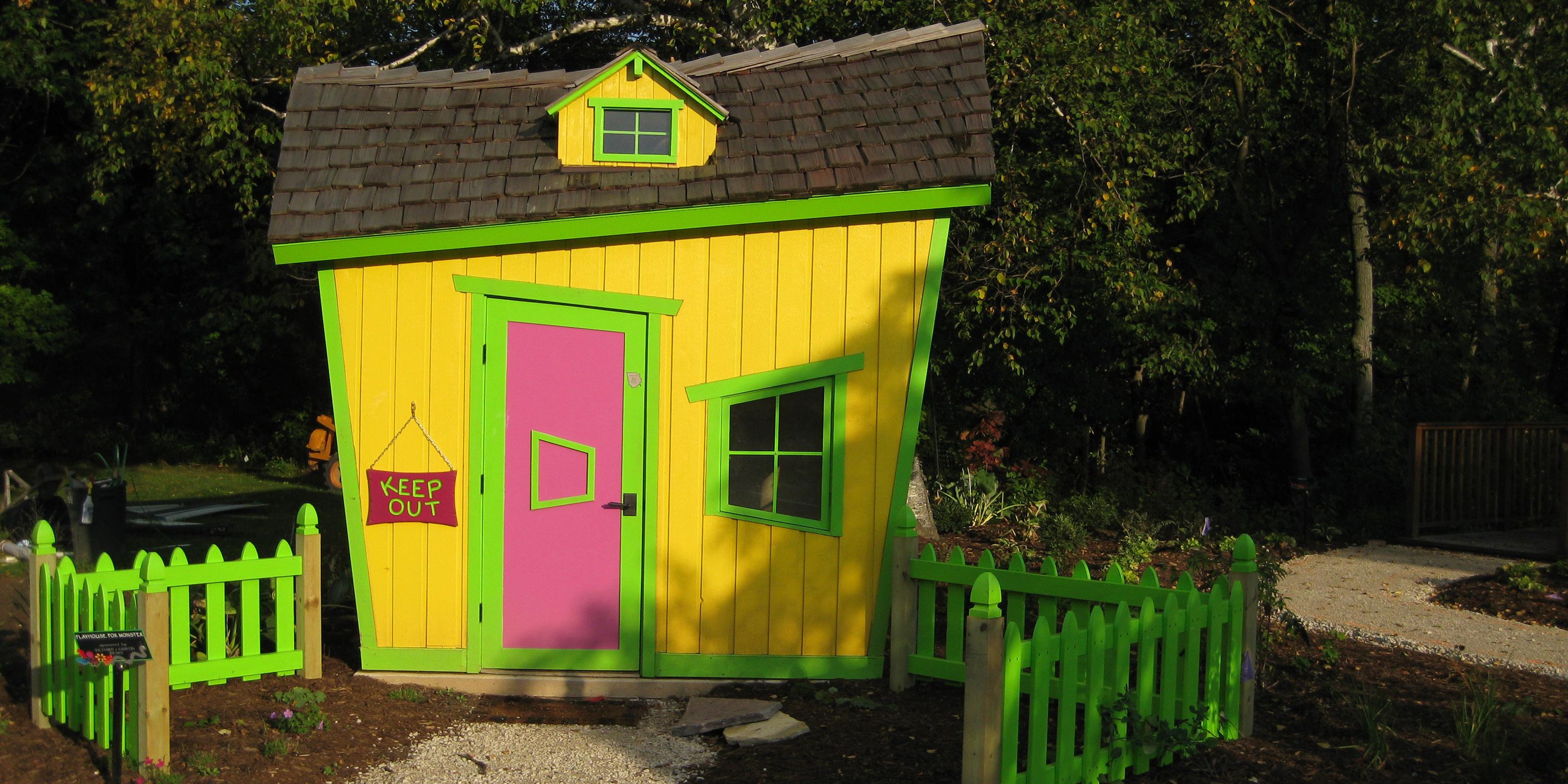
Trampolines, jungle gyms, tree swings and other elements don’t have to be “floating” elements in the landscape and can connect planted areas or be nestled into lush landscapes that offer opportunities for transitional engagement. Consider the use of natural materials whenever possible. Our typical, rectilinear yards shouldn’t appear as holding pens for disparate elements. Providing discreet and adequate storage solutions for yard toys and other smaller items is another worthy goal as we rarely consider this need. This might consist of a standard shed or could be a playhouse that also has storage options. Again, this active landscape should be able to absorb and support the daily “play zone” activities but be appropriate (and durable) for other uses.
Plantings
Aside from the selection and placement of woody plants to create privacy, define functional space or simply beautify, when children enter the equation, it

becomes important to also consider other details. Avoiding toxic and poisonous plants is an obvious goal, as is avoiding overly thorny selections in close proximity to active play areas. Hardy and durable selections are consistently in our repertoire.
Plants that provide scent are typically appreciated by the entire family, so consider incorporating fragrant woody plants, perennials and even select annuals for their additional olfactory engagement. Fragrant plants in close proximity to those active space areas and certainly our entertainment spaces, are ideal for maximum enjoyment.
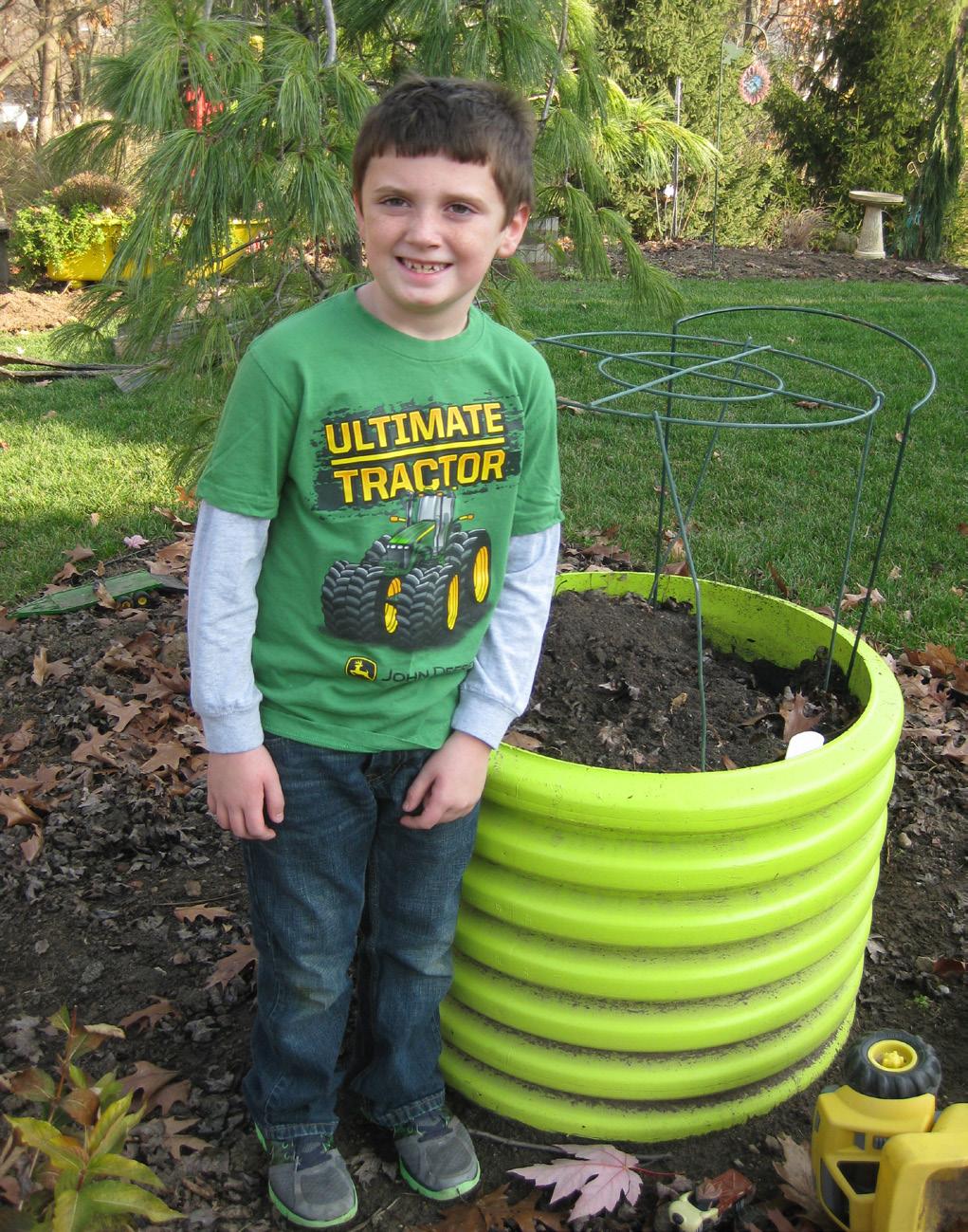
Creating a small, personalized area (i.e. raised bed) for children would also allow them to grow herbs, vegetables and other fun plants. These special gardens become another engagement and learning opportunity that also fosters responsibility for the children. As children get older, these “learning gardens” can be expanded, removed or absorbed into the landscape at that time. Parents may decide to include these elements later but there is
nothing wrong with suggesting them in advance for consideration during the design process.
In Summary
The home landscapes where we spend time daily are vital and support the well-being of the entire family. Considering children in the complex equation of creating a personalized, beautiful and functional landscape, while not a new approach, can really maximize the enjoyment and use of the landscape by the entire family. A kid-friendly landscape can harmoniously include amenities, features and plantings that will evolve as kids grow and interests change. Encouraging both physical and imaginative play in functional areas that also integrate adult enjoyment and use is a worthwhile goal, and the landscape should grow with the family’s interests and become the “hangout” everyone enjoys!

Hardscape Contruction Details
Moisture Issues In Hardscapes and
by Daniel Wood
When water and dissolved minerals move upward through soil and hardscape materials (like concrete, stone, brick, or pavers) and then gasify or evaporate at the surface, a range of physical, chemical, and aesthetic problems can occur. These are driven mainly by capillary action, vapor pressure, temperature changes, and mineral crystallization
Below is a breakdown of the most common issues.
1. Efflorescence (White, Powdery Deposits)
2. Subflorescence (Internal Salt Crystallization)
3. Spalling and Surface Scaling
4. Alkali–Silica Reaction (ASR) in Concrete
5. Hydrostatic Pressure & Vapor Drive
6. Joint and Mortar Deterioration
7. Biological Growth (Secondary Effect)
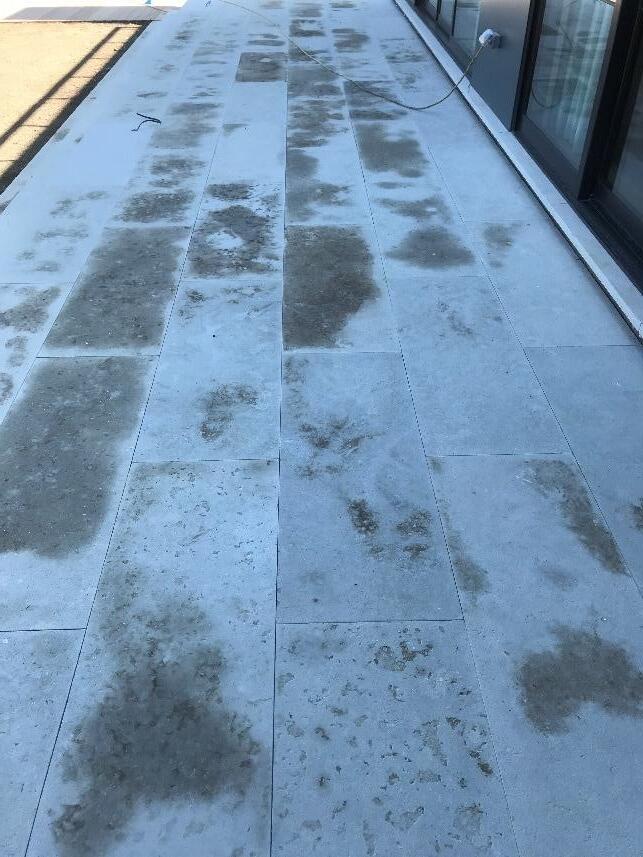
8. Staining and Discoloration
9. Soil & Base Layer Instability
Root Causes (Why This Happens)
• Poor drainage or high water table
• Capillary rise from fine-grained soils
• Lack of vapor barriers
• Concrete pours not allowed to sure for the proper time period
• Highly soluble minerals in soil or base materials
• Impermeable surface layers trapping moisture below
• Temperature gradients driving vapor upward
Typical Mitigation Strategies
• Proper sub-base drainage and grading
• Capillary breaks (gravel layers, geotextiles). The current trend of open graded permeable base installation, with lateral drainage in the base layer for poorly drained subsoils, aids in managing the moisture issue.
• Damp-proofing of unexposed surfaces for more porous natural stones such as some Limestones and Sandstones. Bluestone is a sandstone.
• Usage of resin-based permeable joint products
• Low-alkali concrete mixes
• Vapor barriers under slabs
• Regular maintenance of joints and drainage paths
The Indiana Limestone Institute (ILI) guidelines for damp proofing Indiana Limestone emphasize protecting all unexposed surfaces (backs, beds, joints) with a cementitious or bituminous coating up to 1 foot above grade, and damp proofing adjacent concrete supports to prevent moisture wicking and alkali staining, ensuring a breathable barrier for longevity. They also recommend proper detailing, like ventilated dry areas, and careful application to avoid damaging the stone’s natural breathability or causing impurities to leach out.
Key Guidelines & Recommendations:
• Coverage Area: Apply damp-proofing to all unexposed surfaces, including the back, beds, and joints (within 1 inch of the finished face for bituminous), extending at least 1 foot above grade.
• Support Surfaces: Damp-proof all concrete or CMU surfaces where the limestone will rest, including support angles and ledges.
• Material Types: Use a cementitious waterproof backing (like a thick, sandy slurry) or bituminous backing; ILI does not endorse specific brands but emphasizes breathability.
• Application: Apply coatings in the field to prevent damage and ensure proper curing.
• Purpose: Prevents alkali staining, reduces efflorescence (impurities leaching out), and protects the stone from soil moisture.
• Detailing: Design for proper drainage and include ventilated dry areas around the base of walls.
What to Avoid:
• Acidic Cleaners: Never use strong acids, sandblasting, or wire brushes on limestone.
• Sealers (Sometimes): Avoid impermeable sealers that block the stone›s natural breathability unless specifically advised for certain conditions.
Damp-proofing the bottom and sides of natural stone used in hardscapes (pavers, coping, steps, walls, caps, etc.) can provide several important benefits—especially in installations where moisture, salts, or freeze–thaw cycles are present.
and Damp-Proofing
Daniel Wood is a natural stone and material consultant for Lurvey Land

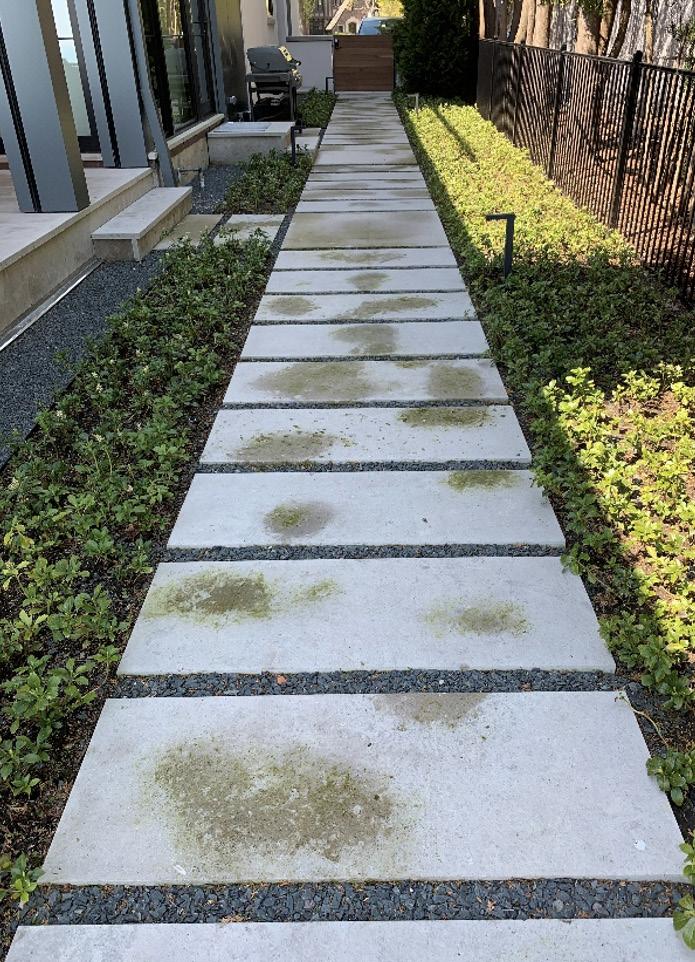
When Damp-Proofing Is Most Recommended
• Areas with poor drainage
• Freeze–thaw climates
• Projects using light-colored stone
⚠️ Typically do not damp-proof the top surface, unless using a breathable penetrating sealer designed for exposed stone.
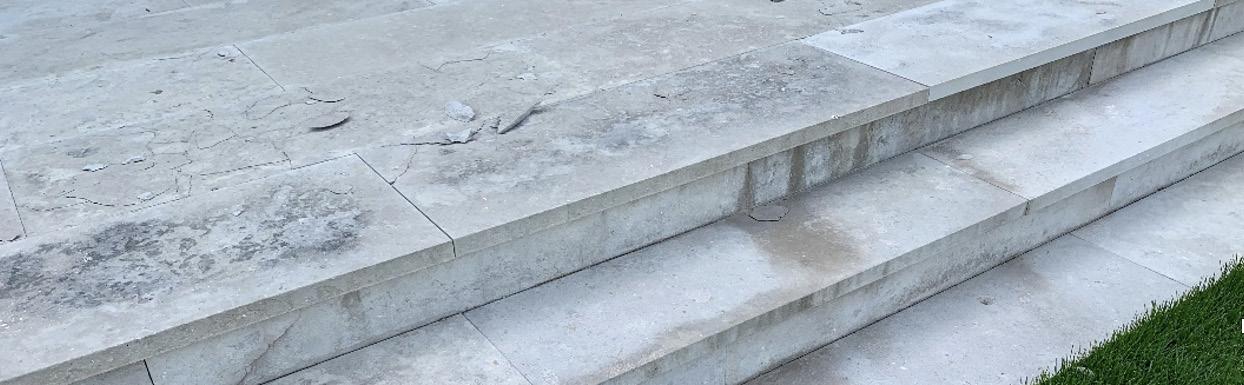
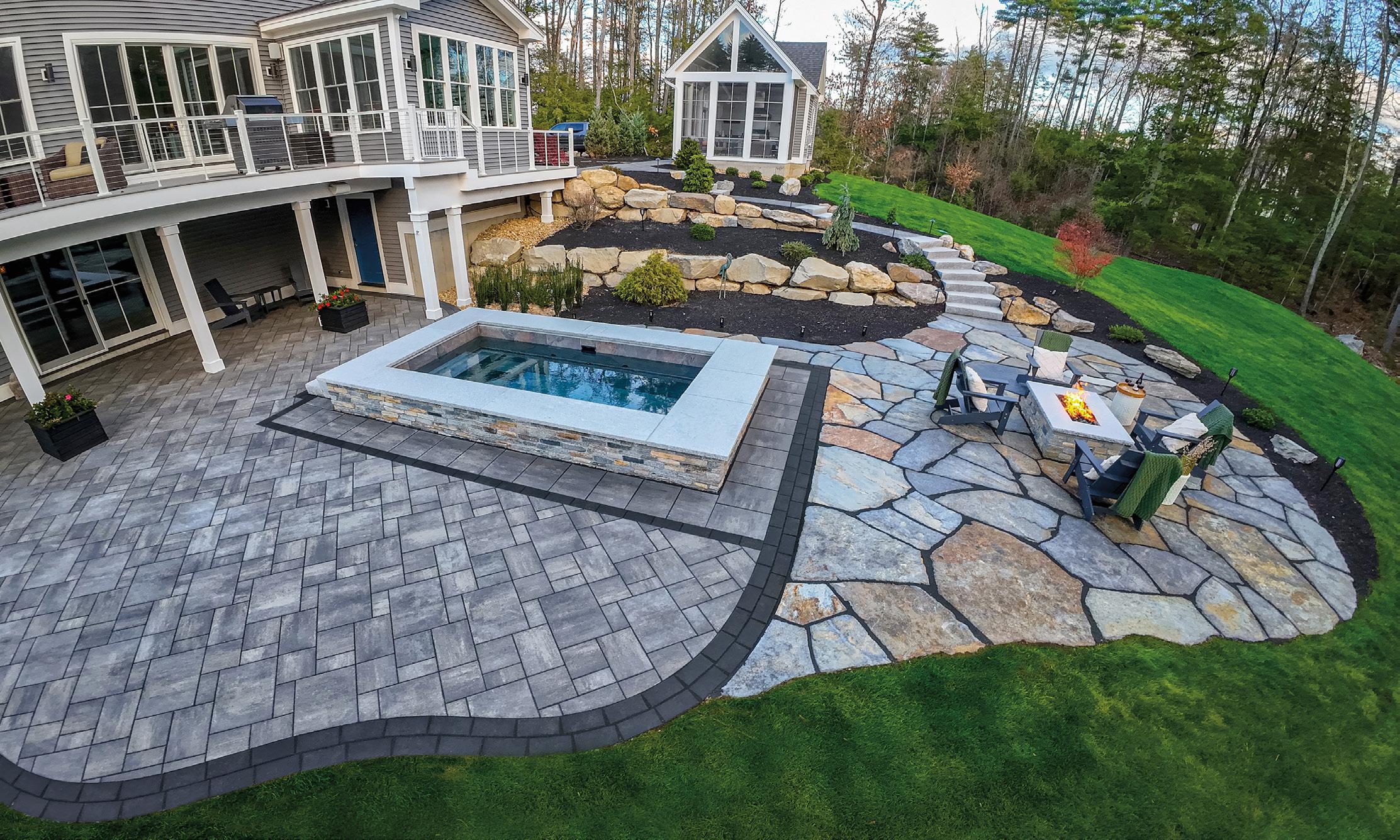
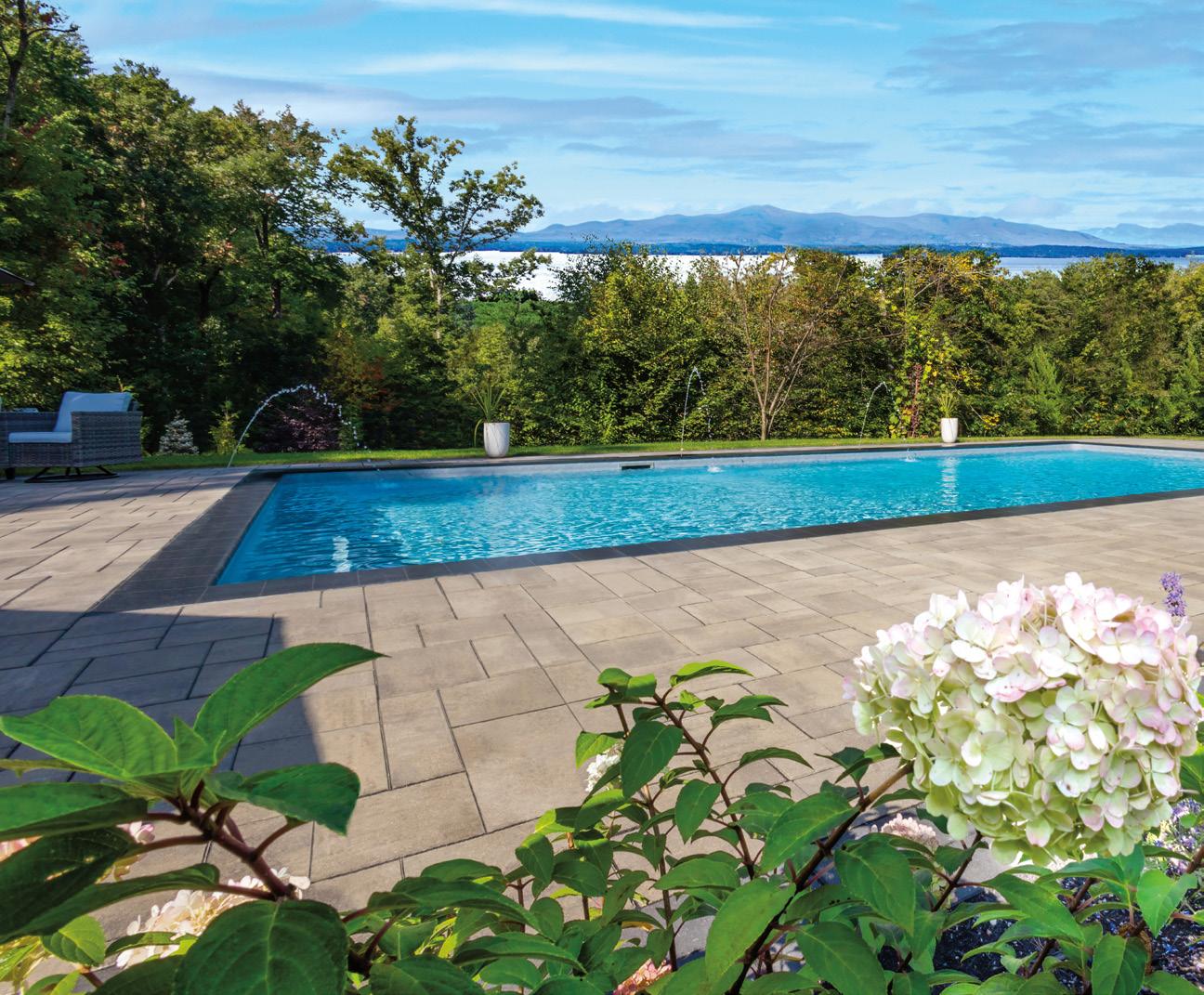
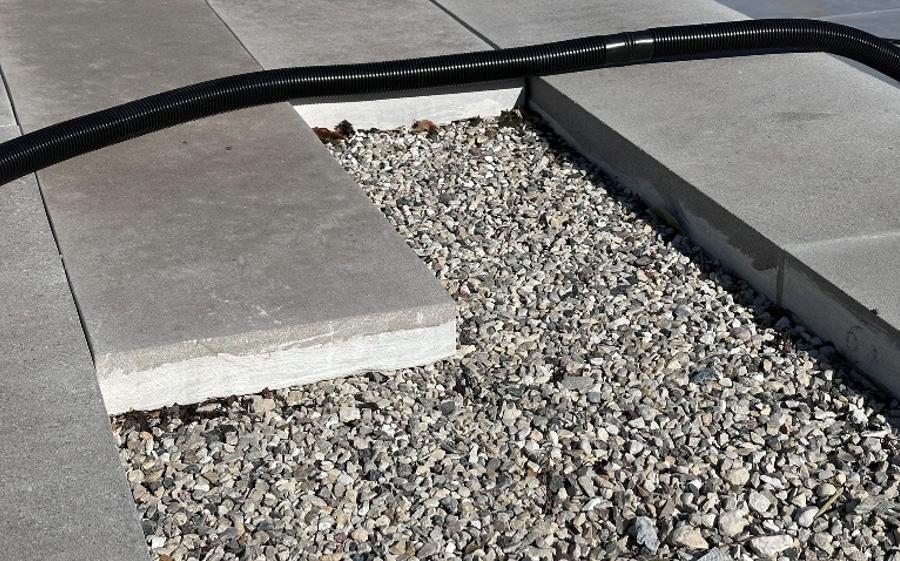
Image of a damp-proofed Indiana Limestone on a pool deck installation over a permeable base.
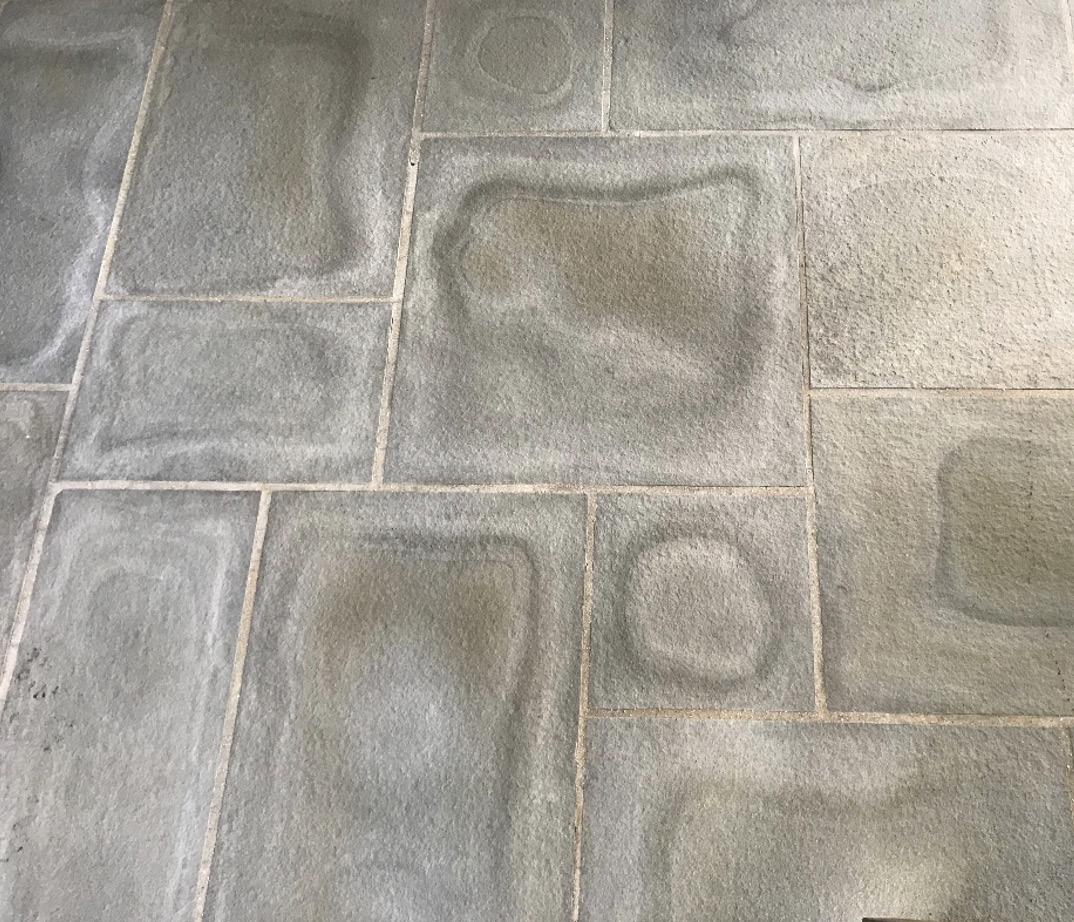
Bluestone staining on a mortar set application
Staining on Limestone Mortar set on Left and dry set on right
Design Debate
Pixel or Pencil? AI or the Brain?
“In
a world of expensive screens and interfaces designed by others, drawing offers a priceless antidote, returning us to our evolutionary path and re-igniting systems that are millennia in
the making.”
— English Architect Patrick Downing, 2014
by Nina A. Koziol
Ahandful of landscape architects began using computerassisted design (CAD) in the 1980s and the new technology slowly gained steam. CAD has streamlined the design process, allowing for faster modifications and two- and three-dimensional modeling. That, too, is changing because now there’s a lot of buzz about integrating emerging software and artificial intelligence (AI) into the landscape design process.
AI-powered software can quickly analyze the site specs, soil types, light exposure and regional climate to display the best plants and layouts. And for some companies, that investment may quickly produce more designs, more efficiently. However, landscape design is traditionally grounded in creativity and hands-on craftsmanship. While the increased use of AI may mark a new era of efficiency and sustainability, there are many designers who find pencilto-paper incredibly rewarding.
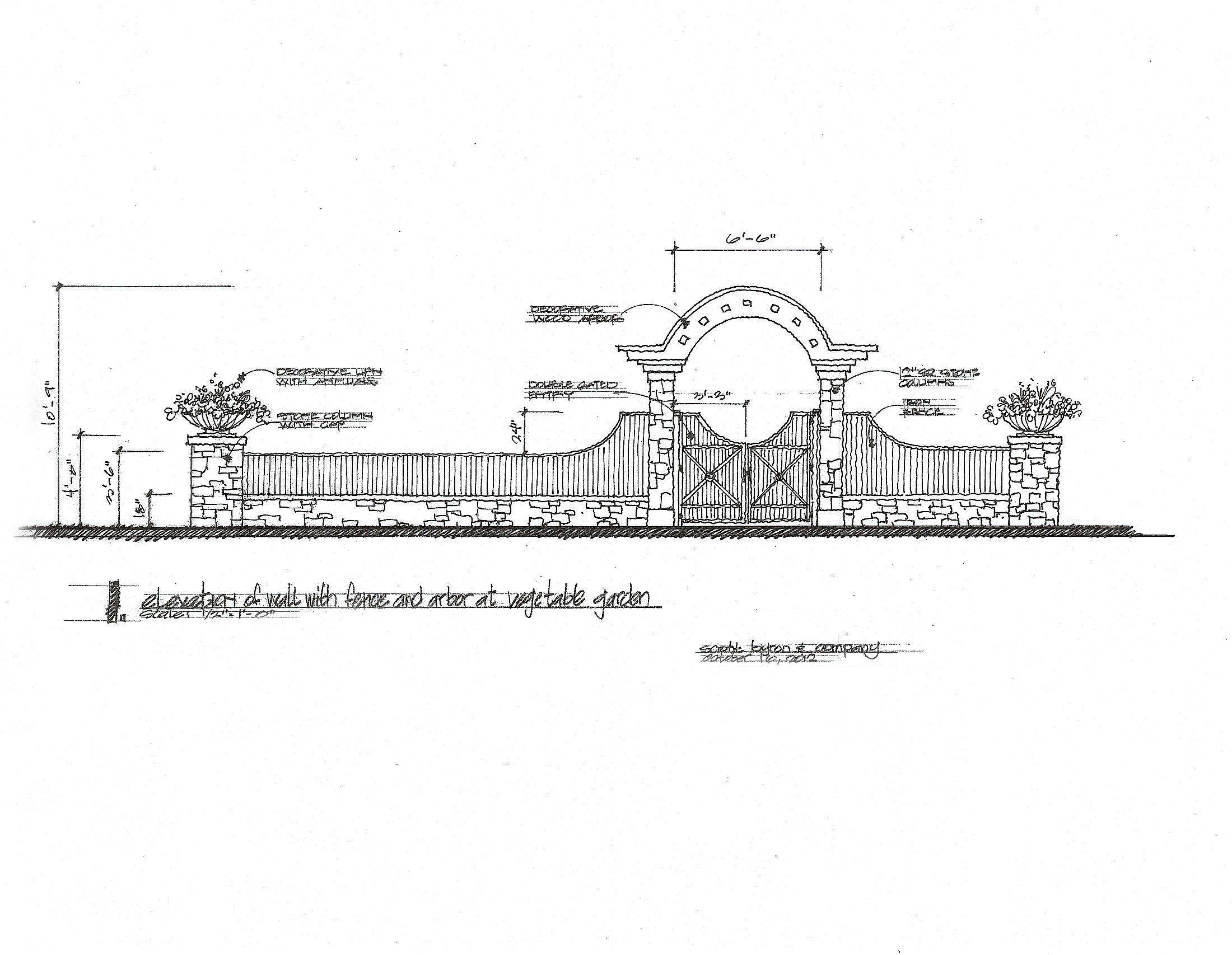
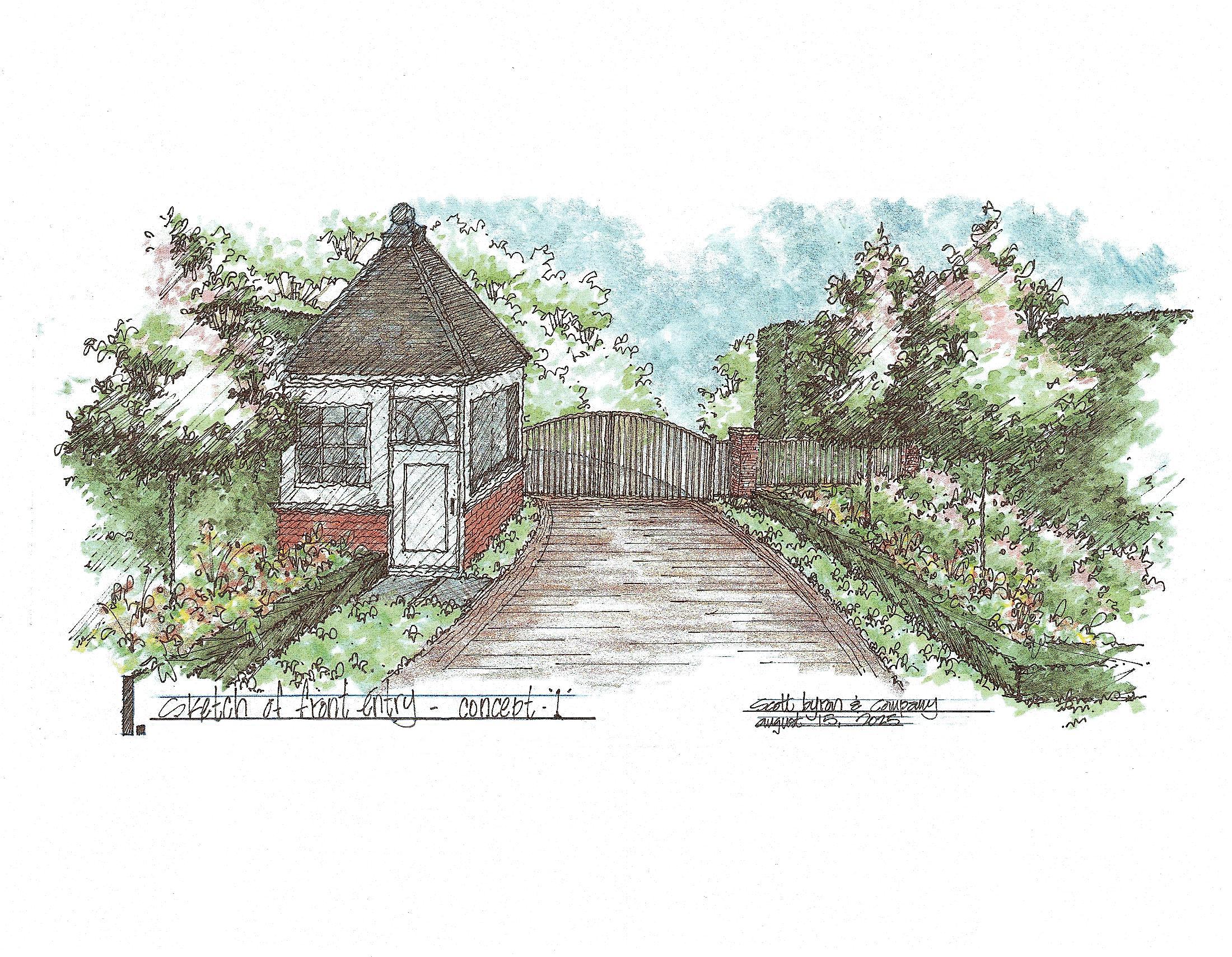
Gary Topalian is the Senior Landscape Architect and Co-leader of the Design Studio at Scott Byron & Co in Lake Bluff. “When it comes to brainstorming and
shaping initial ideas, hand sketching is unmatched,” he says. “When I first started with the firm, hand graphics were the only method used to prepare drawings for client presentations. By the year 2000, CAD was introduced and the design team began to reap the benefits to stay competitive in the industry.” Currently, his design team members intertwine the use of both applications, when necessary, to produce precise drawings from project site surveys to master landscape plans.
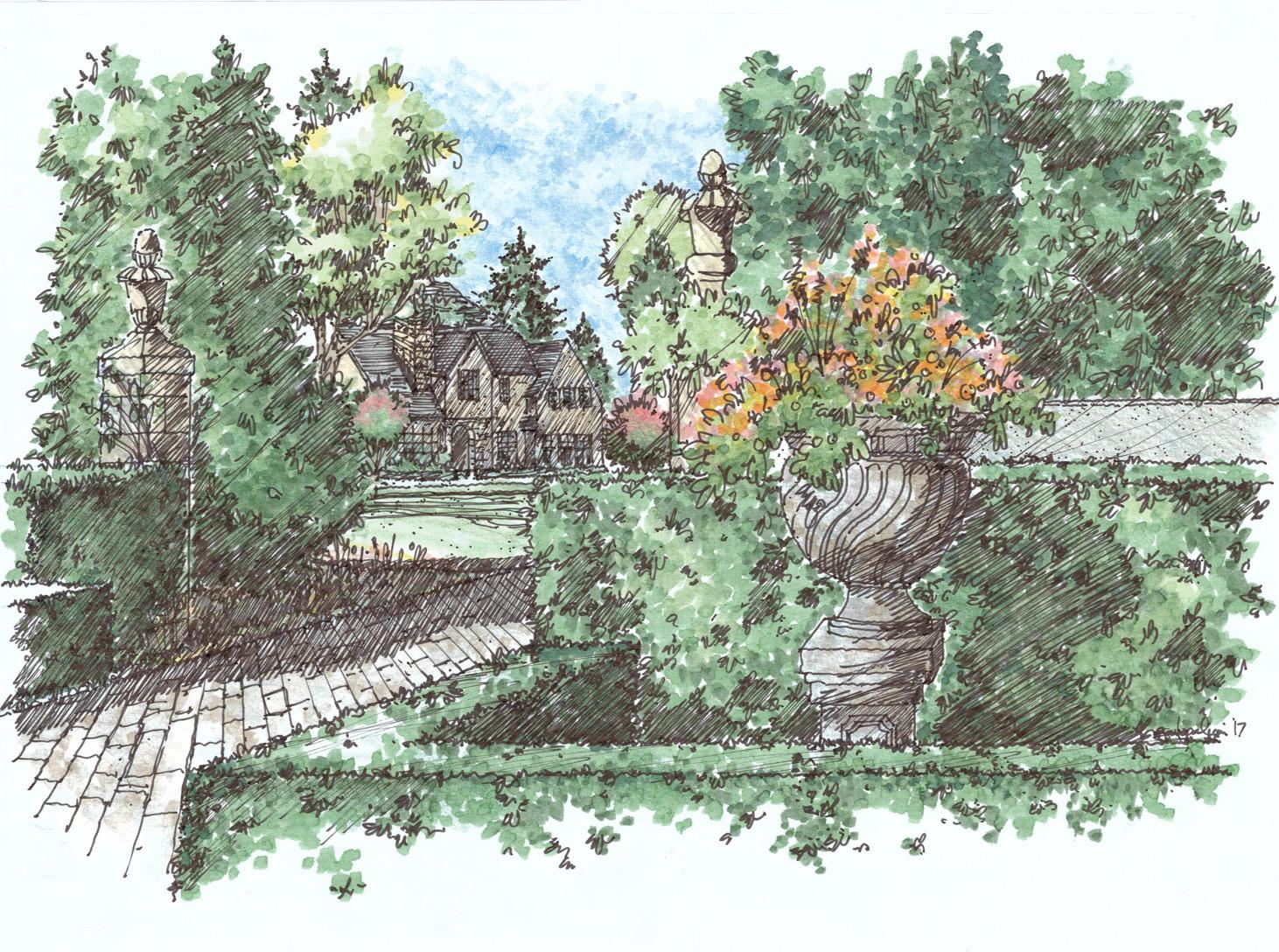
But there’s another reason Topalian enjoys hand-drawn designs. “There is freedom to spark fresh ideas and alternate solutions and concept iterations to then select the stronger option that best represents the design and vision, hence streamlining the creative process.” He notes that hand drawing plans can result in quicker thought development brought to life without the limits of software. “They offer charm, drama, realism and a quicker turnaround time for design development depicting organic and often more appealing aesthetics. Applying the final touch with color gives the landscape plans the
back Michael Dirr!
Hosted by Savage Farms, Inc. | Supported by Pioneer Gardens, Inc.
A nostalgic journey through decades of landscaping and nursery innovation, style, and culture—from the ‘60s to the early 2000s.
Our featured keynote speaker, Michael A. Dirr, is the author of seven books, including Manual of Woody Landscape Plants: Their Identification, Ornamental Characteristics, Culture and Propagation and Uses, a widely used and best-selling reference text. A Mercer scholar, Dirr is considered one of the green industry’s most celebrated plant experts. A professor of horticulture at the University of Georgia, his teaching, lectures, seminars, garden study tours and plant introduction programs have contributed to industry awareness.





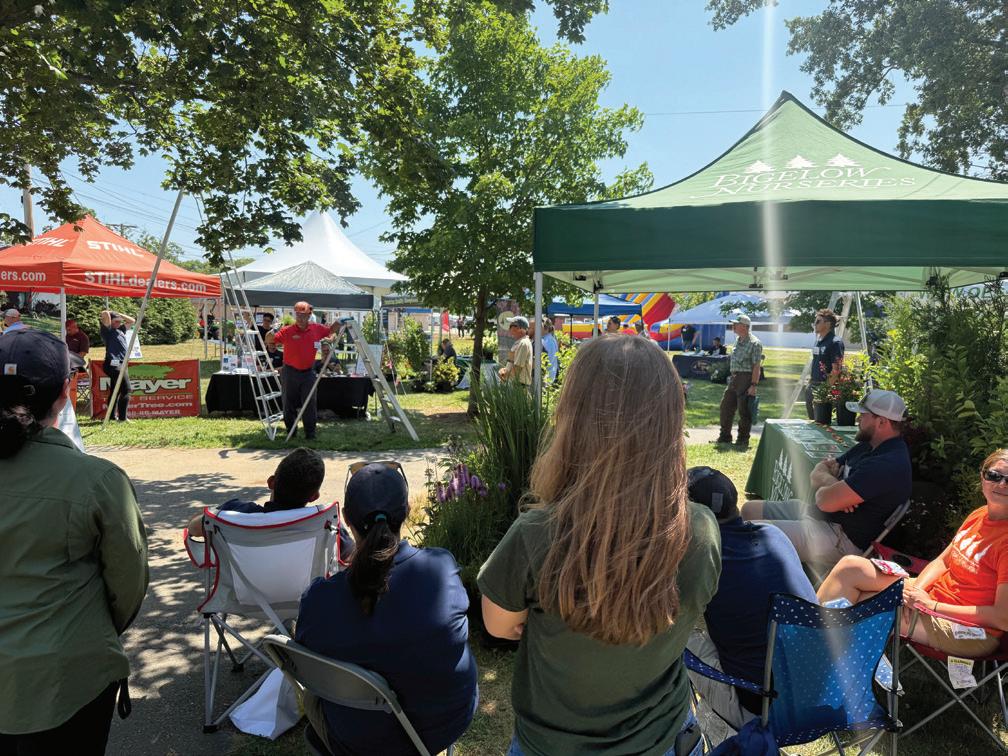
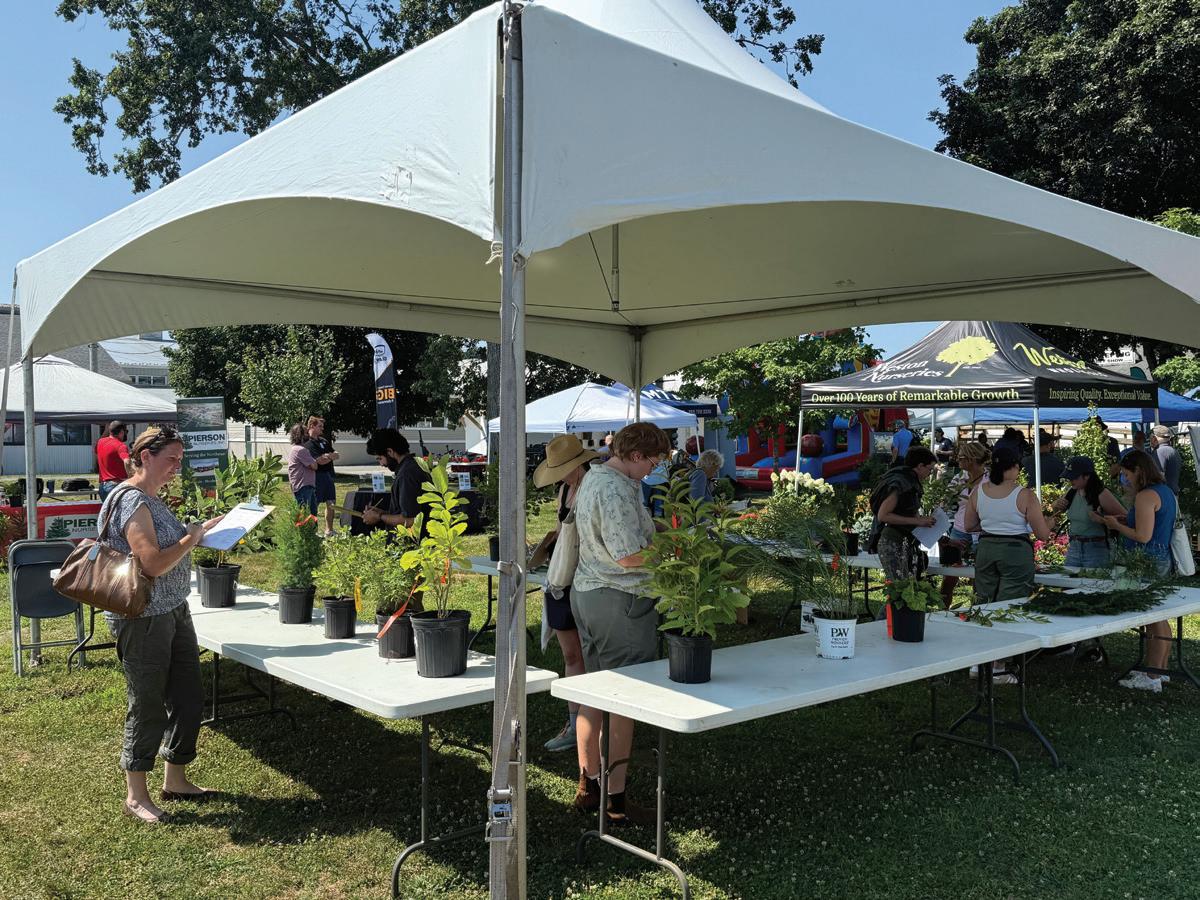
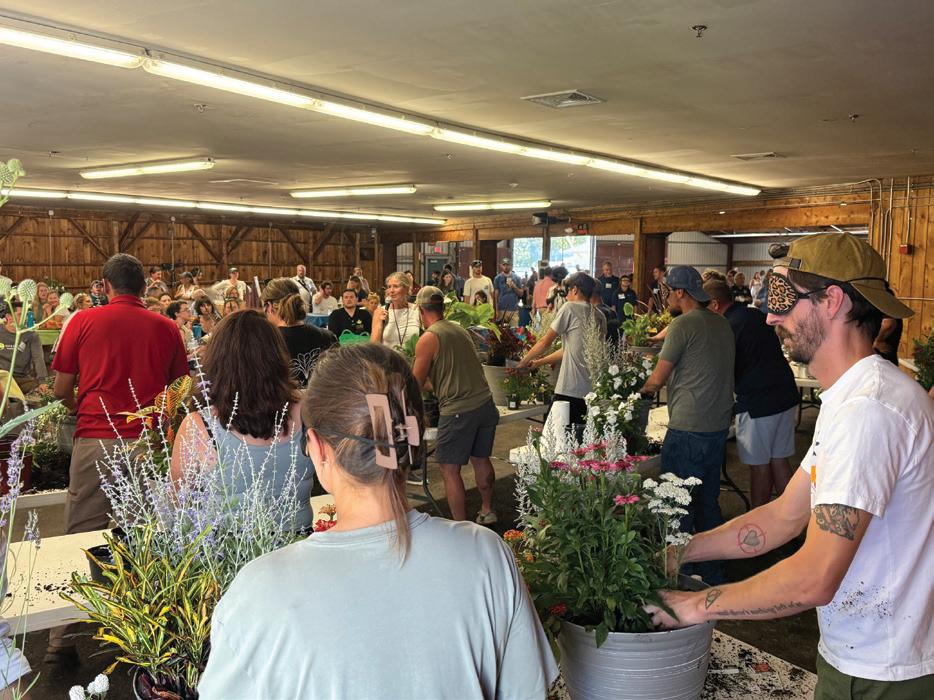
punch and depth, simply adding intrigue to the designs,” Topalian says.
The Brain-Hand Connection
A 2020 study in the Journal of Neuroscience found that while a person was drawing, a more distinct connection was made between the brain’s visual processing center and the area involved in motor planning. Drawing is a process by which the brain transforms perceptions into actions, and in doing so, it enhances the
brain’s ability to share information and think critically.
“The powerful artistic tool of freehand two-dimensional landscape plans can entice and draw clients into the design process,” Topalian explains. “The loose and initial schematic preliminary ideas can help them visualize the proposed conditions developed for their property based on their wishlist.” Topalian recognizes that there are drawbacks to hand-drawn plans, such as the need for physical storage space, potential damage and the need for similar graphic
really started using the 3D modeling towards the end of last year to lay out all the plumbing runs and give the guys better direction in the field.” Up until then, it was hand-drawing, but now he’s using Structure Studios’ Vip3D software, which can transform 2D project drawings into interactive 3D presentations. “Three-D is much better than two-dimensional schematics and elevation drawings,” Carnes says.
“Drawing a plan that is accurate to scale in both 2D or 3D is much easier and faster using CAD,” said Susan Kopczynski, owner, Susan’s Gardenscapes “It’s also easier and faster to make revisions.” However, “The plant graphics in some 3D versions looks amateurish and choices are too limited. When the graphics are expanded and improved, I think that, for larger projects, the speed and accuracy of CAD will win over the art and nostalgia of hand-drawn plans. The exception to that would be for an artist like Piet Oudolf,” she says. Both Oudolf (of Chicago’s Lurie Garden fame) and Roy Diblik, co-owner of Northwind Perennial Farm in Burlington, WI, have been known to doodle their designs on napkins.

New England Wetland Plants, Inc.
Wholesale Native Plant Nursery
Coir Logs, Straw Wattles, Blankets and Mats
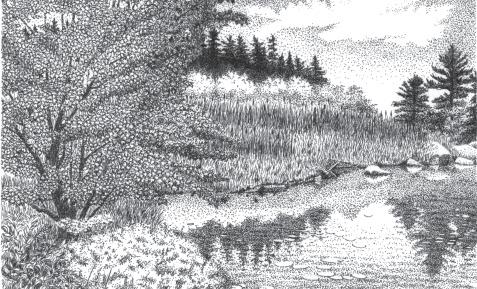

The Future
“It looks like CAD programs are gaining traction with newer and better graphics, but hands down, in my opinion, handdrawn designs are the way to go when presenting,” says Matt Erickson, owner of Erickson Landscaping in Ottawa.
Topalian says he is fortunate that Scott Byron & Co. has always embraced hand drawing graphics as part of its design process to produce master landscape plans.
“We have the privilege to actually utilize both techniques equally well when developing a plan, which can contribute many advantages to our process,” he said. “In essence, the looser and freehand sketched plans offer many benefits, such as enhancing creativity, quicker conceptualization, idea sharing, improving analytical skills and, my favorite, a unique and personal touch that connects the landscape architects and clients to the vision.”
He notes that all of this fosters better problem solving and emotional connections compared to purely digital methods. “The overall goal is still to achieve a visual display that clients can understand and
follow. Furthermore, hand drawing allows for quick idea exploration, fluid creative flow as well as conveying a unique artistic quality making abstract ideas tangible to the thinking process,” he says.
Closing Thoughts
“While freehand plan drawings offer a profound sense of purpose and passion, I do feel that hand-drawn plans, elevations, sketches, details and hand-colored renderings still have a place in the landscape design studios,” Topalian said. “The uniqueness in a hand produced landscape plan maintains a sense of human artistry that develops the joy, comfort and personal touch making each design project exceptional.”
I thought I’d do an online search—using AI no less. It told me: “Hand drawing offers a unique, human quality and allows for emotional expression, while CAD provides precision, speed, and ease of collaboration. Both methods have their advantages and can be used effectively in architecture.”
FULLY FOCUSED ON SUPPORTING YOUR VISION.
At Farm Credit East, the future has never been clearer.

Today, there are plenty of distractions in agriculture to sway producers and their partners from the task at hand. But Farm Credit East maintains the same missiondriven strength that helps both our teammates and customer-owners stay focused on the future. We’re proud to meet the credit and financial needs of Northeast farming, forestry, fishing and agribusiness, all while gaining new perspective ourselves.
Welcome Spring

Plan Your CEUs for 2026
As members of the Massachusetts Nursery and Landscape Association community look ahead to a new season of growth, now is the perfect time for MNLA’s certified professionals (MCH) to Plan Your CEUs for 2026.
Continuing Education Units are more than a requirement. They are an investment in professional credibility, industry leadership, and personal development. The MCH program offers numerous opportunities to earn CEUs throughout the year, and some of the most engaging options do not cost a dime, except your time and creativity.
CEU Opportunities at No Cost
MCHs can earn CEUs by participating in simple, meaningful industry engagement activities:
• Submit Your Favorite Plant – Share why it performs, sells, or inspires in your landscape or nursery.
• Plant Selfie – Highlight a plant success story from the field, garden center, or job site.
• Seasonal Native Plant Spotlight – Showcase a native plant and explain its value to pollinators, biodiversity, and Massachusetts landscapes.
These submissions not only help you earn CEUs but may also be featured in Pro Grow News and shared through MNLA’s consumer outreach initiatives, including Plant Something MA and Growing Wild, a partnership program with the Massachusetts Department of Conservation and Recreation and the Massachusetts Department of Agricultural Resources. It is a meaningful way to elevate both your professional profile and the visibility of our industry statewide.

Start Planning Now
Whether you are newly certified or a long-standing MCH, take time now to map out how you will earn your CEUs in 2026. From events and educational programs to creative submission opportunities, there are many ways to stay engaged and ahead of the curve.
Questions about CEUs or certification? Contact Kayla Anger at admin@mnla.com.
Let 2026 be a year of growth, professionalism, and continued excellence. Plan your CEUs now and stay connected to the strength of the MNLA community.
Celebrating Our New MCHs
We are proud to recognize and celebrate our newest Massachusetts Certified Horticulturists who successfully completed the February exam. Your dedication to professional excellence strengthens the entire green industry. We look forward to highlighting the following individuals and their companies.
Trista Ashok, MCH The Constant Gardener
Hunter Blanchard, MCH NatureWorks Landscape Services
John Callahan, MCH Tufts University
Kristina Ferrara, MCH
Shoma Haque, MCH S Haque Designs, LLC
Luke Henault, MCH ZEN Associates
Matthew Larsen, MCH Parterre Garden Services
Glen Lord, MCH Potted Up
Harley Monteiro, MCH Parterre Garden Services
Stacey Montuori, MCH NatureWorks Landscape Services
Kristin Neill, MCH Recover Green Roofs
John Noonan, MCH Newton Cemetery
Jonathan O’Neal, MCH Hartney Greymont
Randall Owen, MCH Cobble Hill Farms
Anna Powers, MCH Xquisite Landscaping
Max Shafer, MCH Essex Horticulture
Lucy Smith, MCH Reimagined Roots
Rebecca Zielinski, MCH Parterre Garden Services
Becoming certified is a significant achievement. Maintaining certification demonstrates ongoing commitment to knowledge, best practices, and industry advancement.


Before
You Go...
Fragrant Abelia for Spring Scent
by Mark Dwyer
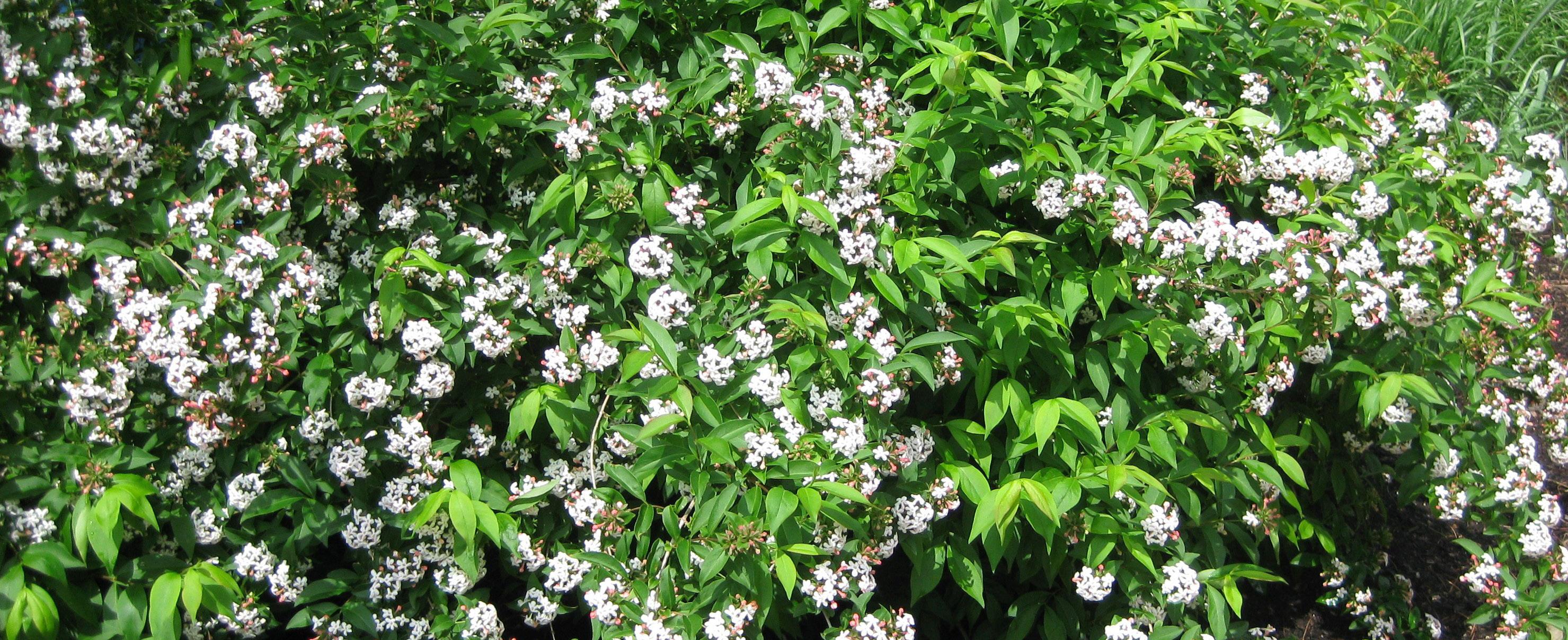
I’m a strong proponent of maximizing scent in the garden and landscape. I can’t say that I’ve ever heard anyone say that their garden is TOO fragrant! Early spring scent in the garden is common with our frequent (and understandable) use of lilacs and fragrant viburnums. If you’ve never visited Lilacia Park in Lombard during peak lilac (Syringa sp.) season, put that on your bucket list! While there are many other spring-blooming, fragrant woody plants, one that I feel is oddly underutilized is the fragrant abelia.
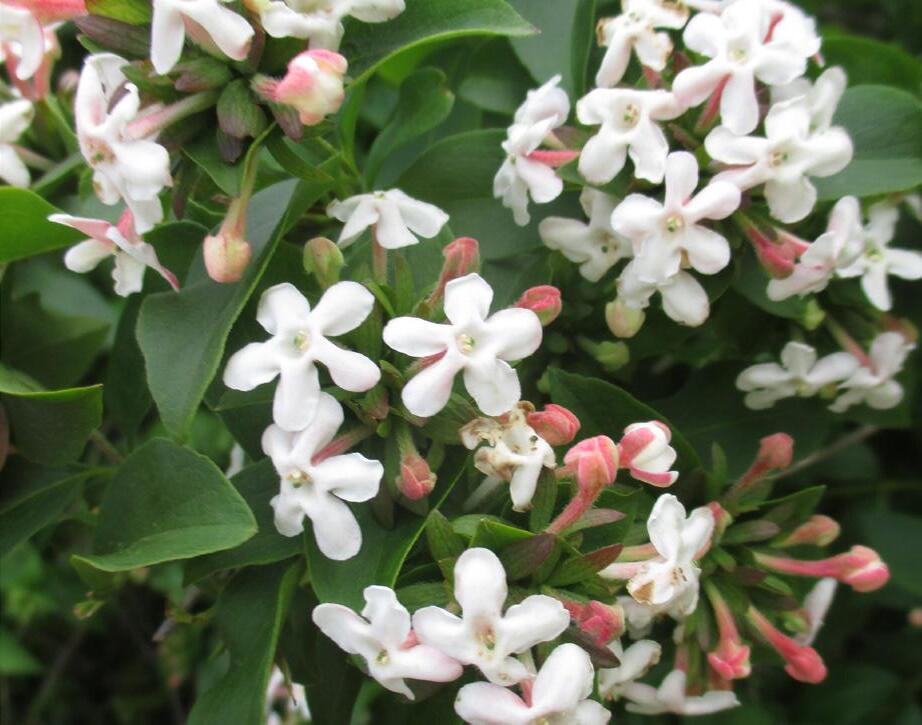
A member of the Caprifoliaceae (honeysuckle) family, fragrant abelia (Abelia mosanensis, syn. Zabelia tyaihyonii) is native to both North and South Korea and has become more readily available over the past decade or so. Over 20 years ago, I planted a trio of this medium-sized shrub (reaching 6’ tall and wide) in a very sunny spot and was enchanted by the extremely sweet flower fragrance in May. Tight clustered, pink flower buds open to pinkishwhite, tubular blooms that emit a strong fragrance similar to jasmine. A light breeze allows you to enjoy the plant from an impressive “radius of waft” and while the flowers are a brief, two-week display, bees, butterflies and hummingbirds will also be interested in this display.
As an added bonus, the glossy green foliage turns a notable orange in fall, and while variable from year to year, it is typically quite showy. While full sun is ideal for this selection, dappled shade is acceptable.
Average soils are perfect for this tough shrub although ample moisture during establishment is important. Blooming on old wood (like lilacs), pruning should be done immediately after flowering. The habit of this shrub is best described as an informal “arching mound”. Occasional thinning and architectural pruning may be required over time. Understanding and accommodating this form, particularly the width, is important.
Fragrant abelia has long been listed with a zone 5 hardiness. My personal experience with multiple polar vortices indicates a solid zone 4 for this species which thrives in the Midwest. There are some varietal selections of Abelia mosanensis that are purported to be more dense, compact and hardy, although I see little difference between these varieties and the straight species. Look for Sweet Emotion Blaze® (replaces the former Sweet Emotion®) and Bridal Bouquet® as they might be more commonly available. Propagation is primarily by cuttings. Deer and rabbits aren’t overly interested in this shrub, and it also has very few insect or disease problems.
While scent is certainly subjective, I personally think this shrub is the most fragrant of our spring options. While the flowering period is brief, the orange fall color is a bonus. Consider placement near paths, patios, decks or in proximity to spaces for that scent to really be enjoyed. It’s worth it!










MARKETPLACE

Schedule Your 2026 Advertising
pro grow news Committment to Qualtiy
The Massachsetts Nursery and Landscape Association has a long history of innnovation. pro|grow|news is simply a reflection of MNLA and its position in the industry. Its purpose is to promote the environmental well-being of the state as well as the highest levels of business ethics within the profession.
2026 brings a renewed commitment to quality for pro|grow|news readers and advertisers.
2026 Issue Schedule Deadlines
Winter November 10
Spring February 10
Summer May 11
Fall August 10
Opportunities
pro|grow|news delivers loyal and active readers to its advertisers. Our policy remains — keep ad rates affordable in order to attract more product choices for members. This commitment has not wavered.

The MNLA Four Seasons Guide provides a complete up-to-date listing of MCHs and members. The annual publication is mailed to members.


My Favorite Plant
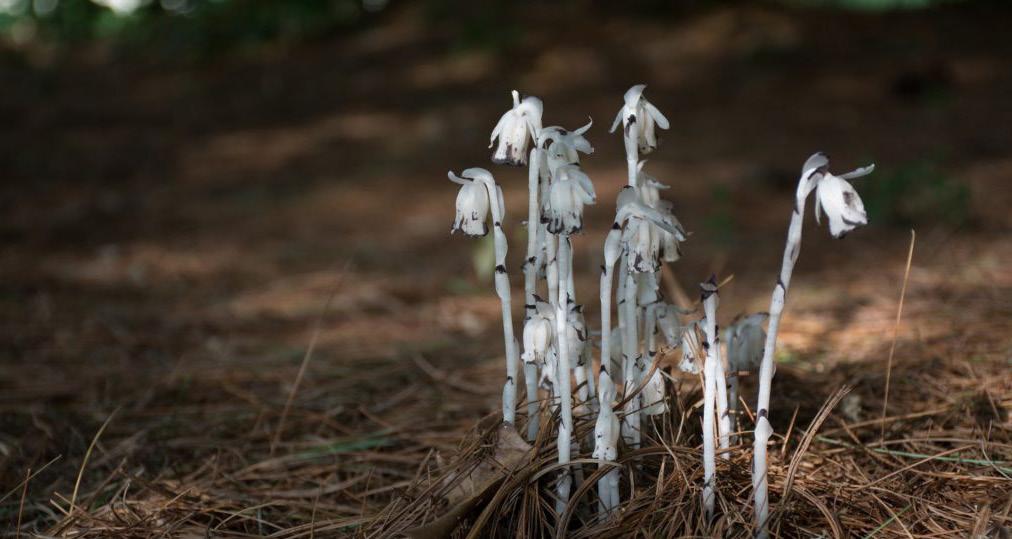
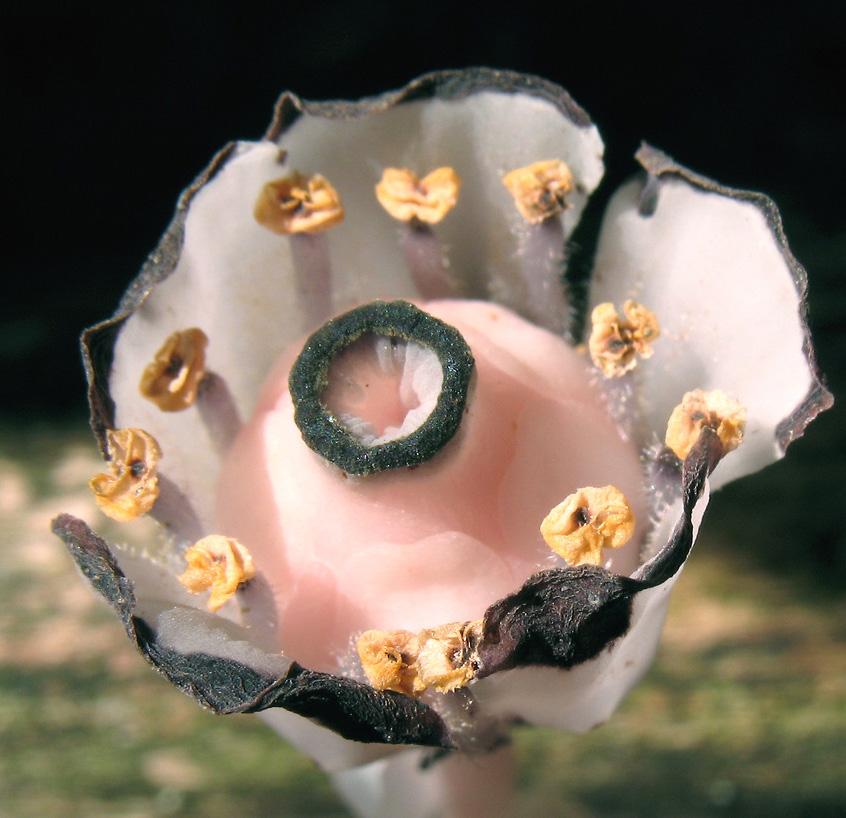
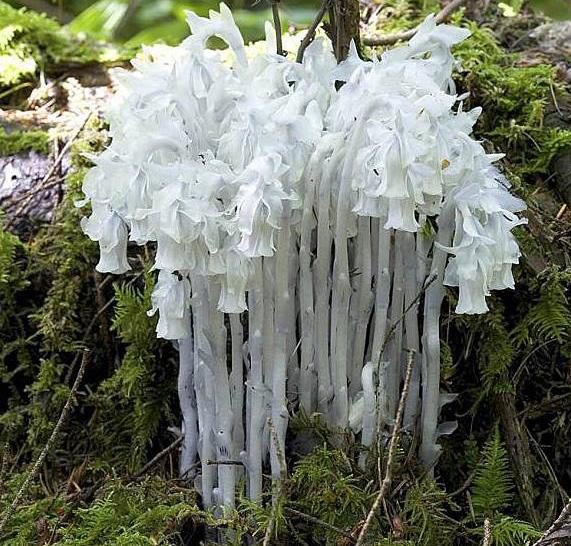
Monotropa uniflora — Ghost Pipe
Why This Plant Shines
Monotropa uniflora is an extraordinary example of adaptation. It is a parasitic plant that has no chlorophyll, getting its nutrients from nearby plants - such as trees- through the fungal network of mycelium in the soil. It can be an indicator for healthy soil.
Facts
and Features
It is a native plant to Massachusetts commonly found in the understory of forested areas. Due to the lack of Chlorophyll, the plant is white, sometimes with black spots, and has a waxy texture. It is often mistaken for fungi but is a plant with a symbiotic relationship with fungi under the soil. However, Ghost Pipe has a parasitic relationship with nearby trees which provide it nutrients through the fungi’s mycelium network.
Alison Carroll, MCH
Parterre Garden Service
Billerica, MA
Scientific Name: Monotropa uniflora
Common Name: Ghost Pipe
Exposure: Shade
Plant Type: Perennial Size: Height 2-12 ins.
Soil: Average
Zone: 9-11, parts of 8
Growth Rate: Average