The Landscape Contractor magazine May.17 Digital Edition
EN ESPAñOL
Photo Credits
ILCA Awards Program 1, 8-9
Rick Reuland 14, 24-25
Logic Lawn 20-22
Mike Yanny 44-52
Hursthouse 34-43
Scott Mehafey/Nina Koziol 44-52
The official publication of the Illinois Landscape Contractors Association (ILCA), The Landscape Contractor is dedicated to educating, advising and informing members of this industry and furthering the goals of the Association. The Landscape Contractor carries news and features relating to landscape contracting, maintenance, design and allied interests. Publisher is not responsible for unsolicited material and reserves the right to edit any article or advertisement submitted for publication. Publication reserves right to refuse advertising not in keeping with goals of Association. WWW.ilca.net
Volume 58, Number 5. The Landscape Contractor (ISSN # 0194-7257, USPS # 476-490) is published monthly for $75.00 per year by the Illinois Landscape Contractors Association, 2625 Butterfield Road, Ste. 104S, Oak Brook, IL 60523. Periodicals postage paid at Oak Brook, IL and additional mailing offices. Printed in USA.
Postmaster: Send address changes to The Landscape Contractor, 2625 Butterfield Road, Ste 104S, Oak Brook, IL 60523. DisPlay aDvertising sales: Association Publishing Partners, Inc., Ph. (630) 637-8632 Fax (630) 637-8629 email: rmgi@comcast.net ClassifieD aDs, CirCulation anD subsCriPtion: ILCA (630) 472-2851 Fax (630) 472-3150 Publisher/eDitorial offiCe: Rick Reuland, rmgi@comcast.net, Naperville, IL 60540 Ph. (630)637-8632
AUGUST
August 10, 2017 Summer Field Day College of DuPage Glen Ellyn, IL
ILCA Staff
Executive Director Scott Grams (630) 472-2851 sgrams@ilca.net
2625 Butterfield Road Ste. 104S Oak Brook, IL 60523 (630) 472-2851 • Fax (630) 472-3150 www.ilca.net
Senior Writer treethyme@aol.com
Patrice Peltier
Feature Writer patpeltier@charter.net
Meta Levin
Feature Writer meta.levin@comcast.net
Nina Koziol
Feature Writer n.koziol@att.net
Heather Prince
Feature Writer princeht@sbcglobal.net
Marilyn Witney
Feature Writer madwitney@comcast.net
From Where I Stand —
On March 31, 2017, ILCA Education Manager
Julie Nicoll will retire. Julie has worked for ILCA for 27.5 years. When I shared the news with the Board, the committees she supported, and the staff, they all said the same thing, “We need to send her off right!” Julie dutifully supported the ILCA for almost three decades and we needed to return the favor.
Unfortunately, due to timing, we didn’t have any major member events on the horizon. I had to plead with Julie to come back for the 2017 Annual Party in November so we could send her off in style. There, we would have plaques and speeches. I could sense Julie’s level of discomfort growing. She finally squeaked, “I don’t have to make a speech, do I?”
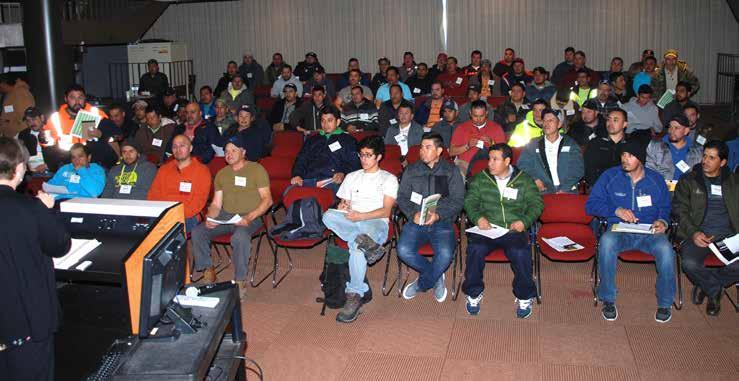
Thankfully, we had one more opportunity to send Julie off in a far more fitting manner. If any reader was lucky to work with her on an event, you knew she invested every ounce of her professional pride into the programs she managed. We decided to launch a new program this year called Field Staff Skills Training. It was to be her swan song. It would involve a brand new program, using two different committees who never worked together before, at a new venue, and actually included our first attempt at bilingual sessions where Spanish and English speakers spoke in the same room at the same time. No, we were not going to send Julie off easy.
legacy she cared about more than flower bouquets and speeches. When I first started at ILCA, I had never hired a single person before. At previous jobs, I had been part of interviews and reviewed resumes, but the decision to hire was never mine. When I had my first opportunity to hire, I naturally found the person who I deemed the most qualified. I looked at the neatly organized resume and fell in love with the bulleted items after each impressive job title. I was impressed by the college they attended and the various software packages they had mastery of. My first hire lasted 45 days.
Our Debt of Gratitude
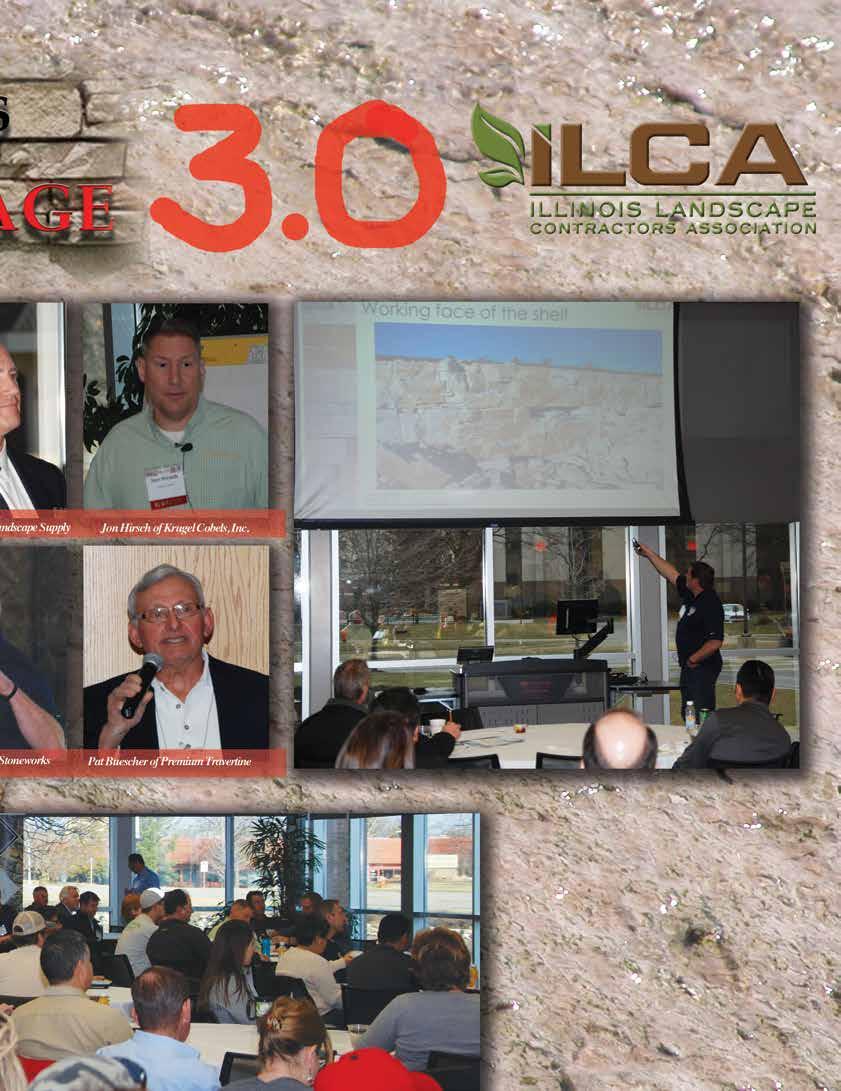
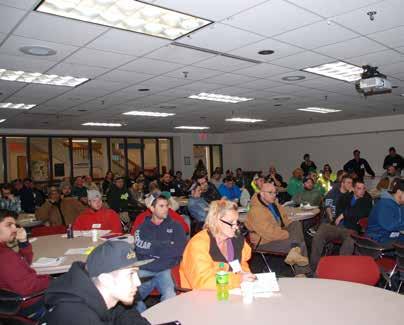
We have an old saying in ILCA; never let it get to the other side of the registration desk. Plans may go awry, but we should do everything possible not to let that harm the attendee experience. Large events are always an exercise in organized chaos, just like large landscape jobs. Julie, of course, executed a phenomenal event. Almost 225 people attended the sold out seminar. They left better prepared for the upcoming landscape season.
In the last 10 minutes of the event, we surprised Julie with a flower bouquet and some brief words in front of the gathered audience. Our words of sentiment did not need translation, everyone understood the significance of Julie’s final education event. Keep in mind, Julie has likely planned between 400-500 events while at ILCA. The entire audience loudly applauded as Julie made her way to the stage. She was flashing her trademark smile. I could tell she was delighted, but at the same time knew she wanted to scamper back to the registration desk to collect evaluations and distribute certificates. That’s Julie; duty first.
If you knew Julie, sending her off at an event for field staff meant more to her than pomp and circumstance. Julie didn’t just support ILCA, she believed in it. Julie, more than any person I have ever met at ILCA, lived our mission. The Path to Professionalism, the structure, the history, the members, those all mattered to Julie in a profound way.
Get Julie alone and the one thing she will miss above anything else are the members. She spoke about ILCA members with reverence and pride rarely found in the modern workplace. When those field staff workers, in their muddy boots and Carhart’s applauded, it meant the world to her. She knew she had just participated in an event that would raise the bar. It would lead to a more efficient and safer industry. That was the
I made a few more hires and went back to my old system. I worked my way through binders of resumes with my red pen. I would circle key attributes and scored each resume on a scale of 1-5. Those hires lasted a few years. It’s impossible to work towards a vision when your team needs to be replaced every two years. I was being humbled by the shortcomings of my hiring process.
I then looked across my office. I saw Julie sitting at her desk. She worked dutifully and diligently. She asked for help when she needed it, but never wasted my time or spent her office visits telling me things I already knew. She came prepared to meetings. She showed up early and left late. She understood the frugality we needed during an ugly, soul sucking recession and simply adjusted rather than fight the inevitable with comparisons to ILCA’s golden age or boom times.
Julie taught me the value of loyalty. Understanding loyalty allowed ILCA to build a stronger staff. That stronger staff has supported the dreams of our volunteers. Those volunteers have ushered in an era of unprecedented success. During her tenure, there are very few ILCA programs Julie did not touch. There are a miniscule amount of companies she did not know. Julie was part ILCA historian and part sage. Like all who are wise, Julie speaks last, not first.
When I came to ILCA I had a lot of crazy ideas. In addition, I was addicted to transforming ILCA and threw my energy behind every half-baked notion I came across. I’d sit at staff or committee meetings, my eyes boggled and my voice was quick. I was half mad scientist and half PT Barnum. Julie would listen and smile. She would then tell me about some similar idea that happened one or three or five or 20 years prior. Yet, she never dismissed these plans. If they failed before, she would illuminate, but not chastise me. She would not use past failures as a reason for why we should not try again.
One would think a 20-year tenured employee would be stuck in her ways. Julie was the exact opposite. She would examine what new factors were in place that could make the old idea new again - the hallmark of a true innovator. Innovation is more than coming up with shiny new ideas. True innovators are the ones who resurrect ideas once cast aside. These innovators find ways to make those ideas succeed when it would be simpler to brush them aside saying, “We tried that once before.”
The one day that stands out in my mind, was in February of 2012. Two employees had left for different jobs within six weeks of one another. The day after they left, I walked into the office crestfallen, rejected, and full of doubt. It was impossible
not to take it personally. Julie and I exchanged pleasantries and asked about each other’s weekends. We then settled down at our desks and began to work. The silence was deafening. I could hear the clock on the wall and the air ducts over my head. That silence did not improve my mood. A few minutes later, Julie appeared at my door. She never barged in. She never interrupted. Julie would gently rap on my doorframe and say “knock, knock.” I smiled and waved her in. She sat down, prepared as always. I leaned on my hand and said, “So Julie, what are we going to do?”
Julie smiled that trademark smile. She considered her next words before just blurting out an answer. She knew I was not asking rhetorically, I was truly at a crossroads. “We move on,” she began. “I know you will figure it out. Besides, we’ve got a lot of work to do.” Julie had more faith in me than I had in myself at that moment. She trusted me to get this right and in the same breath, reaffirmed that she would stand by me while we did.
Less than two months later, Alycia O’Connor and Terre Houte were hired on the same day. That was the birth of the team who had both the courage and insanity to launch iLandscape. A few years later, Marissa Stubler was hired and ILCA was put on a brand new course. In my darkest moment, Julie was my light.
Julie will physically leave ILCA at the end of the month. Yet, her presence will be felt for years to come. I will take her thick employee file and move it to a different file drawer. Some of the performance reviews in that file are handwritten or were banged out on typewriters. That will be a difficult moment for me. I am losing a tremendous employee, colleague, and friend.
One must understand that when you strip it all away, ILCA was built on its education. It has kept us relevant for almost 60 years. We constantly add and eliminate programs to make sure our offerings match what the industry needs at all levels. All those educational programs, Winter Seminars, design charrettes and tours, pruning classes, CLT tests, and so much more had to pass across Julie’s desk. Julie was entrusted with ILCA’s most sacred product for almost 30 years and she met that challenge with her discipline, calm, organization, good humor, and passion for our members. There is simply no way that can be faked.
Julie Nicoll left ILCA in a far, far better place than when she found it. At the end of the day, that is the mark of a true professional. Julie has walked with ILCA on this path to professionalism. Now, she must leave us. Julie was the first to arrive and the last to leave our events for 27.5 years. She would schlep cartloads of neatly organized boxes to her car, ready for the next event. On her last day, she will walk to her car unencumbered and with a head held high. The piece of this industry she’s been carrying for all these years will be set down. I owe it to her to keep carrying this industry forward, we all do.
Scott Grams
President Mike Schmechtig Schmechtig Landscape Company (847) 566-1233 mschmechtig@schmechtiglandscapes.com
Vice-President Lisa Fiore
Don Fiore Company, Inc. (847) 234-0020 lfiore@donfiore.com
Secretary-Treasurer Tom Lupfer Lupfer Landscaping (708) 352-2765 tom@lupferlandscaping.com
Immediate Past President Rusty Maulding Nature’s View (815) 592-7582 rusty@naturesview.info
Directors
Mark Breier National Seed Co. (630) 963-8787 mark.breier@natseed.com
Lisa Fiore Fiore Nursery and Landscape Supply (847) 913-1414 lisa@cjfiore.com
Jose Garcia Natural Creations Landscaping, Inc. (815) 724-0991 info@naturalcreationslandscaping.com
Allan Jeziorski Hartman Landscape (708) 403-8433 allan@hartmanlandscape.net
Dean MacMorris Night Light, Inc. (630) 627-1111 dean@nightlightinc.net
Kevin Manning K & D Enterprise Landscape Management, Inc. (815) 725-0758 kmanning@kdlandscapeinc.com
Maureen Scheitz Acres Group (847) 526-4554 maureen.scheitz@acresgroup.com
Donna Vignocchi Zych ILT Vignocchi, Inc. (847) 487-5200 dvignocchi@iltvignocchi.com
President’s Message —
Spring is upon us and just like many of you who have plans for the 2017 season, your Board of Directors does too. The Board of Directors met in February to develop our plans for the coming year. A new 3-year strategic plan has been developed with a major emphasis on the following: to grow the membership responsibly including all segments of the industry; to fully fund our reserves and develop a 5-year events calendar to make sure we target all of our member needs; and finally to develop a comprehensive public and professional marketing plan to improve the image of the landscape industry as a service and vocation. The staff, Board of Directors and committee members of the ILCA continues to make looking forward a priority.
This past year we have absorbed two organizations - the Illinois Professional Lawn Care Association and the Midwest Ecological Landscape Alliance. We have built a bridge for their members and have strengthened our committees and broadened our appeal. They saw the ILCA as their new home because of our strong history in leadership, committee management, and accomplishments in industry events.
We are keeping a close eye on Illinois Senate Bill 9Service Tax on Landscaping. Under this proposed bill, we are facing a 6.25% sales tax increase on every job we do. The surrounding states were the first to have implemented a service tax on landscaping because they had weak lobbies. Let’s not allow what happened to the companies in the surrounding states happen here in Illinois. If you haven’t done so already, reach out to your representatives. To find your Illinois representatives, go to this website: http://capwiz.com/nea/il/home/, it will provide contact information for your state Representatives. All ILCA members should be telling their elected officials to say NO to Illinois Senate Bill 9 – 6.25% Service Tax on landscaping; you are a landscape professional and your business cannot afford this; please don’t put my business at a greater competitive disadvantage by singling out and taxing landscape services.
To help fund our efforts protecting ourselves from dangerous legislation, we have formed a new subcommittee – Political Action Committee (PAC). Due to what has happened in the surrounding states and current legislature presented in Springfield to be passed into law, the PAC allows us to proactively grow our influence without needing a crisis to bring us together. Monetary contributions are needed for the PAC. These contributions are not bribes. They allow us to focus on the issues and members of the General Assembly in a non-partisan manner. This is the best way for our association to lobby and make the strongest argumentd to defeat bills that will hurt our industry, but most importantly our businesses and livelihood. To date, PAC has raised about $12,500 in contributions. We have a long way to go. The Board would like to get to a point where we are raising $20,000 annually and sending $15,000 out the door in contributions. We need to do this every year in order to protect our industry. To learn more about this committee and making a contribution (every dollar counts), please contact the ILCA office or me.
I hope you and your staff were able to attend one or more of our recent programs: The Chicago Flower and Garden Pre-Show Tour sponsored by the ILCA Women’s Networking Group; Hardscape Illinois; the Foremanship Seminar and the new Field Staff Skills Training on March 16th and 17th (which sold out!). Our committees work hard to provide great programing. Don’t forget to check the website - ilca.net to learn of all upcoming educational sessions and events.
www.ilca.net
Lastly, after 27 years, our Julie Nicoll (ILCA Education Manager) has begun her retirement as of March 31st. There were very few programs she was not a part of and always the go-to person. Thank you Julie for your professionalism and dedication to the organization all these years. Best wishes as you begin your new adventure –retirement.
Respectfully, Michael Schmechtig
Gardens, Inc. • Sharin’ the Shade
Lake Forest
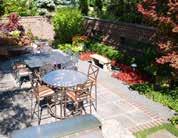
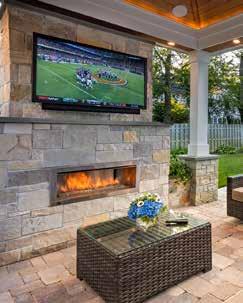
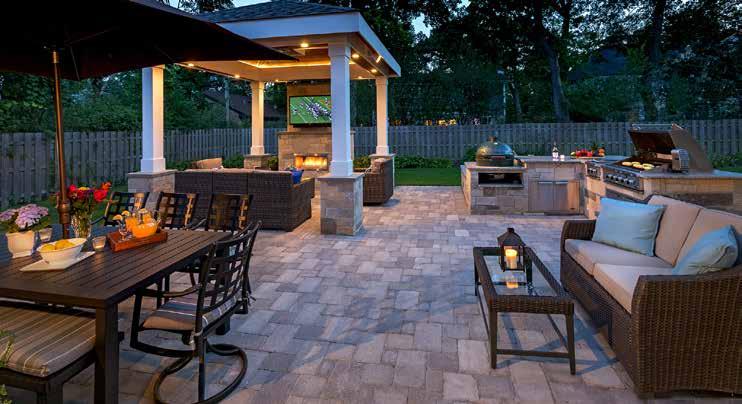
The pleasures of alfresco entertaining are right at hand in this tailor-made outdoor room. The sociable living space is anchored by a custom-built pavilion complete with the latest in media technology, heating and cooling, and hotel-style mini bar.
The clients began with a distinct vision for how they wanted to use the landscape; expand the living area beyond the walls of the house with an outdoor space that delivers style and comfort equal to the home’s interior. They also expressed a desire for their home to be a social hub for family and friends; comfortable for a twosome or 20. The concept of a cigar lounge was proposed where the homeowner, a cigar aficionado, could enjoy a leisurely smoke and beverage outdoors almost any day of the year.
The space was laid out to establish pleasing views from inside the house and make tasks such as grilling and serving convenient. A variety of open-air and covered seating options were designed for dining, conversation, quiet contemplation, or gathering around the TV to cheer on the home team. The covered pavilion extends the outdoor
living season providing protection from the elements and enabling temperature control with a ceiling-mounted fan and infrared heater, as well as a gas fireplace – all controlled by a smart phone app
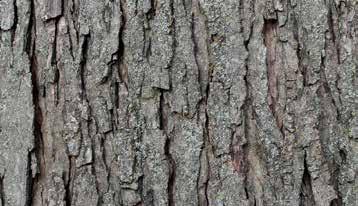
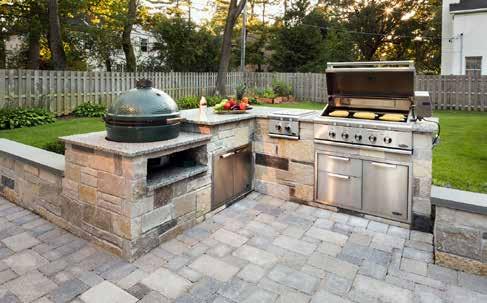
Style, quality, durability, and comfort were achieved through methodical planning, judicious material selection, and expert craftsmanship of all built elements. The design of the pavilion’s vaulted ceiling creates a sense of openness and refinement with honey-stained tongue-and-groove paneling, painted trim, recessed lighting and speakers. The masonry columns, walls, fireplace, and cook station base were constructed on 42” poured concrete footings and faced with a custom blend of seven stone types to replicate the ashlar pattern on the home’s exterior. Bluestone coping was thermal treated to create a pebbled and uniform surface. Gas, power, and signal feeds for the grills, outdoor lighting, sound system, fan, heater, fireplace, and TV were determined in advance and concealed below ground or within each structure. A technology specialist oversaw the expansion of the electrical panel and completed the smart system programming.
Architectural
Containers, Planters and Hardscapes —
Why Specify Certified Stone?
by Meta Levin
“Prior to the certifica-
tion, the stone industry wasn’t necessarily doing a good job telling its story when it came to sustainability,” Karen Olah of Coldspring, a quarrier and fabricator of natural stone, told a full room at iLandscape. While people were demanding more transparency in the products and services they consumed, including the building industry, no one was talking about stone.
That has changed. For landscape contractors, whose clients are interested in sustainability or who are working with architects involved in LEED v4 projects, there now is a certification for sustainable quarrying practices.
Although the certification was adopted in 2014, it is little known in the industry.
“(The certification) speaks to what people are asking for,” she says. “Sustainability is driving the marketplace.”
iLandscape 2017 attendees were given an opportunity to learn about the new certification program through Olah’s presentation, “Why specify Certified Stone: How the Natural Dimension Stone Sustainability Standard is Reshaping Hardscape Projects.” The talk generally explained the ANSI/
NSC 373 stone sustainability standard and was worth 1.5 CEs for Landscape Architects. Administrated by the Natural Stone Council (NSC), an association comprised of natural stone associations from throughout the country, the certification now has been recognized by the U.S. Green Building Council, which administers the LEED building certification – it is certified for LEED v4 - and the International Living Future Initiative’s Living Building Challenge (LBC).
Natural stone already is recyclable, low maintenance, discharges no volatile organic compounds and is durable. Its beauty has made it popular for building and outdoor hardscapes, as well as a number of other uses.
The sustainability standard is designed to provide verification that the stone used for projects is sourced from environmentally responsible material. Using a third party verified standard for natural dimension stone is intended to validate to those using the material that it is produced in an economically, environmentally and socially responsible manner.
(continued on page 12)
VINTAGE PAVERS
Reclaimed from the old streets of many Midwestern cities, clay street pavers and antique granite pavers have become a unique, preferred choice when design requires the elusive look of originality. Once an old street, now an exclusive driveway, reclaimed street pavers provide the look and appeal of natural design. No comparison can be made to these beautiful brick, the texture, the wear of years of weather and use from old carriages and vintage automobiles have created an exceptional patina that newly manufactured concrete pavers cannot match.
Stockyards Brick Clay Street Pavers & Antique
Granite Pavers are utilized most commonly for driveways, paths, walkways and patios. Reclaimed pavers are also used in the construction of many exclusive homes as well as restaurants and country clubs. Some designers are also suggesting them for use in atrium flooring.
ALSO AVAILABLE ARE ANTIQUE COMMON BRICK FROM CHICAGO AND VARIOUS OTHER MIDWESTERN CITIES ALONG WITH RECLAIMED WOOD AND TIMBERS.
The USGBC’s Leadership in Energy and Environmental Design (LEED) rating system is nationally accepted benchmark for green building. Stockyards Brick is proud to support the United States Green Building Council by providing a wide selection of products that comply with LEED guidelines and contribute to LEED certification.
Granite Gate
Granite Pavers
ClayStreetPavers
Containers, Planters and Hardscapes —
(continued from page 10)
Although the certification was adopted in 2014, it is little known in the industry, say those in the know. Attendees at the iLandscape presentation were interested in learning about quarrying practices, as well as whether it helped them identify domestic materials and if the installers needed to be certified to maintain the chain of custody needed for such certifications as LEED v4. At this point the answer to the latter is no, but quarriers and fabricators must be certified.
iLandscape attendees wanted to be able to source the stone from domestic suppliers, says Olah: “They want to be able to support the domestic quarries and fabricators.”
The standard defines environmental, ecological, socially responsible and human health metrics to be used for extracting and manufacturing natural dimension stone, as well as outlines methods for improving baseline environmental performance. iLandscape attendees were interested in the human health and safety aspects of the certification, as well as quarrying practices in general.
Using the ANSI/NSC 373 focuses on educating the design and building professions as to the advantages of incorporating certified stone into their projects.
Modern quarrying and fabricating allows for extracting to demand. By using a diamond saw the stone can be cut more precisely, which means that there is less waste and more of the stone can be used for varying purposes, says Olah. “Everything is used,” she says. “it is efficient and sustainable.”
Conway of Coltswold Gardens, Ltd. In Palos Hills, IL, relied on his knowledge, artistic and writing skills when presenting landscaping proposals to clients. “I was old school,” he says. And then he met 3D imaging software and it rocked his world. (pun intended)
After 32 years in the business, he had declared himself semi-retired. “I was going to teach students in our industry,” he says. Initially, he wasn’t interested in the 3D software, but after playing with it for a weekend, he was hooked. That’s when he began touring the country talking with groups, making presentations, such as the one he made to a packed room at iLandscape 2017, “3D Reality Design Software. It’s here. Embrace it!”
Conway is partial to Uvision by Idea Spectrum, 3D software, which Unilock management asked him to test.
Unilock’s products come pre-loaded in the programs. Only Idea Spectrum can add anything else. Users can, however, download models from the Internet, such as rocks, boulders, native plants and trees. They also can buy multi-manufacturer software, but Unilock has features that only can be seen on its version. Unilock and Idea Spectrum are business partners.
Conway maintains that the software is easy to learn: “If someone pays attention and spends 15 minutes a day practicing, he or she will be competent within 30 days. But you can learn enough to start selling much faster than that.”
There are other 3D software products out there, including the popular SketchUp by Trimble, as well as Rhino 3D; Idea Spectrum’s other software –Realtime Landscaping Architect – and a plug in for Autodesk’s Revit BIM soft-
ware, but, while acting as a consultant for Unilock, Conway has learned, uses and promotes Uvision by Idea Spectrum.
“My sales have gone through the roof,” says Conway, who has been using the software for the last four years.
Educated by television programs, magazines and Internet sites, clients have come to expect high tech presentations, but they still are impressed by what he has to offer. Conway typically brings his Apple TV device into the home, plugs it into a customer’s flat screen television and starts the show.
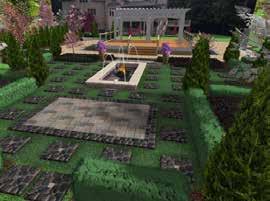
Clients see the proposed landscaping from every angle, including a drone’s eye view of the property from the air, 6 feet up and then, perhaps, 12 feet up, swooping up the walk, through the trees and around the yard. “It’s jaw dropping,” he says. “They are dumbfounded.”
(continued on page 16)
With Enterprise’s help, we began planning out all of our company’s annual vehicle needs at one time – allowing us to spend the rest of the year on our core business. Working with Enterprise has put us in the enviable position of running a newer, more reliable fleet with less headaches, all while driving our fleet operating expenses down.
Blaine A. Owens Partner, Rosborough Partners, Inc.
Containers, Planters and Hardscapes —
The presentation, Conway emphasizes, is more than just pizzazz and dazzle. With a surveying background, it’s second nature to him to read a blueprint or a plat of survey. Not so most homeowners, who, he says, would be hard pressed to find their own back doors on a blueprint.
Conway touts the clarity that a 3D presentation brings to the table. So, for instance, homeowners can see what a landscape will look like when it is first installed, then six years or so down the road. “I can grow the plants in front of them,” he says.
If there are children in the room and a pond is involved in the design, he can populate it with fish, then hand the youngsters the mouse and let them
Arthur Weiler, Inc.
Clavey’s Nursery, Inc.
Doty Nurseries LLC
Fox Ridge Nursery
Goodmark Nurseries, LLC
GRO Horticultural Enterprises
Hinsdale Nurseries, Inc.
Kaneville Tree Farms, Inc.
Kankakee Nursery Co.
Midwest Groundcovers
Poul’s Nursery, Inc.
Spring Grove Nursery, Inc.
The Fields on Caton Farm, Inc.
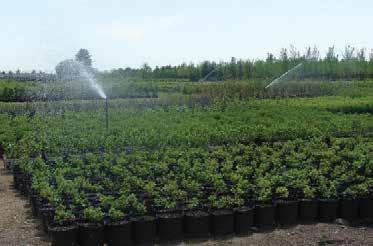
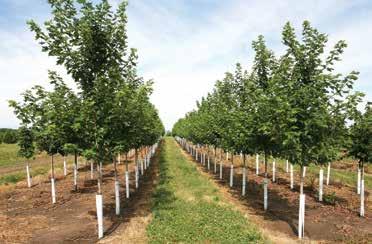
Experienced wholesale growers producing thousands of acres of quality, northern Illinois-grown nursery stock.
Offering a wide variety of shade trees, intermediate trees, shrubs, evergreens, broadleaf evergreens, vines, groundcovers & perennials.
Containers, Planters and Hardscapes —
“feed” the virtual fish.
In addition, he can embed information, such as color, price and inventory into each item, whether it be a hardscape or a tree. Changes are quick and easy, too. It has the communication advantages of technology, as well. For someone like Conway, who now is traveling the country making presentations, clear communications with his employees back home is crucial. He can transmit the plans – in 3D format – to them, complete with the
embedded information necessary for them to do the work.
Of course, other 3D software has similar advantages, but Conway is not talking about other software.
He urges landscape architects and designers to embrace the new technology. “Landscaping competition is not from our peers who attend my seminars,” he says. “It’s from kitchens, because they are presented by such software with amazing clarity. Homeowners have budgets and
options. We need to compete professionally for their budgets.”
The iLandscape audience was interested in what he had to say, says Conway. Interested enough, in fact, to follow him out into the hall after the presentation and to stop him with questions as he walked the show. ‘They wanted to know if it was really that easy,” he says. He tells them that to a landscape architect or designer, “it is a gift.”
Landscape Skills Training for Field Staff
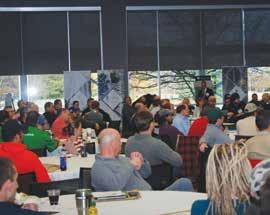
2017 marked the first year for Field Staff Skills Training, a new 2-day seminar for English and Spanish-speaking field staff, foremen, supervisors, and grounds managers. The event was held on March 16-17, 2017 at the College of Lake County, Grayslake, IL.
The seminar covered a broad range of skills that landscape personnel need to know. Held right before the start of landscape season it provided a great tune-up to get employees prepared for the busy landscape season.
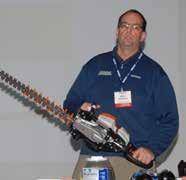
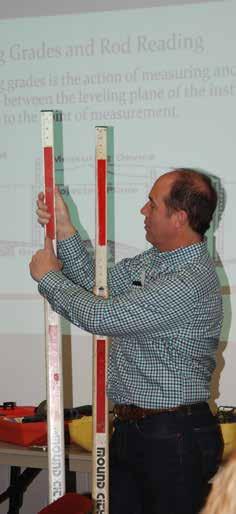
Sessions in English and Spanish included:
Safety and First Aid
Pruning and Planting Trees
Proper Cultural Practices
Plant Layout
Plant and Shrub ID
Plan Reading
Permeable Paver Installation
Irrigation
General Equipment
Instrument Training
Grading and Drainage
Etiquette and Customer Service
5 Math Rules
Women’s Networking Group
Pre-Show Tour of the Chicago Flower & Garden Show
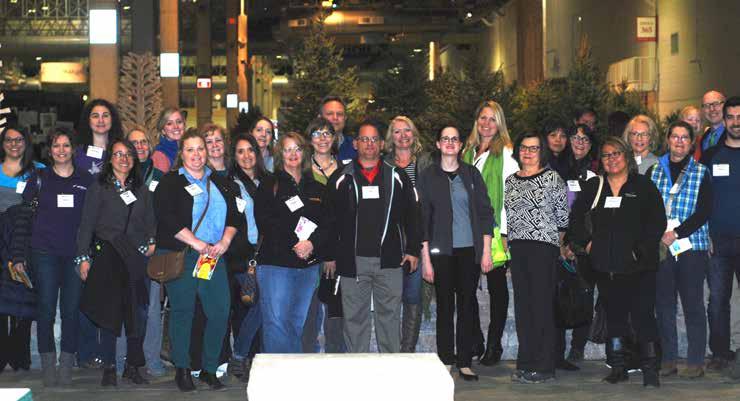
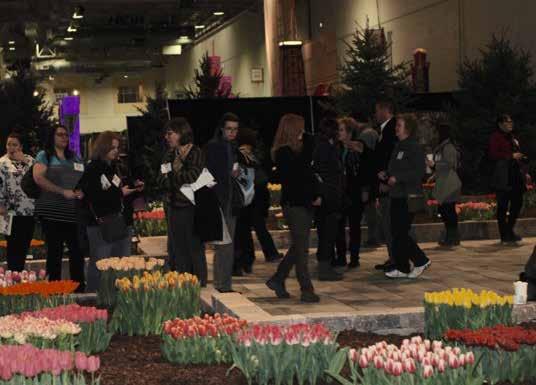
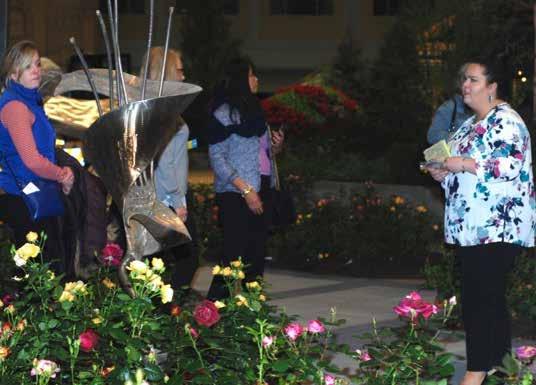
Wednesday, March 22, 2017, ILCA members were treated to an exclusive pre-show tour of the Chicagog Flower & Garden Show, held at Navy Pier. The event was hosted by the ILCA Women’s Networking Group (WNG) who worked with the organizers of the show to provide a 90-minute guided tour before the floor opens from 8:30am-10:00am. This was a terrific opportunity to have the entire show all to yourselves and take pictures without the crowds.
Containers, Planters and Hardscapes
Pots with Panache — Add the WOW factor to your spring containers
by Nina A. Koziol
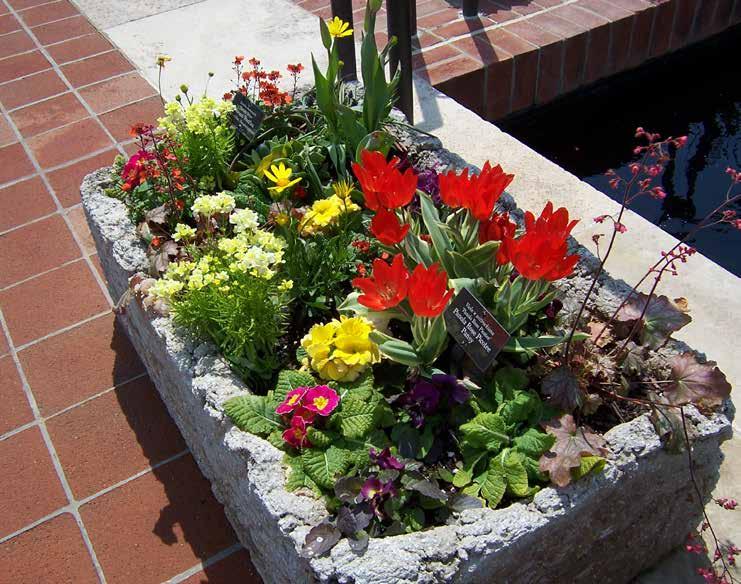
April showers bring May flowers — and lots of them in eye-popping colors that will dress up your clients’ pots, hanging baskets and window boxes. “We typically like strong contrasts, but in spring we need to see color so badly that we try to really make a feast for the eyes,” says Anne Roberts, president of Anne Roberts Gardens, Inc., in Chicago (www.annerobertsgardens.com).
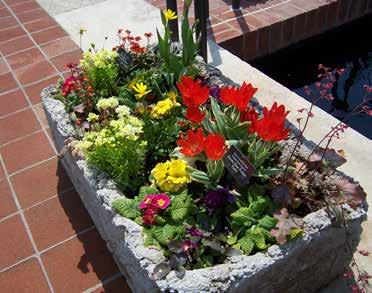
Roberts’ firm, known for creating lush hanging baskets, planters, green walls and roofs for many Chicago commercial and residential properties, created this scintillating spring combination, which melds pale
yellow and chartreuse with a vibrant rose and purple.
The pot features cool-weather annuals: Persian buttercup (Ranunculus ‘Maché Rose’), Senetti blue bicolor, purple pericallis (Pericallis x hybrida) and primrosecolored pansies (Viola x wittrockiana ‘Delta Pure Primrose’). The golden creeping Jenny (Lysimachia nummularia ‘Aurea’) is typically a ground-covering perennial vine in the Chicago area and the yellow-twig dogwood stems (Cornus sericea ‘Flaviramea’) were cut and anchored securely in the potting mix.
The delicate primrose-yellow pansies
counter the vivid blue pericallis blossoms. “You tend to see very bright yellows at this time of year, but this primrose pansy is very pastel and calms the entire composition down. It really works.”
Roberts chose the plants because they are fairly cold-hardy and can withstand a light frost. “The ranunculus is our go-to plant for spring,” she says. “They look like a rose, they continue blooming and they don’t have messy foliage. It’s a real winner in our book.”
The container, planted in early April, is a spring display that can be replaced with heat-loving annuals in late-May. “We do (continued on page 28)
Containers, Planters and Hardscapes —
(continued from page 26) a four-season rotation and I love dark gray, charcoal and light gray for pots,” Roberts says. “Anything you put into this container works no matter what the season or the color of the flowers, foliage or twigs.”
Sited in partial shade, the container holds a soil-less mix of peat, vermiculite, perlite and slow-release granular fertilizer. The mix was added to within an inch or two of the rim so that it won’t wash out when the client waters it. Drainage holes in the bottom are a must for all planters, especially those outdoors so that water can drain freely.
“The container might need watering two to three times a week if there’s no rain,” she says. And, if temperatures dip into the low 30’s at night, the plants may need to be covered to prevent a killing frost from settling on the leaves and flowers—an important reminder for the client.
As the weather warms up, the cool-season annuals wind down. “We do try to keep the lysimachia since it will continue to thrive even in the heat, and we end up with larger plants by keeping them in the containers from spring.”
(continued on page 30)
Kodiak® Orange Diervilla
You need a durable, native plant that will thrive in sun or shade? Drought tolerant? Deer resistant? And support pollinator populations, too? You’ve got it! Our new Kodiak® Diervilla do all of that, plus add intense color to your landscapes.
Available from these suppliers in 2017
Midwest Groundcovers St. Charles IL • 847-742-1793
Kaknes Landscaping Supply Naperville IL • 630-416-1002
CJ Fiore Prairie View IL • 847-913-1417
Lurvey Des Plaines | Park City | Volo www.lurveys.com
Cedar Path Nurseries Lockport | Barrington www.cedarpath.net
Alsip Home & Nursery
St. John • 219-365-0882
SiteOne
Addison | Naperville www.siteone.com
Hinsdale Nurseries
Willowbrook IL • 630-323-1414
KODIAK® Orange
KODIAK®
KODIAK® BLACK
FALL COLOR
Containers, Planters and Hardscapes —
(continued from page 28)
Some of her favorite summer plants are succulents, such as Aeonium ‘Zwartkop,’ Agave ‘Little Shark,’ Sedum ‘Dragon’s Blood,’ Echeveria runyonii ‘Topsy Turvy’ and aloe ‘Gator.’
Her summer seasonal switch-over might also include Euphorbia ‘Firesticks,’ Papyrus ‘Little Tut,” phormium or cordyline.
Trailing plants create fullness when they spill over the edge of the pot, but look beyond the ubiquitous ornamental sweet potato vine. She suggests using lysimachia, which is more delicate-looking and less aggressive in a basket than Marguerite sweet potato, but provides the same chartreuse color.
Experimentation brings innovation. “Have fun—people tend to use the same things over and over. Try something different. There are always new plants and combinations.” And thank goodness for that.
Native Intelligence
An ongoing series to help guide landscape contractors Knowing Native
by Nina Koziol
There’s no question that native plants are hot. They’re touted in magazines, at garden centers and in the news where they’re often linked to bees and other important pollinators. Many natives get the nod for their drought tolerance, low maintenance and disease or pest resistance. As ground covers, some can be used to replace spotty turf in dry, shady sites. Others complement non-native perennials in sunny beds, borders, and in naturalistic and formal designs.
In this ongoing series on natives, we’re including cultivars of native plants, which are often called by the quirky name ‘nativars.’ Nativars can result naturally. One example is Rudbeckia subtomentosa ‘Henry Eilers,’ a quilled petal form of the native plant that was collected by a nurseryman in a wet prairie swale in Montgomery County, Illinois. Nativars also result from human influence (hybridizing). Nativars are selected for many reasons, including showier flowers, compact habits, disease resistance, or more colorful foliage. To maintain their look, they must be cloned and therefore do not contribute much to biodiversity. Nativars are best planted in gardens rather than in restored habitats where the goals are to preserve biodiversity through the restoration and establishment of native plant communities.
“Anytime you can convince a homeowner to plant a native plant over one from elsewhere in the world, that’s a bonus,” says Jacob Burns, curator of herbaceous perennials at the Chicago Botanic Garden. “In regard to nativars, I’m not opposed to homeowners growing them, because sometimes
the foliage is extra attractive and provides needed interest when the plant isn’t in bloom,” he says. “The ideal thing to do is blend nativars with a variety of truly local species to create diversity in the landscape.”
While there are many attractive shade-tolerant plants that are native to the Midwest, some, such as Virginia bluebells, emerge in spring only to bloom and then disappear until the following year.
“A problem with a lot of woodland wildflowers is that they bloom in spring and by August they are either dormant or tired-looking,” Burns said. Mayapples and trilliums are typical examples, which is why Burns looks for plant combinations that hang onto their foliage and perform well all season.
Finding Midwestern woodland plants that bloom later is also a challenge. Burns recommends nativars with colorful leaves, species with late summer fruits, or fall bloomers like asters and goldenrods. These perennials will keep your design from becoming a sea of green most of the year. Here are some of his native plants picks for shady sites.
Plants
contractors in choosing native plants and cultivars
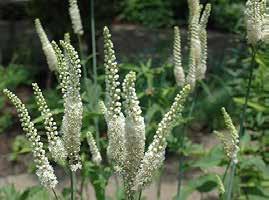
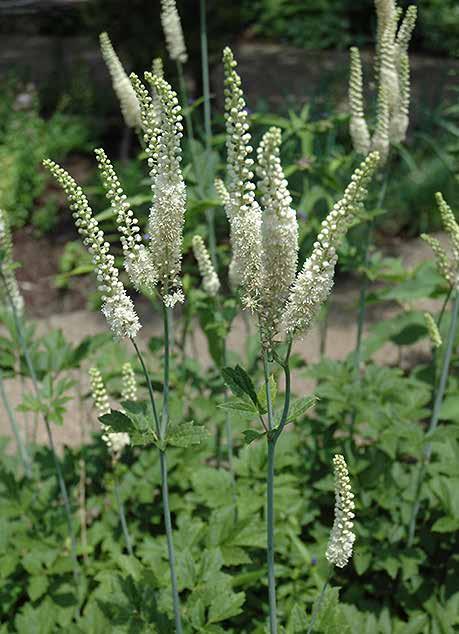
“This is one of the few shade-tolerant natives with summer flowers,” Burns said. “It’s not to be confused with the Asian species Actaea ramosa, which blooms in autumn and has purple leaved cultivars. Not only do I adore Black Cohosh for its summer blooms, I admire its stately size.”
Culture:
• Site: Easily grown in average, moistureretentive soils in part to full shade
• Size: 4-6 ft. tall; 2-4 ft. wide
• Hardiness: Zones 3-8
• Plant Partners: Maidenhair fern, Canadian ginger, Hepatica
Bonus: Flowers 1-2 ft. long are lightly fragrant. No serious insect or disease problems
Native Intelligence
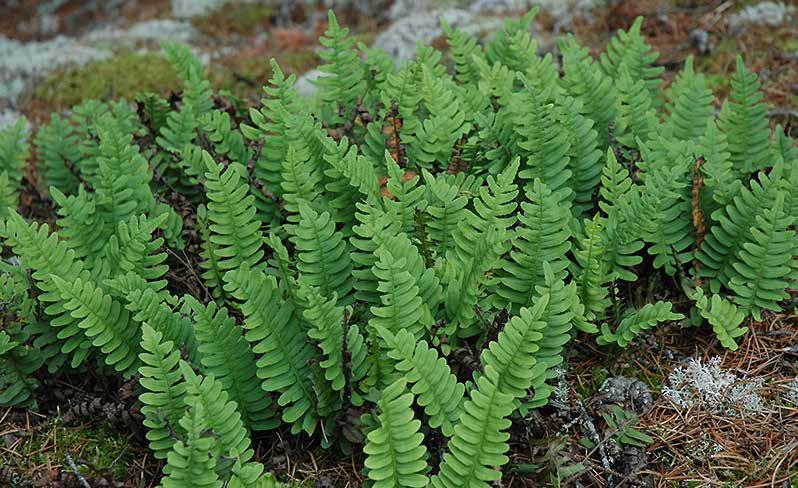
Adiantum pedatum —
Northern
Maidenhair
Fern
Adiantum pedatum —
Northern Maidenhair Fern
“By far, one the most fascinating ferns in all of North America and fortunately, one of the easiest to grow,” Burns said. “No shade garden should be complete without northern maidenhair ferns.”
Culture:
• Site: Grows in average, medium, well-drained soil in part shade to full shade. Spreads slowly by creeping, branching rhizomes to form large colonies over time
• Size: 1-2.5 ft. tall, 1-1.5 ft wide
• Hardiness: Zones 3-8
• Plant Partners: Attractive ornamental fern for the shade border, woodland garden, or native plant garden. Combine with broad leaves of hostas and brunneras. Effective edging plant along shade garden paths
• Native Cultivar: None
Bonus: Tolerates heavy shade
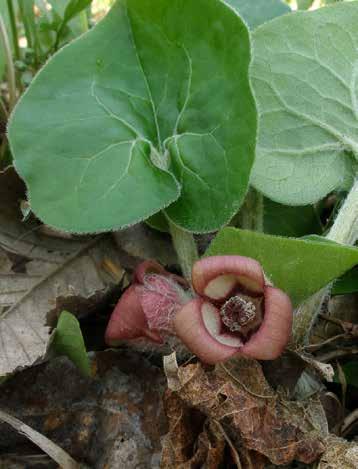
Asarum canadense — Canadian Wild Ginger
Asarum canadense — Canadian Wild Ginger
Wild ginger can be found in most counties throughout Illinois. It grows in floodplain woods and upland mesic (moderately moist) areas. Has large, dull kidney-shaped leaves to 6 inches across. (European ginger has shiny leaves.)
Culture:
• Site: Moist, well-drained humus-rich soil. Flourishes in woodland sites but requires some irrigation during hot, dry weather. Avoid planting too deeply. Spreads slowly by rhizomes to form nice clumps
• Size: 8 in. tall, 1-1.5 ft. wide
• Hardiness: Zones 4-6
• Bloom time: Late spring to early summer. Cup-shaped purplish flowers hidden under the leaves
• Native Cultivar: ‘Eco Choice’ has denser foliage than the species.
Bonus: Deer resistant. Holds foliage throughout the growing season
Side note: Although the common name implies that it’s edible, it’s not. It contains aristolochic acid, which can cause serious and permanent kidney damage, according to the U.S. Food and Drug Administration.
Native Intelligence
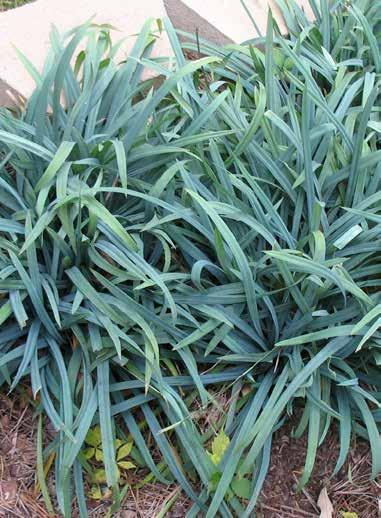
Carex laxiculmis — Creeping Sedge
Carex laxiculmis — Creeping Sedge
“When seeking a colorful ground cover for your shade garden, look no further than the sedge,” Burns said. “Two additional species with blue foliage that are easy to grow include Carex platyphylla and Carex flaccasperma.”
Culture:
• Site: Part to full shade, medium to wet soils
• Size: 6-12 in. tall/wide
• Hardiness: Zones 5-9
Plant Partners: Turtlehead, ferns, hostas. Effective accent for smaller gardens
Native Cultivar: ‘Hobb,’ silvery-blue leaves sold under the trade name Bunny Blue
Bonus: Tolerates deer, heavy shade, wet soil, evergreen
Chelone obliqua — Turtlehead
Chelone obliqua — Turtlehead
“This turtlehead species is surprisingly shade tolerant and provides much needed late summer blooms that last into fall,” Burns said. “Chelone lyonii is a very similar species, but is native to the southeastern U.S.”
Culture:
• Site: Best grown in organically rich, humusy, moist to wet soils in full sun to part shade Preference is for dappled sun and consistently moist soil conditions
• Size: 2-3 ft. tall, 1-2 ft. wide
• Hardiness: Zones 5-9
Plant Partners: Carex, astilbe, ferns
Native Cultivar: ‘Alba,’ ‘Tiny Tortuga’
Bonus: Tolerates erosion, clay, wet soil
Native Intelligence
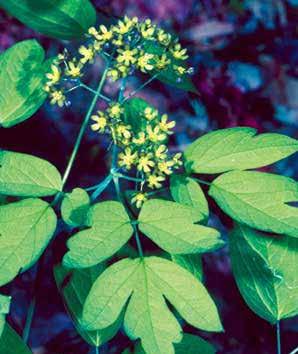
Caulophyllum thalictroides —
Caulophyllum thalictroides
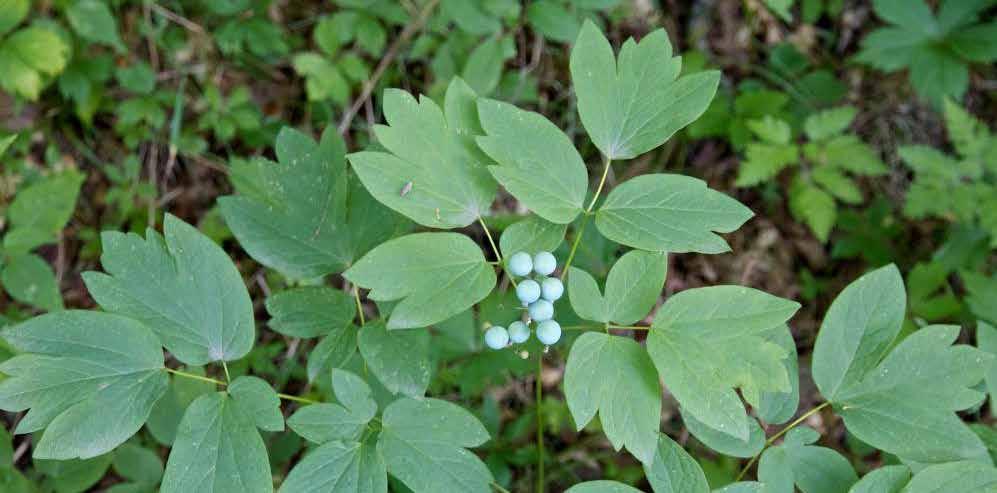
“The foliage on Actaea pachypoda and Actaea rubra, also known as baneberry, are often hit or miss based on the humidity and amounts of water they receive,” Burns said. “The less fussy alternative is blue cohosh, which remains lush and attractive no matter what.”
Culture:
• Site: Shady woodland areas in rich, moist soil. Spreads slowly by rhizomes
• Size: 1-2 ft. tall and 6-12 in. wide
• Hardiness: Zones 3-8
• Foliage: Valued for its lacy, blue-green foliage and its erect clusters of blue, fruit-like seeds
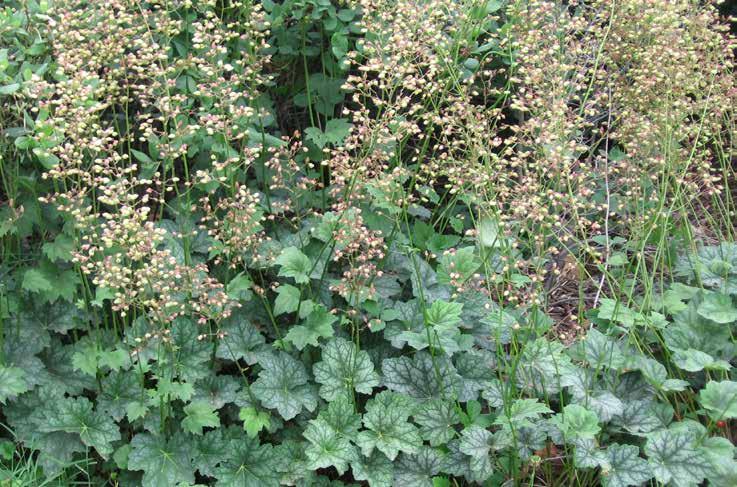
Heuchera americana — Common/Woodland Alumroot, Coral Bells
“While all Heucheras are native to North America, this is one of the few found wild in the Midwest. Look for cultivars that have well-silvered foliage with deep burgundy veins.”
Cultivate:
• Site: Best grown in organically rich, humusy, medium moisture, well-drained soils
Native Cultivars: ‘Dale’s Strain’ and ‘Green Spice’
Heuchera americana — Common/Woodland Alumroot, Coral Bells
Más cosas que ver... Más cosas que hacer...
por Meta Levin
¡Llegó la hora de la feria! El telón subirá el 3 de febrero para la tercera feria anual de paisajismo, iLandscape. Habrá música, premios, nuevos productos y servicios, sesiones educativas, fiestas y gnomos. Será todo lo que usted ha llegado a esperar de iLandscape y más.
“Es un matrimonio entre conciencia de productos, diversión y educación”, asegura Scott Grams, Director Ejecutivo de ILCA. Todos los asistentes tendrán la oportunidad de desempeñar un papel estelar, caminando por la alfombra roja y atravesando el “Paseo de las Estrellas”. La feria se llevará a cabo del miércoles, 3 de febrero al viernes, 5 de febrero de 2016, en el Renaissance Schaumburg Convention Center and Hotel en Schaumburg.
Siempre fresca
En un esfuerzo por mantener la feria fresca e interesante, el Comité de la Experiencia iLandscape ha modificado y actualizado varios aspectos del evento, prestando al mismo tiempo mucha atención a los comentarios que los miembros del Comité recibieron de los expositores y asistentes a la feria el año pasado. Con ese propósito, el escenario de la feria ha sido trasladado al centro del piso de exhibiciones, lo que permitirá a todos los asistentes ver y escuchar desde cualquier parte del salón, mientras continúan revisando las ofertas de los expositores. (Vea el nuevo plan del piso en las páginas 32 y 33).
Las mujeres se expresan en iLandscape 2016
moderado por Ana Belaval de la WGNTV. Los panelistas serán tres mujeres de la industria verde con nombres reconocidos y opiniones muy firmes sobre liderazgo. Las tres son Anna Ball, Presidenta de Ball Horticultural; Terri McEnaney, Presidenta de Bailey Nurseries, y Donna Vignocchi, Presidenta de ILT Vignocchi. Su
Enfoque: Sección en Español
conversación se titula el Paisaje del Liderazgo y cubrirá temas esenciales para gerentes, desde control del tiempo hasta visión y delegación y escucha activa.
Hay una sorpresa especial el jueves. Liza Hausman es Vicepresidenta de Relaciones Industriales en Houzz. com. Houzz está revolucionando las ventas de diseño. Bob Hursthouse de Hursthouse, Inc. advirtió que se están convirtiendo en su segundo generador más importante de contactos, después de las referencias. ILCA hizo una encuesta entre sus miembros y descubrió que era el único sitio de medios sociales con un impacto directo en los resultados finales. Liza tiene una amplia visión de las tendencias nacionales en paisajismo y diseño y discutirá cómo una presencia en los medios sociales está dejando de ser algo “ventajoso” para convertirse en una necesidad comercial.
Nuevo giro en una actividad popular
Este año, el popular recorrido por la feria dirigido por un conferencista, estará a cargo del Dr. Michael Dirr, Horticultor y Catedrático de la Universidad de Georgia. Dirr dirigirá un paseo entre arbustos (“Shrub Crawl”) desde el Garden Stage. El más reciente de una serie de paseos con el público, muy populares, el recorrido incluirá plantas leñosas de una variedad de proveedores.
El sonido de la música
Una vez más, iLandscape estará llena de música. El miércoles tocará un guitarrista flamenco en el vestíbulo; el jueves, Dave Byron actuará por segundo año consecutivo y el viernes amenizará el evento una banda de mariachis. “Habrá músicos durante toda la feria”, afirma Tony Lobello, quien, junto con Katrina House, es copresidente del Comité de la Experiencia iLandscape.
Las atracciones no se detienen Si la música no fuese suficiente, Anderson Animal Shelter pondrá algunas adorables mascotas disponibles para adopción y el jueves, el mago Bill Cook saldrá al escenario en el salón de exposiciones.
Por supuesto que los asistentes podrán festejar el miércoles por la noche, con la música de la Tributosaurus Band. “Es un grupo muy talentoso”, afirma Lobello. “Tendremos una fiesta muy divertida”. La Cena anual de Entrega de Premios de ILCA se celebrará el jueves por la noche. Habrá un jardín de esculturas por el que la gente podrá caminar, así como un área para comer y un punto de reuniones central. “Siempre tratamos de hacer más variada la experiencia”, asegura Grams. “Los artistas y los músicas crean el ambiente adecuado”.
Como respuesta a sugerencias de estudiantes que no estuvieron de
acuerdo con el formato del panel de estudiantes el año pasado, el Comité lo ha cambiado totalmente. En lugar de sentarse y escuchar conferencias, los estudiantes
ILCA Restarts PAC Fund
by Meta Levin
Spurred by the fight to block Illinois Senate Bill 9, ILCA has decided to reboot its PAC (political action committee).
Until now, the PAC, which has been around for years, was primarily funded through occasional donations from members, says Scott Grams, ILCA executive director. A while back there also was a legislative brunch that generated a relatively small amount of money. Now, however, a new committee will make a concerted effort to adequately fund it, says Tom Lupfer, who is organizing and chairing the new ILCA PAC Committee, which is a subcommittee of the existing Regulatory and Legislative Committee.
Illinois Senate Bill 9 threatens to impose a sales tax on services, such as landscape contracting. These would raise the cost of the work, as they are passed along to clients. “Our legislative lobbyist, Dave Manning, has been getting by on a shoestring budget,” says Lupfer.
While the PAC’s fundraising goals are modest, if successful, the result would give ILCA and its lobbying efforts a needed boost. Grams estimates that
the PAC would raise $20,000 annually, and “spend about $15,000 each year to build relationships.”
Included in the latter would be moderate donations to campaign funds of legislators who support the industry and its goals. “Any lobbyist will tell you that if you can back up any position with a political contribution, you have the ear of the elected official,” says Grams. These contributions would be non-partisan, targeting only those who support ILCA’s positions on issues that affect the industry, not by political party.
“An onslaught of new taxes and regulations came together to force our hand,” says Lupfer. “We need to build influence and power, so the legislators will listen to us.” Lupfer also emphasizes that ILCA member donations to the PAC can be modest, as well. “Even $50 would be welcomed. Of course, we’d prefer $500,” he says.
(continued on page 46)
Special Announcement —
(continued from page 45)
Although Grams and Lupfer are talking about raising money, the focus will be on grass roots organizing, including face-to-face meetings with ILCA members and their elected representatives, Lupfer says. In that way, they seek to build long term relationships, so that when a bill does come up, the legislator knows the ILCA member who calls and says, “This bill affects me and this is how.”
For instance, Lupfer’s state representative chairs the Illinois House Revenue Committee. “I’m going to get to know him, so if there is a question about whether an action will affect us, I will be able to pick up the phone and he will know that I am his constituent and who I am.”
ILCA members will not have to meet with lawmakers alone; they will be backed by committee members and even, possibly, Grams. “The member will be the friendly face in the district giving a story about how it affects him,” says Lupfer. “Setting up a meeting with a legislator could be intimidating to some people, but who better knows your story than you do? Being the friendly face is not a huge commitment.”
The PAC Committee also plans to organize more trips to Springfield, as well as encourage ILCA members to talk with their customers about these issues. There also will be sample letters to the editor, email and phone scripts and examples of letters to state representatives made available to the membership.
The Metropolitan Water Reclamation District of Greater Chicago is offering premium quality composted biosolids for commercial use. Our blend is effective, economical and safe. It’s also eco-friendly.
Apply it in a variety of
ways:
• Use as a conditioner for turf grass
• Mix with custom topsoil blends
• Add to planter beds and pots
Only $30 +tax per cubic yard
Available at two locations
Harlem Avenue Solids Management Area
7430 Portage Trail, Forest View, IL 60402
Calumet Solids Management Area
12600 S. Doty Rd., Chicago, IL 60628
Call (708) 588-4300 to arrange for pickup, or email biosolids@mwrd.org.
New Members
vide superior landscape design, installation and maintenance for commercial and residential customers in Fox Valley. We bring that same commitment to quality to irrigation system design, installation, repair and yearly maintenance.
SUPPLIER MEMBERS
Green Soils Management, LLC
Christian Daman
1141 E. Main St., Suite 202
East Dundee, IL 60118
Phone: 847-695-9300
Fax: 847-783-0032
Email: damanc@thelenmaterials.com
Website: www.greensoilsllc.com
We are a joint venture LLC between the Thelen Companies and the Plote Companies. We operate a 60 acre yard waste facility located on Plote’s property off IL Route 72 in between Beverly Rd. and IL Route 25, in the city of East Dundee. Enter at the Beverly Materials entrance and follow the Green Soils Management, LLC. signs. We accept yard waste (grass, brush, and leaves) only. No logs, stumps, manure, or food waste accepted. As a residual of our yard waste/composting operations we offer an assortment of outbound products including compost, leaf mulch, triple blend planting mix (compost, sand, screened topsoil), bio-swale mixes, screened topsoil, and we will homogeneously soil blend to suite per project specifications. Bulk semi and transfer trailer transportation available upon request.
Organix Composting
Jim Cowhey
19065 Hickory Creek Dr. Mokena, IL 60448
Phone: 708-326-3900
Fax: 708-326-3903
Email: jimc@organixrecycling.com
Website: www.organixrecycling.com
Yard waste and food waste composter located in Chicago. Accepting all yard waste and food waste for recycling. Supplying USCC STA and OMRI certified compost and mulches. Certified truck scales and truck trailer tippers on site for receiving materials and selling finished products.