Every few weeks, a new wave of performative outrage washes across social media and op-ed pages about the American Israel Public Affairs Committee — AIPAC is destroying our democracy … AIPAC is buying Congress … AIPAC is subverting America.
The strangest thing about this supposed moral panic is not how hysterical it is, but how selectively hysterical it is.
If the concern were truly “foreign influence” or “money in politics,” the loudest AIPAC critics would be shouting from the rooftops about Qatar, China, Turkey, Iran, Saudi Arabia, the United Arab Emirates — and the tens of billions of dollars that they pour into American universities, think tanks, media outlets and lobbying operations.
They would be demanding hearings on the National Iranian American Council (NIAC), the Iranian-American lobby. They would be calling out the Council on American-Islamic Relations (CAIR), the US Council of Muslim Organizations (USCMO), the Turkish Coalition of America and Beijing’s sprawling influence networks.
Instead, they have only one boogeyman: the Jewish one.
Every major diaspora community in America has lobbying arms, many of them far better funded than AIPAC.
give Jew-haters free reign Record-breaking
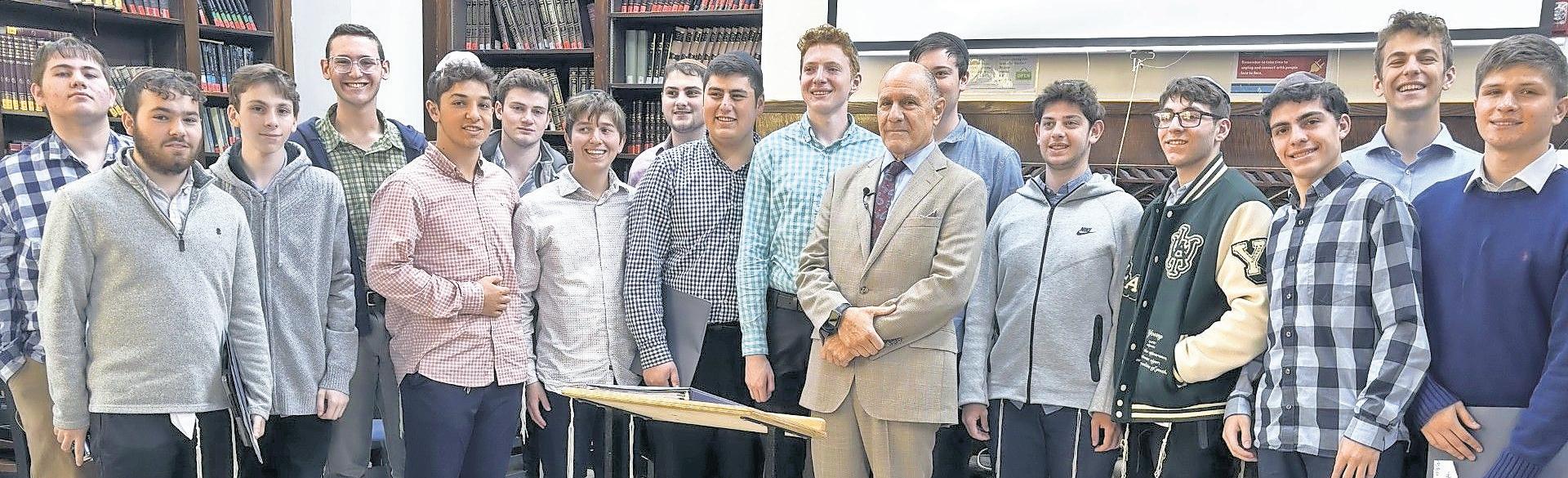
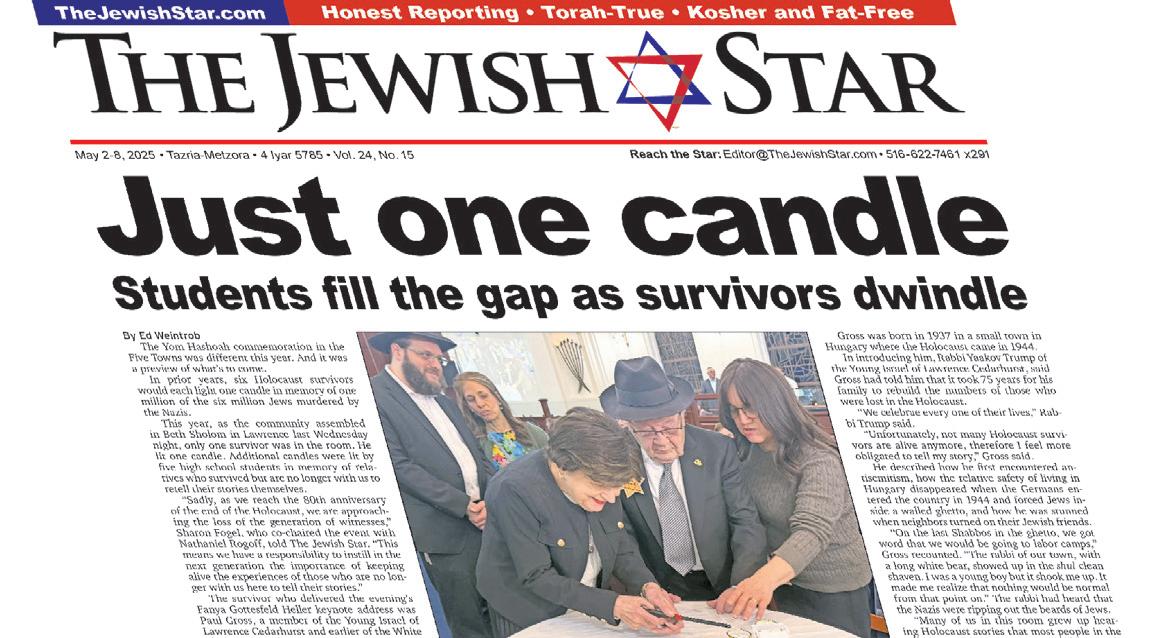
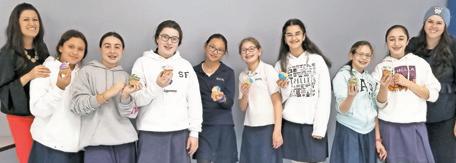
AIPAC’s primary mission is to advocate for Israel in Washington, but it also furthers its mission by mobilizing American Jews. Among the more than 15,000 who attended its 2019 convention in Washington were students (like these from HALB’s Stella K. Abraham High School for Girls in Hewlett Bay Park) who came to hear AIPAC’s message and then themselves lobbied on Capitol Hill Ed Weintrob, The Jewish Star
The Indian-American lobby, the Armenian National Committee, the Hellenic-American Council, the Cuban-American National Foundation, Iranianand Arab-American groups, the Turkish lobby and the Chinese Communist Party’s many influence platforms all pour money into Washington.
Yet only AIPAC is treated as a threat to the republic.
The far-left’s favorite line — “AIPAC is a dark-money foreign lobby!” — collapses under one basic fact: AIPAC does not take foreign money. Its donors
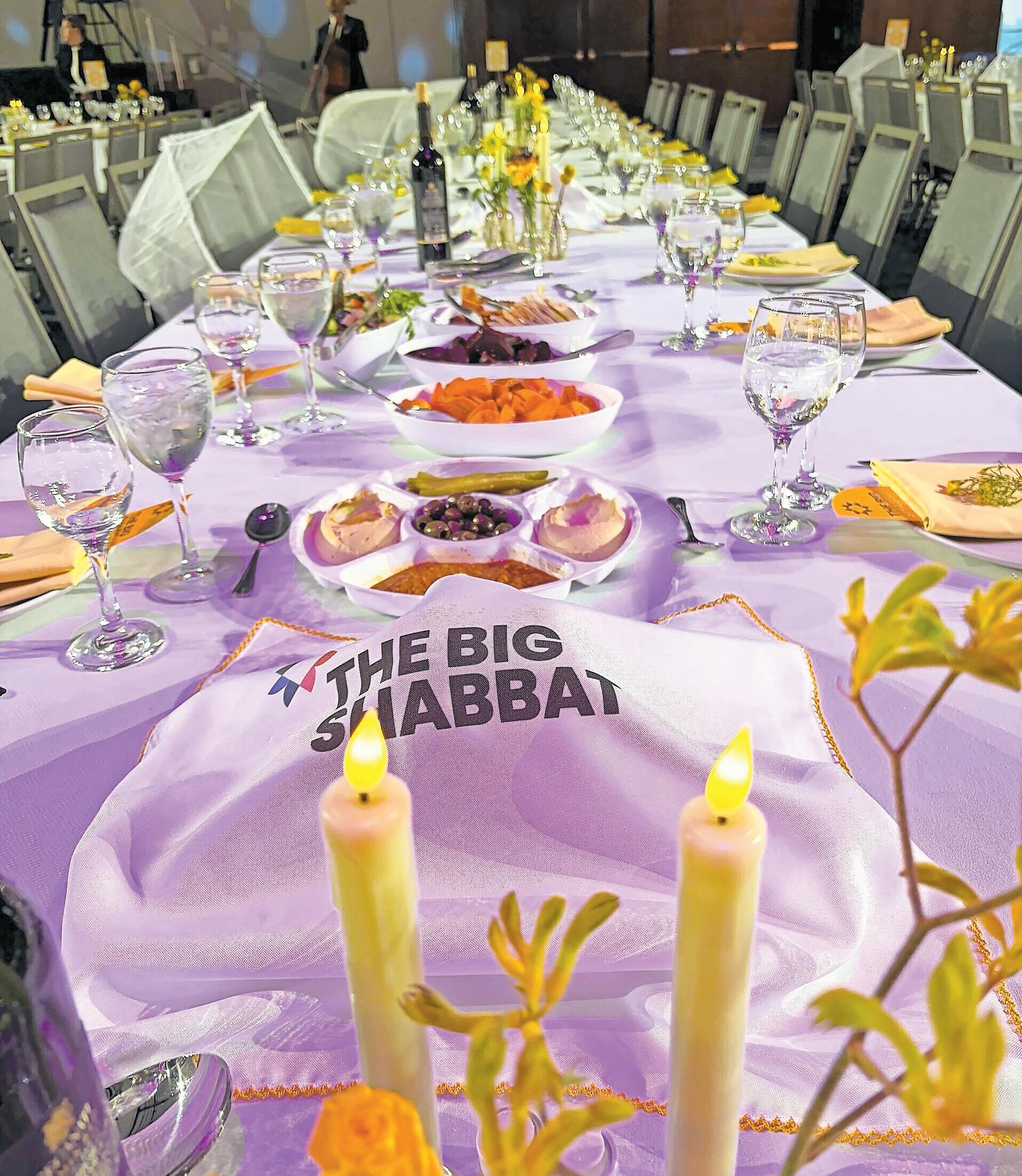
Shabbat dinner
By Anna Rahmanan, JNS
On Wednesday night, Nov. 19, antisemitic protesters blocked worshippers from entering Park East Synagogue, a Modern Orthodox congregation on Manhattan’s Upper East Side, and called for violence against Jews. Two days lat-
er, Temple Emanu-El, a Reform congregation four blocks away, hosted a Friday night dinner which drew so many people that it set a new Guinness World Record.
Seated for dinner were 2,761 people — 439
See 2,761 at Shabbat meal on page 14
Dual loyalty? Wandering, wondering Jews
Hhave
been the
been forever
wondering about who we are and how we fit in with the countries we’ve migrated to over the centuries.
It’s been one of the ongoing dilemmas of our people, a tension between our personal, spiritual identity and our nationality.
When we lived in the glorious days of preInquisition Spain, were we Jewish or Spanish? The question persisted through our journeys across the continents — whether in Europe or Asia, Morocco or Mexico. And today, are we
American Jews or Jewish Americans? Are our brethren living in
are Israelis or Jews?
My friend Rami Sherman was one of the heroic commandos of the legendary Entebbe rescue mission of 1976. He told me that he was raised in a secular kibbutz, and that until he went on the mission to Entebbe and saved more than 100 Jews from Israel and all over the world, he never appreciated a sense of Jewish peoplehood. In Rami’s own words, “I flew to Entebbe an Israeli. I returned a Jew.”
It has never been easy to balance our personal spiritual identity with our national identity, our Jewishness with our nationality of the day.
The anti-Israel protesters and boycotters of the past few years accuse American Jews of dual loyalties while they are busy burning the American flag. How’s that for ultimate hypocrisy?
What is going on now is beyond belief. The insecurity of the Jewish community (not only in
See Dual loyalty? on page 8
ow long
we
“wandering Jews?” I imagine ever since Abraham, the first Jew. And the wandering Jew has also been the wondering Jew. We’ve
Israel
Temple Emanu-El, a Reform congregation on Manhattan’s Upper East Side, set a Guinness World Record on Nov. 21 for its “Big Shabbat” that drew 2,761 people.
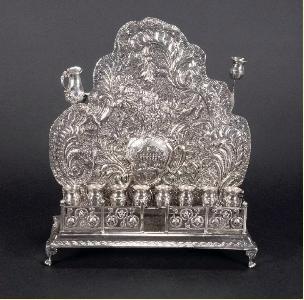
8 nights of Chanukah
EACH ONE A LITTLE BIT BRIGHTER
Ed Weintrob Editor-Publisher • Nechama Bluth, Associate • Stuart Richner, RCI President
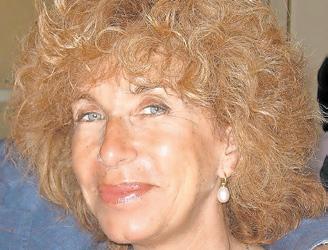
“I embrace who I am ethnically, biologically,” Rep. Debbie Wasserman Schultz old Priya Anand in a Nov. 24 episode of the We Are Spiraling podcast that was titled “The Politics of Curly Hair.”
Referring to her curly hair, Wasserman Schultz told Anand, a former journalist who recently launched the podcast and a hair product business: “It honors my ancestors, my mom, my grandparents. You go across the globe and meet other Jewish women. That is a part of who we are.”
Wasserman Schultz, a Florida Democrat, said Vogue stylists softened her curls and facial features in a photoshoot for an October 2012 article in the magazine. The photoshoot was widely criticized, with many saying that the congresswoman looked “unrecognizable.”
“They didn’t make me look like I was a curlyhaired Jewish girl,” Wasserman Schultz said on the podcast.
She told Anand that she was disappointed that the photo, though “beautiful,” wasn’t “whatever beauty I normally have.”
“That’s just not something I should have to overcome in order to be credible,” she said. “So I just set out to be credible, period.”
Wasserman Schultz also said on the podcast that when colleagues told her how good she looked in the photo, the implication was that they didn’t think she looked so good otherwise.
During the 20-minute episode, one exchange struck Anand in particular, the podcaster said.
Wasserman Schultz said that young Jewish women often thank her for keeping her curls natural. Anand was “touched” by what she told JNS was a demonstration of how “deep the sensitivity is around how one shows up in the world,” and how deeply women feel the need to be seen as themselves.
“If you don’t see representation, there’s this implicit idea that whatever the thing is that’s not being represented is not the thing to be upheld,” Anand said.
“You can photograph the congresswoman from any angle, and it doesn’t matter. People can always identify her, because she has curly hair,” the podcaster said. “It’s the same thing with me.”
Anand said that her parents would watch her dance on stage as a child and would tell her that they “could easily find me out of a sea of little Indian girls, based on my long, curly hair.”
She worked as a journalist, including covering technology news, after graduating from George Washington University, where she was editor-in-chief of the Hatchet, a student publication.
For her entire life, strangers have approached her just to talk about her curls, she told JNS. Whether on airplanes or in coffee shops, “there’s always another curly-haired person,” she said. “We end up in conversation.”
She brought her journalism experience to her new podcast, which probes the cultural significance of curly hair. That includes asking why people hide it, straighten it, politicize it, mock it and celebrate it. The name of the podcast is a nod to “spiraling,” both the anxious kind and the curls literally, she said.
“I want to flip it on its head and have it be something that makes people laugh,” she said.
She dismisses the idea that the podcast might be “too niche.”
“Many people are secretly curly,” she told JNS. “I swear to G-d. Everyone in America knows someone who is secretly curly.”
“I’m willing to bet that if you don’t, it’s because they’re straightening their hair and you haven’t uncovered the secret yet,” she said.
JNS asked Anand why so many women straighten their hair. She pointed to Wasserman Schultz.
“There’s a record on the internet of all the insults that were hurled at her, and some that she mentioned on the show,” the podcaster said.
Anyone who says that prominent people needn’t straighten their hair must be living “with your head under a rock,” she told JNS. “There’s the world that we live in and then there’s hope.”
Anand has also launched a curly-hair product line, Mayura Beauty, using the Sanskrit term for “peacock.” She notes that curlyhaired people think of their hair as “iconic,” like peacock feathers.
“I have approached every step of building a hair care line like a reporter,” she told JNS. “You’re piecing together a puzzle every time you make a story, and it’s similar in business.”
She also hopes that hair can help bring people together.
“If there’s this idea that we can’t share hair products or hair secrets across cultures, I feel that’s very sad,” she said. “That’s like saying you shouldn’t eat another culture’s food.”
Curly-haired Rep. Debbie Wasserman Schultz in her official government photo.
War on AIPAC goal…
Continued from page 1
are Americans, overwhelmingly American Jews. That, of course, is the real issue for many of its loudest critics.
Rep. Rashida Tlaib (D-Mich.) calls AIPAC “the biggest threat to democracy.” Rep. Ilhan Omar (D-Minn.) reduced Jewish political participation to: “It’s all about the Benjamins, baby.” The Democratic Socialists of America (DSA) proclaims that “AIPAC is an enemy of working people.”
Meanwhile, these same figures are silent when Qatar funnels more than $5 billion into US universities (per Department of Education filings); bankrolls think tanks; funds Hamas’s propaganda ecosystem; and provides lawmakers with taxpayer-funded luxury trips.
None of that raises their suspicion. Only American Jews participating in American politics — exactly as other minority groups do — triggers outrage.
Rep. Seth Moulton (D-Mass.) recently said he was “returning all AIPAC donations,” a performance widely praised in the media.
Left unmentioned? Moulton has taken free trips to Qatar and accepted donations from NIAC, an organization that multiple nationalsecurity officials have described as functioning as a de facto mouthpiece for the Iranian regime.
Returning donations from an American-Jewish organization is supposedly “principled.” Accepting support connected to a regime that funds terror, kills protesters and murders women for showing their hair? Apparently fine.
This isn’t ethics. It is antisemitism or cowardice dressed up as virtue.
The hypocrisy hit a new peak when, during a Friday sermon in California, USCMO SecretaryGeneral Oussama Jammal declared: “AIPAC corrupted the soul of America. Senator Ted Cruz’s support for Israel is treason, not patriotism — we are the ones who care about American values.”
This was said by the head of a national lobbying umbrella group. A lobbying group attacking another lobbying group for lobbying — and, predictably, only the Jewish one is illegitimate.
Imagine the outcry if a Jewish organization were to accuse a Muslim-American group of suborning “treason” for engaging in constitutionally protected political advocacy. The accusations of Islamophobia would be endless. But when Jammal hurls that slur at American Jews, many of the same people who claim to oppose bigotry applaud.
This is what AIPAC’s critics never mention:
•Qatar has spent more money buying influence in American universities than any country in modern history.
•China has poured billions into Confucius Institutes and elite institutions in the United States.
•Turkey spends tens of millions annually on lobbyists.
•The UAE, Saudi Arabia and Egypt run massive Washington operations.
•NIAC lobbies aggressively on policy positions aligned with Tehran.
What’s it about?
Discomfort over American Jews exercising political agency in ways that upset far-left fantasies and farright conspiracies.
•CAIR and USCMO lobby and mobilize voters nationwide.
Where is the outrage? Where are the articles? Where are the viral videos about “foreign money buying our democracy”?
There are none, because the panic isn’t about lobbying. It’s about Jewish lobbying.
Even stranger is how perfectly the far-left and the far-right now align on this point.
Nick Fuentes: “AIPAC owns Congress.” David Duke: “AIPAC controls American foreign policy.” DSA activists: “AIPAC is destroying democracy.” CAIR leadership: “AIPAC is treason.”
Different aesthetics, identical obsession: American Jews are supposedly disloyal and too influential.
This convergence is not accidental. Antisemitic narratives have always migrated between extremes. But rarely have both fringes adopted the same slogans so seamlessly.
The issue isn’t money. It isn’t foreign influence. It isn’t democracy. It’s that American Jews remain politically active in support of the US alliance with the only Jewish state and refuse to apologize for it.
AIPAC is the perfect scapegoat because it is generally effective and represents a minority community that refuses to play the role its detractors prefer. It is not passive. Not silent. And it does not treat support for Israel as something shameful. If AIPAC were advocating for Ukraine, Qatar, Turkey, Iran or China, none of these voices would care. They don’t oppose lobbying. They oppose Jewish lobbying.
Because at its core, the AIPAC double standard has nothing to do with threats to democracy. It has everything to do with discomfort over American Jews exercising political agency — responsibly, legally, unapologetically — in ways that upset both far-left fantasies of Jews as perpetual victims and far-right conspiracies about Jewish power.
The real scandal in American politics is not that American Jews want a strong US-Israel alliance and a safe and thriving Israel. It is that so many voices on the far-left and far-right now treat Jewish political engagement as a crime. And that they no longer feel the need to even try to be subtle with their open hate and double standards.
Write: Columnist@TheJewishStar.com
SCHOOLS
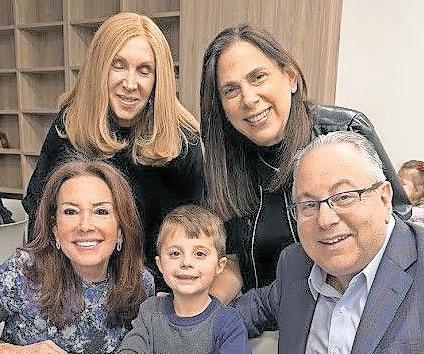
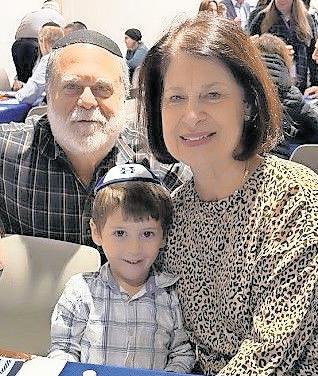
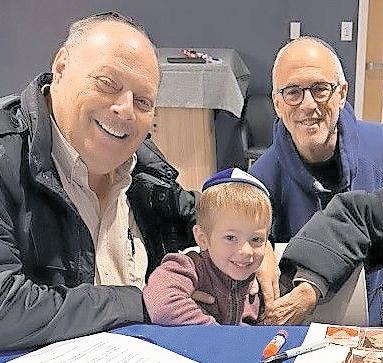
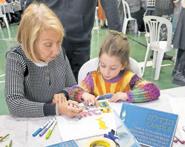
HANC Early Childhood M’Dor L’Dor
Nursery Bet children in the Early Childhood Division of HANC’s Reinstein Family Campus in West Hemp-
stead joined with their grandparents for a M’Dor L’Dor program at which the children presented their grand-
with a tree they hand-painted and to which they attached family photos.
Names Not Numbers captures MTA
Seniors in MTA’s Names Not Numbers Holocaust Documentary elective were joined by Jeff Salgo, a retired CBS News producer, who shared best practices in interviewing. Salgo introduced the mnemonic
HRE: History, Research, and Empathy, explaining that an interviewer must understand the background of the person they are interviewing (History), come prepared and well-informed (Research), and create a respectful,
sensitive space for the interviewee to share difficult memories (Empathy).
The 22 seniors participating in Names Not Numbers will continue their work and look forward to welcoming their Survivors to MTA.
There’s kindness to be found at YCQ
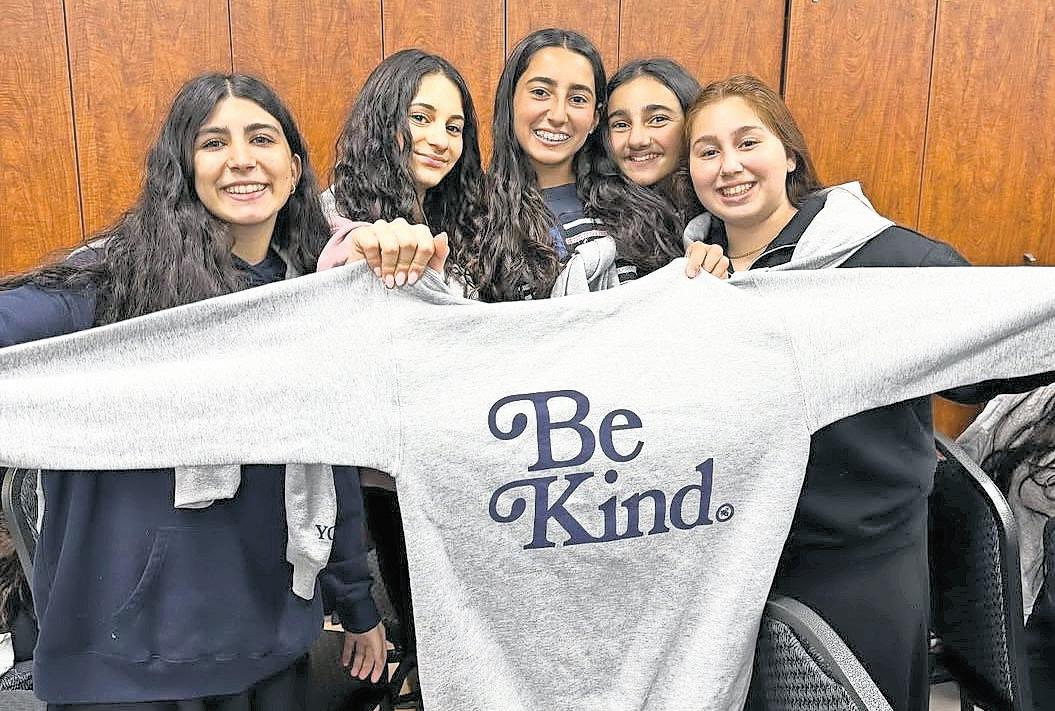
The Yeshiva of Central Queens and the YCQ PTO dedicated a Kindness Campaign in memory of Melissa Maisel A”H, beginning with assemblies led by Rabbi Landsman. Students and staff received zip-up sweatshirts from the PTO with “Be Kind” written on the back.
A “Mix It Up Lunch” encouraged JHS students to sit with new peers, and seventh and eighth graders led activities for elemen-
tary school students.
Additional programming included two Yom Iyuns for Grades 4 and 5 and 6 and 8, respectively. Students learned b’chavruta about the importance of chesed and emulating Hashem’s kindness to us.
The week concluded with “Action Plan Day” during which the entire school wore blue for bullying prevention and made personal commitments to positive change.
Central CIJE Tankers
Several juniors at the Yeshiva University High School for Girls (Central) made their mark.
Camryn Brunner, Annabelle Klein, Ma’ayan Kotkin and Emily Segall presented an invention in progress at CIJE Tank on Nov. 16, hosted by the Center for Initiatives in Jewish Education, and placing as finalists.
Shabbos Week
Central celebrated community and student leadership during its Shabbos Week. Organized by the school’s FIRE (Friends Inspiring Religious Experiences) Ruach Fellows, the event transformed the building into a celebration of Shabbos —
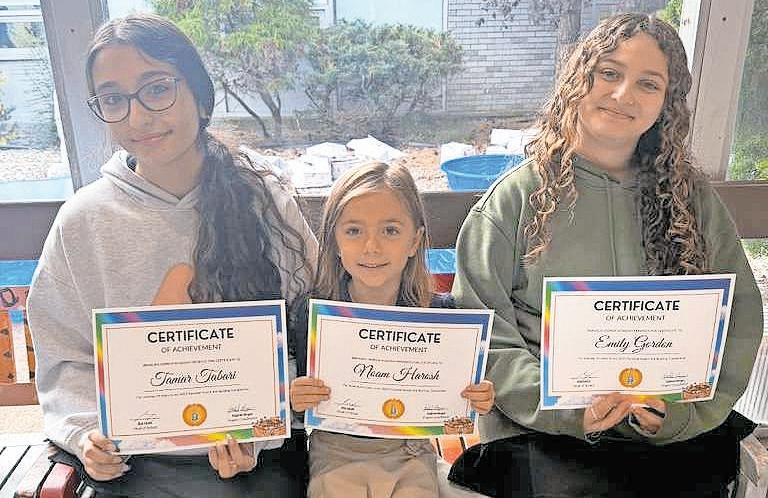
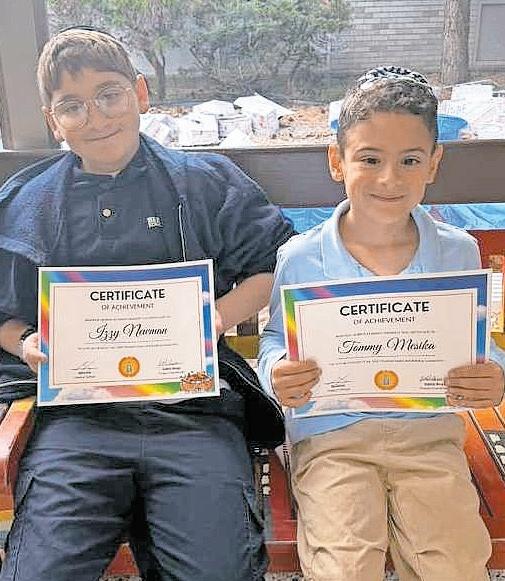
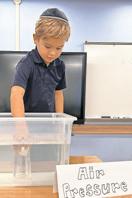
Students at Brandeis Hebrew Academy dove into the story of Parashat Noach with a hands-on project that combined Torah learning, creativity and STEAM — science, technology, engineering, art and math — with collaboration across grades
First place winners (top) were Emily Gordon (8th Grade), Tamar Tabari (8th Grade) and Noam Harosh (1st Grade). Second place
winners (at right) were Izzy Newman (8th Grade) and Tommy Mesika (1st Grade).
“Parashat Noach offers a perfect opportunity to connect timeless lessons of faith with modern learning,” said Gabriel Berger, STEAM Educator. “Students studied the story — and experienced it through teamwork, design thinking and innovation.”
HALB sports club Brandeis STEAM
each day centered on a theme, including erev Shabbos, Friday Night, Shabbos afternoon, and Havdalah/Melaveh Malka.
The week began with an erev Shabbos day, complete with a Hadlakat Neirot Workshop and Chaburah. “Tichel Tuesday” brought high style. Later, there was a cholent cookoff and Frummy Friday.
The event was a testament to the enthusiasm of Central’s FIRE
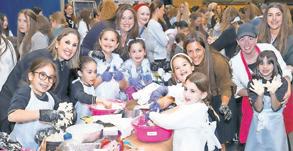
“The fellows collaborated to organize everything, which made it exciting and enjoyable for our students,” said Yael Axelrod, director of Israel guidance and Judaic studies. They also spearheaded this year’s annual Challah Bake, demonstrating the vibrancy and heart the organization brings to Central.
parents
The HALB Sports Club enjoyed a fun filled evening at a Rangers game.
New York City, where many Jews look with foreboding to mayor-elect Zohran Mamdani) across the United States is alarming. Synagogues being targeted, Jewish-owned shops besieged on Black Friday. The clothing store Zara is not Jewishowned, but it does have a branch in Israel, so even that is on the BDS list.
Many American Jews consider themselves Americans first. So did many Germans when Adolf Hitler came to power. They were assimilated into German culture, served proudly in the Kaiser’s Army, but in the end were sent off to Auschwitz together with the bearded Polish Chassidim.
South African Jews, in the main, consider themselves Jewish first — possibly because of the changing governments and their dramatically different policies towards Jews and Israel.
By and large, Jews have been successful in balancing their personal and national responsibilities. Historically, Jews were more loyal to their host countries than those countries were to their Jews. Famously, the Jewish contribution to America is nothing short of monumental in every area of life.
We have lived with the halachic imperative that dina d’malchuta dina (the law of the land is the law we must abide by). In synagogues throughout the world, we’ve recited prayers on Shabbat for the King, Queen, president and governments of the day, even when we may not have agreed with their policies.
What was, in fact, the secret of our success in juggling these seemingly contradictory commitments and loyalties? How did we remain faithful Jews and loyal citizens at the very same time?
This week’s Torah portion, Vayishlach, tells the story of our patriarch Jacob and his impending frightening encounter with his long-lost twin brother, Esau, who was threatening to kill him. Ja-
cob sends envoys to Esau and begins his message with the words, “I have sojourned with Laban.”
Commentary points out that while Jacob was working for Laban in Haran for some 20 years, he still felt like a “sojourner,” a stranger. He never learned from Laban’s evil ways. And he was never quite comfortable and never felt at home in Haran. His home was in the Land of Israel. In Haran, he was an outsider.
Jacob is our role model. Even in alien Haran, he never forgot who he really was.
Wherever we have lived, we have had nothing to apologize for. We have been loyal citizens of every country. We have paid our taxes, served in their armed forces and contributed significantly to every place that granted us the right to reside there.
REPORTER WANTED
Yes, some of us became too assimilated while others may have been too isolationist, but it is safe to say that overall, we have managed to balance our faith and our nationality quite well.
Nobody accused Sandy Koufax of dual loyalty when he refused to pitch for the Dodgers on Yom Kippur during that famous World Series back in 1965. On the contrary, he was respected and admired for his commitment to his faith — not only by his Jewish fans, but by all of America. And, of course, he was a role model for millions of American Jewish kids, myself included. We have never forgotten who we are wherever we have been. May we always continue to be loyal to our host countries, loyal to ourselves and loyal to our faith.
Write: Columnist@TheJewishStar.com
Trump will eye Mamdani
By Mike Wagenhaim
The Trump administration will not allow Mayor-elect Zohran Mamdani to neglect Jews in New York City, according to Leo Terrell, chair of the US Department of Justice’s Task Force to Combat Antisemitism.
“If this mayor turns his back on the Jewish American community, President Trump will take decisive action and the weight of the Department of Justice will be in New York City,” Terrell said. “I can guarantee you of that.”
Trump held a civil press conference with Mamdani, who has said he would have Prime Minister Benjamin Netanyahu arrested if the premier comes to the city, after the two met in the Oval Office. The president called the meeting “very productive” and joked about the mayor-elect considering him a fascist.
Terrell told JNS that there is an “ongoing investigation” about a chaotic, antisemitic protest outside a Nefesh B’Nefesh event at Park East Synagogue in Manhattan.
“We don’t trust the city of New York to do the right thing,” he said.
Terrell said he doesn’t think Alvin Bragg, the Manhattan district attorney, will pursue charges against protesters who blocked the synagogue’s front entrance, barring congregants from safely accessing the building.
The Trump administration “will not allow Jewish Americans to be denied their right to practice their religion,” Terrell said.
He added that time will tell whether Mamdani will change his behavior once he becomes mayor.
“I don’t think there is any prior indication that Mamdani is going to protect Jewish Americans,” told JNS.
is looking to add a full-time reporter to our team as we expand our coverage of local news that’s important to Modern Orthodox communities on LI and in Queens, Riverdale and Westchester.
is looking to add a full-time reporter to our team as we expand our coverage of local news that’s important to Modern Orthodox communities on LI and in Queens, Riverdale and Westchester.
Position offers expert mentoring, a starting salary of $36,400 to $39,520, and a menu of benefits including all Jewish holidays.
Salary ($35,000–$38,000) offers a menu of benefits including all Jewish holidays.
Candidates who have reporting and news-writing experience (professional or collegiate) are invited to email a resume with clips or links to Jobs@TheJewishStar.com.
Candidates who have reporting and news-writing experience (professional or collegitate) are invited to email a resume with clips or links to Jobs@TheJewishStar.com
Dodgers pitcher Sandy Koufax on June 1, 1963.
Leigh Wiener via Wikipedia
Testimony project helps healing by IDF women
By Rolene Marks, JNS
As attention shifts from the battlefield to the long road of recovery, Israelis are beginning to speak more openly about the trauma of the war triggered by the Hamas atrocities of Oct. 7, 2023. For women, that process often unfolds differently. According to the American Psychological Association, women are twice as likely as men to experience post-traumatic stress disorder (PTSD) and are also more likely to seek help.
During the war, many women chose silence. With hostages held in Gaza and families mourning loved ones who fell in battle, they felt that their personal trauma was insignificant by comparison.
“Women experience war very differently from men,” said Ronit Shoval, CEO of the Eden Association, a nonprofit that supports girls and women across Israel. “War is not only about combat. We wanted to look at it from many perspectives.”
Shoval pointed to the moment Israeli families were forced into bomb shelters on Oct. 7 as one of the clearest illustrations of gendered responses to crisis.
“Mothers immediately took responsibility for calming children and separating them from the terror outside,” she said. “Many men searched for weapons and took on the role of defenders.”
Women also process trauma differently, she said. While men often look for practical action, women tend to seek emotional expression. Within days of the Hamas massacre, Shoval and her colleagues began asking what could be done.
“One week after Oct. 7, we sat together and asked what our contribution could be,” she recalled. “A woman from the Nova festival wanted to tell her story again and again. I realized that documenting stories was essential to healing. Trauma needs a beginning, middle and end. But history also erases women’s voices. Wars record generals, not individuals. This project became both therapy and testimony.”
Out of that realization came “October 7th-Her Story: Voices from the Frontline,” a testimony initiative that documents the experiences of female reservists and combat soldiers who fought on the battlefield to defend Israel. To date, some 80 women have shared their stories.
Adi Weiss, the manager of the project, said it initially began as a podcast before shifting to video testimonies.
“We saw how important it was for these women to speak, to
process their trauma on their own terms,” she said. “Trauma victims feel the need to repeat their stories. But over time, details fade or become blocked. We wanted to preserve their voices.”
Weiss added that many women who survived attacks in shelters, at Nova and on kibbutzim spoke openly about their fear of sexual assault.
“They said they feared rape more than death,” she said. “And today we know this fear affected men as well.”
When word of the project spread, women began approaching the Eden Association, wanting to participate. For many, it was the first time they told their story to anyone, including family.
“Some canceled multiple times,” Weiss said. “They wanted to speak but were afraid. Our model focuses on control. Trauma steals control. We ask questions carefully and make sure the women remain in charge of their narrative.”
The stories they shared are harrowing and powerful. Meital Feldman, an imaging specialist who served as a reservist at Camp Shura identifying casualties, described the emotional toll of her duties.
“I was dealing with death constantly,” she said. “I ran my hands over the body bags, whispering, ‘You are a hero of Israel.’ When I came home, I would scrub myself in the shower to bring back the feeling of life, because death clings to you.”
Maj. May Talker, the commander of a body recovery team at the Nova Festival site, recalled the moment that fractured her emotional defenses. “Next to one of the bodies was a phone. It rang with ‘mom’ on the screen. That was the first moment my focus broke. A mother was searching for her daughter, and I knew the truth.”
She said the war proved the quiet strength of women. “Women did powerful things, not only in combat but throughout everything that happened,” she said. “We should talk about it more.”
For female soldiers, the challenges are layered. They face combat like their male counterparts while also navigating issues of acceptance, identity and physical boundaries in overwhelmingly male units.
“They fight three battles,” Weiss said. “On the battlefield, in their personal lives and in defining who they are.”
Capt. Dr. Bar, a medical officer in the Armored Corps, described the additional pressure. “Because I am a woman, I have to prove myself more,” she said. “So I don’t complain, even when it is hard.”
Some women found expression through art rather than words. The project has already produced three exhibitions featuring artwork and photography. Thirteen women were photographed in environments where they felt most at ease, reclaiming control over how their stories are seen.
For Shoval, the project’s meaning is clear. “This is not only documentation,” she said. “This is survival.”
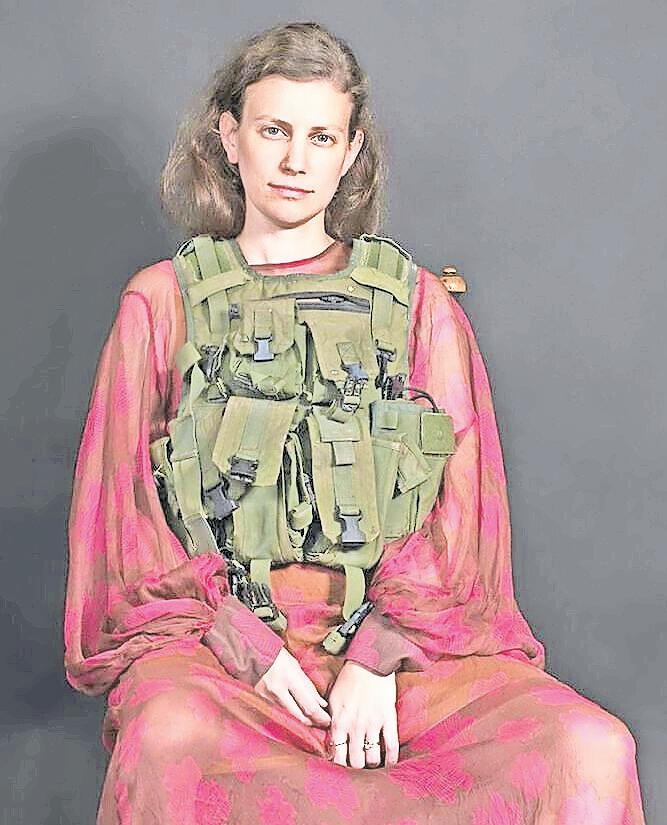
The photograph, “Equals,” featuring Liad Granovich Wiskovsky by photographer Alicia Shachaf was taken in 2025. Alicia Shachaf
For Heaven’s sake, why can’t a Jew make aliyah?
DAVID S. LEVINE
Author
The biblical texts command the Children of Israel to treat converts and non-Jews with exceptional care, love and equality, rooted in empathy from their own history as strangers.
A recent article in the Jerusalem Post by Cookie Schwaeber-Issan (“ ‘Don’t ask, don’t tell’ aliyah,” Nov. 18) makes the uncomfortably true statement that “there is an unacceptable and antagonistic attitude present in Israel’s Interior Ministry [and the office of the Chief Rabbinate] who are discriminating against Jews who are not connected to the faith or even their community.”
While the writer astutely points out that this is occurring “at a time when we are witnessing the worst wave of global antisemitism since the Holocaust, even affecting both totally assimilated, non-observant Jews,” unfortunately, this “unacceptable and antagonistic attitude” has been going on for decades.
According to the Law of Return, established in 1950, eligibility to become a citizen of Israel is as follows: “Every Jew has the right to come to this country as an oleh.” In 1970, the law was amended to include people with at least one Jewish parent or grandparent, or a person who is married to a Jew, whether or not they are considered Jewish under Orthodox interpretations of Jewish law. The law defines “Jew” as a person born to a Jewish mother or converted to Judaism, who is not a member of another religion.
Yet when applying for citizenship, there is a very strict requirement for a letter from an Orthodox rabbi or rabbinic authority recognized by the Chief Rabbinate of Israel, who vouches for the applicant, guaranteeing that this person is a “Jew in good standing.” In some cases, even after fulfilling this requirement, the applicant has been rejected. Additionally, what about those with no synagogue or religious organization affiliation? They might be assimilated, intermarried, etc. Ethnically, they are still Jews.
And what about converts?
Israel’s immigration authority recently denied aliyah to an American woman, already living in Israel, who converted to Reform Judaism, saying her conversion lacked sufficient
5,800 Bnei
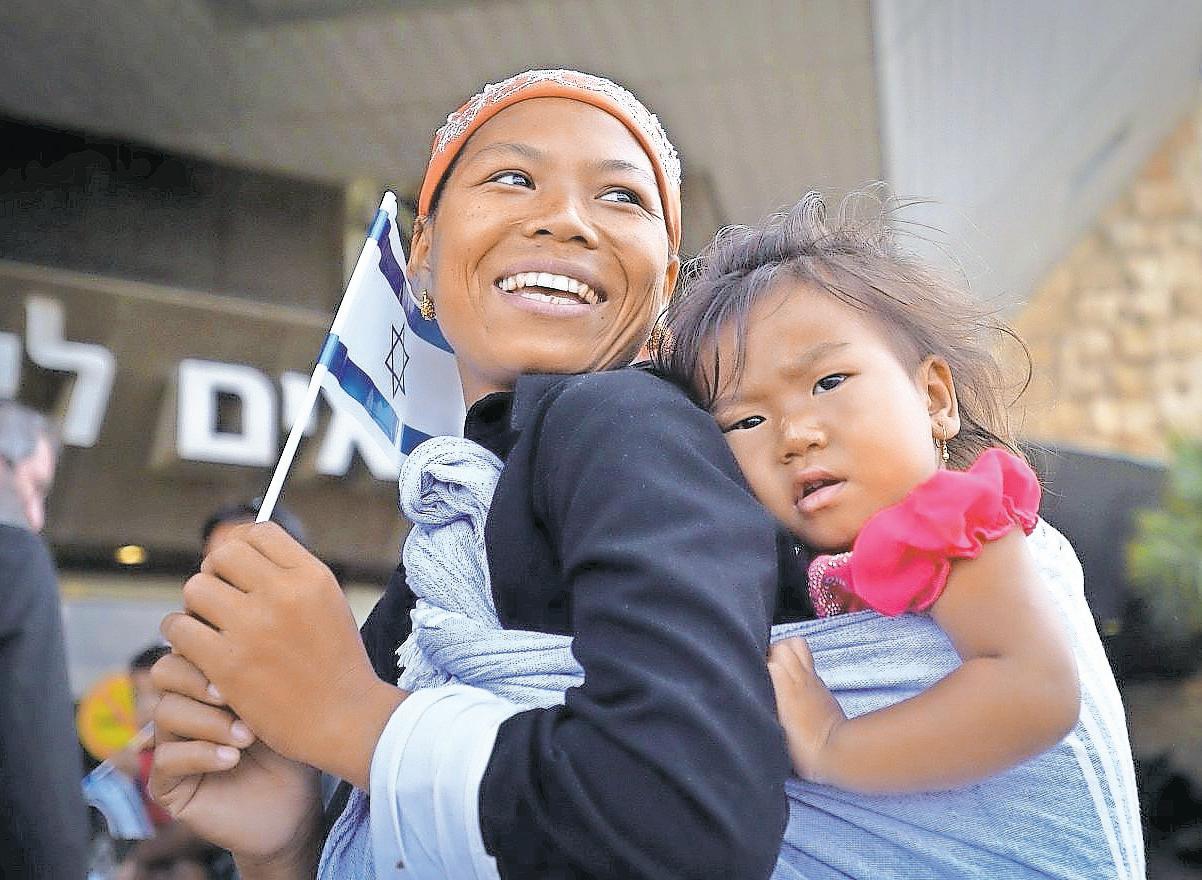
Newly arrived Jew from India, members of the Bnei Menashe community, arrive at Ben-Gurion International Airport on Oct. 13, 2021. Tomer Neuberg, Flash90
community involvement.
Yet a beit din had approved her conversion after nearly a year of study. Additionally, she entered an immersion program to teach English in an Orthodox public school in Netanya, which included living a Jewish communal life in Israel, from school prayers with students to weekly Orthodox Shabbat meals with a host family.
Other related news stories are “Rabbinical courts revoke conversion approved by Beth Din of America” and “Rabbinical Court Puts Thousands of Converts in Legal Limbo,” to reference just a few.
The Bible, Talmud and daily prayers clearly state how converts should be treated or accepted.
One of a number of biblical texts on the subject states: “When strangers reside with you in your land, you shall not wrong them.” “The strangers who reside with you shall be to you as your citizens; you shall love each one as yourself, for you were strangers in the land of Egypt: I am your G-d.” (Leviticus 19:33-34)
Importantly, rabbinic interpretation and Jewish tradition have equated and linked the word “stranger” (ger in Hebrew) with “convert.” Therefore, converts are to be accepted as full Jews. The biblical texts command the Children of Israel to treat converts and non-Jews with exceptional care, love and equality, rooted in empathy from their own history as strangers.
As modern-day proof of this command and concept, this is clearly expressed in the 13th paragraph of the State of Israel’s Declaration of Independence on equality, which states:
Menashe can enter by 2030, Israel says
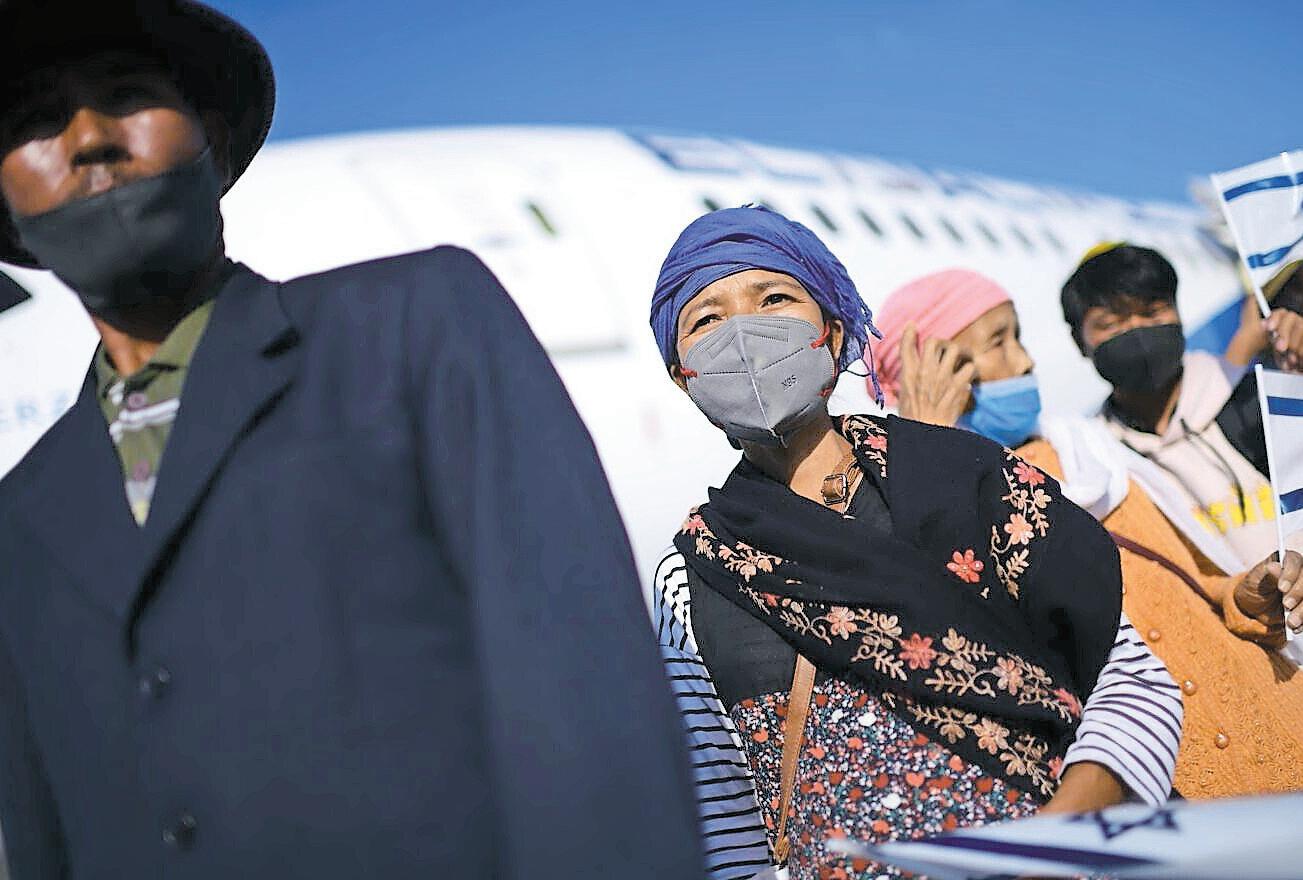
The Israeli government approved on Sunday the immigration of 1,200 members of India’s Bnei Menashe community by the end of 2026, and about 4,600 more by 2030.
This process is expected to bring the entire Bnei Menashe community to Israel, reuniting families, according to the Israeli Prime Minister’s Office.
The new immigrants are expected to settle in Nof HaGalil and additional cities in northern Israel as part of a wide-scale absorption process in cooperation with Minister Zeev Elkin, who serves in the Finance Ministry and is responsible for the Northern Rehabilitation Directorate.
Israeli Prime Minister Benjamin Netanyahu said: “I welcome the important and Zionist decision adopted today by the government, which will bring about an additional wave of immigration of the Bnei Menashe community to the Land of Israel. The new immigrants will settle in the north of the country, as part of the government’s policy to strengthen and develop the North and the Galilee.”
The decision was initiated by Netanyahu and Israeli Aliyah and Integration Minister Ofir Sofer,
About 100 Bnei Menashe landed at Ben-Gurion, headed for the Golan Heights, the traditional homeland of the Menashe tribe, on June 25, 2015. Flash90
THE STATE OF ISRAEL will be open for Jewish immigration and for the Ingathering of the Exiles; it will foster the development of the country for the benefit of all its inhabitants; it will be based on freedom, justice and peace as envisaged by the prophets of Israel; it will ensure complete equality of social and political rights to all its inhabitants irrespective of religion, race or sex; it will guarantee freedom of religion, conscience, language, education and culture; it will safeguard the Holy Places of all religions; and it will be faithful to the principles of the Charter of the United Nations.
If that wasn’t enough, Talmud Bavli Tractate Yevamot 47a v13 states very clearly:
Our rabbis taught: A convert who comes to convert in this time is told: “What have you seen that brought you to convert? Do you not know that Israel in this time are distressed, oppressed, harassed and troubled, and that suffering comes upon them?” If he says: “I know, and I am unworthy [but still wish to join],” they accept him immediately. This authoritatively says accept them immediately, then begin to teach and immerse them in Judaism.
Emphasized in the Shmona Esrei is the 13th blessing: “May Your mercy be aroused, Hashem our G-d, upon the righteous, upon the pious, upon the elders of Your people, Israel, upon the remnant of their scholars, upon the righteous converts, and upon us. Grant bountiful reward to all who trust in Your Name in truth; and place our lot among them, and may we never be put to shame, for we have put our trust in You. Blessed are You, Hashem, support and trust of the righteous.” Note the inclusion and description of converts in this prayer for the righteous.
On Nov. 23, according to a JNS article, the Israeli government approved the immigration of 1,200 members of India’s Bnei Menashe community by the end of 2026 and about 4,600 more by 2030.
According to Israeli Aliyah and Integration Minister Ofir Sofer, this “strengthens the resilience, solidarity and renewal of the State of Israel.” Yet the government statement reads that after approval of the lists by the chief rabbi of Israel and the president of the Great Rabbinical Court, the immigrants will enter the country with a temporary A/5 visa and not citizenship.
We are repeatedly commanded to accept and treat converts as equal Jews. Shouldn’t we also accept the Jewishness of those born Jews, regardless of their current religious situation or affiliation? Would Ruth, a convert from whom King David is descended, be good enough for Israeli citizenship for them today? Don’t those who make up the Chief Rabbinate know their Bible, Talmud and daily prayers? Rabbis of the Chief Rabbinate, let all Jews make aliyah! Jewish cultural and religious life in Israel, coupled with your teachings, should bring them along their path as a positive part of Am Yisrael, the “Nation of Israel.”
David S. Levine is the author of the forthcoming book, “Prayer: In Their Own Words — IslamCatholicism-Judaism: What Do They Pray For?” Write: Columnist@TheJewishStar.com
in collaboration with Finance Minister Bezalel Smotrich and Minister Elkin, the PMO said.
“This wave of immigration joins the blessed immigration we have seen over the past two years from many Jewish communities around the world — an immigration that strengthens the resilience, solidarity, and renewal of the State of Israel,” said Sofer.
Smotrich added, “Completing the immigration of the Bnei Menashe is a renewed connection with brothers who have carried in their hearts the longing for Zion for generations.”
A first Israeli delegation will depart within a week to India, together with the Chief Rabbinate, Conversion Authority, Aliyah and Integration Ministry, Population and Immigration Authority, Foreign Ministry and the Jewish Agency to examine the community members’ eligibility, according to Decision 2442 from 2007, which allows groups to enter Israel for the purpose of conversion and naturalization, the PMO added.
After approval of the lists by the Chief Rabbi of Israel and president of the Great Rabbinical Court, the immigrants will enter the country with an A/5 visa, the statement read. —JNS
Children in our kitchens light up Chanukah WINE AND DINE
EThEl G. hofMAN
Chanukah is a holiday that takes over everything. The pantry overflows with bottles of oil and baking ingredients at the ready, kids decorate the house with dreidels and chocolate gelt coins, the menorahs get dusted off, and there are whispers of gift requests.
For grandparents, parents and kids, it’s the perfect opportunity to relax and talk. Spending quality time together is a life skill, as is spending time in the kitchen. And there’s more to it than just measuring and mixing — health, science, math, nutrition and even family history are all involved. Before beginning to handle food, make sure to wash hands and roll up your sleeves!
Grandparents can tell the story of a particular dish or baked good handed down through generations. Then there are the questions:
•Why does a cake rise?
•How many quarters make a whole cup?
•Which ingredient goes in first?
•How long do you mix?
Fine motor skills are practiced through kneading, mixing, whisking and all the actions used in preparing something they love to do (and better yet, love to eat).
If you’re cooking with little ones, adult supervision is needed, especially with tasks related to the stove or oven. Other recipes are so easy that they can attempt to do it themselves.
So what if the bread rolls for the “Menorah Candles” are squashed or the “Wacky Cake” mixture is plastered up the sides of the baking dish? The results are good enough to eat, and there’s always that satisfied look of “I made it myself.”
To a sweet and Happy Chanukah!
Broccoli Tree Soup (Dairy)
This is one way to get them to eat greens. My toddlers always called broccoli florets “trees.” Serves 2.
Consult your rabbi regarding current broccoli precautions. Checked and frozen broccoli is often preferred.
Cook’s Tips: •Cut florets into smaller florets.•At a pinch, use prepared mac-andcheese from the market.
Ingredients:
• 1 cup macaroni, cooked
• 1/3 cup grated cheese
• 1 to 1-1/2 cups vegetarian broth
• About ½ cup broccoli florets
Directions: Place the cooked macaroni into a medium saucepan. Stir in the cheese and 1 cup broth. Heat over medium heat to melt cheese. Do not boil. Add more broth, if desired. Stir in the tiny broccoli florets and heat through. Pour into bowls and serve.
(Dairy)
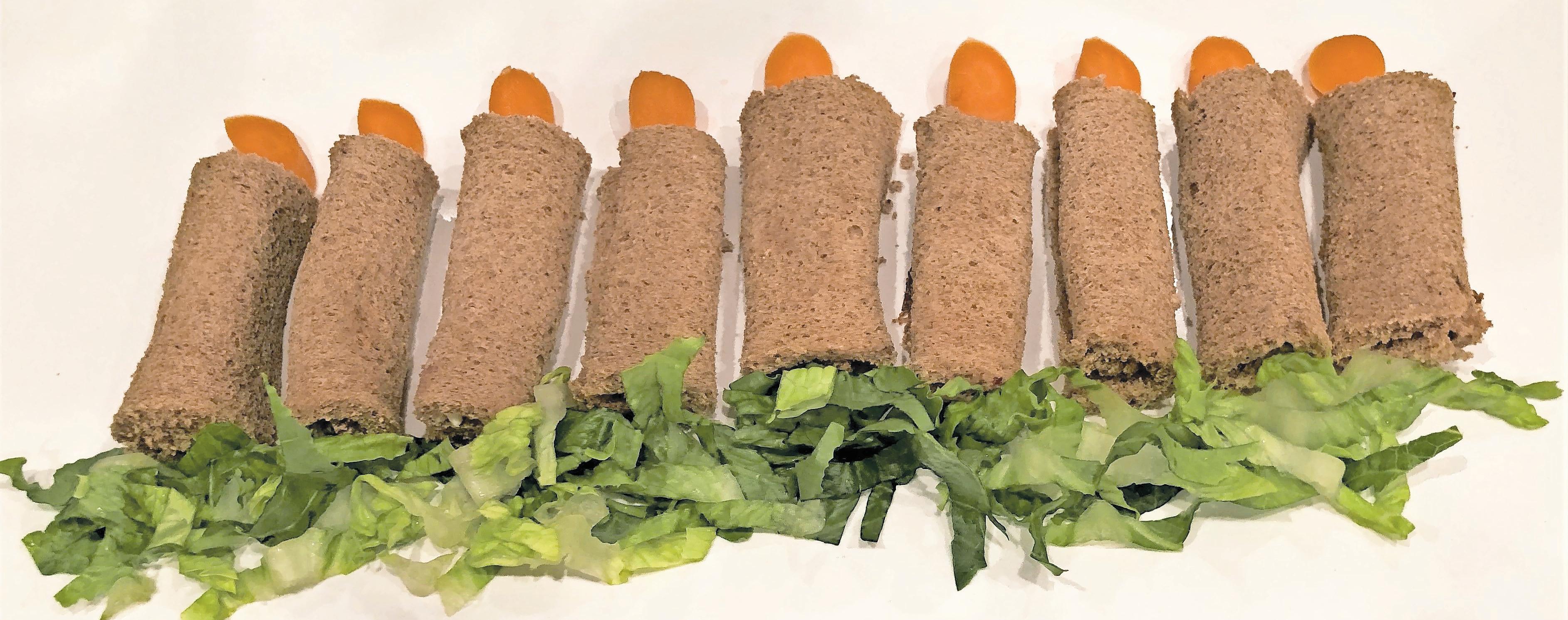
Besides lighting the candles on the menorah, it’s fun to make one that’s good enough to eat. Serves 9.
Cook’s Tips:
•Adults should shred lettuce for little kids.
•Microwave cream cheese 15 to 20 seconds for easy spreading.
•Stack 4 to 5 slices bread on a cutting board. Trim crusts. Save crusts for cheese sticks (recipe below).
•Instead of carrots, quartered small strawberries may be used for flames.
Ingredients:
• 9 slices whole-wheat or white thinsliced bread
• 3 to 4 Tbsp. cream-cheese
• 2 to 3 baby carrots, sliced on diagonal about 1/4-inch thick
• 2 cups shredded lettuce
Directions:
Lay bread slices on a board. Spread thinly with cream cheese. Roll each one up like a jelly roll. Press lightly.
Arrange on a large platter or board to resemble candles. Insert a carrot slice at top of each “candle” to resemble flame. Spread a line of shredded lettuce at bottom of cream-cheese rolls.
Chill or just eat at once.
Cheese Sticks: Place crusts on a baking sheet. Toss in 1 tablespoon melted margarine, then in 1 tablespoon Parmesan cheese. Bake at preheated 375 degree oven for eight to 10 minutes, or until beginning to brown. Cool before eating.
Jammy Pennies (Pareve)
Makes 9 to 12
Cook’s Tips:
•No need to remove crusts.
•No cookie-cutter? Use a juice glass.
•Use any favorite preserves.
•Substitute margarine for peanut butter.
•If not eaten immediately, cover with plastic wrap and chill.
Ingredients:
• 3 to 4 slices whole-wheat bread
• 2 Tbsp. softened peanut butter
• 2 to 3 Tbsp. preserves, any flavor
Directions:
Lay bread slices on a cutting board. Spread thinly with peanut butter, then with preserves. Cut out with a small cookie-cutter, about 1-/2 inches in size. Don’t worry if circles include crusts. Arrange on a platter and serve.
Chocolate Haystacks (Pareve)
Makes 8 to 10 mini stacks
Cook’s Tips:
•Set bowl on a kitchen towel so that it doesn’t slide while stirring.
•Instead of shredded wheat, substitute corn flakes.
•Spoon into paper mini-muffin cups instead of a baking sheet.
Ingredients:
2 Tbsp. margarine, cut in pieces
2 Tbsp. honey
1 Tbsp. sugar
2 tablespoons unsweetened cocoa powder
1-1/2 cups shredded wheat, coarsely crushed
Directions:
Spray a cookie sheet with nonstick baking spray. Set aside.
Place margarine and honey in a medium microwave-safe bowl. Microwave 45 seconds. Stir. If not melted, microwave in 15 second bursts. Add the cocoa and mix until smooth. Add the shredded wheat, stirring to coat almost completely. Drop in heaped teaspoonfuls onto prepared cookie sheet.
Refrigerate 30 to 40 minutes or until firm.
Swift ‘Sufganiyot’ (Dairy)
In Israel, sufganiyot or doughnuts, are always served at Chanukah time, when even El Al Airlines check-in counters often have platters of these oilbased treats to sample. Makes 12.
Cook’s Tips:
•Buy doughnut holes from market.
•Besides preserves, you may use peanut butter, cream cheese or grated cheese.
•Use cinnamon-sugar instead of confectioners’ sugar.
Ingredients:
• 12 doughnut holes, plain or glazed
• 2 Tbsp. preserves
Confectioners’ sugar (optional)
Directions:
Cut each doughnut hole in half. With a teaspoon, scoop out a teaspoonful of crumbs from 6 halves.
Use the end of a wooden spoon to make a smooth hole. Spoon about 1/2 teaspoon of preserves in each hole. Top with the remaining halves, pressing lightly. Roll in confectioners’ sugar or cinnamon-sugar.
To make cinnamon-sugar: In a small jar, measure 1 tablespoon granulated sugar and 1 teaspoon cinnamon. Cover; shake well to mix.
Wacky Raisin Cake (Pareve/Vegetarian)
This goes all the way back to the Depression, a time when dairy ingredients were expensive and scarce. You probably have all of these ingredients on hand in your pantry. 12 servings.
Cook’s Tips:
•Any leftovers may be frozen.
•Instead of raisins, stir in fresh hard fruits, such as finely diced apples or pears.
•No white vinegar? Substitute lemon juice.
•Don’t worry if cake mixture is smeared on inside of pan. It’s wacky!
Ingredients:
• 1-1/2 cups all-purpose flour
• 1 cup sugar
• 4 Tbsp. unsweetened cocoa
• 1 tsp. baking soda
• 6 Tbsp. vegetable oil
See Children in our kitchens on page 14
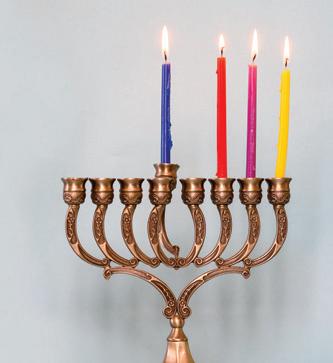
Chanukah ‘Menorah’
Wearing Judaica: Torn between pride and fear
ROBIN FRIEDMAN
Tribe Talk
Packing for a long-awaited trip to Italy recently, I reached for the two necklaces I never take off: my Star of David and the dog tag for Israeli hostages, which I have worn since just after Oct. 7, 2023. Before I zipped up my suitcase, several Jewish friends asked a question that stopped me: “Are you going to wear those in Europe?”
It’s a heartbreaking question — understandable, yet profoundly unfair. Why should anyone have to choose between feeling safe and being themselves?
Yet for many of us today, this is the choice.
This summer, Jewish and Israeli tourists in Europe experienced harassment, intimidation and even violence. In Venice, an AmericanJewish couple was cornered and verbally assaulted. In the Swiss Alps, vandals defaced the car of British-Jewish tourists with “Free Palestine.” In Vienna, a Jewish family was expelled from an Uber simply for being Jewish.
The messages sent in these incidents are un-
Even a quiet expression of identity can make them a target.
mistakable: If you’re visibly Jewish, you may not be safe.
At the same time, this anxiety no longer stops at the water’s edge. It is not just “over there.”
Since Oct. 7, fear has crept into American life — from our trains and schools to social-media feeds. Jewish parents now ask whether their children should wear Judaica to school or hide their Star of David under a shirt. They wonder if they should tell a new teacher their family is Jewish, especially when that teacher’s socialmedia affiliation includes the phrase “globalize the intifada,” a slogan widely understood as a call for indiscriminate violence against Israel and, potentially, against Jews.
Let that sink in: In 2025, American parents are asking whether it is safe for their children simply to appear Jewish, not in Europe in the 1940s, not in a theocracy abroad, not in nations today with a population harboring extreme levels of antisemitic attitudes and beliefs, but in a public school classroom in the United States.
Consider the average Jewish college student in America. They are not deeply involved in student Jewish life — not at Hillel, not at Chabad or at an advocacy group, but they wear a small Star of David necklace. In today’s climate, even that quiet expression of identity can make them a target. The vulnerability comes not from activism but from visibility.
Some 80% of Jewish students say they have hidden their Jewish identity for safety. They think they are choosing safety, but in truth, they are being forced to choose silence.
This is a profound, painful commentary on the state of Jewish safety and belonging in soci-
ety. It signals the normalization of antisemitism and the quiet resignation that Jews must somehow accept less safety, less freedom, less visibility than others.
So, yes, it’s just a necklace. But it is also a question of identity, dignity and safety. When someone asks, “Is it safe to wear this?” what they’re really asking is: “Am I allowed to be who I am without fear?”
In a country founded on freedom of religion and expression, the only acceptable answer should be an unequivocal yes. The fact that it no longer feels that way is an American tragedy.
A recent incident in Skokie, Ill., serves as a stark reminder of such a reality.
This past Oct. 7, a group of mostly 12- to 15-year-olds who were playing basketball were confronted by another group of youths who hurled antisemitic slurs, fired gel-pellet guns and chased them off the court. One child was struck in the leg. The Skokie Police Department
classified the attack as a hate crime.
This is suburban America — not a war zone, not a distant dictatorship. And yet, Jewish children were targeted simply for being Jewish. The Skokie incident, among many others, is not an outlier, but rather, a warning that the freedoms once taken for granted in this nation are increasingly under threat.
In August, a post in the Mothers Against College Antisemitism (MACA) Facebook group asking whether children should wear a Star of David sparked hundreds of heated comments. Most parents urged pride in Jewish identity, though many voiced fear over safety, citing hostile environments like “Jew-hating Seattle” or “proHamas spaces.” Some parents forbade their children from wearing the symbol, even if they wore it themselves, calling it a painful choice. Others advised caution depending on location and risk. Overall, the discussion revealed a community Still, amid this uncertainty, one truth remains: Being Jewish is not a liability; it is a gift. And with that gift comes the responsibility to remain visible and seek to engage outside of the community, even when it’s difficult. Of course, with safety and security always top of mind, our priority now must also be to push prejudice back to the fringes with our presence.
In 2025, wearing a Star of David in a major American or European city, or on a college campus, is no longer just an act of faith. It is an act of courage and a declaration that we will not be erased. Robin Friedman is co-founder of TribeTalk, an organization that empowers Jewish students and their allies to address challenging issues of antisemitism and anti-Israel bias.
Write: Columnist@TheJewishStar.com
2,761 at Shabbat meal sets Guinness record…
Continued from page 1
more than the prior record of 2,322 at a Shabbat gathering in Berlin on July 31, 2015 during the European Maccabi Games.
The Emanu-El event, in planning for several years, took on new significance in the current political climate and following recent events in New York City.
“We didn’t anticipate the environment and the historic moment in which the event would take place, particularly given the tensions in New York City around the increase in antisemitic violence and the divisions sparked during the mayoral race,” Joshua Davidson, senior spiritual leader of Emanu-El, told JNS.
Mayor-elect Zohran Mamdani has said he would have the Israeli prime minister arrested, and his press secretary said after the Park East Synagogue protest that the Nefesh B’Nefesh
event, which addressed Jews moving to Israel, amounted to a “violation of international law.”
“We certainly didn’t anticipate that two days before the event, there would be a very disturbing antisemitic protest at one of New York’s own synagogues,” Davidson said of the Shabbat gathering.
The record-breaking event, which drew Emanu-El members, New Yorkers from different Jewish denominations, international visitors and non-Jews who came with their Jewish friends, “turned out to be more poignant and more powerful than any of us could have imagined,” Davidson said.
“It wasn’t just a celebratory dinner,” he told JNS. “It became an important demonstration of Jewish pride.”
The freed hostage Omri Miran and his wife Lishay lit candles, and prominent Jewish chefs
recited other blessings prior to the meal. Two stars from “Fiddler on the Roof” on Broadway sang Shabbat songs during the meal, as did an a capella group, Davidson said.
“The power of the event was the statement it made at this particular moment in Jewish history,” he said. “It all made the evening an especially poignant statement of Jewish solidarity.”
Frank Greenberg, 68, a Temple Emanu-El member, attended the “spectacular” with his family members and 30 friends who they invited.
“It was incredibly well organized. The security was perfect,” he told JNS. “Everybody was concerned about security. The flow of the evening was better than we expected. No other event I’ve been to comes close to this.”
Everyone was very excited when there was an announcement that a Guinness record had been set, he said.
A spokesman for Mayor Eric Adams praised the event and the message it projected at a tense time for New York Jews.
“New York City is home to a vibrant, eclectic and diverse Jewish community — the largest one outside of Israel,” said the spokesman for Adams, who visited Israel last week.
Rabbi Aharon Slonim, who runs the Chabad at Binghamton University, told JNS that “if every Jewish community continues to break records in this vein, the world will be that much more of a brighter place.”
The Binghamton Chabad began hosting “Shabbat 1,000” dinners in 1994, and one such event drew more than 2,000 people, according to Rabbi Slonim. The event brings Jews together in a “meaningful way” and builds on the vision of the late Rabbi Menachem Mendel Schneerson, the Lubavitcher Rebbe, he said.
Children in our kitchens light up Chanukah…
Continued from page 12
• 1 Tbsp. white vinegar
• 1 tsp. vanilla extract
• 1/2 cup raisins
• 1 cup water
• Confectioners’ sugar to sprinkle (optional)
Directions:
Preheat oven to 350 degrees. Into an ungreased 8x8-inch cake pan, dump in flour, sugar, cocoa and baking soda. Stir to mix. Roughly spread out with a wooden spoon to cover the bottom of pan.
With wooden spoon, make three holes in flour mixture. Pour the oil into one hole, the vinegar into the second hole, and the vanilla and raisins into the third hole. Pour the water over all.
Stir to mix using a big fork, making sure no white streaks remain.
Bake in preheated oven for 30 to 40 minutes, or until a tooth pick inserted in center comes out clean. Cool before sprinkling with confectioners’ sugar (optional) and cutting into squares.
Strawberry Soda (Dairy)
1 serving Ingredients:
• 1/4 cup strawberries, fresh or frozen
• Bottle of sparkling water
• 1 scoop strawberry ice-cream or frozen yogurt
• Box of cookies (sugar, butter, vanilla wafers, plain biscuits)
Directions:
In a mug or tall glass, crush berries with a fork. Fill the glass half-full with sparkling water. Add the ice-cream; stir.
Serve with a cookie on the side.
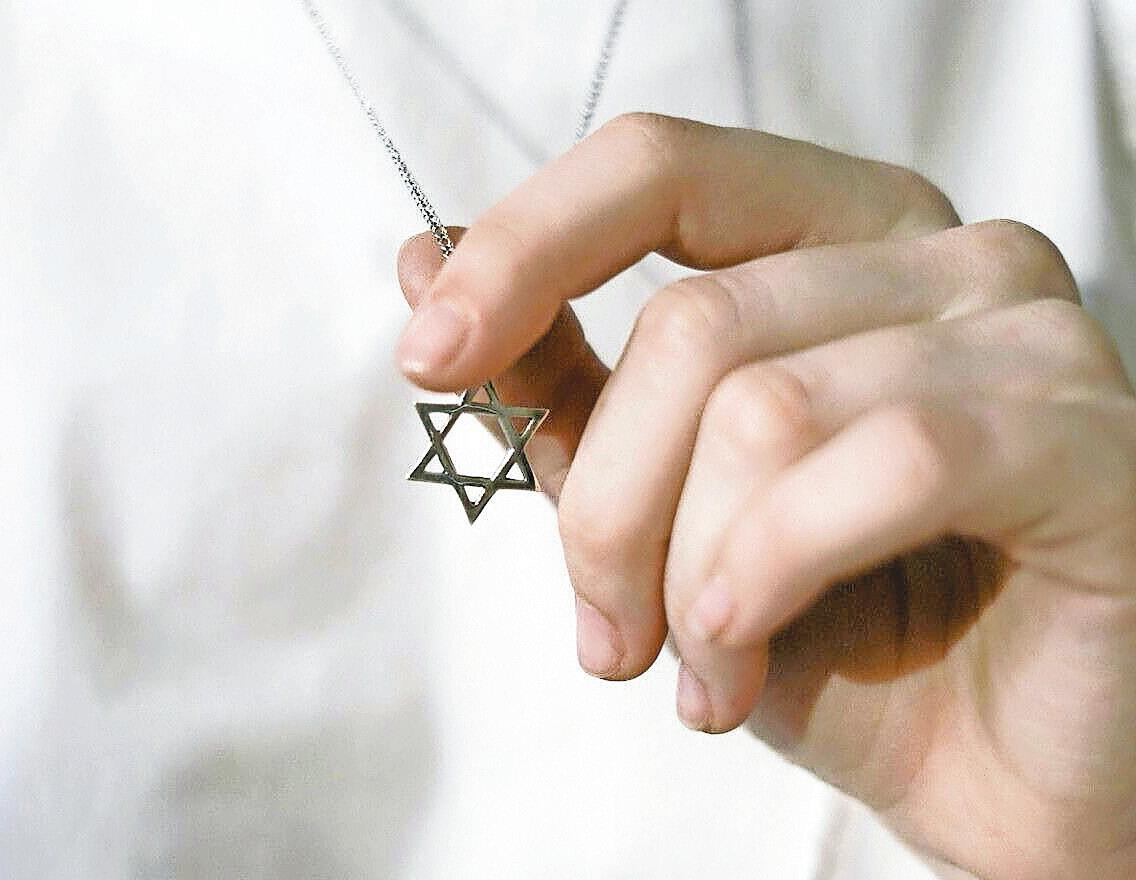
A Star of David. Cottonbro Studio, Pexels via JNS
‘Inside Chanukah’: Full historical presentation
Kosher Bookworm
AlAn JAy
GerBer Jewish Star columnist
Rabbi Aryeh Pinchas Strickoff, author of “Inside Chanukah: Fascinating and Intriguing Insights on Chanukah, Its Miracles, and its History” (Feldheim 2012), perhaps said it best in his perceptive opening preface: Jewish holidays serve a much loftier purpose than simply marking special moments in time or commemorating historical events, though those functions are no doubt important. The fundamental goal of celebrating the Jewish holidays is the internalization of the specific messages each respectively imparts, to help us grow spiritually and ultimately draw closer to G-d. The holiday of Chanukah is no different. During the cold and dark days of the month of Kislev, Chanukah comes with its message of hope and lights to inspire every Jew to recognize the enormous potential within his soul.
ery Institute in Jerusalem; Rabbi Dr. Shnayer Leiman of Brooklyn College; and the dean of American Jewish historians, Dr. Louis Feldman z”l, of Yeshiva University.
The introductory essay, “Judaism vs. Hellenism,” seems to reflect collectively the work of these three outstanding scholars.
In Rabbi Strickoff’s “Author’s Note” we find a series of qualifications concerning some of the historical terms used in his work. One in particular deserves mention in its entirety, as a crucial lesson when studying the history of Chanukah: Unless otherwise noted, references in this sefer to “Yavan [literally, Greece] generally refers to the Syrian-Greek kingdom ruled by Antiochus from his capital city Antioch in Syria that dominated the Land of Israel during the time of Chanukah.
Within the contents of this comprehensive 700 page work can be found just about every major topic and teaching related to the Chanukah story. From ritual practice to history, the author brings to the lay reader a fully annotated work of pure scholarship that includes 700 fully annotated footnotes, textual sources that include historical texts and their background, Talmudic and Rabbinic texts, a Torah perspective on the holiday’s historical texts, and the historical context of the holiday.
Also to be found are detailed descriptions of the laws and practices that give the holiday its unique flavor and image. All of this is presented with relevant historical background and geographic detail in plain and clear English, absent the technical jargon so common in other works. And there is much more.
One fascinating chapter is “section seven” wherein is found the answers to the following two pivotal questions:
•Why does Chanukah always coincide with the parashiyot that tell the story of Joseph (Vayeshev, Mikeitz, and Vayigash)?
•What is the underlying parallel between Chanukah and these three parashiyot which, depending on the year, we read during Chanukah?
Each one of these three Torah portions are given detailed analytical treatment, in a question and answer format, that expands the reader’s understanding of the holiday’s themes and gives us a deeper appreciation of the story of Joseph in light of the Chanukah episode.
Another unique feature in this work is a detailed English commentary of the famed piyut of praise, “Maoz Tzur,” which, in and of itself, serves as a history-based timeline of the Jewish people.
This commentary is based on interpretations found in “Siddur Avodat Yisrael,” “Yalkut Ohr HaGanuz L’Yemei Chanukah,” Rabbi Avraham Rosenwasser’s S”efer Pardes HaChanukah,” and Rabbi Tzvi Cohen’s “Chanukah: Halachot U’Minhagim.”
Note is made by the author of those whose scholarship was referenced in the compilation of this volume. Among those acknowledged with grace are Rabbi Dr. Berel Wein z”l of the Discov-
After the demise of Alexander the Great, his great Greek kingdom was divided amongst his three generals, creating three separate and independent Greek kingdoms in Asia Minor, Egypt, and Syria respectively.
Thus, it is important to specify which kingdom one is referring to when using the term Yavan for the Greeks during that time period. Alternatively, as it may apply in the context, Yavan may also refer to Greek culture and society in general.
The intellectual integrity that is at the foundation of this work, makes this one of the best Chanukah books ever authored in English for the Jewish layperson.
Write: Columnist@TheJewishStar.com
Alan Gerber’s Kosher Bookworm has been featured by The Jewish Star for 18 years.
Jewish Star Torah columnists: Rabbi Benny Berlin, spiritual leader of BACH Jewish Center in Long Beach; Rabbi Avi Billet of Anshei Chesed, Boynton Beach, FL, mohel and Five Towns native; Rabbi Binny Freedman, rosh yeshiva of Orayta, Jerusalem; Dr. Alan A. Mazurek, former ZOA chair, retired neurologist, living in Great Neck, Jerusalem and Florida.
Contributing writers: Rabbi Sir Jonathan Sacks zt”l, former chief rabbi of United Hebrew Congregations of British Commonwealth; Rabbi Yossy Goldman, president South African Rabbinical Association; Rabbi Dr. Tzvi Hersh Weinreb, OU executive VP emeritus.
Five Towns Candlelighting: From the White Shul, Far Rockaway, NY
Scarsdale Candlelighting: From the Young Israel of Scarsdale, Scarsdale, NY
Fear or distress over tough moral choices
rabbi Sir
Jacob and Esau are about to meet again after a separation of 22 years. It is a fraught encounter. Once, Esau had sworn to kill Jacob in revenge for what he saw as the theft of his blessing. Will he do so now — or has time healed the wound? Jacob sends messengers to let his brother know he is coming. They return, saying that Esau is coming to meet Jacob with a force of four hundred men. We then read: Jacob was acutely afraid and distressed. Bereishit 32:8
The question is obvious. Jacob is in the grip of strong emotions. But why the tautology, the duplication of verbs? What is the difference between being afraid and being distressed? To this a Midrash gives a profound answer:
Rabbi Judah bar Ilai said: Are not fear and distress identical? The meaning, however, is that “he was afraid” that he might be killed. “He was distressed” that he might kill. For Jacob thought: If he prevails against me, will he not kill me; while if I prevail against him, will I not kill him? That is the meaning of “he was afraid” — lest he should be killed; “and distressed” — lest he should kill.
The difference between being afraid and distressed, according to the Midrash, is that the first is a physical anxiety; the second a moral one. It is one thing to fear one’s own death, quite another to contemplate being the cause of someone else’s. However, a further question now arises. Surely self-defense is permitted in Jewish law? If Esau were to try to kill Jacob, Jacob would be justified in fighting back, if necessary at the cost of Esau’s life. Why then should this possibility raise moral qualms? This is the issue addressed by Rabbi Shabbetai Bass, author of the commentary on Rashi, Siftei Chachamim:
One might argue that Jacob should surely not be distressed about the possibility of killing Esau, for there is an explicit rule: “If someone comes to kill you, forestall it by killing him.” Nonetheless, Jacob did have qualms, fearing that in the course of the fight he might kill some of Esau’s men, who were not themselves intent on killing Jacob but merely on fighting Jacob’s men. And even though Esau’s men were pursuing Jacob’s men, and every person has the right to save the life of the pursued at the cost of the life of the pursuer, nonetheless there is a condition: “If the pursued could have
Possibly,
no less.
been saved by maiming a limb of the pursuer, but instead the rescuer killed the pursuer, the rescuer is liable to capital punishment on that account.” Hence Jacob feared that, in the confusion of battle, he might kill some of Esau’s men when he might have restrained them by merely inflicting injury on them.
The principle at stake, according to the Siftei Chachamim, is the minimum use of force. Jacob was distressed at the possibility that in the heat of conflict he might kill some of the combatants when injury alone might have been all that was necessary to defend the lives of those — including himself — who were under attack.
There is, however, a second possibility, namely that the Midrash means what it says, no more, no less: that Jacob was distressed at the possibility of being forced to kill even if that were entirely justified.
At stake is the concept of a moral dilemma. A dilemma is not simply a conflict. There are many moral conflicts. May we perform an abortion to save the life of the mother? Should we obey a parent when he or she asks us to do something forbidden in Jewish law? May we break Shabbat to extend the life of a terminally ill patient?
These questions have answers. There is a right course of action and a wrong one. Two duties conflict and we have meta-halachic principles to tell us which takes priority. There are some systems in which all moral conflicts are of this kind. There is always a decision procedure and thus a determinate answer to the question, “What shall I do?”
A dilemma, however, is a situation in which there is no right answer. I ought not to do A (allow myself to be killed); I ought not to do B (kill someone else); but I must do one or the other. To put it more precisely, there may be situations in which doing the right thing is not the end of the matter. The conflict may be inherently tragic.
The fact that one principle (self-defence) overrides another (the prohibition against killing) does not mean that, faced with such a choice, I am without qualms. Sometimes being moral means that I experience distress at having to make such a choice. Doing the right thing may mean that I do not feel remorse or guilt, but I still feel regret or grief that I had to do what I did.
Amoral system which leaves room for the existence of dilemmas is one that does not attempt to eliminate the complexities of
the moral life. In a conflict between two rights or two wrongs, there may be a proper way to act (the lesser of two evils, or the greater of two goods), but this does not cancel out all emotional pain. A righteous individual may sometimes be one who is capable of distress even when they know they have acted rightly. What the Midrash is telling us is that Judaism recognizes the existence of dilemmas. Despite the intricacy of Jewish law and its meta-halachic principles for deciding which of two duties takes priority, we may still be faced with situations in which there is an ineliminable cause for distress. It was Jacob’s greatness that he was capable of moral anxiety even at the prospect of doing something entirely justified, namely defending his life at the cost of his brother’s.
That characteristic — distress at violence and potential bloodshed even when undertaken in self-defense — has stayed with the Jewish people ever since. One of the most remarkable phenomena in modern history was the reaction of Israeli soldiers after the Six Day War in 1967.
In the weeks preceding the war, few Jews anywhere in the world were unaware that Israel and its people faced terrifying danger. Troops — Egyptian, Syrian, Jordanian — were massing on all its borders. Israel was surrounded by enemies who had sworn to drive its people into the sea. In the event, it won one of the most stunning military victories of all time. The sense of relief was overwhelming, as was the exhilaration at the re-unification of Jerusalem and the fact that Jews could now pray (as they had been
unable to do for nineteen years) at the Western Wall. Even the most secular Israelis admitted to feeling intense religious emotion at what they knew was an historic triumph.
Yet, in the months after the war, as conversations took place throughout Israel, it became clear that the mood among those who had taken part in the war was anything but triumphal. It was somber, reflective, even anguished. That year, the Hebrew University in Jerusalem gave an honorary doctorate to Yitzhak Rabin, Chief of Staff during the war. During his speech of acceptance, he said:
We find more and more a strange phenomenon among our fighters. Their joy is incomplete, and more than a small portion of sorrow and shock prevails in their festivities, and there are those who abstain from celebration. The warriors in the front lines saw with their own eyes not only the glory of victory but the price of victory: their comrades who fell beside them bleeding, and I know that even the terrible price which our enemies paid touched the hearts of many of our men. It may be that the Jewish people has never learned or accustomed itself to feel the triumph of conquest and victory, and therefore we receive it with mixed feelings.
A people capable of feeling distress, even in victory, is one that knows the tragic complexity of the moral life. Sometimes it is not enough to make the right choice. One must also fight to create a world in which such choices do not arise because we have sought and found nonviolent ways of resolving conflict.
Yaakov: ‘I will not let you go until you bless me’
It was moving day. My wife and I watched as our entire household was loaded onto the moving truck. We were almost there. Our next step was to meet the movers at our new home, get set up for the night, and put our young children to bed. I casually glanced at my phone and read: “You owe us $36,000 for our labor. You had a lot more stuff to move than we agreed upon. You pay up now, or we drive away.”
True to their word, the moving truck drove off with our stuff.
We enlisted the help of the Long Beach police, but the extortion of our belongings would not be resolved that day. It was getting late. We needed to feed our children and put them to bed.
I reached out to a family I knew in our community. I explained our situation. “Please, come over!” They welcomed us immediately, all five of us, without hesitation. We stayed
with them for two weeks, and they remained gracious and welcoming throughout. I will never forget their kindness and what it meant to me during that time of struggle.
As I watched the truck drive away with everything we owned, I felt myself detach from reality for a moment. Then, through the offer of refuge, I felt myself return.
This past summer, a community member reached out to us. Toxic mold had spread through their entire home. They needed to get out quickly. Repairs would take weeks. They had nowhere to go. My wife and I welcomed them as the other family had welcomed us.
When they arrived with garbage bags and suitcases, they said things like “We do not want to be in your way,” or “I am sure you cannot wait for us to leave.” I answered clearly: “No. Please do not feel that way. Stay as long as you need.”
We had been there. We knew how much it mattered when someone opened their home without making you feel like a burden. What transforms a painful experience into something meaningful? How do we ensure that our struggles don’t just wound us, but somehow shape us? The Torah provides the
answer in a single defining moment.
Yaakov wrestles with an angel throughout the night. The Torah tells us: “VaYivaser Yaakov levado, va yei’avek ish imo ad alos ha shachar (Yaakov was left alone, and a man wrestled with him until the break of dawn)” (Bereishis 32:25).
The Midrash identifies this “man” as the guardian angel of Esav, the embodiment of everything that had threatened Yaakov (Bereishis Rabbah 77:3). This was not only a physical struggle. It was a spiritual one.
“VaYar ki lo yachol lo, va yiga b’chaf yerecho (when the angel saw that he could not overpower him, he struck the socket of Yaakov’s hip)” (Bereishis 32:26). Even wounded and in pain, Yaakov held on. Then the angel spoke: “Shalcheni ki alah ha shachar (send me away, for dawn is breaking)” (Bereishis 32:27).
But Yaakov refused. “Lo ashaleihacha ki im beirachtani (I will not let you go unless you bless me)” (Bereishis 32:27).
What a profound moment. Yaakov was wounded, exhausted, and limping. The night had been brutal. Yet he refused to release the struggle until something meaningful emerged from it, until he walked away transformed rather than merely traumatized. Rav Yitzchak Hutner explains in Pachad Yitzchak that this is the essence of Jewish resilience. We do not romanticize suffering. We do not claim that pain is inherently noble. But we also refuse to let anguish remain meaningless.
The angel then declared: “Lo Yaakov yei’ameir od shimcha ki im Yisrael, ki sarita im Elokim v’im anashim vatuchal (your name will no longer be Yaakov but Yisrael, for you have struggled with the Divine and with men, and you have prevailed)” (Bereishis 32:29).
The Midrash Rabbah notes that the name Yisrael comes from the root “sarita,” you wrestled. We became the nation of Yisrael not because we never fall. We became the nation of Yisrael because we refuse to leave a struggle empty-handed.
I cannot tell you why we had to go through that painful moving situation. I do not pretend to understand the divine calculus of hardship. But I can tell you what emerged from it. That
To understand geopolitics, go read the Torah
This week’s parashat Vayishlach teaches us, the Children of Yaakov, how to engage with “the other.”
Yaakov is about to meet Eisav, onetime brother now quintessential adversary. As Rashi relates, Yaakov prepares in three ways: tefillah, doron (gifts/diplomacy) and milchama (war).
Thousands of years later, this tripartite strategy still guides us.
While this parsha addresses conflict with Eisav (later identified with Rome and Christianity) what about our current enemy, the descendants of Yishmael (the Moslem nations)?
The Torah reveals a link between Eisav and Yishmael. At the end of parashat Toldot,
Eisav takes Yishmael’s daughter, Machlat, as a wife — a point reiterated in this week’s parsha where she is called Basmat. Basmat’s son, Reuel, fathered leaders who ruled the land of Edom (or Seir), whose territory spanned the modern Negev, Eilat, parts of Sinai, and into Jordan. They had kings “even before there was a king in Israel.”
According to Yishmael’s genealogy at the end parashat Chayei Sarah, he had 12 sons (as did Yaakov, later), all becoming nesiim (chieftains) but not kings (because they had no specific land). They were wanderers, nomads dwelling “from Havila to Shur, which is near Egypt, towards Assyria.”
Then the verse there concludes with a curious reference, reporting that Yishmael “al p’nei kol eichav nafal (over all his brothers he fell).” The word nafal means to fall.
Rashi cites the Midrash that rather than use the more common word for dwell — yishkon, as was used earlier in describing Yishmael’s dwelling — the Torah specifi-
There is something special about meeting up with an old friend one hasn’t seen in years. I had just such an experience when I spent a weekend in a community where a friend I hadn’t seen in ten years resides. We spent much of the time catching up with each other’s lives. He showed me a book he had just written, the product of many years of research. He gave me the book as a gift, and I opened it to find that it was dedicated to a rabbi who had passed away some years ago, who had made aliyah together with the famed alter, or old man, of Slobodka, Rabbi Nosson Tzvi Finkel, in the mid-1920s.
I asked him what his connection was to the old rabbi. He told me that this rabbi was one of those anonymous scholars who can be found only in Jerusalem. He was someone with no official position, who lived in poverty,
but who would gladly teach any young yeshiva student who would ask for time with him. He was almost nameless and, in the world’s eyes, was insignificant, although my friend attributes all of his considerable Talmudic erudition to him. In gratitude, he dedicated his book to this sad soul, who now has a “name.”
On reflection, I realized I too had similar experiences, and that many people have influenced me who are, in a sense, nameless. I recall, for example, the rabbi, diminutive in stature but superlative in pedagogical skill, who was retained by my parents to teach me Talmud during summer vacations. I studied with him intensely in my early teens and then forgot about him until recently, when I came to realize how much of my modest skill in Talmud I owe to him.
In this week’s Torah portion, Vayishlach, we encounter just such a person. She unobtrusively walked onto the stage of drama of the biblical patriarchs and matriarchs in the parsha we read three weeks ago, Chayei Sarah. There we read (Genesis 24:59), “And they sent away Rebecca their sister, and her nursemaid, and Abraham’s servant.” We
cally gives us a subliminal message. Earlier when his father Avraham was alive, Yishmael, in Avraham’s merit, dwelt in comfort and confidence. Now, after Avraham’s death, he fell, dwelling in uncertainty, and in discord with his brothers.
Yet Kli Yakar (Rav Shlomo Ephraim Lunschitz) notes that Yishmael did teshuva before Avraham died. Why then use a negative word like nafal? Shouldn’t a penitent Yishmael dwell with confidence?
For this reason, Rav Yitzchak Hutner quotes the Baal HaTurim to establish that the
last verse in parshat Chayeii Sarah is in direct juxtaposition to the first verse of the next parsha Toldot.
Thus Yishmael and Yitzchak are intimately connected, much like Eisav and Yaakov in the verses that follow. They have an “up and down dynamic” — Yitzchak is up when Yishmael is down, just as Yaakov is up when Eisav is down, and vice-versa. But for Yaakov and Eisav this relationship is spelled out explicitly (see verse 27:40), but not for Yitzchak and Yishmael. Why doesn’t it clearly spell it out in the Torah for them as it did with Yaakov and Eisav?
This reflects a clear difference in the essence of both Eisav and Yishmael and their descendants, despite their intermarrying. Why? Because their essence differs. Yishmael’s sons are princes, Eisav’s are kings. Eisav inherited land, while Yishmael’s descendants remained nomads.
Rambam observed that Christianity, de-
The ‘nameless’ who should not be forgotten
Eisav struggles with Yaakov over Torah. Yishmael battles Yitzchak over land. Nameless souls have
learn of this nursemaid’s existence, but we are not told her name. Indeed, we do not hear of her again.
That is, not until this week’s Torah portion when we will read (Genesis 35:8), “And Deborah, Rebecca’s nurse, died, and she was buried below Bethel under the oak; and the name of it was called the Oak of Weeping.”
We learned that her name was Deborah and that Jacob and his family sorely grieved and mourned for her.
It is left to our imagination, and to the midrash and commentaries, to speculate about her activities and relationships during the many years from the time she escorted her mistress to the land of Canaan until her sad demise many years later.
Our rabbis tell us that she was sent by Rebecca to bring Jacob from his long exile in the
land of Haran back to the land of Canaan. After all, when Rebecca encouraged Jacob to flee, she promised him that when it was safe, she would “send for you and fetch you.” (Genesis 27:45). It was Deborah whom she sent to retrieve Jacob, to bring Jacob back. Deborah then spent much time, probably many years, with Jacob and Rachel and Leah and their growing family. As is evident from the fact that her death occasioned such profound grief that it is memorialized in this week’s Torah portion, she must have been much loved. I always imagine that she served as the grandmother figure for all the sons and the daughter of Jacob who grew up without the advantage of a nearby bubby.
For me, as for the old friend with whom I was briefly reconnected, Deborah is an archetype of the nameless soul who makes a powerful impact upon us, and who is forgotten for a very long time until we finally remember him and “name” him. Rebecca’s nursemaid had no name when we first learned of her existence. Only when she passes on, do we finally learn, under the Oak
Published weekly except during certain religious and civil holidays by The Jewish Star LLC New York City office: 5676 Riverdale Ave Suite 311, Bronx NY 10471 • LI office: 2 Endo Blvd, Garden City NY 11530 Here’s how to reach The Jewish Star — Write: Editor@TheJewishStar.com. Call: 516-622-7461 ext 291
Editor & Publisher: Ed Weintrob
516-622-7461 ext 291
Jewish Star Associate: Nechama Bluth
516-622-7461 ext 241
Content: The Publisher endeavors to ensure that our content is within the bounds of normative halachah and hashkafah. Anyone who feels anything we publish may be inappropriate in this regard is urged to bring the item in question to the attention of the Publisher.
Advertising is accepted at the sole discretion of the Publisher and should conform to standards appropriate for distribution in an Orthodox community. Send us your news! Editor@TheJewishStar.com
Advertising: Publisher@TheJewishStar.com
Kashrut: The Jewish Star is not responsible for the
kashrut of any product or establishment featured in its pages. If you have questions regarding any establishment or product, including its supervision, please consult your rabbi for guidance.
Submissions: All submissions become the property of The Jewish Star and may be edited and used by the Publisher, its licensees and affiliates, in print, on the web and/or in any media that now exists or will exist in the future in any form, including derivative works, throughout the world in perpetuity, without additional authorization or compensation. The individual or entity submitting material affirms that it holds the copyright or otherwise has the right to authorize its use in accordance with The Jewish Star’s terms for submissions.
Opinions: Views expressed by columnists and other writers do not necessarily reflect the position of the Publisher or of The Jewish Star LLC.
Distribution: The Jewish Star is available free in kosher food establishments, stores, synagogues, and curb-side newsboxes on Long Island, in New York City and elsewhere. To request free delivery to your location, write Publisher@TheJewishStar.com.
Copyright: All content is copyright and may not be republished or otherwise reproduced without written permission by The Jewish Star; to do so without permission is against the law and halacha. For content reproduction write to Publisher@TheJewishStar.com.
The Jewish Star subscribes to JNS. It, or its contributors, own the copyrights on material attributed to them. The length and content of JNS material and all other submitted material may be edited by The Jewish Star. Member: American Jewish Press Association. This newspaper contains words of Torah. While it is not considered shaimos, please dispose properly.
OPINION COLUMNISTS
Mitchell Bard, foreign policy analyst, authority on USIsreal relations; Ben Cohen, senior analyst, Foundation for Defense of Democracies; Stephen Flatow, president, Religious Zionists of America-Mizrachi and father of Alisa Flatow, murdered in an Iranian-sponsored Palestinian terrorist attack in 1995; Yisrael Medad, Americanborn Israeli journalist and political commentator; Rafael Medoff, founding director of David S. Wyman Institute for Holocaust Studies; Fiamma Nirenstein, Italian-Israeli journalist, author of 13 books, leading voice on Israeli affairs, Middle Eastern politics and antisemitism; Melanie Phillips, British journalist; Moshe Phillips, national chairman, Americans for a Safe Israel; Thane Rosenbaum, Distinguished University Professor at Touro University (published by Jewish Journal); Jonathan S. Tobin, editor-in-chief, Jewish News Syndicate.
THANE ROSENBAUM
Distinguished University Professor Touro College
The incoming mayor of New York, Zohran Mamdani, has assembled his Rotisserie League team of political advisors, all of whom, not surprisingly, are certified antisemites with minors in anti-Zionist, pro-Hamas advocacy.
New York Jews should ready themselves to get roasted. Soon their surroundings will be laced by menace.
What a truly shocking turnaround that would represent, considering that New York City is home to the largest population of Jews outside of Tel Aviv. For Jesse Jackson, the Big Apple was, derogatorily, “Hymie Town”; for Woody Allen, New York was wholly dependent on its Jewish essence — the Jazz Age synonymous with George Gershwin; the culinary imports like bagels and kosher franks; the laugh track of a nation that would be all rimshots without Jewish comedians.
How could cosmopolitan Jews be made to feel unwelcome in a cosmos largely of their own making?
Just wait and see.
Life for Jewish New Yorkers is going to change drastically — especially if one cares about Israel and rejects the premise that social justice warriors are allowed to make war against their Jewish neighbors.
As mayor, Mamdani has no foreign policy power, but he campaigned as if he did.
Nowadays, progressive gravitas and hatred for the Jewish state are one and the same. The man responsible for fixing potholes and plowing snow somehow convinced voters that “Globalizing the Intifada!” was a local matter, too.
He may have invoked words like “affordability,” “childcare,” and “free buses,” but what truly galvanized his campaign and made him such a political anomaly was his unabashed hatred of a Jewish state far removed from the city he hoped to lead.
American Jews might come to learn the hard lessons of their transcontinental counterparts. For nearly 20 years, European governments, terrified by unassimilated and easily ignitable Muslims, have decided that Jewish citizens are not worth protecting.
“Let the Muslims have their fun and maybe they’ll leave the rest of us alone.”
Waves of immigration hellbent on converting European Christianity into an Islamic caliphate have rendered Western Europe unrecognizable — and for Jews, unlivable. Europe’s surrender has led to an exodus of Jews to Israel — people who never imagined trading the culture and cobblestones of Europe for the Iron Dome and David’s Sling of the Middle East.
Jews who refuse to abandon Europe are left
Grzegorz Braun stands next to a menorah in the Polish parliament in Warsaw during Chanukah, on Dec. 12, 2023, after extinguishing its flames. A woman who confronted Braun as he discharged a fire extinguisher was hospitalized. Courtesy Rabbi
with few options. Even Poland, which has imposed rigid restrictions on immigration from Muslim countries, is not especially safe for Jews.
Poland remains almost exclusively a Catholic nation. And despite its long history with Jews dating back to the Middle Ages, Poland is not an ideal sanctuary for Jews escaping the marauding Muslims of Europe.
Before the Holocaust, Poland was home to more than 3 million Jews. This Catholic nation spawned the greatest outpouring of Jewish cultural achievement and religious expression at the time, made all the more tragic given that 90 percent of Polish Jewry was wiped out by the end of World War II.
Today, with so much nostalgia and com-
merce devoted to Poland’s rich Jewish history — there’s a thriving synagogue in Warsaw and a robust Jewish Community Center in Krakow — there are still not much more than 10,000 Jews residing in the country and keeping the faith.
That’s not because Poland imported Islamists to make life miserable for Jews — precisely what happened in France, Germany and the United Kingdom. What is keeping Jews out is much more homegrown.
In 2018, Poland’s parliament, on the eve of Holocaust Remembrance Day, passed a law making it a crime (and establishing civil liability) to speak publicly about Poland’s complicity in the Holocaust — either as a nation, or its people.
While it’s true that Israel’s Holocaust Museum — Yad Vashem — has recognized more than 7,000 Poles who risked their lives to save Jews as “Righteous Among the Nations,” that is actually a small number given that Germany’s death camps were largely located in Poland, where most of European Jewry lived.
Zohran Mamdani speaking at a DSA 101 meeting at the Church of the Village in Manhattan on Nov. 11, 2024. Bingjiefu He via WikCommons
Sholem Stambler
Woe unto Peter Beinart, pummeled and purged
On Feb. 20, 1922, comrade Vladimir Lenin — after losing the vote for the Constituent Assembly that would have consolidated popular support for his November 1917 Bolshevik revolution, and after surviving multiple assassination attempts (he was wounded in perhaps the most famous one on Aug. 30, 1918), peasant uprisings, the Kronstadt rebellion and seeing his economic policy fail — wrote a letter to Dmitrii Kurskii, the People’s Commissar of Justice.
He demanded an “intensification of the repression of the political enemies of the Soviet regime” to be accomplished through the “organization of a number of model trials” to be done “systematically, resolutely and with determination.” The charge would be promoting an armed struggle against the Soviet state.
A total of 33 members of the oppositionist Socialist Revolutionary activists were put in the dock, foremost among them Abram Gots, who was Jewish, as were many other defendants, like Mikhail Gendelman, Lev Gershtein and Evgeniia Ratner-Elkind. The main organizer of this and the later, more famous Stalinist Great Purge show trials, with their displays of “confessions,” was Yakov Agranov, also Jewish.
Agranov’s role developed over 15 years as part of seeking out candidates from among intellectuals vilified for anti-Soviet elements. Attributed to him is the quip: “If there is no enemy, he should be created, denounced and punished.” He himself was executed by firing squad on Aug. 1, 1938, as an “enemy of the people.”
Today, a century following that first show trial, Beinart fessed up to his own error. That
error? Speaking to an audience at Tel Aviv University on Nov. 25.
He bowed his head in abject shame as the Palestinian Campaign for the Academic and Cultural Boycott of Israel (PACBI) condemned him and called on him “to immediately cancel this unethical, unjustifiable engagement that, regardless of its content, can only be used to whitewash the unspeakable crimes committed by Israel and its institutions, including TAU, against Indigenous Palestinians.”
His expression of contrition is too long to be quoted in full. Nevertheless, here are a few excerpts:
“I made a serious mistake … [I] hoped for more conversations with Israelis, to explain why I believe Israel has committed genocide in Gaza and why I believe Jewish supremacy is fundamentally wrong. … I let my desire for that conversation override my solidarity with Palestinians. … As Noura Erakat and others have pointed out, there are ways for me to talk to Is-
raelis without violating BDS guidelines and undermining a collective effort against oppression. … Had I listened more to Palestinians, I would have realized that earlier. It’s embarrassing to admit such a serious mistake. I dearly wish I had not made this one, which has caused particular harm because international pressure is crucial to ensuring Palestinian freedom. This was a failure of judgment. I am sorry.”
Back on Oct. 21, 2023 — three weeks after the “Al-Aqsa Flood” invasion over the Gaza border and ensuing Hamasled murder, rape, burnings and kidnappings in southern Israel — Beinart expressed the view that the terrorist organization “now represents Palestinian resistance” but drew no moral reflection of that reality. Again and again, he justified the worst of Muslim antiZionism, acting as a normalizer of anti-Jewish sentiment among the progressive left. Yet living in his own self-created dreamland, he found himself pilloried by his pro-Palestine
‘He’s not interested in justice — just in looking morally superior while cashing in on our struggle,’ said Palestinian organizer Nerdeen Kiswani.
friends. (In a previous column, I detailed Palestinian activist and organizer Nerdeen Kiswani’s attack on him.)
Kiswani, to remind ourselves, believes in and promotes that “Zionists are Nazis.” As Soviet expert Izabella Tabarovsky responded to Kiswani’s anti-Beinart rage, it was “a useful reminder that the Yevsektsiya story always ends the same way. For those who object to Jewish peoplehood to begin with, no Jew will ever be antizionist enough … she excoriates him for whatever shreds of connection to Jewish peoplehood he has left.”
Chastised, embarrassed and afraid of losing the so-called “friends” he had collected over the years since his Open Zion platform related to his anti-Zionist struggle, he puts on a show trial of his own making with himself in the dock.
Has it helped?
Palestinian journalist Ali Abunimah reacted that Beinart “arrogantly chose to ignore [calls not to speak]. It’s hard not to see this as anything other than an exercise in damage control, to restore his marketability following the overwhelming backlash to his informed, conscious, willful decision to violate a clear picket line.” (Marketability means Jews and money.)
First, Kiswani, in a reaction to Beinart’s explanation why he would be appearing in “Zionist-land” (my term), wrote: “There’s a
See Medad on page 22
What thwarts justice for US victims of terror?
This week, my family should be joyously marking a child’s birthday. Malki — vibrant, sweet-natured, empathetic, musically talented, everyone’s friend and lovingly devoted to caring for her youngest, very disabled sister — was our first daughter. She would now be 40.
But she never reached her sixteenth birthday. Malki’s life ended in the Hamasorchestrated bombing of a bustling pizzeria in central Jerusalem on a summer schoolvacation afternoon in 2001. The monstrous lunch-hour attack targeted Jewish children and claimed 16 innocent lives, among them three Americans, including Malki. Dozens more were seriously injured.
The man who detonated the explosives stuffed into a guitar case slung over his shoulder was not a “suicide bomber,” as news reports called him. He was a willing executioner, recruited and equipped by Hamas jihadists
Terrorists and those shielding them must face consequences.
and promised lurid rewards in the afterlife. He was the bomb. The real bomber, as I have come to realize, was the atrocity’s central figure, its spearhead. Ahlam Tamimi, a 21-year-old Jordanian college student and part-time TV newsreader, was the first woman admitted to the ranks of Hamas operatives just months earlier. She scouted the target — a Sbarro pizzeria — days before, selected it for its crowds of children, and accompanied the human bomb to its entrance before fleeing to avoid arrest and injury.
Living openly today in Jordan’s capital, where she frequently appears in Jordan’s media, Tamimi was secretly charged with terror offenses under US federal law in 2013. Years later, after failed efforts to persuade Jordan to extradite her, the charges went public in Washington. She became the second woman on the FBI’s Most Wanted Terrorists list — arguably America’s most wanted female fugitive. But why does she remain free?
Jordan’s King Hussein and then-US President Bill Clinton signed a bilateral extradition treaty in 1995 that clearly
applies to her. But within a week of the 2017 US Justice Department’s announcement of the charges, a Jordanian court declared the treaty invalid. This happened 22 years after it took effect and despite multiple successful extraditions of Jordanian terrorists to the US.
American aid to Jordan has been lavish and continues growing. After the treaty was made, Jordan became a Major Non-NATO Ally, bringing it significant benefits. Hussein’s son, King Abdullah II, who has ruled since 1999, is a regular White House and congressional guest with unusual access.
The Jordanian court ruling was tailored to protect Tamimi, and dismissed by legal observers and (very quietly) by the State Department. Still, it provides Jordan with plausible cover to shield her. The result is that she lives in Amman as a celebrity, never in hiding and inspiring further acts of terror.
This isn’t because of legal complexities. What’s happening is a deliberate thwarting of US justice, enabled by officials who profess to combat terror yet permit it to be trampled. Tamimi’s freedom is a choice that alarms those, like me, seeking accountability for victims.
For five years, Tamimi hosted a TV show from Amman, broadcast worldwide to Arabicspeaking audiences, advocating for terrorists like herself. Her writings in Arab journals routinely frame her actions heroically, skipping the part about the lives she destroyed. Her prominence embodies the catastrophic values of Islamist terror, amplifying her influence. Her impunity fuels violence, height-
See Roth on page 22
Vladimir Lenin speaking in Moscow in May 1920. Grigory Petrovich Goldstein, Public Domain via WikiCommons
Earlier this year, Arnold Roth and his wife, Frimet, hold a picture of their murdered daughter Malki. Noam Sharon
How Hamas builds its strength: Recruit kids
The military goal of President Donald Trump’s 20-point Gaza ceasefire plan is to disarm Hamas and demilitarize Gaza. So far, however, Hamas has taken the opportunity to refurbish its battered military machine. The terrorist organization is reportedly conscripting more soldiers, despite its lack of fitness to serve. Apparently, the recruiters are dipping deeper into Gaza’s vast population of youths.
For decades, Hamas has operated military training camps where boys ages 10 to 17 learn to haul explosives, shoot weapons and even kidnap Israelis. During the Gaza war, Hamas’ armed forces have absorbed around 30,000 children. Hamas defends the abhorrent practice as a valid form of “resistance.”
The juvenile combatants offer three military advantages. They increase Hamas’ firepower, constrain Israel’s freedom to return fire and create a false pretext to blame Israel if they get killed. International law requires combatants such as Hamas to protect children from the dangers of direct or indirect roles in armed conflicts. Recruiting children under 15 to engage in such hostilities is a war crime, according to the Geneva Convention and the Rome Statute.
Recruiting children under 18 is a “grave violation” of the Convention on the Rights of the Child and customary international law, standards that apply in both peacetime and war. The more Hamas accumulates child soldiers to replenish its depleted troop strength, the more it compounds the illegality.
Prosecuting Hamas for recruiting underage fighters would be relatively easy.
Evidence of the atrocity is plentiful in Hamas’ own documents, and the whereabouts of the culpable parties are well known. All five of Hamas’ top commanders live as guests of the government of Qatar.
If the International Criminal Court in The Hague issued arrest warrants for these five, the United States could pressure Qatar to extradite them for trial. The ICC has already convicted other warlords for the same crime.
Last year, the court issued arrest warrants for two Gaza-based Hamas leaders who subsequently died in battle. The warrants listed
various war crimes but unaccountably ignored Hamas’ weaponization of children.
The United Nations takes a similarly indifferent approach to Hamas’ child exploitation. The agency that investigates breaches of the international child protection laws is the UN Children’s Fund (UNICEF), which publishes findings of deficiencies in periodic “bulletins,” one for each of several suspect countries. The bulletins pursue paths of “engagement” (UN resolutions, “action plans,” “field visits” and/or “recommendations”) to coax violators into compliance.
In the case of Hamas, UNICEF’s engagement is barely visible. Certain UNICEF bulletins covering the “State of Palestine” between 2010
International authorities have failed to protect them.
and today mentioned incidents where Hamas enlisted individual children, and a few of those bulletins voiced “concern” about the wrongdoing. UNICEF’s third-quarter 2015 bulletin went further, observing that one Hamas military training camp held more than 25,000 males aged 15 to 21. However, the finding produced no attempt at engagement, despite the widespread and systemic nature of the offense.
In its annual report of 2024, the SecretaryGeneral properly “blacklisted” Hamas for killing Israeli children in the Oct. 7 invasion. In addition, the report finally acknowledged the existence of the military training camps.
The authors specifically recognized that the malevolent gatherings “exposed” children to “military content and activities.” Astonishingly, they didn’t call for the camps to be closed.
No one knows how many tens of thousands of children Hamas has militarized during its radical reign. What is clear is that the applicable international authorities have failed to protect them.
The best hope for the young victims is for ruleof-law nations like the United States to penalize Hamas-supporting regimes like Qatar. The sanctions could impose financial restrictions, trade embargoes, suspensions from political organizations and/or travel bans. Maybe then the terrorists would stop turning kids into cannon fodder.
Joel M. Margolis is a legal commentator, American Association of Jewish Lawyers and Jurists. Write: Columnist@TheJewishStar.com
When journalism becomes engine of antisemitism
The recent assault on the newsroom of La Stampa, the Italian newspaper where I worked for decades and to which I remain deeply attached, was not born in a vacuum. It was the bitter fruit of years of informational distortion that replaced reporting with propaganda on Israel’s war against Hamas.
About 100 pro-Palestinian protesters stormed the Turin offices of La Stampa during a journalists’ strike on Nov. 28, vandalizing the newsroom, spraypainting threats and hurling manure at the entrance.
Thirty-four suspects were later identified by police from surveillance cameras after the masked assailants overturned desks, wrote slogans against journalists, calling for a “free Palestine” and demanding the revocation of an expulsion order for an imam from Turin, Mohamed Shahin.
In response to the attack, United Nations Special Reporter Francesca Albanese condemned the violence but also denounced journalists who refuse to repeat her preferred narrative, saying, “This should also be a warning to the press to get back to doing their job.”
In effect, she encouraged intimidation against reporters who do not bow to the daily
A sick information system has revived antisemitism reminiscent of the 1930s.
drumbeat of one-sided coverage that has dominated much of Italy’s media since Oct. 7.
Yet her remarks also offered, in reverse, a painful truth: We must finally confront what message has been chosen, for whom it has been crafted, and how much moral devastation it has produced.
A sick information system has revived antisemitism reminiscent of the 1930s. It has inverted the concept of human rights and manipulated public opinion so thoroughly that Italy has witnessed a wave of anti-Israel, anti-Jewish and openly anti-democratic violence. Italy, so admirable in many ways, now stands exposed on the global stage as a warning.
Italy is uniquely afflicted. It is the only Western country where a national labor union called a general strike for Palestine. It is the only one where leaders of the far-left Rifondazione Co-
munista accuse the media of supporting “genocide.” Public spaces are now saturated with Hamas flags and chants that recast Zionism as colonialism, erasing its true meaning as the national rebirth of the only indigenous people who never abandoned Jerusalem.
The attack on La Stampa rightly provokes outrage. But outrage alone is not enough.
According to research by demographer Sergio Della Pergola presented at a major antisemitism conference hosted by CNEL and the Unione delle Comunità Ebraiche Italiane, La Stampa emerged as the Italian newspaper most consistently engaged in anti-Israel propaganda between Oct. 7 and Sept. 19, 2025.
Prominent voices such as Vito Mancuso, Anna Foa, Ilan Pappé and Rula Jebreal shaped a steady narrative of demonization. Despite its historic reputation for moderation, La Stam-
pa has portrayed Israel as violent, punitive and malevolent, while Hamas’s savagery faded into the background of a simplified story of victimhood framed as genocide, apartheid and war crimes.
Della Pergola documented how the historical and political context vanished almost entirely. The Oct. 7, 2023, massacre was swiftly detached from Hamas’s declared goal of destroying Israel and from its systematic use of human shields. Headlines such as “Israel blocks even births,” “Israel tightens the noose,” and repeated claims that massacring civilians is a “standard practice” of the Israeli army became routine.
Editor Andrea Malaguti defended his newsroom with fierce conviction, asserting professional integrity. But professionalism cannot survive when truth is sacrificed to ideology. What happened at La Stampa should serve as a warning to every journalist who believes that a single, morally flattened version of reality can sustain itself without consequences.
Even Mahatma Gandhi, whom the editor cited in self-defense, means nothing to vandals driven by hatred. What must concern us is the collapse of knowledge that has turned young people into instruments of violence, hollowed out their understanding of reality, and produced a moral degeneration fed by ignorance.
Journalism must return to its duty of truth. Not to plant Palestinian flags across Europe. Not to indulge fashionable guilt toward the “Third World,” revolutionary romanticism, jihadist apologetics or antisemitic reflexes. These forces now shape not only the attackers in the streets, but — tragically — the readers formed by years of informational distortion.
The lesson of La Stampa is not only about an attack on a newspaper. It is about the corrosion of conscience that made such an attack imaginable.
Write: Columnist@TheJewishStar.com
Francesca Albanese, UN special reporter for Palestinian rights, at the Bogotá summit in Bogotá, Colombia, on July 16. Office of the President of Colombia via WikiCommons
Palestinian youth demonstrate their skills during a graduation ceremony of a military-style camp organized by the Hamas movement in Khan Yunis in the southern Gaza Strip, Aug. 18, 2017. Abed Rahim Khatib, Flash90
Fiamma NireNsteiN
Key that locks Palestinian society in the past
No symbol looms larger in Palestinian political life than the oversized iron key. Held high at rallies, worn as a necklace, painted on murals and printed on UN-funded school notebooks, the key represents a dream of “return” to homes left during the 1947-48 war.
For 77 years, an entire generation has been taught not to build new lives but to reclaim houses they never lived in, neighborhoods they’ve never seen. It is powerful imagery, but it has trapped millions in a story that has no future.
That fixation is not merely cultural nostalgia. It is the central demand that has blocked peace proposals for decades. Whether at Camp David in 2000, Taba in 2001 or later negotiations under American mediation, Palestinian leaders repeatedly insisted that millions of descendants of refugees must “return” to pre-1948 homes.
The sticking point was never maps alone or borders alone. It was the insistence that history must be reversed — that the modern Middle East can only move forward by pretending nothing changed since 1948.
No other refugee population is taught to wait for a world that no longer exists. Armenians did not spend a century expecting homes in Turkey to be handed back. Greeks and Turks did not raise their grandchildren as “refugees” after their 1923 population exchange. Maturity required building, not wishing.
There is a more immediate historical parallel that Palestinians refuse to acknowledge: Almost 1 million Jews were expelled or forced to flee Arab and Muslim
When children are taught that their future lies in a stranger’s house in Haifa, why invest in building their own future in Ramallah or Gaza?
countries from 1948 into the 1970s.
From Cairo to Baghdad, from Tripoli to Sana’a, Jews left homes, stores, businesses, synagogues, bank accounts and heirlooms. Many had their property seized; others were jailed or killed. They, too, lost homes. They, too, had keys. Yet no Jew today raises their children to reclaim a grandparent’s apartment in Alexandria, Egypt’s Delta neighborhood, in Aleppo, Syria or Iraq.
They did what every society must one day do — face forward and move on. Loss didn’t disappear, but dignity came from building something new. A community that treats mourning as its primary identity eventually denies its children the right to live.
But the Palestinian key is not really about homes. It represents a political demand aimed at erasing Jewish sovereignty. The houses in Jaffa, Haifa and Tzfat are not dusty relics waiting for original owners; they are lived in by other families in a sovereign Jewish state.
The insistence that millions “return” is not a request for coexistence. It is a demographic strategy to make Israel disappear.
Amovement teaching its children to dream of returning to someone else’s living room is not preparing them for peace; it is preparing them for disappointment, anger and paralysis.
And that paralysis has consequences. When children are taught that their future lies in a stranger’s house in Haifa, why invest in building their own future in Ramallah or Gaza?
When leaders wave around keys instead
of development plans, why construct schools that educate for careers, infrastructure that supports cities or institutions that promote accountability? Why work toward normal life — jobs, housing, urban planning, governance — if one’s identity is tied to waiting for someone else’s home to become vacant?
The tragedy is not that refugees once existed. It is that an entire society is told its dignity depends on staying refugees forever. An identity built on grievance eventually becomes a prison. The key, once a symbol of loss, is now a tool of political manipulation — an object
that promises an impossible future so leaders never have to deliver a real one.
If Palestinians want dignity, prosperity and true self-determination, it won’t come from waiting for history to rewind. It will come from doing what Jews expelled from the Arab world did and what countless other displaced peoples have done: stop waiting for a past that will not return and build a future where they live.
The key belongs in a museum — not hung around the necks of children who deserve the chance to build homes of their own.
Write: Columnist@TheJewishStar.com
Locked in the past: In the Aida Refugee Camp near Bethlehem, imagery featuring a key is omnipresent in these 2022 photos — at the camp’s entrance, on a mural, and in the name of a souvenir shop where a key is a focus of conversation. Ed Weintrob, The Jewish Star
stephen M. FLatow
Rosenbaum: No place for Jews, hit on all sides…
Continued from page 18
Despite the critical work by academics such as Jan Gross who chronicled the role Polish Catholics played in ridding themselves of their Jewish neighbors — either by assisting the Nazis or performing their own murderous acts — the Polish people regard themselves as the primary victims of the Nazis and insist that their hands are clean of Jewish blood.
A nation in such blatant and bewildering denial cannot plausibly serve as a refuge for Jews. And in case there is any doubt, just last week Grzegorz Braun, a far-right lawmaker who occupies the opposite pole of the political spectrum from New York’s Mamdani, nonetheless shares a similar disdain for local Jewry and the Jewish state.
Berlin…
Continued from page 17
experience transformed how my wife and I understand hospitality.
That is our inheritance as Yisrael. We do not let go of the struggle until we extract the blessing. We do not allow our suffering to go to waste. And when we finally limp into the dawn, transformed and renamed, we carry both the injury and the insight forward, using what we learned in our own darkness to bring light into someone else’s life.
That may be the great challenge of life. We do not choose our struggles. But we can choose to say, “I will not let you go until you bless me.”
Write: Columnist@TheJewishStar.com
Mazurek…
Continued from page 17
scending from Eisav, claims the written Torah but rejects the Oral Law. Still, they do not contest our claim to Eretz Yisrael. Yishmael’s descendants do not claim our Torah — but, having inherited no land, they contest ours.
Rav Hutner suggests this is why Eisav’s struggle with Yaakov is detailed — it’s a fight over Torah. But Yishmael’s battle with Yitzchak is indirect — a struggle over land.
This explains nafal. With Avraham gone, Yishmael accepts his secondary status. According to Kli Yakar, Yishmael’s repentance included acceptance that Eretz Yisrael was not his inheritance. Tragically, many of his descendants rejected that view, as we saw on Oct. 7. And yet — there is hope.
The Abraham Accords, by name and spirit, reflect shared ancestry. Perhaps the Gulf nations, like their forefather Yishmael, are beginning to recognize that the Land belongs to the children of Yitzchak. Peace with Israel may reflect repentance — religious reconciliation rooted in Torah.
Of course, we mustn’t be Pollyannaish. Iranian Shiites, Hamas, the Muslim Brotherhood, and some Palestinian nationalists still reject our very right to live. Yet their defiance may reflect the Torah’s prophecy: Yishmael “fell over his brothers” — not in defeat, but in recognition of Yitzchak’s destiny.
As Baal HaTurim teaches, when Yishmael falls, Moshiach ben David rises.
But where is Eisav in all this? Traditionally identified with Christianity, many of Eisav’s spiritual descendants — especially evangelical Christians — have acknowledged Israel’s divine claim. This belief, central to some Christian theologies, supports Jewish return to the Land as a prelude to redemption (even
At a recent press conference at Auschwitz, Braun declared, “Poland is for Poles. Other nations have their own countries, including the Jews. Jews want to be super-humans in Poland, entitled to a better status, and the Polish police dance to their tune.”
Braun and Tucker Carlson, I am quite certain, have each other on speed dial.
Israel’s war in Gaza has provoked attacks against Poland’s small Jewish community. But unlike with Western Europe, Canada and the United States, Israel’s enemies are neither Islamists nor progressives. In Poland, the Jewish nemesis once again arises from the radical right.
Braun, a distant presidential contender, rejected renewed efforts to address Poland’s an-
if we diverge on what comes next).
Still, we must recognize that some Christians, particularly in Europe or on the far right and left, who defy G-d’s will and are openly antagonistic to the Jewish people, the Jewish state and even the stunning Abraham Accords. For them there is no teshuva, they remain unrepentant.
But one thing is certain: If we remain true to our Torah principles and are strong and united, Hashem will bring miracles we cannot foresee, bimheira v’yameinu, amen. Shabbat Shalom.
Write: Columnist@TheJewishStar.com
Weinreb…
Continued from page 17
of Weeping, that her name was Deborah.
The name of my summertime teacher from so long ago? We called him “Rabbi Abramchik,” and although I remember him fondly, and he clearly was a major influence in my life, I never knew his first name until he passed away several years ago. It was only then that I learned from his obituary that his first name was Yakov.
Perhaps it is of Deborah and of Rabbi Abramchik that the prophet Isaiah spoke when he said in the Name of the Almighty:
I will give them, in My House
And within My walls,
A monument and a name
Better than sons or daughters.
I will give them an everlasting name
Which shall not perish. (Isaiah 56:5)
Write: Columnist@TheJewishStar.com
Medad…
Continued from page 19
scourge of Zionism and normalization in so called antizionist (self-congratulatory) Jewish spaces which also happen to write books, cash in honorariums, and travel the world while talking about being morally superior for recognizing the bare minimum.”
She added that Beinart is “a Zionist. I keep saying it. He’s not interested in justice — just in looking morally superior while cashing in on our struggle. Man really thinks his ‘once-in-a-generation’ brain is gonna convince baby killers to grow a conscience.”
Afterwards, she tweeted: “Peter consistently disrespects communities he claims to support, particularly Palestinians, and then apologizes for it after. What does everyone who was defending him have to say now that even he admits he was wrong?” In other words, no amount of kowtowing on Beinart’s
tisemitic climate. Nearly two years ago he took a fire extinguisher to a Hanukkah menorah in parliament, and more recently promised to dismantle the International Auschwitz Council if he should ever accede to the presidency.
Meanwhile, the new US ambassador to Poland, Thomas Rose, entered the fray during a recent speech in Warsaw, declaring that any talk of Polish complicity during the Holocaust was a “grotesque falsehood” and “morally scandalous” — going so far as to call it a “blood libel,” a term ordinarily associated with Jewish canards.
Yes, ambassadors are skilled in the art of diplomacy, and Rose is charged with representing American interests in a country that eschews any blame for crimes committed dur-
part can absolve him of his sins.
Palestinian writer Mohammed El-Kurd had lashed out at Beinart that he is an “arrogant, insidious war-profiteering” and, correctly, knew you “will apologize for this in a few years, after you benefit from it, because that is what you have always done.”
Indian actress and model Sana Saeed called Beinart’s new book “tasteless” and “morally egregious, as it “put the identity of the genocidaires of Palestinians at the forefront of their genocide” and wondered why people didn’t understand “what Beinart was about when he spread the mass rape hoax and said how Palestinians/pro-Palestinian people have disappointed him in not condemning it.”
Surprisingly, James Zogby, founder and president of the Arab American Institute, was supportive, posting: “This attack on Beinart is not only wrong, it’s stupid. … He’s now bravely challenging establishment pro-Israel thought, forcing many to rethink their views.”
Issa Amro, a Palestinian activist based in Hebron, said much the same, writing on X: “I have known him as one of the most sincere friends and steadfast supporters of the Palestinian people. His voice, his courage, and his actions have helped make the occupation more costly. … Thank you, Peter, for standing on the right side of history.”
Beinart perhaps counted the pros and the cons, weighed them and decided to hang his head in shame. As the above texts seem to indicate, it will not help. He will be politically and socially hanged. The show trial will go on.
The only thing left is that we Zionists assure that he remains in his self-induced exile from the Jewish community, never to be returned to the fold. He made his choice: “Palestine.” Let him enjoy the bitter fruits he helped nourish.
Write: Columnist@TheJewishStar.com
ing the Holocaust on its soil.
But erasure and denial are moral crimes that should transcend diplomatic niceties and protocols. Three million Jewish ghosts went up in smoke or died as skeletons at places such as Auschwitz, Treblinka and Maidanek — all in Poland. Many were betrayed by Polish Catholics who profited from their neighbors’ deaths. All ghost stories demand that the wrongly dead be remembered for how their lives came to an end.
There has been no shortage of whitewashing these days. How else to explain Mamdani and his legions of progressives pretending that Jews have never been anything other than privileged white oppressors. Now is not the time to trivialize the truth as to why there are
Roth…
Continued from page 19
ens antisemitic sentiment in Jordan, and bolsters groups like Hamas and the Muslim Brotherhood.
US leaders view King Abdullah as a moderate ally essential for peace. Setting aside such views, what aches and confounds is Washington’s absence of any public admission that thwarting Tamimi’s prosecution stems from the notion that it’s a “price worth paying” for never-stated geo-political goals.
A handful of officials, President Biden among them, have paid lip service to extraditing her. But their words ring hollow to me, to the Jordanians, and I believe to anyone committed to justice. Yet the double-talk persists; the hypocrisy at Washington’s highest levels goes unchallenged and mostly unreported. Obviously, Malki’s birthday means nothing to them. But it ought to be a poignant reminder: justice delayed is justice denied — not only for my child but for all American terror victims. Accountability has to be prioritized over expediency.
I want Congress, the State Department and the White House to act decisively. They need to insist that Jordan honors the treaty; to expose the excuses as self-damaging weakness. This Jordan/Tamimi issue has been under the rug for far too long. A commitment to defeating terror demands principle and determination.
In memory of my Malki and the other victims, those who wield the power must ensure that the terrorists and those shielding them face consequences. Enough with delays and pretense!
Arnold Roth brought his family to Jerusalem from Australia 36 years ago.