Graduation full of celebration, and mourning
By BRANdoN cRUZ bcruz@liherald.com

The auditorium of Hofstra University’s David S. Mack Sports and Exhibition Complex was filled last Saturday with proud parents, family members and the 470 seniors who graduated from Uniondale High School this year — the secondlargest senior class in the school’s history, behind only 2004’s 505 graduates.

Although there was no shortage of joy and celebration, there was also grief and a bittersweet feel, as the graduates mourned two fallen
Knights who should have been there to walk across the stage with them — David Brutus, a talented musician and scholar, and Jomani “JoJo” Wright, who set to play NCAA Division 1 basketball.
Members of Brutus’s and Wright’s families accepted their diplomas, honoring them and their high school accomplishments.
“As I look into the crowd, I see a never-ending collage of color, courage, strength and education,” Uniondale High Principal Mark McCaw said. He praised the members of the Continued on page 2
New documentary shows faith, resiliency in Haiti
By REINE BETHANY rbethany@liherald.com

With poignant music, haunting images and stark honesty, a new documentary, “Ayiti Pap Peri,” bears witness to the courageous love of Haitians — including a large number in Uniondale — for their homeland.
The film’s title means “Haiti will not perish.” It is the third documentary about Haiti by its award-winning producer, Cassandre Thrasybule.
“‘Ayiti Pap Peri’ is a film to try to change the narrative about Haiti,” Thrasybule said.
The Caribbean nation of 11.4 million people is known to out-
siders for poverty, crime, political upheavals and devastating earthquakes. The documentary acknowledges its difficulties, but refutes the negative perceptions by showing effective remedies developed by Haitians themselves.
Thrasybule began work on the film in 2019. At the time, Haiti was still recovering from the 7.2-magnitude quake that struck on Jan. 12, 2010, demolishing many structures in Haiti’s capital, Port-au-Prince, and killing as many as 300,000 people.
The documentary follows three groups of Haitians: some who chose to not to leave the country after the earthquake,
and instead stayed to rebuild; some who had migrated before the quake, but moved back to help the nation recover; and some in the Haitian diaspora who have remained in the United States while committing resources to help those back home.
Among the first group were Elizabeth and Jude Jean-Baptiste, who resolved to remain in Haiti after the earthquake destroyed their house. Jude says that they stayed in order to “be valiant hands.” They helped neighbors clear away the rubble while rebuilding their own home.
Expatriate Gilbert Woolly
returned to Haiti in 2012, two years after the earthquake. With colleagues, he established a fish farm, cultivating tilapia. The business is called Taino, the name of the natives who were living on the island when Christopher Columbus first arrived in 1492. The business has thrived.
“The founders (of Taino) are giving back to Ayiti, what Ayiti
molded them to be,” Woolley says in an interview. He explains that fish is a luxury in Haiti, and he makes it more available to lower-income families in a nation where, he says, the ruling class are living “on a different planet.”
Dr. Nikita Sejour, who lives in the United States, worked with
Continued on page 4
JUNE 29-JULY 5, 2023 FREE
rents to go up this year Page 9 New bill battles fentanyl problem Page 14
back at year in sports
6 & 7 UNIONDALE
Expect
Looking
Pages
BEACON BEACON
Brandon Cruz/Herald
VALEdIcToRIAN TRIsToN MoHAMEd, far right, seated next to Salutatorian Yesica Arriola-Hercules and their classmates, happily displaying their diplomas.
Class of 2023 for their resilience, determination and success in the face of adversity and heartache.
“You faced a pandemic,” McCaw said. “You have faced learning loss and you have faced tragedy — but you have also built on a strong sense of community and culture that has guided you through the toughest of times.”
The commencement ceremony featured performances by the high school’s Show Choir, music from the school band, and speakers including Board of Education President Mary Bediako and District Superintendent Monique DarrisawAkil.
“You all have broken all kinds of records in terms of college acceptance rates, scholarships, awards — everything!” Darrisaw-Akil said. “You guys did all those things this year, and that’s why you’re phenomenal.”

She also praised those who doubted they would walk across the stage this year. “Some of you have faced incredible obstacles,” Darrisaw-Akil said, “but you are here today — and that just shows your strength, your courage, and your resilience.”
Valedictorian Triston Mohamed and Salutatorian Yesica Arriola-Hercules spoke about their high school experience, the lessons they learned and friends they made along the way,
and shared messages of hope and ambition with their classmates.
“When I look back on the past four years, I don’t look back fondly on the homework or the exams,” Mohamed said.
“I wouldn’t be able to tell you what I got on my 11th-grade U.S. history midterm or in my ninth-grade physics class, but I am able to vividly describe the people I’ve met and the conversations I’ve had. The graduating Class of 2023 is so much more than merely a collection of grade point averages.”
Mohamed will attend MIT in the fall on a full scholarship, and plans to major in math, while ArriolaHercules will head to Princeton University, also on full scholarship.
After the ceremony, families gathered outside the stadium to take photos and socialize. Eighteenyear-old graduate Samuel Ortiz said it was a surreal feeling to finally be finished with school and to prepare to join “the real world.”
Samuel’s mother, Silvia Cruz, said she was beyond proud of her son for graduating and making it through his high school career despite the pandemic. “He is my last one of my four to graduate high school,” she said. “I am so proud of him.”
Then, having successfully put all of her children through school and seen the mature adults they’ve become, she added, “I’m finally done!”
Uniondale High’s second-largest senior class
a heartfelt speech
the past
years
looking
to a bright future. Continued from front page
Brandon Cruz/Herald
Class of 2023 Valedictorian Triston Mohamed addressing his classmates in
reflecting on
four
while also
forward
a
s I look into the crowd, I see a never-ending collage of color, courage, strength and education.
June 29, 2023 — UNIONDALE HERALD BEACON 2 ATTENTION: Business owners You could be missing out on tax credits of up to $26,000 per employee. Our team of accountants and lawyers has helped businesses of all sizes maximize their Employee Retention Tax Credit (ERTC)—even when they’ve previously been told they do not qualify. Schedule your free, no obligation call with one of our ERTC experts today! 1220894 Promotional offer: some restrictions apply. To qualify for promotional offer, business must enter into an agreement with Easy Tax Credits, LLC, and be eligible to receive ERTC funding. *Promotional offer furnished by Herald Community Media; Easy Tax Credits, LLC, not responsible for fulfillment of promotional offer. EasyTaxCredits.com • Phone: 1-234-CREDITS (273-3487) $1,000 BONUS! Free advertising offer with Herald Community Media* Use reference code LIHERALD-2023
mark mCCaw principal, Uniondale High School
UCC kids’ camp has just a few spots left
Five field trips, a sports clinic, arts and crafts, dance and movement, board games, reading programs at the Uniondale Public Library, a water slide and bouncy house at a picnic … all rolled into one well-planned summer program run by the Uniondale Community Council Youth Project.

Starting Monday, July 10, the program operates 9 a.m. to 5 p.m., Monday through Friday, until its final day on Friday, Aug. 11.
The children, ages 7 to 12, are fed breakfast and lunch, courtesy of Island Harvest.
Parents drop off and pick up the kids at the UCC’s location, 806 Jerusalem Avenue, which has the UCC center, a yurt, and a big tent on an acre and a half of land.
Six staff members and a young person from the Nassau County Summer Employment program will take 40 children through the planned activities, which include a course in conflict resolution.
The five planned field trips will have the children hiking at Cold Spring, studying the environment Jones Beach Inlet with the Cornell Cooperative Extension, roller skating and bowling, visiting the Intrepid Museum, and jaunting to Rye Playland.
School buses rented by the UCC will transport the children to the five destinations.
Registration is still open. Call the UCC at 516-538-9487 and leave a message, which will be returned quickly.
Donations are asked to scholarship children whose families cannot afford the $850 tuition.
Make checks out to UCCYP and send them 806 Jerusalem Avenue, Uniondale, N.Y., 11553.
—Reine Bethany
Nicole Burke wins award for ‘Voice of Uniondale’

Real estate agent Nicole Burke has had an unexpected 10 months.
The first unexpected occurrence was attending an event in fall 2022 at Hofstra University, and going home that night having agreed to host her own radio show.
John Mullen, the general manager for WRHU (Radio Hofstra University), happened to sit next to Burke at that event.
“I could tell she had an incredible personality,” and broached the idea of giving her a half-hour weekly slot.
Burke took up the challenge. She learned the mechanical and technical skills needed, booked her guests, and started broadcasting in December 2022. Her second show was an interview with Monique Darrisaw-Akil, the Uniondale school superintendent.
Mullen heard the segment and precipitated the second unexpected occurrence. He immediately entered the segment into the yearly Press Club of Long Island contest in the category of Radio Education Reporting.
The prizes would be awarded at a din-
ner on June 15.
“John said, ‘This is going to win,’ and I said, ‘Yeah, whatever,’” Burke said.
“To be honest, I had a vacation planned in Louisville with a friend, June 15 through 18.”
In early May, Burke learned that she was in the running to earn at least third place. Heidi Sanft, the cochair of the Nostrand Gardens Civic Association, encouraged Burke to change her vacation plans and attend the PCLI dinner on June 15. The friend readily agreed.
“I was excited,” said Burke. “Over 500 people were at that dinner. It was so loud, I couldn’t hear.
When they called my name, I thought it was for second place. They gave me the plaque and I was like, I won first!”
Burke continues to broadcast interviews with people who live or work in Uniondale every Wednesday at 5 p.m. on WRHU. But now she has a classy greenglass prize to help her celebrate her own hard work and success.
—Reine Bethany
3 UNIONDALE HERALD BEACON — June 29, 2023
Courtesy Lorraine Danser
A bouncy house and a water slide were among the attractions on the final day of the annual Uniondale Community Council kids’ day camp in 2022.
Courtesy Nicole Burke
nicole burke, host of ‘Voice of Uniondale’ on Hofstra University’s WRHU, celebrates her first-place win at the Press Club of Long Island awards with John Mullen, WRHU’s general manager.
Tim Baker/Herald
Habitat for Humanity of Long Island chief executive Jimmy Jack along with Habitat’s community development and special projects director Mymissa Stone accept a $2,000 donation from Herald Community Newspapers and RichnerLive. They were joined, center, by Herald Community Newspapers sales vice president Rhonda Glickman, and RichnerLive executive director Amy Amato.
Giving to create more habitats

Habitat for Humanity of Long Island will have a little extra money moving forward, thanks to the celebrated movers and shakers in real estate.
The local non-profit received a $2,000 donation from Herald Community Newspapers and RichnerLive, money raised during the Herald Real Estate Achievers + Leaders Awards Gala, otherwise known as the Herald REAL Awards Gala.

Habitat for Humanity is an affordable home and property developer that raises funds and creates partnerships allowing hard-working families the ability to become homeowners on Long Island. The
A new documentary changes Haiti narrative
local foundation’s chief executive, Jimmy Jack, as well as the community development and special projects director Mymissa Stone, accepted the check on the organization’s behalf.
“The foundation really promotes the idea that we’re building a legacy and enabling that family to be homeowners,” Stone said.
The gala took place in March, honoring a number of real estate professionals across the industry — and Long Island.
To learn more about how you can support Habitat for Humanity of Long Island, visit HabitatLINY.org.
her husband, Max, who is also a physician, to recruit more than 150 volunteers after the 2010 earthquake. Then, in 2016, the couple founded the second-largest hotel and resort in Haiti’s northeastern sector, bringing infrastructure, streetlights, electricity and hundreds of jobs to the region.
Throughout the film, the interviewees repeatedly assert, “Ayiti pap peri.” One, a boy of about 12, describes surviving the 7.0-magnitude earthquake in 2021 — which was not as catastrophic as the 2010 quake, but still devastating, killing over 2,000 people in Haiti’s southwestern peninsula, in the region of Les Cayes.
Despite his trauma, “I do not think Ayiti will perish,” the boy says, speaking in Haitian Creole, “because there is a God.”
At a press preview of the film at Le Spot restaurant in Elmont last week, Thrasybule opened the floor to attending journalists to offer comments and criticisms. Most of them were Haitian, including Ramadame Raphael, who broadcasts for Radio Métropole in Port-au-Prince, and Raymond Alcide Joseph, who, with his brother Leo, founded the first Haitian newspaper in the United States, HaitiObservateur, in 1971.
“As the most senior here,” said Joseph, who is 92, “I want to go shake Cassandre’s hand. Ayiti pap peri!”
The subsequent discussion, conducted variously in French, Haitian Creole and
English, delved into the responsibility of members of the Haitian diaspora to help their countrymen.
“We have to put the emphasis on the leaders of Haiti,” said Fritz M. Clairvil, a journalist for Haiti-Observateur, “to make sure that they use the diaspora, not just to send money, but to design a specific investment portfolio for the diaspora so that the diaspora can invest.”
Nassau County Legislator Carrié Solages, who is of Haitian descent and attended the press preview, noted that Long Island has a large Haitian community, especially in Elmont, Baldwin, Baldwin Harbor, Uniondale, Freeport, Hempstead and Huntington. He spoke appreciatively of the film.
“We need to support more positive narratives and self-identification for our community,” Solages said, “and I’m just here to thank Cassandre.”
The film was scheduled to premiere on Friday, at 7:30 p.m., in the Hofstra University Student Center Theater. The notable attendees were to include musician Jhon Steve Brunache and artist-activist Emmanuel Obas.

The film showing was to be followed by a question-and-answer session with Thrasybule, Nikita Sejour and others participants in the film, and its editors, Gary Altidor and Patrick Ulysse. Tickets cost $35 in advance or $40 at the door. For more information, go to AyitPapPeri-GrandPremiere.Eventbrite.com. or call (954) 7079709.

June 29, 2023 — UNIONDALE HERALD BEACON 4 1217129 Provided as a community service by this civic minded publication in conjunction with the Association of Community Publishers and Community Papers of Michigan To learn more about Paws With A Cause and to find out how you help, just download this app and watch the story come to life! GET ZAPPAR ZAP THE CODE TO DONATE HOW TO REACH US Our offices are located at 2 Endo Blvd. Garden City, NY 11530 and are open from 8:30 a.m. to 5:30 p.m., Monday through Friday. MAIN PHONE: (516) 569-4000 ■ E-MAIl: Letters and other submissions: rbethany@liherald.com ■ EDITORIAl DEPARTMENT: E-mail: rbethany@liherald.com ■ SUBSCRIPTIONS: (516) 569-4000 Press ”7” E-mail: subscriptions@liherald.com Fax: (516) 569-4942 ■ DISPlAY ADVERTISING: (516) 569-4000 Ext. 249 E-mail: rglickman@liherald.com Fax: (516) 569-4643 ■ ClASSIFIED ADVERTISING: (516) 569-4000 Ext. 286 E-mail: ereynolds@liherald.com Fax: (516) 569-4643 Uniondale Herald Beacon Newspaper (PP#), is published Weekly on Thursday by Richner Communications, Inc., 2 Endo Blvd. Garden City, NY 11530. Periodicals Postage Prices is Pending at Garden City, NY 11530 and additional mailing offices. POSTMASTER: Send address changes to Uniondale Herald Beacon, 2 Endo Blvd. Garden City, NY 11530. Subscription rates: $50 one-time payment within Nassau County or $60 outside of Nassau County or qualified request in zip code 11514, 11530, 11550, 11553, 11555, 11556, 11590. Copyright © 2023 Richner Communications, Inc. All rights reserved.
Reine Bethany/Herald
‘Ayiti PAP Peri,’ Cassandre Thrasybule’s new documentary, was scheduled to premiere at Hofstra on Friday.
Continued from frony PAge
A salute to champions from 2022-23
By TONY BELLISSIMO tbellissimo@liherald.com
It was a banner season for many high school athletic programs in the Herald’s coverage area. Listed are the Top 20 team and individual accomplishments, in chronological order.
1. North Shore cross-country
The North Shore boys’ cross-country team has finally caught up with the girls. On Oct. 29 at Bethpage State Park, both Vikings’ running squads captured the Class III Nassau County championships. For the girls it was old hat. The Neal Levy-coached girls have won 16 of the last 17 county titles – an achievement only surpassed by its stunning unbeaten league-meet record of 195-0. The Vikings girls haven’t lost a meet since 2006. The boys’ recent brilliance is new, having won two of the last three county titles.
2. South Side girls’ cross-country
South Side’s strength in numbers proved too much for the competition at the Nassau girls’ cross-country championships Oct. 29 at Bethpage State Park. The result was a third straight county title for the Cyclones. Senior Cameron Coletti, junior Claire Bohan and sophomore Lana Jewett finished 3-4-5, respectively, in the 13-school Class II 5K race and all five South Side scorers earned All-County honors as part of a dominant performance.
3. Seaford girls soccer
Already a county champion in her first season of varsity girls’ soccer, Ryleigh Nocera was not ready for Seaford’s postseason run to end when it took the field Nov. 5 against Babylon in the Long Island Class B title game. The freshman striker made sure that Seaford’s historic playoff journey would continue when just 54 seconds into overtime she was able to control a long throw-in from Kayla Hoehn and fire a shot into the upper left corner for a dramatic 1-0 victory. Nine days earlier, Nocera set up Kaylie Conklin’s OT winner against Wheatley that delivered the Vikings’ first-ever county crown. Goalkeeper Joanna Bello was perfect in both games behind a defense led by Arianna Garcia, Amanda Williamson, Mia Leggio and Amanda Ettinger.
4. MacArthur girls soccer
The legend of MacArthur goalkeeper Lexie Thompson was further elevated in the Long Island Class A finals against Shoreham-Wading River Nov. 5. Thompson, who surrendered just one goal all season to that point, recorded her 15th shutout with 11 saves in a 1-0 victory over the Suffolk County Class A champions to propel MacArthur to its first L.I. title since 2011. Junior Sara Kealey gave the Generals the only offense they would need thanks to Thompson’s heroics when she scored 11:32 into the first half from about 20 yards out.
5. Calhoun boys’ volleyball
A year after Roslyn spoiled Calhoun’s hopes of back-to-back Nassau Division II boys’ volleyball championships, the Colts returned the favor. Topseeded Calhoun used a balanced attack and took advantage of a second-set lineup gaffe by the Bulldogs to reclaim the county title Nov. 8, 25-22, 25-19, 25-20. Senior Tommy Bello had 20 kills and five blocks, senior libero Brian Sanchez had 23 digs, and senior setter Ryan Pucella had 26 assists to propel the Colts, who also got big efforts from Sean DiPaola and Matt Kalfas.
The Seaford girls’ volleyball team achieved its goal of a repeat county title and established a dynasty in the process. The Vikings once again hoisted the championship plaque after a four-set win against third-seeded North Shore in the Nassau Class B finals Nov. 9. Kailly Nocera, Danielle McHugh and Natalie Masters starred in Seaford’s third county title in four seasons. The Vikings made more history two days later earning the program’s first Long Island championship since 2019 behind Carey-Jean Block’s monster effort in five dramatic sets against Bayport-Blue Point.
7. North Shore football
A special play on special teams and a late dose of its workhorse running back was all North Shore needed to repeat as Nassau Conference IV football champions. Senior Pat Godfrey recovered senior Michael Granelli’s punt block for a touchdown late in the first quarter and the Vikings never trailed in the 20-6 victory over West Hempstead in the county title game Nov. 18. Senior Nicholas La Rosa added touchdown runs in each of the last two quarters, including a game-sealing 10-yard score with 4:05 remaining, as North Shore won its 19th consecutive game.
8. Calhoun girls’ volleyball
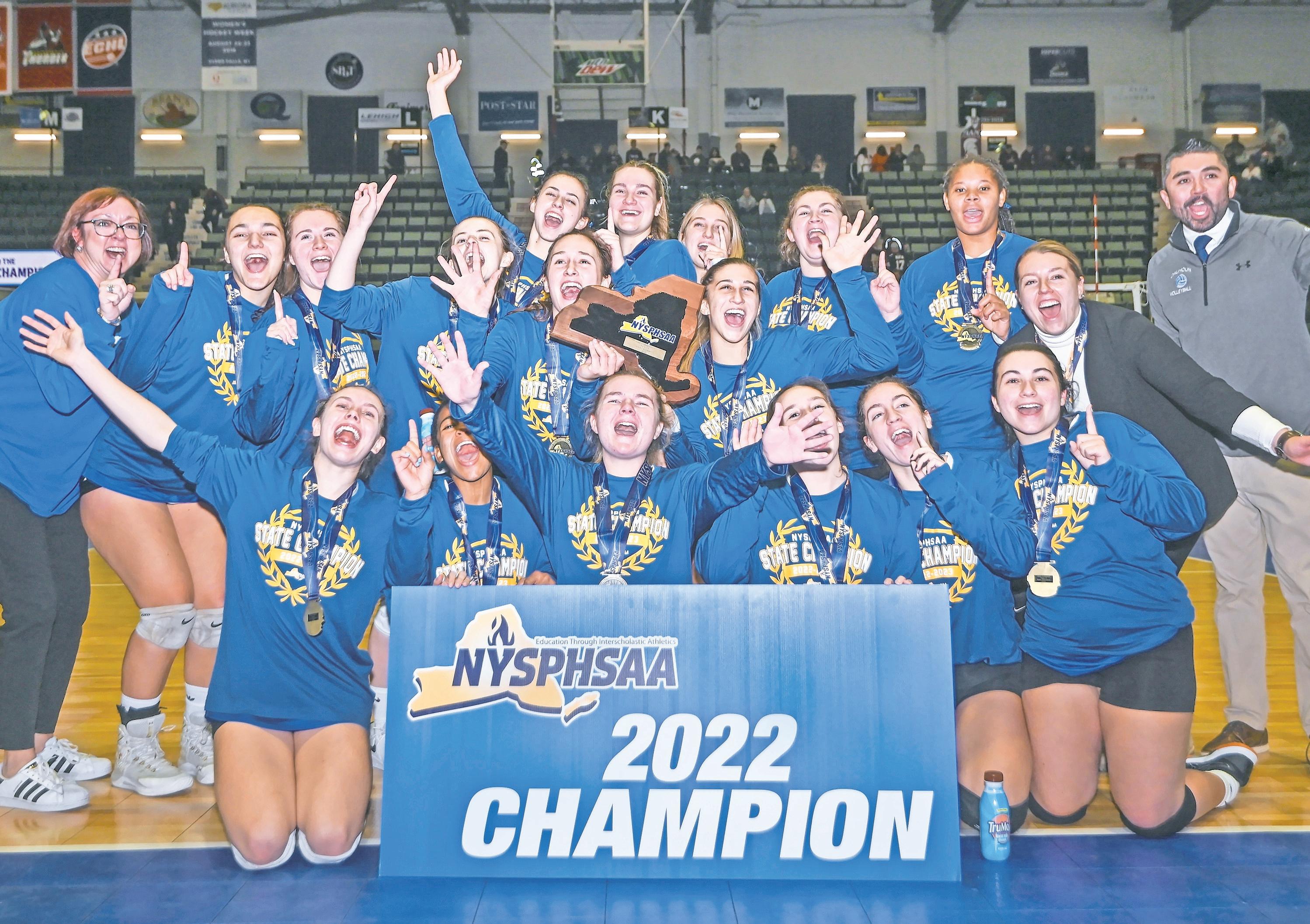
Calhoun left little doubt as to which high school Class A girls’ volleyball team was the best in New York State. After dominating pool play, the Colts completed an incredible run to their first-ever state title by dethroning twotime defending Class A-champion Burnt Hills-Ballston Lake 25-11, 25-19, 25-19 in the Nov. 20 final at Glens Falls. Backed by the inspiring play of senior co-captains Julia Lawrence, Ella Maldonado and Victoria Zovich and key contributions from other players in the rotation, the Colts
made good on their preseason mantra of “Road to States,” which coach Christina Strezenec said was put on the team’s white board in response to the previous season’s Nassau County final loss to Wantagh.
9. Calhoun girls’ track
With only 13 members, the Calhoun girls’ track and field team knew it had hardly any margin for missteps Feb. 7 at the Nassau Class B championships; every Colt would have to harvest points – some in multiple events –for the club to avenge a stinging spring loss and claim a second straight county indoor title. In a flurry of personal bests, which included two school records, Calhoun – led by senior Sara Manson and aided by calculation as cold as the air outside the Student Center – fended off rival Valley Stream North to win back-to-back winter championships.
10. Hewlett boys’ swimming
Hewlett dominated relays and produced top three finishers in eight other events on the way to capturing its first Nassau County boys’ swimming championship since the 1991-92 season on Feb. 11. Leading the effort for the well-rounded Bulldogs was junior Jonah Kirschbaum, who captured the 50-yard freestyle title, anchored two winning relays (200 medley and 400 freestyle), and finished runner-up in the 100 freestyle. Sophomores David Kushnirsky (100 breaststroke champion), Ethan Nus and Ethan Silver were also among the key figures.
11. Seaford wrestling
Seaford wrestling made history in more ways than one during the individual county championships Feb. 11. The Vikings tied a program record in qualifying six wrestlers for the New York State Championships during the Nassau’s Division 2 tournament and for the first time since 2004 finished as the top team on the county finals stage.
June 29, 2023 — UNIONDALE HERALD BEACON 6 Bringing local sports home every week Herald sports
6. Seaford girls’ volleyball
Liss Phillips/Herald
LEd BY A strong senior group, Calhoun captured the NYS Class A girls’ volleyball championship Nov. 8.
No shortage of county, L.I. champs

Seaford produced one county champ, Karl Leudesdorff at 215 pounds, along with five runner-up finishes, which included Ashley Diaz becoming the first female wrestler on Long Island to advance to a county finals match.
12. Wantagh wrestling
Wantagh’s Thomas Bonasera, Anthony Clem and Jesse Vanorden all reached the All-County wrestling podium the previous winter by placing in the top six of their respective weight classes. On Feb. 12 they were back on the big stage at Hofstra and made the most of it. They secured three of the Warriors’ four Nassau Division 1 championships, leading them to a repeat team title along with repeat county champ Joseph Clem. The Warriors racked up 253 points to finish well atop the team standings. Long Beach was runner-up with 208.5.
13. Malverne boys’ basketball
Farvens Ulysse and the Malverne Mules took it to Carle Place early and often en route to another county championship. Ulysse had 10 of his 21 points during Malverne’s explosive run to start the game and Chad Wesley added 13 as the Mules captured their second Nassau County B boys’ basketball title in three seasons with a dominant 60-36 win over the Frogs March 1. Kevin Estime added 12 points for Malverne, which blew out to a 15-0 lead.
14. Baldwin boys’ basketball
For the second Saturday in a row, Jaylen Brown from downtown provided the difference for Baldwin. Brown’s three-pointer from the corner with 56.5 seconds remaining broke the last of six deadlocks and put the Bruins ahead for good in a hard-fought 45-39 victory over Port Washington in the Nassau Class AA boys’ basketball championship game March 11 before an electric crowd of more than 3,500 at Hofstra. It was the third straight county title for Baldwin (21-3), which a week earlier topped Hempstead in the semis on Brown’s three-pointer with 10 seconds remaining.
15. Baldwin girls’ basketball
It was quite fitting Payton Dulin put the finishing touch on Baldwin’s second straight Long Island Class AA girls’ basketball title with a pair of late free throws. After all, it was the sophomore guard’s sensational 17-point performance in the first half March 11 that allowed the Lady Bruins to lead from wire-to-wire in their 39-32 victory over Walt Whitman. Dulin poured in a game-high 19 points and senior Katelyn Simpson added 13 for Baldwin, which shot 7-for-8 from the foul line in the fourth quarter to seal its 22nd win in 24 games.
16. South Side boys’ basketball
South Side seniors Josh Garelle and Rob Pericolosi will be college basketball teammates at SUNY Geneseo, but on March 11 the duo made sure their high school career would get extended in historic fashion. Garelle and Pericolosi each scored 14 points to propel South Side to its first Long Island title since the 1977-78 season with a 45-31 win over Kings Park in the Class A championship game. The two book-ended their scoring outputs with Pericolosi registering 12 of his points in the first quarter alone while Garelle closed strong with 10 in the second half. The Cyclones, who knocked off Manhasset for the county title, finished 25-2.
17. Valley Stream North track
The county championships were again twice as nice for the Valley Stream North track and field teams. The boys’ and girls’ teams swept the Nassau AA spring title for the second straight year at their home track May 23
thanks to a combined five first-place finishes in the field events and six runner-up showings in the running finals. The girls took their fourth straight county crown, with Brooke Fessler (high jump), Nattaly Lindo (shot put) and Moanna Thelusca (discus) winning events and Melissa Innocent placing second in three events. The boys’ captured their 14th championship in 17 years led by winners Joshua Lopez (shot put) and Ethan Smalls (discus.)
18. Seaford baseball

Billy Kind created history for Seaford baseball when he struck out the final batter in a 1-0 Nassau Class B finals Game 2 win against Wheatley May 26. The senior pitcher tossed a one-hitter with seven strikeouts to clinch Seaford’s sweep of the best-of-three championship series and garner the program’s its first-ever county title. In Game 1, senior Sean Costello threw a complete-game shutout, striking out eight in a 6-0 victory. Costello scored the lone run in Game 2 on Nick Apollo’s single. The Vikings finished 22-2.
19. MacArthur softball
MacArthur entered the Nassau Class A softball championship series undefeated and riding a 23-game winning streak including a pair against Clarke, but the Rams took the opener and put a notch in the Generals’ loss column for the first time since 2022. However, MacArthur rebounded in a big way behind senior pitcher Taylor Brunn, and after it stayed alive with her Memorial Day shutout secured the county title the following afternoon with a 12-5 win. MacArthur, in capturing its first Nassau crown since 2017, scored four runs in the bottom of the first, exploded for five runs in the fourth and added three more in the sixth. Sofia Anderson and Hailey Feiler had three RBIs apiece.
20. Seaford softball
In the bottom of the ninth inning of a scoreless Long Island Class B softball championship game June 1, Seaford was threatening after a walk to Gabby Bellamore and
some nifty bunts by Jamie Young and Katie Young that gave Center Moriches trouble. The bases were loaded for Kaitlyn Young. Some may have cracked under the pressure, but she was all smiles at the plate. On a 2-1 count Young drilled a fastball to left field and a would-be sacrifice fly dropped in for a single, walking off the game 1-0 for the Vikings and giving them the L.I. title. It marked the program’s first since 2005. Pitcher Skyler Secondino allowed only three hits and struck out 15.
7 UNIONDALE HERALD BEACON — June 29, 2023 Bringing local sports home every week Herald sports
Photos by Neil Miller/Herald South Side WoN its first Long Island boys’ basketball title in 45 years when it cruised past Kings Park in the Class A matchup March 11.
Billy KiNd helped lead Seaford to its first-ever Nassau County baseball crown May 26.
like environment, resulting in what Executive Director Rahsmia Zatar describes as a deep and lasting connections of more than 100,000 people.
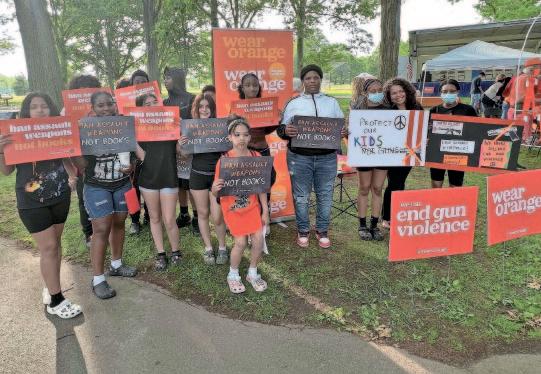
“You don’t get discharged from a family,” Zatar said. That powerful familial unit is paramount to STRONG’s success. The proof lies with the countless people who have gone through the program, grown up, and now have families of their own — lovingly calling STRONG staff members their “moms” and “aunties.” This enduring bond is a testament to the organization’s triumph in fostering a supportive community that extends far beyond a child’s time in the program.
simply providing temporary clinical support, STRONG instead creates a nurturing, family-










Welcome Scan this QR code for faster service


June 29, 2023 — UNIONDALE HERALD BEACON 8 1216161 Local News Period. Nobody covers Uniondale like us… NOBODY. Take a quick visit to liherald.com/freelocal or call 516-569-4000 x 7 * Offer valid for addresses in zip codes 11514, 11530, 11550, 11553, 11555, 11556, 11590. Subscribe today It’s totally FREE! * All you have to do is ask nicely. HERALD ______________ UNIONDALE _____________ BEACON BEACON MAY 18-24, 2023 FREE No surprises in school elections Page 2 Finding life after the pandemic Page 3 LOOK INSIDE Top Lawyers Awards Gala HERALD ______________ UNIONDALE _____________ BEACON Courtesy STRONG of jailing one teenager for a single year, Uniondale-based STRONG helps those CONTINUED ON PAGE 8 against violence among youth Nonprofit confronts systemic issues By BRANDON CRUZ Correspondent Since its inception nearly a quartercentury ago, STRONG Youth has been at the forefront of eradicating young people’s involvement in gangs and gun violence on Long Island. And the Uniondale organization does it by providing essential resources and support to underrepresented and underfunded neighborhoods and communities. STRONG — short for Struggling To Reunite Our New Generation — stands out from other organizations in its unconventional approach to helping young people at-risk. Rather than
“That’s what we aim to build, a sense of to your new hometown paper Here it is! Your new community resource, hot off the presses. But it’s a familiar community resource, too. Hello, I’m Michael Hinman, executive editor of Herald Community Newspapers. We’ve been bringing hometown news to communities just like Uniondale across Long Island since 1924. And while too many villages, cities, towns and hamlets across the county are sadly losing newspapers, we’re proud to buck that trend, bringing much-needed hyperlocal coverage of Uniondale with its very own paper. And that’s where the Uniondale Herald Beacon comes in. We have combined the great journalism at the Herald with the deep community roots of the Uniondale Beacon to create this new publicaWe want to hear what isn’t getting covered in Uniondale. We want to hear your news tips. We want to share stories about the people who make a positive impact, and make Uniondale the amazing community it is. Reach out to Reine at rbethany@liherald.com. Or you can call me anytime at (516) 569-4000, Ext. 203. And if you’d like to keep getting the Uniondale Herald Beacon in your mailbox, it’s easy — and it’s free! Visit us online at LIHerald.com/freelocal. Call us at (516) 569-4000, Ext. 7. Or fill out and return the enclosed response card to let us know. We’ll add you to our mailing list, and you’ll keep getting the Uniondale Herald Beacon each week — absolutely free. Don’t miss an issue. And thanks for reading your local newspaper!
Only Hempstead village escapes rent raise
By BRANDON CRUZ bcruz@liherald.com
Don’t expect rents to rise next this coming year — that is, if you’re living in a rent-stabilized apartment in Hempstead village. Everywhere else? Be ready to pay more.
That was the decision of the Nassau County Rent Guidelines Board last week, hearing the concerns voiced by Hempstead village renters at an open forum earlier this month, The rest of Nassau County could see rents climb by 1 percent for one-year leases, and 2 percent for two-year leases beginning Oct. 1.
The passing vote came after a series of contrary motions were denied by the board, including one by landlord representative Barry Stein, who proposed an increase of up to 6.5 percent before being drowned out by a series of boos from tenants and advocates in attendance.
Stein’s justification for such an increase? Rent income increased nearly 3 percent while expense increases more than doubled that. Then there’s the rising property taxes in Nassau County, rising house insurance costs, and mortgage rates doubling. They were numbers Stein called “unsustainable.”
Stein also asserts the state’s reported profit figures by landlords are overblown, incorrectly looking at entire buildings — includes units not subject to regulation.
Alternatively, board member Rob
AfteR it wAs all said and done, members of the Nassau County Rent Guidelines Board decided regulated rents would rise for the second year in a row, despite some tenants and political groups calling not only for a freeze, but a rollback to pre-pandemic levels.
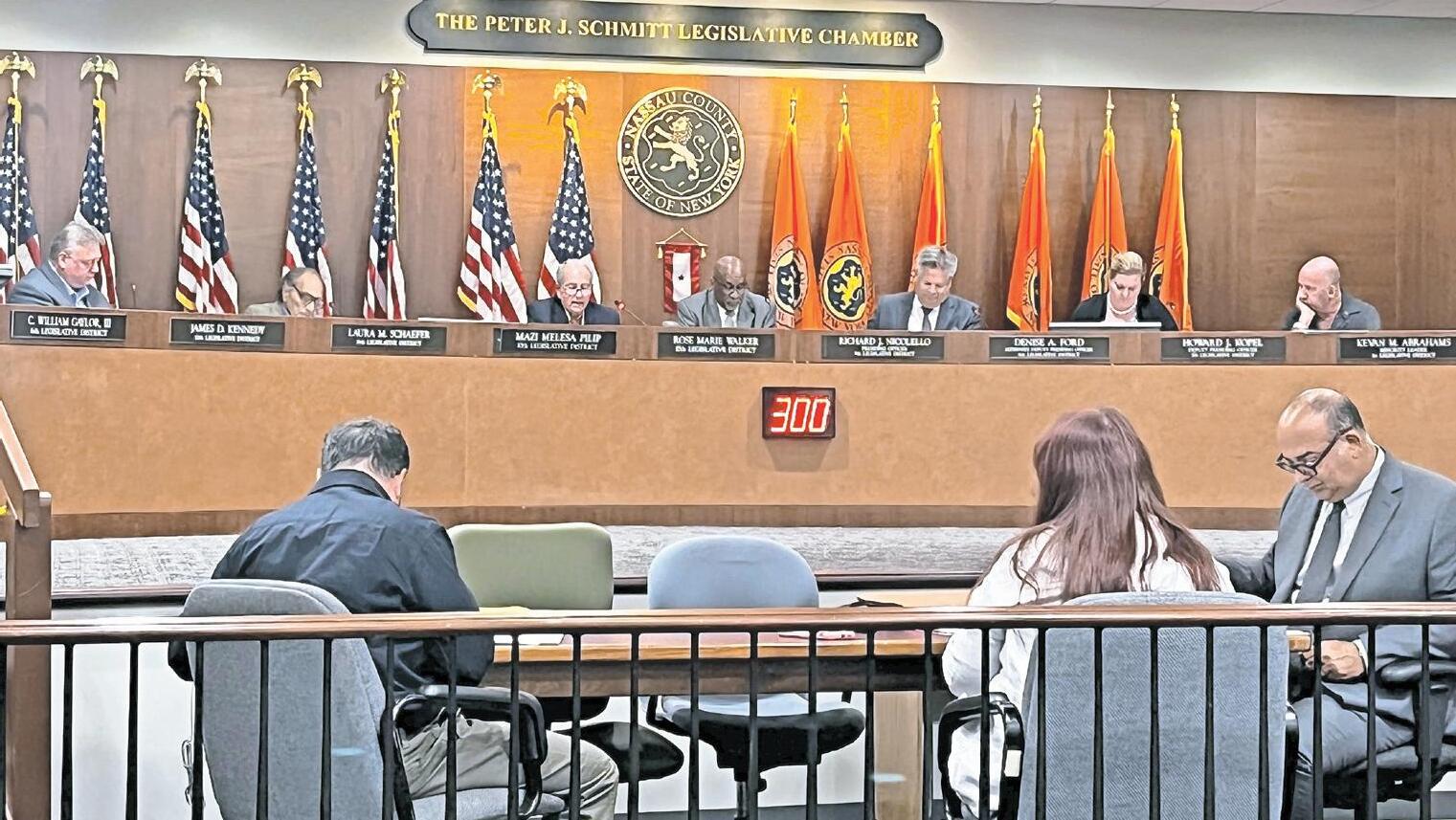
Rychlowski explained tenants like him are overburdened.
“We heard a lot of things from the landlords about the rising cost of living, but what about how that disproportionately affects the tenants?” he asked. “Mr. Stein is arguing that we shouldn’t be using their overall profit margin because it combines non-regulated housing along with regulated housing.”
Despite these claims, landlord profits are at record highs, according to the
state’s New York State Division of housing and community renewal division.
Another member, Martin Melkonian, also pointed out data suggesting rent-stabilized buildings consistently rise in value. That suggests to him this is a profit enterprise — not simply for the cash flow, but for asset growth. And that many ordinary property owners have enormously benefited from rising values.
“Over the past 20 years, the net operating income continues to rise,” Melkonian
said. That net operating income peaked at 38 percent in 2022, “which is the highest it’s been, despite the fact that the expenses have gone up, and admittedly, rents have not followed along. Nevertheless, net operating income continues to rise. What explains that?”
At least from Melkonian’s point of view, despite regulation, landlords do pretty well in terms of cash flow, and extremely well in terms of the rapidly rising property value of their buildings over time.
Following the vote, Jeremy Joseph, — an organizer with the Working Families Party and the Nassau County Democratic Socialists of America — said he is disappointed with the overall vote, but will accept the small victory for Hempstead village residents while acknowledging the long road ahead.
“All tenants in Nassau County deserve a rent reduction,” Joseph said. “Anything less than that is not enough.”
Prior to the vote, the board heard tenants from Hempstead directly, and that members who are not usually on our side were compelled to vote for no raise.
“Just imagine if they gave that same attention to all the municipalities in the county,” Joseph said. “But they don’t. They only have a few hearings.
“If we had a hearing in Freeport and Rockville Centre, they would have heard all the same stuff they heard in Hempstead.”
UNIONDALE SCHOOL DISTRICT Our Promise

Our schools have a stable, highly qualified and experienced staff that is committed to the success of all scholars.

Enrolling your children in public schools provides them with the opportunity to receive a well-rounded education in a diverse and inclusive environment, with a range of programs and resources. Uniondale Public Schools are also accountable to the community and operate under strict regulations, ensuring that every child receives a quality education regardless of their background or circumstances. With highly qualified teachers, a commitment to academic excellence, and a focus on equity and inclusion, our schools offer a comprehensive education that prepares students for success in college, career, and life.
 Brandon Cruz/Herald
9 UNIONDALE HERALD BEACON — June 29, 2023 Free full-day Pre-K, includes breakfast and lunch New dual-language Kindergarten - English and Spanish After-School care until 5:30 pm for working parents (first-come, first served)
Every Uniondale Scholar is empowered, responsible, resilient and prepared for leadership, college and careers. Enroll your child in the best schools in Uniondale!
www.facebook.com/uniondalek12 @UniondaleUFSD @uniondale_k12 Contact us today to give your child the education they deserve. Call us at 516-560-8813 scan the QR code or visit https://district.uniondaleschools.org/central_registration
1219731






























June 29, 2023 — UNIONDALE HERALD BEACON 10 FREE ADMISSION! JOIN US FOR A DAY OF SHOPPING AND FAMILY FUN! SATURDAY SATURDAY AUGUST 19 10AM -5PM OVER 30 VENDORS WILL BE IN ATTENDANCE SELLING CUSTOM, PERSONALIZED, ONE-OF-A-KIND ITEMS. COME OUT AND SHOP LOCAL BUSINESSES! INTERESTED IN BECOMING A VENDOR? TEXT "VENDOR" TO 516-288-5138 JOHN J. BYRNE COMMUNITY CENTER 800 JERUSALEM AVE, UNIONDALE, NY 11553 Call for Delivery (516) 900-0903 1220300 Did you have a car accident or injured on the job? Come in now to get evaluated! We help patients with Neck/Back Pain, Sciatica, Sprain/Strain Stop living in pain and start getting relief! UNIONDALE CHIROPRACTIC MOST INSURANCES INCLUDING NO FAULT & WORKERS COMP ACCEPTED 482 Uniondale Ave, Uniondale, NY 11553 (516) 485-0220 4th of July Have
a Safe and Happy
STEPPING OUT
Lighting up the island: A patriotic salute sets the tone for a colorful Fourth of July
STEPPING OUT
Creative advocacy
he sky will be aglow for the annual spectacle that marks our Independence Day, always a rousing celebration. While the main event is Tuesday, of course, the county-wide festivities begin Saturday, with plenty of local fireworks to enjoy.


TD Bank Celebrate America at Eisenhower Park
it may not always seem so). Other popular festivities involve the historical aspect of our nation’s birthday. Consider a visit to Old Bethpage Village Restoration, Saturday and Sunday, for the historic site’s annual re-creation of a Fourth of July celebration as commemorated during the Civil War.
By Karen Bloom
Eisenhower Park is a popular spot to view the pyrotechnic spectacle, as part of its annual holiday double bill that also includes a concert. The park around Harry Chapin Lakeside Theatre will be filled with visitors celebrating the lead-up to the holiday, Saturday, July 1, to enjoy some tunes and watch as the skies light up at the county’s Independence Day extravaganza.
The prelude, which starts at 7 p.m., includes a drone and laser light show, followed by a performance by the county’s winner of its recently concluded Battle of the Bands competition. That sets the stage for the colorful fireworks that follow, presented by the famed Grucci family, at dusk, simulcast by WALK 97.5 FM.
Of course, there is no formal seating, so bring blankets or chairs. Space is limited, and overflow will be directed to other viewing and parking areas. The rain date is July 2.
Motor City Revue

Journey back in time to 1960s Detroit and the birth of the Motown sound, when Motor City Revue visits the Landmark stage. This 13-piece tribute band will have you dancing and singing along to the songs immortalized by Smokey Robinson & The Miracles, Marvin Gaye, The Temptations, The Supremes and countless others. From Hitsville to Soulsville, they’ll perform it all, with a passion and delivery of the true Motown sound that is undeniable. Their ability to match the vocal harmonies and instrumental mix that distinguished the original recordings is not to be missed. Everyone will be humming along to these iconic tunes in this authentic re-creation of the great era that revolutionized the music industry. Their music is about peace, love and soul that defined a generation and retains its power today.
Friday, June 30, 8 p.m. $47, $42, $38. Jeanne Rimsky Theater at Landmark on Main Street, 232 Main St., Port Washington. (516) 767-6444 or LandmarkOnMainStreet.org.
Celebrate America
• Saturday and Sunday, noon-4 p.m.; Tuesday through Friday, 11 a.m.-4 p.m.

• July 1, 7-10 p.m.
• Harry Chapin Lakeside Theatre, Eisenhower Park, East Meadow
The setting marks the departure of local Union soldiers — new recruits — and the nation’s 85th anniversary. The weekend events, which run from 10 a.m. to 4 p.m., include contra dancing, patriotic speeches, musket firing and children’s games, along with a ceremony and parade, against the backdrop of historic music performed by the Old Bethpage Village Brass Band.
Nassau Pops
Symphony Orchestra
• NassauCountyNY.gov

Jones Beach Fireworks
• July 4, 9:30 p.m.
• Emily Lowe Hall Gallery, South Campus, Hempstead. For information and to RSVP, call (516) 463-5672, or visit Hofstra.edu/museum
• Jones Beach State Park, Wantagh
“When We All Stand,” Hofstra University Museum of Art’s new exhibition, examines the collective power of the arts in society.
Families may also want to check out i.Fly Trapeze, the acrobatic/ circus arts venue nearby in the park.
Or visit the summer home of President Theodore Roosevelt in Oyster Bay for Sagamore Hill’s annual presidential-style Independence Day festivities. Commemorate the holiday in the Roosevelt tradition, at the former presidential residence, on Tuesday, from noon to 4 p.m.
Old Bethpage Village Restoration
Curated by Alexandra Giordano — the museum’s assistant director of exhibition and collection — the exhibit underscores artists’ civic responsibility and influence.
• July 1-2, 10 a.m.-4 p.m.
• 1303 Round Swamp Road, Old Bethpage
The 26th president would gather with his extended family and friends at Sagamore Hill for a day of celebration. Cousins and friends enjoyed the day here participating in flag-waving outdoor activities.
Pat McGann is quickly rising as one of the sharpest stand-ups on the comedy scene. A relative latecomer to comedy, he began doing standup at 31 after realizing he was not very good at selling packaging. He hustled his way to become the house emcee at Zanies Chicago, where he distinguished himself as especially adept at working the crowd. A husband and father of three young children, McGann’s appeal stems from his quick wit and relatable take on family life and marriage. In 2017, McGann began touring as the opening act for Sebastian Maniscalco, moving with him from clubs to theater, to arenas, including four soldout shows at Madison Square Garden. McGann’s relatively short, but impressive resume, includes Montreal’s famed Just For Laughs Festival, Gilda’s LaughFest, The Great American Comedy Festival, and more. McGann still calls Chicago home.
Fireworks at Jones Beach
The beach light show, a longstanding tradition, is eagerly awaited by the throngs of folks who make that yearly holiday trek to Jones Beach on July 4. The vivid display, beginning at 9:30 p.m., is a spectacular 25-minute display using state-of-the-art pyrotechnic technology. The dazzling colors and sights always thrill, accompanied by rousing musical array of patriotic songs simulcast by WALK 97.5 FM and KJOY 98.3 FM.
• OldBethpageVillage Restoration.org
Sagamore Hill
“It highlights the vital role that artists have in activating democratic values that promise equality and freedom, encouraging civic engagement, and cultivating unity,” Giordano says. “Artists often lead the charge and expose truths that may otherwise be ignored. The artists in this exhibition take a stand and call out injustices through their art and activism on issues such as immigration, gender, reproductive rights, mass incarceration, voting rights, racial bias, gun violence, and promises unfulfilled. They all combine the making of art with public service that has a grassroots approach in the hope of mobilizing their communities and the nation to ignite movement, create awareness, and inspire others to stand with them.”
• July 4, noon-4:30 p.m.
• 20 Sagamore Hill Road, Oyster Bay
• NPS.gov or (516) 922-4788























This exhibit, which runs through July 28, is in conjunction with Hofstra’s 13th presidential conference on the Barack Obama presidency coming up in April.
Of course, expect crowds. As always, thousands of hardy souls brave Jones Beach’s jam-packed thoroughfares to get a spot to see the light show. More than 250,000 people generally visit, so an early arrival is a must. “Center stage” is the Central Mall, but fireworks are visible throughout the length of the beach.
Highlights include tours of the Roosevelt home, a concert with the Calliope Brass Band, a holiday-themed Junior Ranger Program, assorted lawn games and crafts for kids, historical exhibits at the Old Orchard Museum, and even an appearance by the president himself as portrayed by re-enactor Joe Wiegand. He will mingle with visitors and read from the Declaration of Independence.
Tim Baker/Herald photos
Saturday, Feb. 11, 8 p.m. $40, $35, $30, $25. The Paramount, 370 New York Ave., Huntington. (800) 745-3000 or Ticketmaster.com or ParamountNY.com.
A summer tradition returns to Eisenhower Park. Settle in with Music director Louis Panacciulli and his orchestra for an evening of crowd-pleasing tunes outdoors. Hear the orchestra interpret the best in popular and light classical music, including several toe-tapping Big Band selections. The program, Salute to Stage and Screen, includes ‘Phantom of the Opera,’ Sinatra selections, a tribute to John Williams, ‘Annie Get Your Gun,’ the best of Billy Joel, Louie Armstrong, and more. Longtime vocalists Jack and Ann Cassin are also back again, as guest soloists, joining the orchestra songs from some of Broadway’s greatest productions. Bring a blanket or a lawn chair and settle for a relaxing evening of music under the stars.

Left photo: Eisenhower Park hosts the popular patriotic light show on Saturday, attracting large crowds that eagerly gather ever year.
History comes alive
The holiday celebration involves more than fireworks (although

“We were interested in the idea that the artist has a civic responsibility,” says museum director Karen Albert. “The initial idea for this exhibition was inspired by an Obama Administration White House briefing that took place on May 12, 2009, where more than 60 artists and creative organizers met with administration officials to discuss the collective power of the arts to build community, create change, and chart a pathway for national recovery in the areas of social justice, civic participation and activism.”
Right photo: The sky will glitter over Jones Beach, another favorite destination
Friday, July 7, 8 p.m. Eisenhower Park’s Harry Chapin Lakeside Theatre, East Meadow. For information, visit NassauCountyNY.gov.
11 UNIONDALE HERALD BEACON — June 29, 2023
for fireworks viewing.
13 BALDWIN HERALD — February 9, 2023
Pat McGann
Yarn/Wire Now in its 18th year, Adelphi
Can art change the world? It’s a question that’s been at the focus of our collective culture for centuries. Now as society navigates the complexities of modern life, art as a path for social change is at the forefront of artistic expression.
WHERE WHEN
THE Your Neighborhood
Art talk
Join Nassau County Museum Director Charles A. Riley II, PhD, for a Director’s Seminar, Sunday, July 9, 3 p.m.
June 29
On exhibit
Three Dog Night
The legendary band is back on tour, appearing on The Paramount stage Thursday, July 6, 8 p.m. Now their fifth decade, Three Dog Night claims some of the most astonishing statistics in popular music. In the years 1969 through 1974, no other group achieved more top 10 hits, moved more records, or sold more concert tickets. Their hits continue to weave through the fabric of pop culture today; songs like “Mama Told Me (Not To Come)”, “Joy to the World”, “Black and White”, “Shambala” and “One” serve to heighten our emotions and crystallize the band’s continuing popularity. Not content resting on legacy alone, Three Dog Night is always working to expand its audience. Maintaining an aggressive, year-round touring schedule, the band performs their hit-filled concerts for generation-spanning audiences. Their now-famous name refers to native Australian hunters in the outback who huddled with their dogs for warmth on cold nights; the coldest being a “three dog night.” $99.50, $59.50, $44.50, $39.50. The Paramount, 370 New York

July 6
He’ll discuss “Oscar Wilde: The Critic and His Artists,” examining the endlessly fascinating author who was connected to a glittering circle of artists. His friends included Toulouse-Lautrec (who painted his portrait on the eve of his legal demise), the Pre-Raphaelites BurneJones, Morris and Millais, Whistler and Sargent (his neighbors on Tite Street in London’s Chelsea), and the naughty prodigy Aubrey Beardsley. Participation is limited; registration required.

Nassau County Museum of Art, 1 Museum Dr., Roslyn Harbor. (516) 484-9337 or


Nassau County Museum of Art’s exhibition, “Eye And Mind: The Shin Collection,” highlights the extraordinary collection masterworks assembled by 31-year-old connoisseur Hong Gyu Shin, an internationally recognized figure in the global art world. He shares his treasures, including works by Whistler, Lautrec, Boucher, Daumier, Delacroix, Klimt, Schiele, Balthus, Warhol, de Kooning, Gorky and many other important names from art history provocatively juxtaposed with the painting and sculpture of our own time from both Asia and the West. On view through July 9. Nassau County Museum of Art, 1 Museum Dr., Roslyn Harbor. (516) 484-9337 or
NOMINATIONS NOW OPEN





For more information or to sponsor this event, contact Amy Amato at aamato@richnerlive.com or 516.569.4000 x224

June 29, 2023 — UNIONDALE HERALD BEACON 12
RICHNER Produced By
JOIN US AT THE HERITAGE CLUB AT BETHPAGE TO CELEBRATE Nominate at www.richnerlive.com/nominate
The
2nd annual HERALD 2023 Excellence in Healthcare Awards will recognize and honor deserving individuals, institutions, facilities and healthcare groups whose dedication and commitment have made a difference in the health and well-being of others.
6:00-9:00PM 11218376 220872
SEPT 27, 2023
to COMMUNITY VOICES
LI TODAY
Since 1993, the LGBT Network has been pioneering advocacy and social change to create safe spaces where LGBT people live, learn, work, play, and pray. We look forward to collaborating with Sands to ensure their environment is safe for all LGBT employees, community partners and guests.
Sands celebrates East Meadow Community Day & Long Island Pride
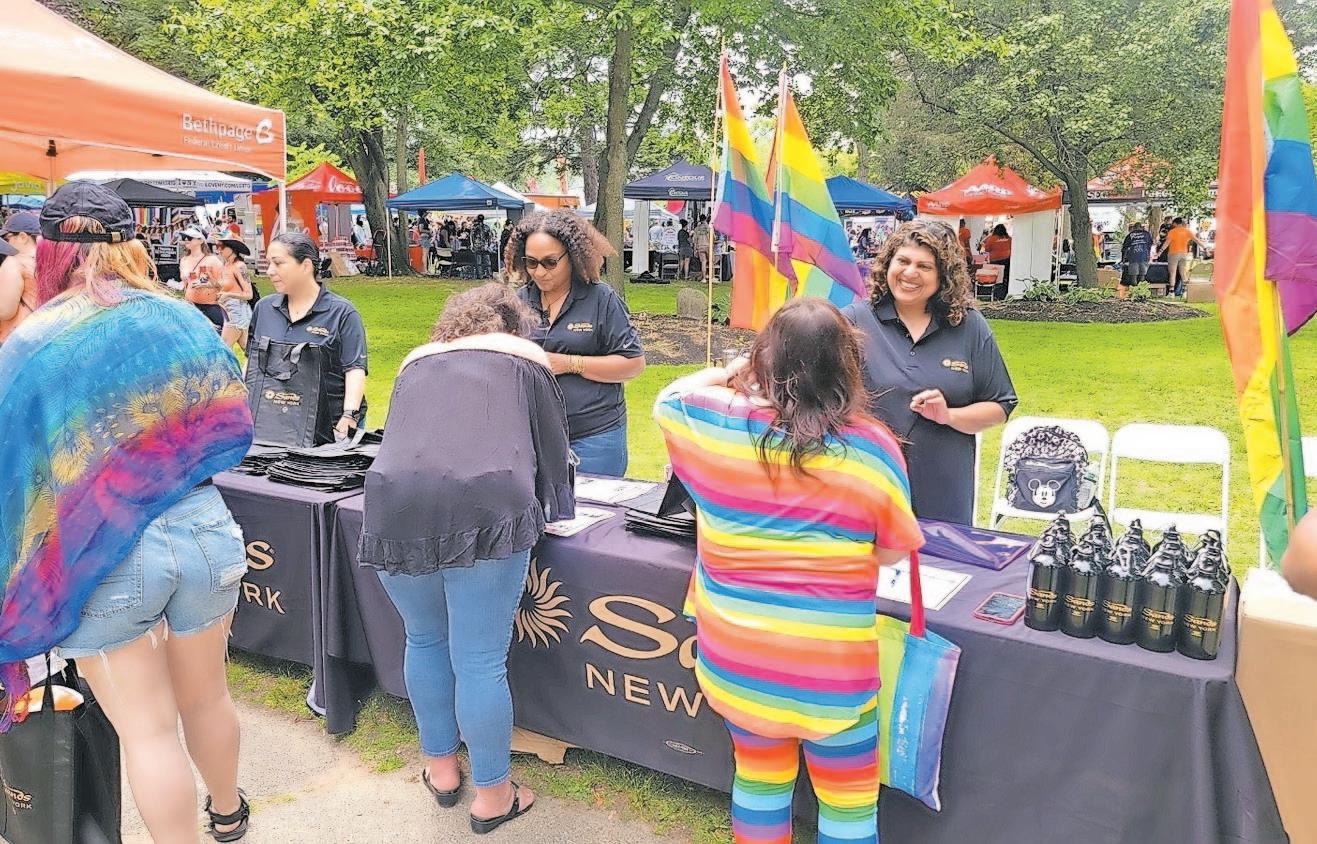
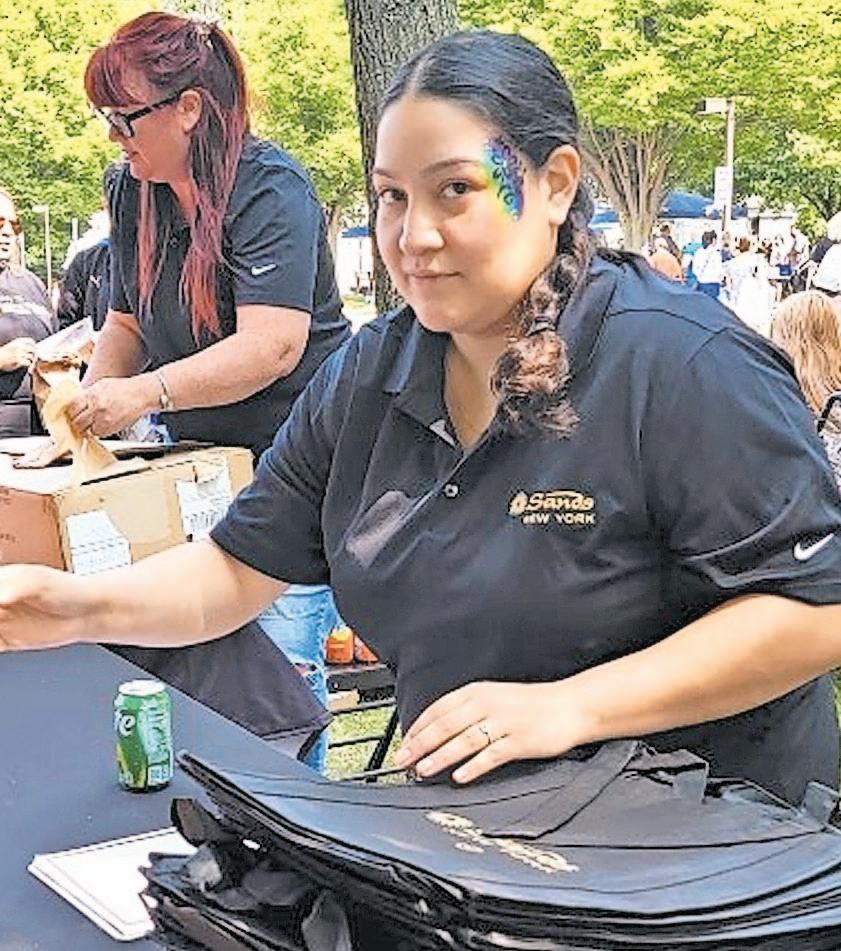
As a company, one of Sands’ corporate responsibility pillars is to support the communities in which their properties are located. And in June, ambassadors from Sands hit the ground running on this initiative by participating in two of Long Island’s annual events.
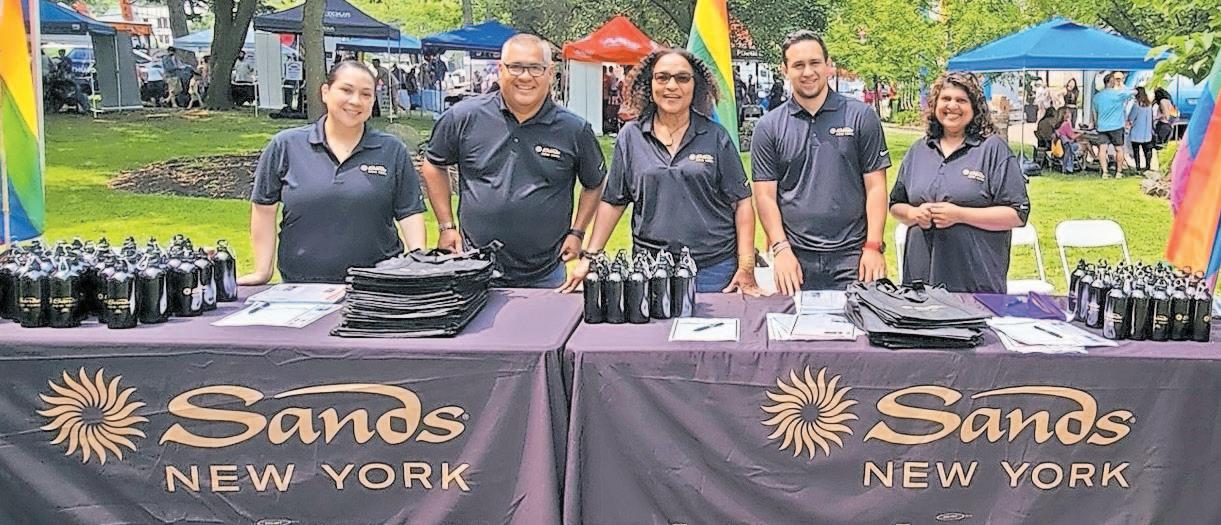
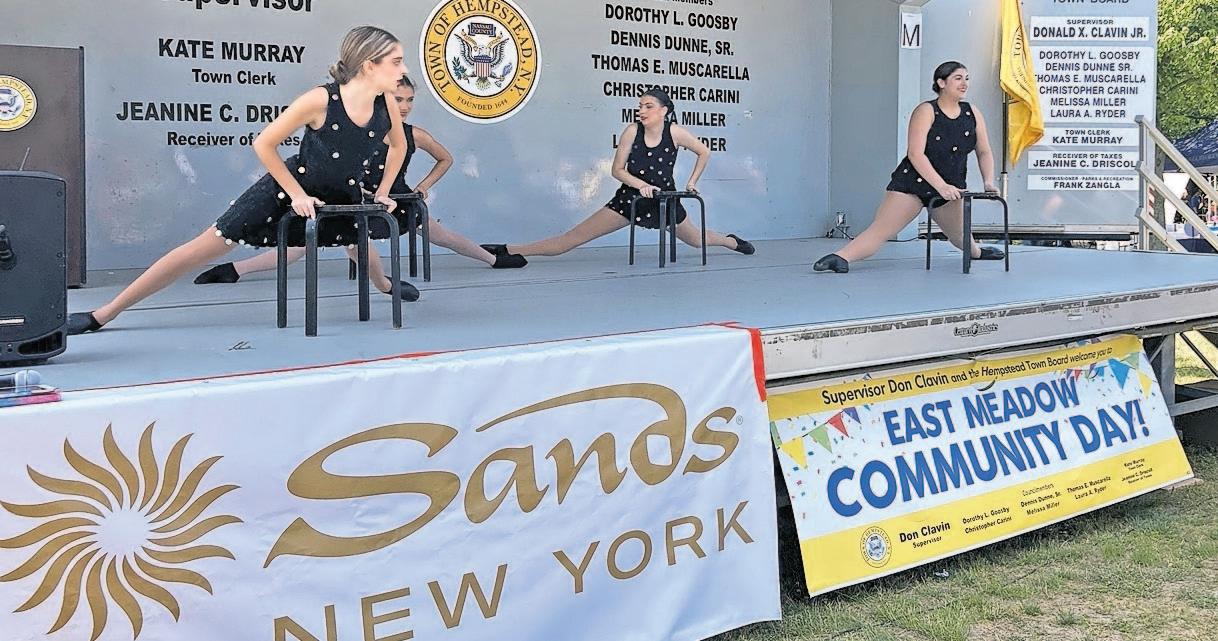
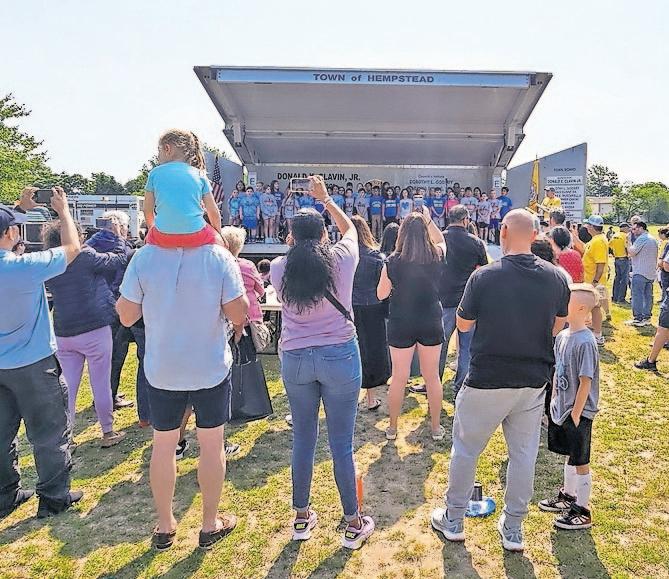
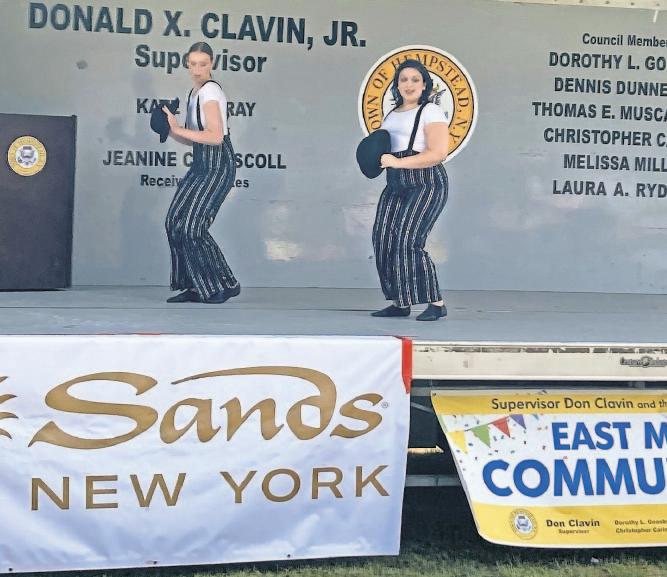
On June 10, Sands Ambassadors joined in East Meadow’s annual Community Day celebration at Senator Speno Park, an event that included a color run, basketball clinic and pie eating contest, among many other things.
On June 11, Sands also celebrated Pride month at the LI Pride Parade and festival produced by the LGBT Network.
As Ron Reese said, “We celebrate Pride at Sands not just in June but as part of our corporate culture every day. We will bring that commitment and energy to our Long Island project, where we look forward to hiring, serving, and celebrating the LGBTQ+ community year-round.”
Their participation in local events is a big part of Sand’s overall commitment to supporting communities.
“Connecting with and supporting our communities is a core value for Sands,” Reese said. “As the new lease holder of the Nassau Coliseum, we are excited to restore the vibrancy of this historic property so Long Islanders can once again make great memories there. We believe that in order to do that, being great neighbors is a critical starting place. With each community event we attend, we are building deeper relationships with local residents and organizations and learning how we can best contribute to the needs and aspirations of the Long Island community that we will soon call home."
Corporate Commitment to Communities
Sands’ Corporate Responsibility Commitment specifically details the company’s dedication to being a good corporate citizen through its three pillars: People, Communities and Planet.
Through its Communities initiative, the company is dedicated to having a positive impact in its regions by helping to maintain a high quality of life and improving the community's ability to respond to challenges. Sands ensures its regions are strong and ideal places to live, work and visit through prioritizing the issues and causes where they can have the greatest impact through community engagement focus areas, including:
Hardship Relief
• Food security – Partner with food-relief organizations to provide resources that alleviate hunger
• Homelessness – Provide immediate relief, create lasting solutions and support advocacy efforts to combat youth homelessness in the U.S.
• Disadvantaged populations – Address regionspecific social issues that promote quality of life and access to basic services
Local Business and Partner Development
• Business growth – Provide platforms and support initiatives that build local business and small and medium enterprise success
• Nonprofit advancement – Accelerate nonprofit capability through collaboration, mentorship and skills-based consulting
Continued on page 2
David

Kilmnick, President LGBT Network

The development of Sands New York will bring a diverse amount of business opportunities to our community. In serving both Nassau and Suffolk counties, the Long Island Hispanic Chamber of Commerce has proudly and will continue to work with Sands to foster partnerships with local latino small, medium and large businesses and as well as in building the local workforce that will be needed to build, manage and operate this transformational project.
Luis Vasquez, President Hispanic Chamber of Commerce




Our annual East Meadow Community Day is a wonderful way our town celebrates what makes living in East Meadow so special. Its such a great way for everyone to interact with businesses, restaurants, religious groups, service clubs and performers at a free event.
We appreciate the Sands joining our local businesses to support and lend their resources to make this East Meadow Community Day the best ever.
Todd Weinstein Community Day Organizing Committee

Volume 1 • Issue 4 June 2023
WHO WE ARE: The developer of a multi-billion-dollar flagship hospitality, entertainment and casino project on Long Island
Photo provided by Sands
Photo: Sands New York was represented at the recent East Meadow Community Days, one of the many events it is involved with around Nassau County.
Welcome
EAST MEADOW COMMUNITY DAY
Cultural and Natural Heritage
• Local asset preservation – Invest in attractions, events and traditions that perpetuate a region’s unique culture, identity and heritage
• Natural environment – Preserve the local ecology through environmental education and advocacy, community conservation initiatives and nature-focused activities
Beyond being a major economic contributor that spurs tourism, jobs and tax revenue to fund social programs, the company invests in addressing key issues and initiatives that promote a thriving local community through Sands Cares, its community engagement program.
Sands Cares
More than just philanthropy, Sands Cares manifests the company’s dedication to working hand-in-hand with communities to inspire positive impact. Through Sands Cares, the company integrates corporate giving, nonprofit capacity building and Team Member volunteerism to address the priorities we’ve identified in our communities.
Corporate Giving: Sands extends its hospitality leadership by being a good corporate citizen that helps communities solve problems and capitalize on opportunities. Through philanthropic giving to nonprofit organizations, Sands addresses important social issues and supports people in need.
Capacity Building: A core focus of Sands Cares is helping build the capability of nonprofit partners to advance their programs and goals. Sands helps them address growth opportunities and serve as a catalyst to support their development.
Volunteerism: Sands’ volunteer program extends its services in the community and helps nonprofit partners advance their missions, while providing opportunities for Team Members to make a difference and develop their skill sets.

To learn more about the Sands as the world’s preeminent developer and

Continued from page 1









and operator of world-class integrated resorts visit sandsnewyork.com
Sands shows its Pride: LGBTQ+ Center of Southern Nevada adds pharmacy to Arlene Cooper Community Health Center
The LGBTQ+ Center of Southern Nevada (The Center) recently celebrated the grand opening of a new onsite pharmacy at the Arlene Cooper Community Health Center, which provides primary care and HIV testing and treatment to the LGBTQ+ and downtown communities in Las Vegas.

The pharmacy’s opening marks a major milestone in The Center’s continued expansion of the health center and is a key component of its long-term vision to transform the facility into a Federally Qualified Health Center (FQHC). Sands has supported The Center in expanding the health center with funding from the Sands Cares community engagement program since 2021.
“Before we opened the pharmacy, our clients had to go at least a mile from the health center to fill prescriptions,” Brian Hosier, chief operating officer at The Center, said. “For many people, that presents a significant challenge. Now, we can provide our clients with a full circle of care in one setting.”
With the opening of the pharmacy, The Center is now aiming to achieve FQHC in 2024. Adding the ability to dispense medication is integral to The Center’s focus on closing gaps in services for LGBTQ+ community members and low-income downtown residents by providing clients with a full range of medical care including testing, treatment, counseling and now medication in a safe place and without being concerned about their ability to
pay.



“The support we received from Sands has been instrumental in making the many facets of our health center expansion possible, allowing us to better serve our clients, many of whom don’t have other resources,” Hosier said.
Sands’ support for The Center addresses strategic Sands Cares priorities including helping disadvantaged populations address hardships and overcome systemic barriers, as well as assisting nonprofits in building their capacity to better fulfill their missions.


Beyond the capacity-building support for the health center, Sands is working with The Center to further advance its capabilities by welcoming the nonprofit into the Sands Cares Accelerator.

Through the exclusive threeyear membership program, The Center will work on developing a strategic focus area to better serve the community with resources from Sands such as funding, goal-setting support, program facilitation, and strategic guidance and mentoring to achieve its goal.
The Center is using its Sands Cares Accelerator membership time to focus on building its story and marketing its services to the community, given the tremendous transformation the organization has gone through over the past few years, especially with the major expansion of the health center and the new pharmacy as key offerings to the community.
LI TODAY
LGBTQ+ PRIDE NETWORK
Photo provided by Sands
Photo: The Center opened its new pharmacy at the Arlene Cooper Community Health Center with a ribboncutting ceremony on April 26.
Storybook Stroll
Bring the kids to Old Westbury Gardens for a storybook adventure, Saturday, July 1, 10:30-11:30 a.m. Stroll the gardens and listen to Janell Cannon’s “Stellaluna.” Later create a unique take home craft. For ages 3-5. Old Westbury Gardens, 71 Old Westbury Rd., Old Westbury. For information visit OldWestburyGardens.org or contact (516) 333-0048.


July 6




Summer stage Plaza
Theatricals brings the iconic musical “Rent,” to Eisenhower Park, Thursday, July 6, 7 p.m. The acclaimed reimagining of “La Vie Boheme,” loosely based on Puccini’s opera and set on East Village streets, fire escapes, tenements, and cafes. This groundbreaking roller coaster ride depicting the joys and sorrows of an eclectic, diverse group of young artists and activists is always captivating. Harry Chapin Lakeside Theatre, Eisenhower Park, East Meadow. For information, visit NassauCountyNY.gov.











Breastfeeding Support Group


Mercy Hospital offers a peer to peer meeting for breastfeeding support and resources, facilitated by a certified breastfeeding counselor, every Thursday, 10:30 a.m.–11:30 a.m. Bring your baby (newborn to 1 year) to the informal group setting. All new moms welcome, regardless of delivering hospital. Registration required. Call breastfeeding counselor, Gabriella Gennaro, at (516) 705-2434 to secure a spot. Mercy Hospital, St. Anne’s Building, 1000 North Village Ave., Rockville Centre. For information visit CHSLI.org.

Summer sounds
Enjoy the music of local artist Jerome “City” Smith, as he performs at a free concert at Roosevelt Pool, Thursday, July 8, at 8 p.m., part of the Town of Hempstead’s Summer Concert Series. 14 Harts Ave., Roosevelt.Seating is not provided, attendees are encouraged to bring a blanket or lawn chair.




Having an event?







Family Bat Walk

Stroll Old Westbury Gardens with Gabriel Willow, a New York Citybased urban naturalist and environmental educator, Saturday, July 8, 7:309:30 p.m. He will lead a walk through the gardens to listen and look for bats while discussing bat ecology and conservation. All ages are welcome. Space is limited and reservations are required. Rain date is Saturday, July 15. 71 Old Westbury Rd., Old Westbury. For information contact (516) 333-0048 or visit OldWestburyGardens.org.
Items on The Scene page are listed free of charge. The Herald welcomes listings of upcoming events, community meetings and items of public interest. All submissions should include date, time and location of the event, cost, and a contact name and phone number. Submissions can be emailed to thescene@liherald.com.







Seasonal Crafts

Kids in grades K-5 can join Miss Young for a fun seasonal craft, Thursday, June 29, 7-7:45 p.m., at Uniondale Public Library. 400 Uniondale Ave. Limited spaces available. To register, visit UniondaleLibrary. org and click on events.
Summer Pop-Up Series



Enjoy shopping and family fun, Saturday, July 15,10 a.m.-5 p.m. Vendors throughout Long Island and the tri-state area will be in attendance selling custom, personalized, one-of-a-kind items. Food, drinks and sweets also available for purchase. John J. Byrne Community Center, 800 Jerusalem Ave., Uniondale.



Westbury House Tour

Test Your Knowledge Trivia












Adults over the age of 18 are welcomed to attend a fun, competitive jeopardy style trivia game and compete against other adults for prizes and awards at Uniondale Library, Thursday, July 6, 7-8:30 p.m. Limited spaces are available. To register, visit UniondaleLibrary.org and click on events. 400 Uniondale Ave.

Monopoly Tournament
Teens in grades 6-12 are invited to the Uniondale Library, Friday, July 7, 4-5:30 p.m., to compete against each other in a monopoly tournament. Limited spaces are available. To register, visit UniondaleLibrary.org and click on events. 400 Uniondale Ave.
For many years visitors to Westbury House at Old Westbury Gardens asked what was beyond the first floor corridor. Now gp beyond the door and discover “secrets of the service wing,” during a 60-minute guided tour, Friday, June 30, noon. Be introduced to the intensive labor required to create the lifestyle experienced by the Phipps family and their guests; tour the many rooms that were “behind the scenes” to create the formal dining experiences of early 20th century. Go along the corridors to the butler’s pantry and silver cleaning room then descend the 17 steps to the kitchen, scullery, and wine storage rooms located on the ground floor. Reservations required. 71 Old Westbury Rd., Old Westbury. For information contact (516) 333-0048 or visit OldWestburyGardens.org.
13 UNIONDALE HERALD BEACON — June 29, 2023 ACOMEDY FORTHEAGES. ALLAGES! BROADWAYGOESWRONG.COM 212-239-6200 NEW WORLD STAGES 340 W 50th St (between 8th & 9th Aves) PHOTOS BY MATTHEW MURPHY BROADWAY’S FUNNIEST SMASH HIT AND INTERNATIONAL PHENOMENON “A GUT- BUSTING HIT! ” 1216331 BRUCE A. BLAKEMAN NASSAU COUNTY EXECUTIVE presents LAKESIDE THEATRE CONCERTS NASSAU COUNTY SUMMER FUN SPONSORED BY EISENHOWER PARK FREE ADMISSION | Parking Field #6 | Bring Chairs All concerts 8:00-10:00pm unless otherwise noted. All events weather permitting, call 516-572-0201 for up to date information. SATURDAY | JULY 8 | 8:00PM 1220230
July 8
Gillibrand ready to combat fentanyl ODs
Fend off Fentanyl Act has bipartisan support
By BEN FIEBERT bfiebert@liherald.com
There were 270 reported deaths from overdoses in Nassau County in 2021. Of those, nearly three-quarters of them involved fentanyl, an opioid analgesic said to be 100 times stronger than morphine.
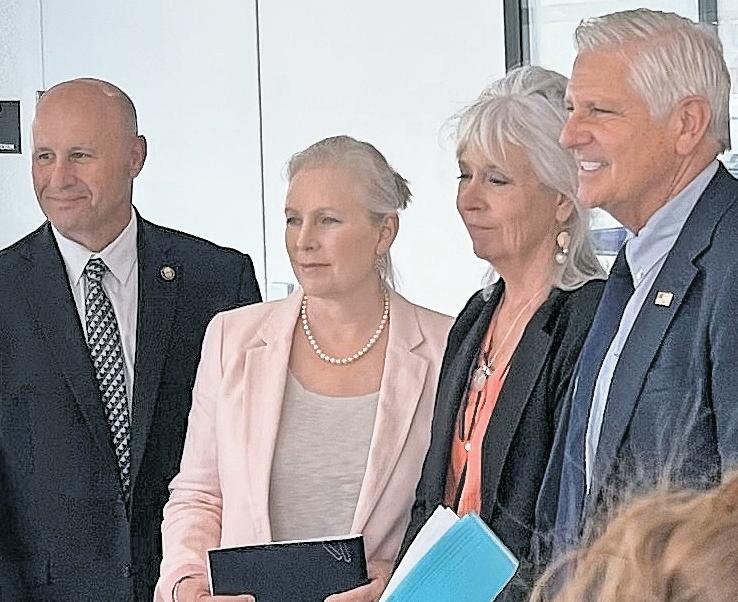
And that must come to an end, according to U.S. Sen. Kirsten Gillibrand. And for her, it all starts in the halls of Capitol Hill through a bill that’s already earned the support of not only the Nassau County Police Department Center, but lawmakers and leaders on both sides of the political aisle.
Gillibrand’s Fend Off Fentanyl Act was introduced in Nassau County last week by Police Commissioner Patrick Ryder, County Executive Bruce Blakeman, District Attorney Anne Donnelly, Long Island advocate Carole Trottere, and Long Island Council on Alcoholism and Drug Dependence executive director Steve Chassman.
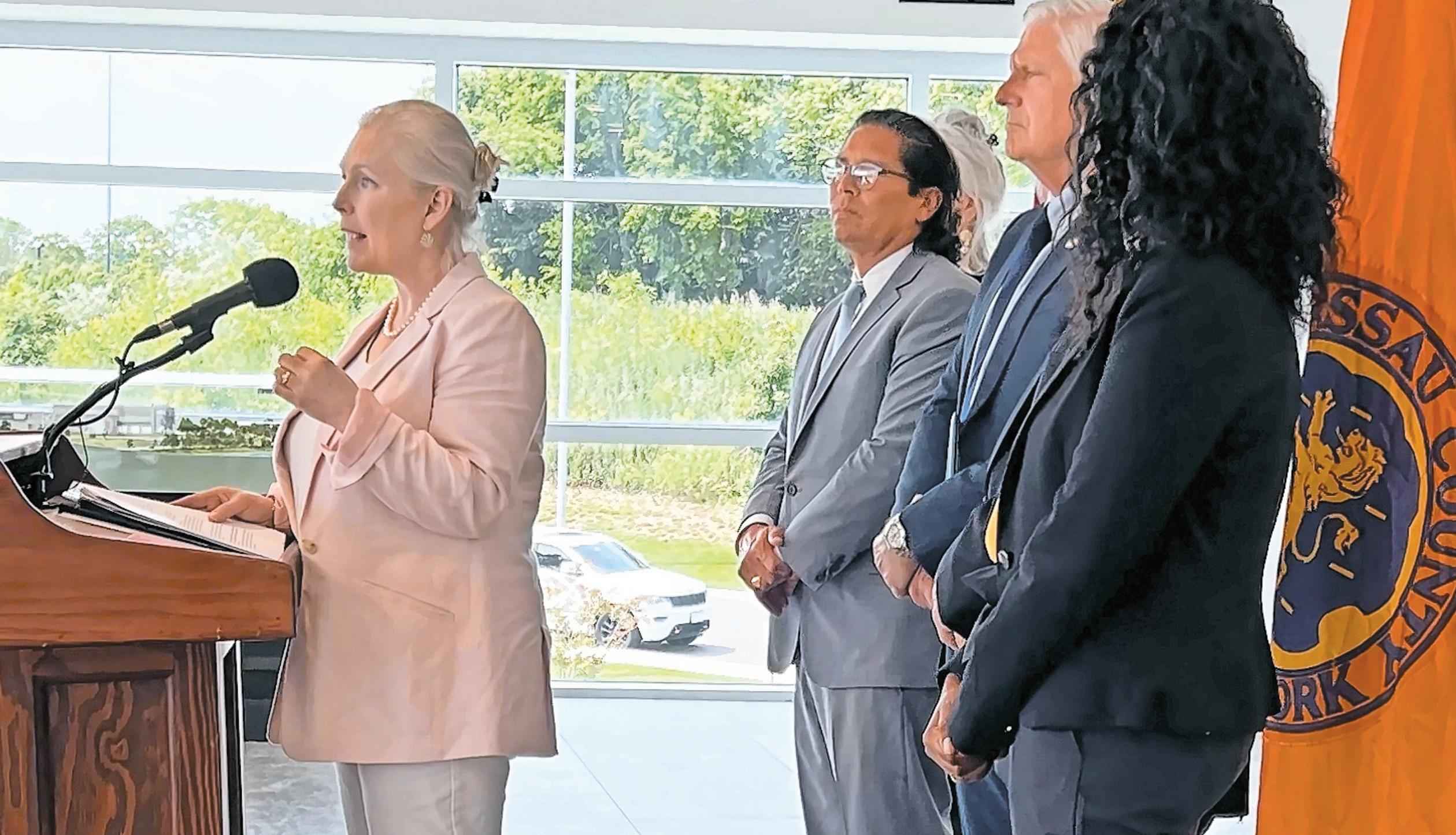
“No community has been left untouched by the deadly impacts of silent killers like fentanyl, including Long Island,” Gillibrand said. “Just last year, the DEA seized enough deadly doses of fentanyl in New York for more than three times the state’s population.”
The bill targets both cartels as well as people involved in producing and trafficking drugs into the United States, the senator said. The legislation will “better empower” the government to sanction drug traffickers and combat money laundering schemes that make this trade profitable.
“We have lost far too many lives to fentanyl overdoses,” Gillibrand said. “And I am committed to work-
ing with my colleagues in congress to keep our communities safe from deadly synthetic opioids.”
Gillibrand’s bill is intended to provide more resources to law enforcement and police officers on Long Island. This will then help them “trace these transnational criminals,” find the supply chain of these drugs, and then shut down these drugs deals on a local level. Gillibrand said fentanyl is “making the strengths of these drugs so much stronger than ever imagined,” which is why she is working on finding their source.
Trottere has fought against fentanyl since her son was fatally poisoned in 2018 when he was just 30 years old. He was a licensed welder and had a great job before dying, she said. And when his life ended, Trottere’s “nightmare began.”
“Unfortunately, my story is far from unique,” she said. “Disturbingly, fentanyl and opioids have quickly become the leading cause of death among adults 18 to 45. Last year on Long Island, there were over 500 deaths from fentanyl and opioids. That means over a thousand parents became members of the club that
nobody wants to join.”
These young people who died too early could have contributed a lot to the world, Trottere said, but we’ll never know what that would have been. She is certain about one thing, however: the feeling of grief. The pain that follows the death of a child is “unimaginable.”
“To the young people out there, I understand that death is not on your mind,” Trottere said. “It’s probably graduating, which is what it should be. But when you take any street drug or accept a pill from a friend at a party, or buy drugs from someone you don’t know, it could be the last thing you do.”
Fentanyl is getting mixed with everything, Ryder said. “Cocaine, crack, heroin, and even some marijuana in some situations.”
Some may not even know it, Ryder said. Adderall — used to help with attention deficit hyperactivity disorder — is abused by students in schools to help them focus. But it could very well be laced with fentanyl, intended to get them addicted, and then prompting them to buy more.
This is the “business model” that Ryder has been seeing kill people across Long Island.
“It is sickening how fentanyl traffickers continue to profit by peddling deadly poison to our communities and our children,” Nassau County legislator Delia DeRiggi-Whitton said, in a statement. “Sen. Gillibrand’s Fend Off Fentanyl Act will strengthen ongoing efforts to keep this deadly, highly addictive drug out of our nation, and empower law enforcement to seize the ill-begotten gains being made at the expense of sick and suffering addicts.”
June 29, 2023 — UNIONDALE HERALD BEACON 14
Ben Fiebert/Herald
U.S. SEN. KIRSTEN Gillibrand announces the Fend Off Fentanyl Act, which aims to tackle the fentanyl crisis in New York. More than 70 percent of overdose deaths in Nassau County in 2021 involved fentanyl.
No community has been left untouched by the deadly impacts of silent killers like fentanyl, including Long Island.
KIRSTEN GIllIBRaNd U.S Senator
No matter the industry, businesses around the world are undergoing dramatic changes to the way they operate. From technology and skill development to cultural barriers to self care and mental health, every organization must adapt and evolve or risk being left behind.













As we navigate a time of pivotal change, the Herald’s 2023 WE Summit presented by Bank of America brings together thought leaders, innovators and barrier-breaking women for conversations around this year’s theme: The Future is Now.










15 UNIONDALE HERALD BEACON — June 29, 2023 EARLY BIRD DISCOUNT ENDS JULY 9 SCAN ME LIZ BENTLEY Motivational Speaker Media Expert CEO & Founder Liz Bentley Associates KEYNOTE SPEAKER KRISTIN THORNE Multi-Emmy Award-Winning Investigative Reporter WABC-7 TV MODERATOR WORKSHOP SPONSORS SUPPORTING SPONSORS LANYARD/BADGE SPONSOR
For more information about WE Summit or sponsorship opportunities, con tact Amy Amato: Not-for-Profit Partner The Crescent Beach Club • Bayville, NY 8:30am - 3:30pm Produced by ( 5 1 6 ) 5 6 9 - 4 0 0 0 x 2 2 4 BETH FINKEL State Director AARP New York PANELIST
SPOTLIGHT JODI SEITLER Vice President, Crisis and Issue Management, Value Chain Lead Estee Lauder PANELIST TALISA FLATTS Human Resources Business Partner II at Amazon Logistics Amazon PANELIST USE CODE EB25
A
OF
AND AGENDA
1220734
SPEAKER
FOR
FULL LIST
SPEAKERS, WORKSHOPS
VISIT: RICHNERLIVE.COM/2023-WE-SUMMIT
Public Notices
LEGAL NOTICE
NOTICE OF SALE SUPREME COURT - COUNTY OF NASSAU DEUTSCHE
BANK NATIONAL TRUST COMPANY, AS TRUSTEE FOR FREMONT HOME
LOAN TRUST 20062, ASSET- BACKED CERTIFICATES, SERIES
2006-2 Plaintiff, Against DEMOFILDA BLUME A/K/A
DEMOFILDA J. BLUME, MICHAEL BLUME, et al.
Defendant(s) Pursuant to a Judgment of Foreclosure and Sale, duly entered 05/02/2023, I, the undersigned Referee, will sell at public auction, on the North Side steps of the Nassau County Supreme Court located at 100 Supreme Court Drive, Mineola, N.Y. 11501. This Auction will be held rain or shine on 7/17/2023 at 2:00 PM, premises known as 836 Hempstead Boulevard, Uniondale, New York 11553, And Described As
Follows: ALL that certain plot piece or parcel of land, with the buildings and improvements thereon erected, situate, lying and being In The Town Of Hempstead, County Of Nassau, State Of New York. Section 50 Block 138 Lot 342 And 343. The approximate amount of the current Judgment lien is $386,866.18 plus interest and costs. The Premises will be sold subject to provisions of the aforesaid Judgment of Foreclosure and Sale; Index # 605885/2018 If proper social distancing cannot be maintained or there are other health or safety concerns, the then Court Appointed Referee will cancel the Foreclosure Auction. Mark L. Lieberman, Esq., Referee. McCabe, Weisberg & Conway, LLC, 10 Midland Avenue, Suite 205, Port Chester, NY 10573 Dated: 5/23/2023 File Number: 17-303102 LD 140139
LEGAL NOTICE
NOTICE OF SALE SUPREME
COURT NASSAU COUNTY
U.S. BANK TRUST, N.A., AS TRUSTEE FOR LSF11
MASTER PARTICIPATION
TRUST, Plaintiff against NASSAU COUNTY PUBLIC

ADMINSITRATOR AS ADMINISTRATOR OF THE ESTATE OF WILLIAM J.B. CARTER A/K/A WILLIAM
J.B. CARTER, SR. A/K/A
JOSEPH W. CARTER, SR., et al Defendant(s) Attorney for Plaintiff(s) Fein Such & Crane, LLP, 28 East Main Street, Suite 1800, Rochester, NY 14614.
Pursuant to a Judgment of Foreclosure and Sale entered January 11, 2023, I will sell at public auction to the highest bidder at North Side Steps of the Nassau County Supreme Court at 100 Supreme Court Drive, Mineola, NY 11501 on July 18, 2023 at 2:30 PM. Premises known as 1063 Northgate Court, Uniondale, NY 11553. Sec 55 Block 530 Lot 16. All that certain plot, piece or parcel of land with the buildings and improvements thereon
erected, situate, lying and being at Uniondale (unincorporated), in the Town of Hempstead, County of Nassau and State of New York.
Approximate Amount of Judgment is $183,448.10 plus interest, fees, and costs. Premises will be sold subject to provisions of filed Judgment Index No 007186/2013. Cash will not be accepted at the sale. The foreclosure sale will be conducted in accordance with 10th Judicial District’sCovid-19 Policies and foreclosure auction rules. The Referee shall enforce any rules in place regarding facial coverings and social distancing. If proper social distancing cannot be maintained or there are other health or safety concerns, then the Court Appointed Referee shall cancel the foreclosure auction. Foreclosure Auctions will be held “Rain or Shine.” Lisa Goodwin, Esq., Referee AYSN382 140165
LEGAL NOTICE NOTICE OF SALE SUPREME COURT - COUNTY OF NASSAU U.S. BANK N.A., AS TRUSTEE, ON BEHALF OF THE HOLDERS OF THE J.P. MORGAN MORTGAGE ACQUISITION TRUST 2006CH2 ASSET BACKED PASSTHROUGH CERTIFICATES, SERIES 2006-CH2, Plaintiff, Against MAUREEN E. HILLARY A/K/A MAUREEN HILLARY, et al.Defendant(s)
Pursuant to a Judgment of Foreclosure and Sale, duly entered 11/15/2016, I, the undersigned Referee, will sell at public auction, on the North Side steps of the Nassau County Supreme Court located at 100 Supreme Court Drive, Mineola, N.Y. 11501. This Auction will be held rain or shine on 7/17/2023 at 2:00 PM, premises known as 612 Newton Avenue, Uniondale, NY 11553, and described as follows: ALL that certain plot piece or parcel of land, with the buildings and improvements thereon erected, situate, lying and being in Uniondale, Town of Hempstead, County of Nassau and State of New York Section 36 Block 134
Lot 507 The approximate amount of the current Judgment lien is $388,511.23 plus interest and costs. The Premises will be sold subject to provisions of the aforesaid Judgment of Foreclosure and Sale; Index # 11090-14
If proper social distancing cannot be maintained or there are other health or safety concerns, the then Court Appointed Referee will cancel the Foreclosure Auction. For sale information, please visit Auction.com at www. Auction.com or call (800) 280-2832. Jane Shrenkel,
LEGAL NOTICE NOTICE OF SALE SUPREME COURT COUNTY OF NASSAU, GITSIT SOLUTIONS LLC
FKA KONDAUR CAPITAL CORPORATION, Plaintiff, vs. JOSE A. PACHECO
A/K/A JOSE PACHECO, ET AL., Defendant(s).
filed judgment and terms of sale. Foreclosure auction will be held “rain or shine.”
If proper social distancing cannot be maintained or there are other health or safety concerns, then the court appointed referee will cancel the auction.
Train to become a community journalist
STAFF REPORT
Pursuant to an Order Amending Caption, Confirming Referee’s Report and Judgment of Foreclosure and Sale duly entered on December 20, 2022, I, the undersigned Referee will sell at public auction on the front steps on the north side of the Nassau County Supreme Court, 100 Supreme Court Drive, Mineola, NY on July 26, 2023 at 2:30 p.m., premises known as 327 Maple Avenue, Uniondale, NY 11553. All that certain plot, piece or parcel of land, with the buildings and improvements thereon erected, situate, lying and being in the Town of Hempstead, County of Nassau and State of New York, Section 34, Block 502 and Lots 504506 & 701. Approximate amount of judgment is $758,849.20 plus interest and costs. Premises will be sold subject to provisions of filed Judgment Index #614230/2018. Cash will not be accepted. This foreclosure sale will be held on the north side steps of the Courthouse, rain or shine. COVID-19 safety protocols will be followed at the foreclosure sale. If proper social distancing cannot be maintained or there are other health or safety concerns, the Court Appointed Referee will cancel the sale.
MALACHY LYONS, JR., Referee. STEIN, WIENER & ROTH, LLP, Attys. for Pltf., 1400 Old Country Road, Ste. 315, Westbury, NY 11590. File No. 69360#100472
140258
LEGAL NOTICE
NOTICE OF SALE
SUPREME COURT COUNTY OF NASSAU, 1 OAK RICHLAND, LLC, Plaintiff, vs. ROSA L. SARAVIA, ET AL., Defendant(s).
Ever read a story and thought, “I can do that!” Or missed coverage in your local paper simply because the newsroom didn’t have enough resources?
Now could be your chance to do something about it. And the New York Press Association — the statewide organization representing news outlets like the very newspaper you’re reading — is offering training to neighbors just like you interested in covering news for the local newspaper.
business of newspapers. The differences between news and opinion and news and advertising. And discussing news literacy and ethics.
The second session focuses on basic news writing, the “inverted pyramid” method of writing, and how to write a lede. There also will be discussion on checking facts, how to avoid libel, and the difference between “off-the-record” and “on background,” as well as how to follow recommended writing styles, story accuracy, and writing clearly.
Janine
T. Lynam, Esq., Referee Knuckles, Komosinski & Manfro, LLP, 565 Taxter Road, Suite 590, Elmsford, NY 10523, Attorneys for Plaintiff 140198
LEGAL NOTICE NOTICE OF SALE SUPREME COURT. NASSAU COUNTY. CITIBANK, N.A., AS TRUSTEE FOR WACHOVIA LOAN TRUST
2005-SD1 ASSET-BACKED CERTIFICATES, SERIES
2005-SD1, Pltf. vs. LESLY ROSEMOND, et al, Defts., Index #615208/2019.
Pursuant to a Judgment of Foreclosure and Sale duly entered on April 21, 2023, I, the undersigned Referee will sell at public auction on the front steps on the north side of the Nassau County Supreme Court, 100 Supreme Court Drive, Mineola, NY 11501 on July 24, 2023 at 2:00 p.m., premises known as 400 Hawthorne Avenue, Uniondale, NY 11553. All that certain plot, piece or parcel of land, with the buildings and improvements thereon erected, situate, lying and being in the Town of Hempstead, County of Nassau and State of New York, Section 34, Block 495 and Lots 234-235. Approximate amount of judgment is $159,039.91 plus interest and costs. Premises will be sold subject to provisions of filed Judgment Index # 601376/2021. This foreclosure sale will be held on the north side steps of the Courthouse, rain or shine. COVID-19 safety protocols will be followed at the foreclosure sale. If proper social distancing cannot be maintained or there are other health or safety concerns, the Court Appointed Referee will cancel the sale. Harold F. Damm, Esq., Referee Shnayder Law Firm LLC, 148 East Street Road, Suite 352, Feasterville, PA 19053, Attorneys for Plaintiff
140334
The free four-part online program focuses on ethics, accuracy in reporting, interviewing techniques, and how to write clearly. Everyone who completes all four sessions and pass a written test will receive certification as a community journalist from the association.
“We’re not aiming to replace traditional journalists with this program,” said Judy Patrick, the association’s vice president for editorial development, in a news release. “We’re working to expand local news coverage and build on our industry’s longstanding tradition of community correspondents.”
The one-hour sessions include an introduction to journalism that will explain the First Amendment and the
On the job in the third session, participants can explore how to comport themselves on the job, how to find news and interview story subjects and sources, the variety of stories — from hard news to features — how to find and develop sources, and why deadlines matter.
The basics of local government across the state will be covered in the last session, along with how to write about governmental financial budgets, education and politics, learning about basic investigative tools, open government tools in New York, and social media.
Offered four times a year, the first online session is set to run between July 10 and July 13 beginning at 4 p.m. Free registration is open through July 7 by emailing judy@nynewspapers.com.
Esq.,
Referee. SHELDON MAY & ASSOCIATES Attorneys at Law, 255 Merrick Road , Rockville
Pursuant to judgment of foreclosure and sale entered Feb. 16, 2023, I will sell at public auction on the North Side Steps of the Nassau Supreme Court, 100 Supreme Court Drive, Mineola, NY on July 27, 2023 at 3:30 p.m. prem. k/a 760 Campus Street, Uniondale, NY 11553 a/k/a Section 50, Block 285, Lot 116 a/k/a Lot 116 on a certain map, entitled “Map of Colonial Gardens, Uniondale, Town of Hempstead, Nassau County, N.Y.” and surveyed by Robert L. Clement, City Surveyor, Aug. 29, 1936 and filed in the Office of the Clerk of Nassau County on Sept. 11, 1936 as Map No. 1083. Approximate amount of judgment is $97,196.14 plus costs and interest. Sold subject to terms and conditions of
LEGAL NOTICE
SUPREME COURT OF THE STATE OF NEW YORKCOUNTY OF NASSAU OCWEN LOAN SERVICING, LLC, V. WILLIAM F. JONES, JR, ET. AL. NOTICE OF SALE NOTICE IS HEREBY GIVEN pursuant to a Final Judgment of Foreclosure dated May 02, 2023, and entered in the Office of the Clerk of the County of Nassau, wherein OCWEN LOAN SERVICING, LLC is the Plaintiff and WILLIAM F. JONES, JR, ET AL. are the Defendant(s). I, the undersigned Referee will sell at public auction at the NASSAU COUNTY SUPREME COURT, NORTH SIDE STEPS, 100 SUPREME COURT DRIVE, MINEOLA, NY 11501, on July 25, 2023 at 2:30PM, premises known as 529 LIBERTY
STREET, UNIONDALE, NY 11553: Section 50, Block 137, Lot 317: ALL THAT CERTAIN PLOT, PIECE OR PARCEL OF LAND, WITH THE BUILDINGS AND IMPROVEMENTS THEREON ERECTED, SITUATE, LYING AND BEING IN THE TOWN OF HEMPSTEAD, COUNTY OF NASSAU AND STATE OF NEW YORK Premises will be sold subject to provisions of filed Judgment Index # 008792/2014. George Esernio, Esq. - Referee. Robertson, Anschutz, Schneid, Crane & Partners, PLLC 900 Merchants Concourse, Suite 310, Westbury, New York 11590, Attorneys for Plaintiff. All foreclosure sales will be conducted in accordance with Covid-19 guidelines including, but not limited to, social distancing and mask wearing. *LOCATION OF SALE SUBJECT TO CHANGE DAY OF IN ACCORDANCE WITH COURT/CLERK DIRECTIVES. 140336
NOTICE that pursuant to Section 202-48 of the code of the Town of Hempstead entitled, “Handicapped Parking On Public Streets,” a public hearing will be held in the Town Meeting Pavilion, Hempstead Town Hall, 1 Washington Street, Hempstead, New York, on the 11th day of July, 2023, at 10:30 o’clock in the forenoon of that day, to consider the adoption of a resolution setting aside certain parking spaces for motor vehicles for the sole use of holders of special parking permits issued by the County of Nassau to physically handicapped persons at the following locations: UNIONDALE MANOR PARKWAYeast side, starting at a point 138 feet north of the north curbline of Gerald Street, north for a distance of 20 feet. (TH229/23) ALL PERSONS INTERESTED shall have an opportunity to be heard on said proposal at the time and place aforesaid.
Dated:June 20, 2023 Hempstead, New York BY ORDER OF THE TOWN BOARD OF THE TOWN OF HEMPSTEAD DONALD X. CLAVIN, JR. Supervisor
KATE MURRAY Town Clerk 140443
LEGAL NOTICE SUPREME COURT OF THE STATE OF NEW YORK - COUNTY OF NASSAU BANK OF NEW YORK MELLON TRUST COMPANY, N.A. AS TRUSTEE FOR MORTGAGE ASSETS MANAGEMENT SERIES I TRUST, V. ELAINE DEL COLLE, AS TRUSTEE OF THE KMETZ FAMILY TRUST, ET. AL. NOTICE OF SALE NOTICE IS HEREBY GIVEN pursuant to a Final Judgment of Foreclosure dated May 23, 2023, and entered in the Office of the Clerk of the County of Nassau, wherein BANK OF NEW YORK MELLON TRUST COMPANY, N.A. AS TRUSTEE FOR MORTGAGE ASSETS MANAGEMENT SERIES I TRUST is the Plaintiff and ELAINE DEL COLLE, AS TRUSTEE OF THE KMETZ FAMILY TRUST, ET AL. are the Defendant(s).
known as 715 LAFAYETTE AVENUE, UNIONDALE, NY 11553: Section 50, Block 120, Lot 198,199, 200, and 201: ALL THAT CERTAIN PLOT, PIECE OR PARCEL OF LAND, WITH THE BUILDINGS AND IMPROVEMENTS THEREON ERECTED, SITUATE, LYING AND BEING IN THE TOWN OF HEMPSTEAD, COUNTY OF NASSAU, STATE OF NEW YORK Premises will be sold subject to provisions of filed Judgment Index # 613982/2021. Harold F. Damm, Esq. - Referee. Robertson, Anschutz, Schneid, Crane & Partners, PLLC, 900 Merchants Concourse, Suite 310, Westbury, New York 11590, Attorneys for Plaintiff. All foreclosure sales will be conducted in accordance with Covid-19 guidelines including, but not limited to, social distancing and mask wearing. *LOCATION OF SALE SUBJECT TO CHANGE DAY OF IN ACCORDANCE WITH COURT/CLERK DIRECTIVES. 140474
phone
Dated: 5/23/2023 File Number: 32669 LD 140134
Centre, NY 11570
LEGAL NOTICE NOTICE OF PUBLIC HEARING PLEASE TAKE
LUNI 1-1 0630 To Place A Notice Call 516-569-4000 x232 Search for notices online at: www.newyorkpublicnotices.com Place a notice by
I, the undersigned Referee will sell at public auction at the NASSAU COUNTY SUPREME COURT, NORTH SIDE STEPS, 100 SUPREME COURT DRIVE, MINEOLA, NY 11501, on August 01, 2023 at 2:30PM, premises at 516-569-4000 x232 or email: legalnotices@liherald.com
June 29, 2023 — UNIONDALE HERALD BEACON 16
Public Notices
Needed For Garden City Law Firm.

Help Wanted Administrative Assistant For Five Towns Law Firm Mgmt/ Computer Skills Mandatory Salary Commensurate With Experience. In Office Position Email Resume To Siberlaw@aol.com
BOOKKEEPER/ OFFICE MANAGER: Small Merrick CPA Firm Seeks PT Bookkeeper/ Office Manager 4 Mornings/ Week. Individual Must Have Knowledge Of Payroll Taxes, Sales Taxes, General Ledger + Bank Reconciliations. Knowledge Of Tax Software Helpful. Prior CPA Firm Experience Preferred. Call 516-379-1663, Email Resume jacobsandco@optonline.net
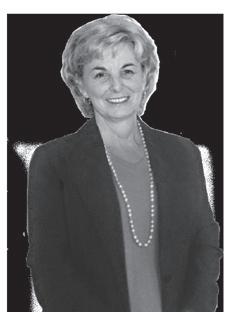



CIRCULATION ASSOCIATE Full Time/Part Time Richner Communications, publisher of Herald community newspapers has an excellent opportunity for a FT/PT Customer Service Clerk in our busy Circulation Department.
Basic customer service and administrative responsibilities include: heavy computer work, answering phones, making phone calls, entering orders, faxing, filing, etc.
STRONG knowledge of EXCEL a must! Knowledge of DATABASE maintenance or postal regulations a big plus. Qualified Candidates must be computer literate, able to multitask, dependable, reliable, organized, energetic, detail oriented and able to work well under deadlines. For consideration, please send resume & salary requirements to: careers@liherald.com
EDITOR/REPORTER
The award-winning Herald Community Newspapers group, covering Nassau County's North and South Shores with hard-hitting news stories and gracefully written features, seeks a motivated, energetic and creative editor/reporter to join our dynamic (and awesome) team! This education and general assignment reporting position offers a unique experience to learn from some of the best in the business. Historically, reporters who have launched their careers with us have gone on to The New York Times, Newsweek, Newsday, the New York Daily News, New York Post, CNN, BBC, NBC News and The Daily Mail, among many others. We look for excellent writers who are eager to learn, enhance their skills, and become well-established and respected journalists in our industry. To apply: Send a brief summary in the form of a cover letter describing your career goals and what strengths you can bring to our newsroom, along with a resume and three writing samples to mhinman@liherald.com
LINE COOK: Friday, Saturday, Sunday, Monday 10am-6pm. Sandwiches/ Salads. Beach Restaurant. Great Summer Job. 516-835-2819
MACHINE PROGRAMMER/ MACHINE OPERATOR Will Train


*Math Skills Helpful.
*Work In A Machine Shop. Northfield Precision Instruments Phone 516-431-1112 Ask For Charles. E-mail Resume sales@northfield.com
Manager On Duty
At Blaze, Old Bethpage Village Outdoors From September Through November 5-8 Hour Shifts. Serve As The Primary Point Of Contact For All Issues That May Occur During The Event, Seeing Each Through To Resolution. Serve As The Primary Point Of Contact For Emergency Personnel Hourly Rate $25-$30 To Apply: https://hudsonvalley.org/ employment/
MULTI MEDIA ACCOUNT DEVELOPMENT


Inside Sales
Looking for an aggressive self starter who is great at making and maintaining relationships and loves to help businesses grow by marketing them on many different advertising platforms. You will source new sales opportunities through inbound lead follow-up and outbound cold calls. Must have the ability to understand customer needs and requirements and turn them in to positive advertising solutions. We are looking for a talented and competitive Inside Sales Representative that thrives in a quick sales cycle environment. We offer salary, commission, bonuses, health benefits, 401K and paid time off. Will consider part time. Please send cover letter and resume with salary requirements to ereynolds@liherald.com Call 516-569-4000 X286
Help Wanted OUTSIDE SALES
Richner Communications, One of the Fastest Growing Media, Event and Communications Companies on Long Island is Seeking a Sales/Marketing Candidate to Sell our Print Media Products and our Digital, Events, Sponsorships.



Salary, Commission, Eligible for Health Benefits, 401k and Paid Time Off. Will Consider Part Time. Please Send Cover Letter and Resume with Salary Requirements to rglickman@liherald.com or Call 516-569-4000 X250
Path Monitor

At Blaze, Old Bethpage Village
Outdoors From September
Through November
5-8 Hour Evening Shifts

Providing A Welcoming Atmosphere And Ensuring Guest Safety. Hourly Rate $20.
To Apply: https://hudsonvalley.org/ employment/
Help Wanted
PRESS-ROOM/WAREHOUSE HELP

Long Island Herald has IMMEDIATE open-

17 UNIONDALE HERALD BEACON — June 29, 2023 H1
Responsibilities Include Filing, Ordering And Stocking Office Supplies, Mail Distribution, Photocopying, Scanning, And Errands To Banks, Post Office And Courts. Must Have A Vehicle And Valid N.Y. Driver License. Please Email Resume To mjagnandan@albaneselegal.com Or Call 516-248-7000 Ext.2212
WANTED Full Time and Part Time Positions Available! Busy Print Shop in Garden City is Hiring Immediately for Full Time and Part Time Drivers. Must Have a Clean License and BoxTruck Driving Experience. Hours Vary, Night Availability is a Must. Please Email Resume to careers@liherald.com or Call (516)569-4000 x239 DRIVING INSTRUCTOR Company Car/ Bonuses. Clean Driving Record Required, Will Train. Retirees Welcome! Bell Auto School 516-365-5778 Email: info@bellautoschool.com DRIVING INSTRUCTORS WANTED Will Certify And Train HS Diploma NYS License Clean 3 Years Call 516-731-3000
DRIVERS
OFFICE HELP PT/FT:
Literate.
Phones, Packing,
Orders.
Dental Supply
516-783-7800
Computer
Answer
Process
Baldwin
Company.
ings for a FULL-TIME Pressroom/warehouse helper in Garden City. We are a busy print shop looking for a motivated and reliable individuals to assist in various duties in the shop. Forklift experience is a plus and heavy lifting is required. Hours vary, so flexibility is key. Email resumes or contact info to careers@liherald.com SEWING MACHINE OPERATOR/ CANVAS FABRICATOR For Foreman Position. Experience a Must. Awning Company. Call/Text Tommy 516-250-8094; tgawnings@aol.com Send Resume Business/Opportunities NICHE FRANCHISE OPPORTUNITY THEFANWHISPERER.COM REPLACING NOISY BATHROOM FANS PLUG & PLAY EASY. I TRAIN. 1-888-888-2134 REAL ESTATE CLASSIFIED Fax your ad to: 516-622-7460 E-mail your ad to: ereynolds@liherald.com E-mail Finds Under $100 to: sales@liherald.com DEADLINE: Monday, 11:00 am for all classified ads. Every effort is made to insure the accuracy of your ad. Please check your ad at the first insertion. Credit will be made only for the first insertion. Credit given for errors in ads is limited to the printed space involved. Publisher reserves right to reject, cancel or correctly classify an ad. To pLACE your AD CALL 516-569-4000 - press 5 Employment HERALD JOIN OUR TEAM! Be a part of a growing multi media company based in Garden City Now Hiring: •Sales/Multi Media Consultants* •Reporter/Editor •Pressman/Press Helper Mail Your Resumes to Careers@liherald.com or call 516-569-4000 ext 239 *must have a car 12 04615 E-mail Your Resumes to Careers@liherald.com 1217542 Office: 718-534-7400 ext. 147 Cell: 631-316-0448 esuarez@fsnursing.com 1220129 Homes HERALD To place an ad call 516-569-4000 press 5 Results t hat Move You 1216503 1219230 Robin Reiss Licensed Real Estate Salesperson Cell: 516.510.6484 Office: 516.623.4500 Robin.Reiss@elliman.com This Robin won’t rest until you are in your new NEST! How’s the market?? Please contact me for your free market report and personalized service! “Leading Edge Award Winner” Lic. Real Estate Salesperson 516-312-8956 kcowden@realtyconnect.com 650 Wantagh Avenue Levittown, NY 516-346-5040 1216027 LOOKING TO BUY OR SELL? CALL/TALK/LET'S MAKE A PLAN. 22 YEARS EXPERIENCE IT IS STILL A SELLERS MARKET! While The Market Is Still HOT!! Call Me For A FREE Market Evaluation #therightagentmeanseverything 1219930 Erica Nevins Licensed RE Salesperson 516-477-2378 erica.nevins@remax.net 3305 Jerusalem Avenue, Wantagh, NY RELIANCE
HomesHERALD
To place an ad call 516-569-4000 press 5 • To place an ad call 516-569-4000 press 5
New Construction
This home is a 2023 new construction. It is FEMA compliant, with elevator, on a wide block. This home has three bedrooms, 3.5 baths with 9 foot ceilings. The Ground floor has a one car garage, finished interior with sheetrock and ceramic tile floors along with a coat closet. The Second floor features three bedrooms, utilities, linen closet and laundry room. The Third floor consists of a state-of-the-art kitchen, formal dining area, open great room with cathedral ceilings, gas fireplace, and a powder room.
97 Minnesota Ave Long Beach
Vetting a contractor, Part 2
Q. We need some advice on how to pick a contractor. Our neighbors down the street are going through a tough time with delays, seemingly shoddy work that didn’t pass inspection and extra costs for things they didn’t want or expect. Do you have any suggestions on how to interview a contractor, and what to ask about or look for in their proposal? We want to avoid what our neighbor is going through.
A. Continuing from last week, make a checklist of questions. Ask how long the contractor has been in business, and check the information with New York state. Businesses are registered in the state Department of State database, at dos. ny.gov. If the company isn’t there, ask if they have a different name — but ask. Giving a large sum of money to a business without confirming who they are is risky.
Anthony M. Ponte Broker Owner

Stonegate Real Estate 2A Poole Street Oceanside, NY 11572

Cell: (516) 852-2071
Office: (516) 740-2777
Open Houses
HEWLETT BAY PARK 7/2, 11-12:30
Next, contact the Department of Consumer Affairs, which issues the contractor’s license. This serves more than one purpose, by confirming the contractor has a clean record, and is licensed for the work you want done. You’ll need the license number to give to your municipality to apply for a permit for the work. This information is available by looking up your county consumer affairs office.
Open Houses
with Vaulted Ceiling, Fpl, Fam Rm. 2 Car Att Gar. Endless Possibilities! SD#14 $1,349,000
1025 Seawane Dr, BA, NEW TO MARKET! Beautiful 4 BR, 4.5 Bth Contemporary Home on ½ Acre Resortlike Prop. LR, DR, EIK & Family Room All Overlooking IG Gunite Pool & Magnificent Landscaping. Soaring Ceilings, Loads of Natural Light. Fabulous House For Entertaining. Circular Driveway, 2 Car Att Gar. SD #14 $1,899,000 246 Adams Rd, BA, NEW TO MARKET! Elegant & Stately 4200 Sq Ft CH Col on Beautiful Quiet St. 5 BR, 4.55 Bth. Sweeping Staircase. All Spacious Rooms with Top Quality Finishes. Amazing Fam Rm with Cathedral Ceiling Overlooking 1 Acre Resortlike Prop Featuring IG Gunite Pool, Patio & Tennis Ct. XL Fin Bsmt. Upper Level has Primary Ste w/ Dressing Rm & Bth Plus 3 BRs & 2 Bths. 2 Car Att Gar. Low Taxes!
SD#20 $2,500,000
HEWLETT
1638 Ridgeway Dr, BA, FIRST TIME ON MARKET! Well Maintained 6 BR, 3.5 Bth 3500
Sq Ft Exp CH Colonial on Beautiful St. LR/Fpl, Spac Fam Rm/Fpl, FDR, EIK & Sun Rm
Overlooking 1/3 Acre Resortlike Prop, IG Lap Pool, Hot Tub, Bar & Gazebo. FBsmt. 2
Car Gar. SD#20 $1,149,000
1193 E. Broadway # M23, BA, Move Right Into This Stunning Gut Renovated 2 BR,


2 Bth Coop in Garden Town. Gourmet Kit W/Thermdore St Steel Appl Opens Into

DR & LR. Primary BR w/Bth Plus Spac 2nd BR. W/D in Unit. New Self Controlled
CAC. Oak Flrs, LED Lights. Near LIRR. Parking Avail. SD#14. You Don’t Want to
Miss This REDUCED! $359,000
1534 Broadway #205, BA, Extra Large 2000 Sq Ft, 2 Bedroom (Originally 3 BR), 2
Bath Condo in Prestigious Jonathan Hall with Doorman
190 Meadowview Ave Ever Dream of Living in A Castle? This 8000 Sq Ft Mansion is Full of Character. Amazing Architectural Details, Soaring Ceilings, Stained Glass Windows. 5 BR, 6.55 Bths. Sprawling 1.3 Acre Prop with IG Gunite Pool. SD#14.Near All. Must See This Unique Home!..REDUCED $2,999,000 Ronnie Gerber, Douglas elliman 516-238-429 ba
HEWLETT HARBOR BA, 1025 Seawane Dr,NEW TO MARKET! Beautiful 4 BR, 4.5 Bth Contemporary Home on Ω Acre Resortlike Prop. LR,DR, EIK & Family Room All Overlooking IG Gunite Pool & Magnificent Landscaping.Soaring Ceilings, Loads of Natural Light. Fabulous House For Entertaining. Circular Driveway, 2 Car Att Gar. SD #14...$1,899,000 Ronnie Gerber, Douglas Elliman 516-238-4299
HEWLETT HARBOR BA, 1051 Channel Dr, FIRST TIME ON MARKET! 3/4 BR, 2.5 Bth Split on Beautiful Ω Acre Parklike Property. Updtd Gran/Wood EIK, Spac LR/DR with Vaulted Ceiling & Fpl, & Fam Rm. 2 Car Att Gar.Endless Possibilities!
SD#14...$1,349,000 Ronnie Gerber, Douglas Elliman 516-238-429
HEWLETT HARBOR BA 246 Adams Rd, NEW TO MARKET! Elegant & Stately 4200 Sq Ft CH Col on Beautiful Quiet St. 5 BR, 4.55 Bth. Sweeping Staircase. All Spacious Rooms with Top Quality Finishes. Amazing Fam Rm with Cathedral Ceiling Overlooking 1 Acre Resortlike Prop Featuring IG Gunite Pool, Patio & Tennis Ct. XL Fin Bsmt. Upper Level has Primary Ste w/ Dressing Rm & Bth Plus 3 BRs & 2 Bths. 2 Car Att Gar.Low Taxes!
SD#20..$2,500,000 Ronnie Gerber, Douglas Elliman 516-238-4299
WOODMERE BA, 504 Saddle Ridge Rd., FIRST TIME ON MARKET! Move Right Into This Renovated 4 BR, 2 Bth Split with Open Layout in Prime Location! Granite/Wood EIK Opens to Dining Room & Living Room. Lower Level Den. HW Flrs, Gas Heat, CAC. Oversized Property! SD#14.Near All!..$999,000 Ronnie Gerber, Douglas Elliman 516-238-4299
Apartments For Rent
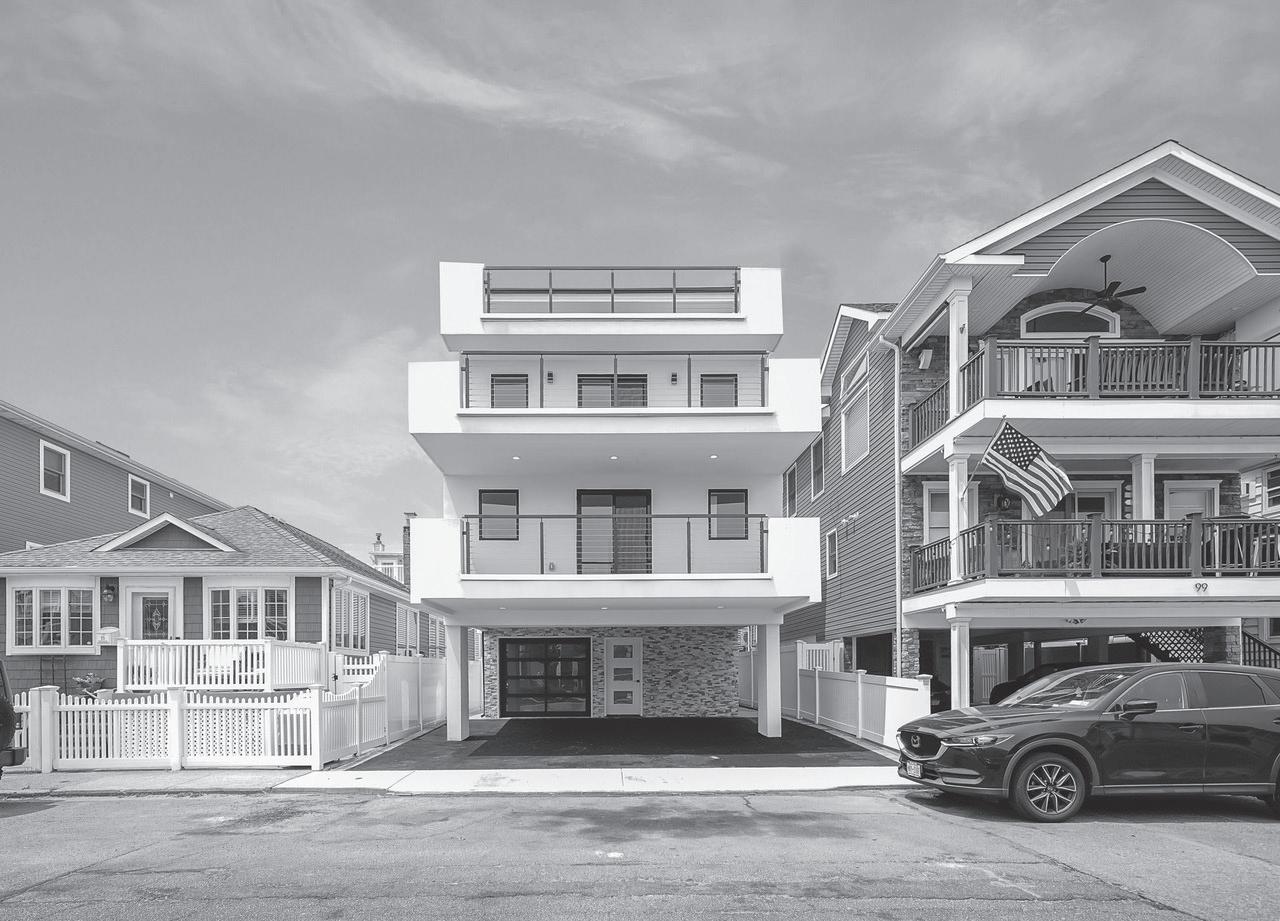
CEDARHURST NO FEE Private Entrance, Modern 1BR, 2BR, 3BR, CAC, W/D, Storage, Wall To Wall Carpeting, Indoor Parking Space. Starting At $1450 For One Bedroom When Available. (516)860-6889/ (516)852-5135/ (516)582-9978
MoneyTo Lend
ARE YOU BEHIND $10k OR MORE ON YOUR TAXES? Stop wage & bank levies, liens & audits, unfiled tax returns, payroll issues, & resolve tax debt FAST. Call 888-869-5361 (Hours: Mon-Fri 7am-5pm PST)
Cemetery Plots
CEMETERY PLOT FOR TWO For Sale: Pinelawn Cemetery. Garden Of Normandy North. Price Negotiable. 516-375-1905
ANNOUNCEMENTS
MOTIVATED SELLER: 44 Mohawk Way, Elizabethtown, NY Adirondack Mountain Home overlooking village.Stunning attention to details, blazing internet, close to I-87 and Ferry to Vermont. Christine Benedict, 518-593-0533 or Christine.adkrealtor@gmail.com
When the time comes, the same should be done for your plumber and your electrician, both of whom are supposed to be licensed and on file with the local jurisdiction where the work will be done. From time to time, people use an electrician’s or plumber’s license number but aren’t that plumber or electrician. This just complicates and delays things, since no local government will issue a permit without confirming that the license number given to the owner matches the name of the license holder. When the wrong information is given, suspicions arise. Whatever the arrangement is, the correct information must be given.
The same goes for insurance. When you interview a contractor, familiarize yourself with the insurances that are required by your local building department, and be sure to verify that the contractor you are interviewing can provide the documents.
Next, ask if the contractor will be arranging the required building inspections, in stages throughout the job, from your jurisdiction. Ask how you can also verify that the inspector was there. Many municipalities have gone to online portals where you can track which inspection has been done and whether a project passed. Discuss timelines, who will be managing the work onsite and whether there will be site meetings to keep up communications about the progress.
When you get to the point of discussing costs, confirm the method of payment. As I previously recommended, milestone payments for things you can see, such as when the concrete foundation is done, when the windows and doors are installed, etc., are the best way to keep track of the payment process. There’s a lot to be done, but this is one of the most expensive things you will ever do. Good luck!
© 2022 Monte Leeper
Readers are encouraged to send questions to yourhousedr@aol.com, with “Herald question” in the subject line, or to Herald Homes, 2 Endo Blvd., Garden City, NY 11530, Attn: Monte Leeper, architect.
June 29, 2023 — UNIONDALE HERALD BEACON 18 H2 06/29
Real Estate
Ask
The Architect
Monte
Leeper
HOME Of tHE WEEK
Long Beach
OPEN HOUSES SUNday, 7/2/23 HEWLETT Bay Pa RK 190 Meadowview Ave, 11-12:30, Ever Dream of Living in A Castle? This 8000 Sq Ft Mansion is Full of Character. Amazing Architectural Details, Soaring Ceilings, Stained Glass Windows. 5 BR, 6.55 Bths. Sprawling 1.3 Acre Prop with IG Gunite Pool. SD#14. Near All. Must See This Unique Home! REDUCED $2,999,000 HEWLETT H a RBOR 1051 Channel Dr, BA, FIRST TIME ON MARKET! 3/4 BR, 2.5 Bth Split on Beautiful ½ Acre Parklike Property. Updtd Gran/Wood EIK, Spac LR/DR
& Elevator. Updtd Wood/Quartz Kit, LR & DR. Washer/Dryer in Unit. Underground Pkg. Loads of Closets. Terrace Faces Back. Easy Ranch Style Living BIG REDUCTION!! MOTIVATED SELLER! $579,000 WOO dMERE 504 Saddle Ridge Rd, BA, Move Right Into This Renovated 4 BR, 2 Bth Split with Open Layout in Prime Location! Granite/Wood EIK Opens to DR & LR. Lower Level Den. HW Flrs, Gas Heat, CAC. Oversized Property! SD#14. Near All! REDUCED! $999,000 CE da RHURST 332B Peninsula Blvd, BA, Move Right Into This Updated 3 Br, 2.5 Bth Coop Townhouse. LR, DR, Gran/Wood Kit w/ Stainless Steel Appl. Trex Deck Off LR. Primary Suite Features Updtd Bth & WIC. Att Gar Plus 1 Pkg Spot incl in Maintenance. W/D. Pull Down Attic. SD#15. Convenient to Shops, Trans & Houses of Worship $449,000 Ronnie Gerber 516-238-4299 1220081 Rent Your Apartment through the Herald and PrimeTime Classified section. Call us for our great *specials. 516-5694000, press 5 for Classified Dept. *(private party only)
















19 UNIONDALE HERALD BEACON — June 29, 2023 H3 06/29 MarketPlace HERALD To place an ad call 516-569-4000 press 5 • To place an ad call 516-569-4000 press 5 • To place an ad call 516-569-4000 press 5 ACE LANDSCAPING SERVICES, INC. 516-791-6241 • PVC Fence & Railing • Junk Removal Services • Any Type Of Roofing & Siding Work • Mosquitoes & Horticultural Dormant Oil Applications • Pavers & Concrete Work • Expert Carpentry Work • Weekly Maintenance • Complete Lawn Renovations • Tree Service • Root & Stump Grinding • Weed & Pest and TICK Control • Organic Lawn & Tree Care • Shaping Up Shrubs & Bushes, Hedges • Indoor & Outdoor Painting, Sheetrock, Spackle www.acelandscapingservices.com 1220050 JR PRESIDENT • Serving Our Community For Over 25 Years Free Estimates Lic./Ins. Nassau County & NYC, HOME IMPROVEMENT DIVISION 1213521 OCEAN VIEW POWER WASHING Inc. 10% OFF ANY SERVICE Call Bobby • 516- 431- 7611 Homes • Fences • Decks • Cedar Homes Sidewalks • Patios Staining & Painting Specializing In Power Washing 1215900 1217751 • Tree Removal • Stumps • Fertilization • Planting • Land Clearing • Topping FRANCISCO’S TREE SERVICE & lANdSCApINg FREE ESTIMATES Lic# H206773000 Office: 516-546-4971 Cell: 516-852-5415 1215870 Wenk PIPING & HEATING CORP. If Your Plumbing STInkS Call The WenkS! 516-889-3200 Oil to Gas Conversions • Hot Water Heaters Boilers • Radiant Heat • Whole House Water Filters All Plumbing & Heating Work • Lic./Ins. FREE ESTIMATES • 24/7 Emergency Service Available wenkpipingandheating.com $ 2 5 OFF Any Service Call For New Customers Exp. 7/31/23 1217661 1219283 TREE SERVICE FREE ESTIMATES RESIDENTIAL COMMERCIAL OWNER OPERATED 516-216-2617 Nass. Lic. # 185081 Suff. Lic# HI-65621 WWW.WECARETREESERVICE.COM TREE REMOVAL • LAND CLEARING • PRUNING STUMPGRINDING • ELEVATING • STORM PREVENTION CERTIFIED ARBORIST ON STAFF ALL MAJOR CREDIT CARDS ACCEPTED ★★★★★★★★★★★★★★★★★★★★★★★ ★★★★★★★★★★★★★★★★★★★★★★★ ★ ★ ★ ★ ★ ★★★★★★★★★★★★★★★★★★★ ★★★★★★★★★★★★★★★★★★★ ★ ★ ★ ★ ★ 50% Off 6/21/23 through 9/22/23, (Coupon must be presented at time of estimate) on 2nd pruning done on same day! $ UMMER $ AVINGS LITO CONSTRUCTION We Build The Future, We Restore The Past. Home Improvement & Construction Ser vices 1212449 Masonry • Brick Work • Stone Decor • Pointing • Tile • Driveways • Sidewalks • Steps • Framing • Foundations • Remodel Interiors • Extensions • Bathrooms • Basements Licensed & Insured • Free Estimates 516-564-8315 • 516-376-9365 10% OFF ANY JOB OVER $2000 OWA_GotClutter_BW_Bold Sunday, August 02, 2020 11:31:01 AM 1219433 1217731 1219243 *Power washing sPecialist* Also specializes in ★ Deck Renovation ★ Driveways Siding ★ Masonry ★ Fences ★ Roofing ★ Interior/Exterior Painting. (516) 678-6641 - Licensed & Insured Free estimates...Best Price For High Quality service Residential and Commercial - All Surfaces Call Anthony Romeo “The Local Guy” “Anthony & J Home Improvement, Inc.” 1215550 - Parking Available in BellmoreVans and Small Box Trucks • Security Cameras and Fencing Bellmore Automotive i nc. ( 1 light South of North Jerusalem Ave.) 959 Bellmore Ave., N. Bellmore, NY 11710 516-783-1188 WE GET YOUR SEWER AND DRAINS FLOWING AGAIN www.unclogitnow.com new customers only CALL NOW 888-777-9709 $69 Sewer $99 Hi-Tech Jetting $49 Drains JVR Plumbing & Heating - Nassau Master Plumber lic # 2520 Suffolk # 2111 /Ins 12 1 9251 1219224 raf industries corp. home improvement 516-867-2603 Lic./Ins. Nassau - Lic #154401 • Long Beach - Lic #14401 free estimates home improvement speciaL ist no J o B too BiG or smaLL To Place Your Card in the Just call 516-569-4000 press 5, then 2 Here’s My Card Directory Sell your merchandise in no time! Email your Ad to the Herald and PrimeTime Classified Department at sales@liherald.com to run a FREE "Finds Under $100" CLUTTER driving you CRAZY?
Garage Sales
LIDO BEACH: SATURDAY 7/1/23 And Sunday 7/2/23 10am-4pm. 22 Biarritz Street (Off Lido Blvd.) Shoes, Clothes, Jewelry, Bags, Etc.
LYNBROOK - 176 CHARING CROSS Sat. 7/8. (Rain Date Sun. 7/9). 9am-3pm.
Collectible Figurines, Home Furnishings, Housewares, Baseball Cards, Christmas Decorations & Much More.
SEAFORD: Saturday 7/1/23 and Sunday 7/2/23 9am-1pm. 1725 Washington Ave. Multi- family Moving Sale!

MERCHANDISE MAR
Antiques/Collectibles
We Buy Antiques, Fine Art, Coins & Jewelry

Same Day Service, Free In-Home Evaluations, 45 Year Family Business. Licensed and Bonded, Immediate Cash Paid. SYL-LEE ANTIQUES www.syl-leeantiques.com 516-671-6464

FINDS UNDER $100
Finds Under $100
1950'S HOME MOVIE Screen, Ray-Tone Royal Scot, $79. 516-798-2098

2 FOLDING CHAIRS, Deluxe, Padded by Meco, Black, Excellent, $39. 516-798-2098
20 LB YORK dumbell set of 2 and 12 lb Reebok dumbell set of 2. $60 for both.
516-785-6031
Finds Under $100
3 PIECE BEIGE leather sectional couch. Good condition. $99 call Lisa @ 516-241-7713
ELECTRIC SINGER #95 sewing machine with table. Good condition $75. Call Lisa@ 516-241-7713
GOLF BAG 3 Woods 8 irons $65 (516) 445-7390.
MIKASA BONE CHINA: Service for 12. All Serviing Pieces. White with Silver Rim, $80. 516-840-6081


SNACK PLATES FLEUR de Lis 12 plates 10 teacups $60. 516 445-3212
VINTAGE CHODZIEZ BONE china complete service for 8. Made in Poland $80.00. 516-785-6031
SERVICES
Brick/Block/Concrete/Masonry
*MICHAEL LO BAIDO CONSTRUCTION*

Cement Specialist, Brickwork, Interlock Bricks, Belgium Blocks, Stoops, Patios, Driveways, Sidewalks, Basement Entrances, Pavers, Waterproofing. Quality Work, Lic./ Ins. Owner Always Onsite Free Estimates 516-354-5578
Decks
DECKS DECKS Our Only Business COMPOSITES/WOOD Excellent References & Many Photos
516-729-5859
Electricians
E-Z ELECTRIC SERVICES, INC. All Types Residential/Commercial Wiring, Generators, Telephone/Data, Home Entertainment, Service Upgrades, Pools, Spas. Services/Repairs. Violations Removed. Free Estimates Low Rates. 516-785-0646 Lic/Ins.
Handyman
HANDYMAN
Repairs and Installations for the Household. Careful and Reliable and Vaccinated. Licensed and Insured. 30-Year Nassau County Resident. Friendly Frank Phone/Text 516-238-2112 E-mail-Frankcav@optonline.net
Home Improvement
BATH & SHOWER UPDATES in as little as ONE DAY! Affordable prices - No payments for 18 months! Lifetime warranty & professional installs. Senior & Military Discounts available. Call: 866-393-3636
LITO CONSTRUCTION
Home Improvement/ Construction 10% OFF ANY JOB OVER $2,000 Masonry, Brick Work, Stone Decor, Pointing, Tile, Driveways, Sidewalks, Steps, Framing, Foundations, Remodel Interiors, Extensions, Bathrooms, Basements. Licensed/ Insured. Free Estimates. 516-564-8315, 516-376-9365
WIREMAN/CABLEMAN/HANDYMAN
FLAT TVS mounted, Phone, TVs&Computer wiring installed & serviced, camera &stereos , HDTV – Antennas- FREE TV www.davewireman.com Call Dave 516-433-WIRE (9473) 631-667-WIRE (9473) or Text 516-353-1118
Miscellaneous
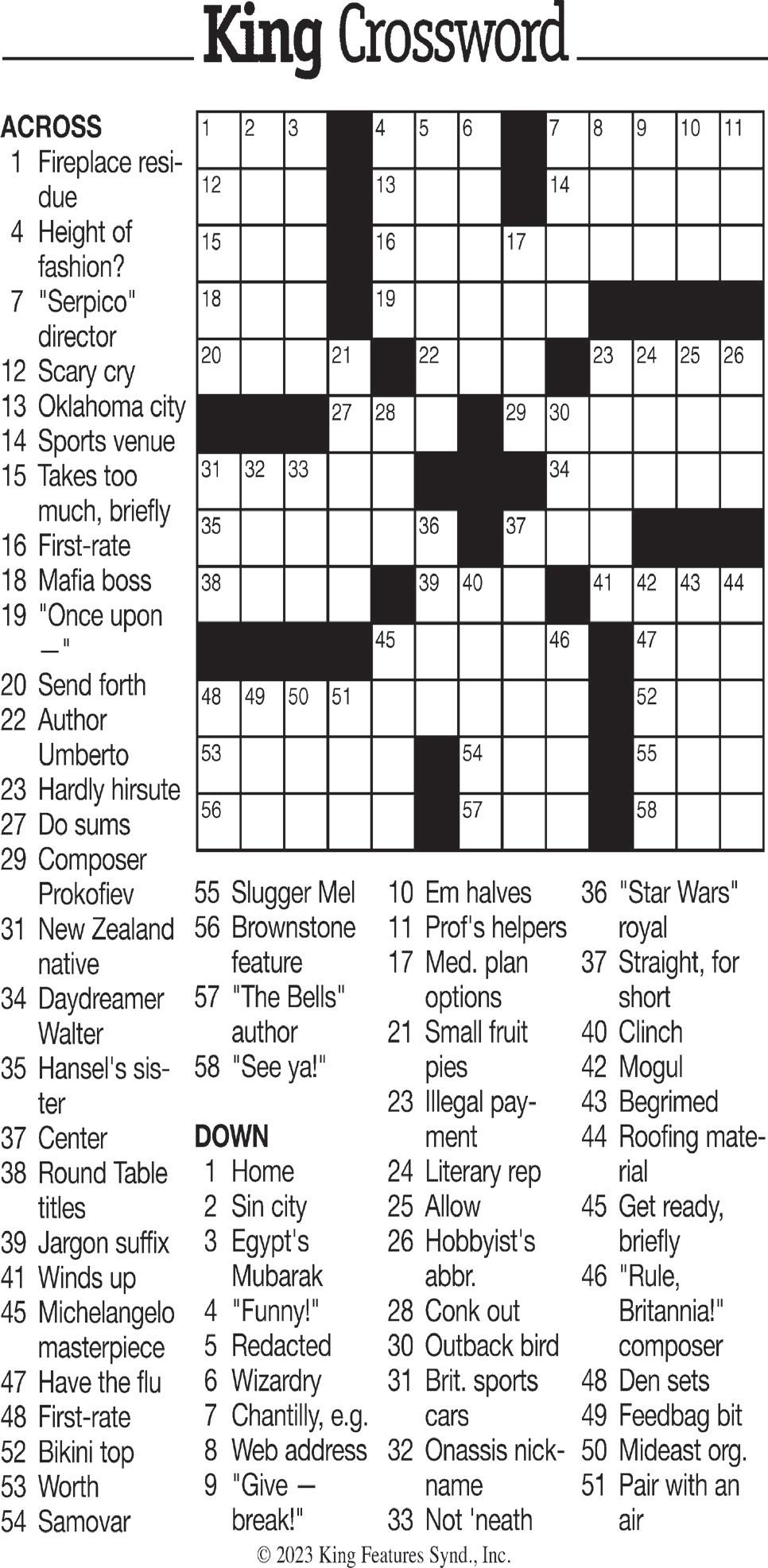
BEST SATELLITE TV with 2 Year Price Guarantee! $59.99/mo with 190 channels and 3 months free premium movie channels! Free next day installation! Call 888-508-5313
Painting
OLD SALT PAINTING Small Job Specialist Great Rates, Free Estimates 516-312-9643
Power Washing
POWERWASHING ALL SURFACES: Houses, Fences, Concrete/ Brick, Decks/Sealing. . ANTHONY & J HOME IMPROVEMENT, INC. 516-678-6641
Tree Services
T&M GREENCARE TREE SERVICE
*Tree Removal *Stump Grinding *Pruning *Roof Line Clearing. Residential and Commercial. "We Beat All Competitors' Rates." Lowest Rates. *Senior Discount. Free Estimates. *516-223-4525, 631-586-3800 www.tmgreencare.com
Satellite/TV Equipment
DIRECTV. NEW 2-YEAR Price Guarantee. The most live MLB games this season, 200+ channels and over 45,000 on-demand titles. $84.99/mo for 24 months with CHOICE Package. Some restrictions apply. Call DIRECTV 1-888-534-6918
Sprinkler Syst./Irrig.Wells
Satellite/TV Equipment

DISH TV $64.99 For 190 Channels + $14.95 High Speed Internet. Free Installation, Smart HD DVR Included, Free Voice Remote. Some restrictions apply. Promo Expires 1/31/24. 1-866-595-6967
PROFESSIONAL SERVICES
Education
COMPUTER & IT TRAINING PROGRAM!
Train ONLINE to get the skills to become a Computer & Help Desk Professional now! Grants and Scholarships available for certain programs for qualified applicants. Call CTI for details! 844-947-0192 (M-F 8am-6pm ET). Computer with internet is required.
TRAIN ONLINE TO DO MEDICAL BILL-
ING! Become a Medical Office Professional online at CTI! Get Trained, Certified & ready to work in months! Call 855-543-6440. (M-F 8am-6pm ET). Computer with internet is required
Health & Fitness
VIAGRA AND CIALIS USERS! 50 Pills SPECIAL $99.00 FREE Shipping! 100% guaranteed. CALL NOW! 855-413-9574
AUTOMOBILE & MARINE
Autos For Sale
LEXUS, LS430, 2002: 107,533 Miles, Excellent Condition, Automatic, Green Grey, Leather Seats, Well Maintained, Dealer Serviced,
June 29, 2023 — UNIONDALE HERALD BEACON 20 H4 06/29
Lic./Ins.
& S
Free Estimates C
DECKS
Garage Kept, New Michelin Tires, $10,000. Motivated 516-760-0468 Autos For Sale MAZDA MIATA 2015 Club Edition, Silver Black Interior, 17,000 Miles, Perfect Condition. If Looking for a Miata, This is a good One To Buy. $23,800 917-273-3737 Autos Wanted ***AAA*** AUTO BUYERS $Highest$ Ca$h Paid$. All Years/ Conditions! WE VISIT YOU! Or Donate, Tax Deduct + Ca$h. DMV ID#1303199. Call LUKE 516VAN-CARS. 516-297-2277 DRIVE OUT BREAST Cancer: Donate a car today! The benefits of donating your car or boat: Fast Free Pickup - 24hr Response Tax Deduction - Easy To Do! Call 24/7: 855-905-4755 Junk Cars Wanted HIGHEST CA$H PAID All Cars Bought 24/7 FREE Pickup Serving Nassau County 41 Years No Title, No Keys=No Problem ID Required. CALL US LAST! Call us at 516-766-0000 Boats & Accessories 1987, 28F CARVER: Sleeps Five, Flying Bridge, Low Hours, All Rebuilt, Fresh Water Cooled, Above Par. Must Be Seen! $15K, Details Owner 718-503-8337, BtYd 516-764-3300 HErald Crossword Puzzle Stuff HERALD To place an ad call 516-569-4000 press 5 • To place an ad call 516-569-4000 press 5 • To place an ad call 516-569-4000 press 5 Answers to todAy’s puzzle 28th ANNUAL July 20- 29, 2023 stonybrookfilmfestival.com 1215946 1220936 1208972 • SYSTEM TURN-ONS • Installations/Renovations • Service • Repairs Certified Backflow Tester Joe Barbato 516-826-7700 Free Estimates Licensed and Insured
Mr. Trump meets Lady Justice
The political news these days is dominated by two names, Biden and Trump. Because of his many criminal entanglements, Donald Trump wins the prize for the most coverage. But there are other names that are unfamiliar to many readers, and their stories may help clarify your thinking about the issue of mishandling classified documents.
Retired Air Force Lt. Col. Robert Birchum recently made the news when he was sentenced to three years in prison for storing classified documents at various locations. A 30-year veteran of the Air Force, Birchum entered into a plea agreement, under which he admitted to having kept documents labeled “top secret,” “secret” or “confidential.”
Birchum admitted that he had knowingly removed over 300 documents from his office and stowed them in his overseas officer’s headquarters, at his home and in a storage pod in his driveway. More than 30 of those files were marked “top secret,” the highest level of classification.
A thumb drive contained 135 files marked as “classified,” and a hard drive
had 10 files that contained information marked as “secret.” Birchum had a spotless record during his decades of military service, which made the sentencing that much harder for the average citizen to comprehend.
Another new name in the news was Nghia Pho, a former software developer at the National Security Agency. Pho took troves of highly classified information out of a secure location and kept them at home. As reported two weeks ago by the HuffPost’s Jennifer Bendery, Pho, a Vietnamese immigrant who was working on his English, said he was falling behind his peers in promotions and wanted to catch up on work at home.
Pho received a five-and-a-half-year sentence in federal prison for trying to keep pace with his fellow workers. What was most significant was the reaction of the NSA director, Navy Adm. Michael Rodgers. Rodgers, an appointee of President Obama, was kept on in his job by President Trump until his retirement.
In a harsh three-page letter to U.S. District Court Judge George Russell III, Rodgers wrote, “While criminal conduct involving matters of national security may come in different forms and some of the harms may not be immediately appar-
ent, the retention of classified information is no less damaging to the national security of our country and our ability to protect and defend the Nation against our adversaries.”
Rodgers concluded his letter, Bendery wrote, by calling Pho’s actions “a breach of trust” and indirectly telling the judge to prove he stands with the intelligence community with his sentencing.
“Affirmation by this court of the cost to the women and men who have dedicated their lives to public service and who have maintained trusted stewardship of national defense information will send them a message of confidence and respect.”
The stories of Birchum and Pho are just two of many that are popping up in the news these days. Birchum apparently decided he should be the custodian of sensitive documents, and Pho did something genuinely stupid. This brings us to the case of Trump, who stands accused of obstruction of justice and violations of the Espionage Act.
The Trump accusations are so bewildering. Why didn’t he just turn over all of the classified documents that were requested when he was served with a subpoena? Why did he allegedly stonewall
the prosecutors and lie about having any such papers in his possession? Why did he tell his counsel to deny having any additional sensitive papers at his Mar-aLago home?
Trump’s defenders have rushed to protect him by accusing the FBI and the Justice Department of “weaponizing” their powers against a political opponent. But Trump is no different from Birchum or Pho when it comes to the issue of holding onto documents that could aid our enemies.
Does being a former president exempt you from the same day in court that Birchum and Pho got? Add the name of recently arrested Air National Guardsman Jack Teixeira to the roster of those who have been charged with the possession of secret documents.
Of course, Trump is entitled to a presumption of innocence. He will have his chance to tell his story, if he testifies in front of a jury. What is mystifying is why he finds himself in this position at all. And if found guilty, why should he be treated differently than Birchum and Pho?
Jerry Kremer was an Assemblyman for 23 years, and chaired the Assembly’s Ways and Means Committee for 12 years. He now heads Empire Government Strategies, a business development and legislative strategy firm. Comments about this column? jkremer@liherald.com.

Where’s Granny? Living in the backyard bin.
You may think this doesn’t have relevance for you, but you’re wrong, my friend. You may be 40 years old, running 7-minute miles and sprinting up the corporate ladder, but believe me, you need to focus on your old age — now. In fact, the only way you won’t have to plan for your dotage is if you die before you become decrepit, not an entirely awful option.
most relevant issue in your life, if it isn’t already.
RANDI KREISS

The new rage around the country is a concept for housing, or more accurately, storing our elderly. Several companies are selling what they call MedCottages or Granny Pods, prefabricated guest houses — glorified hospital rooms — that can be plunked down right in a willing child’s backyard.
The standard is 12 feet by 24 feet, and runs $39,000 and up. Sounds pricey, but it’s cheap when you consider the cost of assisted living or skilled nursing care. I know you don’t want to think about this stuff, but I insist, because the chances are 100 percent that this will become the
These pods hook up to local sewage and power lines. They have “virtual” caregivers that remind you over a speaker to “take your meds” or it’s “time for lunch.” The toilets can read body temperature. Floorboards are lighted. The living room has its own defibrillator, and a monitoring system communicates the elder’s activities to a security service. Of course, you can’t sneak a puff, or a sip or anything else fun because Big Brother is watching. Next step, I suppose they could dig a giant hold in the backyard, put a board over it, install the Granny Pod on the wooden foundation and when the elders pass on, just drop that baby into the ground. Dust to dust.
According to the American Association of Retired People, there is little planning in place to deal with the explosion of super-old people coming down the pike — some 70 million by 2030.
I’m sitting at ground zero in this generational squeeze. My parents live on their own, with helpers, in Florida. My sister and I go back and forth as often as
we can, which isn’t close to often enough. Of all the things I anticipated worrying about in my 60s, elder care never crossed my mind. Now it’s a daily, consuming and pressing concern.
So, a Granny Pod for Mom and Dad? They actually might go for it, but it doesn’t touch the real concerns. My mother is lonely because my dad sleeps all day. Her friends are gone. What she wants is for us to be there, basically, all the time. Not unreasonable for her, but problematic for us.
Let’s consider the idea of my folks living in my backyard. I could pop in and say hello several times a day. That would be nice. But they would still need helpers every day. Someone would still have to monitor all the meds and devices and the cleaning and meals and TV repair and appliance maintenance and visits to doctors and outings to the rest of the world and finding the missing hearing aids, canes and glasses.
And when the sprinklers went off, it would be a bitch.
A pod in a backyard could work in some situations, perhaps for all the millennial kids who are reportedly moving
Randi is on a brief leave. This column was originally published June 2-8, 2016.
home to Mom and Dad. But for the frail elderly with no connections to the community, it would be tantamount to climate-controlled storage.
Jumping ahead to my own future elder years, a pod is out of the question for my hubby and me. First, my son’s backyard is a canal in Florida, and my daughter’s is a mountain in the Sierra Nevada. Second, if you put my husband and me in a 12-by-24 space to live out our days, those days would be numbered.
No one in government is dealing with the tsunami of elderly coming our way. That leaves each of us to deal the best we can, which is woefully insufficient. We need communal, political and financial assistance to make life livable for our very old — and for the people caring for them. But a backyard pod?
When my daughter was little, she said she wanted to live in our backyard when she grew up. The wish may get turned around if I decide someday to permanently drop in on her.
Copyright 2023 Randi Kreiss. Randi can be reached at randik3@aol.com.
21 UNIONDALE HERALD BEACON — June 29, 2023
Several companies are selling what they call MedCottages or Granny Pods.
opINIoNS
The charges against him are bewildering. Why didn’t he just turn over the documents?
JERRY KREMER
In Congress, July 4, 1776
The Declaration of Independence was first published on July 6, 1776, in a newspaper, the Pennsylvania Evening Post. We are proud to commemorate that high point in American journalism by reprinting that historic document.
When in the Course of human events, it becomes necessary for one people to dissolve the political bands which have connected them with another, and to assume among the Powers of the earth, the separate and equal station to which the Laws of Nature and of Nature’s God entitle them, a decent respect to the opinions of mankind requires that they should declare the causes which impel them to the separation.
We hold these truths to be self-evident, that all men are created equal, that they are endowed by their Creator with certain unalienable Rights, that among these are Life, Liberty and the pursuit of Happiness. That to secure these rights, Governments are instituted among Men, deriving their just powers from the consent of the governed. That whenever any Form of Government becomes destructive of these ends, it is the Right of the People to alter or to abolish it, and to institute new Government, laying its foundation on such principles and organizing its powers in such form, as to them shall seem most likely to effect their Safety and Happiness. Prudence, indeed, will dictate that governments long established should not be changed for light and transient causes; and accordingly all experience hath shown, that mankind are more disposed to suffer, while evils are sufferable, than to right themselves by abolishing the forms to which they are accustomed. But when a long train of abuses and usurpations, pursuing invariably the same Object evinces a design to reduce them under absolute Despotism, it is their right, it is their duty, to throw off such Government, and to provide new Guards for their future security. Such has been the patient sufferance of these Colonies; and such is now the necessity which constrains them to alter their former Systems of Government. The history of the present King of Great Britain is a history of repeated injuries and usurpations, all having in direct object the establishment of an absolute Tyranny over these States. To prove this, let Facts be submitted to a candid world.
He has refused his Assent to Laws, the most wholesome and necessary for the public good.
He has forbidden his Governors to pass Laws of immediate and pressing importance, unless suspended in their operation till his Assent should be obtained; and when so suspended, he has utterly neglected to attend to them.
He has refused to pass other Laws for the accommodation of large districts of people, unless those people would relinquish the right of Representation in the Legislature, a right inestimable to them and formidable to tyrants only.
He has called together legislative bodies at
places unusual, uncomfortable, and distant from the depository of their Public Records, for the sole purpose of fatiguing them into compliance with his measures.
He has dissolved Representative Houses repeatedly, for opposing with manly firmness of his invasions on the rights of the people.
He has refused for a long time, after such dissolutions, to cause others to be elected, whereby the Legislative Powers, incapable of Annihilation, have returned to the People at large for their exercise; the State remaining in the mean time exposed to all the dangers of invasion from without, and convulsions within.
He has endeavoured to prevent the population of these States; for that purpose obstructing the Laws of Naturalization of Foreigners; refusing to pass others to encourage their migrations hither, and raising the conditions of new Appropriations of Lands.
He has obstructed the Administration of Justice by refusing his Assent to Laws for establishing Judiciary Powers.
He has made Judges dependent on his Will alone, for the tenure of their offices, and the amount and payment of their salaries.
He has erected a multitude of New Offices, and sent hither swarms of Officers to harass our people, and eat out their substance.
He has kept among us, in times of peace, Standing Armies without the Consent of our legislature.
He has affected to render the Military independent of and superior to the Civil Power.
He has combined with others to subject us to a jurisdiction foreign to our constitution, and unacknowledged by our laws; giving his Assent to their acts of pretended legislation:
For quartering large bodies of armed troops among us:
For protecting them, by a mock Trial, from Punishment for any Murders which they should commit on the Inhabitants of these States:
For cutting off our Trade with all parts of the world:
For imposing taxes on us without our consent:
For depriving us in many cases, of the benefits of Trial by Jury:
For transporting us beyond Seas to be tried for pretended offences:
For abolishing the free System of English Laws in a neighbouring Province, establishing therein an Arbitrary government, and enlarging its Boundaries so as to render it at once an example and fit instrument for introducing the same absolute rule into these Colonies:
For taking away our Charters, abolishing our most valuable Laws, and altering fundamentally the forms of our Government:
For suspending our own legislature, and declaring themselves invested with Power to legislate for us in all cases whatsoever.
He has abdicated Government here, by declaring us out of his Protection and waging War against us.
He has plundered our seas, ravaged our Coasts, burnt our towns, and destroyed the lives of our people.
He is at this time transporting large armies of foreign mercenaries to compleat the works of death, desolation and tyranny, already begun with circumstances of Cruelty & perfidy scarcely paralleled in the most barbarous ages, and totally unworthy of the Head of a civilized nation.
He has constrained our fellow Citizens taken Captive on the high Seas to bear Arms against their Country, to become the executioners of their friends and Brethren, or to fall themselves by their Hands.
He has excited domestic insurrections amongst us, and has endeavoured to bring on the inhabitants of our frontiers, the merciless Indian Savages, whose known rule of warfare, is an undistinguished destruction of all ages, sexes and conditions.
In every stage of these Oppressions We have Petitioned for Redress in the most humble terms: Our repeated Petitions have been answered only by repeated injury. A prince, whose character is thus marked by every act which may define a Tyrant, is unfit to be the ruler of a free People.
Nor have We been wanting in attention to our British brethren. We have warned them from time to time of attempts by their legislature to extend an unwarrantable jurisdiction over us. We have reminded them of the circumstances of our emigration and settlement here. We have appealed to their native justice and magnanimity, and we have conjured them by the ties of our common kindred to disavow these usurpations, which would inevitably interrupt our connections and correspondence. They too have been deaf to the voice of justice and of consanguinity. We must, therefore, acquiesce in the necessity, which denounces our Separation, and hold them, as we hold the rest of mankind, Enemies in War, in Peace Friends.
We, therefore, the representatives of the United States of America, in General Congress, Assembled, appealing to the Supreme Judge of the world for the rectitude of our intentions, do, in the Name, and by Authority of the good People of these Colonies, solemnly publish and declare, That these United Colonies are, and of Right ought to be Free and Independent States; that they are absolved from all Allegiance to the British Crown, and that all political connection between them and the state of Great Britain, is and ought to be totally dissolved; and that as Free and Independent States, they have full Power to levy War, conclude Peace, contract Alliances, establish Commerce, and to do all other Acts and Things which Independent States may of right do. And for the support of this Declaration, with a firm reliance on the Protection of Divine Providence, we mutually pledge to each other our Lives, our Fortunes and our Sacred Honor.
The Declaration was signed first by John Hancock, president of the Continental Congress, and then by 55 others representing the 13 original states.
June 29, 2023 — UNIONDALE HERALD BEACON 22 UNIONDALE HERALD BEACON Office Established 2023 Incorporating The Uniondale Beacon The East Meadow Beacon Reine Bethany Editor BRandOn cRuz Reporter nicOle Welch Multi Media Marketing Consultant 2 Endo Boulevard Garden City, NY 11530 Phone: (516) 569-4000 Fax: (516) 569-4942 Web: www.liherald.com E-mail: beaconnews@liherald.com Copyright © 2023 Richner Communications, Inc.
COMMUNITY NEWSPAPERS Cliff Richner Publisher, 1982-2018 Robert Richner Edith Richner Publishers, 1964-1987 ■ StuaRt RichneR Publisher ■ JiM ROtche General Manager ■ Michael hinMan Executive Editor JeffRey BeSSen Deputy Editor JiM haRMOn Copy Editor KaRen BlOOM Features/Special Sections Editor tOny BelliSSiMO Sports Editor tiM BaKeR Photo Editor ■ RhOnda GlicKMan Vice President - Sales aMy aMatO Executive Director of Corporate Relations and Events lORi BeRGeR Sales Director ellen ReynOldS Classified / Inside Sales Director ■ JeffRey neGRin Creative Director cRaiG White Art Director cRaiG caRdOne Production Coordinator ■ dianne RaMdaSS Circulation Director ■ heRald cOMMunity neWSPaPeRS Baldwin Herald Bellmore Herald East Meadow Herald Franklin Square/Elmont Herald Freeport Herald Glen Cove Herald Hempstead Beacon Long Beach Herald Lynbrook/East Rockaway Herald Malverne/West Hempstead Herald Merrick Herald Nassau Herald Oceanside/Island Park Herald Oyster Bay Herald Rockaway Journal Rockville Centre Herald Sea Cliff/Glen Head Herald Seaford Herald South Shore Record Uniondale Herald Beacon Valley Stream Herald Wantagh Herald MeMBeR: Americas Newspapers Local Media Association New York Press Association Published by Richner communications, inc. 2 Endo Blvd. Garden City, NY 11530 (516) 569-4000
HERALD
Man up? Sure, let me ask for help
I’ve struggled with depression and anxiety my whole life. That’s not an easy thing to admit, especially publicly. But mental health awareness isn’t what it used to be, thankfully. The stigma has been largely diminished. So, in honor of guys pushing off asking for help or pretending we’ll do it tomorrow, I’m offering a belated note for Men’s Health Month and Men’s Mental Health Month, both in June. Yes, June’s just about over, but as my mom and wife often say, if you want to hear about the plan, ask a man. If you want it done, ask a woman.
I grew up with a core group of friends, and as we aged, we got better at talking to one another about things that were bothering us. We made plenty of jokes, and helped each other through tragedy and defeat.
At a friend’s wedding earlier this month, I was reminded, by being with my old friends, that even though we’re a bit grayer and see one another less and less, our friendships remain strong. We retold inside jokes, bragged about our kids, and laughed all night.
These are men and women I’ve known for 40 years or more. We grew up together, and shared the same experiences as kids in the same hometown. We celebrated one another’s successes and commiserated about one another’s failures as we navigated adolescence and then early adulthood.
But even with my closest friends, I have never completely surrendered my male ego and asked for help, or explained a mental health problem. Sure, I’d say that I was struggling or hurting, and they would help me. Those cathartic admissions were helpful, but not regenerative.
My oldest son, now a 26-year-old police officer, told me that he recently sought mental health help through his job. He said he had felt apprehensive on a few recent patrol calls.
That’s never happened. He’s always been a tough dude — we took him to the emergency room twice in one day for different injuries when he was 9. He likened his recent unease to a case of the yips — a baseball player’s sudden and inexplicable inability to make routine throws accurately.
I was relieved to hear he had the fortitude to seek professional help. Several friends on the job told him they regular-
Letters
Why are we charged twice for using a credit card?
To the Editor:
I cannot be the only one upset by this new trend of being charged for using a credit card. It started with two different prices for gas. That has now moved to restaurants (including fast food), the service industry (haircuts), car dealerships, doctor’s offices and even religious institutions.
And the charges aren’t consistent: 3 percent here, 3.5 percent there. And who knows if these percentages are accurate? Maybe the actual charges are less, and they’re just padding their profits?
We pay to have a credit card, and we pay to use a credit card.
My wife and I go out for a nice dinner once a week with friends. This would include having a glass of wine with dinner. Well, I will refrain from ordering alcohol from restaurants. Alcohol has a very large profit margin. Would a restaurants rather sell four glasses of wine for $40 or charge the 3.5 percent credit card
surcharge?
If enough people start doing this, will restaurants stop passing the credit card processing fees on to patrons? Maybe, maybe not, but it will send a message that we’re tired of being nickeled and dimed for just about everything. Truth be told, all they have to do is raise prices by 25 cents and no one would know the difference.
What’s next? Food costs have skyrocketed since the pandemic. Going to the supermarket is quite expensive. Do people feel safe carrying a lot of cash around? I can foresee the day when supermarkets will be adding the credit card fee.
I have written to our senators, Kirsten Gillibrand and Chuck Schumer. You know what their response was? Crickets. Nothing.
Shouldn’t there be some legislation against this practice? It is a double charge to pay to have a credit card and to pay to use a credit card. But our elected officials choose to ignore this, and let their constituents bear the brunt of it. As usual.
JEFF COHEN Wantagh
ly go to a therapist to talk about job stresses and issues. As a dad, that made me happy that he is mature and strong enough to ask for mental help before an issue corroded into something larger.
For 11 years as a high school English teacher, I took advantage of our social workers by frequently bringing students with issues into their office for help. I was amazed at how comfortable adolescents had become with expressing their feelings and reaching out for help, without making a big deal of it.
These things weren’t talked about when I was in school, and certainly not among friends. Anger was the closest thing to an emotion that a boy could express in front of a group of fellow 10-year-olds.
It’s remarkable that mental health awareness and acceptance has come so far in a few decades. But men remain trapped by clichés of manliness and the stigma of admitting any mental health issue, however brief. We’re supposed to soldier through it, man up, tough it out. There is strength in learning to deal with adversity through perseverance, and there is also astuteness in knowing when something could be wrong and seeking professional help. Cognitively
dissonant, we put our heads down and plow through a hardship, but that childish reaction often fails and exacerbates a problem.
Men are generally less likely than women to ask for help for depression or stressful life events. Men downplay symptoms and pretend they’re OK.
According to Mental Health America, more than 6 million American men suffer from depression. Male suicides have increased since 2000.
There are ample places to get more information online. Here are two: MentalHealthAmerica.net and MensHealthNetwork.org.
The biggest step is asking for help.
My dad often said that he made a point of saying “I love you” to my brothers and me, because he didn’t remember his own father ever saying it to him. I smile when I hear my kids say that to each other. Seems pretty normal nowadays, but it wasn’t when my dad was a kid.
I love my kids, and I’m proud my oldest son is seeking mental health help. His actions put the lie to the false narrative that tough guys don’t need help. More men need to follow his example.
Mark Nolan, the editor of the Lynbrook/ East Rockaway and Malverne/West Hempstead Heralds, taught high school English for 11 years. Comments? mnolan@liherald.com.
 Framework by Evan Mattioli
23 UNIONDALE HERALD BEACON — June 29, 2023
At the New England Aquarium — Boston
opInIons
mental health awareness has come a long way in a few decades.
mark noLan Comments about our stories? Send a letter to the editor to execeditor@liherald.com.
One of the best. Once again. Right here in Oceanside.
High Performing in Nine Areas of Care
June 29, 2023 — UNIONDALE HERALD BEACON 24
mountsinai.org/southnassau 1202472
